Tooth and Claw

The 1942 Disney classic Bambi really ought to have been a PG. It might well have been by its own standards if it were released today. It’s dark, there’s more than one traumatic death (one only just off-screen) and some of the music is even more anxiety-inducing than the Jaws theme, which it may well have inspired. Man, the ever-present danger and the film’s primary antagonist, was justifiably placed at number 20 on AFI’s list of the greatest movie villains of all time, ranking higher than all but one of all the animated villains ever created – and we never even see him.

But I’m not going to talk about Man. We know our own capacity for wickedness. I’d rather muse over the one aspect of that movie that used to genuinely terrify me as a child.

I’m talking, of course, about the dogs.

From the moment the music cuts out and the barking starts, it’s a solid couple of minutes of pure terror. The artists could hardly have drawn them to be more terrifying, with shining white teeth and cruel, heartless eyes of featureless white or soulless black. The constant baying of the hunting pack stays in your head years later, drawing near like drums whenever you hear the soundtrack – and it’s not a mile away from the reality either. I remember hearing a hunting horn sound in the countryside somewhere in the south of France when I was younger and the distant thunder of a pack of dogs on the scent. It’s a sound lost to England many years ago, but one you still might come across if you travel around the quieter corners of Europe.

That chase sequence in Bambi has stuck with me for years. It’s not an outright vilification of hunting, but it is an awesome depiction of unbound savagery from a darker time in our past, before hunting regulation and wildlife protection laws were brought into force. We never see the film’s primary villain, but his capacity for monstrous carnage is more than evident in the beasts he has created, the beasts of our own making.

It’s only recently that I’ve started to take an interest in dogs. It’s possible that Bambi put me off them early on. Or the ones from the horror-show that is the 1954 animated film Animal Farm. Or the dog from Manor Farm in 1978’s Watership Down (there were some horrific portrayals of man’s best friend in 20th century children’s movies). Or maybe it’s just because I’ve spent the last twenty-eight years of my life living with cats that I’ve naturally picked the opposing team. Regardless, the tide, if not turning exactly, is beginning to even out.
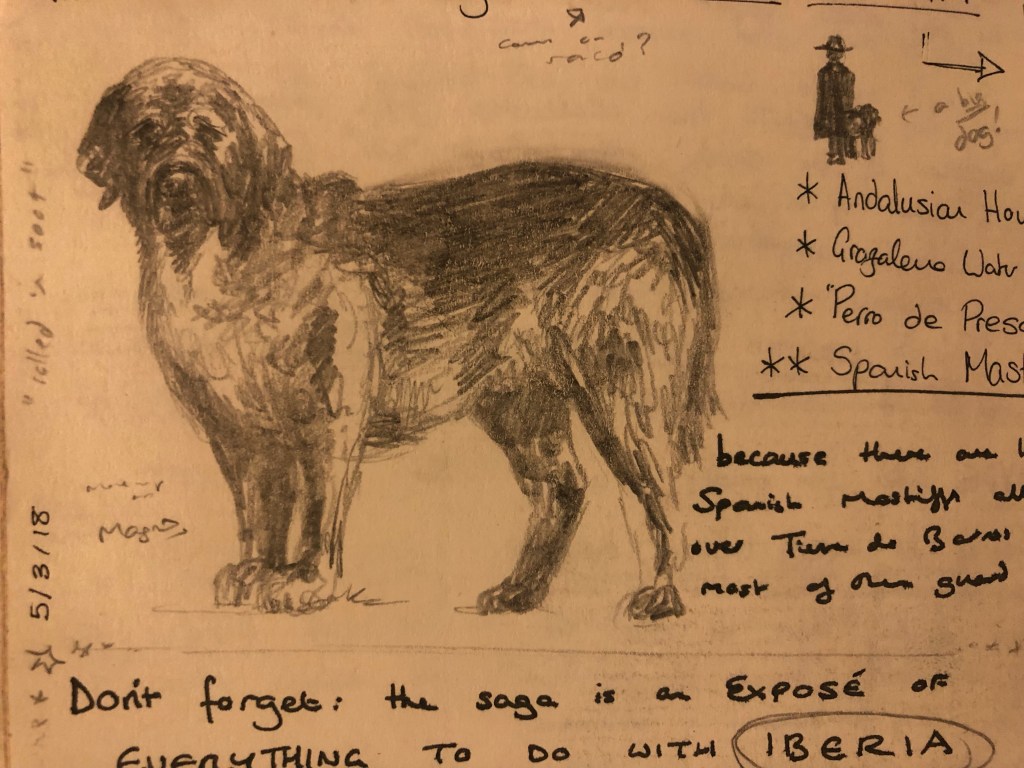
El mastin español – guardian of the Tierra de Barros

When I lived in Extremadura, I remember finding some of the largest dogs I’ve ever seen out in the countryside, lazing about in the shadows within fenced enclosures and barking at anything and anyone that came near. Not just any bark, either, but a terrible, three-throated bellow that you can hear from a great distance, the kind you might expect from Cerberus. I’m talking about the Spanish Mastiff, an impressive breed once used by the shepherds of La Mesta, Spain’s ancient “wool mafia”, as a guard dog for their valuable Merino sheep. A working dog bred for its size and strength, it’s not hard to imagine this beast in action against the wolves and bears that once roamed the forests of Iberia. They were popular combatants in bear-baiting, a sport which was just as popular in parts of Spain as it was in medieval England, to the detriment of the country’s bear population. Dog after dog would have been sent against the great beasts until they could fight no longer.

These days, of course, there are probably more mastiffs in Spain than there are wolves and bears put together, and the giant bear-killers look like old soldiers gone to seed in their enclosures under the Spanish sun. There was only one victor in their fight against the country’s predators, and it wasn’t the vanishing wolves, the ghost-like bears or even the mastiff, chained to its post in the quiet Spanish countryside. It’s quite sad, when you think about it.
It wasn’t only the wild beasts of Spain’s interior that the mastiff was trained to fight. There are plenty of stories of the use of perros de guerra in the Spanish conquest of Mexico. Given the diminutive size of the dogs native to the Americas upon the Spanish arrival (see the xolo dog for an example), it’s hardly surprising the Spanish saw fit to use their monstrous dogs as additional leverage in their fight for the American interior. Becerrillo, a war dog owned by the conquistador Juan Ponce de León, is the most famous example. Whether it was the mastiff, the alano or even the greyhound the Spanish employed, the results speak for themselves, and monstrous armoured dogs appear in a number of contemporary recollections of the conquest – there’s an especially telling (and graphic) depiction in the Coyoacan Codex. Whether you choose to believe all the details of the so-called “black legend” concerning Spain’s atrocities in the New World, there’s no denying the awesome power of these war dogs if you ever encounter one in the Spanish countryside.
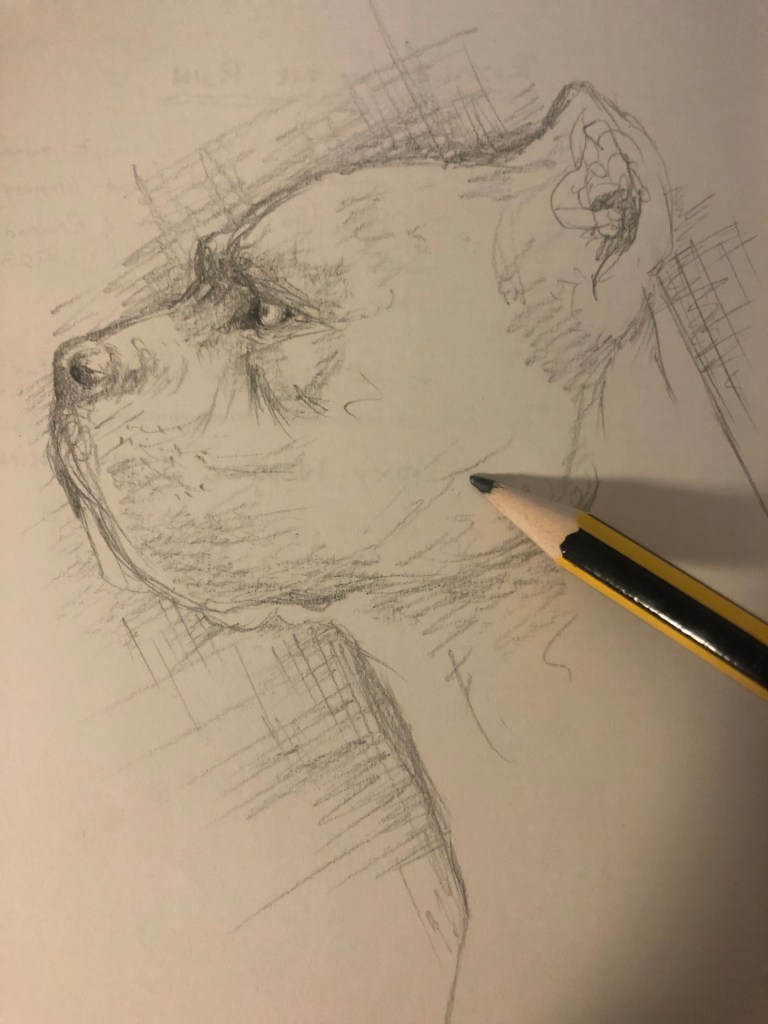
A quick sketch of a Spanish alano, scribbled into the journal between Church and tutor today

Naturally, I’ve written one into my book, as a faithful companion to my leading lady. It’s not as simple as you’d think, writing a dog breed into a book, as by its very nature, dog-breeding is an ever-changing world. Many of the dogs we know today have only been around for a few hundred years or so. The Spanish mastiff we know today is already a very different animal to the kind used at the start of the twentieth century: the original mastiff was still a sturdy, powerfully-built working dog, but not at all like the lumbering giant you see around the Spanish countryside today.

Other dogs that were more familiar to our ancestors have long since disappeared: the stocky Old English bulldogs bred for the sport of bull-baiting, long-since replaced by the squat, hyperbrachycephalic creatures we know today; the alaunt, the rache and the Talbot hound, the mainstays of medieval nobles and huntsmen; and, of course, the mighty Molossus, the ancient war dog of the Greeks and Romans. In our endless desire to bend nature to our will – bigger, smaller, stronger, more obedient, less intelligent – we have warped our old enemy, the wolf, into an absurd array of shapes and sizes. It’s a testament to man’s ingenuity that, long ago, we were able to turn our most hated rival into our best friend, but my word, did we do some terrible things to him along the way. I wonder what a wolf thinks when it crosses paths with a pug or a dachshund. Is there a flicker of recognition, do you think, or have thousands of years of man’s meddling twisted their kin into shapes they cannot begin to understand as one of their own?
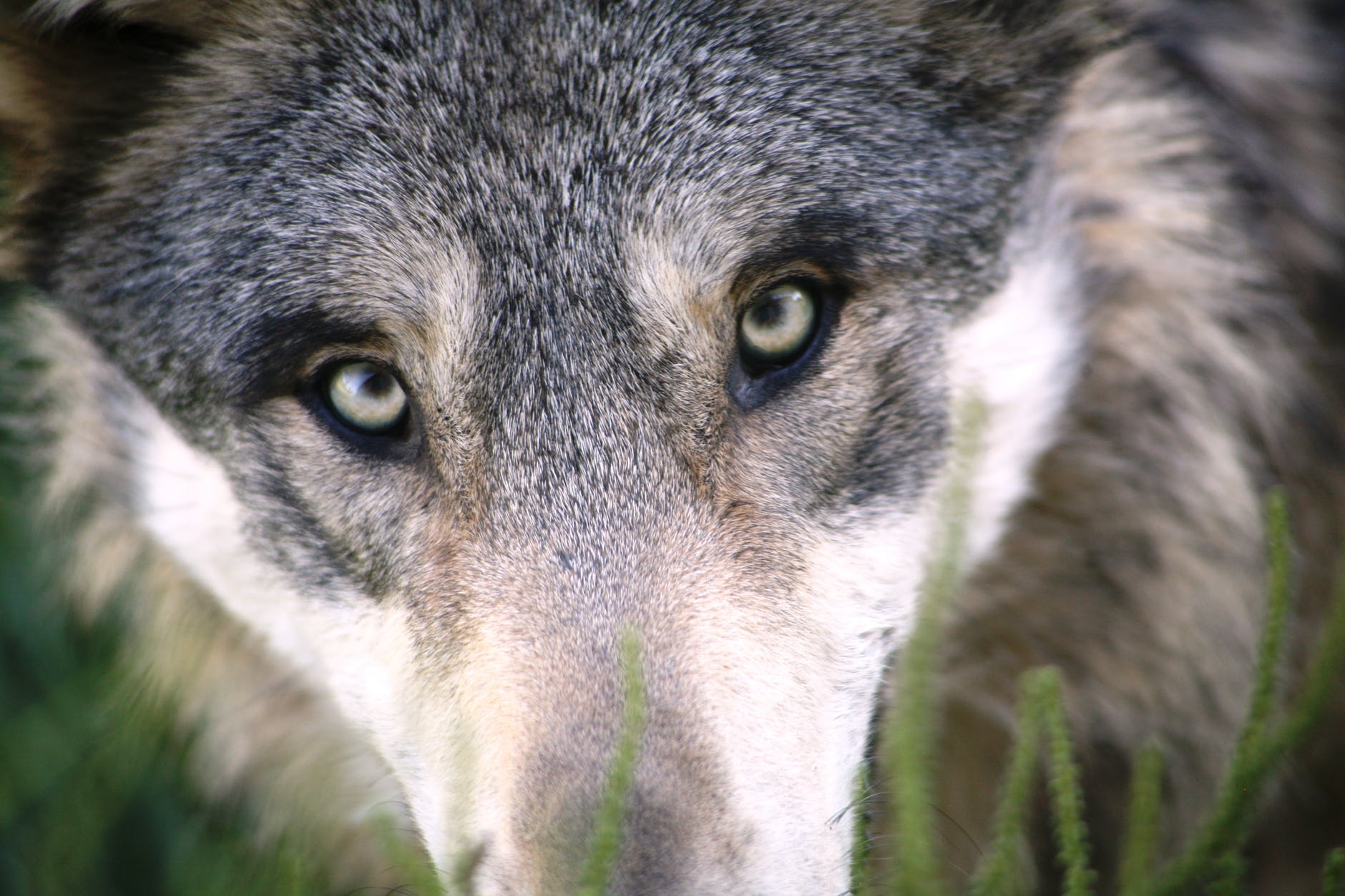
Photo by Brenda Timmermans on Pexels.com

I’d really like to track wolves in the wild someday. I’ve heard that one of the better places to do that in Europe is in the wild Abruzzo region of central Italy. I don’t think I’ll manage it this time – as you might expect from one of Italy’s last refuges for the symbol of Rome, it’s not exactly a hop, skip and a jump on public transport. But if years of nature-watching has taught me anything, it’s patience, and I can wait for an experience like that. Spain’s Sierra de la Culebra is also supposed to be a good place to search for wolves, and when last I heard from the place, a pack had been seen in Extremadura, though memory fails me as to where.
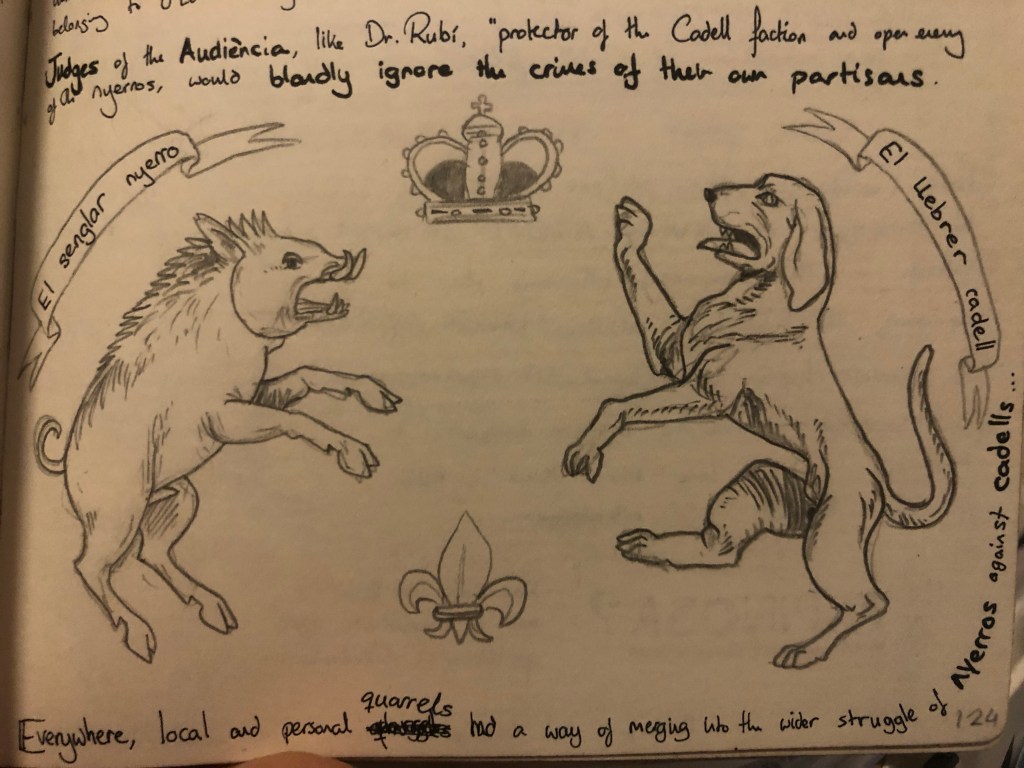
The llebrer (R), symbol of one of Catalunya’s most notorious 17th century gangs, the Cadells

In the meantime, I will read up some more on Spain’s dogs, if only for the sake of my novel. If there’s a place for the loyal mastiff, I’m sure I can find a space for something like the nightmare fuel from Bambi, too. BB x
Exile

I’ve deliberately waited to pen this one. Being both out of the country and out of WiFi meant that I didn’t get the news until I got to class this morning, by which point I’d already forgotten yesterday’s referendum buzz. I had more important things on my mind, like how many men were really killed at Covadonga, and what kind of a world would Spain have been had Navas de Tolosa gone the other way. Stuff like that.

Waiting has also meant that you’ve been spared the knee-jerk, bloody-hell-it’s-the-end-of-the-world-as-we-know-it attitude that I spent most of this morning suffering from. In fact I was so shocked by the news that I could hardly talk for the first twenty minutes or so of class. And whilst I was a little tongue-tied for the first two weeks, the last few days’ confidence boom has brought out the chatterbox in me, and therefore it felt quite odd being left with suddenly nothing to say.

I’m talking, of course, about Brexit. About my country’s decision to ignore sanity, common sense and all basic human emotions besides fear and to rally behind some of the most sinister British politicians in living memory.

It smacks of Weimar. It smacks of Trump. It smacks of the start of pretty much every slow run-up to fascist mind-control. I’m not going to start spouting nonsense about the end of the world – it’s really not – but it was a knock I was certainly not expecting this morning. 

And that’s the strangest thing of all. I simply never saw it coming. It always seemed so… laughable. Oh, I’d be the first to confess that I’ve barely looked into the consequences or the data. I got most of my updates from Have I Got News For You. In the end, if the truth be told, I simply let instinct and common sense decide my stance on the matter. Perhaps that makes me no better than anyone else. But if my Facebook page is anything to go by, the Brexit voter is a very rare beast indeed – at least, amongst my generation. I’m told it’s the fault of the older generation; they voted for Leave in their droves, apparently. Personally I have no idea. I have no grandparents, no great uncles or aunts, and therefore no contact with that generation whatsoever. I don’t have the foggiest how they live, or how they think. Therefore I refuse to buy into rumours or make claims about what I don’t know. If only some of my countrymen had done the same.

It still shocks me, though. How did it happen? It was just a joke, right? Everyone and their tabby cat was against it: Patrick Stewart, Alan Sugar, Ryanair, James Bond, David Attenborough, the Prime Minister… The list was endless. Who was supporting Leave? I mean, apart from Trump, Kim Jong Un and IS, who naturally all want what’s best for us, of course. I was baffled enough by the Trump campaign. How could a man faced with such a fierce backlash ever get to be the Republican candidate for the President of the United States? And yet he did. It was tempting to think ‘only in America’… and yet, here we are. Severed from the European Union by another silent majority who – if the rumours are true – won’t have to live with the results for even a breath of the time that we will. We, the generation who came out so strongly in defense of the Union… Ignored.

To say that it swayed my mind on moving abroad after university would be heresy. I’d already made that decision many months ago, and I’m proud to say that I made it out of love, not fear. My decision stands. Only, perhaps now there’s a sense of urgency, a feeling of Cortés landing in Mexico about it. My plans were laid, but somebody went and burned the boats. It may take all of ten years to obtain my Spanish citizenship, or – if that old Hispanic obsession with blood still stands – it may be less, but the way things are going, I’m bound for exile no matter what happens. BoJo and Farage and their silent worshippers have made it just that little bit harder now, as my road is now fraught with VISAs that had never been necessary before, but I won’t let that stop me. They can try, but they’re not treading on my dreams.

The way some of us Brits have reacted to this – myself included – you’d think that war had just been declared. That’s the worst part of it all: the fear. It’s fear that has got us in this state. Fear of what? The unknown? The migrant crisis? I would pay handsomely to send the average Leave supporter to one of the refugee camps in Jordan or Greece for a couple of months, if just to see if there really is a right answer. Familiarity: that’s the obvious solution. Once you know that which you’ve only seen and heard in the news, it’s suddenly a great deal more than a number on a piece of paper (Would Stalin have sent so many to their deaths if he’d had the chance to get to know them all?).

Of course, I’d go for the laughter route myself. Laugh at your fears, laugh at the world and especially laugh at yourself. I almost walked into the same lamppost twice today, and I had to count the hours between nine o’clock and twelve just to be sure there were three of them. And yes, I just did it again to confirm. Yours truly has some remarkably oafish tendencies. But I revel in my bouts of stupidity. It’s what made the Greek gods so much more interesting than the Abrahamic belief in perfection. None of us are perfect, nor ever could be. We’ve as much hope of being ‘perfect’ as a Jack Russell has of explaining quantum physics to a nursery group. But we try. And that’s kind of funny. We should laugh at that.

 J.K. Rowling had it down: laughter really is the best cure for fear, but familiarity is the next best thing.

Where am I going with this? I’ve literally just got home. My phone wouldn’t make the connection to my host family for some reason so I ended up sitting in the doorstep for an hour, as I’ve done in one way or another so often in my life. I’m quite used to it by now. Waiting is no bad thing. It gives you time to think, to muse, to watch the world go by. Life goes on. Britain may have decided to leave the European Union and we may or may not be headed for troubled times, but it’s business as usual in Tetouan.

I’ve been waiting my whole life in one way, shape or form: the right girl, the right moment, the right place, the right language. Patience: birdwatching taught me that. I can wait a little longer. One day, when of all of this fear and hostility has blown up and/or over, we’ll look back and have a good, long laugh. No matter how dark it gets. BB x

Beginning is the Hardest Thing

‘Business or pleasure, sir?’

‘Does language study count as business?’

‘Ah, I guess that’s a bit of both, then. Enjoy your stay, sir.’

I don’t think I’ve ever had a worse case of cold feet than I did last night. If I paint myself as a seasoned traveler, the reality couldn’t be more disappointing. I spent most of this morning flying about the house in a panic, weighing, re-weighing and rearranging my suitcase, adding and removing books, cursing and swearing about how little I actually know about what happens when I leave the airport at Tangier. Shameless.

For the record, I had cold feet before going to Spain last September. Not quite this bad, but I still had my doubts. I suppose knowing Sevilla and being very confident in my Spanish did help, but having a firm knowledge of where I’d be sleeping that night was an added bonus. Maybe it’s the fact that I’ve had precious little over forty-eight hours at home that had me unsettled, most of which I spent traveling anyway.

It could also be the fact that I’m striking out alone.

I’ve forgotten my little green Arabic grammar book. It’s not essential, but it would have been nice to have – like so many things in my life. Al-Kitaab will do.

On a similar note, I’ve a lot less baggage this time. 18 kilos of hold luggage and a much slimmer rucksack than usual. Benjamin learns. It’s only two months, after all. I’ll need to invest in some decent sandals when I’m out there, though. Like as not it’ll be much too hot for socks. That might mean haggling, and I hate haggling, but… I’ll cross that bridge when we come to it. This is why I’m heading out alone rather than waiting for the others. I have to push myself. I have to, or else I’ll never learn.

The gate info will be up in a minute. I guess I’d better get up and get ready to go. I’m not feeling quite so jittery anymore. Excited and a little scared. Good combination! I’ll see you in Africa. Ma’as-salaama! BB x

Splash: Fear in a Hoodie and a Baseball Cap

I was sitting in the park sketching when one of the local malotes loitering around the bridge lobbed a brick at me. It fell short by a few feet and landed with a heavy splash in the water, but the message hit home. I took my blonde hair and foreign appearance out of firing range and returned to the safety of my room to listen to a podcast on South African townships in peace.

It’s a sad fact of the world that one of the things that scares me most is my own generation. It always has, far more than all the villainies of our world. The romantic in me would like to point out that I’m currently living in the land that birthed both Cortés and Pizarro, those butchers of the New World, as well as the most ferocious wing of the Spanish Inquisition… but I’d like to think I’ve got more than enough common sense to eliminate any racial motivations behind this morning’s unfortunate brick incident. The simple fact of the matter is that it’s a world I just don’t understand. And, to quote a Batman villain (for want of a better source), ‘you always fear what you don’t understand’.

Why? What’s the point? What would lead anyone to revel in a deliberate act of aggression? If it’s a misplaced act of pumped-up testosterone, I disown my sex here and now. I just don’t get it. Maybe it’s because I’m British and I’d rather die than tread on somebody else’s toes. Or perhaps it’s because I’m the kind of person that bursts into tears over King Kong or The Green Mile. I guess I’ll just have to content myself with the simple fact that everyone is different, for good or ill. Without fear and violence, how would we define that which is good?

As a kid I remember being chased by thugs from down the road when I was out with my camera watching buzzards. The same suspects called “carol-singing” a few weeks later – a six-second, tuneless rush of We Wish You a Merry Christmas for which they expected payment – and pointed me out as ‘that kid with the sick camera’. At the time I had no idea what he was on about; ‘sick’ as an adjective meaning ‘impressive’ had developed in the nine months I’d been out of the country and it caught me unawares. I still find it substandard as a slang term. France’s verlan is simply streets ahead, no pun intended.

It’s this bastardization of words, of filling the English language with redundant dual-meanings, that bothers me. Standard has come to mean excellent. Lad has come to mean exemplary individual and gay has been a blanket, one-size-fits-all insult for as long as I can remember. Especially the latter, since it’s been used on me since I was at primary school. It shouldn’t have offended me in the slightest, since it was neither true nor (I hope) intended as such, but the ignorance of it all has frustrated me for years.

Who am I to comment? I’m a relatively privileged white middle class English boy with two jobs in a country where most of my generation struggle to find one. Is it any wonder they’re angry? A small part of me occasionally resurfaces at moments like these, telling me to mind my own business and go home. But then, it’s a hateful phrase and one that’s no match for my own curiosity. Honestly, if it weren’t for my aforementioned issues with causing trouble, I’d have all the fittings for a journalist.

Nevertheless, here I am, holed up in my room. It’s less shock than the warmth of my bed that’s keeping me from going back to the park now, but it’s had me thinking; doubly so over my South Africa plans. What right have I to fork out on a self-styled adventure to a country where my own brick-dodging incident pales in comparison to the terror of the townships? A younger me would have cited white-guilt all day. These days I simply wonder whether or not the problem is seeing us and them in the first place.

And strangely enough, it’s only left me keener than ever to go there.

In that sense, it’s not the hooded youth I’m afraid of. It’s the potential for violence in all of us. We are, by record if not by roots, a violent race. It’s our imperative as a species to overcome that and nurture our caring side, which is certainly not unique to us in the animal kingdom. A line in one of my favourite books says ‘there’s so much human suffering that the whole world should be wailing’. She’s right. But if we all become so afraid of ourselves by drawing lines in the sand that we have to live in compounds like today’s South Africa, what kind of a world are we leaving for those who come after us?

The drone buzzing about overhead just crashed to earth with a loud smack right at the feet of the malotes. The kids to whom it belonged ran to collect it none the wiser to their jeers. A lesson in bravery from two seven year-olds.

I’m keener than ever for South Africa. Fears must be faced, not avoided. It won’t rid me of all of my fears, but it might just put my troubles into perspective. BB x

Explosions in the Night

When Eyjafjallajökull erupted and grounded flights across Europe, I was one of the last to hear of it. Indeed, my mother and I knew nothing of it until we got to the airport, only to be told there’d be no flights for several days because of the Icelandic volcano – didn’t you see the news? It wasn’t even for want of connectivity to the outside world, though I was spending a couple of days in the marshy outpost of El Rocío at the time, but because Spanish news the night before decided to prioritize a report on whether Spaniards actually react to STOP signs, as they’re written in English, over the eruption. Of all the nights…

Last night, once again, the world was rocked by explosions of a very different, more sinister nature, and I slept through them unawares – until I saw the news this morning. And if I’m being totally truthful, I heard plenty of explosions last night here in Extremadura, but they were all of them of my own making. IS declared its actions to be an act of war this morning, and another great and terrible power made a similar declaration the night before – in my head.

I’m here in Cáceres for the Fiesta de las Tres Culturas, ostensibly to do a bit of sightseeing but primarily in search of inspiration for my novel. Cáceres is a stunningly beautiful medieval city, especially so when the town is kitted out with a giant medieval market and the townsfolk are all dressed up. There are crepe-peddlers from Lisbon, camel farmers from Valladolid and a musical troupe from Tetouan, to name just a few. And of course there’s at least one Englishman wandering about the old city with a sketchbook, snatching the occasional character out of the street with his pencils. All in the name of the novel. As I’m now set on nothing else for a career, I’ve started to take this writing malarkey very seriously.

Last night I was scripting the grand denouement of my saga, involving a terrible siege and the destruction of several beautiful buildings, as is necessary for the eventual outcome. As the bombs went off in Paris and gunfire turned the streets into a second Beirut, I had musket and cannon salvos in my head. That the idea came to me at around the same time as the attacks began is probably pure coincidence. The realization this morning of said coincidence made me feel quite sick. Everybody in the hostel cafe was silent with their eyes fixed on the TV as the ticker tape spelled out Spain’s reportage of the dreadful events of the previous night. The whole of Paris in a state of emergency? Citizens told not to leave their homes and the army deployed onto the streets? It’s like something out of a story in itself. And once again, we’re told the perpetrators were operating under the shadowy veil of IS. A war of a very different nature to the ones going on in my mind. There, in the simplified romanticism of my imagination, there are always two clear sides, figures of questionable authority in leading roles on both fronts, and a battleground on which to resolve any dispute by military force.

Not so in the real world. Twenty-first century warfare is a far more sinister affair. It’s international. A war of proxy, of shady political dealings and old worlds dragged unwillingly into democracy and the present day. Of drone strikes and mobile phones. Skirmishes fought in the East are avenged by agents operating upon the civilian population in the West. A state of total war where nobody is safe, from the soldier out on manoeuvres in Damascus to the man back home who used to deliver him the mail. At least, that’s as much as I remember of the term from my wrangling with A-Level History (before it got tedious and became the study of historians and social policy, not kings).

In short, I don’t have the foggiest as to how to react. I’m just a wannabe author voicing my feelings as they come to me. Ask a history or international relations student for their views if you want a kernel of experience: my foray with Charlie Hebdo showcased my inadequacy for dealing with such weighty matters in a succinct, un-detached manner. That’s only natural; growing up as a writer, I’ve fought hard to hold on to my imagination, and with it the childish way of seeing things as fair and unfair, good and evil, where everything can be tied back to the condition of the human heart. Mine, at the very least, is a gentle one, and it doesn’t take much to make it bleed. Hence the moniker. But it would do us all well to remember that at the heart of this long and terrible nightmare are human beings like you and me.

Personally, I ask for no swift vengeance on IS and its agents. A beast pushed into a corner is capable of unpredictable ferocity, and we’ve been pushing for long enough. The wave of violence will only spiral out of control, and many innocents will be caught up in the whirlwind before it’s over. That being said, I sincerely hope that the surviving perpetrators feel the weight of every casualty in their hearts. Some villains are unshakeable in their resolve – I turn you to fiction once again: Iago, Moriarty, the Joker and all the martyrs and psychopaths of that nature – but under the cloak of a righteous cause, there’s as human a heart, imbalanced and afraid, as everyone else.
At least, that’s my way of looking at it. I’ve probably got the wrong end of the stick as usual, but writing is my trade, and if I must write, it will be from the heart, and mine currently hurts from all I’ve seen and heard. My thoughts and prayers go not just to the people of Paris, but to the beleaguered Syrians themselves, for whom this dark threat is ever at hand, and who, fleeing said terror, have found so many European powers that bow not to the strength of their humanity but to whatever quota they deem acceptable; to a land that, for all its sympathy, continues to look to its own, until its own become the targets. To them, and to all the victims of terror around the world, in whatever form it may take, Eastern or Western.
I never did believe in Utopia, and I never will, but the sooner we can put an end to this shadowy decades-long war of terror, the better. BB x

Alone in a Crowd

Cars. Cars everywhere. Screeching tyres. Blaring horns. Shouting. Don’t understand. The language and the heat. The expense. Can’t stand it. Need silence. Need it now.

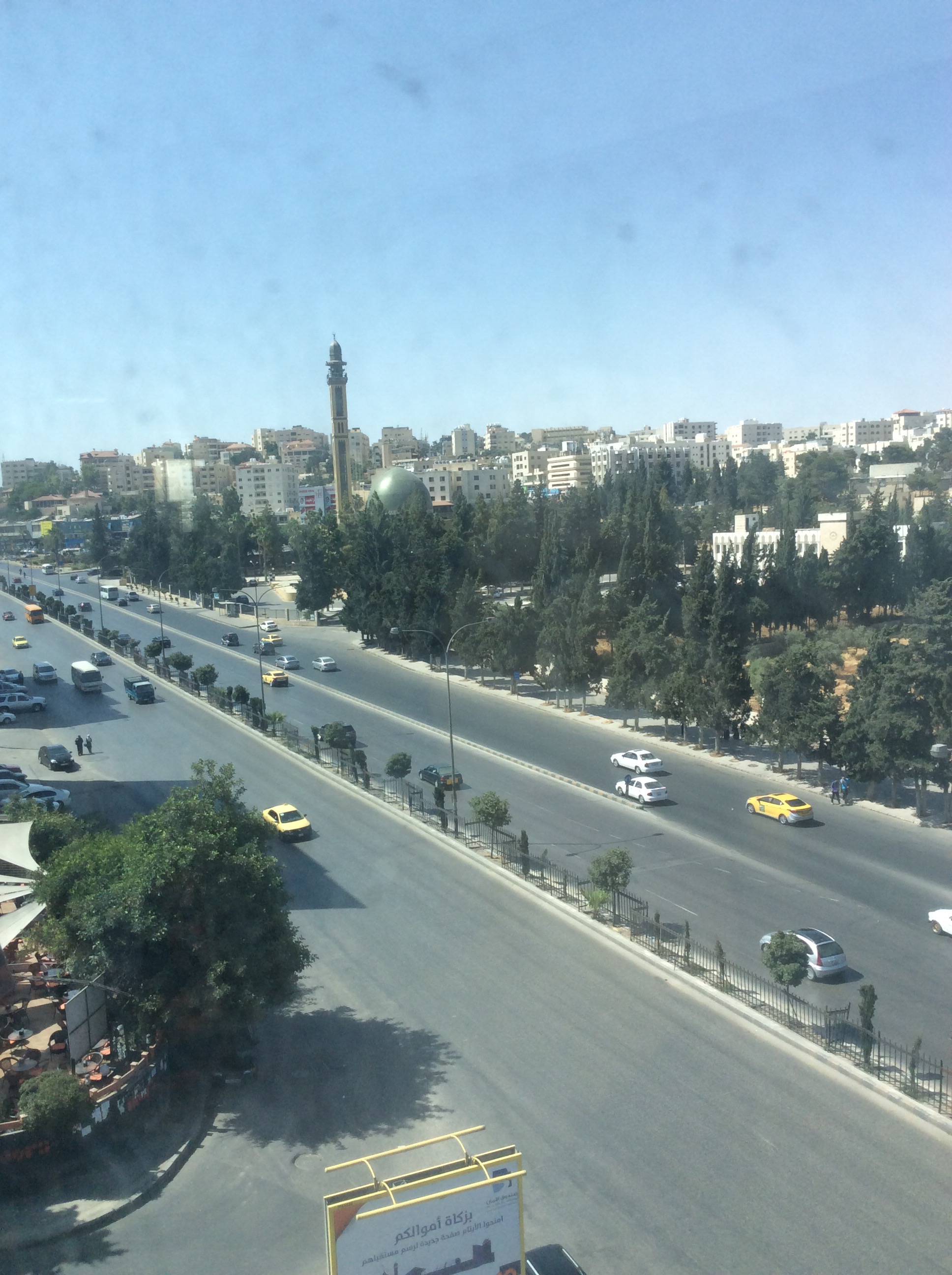
Five days since we rocked up here in Amman and it’s finally getting to me. All things considered I’ve held out well for as long as I could, but I’m no town mouse. This is all a bit much for me. There’s simply nowhere to run, no quiet, shaded wood, no bubbling river or creek, nowhere to hide from the noise. Our apartment is next to a building site overlooking the main road. Because of the heat, work starts early, so I haven’t been sleeping well. All I want is ten minutes of silence, but it’s impossible to find. The city stretches for mile upon mile of dusty, swarmed roads in all directions. I can’t even see where it ends on a good day. It just disappears, vast and white, like a scummy wave over the hills into the middle distance. I don’t hate it here, but it’s killing me slowly.

Perhaps I’m overreacting. Cities are supposed to be exciting places to live. But right now I feel trapped, imprisoned by my own choices. I long for the green fields of Sussex and the birdsong in the oak trees like I’ve never done before. I used to think England had lost its natural beauty. Here in the desert I understand. The only animals on the street are the house crows that flap lazily overhead like miniature vultures and the hordes of scabby cats that patrol the streets, frequenting every bin and dump site in town. Nothing here is truly wild; nothing but the taxis, racing madly from end to end with no regard for the road or anybody walking on it. And if you can’t hack the walk, you’ve no choice but to hail one down. It’s the only way to get around. How could I ever live in such a place?

We’re thinking of heading out to the desert castles in the Azraq plain tomorrow with the other students. It’ll be the first bit of traveling we’ve done since we got here and I’m dying to get going. Not to see Jordan beyond the city walls, but to escape. I need air. Time. Space. And I’ve been living on borrowed time trying to get by without it. Nine months in an isolated Spanish village gets more appealing by the second. I hope my heart can bear the wait. BB x