Of all the days to have for a twenty-four hour pitstop in Spain, I had to pick the one where the temperature dropped a full ten degrees. My light fleece couldn’t handle the Arctic chill of 11°C (a good warning for Peru). Tomorrow it’ll be back up to 24°C here – but this time tomorrow I’ll be far away, waiting for my connecting flight in Bogotá. I still can’t quite get my head around that.
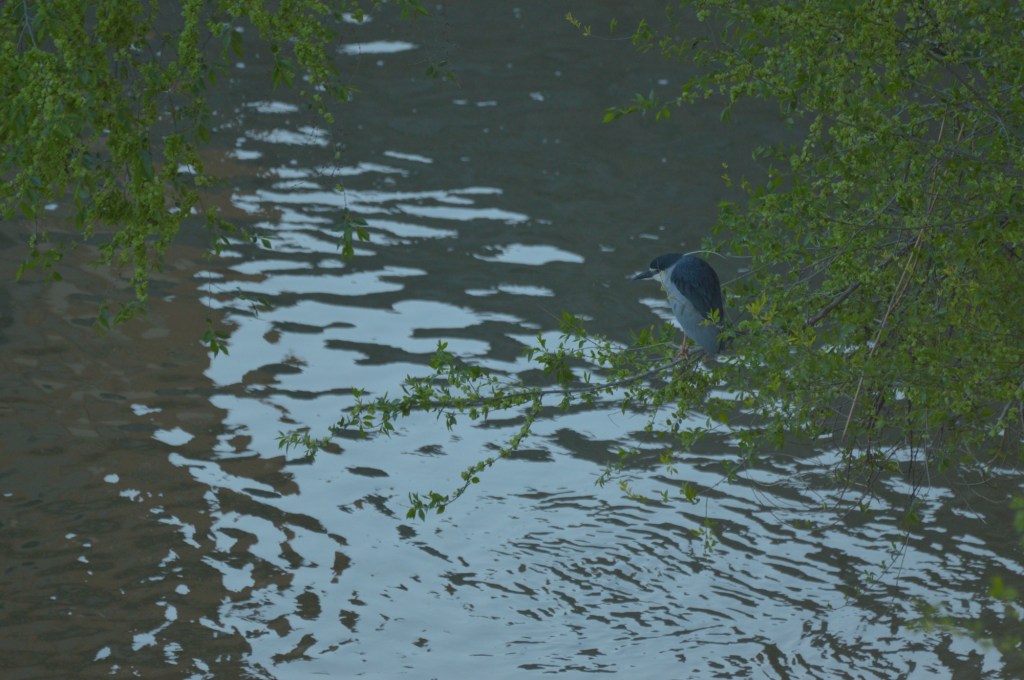
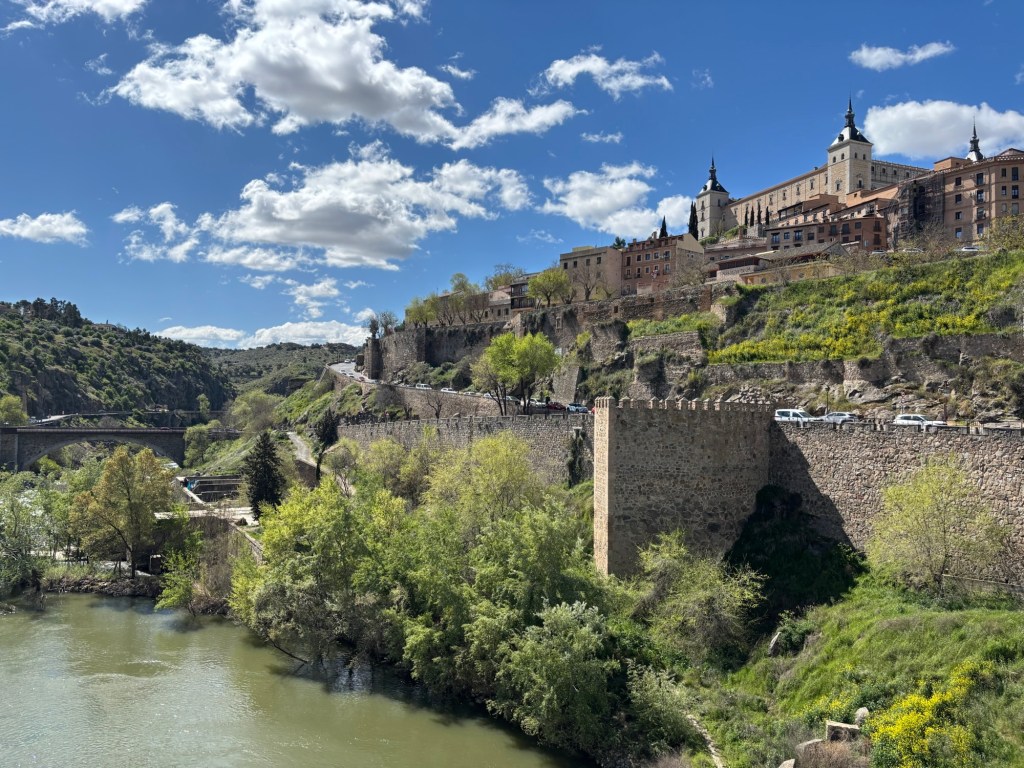
After an exquisite dinner of rabo de toro at Las Brasas del Vulcano last night (easily one of the best if not the best that I have ever eaten), I managed a relatively early start this morning to catch the first bus to Toledo. I think I had it in my head that I’d see all sorts of wildlife along its riverbanks, but it was very windy today, and I had also promised myself I’d do Palm Sunday Mass – a much-needed blessing to give me luck in the weeks to come – so it wasn’t as busy on the nature front as I had imagined. All the same, I saw what I came all the way to see: a night-heron.
Seems a little foolhardy, no? After all, night-herons are one of the very few Old World species that you can also find on the other side of the Atlantic. However, night-herons have a special place in my heart because I can date my career as a birdwatcher to the day I first saw one of these handsome fellas in Córdoba in 2005, on the day Pope John Paul II died.
The last time I visited Toledo was in 2013, when I was backpacking across Spain on a budget of 200€. I was eighteen, my Spanish was passable and I was already dangerously underweight, on account of not really considering food and drink a necessary expense. Fortunately, I have grown up a lot since then, and learned that, of all things, food is the last thing that should be omitted from the budget.
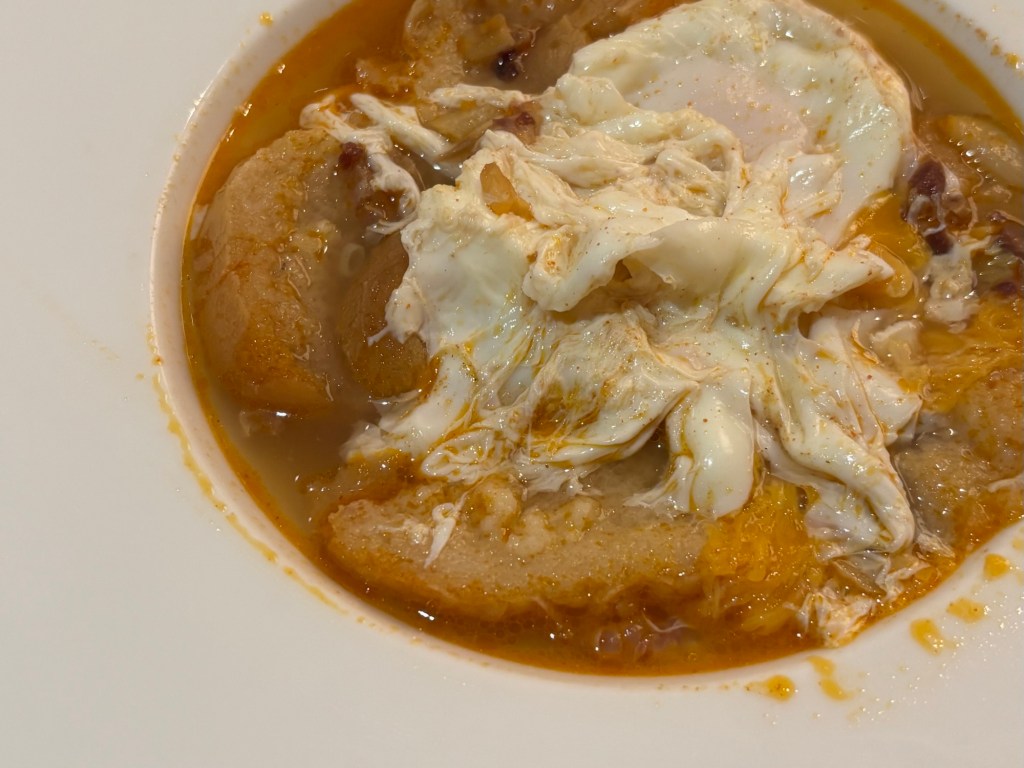
On that mad adventure, I have a particularly distinct memory of treating myself to a sopa castellana – my first meal out in a week – and feeling like my whole body had been healed at a stroke. As such, to my mind, that simple peasant dish remains the sultan of soups. If it is on the menu, I will have nothing else.
I treated myself to an upmarket lunch as a Spanish sendoff at Restaurante Palencia y Lara – and what an incredible find it was! I can’t decide which of their sopa castellana, cordero lechal or tarta de queso was the standout.
Sopa castellana isn’t an extremely complicated dish. It only really consists of bread, egg, stock and a good few cloves of garlic. But it is a restorative like none other.
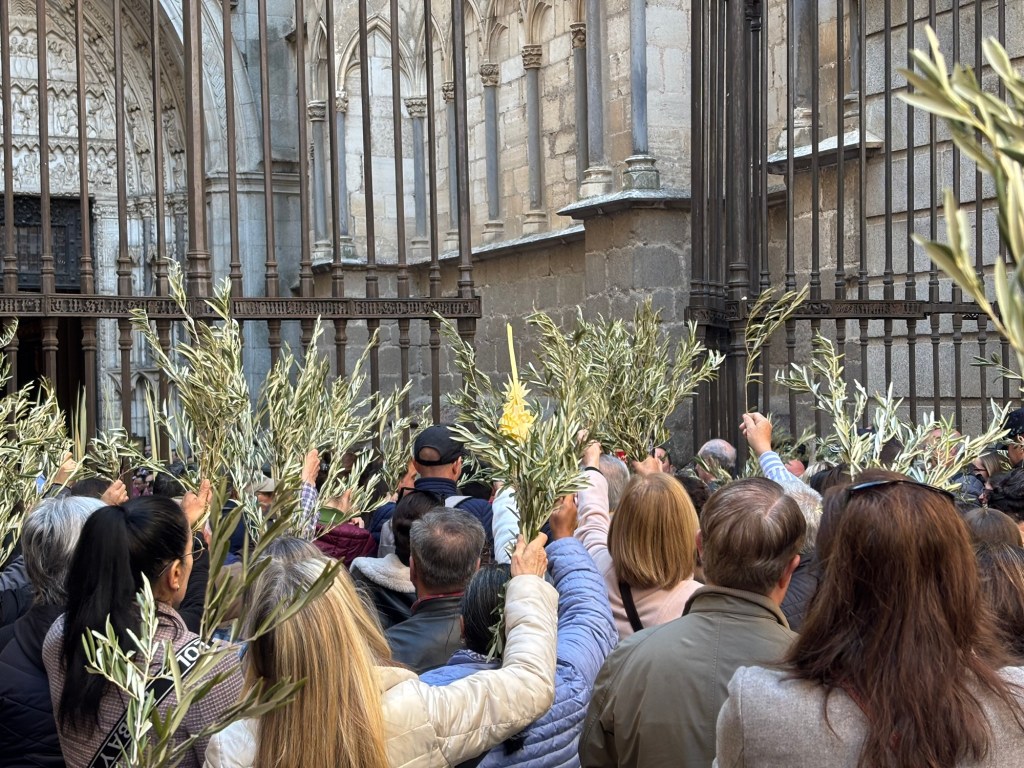
I will be traveling around a lot during Semana Santa, so while I will be in a country that also celebrates Easter properly – even if it is on the other side of the world – I will probably miss a lot of the festivities. That’s one of the reasons I insisted on seeing Toledo’s Domingo de Ramos procession, celebrated from its Catedral Primada de Santa María.
It’s been a while since the time I celebrated Palm Sunday in Rome with Pope Francis, so I’d forgotten how long the reading is (they relate the entire Passion). All in, the ceremony lasted just shy of two hours. But I have come away with a sprig of an olive branch, and I hope it will bring me luck on my travels around the Americas. I’d have brought my lucky vulture feather, but I’m a bit too attached to that to chance losing it along the way.
Toledo was stunning in the sunshine. I’m glad I came here for a pit stop, even if only for a day. It’s nice to be somewhere familiar and nostalgic before pitching myself headfirst into a world that is totally alien.
T minus ten hours. I’ve decided not to chance the first Metro of the day and booked an Uber for peace of mind. Once I make it to Barajas, I can relax a bit.
After that… well. It’s in God’s hands, I guess. See you on the other side! BB x
It’s been raining all day again. I was out late with Tasha last night catching up on old times – neither of us could really believe that it’s been nearly eight years since I left – so I didn’t begrudge the downpour for a long and cosy morning in bed. You don’t have to be busy every day of the holidays, even when you’re abroad.
Luckily, I was all over Mérida yesterday with my conjunto histórico ticket, granting access to all the city’s Roman ruins, so the only thing I missed out on was the Alcazaba, which I might visit tomorrow with Tasha and her boyfriend Antonio, if he’s up and about. I don’t think I’ve seen the Alcazaba before – one tends to focus on Mérida’s Roman history rather than its Moorish past, and there are older and more impressive alcazabas (the Spanish rendering of the Arabic qasbah) in Andalucía: Sevilla, Córdoba and Granada, to name just the obvious ones.
Mérida isn’t unique in having a Roman amphitheatre either. There’s a pretty spectacular one (albeit less often seen) in Santiponce that I’ve often seen from the bus on the way in from the north. But there are a few more unique treasures to be found in Extremadura’s administrative capital, and I thought I’d tell you about one such gem below.
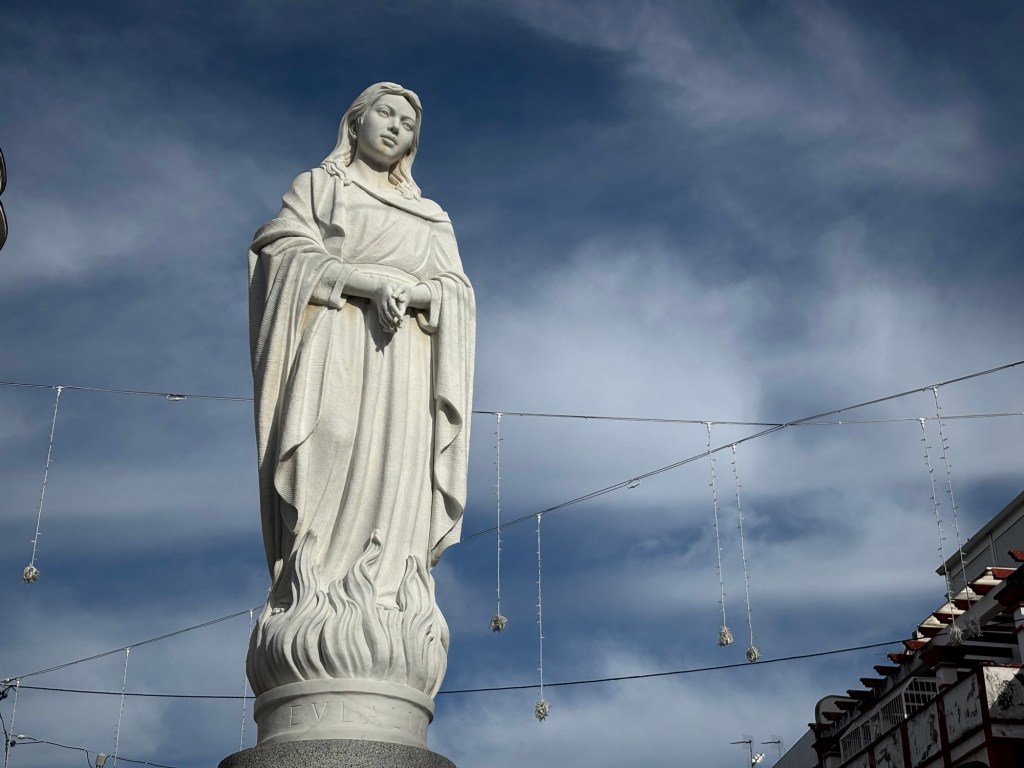
Let’s start with the lady of Mérida – because every Spanish city has its special lady. This one is Santa Eulalia.
Eulalia of Mérida stands tall above the other Christian saints of Spain, which is especially impressive as she only lived to around twelve years of age. A Roman Christian, she and her family were forbidden to worship God under the Persecution of Diocletian. Incensed, and unable to keep her faith to herself, Eulalia fled out of exile to the city of Emerita Augusta, where she openly challenged the local governor, Dacian, insulting the pagan gods whom she was commanded to worship. After a few desperate attempts to reason with her, Dacian had the girl beaten, tortured and burnt at the stake. According to legend, Eulalia is said to have mocked her tormentors until her dying breath, which came out in the form of a dove.
Eulalia was once a great deal more powerful than she is today. Before the rise of the cult of Santiago, it was Santa Eulalia de Mérida in whom the Christian soldiers placed their trust as they made war on the Muslims occupying the lands their ancestors had once held; and it was to her tomb in Mérida that thousands of pilgrims travelled during the Middle Ages, before Santiago Matamoros muscled her out of the picture.
At least one of my Protestant Christian friends has remarked at some point about the thin line between the Catholic Church’s veneration of saints and idol worship. Surely – they have reminded me – it is God and by proxy his son, Jesus Christ, to whom prayers should be made, not the pantheon of mortals who claim to be able to intercede on my behalf?
I can see the argument as plain as day. There are shops up and down this country selling nothing but saint souvenirs: votive candles, icons and fridge magnets, scented rosaries and car ornaments. I have a few myself – a family rosary from Villarrobledo and a more personal one from La Virgen del Rocío, which these days is on my person more often than not.
However, I don’t think it’s as simple as that. How frightfully urbane, to assume that the only true relationship with God is a detached and decidedly modern Western take on prayer. How tremendously big of us to assume that we can comprehend a force that it is, by its eternal nature, beyond our understanding. Community is a powerful agent – it seems only right that the spiritual world, Christian or no, has a network of pomps to streamline the neural network that binds us all together. On Earth as it is in Heaven, as they say.
Spain has a long history of wandering saints. Santiago journeyed beyond death to Galicia, sparking the most famous pilgrimage in Christendom. Guadalupe travelled from her mountain home to México to become one the most venerated Marian cults in the world. Eulalia was dug up and reinterred in Oviedo, where she became a figurehead of the Reconquista (I genuinely had no idea I was standing before her final resting place this summer). Teresa of Ávila’s body parts have travelled all over, most famously her Incorruptible Hand, which used to grace Francisco Franco’s desk.
Tomorrow, I make for Sevilla. Journey’s coming to an end. I’d better make sure I’m fully packed. BB x
Albergue Seminario Menor, Santiago de Compostela. 18.11.
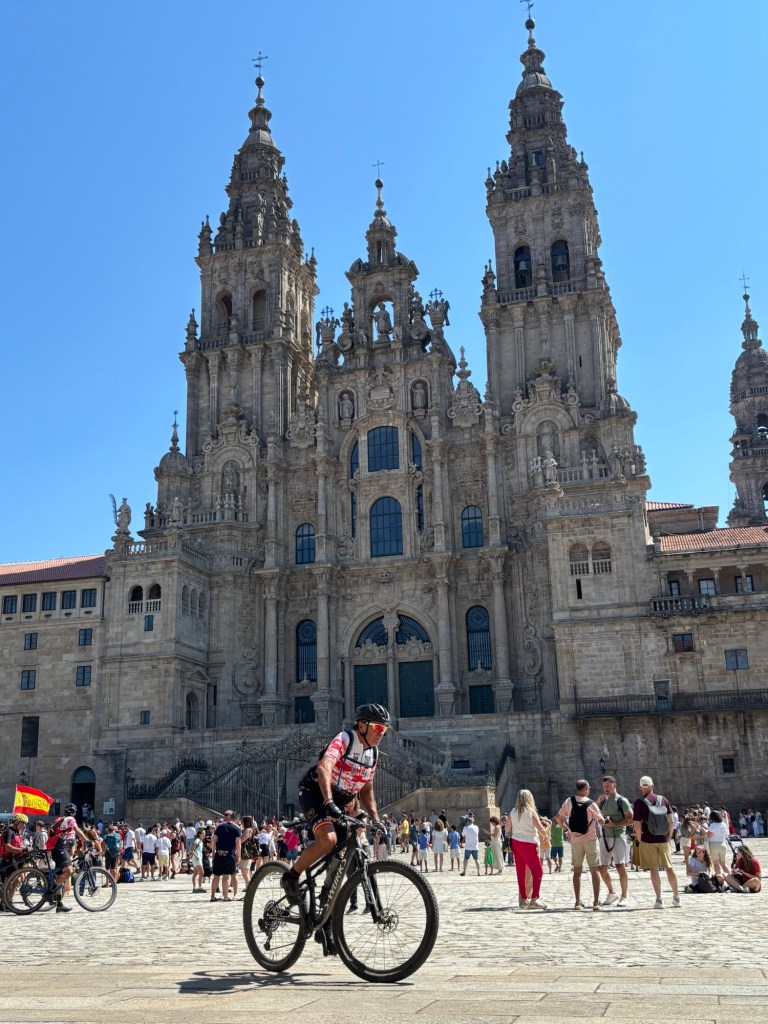
Two years ago, when I walked into Santiago’s Praza do Obradoiro under a cool white cloud, I could not shake the feeling that I had not quite earned the triumph that the end of the Camino usually entails. I had walked in alone, in the early hours of the morning, after setting out from Burgos some twenty-one days prior. My credencial showed that I had walked all the way, but not all at once: my circuitous route had taken me four years, starting in the summer of 2019 and continuing in the spring and summer of 2023, after COVID and a number of other factors prevented me from walking further.
Not this time. Today felt like the finish you read about in books and in the films. Today, after walking over a thousand kilometres across France and Spain, to be welcomed like a hero by old friends in front of a crowd of thousands before a cathedral bathed in light… I was on the verge of tears this time.
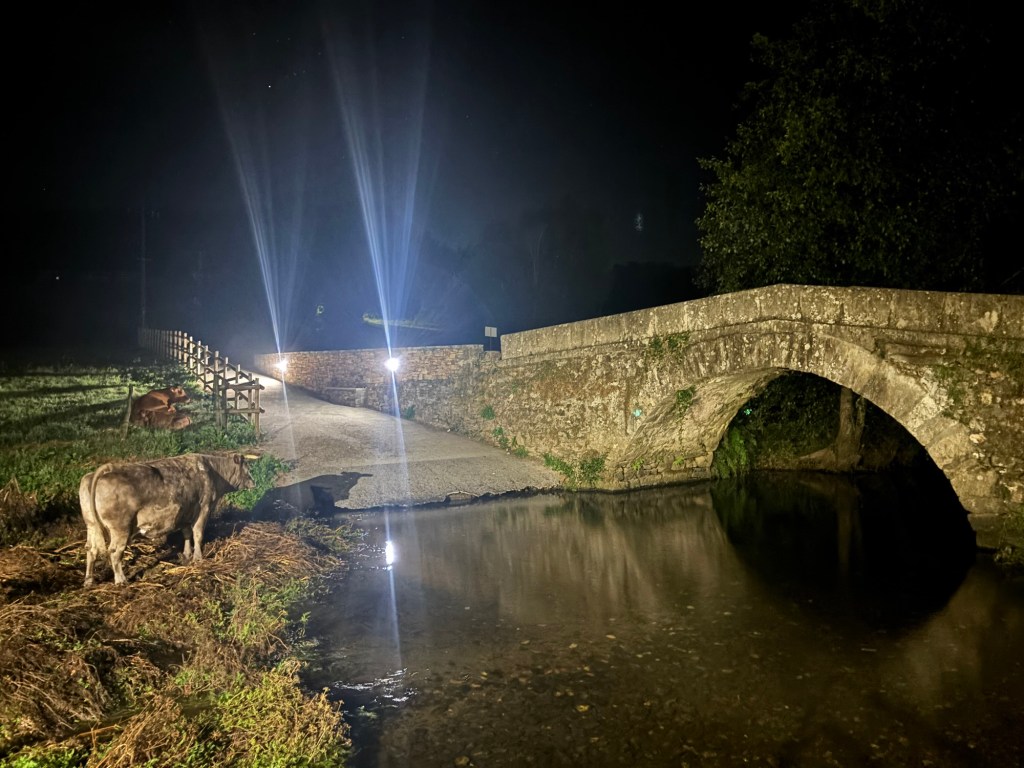
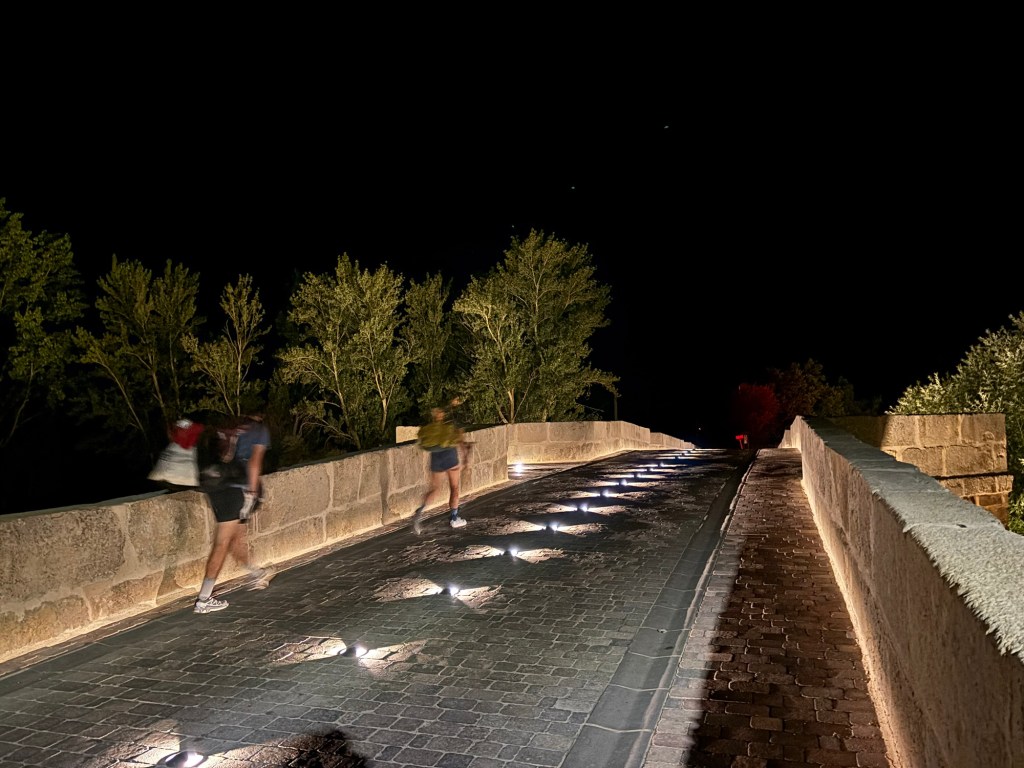
Ribadiso was silent when I left at around a quarter to five this morning – the earliest I have set out along the entire trek. A few cows had wandered down to the river for a drink by the reflected light of a few lamps along the bridge, but I could hardly make out more than their silhouettes in the gloom. My phone did a much better job than my eyes could do.
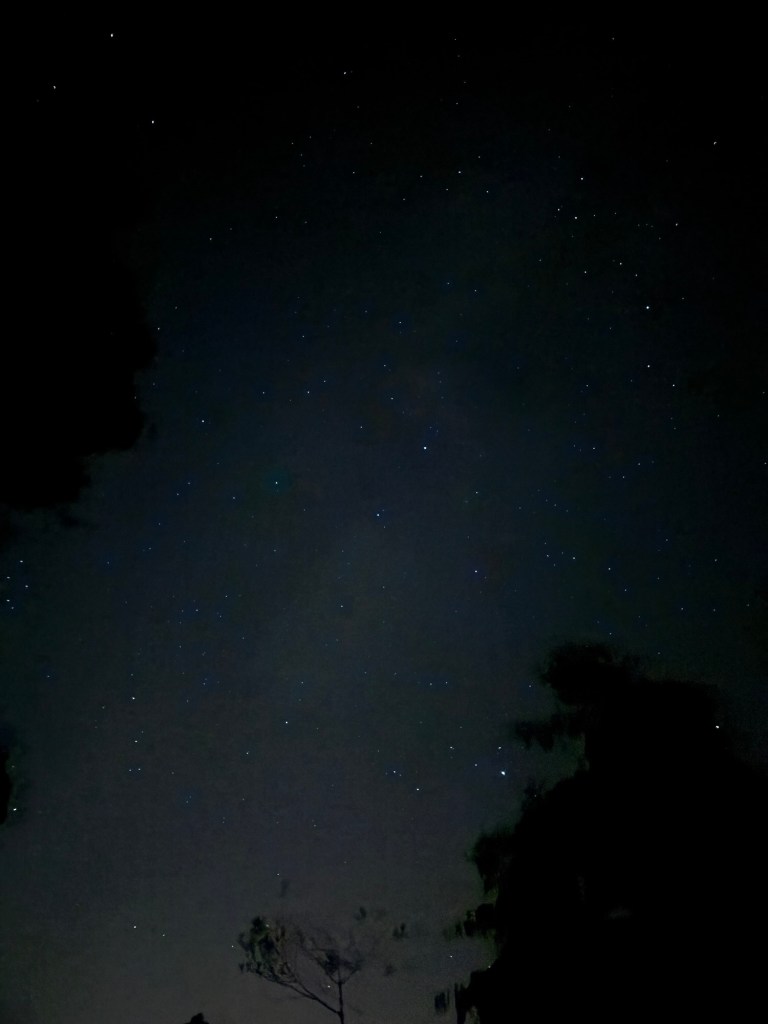
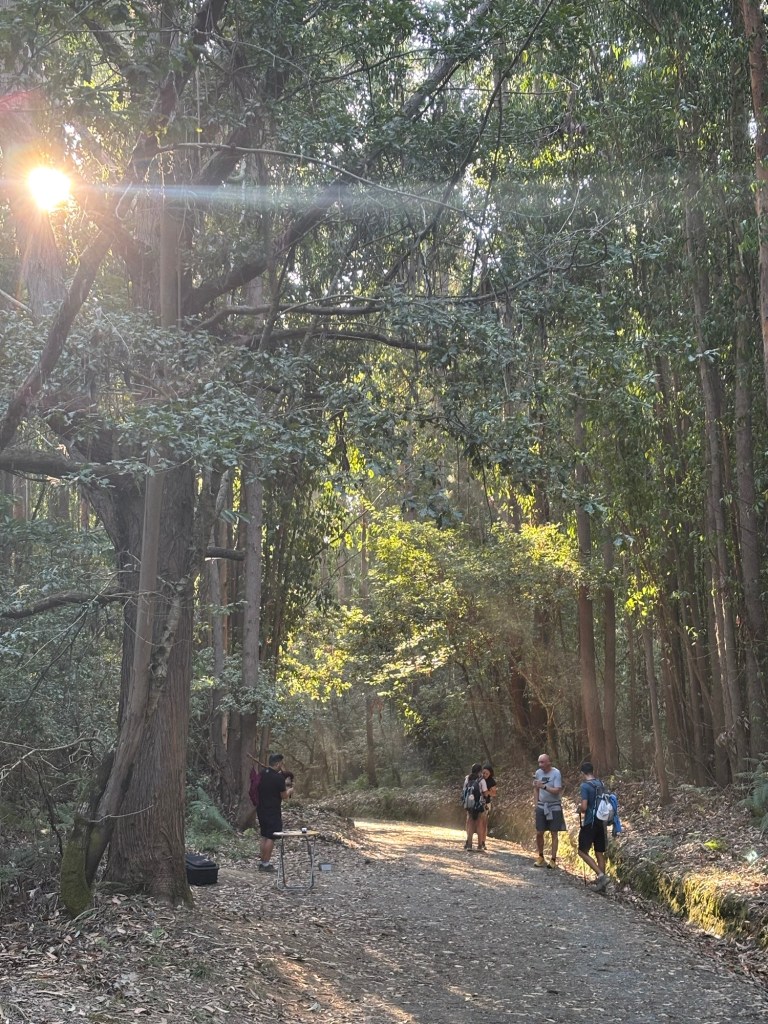
Darkness shrouded my steps until well after seven o’clock, so the first two and a half hours of my walk were made in the long shadows of night. As usual, I avoided using my phone’s torch as much as possible, navigating by starlight and the shadows of the trees against the sky, turning it on only to check I was not in any danger of leaving the trail. I passed a few pilgrims on the road who turned their glaring flashlights on me as I motored past, no doubt perplexed as to why I had decided not to light up the way in front of me.
I picked up considerable speed whenever I saw the dim moving light of a headtorch on the road ahead. I have not been a huge fan of headlamps and torches since two were trained on me like searchlights at two o’clock in the morning on a beach in Almería, during my mad trek across Spain at the age of eighteen. The fright that experience gave me has never really gone away, which may go some way to explaining my general disdain for the invasive, almost threatening white light of a handtorch. But there’s also my natural stubbornness, which I suspect has much more to do with it. You don’t really need a torch to navigate by night… not when your eyes grow accustomed to the gloom. So why bother?
I considered stopping for breakfast at a number of cafés once they started to open their doors after 7am, but every time I neared one, it looked packed to the gills, so I moved on. If I’d known that this would be the case all the way to Santiago and that I would not stop again until I reached the holy city, I might have shrugged off my pride and popped in for a tostada. But I didn’t, and when I accidentally took the forest route bypassing O Pedrouzo altogether – the usual staging post before the final push to Santiago – I decided to push on to the end on the power of a Bolycao and the last of my Nakd blueberry bars. It wasn’t much of a breakfast for a forty-three kilometre hike, I’ll admit, but it did the job.
The road got quieter before O Pedrouzo after I had overtaken all of those pilgrims who had set out from Arzúa, only to ramp up again as I hit the back of the O Pedrouzo brigade. I met a few new characters as well as the first of a few old faces from the Camino Francés: Don Decibel, a raucous Spanish soldier whose phone call to his friends ten kilometres back hardly required the use of a phone at all (though I’m not sure I’d count the repeated phrases “oyé maricones” and “viva España putamadres” as a conversation); the Shadow, a French pilgrim who seemed to catch up to me constantly despite my attempts to race on ahead; Tim & Jackie, an Australian couple who fell behind us at Carrión de los Conded when Tim’s legs started to cause him trouble; and Edoardo, the charismatic Don Juan, who had slowed down to walk with a large group of Italian pilgrims.
And then there were the school and university groups. Hundreds of them. Well over a thousand, if I’d bothered to count them all. The ticker in the Pilgrim Office in Santiago showed that 847 had already made it to the city before I arrived at around twelve o’clock, so that number is not as much of a hyperbole as you might think.
The post-Sarria rush is real. It wasn’t quite as obvious two years ago as it is now, in the middle of August, when the crush is at its highest. I’d wager that I’d have seen even more if I’d left even a little later. They were all in very high spirits and many of them were draped in the colourful flags of their home regions: Andalucía, Valencia and Asturias were the most obvious. I looked for the black bars of the Extremaduran flag, but I didn’t see one.
I wondered, if I’d carried a flag, which one I would have the right to bear. Not Andalucía, surely, as I only lived there for a little under a year as a child (though it has forever marked my accent and identity), and not Extremadura either, since I have no familial connection to that earthly paradise whatsoever. La Mancha, perhaps, as that is where my cousins reside – but when my great-grandmother was born, that part of La Mancha was part of Murcia. My grandfather and his father, on the other hand, were from the Valencian province of Alicante.
In short, I have no claim to any of the regional flags. So I would have settled for the rojigualda instead.
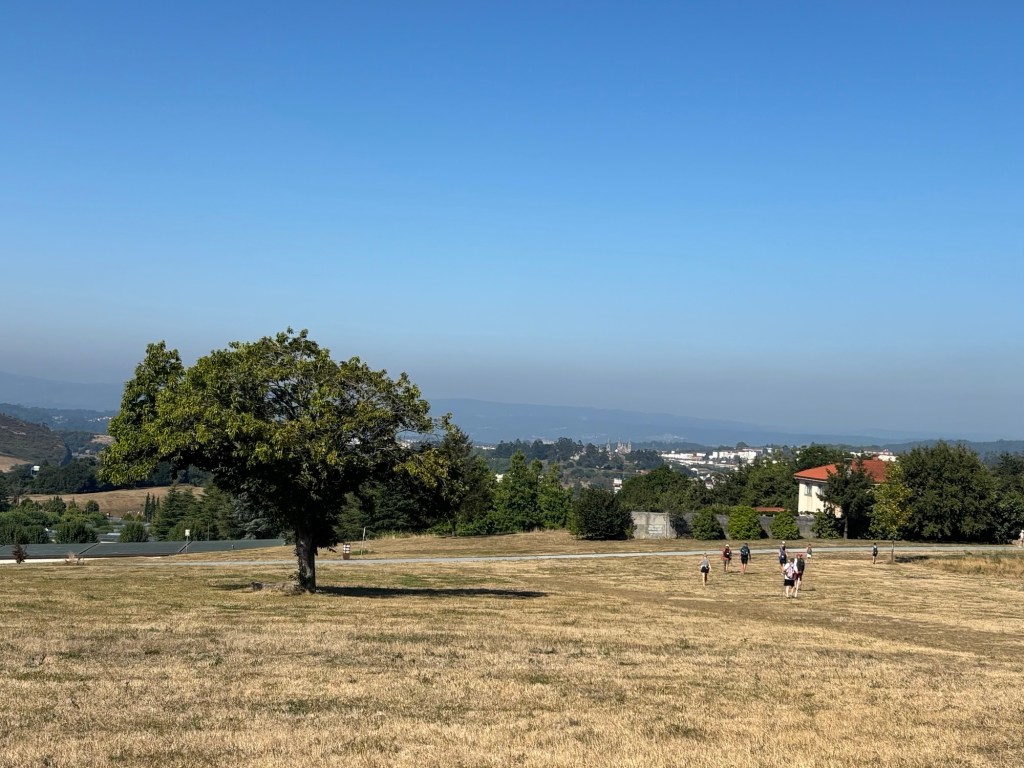
I couldn’t find the famous pilgrim statues on Monte do Gozo – I wonder if they’ve been moved to a different location? Their pedestal was where Google Maps said it would be, but I could not find them. I did, however, see my destination for the first time, and that was motivation enough to proceed: the twin turrets of Santiago’s cathedral, between the gleaming white houses and the towering eucalyptus trees.
When I left Ribadiso this morning, Google Maps thought it would take me around nine hours to reach Santiago. It took me seven. I had some powerfully uptempo music to get me through the last ten kilometres, up to and including:
Rhythm is Gonna Get You – Gloria Estefan
Higher Ground – Stevie Wonder
Voodoo Child – Rogue Traders
El Cid March – Miklos Rozsa
It’s a Big Daddy Thing – Big Daddy Kane
Qué Pasa Contigo – Alex Gaudino
Walk Right Now – The Jacksons
Deliver Us – The Prince of Egypt
The last one was the killer. I get emotional listening to that track at the best of times, but the timing was absolutely perfect, reaching the triumphant crescendo finale just as I reached the back of the square and turned to face the cathedral. There really were tears in my eyes this time.
Let’s face the facts. I walked a bloody long way.
I had hardly arrived in the main square when I was jumped by three old friends: Juha the Finn, Max the Austrian and David the American. To be honest, I was not expecting to run into any of the old guard at all: my side quest over the San Salvador and along the Primitivo put me almost a week out of sync with the crew I had walked with, and even three double days wouldn’t have been enough to catch up to them all.
However, with the exception of Chip (who left for home several days ago) and Audrey and Talia (who I missed by a matter of hours), everyone else was here, including Alonso and Gust, the last remaining members of our little band of seven. I could not have hoped for a better welcome wagon.
Alonso, Gust and I are all at the Seminario – along with a good number of familiar faces – and we had a decent lunch (if a bit pricey for what it was) and a phenomenal Gujarati supper at Camino Curry, a brave new enterprise by a family from Birmingham that was both the most delicious and the friendliest meal I have had on the entire Camino. Given that the fellows had been advertising on my Facebook posts, I’d say they earned my custom.
We said farewell to Max and Juha for the last time on this Camino and returned to the albergue for a couple of rounds of Go Fish (instead of watching the 10pm screening of the Superman movie at the local cinema and risking the nine minute dash back to the seminario before lock-up). I’m normally averse to card games but I had a great time. It reminded me of those dark internet-free nights in Uganda long ago, with Teddy and Maddy and Mina. That feels like a lifetime ago.
Well… tomorrow is another day. No more 5am starts. That’s something to look forward to! BB x
Today marks the longest walk I have ever done in my life. As of eleven o’clock this morning, I have walked 1,013km since setting out from Bordeaux nearly six weeks back on the last day of June. My feet are mildly blistered but not painful, and one of my sandals is starting to fall apart, but my head and heart are clear and Pinta and Niña are none the worse for their thousand-kilometre journey across the country.
I haven’t used my journal much, but I wouldn’t have set out upon this road without it. It’s now by far the longest-serving and most well-travelled (and most battered) of the three journals I have kept since I bought the Red Book in a librería in Villafranca de los Barros back in 2015. Now a veteran of four Caminos, it’s earned an early retirement, I think, but I’m still a good fifty pages or so from finishing it, so it may well have further to travel, I suspect.
Maybe I should just hurry up and get that bloody book written already. Lord knows I have crammed enough research into those journals.
Today ought to have been a short one, but I ended up adding an extra three kilometres to my walk after realising halfway through the dark woods out of As Seixas that I’d left my credencial behind. I have three, including a spare and the completed one in my journal, so I wouldn’t have been turned away at the next albergue, but it’s the principal, damn it – and I was only ten minutes into the walk, so I legged it back without the aid of a torch to the albergue, hoping the other pilgrims had not shut the door behind them.
Luckily, they hadn’t, and my credencial was sitting on the bunk above mine along with a sachet of Cola Cao, just where I’d left it the night before. Sometimes I’m in such a hurry to be the first out the door and on the road that I leave things behind. So far on this trip, that has cost me a pair of sunglasses and a vest – and very nearly my credencial. Muppet.
I restored my reserves with a cup of hot chocolate from the vending machine and took a shortcut back to the Camino via an improvised route to the north. The roads were deserted, so I didn’t have any issues. The three pilgrims who I had sprinted past seemed surprised to be overtaken, after they’d last seen me going back down the Camino about half an hour ago.
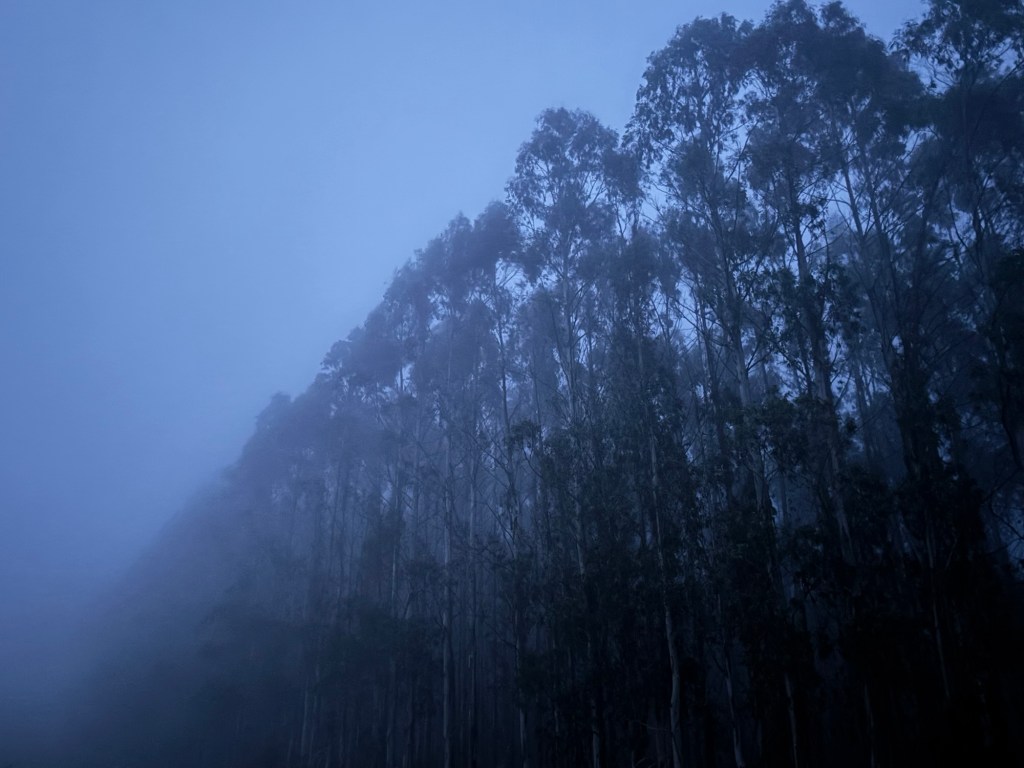
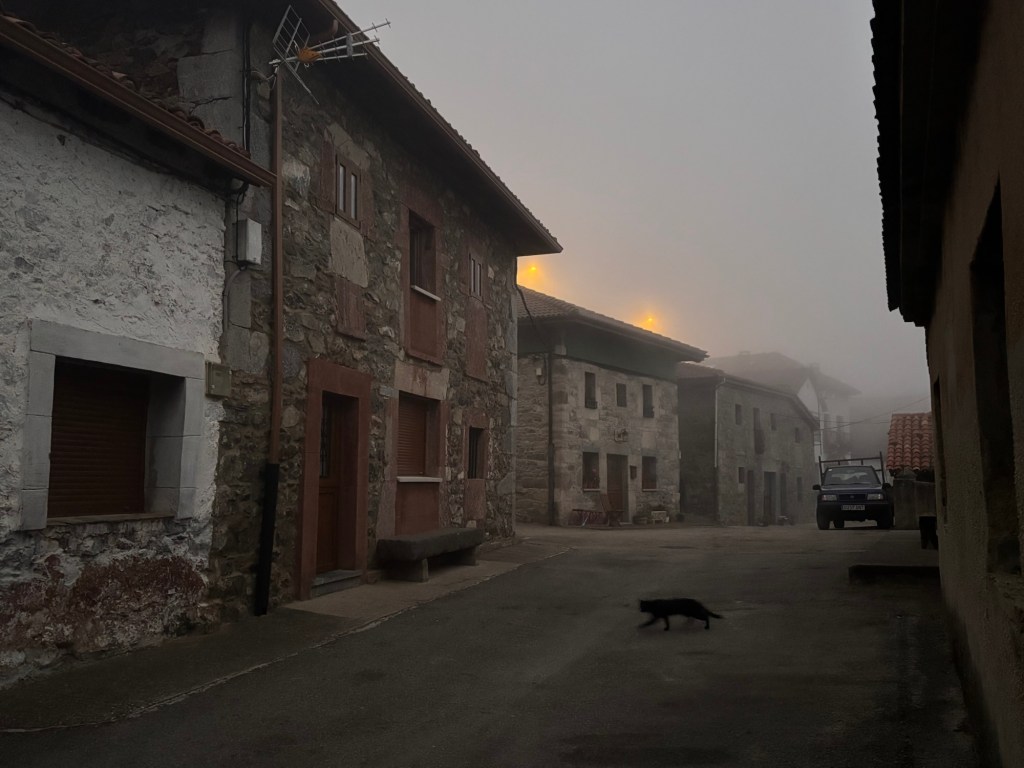
It was a very dark and misty morning. As Seixas is at the foot of a great big hill lined with wind turbines, which kept a lot of the morning mist hanging over the village and its eucalyptus stands. It was a little eerie, and I nearly jumped out of my skin when a nightjar almost clipped my head, announcing its presence merely inches from me with its frog-like grooik flight call. It may well be one of the last ones I see this summer, so I did not begrudge him the fright.
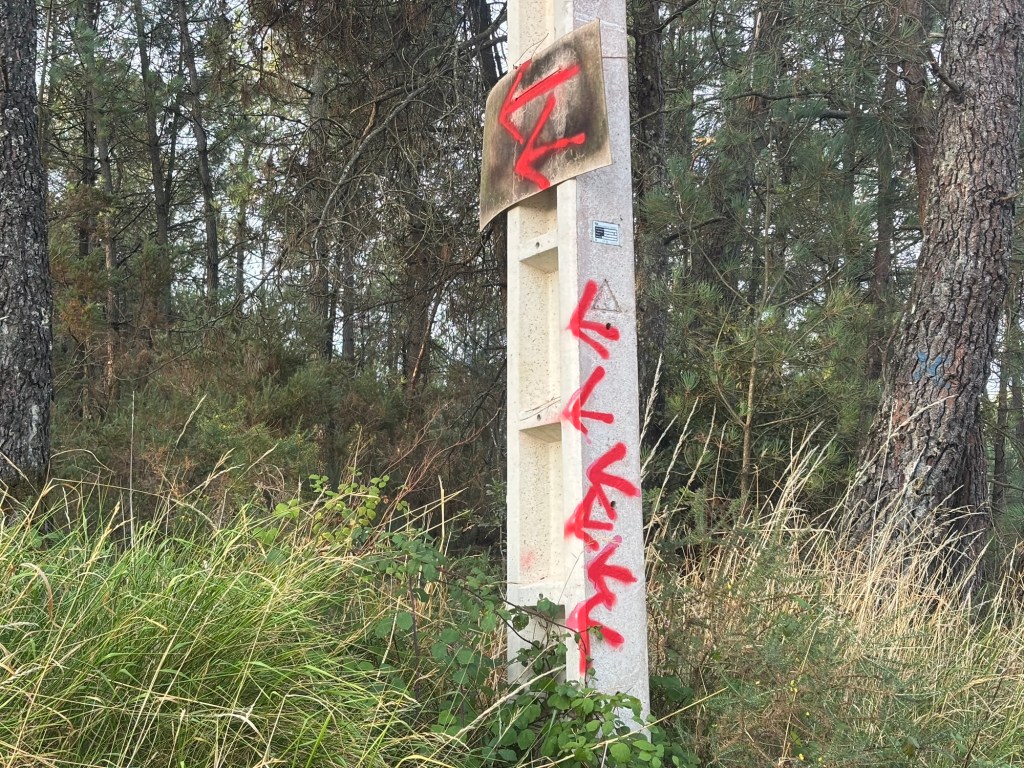
Twice today I very nearly took a wrong turn, saved by my intuition. I have followed the yellow arrows of the Camino all the way from the heights of Somport and they have not yet put me wrong. Curiously, however, a number of red arrows have sprung up, usually in large groups and always pointing off the road. They may indicate an alternative route but they are a little unreliable: in one case they put me back on track after I took the wrong road, but in another spot they pointed in completely the wrong directions and only a brief chat with a friendly labourer solved the conundrum.
If in doubt, don’t trust the red arrows. The yellow arrows always lead to Santiago. The red arrows might not. When you put it like that, it’s almost like a child’s game.
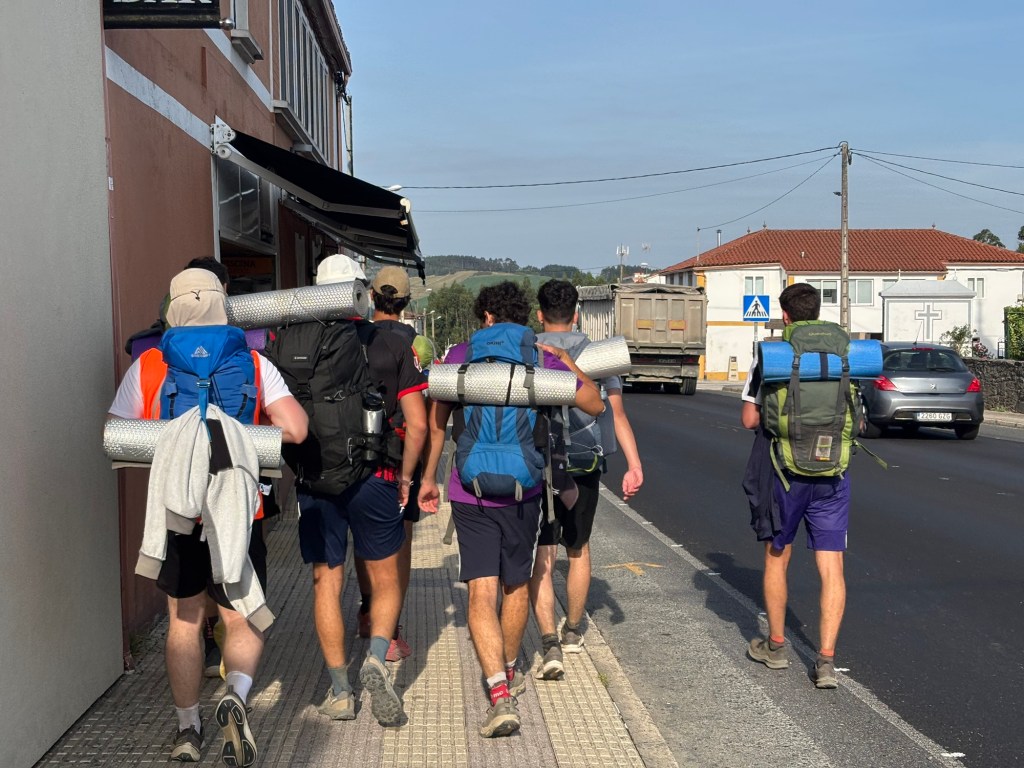
I reached Melide just before nine (ahead of schedule, despite the loss of 20 minutes) and bought a few supplies in one of the corner shops before moving on. The volunteer in the Concello de Melide warned me about the “fiesta” from here on out, and he wasn’t wrong: for the rest of the morning, the Camino was absolutely packed. Extended families and university groups, parishes and pensioners and pre-teens with their parents, and quite a lot of dog walkers, most of them carrying small backpacks and sticks they’d found at the side of the road (as opposed to the titanium pole wielding pilgrims of the Camino Francés). On average, it’s estimated around a thousand people a day walk the final 100km in August.
Hence the rush for a room.
I wonder what became of my shaman stick that was stolen in El Acebo? Who knows – perhaps it’s already done another Camino of its own.
I had a choice to make this morning: finish early and stake out the albergue municipal in Ribadiso, or roll the dice and shoot for Arzúa, only three kilometres further on. Arzúa’s municipal has fifty-seven beds to Ribadiso’s sixty, and it would lop three kilometres off tomorrow’s trek… but Arzúa is the end stage in all the guidebooks. How could I be certain that there’d be a bed left, even if I made it before half eleven? I passed at least a hundred pilgrims on the road before reaching Ribadiso, and I had set out from Melide after nine o’clock – a full four hours after the early birds.
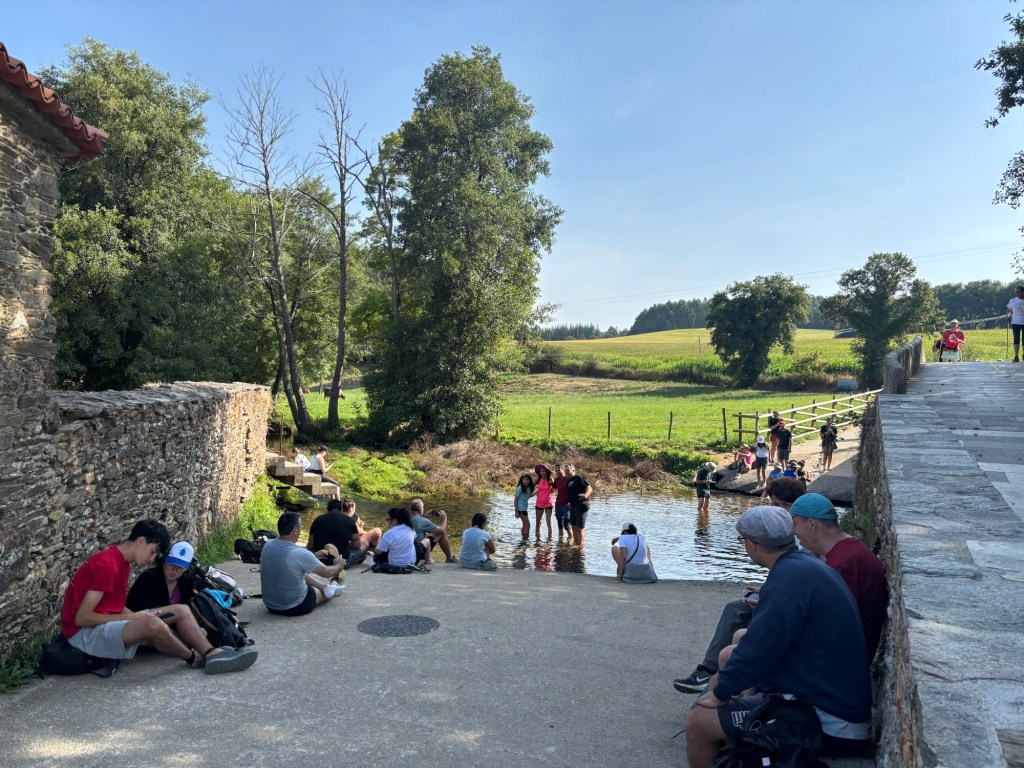
No – wisdom overcame risk today. I found a spot by the bridge in Ribadiso and sat down. It looked at first like around twenty to thirty other pilgrims had the same idea, but gradually they came and went, stopping only for a quick paddle in the river. With temperatures rising up into the mid thirties this afternoon, and so much paved road below, who can blame them?
I might go and paddle myself, once the hordes have moved on. For now, I might catch up on some sleep. I have one last challenge tomorrow and it’s a long one: over forty kilometres remain. Let’s…. Must focus and proof-read, but… Zzz… BB x
Three days shy of Santiago and my feet are starting to get the better of me. It’s been a minor miracle that I’ve made it this far unscathed, but I suspect that murderous climb up and over the Hospitales route – coupled with several forty kilometre days back to back – have conspired to give me one final challenge in the form of two mirrored blisters, one on each of my little toes. I brought a veritable school kitbag of Compede plasters with me on this Camino, but I gave most of them away to my younger companions during the Meseta stage (as they really were suffering a great deal more than I am now), so I have had to resupply tonight.
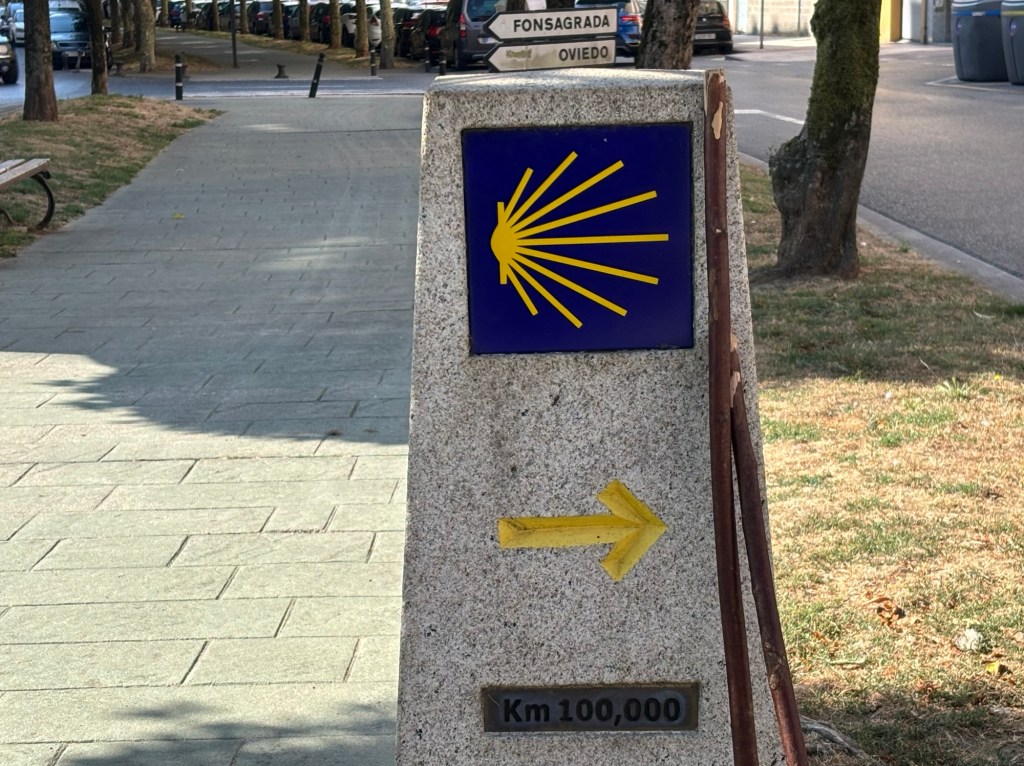
Fortunately, the end is in sight. Three rather challenging days remain, as I still have a hundred kilometres to clear (Lugo conveniently marks precisely 100km from Santiago), but I remain steadfast in my desire to see this thing through to the end. I’ve come this far.
I don’t have an awful lot to report from this morning’s walk. I took it slowly to give my feet a break, but I still didn’t see any more than the three pilgrims from the albergue in Castrojeriz who left ahead of me, and that within the first hour and a half.
I didn’t sleep very well because the rakes from the night before decided it would be a great idea to go the bathroom and laugh their heads off at some private joke sometime around midnight. I’d normally be wide awake at that time of night anyway, but on the Camino, sleep is precious, so before I knew what I was doing my teacher mode activated and I found myself opening the door to the bathroom to give them a piece of my mind. They looked dreadfully disheveled with bloodshot, unfocused eyes, and had clearly been both drinking and smoking. I tried to get back to sleep afterwards, but it must have been another hour or so before I could do so.
It’s not always easy to deactivate from teacher mode, even on holiday. I remember doing something similar on a stag do once when some of the fellows I was with decided it would be fun to kick a football into the road. This kind of thing used to come very hard to me, but I guess practice makes perfect. Or a perfect party pooper, take your pick.
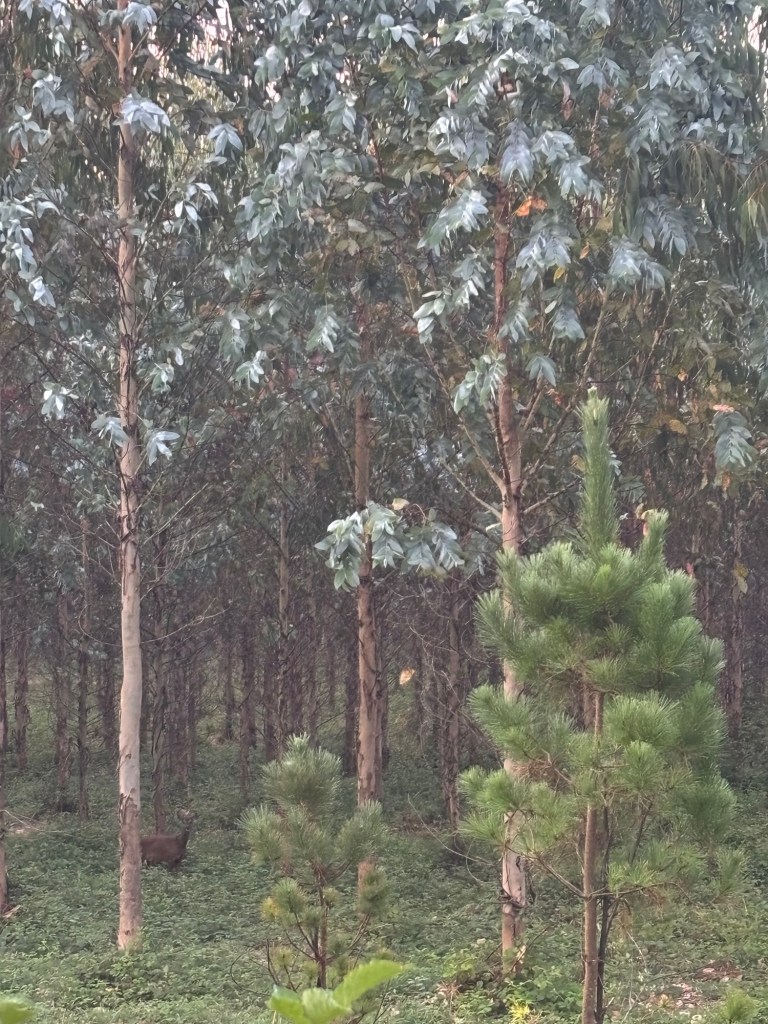
I was up again at half four, but delayed leaving until around six, as Lugo was only twenty kilometres’ distance and I didn’t want to get there too early, even at a slower pace than usual. Even so, I was early enough to see a fair number of roe deer in the woods, one of them so close I could see the light in its eyes before it bolted.
I reached Lugo shortly after eleven without any great difficulty. It was a poor morning for stamp collecting. I passed what I am sure is a famous Primitivo stop, the Oasis Primitivo, where both stamp and watermelon can be had at the right time of day, but it was not yet nine o’clock and a Monday morning and there was nobody around. So I pressed on.
Mondays can be frustrating on the Camino. On Sundays, all the shops and supermarkets close for the whole day and Monday can be little better. Twice now I’ve made landfall in a large town or city on a Monday, only to find that all its sites and museums are closed on Mondays. So it was with Lugo. At least the 100km sign was free and easy to see.
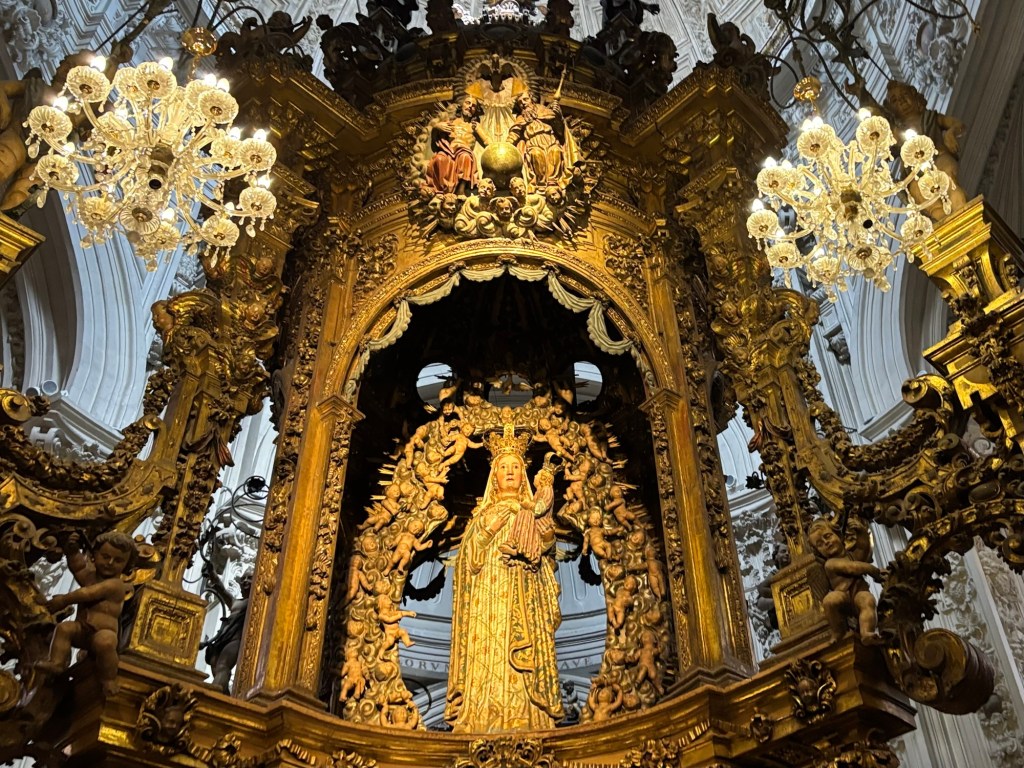
Lugo’s cathedral pays no heed to Spain’s Garfieldesque aversion to Mondays, so I had a look around. Contrary to what several folks online were saying, it’s not free, but it is a cheaper fare for pilgrims at 5€, which isn’t so bad. It’s not as spectacular as León or Burgos, though the chapel to the Lady of Lugo, la Virgen de los Ojos Grandes – the Lady of the Large Eyes – was rather impressive. Her eyes didn’t seem especially large, but maybe it’s because hers were painted brown rather than blue, as is often the way, so they seem like great pools of dark light.
The albergue was pretty busy, as I expect will be the case for the next two nights as the Primitivo rejoins the Francés in Melide, but they’ve almost all of them gone out for dinner, so I’m alone to write. The pseudo-Compede on one of my heels isn’t sticking so well, so I’m keeping one leg balanced on top of the other. In a week from now, I’ll be back in the comfort of my own bed (provided I can get my hands on my key!) and my tired feet will finally be able to rest at last. But let’s not dwell on that just yet.
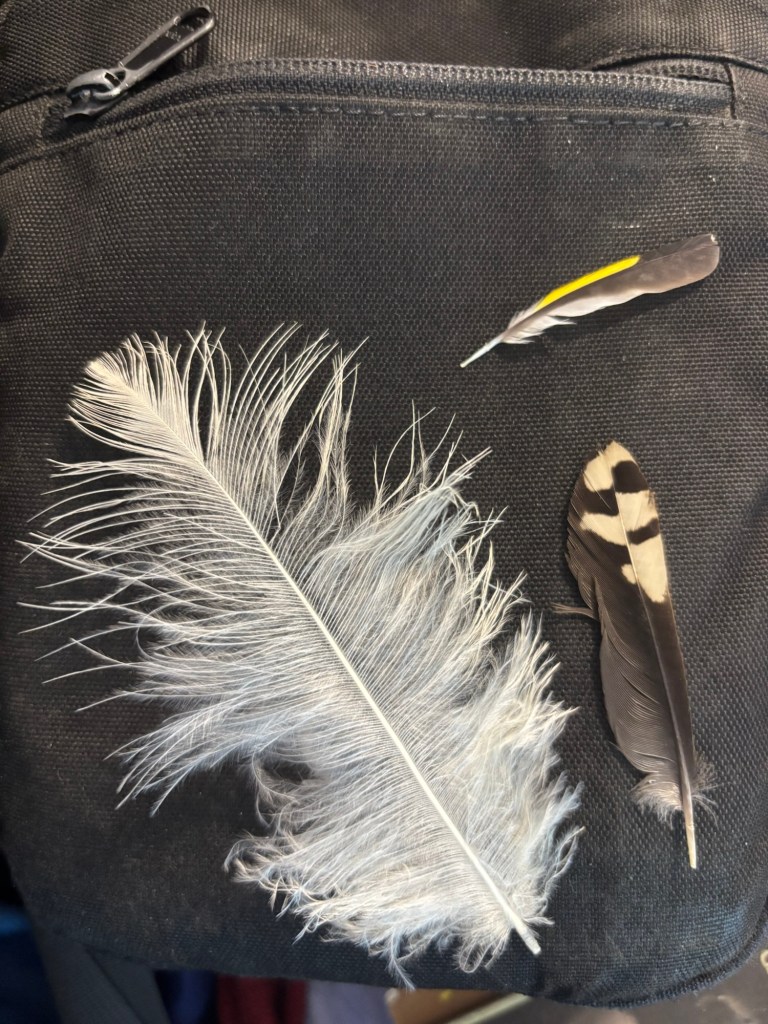
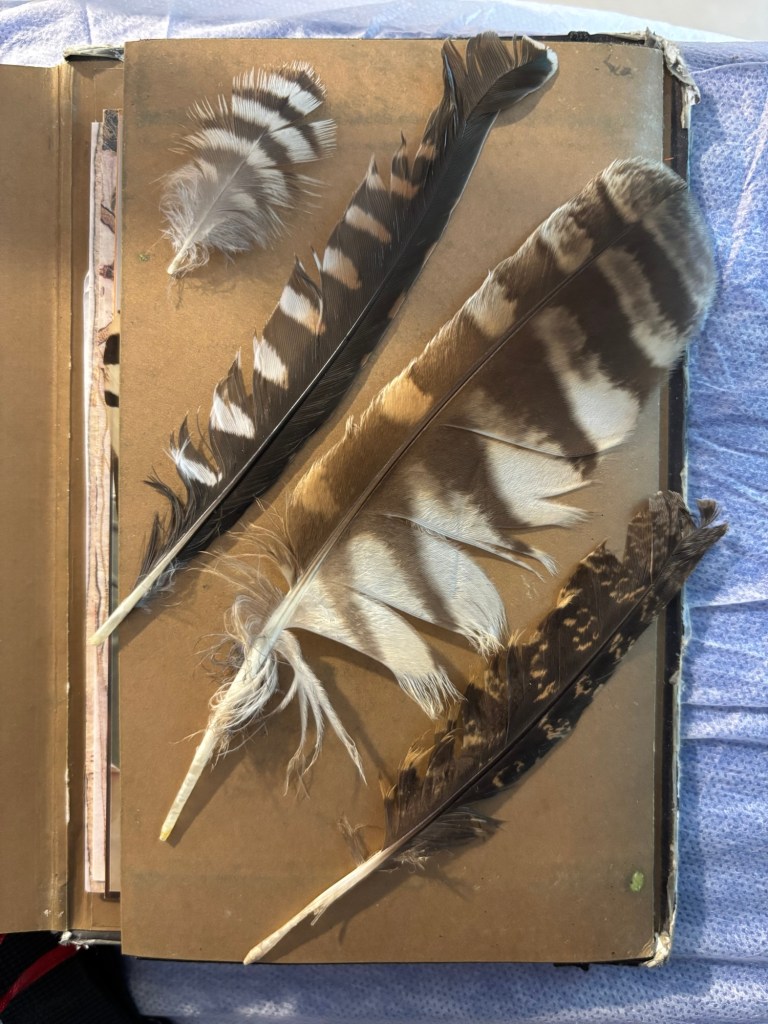
Instead, I thought I’d take you through my beautiful collection of feathers that I’ve found along the pilgrim road this year. None of them are quite as rare or as beautiful as the fossil scallop – well, perhaps one of them – but I know them and I know their origin. Each one tells a story.
Stashed away in my journal, the smaller ones: a tiny goldfinch feather (rescued from a spider’s web by Audrey, one of my American companions), a feather from the wing of a great-spotted woodpecker and the plume of a large white bird, either a stork or a great bustard, found beneath the flight path of the six birds I saw on my way to Frómista.
Also within the back pocketof my journal are four more finds, all from different stages of the Camino: a quail feather from the Aragonés, a kestrel’s wing from the Francés, a tawny owl’s downy flight feather from the dark forests of the Camino de San Salvador and a chest feather from the breast of a peregrine falcon, found in the cloisters of Lugo’s Cathedral on the Primitivo. It is surely this last that is the most emblematic in the collection, since the name Peregrine Falcon might literally be translated as “pilgrim” or “wanderer”. It’s a direct translation in Spanish (halcón peregrino), so to find such a thing as my journey draws to a close seems apt.
And then there’s the larger finds, the feathers that are too big to fit inside my journal, and so remain slotted into my rucksack during the day’s walk. The long and tapering black finger of a crow seems right, as this has been a familiar companion along the Primitivo, as is the small buzzard plume, and the black and white feathers of a white stork serve as a reminder of the Meseta and the town of Boadilla, where we lost our fearless German companion Theo to major foot complications. The other two have been with me since the very start of the Camino, discarded by a red kite and a griffon vulture on the rugby pitch at Bedous.
The largest of them all, the vulture, has been my totem on this trek. I found a similar one when I was a lad in the mountains of Andalusia, which I still possess to this day, but it has not been on the adventure that this one has.
I am rather attached to it. I find myself checking over my shoulder at least four or five times a day to make sure it’s still there. I sometimes feel I’d be more alarmed if it went missing rather than my watch or wallet – as though it’s been a lucky talisman of some kind.
Whatever it is, it once belonged to a proud and magnificent creature, and I have carried it with me for nearly a thousand kilometres. Through sun and rain and under the moon and stars. In the blinding light of the meseta and the towering shadows of the great cathedrals of Castile. Across sand and stone, hill and dale, moor and mountain – and, hopefully, to the end of my journey.
I don’t really believe in lucky talismans – I prefer to subscribe to the notion that the Creator has a master plan – but, like my faithful Niña and Pinta, they do provide some comfort along the road. The final hundred may yet be my greatest challenge of all, so I will need all the comfort I can get! BB x
Less than a week remains. I’ve been on the road for well over a month now. Thirty-six days, to be precise. Thirty-six days of the same morning routine, which I shall try to relate below.
Wake up at 4.45am. Sometimes an hour later. Pack away my sleeping bag and charger and scan the area to make sure I don’t leave anything behind. Go to the door and check for the essentials: passport, wallet, phone, sticks. Set out by 6am at the latest and have some kind of breakfast as I go: a Nakd blueberry bar, a Bolycao or a flat peach.
Some days I stop for breakfast. Some days I stop for a breather. And some days I don’t stop at all. Today was one of those days. Apart from a five minute pause in the shade, I walked pretty much without a break from A Fonsagrada to Castroverde – nearly forty kilometres over hill and fell.
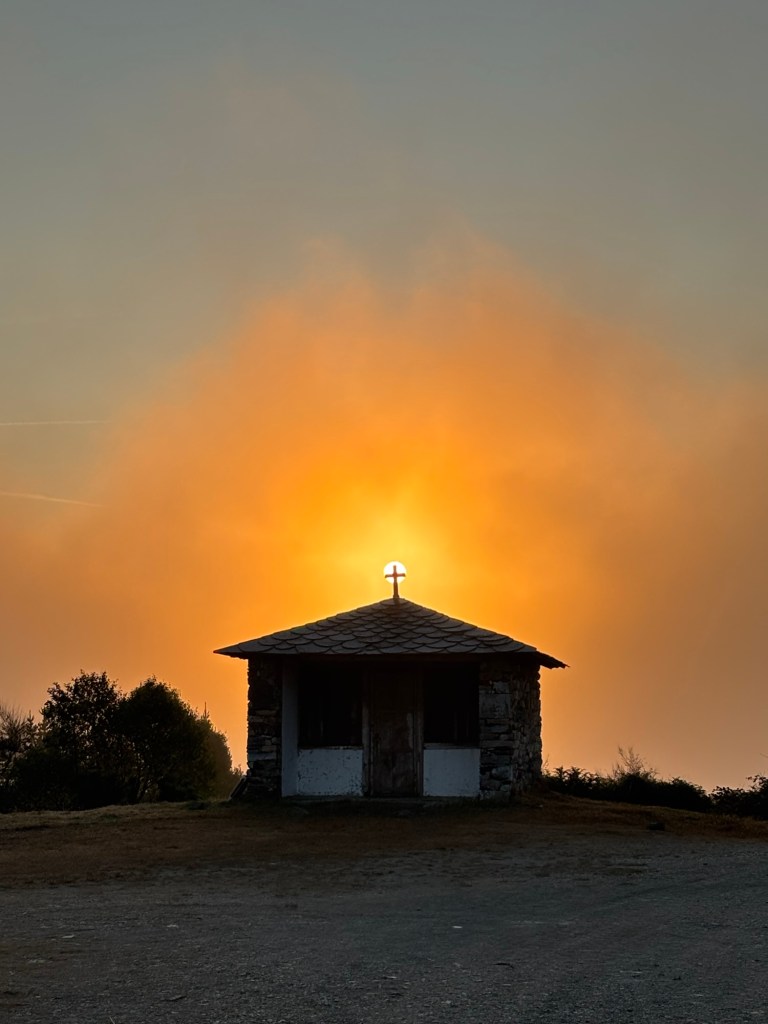
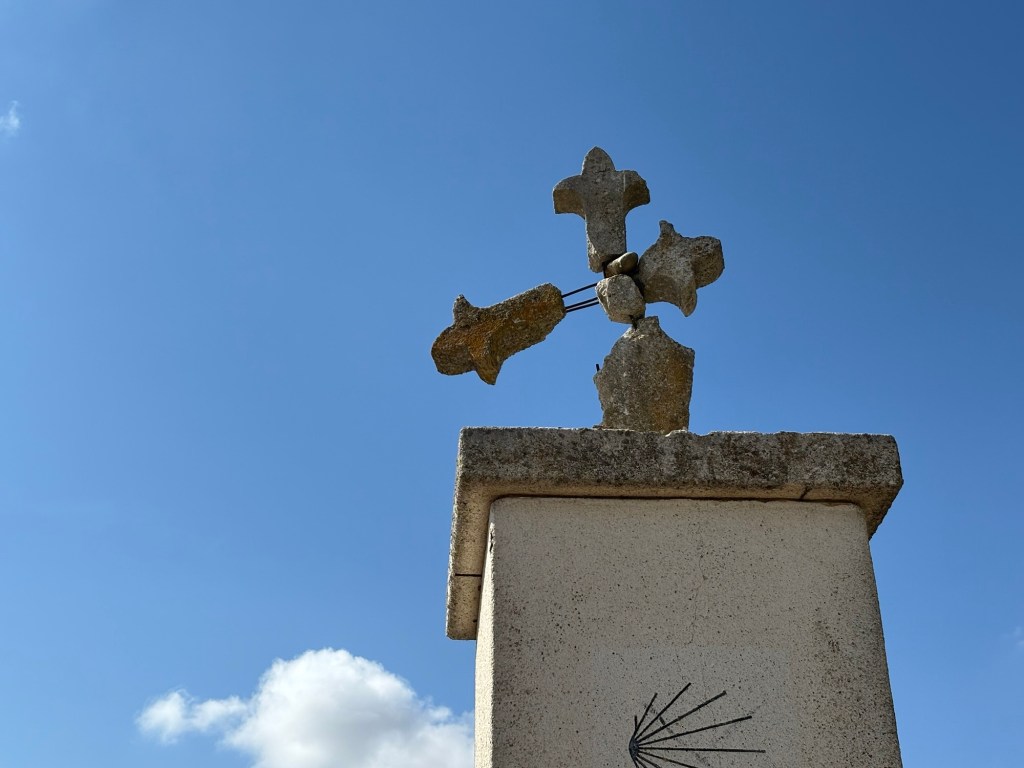
But I always make a brief stop when I reach a church or sanctuary – or, failing that, a cross in the wilderness. Prayer is an important part of my Camino, as it’s one of the few times I really feel connected to my faith.
I pray for the dead: for my grandfather José and my great-grandparents, Mateo and Mercedes; and I pray for David, the father of a dear friend who passed away earlier this year, in honour of a promise I made.
I pray for the living: for my companions along the road, and for the communities through which I have passed, as is often the request in some of the smaller and more devoted villages along the Camino. I usually add an intention for somebody or something different every day: the Italian girl too ill to go on, an inspirational teacher who came to mind during the walk, or someone I crossed verbal swords with at some stage or another.
Finally, for myself, I ask only that my steps be guided to Her, wherever She may be – the woman who will love me as much as I love her. She’s proving rather difficult to find, but prayers can be good for the soul, even if they don’t always deliver.
It is easily to be contemplative along the Camino de Santiago. So many hours alone on the road, with nothing but the songs of birds and the whistling of the wind in the trees above. I’ve had the familiar company of the characters from the Lord of the Rings for the last four days, but that saga ended shortly before I reached O Cádavo and I needed silence for the last two hours after that.
The timing was apt. The last third of The Return of the King is all about saying goodbye. Today I said goodbye to the mountains, crossing Montouto – the last of the high sierras on the Primitivo – shortly before eight o’clock. My feet will be thankful, but I shall miss the awesome beauty of being up among the clouds in the early hours of the morning. There is a silent magic in the mountains, colossi of stone that have watched the world grow around them since time immemorial. The Camino is an ancient road, but the land is older still, and the Primitivo takes you through some of the best of it.
I wonder if it’s the silent prayers that are answered more readily than the spoken ones? I have never prayed for good fortune with the wild things along the Camino, or on any of my adventures for that matter, and yet I have had such luck this year: nightjars, otters, vultures, wolves and that magnificent lynx. Some of it you could chalk up to practice, knowledge and stealth, or even just luck, but I like to think it’s earned somehow. Despite the heartbreaks I have had, I still tend to go into relationships with my heart wide open – and that has always been the case in my relationship with nature.
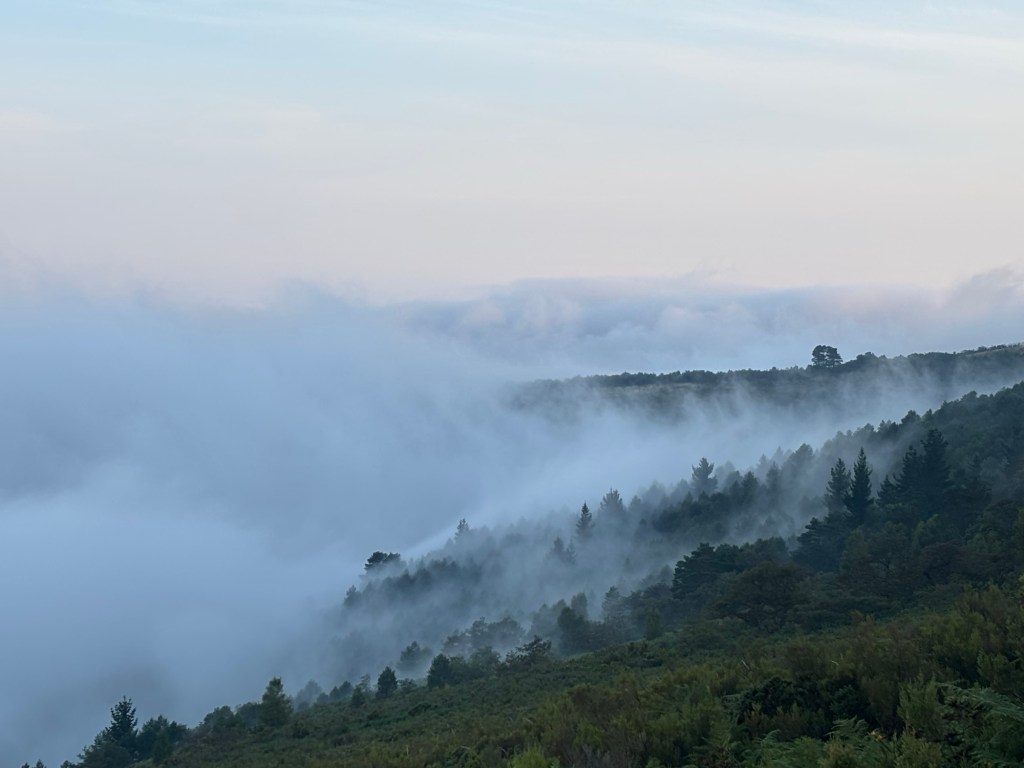
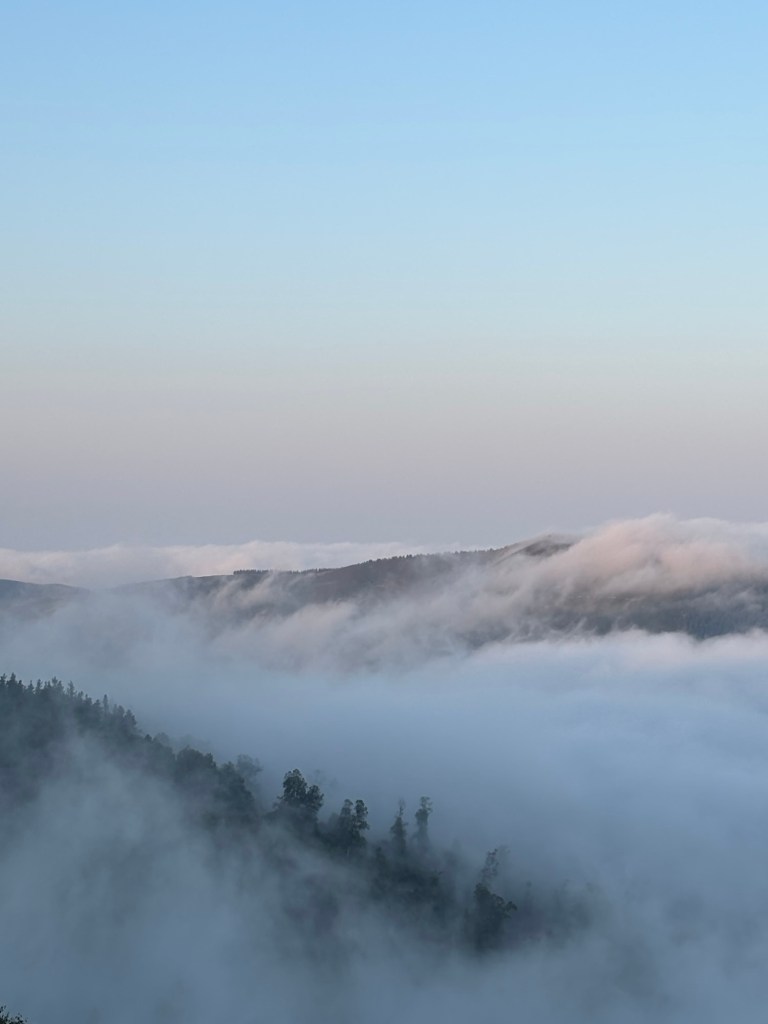
Watching the ocean of clouds roll across the valley and through the trees was enough to lift my spirits this morning. I forgot to say thank you in my prayers then, so I shall tonight. It isn’t every day you get to see such beauty, and we should always be grateful for such things.
In a month’s time, I shall be back at my desk. Planning lessons. Responding to emails and Teams messages. Worrying about this or that task that needed doing yesterday. I have been able to shut myself off from it all on the Camino – in fact, I’ve hardly given it much thought until today. What a beautiful panacea the Camino is!
I met an old friend in Castroverde today: Teodor, a Romanian pilgrim who I had dinner with in Monreal, now all of four weeks ago. I didn’t recognise him at first, but he recognised me. Curiously, he’d heard talk of me on the road a few days prior. How is beyond my guessing, as I’ve done several double days, so whoever it is who had met me has obviously been racing ahead. The Camino can be like that: a one-thousand kilometre long bubble.
I went to the local pool with him and the small group of young men in his train, but I didn’t have dinner with them. Teodor and the Danish doctor among them made for fascinating conversation, but the others were more interested in smoking and talking about how many ‘b*tches’ they could have been ‘doing’ on the Camino between awkward attempts to get the waitress to linger. I’m not a big fan of rakish behaviour, so I politely excused myself and had dinner back at the albergue.
Tomorrow I make for Lugo. It’s only twenty kilometres or so, so it’s a really light day, but my feet might forgive me the release after two forty kilometre stints back to back. I do want to get to Santiago with functioning feet, after all. BB x
Albergue de Peregrinos El Salvador, Oviedo. 19.27.
Ignore what I said yesterday. I’ve reached Oviedo a day ahead of schedule. There are a few reasons for this:
The Albergue in Pola de Lena was due to open at 15.30, some three hours after I arrived. The website was pretty vague about the need to book ahead.
The next town, Mieres del Camino, was about three hours’ walk on, but had no albergue – pilgrims are housed in the Residencia Universitaria for the princely sum of 25€.
The flights home from Santiago go up by about 50€ after the 10th August, giving me an incentive to pick up the pace, but…
…my feet could use a break after all that climbing, and speeding up is the last thing that I need.
Oh, and I’ve had three days without WiFi, so my data has been cascading faster than my Camino buddy Alonso could finish a watermelon.
Hopefully you’ll forgive me for catching a train for the last 30km or so from Pola de Lena. I have been walking about 25-30km a day every day for four weeks, and I used one cheeky bus ride on my last Camino to circumvent the tedious industrial estate west of León. This time it’s my own health I’m looking out for!
It’s a good thing I jumped the gun and climbed up and over Puerto de Pajares yesterday, as when I awoke this morning, it was to a fogbound world. The rain that was forecast never came, but in its place a thick blanket of mist had descended upon the mountains, obscuring everything from sight. It didn’t clear until around half past ten, by which point I would have long since reached the Asturian border if I’d stuck to my original plan.
Two of the sportygrinos left around five minutes before I did, but I never saw so much as a whisper of them on the trail, and I was making pretty good speed. I’d get to wondering whether some of these lean Spanish pilgrims take the Camino at a run, but there was no such trace in the mud, so perhaps they took a shortcut. Or went by bike.
The initial descent into the valley below was positively murderous underfoot, so Pinta and Niña came to the rescue once again. It wasn’t helped much by the knowledge that once I’d got to the bottom of the valley, I’d only have to go back up again on the other side.
The Lady of El Rocío sent me a gift to speed me on my way. A pine marten came scampering out onto the path as I started to climb, stared at me for a few seconds, and then went bounding off into the trees. I raced after it on stealthy feet, but it had vanished.
About an hour or so later on, as the Camino threatened monotony on a 5km asphalt stretch, she sent another gift in the form of a white raptor: an Egyptian vulture, the first I’ve seen in years, smaller than its griffon cousins but by no means less impressive. Between these two gifts and the cries of buzzards that followed me all the way to Pola de Lena, I was in good company all morning.
Something that caught my eye along today’s route was the quiet fury at the Asturian AVE line. The AVE (Alta Velocidad Española, Spain’s high-speed rail line) arrived late in Asturias, with works completed in November 2023. The project took nearly twenty years to complete, owing to the difficulty of the terrain – namely, the formidable barrier of the Cordillera Cantábrica. The first attempt to dig a tunnel through the mountains hit an enormous aquifer that drained many of León’s rivers and reservoirs, requiring rapid repairs and a considerable sum of money to re-route the tunnel.
All in all, the final cost of the AVE line from Madrid-Gijón was around 4€ billion. For context, the Madrid-Barcelona line cost around 9.5€ billion to lay down, which is just under twice the length, but there is considerably more traffic between the two megacities, and the Catalans have always benefited from their access to the profitable Mediterranean Sea. The Asturians, on the other hand, are proud of the natural beauty of their mountain principality and the decision to mine straight through the mountains does not seem to have been universally welcomed here.
I reached Pola de Lena at around 12.15 and killed some time over lunch (alubias con orejas, chuletón and natillas – and all for less than £10!). I had the same rigmarole with the train ticket as I had in France: the ticket barrier wouldn’t recognise the QR code on my phone, so as there was nobody at the desk, I just bought a 2€ ticket to the next stop. And just like France, the QR code worked perfectly at the other end. No idea what that’s all about.
Oviedo is a very different city to the ones you encounter on the Camino Francés. It feels distinctly more European than Spanish: large green parks, blocky, modern buildings and no plane trees in sight. I had to cross one such park to reach the albergue and practically stumbled upon a statuette of Mafalda, the beloved creation of Argentine artist Quino. She’s a big hit in her home country (and in Spain), but Oviedo has a special place for Mafalda due to the presence of her statue in the park. That’s why you’ll find Mafalda-themed tee-shirts and toys in shops all across the city.
I got to the albergue in time for 16.00, when the hospitalero hobbled in, but it was gone 17.00 by the time I got to check in – despite being only seventh in line. The poor guy seemed to have learned the monologue like a script which he rattled off at high speed, too fast for even the Spaniards amongst us to understand. The only point he was crystal clear on was that we had to be in by 22.00h, at which point he would close the doors. I suppose that must be a recurring problem in the cities.
I can tell you one thing I’ve noticed immediately about the Camino Primitivo. It’s a lot more European. I haven’t met a single American (or Brit, for that matter). Lots of Spanish, lots of French and a scattering of German, Austrian, Italian and Portuguese. But no Americans. I wonder if that’s a thing? Do they only come across the Atlantic for the “big ones” – the Francés and the Norte? The Primitivo is just under a fortnight (I will be doing it in around 10-11 days) so perhaps it’s not worth the investment. It will mean a serious shot in the arm for my languages – and isn’t that precisely why I love the Camino so much?
It would be remiss of me to come all this way and not visit the Catedral de San Salvador, so I slipped in for a flying visit just before closing time. True to form, the scaffolding curse struck again: the cathedral was untouched, but the image of San Salvador was behind a heavy hemp screen, being carefully restored by a couple of painters. There’s plenty more to see, though, and I had a wander around the sacred relics and the pilgrim tombs in the cathedral’s antechambers.
Just before leaving, my eye was caught by a small but incredibly ornate chapel by the exit to Santa Eulalia de Mérida, a teenage saint from Extremadura who is venerated in Asturias. She’s a long way from home, up here in the cold mountains of Asturias; but then, so was the Lady of El Rocío in that shrine by the lake west of Logroño.
I’m only just beginning to take an interest in the cult of saints in Spain – and I feel all the more foolish now for dodging an entire module on the subject at university. Given my especial devotion to the Lady of El Rocío, it seems a subject I really should explore some more. Maybe there’s a space for Eulalia in there. She would be a bridge to the land that stole my heart.
French to my right. Portuguese to my left. Spanish out in front. It’s shaping up to be a good Camino choice for languages. And if my plan holds out, I might even get to say one last goodbye to at least one of the pilgrims with whom I shared the road from Puente La Reina. New friends and old. That would be a nice way to end this adventure. BB x
Albergue El Jardín del Camino, Mansilla de las Mulas. 22.20.
I’ve developed my first blisters of the Camino, but typically for unconventional me, they’re not on my feet at all. They’re on my lower back, where the frame of my rucksack has been rubbing, despite my best efforts to adjust the straps. If I adjust them any further, I won’t be able to fit my arms through the straps, or take them out for that matter. I’ve put some Compeed over them and that has helped a little, but it’s a bummer to have to slum it with the rest of the world after such a glorious blister-free run of it.
We left Sahagún early, lingering for half an hour later than yesterday to take advantage of the breakfast left out by the Benedictine sisters and their volunteers. It was still dark when we set out – not as pitch-black as yesterday, but still dark enough to warrant the use of torchlight to find the signs here and there.
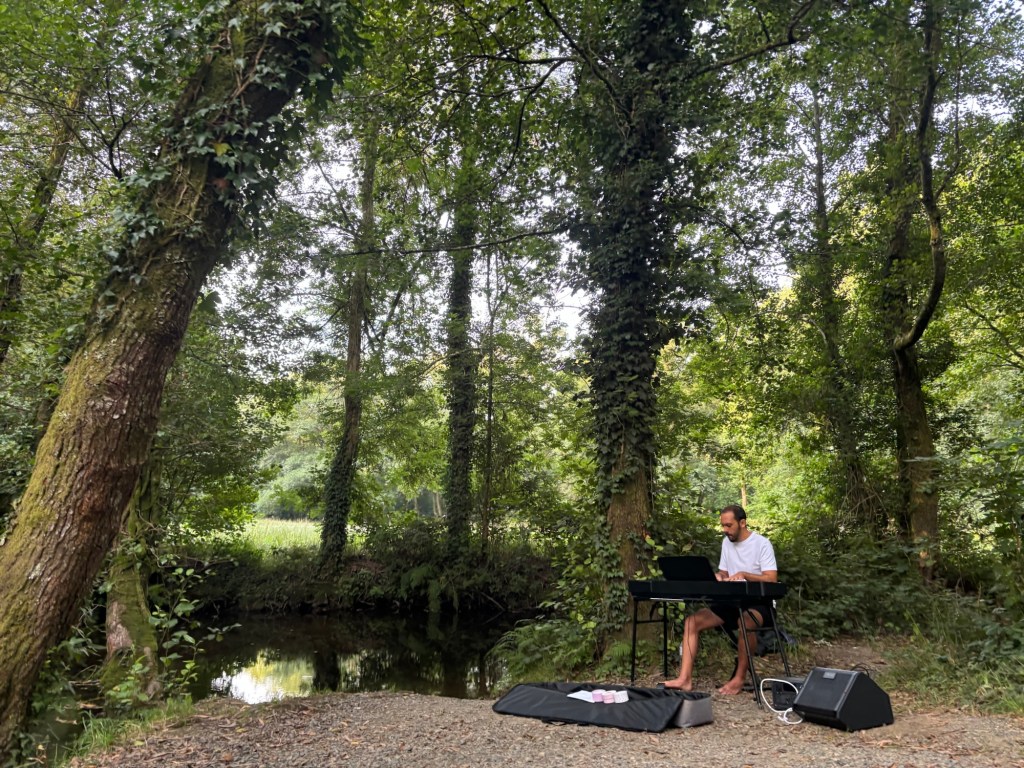
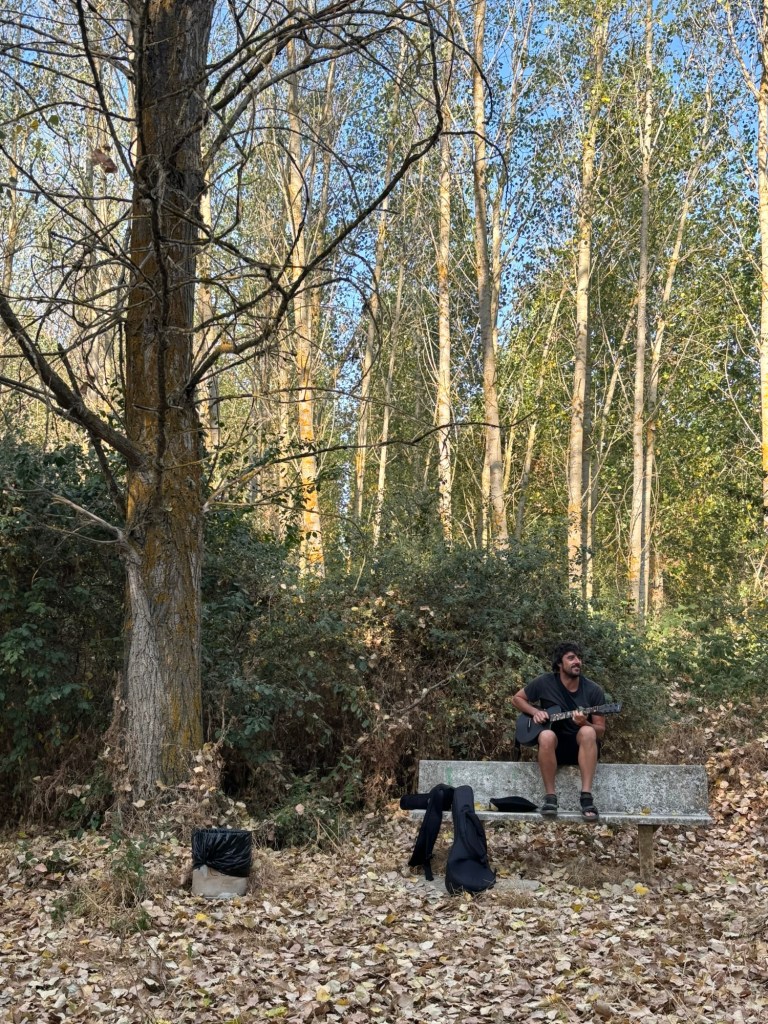
We passed Bercianos early and most things were shut, after which I started to get itchy feet and took off ahead. Along the way I heard the strumming of a guitar in a slim stretch of forest – a brief oasis in the golden fields of the meseta – and there I found Steven, a Chilean-South African who we haven’t seen for about a week. He’d found a solitary spot beneath the trees where the orioles sing to play his heart out. That’s something I’ll admit I’ve been missing a bit in this fun but busy Camino.
I stopped a couple of times during today’s walk to appreciate the silence of the meseta. There’s not much like it. I imagine the Dakotas might have the same sound – or rather, the same total absence of it. I suspect it’s that all-encompassing stillness that leads some pilgrims to abandon the Meseta altogether, fleeing the self-imposed stillness that surrounds you from the moment you leave the city of Burgos and step up into the golden highlands. I am not even out of it yet and I know I shall miss it when it has gone.
Today, as I have done on my solo strike-outs, I allowed myself a moment to listen to some music. Mostly from my favourite musicals so I could sing along (Jesus Christ Superstar, West Side Story, The Prince of Egypt and Fiddler on the Roof), but also my recordings from my various musical endeavours with my students over the years.
Rutherford House’s Rolling in the Deep and their house band’s covers of Stayin’ Alive/Without Me and Thrillie Jean. My short-lived Gospel Choir’s Ain’t No Rock. My new funk band’s one-day run atLauryn Hill’s Doo-Wop. I forget more than half of the lessons that I teach, but every rehearsal and every performance stands out in my memory like an island in a wide, wide sea. The voices of the children I have taught surround me like a vortex in the Meseta and I am lifted up by the smiles on their faces as they experience the same giddy thrill that the music gave to me when I was their age. It makes the whole thing worthwhile – the long hours, the nerve-shattering email and Teams threads, the windowless flats and the social life that I have sacrificed upon the altar of my calling for the last nine years of my life.
Without the music, it would all be for nothing. It would all be a mistake.
There’s all sorts on the Camino. Sane and insane. Students and soldiers. Culture vultures and racists. Free spirits, free lovers, free thinkers and freeloaders. People who seem to think it’s ok to slap stickers advertising their YouTube channels on every flat surface and people walking so fast they don’t have time to read. And yes, while many pilgrims blanch at the idea of singing together (barring the Italians, these are frustratingly common), there are plenty of us who leap at the chance to connect with others through the medium of music, the truly universal language.
I’m a little disappointed that the most popular Camino-related song one encounters along the Camino (besides Ultreia, Suseia) is a mawkish folk song in English called The Way that is currently being aggressively marketed in sticker form wherever you go. By comparison, even the Taizé songs that have now sunk their claws into the Camino are a breath of fresh air – at least they respect the multilingual world of the Camino de Santiago (which I refuse on principle to translate as “the Way”).
I’m having a much more spiritual time on the Camino this year. I’ve managed to attend Mass most days, despite traveling with a group of non-Catholics, and all the pilgrim blessings have been very special. Yes, I’m still a little annoyed by the rampant secularisation of the Camino and the way it gets treated as a big and sociable walk across Spain, as though that’s all there is to it… But every day is an exercise in tolerance and I’m doing my best to listen and learn.
I miss Spanish food. I’ve sacrificed my usual diet to facilitate the dietary requirements of my fellow vegetarian and gluten free pilgrims and it’s meant a lot of bland and global meals for the last fortnight. But that’s just one more lesson the Camino has to offer: life is all about sacrifice, especially if you live to serve, as I believe we do. Sometimes we have to give up the things we want the most – a job, a lover or even just a plato combinado – to make sure that those around us can be the very best versions of themselves. It isn’t an easy path, but I know that it is the right one.
Faith in its most literal manifestation may not be as ubiquitous on the Camino de Santiago as it once was, but it can always be found in the small actions and interactions of others. That gives me hope. My back might be hurting from the friction of the weight I’m carrying, but my heart is light. BB x
Albergue Parroquial de Santa María, Carrión de los Condes. 22.08.
Carrión de los Condes is a wonderful place. Which is odd, as it’s believed to have been named for the villainous counts who did their level best to defile the daughters of Rodrigo Díaz de Vivar in the Lay of El Cid, the (half) true story of Spain’s greatest hero. Even the proper name, Carrión, is an oddity: though it likely sprang from a mangling of the Latin name “Caro”, in its modern form, it carries a double meaning as a pejorative term used to describe somebody vile, useless or otherwise despicable. A carrion-eater, perhaps – one too weak and cowardly to do their own work, and happy or scavenge off the labour of others.
Which, curiously, serves as a good launch-point into today’s blog. Without putting too fine a point on it, I’ll paraphrase Hagrid from the Harry Potter films: not all pilgrims are good.
We left Frómista late (around 7.20ish) after making a valiant assault on the watermelon that Alonso bought last night. It made for a decent breakfast, but we couldn’t finish it all in one sitting, even between the four of us. We put it in the fridge for the benefit of other pilgrims coming after us. We were hardly out of the door when one pilgrim – who had been on the road with us for a while – appeared out of nowhere, made a beeline for the fridge, and took the melon for himself.
Well, that’s kind of what we intended by leaving the melon, right? So what’s the problem? As always, context is everything.
We cleared the 19km distance between Frómista and Carrión in a little over four hours, including a stop in Villalcázar de Sirga for an early lunch. It’s an easy walk, but easily the most tedious of the entire Camino, as it is an arrow-straight line that follows the P-980 highway in its entirety. Opportunities for wildlife observation are slim, and cultural tangents even less. It’s just a long walk in a straight line. At least the storks of Carrión kept us company. We also picked up a new companion in Edoardo, an effortlessly charismatic Italian soldier from Puglia, who was great company on the road.
The Albergue Parroquial de Santa María opened at midday and we were warmly received by the Augustinian nuns and their young assistants, three university students from Galicia, Madrid and Granada. Marta, the granadina, was especially friendly – though that may have been on account of my Andaluz accent which always comes out roaring the moment I meet someone from the south. Edoardo was almost certainly smitten and did his best to charm all three of them, but the granadina especially. I’ve seen a fair amount of bare-faced flirting from older gentlemen on the Camino, but the Italians do it with considerably more panache. It also helps when they’re not over the age of fifty, I suppose.
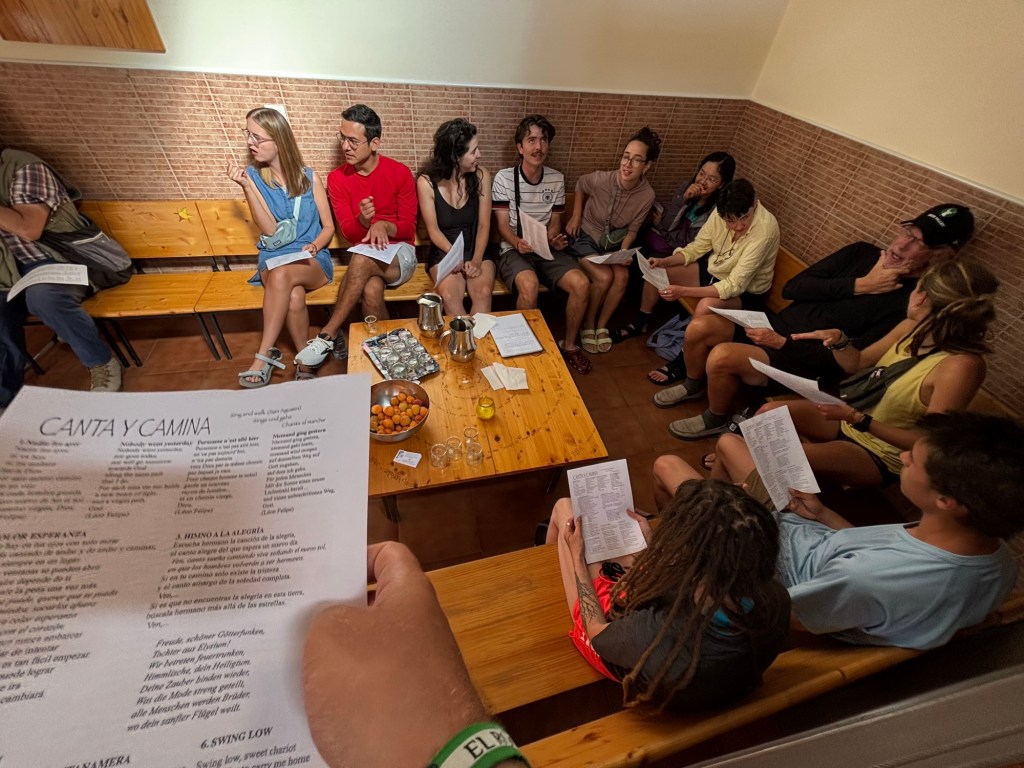
Vespers was beautiful, as Carrión’s nuns are famously musical, led by the vocals and guitar skills of the Peruvian sister (who was here the last time I stayed in Carrión). The encuentro musical was especially magical this time, because unlike Grañón, they asked us outright to share our reasons for walking the Camino. I did, explaining how I’m walking for my grandfather and my great-grandparents who never had the chance – but also as a way of saying thank you to La Virgen del Rocío, who was instrumental in curing me of a tremendously broken heart earlier this year.
And what did they do? They decided on a whim to play us a song for La Blanca Paloma, just for me – the Salve Rociera, known as Olé, Olé. What a beautiful thing to do! I’ve included the lyrics below, because they are so wonderfully poetic:
Dios te salve, María Del Rocío, señora Luna, sol, norte y guía Y pastora celestial
Dios te salve, María Todo el pueblo te adora Y repite a porfía Como tú no hay otra igual
Al Rocío yo quiero volver A cantarle a la Virgen con fe Con un olé…
Fizzing with the warm glow of a satisfied acolyte, I went along to Mass. It was… eventful, to say the least. The Bishop of Palencia was in town to conduct the proceedings, which – unbeknownst to all but the townsfolk – had kindled the fire of a small but powerful rebellion.
As was later explained to me by one of the parishioners, their long-serving and beloved parish priest was in the process of being transferred, and the locals – who seemed to adore the man with a fervour rarely seen in the UK – decided to use the arrival of the bishop to make their feelings known. There was a loud buzz toward the end of the service as the doors were flung open, and in marched a large crowd of children and their parents, all of them carrying placards and banners with slogans saying “La voz de la iglesia es la voz del pueblo” and “Queremos que Don Ricardo no se vaya”. The press seemed to have been tipped off, and Don Ricardo made a rather humble exit – I wonder what he made of the spontaneous show of fealty from his flock? It must have been hard to hide any emotion.
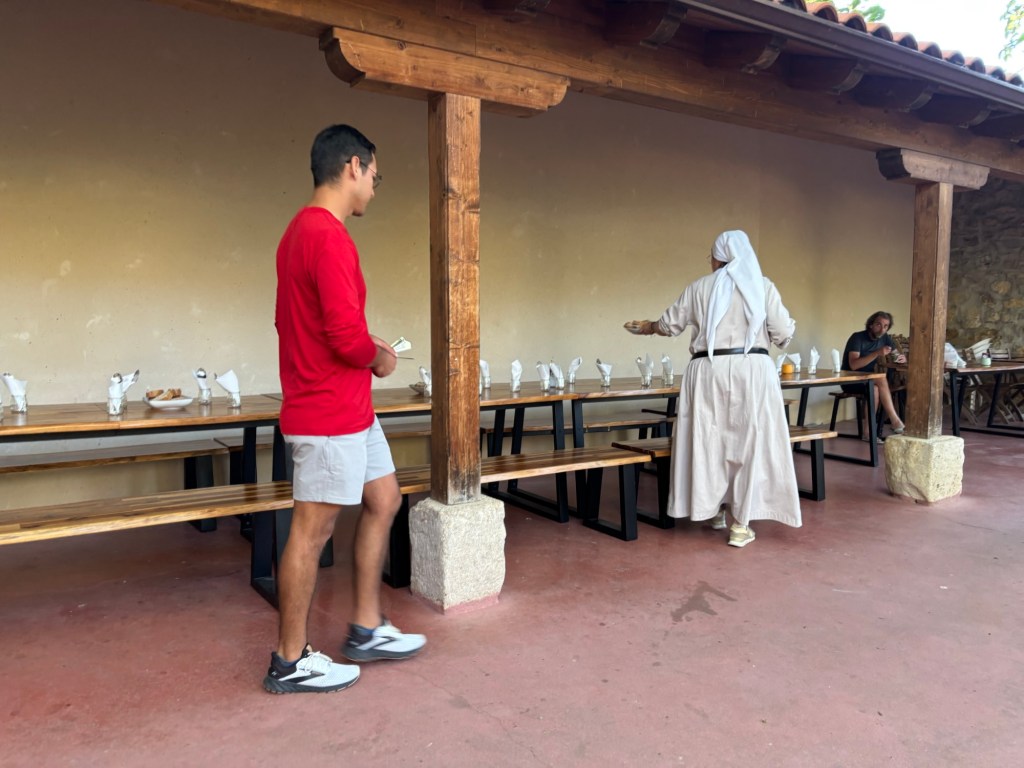
After Mass (and the mass protest), I went back to the albergue to help Edoardo make dinner – I cut and cooked the spaghetti and laid the table as the Italian had already prepared an enormous serving of pisto (free from gluten and meat, as it’s hard to cater to everyone with one dish). Together with the nuns and their three volunteers, we put out quite a spread.
And who should have arrived at our albergue at the last minute but our melon thief! He was conspicuous in his absence from the preparations and did not lift a finger during the clean-up operation, plugging in his earphones and retreating to the other side of the table – present but idle. Not only that, but while the nuns were saying a prayer, he got up and helped himself to seconds and then thirds of the soup the nuns had prepared.
Perhaps I’m being harsh, but this is the fourth time we’ve seen him do this: turn up to an albergue, contribute nothing, extricate himself from the communal preparations and then arrive just in time to devour the spoils, without so much as a please or thank you. Worse, he had the gall to comment that he didn’t think the meal was worth 4€ when the Italian asked for a small contribution to cover the costs of buying the supplies at the end of the supper.
I have spoken to the man previously – who, I am ashamed to admit, is a fellow Englishman – and he admitted that he doesn’t pay in donativos because he believes they’re already dodging taxes, and therefore don’t need our contributions. Which is odd, as he seems quite happy to scavenge off the contributions of others.
Shameful doesn’t cover it. I’m this close to confronting the man, which wouldn’t be in the spirit of the Camino… but if there’s one thing I won’t stand for, as a pilgrim and a teacher, it’s selfishness. I was raised to always put others’ needs before my own, so that kind of behaviour really sets my teeth on edge.
I prayed for him – partly to temper my own frustration and partly out of habit (it’s a good way to deal with people you don’t get on with). I hope he starts to see the light on this Camino and learns to chip in, like so many of us do every day along the pilgrim road, as it would be a dreadful shame if his behaviour cast a dim reflection on the English attitude toward the Camino.
Rant over. I just needed to point out that we pilgrims aren’t exactly model citizens. He’s not. I’m not. I should be the better man and not let it get to me so. But the Camino is the world, and thus have we made it. It’s up to us to call out that kind of behaviour in such a way that everyone feels they can contribute, even in some small way.
I’ll sleep on it. Hopefully I can come up with a way to bring him amicably to the service of his kin. Me, or some higher power.
Our Lady of El Rocío, if you’re listening… give me strength!
Albergue El Alfar de Rosalía, Hornillos del Camino. 20.03.
I was up at 4am this morning, probably due to the racket put up by the Koreans snoring next door. In any event, they were up and about with headlamps on by five and, since I couldn’t get back to sleep, I figured I’d get ready for the day, too.
It was as well that I did so. I had to intervene with a frantic Spanish woman in her fifties who was weeping into her phone with frustration because she couldn’t find the emergency exit that would allow her to leave the albergue before the main doors opened at 6.30am. I calmly pointed out the stairwell and a minor outflow of five or six similarly lost pilgrims followed suit, including Gust, the young Belgian lad we encountered in Grañón, and Lur, an enigmatic Basque girl with raven-black hair who has hardly said a word but who has been a feature of the Camino since Puente La Reina.
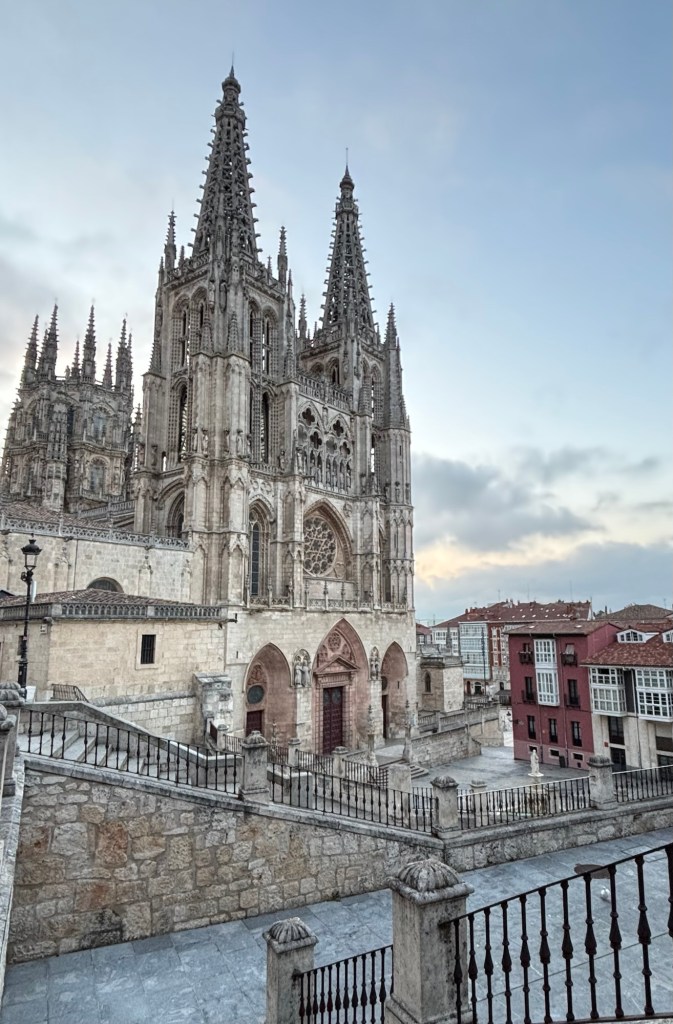
We said farewell to Alex after a last breakfast together outside the albergue and set off just after seven o’clock. Burgos’ Cathedral looked as magnificent as ever in the morning light, its twin towers visible for nearly four hours on the horizon after we left the city.
Leaving the city of Burgos is almost as laborious as entering it, but the west side of the city is a residential district and thus makes for a much more pleasant walk. An old lady redirected us near Villalbilla de Burgos, and while I don’t think it would have made an awful lot of difference if we’d kept going the way we were going, it’s nice that everyone around here id so invested in the Camino that they’re out to help.
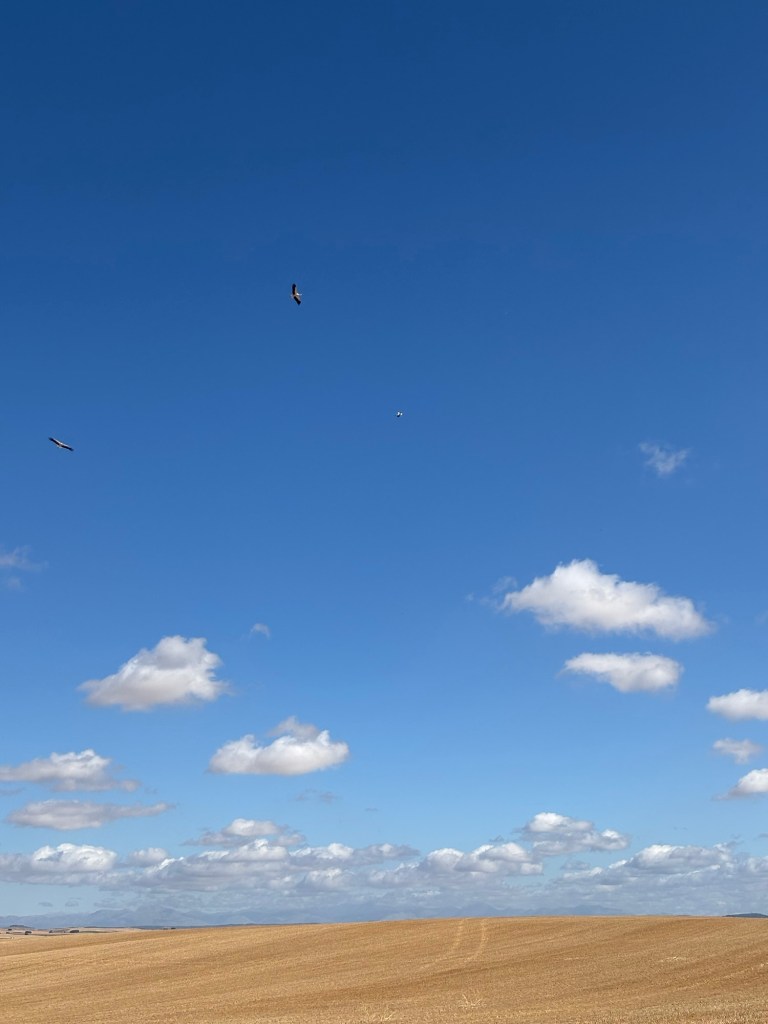
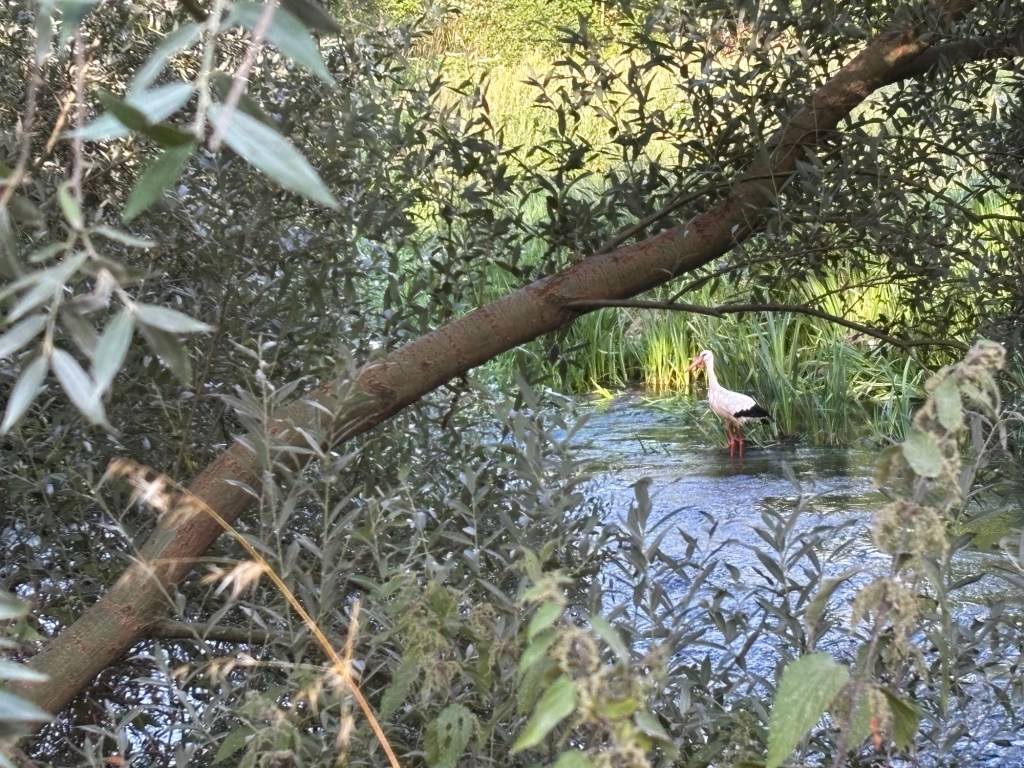
I found a couple of storks feeding in the Arlanzón river just after the crossing. They’re always so unaffected and untouchable in their nests atop the turrets and towers of Spain’s churches, so it’s not all that often that you encounter them in their “natural” habitat, where they are surprisingly wary and don’t let you get too close.
Tardajos’ church was open so I dropped in to collect the second stamp of the day, and a tip-off from pilgrims further ahead alerted us to a nun blessing pilgrims in Rabé de las Calzadas. The sister in question, a little old lady in her seventies dressed all in white from the Daughters of Charity, stood at the door of a little chapel on the edge of town, waving passing pilgrims over to approach. We went over for a blessing.
Spiritually, we’re a mixed group: a lapsed Catholic, a Reform Jew, an Agnostic and a Catholic who has found his way to God relatively recently. But for this last, this moment was one of the most magical of the entire Camino so far.
Taking us firmly by the hand, the Sister talked to us awhile about the spirit of the Camino and what it truly means to be a believer, in the least preachy way I have ever heard. Some of the would-be youth pastors I have worked with in the past would have learned much by her example. She quoted a poet who she could not remember (and I cannot locate) and asked us to go forward with the eyes of an owl, always searching, the heart of a child, always feeling, and the feet of a pilgrim, always walking.
Perhaps she was paraphrasing the Spanish poet Antonio Machado’s Olivo del camino, which has the following line:
Que en tu ramaje luzca, árbol sagrado, bajo la luna llena,
el ojo encandilado del buho insomne de la sabia Atena.
She gave us each a small token of the Lady of Charity, blessed us with a gentle hand on the forehead and sent us on her way. A purer soul on the Camino would be hard to find.
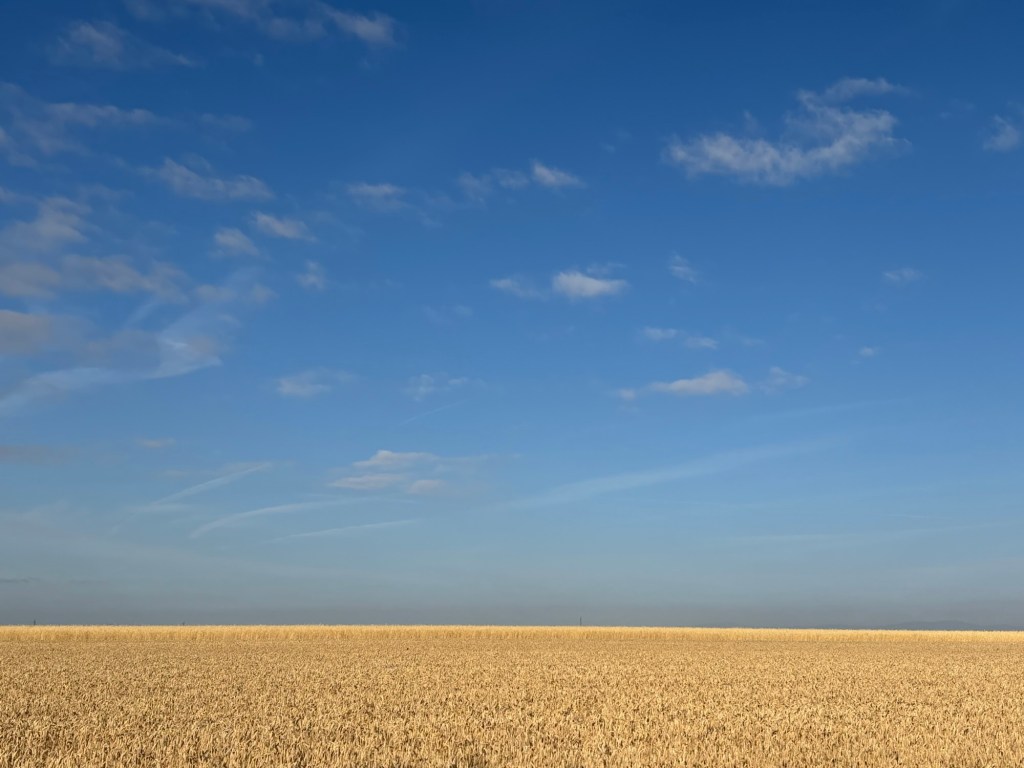
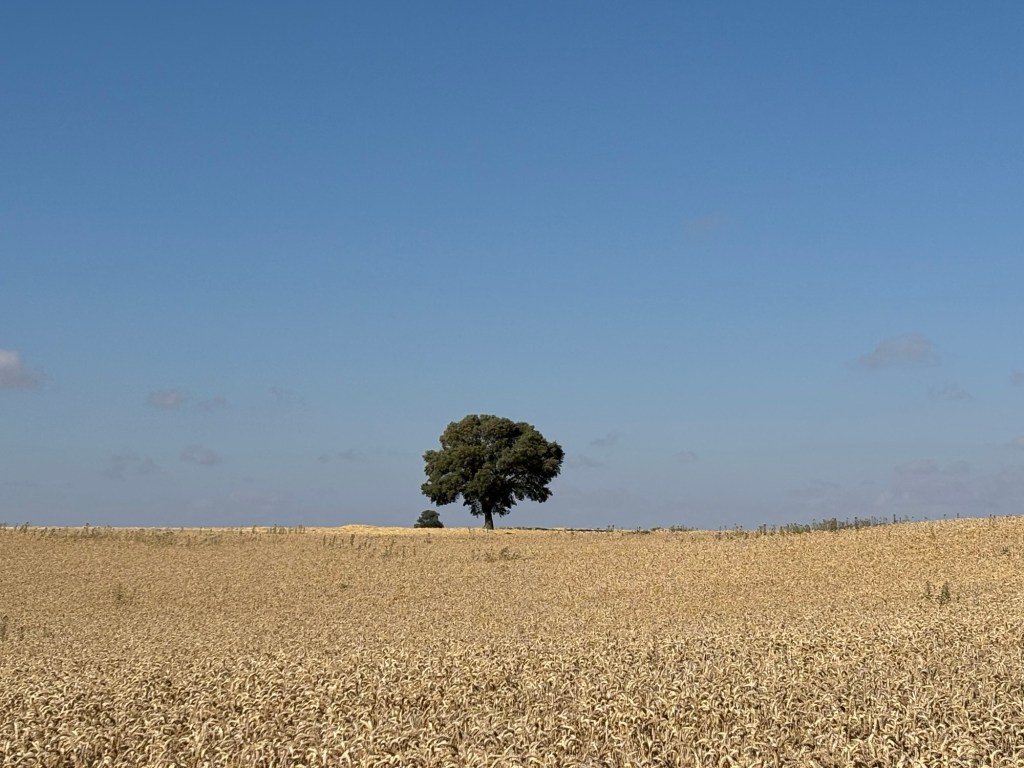
After Rabé de la Calzada, the Camino climbs up one last time and then the Meseta begins in earnest: a vast and unbroken expanse of gold beneath the immensity of the Castilian sky, pushed beyond the reach of man by a thousand generations of Castilian countryfolk.
It is hard to describe the true beauty of the Meseta when so many pilgrims describe it as the “hardest” stage. The “least interesting” stage. The “most boring” or even “the ugliest”. It is certainly true that the spectacular Pyrenean scenery of the first few days is now little more than a distant memory.
But to do so is to ignore the magic of the Meseta. The whistling wind in the golden fields. The gentle throb of the wind turbines on the hills all around. The near total absence of birdsong, interrupted only so often by the twitter of a linnet or the call of a quail. This is a road that can be walked with a companion, but is best walked alone.
For me, this is where the true Camino begins: the road inside, into your head and into your heart, with nothing between you and your thoughts but the sapphire sky.
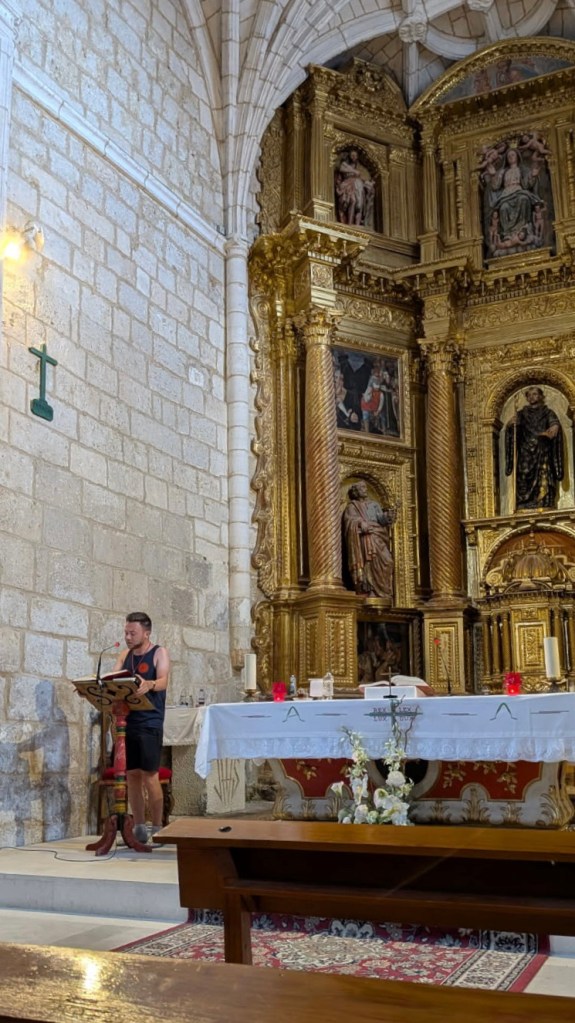
I was going to spend the afternoon writing, but I heard the church bells ringing for the afternoon Mass so I set down my things and wandered over. It wasn’t an especially large gathering, and I was the only Spanish speaker present until a small group of pilgrims from Urgell arrived, so I was called upon by the priest to do the reading. I could certainly have dressed more modestly, even though my options are limited out here, but I wasn’t expecting to be delivering the Lord’s word this afternoon, so… a sports vest, toe socks and Hawaiianas it was.
The reading was from Exodus, 11:10 to 12:14 – by far my favourite book of the Bible. For perhaps the first time in my life, I felt something in that church. It moved me. Not just the sacred words, but… something. Like a voice I could only perceive, that spoke to me without words. For a moment, I felt as though my great-grandparents and my grandfather were right there beside me. It was nearly enough to move me to tears.
When Mass was ended, the priest called us up to the altar for the pilgrim’s blessing. Everyone read the blessing in their own language. I read twice – once in English, once in Spanish. Spanish feels more natural for prayer – after all, if they prayed at all, that’s the language my ancestors would have spoken. And isn’t this all about a closer walk in their footsteps?
I have been on the road for eighteen days now. Twenty, if you count the day and night it took me to reach Oloron-Sainte-Marie and the start of the Camino. It has taken this long to find the spiritual side of the Camino for which my heart has been longing so. I feel more fortunate than ever and my heart is full of hope.
The Meseta stage can be a trial. It can deter many weary pilgrims, especially in the heat of the summer. But I remain convinced that it is where the unspoiled heart of the Camino can be found, in every sense of the word.
The way ahead is clear and my eyes are wide open. I shall follow that road, wherever it may lead, and trust in His plan, whatever that may be. BB x











 The Book of Barnabas