The starlings have finished their shift for the night and turned in their timecards. The yappy dog has taken over the night shift and is busy barking at every car that goes past. What the appeal may be in such scrappy scamps I cannot guess. If I worked in a profession that allowed me the time to have a dog, I’d want one that looked like… well, a dog, I guess. A wolf, moreover. Like a sheepdog, a collie or a wolfhound.
I’m thinking out loud. But that, I guess, is what blogging is for. Anyway. Here’s my account of Mérida, capital city of Extremadura, former heart of the Roman province of Lusitania, and the seat of the king in my novels.
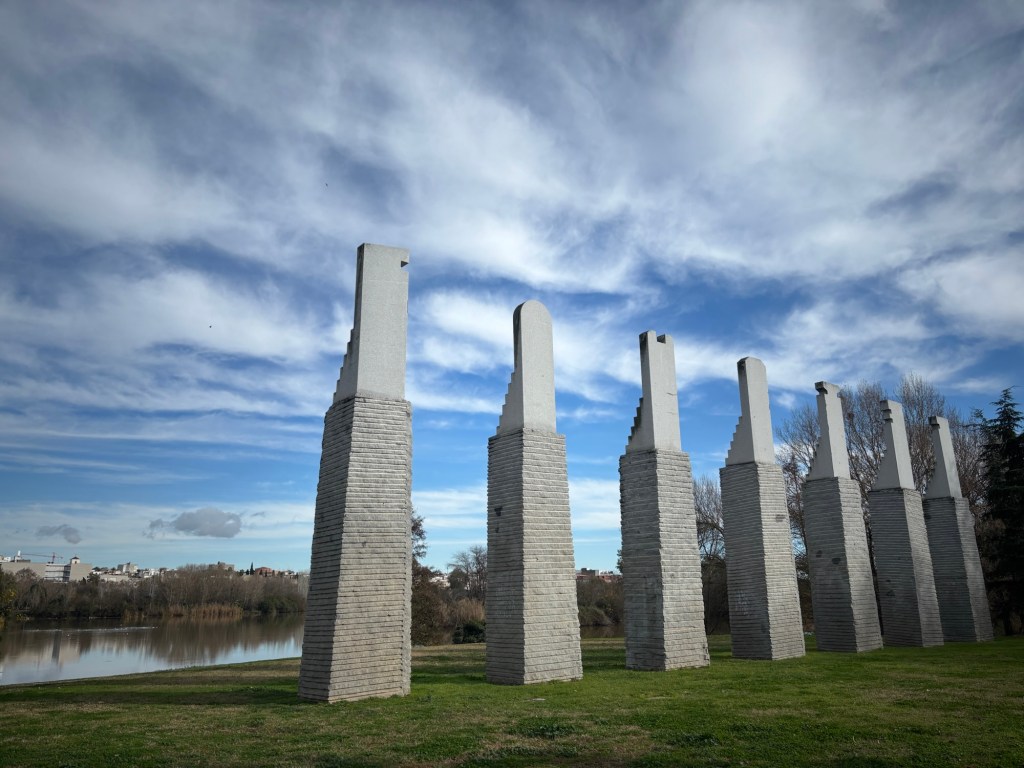
As you leave the bus station on the south bank of the Guadiana River, you’ll notice almost right away a cryptic row of sculptures on the riverbank. At first glance, they seem to spell out a word, but a closer look reveals that they aren’t letters at all, but rather figurative depictions of thrones (if they were letters, I suppose they might spell out “CEIOHAD”, which – besides looking more like Irish than Spanish – is about as easy to understand as the Muqattāt of the Qur’an).
They are the work of local sculptor Rufino Mesa, native son of Valle de Santa Ana, and they pay homage to one of Mérida’s most cherished legends: that of the Seven Chairs that once stood outside the city.
According to legend, these enormous block of stone were the seats of seven Muslim princes (or kings, depending on the teller), who sat upon these ancient thrones to discuss matters of state. Given the fractious nature of the various Berber tribes who occupied the Iberian peninsula during the period of the Muslim conquest and the ensuing Taifa period when Al-Andalus splintered into a network of warring states, it’s perfectly possible that such a drama might have played out at least once here.
Until the start of the 20th century, these seven chairs were still a visible feature of the city, sitting in a field a short distance from the edge of town: a strange but not entirely ignored feature of the city. The ring of stone had seen use as a bullring in the 18th century, and the story of the seven kings had evolved into legends of buried treasure, though no major excavation took place until the archaeological endeavours of Maximiliano Macías and José Ramón Mélida in 1910.
At the time, the site looked very different to how it does today:
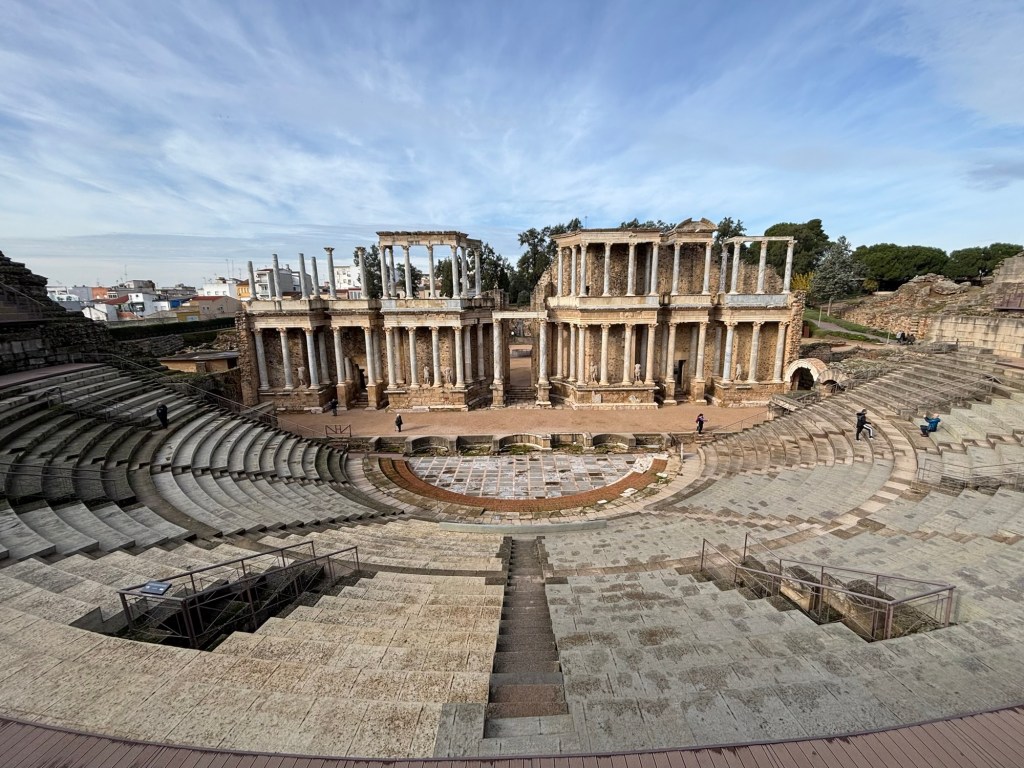
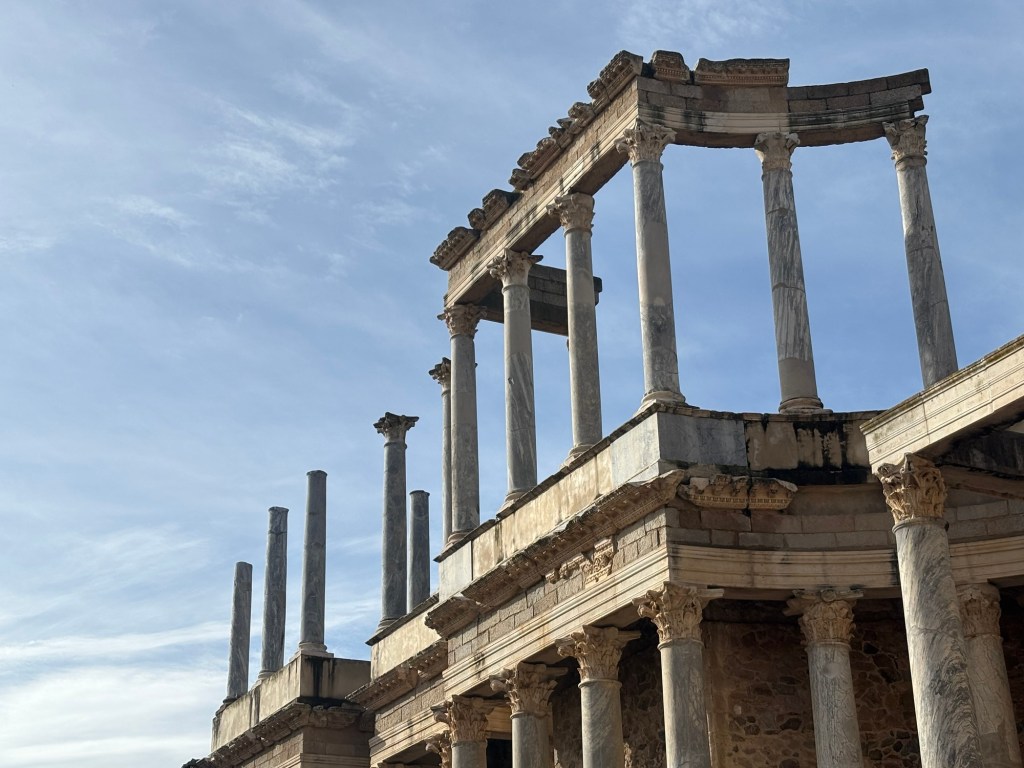
Digging deep, Macías and Mélida uncovered the roots of the seven chairs, revealing an enormous Roman theatre that had lain hidden beneath the earth for around fifteen hundred years. Its remains had long since been scavenged by the Visigoths and their Muslim successors for use in other constructions – such as the Grand Mosque of Córdoba, where there can be little doubt that many of its original pillars may be found – but the greater part of the foundations remained preserved beneath the earth.
It’s not quite as well-preserved as the Roman complex at Jerash, but then, Mérida sits on the bank of a great river – the Guadiana – and has been the site of battles both ancient and modern since the Teatro Romano was first built, and has therefore been a frontline city for much of its existence.
The modern reconstruction is an impressive feat, but more impressively still, it has been partially restored as a working theatre, hosting the Festival del Teatro Romano every summer. I’ve yet to see the festival with my own eyes, so it remains a bucket list item.
I spent nearly two hours wandering around the remains of the Theatre and Amphitheatre. I’ve been here before, of course – twice, at least, as I seem to recall a brief visit with IES Meléndez Valdés – but this place loses nothing in the rediscovery.
I caught myself touching one of the ancient slabs of stone and wondering what it would be like to be hurled backwards in time to the moment it was first laid there. I’m sure I’m not the first to have had that thought and I know I won’t be the last. The plethora of books both fiction and non-fiction on the Romans are proof of our ongoing fascination with the Roman Empire – even if it does come at the detriment of our interest in any of the other periods that followed (seriously, I’ve been to several bookshops now and I can’t find even one book on Mérida’s history between the fall of Rome and the Civil War).
I’ve more stories to relate, but I think I’ll split them up – Mérida has more than one story to tell. As the Córdoban scholar Mohammed Ar-Razi once put it:
No hay hombre en el mundo que cumplidamente puede contar las maravillas de Mérida.
So I won’t try to do so in a single blog post – or several. Instead, like the Visigoths, the Muslims and nearly a hundred generations of Spaniards before me, I’ll take what I can and use its bricks and mortar as the foundations for my own stories. BB x
Andén 13, Estación de Autobuses de Cáceres. 13.29.
That last post was a bit lacklustre. I can’t be at the top of my game all the time, but I’ll admit it is hard to write convincingly about my favourite topic – nature – when the rain kept me indoors for most of the day. I got out for a bit during the evening to have dinner at Mesón Troya, one of the restaurants in the square (usually a place to avoid in larger towns, but not so here), but beyond my short sortie beyond the castle walls, I didn’t get very far yesterday. Instead, I contented myself with watching the stars from the hilltop and counting the towns and villages twinkling in the darkness of the great plains beyond: Monroy, Santa Marta de Magasca, Madroñera, and the brilliant glow of faraway Cáceres.
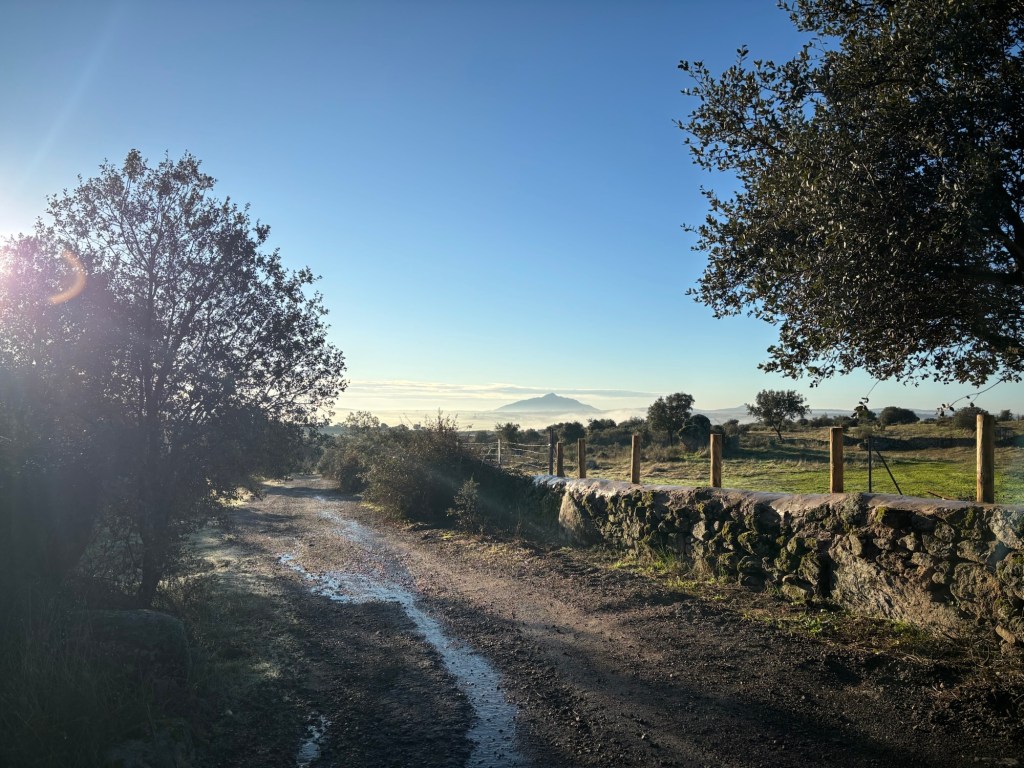
Morning summoned a slow sunrise into a cloudless sky. If I had brought walking clothes, I would have set out across the llanos on foot – but Chelsea boots, a smart winter coat and bootcut Levi’s jeans don’t exactly make for the most comfortable long-distance fare, so I erred on the side of caution and took a stroll into the berrocal – the rocky hill country south of Trujillo.
Idly, I set my sights on a restored 17th century bridge some five kilometres or so from town, but I was quite happy to wander aimlessly if the path presented any interesting forks.
My working life is so full of tasks that require forethought and planning that it’s nothing short of liberation itself to have that kind of absolute freedom that I crave: the freedom to do or not do, to turn back or to push on, to take this road or that, without any thought as to the consequences (beyond the need to get back in time for the bus). A freedom that becomes maddening when it’s taken away from me, like it was in Jordan, all those years ago. It’s a hardwired philosophy that I’ve become increasingly aware of as I’ve grown older, bleeding into my views on speech, movement and identity – and massively at odds with most of my generation.
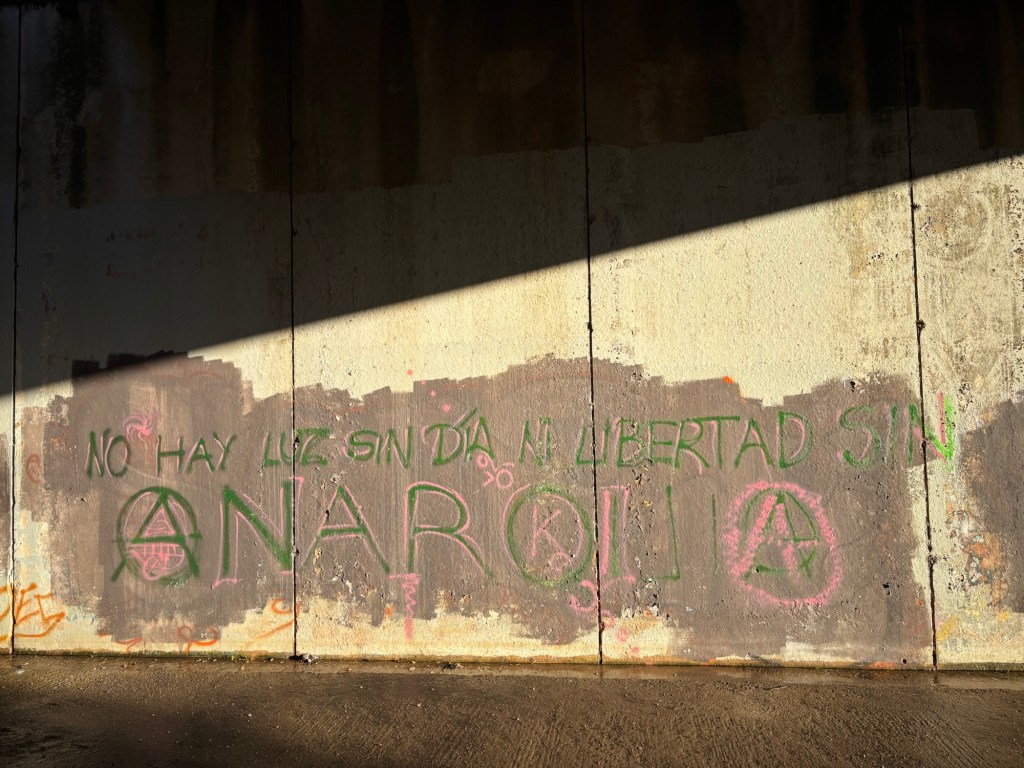
Perhaps it’s an inherited desire for freedom from my Spanish side: I do have family ties to Andalucía, a region that once made a surprisingly successful bid for anarchy, and my great-grandparents quite literally put their lives on the line to make a stand for freedom of thought under Franco’s fascist regime.
Or perhaps that’s just wishful thinking. Either way, it’s hard to deny just how important that sense of total freedom is to me. Maybe I’m more like the Americans than I thought.
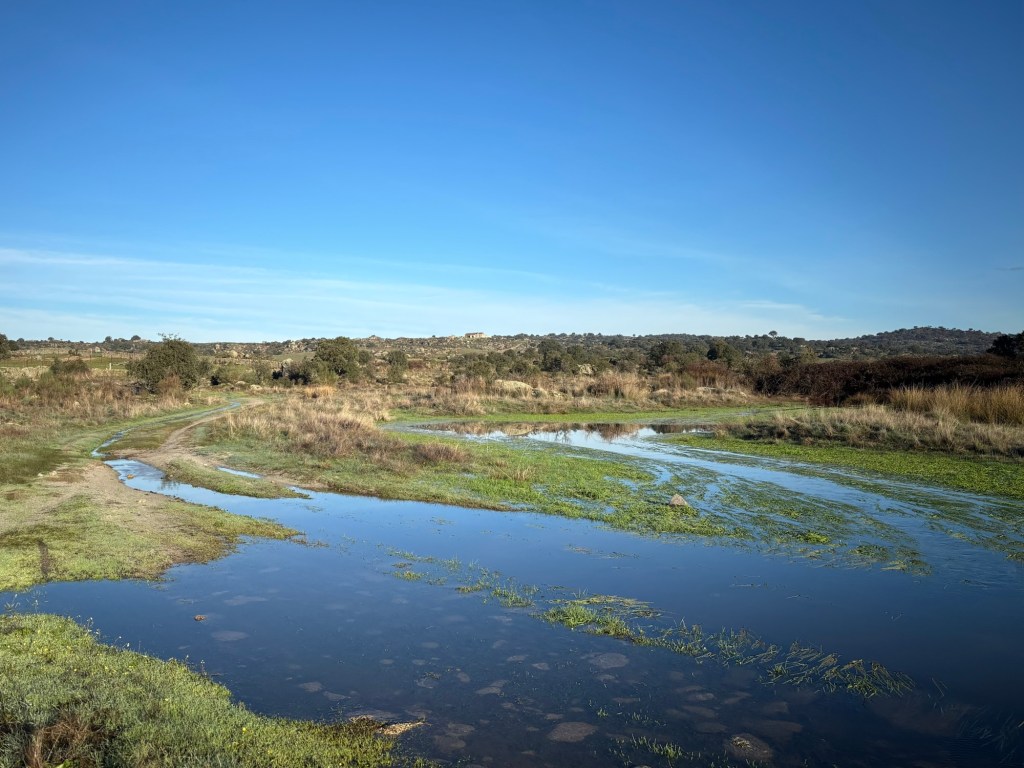
I didn’t make it as far as the bridge. The full day of rain from the day before had done more than dampen the sandy soil and form puddles and pools in the road. It had also swollen the Arroyo Bajohondo to the size of a small river. It didn’t look particularly bajo or hondo, but I didn’t trust the stability of the soil underfoot and didn’t fancy making way to Mérida with soaking jeans up to my knees for the sake of a tiny bridge, so I turned about and returned the way I had come.
Without a car at my disposal, I couldn’t make it out onto the plains, home to Trujillo’s more emblematic species (bustards, sandgrouse and stone curlews), but the berrocal was teeming with wonders of its own. Hoopoes, shrikes and stonechats watched my coming and going from the rungs of rusting farming stations, while woodlarks and skylarks ran this way and that along the stone walls that marked the boundaries of cattle stalls along the way. A flock of Iberian magpies kept me company on the way back, their jaunty black caps almost shining in the sunlight, and I nearly missed a lonely lapwing sitting in one of the fields – a curiously English sight in far-flung Extremadura – before it took off on powerful, bouncing wingbeats.
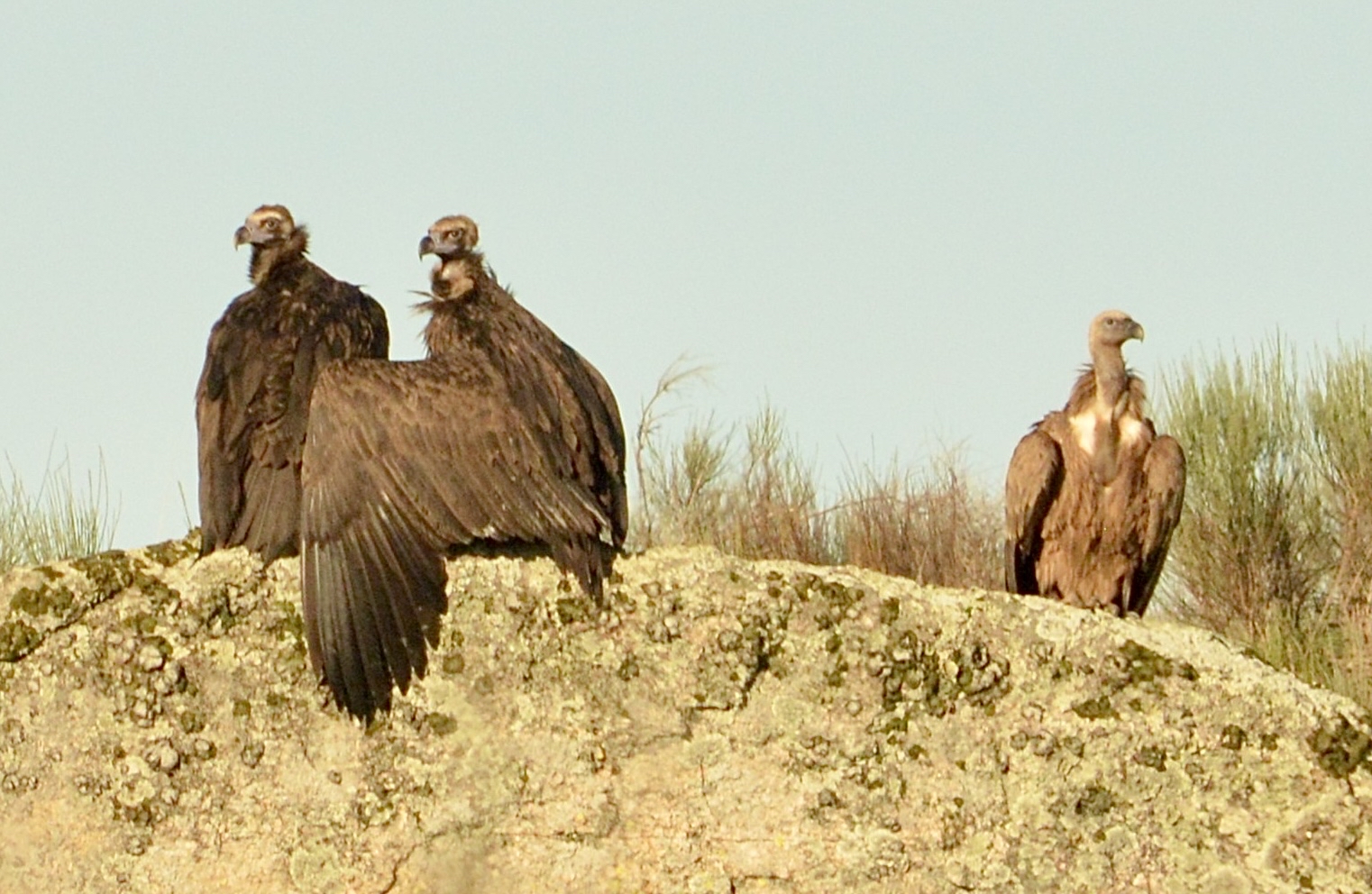
Speaking of powerful wingbeats, I was practically clipped on my way down to the arroyo by three hulking shapes that flew overhead. I clocked one as a griffon – there are few silhouettes I know better – but I had a feeling the other two might have been black vultures – something about their colossal size and the heaviness of their beaks. They seemed to have disappeared by the time I turned the corner in pursuit, which is hard to imagine for creatures with a wingspan of around 270cm.
A change in perspective always helps, however. I found all three on my way back, sunning themselves on a granite boulder not too far from where I’d first seen them. I suppose I’d have had my back to them on the way down. And what an impressive sight they are! Hulking great things, even if they were some way off.
Even with the full day of rain, I’ve scarcely had a moment out here where I’ve felt lost or alone. Spain works an incredibly potent magic upon me, whether it comes in the form of the music of its native language, pan con aceite y tomate, the immense blue skies of Castilla or the spectacular sight of its vultures, forever and always my favourite sight in the whole world.
I conveyed this jokingly to an old lady from Villafranca on the bus. She gripped my arm with a talon that the vultures might have envied and told me in no uncertain terms to “búscate un trabajo aquí”. It does feel like the universe is trying to help me to set things right and come back. But I have to get it right. I need this to work this time. So – fingers crossed.
If I could spend the rest of my life in the passing shadow of the vultures, I’d die a happy man. BB x
It turns out the rain in Spain does indeed fall mainly on the plain. And when it does, it does so with a Biblical vengeance. I made it to my hotel in Trujillo with just seconds to spare when the heavens opened. Any hopes I might have harboured of exploring the city’s surrounding countryside were swiftly washed away, as the rain came down all afternoon, all through the night and long into the following morning.
This would be a real downer if I’d had plans. But my itinerary is an open book and I’m always happy to improvise – it is my preferred method of travel. So I enjoyed a late morning, a proper breakfast and the blissful quiet of one of Spain’s most beautiful (if isolated) towns.
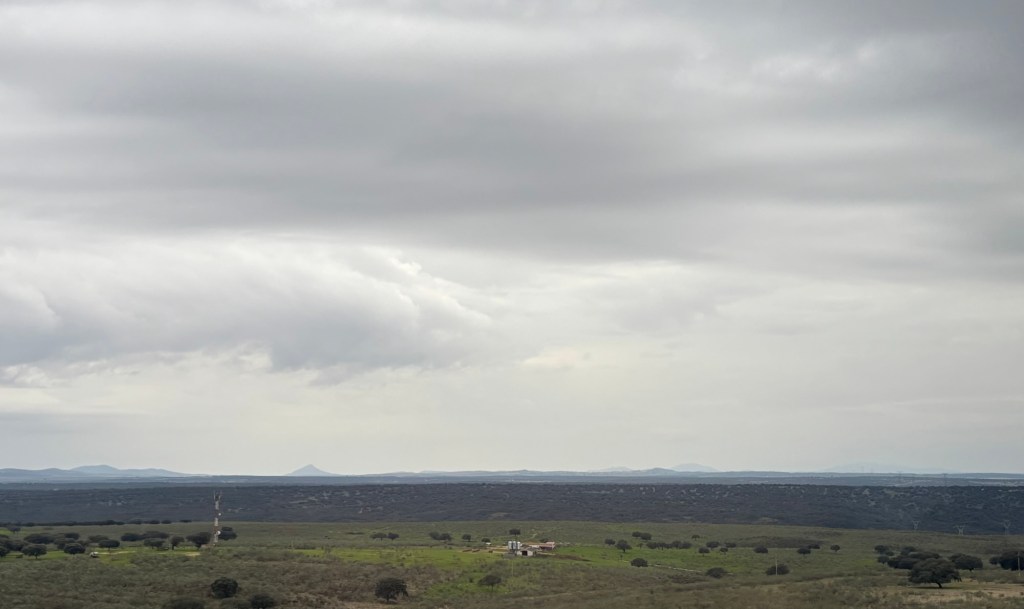
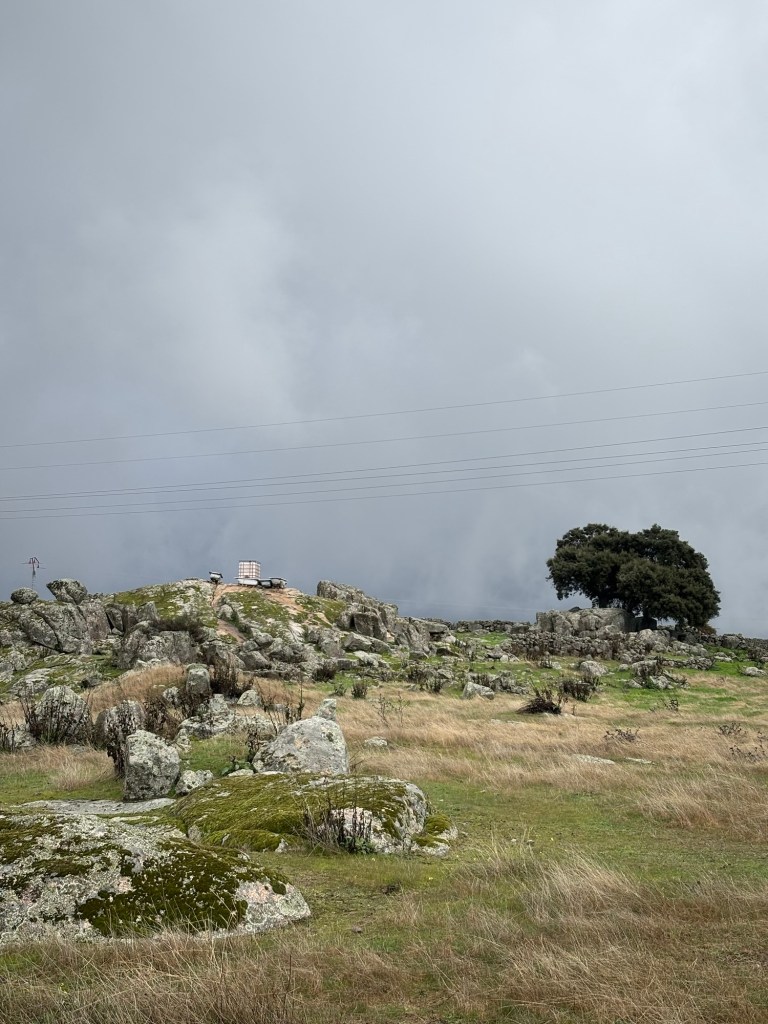
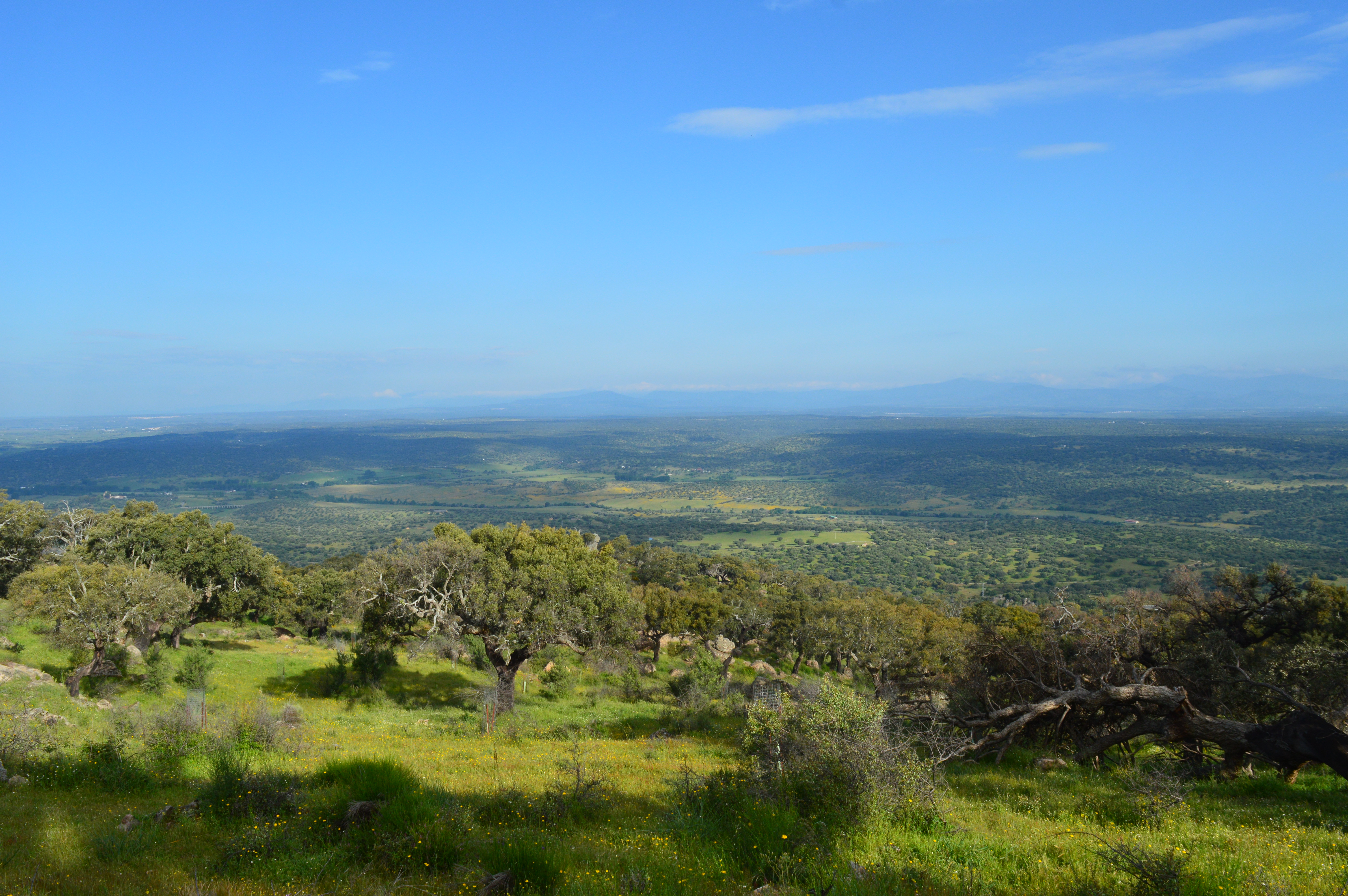
Trujillo sits atop a small granite ridge in a boulder-strewn corner of the Llanos de Cáceres, a vast and featureless steppe that stretches between the Sierra de San Pedro in the west and the Ibor Mountains to the east. There’s nothing like it in Western Europe. You’d have to go as far as the Puzsta in eastern Hungary to find anything close to its vastness. Lichen-covered granite boulders rise out of the earth like giant’s teeth and the odd tree stands alone in the fields, but beyond that, it’s like staring into the infinite.
Little wonder, then, that Hernán Cortés and Francisco Pizarro – both native sons of this part of the world – set their sights on nothing less than the horizon – they’d had no choice but to do so since the day they were born.
Extremadura can be a desolate place in winter. It can be pretty desolate in summer, too, but there is a virgin beauty in its isolation. By avoiding the grasping arms of the hordes of tourists who have strangled much that remained of Old Spain into submission, Extremadura has managed to hold on to the embers of an ancient fire which exists only in the memory of those living among the tower blocks of the southern coast.
Perhaps that’s why it’s often considered one of the main contenders for the Birdwatching Capital of Europe, since so many rare and otherwise elusive species still flock here in droves, taking advantage of our absence to go about their lives as their ancestors have done since before we came to this land.
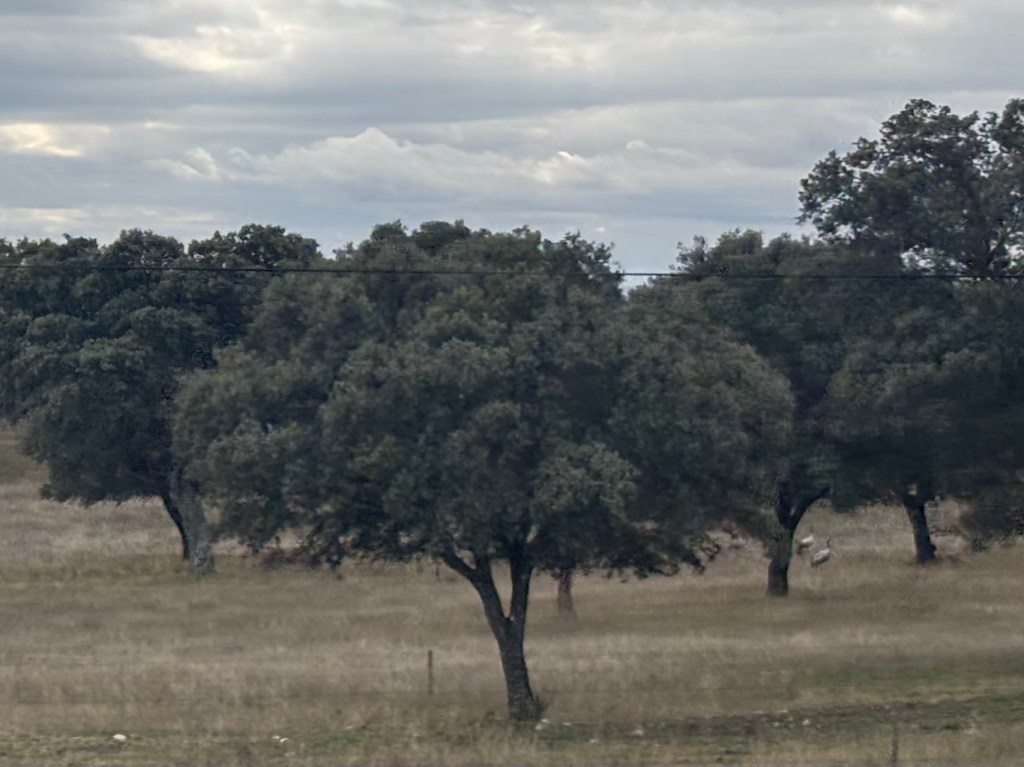
You can see some of that without even leaving the motorway. Every winter, more than 75,000 common cranes travel from their breeding grounds in Northern Europe to this remote corner of the Iberian peninsula. They spend the colder months in the shade of the dehesas, feeding on acorns. They’re a rather common sight if you look beneath the trees, and at over a metre in height, they’re hard to miss.
When I first came to Trujillo in the spring of 2016, I promptly fell in love with the place. It wouldn’t be the first remote corner of Spain that’s stolen my heart – El Rocío and Hornachos are up there – and it won’t be the last. It’s found its way into my saga as the elected home of my hero, partly out of practicality and partly out of a sense of wish fulfilment on my part. Half of me wishes I’d been brave enough to flat out ask to be sent here for my second British Council placement back in 2017. It would have been a lottery, of course, but what would it have been like to live here, I wonder? Trujillo is a lot smaller than Villafranca de los Barros – and a lot more out of the way – but infinitely more scenic.
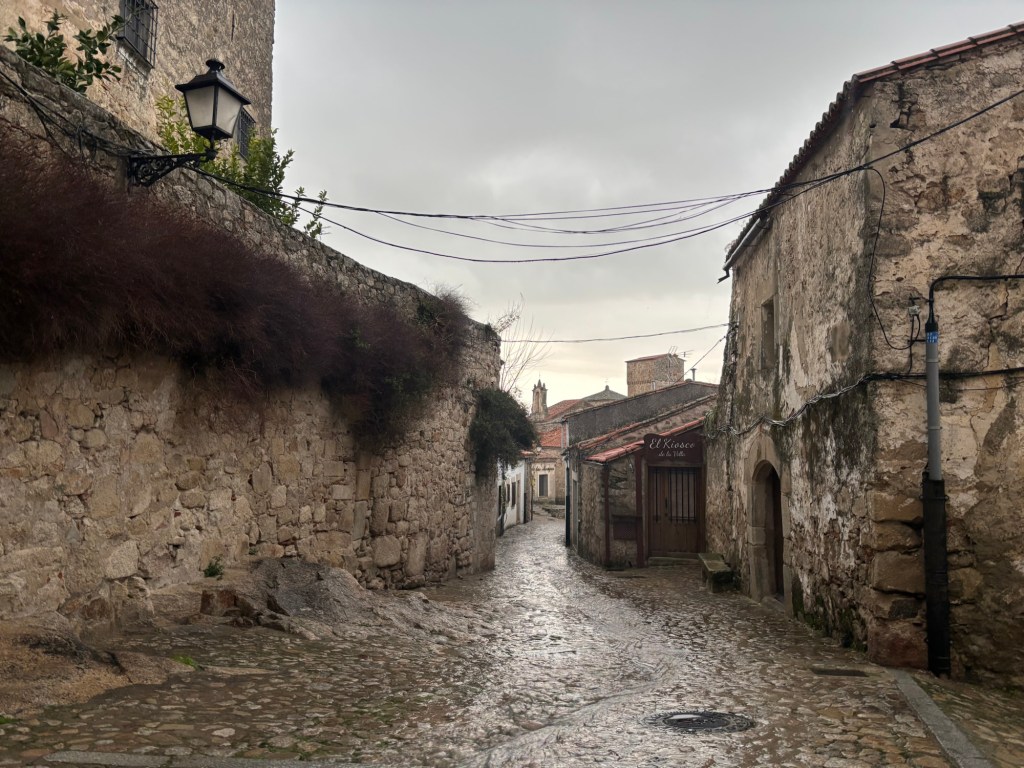
I managed a short reccie to the north of town, before the skies turned dark once again and I had to admit defeat and return to the hotel. The cobbled streets running down from the hilltop had become rivers in their own right. It wasn’t yet siesta time, but nobody else was out and about. And with good reason!
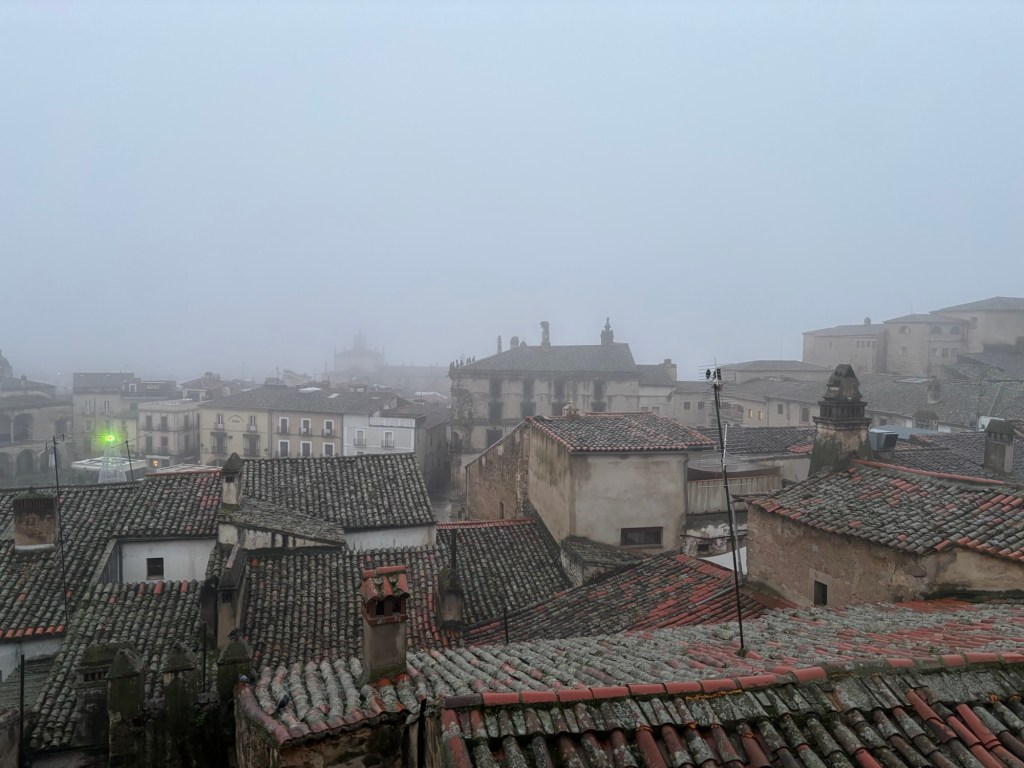
From my vantage point on the second floor of the hotel, I can see out across the plaza and the rest of town. There isn’t all that much to see, with the rain clouds obscuring most of the world from view, but when the sun is shining, you can see straight across to the pyramidal Sierra de Santa Cruz – and the town at its feet, curiously named Santa Cruz de la Sierra (I’m not altogether sure which came first).
If the weather had been kinder I’d have set out at first light and tried to reach the old Moorish settlement at its summit… but then, I haven’t exactly come dressed for a hike. Perhaps it’s for the best that I have had a day to take it easy in Trujillo.
Tomorrow is a new day. 0% chance of rain. I don’t need to rush off anywhere, so I might go for a stroll after breakfast and try to soak up the countryside while I’m here. BB x
I have a confession to make. For a wannabe author, I’ve always been rather guarded about my stories. As a teacher I make no secret about the fact that of my various hobbies I love writing best of all, above drawing, above being out and about in nature – and, yes, even above music. Why? Because writing is one of the few things in the world that you can truly call your own. You can’t compare your voice to somebody else’s any more than you can compare your ability to think. But, for all the show of carrying a journal around and self-consciously dropping into conversation now and then that I write for pleasure, I don’t really talk overmuch about my books.
There’s a couple of reasons for that. The first one is simple self-defence, the fear that somebody could steal your ideas and tell your own stories as though they were their own. Laugh if you will at that idea – what story hasn’t been told and retold a thousand times over since the dawn of time? – but an incident involving my artwork, DeviantArt and an alarming case of identity theft back in my schooldays has left me cautious about putting my work out there. In that case, I was lucky that the thief had been indiscriminate in their robbery: though some of the drawings they claimed as their own were odds and sods from the novel, more than a few were portraits of friends from school, so it wasn’t just my intellectual property on the line. Together with some friends, we kicked up a fuss and had the thief’s account taken down. To their credit, DeviantArt were pretty quick. I don’t suppose I’ll ever know who the culprit was, though reason tells me it could only have been somebody I knew. I learned a valuable lesson, though: art is easy to steal.
The second reason is the simplest one: there’s just too much to say in one sitting. I can see that on those occasions when somebody leafs through one of my journals. There’s so much going on in there and none of it in any particular order, and without a map, you’d never know where to start. Entering into a writer’s world is probably a rather daunting experience, like arriving at a house party and finding you don’t know any of the guests. You could try. You could sum up the Lord of the Rings saga by saying it’s all about a quest to destroy a magical ring, but that leaves out the silent terror of the Mines of Moria, the treachery of Gollum and the mournful autumnal kingdom of the elves; the details that make the world come to life. Story-telling is a necessarily one-sided pastime, and since my day job places such an emphasis on listening, my favourite hobby is something I try to avoid at all costs, because it feels selfishly out of sync.
Today, I’m going to break a habit. I’m going to let you into my world.
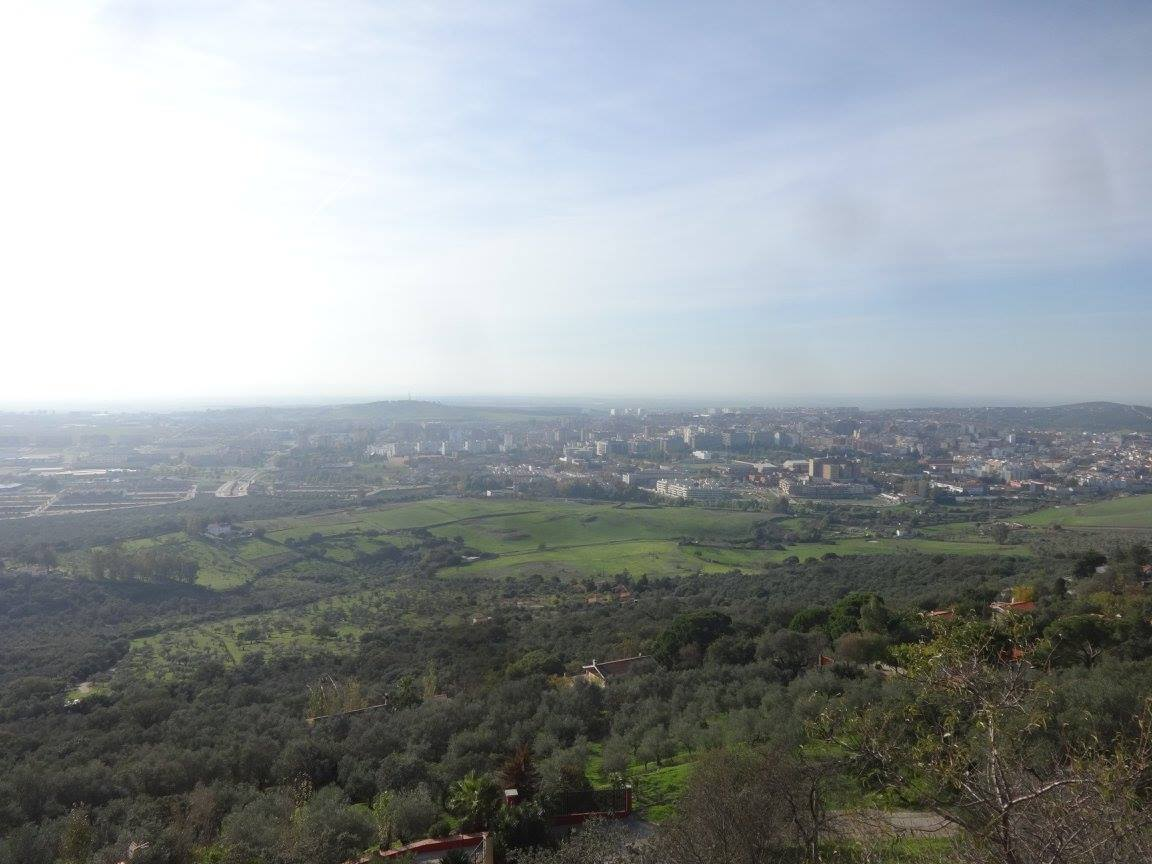
We can start where it all began. Where it all began to take shape, I mean. According to my journal, that was at 15.30 on Friday 13th November, 2015, on a rocky outcrop beside the Santuario de Nuestra Señora de la Montaña just outside the city of Cáceres. I’d been writing “the book” for about twelve years by then – I can trace the first draft back to 2003 – but it was here in Extremadura that everything suddenly fell into place. As I looked out across the plains of Cáceres and upon the city thrown into shadow by the setting sun, something magical happened. It was as though I was staring at a giant jigsaw puzzle that was suddenly arranging itself into perfect order before my eyes. I wrote myself a note in my journal – “What might this place have looked like in the 1600s?”. Sometime later I pencilled in two words above that line: “it begins!”.
And so it began. The cast of characters I had carried in my head and in my heart for over a decade moved to Spain, and the kingdom of Meridia was born.
Picture a corner of the world where the fields go on forever. A land of immense blue skies and sparsely-populated hill-towns, clustered like barnacles about the few slopes that rise out of the motionless sea of earth, where the merciless sun comes down with unfettered fury in summer, and in winter, chill winds howl unimpeded across the plains. A kingdom that has seen people come and go: Moorish forts atop the limestone crags that the vultures have not claimed for their own; Roman arches and theatres rising out of the earth like the bones of some long-dead giant; and, deep in the mountains that ring this hidden kingdom, the faded artwork of a people so ancient that they have long since faded into oblivion. And such mountains! Look to the north on a clear day and you can see them towering mightily over the fields, vast and blue like the sky above, their peaks scarred with snow well into the spring. That’s where the old forests cling on, fugitives from the axes that carved the Roman Empire from Spanish lumber many centuries ago. And where the forests give way to the water, powerful rivers bubble up from the deep, thundering through the hills and carving sheer ravines through the finger-like ridges that splay across the plains from the Sistema Central.
The best of it is that I don’t have to invent this world at all, because it actually exists, and her name is Extremadura. All I had to do was to imagine her in somebody else’s hands. My hands.
When I first set out to create Meridia – named, of course, for the city of Mérida – I initially wanted to keep the real-world location a secret, until the close of the story, at least. It didn’t take me long to realise just how impossible that was going to be from a worldbuilding perspective, particularly over a saga spanning seven books, but since “big reveals” are and always have been a majorly appealing part of story-telling, I played along for a time. I was also still reluctant to fully transition to the use of Spanish people and place names, so I had a go at creating names of my own.
Casiers. Barosse. Meroon. Looking back now, I’m cringing already at how disgustingly English they sound. But then, few tales come into being in a matter of moments. Worldbuilding takes a long time, longer by far than it takes to tell the story itself. I can only guess at how many hours Tolkien must have poured into the creation of Arda. It’s taken me all of twenty years.
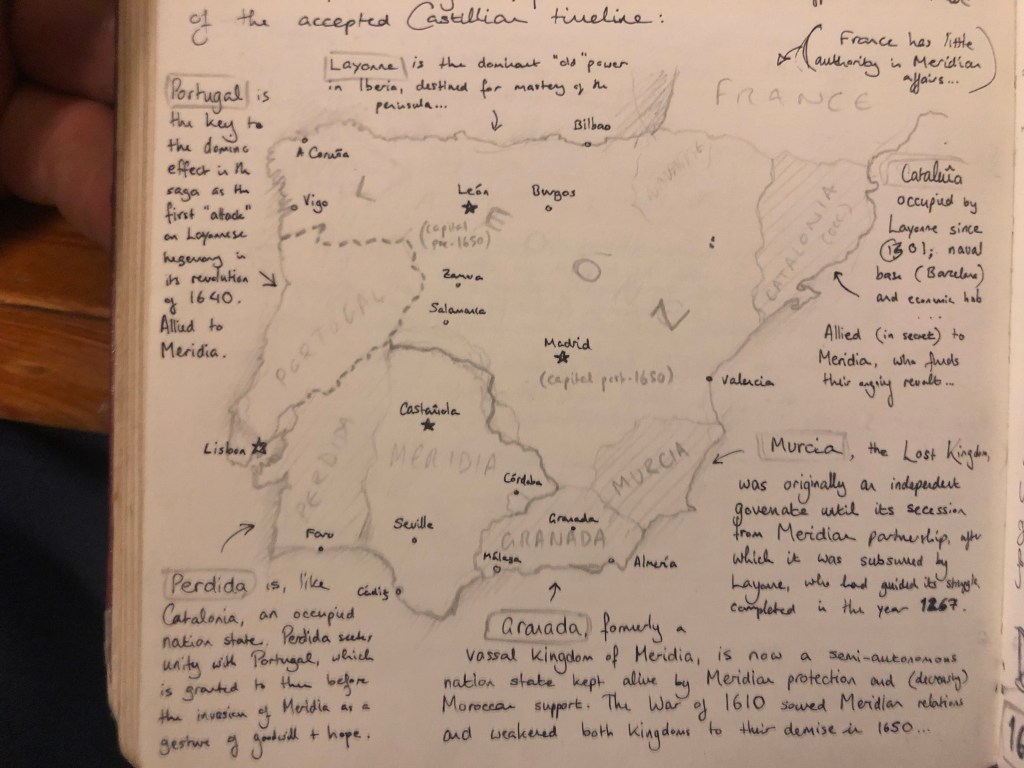
Here’s the same map, drawn about a year later. It’s the eighth of a total of ten maps of the peninsula in the same journal (when students ask me how I can draw a map of Spain from memory… this. This is how). It’s probably the most accurate, and the one I still use today when mapping out the events of the saga, the exception being the retroactive introduction of the “corredor cordobés” that cuts a swathe from Córdoba to the city of Cádiz, separating Meridia from Granada and providing a political flashpoint for the plot. Ringing the map, you can see the history I’ve had to build up around it. I tell you, writing a historical novel is one thing, but writing allohistory – that is, an alternative timeline – is a messy, time-consuming business. If I didn’t keep a journal, I doubt I’d remember all the details. Nevertheless, they’re absolutely essential to giving your world an identity of its own, just as the “Greatest Generation” and the “fight them on the beaches” speech are integral parts of our collective memory.
Creating five hundred years of history for a kingdom which never existed is quite the task. Beginning it is easy, as is the wrapping it all up at the end. It’s what you do in between that’s the trouble. How do you explain away, for example, the men who changed the world who hailed from that corner of the real world? How do you rewrite an essentially Spanish history in a timeline where Granada did not fall until the middle of the seventeenth century, where Seville was in foreign hands for the greater part of the Age of Discoveries, and – perhaps most importantly of all – where almost all of Spain’s conquistadors from Cortés and Pizarro to Francisco de Orellana and Núñez de Balboa hailed from a land that did not carry the flag of Castile?
To be honest, that’s half of the fun, trying to find radically new ways of retelling history. It’s why I wrote my dissertation on the Cronica sarracina, arguably one of the greatest works of fiction ever sold as fact in Spain (or was it fact sold as fiction?). I’m doing the same thing with Meridia: I’m telling the story of Spain through a glass darkly, holding up a devil’s mirror to the country I know best.
And once the world has taken shape in your head, it’s time to set your characters running across its empty plains, so your voice can follow them, painting their footprints with words.
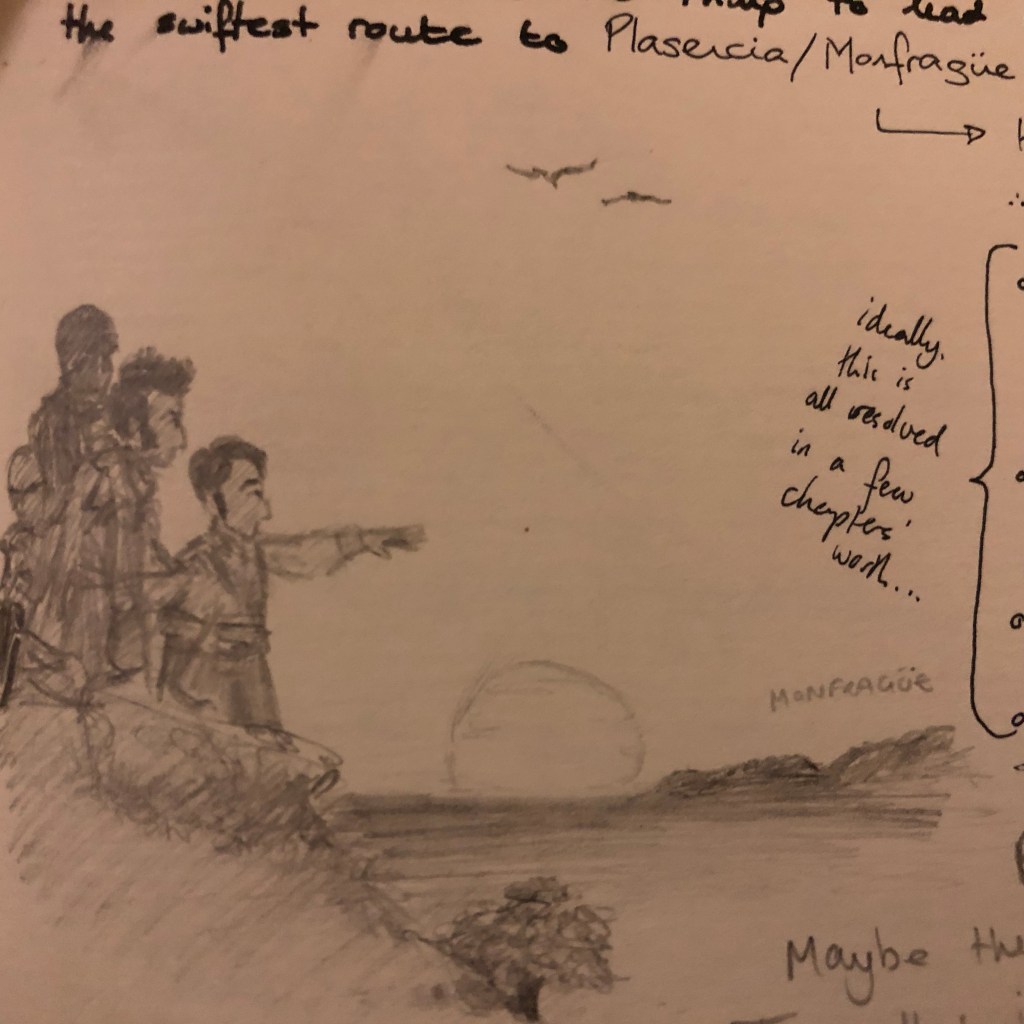
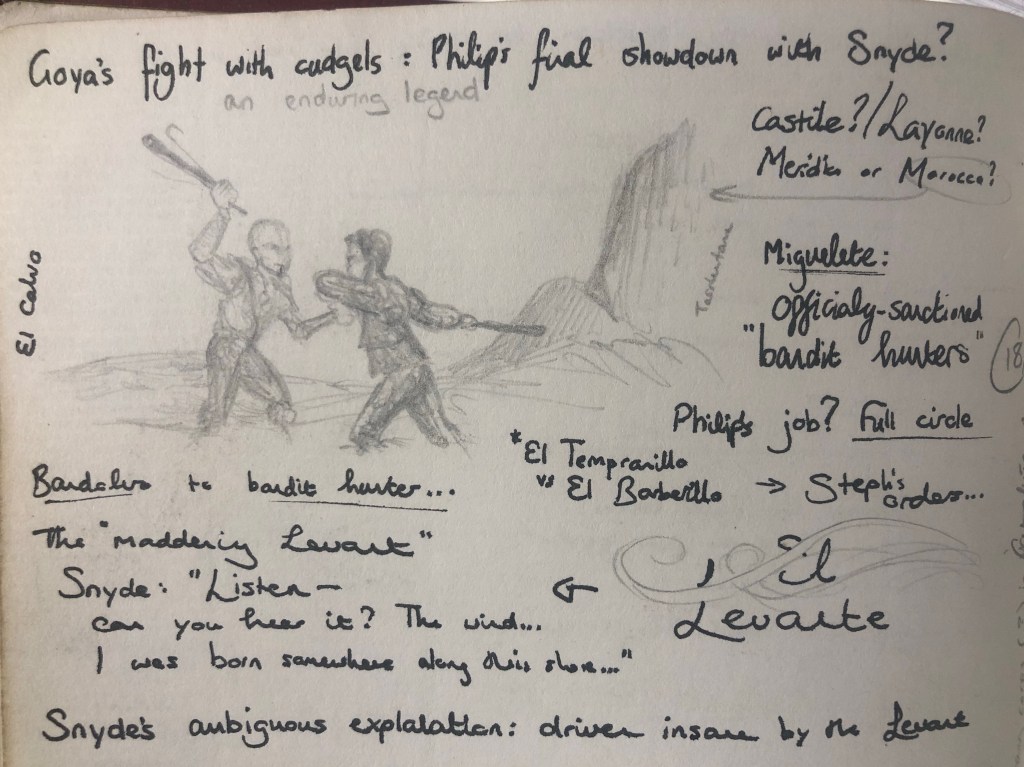
I take my inspiration from the world around me. From books, mostly, but also from photographs, legends, paintings and even conversations with strangers. More than one character has slipped between the pages of the book over the years after a brief encounter with one of those larger-than-life types. In essence, the saga is my paean to my grandfather’s country, so I try to weave as many details in as I can. The madmen of the Hurdes. The seven chairs of Mérida. Goya’s fight with cudgels. The mystery of who really got to the New World first and the Lisbon Earthquake. The odd real person makes a cameo appearance from time to time: Diego Velázquez, Michiel de Ruyter and the lost children of the sack of Baltimore. I get the same satisfaction threading their tales into the narrative as I did from peppering each and every essay I wrote at university with “ursulas” (unnecessarily farfetched sidetracks that somehow relate back to the essay question, named for the sea witch in The Little Mermaid). When you’ve been writing the same story for twenty years, you’ve got to find new ways to keep the game fresh.
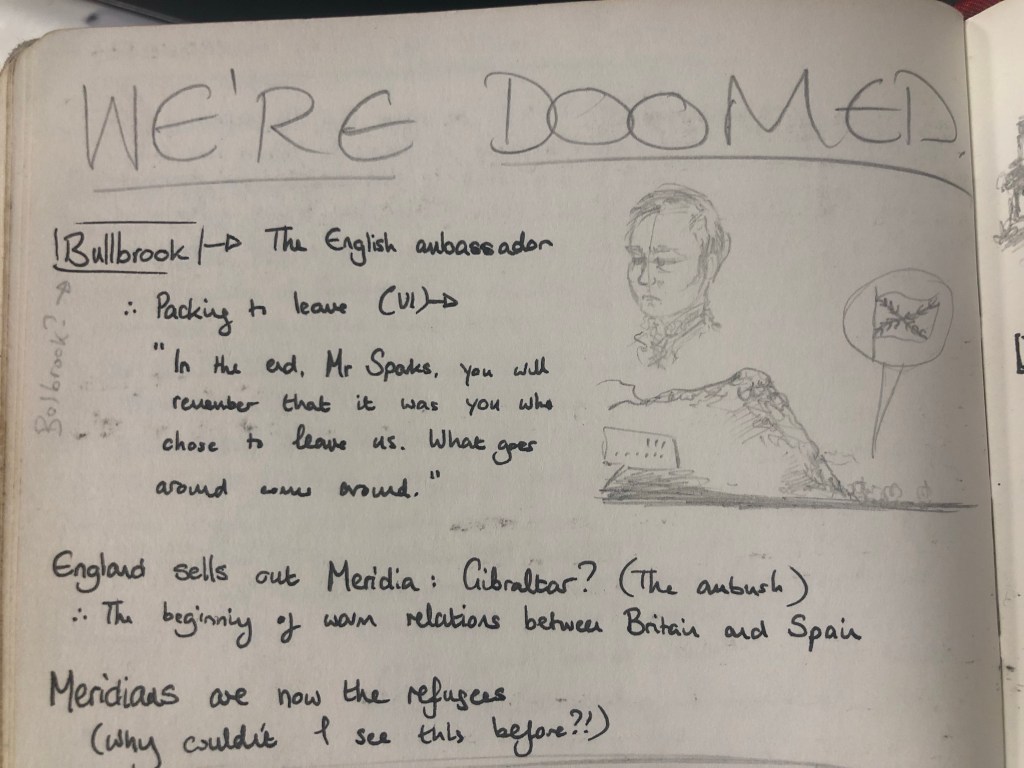
And sometimes, it’s not a book or a person that finds its way into the worldbuilding effort, but the real world itself, in real time. Like this little snippet from the journal. I’ll leave you with the date (24/6/2016) and let you guess what it’s referring to.
Worldbuilding is laborious. It takes a bloody long time if you plan to do it right. It took me a matter of seconds to decide to move the fictional kingdom of my childhood into Extremadura, but it’s taken my characters all of five years to finish unpacking. The central characters of the story have only borne their new Spanish names for a little over a year. But it’s easily one of the most entertaining parts of the story-telling business, and it doesn’t half smooth out the writing process when you finally find the time to sit down at the computer and have a solid crack at the next chapter.
So… what would you like to know? Asking for somebody else’s thoughts on what is nothing more or less than the single most precious creation of one’s life is more than a little unnerving – I’m not afraid to admit I got the shivers writing that question – but the purpose of story-telling is to share, and I could do with airing the world inside my head for a change.
Alternatively, if you’re a writer too, does my experience with the worldbuilding process sound familiar? I’d love to hear your thoughts. BB x
On Monday, I kick off my new role as the middle school gifted and talented programme coordinator with a lecture on the Aztecs. It wasn’t the obvious choice, as Mexico is a country I have neither visited nor researched nearly as extensively as my grandfather’s country. As a matter of fact I made a conscious effort to steer well clear of Latin American affairs at university, cleaving to the Iberian modules even when it meant the pickings would be slim. If Durham’s only Cervantes specialist hadn’t been on maternity leave in my final year, I could have stayed quite happily in my fairy-tale world of knights and princesses and Moorish warlords and binged on ballads, and I wouldn’t have had to go anywhere near strap-on wielding Catalans and metaphysical Madrilenians. Oh Quijote, en mala hora me abandonaste!
Ordinarily, for such a school project I would have stuck to my guns and wheeled out some Moorish magic with a talk about Islamic Spain, something that is close to my heart; or El Cid, a man whose legend (and whose 1961 movie) is embedded, thorn-like, a couple of inches deeper. I even briefly considered whipping up something about pirates, but I haven’t read nearly enough to do that one justice. Not yet.
I landed upon the Aztecs for a couple of reasons. One, because the book I have chosen to read with my IB students is Laura Esquivel’s Malinche. Two, because my school – or rather, the people whose money built the house in which I now live and work – has a long history with Mexico, a connection that is plainly carved into the stone in several places.
But I think the main reason I wanted to explore the Mexica was because it ties me back, through the ruthless conquistadors, to a place that is still very dear to me: Extremadura.
My first contact with Spain was with Andalusia, with her jagged crags and whitewashed mountain villages. If I wasn’t spellbound there and then, my mum and dad must have been, because they made the crazy decision to up sticks and move us there in 2006… right on the eve of the financial crisis that was already driving many of Spain’s expats out. It might not have been the wisest move for three out of the four of us, but after a year of weekend hikes in the surrounding sierras, gecko-hunts in the streets by night, Holy Week spectaculars and vulture-chasing in the misty heights of El Gastor, I was absolutely hooked. Andalusia was my polestar for many years to follow, and her light shone brightest on the paradise of the tierras rocieras of Doñana National Park.
(The author, blinded by the light since ’05)
Over the years I braved her jealousy and flirted with her sisters: a school trip took me from Barcelona and the magical Mediterranean town of Tossa de Mar up and into the clouded dales of Cantabria and the foothills of austere Asturias. Legends of the Cid led me to Burgos and the empty plains of Old Castile, the guiding light of my ancestry led me home to la Mancha, and in recent years I’ve swum in the crystal waters of Mallorca and Menorca. Throw in flying visits to Aragon, Alicante, La Rioja and the Basque Country and it’s getting to the stage where there’s hardly a corner of the country I haven’t explored.
But I don’t think I could ever have anticipated the rawness of my obsession with Extremadura. From the moment I set foot on her soil I was lost. It honestly felt like falling in love for the first time. Not the high school crush kind of falling in love, but that kind of mature depth of feeling, that gut-wrenching, iron-tasting jolt in your upper body that tells you something’s starting functioning inside that was only dormant before.
Oh, cut the poetry already, BB. If you’ve been reading this blog as long as I’ve been writing it, you’ll know I didn’t actually talk like that when I arrived in Villafranca de los Barros on that hot September afternoon seven years ago. But hindsight is a wonderful thing, and any corner of the Earth that could convince me to jettison my plans for taking my teaching game over to South America for a second (and very almost a third) time must have an awesome power.
When Hernan Cortes and his men entered Tenochtitlan, one of the greatest cities of the world at the time, one of the things that shocked them most of all were the dreadful tzompantli, wooden scaffolds nearly two metres in height that carried between them the many thousands of impaled skulls of the sacrificial victims of the Aztecs. They came back to Spain telling wild tales of eagle warriors and war priests with matted hair and bleeding knives, and when one reads of the savagery wielded in the name of Castile upon the Mexica, it isn’t hard to understand why it’s been so popular until recently to discount the stories of tzompantli as a myth invented by the conquistadors to justify their actions. Until 2015, the year I moved to their homeland, when the bases of the huey tzompantli were uncovered in Mexico City, complete with row upon row of human skulls, laid out like so many candy calaveras on Dia de los Muertos. The conquistadors, for all their sins, must have had stories worth telling, if only people would listen.
Extremadura is one of those places I will probably write about again and again for the rest of my life. If Andalusia was my first crush, Extremadura was the lady who captured my heart for good. Not even the knowledge I have now that ties my bloodline more closely to Valencia than la Mancha can put a stain (no pun intended) on my devotion to her. Hers is a story I would tell and tell and tell until my tongue split in two.
Tzompantli: an image which struck no small amount of awe and fear. The presence of a God or Gods unknown (and a word that first threatened to split my tongue in two, but is now so satisfying to say that I have rather awkwardly made it the title of this post).
That is my Extremadura. Unknown. Disconnected. Hard to say. Trainless. Abandoned. The conquistadors couldn’t get out fast enough. Malaria festered in her hidden valleys long after it had been extirpated everywhere else, and the Mesta virtually enslaved her very earth to their will, subjecting her people to centuries of poverty. But it is precisely because of these fascinating tales – coupled with her unparalleled natural beauty – that I do believe Extremadura to be the jewel in Spain’s crown.
And oh, look – I started writing about Mexico and here we are, back in Spain. I’m nothing if not predictable. Some of us spend our lives traveling in search of that “something” that is just beyond our reach. I count myself amongst the lucky ones who found what I was looking for and need look no further – at least, no further than the light that shines on Spain’s shores. I can only hope Doña Extremadura forgives my curiosity.
Did Rodrigo, last of the Visigoth kings, truly disappear in her mountains after the fall of Merida? Did an army of ants reduce one of her villages to rubble? Were there really hordes of dwarves in Las Hurdes who descended into the valleys by night to terrify the locals? And what made Carlos, supreme ruler of the Spains, the Americas and all the Hapsburg Empire decide to spend the last years of his life in her wooded hills?
You will only find out if you go. Don’t hold on too tightly to your heart. BB x
P.S. Thinking about sharing some more stories from this part of the world… watch this space.
April isn’t normally a mad month. This one has been, though. Since getting back from La Mancha, I’ve been here, there and everywhere. Performing in the school play. Working at a Language Immersion weekend in Burguillos del Cerro with the local EOI. Attending extra Gospel Choir rehearsals in Zafra. Taking additional classes at school, cancelling my private classes (at last) and doing intensive research in the library. For what is supposed to be a twelve-hour working week, I’ve been rather busy. It’s never anything that I can’t handle, though, and with the end in sight now, lesson planning is becoming easier rather than harder. That’s some small relief.
Parroquia de Santa Maria de la Encina y San Juan Bautista, Burguillos del Cerro
The weather, though… What is with the weather this year? Ignoring the fact that I’m English and that my first blog post in almost a month should naturally be to talk about the weather, it’s been one of the weirdest years for weather I’ve ever seen. First the cold, then the rain – three and a half weeks of it – then a week of glorious sunshine, then hard rain again, and now summer, with high humidity and thunderstorms forecast over the Puente de Mayo. It’s as though Spain just forgot to do Spring this year.
I’m wondering whether that Star of David tucked away in there was intentional…
Winter was long, dry and freezing cold here in Tierra de Barros. Spanish houses are designed with the long, sweltering summers in mind, and though they’re well-adapted to shutting out the light and heat in August, they’re lamentably bad at keeping it in during the winter months. You basically need the brasero (a flat heater, often kept beneath a covered table) on every night. It’s a long battle between cold hands, feet and everything, and the bimonthly electricity bill, and the latest invoice that’s been lying on the kitchen table for the last fortnight serves as a reminder of the cost of the season’s war crimes. It’s a pity one can’t live in Spain for half the year and England for the other. You could make a killing on the savings.
Booted Eagle (aguila calzada) from the castle at Burguillos
On a minor note, it’s impossible to get into a comfortable position on this sofa. There. I’ve acknowledged the elephant in the room. We can move on.
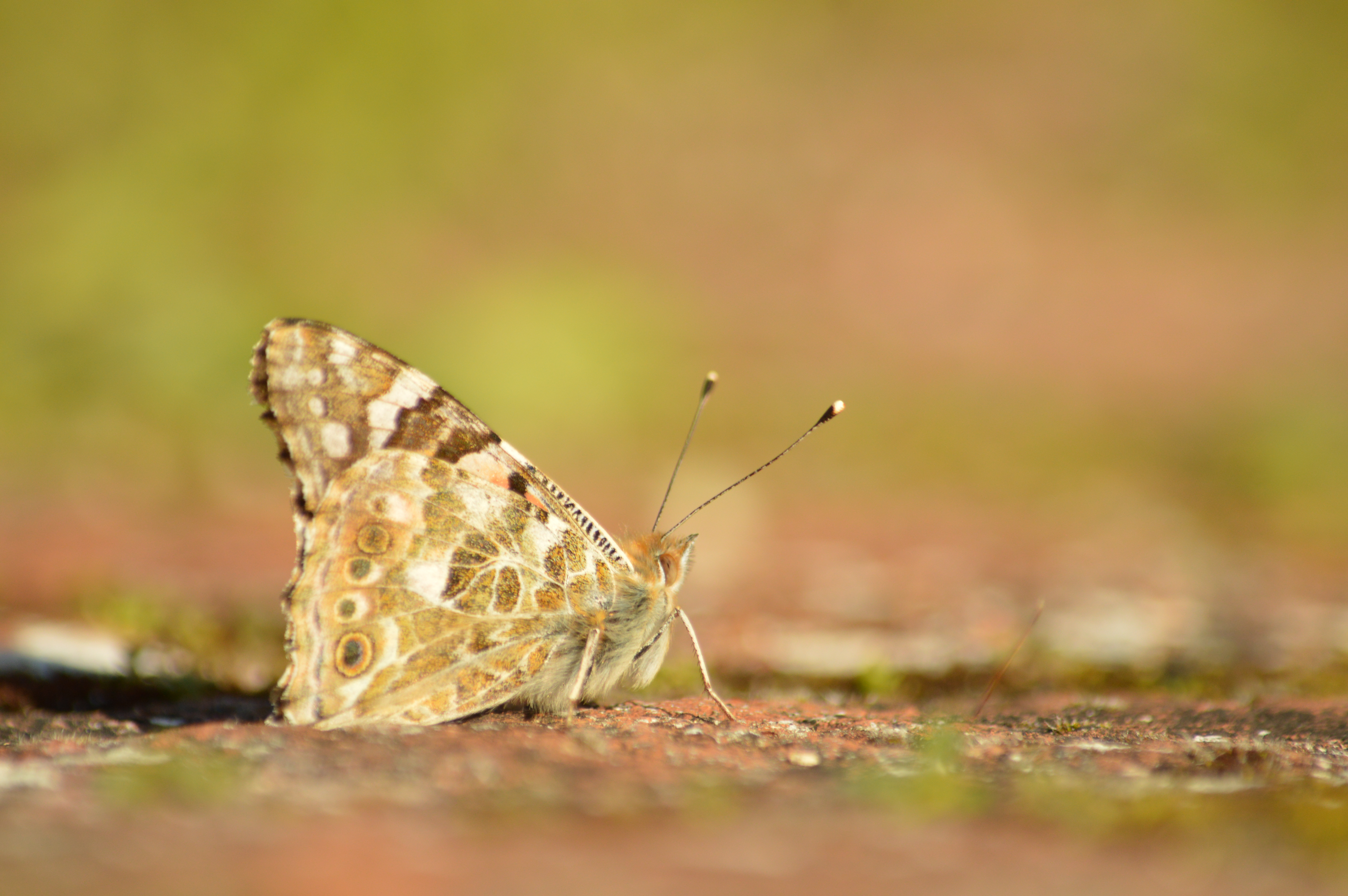
Painted Lady taking a break on the castle top
I’ve been wondering what to write the next blog post about for a while. A couple of weeks ago the bee-eaters arrived, on the very day I’d commented on their absence, and that brought joy to my heart. Later, I had the Language Immersion, which raised some rather disconcerting news concerning my beloved Extremadura, but that wasn’t strictly blog-worthy. I also dug out the local library’s regional encyclopedias, which were filled to the brim with local information I could only dream about before… but at the risk of boring you all senseless, I’ll wait until I’ve properly processed the information before regurgitating it here and now. No, the answer, my friend, was blowing in the wind.
Or should I say, screaming.
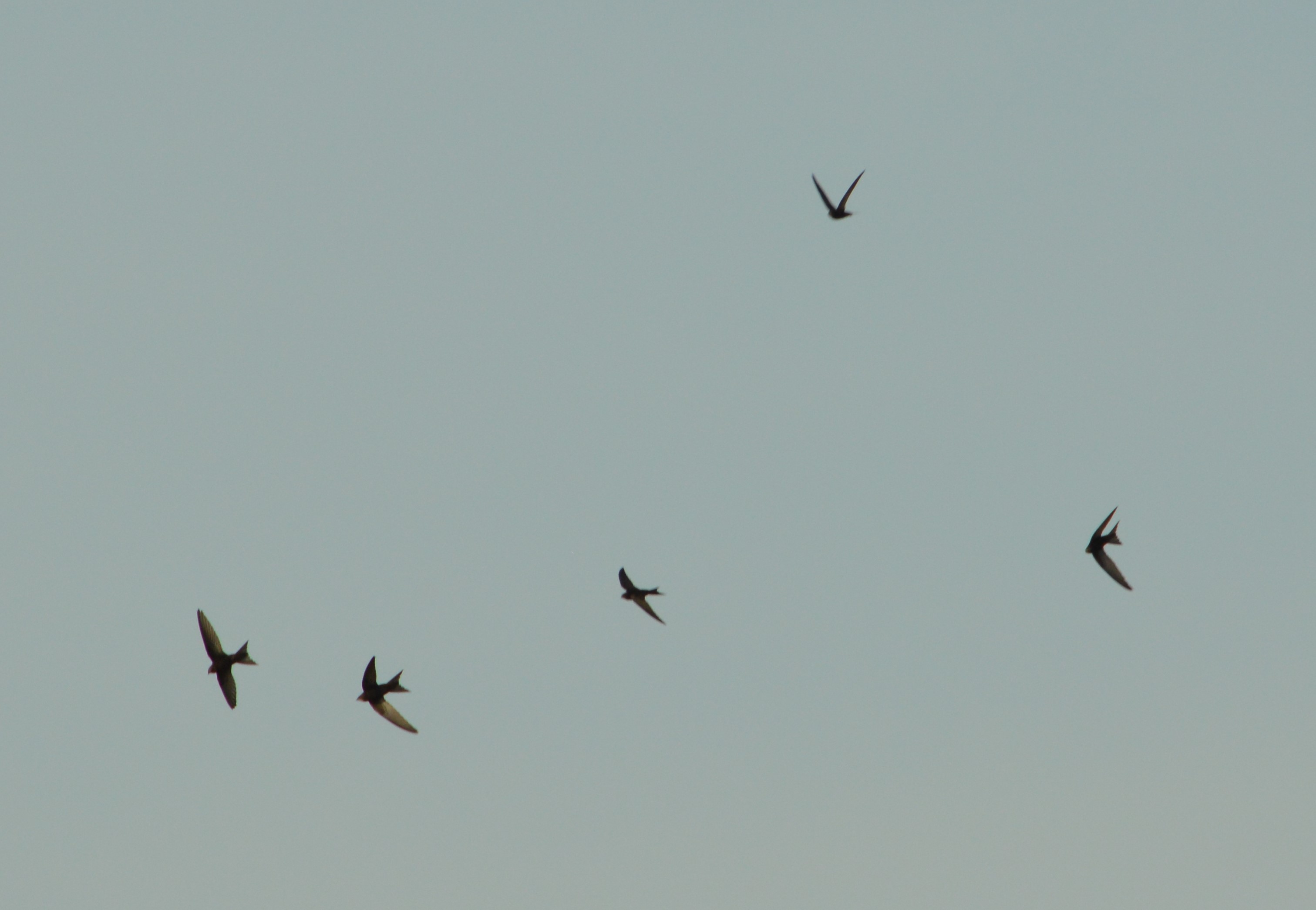
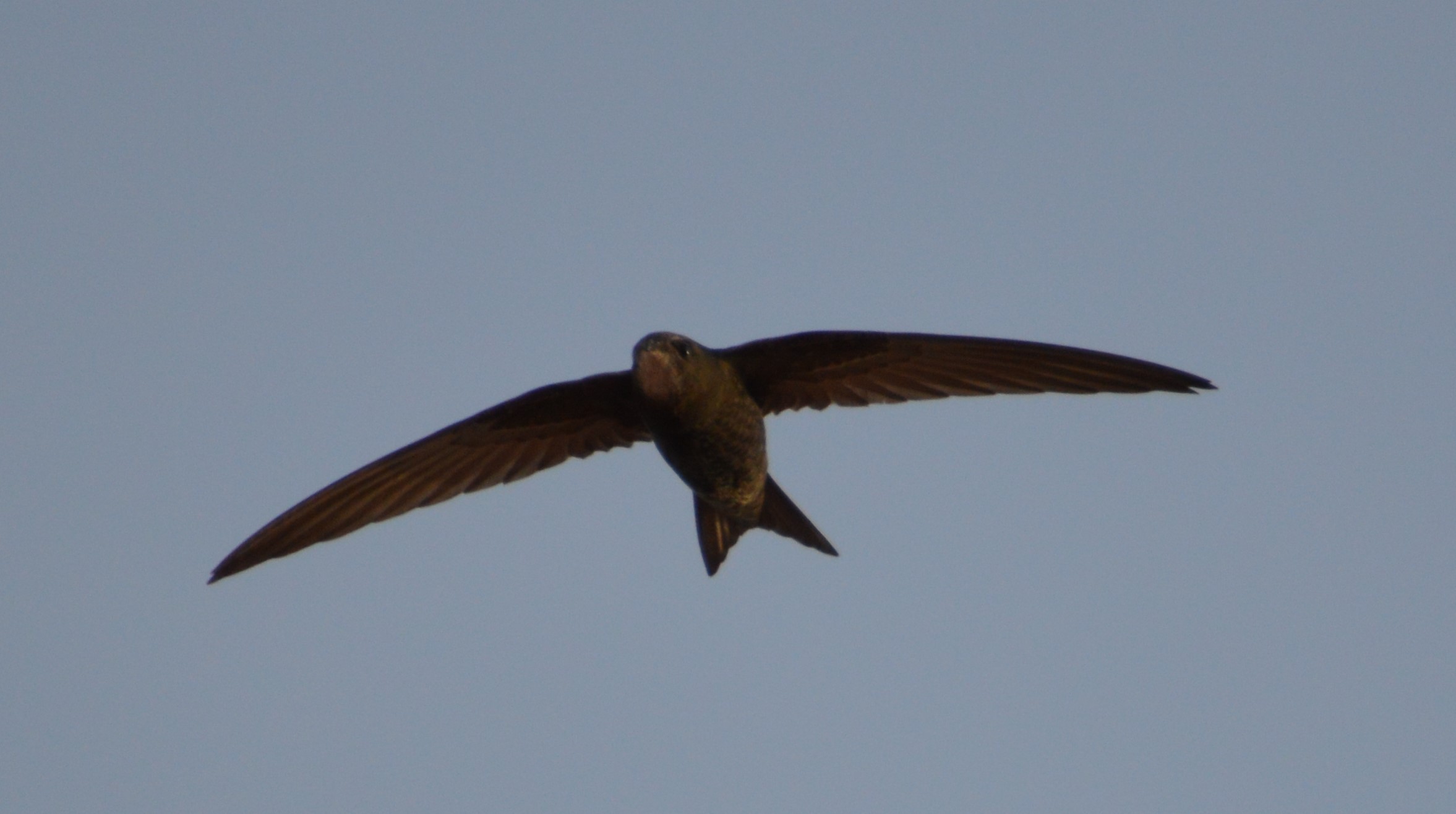
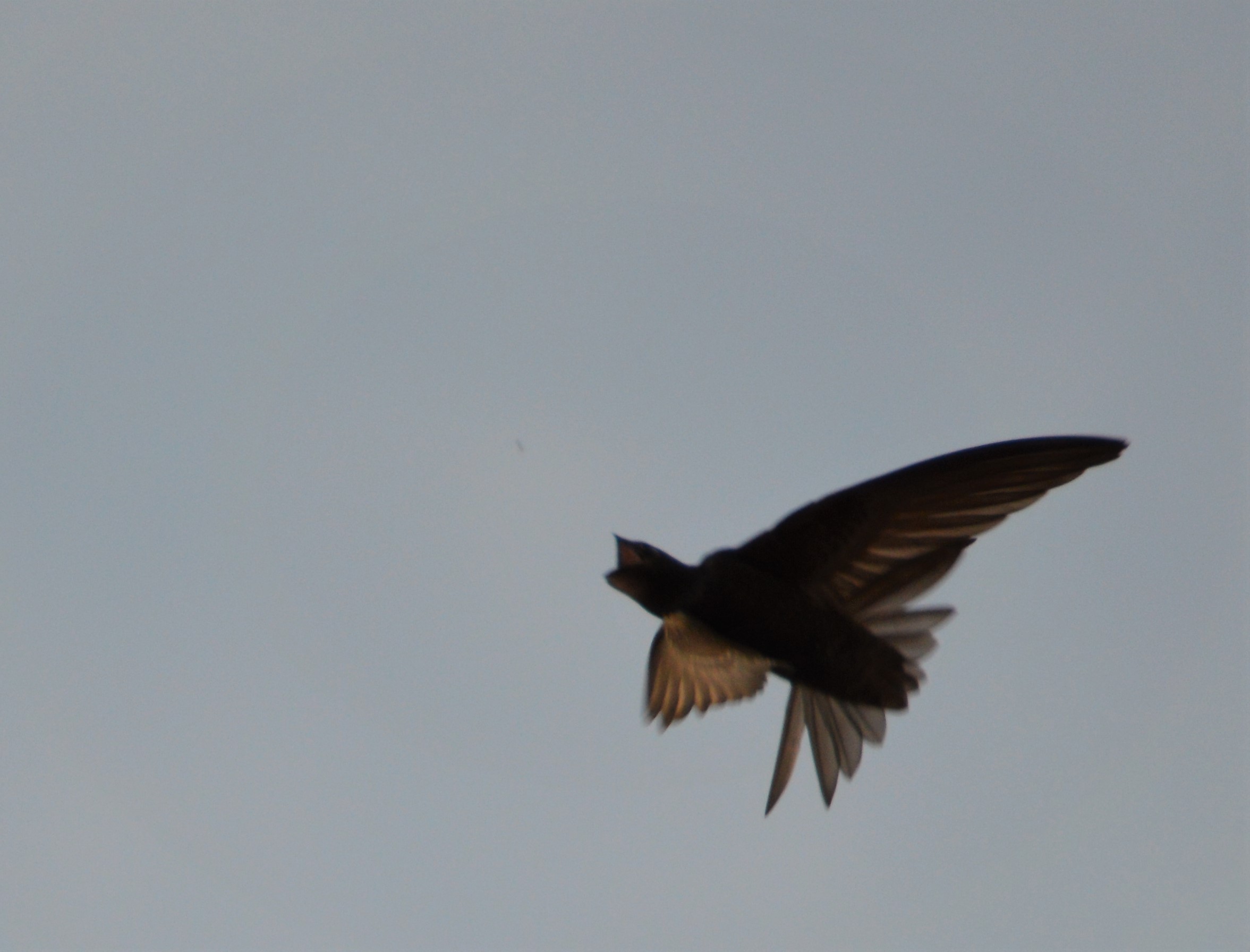
The swifts have been here for over a month now, hawking overhead on their way north alongside the hundreds of swallows, martins, kites and storks also bound for northern Europe, but the Villafranca contingent only arrived a few weeks ago. How do I know this? Well, it’s quite simple, really. I know this because the screaming only began a few weeks ago. The collective noun for a flock of swifts varies, with some opting for a box of swifts, or the more alliterative swoop of swifts, though in perfect honesty I’m going to tip my hat to the chappie who coined the phrase a ‘screaming frenzy’ of swifts – because anybody who’s familiar with these peculiar creatures will know that they’re not exactly the most inconspicuous of birds, to put it lightly.
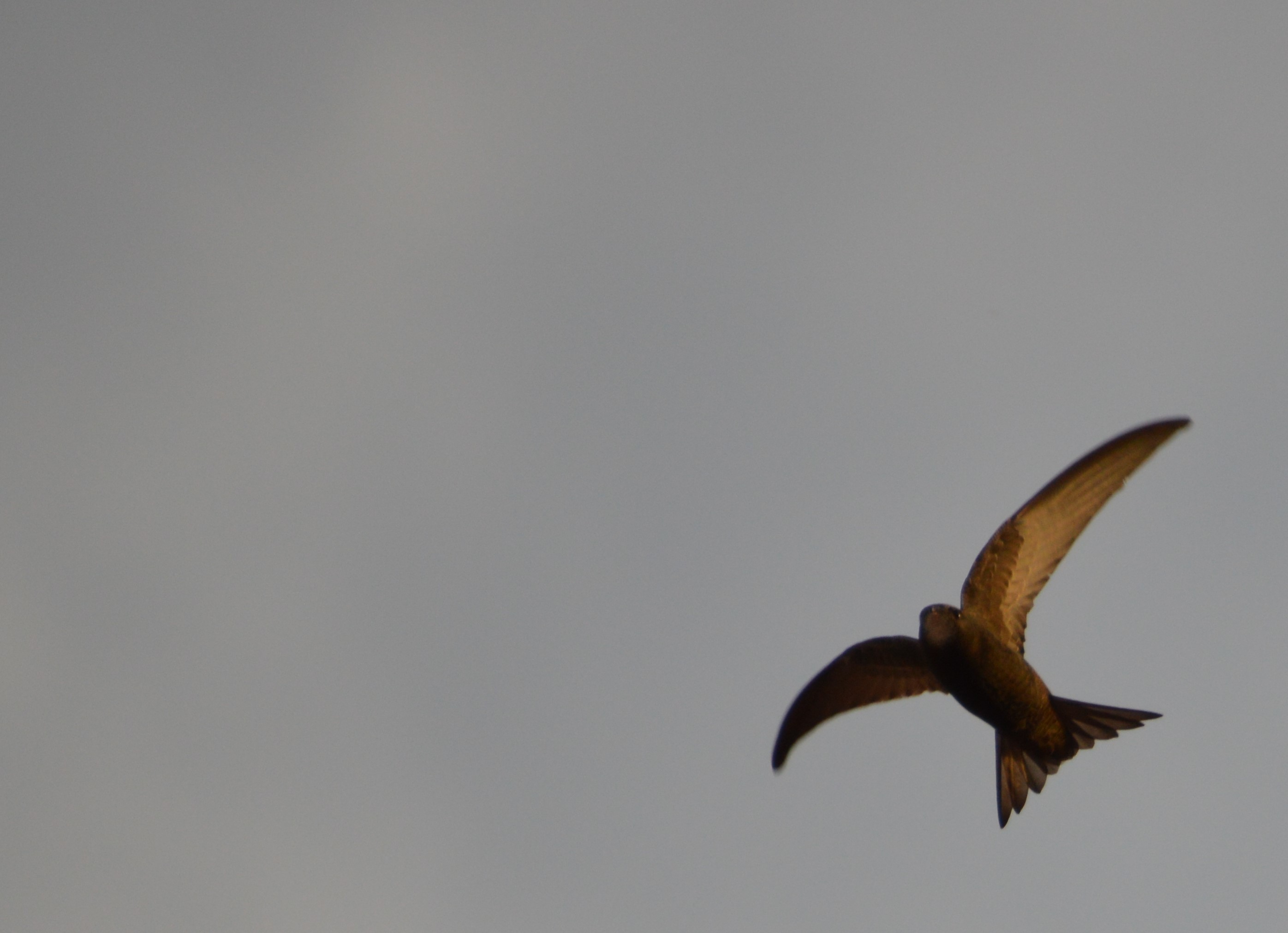
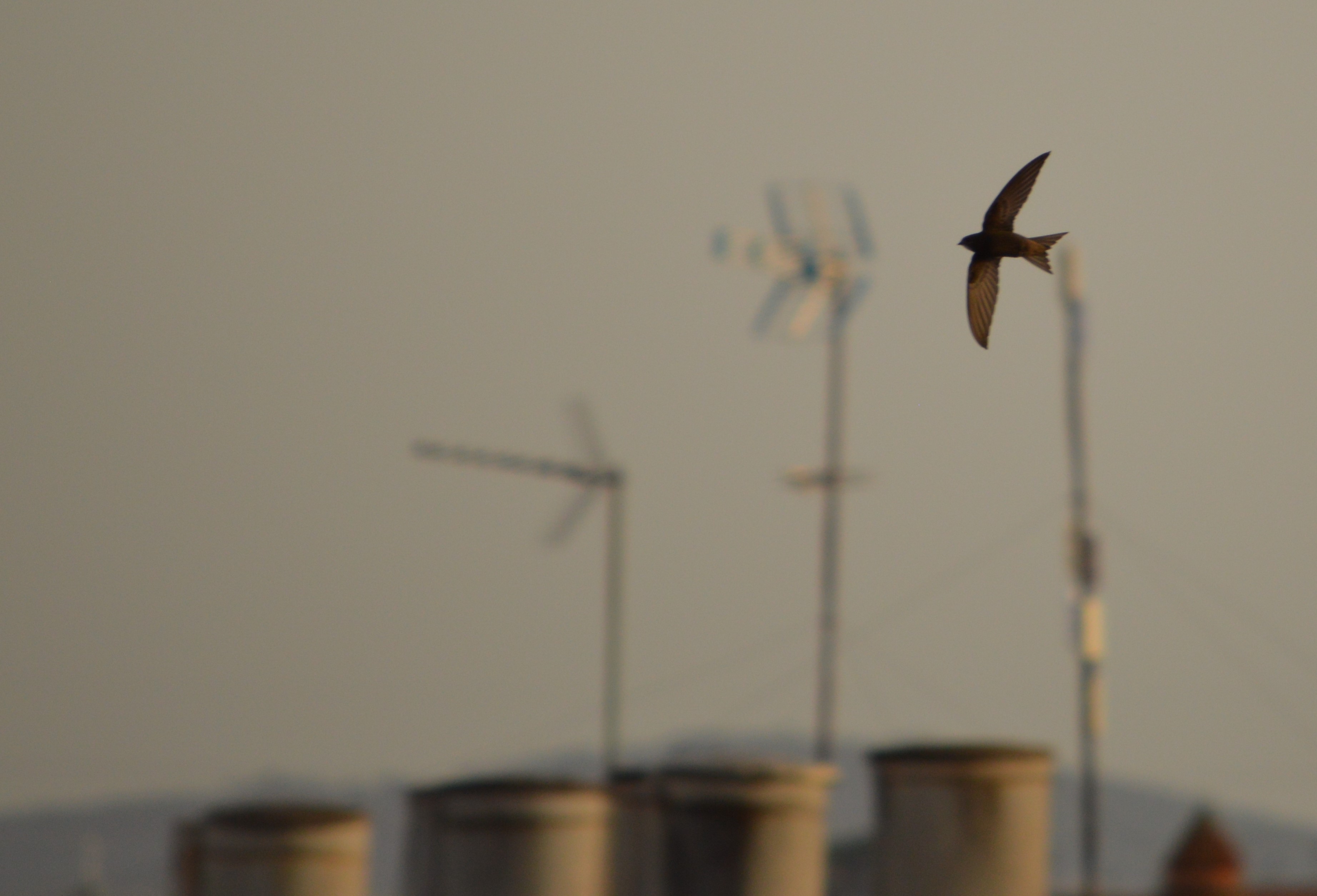
Swifts are odd-looking birds, to say the least. In flight, they’re right out of a kid’s drawing: long, tapering wings with no trailing fingers, a stubby, featureless face and a cigar-shaped body which makes them look more like a fish that grew feathers and took to the sky. At the same time, their large brown eyes and tiny mouths lend something mousy to their appearance, too. They’re not even that closely related to swallows and martins, with which they share the skies. But whatever they are, they’re endlessly fun to watch, as they duck and weave and scream and perform some of nature’s most endearing acrobatics on a summer evening, seemingly for the sheer thrill of it.
The saying “one swallow does not a summer make” holds more and more weight here in Spain, especially now that in recent years many swallows never leave at all, opting instead to take their chances with the Spanish winter rather than brave the journey across the Sahara and back. Swifts, on the other hand, are die-hard migrants, spending almost their entire lives on the wing. They eat, sleep, mate and collect all the material they need to build their nests in the air. The ancients believed they never came down at all: their scientific name – apus – derives from the Greek for ‘without feet’. Needless to say they do, like all birds, though they’re small and underdeveloped in comparison to their powerful wings. I’ve only ever seen a swift’s feet once, and that was because I found a dead fledgling beneath the eaves of the village church when I was thirteen. I remember Adisham being a haven for rare birds then: spotted flycatchers, yellow wagtails, corn buntings, grey partridges and even local rumours of a lonely corncrake. I wonder how it’s faring now.
There are five species of swift in Spain: the common swift (above), the larger brown-and-white Alpine swift and the chunkier pallid swift, and the two newcomers from Africa, the white-rumped and little swifts (you’ll see the latter a lot more readily if you take a wander through the streets of Marrakesh, where they make a habit of weaving between the heads of the shoppers on their way to their nests). It’s the common swifts we get here in Villafranca, the same kind we see back home in England, even though theirs is a sound I have come to associate more and more with Spain than England. Like the cuckoo and the turtle dove, the early summer screams of the swift faded into memory as I grew up and they began to disappear. It can’t be easy, sharing our little island with Man.
Look close and you’ll see the fly that once was
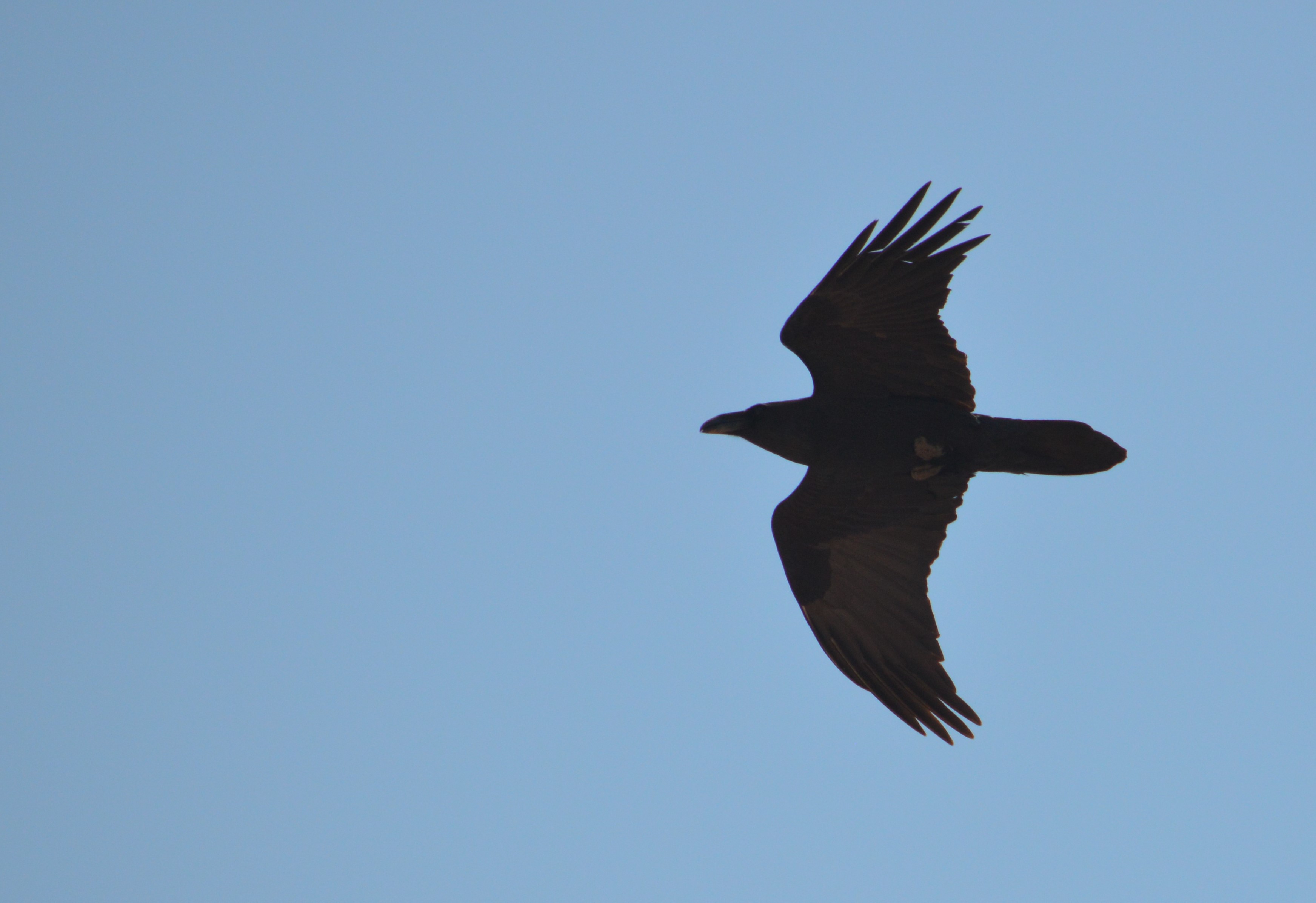
The older I get, the more I appreciate the simpler things. When I was younger, it was all about the bells and whistles: hoopoes with their punk-rocker crests, rollers with their shiny blue jackets and gallinules in their resplendent purple glory. I’m still mad about the gallinules, but a long detox from the serious bird-watching of my teen years has done me wonders. Swifts and starlings are just as worth watching these days as kites and eagles, with the added bonus being that they can be counted on to be outside my window at any given moment… Although, that being said, it’s a rare moment when I look out the window and don’t find myself picking out a kite, stork or eagle in the blue sky. Yesterday I’d popped my head out for just a minute when a raven flew over. My flat seems to be on the flight path, because most everything I see passes right overhead.
Time for bed, I think. Well, another chapter of Bryce Courtenay’s The Power of One and then bed, anyway. There are some authors I just keep coming back to. Bryce Courtenay is one of them. BB x
The Heavens have given us a temporary respite. The spring rains that began a month ago today are still falling hard, and set to fall harder still over the next week or two, but today the clouds are colourless and clear. I no longer live in a state of quasi-permanence beside the brasero and soon I’ll be able to put my jumpers back in the wardrobe once again. Spring has definitely arrived here: my morning walk to school is a symphony of song from the park, albeit a symphony where every part seems to think they hold the solo, from the strings of the serins and the woodwind of the blackbirds to the kestrel fanfare, stork drumrolls and the uncompromising neither-here-nor-there noise of the starlings. It puts a smile on my face every morning.
I’m conscious, as I often am at this time of year, of my time running out. Where the year seemed to stretch on into the middle distance back in cold, gloomy February, March holds up a mirror as if to remind me how much the cold warps one’s perspective. As it stands, I only have twelve weeks remaining, of which nine and a half are working weeks and only four bring as-of-yet unscheduled weekends. In my desire to be busy once again I’ve burdened myself up with responsibilities that eat into my timetable like caterpillars: a private lesson in Almendralejo, choir rehearsals in Zafra and play rehearsals at 8.15am on a Thursday morning. Combined with commuting time, and those inevitable private lessons that are at the incredibly inconvenient time of six o’clock in the afternoon, my time is slipping through my fingers and the year will be over before I know it. And with a summer job and a proper job at the end of it waiting for me back in England, that’s more than a little disheartening. Something’s got to give.
Reading is keeping me afloat. I finished She the other day and I’m onto another classic, Hardy’s Far from the Madding Crowd. After the insightful but heavy high-Victorian ‘thees’ and ‘thous’ of Haggard’s dialogue, it’s a breath of fresh air to hear people speak in an altogether more human register some twelve years prior. Once again, I’m reminded that, if it weren’t for my all-consuming love for Iberia, I would have followed my grades at gone for a degree in English Literature. I might not have enjoyed reading as much at the time, but I’m certainly making up for lost time here and now, even if that does entail reading two Haggard books per month. Still, I don’t read Haggard for the dialogue: the old adventurer might be unable to tear himself from his medieval register, but there is wisdom scattered in his words like pearls on a stormy beach, and I love mining his books for quotes in such a fashion. I just need to modernise my reading tastes so my own writing doesn’t become quite as jaded. Hardy might be a step backwards in time, but he’s more than a step forwards in modernism. BB x
Snow doesn’t like me. Every time it falls I’m in the wrong country. The last time I remember snow good enough to build a decent snowman was early in 2013, when I was on my abortive gap year and had precious little else to do. Going north to university was supposed to bring better weather; living as close to the coast as I did, pretty much every weather front we got had dissipated by the time it reached us.
Not so. In my first year at Durham we had a light dusting, and second year delivered only a little better. In my third year the powers that be decided to deliver a decent fall… but of course, I was in Spain at the time, and didn’t see any snow whatsoever. The following year I returned to Durham, where it was cold, but not enough for snow. Spain, on the other hand, got a lashing so strong it covered most of Andalusia – one of Spain’s hottest regions – in an impressive layer. And now this Beast from the East lays waste to the UK with snowfall like it hasn’t seen in decades, and here I am in the one part of Europe that was spared.
It’s obvious. Snow and me simply aren’t compatible.
What are we getting here in Spain? Guess. I’ll give you a clue: they had a fair idea when they wrote My Fair Lady.
You want the Beast from the East? Try the Pest from the West. It’s supposed to rain for a full fortnight.
There are just over a couple of weeks to go until Semana Santa. I haven’t been blogging much, partly because of the taxing nature of private lessons with under tens, but mainly because any writing I don’t commit to my novels seems like a betrayal, especially with the workload (and the salary) set to treble next year, and by my own hand. I’ll keep you posted. BB x
Good morning from the staff room. My second 1°ESO class are busy preparing posters on British food for next week’s Semana Cultural this morning, so I’m off the hook for an hour. It’s a shame, really; they’re probably the one class that could have really benefited from a presentation on the UK, seeing as it’s what they’re working on right now. My other 1°ESO class loved it, and I dare say the addition of a Honchkrow to explain ‘honcho’ helped a lot in the ‘foreign words in English’ section. Not that honcho – a Japanese term for ‘big boss’ – is a word you expect to come across all that often, but it makes the language learning process a lot more colourful. Going over the same ‘how much is a ticket’ dialogue every week gets a bit dry, eventually.
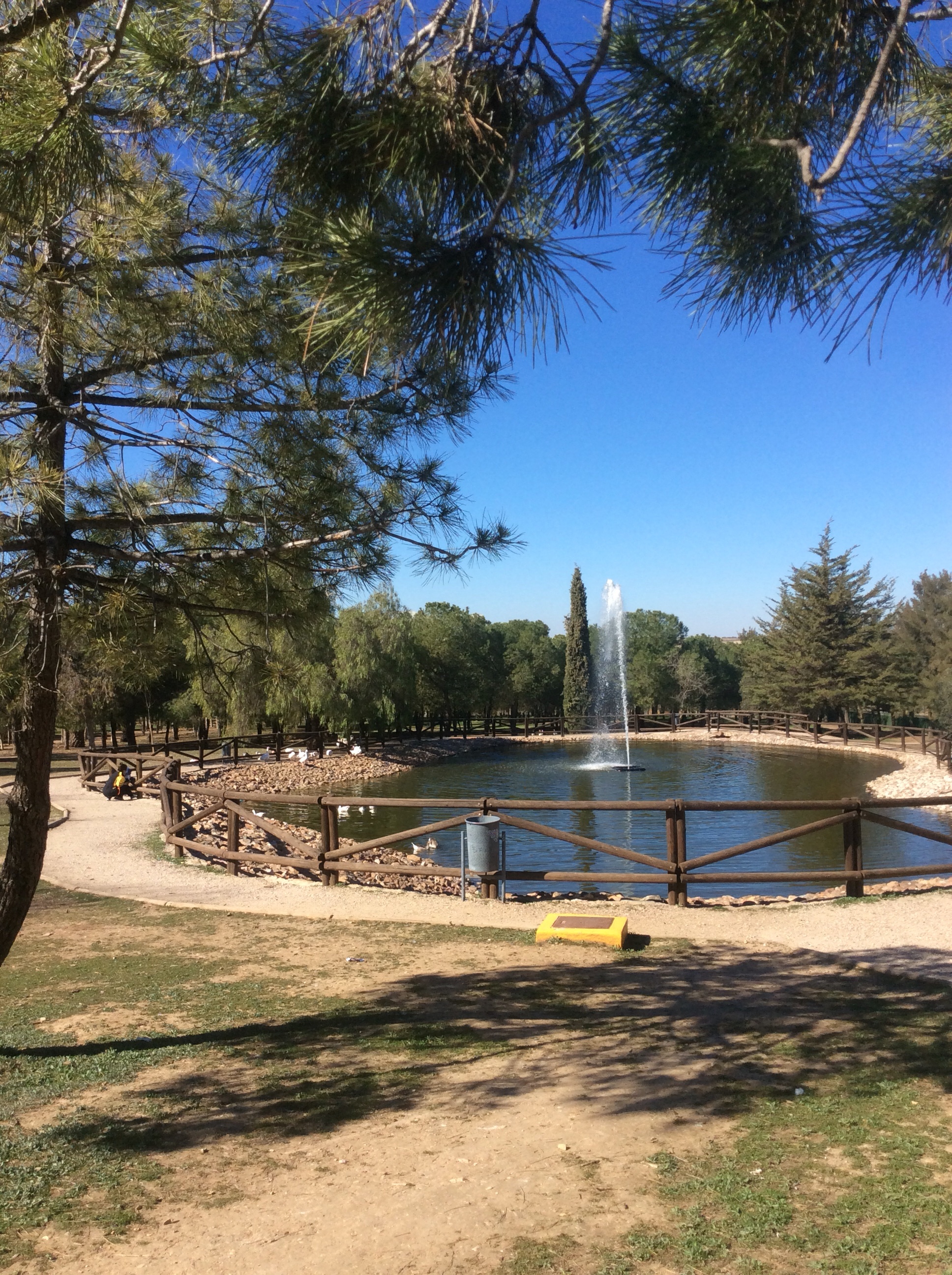
I went for a walk in the park yesterday. It’s been so warm and sunny recently, I simply couldn’t justify going straight home from work. Tired as I was, I slapped a small lunch together, downloaded a few In Our Time podcasts and crossed the road into the park. It was a little windier than I’d have liked, so I didn’t stay all that long in the end. Without it, it might have been as warm as 18°C. In February. But here in the plains of Extremadura, we’re ruled by the terrain. The wind that blows across the flats is cold and loud, like something out of the Old West. You half expect a tumbleweed to pass you by. It’s a shame that we think immediately of America when we hear that name: with its wide open plains, rocky cliffs and canyons teeming with bandits, and its historic code of honour and justice, I’d like to think Spain was the real Old West; the Ancient West, if you will.
The swallows are here. I watched a few of them twittering noisily as they careered about the pond, whilst one of the town’s storks soared lazily overhead. The trees were alive with goldfinches, and I saw a huge bat on its way to the park from my flat the other night. It was a lot easier to consider a job in England a month ago, I’m telling you, before Spain started thinking about her Spring clothes. Now that it’s feasible to go to bed without having the heater on for a full hour, and the blue skies are no longer laden with a biting cold air, I find myself in love once again. The saying goes: ‘nueve meses de invierno y tres de infierno’ – nine months of winter and three of Hell – but Spain can be equally unforgiving in the grip of winter.
I spent a little while watching a robin – always one of my favourite birds – and a couple of hoopoes flapping about like oversized butterflies. Symbols of England and Spain, in my head. I should go to the park more often.
It’s hard to see the change in the seasons here in Tierra de Barros, with the park full of evergreens and the surrounding eternity of vineyards and olive trees, but the animals tell you. And where they fail, the town drummers do a pretty good job. Carnaval is over, and I thought that might be the end of their incessant weekly drumming, but I was wrong: last night as I lay dozing in the living room, I heard the unmistakeable march of the Holy Week procession. It’s a good month away, but preparations have begun in earnest. But I’m not complaining: Semana Santa is far and away one of my favourite things in Spain and I never want to be anywhere else when it’s on. Like countless Brits before me, I’m shamelessly enthralled by the primal magic of it.
And, like countless Brits before me, I’m steadily coming to understand that our humour and theirs – or anybody else’s, perhaps – simply don’t mix. My jape about my countrified accent got cut from the play this morning. I guess they didn’t see the funny side. One of my students did point out to me recently that imitating their accent is one of the few things guaranteed to rile an extremeño. As a guiri, perhaps I’m allowed a certain amount of leverage – it’s always funny to see a foreigner having a go, I guess – but patience, in the end, wears thin. Especially when I have to make that same joke at twenty-five minutes past eight every Thursday morning.
A few weeks ago there was an article in The Times titled ‘How to be Spanish‘ that caused uproar on Spanish social media. The Spanish, it seems, don’t like being told how to be Spanish by an Englishman (a puto guiri, to quote various Twitter users). Surprise of the century. Spaniards came out with war flags, claiming the author had no idea what country he was talking about. Whoever these folks were who eat tapas at the bar and never at the tables, swear so liberally and have a slightly more relaxed attitude to time than the hyper-punctual English, they certainly weren’t Spanish.
Shortly afterwards, the Spanish retaliated with an article of their own on how to be British, citing such customs as queuing for everything, wearing white socks, wall-to-wall carpeting and, of course, our penchant for exaggeration. It was a childish exchange, but you have to admit, there were a few cultural nuances both sides got spot-on.
It was a lot of fun to discuss in class, I’ll give you that, but whilst I agree that the original author could have been a little less damning in his exaggerations – a flaw I’m often party to (see the war flags remark) – it seems to me that the problem lies not in the content itself, but in how it was received. Of course not all Spaniards act the way the author describes, but then, he doesn’t go out of his way to make that clear. And, of course, it wouldn’t be so funny if every observation in the article carried a disclaimer. Remember those jokes that your friends make that you didn’t get, and they then had to explain? Yeah… They weren’t funny at all.
As Brits, we read such things with a smile, seeing the irony and the humorous comparisons, because as a nation that’s what we do best: ridicule. We love to laugh, to laugh at others, and (sometimes) to be laughed at in turn. It’s not a universal attitude, but trying to be funny on a regular basis is, I think, an inherently British custom. Most everybody else has a life to be getting on with. Great Britain is cold, rainy and – according to some – has potentially the worst cuisine in the world (the very un-English chicken tikka massala was our most popular dish for years), but we are fantastic at making light of this and everything else, from our politicians and our history to our friends and neighbours, even if the rest of the world looks on in confusion. I gave up trying to introduce my kids to Blackadder and Monty Python a long time ago. It requires too much explanation. By contrast, Mr Bean works like a dream… because there’s no dialogue whatsoever. Which, given that he’s portrayed by easily one of our wisest and wittiest comedians, is a crying shame.
So that’s all it is. The British like being funny. And when our jokes involve people beyond our remit, we get confused when they take offence. Why can’t they see the funny side? The answer is simple: they don’t have to. That’s not to say we shouldn’t make jokes anymore. British humour is, in the humble opinion of this author, king. But we could be try to be a little more aware of what cultural difference means. If the Spanish come across as having a lax approach to time, it’s only because we’re unreasonably pernickety about it. The whole and ungeneralised truth lies somewhere in between.
Jokes are fine. Our problem is that we expect others to take a joke, to know when we’re being funny and when we’re not… and it’s not always easy. Especially in print. BB x
I watched a house being torn down on my way home yesterday. The sun was setting behind, casting beautiful golden rays through the dust as the maw of the digger ripped the walls apart. Destruction is an odd thing to witness. It obviously has its pull; there were some four or five others standing by who, like me, had paused in their perambulations to watch: an old man, a chap in blue overalls, a man and his dog, a mother and her daughter, and me; all of us gathered there to witness the last moments of a 60’s flat block. The walls came down like sand.
I once heard it said that it can be a thrill to watch somebody on a downward spiral. I never did understand what it meant, though I suppose it’s along the same lines as the death of the flat block. It’s a spectacle. We don’t pay to see movies where the hero overcomes every single obstacle and has a wonderful life thank-you-very-much, with no end to his or her wish-you-were-here lifestyle. We want to see suffering. We want to know they’re as vulnerable as us. And if they succeed, and they don’t always succeed, we want to know it came at a cost. Nobody is invincible, but everybody is human to some degree. It’s about what rises out of the ashes, rather than the ashes themselves.
I’ll have to think about that downward spiral case some more.
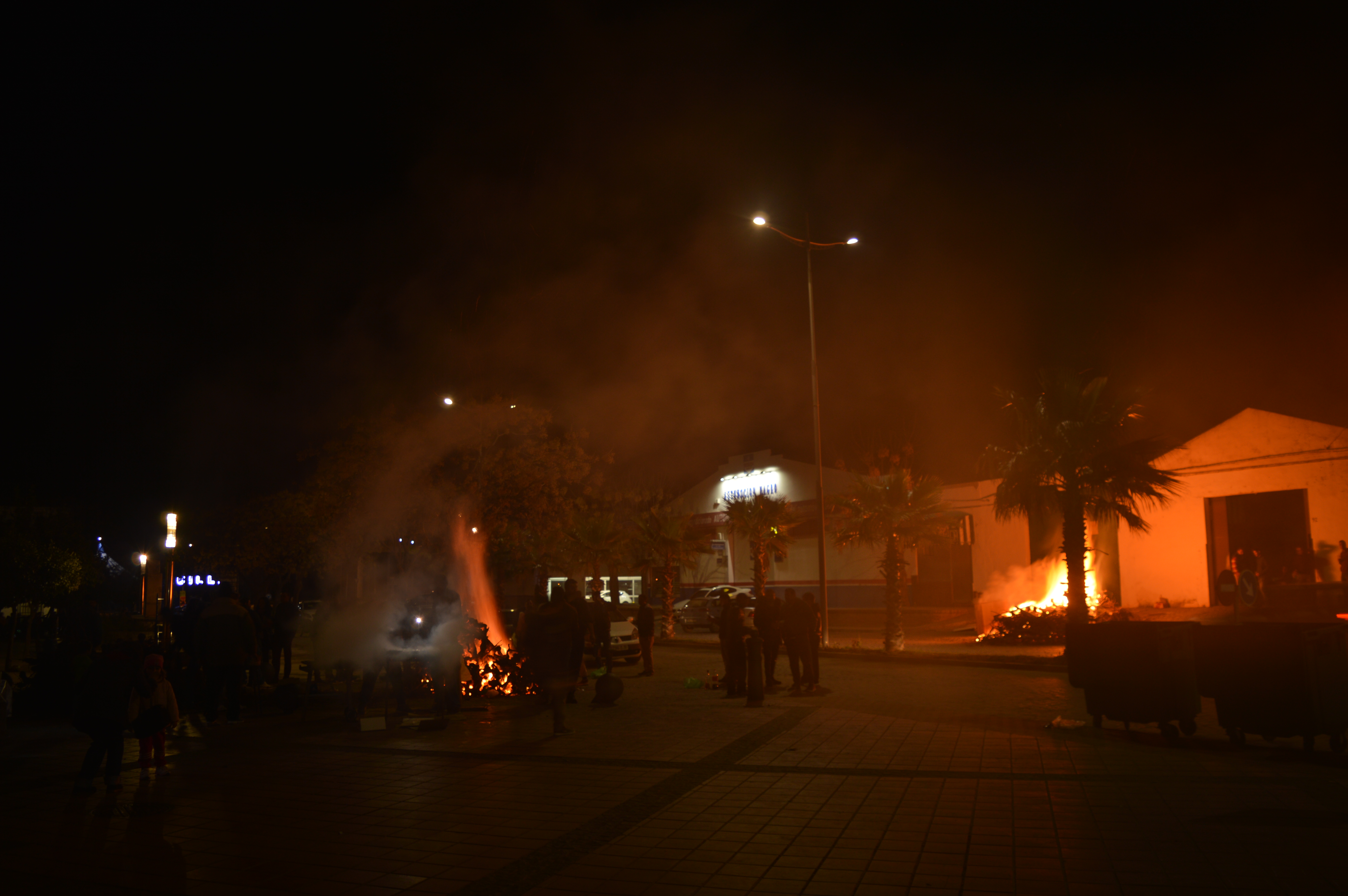
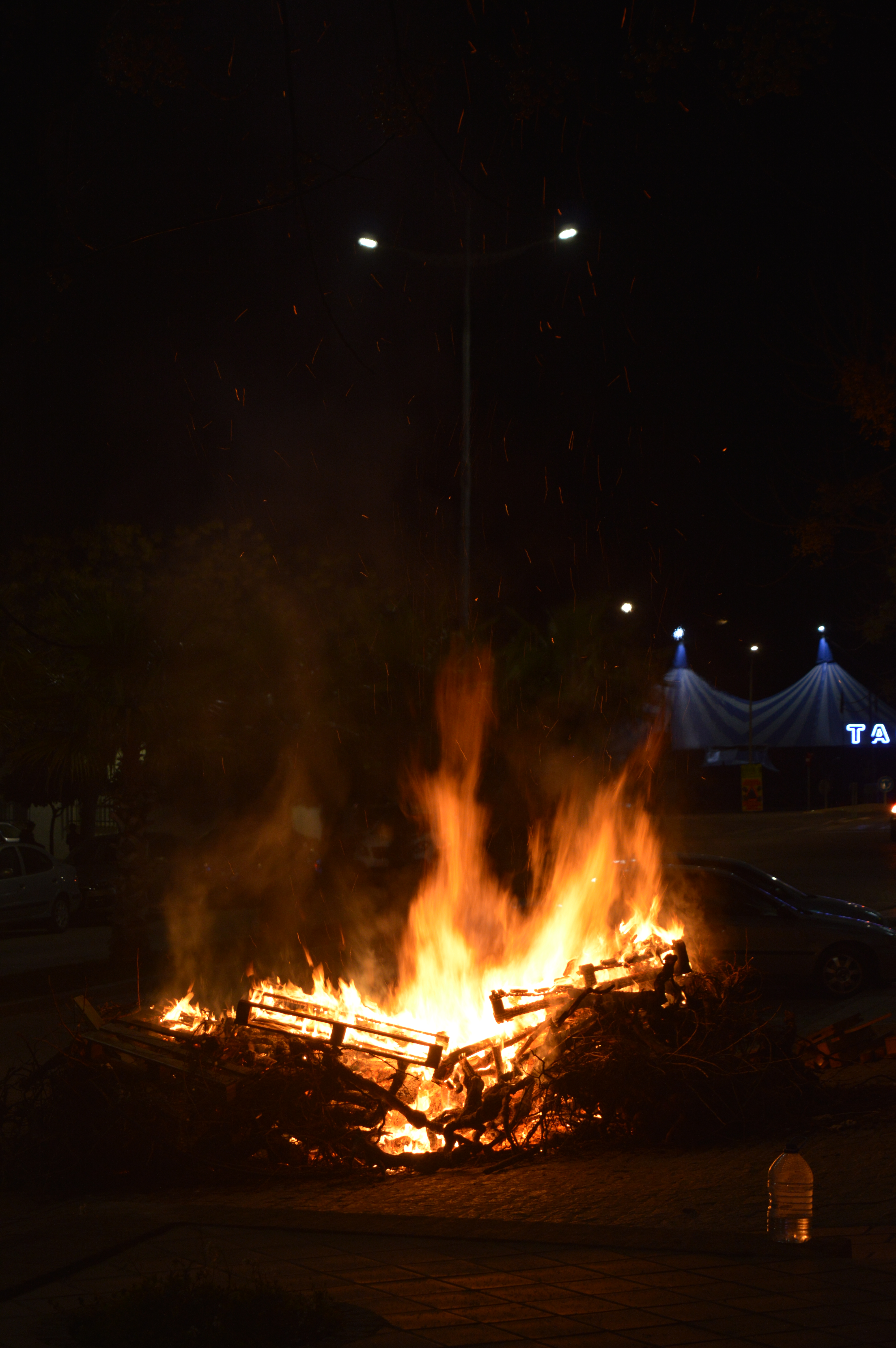
Villafranca celebrated Candelas last night. It’s a local festival, similar to the English custom of Bonfire Night only in that the main ingredient is a number of bonfires. Folk were gathered in front of the main bars in town, where a handful of small bonfires had been laid out and set alight. Whatever they were putting on them was coughing up thick smoke and a hellish rain of sparks. Beyond, on the town outskirts, the neon lights of a visiting circus glared through the haze. It looked like something out of a Don Bluth film. I tried to imagine the first candelas, four hundred years ago and more, then the only lights in this dark land. A friendlier festival than Halloween – or, perhaps, what Halloween has become – if only I had somebody around to share it with. That night I wandered the streets alone, knowing once again after a long time how it feels to be on your own.
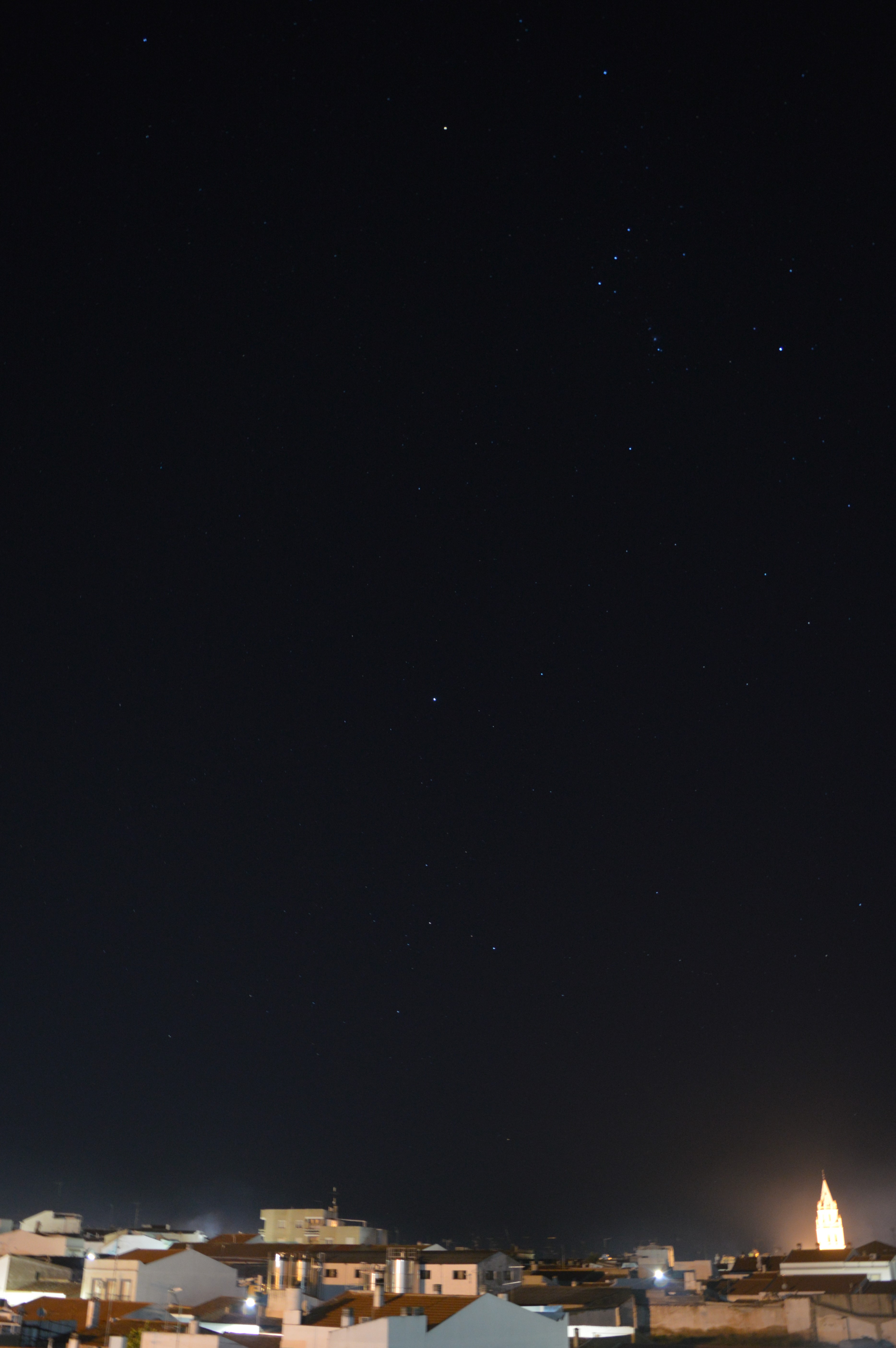
Our electricity bill is almost double what it was last term. That’s hardly surprising; since then, we discovered the flat’s heaters – both the presence of and the real need for them. No biggie. I’m keeping my options open on the job front, looking for work in both Spain and England. It may be some time before I have the enviable position of being able to make such a decision from a position of comfortable stability. Until then, I need to put Reinette through her paces (Hornachos is still beckoning), read a few more books, write a few more letters and apply some serious muscle to my novel. Time is in my favour this year, but still it slips through my fingers by the second. Orion watches from the night sky as he has for millennia, and the sight of him comforts me.
I’ll be back in England in under a week. It’s a nice way round to have it, I’ll grant you, living in Spain and holidaying in England. There’s also talk of an upcoming gig for the Northern Lights which I might feasibly be able to make. The ground beneath my feet is moving. In the meantime, I’m relying on Thomas Hardy, Marvin Gaye and a never-diminishing rota of classroom games to keep my mind at work.
In other words, life goes on. I’ll see you around. BB x








 The Book of Barnabas