A Taste of Adventure

One of the very best things about my job is my role as the middle school Gifted and Talented Co-Ordinator. As one of the few not on the G&T list in my grammar school days you might jump to the conclusion that there’s a chip on my shoulder there, but that’s not quite right. A more likely excuse is that in my sixth form days I was involved with my school’s Arts and Humanities Society, a pre-university lecture/seminar group run by my history teachers, and it was so pivotal in my development as an academic that I have spent the last few years wanting to set up a society of my own here. The simple fact of the matter is that, four years into my teaching career, I’ve found the niche that allows me to do what I’ve always wanted to do: explore learning for its own sake.

So far, what that has entailed is two after school lectures, one every half term, on subjects that my students might otherwise not encounter in the classroom. I got the ball rolling last term with a talk on the Aztec, where we went on a whirlwind tour of the history of the Mexica, the geography of Mexico and the fierce deities of the Aztec pantheon – as well as the tale of Cortes, la Malinche and the fall of Tenochtitlan. Since I’d much rather the sessions were seminars rather than dialogues, I make a real point of taking questions and posing some of my own as I go so that these talks are more of a journey together than a lesson with me at the front. In the best of all possible worlds – the world I’m trying to create in a Monday afternoon classroom – I’d like to come out of the hour knowing that I haven’t added to their knowledge so much as given them new avenues to explore. That’s why I conclude each session by asking my students what they’d be interested in learning about next time. Today, there were a lot of requests for Chinese history: the Tang Dynasty, the Civil War and the Opium Wars. Perhaps that’s because we took a ride with Zheng He and his treasure fleet this afternoon.
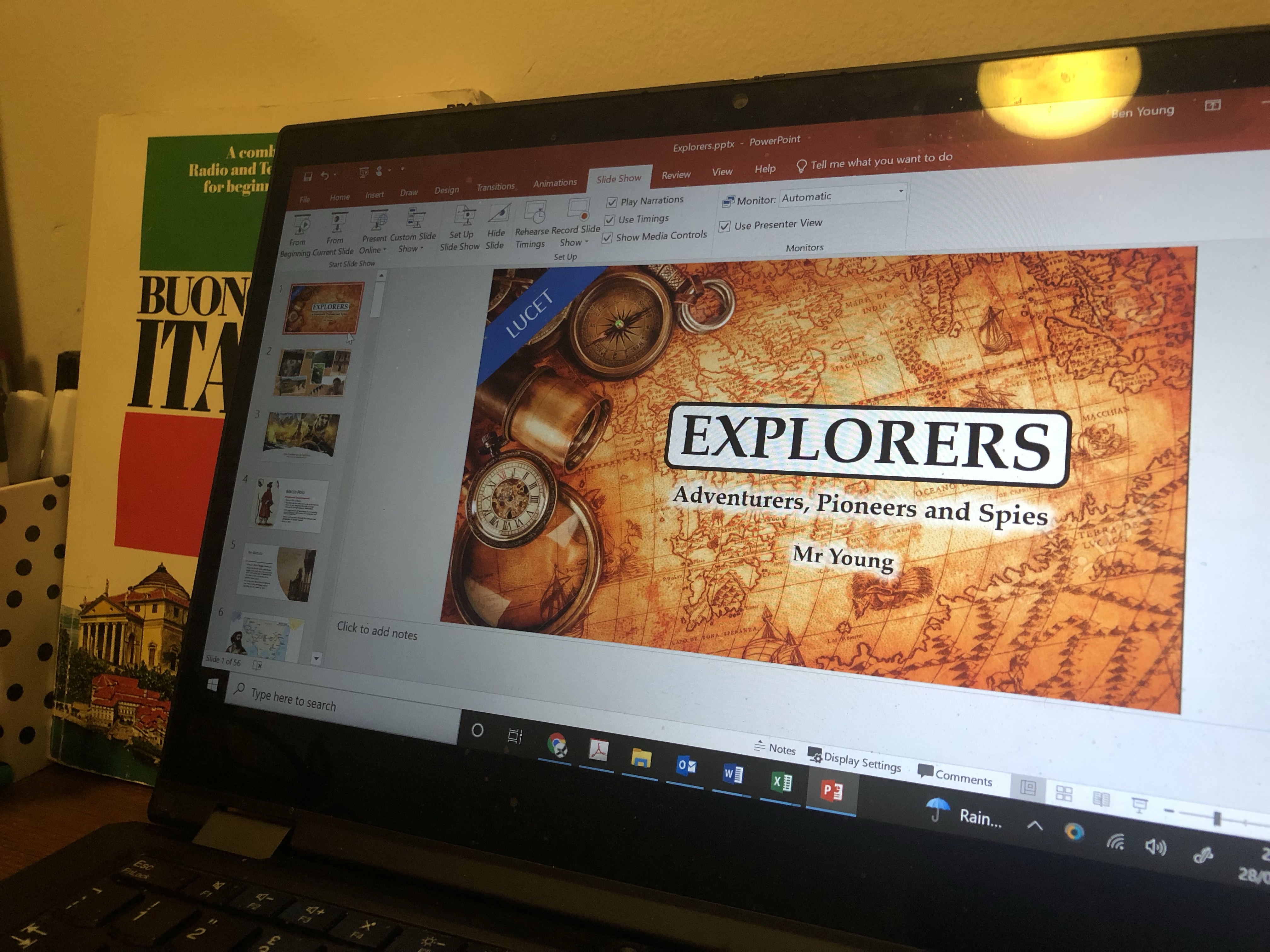
Today’s talk was on Explorers, after one of my students requested a lecture on adventurers like Cook and Lewis & Clark. It was so much fun to research, not least of all because I have been lucky enough to do no small amount of exploring myself in my twenty-eight years on this Earth. I started off with the graphic below and, after we’d agreed Mr Young really doesn’t suit a beard, I picked my students’ brains about the locations in each one. Using the clues of this man’s local dress, and the mountain gorilla, and the facade of the rose city, and the scallop shell, they smashed every single one. Proud teacher moment.

I get a lot of satisfaction from seeing my kids go from strength to strength in the language classroom. But I’d call myself a seeker of knowledge for its own sake long before I call myself a linguist, and this is where somebody like me is in his element. Seeing the electric enthusiasm of my students sparkling like Saint Elmo’s fire from their outstretched fingers as they vie to share their collected wisdom with their peers, answering questions I haven’t yet posed four slides in advance because they read this book here or their parents showed them that thing there… There’s few things like it. It’s one of those “this is why I teach” moments, and the best thing about it is that you’re not having to do an awful lot of teaching. The knowledge is there. All you have to do is open a few doors.

This afternoon, over the space of an hour, we traveled the world. We sailed around China, Africa and the Indian ocean with Marco Polo, Ibn Battuta and Zheng He. We crossed the Atlantic with Leif Eriksson and the Basques and wondered what took Christopher Columbus so long. We learned to navigate by the stars and explored the constellations. We met mild-mannered mountain men, meddling missionaries and bloodthirsty bandeirantes. We searched for Amelia Earhart’s final resting place, climbed the Matterhorn (and fell down the other side) and, saving the best until last, we sat down and had a difficult conversation with that most impressive of adventurers, and one of the greatest linguists (or even, in the opinion of this author, Britons) of all time: Sir Richard Francis Burton. Somehow I managed to cram it all into the space of an hour.

Well. Almost. We ran overtime by about five minutes, but not a single one of my kids reached for their phone, or started to pack up and leave. And that may well have to do with the fact that I chose to end the talk with the personal story of a friend of mine who gives us all a reason to believe in hope again: Luke Grenfell-Shaw, triathlete, fellow Arabist and CanLiver, and champion of the Bristol2Beijing tandem ride across the world. The best thing about that? Once again, I wasn’t even adding to their knowledge. Two of my students lit up at the image alone. They knew this man. They had heard of him.
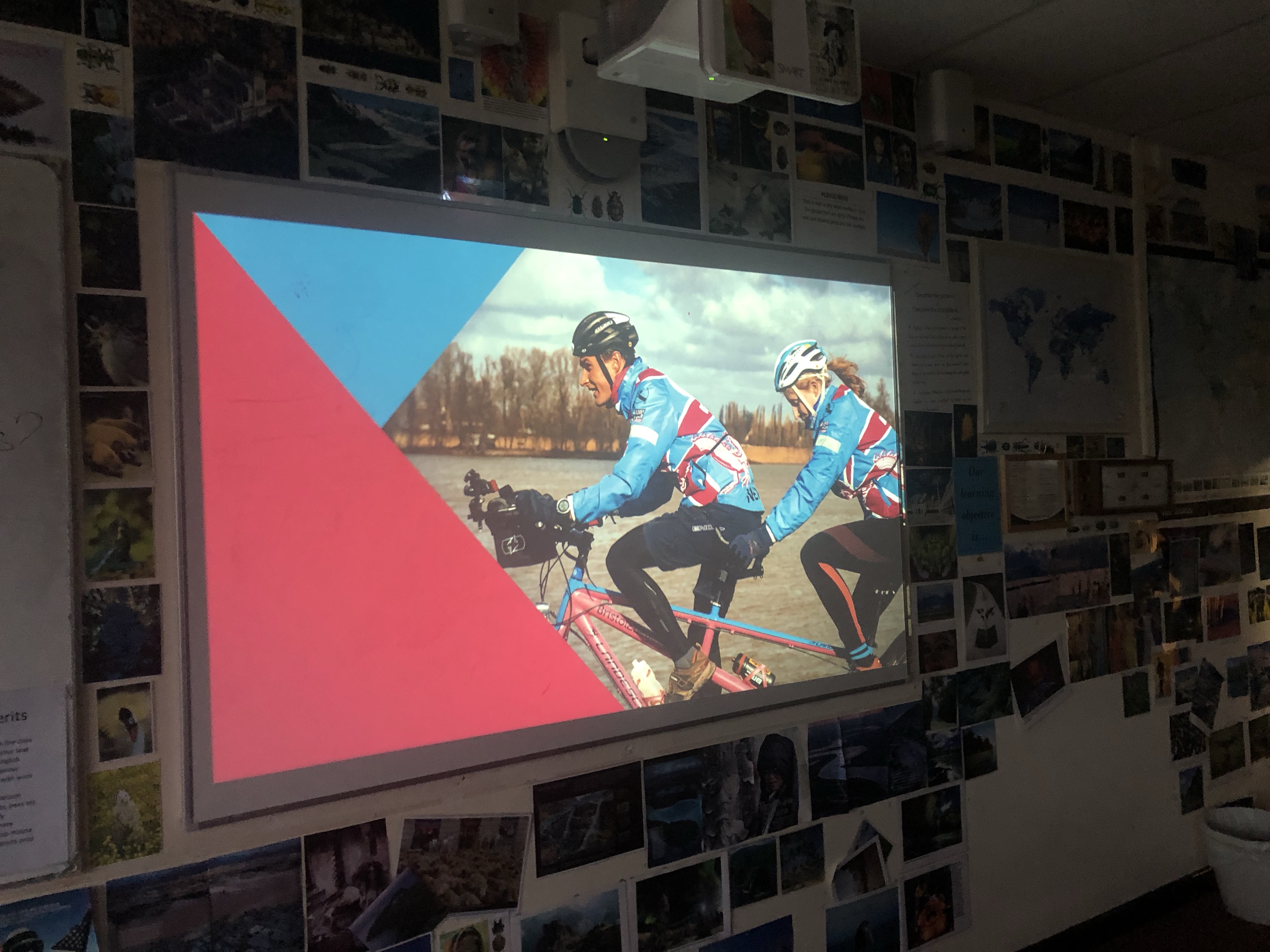
I can’t tell his story. I won’t. Read about him for yourself – there are few men in this world like Luke. And though I poured my heart and soul into this evening’s talk, I’d like to think that it will be Luke’s story that my kids take home tonight. The world is vast, and explorers and adventurers have already been over so much of it and documented everything. But that doesn’t mean the age of adventure is over. People like Luke are living proof that adventure lies within, in our hearts and in what we choose to do with the world around us.

Godspeed, Luke. We’re rooting for you here.

https://www.bristol2beijing.org/

In the meantime, I’d better find myself an expert on Chinese history! BB x

Buck

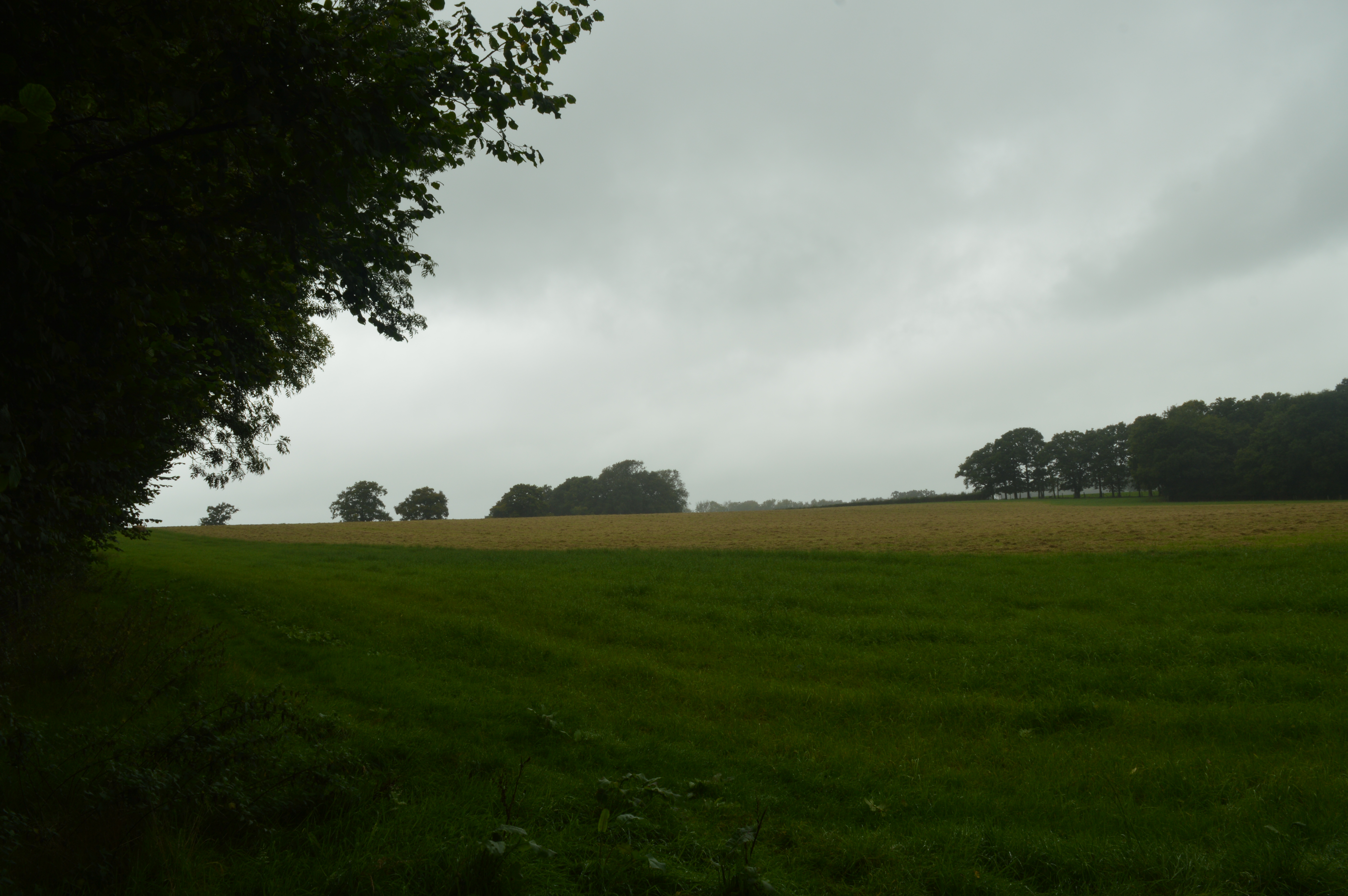
Autumn is creeping into the Weald. The trees haven’t turned brown yet – I don’t suppose I’ll see that before I go – but the leaves are beginning to fall and there’s a whiff of cold in the air, mingled with the damp, rotting smell of mushrooms. From the top of Turners Hill you can see for miles, sometimes all the way to the high hills of the South Downs on a clear day. Not so much at the moment, with the Weald mist of early autumn settling in on an almost daily basis, but every once in a while.

DSC_0096

England truly comes into its own at this time of year. It’s a season of green forests, Scotch mist and crows calling overhead. Acorns adorn the oak trees, the hedgerows are full of blackberries of varying tastes and conkers grin from their spiny shells in the horse chestnut trees. The pheasants have moulted and are roaming the country roads and fields, looking in a very sorry state, robbed of their handsome gloss and tail feathers. For so foreign a creature – most of today’s birds are descended from eighteenth century Chinese imports – theย cork-ok of the pheasant is as much a part of the English country soundscape as the crow or the woodpigeon. It’s a soundscape I miss dearly in the silence of the Extremaduran plains.

DSC_0063

Leaving the road for a while, I wandered along a winding country lane and went blackberrying in the verges. Over the distant drone of a bandsaw from behind the barn, a pair of buzzards called to each other. A phone was ringing in the farmhouse. It was a reality check, a ‘Moment’, as I call them. I wonder what it’s like to live on a farm, out here in the old country. Sometimes I think that I’m isolated here, but at the very least I live on a main road. Farms like this one are so far out that any experience of mine pales in comparison. The phone had stopped ringing by the time I’d come to my own conclusions, and I ate a few more blackberries. I swallowed them rather than chewing them, because if I don’t then one of the pips always manages to get itself wedged in my molars.

DSC_0106

I thought I’d run a short distance, regardless of the endlessly clinking two-pence coins in my camera bag. I didn’t get far up the hill before I stopped, because a sixth sense told me the noise might flush something up ahead. Sure enough, thereย wasย something up ahead, and it hadn’t heard the coins at all: a young roe deer buck, grazing at the edge of the woods.

DSC_0129

It was just one more of those ‘why didn’t I bring a longer lens’ moments. After my trip to the Farne Islands, I really should have been better prepared on that count. These days, however, I’m not so fussed by the photos. The buck continued grazing idly as I crept down the hill towards it, either completely unaware or completely uninterested in my presence. After a minute or so it found a fallen tree and busied itself with scent-marking, scraping its horns repeatedly on the branches.

I must have been within fifty yards or so, close enough to see the white circles on its nostrils, when it finally caught my scent and saw me. It didn’t bolt at first, but stared at me for a few moments. I think it was more curious than frightened. Eventually it made up its mind and tore away through the grass, leaping through the tussocks and over the fence back into the copse from which it had come. I followed it, but could not find it. I sat on a stile at the corner of the field and wrung the water out of my socks as the rain came down. Sheltered under the oak trees, I waited out the drizzle barefoot.

DSC_0139

After a quarter of an hour, I put my socks and shoes back on. They were still wet from the thick grass and squelched on each footfall, but I didn’t really care anymore. In the Weald a lot of the footpaths run over old watercourses, where thick slabs of stone jut out of the earth. One such dark gully ran down from the corner of the field and I followed it, soaking in the sound of the wind in the trees overhead.

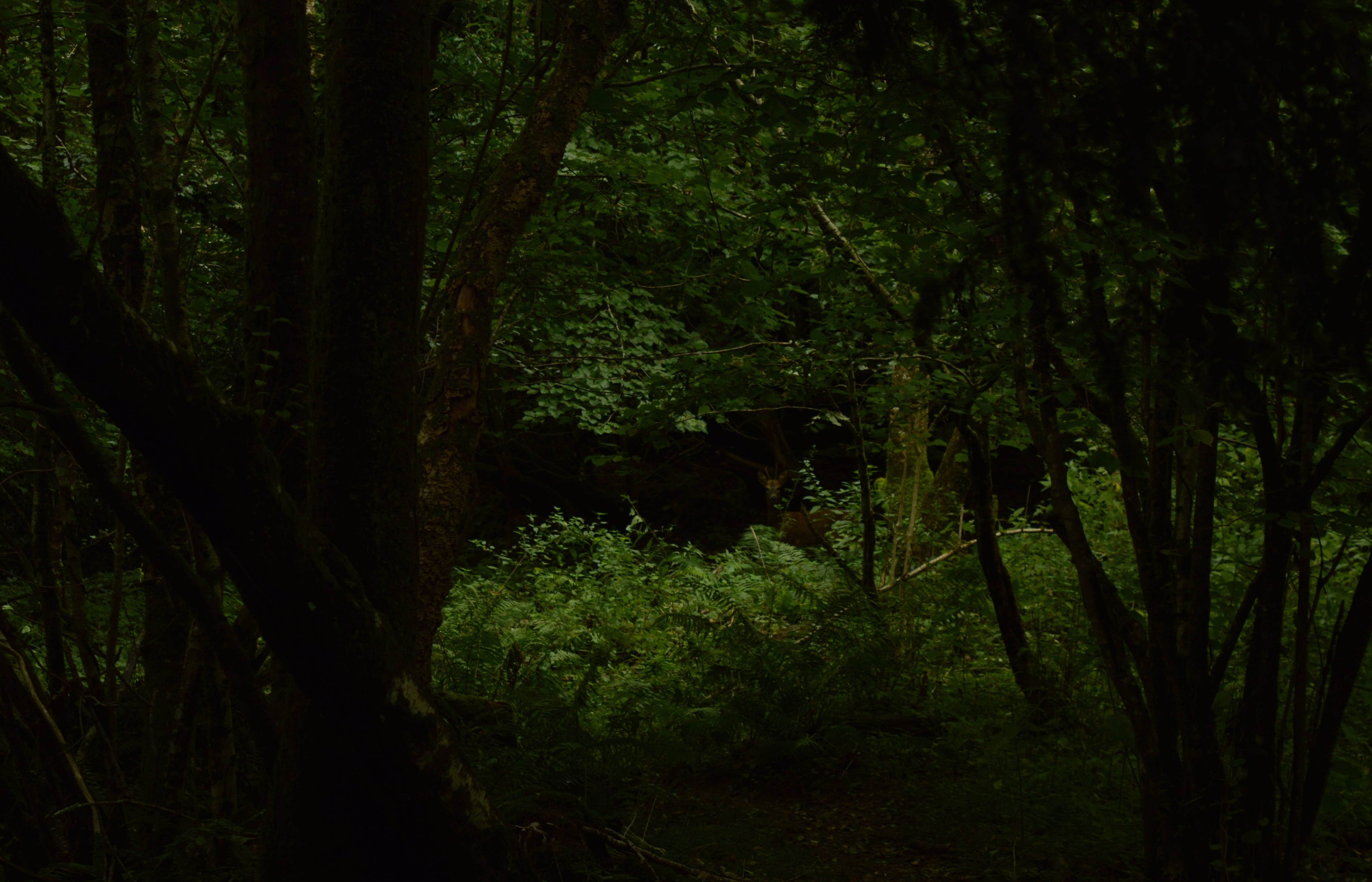
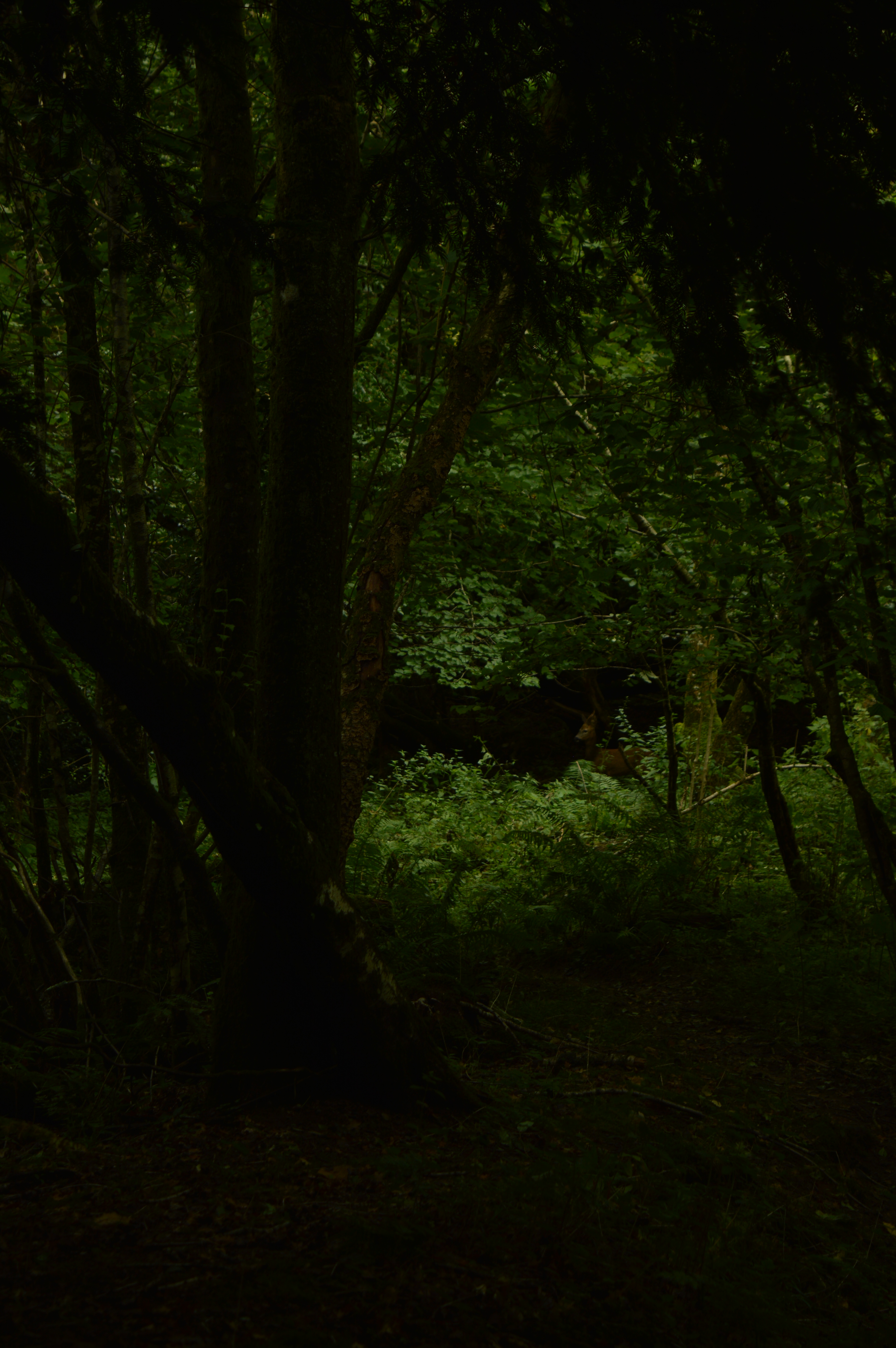
A short way ahead I stopped to check the white balance settings on my camera, and – there it was again. That sixth sense. I looked up and, sure enough… thereย it was again. The roe buck, at the bottom of the gully, looking right back at me.

DSC_0144

He held my gaze for a little longer this time, and when he scampered off, it was a little slower than before. I felt so alive. Mum said she saw a muntjac on her morning run the other day. I know I heard them in the woods when I was working here in the summer. I’d sure love to see one; they’re one of the oldest kinds of deer in the world. There’s something more primal still about the roe deer, though. They were here long before the muntjac, the sika and the fallow, perhaps even before the mighty red. I’ve had brief encounters with them in the mountains of Spain and the forests of France, and seen them many more times in passing from trains, grazing away at the forest edge in some field or quiet garden. Bambi was a roe deer, in the original story by Felix Salten. Having watched the bold curiosity of the young buck this morning, it makes perfect sense.

DSC_0145

I read in a magazine once that encounters like that are what you call ‘RSPB moments’. Granted, it was the RSPB magazine, so they would use the tagline, but it’s what I’ve come to associate with such close encounters. There are Moments, when you open all of your senses to the world around you in that instant: the ringing of a telephone, the organised cluster of objects on your desk that tell a few stories and none at all, the never-ending sound of your own breathing. And then there are moments grander still, like an encounter with a wild animal. There is a power in nature I get from nowhere else, and it feeds me still. BB x