Eulalia

Hotel Rambla Emérita, Mérida. 20.16.

It’s been raining all day again. I was out late with Tasha last night catching up on old times – neither of us could really believe that it’s been nearly eight years since I left – so I didn’t begrudge the downpour for a long and cosy morning in bed. You don’t have to be busy every day of the holidays, even when you’re abroad.

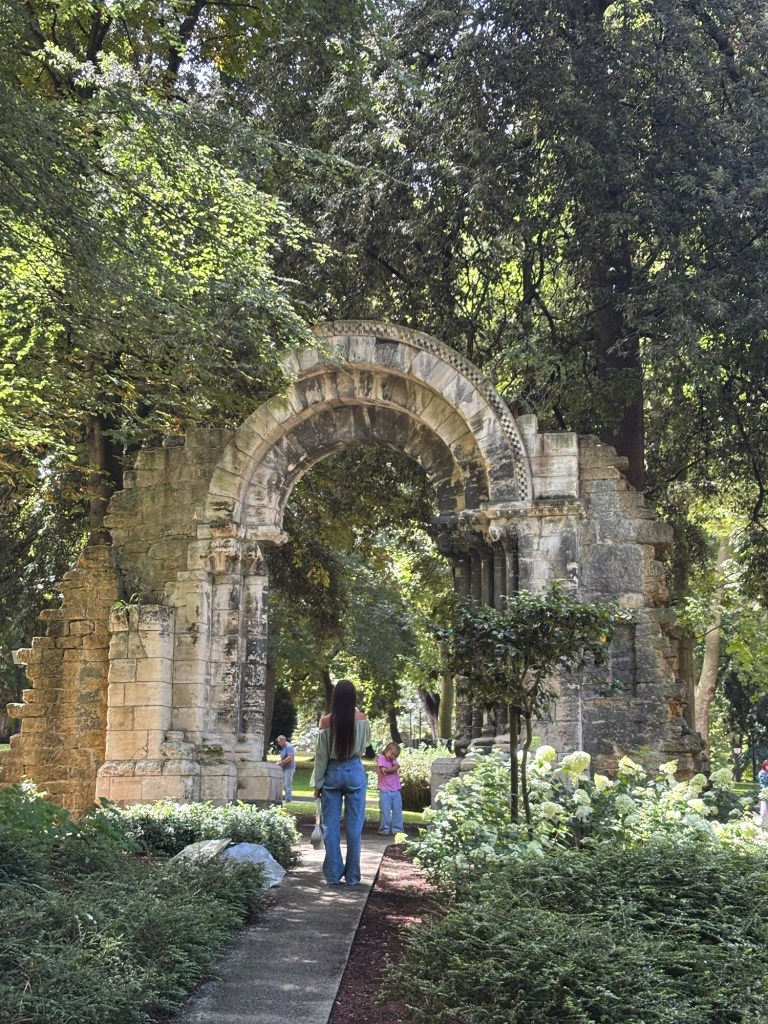
Luckily, I was all over Mérida yesterday with my conjunto histórico ticket, granting access to all the city’s Roman ruins, so the only thing I missed out on was the Alcazaba, which I might visit tomorrow with Tasha and her boyfriend Antonio, if he’s up and about. I don’t think I’ve seen the Alcazaba before – one tends to focus on Mérida’s Roman history rather than its Moorish past, and there are older and more impressive alcazabas (the Spanish rendering of the Arabic qasbah) in Andalucía: Sevilla, Córdoba and Granada, to name just the obvious ones.

Mérida isn’t unique in having a Roman amphitheatre either. There’s a pretty spectacular one (albeit less often seen) in Santiponce that I’ve often seen from the bus on the way in from the north. But there are a few more unique treasures to be found in Extremadura’s administrative capital, and I thought I’d tell you about one such gem below.

Let’s start with the lady of Mérida – because every Spanish city has its special lady. This one is Santa Eulalia.


Eulalia of Mérida stands tall above the other Christian saints of Spain, which is especially impressive as she only lived to around twelve years of age. A Roman Christian, she and her family were forbidden to worship God under the Persecution of Diocletian. Incensed, and unable to keep her faith to herself, Eulalia fled out of exile to the city of Emerita Augusta, where she openly challenged the local governor, Dacian, insulting the pagan gods whom she was commanded to worship. After a few desperate attempts to reason with her, Dacian had the girl beaten, tortured and burnt at the stake. According to legend, Eulalia is said to have mocked her tormentors until her dying breath, which came out in the form of a dove.

Eulalia was once a great deal more powerful than she is today. Before the rise of the cult of Santiago, it was Santa Eulalia de Mérida in whom the Christian soldiers placed their trust as they made war on the Muslims occupying the lands their ancestors had once held; and it was to her tomb in Mérida that thousands of pilgrims travelled during the Middle Ages, before Santiago Matamoros muscled her out of the picture.

At least one of my Protestant Christian friends has remarked at some point about the thin line between the Catholic Church’s veneration of saints and idol worship. Surely – they have reminded me – it is God and by proxy his son, Jesus Christ, to whom prayers should be made, not the pantheon of mortals who claim to be able to intercede on my behalf?

I can see the argument as plain as day. There are shops up and down this country selling nothing but saint souvenirs: votive candles, icons and fridge magnets, scented rosaries and car ornaments. I have a few myself – a family rosary from Villarrobledo and a more personal one from La Virgen del Rocío, which these days is on my person more often than not.

However, I don’t think it’s as simple as that. How frightfully urbane, to assume that the only true relationship with God is a detached and decidedly modern Western take on prayer. How tremendously big of us to assume that we can comprehend a force that it is, by its eternal nature, beyond our understanding. Community is a powerful agent – it seems only right that the spiritual world, Christian or no, has a network of pomps to streamline the neural network that binds us all together. On Earth as it is in Heaven, as they say.
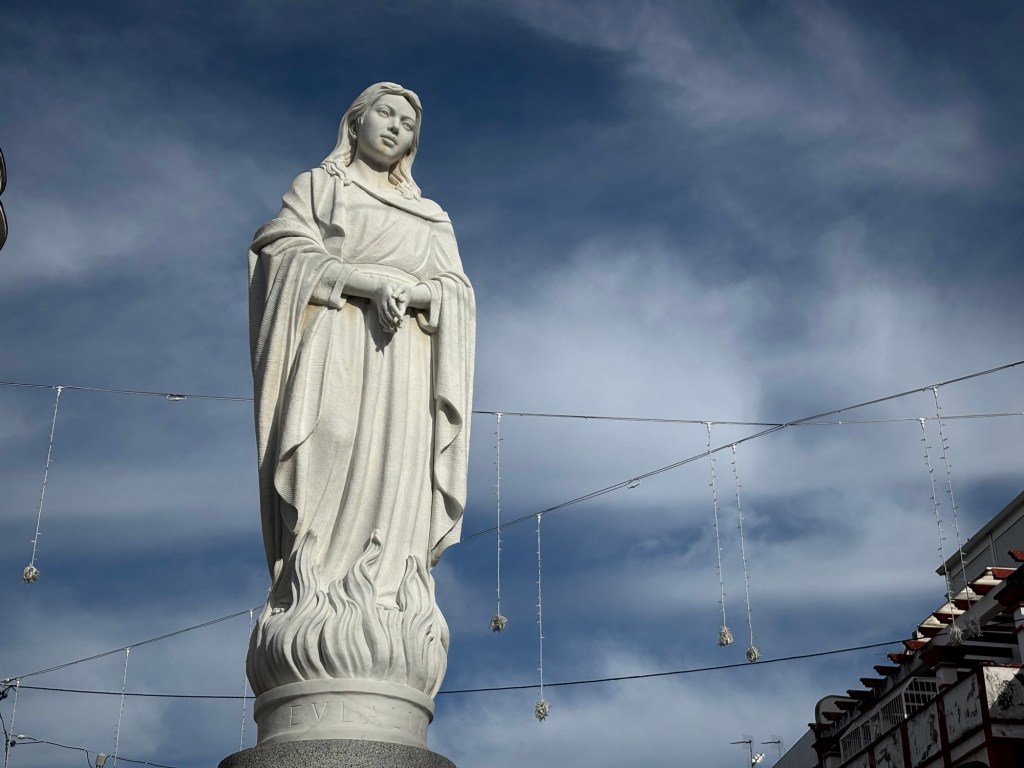

Spain has a long history of wandering saints. Santiago journeyed beyond death to Galicia, sparking the most famous pilgrimage in Christendom. Guadalupe travelled from her mountain home to México to become one the most venerated Marian cults in the world. Eulalia was dug up and reinterred in Oviedo, where she became a figurehead of the Reconquista (I genuinely had no idea I was standing before her final resting place this summer). Teresa of Ávila’s body parts have travelled all over, most famously her Incorruptible Hand, which used to grace Francisco Franco’s desk.

Tomorrow, I make for Sevilla. Journey’s coming to an end. I’d better make sure I’m fully packed. BB x
Camino XVIII: Down and Out

Albergue de Peregrinos El Salvador, Oviedo. 19.27.

Ignore what I said yesterday. I’ve reached Oviedo a day ahead of schedule. There are a few reasons for this:

  1. The Albergue in Pola de Lena was due to open at 15.30, some three hours after I arrived. The website was pretty vague about the need to book ahead.
  2. The next town, Mieres del Camino, was about three hours’ walk on, but had no albergue – pilgrims are housed in the Residencia Universitaria for the princely sum of 25€.
  3. The flights home from Santiago go up by about 50€ after the 10th August, giving me an incentive to pick up the pace, but…
  4. …my feet could use a break after all that climbing, and speeding up is the last thing that I need.
  5. Oh, and I’ve had three days without WiFi, so my data has been cascading faster than my Camino buddy Alonso could finish a watermelon.

Hopefully you’ll forgive me for catching a train for the last 30km or so from Pola de Lena. I have been walking about 25-30km a day every day for four weeks, and I used one cheeky bus ride on my last Camino to circumvent the tedious industrial estate west of León. This time it’s my own health I’m looking out for!


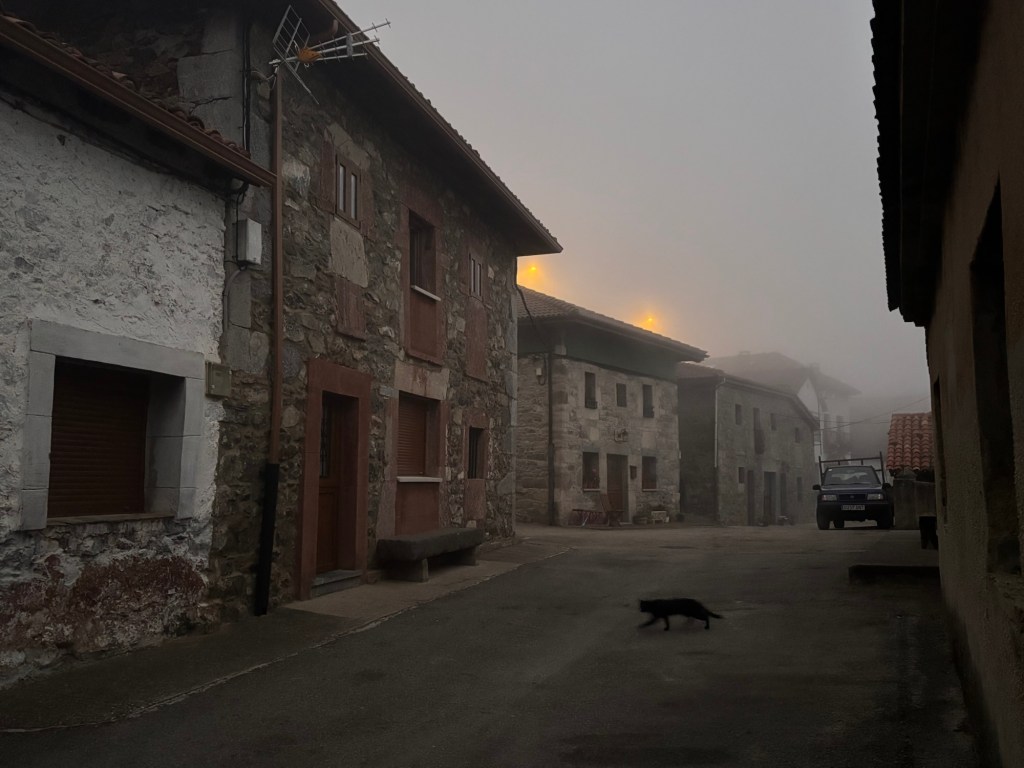
It’s a good thing I jumped the gun and climbed up and over Puerto de Pajares yesterday, as when I awoke this morning, it was to a fogbound world. The rain that was forecast never came, but in its place a thick blanket of mist had descended upon the mountains, obscuring everything from sight. It didn’t clear until around half past ten, by which point I would have long since reached the Asturian border if I’d stuck to my original plan.


Two of the sportygrinos left around five minutes before I did, but I never saw so much as a whisper of them on the trail, and I was making pretty good speed. I’d get to wondering whether some of these lean Spanish pilgrims take the Camino at a run, but there was no such trace in the mud, so perhaps they took a shortcut. Or went by bike.


The initial descent into the valley below was positively murderous underfoot, so Pinta and Niña came to the rescue once again. It wasn’t helped much by the knowledge that once I’d got to the bottom of the valley, I’d only have to go back up again on the other side.

The Lady of El Rocío sent me a gift to speed me on my way. A pine marten came scampering out onto the path as I started to climb, stared at me for a few seconds, and then went bounding off into the trees. I raced after it on stealthy feet, but it had vanished.

About an hour or so later on, as the Camino threatened monotony on a 5km asphalt stretch, she sent another gift in the form of a white raptor: an Egyptian vulture, the first I’ve seen in years, smaller than its griffon cousins but by no means less impressive. Between these two gifts and the cries of buzzards that followed me all the way to Pola de Lena, I was in good company all morning.

Something that caught my eye along today’s route was the quiet fury at the Asturian AVE line. The AVE (Alta Velocidad Española, Spain’s high-speed rail line) arrived late in Asturias, with works completed in November 2023. The project took nearly twenty years to complete, owing to the difficulty of the terrain – namely, the formidable barrier of the Cordillera Cantábrica. The first attempt to dig a tunnel through the mountains hit an enormous aquifer that drained many of León’s rivers and reservoirs, requiring rapid repairs and a considerable sum of money to re-route the tunnel.

All in all, the final cost of the AVE line from Madrid-Gijón was around 4€ billion. For context, the Madrid-Barcelona line cost around 9.5€ billion to lay down, which is just under twice the length, but there is considerably more traffic between the two megacities, and the Catalans have always benefited from their access to the profitable Mediterranean Sea. The Asturians, on the other hand, are proud of the natural beauty of their mountain principality and the decision to mine straight through the mountains does not seem to have been universally welcomed here.


I reached Pola de Lena at around 12.15 and killed some time over lunch (alubias con orejas, chuletón and natillas – and all for less than £10!). I had the same rigmarole with the train ticket as I had in France: the ticket barrier wouldn’t recognise the QR code on my phone, so as there was nobody at the desk, I just bought a 2€ ticket to the next stop. And just like France, the QR code worked perfectly at the other end. No idea what that’s all about.

Oviedo is a very different city to the ones you encounter on the Camino Francés. It feels distinctly more European than Spanish: large green parks, blocky, modern buildings and no plane trees in sight. I had to cross one such park to reach the albergue and practically stumbled upon a statuette of Mafalda, the beloved creation of Argentine artist Quino. She’s a big hit in her home country (and in Spain), but Oviedo has a special place for Mafalda due to the presence of her statue in the park. That’s why you’ll find Mafalda-themed tee-shirts and toys in shops all across the city.


I got to the albergue in time for 16.00, when the hospitalero hobbled in, but it was gone 17.00 by the time I got to check in – despite being only seventh in line. The poor guy seemed to have learned the monologue like a script which he rattled off at high speed, too fast for even the Spaniards amongst us to understand. The only point he was crystal clear on was that we had to be in by 22.00h, at which point he would close the doors. I suppose that must be a recurring problem in the cities.

I can tell you one thing I’ve noticed immediately about the Camino Primitivo. It’s a lot more European. I haven’t met a single American (or Brit, for that matter). Lots of Spanish, lots of French and a scattering of German, Austrian, Italian and Portuguese. But no Americans. I wonder if that’s a thing? Do they only come across the Atlantic for the “big ones” – the Francés and the Norte? The Primitivo is just under a fortnight (I will be doing it in around 10-11 days) so perhaps it’s not worth the investment. It will mean a serious shot in the arm for my languages – and isn’t that precisely why I love the Camino so much?


It would be remiss of me to come all this way and not visit the Catedral de San Salvador, so I slipped in for a flying visit just before closing time. True to form, the scaffolding curse struck again: the cathedral was untouched, but the image of San Salvador was behind a heavy hemp screen, being carefully restored by a couple of painters. There’s plenty more to see, though, and I had a wander around the sacred relics and the pilgrim tombs in the cathedral’s antechambers.

Just before leaving, my eye was caught by a small but incredibly ornate chapel by the exit to Santa Eulalia de Mérida, a teenage saint from Extremadura who is venerated in Asturias. She’s a long way from home, up here in the cold mountains of Asturias; but then, so was the Lady of El Rocío in that shrine by the lake west of Logroño.

I’m only just beginning to take an interest in the cult of saints in Spain – and I feel all the more foolish now for dodging an entire module on the subject at university. Given my especial devotion to the Lady of El Rocío, it seems a subject I really should explore some more. Maybe there’s a space for Eulalia in there. She would be a bridge to the land that stole my heart.


French to my right. Portuguese to my left. Spanish out in front. It’s shaping up to be a good Camino choice for languages. And if my plan holds out, I might even get to say one last goodbye to at least one of the pilgrims with whom I shared the road from Puente La Reina. New friends and old. That would be a nice way to end this adventure. BB x