Albergue Municipal, Estella-Lizarra. 20.39.
Excuse the late entry – I’ve chosen to be sociable today and have spent most of the afternoon in the company of fellow pilgrims from around the world. It’s been a welcome change after nine days of silence! But a promise is a promise, and I have a duty to uphold! So here’s today’s report.
I was up early this morning – five to four, to be precise. Falling asleep around ten didn’t help my sleep pattern, I guess. I couldn’t quite justify striking out for Estella so soon – it is only just under 22km from Puente La Reina – so I dawdled until five, at which point several pilgrims were already getting ready to go. Again, I dawdled, not wanting to arrive in Estella with two hours to kill before being able to jettison my rucksack, so I carved the names “Niña” and “Pinta” into my sticks (after Columbus’ ships – the Santa María, the third of the trio, is my rosary). It’s not especially visible, as all I had to hand was a kitchen knife, but it’s a start.
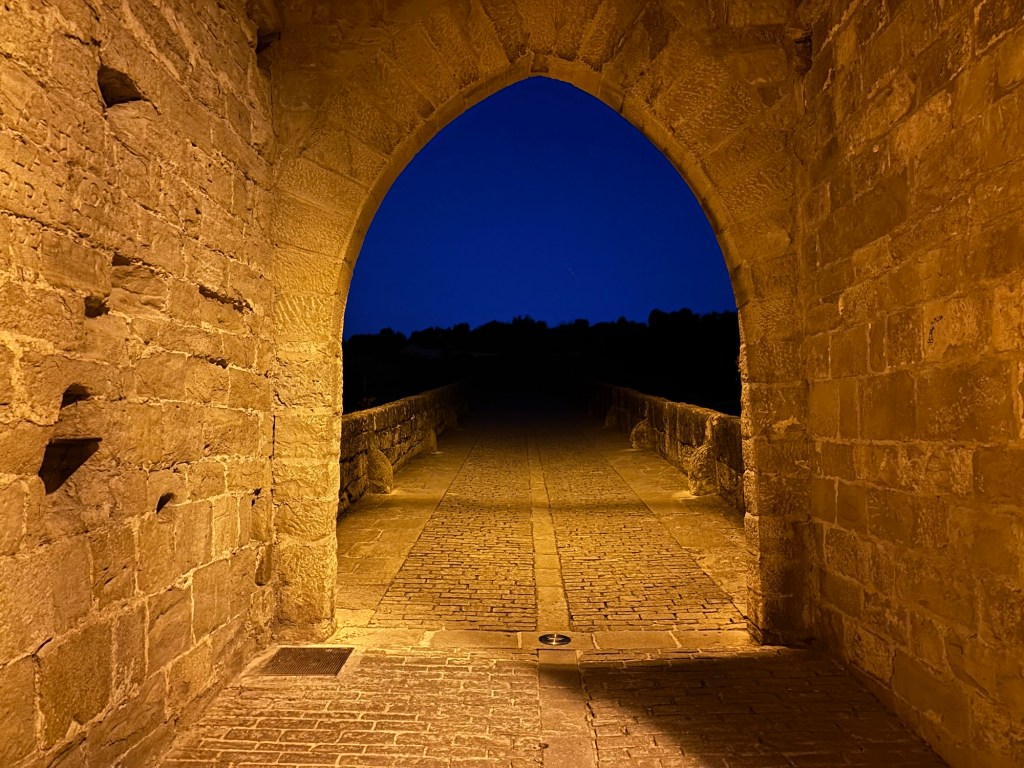
I was one of the first to strike out, but I gradually let a fair number of pilgrims overtake me. I stopped frequently; waiting for the sunrise at Cirauqui, sketching a lonely cemetery, grabbing a tortilla sandwich at the same bar I ate in when I walked this path with my mother six years ago. I also managed to collect a few stamps, which is always a plus.

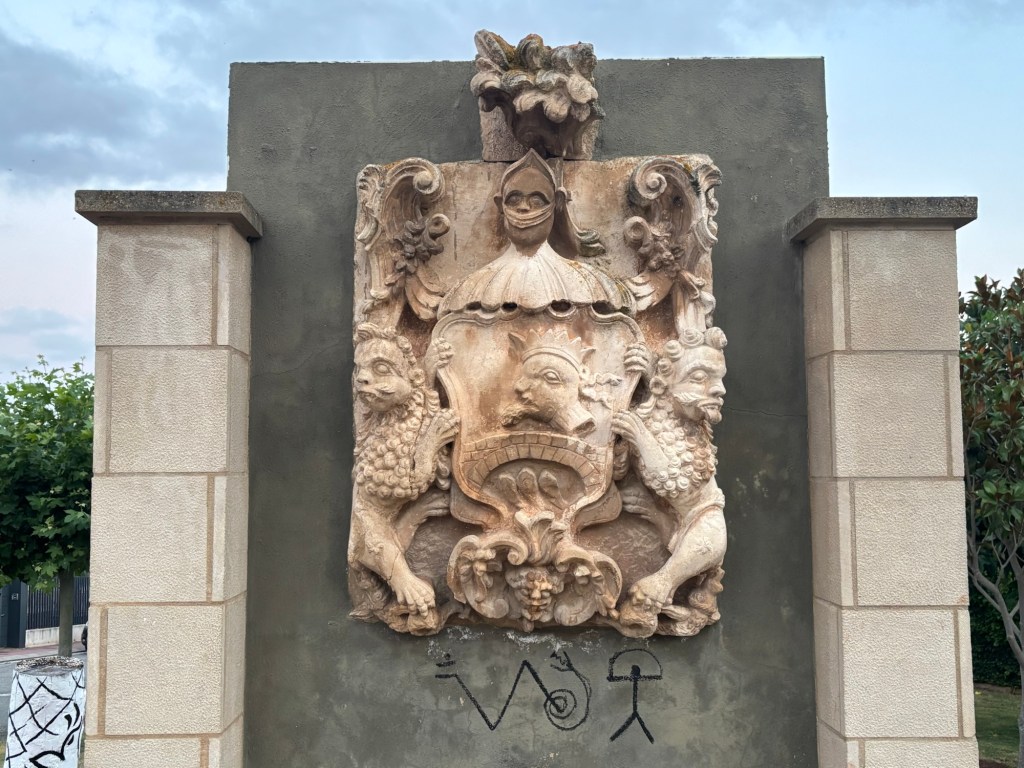
I spent a lot of time today looking at the decorations on houses and doors, which suddenly become more elaborate upon entering the Basque territories. Many houses bear a heraldic crest, and around here the motif of the knight’s helmet with the visor raised is fairly common. In heraldry, this is usually the sign of high-ranking nobility. Many of medieval Spain’s most prominent nobles were of Basque extraction (or Basque adjacent), like the Mendoza, Loyola and Haro lines.
Curiously, scratched beneath one of these crests were two symbols. One is easily recognisable as the Índalo, an ancient fertility symbol from Spain’s southeast. The other is… well, I’m not entirely sure. I’m fairly certain it’s an invention by the artist who left the Índalo, in much the same style, with what seems to be a serpent drawn out of the end. Graffiti usually has a point to make – I wonder what it could mean?
I couldn’t help noticing the door knockers as I passed through Cirauqui. My mother used to fill memory cards with photographs of these things, which in the south (and here) often take the shape of a woman’s hand holding a metal ball, known as a Hand of Fátima. It’s an ancient Moorish motif used to ward off the evil eye, and appears in a lot of Mediterranean and North African jewellery. The lion’s head – a style much more familiar to those of us who live on the other side of the Pyrenees – does much the same thing, warding off evil spirits with its frozen roar.
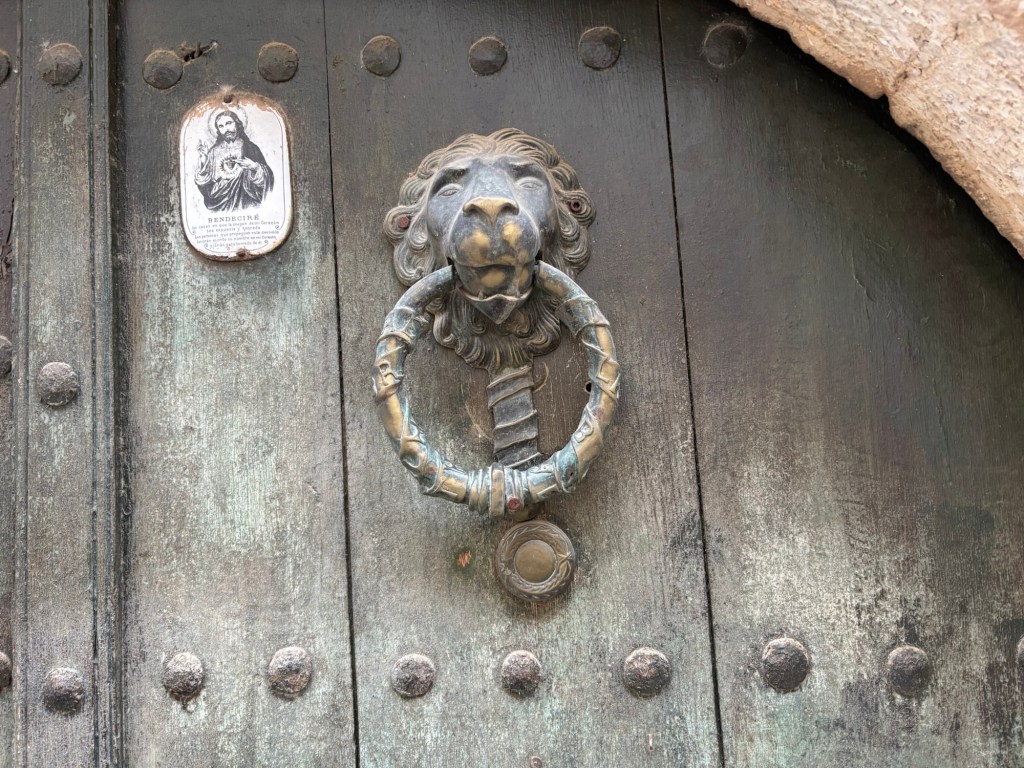
I am, of course, reading far too much into this. I imagine your average Joe (or José) probably doesn’t consider how effective this or that door knocker will be at warding off evil spirits. Still, it’s one of those things that’s so deeply embedded into our psyche that we don’t even realise we’re doing it. Like Christmas, in a way. Most of us don’t give thanks to God for the birth of Jesus Christ on the 25th December, but that doesn’t stop us from opening presents and celebrating late into the night.

I spent so much time hobnobbing with fellow pilgrims this afternoon that I didn’t really get to explore Estella much. It was also a sweltering 36°C, which didn’t exactly encourage an afternoon wander. Fortunately, I stayed here for two whole days the last time I came through, so I’ve seen all of Estella and its charms before.
One thing I did seek out, though, was the remarkable archway of the Iglesia del Santo Sepulcro. It caught my attention today for the same reason it did all those years ago: the horrifying maw swallowing sinners, and dragging them into Hell.
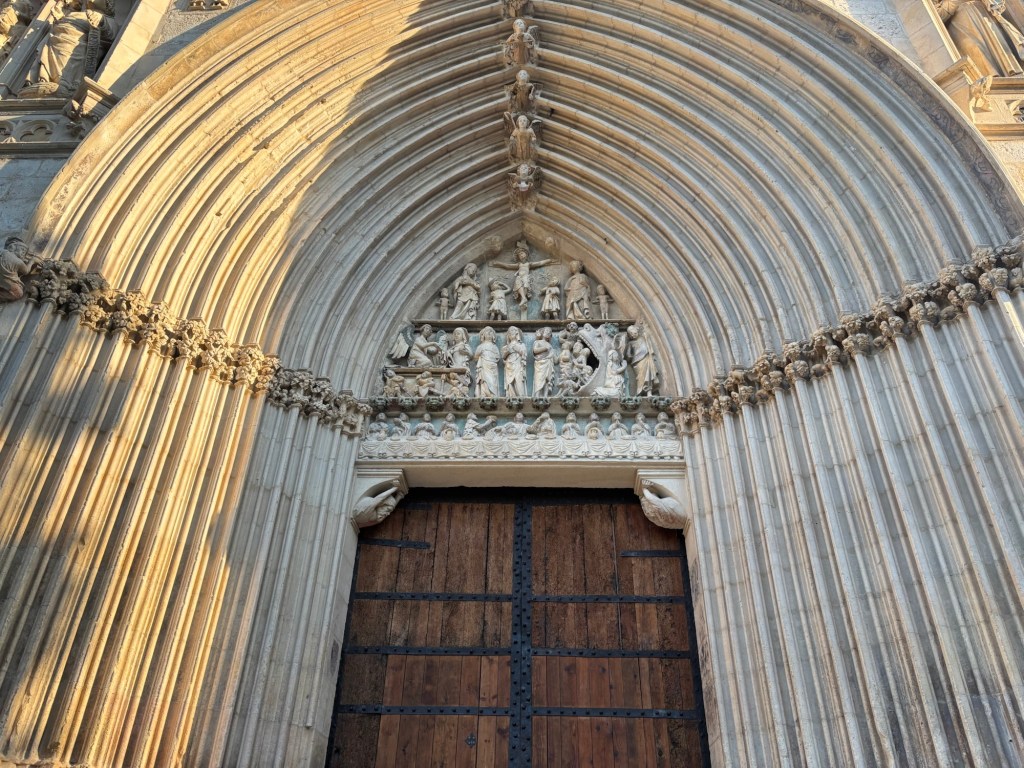
This motif is not unique to Estella. It can be found all over Europe. I’m fairly sure I saw one in Bordeaux last week. It’s known as a Hellmouth, and it can be found in Anglo-Saxon artwork at least as far back as the 8th century. It’s thought to be a representation of the “Crack of Doom”, the Day of Judgment – crack having a dual meaning in English, being both a harsh sound (like a thunderbolt or trumpet blast) and a chasm or pit. It may even have ties to an old Scandinavian legend of the Fenris Wolf, who was destined to swallow up Odin, the Allfather, and thus the world entire.
It’s certainly funny to think that such an English (read: Anglo-Saxon) blend of Christian and pagan imagery should find its way onto the doorway of a Spanish church, over a thousand kilometres to the south. It’s just one more reminder of the power of a good story: dropped in the right place, and told in the right way, it can send ripples that cross entire oceans.

Tomorrow I make for Los Arcos, a town I bypassed last time in favour of the ice baths of Sansol. Let’s see what I missed! BB x
 The Book of Barnabas