San Lorenzo de El Escorial, 13.45
A shadow lies upon his tomb, in Moria, in Khazad-dûm. The Company stood silent beside the tombs of the kings of old. There were many recesses cut in the rock of the walls, and in them were large iron-bound sarcophagi of black marble. Frodo and the Company stood in awe, but Pippin felt a compulsive urge to reach for his iPhone so that he might share the spectacle on Instagram. He held it aloft, and for a moment it glimmered, faint as a rising star struggling in heavy earthward mists, and then it issued forth a minute heart of dazzling light, as though Eärendil had himself come down from the high sunset paths with the last Silmaril upon his brow.
“No photos!” barked the security guard, gesturing wildly in Pippin’s directions, before muttering a loaded “turistas” under her breath.
In the year 1563, Felipe II ordered the construction of an enormous palace in the foothills of Monte Abantos, partly to commemorate his victory over the French at the Battle of San Quintín, partly as a country retreat where he could hunt big game, but perhaps most importantly as a necropolis for the Hapsburg line. Here, entombed within the bowels of the largest Renaissance building on Earth, lie the remains of almost every king and queen of Spain of the Hapsburg and Bourbon lines.
To get here from Madrid, you have to catch a bus from Moncloa. Spain is steadily catching up to the rest of the world as a cashless country, but most of the local bus companies are still coin-operated. I was delayed by an hour because my first attempt to board was a flop: the driver thought I said “puedo cobrar” instead of “comprar” and wagged a finger at me, saying “yo cobro, tú pagas”. Granted, I had a cold, but I’m pretty sure I made myself clear. I was honestly so ruffled by his wagging humour that I forgot I did actually have a ten euro note on me, so I got off the bus and went in search of breakfast and a cash machine – and a few plasters for my wounded ego.
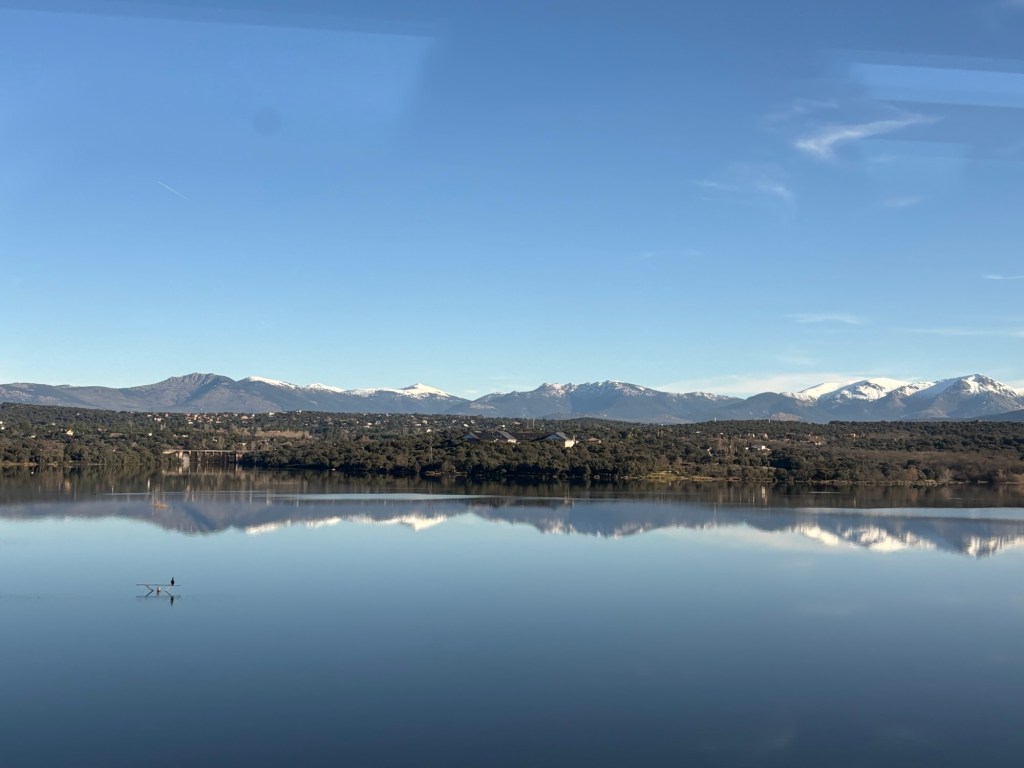
The next bus driver wasn’t a wisecrack, so I had a very enjoyable ride across the dehesa. To the north of the road to El Escorial, the snowbound peaks of the Guadarrama rise up out of the plain, its mantle pure and unspoilt by the ski-lifts and stations that criss-cross similar ranges in Central Europe. At one point, the road crosses the Valdemayor reservoir, and on a cloudless day such as this, the mountains rise again into the mirrored surface of the blue waters.
The centrepiece of El Escorial – as is so often the way with Spain’s grandest architectural treasures – is an enormous basilica, featuring a collection of saintly portraits, painted ceilings and a gilded reredos of jasper and red granite that stands an eye-watering 92 ft tall. As if that weren’t enough, the high altar is watched by the sentinel eyes of life-size bronze sculptures of Felipe II and his father, Carlos V, and their respective families, eternally offering their prayers to God above the crypt where their bodies are interred. It’s no great leap of the imagination to compare El Escorial to the Valley of the Kings: should it fade into memory someday, the discovery of the altarpiece alone would be an archaeologist’s field day.
The comparisons don’t end there. Much like the triumphal engravings of Ramses’ victory at Kadesh in Abu Simbel and Trajan’s Column in Rome, El Escorial’s “Sala de Batallas” (Hall of Battles) testifies to the martial prowess of the Habsburg line, depicting the greatest victories over the French, Moors and other enemies of the dynasty across over a hundred metres of fresco. That’s ten times the length of my mega drawing and eight times the height. I clearly missed my calling by four and a half centuries.

As well as a hoarding place for countless royal artefacts (including one of the largest collections of holy relics in the world, numbering around 7,500), El Escorial is most widely known as the final resting place of Spain’s monarchy from the early modern period on. These most haunting treasures of the royal palace can be found in the innermost depths of the palace complex, entombed within vaulted marble sarcophagi that contain the remains of princes, consorts, bastard sons and daughters and other high-ranking members of the Hapsburg line, right the way up to the present. The blank headstones above the sarcophagi in the last rooms sit waiting for Juan Carlos’ relatives and their progeny.
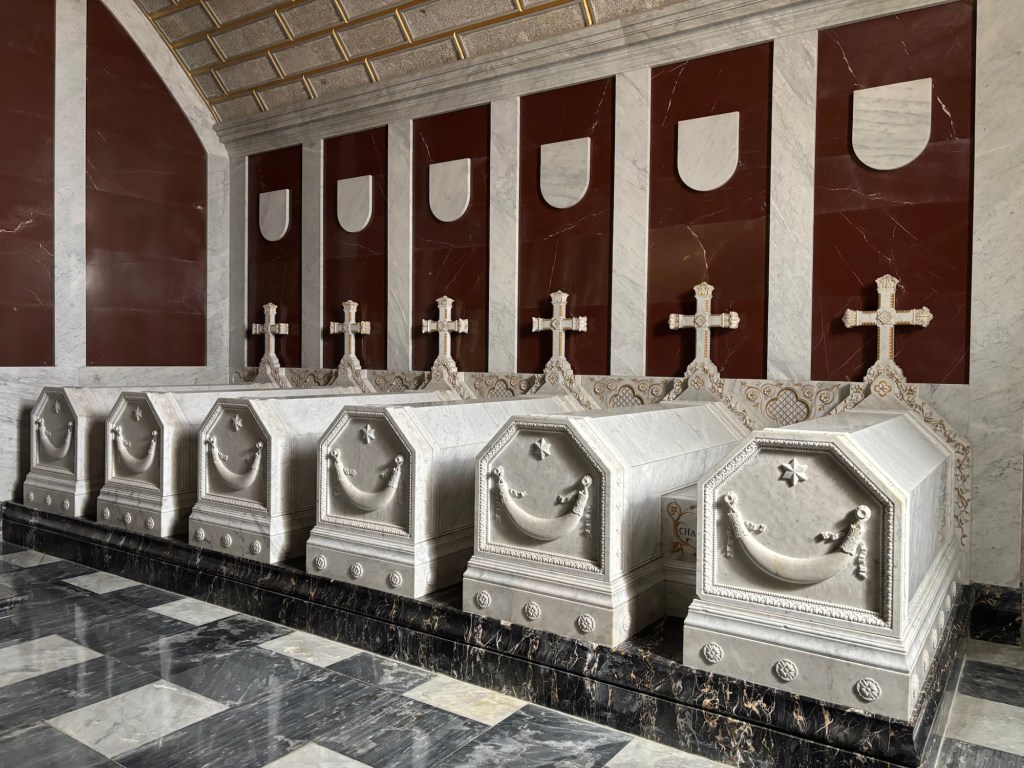
If that weren’t chilling enough, one of the rooms features an enormous marble monument to those of royal blood who perished before puberty, marked with A or B to differentiate between the Austria and Bourbon clans. With their famous predilection for morganatic marriages, it’s perhaps no surprise that so many infantes never made it to adulthood.
In the deepest reaches of all, far below the palace itself, is a golden chamber called the Panteón de los Reyes. This is the Habsburg Holy of Holies, where the bodies of the kings and queens were laid to rest: from Carlos V, who oversaw the conquest of the America’s and the birth of the Spanish Empire, all the way up to Alfonso XIII, exiled in 1931 by the short-lived Spanish Second Republic. In a single 360° turn you can see them all. There can be few places in the world quite like this, where you are quite literally encircled by the tombs of the kings of the past.
In such a sacred space, photos are, quite naturally, forbidden – but that didn’t stop a couple of Korean and American tourists from trying. I just carried out a quick sketch in my journal and was done with it. Nobody ever seems to mind the sketching. I wonder why that is?
Outside, the air is a lot less oppressive. A number of articles describe the location as “austere”, and I can imagine that in the grip of winter it may well be, but under the warm spring sunshine it is anything but. A cool wind blows down from the snowy mountains, but it is accompanied by a warmth in the air, sweeter with the scent of cherry blossom. Crag martins and wagtails twitter merrily over the pool, and in the dehesa beyond, I saw (and heard) a family of one of Spain’s most beautiful birds of all, the Iberian magpie, a relic of the Ice Age whose nearest living relatives can be found in eastern China. As I watched them hopping around in the branches of the nearest tree, a little owl flew into sight, calling to its partner in the valley below.
Finally, the greatest sight of all. As I made my way back to the bus station, a lonely black shadow came down from the mountains, casting an unmistakeable silhouette against the intense blue of the Spanish sky: a griffon vulture, the true king of these mountains. They were here long before the Hapsburgs and will be haunting these hills long after they have been forgotten.
I have been fascinated with vultures since the first time I saw one. That boyish glee I get when I see that shape in the ether hasn’t gone away after twenty years. I don’t think it ever will.
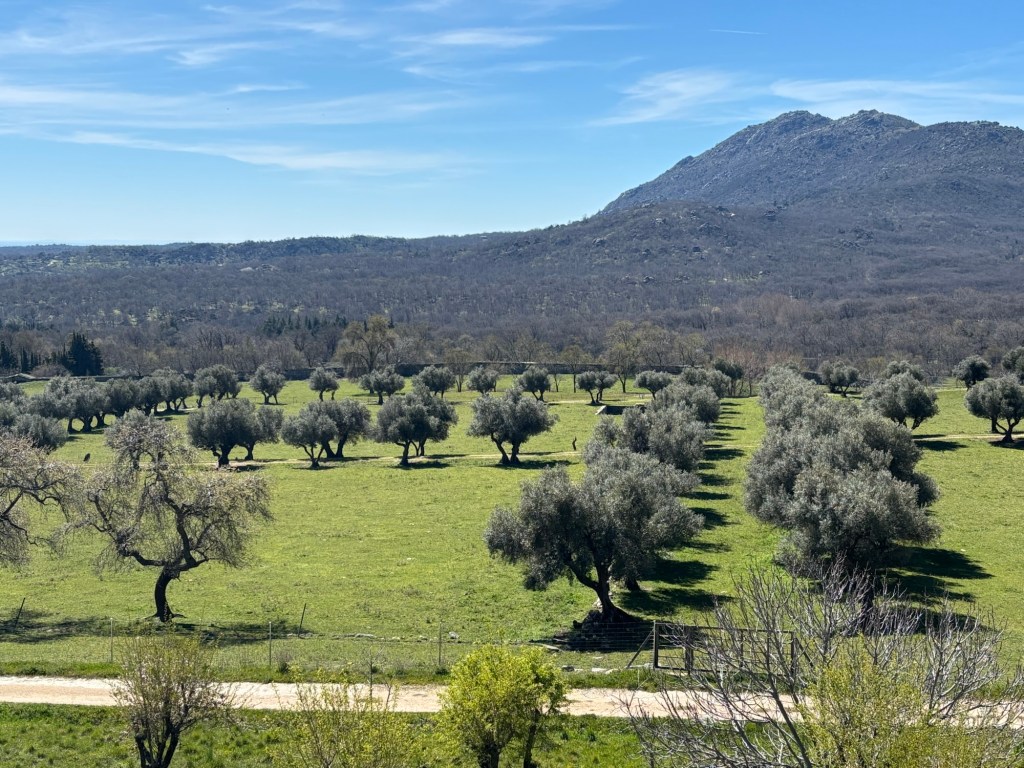
Austere? The building, perhaps, in true counter-reformation style, but the location? Hardly. I don’t think Felipe needed much convincing. If I had all that Habsburg money floating around, I’d have wanted to end my days here, too. BB x
 The Book of Barnabas