A Taste of Adventure

One of the very best things about my job is my role as the middle school Gifted and Talented Co-Ordinator. As one of the few not on the G&T list in my grammar school days you might jump to the conclusion that there’s a chip on my shoulder there, but that’s not quite right. A more likely excuse is that in my sixth form days I was involved with my school’s Arts and Humanities Society, a pre-university lecture/seminar group run by my history teachers, and it was so pivotal in my development as an academic that I have spent the last few years wanting to set up a society of my own here. The simple fact of the matter is that, four years into my teaching career, I’ve found the niche that allows me to do what I’ve always wanted to do: explore learning for its own sake.

So far, what that has entailed is two after school lectures, one every half term, on subjects that my students might otherwise not encounter in the classroom. I got the ball rolling last term with a talk on the Aztec, where we went on a whirlwind tour of the history of the Mexica, the geography of Mexico and the fierce deities of the Aztec pantheon – as well as the tale of Cortes, la Malinche and the fall of Tenochtitlan. Since I’d much rather the sessions were seminars rather than dialogues, I make a real point of taking questions and posing some of my own as I go so that these talks are more of a journey together than a lesson with me at the front. In the best of all possible worlds – the world I’m trying to create in a Monday afternoon classroom – I’d like to come out of the hour knowing that I haven’t added to their knowledge so much as given them new avenues to explore. That’s why I conclude each session by asking my students what they’d be interested in learning about next time. Today, there were a lot of requests for Chinese history: the Tang Dynasty, the Civil War and the Opium Wars. Perhaps that’s because we took a ride with Zheng He and his treasure fleet this afternoon.
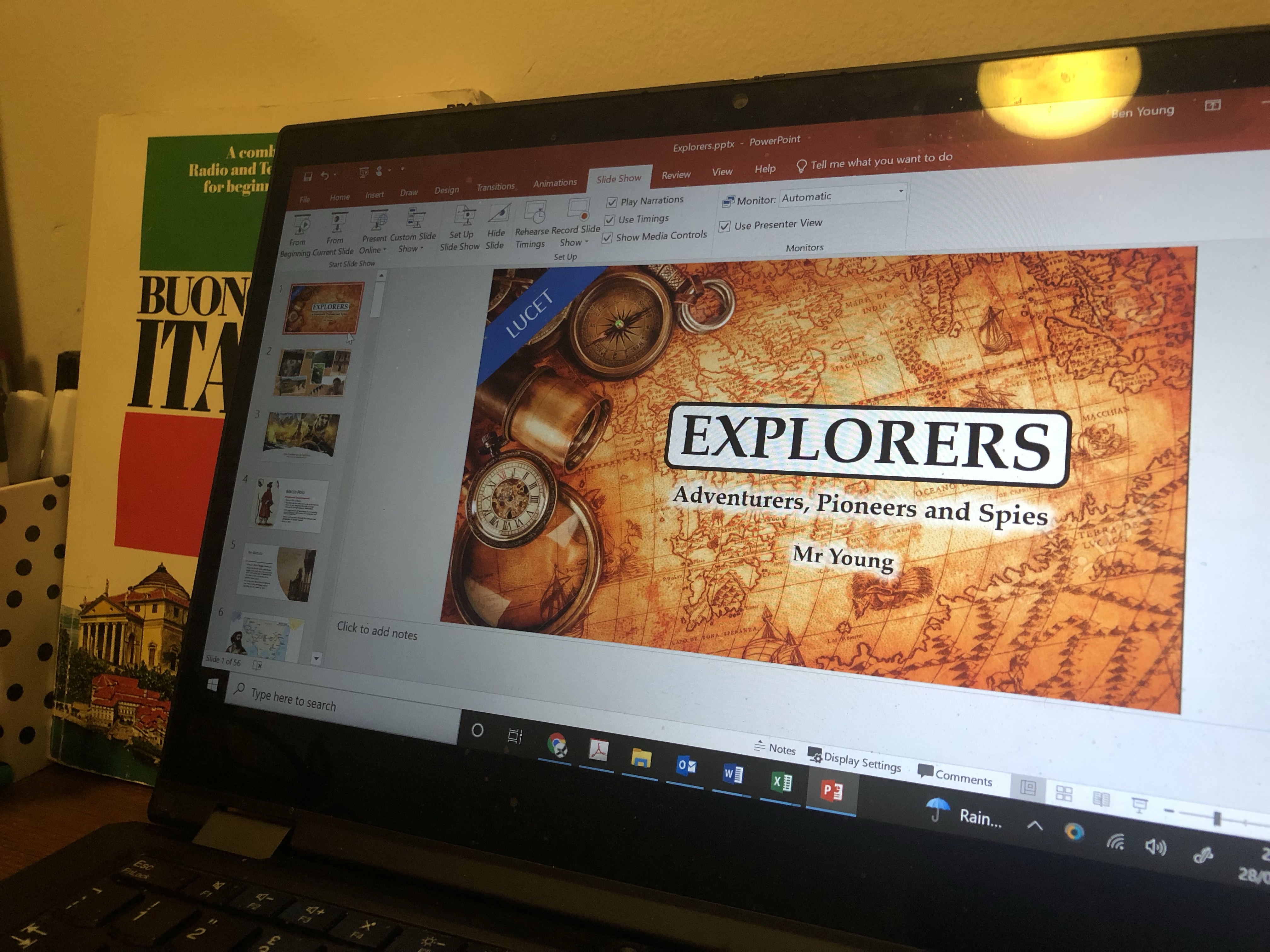
Today’s talk was on Explorers, after one of my students requested a lecture on adventurers like Cook and Lewis & Clark. It was so much fun to research, not least of all because I have been lucky enough to do no small amount of exploring myself in my twenty-eight years on this Earth. I started off with the graphic below and, after we’d agreed Mr Young really doesn’t suit a beard, I picked my students’ brains about the locations in each one. Using the clues of this man’s local dress, and the mountain gorilla, and the facade of the rose city, and the scallop shell, they smashed every single one. Proud teacher moment.

I get a lot of satisfaction from seeing my kids go from strength to strength in the language classroom. But I’d call myself a seeker of knowledge for its own sake long before I call myself a linguist, and this is where somebody like me is in his element. Seeing the electric enthusiasm of my students sparkling like Saint Elmo’s fire from their outstretched fingers as they vie to share their collected wisdom with their peers, answering questions I haven’t yet posed four slides in advance because they read this book here or their parents showed them that thing there… There’s few things like it. It’s one of those “this is why I teach” moments, and the best thing about it is that you’re not having to do an awful lot of teaching. The knowledge is there. All you have to do is open a few doors.

This afternoon, over the space of an hour, we traveled the world. We sailed around China, Africa and the Indian ocean with Marco Polo, Ibn Battuta and Zheng He. We crossed the Atlantic with Leif Eriksson and the Basques and wondered what took Christopher Columbus so long. We learned to navigate by the stars and explored the constellations. We met mild-mannered mountain men, meddling missionaries and bloodthirsty bandeirantes. We searched for Amelia Earhart’s final resting place, climbed the Matterhorn (and fell down the other side) and, saving the best until last, we sat down and had a difficult conversation with that most impressive of adventurers, and one of the greatest linguists (or even, in the opinion of this author, Britons) of all time: Sir Richard Francis Burton. Somehow I managed to cram it all into the space of an hour.

Well. Almost. We ran overtime by about five minutes, but not a single one of my kids reached for their phone, or started to pack up and leave. And that may well have to do with the fact that I chose to end the talk with the personal story of a friend of mine who gives us all a reason to believe in hope again: Luke Grenfell-Shaw, triathlete, fellow Arabist and CanLiver, and champion of the Bristol2Beijing tandem ride across the world. The best thing about that? Once again, I wasn’t even adding to their knowledge. Two of my students lit up at the image alone. They knew this man. They had heard of him.
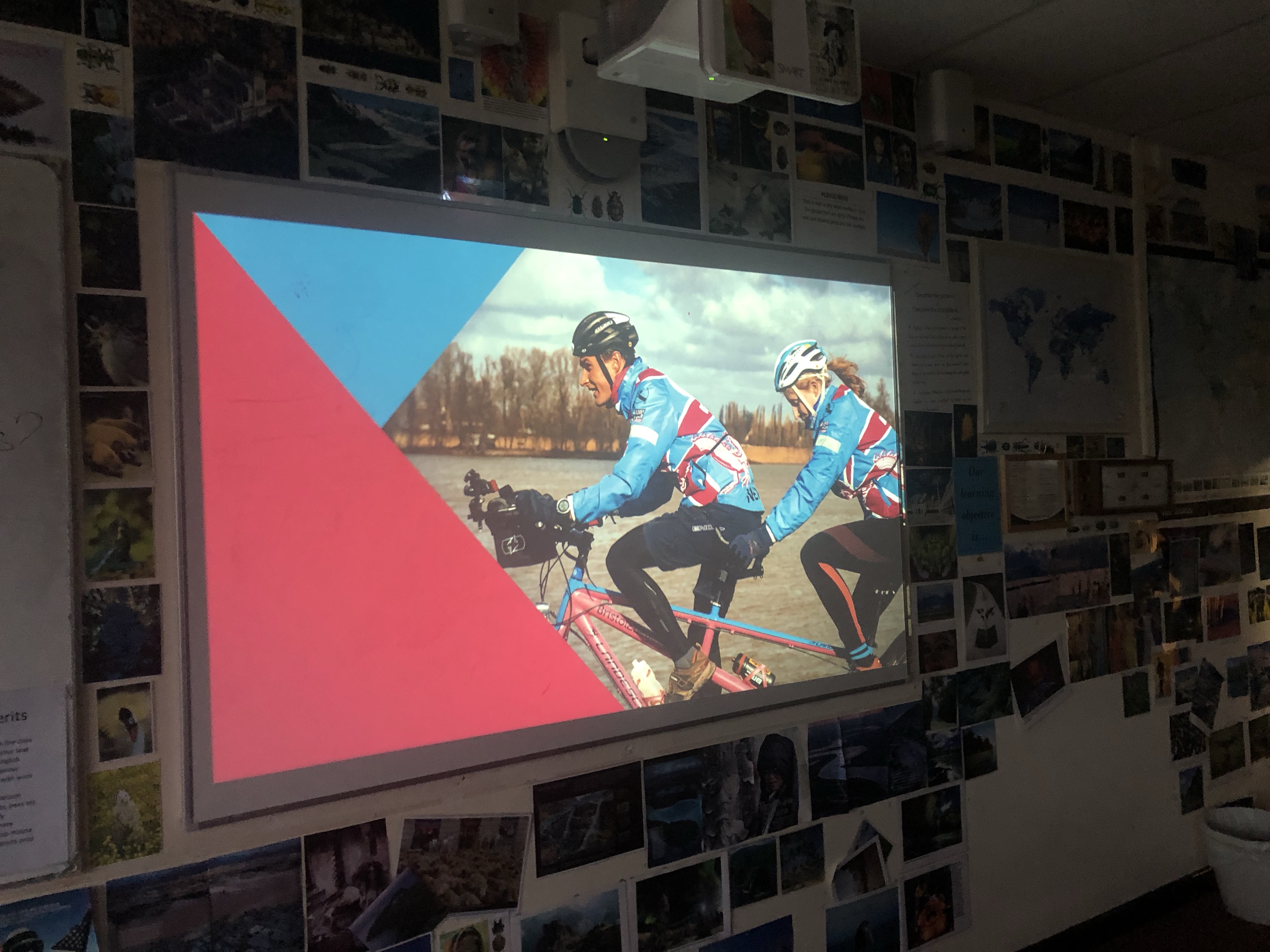
I can’t tell his story. I won’t. Read about him for yourself – there are few men in this world like Luke. And though I poured my heart and soul into this evening’s talk, I’d like to think that it will be Luke’s story that my kids take home tonight. The world is vast, and explorers and adventurers have already been over so much of it and documented everything. But that doesn’t mean the age of adventure is over. People like Luke are living proof that adventure lies within, in our hearts and in what we choose to do with the world around us.

Godspeed, Luke. We’re rooting for you here.

https://www.bristol2beijing.org/

In the meantime, I’d better find myself an expert on Chinese history! BB x

“…So I Became a Teacher”

Ten years ago, British comedians Ben Miller and Alexander Armstrong ran a cracking comedy show on the BBC. The show has always been one of my standout favourites in British comedy, delivering some truly brilliant sketches including Perfectly Innocent, Kill Them, The Embarrassed Prime Minister and the Polish Plumbers, to name just a few. One running gag that hits close to home but still makes me chuckle is the comedy duo’s Be A Teacher ads, lampooning the common reasons why people “fall into” teaching:

“Failed in the real world? Then why not be a teacher?”
“Quite bright, but lazy? Need a safety net? Be a teacher.”
“Good enough to get a degree but not good enough to get a job? Be a teacher.”
“If your ambitions haven’t quite come off, remember: there’s always teaching.”

It’s a little tragic that one of the most important and time-honoured professions in human history often seems to fall into the category of “one of those jobs you do when you’ve tried all other avenues”. Conversations at school and university often went one of two ways whenever teaching came up: either “I just want to do something more worthwhile with my degree, you know?” or “God, I hate kids. I could never do that”. They’re hardly groundless as arguments go. Who in their right mind would want to get back into the classroom almost as soon as they’d left it? There’s surely something intrinsically sadistic about that kind of decision, and that’s before we even get onto the nitty-gritty of marking, differentiation and pupil management. And as for the hating the kids part… well, they say never work with children or animals – but maybe that’s just because you can’t ever truly predict or control either of them. And it is so very human to want to be able to do just that.

For me, at least, it has never been a question of “lapsing” into the education business. It is, like so many things, a family affair. Both of my parents were teachers. My Spanish great-grandmother was a teacher, and she married a teacher. I’m just continuing with the job. I might have had my wobbles along the way, but I don’t think I’ve ever really doubted that I’d be a teacher someday. Sure, that’s easy to say on a Saturday night, when most of the kids are out and boarding duties have been light, but it really is one of those professions that teaches you all the time, usually in ways you don’t expect.

I’m writing tonight because these last two weeks have been tough. The reality of teaching foreign languages to the English – ever the most stubborn of peoples when it comes to learning foreign languages – is beginning to bite. Not a week goes by when I don’t hear the line “Sir, why do I have to learn a language? Why can’t I just speak English?”, or variations thereof. The Modern Languages and Cultures graduate in me would love to give some solid answers, but these are fourteen-year old kids, for pity’s sake. A university-level argument on the merits of multilingualism pales in comparison to the fact that they have to revise twenty words they may very well never have to use in their lives – besides the end-of-year exam, of course.

So what use is the degree, then? What was the point in spending £9000 a year on the study of French, Spanish and Arabic history and literature if I am to spend the next four years teaching kids how to count up to thirty-one or discuss their plans for the weekend? These are questions I have been asking myself a lot these past two weeks. I came back to England with a mission, to do my part in a desperate campaign to save this country from collapsing into ignorant isolationism, knowing full-well what it would mean. And yes, whilst working in a boarding school does allow me to continue to channel my passion for music – easily the best part of the job by a country mile – the teaching side of it is hardly as scholarly as I’d have liked, sometimes.

At times like these, I do miss university. I miss staying up late with my housemates discussing political or social matters, I miss the excitement of sharing in the knowledge of others, and of sharing your own in turn, and I miss the challenge of stretching my brain. God, I miss that. I’ve been reading like a fiend these last few weeks out of a mad desire to tackle something more intangible than the days of the week. I ordered a book of ancient Spanish poetry off eBay the other day and pored over it during prep one night, something I admittedly would never have done at university. But then, my brain was stimulated in other ways then.

So what’s keeping me here? Why do I go on teaching?

Because I believe it’s nothing more and nothing less than one of the most important jobs in the world. For as long as there have been humans, there has been teaching, and even before then, there was teaching and learning after a kind. In the words of a colleague of mine, “I don’t care how much more you earn in the office, your job could disappear from the face of the earth overnight and nobody would notice. Not so with teaching”. You might see it as giving up on your own hopes and dreams to encourage others to pursue theirs, or that might have been your ambition all along. Teaching is the job that keeps on giving – both in reward and in workload, yes, but the rewards make up for it. I am a far braver, far more tolerant individual thanks to teaching. You don’t go into teaching to share your love with just the kids who love the subject back. That’s neither practical nor necessary. You do it just as much for the kids who don’t listen as for those who do. Teaching the subject you love to children with no love for it whatsoever will sap your zeal, strangle it if it can, but it does encourage you to see things from a different perspective. And, frankly, any job that does that on a regular basis is a job worth pursuing, if the ultimate goal of human existence is to understand each other – which is what I have always supposed it to be.

I still can’t fault Armstrong and Miller, simply because that sketch is bloody hilarious. But if you’re enthusiastic, passionate about your field, patient and have a drive to listen and learn, I cannot encourage you enough: be a teacher. Money might make the world go round, but somebody has to encourage and inspire the next generation (besides, the last thing the world needs is more businessmen). So go on. Be a teacher. BB x

Double-Edge

The Christmas holidays have come and gone. I’m back in Durham once again for what is beginning to feel increasingly like the last tilt of sand in the hourglass. Last term went by like a bullet as I found myself thrown headlong into a heavy workload once again, but yours truly must have learned his lesson over the last year or two, because I can’t think of a day when I let it get me down. The troubles and traumas of the first two years of academia and extra-curricular pressures wanted and unwanted were very much absent from last term; if they were there, they were buried deep beneath a veneer of simple satisfaction. Satisfaction with my course, satisfaction with my extra-curricular commitments, satisfaction with the direction my life is taking me.

That’s not to say I’ve got it all figured out. I don’t. I’m still waiting on a crucial reference to secure my post next year – without it I could end up in hot water. I’m surrounded by people who are powering ahead with their dissertations at a remarkable rate, whilst I content myself with reading leisurely around the subject before I even think about the process of putting pen to paper. The Lights are also taking me forward at considerable speed, and it is this last which is eating into my timetable more than anything else at the moment. After three entire days of pitch-punching and choreo workshops, it’s easy to forget that university is a place for the pursuit of knowledge.

That’s something I’ve been thinking about recently: what does a university mean?

Over the last few years I’ve met a lot of people from different walks of life who have very different attitudes to university. There are many for whom it is simply the next stage in their studies, a means to an end, an expensive-but-necessary qualification to hack into the job market. I find it a little heartbreaking that this is what university has become for so many, the semi-obligatory next step in the road and one that we are all too often pushed into without even thinking. University should be open to everybody, of course, but does that necessarily mean that everybody needs to go to university? I’m not so sure.

Then there are those who accept that first notion and proceed to enjoy their time at university with their eventual degree very much subsidiary to their overall experience. They’re the ones who couldn’t care less if they land a 2:2 at the end of three years of lectures and under-prepared seminars, just as long as they had an amazing time and met some life-changing people along the way. Granted, it’s a point of view that suits the wingers and the daddy’s-boys more than most, but it’s not too uncommon. And at the end of the day, you can’t criticise the stance too harshly: it’s a very good example of making the best of a bad situation.

What else can a university degree offer? Networking, for one. It’s a fantastic way to meet new people and, by default, make important contacts in the outside world. It’s a good way to hone the skills you learned at secondary school to perfection, or to stay immersed in a subject you enjoyed. Some just don’t like to leave the school environment behind: the routine, the structure and the linear timetabling make for a familiar existence (and I include myself shamelessly in that bracket).

There is, of course, another important reason people decide to go to university: in pursuit of raw knowledge. That, for me, is the very essence of university. It’s what it’s all about: seeking new truths, dispelling old beliefs and walking into new worlds. What saddens me most is that this is so rarely the primary motivation. I wonder whether it’s more than a little big-headed of me to say such a thing, but I guess I expected to find more people with this kind of attitude when I rocked up a fresh-faced, idealistic fresher a few years back. I wasn’t exactly popular, and with an attitude like that, it’s really not hard to see why. Since then I’ve mellowed a bit, but I still feel a little happier than I should when I encounter somebody else who has nothing but unbridled passion for their degree. Perhaps that’s just the nature of an undergraduate degree; the Masters students all seem to be wholly absorbed in their studies. I guess I’ll just have to return to this world a few years down the line.

Perhaps it’s because I want to be a writer that the simple pursuit of knowledge for its own sake is so important to me. How can you profess to write for people if you don’t read? It’s little banal thoughts like that that kicked me back into reading fiction two years back. The effect that reading fiction has had on my overall enjoyment of academic research is surprising, to say the least. I wonder whether the two were supposed to go hand-in-hand from the very beginning.

More and more these days my degree leads me and my stories into worlds and places I could never have found on my own, and likewise the years of research I have carried out for my books gives me insight into my degree that features nowhere in my course. I have been torn from Spain, from the land that bled life into my tales like veins to a beating heart, but with a little hard work, I have found a survival mechanism in the university effect. Whatever one’s motivation for going to university may be, the result is a hot-pad of intellectuals of all walks of life. It is a place for bringing together great minds for the bettering of the nation, in pursuit of new truths and new ideas. Just the vibe alone of such an environment is reason enough to throw oneself into academia. That, I think, is the real purpose of university.

If only the UK could follow the Scandinavian example and make a university degree a realistic option for all, with no respect for money or background. The way things are going, such an aspiration is little more than a pipe-dream at the moment, but if we might try to take a step in the right direction, I’d implore the powers that be to rethink the idea that everybody in this country should be going for a university degree by necessity. University should be encouraged, of course, but no more than an apprenticeship, an equally admirable path by all respects. Higher education should be for everybody, but’s it’s not. An option, not a necessity.

I may be little more than another one of those liberal, meritocratic millennials, but I’m not alone. I think there’s something very wrong with the way we’re monopolising higher education, when it should be nothing more than that: an education.

To make good on my words and dispel a few old beliefs. A university degree is not meant to be the three best years of your life. It’s not meant to be a government-sponsored ride of wild parties and last-minute essays. And it’s not meant to be a long slug of soulless study either. But it can be immensely worthwhile and should not be abused.

But what do I know? Students are, after all, noisy creatures that are happy to live in hovels and live in close-knit cliques of their own. What do I know about the world? x

Creativity in the Classroom: A Step Too Far?

I´m falling into something of a routine out here, now. Three hours with the state school, two hours with the Catholic school, one hour´s private English lesson, one hour´s Spanish conversation with my flatmate, a couple of hour´s reading and then bed. That´s good. I like a routine. It lets me know what I´m doing. I tend to go a bit spare without exact orders.

As I guessed all along, the term ´language assistant´ is a very loose one, interpreted by different schools in different ways. Some of my companions are working as ´classic´ language assistants, taking individuals or small groups for short periods for conversation. Others attend class with an English teacher as a human dictionary, there to lend a hand whenever a native speaker´s touch is needed. In Spanish, the term ´language assistant´ gets shortened down to just one word – auxiliar – which leaves even more room for interpretation. And just as happened in the last two ´language assistant´ jobs I´ve had, I seem to be working a real teacher rota.

Granted, I had prior warning this time. The first time I was promoted, so to speak, I had no idea that I was supposed to be taking full classes on my own until I was told that the diminutive head of the French department had decided to benefit from my presence by taking a month´s holiday at short notice. This time I was given a couple of lessons´ observation to get the feel of it, and even though they mostly left me leading the events – a harbinger, I guess – it was good to know what I was getting myself in for in advance.

So I´m a sub-teacher. That´s not a problem. In fact, it´s exactly what I wanted. It´s just… well, it´s reassuring to know that it doesn´t matter where you go in the world, ´language assistant´ is always a very flexible term.

In one school I take entire classes on my own, from bawling primary level to studious upper sixth. In the other I also prepare an hour´s class for whichever groups of the twelve I have that day – equally widely-spread, but fortunately without the weekly terrors of the primaria – and these are almost always under the supervision and occasional assistance of one of the English staff. The irony there is that they´re probably doing what comes under my job description. The system in place is the one used by bilingual schools nationwide: one class where the language of conversation can only be English, to compliment the others which are spent on writing and grammar. Nobody likes grammar. So that means it´s my class that everyone looks forward to by default, which is something to smile about.

Taking a full class obviously means you need an hour´s worth of material, and with teenagers thrown into the mix, you need to be prepared for all eventualities. I´m learning what to do when they´re tired, and how to calm them down when they´re exciteable, without letting them know there´s a system to it all. I´m learning what ideas students wants to discuss and which ones turn them off, and which games work well, and which ones don´t. And though I should have seen it coming a mile off, I tried this week once again with what is and always has been the greatest stumbling block of all: tapping into the students´ creativity.

Now this is something I feel very strongly about, and I´ve already written one behemoth of a text this week, so I´ll tackle it as lightly as I can. The simple fact of the matter is that there isn´t enough emphasis placed on creativity in schools these days. To tell the truth, I´m not entirely sure there ever has been. One of my English teachers once announced at a parents´ evening that she was ´paid to teach, not to inspire´. I disagree entirely. Inspiration should be right at the front of teaching, if we´re not all to become mindless robots.

Ah, but this is beginning to smack of yesterday´s post. It´s vaguely related, primarily because the game I´ve been ending my technology lessons with – a simplified variation on the British radio show I´m Sorry I Haven´t A Clue´s “Good News, Bad News” – has, time and again, come up dead in the water. The reason? Because nobody´s able to tap into their own creativity. I don´t know whether it got stamped out of the education system in favour of textual comprehension or the study of presentational devices – the kind of stuff that actually comes up in an exam – but the art of coming up with stories seems to disappear once you hit secondary school level.

For a budding author, I find this nothing short of horrifying. I spent most of my school career writing stories, and yes, it probably did affect my grades, but I left with an impressive English mark, and it´s my English that has always saved my neck. I´d have been flat-out rejected from grammar school if it hadn´t been for my English, since my mathematical capability is comparable to that of a wet flannel. The only excuse I can think of is that I´ve never stopped writing: from short stories to novels, diaries to blogs, love letters to newspaper articles. It keeps me alive. More importantly, it keeps my brain alive.

The higher up the education system you go, the less you´re encouraged to think for yourself. At some point you have to start quoting other writers. Then you have to start referencing other texts you´ve read and basing your arguments on the standpoints of extinct luminaries. The result, of course, is that by the time you get to university and you´re suddenly encouraged to come up with your own argument, a lot of people are quite understandably left high and dry, because they haven´t been taught how to think that way.

Here´s the difficulty. Creativity cannot be taught. It can be encouraged, it can be inspired, but it cannot be taught. For starters, how do you mark creativity? This is a regular feature of the arts world, of course, but outside the tripartite kingdom of Art, Music and Drama, creativity doesn´t get all that much of a look-in. In a world where everybody is mark-centric, from pupils to parents to headmasters and the governors to whom they bow, that kind of question gets thrown out early on, and the baby with the bathwater. So me going headlong into a class of fifteen year-olds and expecting them to come up with a story in fifteen minutes of “Good News, Bad News” was the very height of foolishness, especially for somebody with two jobs´ worth of teaching experience under his belt. A different English teacher – one who certainly did know how to inspire – once told us that the truth of the matter is that there are those who can, and those who can´t. I´m still not entirely sure where I stand on that, since I´m none too keen to cut anybody off, but I acknowledge that there´s more than a kernel of truth in that statement.

Creativity, I believe, is something that we´re all born with. We all loved to listen to stories when we were children, and most of us will have tried our hand at making one or two, intentionally or no. Heck, it´s fuelled language growth, all the arts and technology for all human existence. The trouble is that so much of it disappears when we grow up, when we´re told we have to put fiction behind us and focus on the real world. Unless you´re a stubborn little bastard like me, and you decide early on to defy that and to hold on to your creativity and remain a child forever. Like a twenty-first century Peter Pan.

In short, it´s perhaps too much to expect every student to be able to create stories of their own, especially at secondary level. There are a few rogue elements – it´s not difficult to recognise your own characteristics in others – but on the whole it strays much too far into the awkward silence minefield. Well, I´ve learned my lesson (no pun intended). But I´m not about to concede defeat. Never. I doubt I´ll make story-tellers out of the lot of them, but if I can sow the seeds of a budding Cervantes or Lope amongst the drowsy horde, I´ll consider my job accomplished. At the end of the day, we´re all story-tellers in one way or another. All it takes is the courage to leave behind what is real and to dabble with what is not. I said right at the start that I like exact orders. True. But there´s enough of an anarchist in me to want to break free sometimes. I hope there´s a little anarchy in everybody. BB x