City of Memories

Hostal La Banda, Calle Dos de Mayo. Sevilla. 15.20.

The Americans have taken over. They’re sitting at a table behind me discussing the local culture of Sevilla that interests them so, like baseball, 7-Eleven and Jello shots. One of them asks the receptionist for a board game and they set to a game of Cards Against Humanity.

Outside, the rain comes down. When it comes to the weather, Luck has not necessarily been on my side during this holiday. Fortunately, I’ve been to all of these places before and seen the main sights before, so my heart isn’t bleeding over a few rain clouds. It’s actually quite relaxing, not having to dash off to this or that bit of sightseeing. It feels like living out here again. That was, I believe, the general idea.


Sevilla and I go way back. I’m not 100% certain, but I think came here for the first time in the summer of 2005, shortly after my parents bought the house in Olvera (that we still haven’t managed to sell off, twenty years on). I don’t remember much from that first visit beyond a flying visit to the Alcázar under a blazing sun, the noise and smell of the horses in the Plaza del Triunfo and a little blue notebook with a plastic cover where I kept a record of the animals I saw in my new country: black kites, bee-eaters, lesser kestrels and the city’s ubiquitous monk parakeets (which have only increased in number).

Since then, it has been the backdrop to a number of different episodes of my life.
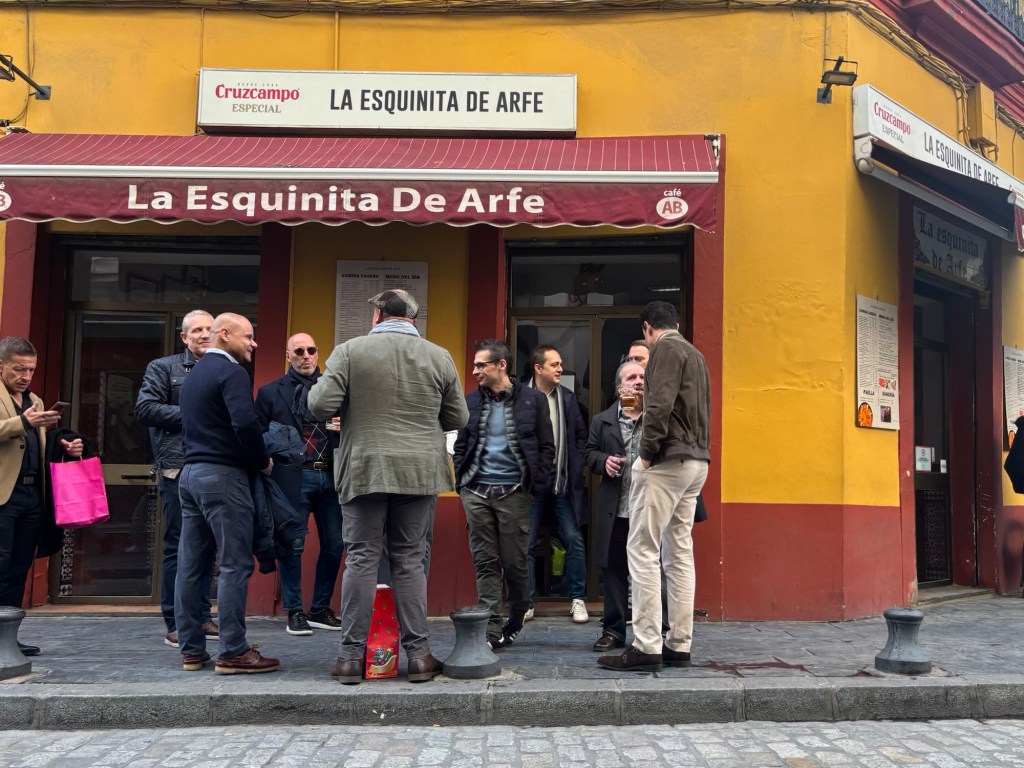

Through my secondary school years, I made the odd pilgrimage to Doñana National Park with my mother. That was when Sevilla really started to become a fixture in my life. After Gatwick, it’s probably the airport I’ve used the most. Mum and I always had the same ritual upon arrival: before anything else could be achieved, we had to grab a zumo natural or café solo from one of the airport cafés. We never stayed in the city, but it was our regular conduit to and from the sanctuary town of El Rocío.

It was also where we learned of the eruption of Eyjafjallajökull in 2010, as we had no WiFi at our campsite in El Rocío, and this was before the advent of mobile data. You’d have thought there might have been something on TV, but all we saw on the night of the eruption which grounded all flights across Europe was a brief noticiero questioning whether Spaniards actually pay attention to STOP signs, given that they’re written in English – a question I still ask myself today, as I wander around Sevilla.


When I moved to Spain for my first British Council placement in 2015 – when this blog began – it was Sevilla to which I came, suitcase in hand, to sit beneath the shade of a fig tree on the east bank of the Guadalquivir and think about the future.

I came back to Sevilla again and again when I got back in touch with my former classmates from Olvera, particularly a childhood sweetheart (who led me up the garden path for several months before throwing up a wall during a memorably awkward visit to Madrid). Every visit to the pueblo required just under an hour’s commute across the city centre between Plaza de Armas and Prado de San Sebastián. By the third or fourth visit, I’d got the route down to twenty-five minutes, though I did once make the trip in under ten when I was in danger of missing the last bus home.

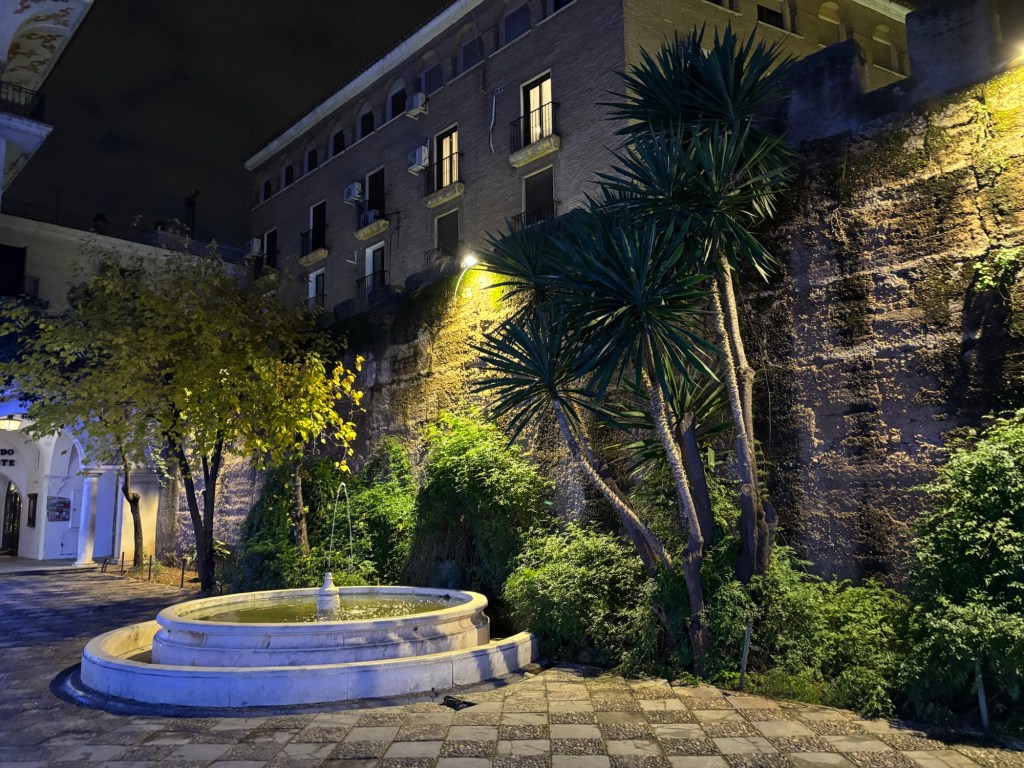
It was around then, during those frenzied trips between Sevilla’s bus stations, that I really fell in love with the Plazuela de Doña Elvira, sitting as it does in the labyrinthine heart of the old city. I’ve made a point of stopping by ever since.


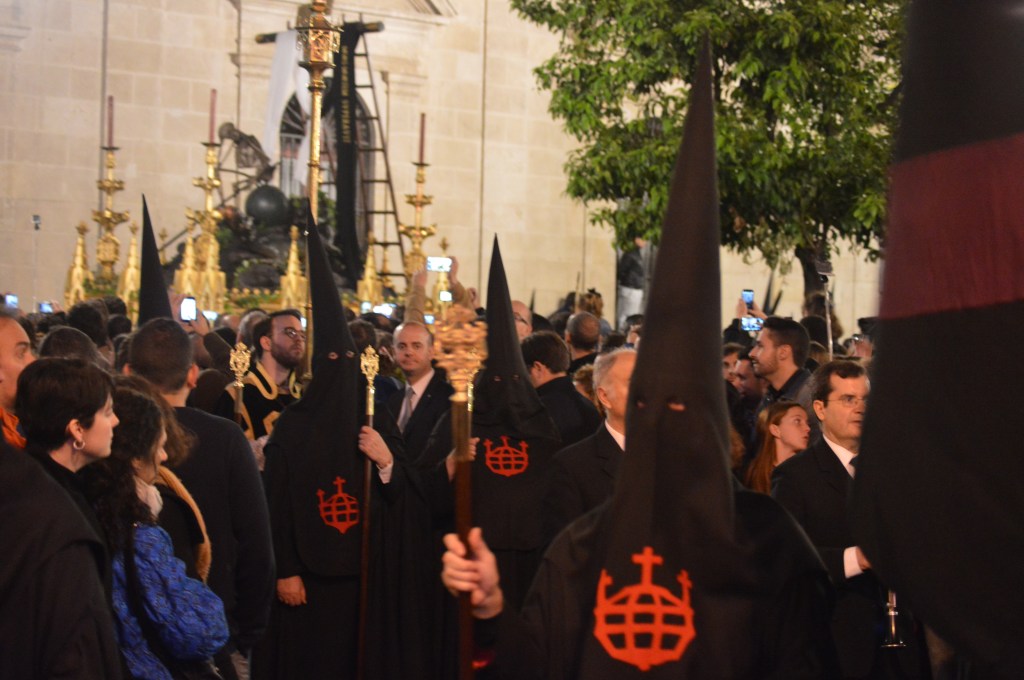
Halfway through that year, I took a friend to the city to show her the majesty of Semana Santa. My experience of Spain’s Easter celebrations had previously been confined to Olvera, which was a highly unfair place to start – on everywhere else. Olvera’s penitentes, demonstrating a strength bordering on the Herculean, have to navigate the monstrously steep gradients of the town’s roads, constantly ducking and rising to avoid the low-hanging wires – all while carrying several tonnes of sacred wood and several hundred tapering candles within a precarious silk canopy. Caídas (falls) are not unheard of in Semana Santa, but I never saw the olvereños break so much as a sweat for their endeavour.

After that, I might be forgiven for having exceptionally high standards for Semana Santa. Sevilla met them. We were walled in by three simultaneous processions, but a friendly Guardia unintentionally gave us front row seats to the greatest show in town when he shoved us unceremoniously with his baton out of the road and in front of the lines that had been growing along the side of the street all morning. Málaga and La Mena may have raised my expectations even higher, but I’d like to go back and see Sevilla in its Easter glory again sometime.

By my mid-twenties, I could be pretty confident in saying that I knew few cities in the world better than Sevilla – including almost every city in my home country (with the possible exception of Canterbury). I do believe that I really could navigate this city blindfolded, if I had to. That was why I decided to take my second girlfriend there, less than a month after we started dating. I hoped that sharing the city with her would be like sharing my heart – since it had found its way in there a long time ago.

I took her to all my favourite places. Bar El Postiguillo. La Plazuela de Doña Elvira. La Plaza del Cabildo. El Real Alcázar and El Herbolario. She smiled sweetly and played the part of my muse around the city, but I don’t know if she felt the same way about the place as I did.

Later, when things started to fall apart, she told me I’d “missed the boat” for teaching her Spanish. It was the confirmation I’d long suspected that I was never going to be able to share my undying love for this country with her, and the chief reason why I broke things off with her in the end. A heart divided cannot love.

I have no desire to return to America after the intensity of last summer’s heartbreak. Sevilla, however, is immune. My heart could break a thousand times within its scented streets and still I would return.

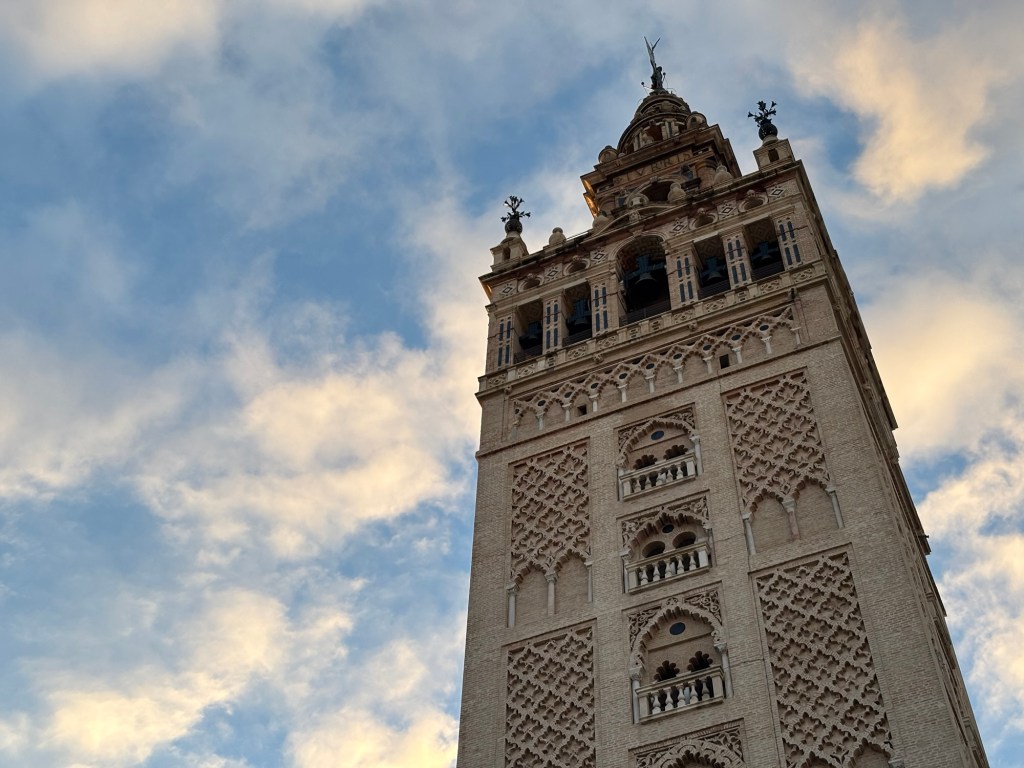
In the last few years, I’ve led a couple of school trips here, too, playing the part of historian, quartermaster and tour guide. In this last capacity, Sevilla has sealed its place in my head as much as my heart, as I had to swot up on so much local history that I might as well have put on a red jacket and joined the city’s legion of guías turísticos.

And here I am again, as 2025 draws to a close. It’s been about twenty years since I first came here, and that’s around two thirds of my life. I don’t doubt I’ll be back again soon, drawn by some invisible magnetism to her cobbled streets, her orange-scented courtyards and the irresistible joy of her people and their merry accent.

The local hostalero gave me the highest possible praise last night. My accent, while occasionally inflected with English, is unmistakably andaluz. Coming from an Andalusian, that is praise indeed – I usually get told I sound sureño by northerners, but no de aquí by the southerners themselves, pointing to the east when I am in Cádiz and west when I am in Almería. That’s twice this year I’ve managed to blend in.

It’s about time I moved here. The stars are aligning. I only need the opportunity. BB x
Washout

Palacio Santa Marta, Trujillo. 19.04.

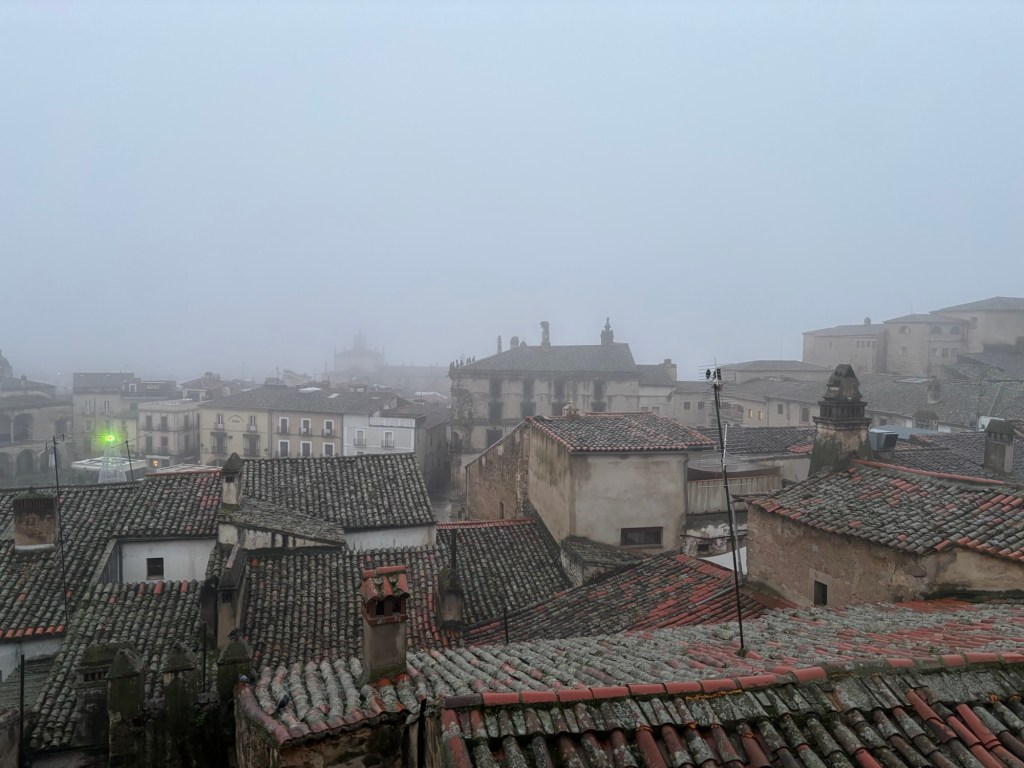
It turns out the rain in Spain does indeed fall mainly on the plain. And when it does, it does so with a Biblical vengeance. I made it to my hotel in Trujillo with just seconds to spare when the heavens opened. Any hopes I might have harboured of exploring the city’s surrounding countryside were swiftly washed away, as the rain came down all afternoon, all through the night and long into the following morning.

This would be a real downer if I’d had plans. But my itinerary is an open book and I’m always happy to improvise – it is my preferred method of travel. So I enjoyed a late morning, a proper breakfast and the blissful quiet of one of Spain’s most beautiful (if isolated) towns.


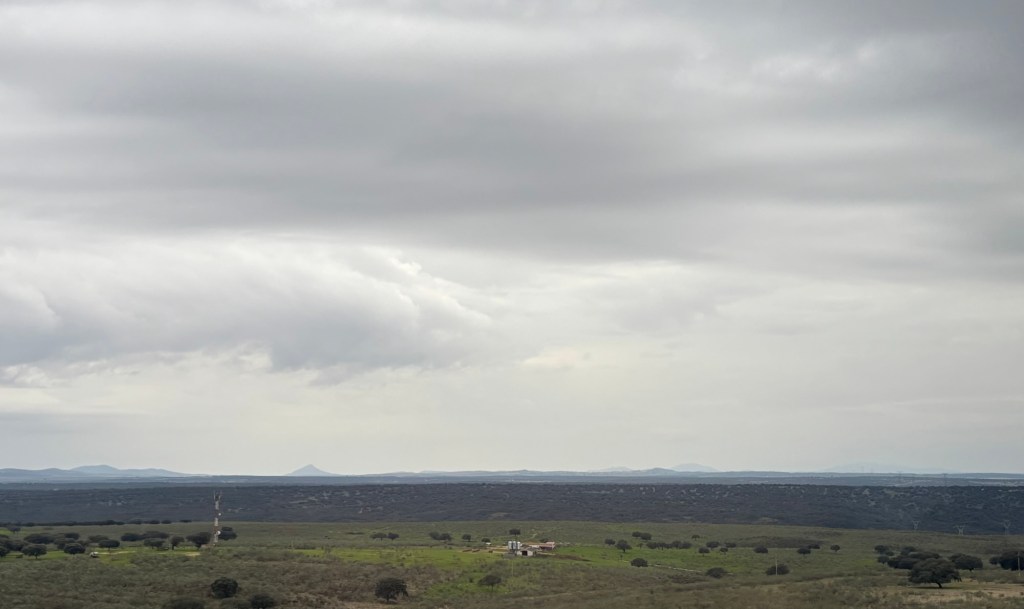
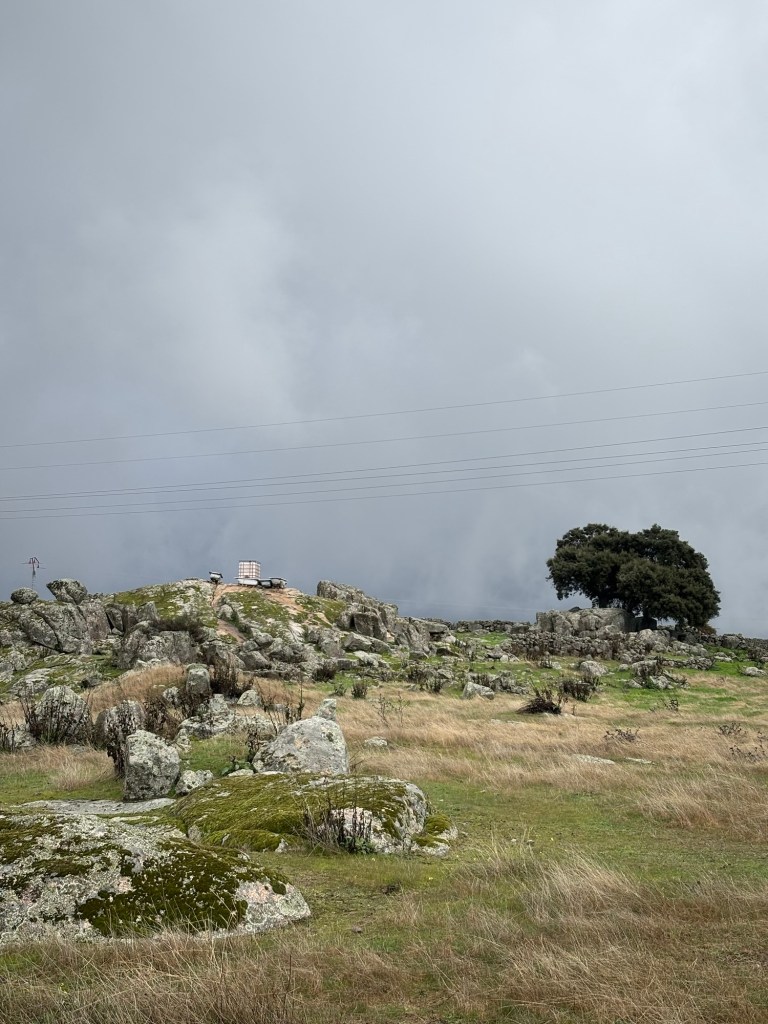
Trujillo sits atop a small granite ridge in a boulder-strewn corner of the Llanos de Cáceres, a vast and featureless steppe that stretches between the Sierra de San Pedro in the west and the Ibor Mountains to the east. There’s nothing like it in Western Europe. You’d have to go as far as the Puzsta in eastern Hungary to find anything close to its vastness. Lichen-covered granite boulders rise out of the earth like giant’s teeth and the odd tree stands alone in the fields, but beyond that, it’s like staring into the infinite.

Little wonder, then, that Hernán Cortés and Francisco Pizarro – both native sons of this part of the world – set their sights on nothing less than the horizon – they’d had no choice but to do so since the day they were born.


Extremadura can be a desolate place in winter. It can be pretty desolate in summer, too, but there is a virgin beauty in its isolation. By avoiding the grasping arms of the hordes of tourists who have strangled much that remained of Old Spain into submission, Extremadura has managed to hold on to the embers of an ancient fire which exists only in the memory of those living among the tower blocks of the southern coast.

Perhaps that’s why it’s often considered one of the main contenders for the Birdwatching Capital of Europe, since so many rare and otherwise elusive species still flock here in droves, taking advantage of our absence to go about their lives as their ancestors have done since before we came to this land.

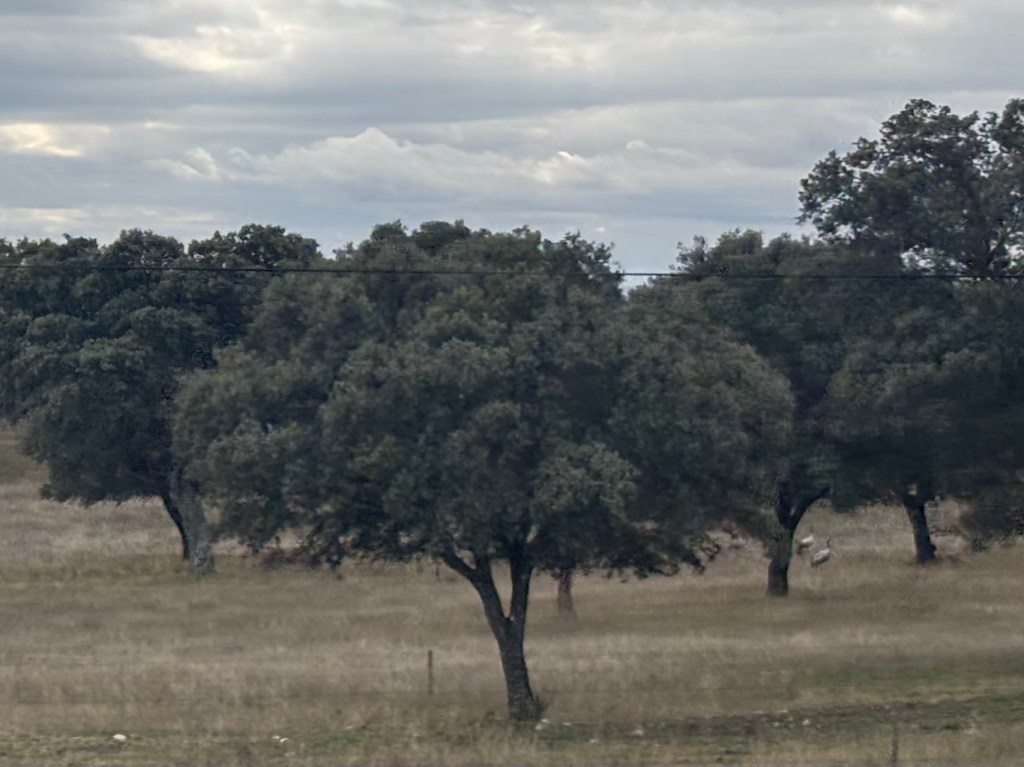
You can see some of that without even leaving the motorway. Every winter, more than 75,000 common cranes travel from their breeding grounds in Northern Europe to this remote corner of the Iberian peninsula. They spend the colder months in the shade of the dehesas, feeding on acorns. They’re a rather common sight if you look beneath the trees, and at over a metre in height, they’re hard to miss.


When I first came to Trujillo in the spring of 2016, I promptly fell in love with the place. It wouldn’t be the first remote corner of Spain that’s stolen my heart – El Rocío and Hornachos are up there – and it won’t be the last. It’s found its way into my saga as the elected home of my hero, partly out of practicality and partly out of a sense of wish fulfilment on my part. Half of me wishes I’d been brave enough to flat out ask to be sent here for my second British Council placement back in 2017. It would have been a lottery, of course, but what would it have been like to live here, I wonder? Trujillo is a lot smaller than Villafranca de los Barros – and a lot more out of the way – but infinitely more scenic.


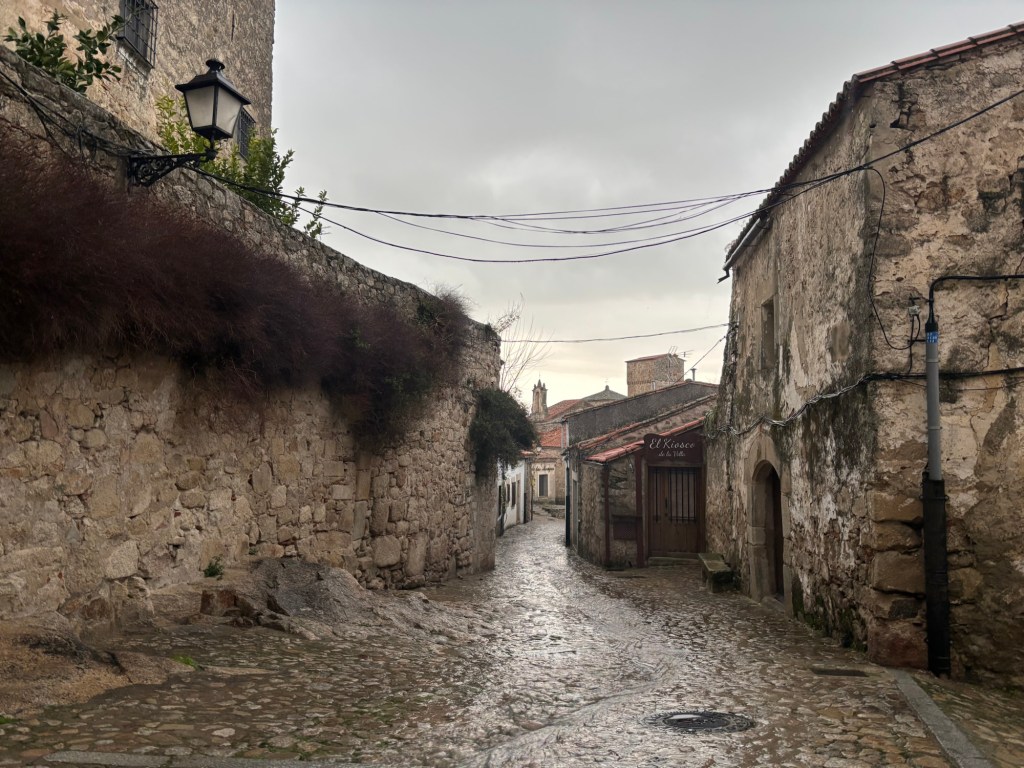
I managed a short reccie to the north of town, before the skies turned dark once again and I had to admit defeat and return to the hotel. The cobbled streets running down from the hilltop had become rivers in their own right. It wasn’t yet siesta time, but nobody else was out and about. And with good reason!


From my vantage point on the second floor of the hotel, I can see out across the plaza and the rest of town. There isn’t all that much to see, with the rain clouds obscuring most of the world from view, but when the sun is shining, you can see straight across to the pyramidal Sierra de Santa Cruz – and the town at its feet, curiously named Santa Cruz de la Sierra (I’m not altogether sure which came first).

If the weather had been kinder I’d have set out at first light and tried to reach the old Moorish settlement at its summit… but then, I haven’t exactly come dressed for a hike. Perhaps it’s for the best that I have had a day to take it easy in Trujillo.


Tomorrow is a new day. 0% chance of rain. I don’t need to rush off anywhere, so I might go for a stroll after breakfast and try to soak up the countryside while I’m here. BB x
Where there’s Light, there’s Hope

Room 402, TOC Hostel Madrid. 17.32.

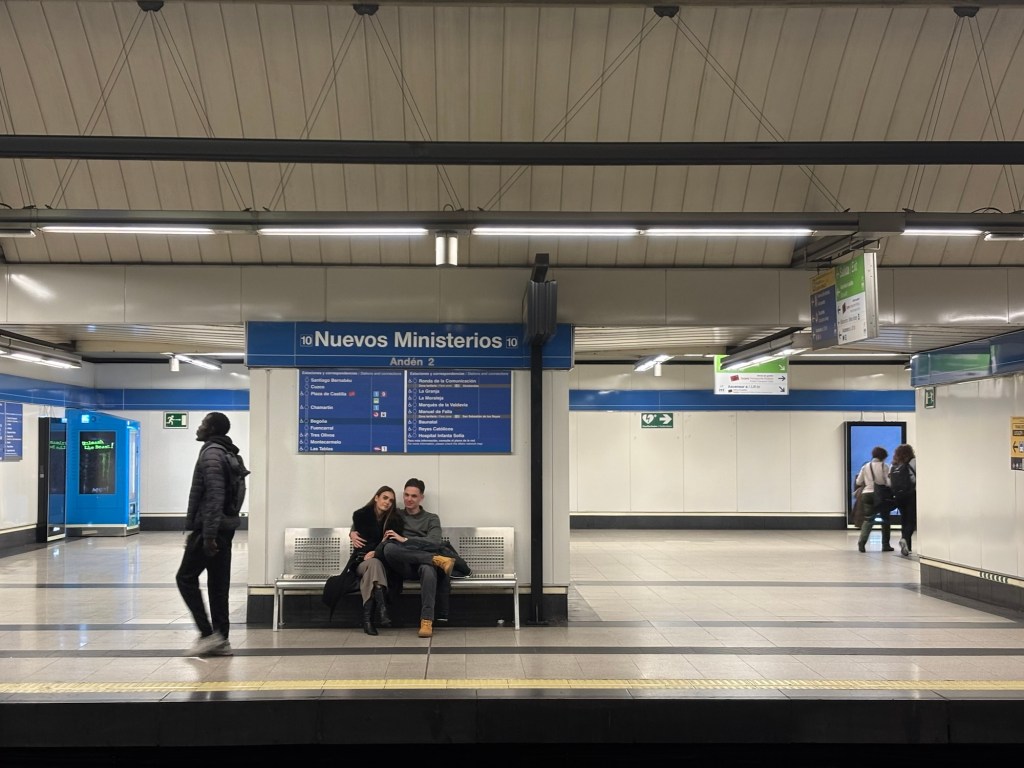
It is categorically impossible to be down at heart in Madrid. Whatever my thoughts and feelings were, they were altogether altered the moment my feet were back on Spanish soil as I left the plane at Barajas last night. It’s not as though I need reminding that Spain is always the answer to my lonely heart, but it is good to know that its medicine is none the weaker for every visit – especially as this is my *fourth* visit this year (though if you count my sorties to and from the Canaries and Gibraltar, it would be my sixth). Anyone would have thought I had an itch that needed scratching…


Ah, Madrid. Like the girl next door in every American romcom, I have come to regret dismissing you so lightly when first we met, now that you have captured my heart. There is something undeniably homely about La Capital, which neither London nor Paris nor Berlin can match. Even now, bustling as it always is in the run-up to Christmas, it still feels more like a large town than a capital city.

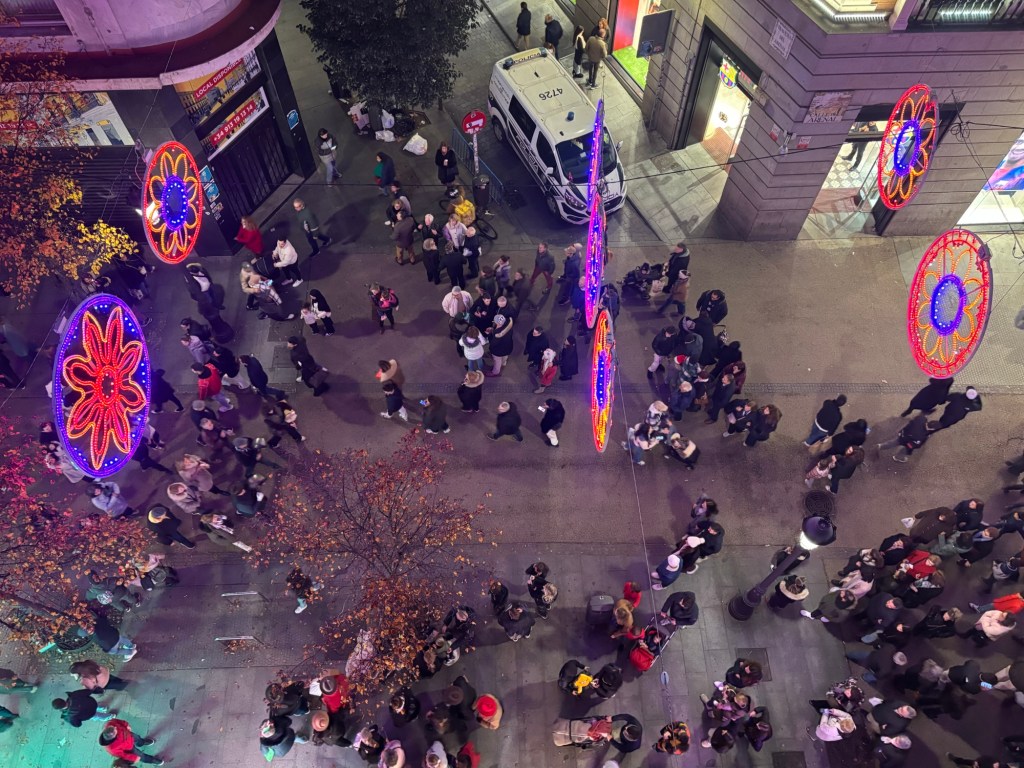
From my vantage point in the hostel, overlooking the glittering Calle del Arenal, the hubbub below is a merry melange of conversation, villancicos, far-off snatches of song and the intermittent underground rumble of the metro. The near-constant snapping of chasquibumes (bang snaps) makes the city sound like a crackling fire.

I don’t say this often, but here is a city I wouldn’t mind living in.


Merry-go-rounds, ice rinks and various Christmas-themed stalls have been set up in the various squares and open spaces throughout the city. Traditionally, it’s the Reyes Magos (the Three Wise Men) who bring children presents in Spain – which has always struck me as a much more logical excuse to celebrate the giving of gifts – but that doesn’t seem to have stopped the Spaniards from starting the festivities several weeks prior. And why not? Any excuse for a celebration will do.


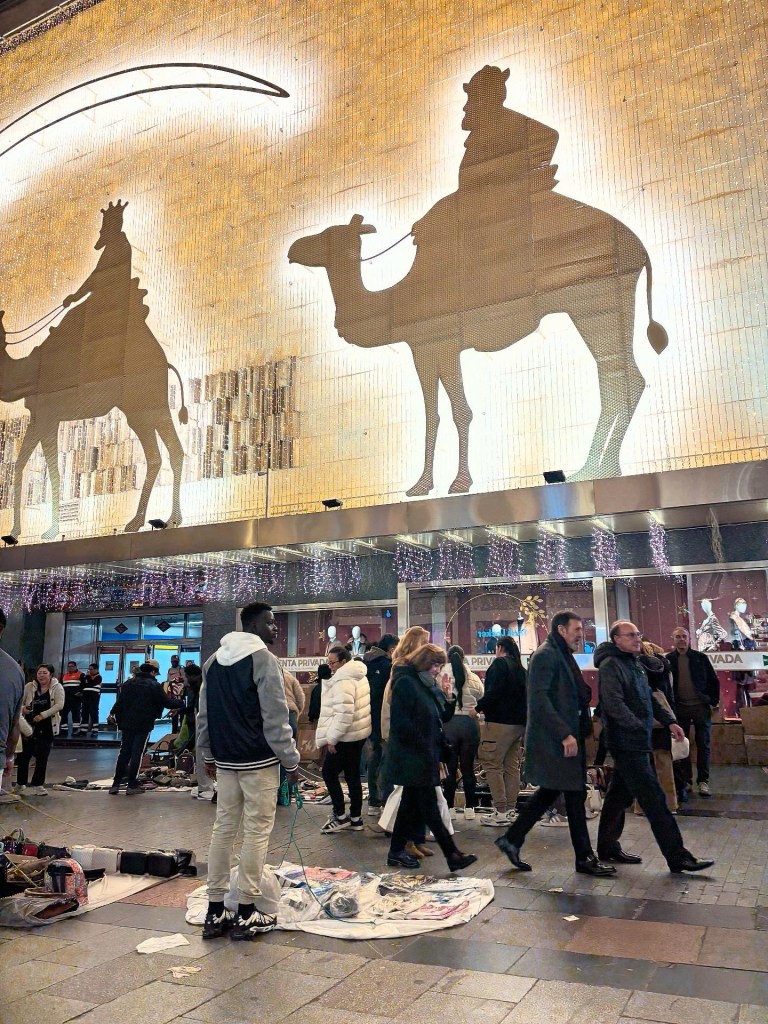
By far the brightest lights can be found on the walls of Callao’s Corte Inglés, which draws a constant stream of shoppers into the night (it was still heaving at half past nine when I passed by en route to the hostel last night). Wherever there’s a crowd, there’s usually a ragtag bunch of pedlars clinging remora-like to its underbelly. Sure enough, I found three manteros hawking the usual array of glasses, handbags and Yamine Lamal shirts outside the main entrance, the strings of their cloth blankets twitching in their nervous hands at every distant blast of a police car. Their location of choice – beneath the three wise men – seemed almost poetic.

I don’t suppose the Baby Jesus would have had any more call for a Barcelona tee-shirt than he did for frankincense. Neither, it seems, did the madrileños. But who’s to say that these three wise men didn’t follow a star of sorts to Europe?


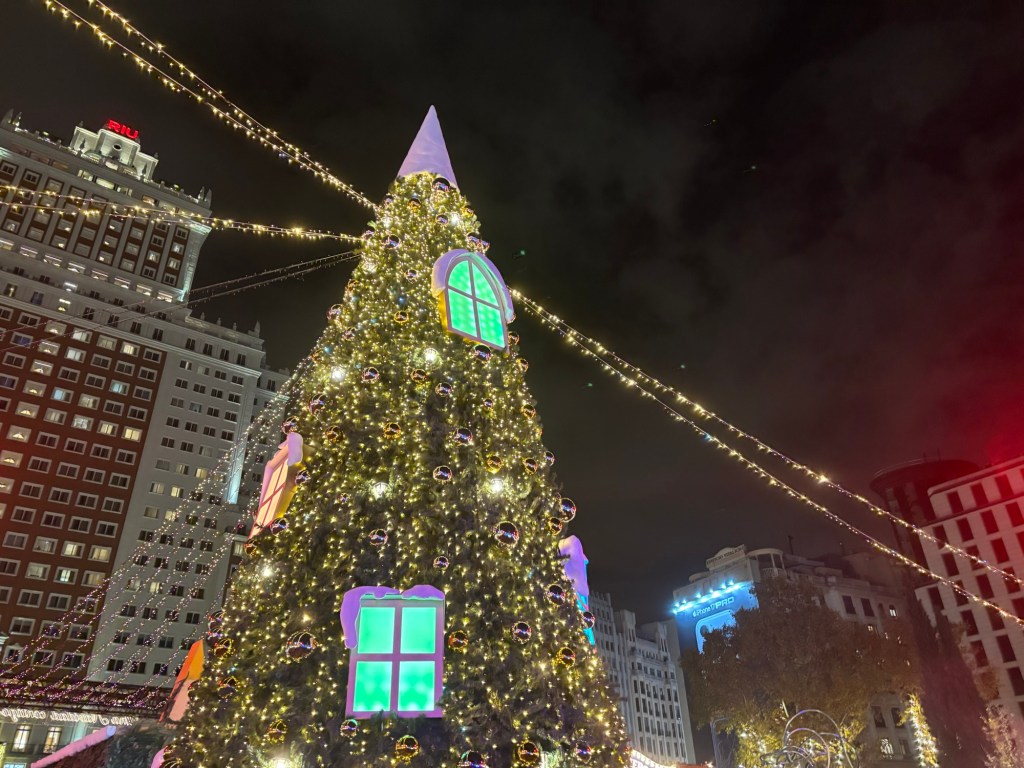
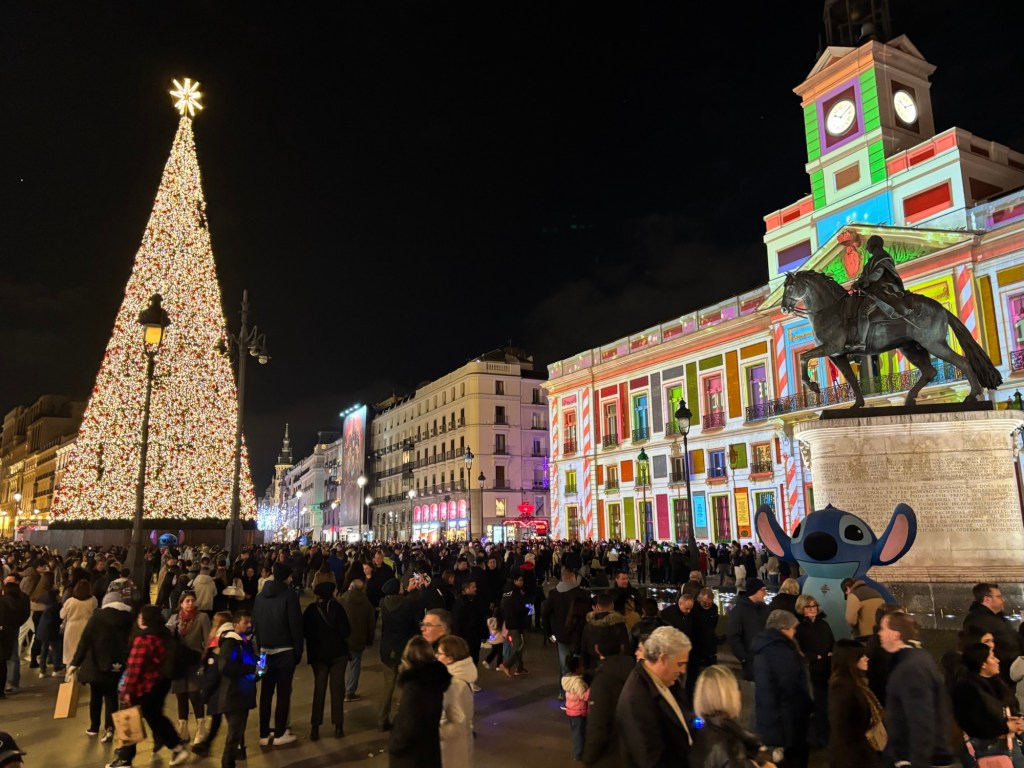
Down the street in the Puerta del Sol, the Real Casa de Correos is lit up like an advent calendar – though in its technicolour array it looks more like a dollhouse – and the usual conical tree of lights stands between Carlos III’s smug smile and the oso y madroño statue on the other side of the square.

Could you call La Puerta del Sol a square? It functions like one, more so than the nearby Plaza Mayor (which really is a square) but it’s really more of a semicircle – a giant protractor radiating in multiple directions from Kilómetro Cero at the feet of the Casa de Correos. At least, it would be, if the centre of the semicircle were just a few yards to the left.


I’m only here for a couple of nights. Extremadura is calling. It has been too long since I last laid eyes on the corner of Spain that well and truly stole my heart all those years ago, and since then, it’s been nothing more than a beautiful word on my lips. I’ve already had my fair share of nostalgia trips this year to Finisterre, Gibraltar and El Rocío, but one more won’t hurt. Holidays are for healing, and that’s exactly what I intend to do. BB x
Moje Sibiř: Magic from the Taiga

Back in April, I made a flying trip to Prague to spend a few days with my dear friends Andrew and Babette. I’d never been to the Czech Republic before, so I used the opportunity to see the sights: the statue of Jan Hus, the Jewish cemetery and the tomb of Rabbi Loew, creator of the legendary Golem of Prague. But I was in for an unexpected treat when Andrew took me to see an evening show of Moje Sibiř, a spatial composition centred around the spirit of Siberia. Over the space of 45 minutes and seven movements, Roman Zabelov and his troupe dimmed the lights and carried the audience away into the endless forests of the Siberian taiga by the power of music alone.

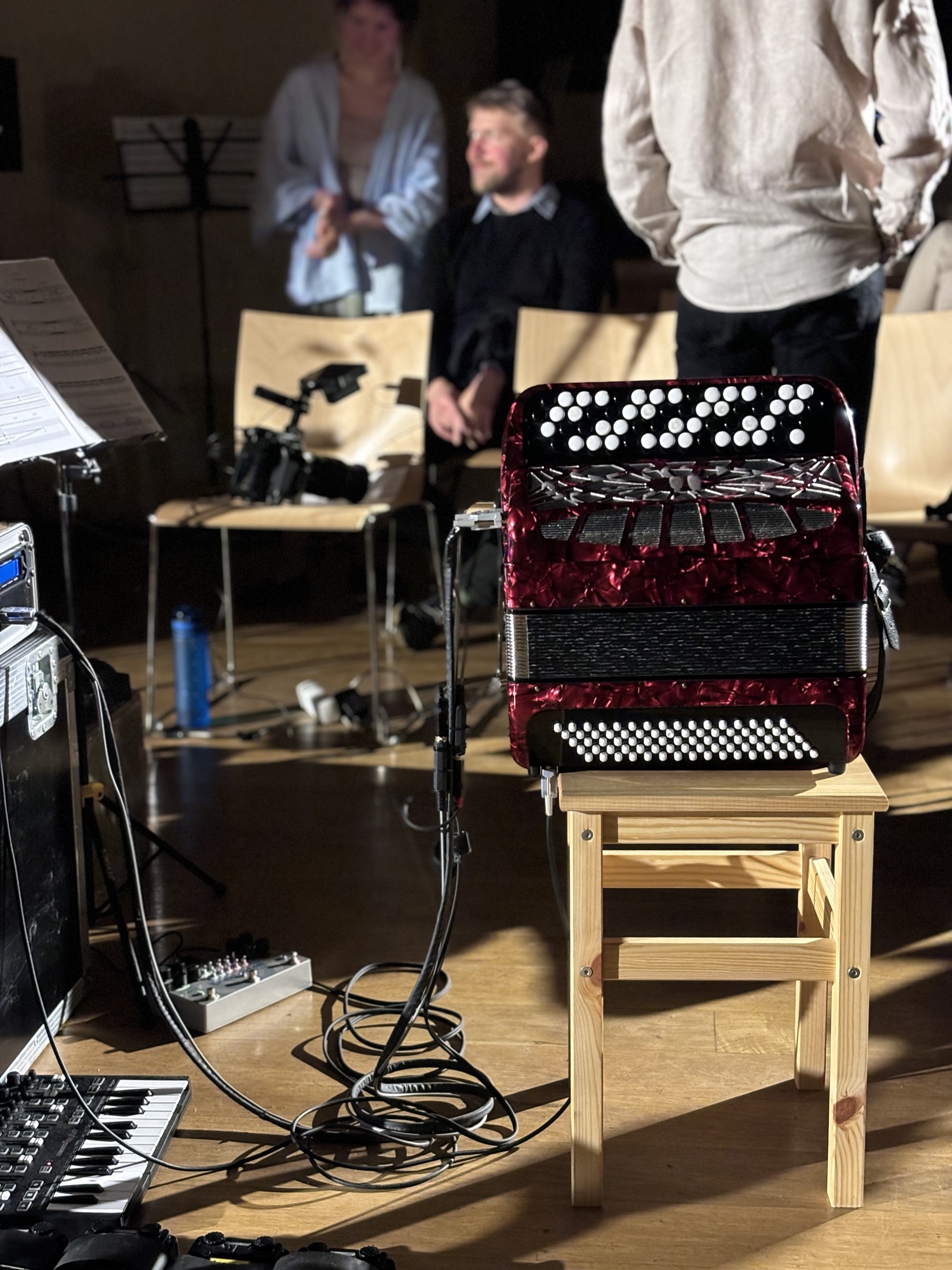
Roman led the suite with his voice and his accordion, conducting much of the composition with eyes closed tight in the manner of a shaman weaving some kind of ancient magic. Speaking of spellbinding, I have never seen an accordion played so creatively: it is obvious that Roman is a something of a frontiersman, combining unorthodox techniques with a quasi-mystical, body-and-soul engagement with his craft, like a Belarusian Pan of the Far East. Zabelov’s ensemble, stationed in various locations around the performance space, worked together to turn the hall into something far more intense than a simple performance space. Through a clever combination of ethereal singing, haunting vocals and long, whooshing breaths, it felt as though they were summoning the arctic wind itself into the room. I had to close my eyes for one of the movements and let it carry me away.

The setting might have been showstopping in its own right, with seating arranged beneath the myriad paintings of the Baroque Refectory of the Dominican Cathedral of St. Giles, but a combination of technical wizardry and clever vocal choreography transformed the gallery into an illusory space: shadows seemed to leap from the paintings and follow the echoes around the room, while the heavens above rippled beneath the rusty iron waters of a tundra pool. I might as well have been holding the heart of the taiga in my hands.

Whether or not it was Roman’s intention, I have been spellbound by the idea of Siberia ever since. I suppose it’s the instigator behind my current fascination with the Amur region and its tigers. If it weren’t for the fact that any and all possibilities of traveling out there are off the table because of the current tension between Russia and the West, I might well have been looking into making my own way out there. It’s amazing what a little musical hypnotic suggestion can do. BB x

There are places that whisper and shout. There are places we return to and that we look for all our lives. These places are both real and imaginary, but that doesn’t detract from their reality. Such is My Siberia.
Roman Zabelov

Equestrian

Wandering the streets of Paris, it’s easy to understand why the city was surrendered to the Germans without a fight in the summer of 1940. I have been lucky enough to see a number of beautiful cities all around the world, but there is something truly exceptional about the French capital – calm, curated, unspoiled. As the official line went in that dreadful summer, as Britain stood alone on the edge of a darkening Europe, “no valuable strategic result justified the sacrifice of Paris”. The West is full of cities scarred by the ravages of war, and while it may have earned them an unfair reputation for cowardice in popular culture, you really have to admire the gall of the French for putting their beloved city above their freedom, the first and foremost of their three sacred values. It gleams to this day.


A personal mission took me to Versailles, on the outskirts of Paris. My Metro pass was only for Zones 1-3, which was one stop shy of the Château itself, but I was very grateful for the break. The half-hour walk to the famous 18th century palace takes you through the tranquil suburbs of verdant Viroflay, and with the mottled darkness of the Meudon Forest rising up and over the hill behind you, Paris seems a lot more than half an hour away.

I came here in search of a shot glass, of all things, but I found something far more arresting: an exhibition of equestrian paintings of immeasurable beauty. So I’ll take you on a little tour of the inside of my head as I stood there in awe.

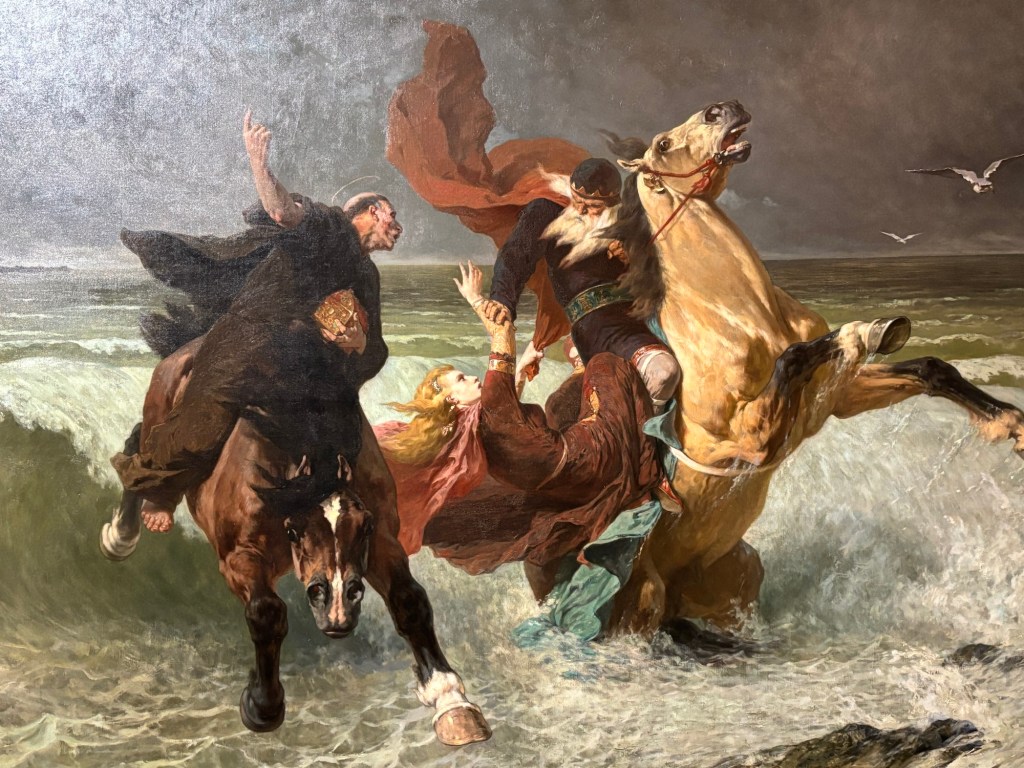
The first one to catch my eye was an enormous tableau by the 19th century artist Evariste-Vital Luminais, known as the painter of the Gauls. Titled La fuite de Gradlon, it tells the story of the escape of King Gradlon from the legendary city of Ys, the Breton counterpart to Atlantis. The tale tells that Ys was destroyed when the king’s wayward daughter, Dahut, opened the dikes that protected the city from the sea, ostensibly to allow her lover in to see her. Fleeing the destruction across the sinking floodplain, Gradlon’s friend and advisor, Saint Gwénnolé, implored him to cast off the demon he brought out of Ys, or risk losing his own life in the endeavour. Dahut was thrown into the merciless sea, and Gradlon and Gwénnolé escaped with their lives. I guess that makes it the oldest account of the “begone thot” meme.

I have always been captivated by stories of Atlantis. Dig deep enough and you’ll find stories of sunken cities all over Europe: Tartessos, Akra, Saeftinghe and Rungholt. Tolkien’s Numenor might even be considered a fanciful addition to that list. I should give this Ys legend a closer look.


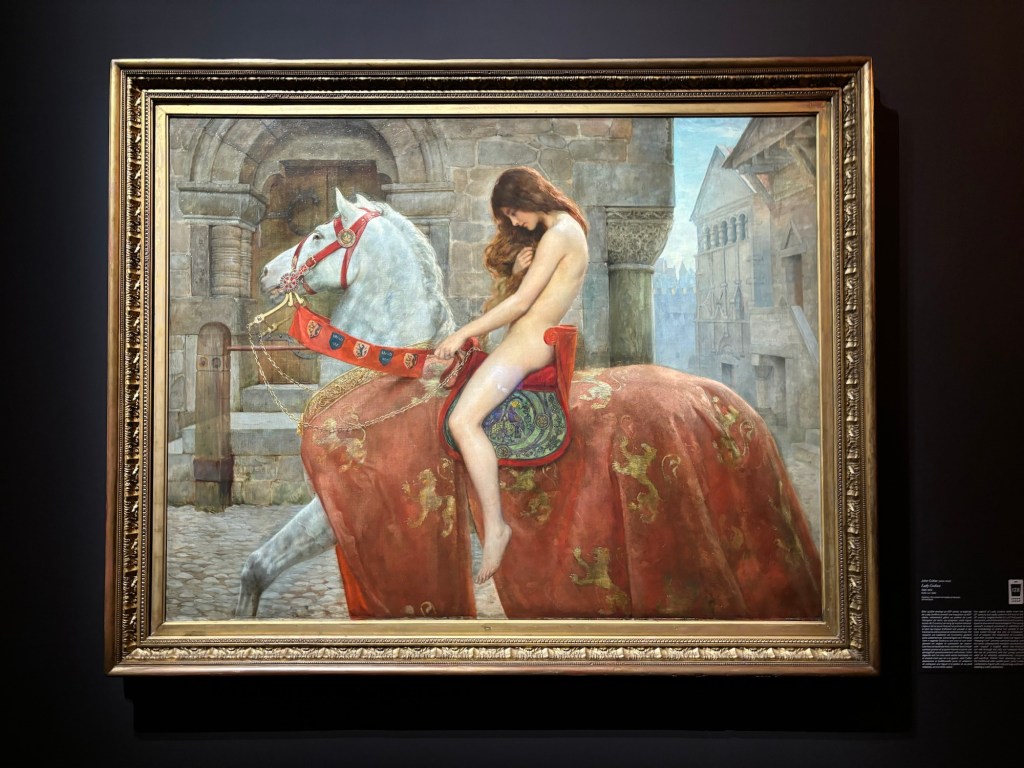
No prizes for guessing the subject of this one: it’s the naked ride of Lady Godiva by the English pre-Raphaelite painter John Collier. Most depictions of this legend have her riding side-saddle, an enduring medieval custom that preserved a woman’s modesty by keeping her knees together while reducing the risk of an accidental tear of the hymen (the age-old proof of virginity). Collier has her riding astride, all the stronger for her position, focusing on her dauntless courage in the face of her husband’s oppression.

It isn’t easy to remember one’s sexual awakening, or when and where it began. I’ve seen various authors ascribe theirs to a range of sources, from the older siblings of friends and schoolteachers to National Geographic magazines and Uma Thurman’s role in Pulp Fiction. I didn’t exactly gobble up popular culture in the Nineties and Noughties with the same fervour as my classmates, so I think mine started with an illustration of Lady Godiva in a children’s book of folktales and legends – if not with the Little Mermaid (setting in motion a lifelong fascination with red hair that has proved impossible to shake).


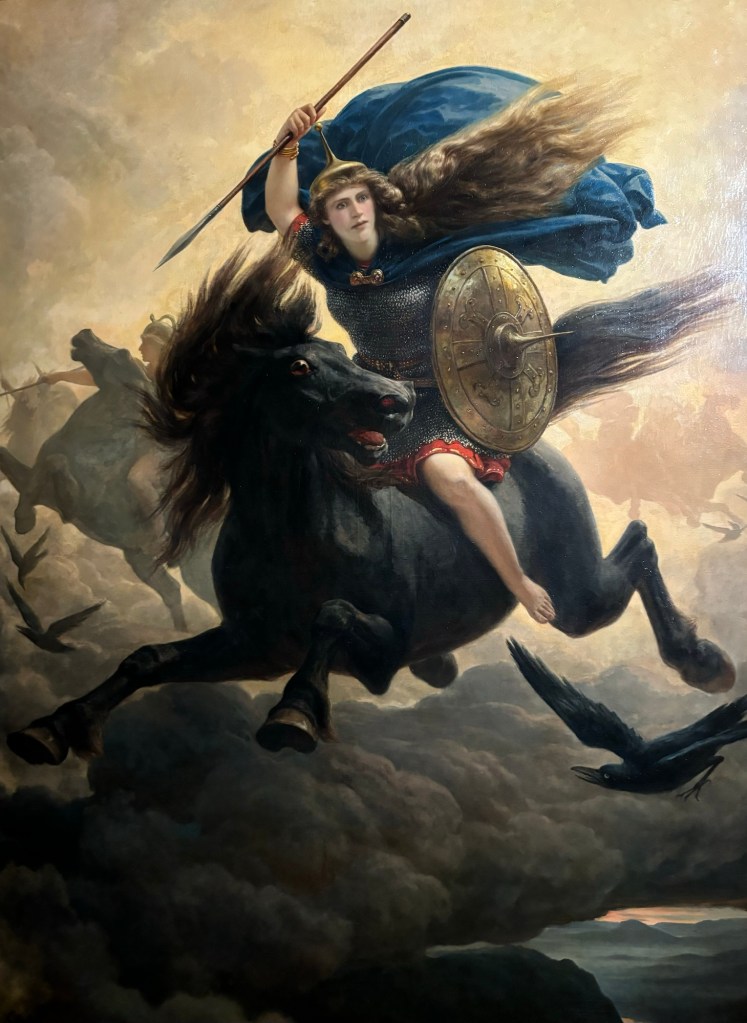
You couldn’t have an equestrian exhibition without at least one painting of the famous Valkyries of Norse legend, shield-maidens and psychopomps that herd the souls of the slain to Valhalla, the Hall of the Dead. It’s a dark and moody piece, but I would have given a great deal to see Peter Arbo’s more famous painting, Åsgårdsreien, which depicts Odin’s “Wild Hunt”, a spectral apparition said to appear on stormy nights as a herald of woe and disaster for the beholder. I’ve had a thing for that folktale since I found its equivalent in Cataluña, centred on the doomed Compte Arnau who rides again at night with skin afire, pursued by his hungry hounds. There’s even a country song by Stan Jones about the famous “Ghost Riders in the Sky” that Johnny Cash went on to cover, which has the Valkyries of old trade in their helmets for stetsons.

I do love it when a myth goes global.


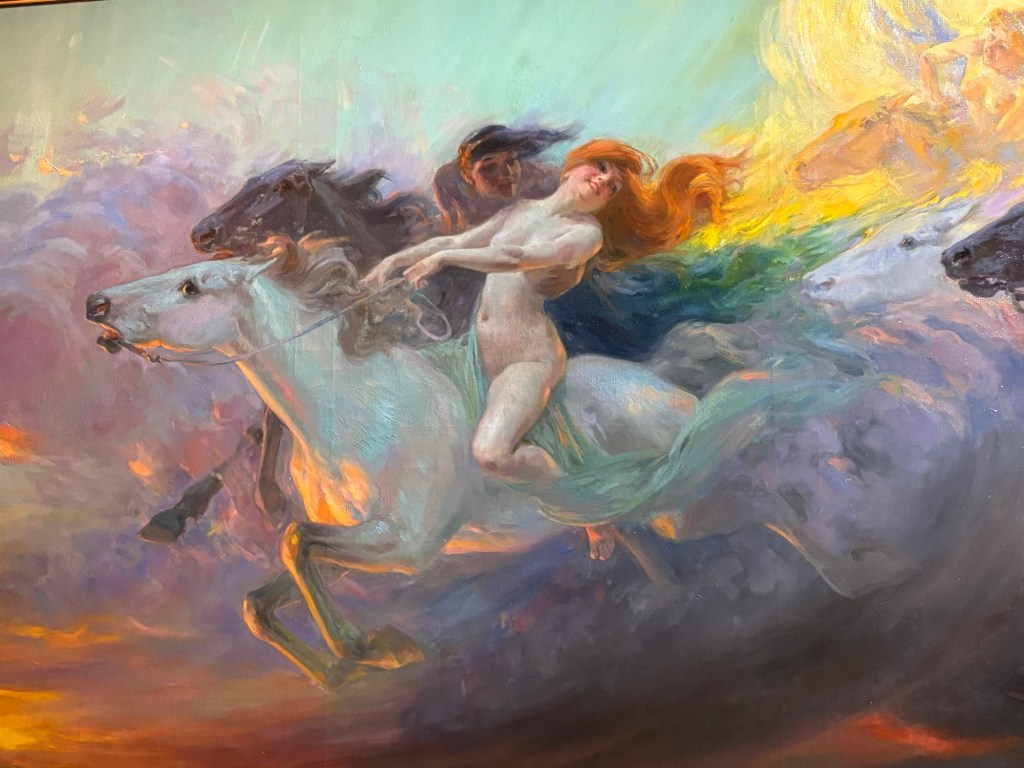
One painting in particular caught my eye (and not just because the leading lady has red hair!): Crepúsculo by the Spanish painter Ulpiano Checa y Sanz. Even without the aid of the title, you know straight away what you’re looking at by the colours alone: the halcyon flash of twilight, as the last rays of the setting sun scatter across the darkening world in a brilliant array of colours. Am I glad that the painting that really took my breath away was crafted by a Spaniard? You bet. The landscape below reminds of the opening crawl of the Charlton Heston El Cid film, and in its strange and featureless way, it is so very Spanish. Foreign painters of Spanish scenes often play up to the Romantic stereotype of dusky maidens with hooded eyes lounging on street corners with flowers in their hair, so it’s nice to see a native sharing my weakness for a change.


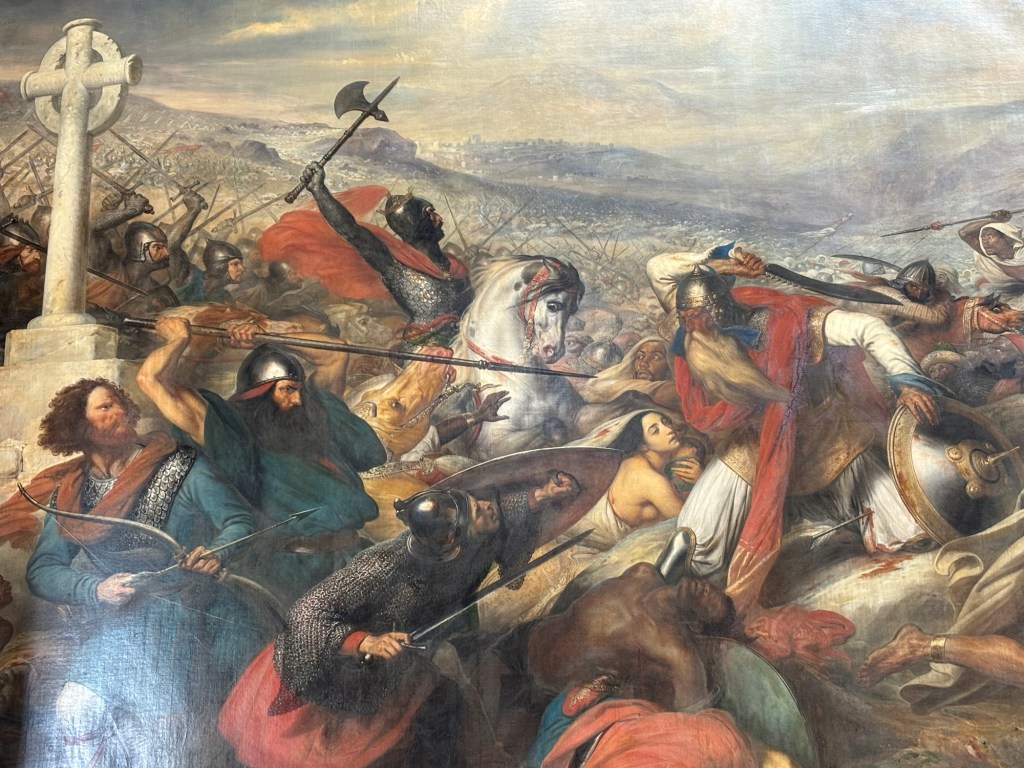
Finally, a painting I really didn’t expect to see, but one that must have been at Versailles for some time, as it was not in the equestrian exhibition but in the palace’s Galérie des Batailles. As patriotic paintings go, it’s got to be up there with La Liberté guidant le peuple by Delacroix (though perhaps not as widely known). This is Charles de Steuben’s Bataille de Poitiers en octobre 732, and it tells the story of the decisive battle between the Frankish forces under Charles Martel, “the Hammer”, and the invading Umayyad army Abd al-Rahman al-Ghafiqi. I must have seen this painting a thousand times for it is tied up with the history of Spain, and of Europe itself: had the Umayyads not been stopped so decisively, they might well have gone on to conquer the rest of Europe. It’s one of those real watershed moments that comes around but rarely in history, and I was amazed to see the real thing – which is, like the armies it portrays, vast.

Not a good time to be a horse, or a European for that matter, but what a find!


Well, that’s quite enough painting perambulations for one post. I’ve just arrived in the pirate city of Saint-Malo where the sun is shining and the water is crystal clear. I think I’ll go for a dip while the weather holds! BB x

Up and Down

When I’m on the road, I have a real complex about fitting in. It must be a side-effect of being a linguist, but I cannot stand the idea that I might stand out as a foreigner, if I can help it. Usually it’s simply a question of dressing appropriately, but it also makes me think very hard about my accent when I speak. This has had some brilliantly cringeworthy outcomes, such as getting into a blazing row with a taxi driver in a French that has never been as fluent since, and defaulting to a makeshift (albeit stateless) American accent while riding the Amtrak train two weeks ago… The worst has to be that two-hour drive in a Luton van with a dyed-in-the-wool Yorkshireman in my university days, where I was so self-conscious about my southern accent that I feigned a northern accent so as not to come across too posh… My housemate, a Wensley lass herself, took an exceptionally dim view of the whole affair. In her own words, my accent had only made it as far as Sheffield.

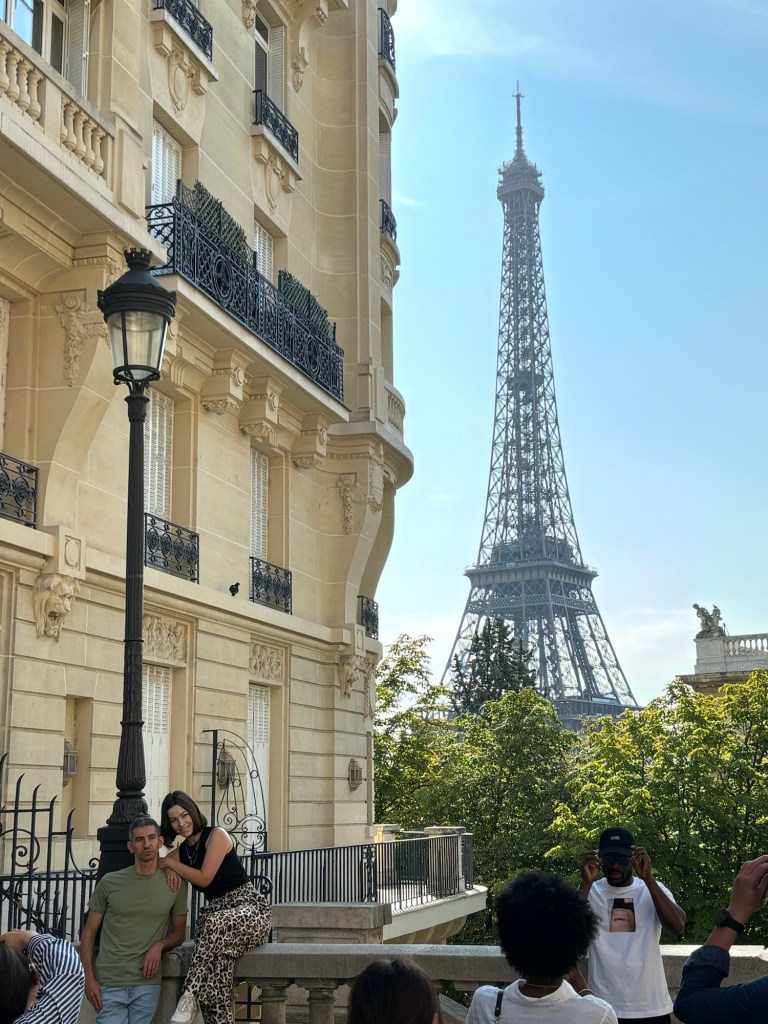
Fortunately, I’m in France, not Sheffield, and with just over a week to go until the Olympic Games begin, the city is so full of tourists that it’s probably easier to blend in as one of them than to ape any Parisian. So I caved and bought myself an Olympic T-shirt, since it’s unlikely to come back here in my lifetime.


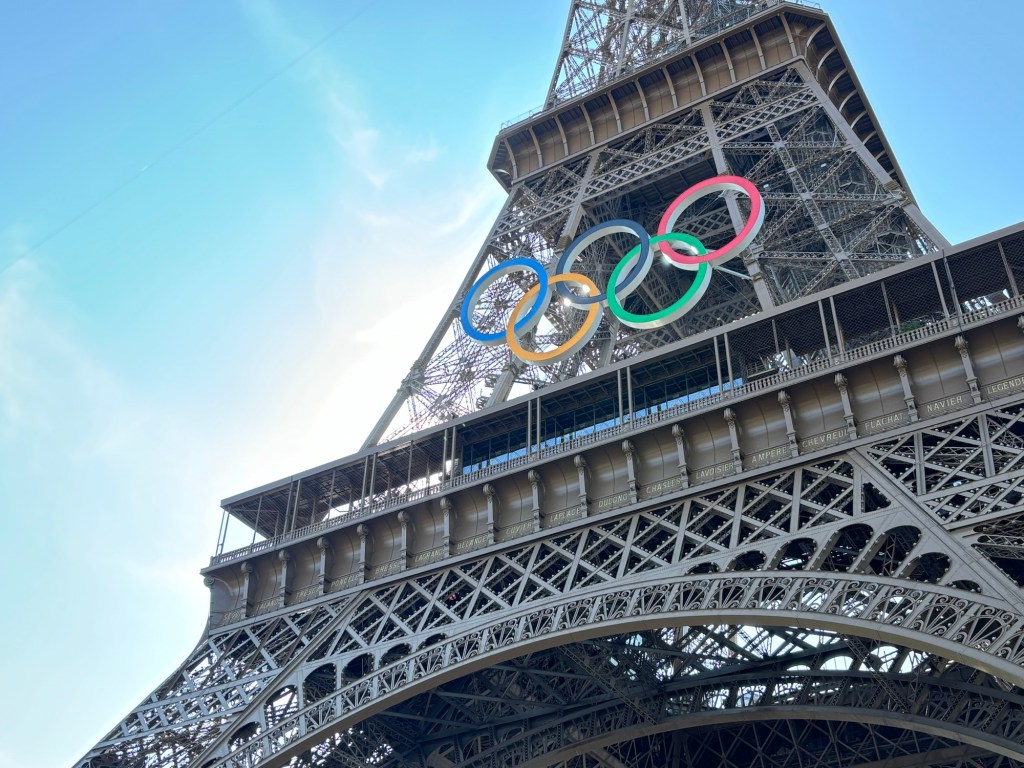
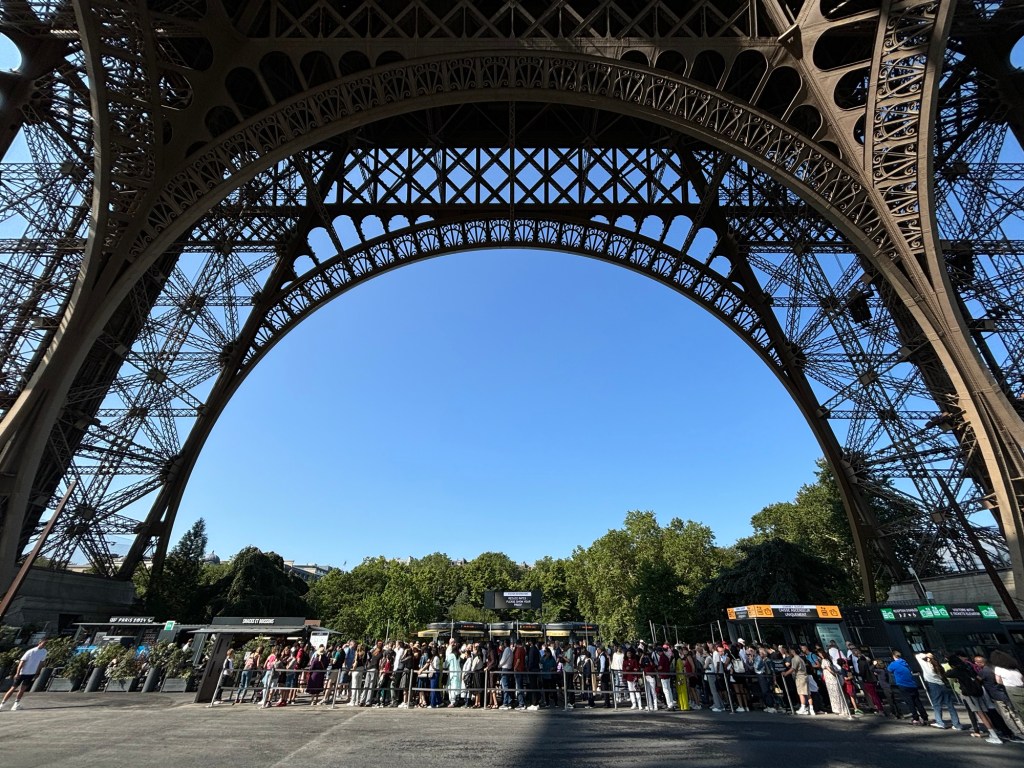
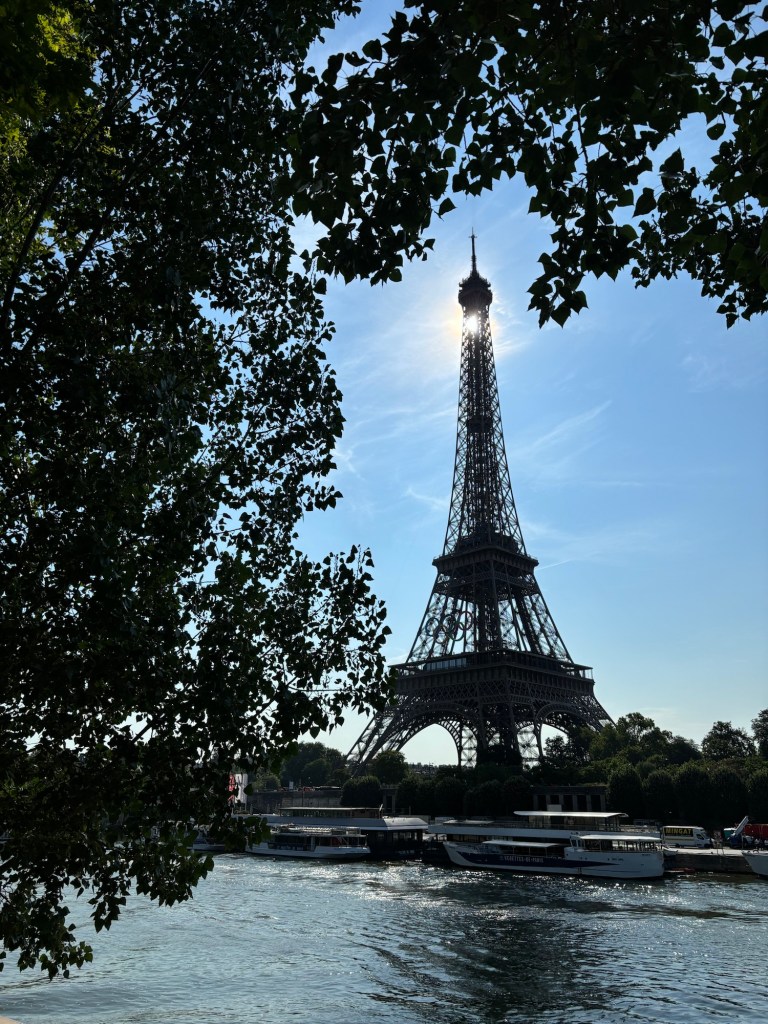
I only have the one full day in Paris, so I decided to make the most of it and go supertouriste for the day. With Nôtre-Dame still under heavy repairs after the fire of 2019, and the Louvre fully-booked up for days, that left the Eiffel Tower, l’Arche de la Triomphe and the Château de Versailles. I didn’t really set out with a specific itinerary in mind this morning – I rarely do when I’m traveling solo – and the decision to join the queue for tickets up the Eiffel Tower was very much a spur-of-the-moment one. After all, the website said that all the summit tickets were sold out, and while the views from the second floor are good, who’d make the climb and not go all the way up?


Turns out the website doesn’t know jack. The queue was about half an hour long, but when I did get there the ticket seller simply raised an eyebrow when I inquired about the availability of summit tickets and said “bien sûr”. So if you’ve considered seeing the tower on your trip to Paris and you haven’t made any reservations, fret not – they always keep some to sell on the day.


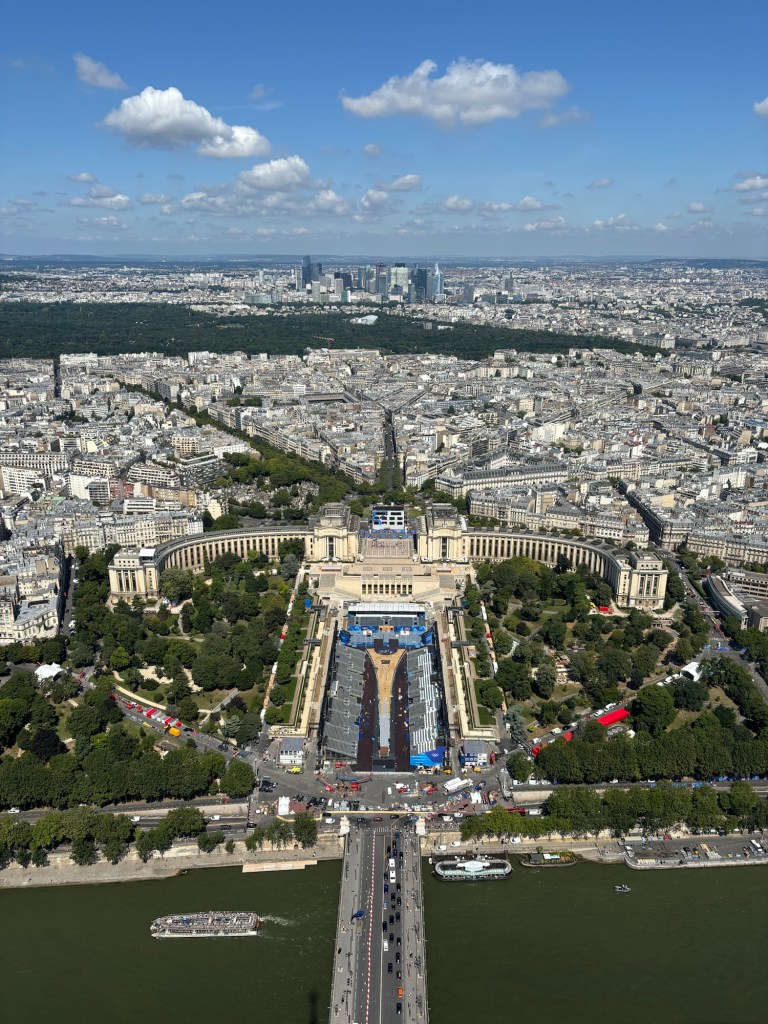
Preparations are well underway for the Olympic Games here in Paris. The Olympic torch has completed its relay of the various départements, including far-flung Outremer, and is now circling the city in an ever-shrinking spiral. All around the city, cyclists are coming and going with pink signs in their panniers, pointing visitors in the direction of this or that event. Stadiums and stands have sprung into being like enormous steel mushrooms, and the avenue that stretches from Trocadero to the École Militaire now hosts a giant show ground, which looks like a building site from the ground but a lot more like a Roman circus from above.

It’s also impressive just how big the Bois de Boulogne is. Hyde Park may be a green lung for the heavy London air, but it pales in comparison to the dark forest that has clung on in Paris’ northern district, as though threatening to break the encirclement and rejoin its sister Meudon in the west, given the opportunity.


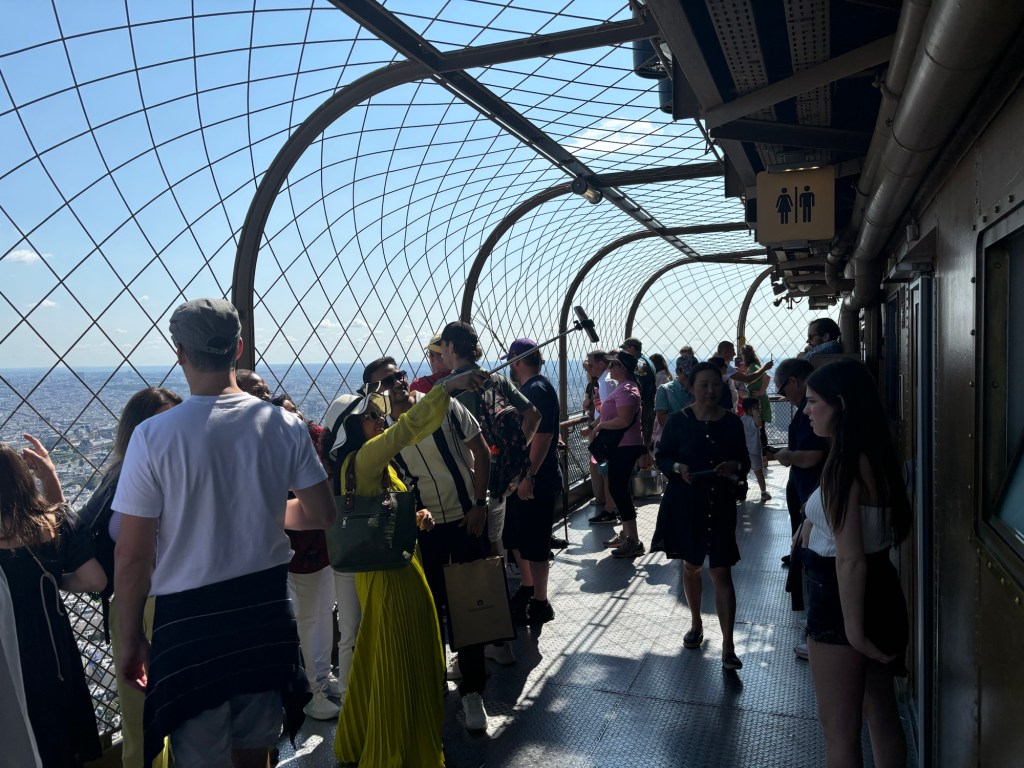
The summit of the Eiffel Tower really is quite something. Photos don’t really do it justice. There’s any number of skyscrapers that have now beaten its giddying record, but none so old, so charming, so immediately recognisable. It’s quite something to perch high above the City of Light, pigeon-like, and join the ranks of historical characters who have stood in the same spot: kings, shahs and statesmen, warmongers, tribal chiefs and Buffalo Bill. You’re more likely to be elbowed out of the way by an errant child angling for a better view or jostle for space with a Brazilian family taking every possible angle of each other than you are to meet any of the former, of course, but who knows? With the Olympics converging on the city, now’s as good a time as any to go stargazing up the Eiffel Tower.


I’ve been a bit reckless with the traveling this summer. I’d like to argue that this latest venture is purely tactical, with French being a very valuable commodity where I’m going, but it’s also methodical: it’s a very good way of keeping busy in the yawning maw of the summer holidays, which can go on and then some if you don’t find some way to keep busy. At the moment, one wedding after another plasters my social media feed as old friends tie the knot. It should make me smile, but on one level it always reminds me just how cut off my career has left me. That’s just one of many reasons I’m moving to a new job and a new part of the country this summer. It’s high time I hit the reset button and started from scratch.

But until then, I have the joys of the open road. Perhaps it’s my way of justifying my existence in these long, empty stretches we call holidays. I might have missed the boat festival in Brest by a matter of days, but I’m really quite excited to explore Britanny. After all – it’s supposedly the location of the indomitable Gaulish village of Astérix and Obélix. Between those two comic rascals and St-Malo’s long history of piracy, I should be in for a treat! BB x
Don’t Sleep With a Drip (Call a Plumber)

In the Southlands there’s a city / way down on the river / where the women are very pretty / and all the men deliver.

The Princess and the Frog

Two things hit you right away when you step out of the car and into New Orleans: the heat and the smell. Both are overpowering. The heat gets under your clothes and into your skin in seconds, as though you’re sliding into a sauna. The smell hits you like a wave: a heady mix of diesel, sugar and, above all else, weed. I’ve never been anywhere quite like it.

After the city complex that is Dallas/Fort Worth International, New Orleans’ Louis Armstrong Airport felt much cosier – insofar as Americans do “cosy” when it comes to buildings. The lack of passport control caught me off guard, but then, it was only on an interstate flight. I didn’t get a stamp for the passport, which is a little annoying – it would have looked nice next to all the European stamps (a tiny compensation for Brexit).

I took an Uber into town, it being a Sunday and me having no idea where the bus set out from. Every American I’ve ever spoken to has only had bad things to say about their public transport, and besides, I figured an Uber would at least give me a local to talk to en route. My driver Calvinisha was a very charming New Orleans girl who was only too keen to point me in the direction of a number of food joints, namely Mr. Ed’s Oyster Bar. I’ve added it to the list. She also added that I’d ‘just missed out on the swinger festival’. I didn’t ask her to clarify whether she meant that in the musical or sexual sense. In New Orleans, it could easily have been either.


I checked into my hostel on 1028 Canal Street and set out for a wander, very conscious that I needed an early night to avoid any jet-lag on my first couple of days. My room was empty but for a steady drip from a leak in the ceiling and a disembodied voice coming from behind one of the curtains: a British guy clearly playing some kind of MMORPG, telling his friend to “use black sword”, “send in a fire mage” and other strange and rather bizarre commands. Leaving him to his world of make-believe, I locked my things away and set out for a stroll.

It’s hard to describe my first thoughts of New Orleans and at the same time do the city justice. It is certainly a culture shock for a European country boy like me. Skyscrapers that dwarf most of London’s tallest buildings. Shops that look like El Rocío homes openly advertising voodoo, weed and “barely legal” strippers. At first glance, New Orleans is everything you might expect to hear about in 20th century Soviet propaganda about America: casual, sleazy, decadent. But when it’s 38°C out there and the humidity is over 70%, can you blame them?


It feels like this town ought to operate on a Spanish-style siesta timetable – and yet, even in the hottest part of the day, folk are still wandering the streets. You have to hand it to the pioneers and their descendants. Louisiana heat is not to be trifled with.


For me, this whole American adventure is kind of a test. I think one of the subconscious reasons I’ve never really thought about going to the States is because of my languages. Hear me out. I’m not the best at striking up a conversation with a total stranger, in a shop or bar or anywhere else – unless it’s in another language. For whatever reason, I’m a lot bolder in my dealings with strangers when it’s in Spanish or even French. I honestly believe that it’s a confidence trick – you’re focusing so much on getting the language right that you don’t stop to think about where you are, who you’re talking to. I’ve heard so much Spanish here and I’m instantly filled with a desire to leap into conversation, which I can’t say happens as readily in English. I’ll just have to work on that.


I came back to the hostel around seven thirty and tried to get an early night’s sleep. I was in for a bit of a shock: the dripping was actually coming down onto my bed, a full third of which was soaked through. Never mind the damp, the constant slap of water on the soaked mattress was maddening. It’s funny how you can doze off amid the constant hum and roar of a plane engine, but a rhythmic tap with keep you up. I tried taping it up, but after five minutes it returned with a vengeance, beating an even faster rhythm than before. I admitted defeat and curled up into the drier part of the bed.

I confess I was so tired that I didn’t have the energy to drag myself out of bed and tell the front desk, but in the end I didn’t need to – a guardian angel in the bunk next to mine had already phoned ahead and eventually the hostel staff allowed me to move to the bed across the room. I don’t think I’ve ever fallen asleep so fast.

Tomorrow is another day – the bayou calls! BB x

Camino V: A Man Out of Time

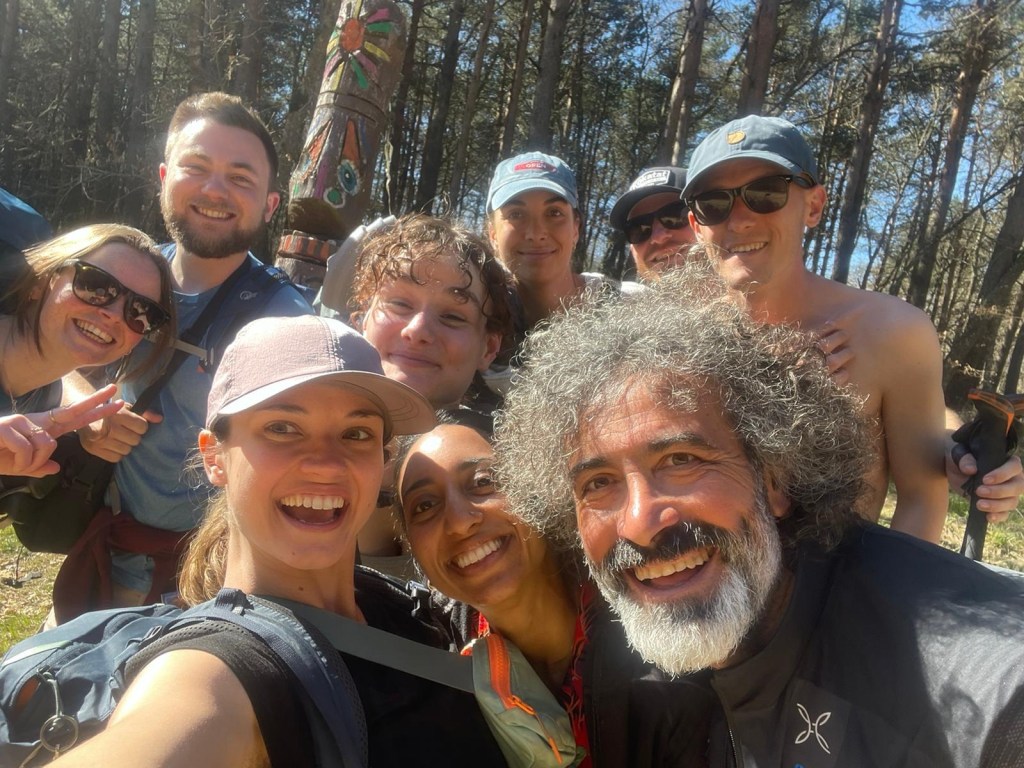
After the Carabiniere’s tip-off about the limited options in San Juan de Ortega, we made the collective decision to strike out early for Agés, the next town along. So, after a day’s hiatus, I had my sunrise again – at the cost of my fingers, which were numb with cold for the first half hour at least. Mikel the Dane caught up to my ferocious pace to lend me his fleece-lined gloves. The way everyone looks out for each other on the Camino… there’s really nothing quite like it.


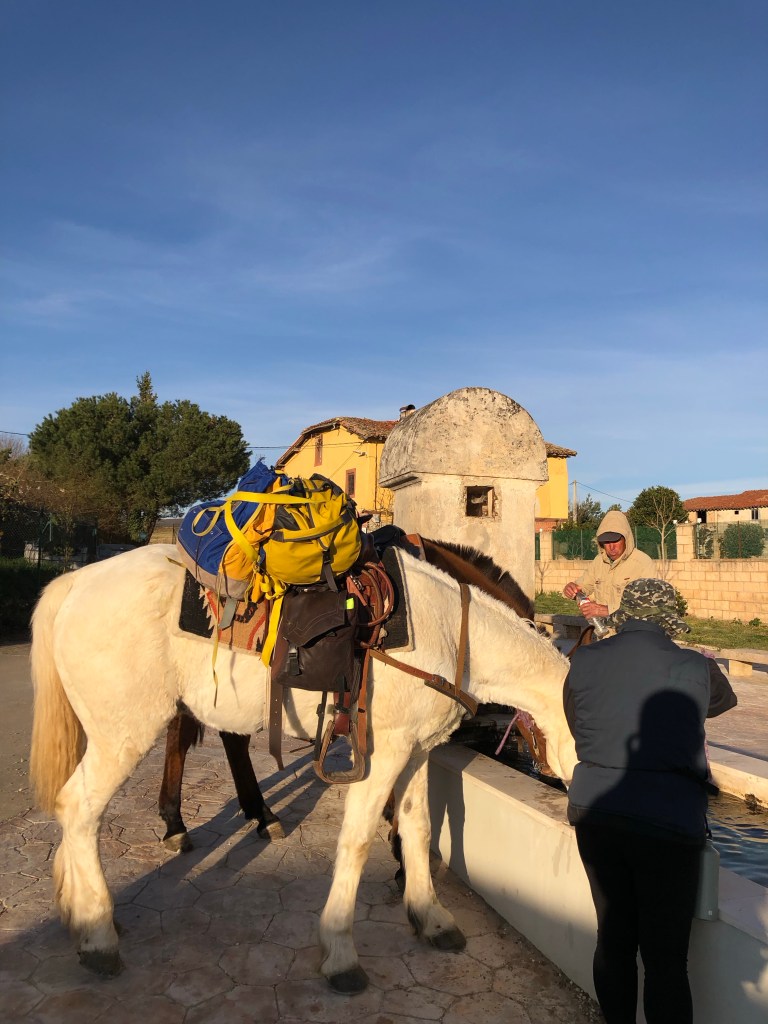
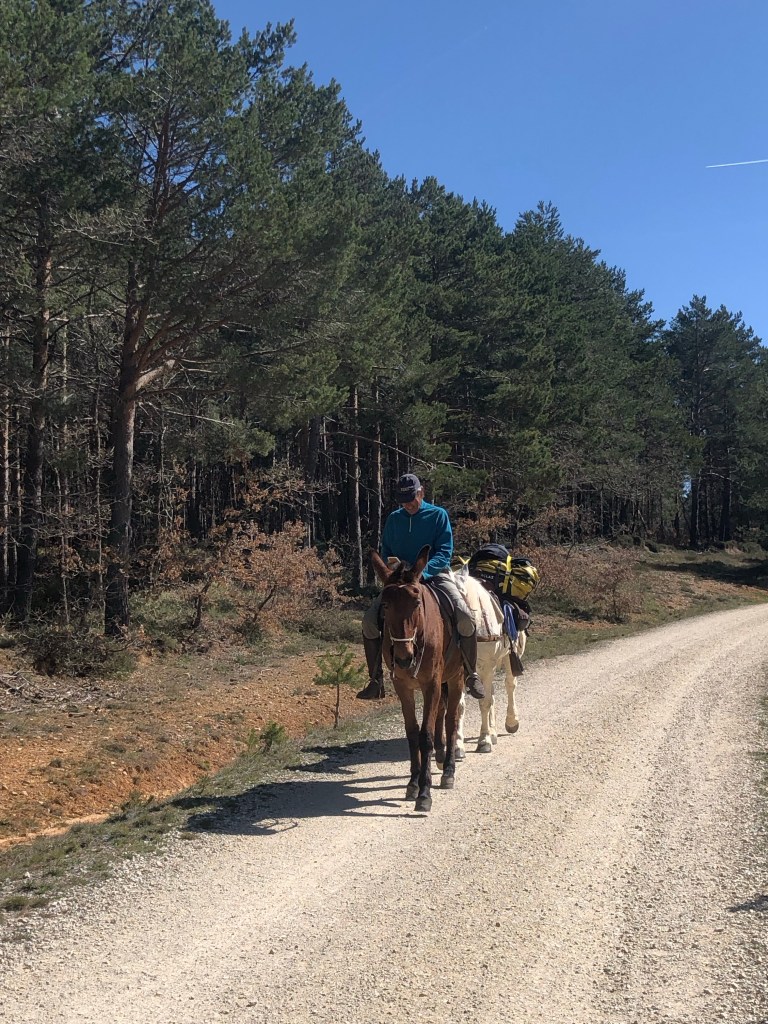
Shortly before reaching Tosantos I picked up the trail of Enrique the Arriero and his mule, Jena, and as soon as he came into sight I picked up the pace to catch up to him. It was a merciless effort on my already beleaguered heels but worth it – with so few in his trade left in the world, you don’t pass up a chance to learn something of that vanishing world. One of our number had lost his card to a hungry ATM so I couldn’t stop to chat long, but I told myself I’d try to catch him further down the road if I could. I had already penned “Entrevista con un arriero” in my journal and that would just be a waste of paper if I couldn’t fill it in.


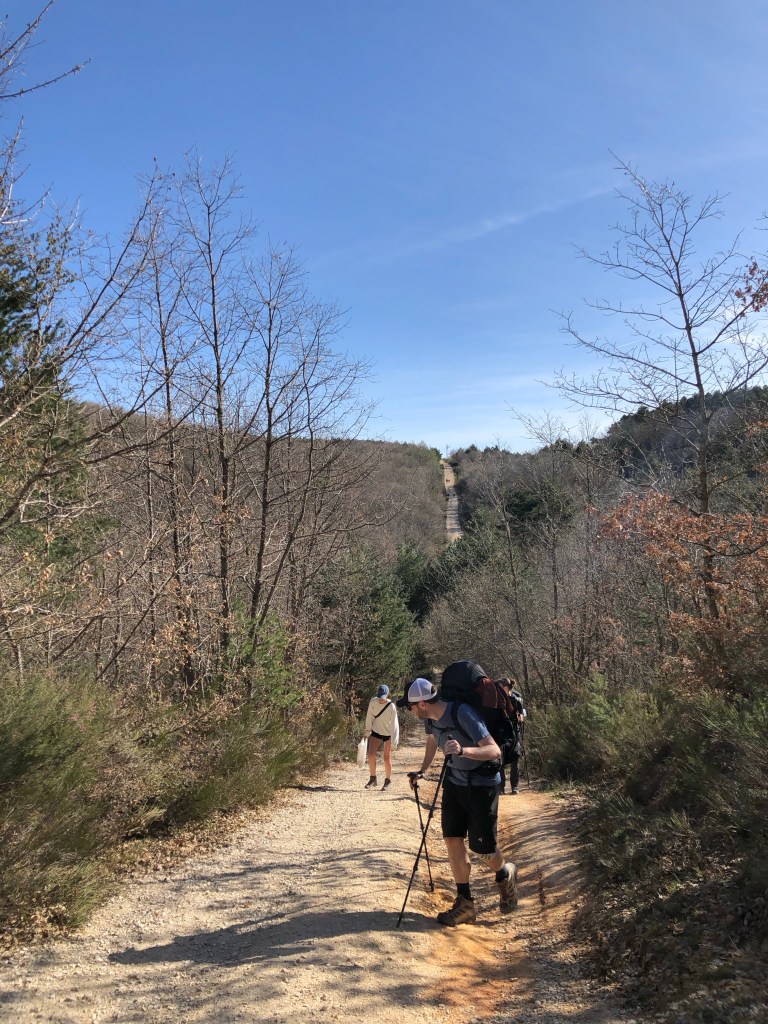
After grabbing an early lunch/late breakfast at Villafranca Montes de Oca (20€ fed all seven of us with a sizeable tortilla & jamón bocata and drinks) the Camino wound steeply uphill into the Sierra de La Demanda. I won’t be the first pilgrim to say it was demanding and I won’t be the last, but it was a welcome change to be under the shade of the trees after the roadside meandering of the last few days.


There’s a monument about halfway through the Sierra to the fallen of the Civil War – that is, the opponents of the Nationlists in Burgos who were dragged out of their beds and summarily executed up here in the woods in the early days of the war. Most Spanish families can relate to this grisly tale: most of the circle of friends of my great-grandfather Mateo similarly disappeared, being known for harbouring or having harboured socialist sympathies even after the war was over. I said a prayer and moved on.

After another steep climb we finally made it to an open stretch of the Camino where the Carabiniere led us to a shaded spot where a food van had been parked on his last run of the Camino a year prior. The proprietor was still here, and while the ‘stamp girl’ was on her way (she’d gone to get fresh ink) he was happy to provide us with fresh strawberries free of charge while we waited.


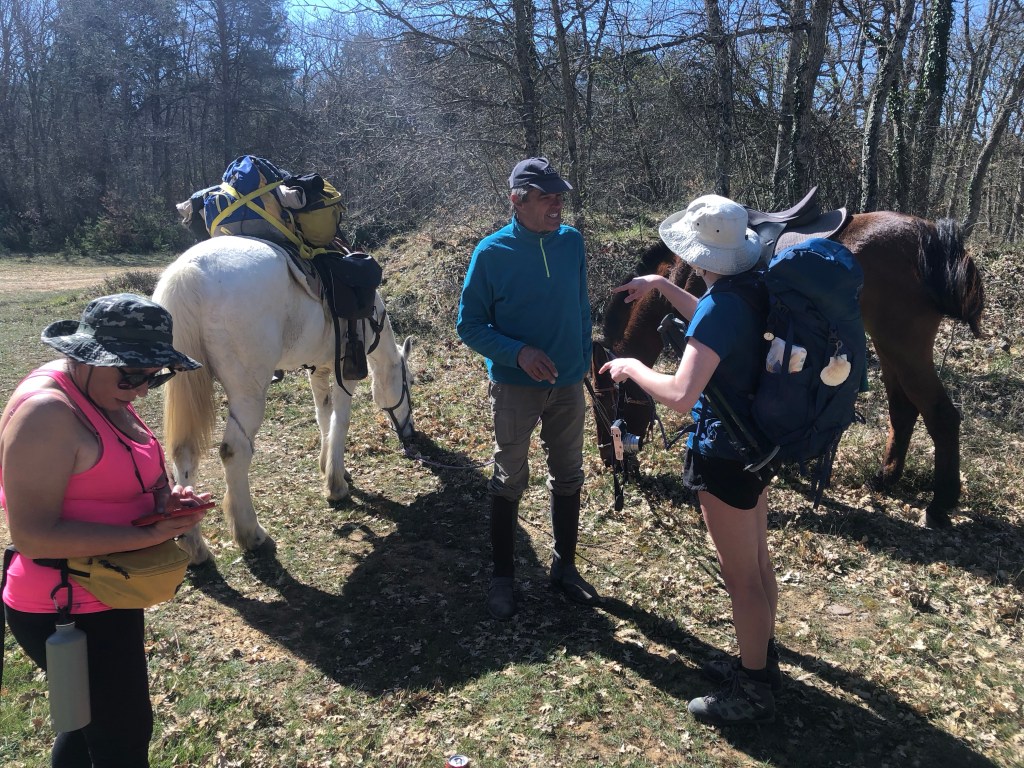
Here, at last, I caught up again with Enrique, and was able to ask him all the questions I’d had on my mind about being an arriero.


Enrique – or Kike, as written across his hat – has been a muleteer ever since he was a child. He picked up the trade back home in Argentina, where the vast distances and tricky terrain have allowed the profession to long outlive its run in Europe. He likened the trade to studying to become a surgeon: long, hard work and dependant on the collected wisdom of many teachers and masters of the art. Experience, said he, was the best teacher of all, and – now in his sixties – he has had almost six decades worth of it. He grew up a poor man, living on the streets and carving a life for himself in the countryside, not that you’d know now from his noble bearing, bright white smile and polished riding boots (an bold choice of footwear for the Camino). Since his move to Spain twenty-five years ago, he’s got by working with horses and mules wherever and however he can, teaching, buying and selling, running activities for children… whatever he can turn his hands to. I remember as a child seeing the odd arriero in the country around Olvera, so it was more than just an honour to meet a man whose profession is that of the title character in my books. It was a warm dash of nostalgia.


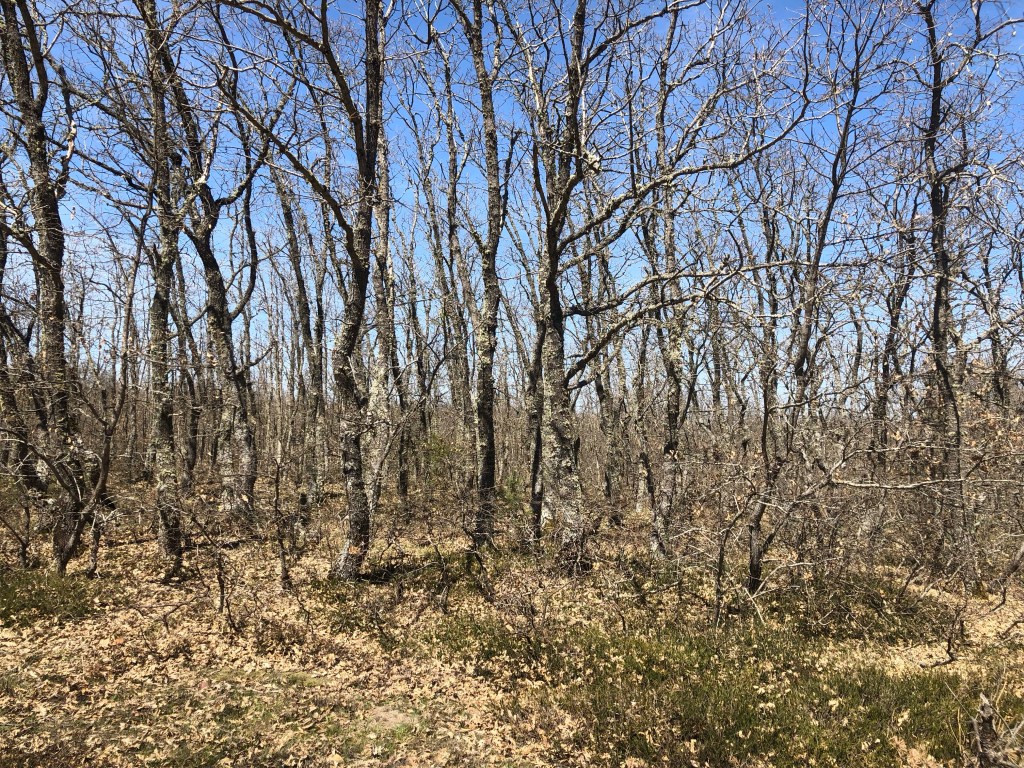
The dark pine forests of the Sierra de La Demanda soon gave way to a skylit swathe of leafless oaks, covered so thickly in lichen that they looked half-dead, like greying, flayed cadavers beneath the sun. However, the forest could not have been more alive. A cuckoo called in the trees and followed us like a shadow along the Camino for some time, while chaffinches, blue tits and the piping song of a wryneck played a merry tune to carry us along. It helped to take my mind off the blisters forming on my beleaguered feet and then some.


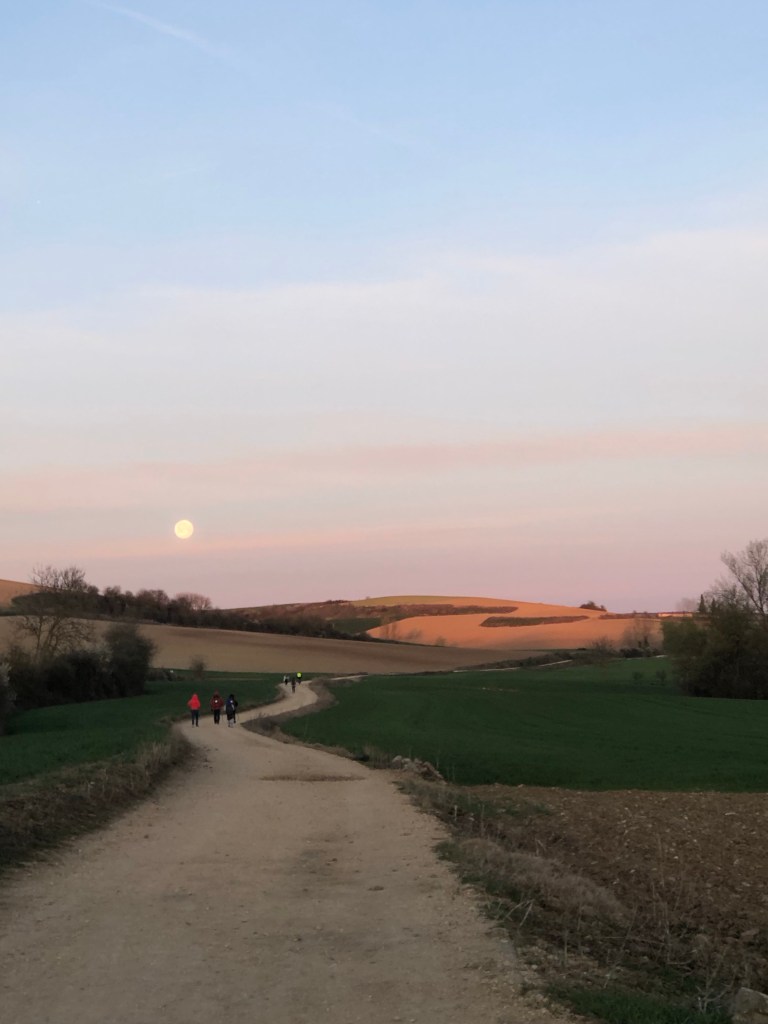
Then, before we knew it, the trees were at an end and there, stretching out before us, was the meseta. The prehistoric treasure trove of Atapuerca lay between us and Burgos, but far away in the blue beyond rose the mighty snow-capped peaks of the Cordillera Cantábrica, as impressive now as they ever have been. We came down into Agés shortly after half past two – well into the afternoon – and within another half hour we had all decided to take a siesta.

The other pilgrims have gone out for a beer. I needed a little longer to recover this time, and besides, I wanted to strike while the iron is hot with the blog rather than wait until later. With the last twenty-three kilometres of this stage of the Camino still to go tomorrow ending in Burgos, I don’t think I’ll see Enrique again. So I wanted to record my interview here before I forget.


You never know who you’ll meet on the Camino. Teachers, scholars and sailors, bereaved parents and happy families, policemen and anarchists, priests and atheists. Now, finally, I can add an arriero to that number. BB x

Slow Clocks and White Socks

Good morning from the staff room. My second 1°ESO class are busy preparing posters on British food for next week’s Semana Cultural this morning, so I’m off the hook for an hour. It’s a shame, really; they’re probably the one class that could have really benefited from a presentation on the UK, seeing as it’s what they’re working on right now. My other 1°ESO class loved it, and I dare say the addition of a Honchkrow to explain ‘honcho’ helped a lot in the ‘foreign words in English’ section. Not that honcho – a Japanese term for ‘big boss’ – is a word you expect to come across all that often, but it makes the language learning process a lot more colourful. Going over the same ‘how much is a ticket’ dialogue every week gets a bit dry, eventually.

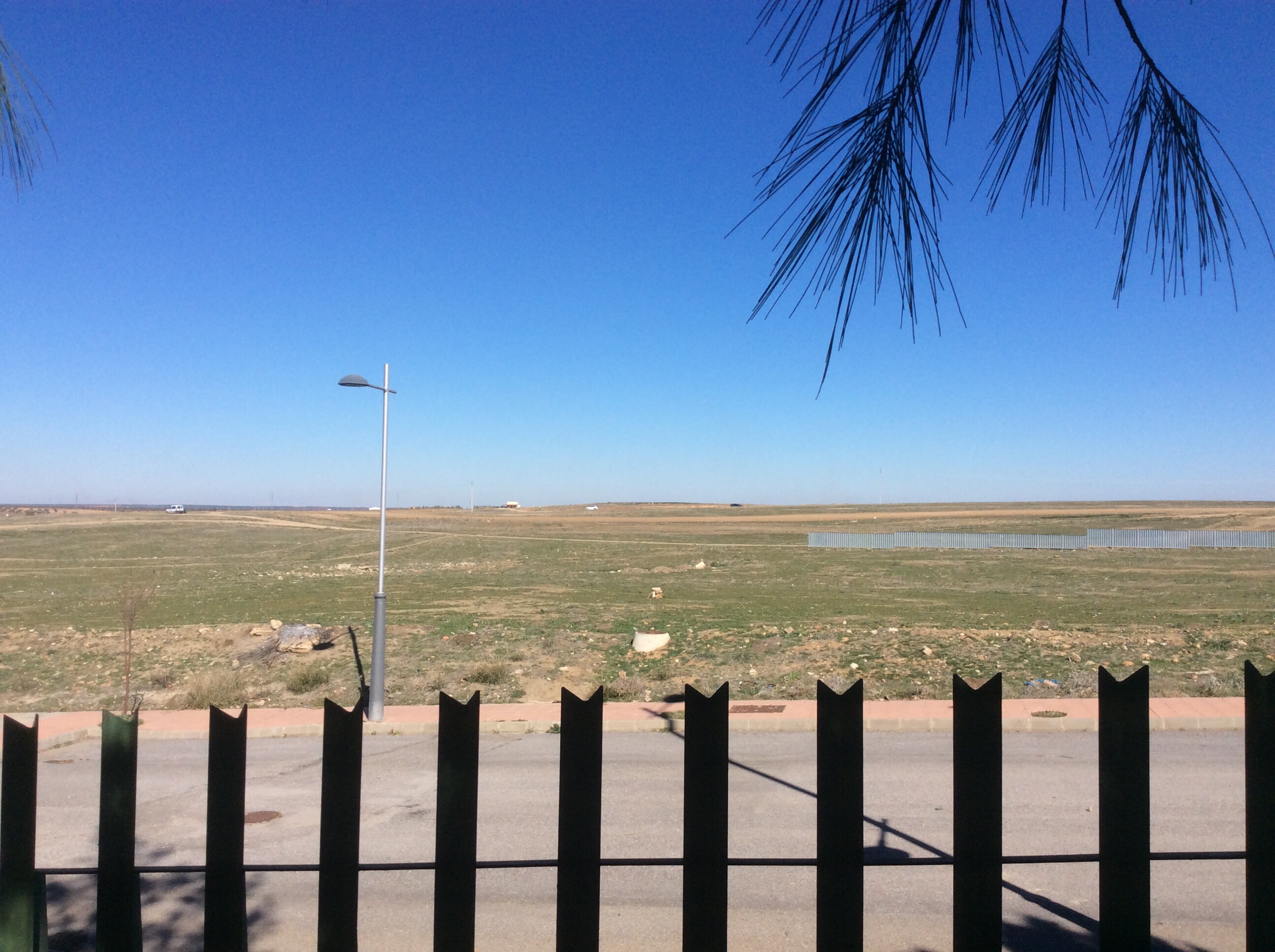
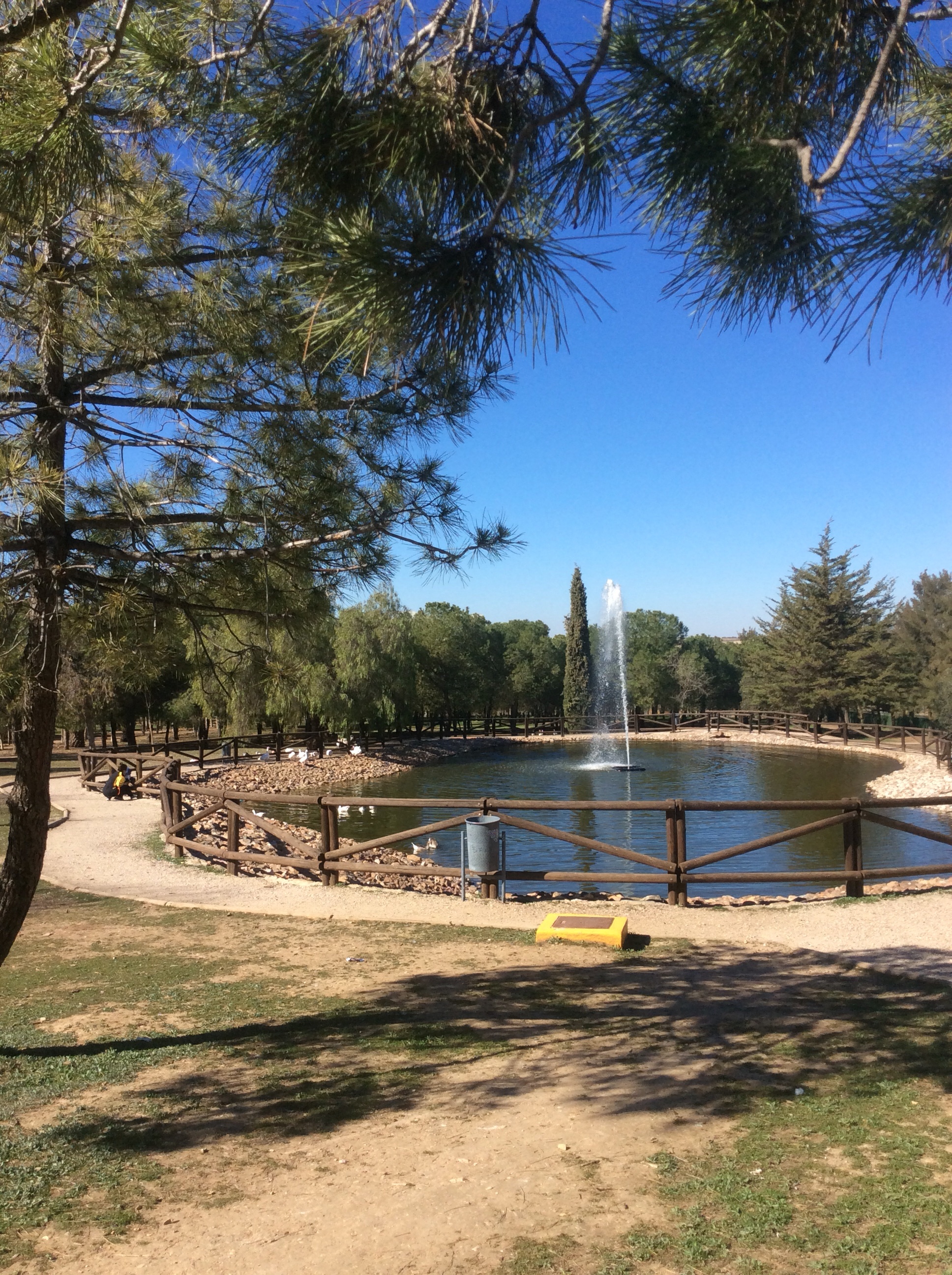
I went for a walk in the park yesterday. It’s been so warm and sunny recently, I simply couldn’t justify going straight home from work. Tired as I was, I slapped a small lunch together, downloaded a few In Our Time podcasts and crossed the road into the park. It was a little windier than I’d have liked, so I didn’t stay all that long in the end. Without it, it might have been as warm as 18°C. In February. But here in the plains of Extremadura, we’re ruled by the terrain. The wind that blows across the flats is cold and loud, like something out of the Old West. You half expect a tumbleweed to pass you by. It’s a shame that we think immediately of America when we hear that name: with its wide open plains, rocky cliffs and canyons teeming with bandits, and its historic code of honour and justice, I’d like to think Spain was the real Old West; the Ancient West, if you will.

The swallows are here. I watched a few of them twittering noisily as they careered about the pond, whilst one of the town’s storks soared lazily overhead. The trees were alive with goldfinches, and I saw a huge bat on its way to the park from my flat the other night. It was a lot easier to consider a job in England a month ago, I’m telling you, before Spain started thinking about her Spring clothes. Now that it’s feasible to go to bed without having the heater on for a full hour, and the blue skies are no longer laden with a biting cold air, I find myself in love once again. The saying goes: ‘nueve meses de invierno y tres de infierno’ – nine months of winter and three of Hell – but Spain can be equally unforgiving in the grip of winter.

I spent a little while watching a robin – always one of my favourite birds – and a couple of hoopoes flapping about like oversized butterflies. Symbols of England and Spain, in my head. I should go to the park more often.

It’s hard to see the change in the seasons here in Tierra de Barros, with the park full of evergreens and the surrounding eternity of vineyards and olive trees, but the animals tell you. And where they fail, the town drummers do a pretty good job. Carnaval is over, and I thought that might be the end of their incessant weekly drumming, but I was wrong: last night as I lay dozing in the living room, I heard the unmistakeable march of the Holy Week procession. It’s a good month away, but preparations have begun in earnest. But I’m not complaining: Semana Santa is far and away one of my favourite things in Spain and I never want to be anywhere else when it’s on. Like countless Brits before me, I’m shamelessly enthralled by the primal magic of it.

And, like countless Brits before me, I’m steadily coming to understand that our humour and theirs – or anybody else’s, perhaps – simply don’t mix. My jape about my countrified accent got cut from the play this morning. I guess they didn’t see the funny side. One of my students did point out to me recently that imitating their accent is one of the few things guaranteed to rile an extremeño. As a guiri, perhaps I’m allowed a certain amount of leverage – it’s always funny to see a foreigner having a go, I guess – but patience, in the end, wears thin. Especially when I have to make that same joke at twenty-five minutes past eight every Thursday morning.

A few weeks ago there was an article in The Times titled ‘How to be Spanish‘ that caused uproar on Spanish social media. The Spanish, it seems, don’t like being told how to be Spanish by an Englishman (a puto guiri, to quote various Twitter users). Surprise of the century. Spaniards came out with war flags, claiming the author had no idea what country he was talking about. Whoever these folks were who eat tapas at the bar and never at the tables, swear so liberally and have a slightly more relaxed attitude to time than the hyper-punctual English, they certainly weren’t Spanish.

Shortly afterwards, the Spanish retaliated with an article of their own on how to be British, citing such customs as queuing for everything, wearing white socks, wall-to-wall carpeting and, of course, our penchant for exaggeration. It was a childish exchange, but you have to admit, there were a few cultural nuances both sides got spot-on.

It was a lot of fun to discuss in class, I’ll give you that, but whilst I agree that the original author could have been a little less damning in his exaggerations – a flaw I’m often party to (see the war flags remark) – it seems to me that the problem lies not in the content itself, but in how it was received. Of course not all Spaniards act the way the author describes, but then, he doesn’t go out of his way to make that clear. And, of course, it wouldn’t be so funny if every observation in the article carried a disclaimer. Remember those jokes that your friends make that you didn’t get, and they then had to explain? Yeah… They weren’t funny at all.

As Brits, we read such things with a smile, seeing the irony and the humorous comparisons, because as a nation that’s what we do best: ridicule. We love to laugh, to laugh at others, and (sometimes) to be laughed at in turn. It’s not a universal attitude, but trying to be funny on a regular basis is, I think, an inherently British custom. Most everybody else has a life to be getting on with. Great Britain is cold, rainy and – according to some – has potentially the worst cuisine in the world (the very un-English chicken tikka massala was our most popular dish for years), but we are fantastic at making light of this and everything else, from our politicians and our history to our friends and neighbours, even if the rest of the world looks on in confusion. I gave up trying to introduce my kids to Blackadder and Monty Python a long time ago. It requires too much explanation. By contrast, Mr Bean works like a dream… because there’s no dialogue whatsoever. Which, given that he’s portrayed by easily one of our wisest and wittiest comedians, is a crying shame.

So that’s all it is. The British like being funny. And when our jokes involve people beyond our remit, we get confused when they take offence. Why can’t they see the funny side? The answer is simple: they don’t have to. That’s not to say we shouldn’t make jokes anymore. British humour is, in the humble opinion of this author, king. But we could be try to be a little more aware of what cultural difference means. If the Spanish come across as having a lax approach to time, it’s only because we’re unreasonably pernickety about it. The whole and ungeneralised truth lies somewhere in between.

Jokes are fine. Our problem is that we expect others to take a joke, to know when we’re being funny and when we’re not… and it’s not always easy. Especially in print. BB x

Fasting for Convenience

I never saw it coming, but the biggest challenge of living in Morocco is not the language at all. Above and beyond case-marking and getting your head around an Arabic variant that freely borrows French and Spanish words, rendering it almost four languages at once, is the challenge of eating. And whilst I consider myself reasonably proficient at keeping myself well-fed, these first few days in Morocco have rocked me to my core.

The problem, of course, is tied up with living with a family.

Before I set out on my ridiculous trans-Iberian adventure three years ago, I had the appetite of a wolverine. Always eating, ever snacking, stuffing myself with huge quantities of food that I was somehow able to finish in one sitting. Luckily for me, I remained as thin as a beanpole. Something to do with age, a penchant for going on long walks and a good metabolism. I was lucky. 

2013 changed that. The whole Santander to Almería adventure was in a constant state of flux – I don’t think the exact route was entirely clear until it was over – and in the mayhem of sleeping rough in the mountains and navigating by compass and a map dated from 1978, I forgot to eat. That Spanish adventure killed my appetite for good.

Ever since, it doesn’t take much to fill me up. Which is a positive boon, when you think about it, but a major snag when it comes to lodging with an Arab family. I expect it’d be the same just about anywhere in the world, but Arab hospitality is deservedly famous. In amongst all of the Arabic that went over my head, I’ve heard my hosts say more than once that they think I’m not eating well. Not for want of trying – Moroccan food is amazing – but I’ve yet to finish a meal. The quantities are enormous, and the whole eating-with-your-hands thing is frustratingly technical. It slows me down to the point where I’m only halfway through a meal by the time the others have finished eating. Naturally, I’m much too stubborn to accept the cutlery they offered – it’s shameful, like resorting to English abroad – but I can’t help but wonder whether by trying to adapt in one way I’ve only set myself another challenge.

And I need to learn. Eating with one’s hands is the done thing in so many parts of the world, not least of all my beloved Africa. I’ve given myself a week to learn to do it properly; after that, I may resort to a knife and fork, if only to be eating well. It’s Ramadan, after all. It would make no sense at all to be fasting and eating less than usual at the same time. That’s idiocy on another level.

The fasting thing is good, though. It felt right, somehow, getting up at two with the family to eat suhūr together. It adds a new sense of structure to the day. They were all fast asleep when I left the house this morning, which you might expect from a total of five hours’ sleep, but I had class to go to. Fortunately, it’s only a forty minute walk, and that takes you through the medina and last the Royal Palace. It’s a really lovely walk, and it feels better off the back of having fasted with the Tetouanis.

All of this is very easy to say now, on the noon of the first day. Left to my own devices, I doubt I’d make much headway. But with the family watching I’m willing to try. Ramadan helwa, as they used to say in Jordan. And anything that’s got something to do with helwa can’t be that bad. BB x

The view from Class N°5, Dar Loughat