Camino XVIII: Exodus

Albergue El Alfar de Rosalía, Hornillos del Camino. 20.03.

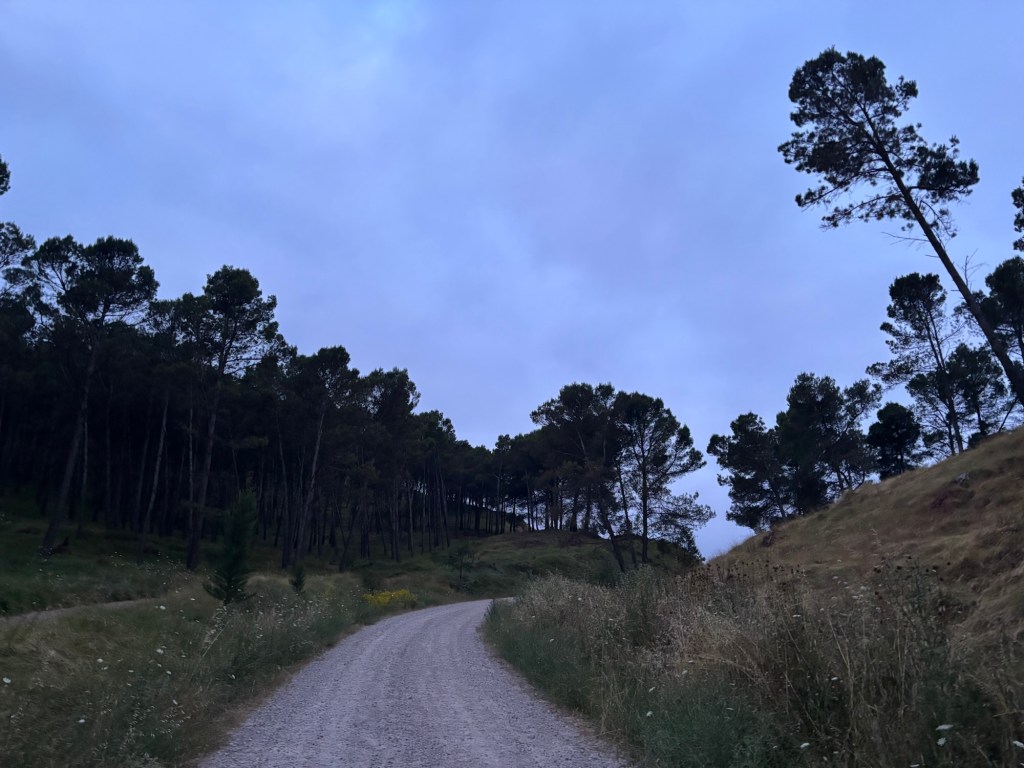
I was up at 4am this morning, probably due to the racket put up by the Koreans snoring next door. In any event, they were up and about with headlamps on by five and, since I couldn’t get back to sleep, I figured I’d get ready for the day, too.

It was as well that I did so. I had to intervene with a frantic Spanish woman in her fifties who was weeping into her phone with frustration because she couldn’t find the emergency exit that would allow her to leave the albergue before the main doors opened at 6.30am. I calmly pointed out the stairwell and a minor outflow of five or six similarly lost pilgrims followed suit, including Gust, the young Belgian lad we encountered in Grañón, and Lur, an enigmatic Basque girl with raven-black hair who has hardly said a word but who has been a feature of the Camino since Puente La Reina.


We said farewell to Alex after a last breakfast together outside the albergue and set off just after seven o’clock. Burgos’ Cathedral looked as magnificent as ever in the morning light, its twin towers visible for nearly four hours on the horizon after we left the city.
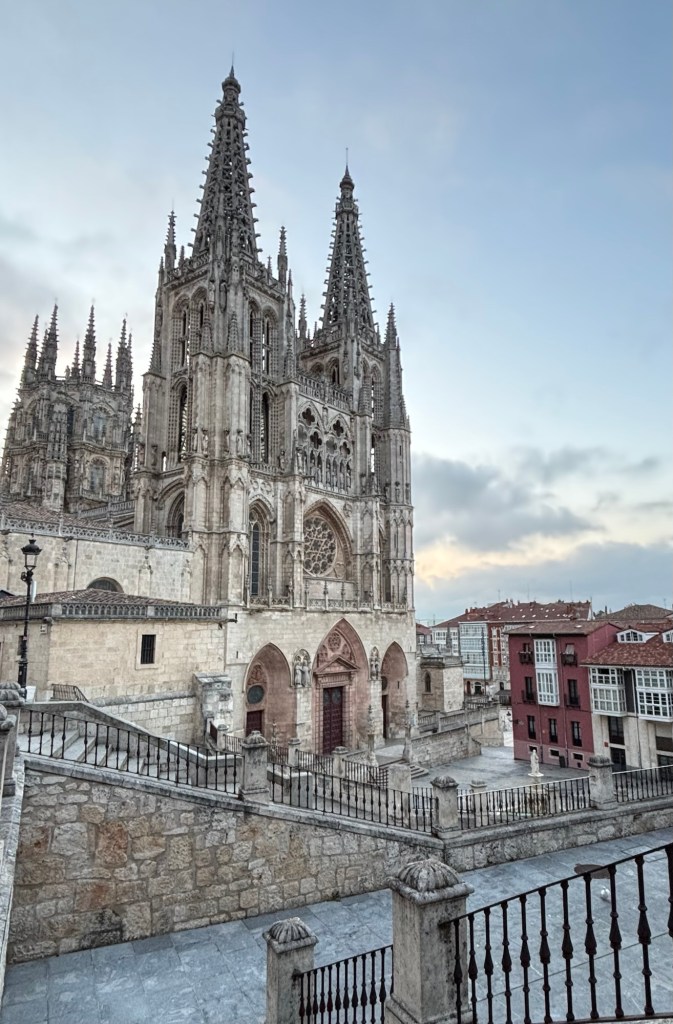

Leaving the city of Burgos is almost as laborious as entering it, but the west side of the city is a residential district and thus makes for a much more pleasant walk. An old lady redirected us near Villalbilla de Burgos, and while I don’t think it would have made an awful lot of difference if we’d kept going the way we were going, it’s nice that everyone around here id so invested in the Camino that they’re out to help.

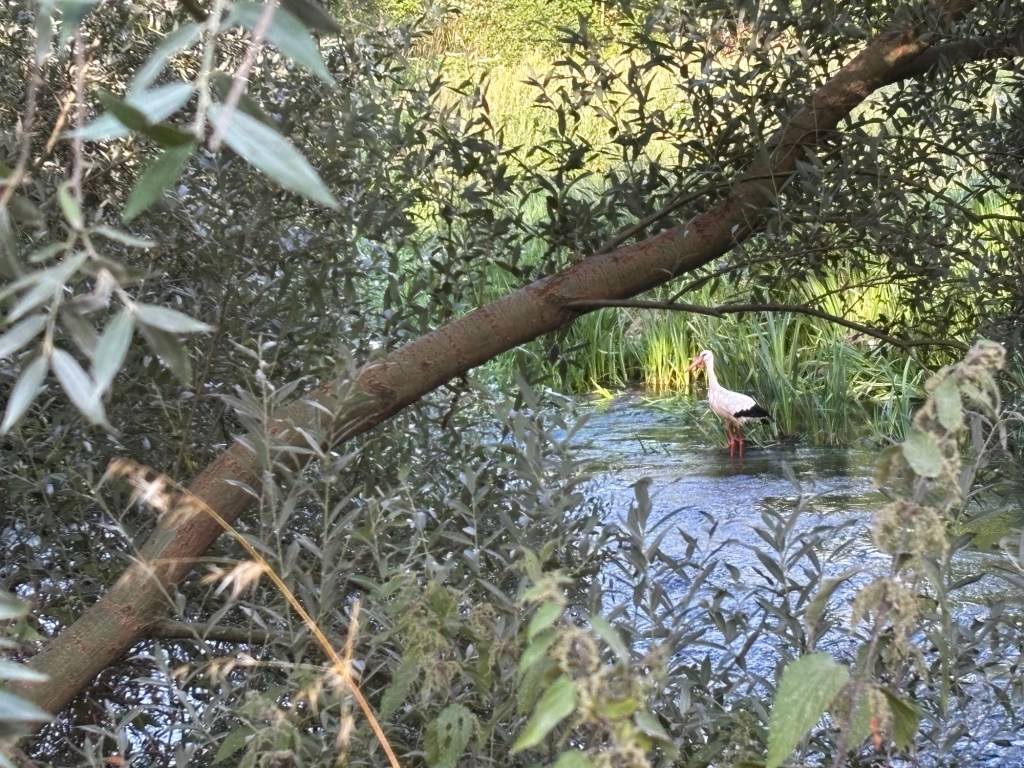
I found a couple of storks feeding in the Arlanzón river just after the crossing. They’re always so unaffected and untouchable in their nests atop the turrets and towers of Spain’s churches, so it’s not all that often that you encounter them in their “natural” habitat, where they are surprisingly wary and don’t let you get too close.

Tardajos’ church was open so I dropped in to collect the second stamp of the day, and a tip-off from pilgrims further ahead alerted us to a nun blessing pilgrims in Rabé de las Calzadas. The sister in question, a little old lady in her seventies dressed all in white from the Daughters of Charity, stood at the door of a little chapel on the edge of town, waving passing pilgrims over to approach. We went over for a blessing.

Spiritually, we’re a mixed group: a lapsed Catholic, a Reform Jew, an Agnostic and a Catholic who has found his way to God relatively recently. But for this last, this moment was one of the most magical of the entire Camino so far.

Taking us firmly by the hand, the Sister talked to us awhile about the spirit of the Camino and what it truly means to be a believer, in the least preachy way I have ever heard. Some of the would-be youth pastors I have worked with in the past would have learned much by her example. She quoted a poet who she could not remember (and I cannot locate) and asked us to go forward with the eyes of an owl, always searching, the heart of a child, always feeling, and the feet of a pilgrim, always walking.

Perhaps she was paraphrasing the Spanish poet Antonio Machado’s Olivo del camino, which has the following line:

Que en tu ramaje luzca, árbol sagrado,
bajo la luna llena,

el ojo encandilado
del buho insomne de la sabia Atena.

She gave us each a small token of the Lady of Charity, blessed us with a gentle hand on the forehead and sent us on her way. A purer soul on the Camino would be hard to find.
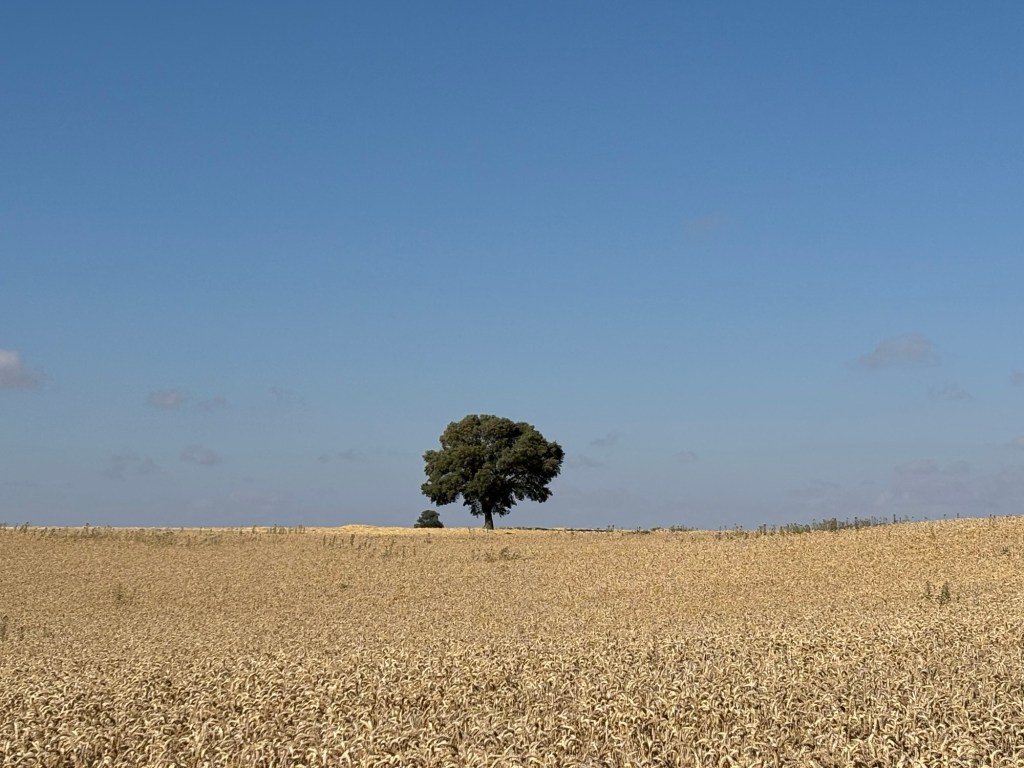

After Rabé de la Calzada, the Camino climbs up one last time and then the Meseta begins in earnest: a vast and unbroken expanse of gold beneath the immensity of the Castilian sky, pushed beyond the reach of man by a thousand generations of Castilian countryfolk.

It is hard to describe the true beauty of the Meseta when so many pilgrims describe it as the “hardest” stage. The “least interesting” stage. The “most boring” or even “the ugliest”. It is certainly true that the spectacular Pyrenean scenery of the first few days is now little more than a distant memory.

But to do so is to ignore the magic of the Meseta. The whistling wind in the golden fields. The gentle throb of the wind turbines on the hills all around. The near total absence of birdsong, interrupted only so often by the twitter of a linnet or the call of a quail. This is a road that can be walked with a companion, but is best walked alone.

For me, this is where the true Camino begins: the road inside, into your head and into your heart, with nothing between you and your thoughts but the sapphire sky.


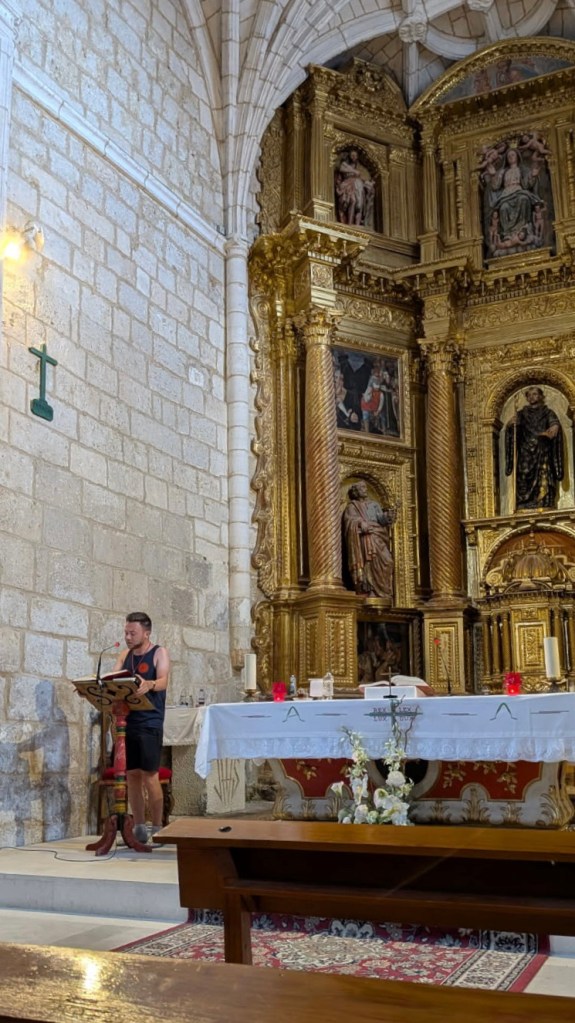
I was going to spend the afternoon writing, but I heard the church bells ringing for the afternoon Mass so I set down my things and wandered over. It wasn’t an especially large gathering, and I was the only Spanish speaker present until a small group of pilgrims from Urgell arrived, so I was called upon by the priest to do the reading. I could certainly have dressed more modestly, even though my options are limited out here, but I wasn’t expecting to be delivering the Lord’s word this afternoon, so… a sports vest, toe socks and Hawaiianas it was.

The reading was from Exodus, 11:10 to 12:14 – by far my favourite book of the Bible. For perhaps the first time in my life, I felt something in that church. It moved me. Not just the sacred words, but… something. Like a voice I could only perceive, that spoke to me without words. For a moment, I felt as though my great-grandparents and my grandfather were right there beside me. It was nearly enough to move me to tears.

When Mass was ended, the priest called us up to the altar for the pilgrim’s blessing. Everyone read the blessing in their own language. I read twice – once in English, once in Spanish. Spanish feels more natural for prayer – after all, if they prayed at all, that’s the language my ancestors would have spoken. And isn’t this all about a closer walk in their footsteps?

I have been on the road for eighteen days now. Twenty, if you count the day and night it took me to reach Oloron-Sainte-Marie and the start of the Camino. It has taken this long to find the spiritual side of the Camino for which my heart has been longing so. I feel more fortunate than ever and my heart is full of hope.

The Meseta stage can be a trial. It can deter many weary pilgrims, especially in the heat of the summer. But I remain convinced that it is where the unspoiled heart of the Camino can be found, in every sense of the word.

The way ahead is clear and my eyes are wide open. I shall follow that road, wherever it may lead, and trust in His plan, whatever that may be. BB x

Camino XIV: Black Eyes

Cafetería La Concha, Grañón. 16.15.

A red sky in the morning is usually a herald of rain. I saw the rising sun for just a fraction of a minute as I left Nájera: a huge blood-red disk, perfectly circular, disappearing almost as soon as it appeared behind a low curtain of cloud that stretched at least as far as Aragón, and perhaps beyond. It’s certainly true that it was a cooler and cloudier morning than most, but whatever promise of rain the sun made it the early hours was forgotten once it was out of sight, like a fickle lover. The clouds have almost entirely disappeared, leaving behind the immense blue heavens for which Spain is so famous.

I’m here in Grañón – ice cream in hand – and it couldn’t have worked out for the better.


I was woken in the night by a pillow to the face. In the half-light I saw the pilgrim on the bunk below standing there. He said something, but it was in German and I was half-asleep, so I neither understood nor recall what he said. I guess I might have been snoring, though that’s not usually a problem these days – but I was on the top bunk, which had no railings, so my sleeping posture probably wasn’t the best last night.

The others – my Camino family, as it were – were all still fast asleep, and their intention was to reach Santo Domingo de la Calzada (the guidebooks do have a strong hand in where pilgrims end up), so I set out alone. I have somewhat mastered the “Irish Exit” strategy, and the Camino lends itself very well to such a move.

The reward for striking out alone was a nightjar – and not just the sound of one, but the sight of one as well. They’re bizarre creatures, nightjars: shaped like a cuckoo, or maybe a small hawk, with an owl-like face, a whispered beak and enormous black eyes. They’re often heard in the places they frequent, but rarely seen due to their nocturnal habits, so it’s remarkable that they should have left such an impression as to have such an intensely evocative name in each language.

In German they’re nachtschwalben – night swallows. In Spanish, chotacabras – goat-suckers (the Italian succiacapre is much the same). The French use the term engoulevent – literally, wind-eater, on account of their hunting habit of flying through the twilight air with their beaks wide open. In English, I can only assume the name is phonic: because the nightjar’s call can only be described as a long, rasping jar or churr, which it can go on producing for hours with seemingly no need to rest.

I only saw it a few times as it moved beneath the forest canopy, with the jerky motion of a child’s toy glider, its wings held high as it manoeuvred dextrously through the trees. But it was enough. I consider that a very good start to the day.


I came this way during the spring a few years ago and I remember needing gloves, it was so cold. There was even frost on the ground. Not so today: the endless green fields of shimmering wheat have since turned to gold, as though by the hand of Midas. With the merciful cover of the clouds, they were not blinding to the eye, so the loss of my sunglasses in Sansol the other day was no concern, though I did buy a new pair in Santo Domingo; it would be nothing short of madness to attempt the ceaseless flat of the Meseta without them (where it sometimes feels like you’re walking on the sky).


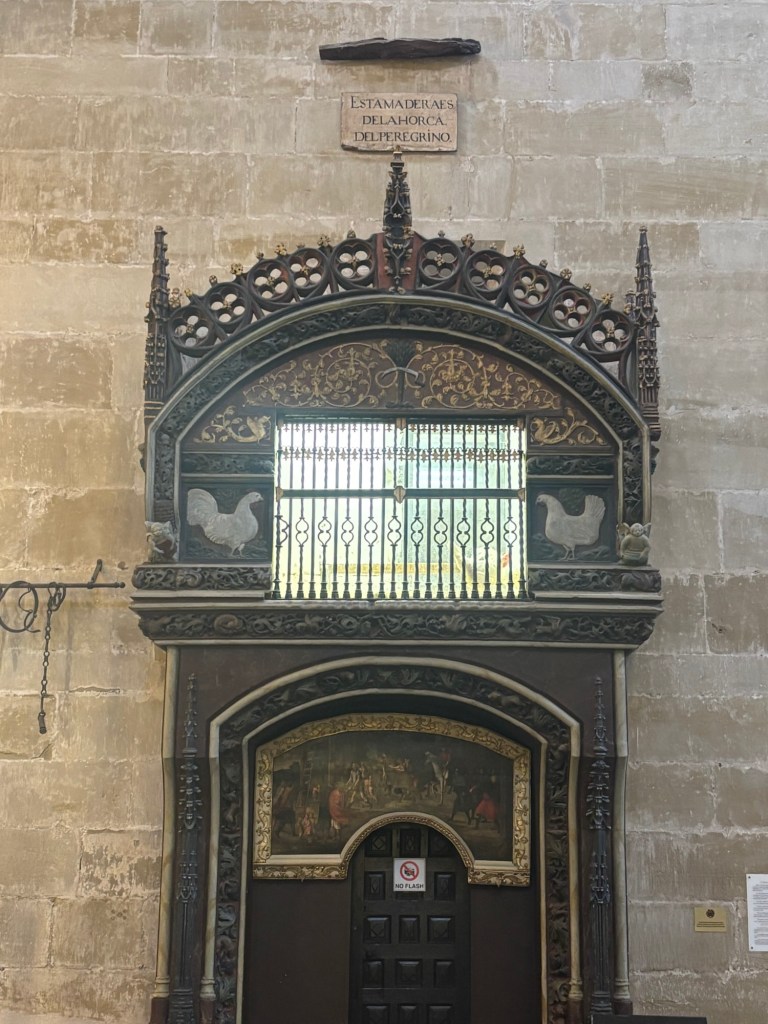
I stopped in Santo Domingo to have the rest of the pâté and bread I bought yesterday as a light lunch. The last time I came here, I was with Mikkel, Lachlan and Sophia and so I never got around to visiting the cathedral, so I made good on that today. Apart from netting me another couple of stamps for the credencial, it also housed a number of treasures that I wanted to investigate – not least of all the famous “resurrected chickens” that feature so prominently in the town’s history.


Santo Domingo de la Calzada, like so many towns along the Camino, was born on the pilgrim road, founded by the same Domingo García who gave the town its name. Its most famous legend tells of the execution of a young German pilgrim who, passing through the town, attracted the attention of the mesonera (innkeeper). After rejecting her amorous advances, the spiteful mesonera concealed a silver cup in the pilgrim’s bag before he left, for which he was accused of theft, sentenced to death and hanged on the spot. When his parents came to identify the body, they found him alive, claiming Santo Domingo had saved him. The sceptical mayor, who was fairly sure that the boy they had hanged the day before had been executed properly, claimed he was as alive as the chicken on his plate – which promptly stood up and crowed, testifying to the truth of the pilgrim’s fate.

Ever since, a pair of the descendants of the resurrected chickens (don’t ask me how they check) have been kept in the cathedral, together with a piece of the scaffold where they hanged – or tried to hang – the innocent pilgrim, all those centuries ago. Go figure.


Santo Domingo’s cathedral, like many in Spain, is full of hidden treasures. I was particularly taken – as always – by the mythical creatures that pop up in the stonemasonry. Harpies, dragons, demons, griffins… for a faith that spent so much time and money driving all traces of paganism from the land, it sure is amusing to see that Spain’s churches are full to the rafters – quite literally – with frozen memories of that dark world.


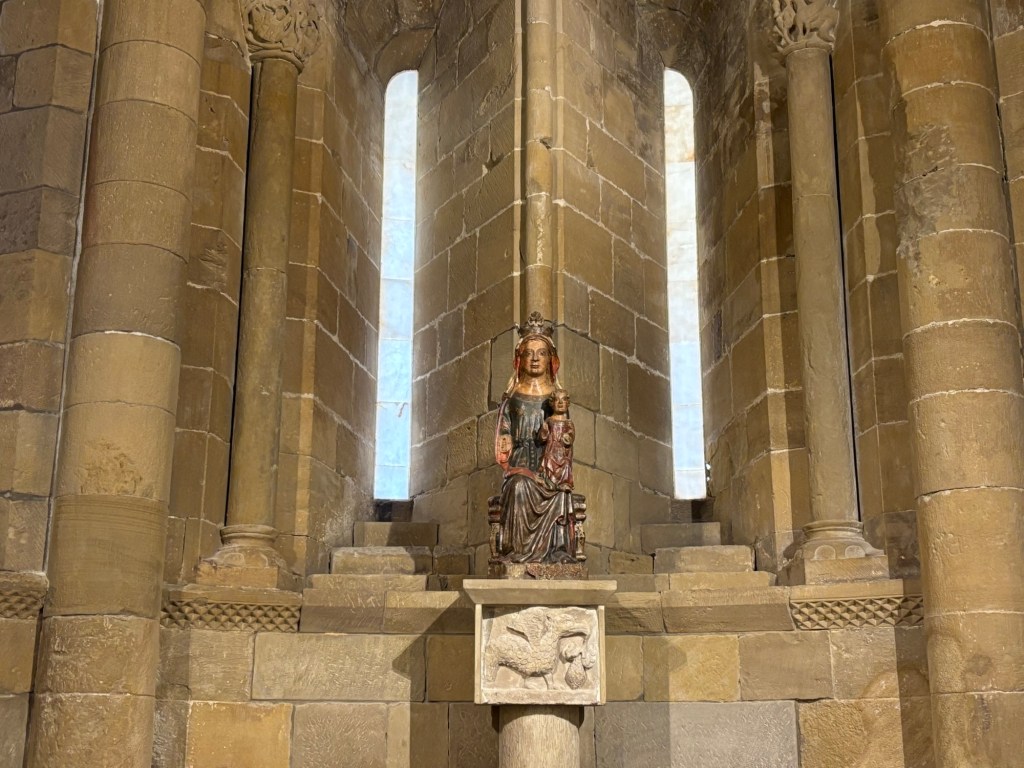
One really stands out, especially after some recent reading. In one alcove, an icon of the Virgin Mary and child stands above the carved image of a griffin – in fact, there’s quite a few griffins watching over the chapel from the surrounding pillars. There’s a deeper poignancy at work here: griffins have been symbols of maternity since their invention over a thousand years ago.


Unlike the other mythological beasts of the ancient world, like centaurs, unicorns and minotaurs – which have a solid grounding in Greek mythology – the griffin seems to spring into existence out of nowhere, but already fully-formed.

Adrienne Mayor has a very convincing theory that the griffin is an unmistakeable reimagining of the protoceratops, a Cretaceous era dinosaur often found protecting its young in the lands where griffins were believed to reside (Central Asia). As stories of such “griffins” reached Europe, they entered our heraldic system, and are often to be found around the Virgin Mary, the single most important symbol of maternity in the Christian faith. A seemingly bizarre pairing – but a perfectly logical one. Two ancient beliefs meeting in the middle.


Under the cathedral, where Santo Domingo is buried, a relatively recent mosaic stares out at you from a thousand shining tiles. The design is modern, but the style is almost Byzantine: teardrop-shaped faces line the wall with huge, almond eyes the colour of midnight.


This is the kind of religious art that I have always found especially compelling. There’s an otherworldliness to it that borders on the mystical, a connection to the faith of those first believers long ago. That’s what I sometimes think the modern church is missing, why so many lose interest: the more it tries to modernise, to catch up to the new generations “on their level”, the more it loses the mystery that made the early church so compelling. I know that for me, at least, it’s that connection to the ancient ways, to tradition, that speaks to me. And I get a piece of that when I see this kind of art, even in imitation. A mirror to the ancient world, when faith was new and hot like a flame.


It’s nearly half past five. I’d better head back to the albergue – I’m on dinner duty. That’s the price for arriving early! BB x

Camino IV: The Dark World

Casa Mamré, Jaca. 20.08

Well, first of all, dinner last night was phenomenal. Heidi, one of our hospitaleros, cooked up an absolute smorgasbord supper, and still under the banner of donativo. I hope the other pilgrims also tipped generously, because it must be really hard to whip up a spread like this without the generous donations of the pilgrims themselves. Remember, donativo doesn’t mean free – pay what you can, and what you feel the place deserves!


I was one of the last to leave this morning, as I was hoping I might score a few more stamps in churches along the way. as a matter of fact, they were all shut – every single one of them – so I needn’t have dawdled. I did only have 19km or so to go today, though, so I was in no hurry.

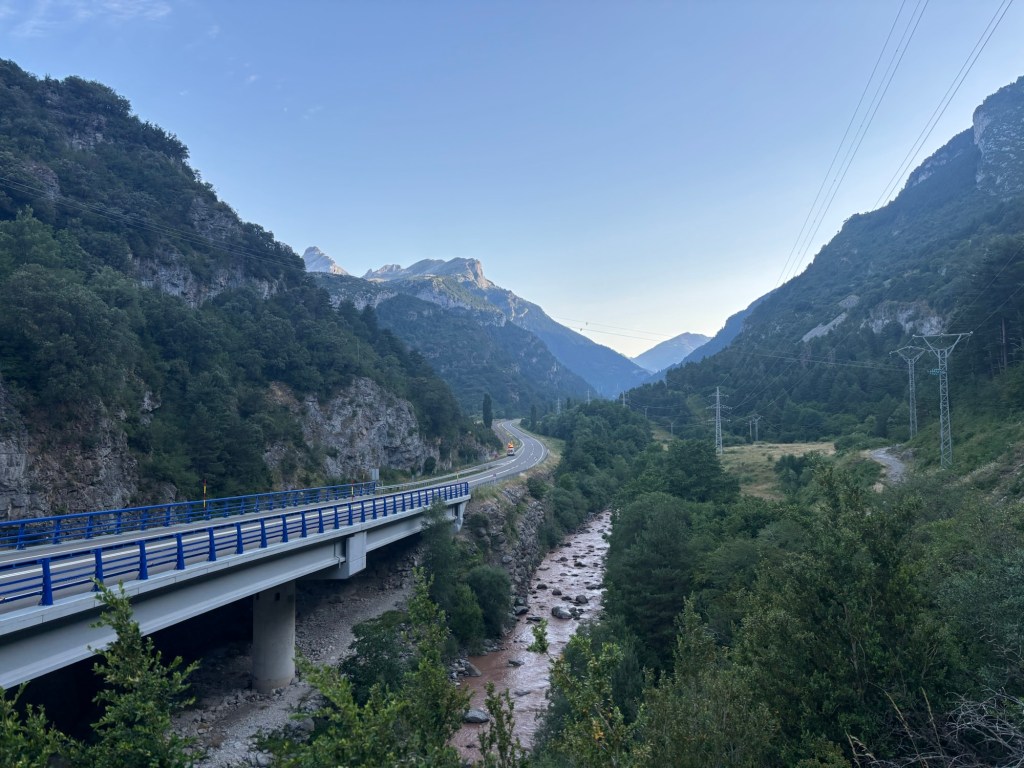
Leaving Canfranc behind, the Camino follows the river through the Valle de Aragón all morning, only turning away for the ascent to Jaca at the end of the road. What was only a mountain stream yesterday is already a powerfully flowing river, carving an impressive series of gorges in the granite along its course.


The next town along is Villanúa, where you are confronted with a strange sculpture in the shape of a many-limbed tree stump. On closer inspection, it’s actually an abstract representation of the women of Aragón who were persecuted for the crime of witchcraft during the Middle Ages. A single face carved into the structure drives the message home. There used to be a rope hanging from one of the branches, in a nod to one of the favoured methods of execution of witches, but it looks like that was removed.


During the Middle Ages, Aragón was knee-deep in tales of witchcraft. The Inquisition tasked itself with purging the region of heretics – a very broad umbrella that encompassed Protestants and “Judaizers” as well as witches – but such was the strength of belief in the occult in this remote and mountainous corner of Spain that witchcraft remained a talking point until as late as the 19th century, as can be seen in the pinturas negras of the Aragonese painter, Francisco de Goya.

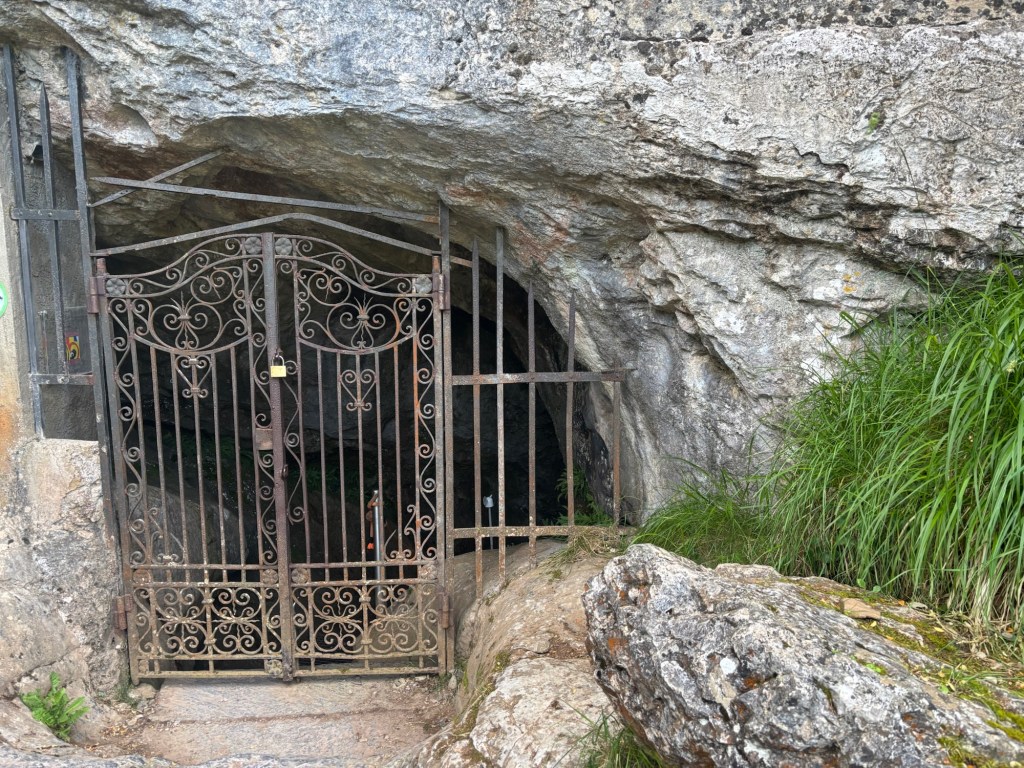
The reason Villanúa comes into this can be found just off the Camino a hundred metres or so before entering the town. A series of steps cut into the rock lead up to a cave, accessible only via a guided tour. You can feel the chill of it as you climb towards it, and while there are plenty of perfectly reasonable scientific explanations for the drop in temperature near a cave mouth, it’s easy to see why such a place might have instilled a sense of fear in the ancients. The steps go deep, and in its heart is a large cavern lit by a great hole in the ceiling. It is believed that this was where the witches of Villanúa came to practice their akelarres – Witches’ Sabbaths – summoning evil spirits and bathing naked in the moonlight.

Of course, it’s just as likely that most (if not all) of those accused of witchcraft in the Middle Ages were completely innocent. Some local pedant seems to think so, anyway, adding a footnote to the information, claiming the accused were “too busy being burned and hanged by the misogynists of their time” (#romantizandomasacres).

It may well be true, even if it does take away from the mystery, but it’s worth bearing in mind that curanderos – folk healers – were frequently called upon throughout the Medieval period, especially in times of environmental stress. It’s plausible that some of the so-called witches really were trying to bring about some kind of change in their own way.

For me, it’s never been about their innocence. Whether or not they were witches is of no consequence (though I’d rather believe they were). The real demons of the story are the ones who were so strangled by their own fear that they saw fit to send these unfortunate souls to their deaths.

Either way, peregrino, if you feel a chill on your approach to Villanúa, it might just be the lingering malice of the Cueva de las Güixas on your left.


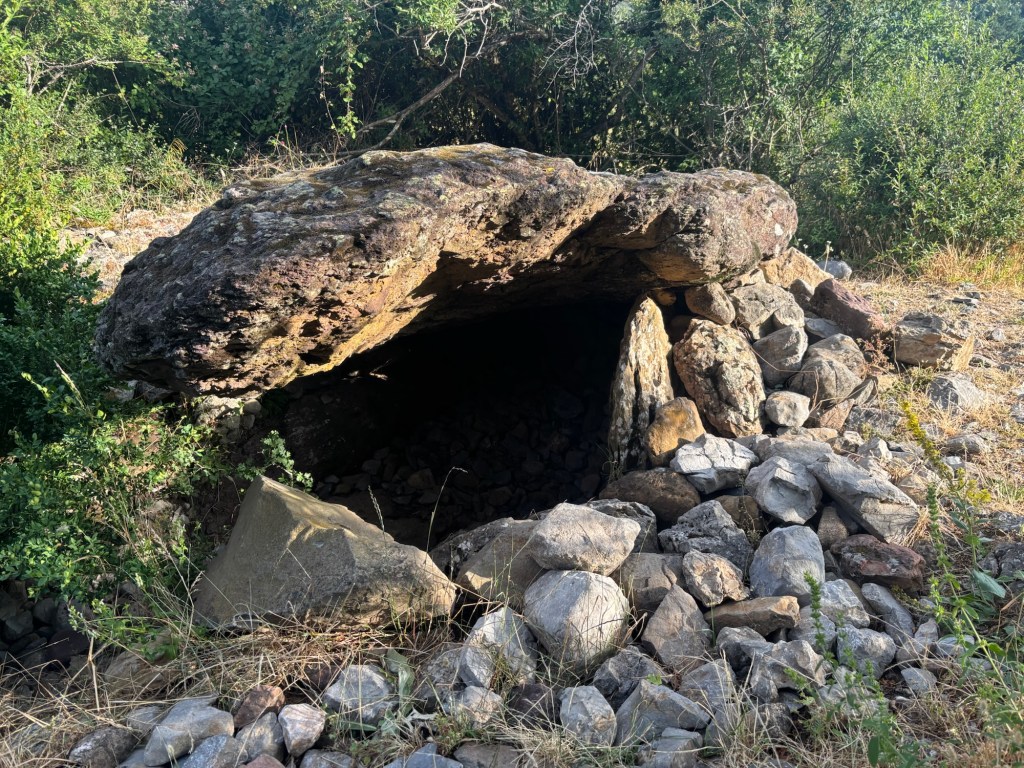
I had to double-back today, not because I’d forgotten something, but because I’d missed something rather special. The boulder-strewn fields before Villanúa harbour more than just witches’ grottos. There are older and more mystical relics by far, though I’d wager the average pilgrim completely passes them by, fatigued as they are from their three-hour climb down from the mountains.

It’s a dolmen – an ancient burial site from the Stone Age. There are quite a few of these in the area – large stones (or megaliths) being plentiful in the Pyrenean basin – but at least one can be visited from the Camino without too much effort. Dolmens like these can be found all over Europe, from the islands of the Mediterranean to northwestern France and Britain. In a way, they are just as much a symbol of the Camino as the yellow arrows, since they mark the westward expansion of our earliest ancestors as they moved west across Europe, until they could go no further.


The remaining fifteen kilometres or so to Jaca are easy to follow, if a little rocky underfoot. I’d spent so much time exploring the caves, dolmens and ruins of long-abandoned villages that I now had quite a long march beneath the risen sun, and my feet were definitely starting to complain after yesterday’s exertions. So, for once, I plugged in and listening to an audiobook – William Golding’s The Inheritors – as a way to push on. I hoped I might pop in on a few churches along the way, but as I suspected, they were all shut, so I got to Jaca by midday without further delay. Mariano, the musical madrileño from the albergue in Canfranc, had got there just before me, but we still had a little wait before the dueña showed up to let us in.


I bought lunch for myself and Mariano (I’ve had an easy ride with others treating me so far, and it’s only fair to share), before giving myself an hour or so to explore Jaca. The cathedral is austere but impressive, as Spanish churches often are, but its real treasures were in its Diocesan museum. At 3€ for pilgrims – with a stamp for the credencial thrown in – it’s a steal, especially when you see what it contains.


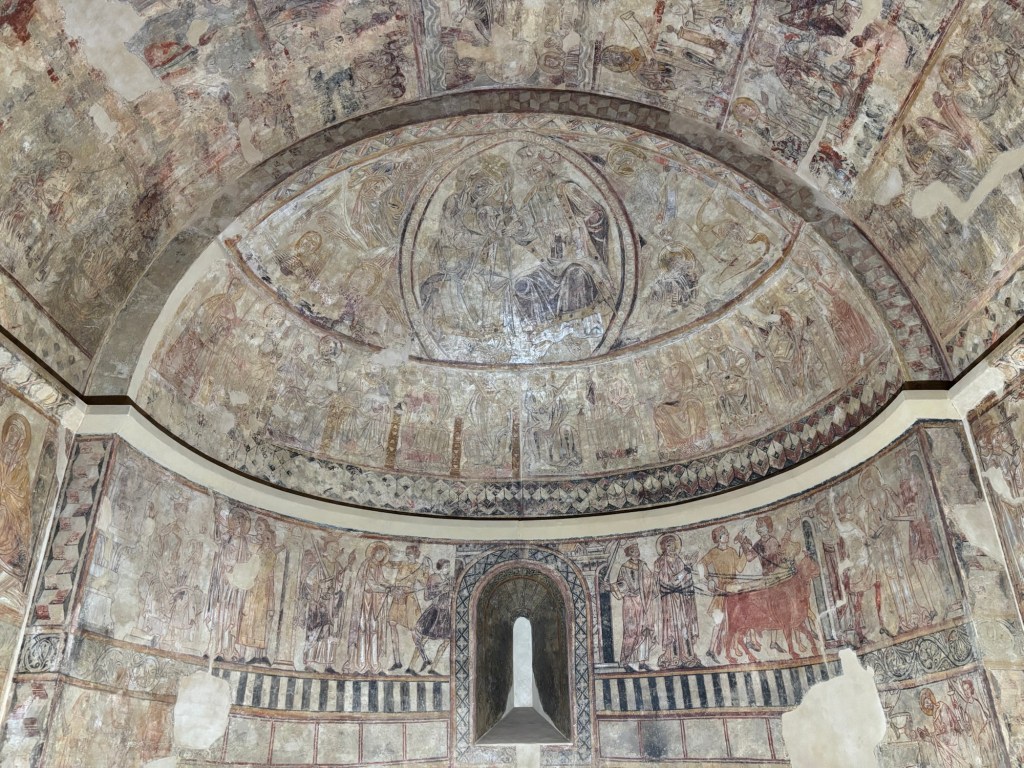
These Halls of Stories are bewitching beautiful, recreating scenes from the Bible for the illiterate masses while the holy words were kept in the jealously guarded secret language of the elite, Latin. I’m not normally one for religious art – the Renaissance obsession with ecstasy in its subjects is a major turn-off for me – but anything Gothic or earlier and I’m all in. The world was a darker and more mysterious place back then – and doesn’t that make it so much more interesting?


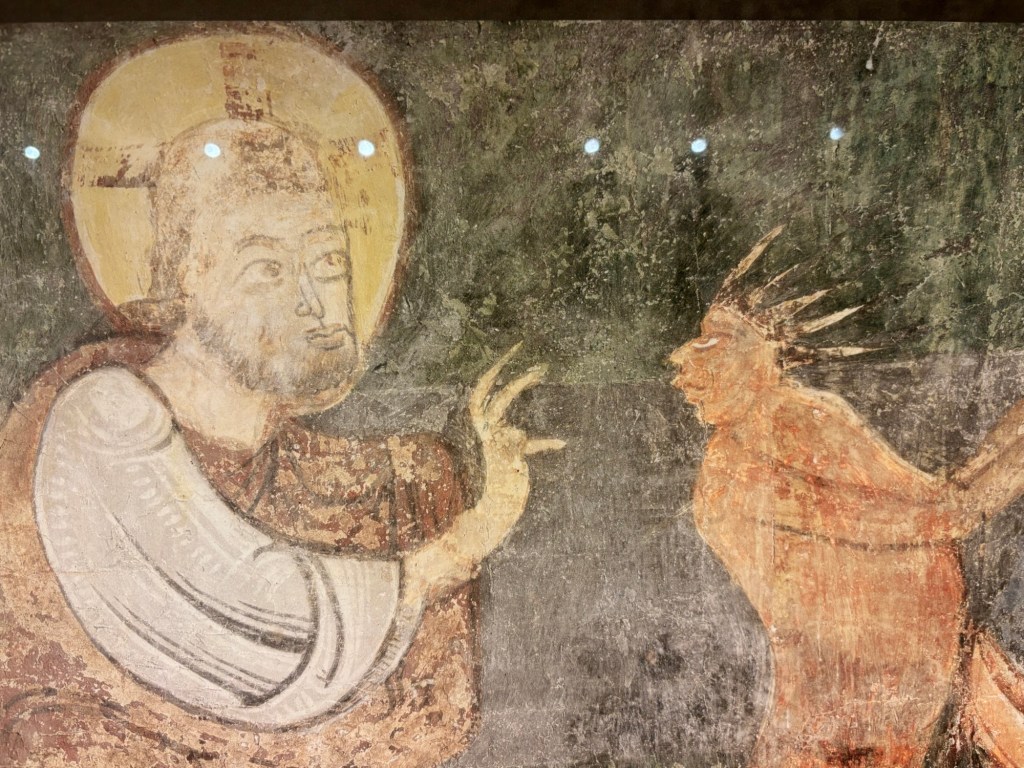
Latterly, I’ve become a lot more interested in ancient depictions of monsters, and the Devil definitely falls into that bracket. It took me a little while to realise the crowned imp in the image above – a detail from the mural of Bagüés – is a representation of Satan. I wonder what their reference was? With the red skin, narrow eyes and the feather-like crown, he almost looks like a Taino Indian, but that would be anachronistic in the extreme – these paintings were created four hundred years before Columbus sailed to the Americas.

Are there elements of Pan, the pagan god of the wilderness? It’s no secret that the goat-legged minor deity had a huge impact on the Christian devil, with the early Christian scholar Eusebius of Caesarea claiming the two were one and the same in the 4th century. Pan represented all that Christianity sought to suppress: vice, sin and animal instincts, crystallised in Pan’s half-beast limbs.

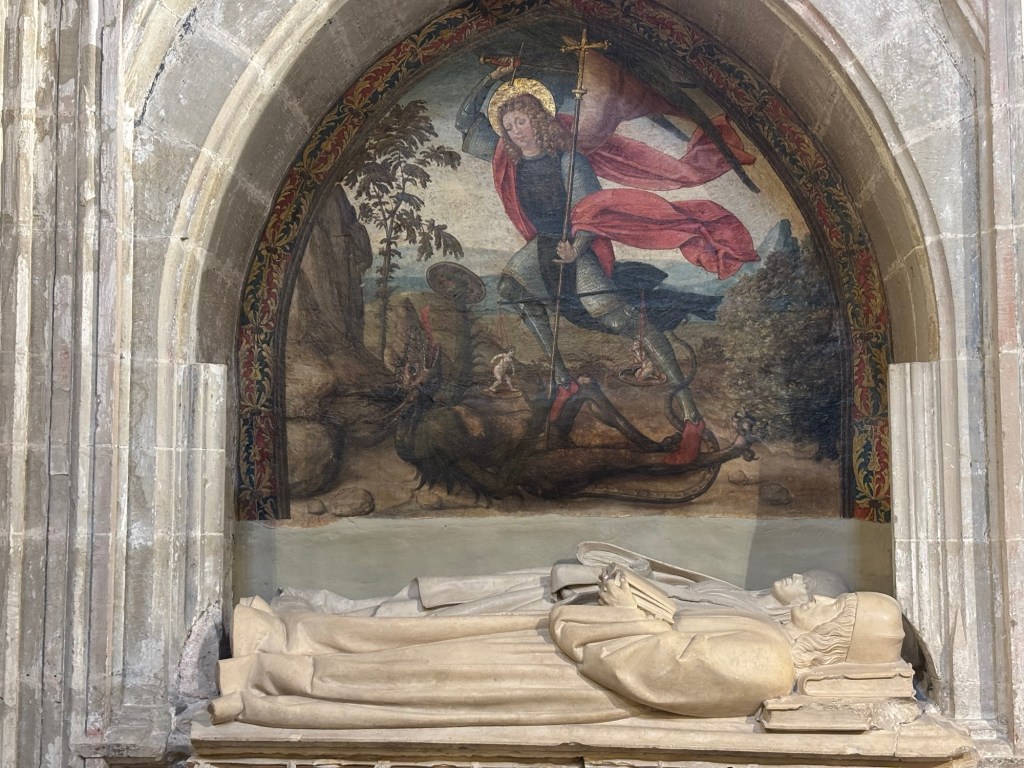
It’s not always goats, either. Traditional depictions of the devil often feature scaly or bird-like legs, akin to a chicken or a hawk. Most paintings of Saint Michael feature the Archangel standing triumphant over the body of a demon, and it’s easy to see the inspiration in these paintings: pigs’ ears for greed, scaly skin for the deception of the serpent, and thick, knotted talons for the eagle, one of the most feared and respected predators of the ancient world (if you’re not convinced, just look at how many world flags feature an eagle).


The references are much clearer here, but what of the Red Devil from the Bagüés mural? He has neither the goatee beard nor the cloven hooves. Who was the artist’s muse? Perhaps we’ll never know.


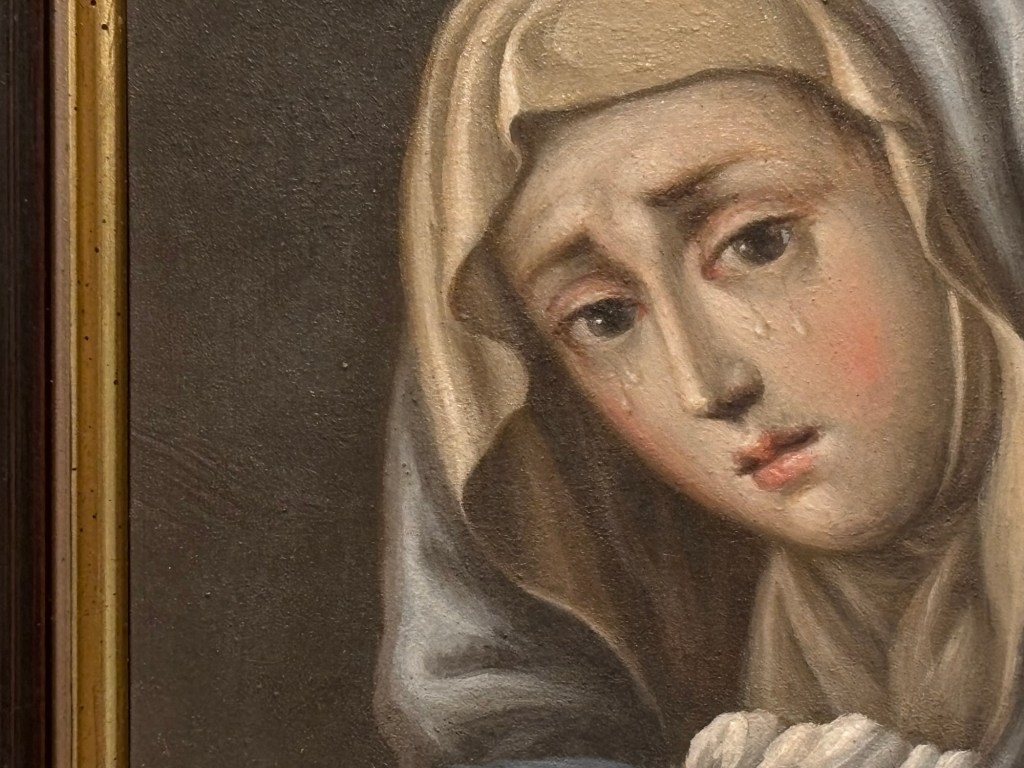
As I worked my way round the exhibit to the exit, a solitary face caught my attention. Or rather, a pair of eyes. Amid a wall of depictions of a saintly and contented Mary – Inmaculada, Asunción, Madre de Diós – a little painting of Dolorosa follows you with its eyes, which are bloodshot and full of tears. Her Son, arrested by the religious authorities and sentenced to death for the crime of working miracles, was crucified before a baying crowd.

Over a thousand years later, the same story played out again and again across Europe, only now it was done in Christ’s name. There must have been a thousand Marys who watched their sons and daughters befall a similar fate. And still it plays on.

Critics may say the Catholic Church puts far too much emphasis on the doom, gloom and damnation, but there is wisdom in the Catholic acknowledgement of the darkness. We might have been created in God’s image, but that does not make us perfect, and history tells us that some of us stray very far from the path when we try to be perfect.

Mary’s grief is eternal: it ripples across time.


Wow, that got pretty heavy. Check back in tomorrow for some more light-hearted adventures across Aragón! BB x

Smoke Signals

Aeropuerto De Santiago – Rosalía De Castro. 14.40.

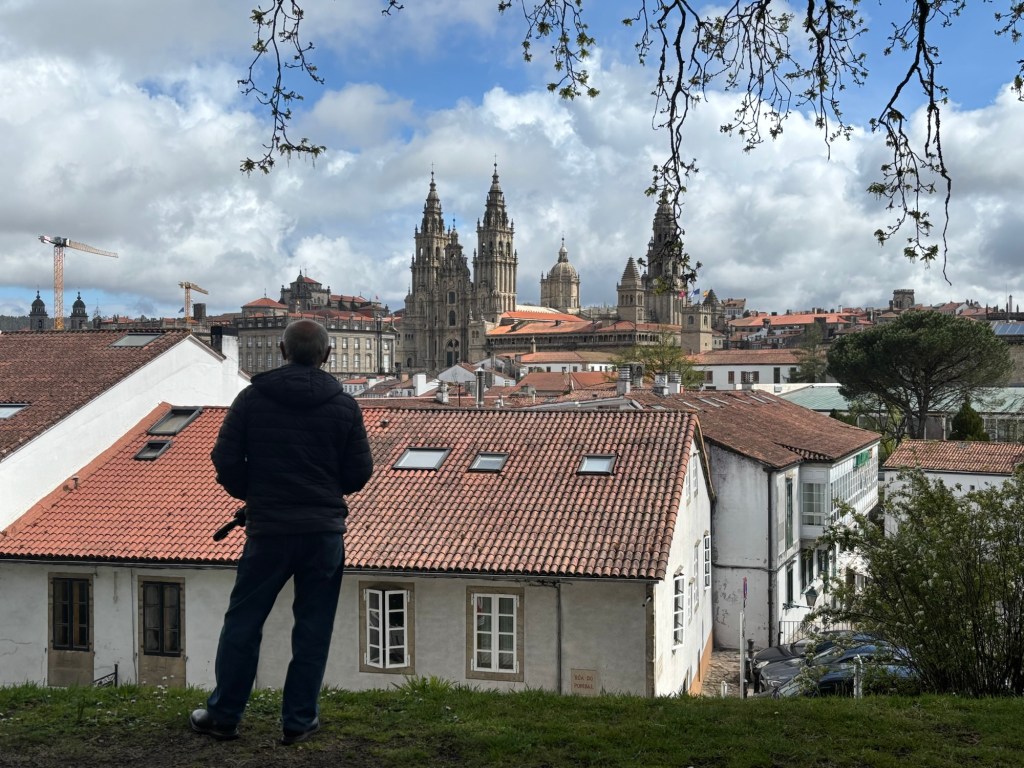
I’m back at Santiago’s very small, very civilised airport. It’s another five hours until my flight, but Galician weather is highly unpredictable and I didn’t fancy making the three-hour hike to the airport under a belt of rain clouds, so I forked out a euro and caught the bus instead. On the plus side, it gives me plenty of time to read and rest – tomorrow will involve no small amount of walking, so it’s best I don’t wear out my feet just yet.

There’s a WHSmith in the departures lounge. I wonder how much longer that outpost is for this world, and others scattered in airports across the world, now that the dependable newsagents is going under, just like Woolworths before it.


I only just made it to the 19.30 pilgrim Mass in the cathedral of Santiago last night – it took me a little longer than I anticipated to track down the books I was looking for. There was a queue outside the door, and when I was a few metres from the great doors, an attendant in a high-vis orange jacket announced that visits were now over for the day – unless, of course, we were queuing for the Mass. That thinned some of the line, but even so, it was standing room only this time… not the front row seats I enjoyed at the end of the Camino in 2023.

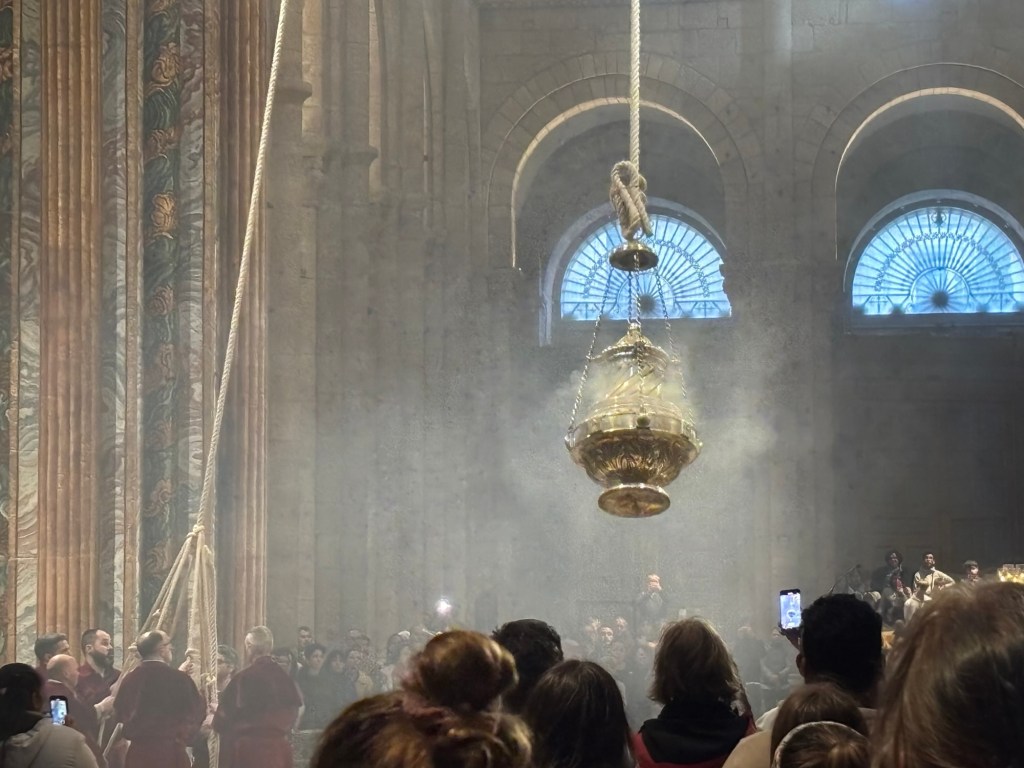
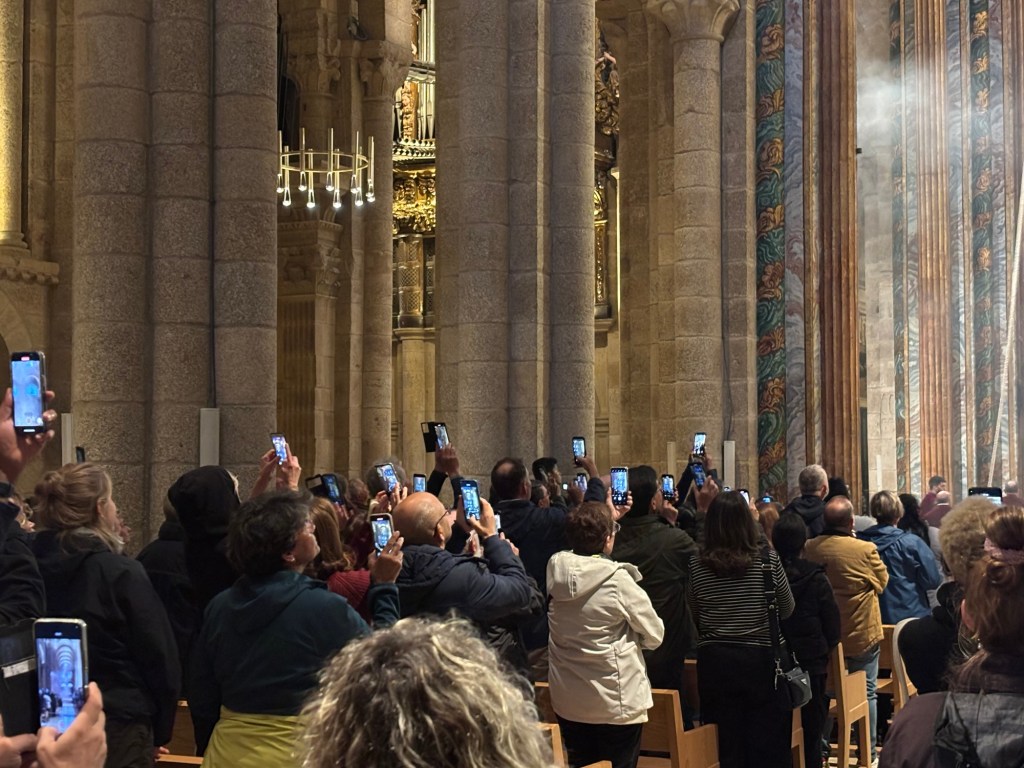
The reason for the crush became apparent in the last few minutes of the Mass, when a group of eight priests in burgundy cassocks approached the enormous knotted rope securing the botafumeiro, Santiago’s famously huge incense burner and, with one collective tug, began to hoist the thing into the air.


Weighing in at 80kg and measuring an impressive 1.93m in height, the botafumeiro of Santiago is one of the largest in the world, outsized only by the Christendom College censer in Virginia (because of course the Americans, not satisfied with an imitation, had to have a bigger one). Unlike its American cousin, however, the botafumeiro is more than just a showpiece. The reason for its size was to purify the air within the cathedral and thus cover up the smell of the pilgrims, who must have stunk to high heaven in the centuries before Jacotrans, Booking.com and Compede blister plasters.

The botafumeiro you see today has been in use since 1851. The original, a 15th century thurible of solid silver, was stolen by French troops in the Spanish War of Independence and supposedly melted down for coinage. This and other acts of vandalism marked the French occupation, which saw many monasteries and Roman bridges destroyed in the name of military strategy. A local legend holds that the Alhambra was nearly blown to pieces on Napoleon’s orders as the French lost their grip on Spain, spared only by the efforts of a single French soldier who had a change of heart and stayed behind to defuse the charges, saving the last remaining medieval Islamic palace in the world from being lost forever.


The botafumeiro swings alarmingly low over the heads of the faithful, reaching a top speed of 68km per hour, though never low enough to catch the heads of even the tallest German pilgrims. It’s quite a special sight, because its presence isn’t guaranteed: it’s usually only brought out on holy days, such as Easter Sunday or the Feast of Santiago on the 25th July. I missed it last time as I set out for the coast on the 25th, hoping to beat the crowds that would follow.

There is a small chance, however, that your visit may coincide with the whim of this or that religious order (or wealthy pilgrim), who can pay a certain amount of money to have the censer brought out especially for their arrival. This time I got lucky: a confraternity had traveled all the way from Goa to celebrate Mass in Santiago, so the botafumeiro was brought out. Lucky me!


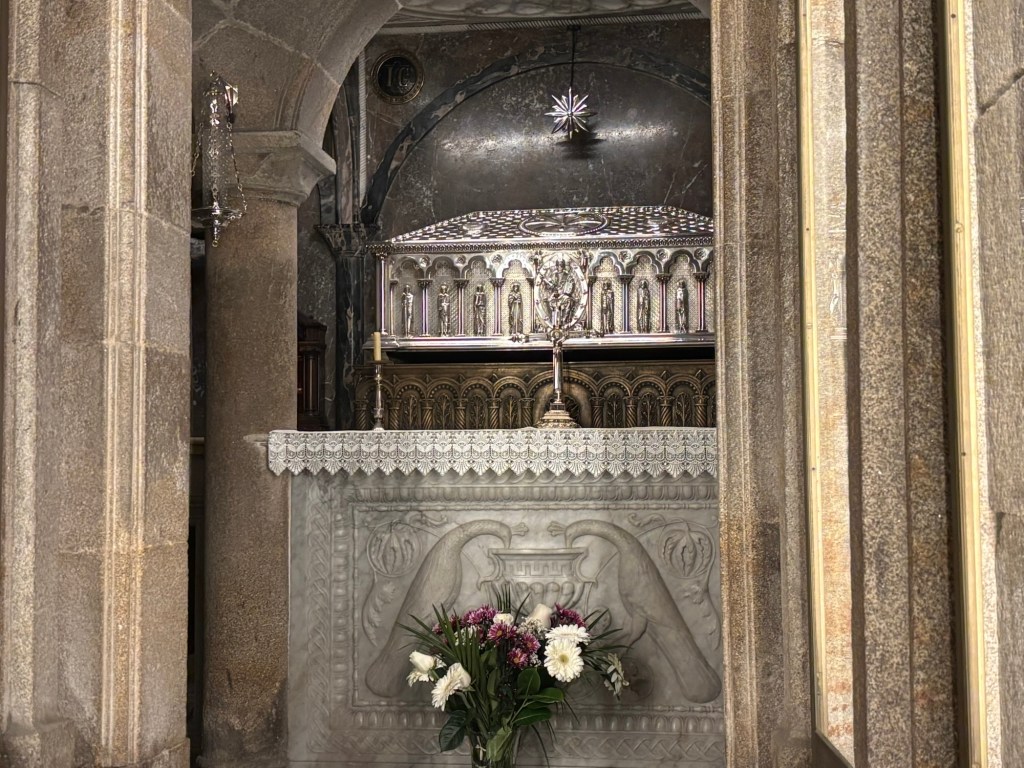
After three visits to the cathedral without paying my respects to the true purpose of the Camino, I decided to make one last trip to see the tomb of Santiago himself. The first of Christ’s apostles to be martyred for his faith, Santiago el Mayor (or Saint James the Greater, if you prefer) was beheaded on the orders of Herod Agrippa. His head was buried near the spot where he was killed (now beneath the Armenian Cathedral of Saint James in Jerusalem) but his body is believed to have been transported to the Galician coast, where his remains were discovered – as they so often are – by a hermit in the woods, who saw a great light shining upon a forgotten Roman tomb.

The veracity of the legend is irrelevant: word got around and soon the final resting place of Santiago had become the most important pilgrimage site in all of Christendom. That it just so happened to coincide with a time when the Christian kingdoms in the north were desperately seeking a rallying flag to counter the Muslim forces who had taken the Iberian peninsula by storm (and the angels believe to aid them in battle) is curious, to say the least.

Santiago’s tomb is a small silver coffin, located in a crypt beneath the central altar. The eighty-strong Portuguese school trip group that I had fallen behind weren’t all that interested in the bones of Jesus’ most faithful apostle, busying themselves repeating lines from Portuguese trap songs and stealing kisses from their girlfriends in the shadows, so I had plenty of time to stop and admire the coffin undisturbed.


I was lucky to get in when I did: by the time I left via the north door, the queue to get in stretched for nearly two hundred metres around the side of the cathedral. Pro tip: get in early, or just after Mass, when the queues are at their thinnest!


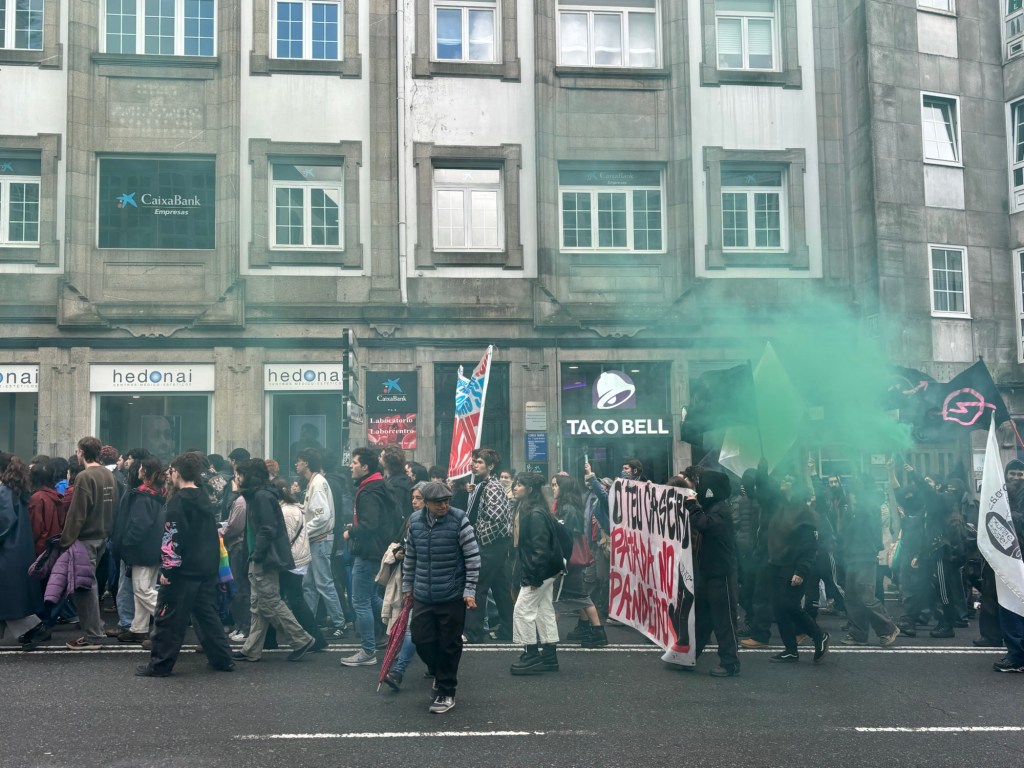
I had a quick bocadillo lunch in the old town and packed my things, thinking to spend a few sunny hours in the Parque de Alameda, but I was distracted en route by the sound of shouts and firecrackers. Doubling back, I found an advance guard of local police cordoning off the Avenida de Xoán Carlos I, and behind them, an enormous crowd of youths dressed mostly in black, carrying flags, placards and loudhalers.

I could have guessed what they were going to be protesting about, and my guess would have been on the money – after all, it’s a sore tooth Spain has been nursing for several years now: the housing crisis.


The short explanation? Spain’s housing market is a shambles. By some estimates, the cost of renting a property has gone up by 78% in the last decade, driven by rampant speculation and unrestricted vulture funds. Put simply, the average Spaniard now finds it very difficult (if not impossible) to find an affordable place to live, especially in the areas most popular with tourists. This is a country where flat-sharing websites like Idealista and Easypiso hold sway: AirBnB and its kin have made Spain a tough place to buy.

This has been most keenly felt in Barcelona and the Balearics, where many properties are vacant for large parts of the year, occupied only during the summer months by foreign investors. It’s one of a number of factors forcing Spaniards to live at home with their parents well into their twenties (or even thirties), and driving others to seek their fortune elsewhere. It’s also why I’m making a point of staying in pensiones wherever I go – a far older and more sustainable method of supporting the local economy as I travel.


There’s an even more sinister side-effect of the housing crisis in cities like Barcelona. I’m referring to the okupas, or the occupation of properties by gangs and other drug-related agencies who turn vacant holiday homes into drug dens, known here as narcopisos. The shady legal status of squatters in Spain, which makes it very hard to evict without the proper authority, doesn’t help matters at all.

Yes, A Place in the Sun and your kind – this is partly your fault. By encouraging the buying and selling (and re-selling) of property along the coast, you are driving the locals out of town faster than the local wildlife was displaced before them.


Naturally, it’s Spain’s youth who are taking the brunt of this crisis – and so, quite naturally, they’re the ones taking to the streets in large numbers to complain about it. Pedro Sánchez, Spain’s Prime Minister, has attempted to address the problem by proposing a ban or even a supertax on foreign buyers, but in the regions that depend the most on tourist dollars like Andalucía and the Costa Brava, that will be a very bitter pill to swallow. So, for now, Spain will have to muddle through these murky waters until a more universal solution can be found.


The protesters marched on up the avenue, followed closely by the police and their van, carrying their riot helmets at their hips. Some of the protesters threw petards into the road as they passed. Others lit flares. I watched them go and returned to the park.

Similar protests are taking place all across Spain today. I wonder if it will come to a head? It’s hard to say, but it is fascinating to be here on the ground while it’s all going down. It isn’t often that you get to live through history in the making, especially when it’s something you teach (manifestaciones is one of the tried-and-true A Level Spanish topics).

This. This is why I travel.


The smoking incense of Santiago’s botafumeiro was meant to cover up the stink of something rotten. Seeing the smoking flares of the protesters as the police escort them through the city, I can’t help but note the connection.

I’ll keep you posted if I hear or see anything else. I trust this isn’t the last we’ll hear of it. BB x
Camino XIX: Over the Border

Well, here I am in Galicia, just about the only part of Spain that isn’t suffering the ferocious heatwave that is sweeping across Europe right now. With temperatures soaring into the 40s in a red wave from Madrid to the south, I’m more grateful than ever for the merciful Atlantic winds that keep Galicia fresh and green. Santiago certainly picked his spot with Spanish summers in mind…


I didn’t sleep much last night, though I must have dreamed a fair amount. I’m pretty good at waking myself up on command, because I knew I needed to be up in time to charge my phone (the sockets were all in use when I got back last night) and lo and behold I was up without provocation at two in the morning.

I’m already used to functioning on less sleep than is healthy from my work in a boarding school, so when five thirty came around I was already on the road. The vending machine gobbled up my euro and gave me a self-satisfied LISTO! when all it gave me was a plastic cup and a deceptive whirr that most definitely did not produce any hot chocolate… but, serves me right for using a vending machine.

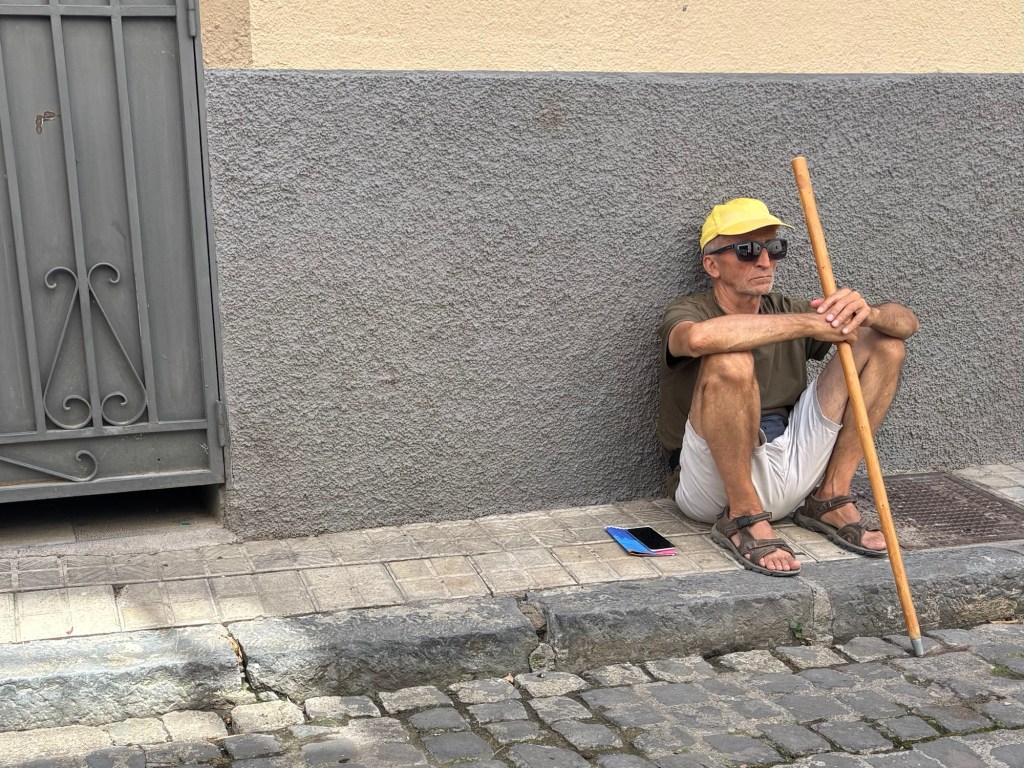
I was sorely tempted to join the less than 1% of pilgrims who take the Dragonte route up through the mountains this morning, but as yesterday was a Sunday, I hadn’t been able to buy supplies, so I chose caution over valour and took the basic route. If I’d had my faithful stick I might have chanced it, but… it is what it is.

I did, at least, have the sense to stop for breakfast at a bar in Trabadelo, where the tortilla was decent, the napolitana was delicious and the Cola Cao was divine.


I’ll say this much, it might be the basic option, but it’s a lot better a route than it looks. On a map it seems to follow a road almost all day, which it does, but with the construction of the A-6 Noreste motorway, pretty much all the traffic took the high road, leaving the Camino almost devoid of cars. And since even the sight of a car at the moment makes me think of the intensive course that may or may not be coming my way when I get back (it’s proving hard to find an instructor who’s free), that was some relief!


The Valcarce river flows alongside the Camino for most of the route, providing a gurgling backdrop to the walk. I kept my eyes open for otters, which are sometimes seen in the river, but I didn’t see any. I did see the other thing I was looking for though: a dipper, just as I left the road at Las Herrerías. The characterful little things are a feature of most highland rivers in Spain, if you keep an eye out for them.

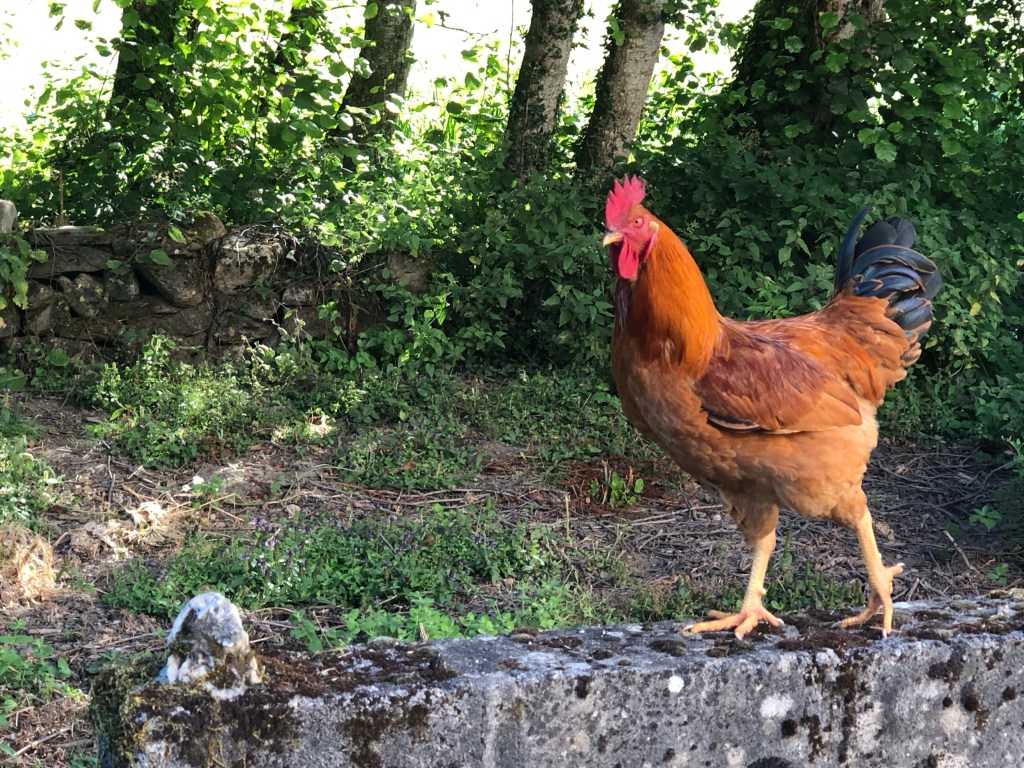
It wasn’t easy to catch on camera, but I found considerably more willing subjects in a gang of long-legged Spanish chickens further up the road. The way they were going, they looked as though they might have been making the pilgrimage themselves! Though I was briskly disillusioned when the rooster started sizing himself up to me, squaring off like a boxer in a title fight. Feeling a hard pass on letting him test his spurs on me was a good move, I left them be.


After the picturesque village of Las Herrerías, the real challenge begins. A 600m climb and then some stands between you and O Cebreiro, the first town beyond the border, and boy are the first few hundred metres a challenge. Thank God I played it safe this morning and took the easy route! It’s a beautifully forested climb, but a climb all the same…


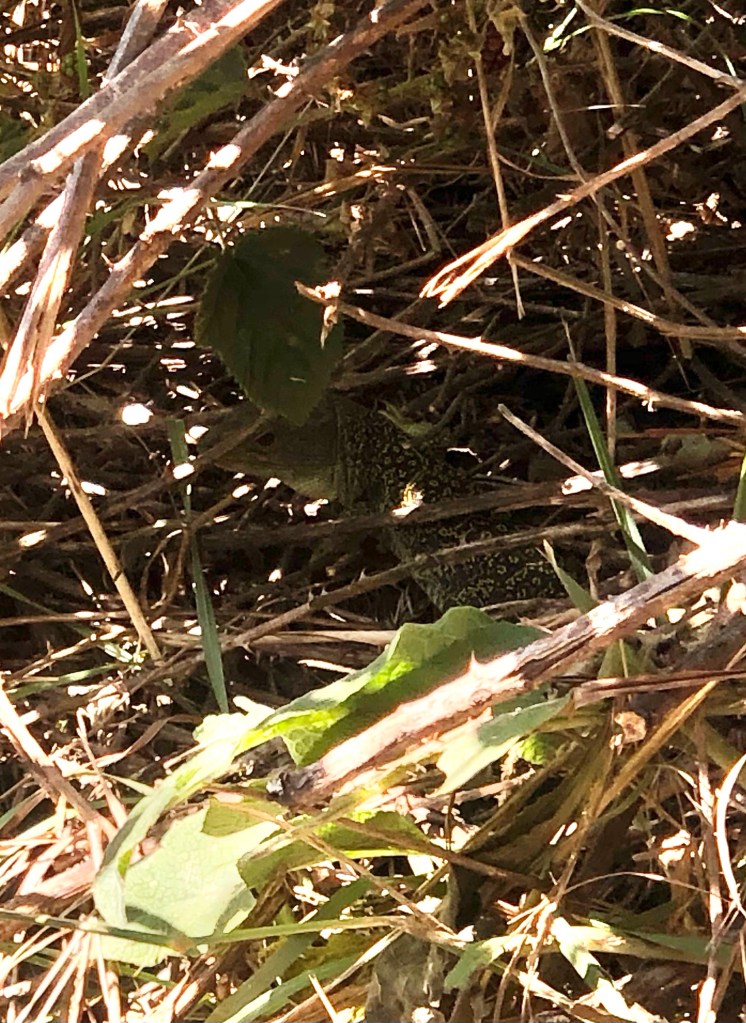
After La Faba (where the fountain water is so deliciously cold that my bottled water needed jettisoning immediately) the Camino climbs ever higher through one last stretch of forest and then up into the sunlit highlands of Castilla y León’s final outpost. I must have gone on ahead of the others, because I only passed a few intrepid pilgrims up here. It might not have been heatwave material, but the sun was high up by this point and the lizards were out, including the giant green occelated kind that used to fascinate me as a kid. Most of them were well under cover before I saw them go, but one lingered long enough for me to see where it was hiding. Can you see it?


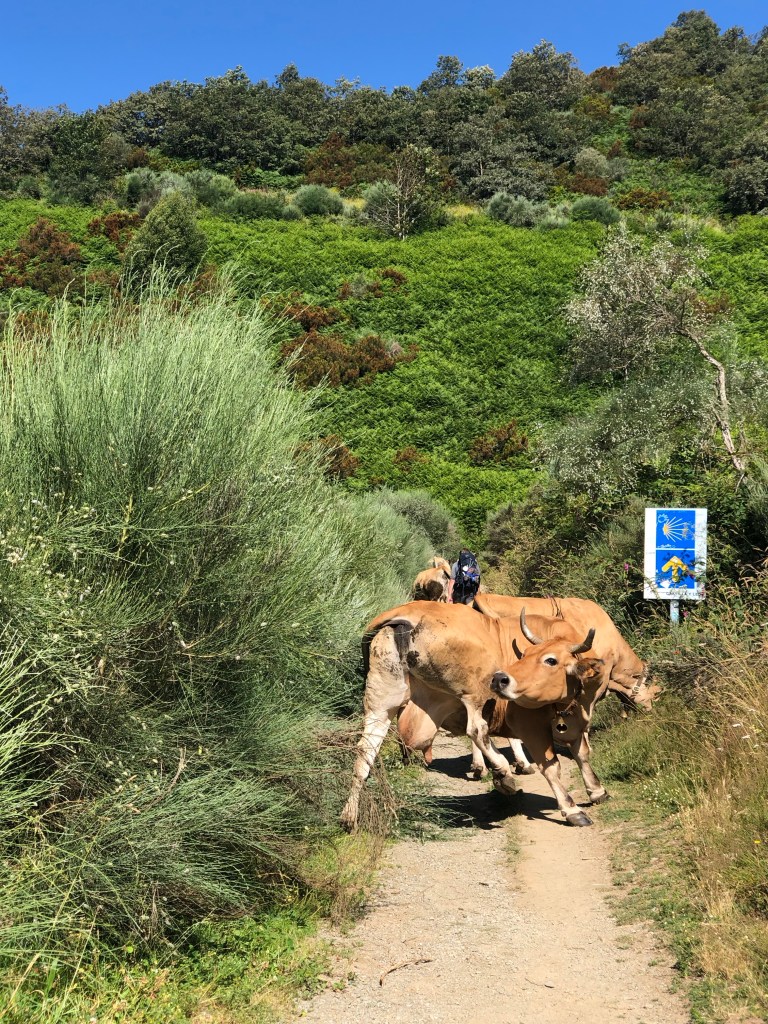
La Laguna was little more than a cluster of farm buildings, and after that it’s only a few more hundred metres up to the border. I did have one unexpected roadblock in the form of a wayward herd of cows, whose youthful cowherd was desperately trying to coax away from the path. The cows had other ideas, and it took a few minutes to get by.


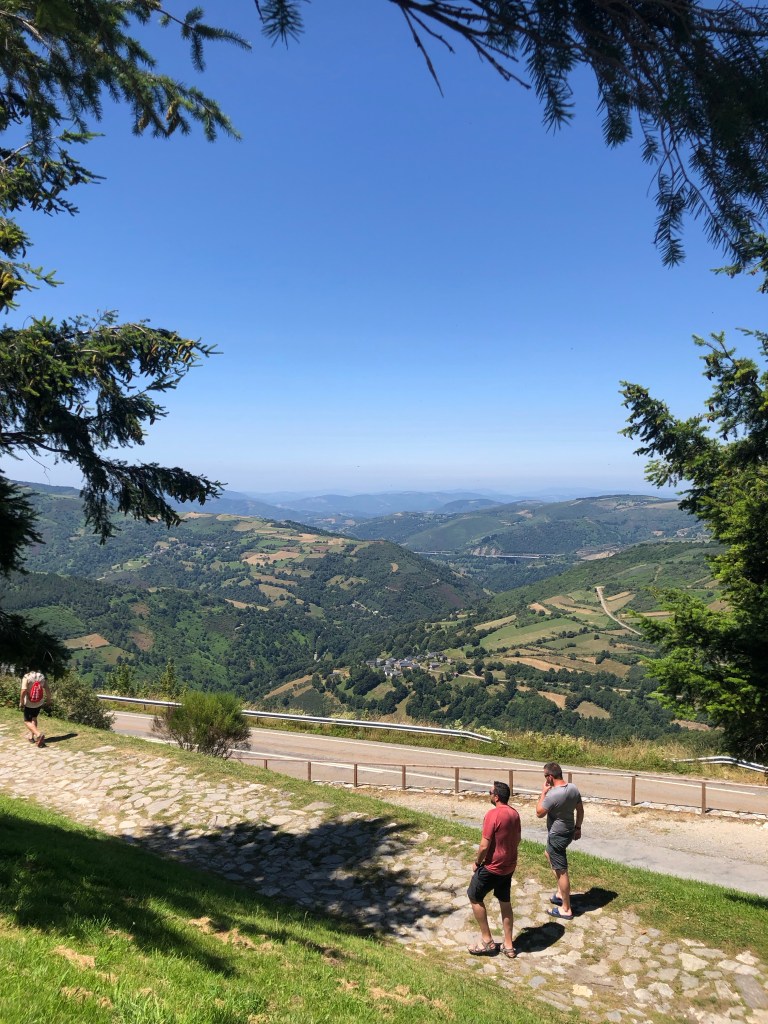
A colourful stone statue marks the border. Now I’ve set foot here in Galicia, there are only two comunidades autónomas left in Spain which I haven’t explored: Murcia and the Canary Islands (assuming one doesn’t count the Moroccan enclaves of Ceuta and Melilla). I almost stepped on a stoat that shot out of the verge on the final climb up to O Cebreiro, and while it was much too fast for a photo, the views from the top of the mountain absolutely screamed for one – or several.


I managed to beat Google’s initial suggestion by forty-five minutes, but since the albergue didn’t open until one, I had a sitting nap and waited – my feet were just dead.

I had lunch with a random assortment of new pilgrims, mostly Americans, in a hotel-restaurant-giftshop affair. How to put it politely… I’ve had more tolerant company for lunch. Most of the Americans I’ve met abroad have been the most refreshingly open-minded and charismatic characters I can recall. This bunch were memorable only for their moans. Two of them were off on one for the full hour about how rude the Spanish are, slating the food, the service and the hostaleras, all while unironically claiming their status as Americans entitled them to fair treatment.

I excused myself to go to the bathroom. I paid my fare and apologised to the chef. I did not go back.

Fortunately, my faith in America was restored by the welcome return of a meseta pilgrim, Simas. A chat over a half pint with another open-minded pilgrim was just what the doctor ordered. Bumping into two more Catholic Americans while paying the bill was an added bonus.

Mass in O Cebreiro’s 6th century church was really special. The priest spoke from the heart, juggling several languages throughout, and blessed us all with holy water and words of power. At the pilgrim’s benediction at the end, I volunteered to read the closing prayer when an English speaker was required. Perhaps I just wanted to read a prayer for my fellow pilgrims, or perhaps it was a subconscious dig at the fact that, Americans aside, there was only one inglés in the room. (If that was it, God, please forgive me that little victory!)

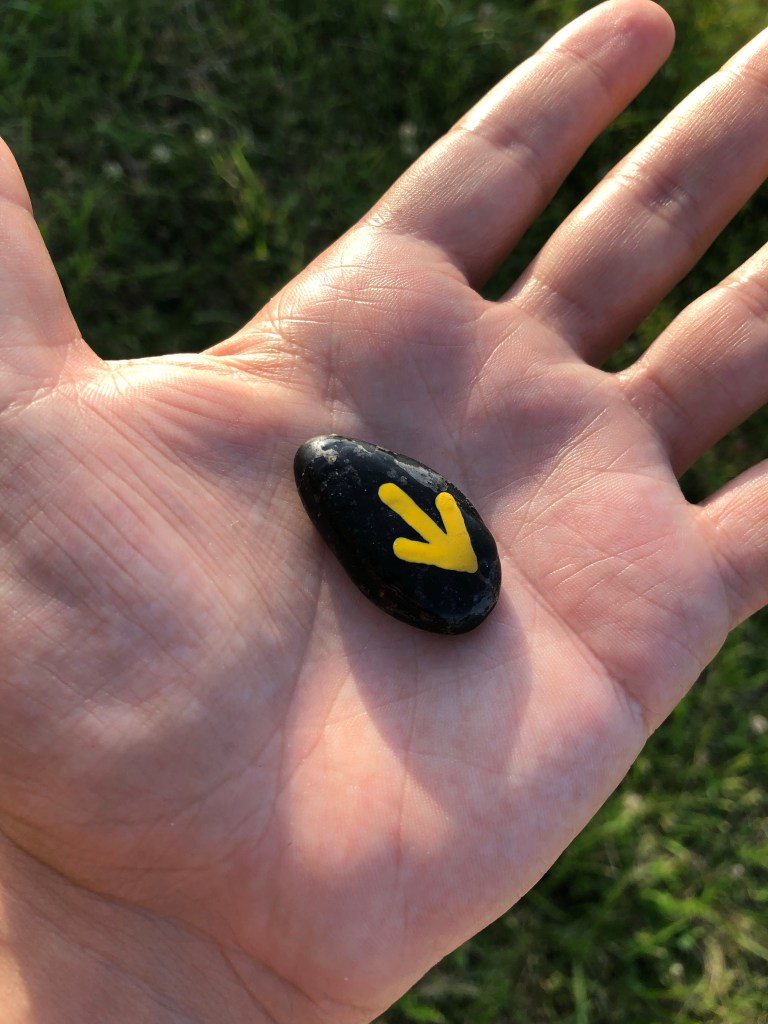
As a parting gift, the priest gave us each a little stone with the yellow arrow of the Camino. I’m holding mine now, its tiny yellow arrowhead forking through my fingers to the northwest.


Now I’m watching the sun set over the rolling hills of Galicia. It’s been a long day, but a good day. Simas and I will make for Triacastela tomorrow, while others shoot for Sarria in a mad rush to Santiago. Here’s to eveybody’s journey – may they find what they’re looking for! BB x

P.S. I have a new stick!!! (It was only 10€ and after today I’m not chancing the last 140km without one!)