“…So I Became a Teacher”

Ten years ago, British comedians Ben Miller and Alexander Armstrong ran a cracking comedy show on the BBC. The show has always been one of my standout favourites in British comedy, delivering some truly brilliant sketches including Perfectly Innocent, Kill Them, The Embarrassed Prime Minister and the Polish Plumbers, to name just a few. One running gag that hits close to home but still makes me chuckle is the comedy duo’s Be A Teacher ads, lampooning the common reasons why people “fall into” teaching:

“Failed in the real world? Then why not be a teacher?”
“Quite bright, but lazy? Need a safety net? Be a teacher.”
“Good enough to get a degree but not good enough to get a job? Be a teacher.”
“If your ambitions haven’t quite come off, remember: there’s always teaching.”

It’s a little tragic that one of the most important and time-honoured professions in human history often seems to fall into the category of “one of those jobs you do when you’ve tried all other avenues”. Conversations at school and university often went one of two ways whenever teaching came up: either “I just want to do something more worthwhile with my degree, you know?” or “God, I hate kids. I could never do that”. They’re hardly groundless as arguments go. Who in their right mind would want to get back into the classroom almost as soon as they’d left it? There’s surely something intrinsically sadistic about that kind of decision, and that’s before we even get onto the nitty-gritty of marking, differentiation and pupil management. And as for the hating the kids part… well, they say never work with children or animals – but maybe that’s just because you can’t ever truly predict or control either of them. And it is so very human to want to be able to do just that.

For me, at least, it has never been a question of “lapsing” into the education business. It is, like so many things, a family affair. Both of my parents were teachers. My Spanish great-grandmother was a teacher, and she married a teacher. I’m just continuing with the job. I might have had my wobbles along the way, but I don’t think I’ve ever really doubted that I’d be a teacher someday. Sure, that’s easy to say on a Saturday night, when most of the kids are out and boarding duties have been light, but it really is one of those professions that teaches you all the time, usually in ways you don’t expect.

I’m writing tonight because these last two weeks have been tough. The reality of teaching foreign languages to the English – ever the most stubborn of peoples when it comes to learning foreign languages – is beginning to bite. Not a week goes by when I don’t hear the line “Sir, why do I have to learn a language? Why can’t I just speak English?”, or variations thereof. The Modern Languages and Cultures graduate in me would love to give some solid answers, but these are fourteen-year old kids, for pity’s sake. A university-level argument on the merits of multilingualism pales in comparison to the fact that they have to revise twenty words they may very well never have to use in their lives – besides the end-of-year exam, of course.

So what use is the degree, then? What was the point in spending £9000 a year on the study of French, Spanish and Arabic history and literature if I am to spend the next four years teaching kids how to count up to thirty-one or discuss their plans for the weekend? These are questions I have been asking myself a lot these past two weeks. I came back to England with a mission, to do my part in a desperate campaign to save this country from collapsing into ignorant isolationism, knowing full-well what it would mean. And yes, whilst working in a boarding school does allow me to continue to channel my passion for music – easily the best part of the job by a country mile – the teaching side of it is hardly as scholarly as I’d have liked, sometimes.

At times like these, I do miss university. I miss staying up late with my housemates discussing political or social matters, I miss the excitement of sharing in the knowledge of others, and of sharing your own in turn, and I miss the challenge of stretching my brain. God, I miss that. I’ve been reading like a fiend these last few weeks out of a mad desire to tackle something more intangible than the days of the week. I ordered a book of ancient Spanish poetry off eBay the other day and pored over it during prep one night, something I admittedly would never have done at university. But then, my brain was stimulated in other ways then.

So what’s keeping me here? Why do I go on teaching?

Because I believe it’s nothing more and nothing less than one of the most important jobs in the world. For as long as there have been humans, there has been teaching, and even before then, there was teaching and learning after a kind. In the words of a colleague of mine, “I don’t care how much more you earn in the office, your job could disappear from the face of the earth overnight and nobody would notice. Not so with teaching”. You might see it as giving up on your own hopes and dreams to encourage others to pursue theirs, or that might have been your ambition all along. Teaching is the job that keeps on giving – both in reward and in workload, yes, but the rewards make up for it. I am a far braver, far more tolerant individual thanks to teaching. You don’t go into teaching to share your love with just the kids who love the subject back. That’s neither practical nor necessary. You do it just as much for the kids who don’t listen as for those who do. Teaching the subject you love to children with no love for it whatsoever will sap your zeal, strangle it if it can, but it does encourage you to see things from a different perspective. And, frankly, any job that does that on a regular basis is a job worth pursuing, if the ultimate goal of human existence is to understand each other – which is what I have always supposed it to be.

I still can’t fault Armstrong and Miller, simply because that sketch is bloody hilarious. But if you’re enthusiastic, passionate about your field, patient and have a drive to listen and learn, I cannot encourage you enough: be a teacher. Money might make the world go round, but somebody has to encourage and inspire the next generation (besides, the last thing the world needs is more businessmen). So go on. Be a teacher. BB x
Last Straw

Easter has arrived in Tierra de Barros. True to form, as it does every year, the glorious sunshine lasted only as long as the last week of term: now that the holidays are here, the clouds have returned. I remember reading once that it rains more on weekends than weekdays because of something to do with carbon emissions. I never did go down the rabbit hole, so to speak, but given the current state of affairs, it seems plausible.

I’ve made the decision to cancel all of my private classes as of this evening. It’s been on a slow-burner for the best part of a term (I might have considered it more carefully back in first term, were it not such a lucrative source of income). It’s going to be a financial dent, but it’s for the best. Had things panned out differently, I wouldn’t be so keen, but it’s beginning to take its toll on both me and my flatmate.

Making the decision to come to Villafranca de los Barros for a second time was, in part, a financial move, as I knew I had at least two potential second jobs waiting for me here and a healthy spread of contacts. Life, however, is seldom predictable, and as it turned out, I lost out on all three counts: my old job in a local concertado turned out to be in the hands of a local teacher this year; the spare auxiliar post at the prestigious private school across the road was streamlined into the wider auxiliar programme, cutting that option off as well; and, rather than granting me a healthy group of older students, my contacts this year inundated me with requests for classes for their under-10’s. And, like the fool I was, and without the financial security of the two second jobs I’d been holding out for, I took up the latter without thinking.

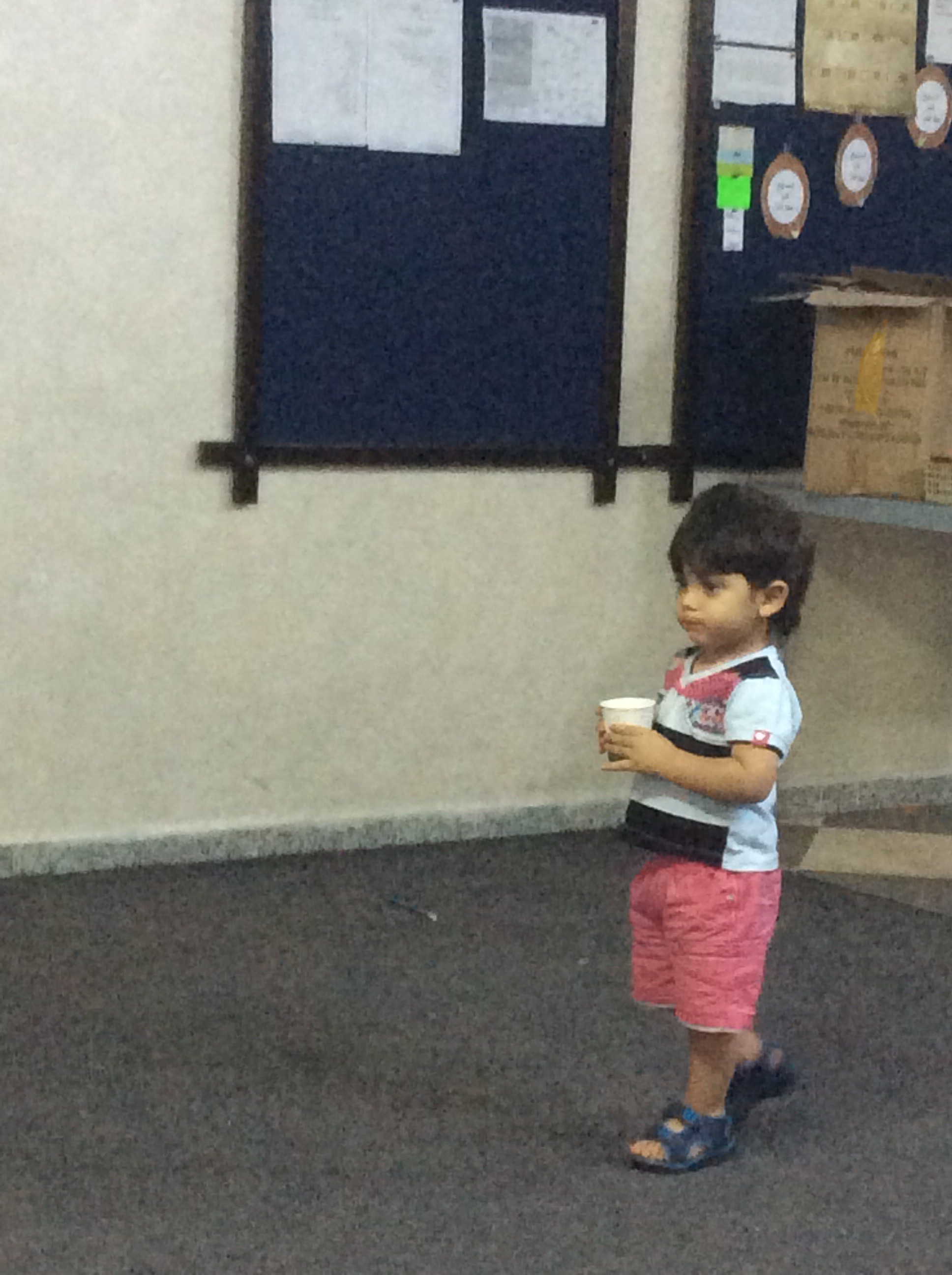
Since October, I’ve spent an hour every night from Monday to Friday dealing with raucous three-year olds, who have little to no interest in history, literature or current events, and would much prefer to yank the curtain pulls until they snap, or mangle my pencils, chalk my floor and otherwise wreak havoc in my flat. Were the flat mine I might be able to laugh it off, but it’s not, and the circle cannot hold. I moved most of the breakable materials into the storeroom within a couple of weeks, after the inquisitive little monsters found it in them to touch everything in sight, up to and including my flatmate’s school things, which despite my warnings he continued to leave in the line of fire on his return from work every day. And now, on the last day, the line has snapped: we found his satchel this morning with a broken strap.

It’s a shame that this had to come up on the last day, but I guess I shouldn’t have expected anything different. In his shoes, I’d have simply shrugged and gone to work with a broken satchel, taking it as part of the fruits of life, but then, it takes an awful lot to provoke me. Complaining and provoking slows life down and sullies the waters so, and I don’t hold by it; as long as you’re still breathing at the end of the day, there’s really no use crying over spilt milk. But he’s an Andalusian, and the six o’clock noise – bang in the middle of his siesta time – was going to drive him to the brink sooner or later. And I have myself to think of, too; my novel has ground to a slow trudge since taking on these lessons. Back in October, I was writing a chapter and a half a week. Since then, I’ve penned one a month. And isn’t that what this year was all about – to be here in Spain and to have the time to write? Next year I won’t have that luxury, mark my words.

So that’s that. The buck stops here.

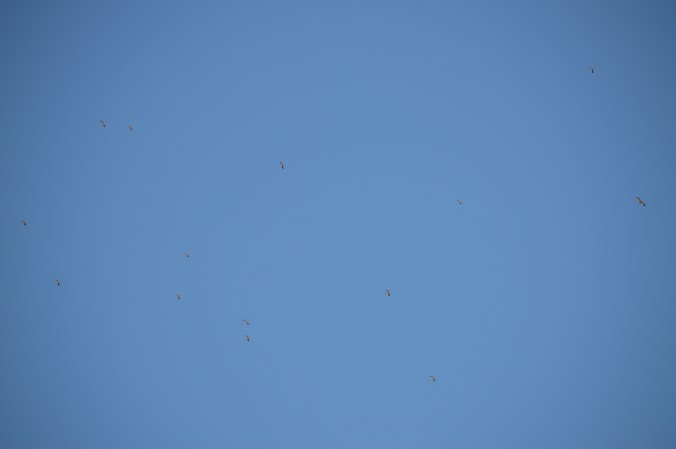
It’s not all doom and gloom. The clouds are still here, and they say there’s more rain on the way, but the worst of the storm is over. The birds seem to know it, too: I’ve been lucky enough to see quite a lot of migration from the comfort of my own flat in the post-private lesson lull this week. On Monday I saw seven black kites heading in a straight line right over the flat, as though following the camino de plata in their northward journey. On the bus back from touring with the school play in Elvas on Tuesday, I saw several swifts racing overhead. And yesterday, circling high on the thermals, an enormous phalanx of storks filled the sky before reaching the perfect height and soaring on to the north on outstretched wings.

DSC_0009

One year, I’d love to be in Gibraltar when they come. I hear it’s quite the thing to see. BB x

Outsider

I think I’m contracting hayfever, which is frankly ridiculous in a place that’s almost as dry as Jordan. Or maybe that’s just my sinuses reacting to an overdose of chorizo in last night’s risotto. Whatever it is, it’s spoiling the atmosphere.

It’s two o’clock on a Sunday afternoon here in the Parque de la Paz in Villafranca de los Barros, which means the town’s finally awake and everybody and their five children are out to enjoy the sunshine for a few minutes and then spend a good three hours in the shade, chatting noisily over a pint or a cafelito, more often than not the other way around to what you might expect. Where the students of the town are is anybody’s guess (I suspect they lead a more nocturnal existence at the weekends), but all the families converge on the park come Sunday morning. Scores of children on roller-skates climbing up and down the ramps by the Bar Atalaya whilst mami and abuela witter away with babi in a pushchair, getting ogled at every other minute or so with cries of ‘ay que linda, ay que linda’ or such like. One or two of the children who aren’t too fond of roller-blading are tottering around in oversized shirts, hands stuffed into crisp-packets and gaping in wonder at everything that moves. Especially the strange individual sitting on the bench on his own. Who even does that?

It’s both the easiest and the hardest thing about village life in Spain. Or village life just about anywhere, come to think of it, but especially in Spain. It’s a big family world, and if you’re not part of the family… well, you get the idea. Little Sunday idylls like this remind me just how much I’ve always wanted little dark-eyed curly-haired toddlers of my own, and whereas in England that kind of remark would probably earn you a wary look if not a second opinion from most people, here in Spain it’s a totally natural thing to be baby-centric. It must be – these Spaniards have giant families. One of the students I’m to be teaching put me in a tight corner when, during an introductory class, she asked ‘why is your family so small?’. My colleague apologised on her behalf and told me I didn’t have to answer that one, but the point had been made. I come from a family of four, including myself. Naturally, then, I’ve always loved the idea of a large family. It was one of the things I treasured most about my first relationship. We all want what we can’t have.

I suppose I ought to tell you that I’ve found somewhere to live for the next eight months. It was almost too easy. The new mechanics teacher from Plasencia made good on his offer and I’m now conveniently based just five minutes’ walk from the centro, and one minute’s walk from the park – which, ironically, is to be my internet hotspot for the rest of the year. I’m not going to complain about that. It’s a wonderful place to be. With any luck, in a couple of weeks I’ll have found the younger generation of this town and this may prove to be their hangout too – albeit at a different time of day, of course. That’s the only thing I envy the Erasmus students for; a ready-made social circle of people their own age. But at least I get the golden kernel in that I am, quite obviously, the only Englishman in town. And I mean that quite literally. There are two other auxiliares to be working here when October rolls around, but they’ll be living in Almendralejo, leaving me as the English-speaking bastion here. That couldn’t suit me any better. Because that means that, apart from when I’m teaching, or when I’m reading or writing my novel, the only language of communication I’ll be using out here will be Spanish. And unlike Andalucia, where (beautiful though it is) I might well miss half of what is said in the slur, I understand everything here. It’s an enchantingly countrified strain of Castilian, and that suits me down to a T.

When the time is right and I’m fully settled in and documented (the latter awaits in the Oficina de Extranjeria in Badajoz tomorrow, or as long as it takes) I’ll head for Olvera, where I’m lucky enough to have a host of old friends waiting to meet me, after I had to leave them behind to return to life in England, now almost nine years ago. I should thank my stars for that much. It may feel like I’m an outsider, watching all these families going about their Sunday paseo, but I’ve got my toe in the door already and I’m working the rest of my foot in as we speak. BB x

And Then He Threw A Table At Me

There’s a line in Tolkein’s The Fellowship of the Ring when Gandalf returns from his first encounter with the Balrog and tells his companions that he has ‘never felt so spent’. Well, I just got back from an hour spent looking after nine Iraqi children, and I think I have a fair idea of what it must have been like to face said fire demon.

But don’t get me wrong. I signed up for this. Willingly, even.

After three weeks of teaching English at this church Andreas introduced us to, I’ve been enjoying it so much that when one of my co-workers called in to say that she’d be absent, I leapt at the chance to try something new in looking after the children of our students for a change. They looked pretty fun, they sounded like they were having a good time with the girls, and Firas’ youngest is just about the cutest little thing on the face of the planet, even with the super-saiyan hair. The year abroad is all about new experiences, right? And I’m not afraid to say I’ve always been rather good with kids. I guess it’s my willingness to de-age mentally by about twenty years whenever I’m in that kind of position. Clown mode, or something like that. Kids love it. It’s supposed to be foolproof.

These kids don’t exactly speak much English, but I’d been told that they could introduce themselves and that they knew a few basic words, like colours, animals, the parts of the body… that kind of thing. So I thought I’d get the ball rolling with a song and dance kind of game. ‘I get loose’, to be precise. It always went down a storm in Durham, and that was with twenty year old students. Once they finally understood that they were supposed to be copying me – Maryam, the oldest of the girls, had to explain it to them – they seemed to be enjoying it. But one of the kids, Fadi, wasn’t having any of it. He just stood looking surly in a corner saying ‘ba’ over and over again, getting louder every time. After a few minutes of this it became almost impossible to think, so I shot him a dark look. He just yelled even louder at me, and then ran over and started hitting me with a microphone that he’d picked up from who knows where. I scolded him for it but he kept at it, and in the end I let him tire himself out until he got bored of smacking my arm. At least, I thought he had. Instead he ran to the other side of the room, grabbed the nearest small object – a piece of wooden train track – and threw it at me. Luckily, he missed, which is more than can be said for the dollhouse, the microphone, Noah’s ark, the drum, the foam floor mat and three chairs. When I looked up from teaching the girls (whose attention was quickly beginning to wane by this point) and saw a table flying at me from the other side of the room, I guess I realised that we had gone beyond the point of no return. At least he didn’t get his hands on my iPad, or I might really have lost it.

And then the screaming began. Whether Maryam had lost faith in my ability to control the class, or whether she was angry that it wasn’t Susie taking the class, or whether she just revelled in the chaos, I don’t know. But the next thing I knew all five of the microphones that Fadi had been using as missiles had found their way into the hands of the older girls and they were all screaming at the top of their voices into them. Fortunately, they weren’t on, though for all intents and purposes, they might as well have been. I tried everything – disappointed face, changing tack, feigning ignorance, even getting strict – to no avail. They just waved a massive thumbs down in my face and the screaming continued.

It was at this point that Andrew stepped in to lend a hand. For a few seconds the kids stopped, judging how he might react – and then unleashed a new barrage of screaming on him instead. Between the two of us we made absolutely zero headway and eventually Andrew retreated back to the Bible study group. Five ear-bleeding minutes later Kate came to my assistance and we tried again. More screaming – only this time they got tactical. ‘We’ll stop screaming if you dance’. So I danced, and they stopped screaming – for a grand total of two minutes. ‘We’ll stop screaming if you sing’. I whipped out the Circle of Life for them, and they actually shut up – until the English lyrics, at which point the screaming started up anew, not least of all because one of the girls who had slipped away during the chaos had returned with five cups of water. Ammunition to renew the war on the Substitute. There was a point when Kate and I just looked at each other in an expression of utter helplessness. What could we have done? The kids were mutinous in the extreme. They weren’t having any of it; no Heads, Shoulders, Knees and Toes, no introductions, no colours, nothing at all. Just screaming. When their parents came in to tell them to shut up, and they got the screaming treatment just as bad as we had, Andrew, Kate and I threw up our hands in defeat. We’d tried everything. The kids had overwhelmed us. And when the clock struck five minutes past five, I can honestly say I’ve never felt happier to have finished something.

So the next time I jump at the chance to teach kids, somebody stop me. Please. My ears, at the very least, would be grateful. BB x