Camino XXX: Journey in Hope

Albergue El Texu, La Espina. 17.09.

One of the things I love the most about the Camino is that the planning required, relative to any other holiday, is minimal at best. In most instances, you can pick up your bag, start walking and stop in this town or the next when you’re tired. It helps to know which locations are truly special or worth seeking out, but you can always follow the Camino at your pace. For a teacher like me, for whom planning is a daily and often insurmountable chore, the last thing I want on a holiday is to have to plan all of my movements. The total freedom the Camino provides is one of its greatest blessings.

Except when you see signs like this.
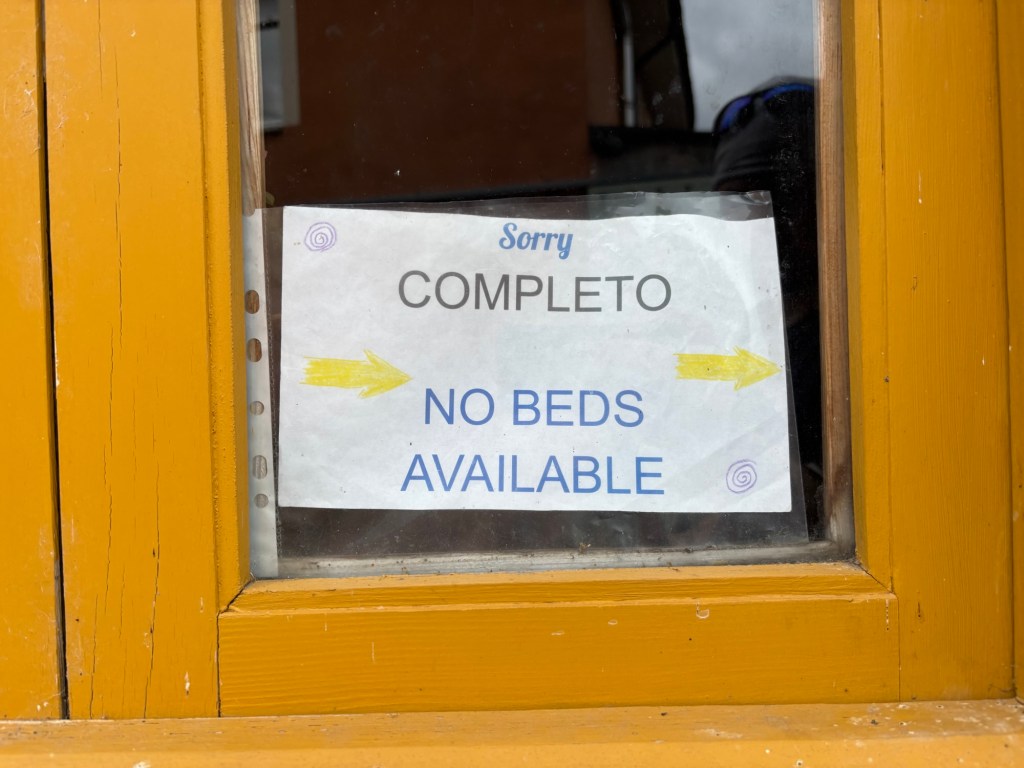

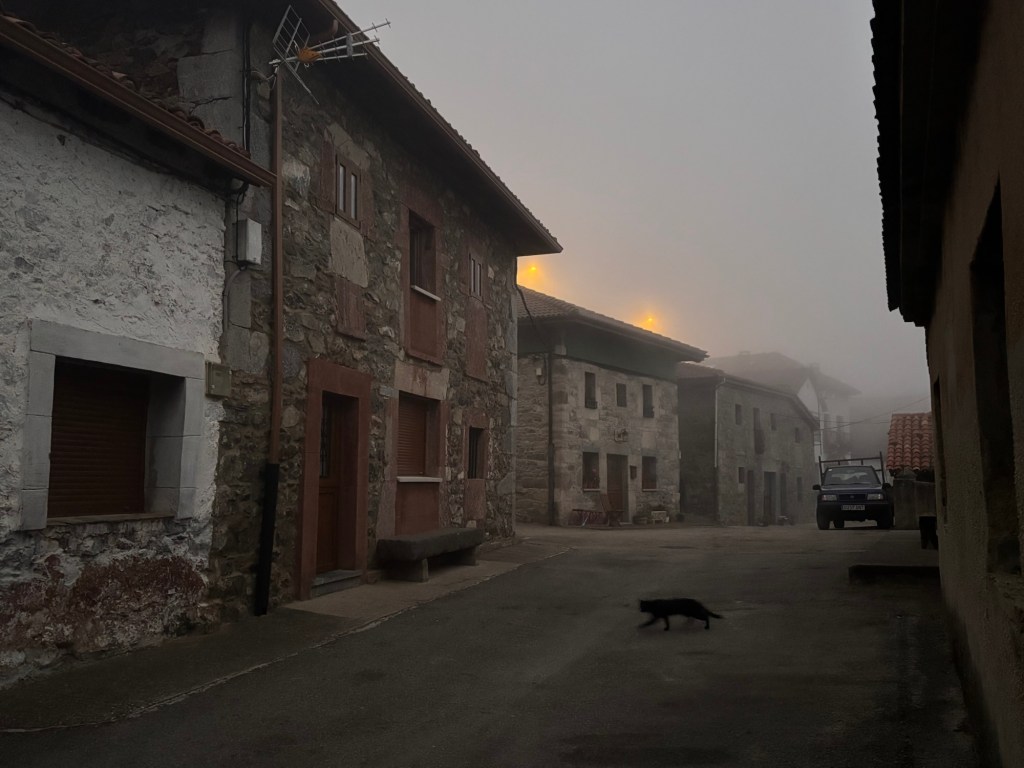
I had read a lot about the quality of Bodenaya’s albergue, so I was a little disheartened to see this sign in the window when I got there at around half past one after an arduous climb up from Salas, only to find it was all full – already, and whole hour and a half before it was due to open. Bodenaya, like many albergues along the Primitivo, is small and personal, counting on just ten beds. However, this is not normally a problem if you’re quick on your feet and get there in plenty of time.

Sadly, popularity breeds on itself, and some pilgrims (sometimes with legitimate reasons) feel the need to book all of their accommodation ahead of time so that they can enjoy the walk in peace without worrying about having a bed for the night.

Which is great for them. But not for those of us who have to deal with the disappointment of doing everything right and being beaten to a bed by the eager beavers who would prefer peace of mind over the freedom of the Camino.

Everyone walks the Camino in their own way. That’s a fact. I just don’t agree with the idea of booking accommodation in advance along a route that is one of the few places in the world where you genuinely don’t need to. There are all sorts of other holidays where that kind of mindset is the norm. If I wanted to know where I’d be and what I’d be doing a week or a month in advance, I’d consult my teacher’s planner (or somebody else’s, as I hate writing in mine). Work is planned. The Camino is freedom.

There. I’ve said my piece. Let’s move on.


The hospitaleros at Grado put out a large breakfast spread, so I ate well this morning. I saw a few familiar faces along the road, many of whom had stayed at San Juan the night before after finding Grado’s municipal full (there’s a reason the municipales are often occupied by the younger and fitter pilgrims).

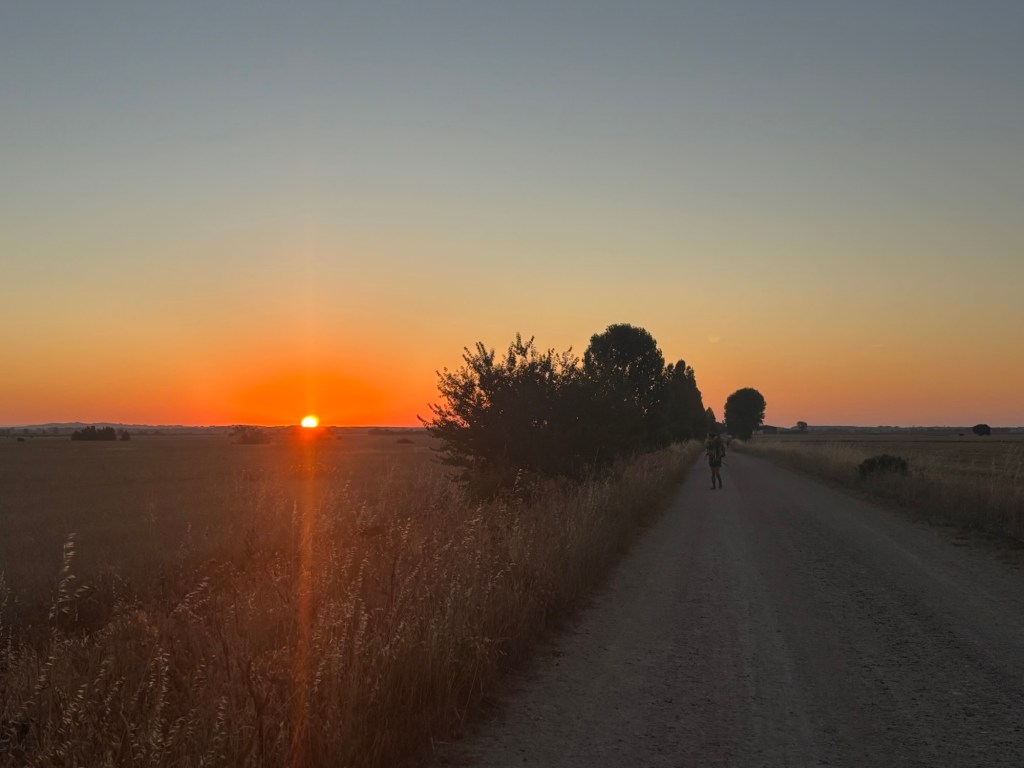
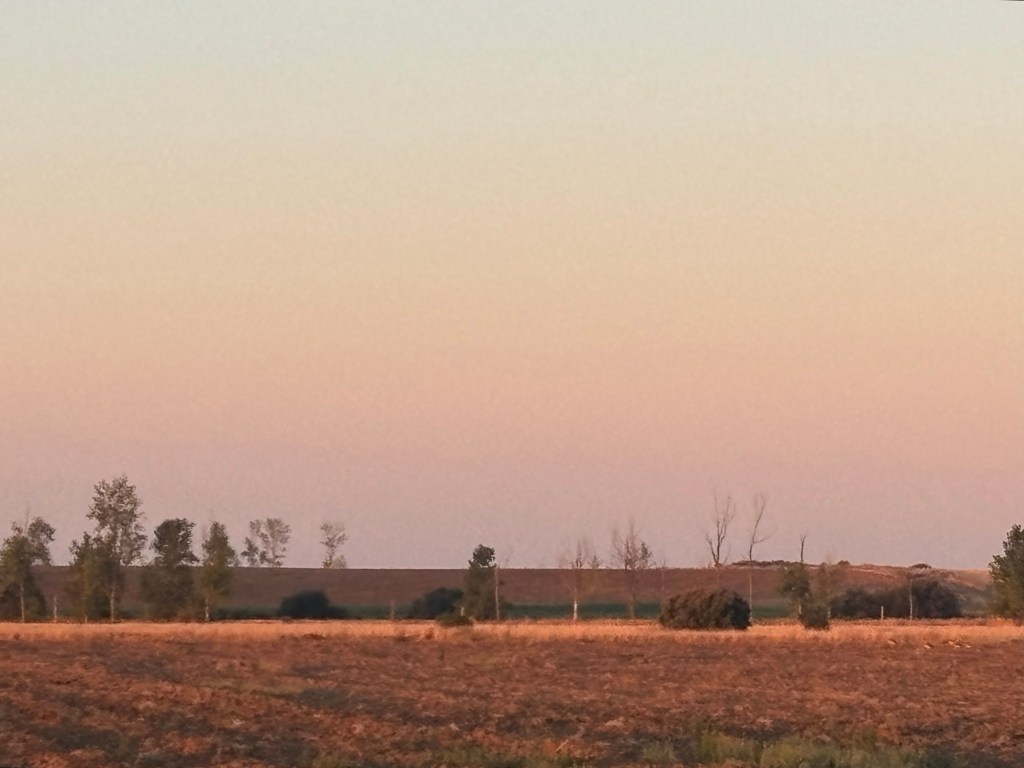
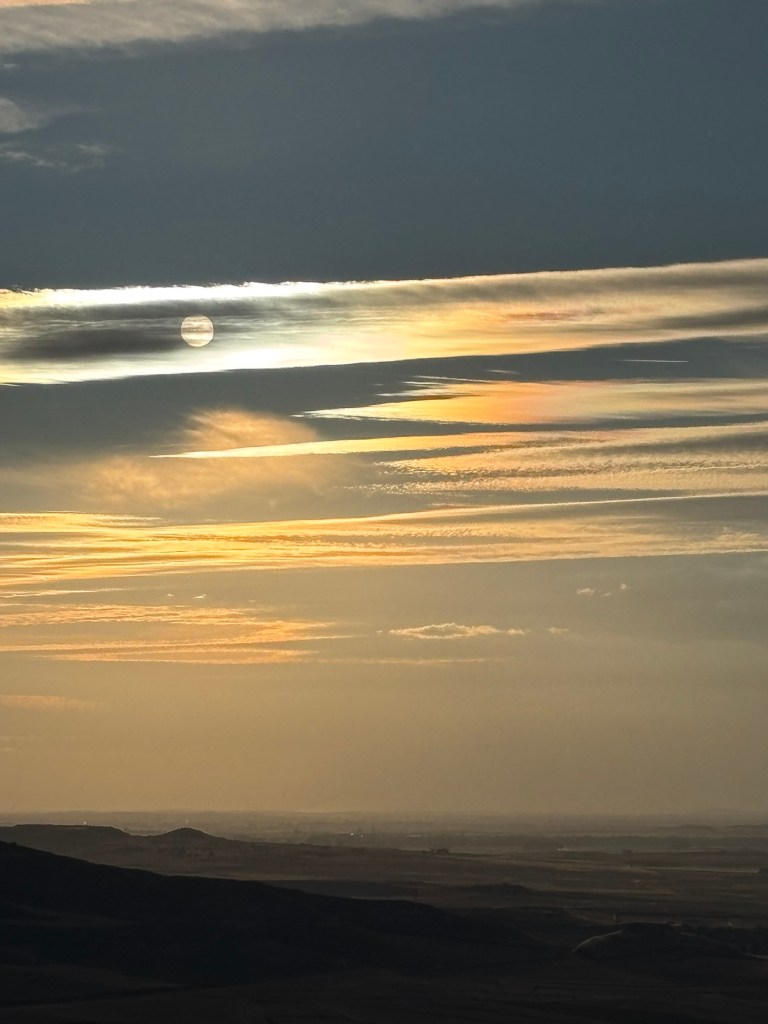
There were a few clouds on the horizon, but the sun rose in a warm, pastel pink, promising a warmer and drier day’s walk ahead. I was quite glad of the rain yesterday, but now that I am armed with more sun lotion, I am not as concerned about another day under the sun’s anvil as I was on the San Salvador trek.
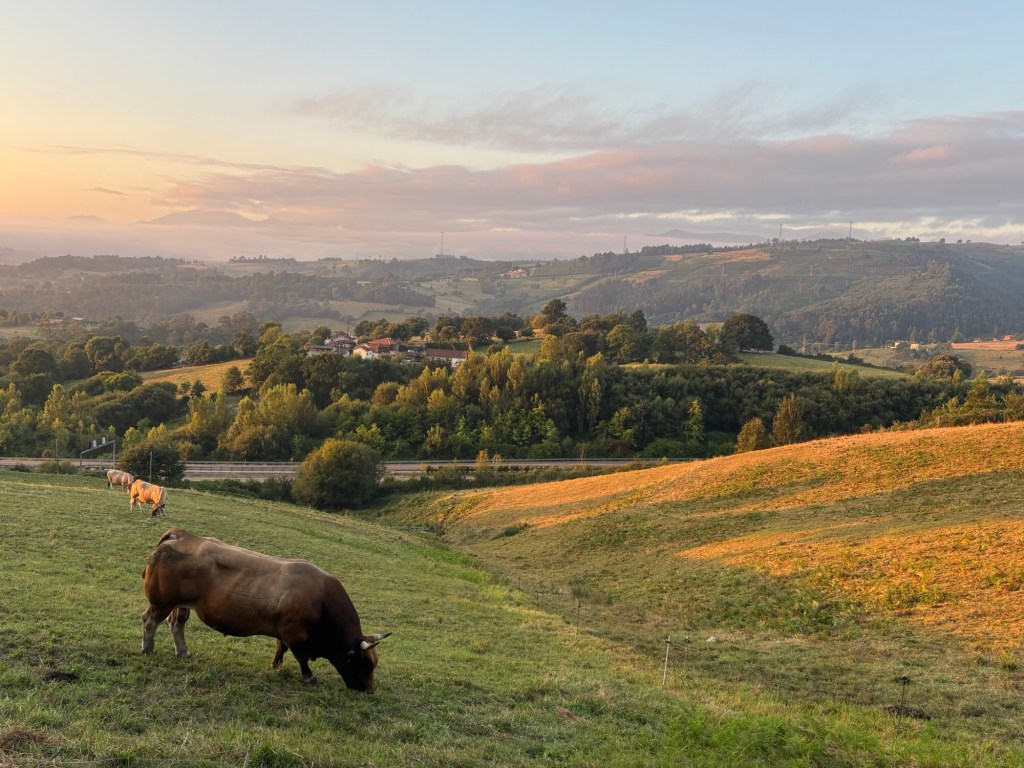

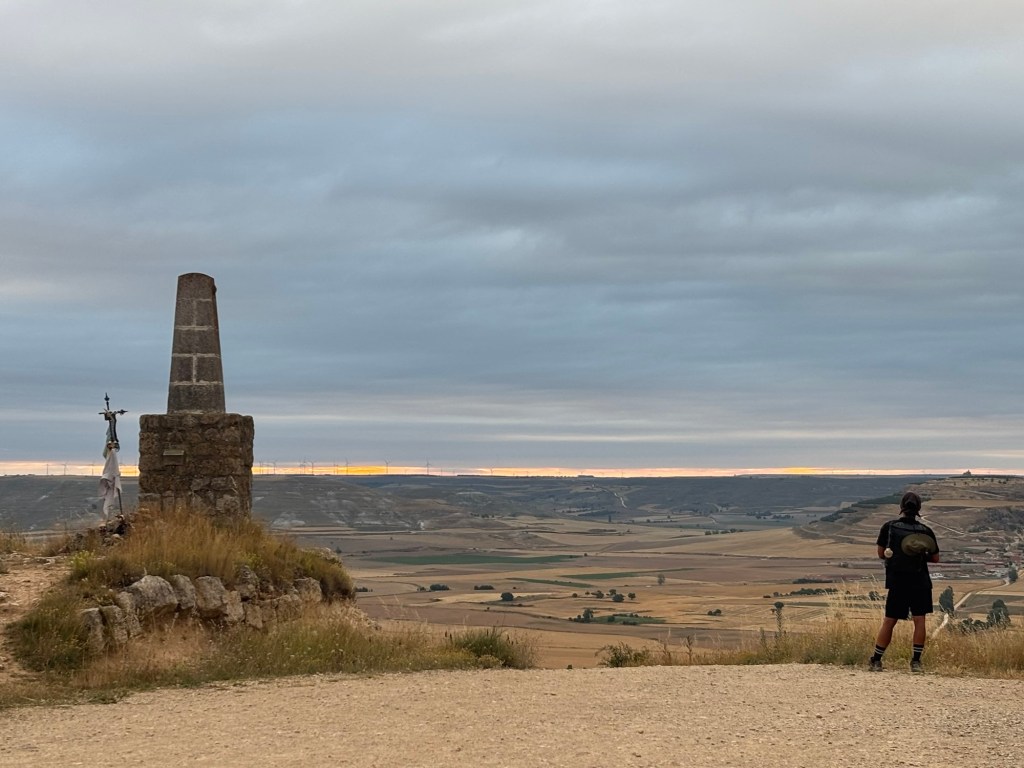
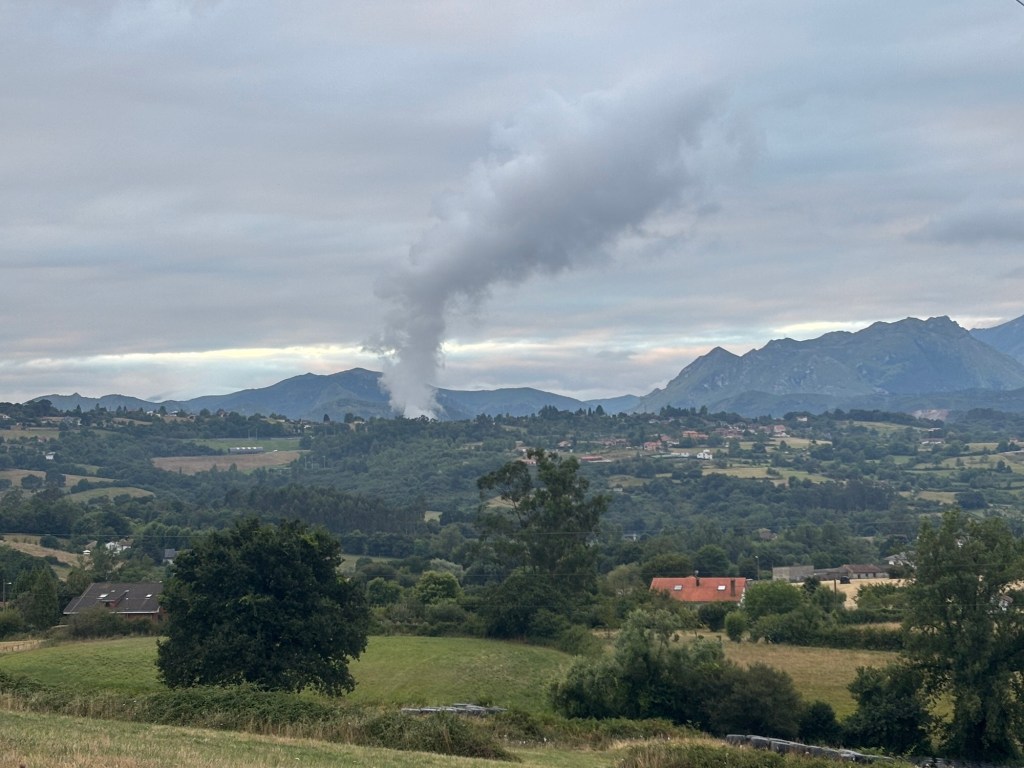
The climb up from Grado is not half as impressive as the descent on the other side, which provides a sweeping panorama of the valleys ahead, all the way to the turbine-topped hills of Pumar that lead to the Bay of Biscay. No Asturian landscape seems to be complete without a small pillar of smoke from some factory or quarry: in this instance, the chalk mines at La Doriga.
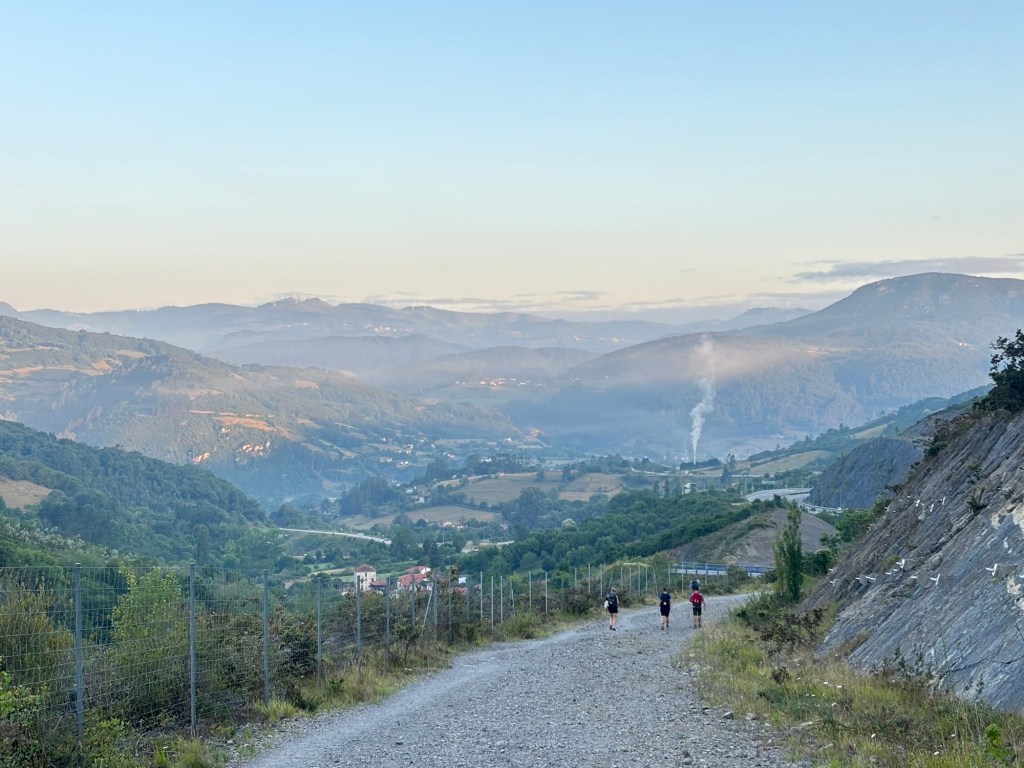

Spain’s north has always been its industrial heartland. This is largely due to its abundance of natural resources like iron, copper and coal, which gave the region all the tools it required to build what would become one of the world’s first global empires. There were even gold mines here once, when the Romans scoured their own empire in search of that most precious of metals.

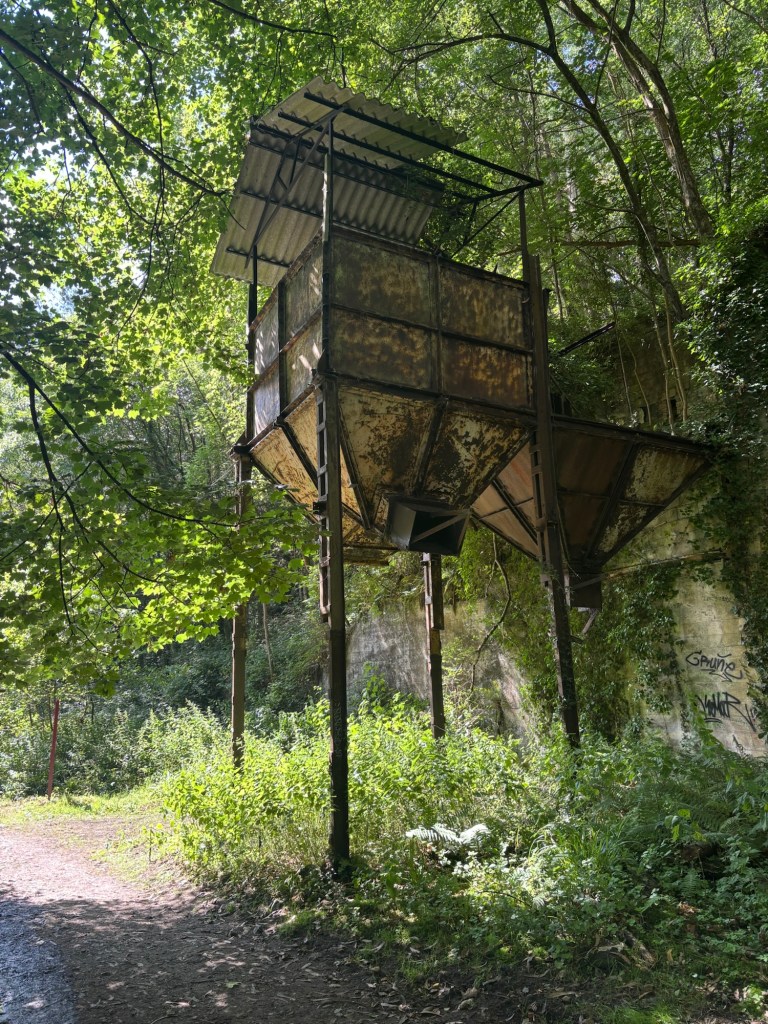
Many of the quarries are still in use, but some have fallen into disrepair, slowly disappearing within the dark forests of Asturias. This one caught me by surprise in the hills behind Salas. The vents through which the chalk must have been shuttled once had long since rusted shut, and vines and thick carpets of ivy had all but concealed the adjacent storehouses, but the tower remains standing. I’ve always been fascinated by abandoned quarries and factory buildings, and Asturias has plenty to explore, even along the Camino.

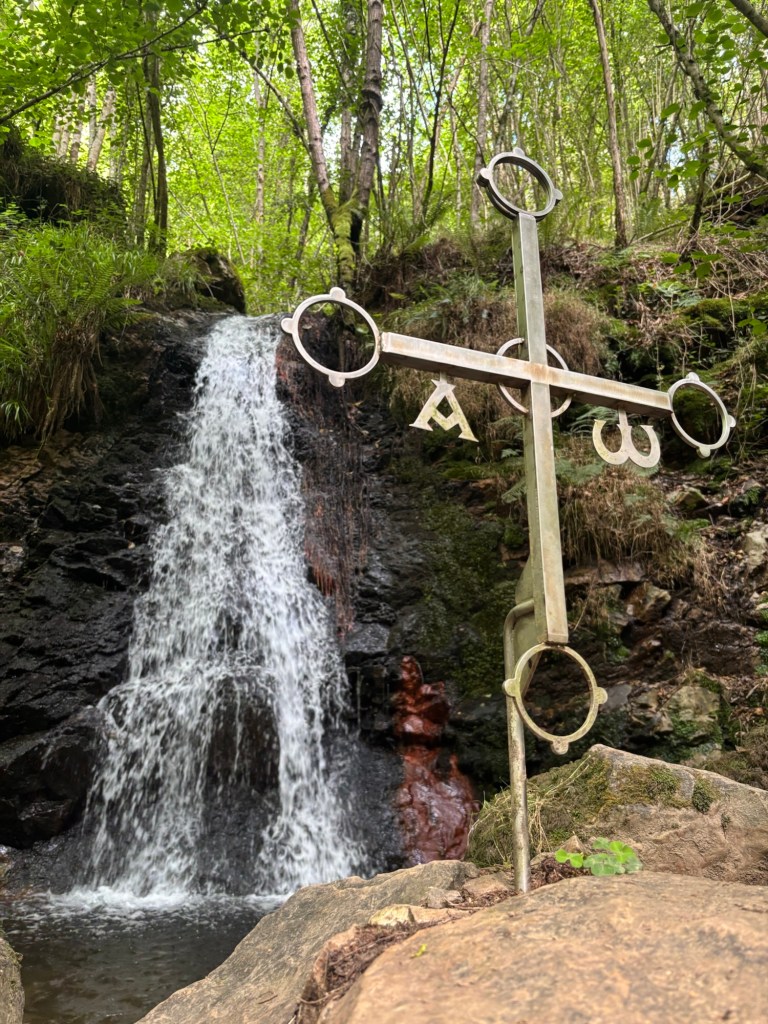
A short distance from the Camino (at the cost of a 200m descent) is the Cascada de Nonaya, a concealed waterfall hidden away deep in the forest. It’s easily missed from the pilgrim road, but Google Maps is a wonderful thing, so I knew what to look out for. Somebody has erected a metal simulacrum of the Victory Cross of Asturias at its base, so in the absence of a church, I made this one of my stops for a prayer today. It was a very special place: peaceful, dark, ancient.

After the waterfall, the Camino makes a very steep climb up the mountainside before levelling out along the main road towards Tineo. My destination, Bodenaya, turned out not to be – as I had the slightest inkling might be the case – so I shrugged and moved on. La Espina seemed promising, but the municipal albergue didn’t seem to be what it had been cranked up to be online. Then I saw yet another sign for a well-advertised albergue that wasn’t in any of the websites, and the fatalist took over. I know better than to deny fate when it’s trying to tell me something.
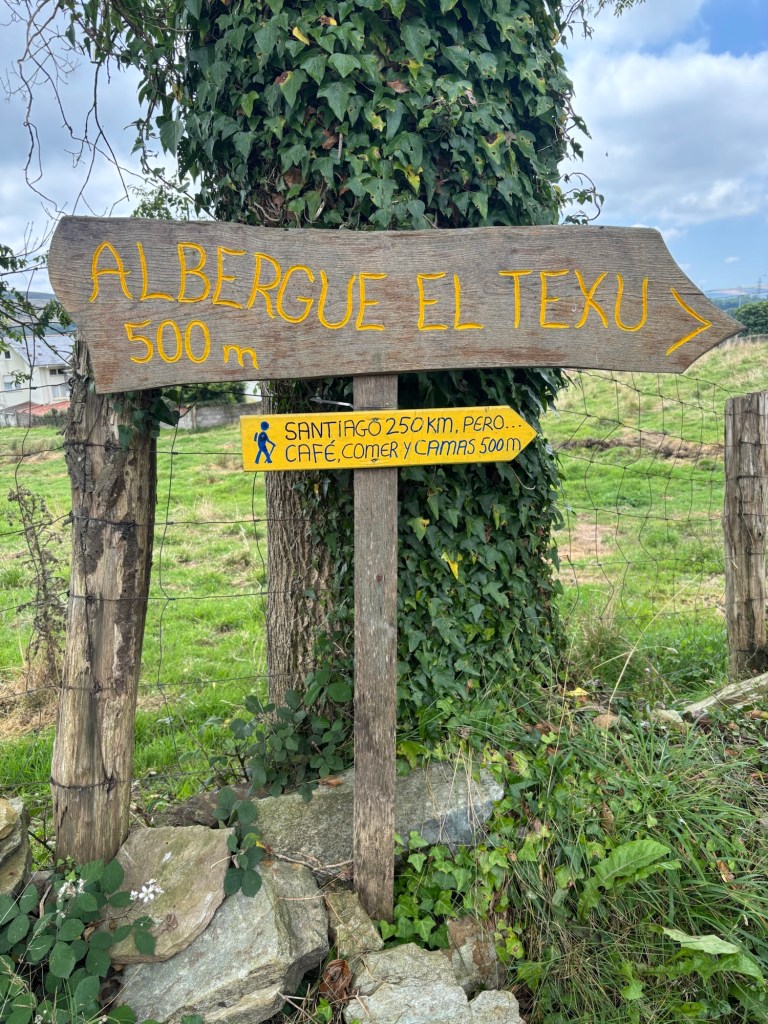

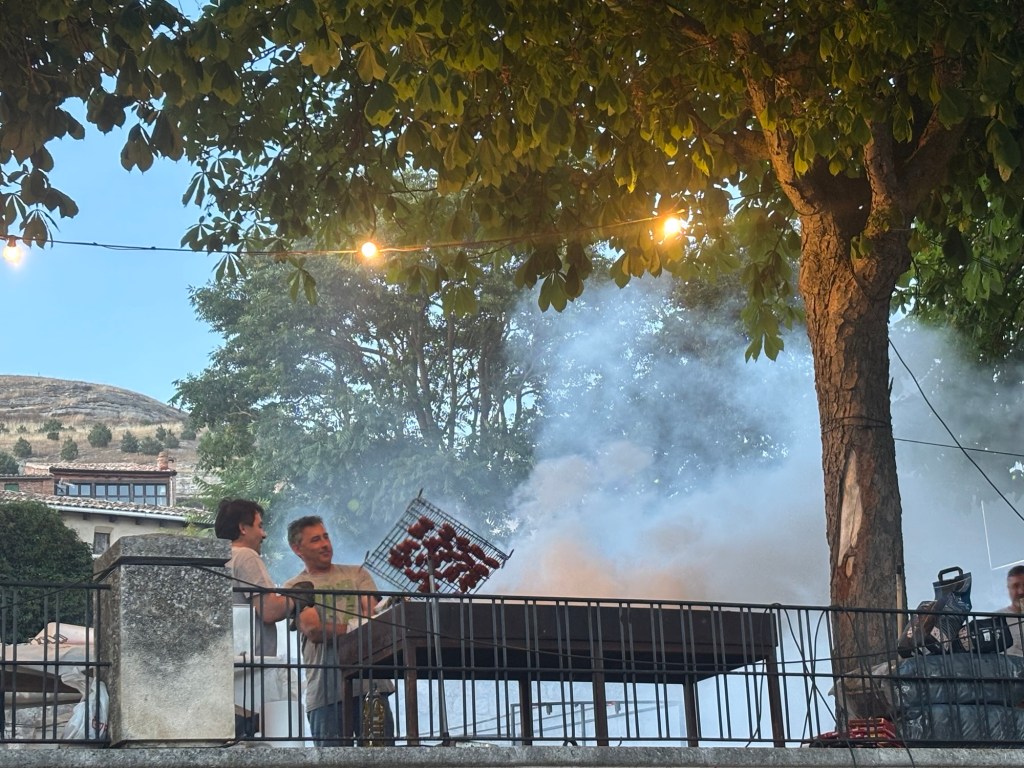
El Texu is a beautifully peaceful setup, run by a Dutch family and their volunteers. It wins the award for best shower on the Camino, as far as I’m concerned, and I haven’t even had the Thai green curry that Nani is making for supper! I’m normally a purist for Spanish fare on the Camino, but right now, a Thai curry sounds incredible. I can’t wait! BB x
Camino XXIX: Asturias

Albergue de Peregrinos, Grado. 21.40.

Confession. I was genuinely considering skipping Grado to gain a day this morning. I think I still hadn’t shaken the idea that, if I could only walk a little faster, I might catch up to my companions on the Camino Francés before they left for home. But the Camino, like an old god, is fickle. I’m not sure whose idea it was – Santiago, the Lady of El Rocío or the capricious spirit of the Camino itself – but I was waylaid at the albergue this morning by a retired Swedish woman who wanted company on the road out of town. The Camino leads straight to the train station, and I might have made it in time… but the Swedish woman pointed left and I followed without thinking.

I lost her about half an hour later when I picked up speed at the city’s outer limits, but I see now that it was a signal: no tricks this time. This Camino must be walked from beginning to end. There is something along this road that I am meant to do or see. The fatalist in me takes over on the Camino, and right now he is utterly convinced of that fact. So here we are.


Welcome to the Camino Primitivo. If you were expecting something similar to the Camino Francés, think again. It’s almost like stepping out of a bus and onto a boat: the same feeling of companionship, but an altogether different vehicle in an altogether different environment.

Asturias is, in a way, the grandfather of Spain. This green and clouded region, together with Cantabria and the Basque Country, was the final holdout of Iberia’s Christians during the Moorish invasion of 711, and it was from here – so the legends tell – that Don Pelayo established the Asturian monarchy, the earliest forerunner of the Spanish crown, and began the Christian reconquest of Spain – the Reconquista – which would take nearly eight hundred years to complete.

You might think such a place would be as Spanish as it gets. You would be mistaken. This is not a land of paella, flamenco and bull-fighting, or dark-skinned maidens flanked by guitar-wielding lotharios (a stereotype far more common among Italian pilgrims this year). This is a green and hilly country where the clouds descend as far as the tree-tops and sometimes beyond; where the rain rolls in off the sea in visible eddies and falls like mist on your face. Where the men are short but powerfully built, and the women breathtakingly pale. Where great clouds of smoke rise from the quarries and factories, and the air is thick with the constant ringing of cowbells. This is Asturias. It could hardly be more different to neighbouring León. It is a reminder – as though one were needed – that Spain is, in reality, a multinational state, where even the kingdom that started it all has its own distinct language and identity.


For the greater part of the morning, my road was cushioned by the clouds. Sometimes they moved with me, sometimes they moved against me. It rained for a half-hour or so, but it was not so much rain as a rain cloud that was so low to the ground that one could walk right through it. The Camino from Oviedo ducks and weaves through the hill country, sometimes following the asphalt roads, sometimes leading down dark trails into the tangled forests of oak and eucalyptus.

It’s very easy to see how this corner of Spain – behind the frontier of the Cordillera Cantábrica – shelters most of Spain’s lingering mythology. The forests are dark and watchful and the mist rolling through them plays tricks with your eyes. I heard something large kick up the leaves and dart into the deep at one point, but I never did see what it was. A deer, perhaps. There are plenty of them about.

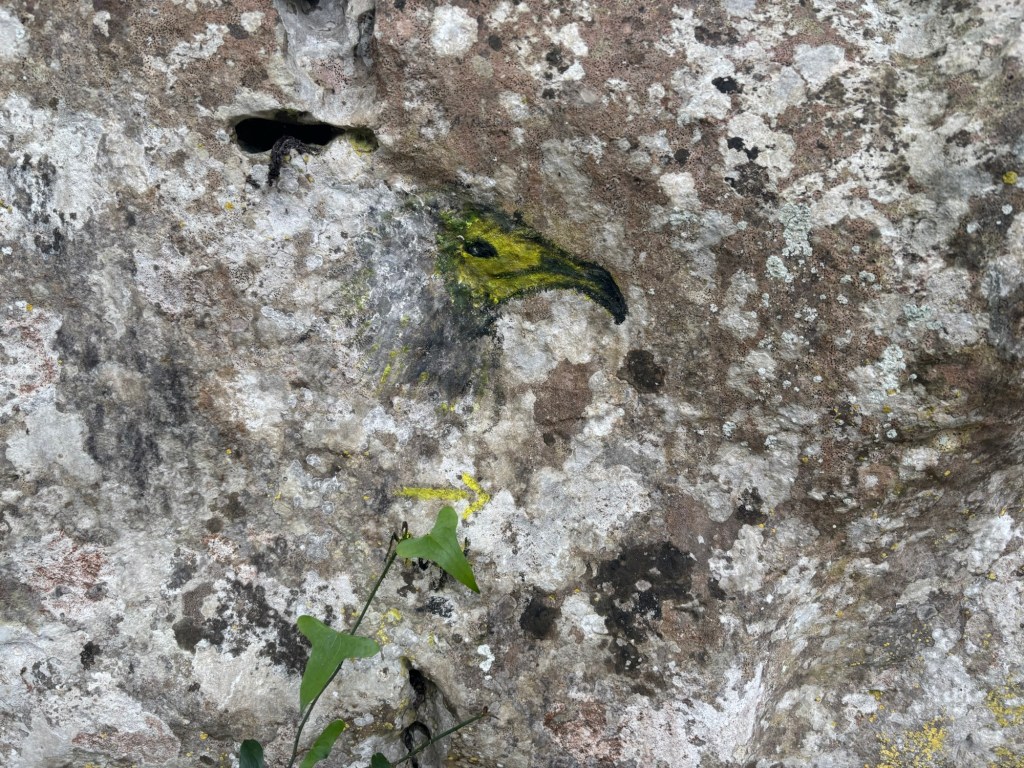
In one of the forested stretches, the Camino crosses a small clearing scarred with limestone teeth, like the bones of some ancient monster. A splash of colour on one of the rocks nearest to the road caught my eye and, on closer inspection, it was the head of one of the spirits the Lady of El Rocío sent to guide me yesterday: an Egyptian vulture.


Egyptian vultures are one of the oldest species of vulture still in existence. They are also the last of their kind, with their nearest relatives believed to have died out during the Miocene. They are incredibly intelligent creatures, being one of the few species to use not just one but two tools: using stones as hammers to break into eggs, and sticks as spools to gather wool or other nest-building materials.

They’re also amazing to look at, with their glam-rocker hairstyles and their black and white wings. I found myself wondering whether this bird was one of the inspirations for the Chozo, an ancient race of superintelligent avianoid aliens from the Metroid series. Their faces certainly match up to the earlier designs.

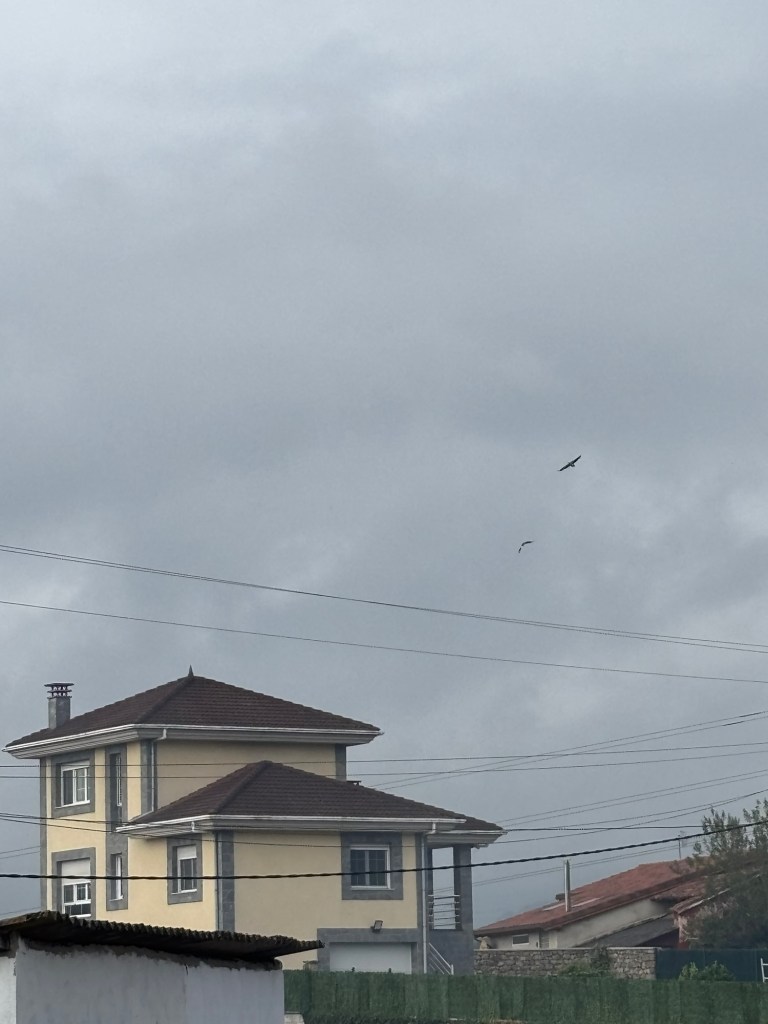
Well, while I had them on the brain, suddenly, there they were: a pair of them, circling low over a hamlet on the outskirts of Premoño. A local and his son were heaping refuse onto a small bonfire, which may be what drew them in, but before long they were riding the thermals high into the sky. It was enough to make me skip one breakfast stop just to chase after them and watch them ride higher and higher until I could no longer make out the diamond shape of their tailfeathers.


I tried to make amends on a breakfast stop in Valduno, but one of the waiters made frantic signs to be quiet as I opened the door: half the bar space had been given over to microphones and speakers, and they were in the middle of recording a podcast. I could get some water, they said, or wait in a corner. I felt I was intruding on something. I moved on.

I found a better spot in Paladín, where I had a nice long chat with the barman. He had some sort of alarm setup which sounded awfully close to Colours of the Wind from Disney’s Pocahontas, which went off whenever somebody walked through the gate – I guess that’s how he knew to appear the moment I arrived. He was keen to know how many pilgrims I had seen on the road. I told him only a handful, as I had been one of the first to leave Oviedo – which was true – but that there had been plenty at the albergue. He was quick to point out that not all of them would come this way, as the Camino Norte also runs through Oviedo, but seemed very appreciative to have a conversation with a peregrino. Spanish tourists bring money during the summer, he said, but they don’t bring much more than that: a place to eat and sleep and then they’re gone. He missed conversations with pilgrims and swapping tales from the road.

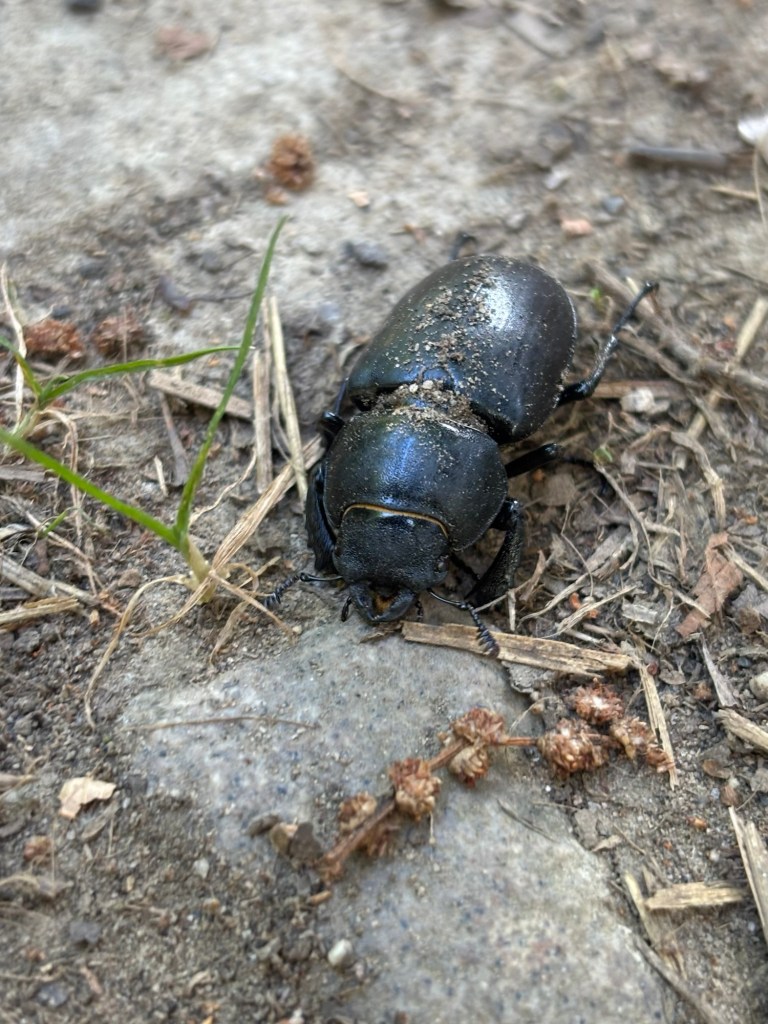
After Paladín, the Camino returns to the banks of the Nalón for a little while. I was so fixated on the beauty of the river that I almost stepped on a stag beetle. I have yet to see one of the impressive males, but the females seem to get about quite a bit during the day, as this is the sixth or seventh one I’ve seen along the Camino.


Like its sister, the Tajo, and a great number of other Spanish rivers and creeks, the Nalón cuts right through the craggy cliffs and sierras on its winding journey to the sea. The train from Oviedo seems to follow it, which must make for a spectacular journey. There’s a small bar at the foot of the Peñón de Peñaflor where you can stop for a drink, but I was much too busy drinking in the view. The old masters painted paradise as a garden with many mirrored lakes and fruit trees, but I think mine would be scarred with karstic crags just like these.


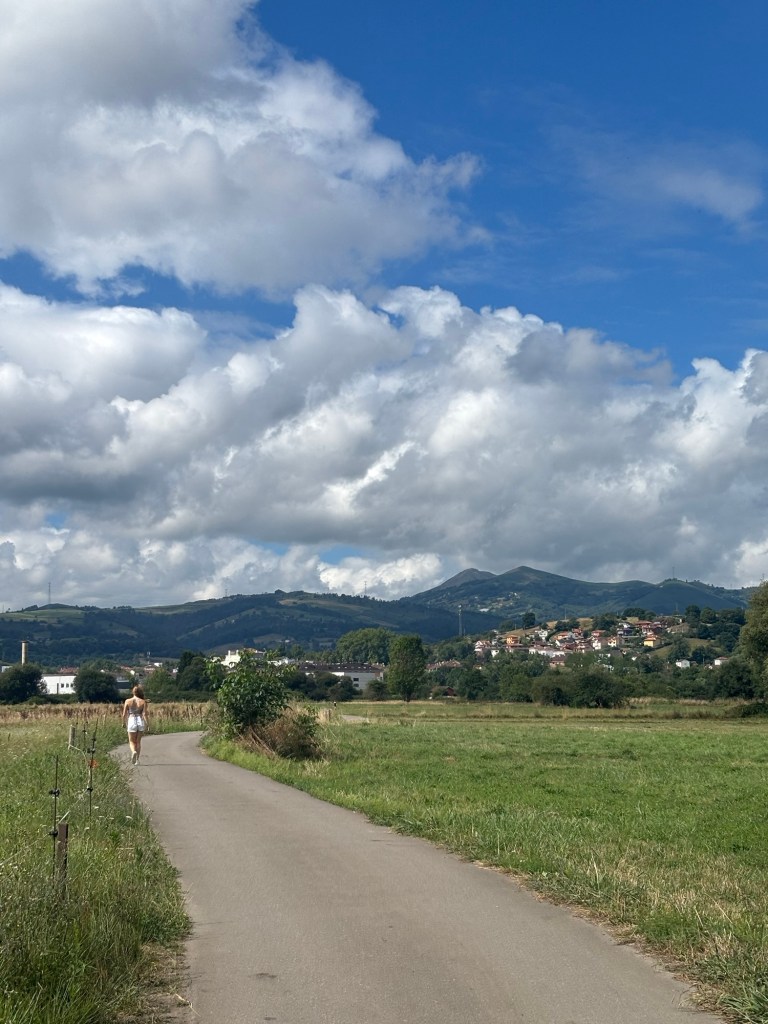
After crossing the river and the tiny settlement of Peñaflor – a small cluster of houses that seem to exist purely to justify the train station – the Camino cuts across the countryside toward the hill town of Grado. A local girl in white cut-off jeans stepped out into the road as I left town and sauntered on ahead with a jaunty, confident stride, toying with her hair over one shoulder and then the other, and then held up in one hand, as though she couldn’t quite make up her mind how she wanted it. It was about half an hour’s walk to Grado, where she finally disappeared into one of the apartment buildings. Spaniards aren’t known for being natural long-distance walkers, so I wonder what she was doing out here?


I reached the albergue a full two hours ahead of opening time, so I took off my sandals and zoned out for a bit. I’ve found a comfortable method in wearing my liner socks underneath the woolen socks (which may well be their original purpose). It’s not too hot and it meant no discomfort whatsoever from my blisters. Let’s see if it lasts.

Andrés, the cheery hospitalero from Badajoz (I’d recognise that accent anywhere) arrived just before 2pm and handled check-in, after which I had a good nap for two hours (that’s how I can justify still writing at this late hour, when all the other pilgrims have long since turned in). I considered going out to eat, but instead sorted out my flight home and popped out to a supermarket to get some supplies – namely, sun-tan lotion, as I’m all out and there are some long days ahead.

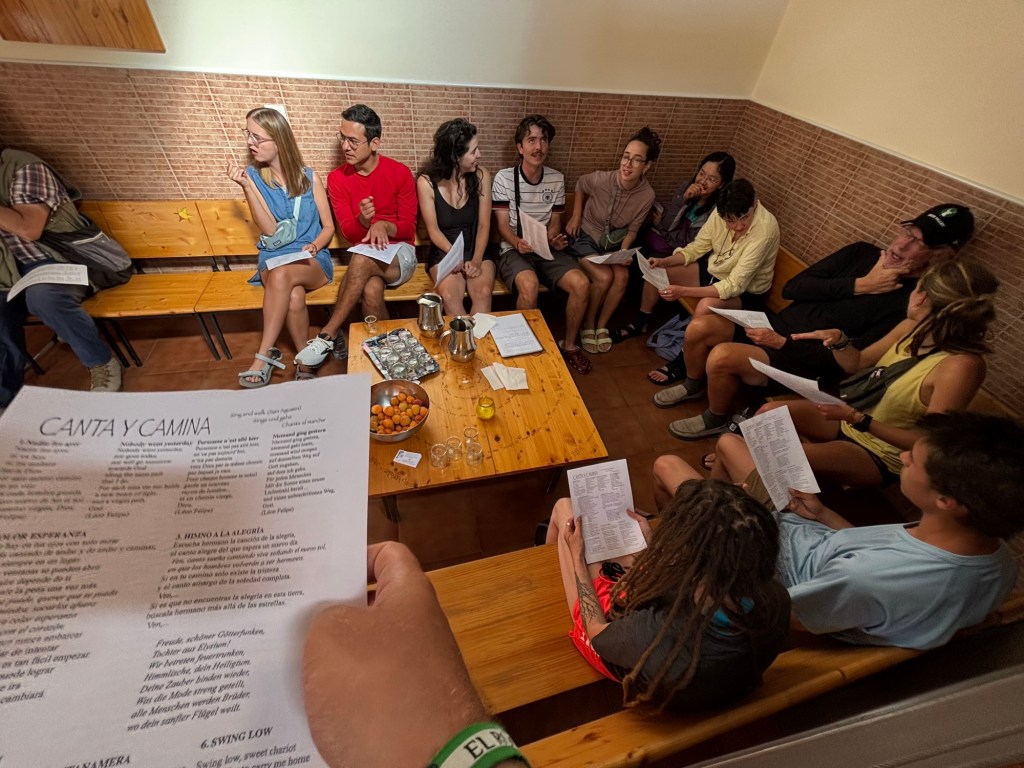
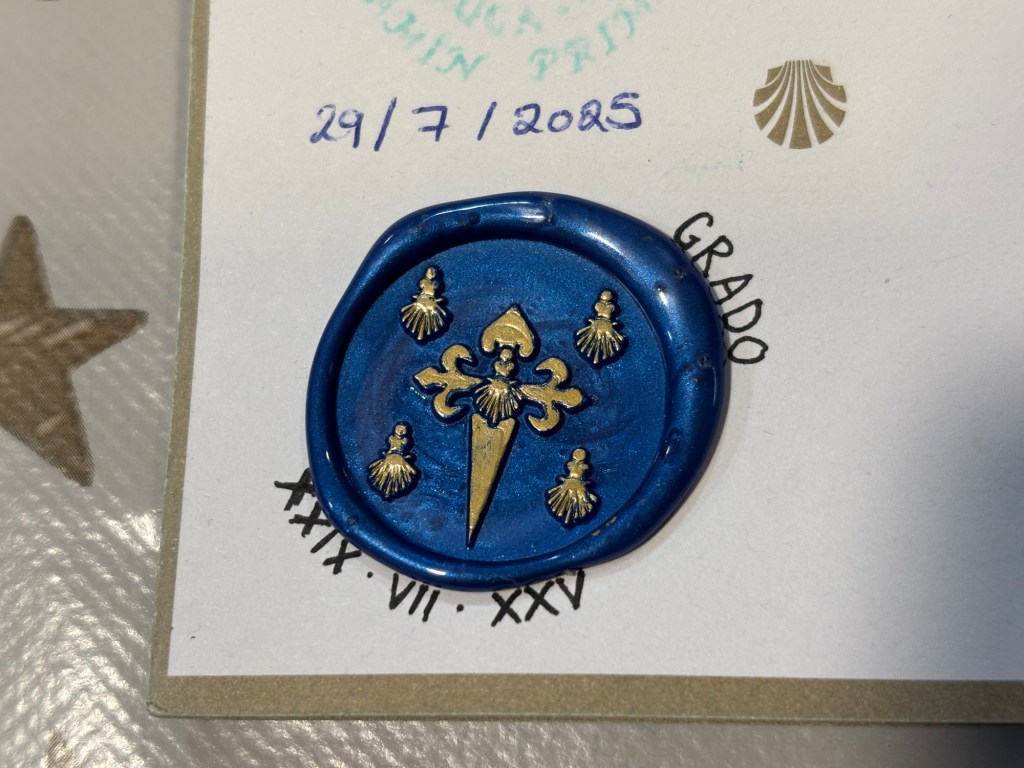
Back at the albergue, Andrés suggested making some wax stamps. This slowly brought all the pilgrims downstairs and got conversations flowing all around the room. Hospitaleros only typically work for around 15 days before moving on, but here was a master at work: friendly, accommodating, knowledgeable and unimposing. Just present.

He also had the spirit to call out a fellow Spaniard for a slightly tactless remark about how “easily” Moroccan migrants get Spanish citizenship. As a former civil servant, Andrés certainly knew his stuff – enough to put the man in his place with some hard facts about the reality of immigration policy in Spain.

I feel I learned a lot today. I also got a shiny new wax stamp for the passport, which I painted gold in a nod to the Asturian flag. Now when I look at it, I’ll remember this place.


I don’t know if I’ll find a “Camino family” again like I did on the Francés – that road does facilitate the group dynamic like no other. But this feels right. I’m learning so much and seeing so much more.

Somebody stopped me from catching that train, and they had the right of it. Here’s to another week and a half of wonder. BB x

Camino XVIII: Down and Out

Albergue de Peregrinos El Salvador, Oviedo. 19.27.

Ignore what I said yesterday. I’ve reached Oviedo a day ahead of schedule. There are a few reasons for this:

  1. The Albergue in Pola de Lena was due to open at 15.30, some three hours after I arrived. The website was pretty vague about the need to book ahead.
  2. The next town, Mieres del Camino, was about three hours’ walk on, but had no albergue – pilgrims are housed in the Residencia Universitaria for the princely sum of 25€.
  3. The flights home from Santiago go up by about 50€ after the 10th August, giving me an incentive to pick up the pace, but…
  4. …my feet could use a break after all that climbing, and speeding up is the last thing that I need.
  5. Oh, and I’ve had three days without WiFi, so my data has been cascading faster than my Camino buddy Alonso could finish a watermelon.

Hopefully you’ll forgive me for catching a train for the last 30km or so from Pola de Lena. I have been walking about 25-30km a day every day for four weeks, and I used one cheeky bus ride on my last Camino to circumvent the tedious industrial estate west of León. This time it’s my own health I’m looking out for!


It’s a good thing I jumped the gun and climbed up and over Puerto de Pajares yesterday, as when I awoke this morning, it was to a fogbound world. The rain that was forecast never came, but in its place a thick blanket of mist had descended upon the mountains, obscuring everything from sight. It didn’t clear until around half past ten, by which point I would have long since reached the Asturian border if I’d stuck to my original plan.


Two of the sportygrinos left around five minutes before I did, but I never saw so much as a whisper of them on the trail, and I was making pretty good speed. I’d get to wondering whether some of these lean Spanish pilgrims take the Camino at a run, but there was no such trace in the mud, so perhaps they took a shortcut. Or went by bike.


The initial descent into the valley below was positively murderous underfoot, so Pinta and Niña came to the rescue once again. It wasn’t helped much by the knowledge that once I’d got to the bottom of the valley, I’d only have to go back up again on the other side.

The Lady of El Rocío sent me a gift to speed me on my way. A pine marten came scampering out onto the path as I started to climb, stared at me for a few seconds, and then went bounding off into the trees. I raced after it on stealthy feet, but it had vanished.

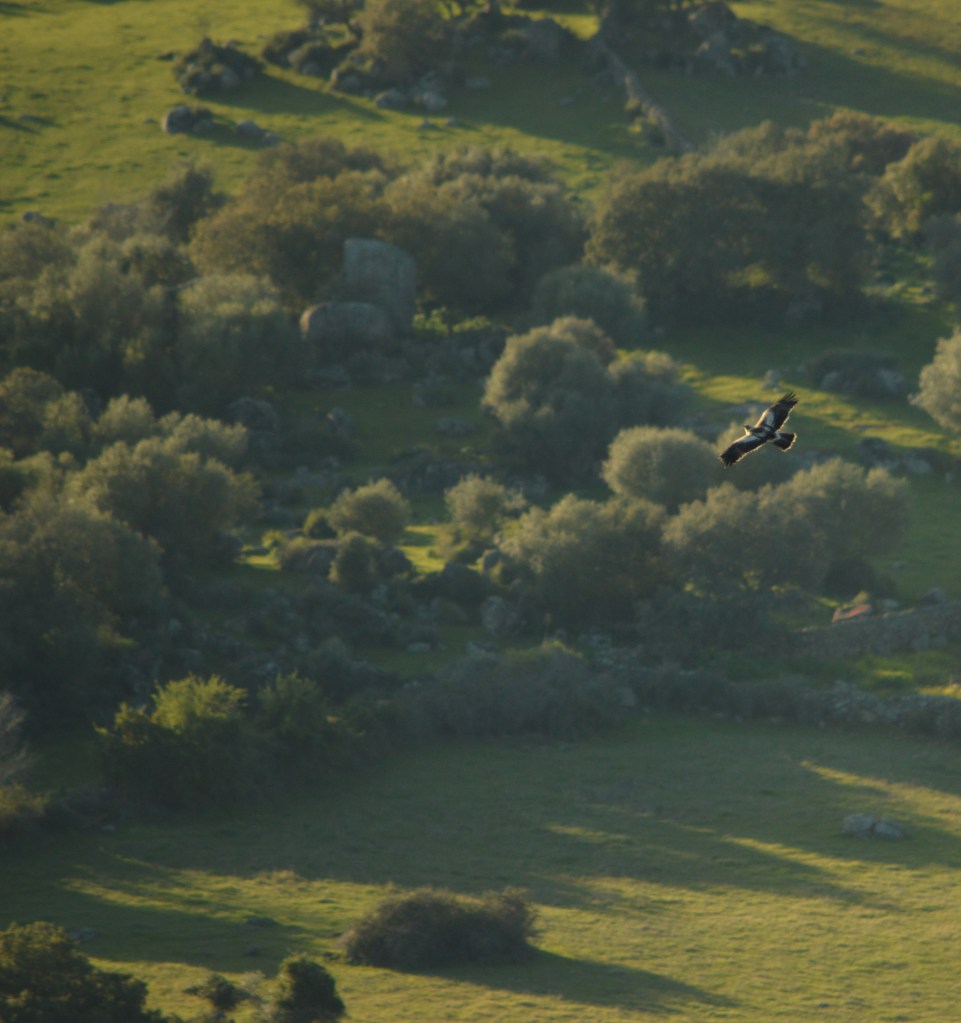
About an hour or so later on, as the Camino threatened monotony on a 5km asphalt stretch, she sent another gift in the form of a white raptor: an Egyptian vulture, the first I’ve seen in years, smaller than its griffon cousins but by no means less impressive. Between these two gifts and the cries of buzzards that followed me all the way to Pola de Lena, I was in good company all morning.

Something that caught my eye along today’s route was the quiet fury at the Asturian AVE line. The AVE (Alta Velocidad Española, Spain’s high-speed rail line) arrived late in Asturias, with works completed in November 2023. The project took nearly twenty years to complete, owing to the difficulty of the terrain – namely, the formidable barrier of the Cordillera Cantábrica. The first attempt to dig a tunnel through the mountains hit an enormous aquifer that drained many of León’s rivers and reservoirs, requiring rapid repairs and a considerable sum of money to re-route the tunnel.

All in all, the final cost of the AVE line from Madrid-Gijón was around 4€ billion. For context, the Madrid-Barcelona line cost around 9.5€ billion to lay down, which is just under twice the length, but there is considerably more traffic between the two megacities, and the Catalans have always benefited from their access to the profitable Mediterranean Sea. The Asturians, on the other hand, are proud of the natural beauty of their mountain principality and the decision to mine straight through the mountains does not seem to have been universally welcomed here.


I reached Pola de Lena at around 12.15 and killed some time over lunch (alubias con orejas, chuletón and natillas – and all for less than £10!). I had the same rigmarole with the train ticket as I had in France: the ticket barrier wouldn’t recognise the QR code on my phone, so as there was nobody at the desk, I just bought a 2€ ticket to the next stop. And just like France, the QR code worked perfectly at the other end. No idea what that’s all about.

Oviedo is a very different city to the ones you encounter on the Camino Francés. It feels distinctly more European than Spanish: large green parks, blocky, modern buildings and no plane trees in sight. I had to cross one such park to reach the albergue and practically stumbled upon a statuette of Mafalda, the beloved creation of Argentine artist Quino. She’s a big hit in her home country (and in Spain), but Oviedo has a special place for Mafalda due to the presence of her statue in the park. That’s why you’ll find Mafalda-themed tee-shirts and toys in shops all across the city.


I got to the albergue in time for 16.00, when the hospitalero hobbled in, but it was gone 17.00 by the time I got to check in – despite being only seventh in line. The poor guy seemed to have learned the monologue like a script which he rattled off at high speed, too fast for even the Spaniards amongst us to understand. The only point he was crystal clear on was that we had to be in by 22.00h, at which point he would close the doors. I suppose that must be a recurring problem in the cities.

I can tell you one thing I’ve noticed immediately about the Camino Primitivo. It’s a lot more European. I haven’t met a single American (or Brit, for that matter). Lots of Spanish, lots of French and a scattering of German, Austrian, Italian and Portuguese. But no Americans. I wonder if that’s a thing? Do they only come across the Atlantic for the “big ones” – the Francés and the Norte? The Primitivo is just under a fortnight (I will be doing it in around 10-11 days) so perhaps it’s not worth the investment. It will mean a serious shot in the arm for my languages – and isn’t that precisely why I love the Camino so much?


It would be remiss of me to come all this way and not visit the Catedral de San Salvador, so I slipped in for a flying visit just before closing time. True to form, the scaffolding curse struck again: the cathedral was untouched, but the image of San Salvador was behind a heavy hemp screen, being carefully restored by a couple of painters. There’s plenty more to see, though, and I had a wander around the sacred relics and the pilgrim tombs in the cathedral’s antechambers.

Just before leaving, my eye was caught by a small but incredibly ornate chapel by the exit to Santa Eulalia de Mérida, a teenage saint from Extremadura who is venerated in Asturias. She’s a long way from home, up here in the cold mountains of Asturias; but then, so was the Lady of El Rocío in that shrine by the lake west of Logroño.

I’m only just beginning to take an interest in the cult of saints in Spain – and I feel all the more foolish now for dodging an entire module on the subject at university. Given my especial devotion to the Lady of El Rocío, it seems a subject I really should explore some more. Maybe there’s a space for Eulalia in there. She would be a bridge to the land that stole my heart.


French to my right. Portuguese to my left. Spanish out in front. It’s shaping up to be a good Camino choice for languages. And if my plan holds out, I might even get to say one last goodbye to at least one of the pilgrims with whom I shared the road from Puente La Reina. New friends and old. That would be a nice way to end this adventure. BB x

Camino XXVI: The Journey Continues

Albergue de Peregrinos, La Robla. 16.13.

I’ve just woken up from an hour’s nap. It might have been a little longer, I’m not so sure. All I know is that when I fall asleep there were only three of us in the albergue, and now it’s looking astonishingly busy. Mostly sporty Spanish types in their 40’s, mind: tall and lean, with hawklike handsomeness in their Roman profiles and dressed from head to foot in short-sleeved Lycra and health-tracking smartwatches. The exceptions are a greying Dane and a Japanese couple, neither of whom speak any Spanish whatsoever. To be honest, I wasn’t expecting company at all, but then, perhaps it’s hardly surprising that others beside myself should seek out a more rugged and quieter version of the Camino during high season.

Hopefully it doesn’t get too busy. I’ve come here for quiet reflection and a spiritual challenge, not a hiking holiday.


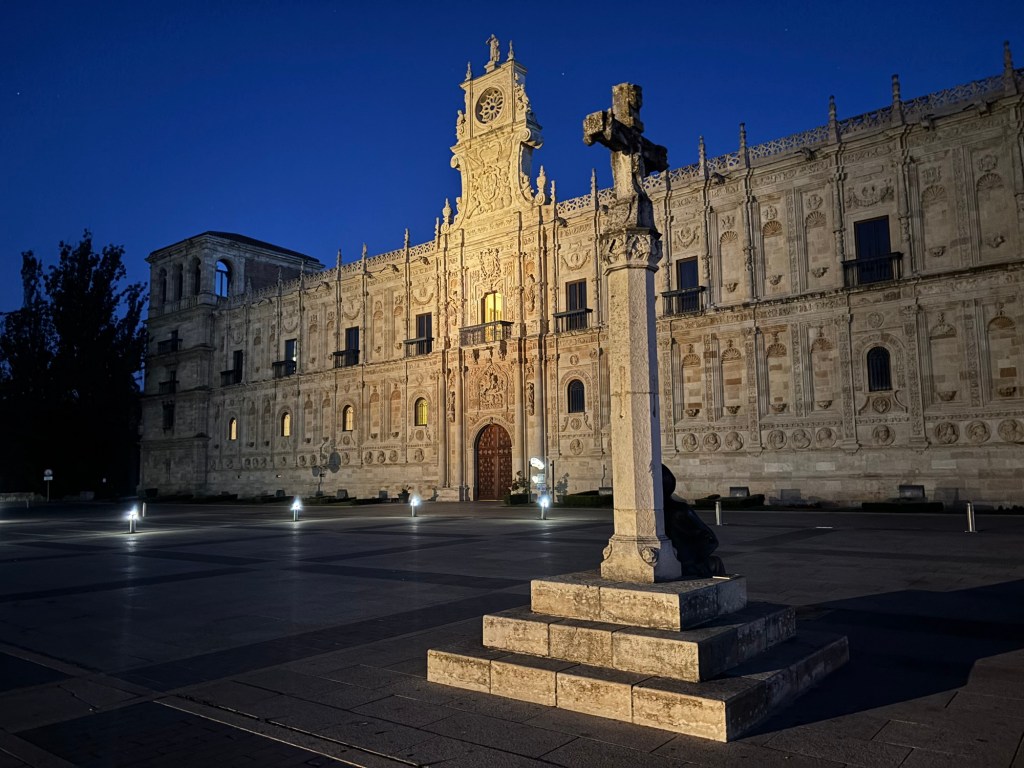
I left León shortly after six this morning and took the north road at the Convento de San Marcos, leaving the Camino de Santiago behind. I will not see that road again until I reach Melide, a little under two weeks from now.

I cast a glance down the westward road into the empty but well-lit streets of León’s industrial district, across the bridge where I said farewell to Audrey, Talia, Alonso and Steven yesterday morning. By now my companions will have reached Astorga and beyond a few manic longer days there is little hope of catching up to them before they arrive in Santiago, and with the terrain ahead I would be foolish to try. I have to let them go.


I had the Camino to myself all morning: no flashlight-wielding pilgrims in front, no Italian conversations behind. Just me, the morning and the voice of Derek Jacobi in his retelling of Robert Graves’ I, Claudius.

The pilgrim detritus of the Camino Francés is nowhere to be seen. This is what I had heard: this is the Camino as it once was, where the occasional painted stone, makeshift cross and shrine to the Virgin Mary indicate the way, not a scourge of senseless stickers and pilgrim graffiti. It was perfectly easy to follow, though I am glad I set out early, as the cloud cover began to fade before ten o’clock.

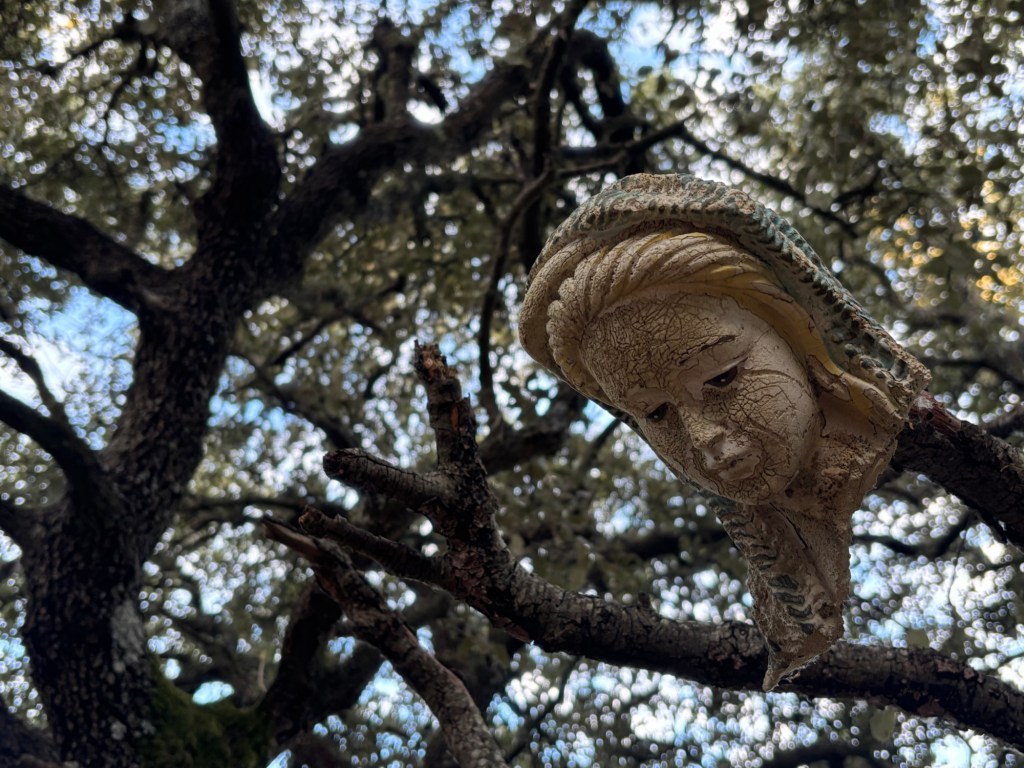
One such shrine to Mary was a little disturbing: her disembodied head had been impaled upon a branch staring down at the road, while her hands stretched across her chest to her sacred heart had been similarly affixed to a nearby branch. I could not find what became of her legs.


The Camino climbs up into the hills a couple of times, forging a path through the forest between the road and the river. Now and then it breaks out into the open, but for the most part I wandered beneath the canopy of ancient trees covered in carpets of trailing lichen. There was a strong smell in the forest that might have been fox, though it was different to any fox scent that I have ever caught. I thought at first it might have been wolf, but wolves are not as pungent as foxes – they also are good at covering their tracks by rolling in dirt to hide their scent so as to hunt more effectively. So I am not sure what it was.


I reached La Robla for 11.30 and considering pressing on to Buiza, but as tomorrow is Sunday, I figured it wiser to stop here, buy supplies for the road ahead (as nowhere will be open tomorrow), and rest. I popped into the local AlCampo supermarket to get some fruit, some bread and a few tinned meals in case of emergency. I took the flip-flops (a bad idea over anything but a short distance, but I needed a change of shoes) and managed to smash my big toe against the step when my flip-flop caught. It’s fine now, but it wasn’t a lot of fun at the time, though it may take some of the discomfort away from the blisters on my heels.

The lady at the checkout was very keen to get me an AlCampo card which they were “giving away”. The whole thing took around fifteen minutes to fix (as I had to use my long-since defunct Spanish mobile number and the town’s postcode, since the website wouldn’t accept either of my English credentials), but it may save me a little money in the long run – provided I shop at AlCampo. Which, I am sure, is the whole point.

The hospitalero still hasn’t appeared, but it’s nearly six, so I’m sure they’ll be here soon. In the meantime, I’m going to do some reading. BB x

Camino XXV: R&R

Albergue Parroquial de las Carbajales, León. 21.33.

I’m not entirely sure I needed a rest day. I could just as easily have pushed on to La Robla today and been well on my way to Oviedo, but I wouldn’t have got to say goodbye to my friends, and that was important. We had one final breakfast together at a bar opposite the Parque del Cid, and then I walked with them as far as the bridge of San Marcos. They set off with hearts full of light and I turned back to the city, alone.


Leaving the Camino for any reason is always a hard thing to do. Choosing to remain behind, however – that’s probably the hardest thing of all. Knowing that the companions who have been your world for the last two weeks are somewhere out there, still going strong, as you open the door to the place where you stayed to find the place dark and empty.

Chip, the friendly gentleman from Utah and the father figure of our little group, had gone by the time I returned. So it was just me. I’m perfectly happy with my own company, but that sudden void of emptiness still hit hard.

I didn’t have too long to wait. I sat in the square by the cathedral and watched people come and go for a little while. When twelve o’clock came around, I checked into the Albergue Carbajales (where I stayed two years ago), bought myself the Salvadorana credencial and struck out into the city for a little culture – something to take my mind off my sudden isolation.

I’ve been to the Centro de Interpretación in the Palacio del Conde Luna before, but museums are always worth a second look. León is the rival faction in the alternative history saga that I’m writing, not Castilla, so I’m always looking for details in places such as this to help me build my world.

I especially love medieval art – particularly the Byzantine style with almost-shaped, almost cartoonish eyes. They are far more descriptive in their storytelling than any early modern masterpiece and very easy to replicate in my journal. I was lucky to arrive just in time for a free guided tour with a local historian, too, which was pretty special.


Today was mostly, however, about people watching. I saw a handful of familiar faces in town – the digital nomad couple from Texas, the retired American couple I met in Hornillos, the Effing Dutchman and two Texans from the other young group who took a rest day in León – but on the whole they were mainly stragglers, as the rest of the weekend wave all moved on today.

No – today was for watching the people of León.


León is a part of Spain I have got to know rather well thanks to the Camino. Andalucía and Extremadura will always have my heart, but there is a proud and noble beauty in this ancient corner of Iberia. Leonese Spanish is crystal clear, which is notable in that their regional dialect, llionés, is closer to being a language in its own right than a simple change in accent. If the Castilians hadn’t proved the greater of the two powers, the Spanish we speak today might have sounded very different indeed.

As it is, a combination of geographical, political and economic factors left the Leonese stranded, looking inwards, while the mobile Castilians raced to grab the former Muslim territories across the border and, in so doing, sow the seeds of one of the most successful languages of all time.


There‘s still some lingering resentment about León’s status as an autonomous community within Spain. If it wasn’t obvious from the Camino signs (where Castilla or León are scratched out on either side of the border), it’s even more so in León itself, where Leonese flags are sold on the cheap and some stores carry placards or banners in their windows promoting self-rule.

We focus a lot on Catalunya’s constant struggle for independence, but it’s worth remembering that Spain was once a republic comprised of individual states, many of which were once kingdoms in their own right. The Catalans are certainly vocal, but they’re not the only ones with a claim on self-rule: the Basques, the Galicians, the Leonese and even the Andalusians could all claim that their regions are distinct enough to warrant independence.

The Americans I have been walking with are young and carry that profound dislike for nationalism and state boundaries that is so common at that age. I remember it well. But for me, though I remain a fierce advocate of liberty and freedom of though, speech and expression, I am also a believer in the good that comes from having a sense of national identity. After all, in my case, finding out about my heritage in Spain has given me immense peace of mind. I’m not just play-acting at speaking Spanish anymore. It’s literally in my blood.


Tomorrow, we begin again. I’ve heard there may even be wolves up in the mountains. I’ll keep my eyes peeled. BB x

Camino XXIV: The Road Not Taken

Plaza Mayor, León. 21.03.

Tomorrow marks the end of one Camino and the beginning of another. And not a moment too soon. I fear my social battery is at maximum capacity. I got the jitters after showing up late to the dinner the others had arranged at the Royal Tandoori, to find a crowd of fourteen.

Maybe it was the sudden shift from the intimate setting of my haircut the hour before to a busy table of English and Americans holding court over an Indian meal; or maybe it was the location of my Siege Perilous as the final invitee, squashed into the corner; or the fact that they’d started without me.

Whatever it was, I know now that my decision to leave the Camino Francés is a wise one. It’s a little shameful to admit, but I could use a break. I’m not proud of the fact that these social settings continue to throw me every so often, but I am getting better at hitting the escape button before it escalates.


On the walk into León this morning, Talia asked me a question that has genuinely had me thinking all day. I think it was something like this:

When did you decide not to pursue a career in biology?

At first it seemed a pretty straightforward question. My grades in Biology were never all that great, the competition at my school was just too much and it never occurred to me even once to study Biology (or Natural Sciences) at university.

But with a little context, I can see why she asked me that out of the blue – and I’m frankly amazed how much I’ve suppressed what is nothing less than a core memory that might once have changed the course of my life.

Audrey was using an app to identify some of the birds we’d seen since leaving Mansilla de las Mulas – I think it was Seek. I pointed out a few things I could hear: serins in the branches of a nearby tree, a booted eagle circling in a field, the bee-eaters we’d heard the day before.

I guess it was that quickfire succession of names that prompted Talia’s question. My answer was fairly improvised, but I think it checks out.

When did I decide not to pursue a career in biology? When I realised that it was never going to be about zoology – not under the British education system, anyway. That, and my mathematical ability was (and is), quite frankly, dismal.


I have various interests. I’m a musician. A linguist. A writer, an occasional poet and a Hispanist. A mimic. A Catholic. But before all of these things, I am a naturalist. Before I found my fluency in Spanish and French, I could already understand the calls of every bird in the British Isles and could tell you what most of them meant: warning, alarm, hunger and mating calls. It was, I suppose, the first language I ever learned.

I was just as obsessive with my childhood interest in dinosaurs: I had to know them all. Where they were found, why they were called what they were called. It wasn’t enough to know the famous ones, like the T-Rex and velociraptors – I had to dig deeper. One such precocious example that comes to mind was my decision to bring along a Eustreptospondylus drawing to Show and Tell at primary school. Doubtless an elephant would have sufficed, but why would I ever have settled for something as basic as that?

I still have discarded exercise books that my parents gave me where I logged all the species mentioned in wildlife documentaries. I always put down the title and locations covered, and I sometimes wrote the date, too. Others I used as scrapbooks, taping in feathers and sketching footprints and writing about when and where I found them.

You’d have thought that these might have been the early indicators of a scientist. Certainly, I wanted nothing more than to be a palaeontologist when I was a kid (which can be gently excused by the fact that the BBC’s peerless Walking with Dinosaurs documentary series came out just in time to capitalise on my five-year-old dinosaur obsession.

When I was a little older, I genuinely considered a career in conservation. I entertained the idea of a degree in Ornithology, or something similar, to allow me to put my fiendishly good memory for birds and their calls to use.

And then, suddenly, that dream died.


It was probably the maths that killed it. All the natural science degrees I explored required a basic level of mathematical competence and at the time I was struggling to scrape even a passing grade at GCSE. Chemistry, too – a lot of Zoology degrees suggested chemistry as an A Level, and chemistry was far too mathematical for me. Without maths, my conservation aspirations were dead in the water. That was that.

But there was another factor that pushed an old dream out of the nest: the slow decay of a child’s interest as the subject closest to his heart never even materialised in the subject that should have concerned it most intimately.

My memories of Biology center on two things: plant cells and sourdough bread. I was so excited when food chains and food webs came up, until I realised that, within the British curriculum, that was the one and only time that animals would be mentioned. Everything else was so cold, so clinical. Palisade walls and mytochondria. Genomes and inheritance, though usually in plants. The fact that I knew the names of every animal and bird in the British Isles (and most of Europe, for that matter) gave me no advantage whatsoever.

My school was a specialist science school. Our Biology department was doing really exciting things with MS research, and it was one of my Biology teachers who was instrumental in sending me out to Uganda on my first ever teaching post. But somewhere along the way, my aspirations as a conservationist were slowly choked by the strangling vines of the British science curriculum. Zoology, palaeontology, anthropology, ornithology and even primatology were all areas I was desperate to explore, but as the years went by and Biology concerned itself less and less with the natural world and more and more with the minutiae of bacteria and cell structure, the less I cared for it.

It must have been around then that I first entertained the idea of becoming a teacher – once I realised I would never be good enough at two of my weakest subjects to survive to the point when Biology became Zoology. Fifteen years old and already carrying the shards of a shattered dream.


One way or another, I think I realised early on that there was little that a Zoology degree could teach me that I truly desired. I didn’t need to pursue a career in science to justify my greatest love. Knowing the names of every animal and bird gave me a sort of spiritual connection with each and every one of them – no scientific research could work a greater magic than that. Still, it’s interesting to think where my life could have gone if I’d really committed to that path.

Instead, here I am, gone thirty, walking the Camino with a head that twists so quickly when I see the silhouette of a kite or vulture that it’s a miracle I haven’t twisted my neck yet.

It’s hard to say what my experience would be like if I walked all the way to the end of the road with these wonderful people. I will never know, because I have made my choice. And I know it is the right choice. It will take me up into the mountains and back into the natural world, where I am and have always been at my happiest.

Here’s to that – to good health and happiness, and a significantly harder road ahead! BB x

Camino XXIII: Sacrifice

Albergue El Jardín del Camino, Mansilla de las Mulas. 22.20.

I’ve developed my first blisters of the Camino, but typically for unconventional me, they’re not on my feet at all. They’re on my lower back, where the frame of my rucksack has been rubbing, despite my best efforts to adjust the straps. If I adjust them any further, I won’t be able to fit my arms through the straps, or take them out for that matter. I’ve put some Compeed over them and that has helped a little, but it’s a bummer to have to slum it with the rest of the world after such a glorious blister-free run of it.


We left Sahagún early, lingering for half an hour later than yesterday to take advantage of the breakfast left out by the Benedictine sisters and their volunteers. It was still dark when we set out – not as pitch-black as yesterday, but still dark enough to warrant the use of torchlight to find the signs here and there.


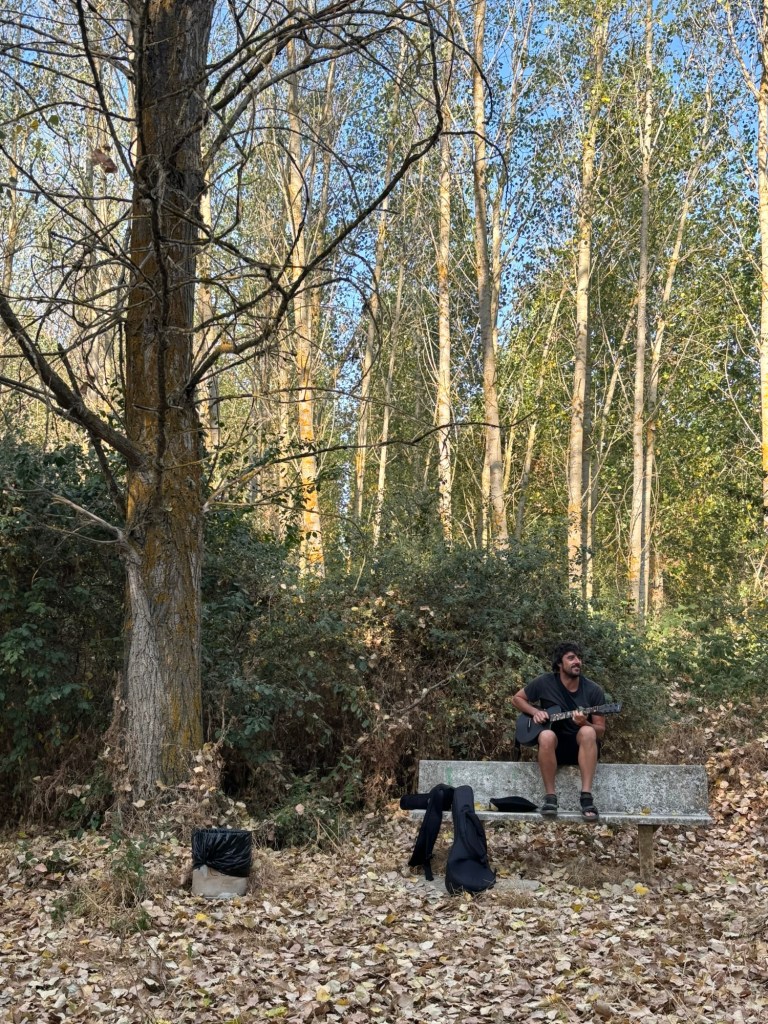
We passed Bercianos early and most things were shut, after which I started to get itchy feet and took off ahead. Along the way I heard the strumming of a guitar in a slim stretch of forest – a brief oasis in the golden fields of the meseta – and there I found Steven, a Chilean-South African who we haven’t seen for about a week. He’d found a solitary spot beneath the trees where the orioles sing to play his heart out. That’s something I’ll admit I’ve been missing a bit in this fun but busy Camino.


I stopped a couple of times during today’s walk to appreciate the silence of the meseta. There’s not much like it. I imagine the Dakotas might have the same sound – or rather, the same total absence of it. I suspect it’s that all-encompassing stillness that leads some pilgrims to abandon the Meseta altogether, fleeing the self-imposed stillness that surrounds you from the moment you leave the city of Burgos and step up into the golden highlands. I am not even out of it yet and I know I shall miss it when it has gone.


Today, as I have done on my solo strike-outs, I allowed myself a moment to listen to some music. Mostly from my favourite musicals so I could sing along (Jesus Christ Superstar, West Side Story, The Prince of Egypt and Fiddler on the Roof), but also my recordings from my various musical endeavours with my students over the years.

Rutherford House’s Rolling in the Deep and their house band’s covers of Stayin’ Alive/Without Me and Thrillie Jean. My short-lived Gospel Choir’s Ain’t No Rock. My new funk band’s one-day run at Lauryn Hill’s Doo-Wop. I forget more than half of the lessons that I teach, but every rehearsal and every performance stands out in my memory like an island in a wide, wide sea. The voices of the children I have taught surround me like a vortex in the Meseta and I am lifted up by the smiles on their faces as they experience the same giddy thrill that the music gave to me when I was their age. It makes the whole thing worthwhile – the long hours, the nerve-shattering email and Teams threads, the windowless flats and the social life that I have sacrificed upon the altar of my calling for the last nine years of my life.

Without the music, it would all be for nothing. It would all be a mistake.

There’s all sorts on the Camino. Sane and insane. Students and soldiers. Culture vultures and racists. Free spirits, free lovers, free thinkers and freeloaders. People who seem to think it’s ok to slap stickers advertising their YouTube channels on every flat surface and people walking so fast they don’t have time to read. And yes, while many pilgrims blanch at the idea of singing together (barring the Italians, these are frustratingly common), there are plenty of us who leap at the chance to connect with others through the medium of music, the truly universal language.

I’m a little disappointed that the most popular Camino-related song one encounters along the Camino (besides Ultreia, Suseia) is a mawkish folk song in English called The Way that is currently being aggressively marketed in sticker form wherever you go. By comparison, even the Taizé songs that have now sunk their claws into the Camino are a breath of fresh air – at least they respect the multilingual world of the Camino de Santiago (which I refuse on principle to translate as “the Way”).

I’m having a much more spiritual time on the Camino this year. I’ve managed to attend Mass most days, despite traveling with a group of non-Catholics, and all the pilgrim blessings have been very special. Yes, I’m still a little annoyed by the rampant secularisation of the Camino and the way it gets treated as a big and sociable walk across Spain, as though that’s all there is to it… But every day is an exercise in tolerance and I’m doing my best to listen and learn.

I miss Spanish food. I’ve sacrificed my usual diet to facilitate the dietary requirements of my fellow vegetarian and gluten free pilgrims and it’s meant a lot of bland and global meals for the last fortnight. But that’s just one more lesson the Camino has to offer: life is all about sacrifice, especially if you live to serve, as I believe we do. Sometimes we have to give up the things we want the most – a job, a lover or even just a plato combinado – to make sure that those around us can be the very best versions of themselves. It isn’t an easy path, but I know that it is the right one.

Faith in its most literal manifestation may not be as ubiquitous on the Camino de Santiago as it once was, but it can always be found in the small actions and interactions of others. That gives me hope. My back might be hurting from the friction of the weight I’m carrying, but my heart is light. BB x
Camino XXII: Starlight

Albergue de la Santa Cruz, Sahagún. 21.17.

Today was a lot more like the Camino Francés that I remember: long, unforgiving, sociable and under the stars for the first half of the morning. I’ve been taking it easy with all these post-sunrise starts with the other pilgrims, so with my fork from León now very much on the horizon, it’s good to get back into the routine.


We agreed the night before to strike out for Sahagún, partly because Audrey wanted to go further and potentially save a day to add to the end of her trip, and partly because I wanted to get to Sahagún after having had the place recommended at least twice. There was also the very real possibility that we could both shake the freeloading Englishman and catch up to the endlessly entertaining double act of Juha and Mad Max, who have been at least a day ahead of since Grañón, where the floor beds didn’t agree with Max’s back.

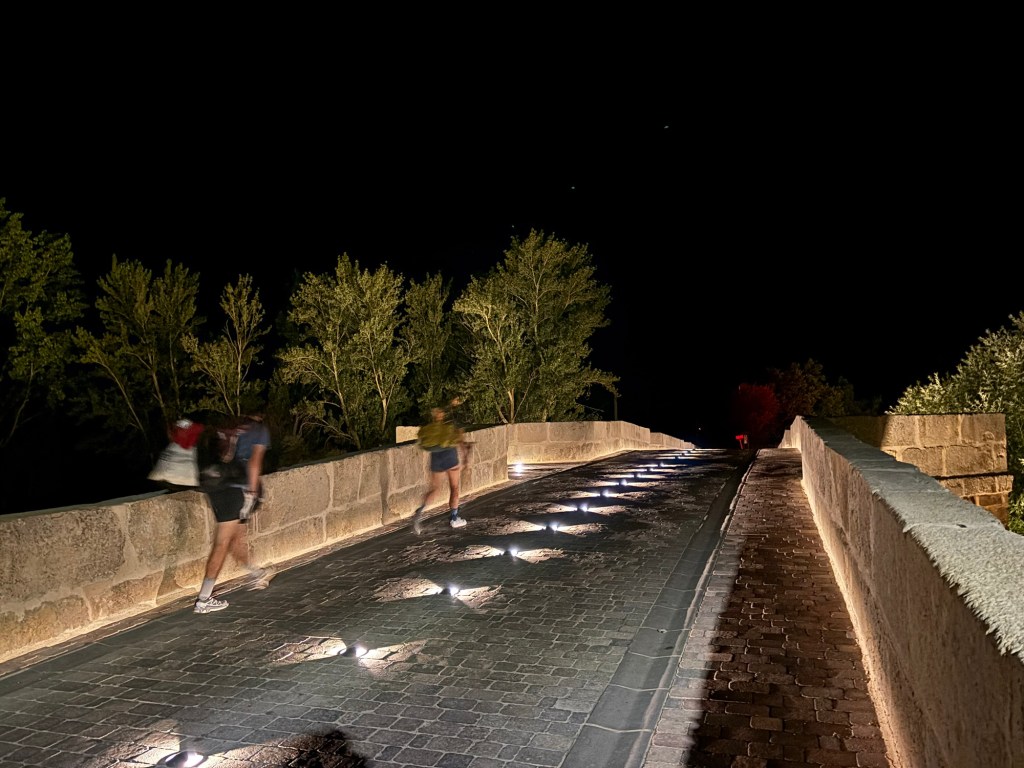
So, at five on the dot, the five of us set out from Carrión and into the night. We lost Edoardo sometime before sunrise – I’m not sure he could keep up, as he does appear to be carrying the biggest stick on the Camino (which probably might be better described as a branch or log). I also got lost: in my stubborn refusal to use artificial light, I completely missed the turn-off to the pilgrim road after Carrión and lost twenty minutes backtracking once I’d realised my mistake. On the plus side, it did mean total silence and an unrestricted view of the night sky, which was spectacular this morning.


There’s no lighting along the nineteen kilometre road between Carrión and Calzadilla, and all the towns are distant, so the stargazing was almost as good as it was on Tenerife. Even the Milky Way was visible, stretching westwards toward Santiago like the songs describe.

I spent a great deal of the morning racing ahead, mostly because of an obnoxious pilgrim who was lighting the entire path with a brilliant LED head torch, even though visibility by star and moonlight was perfectly good enough once your eyes had adapted. With him in the dust, I allowed myself some time to listen to a couple of chapters of an audiobook (some short stories about the Sargasso Sea from Strange Tales from the Deep and I, Claudius).


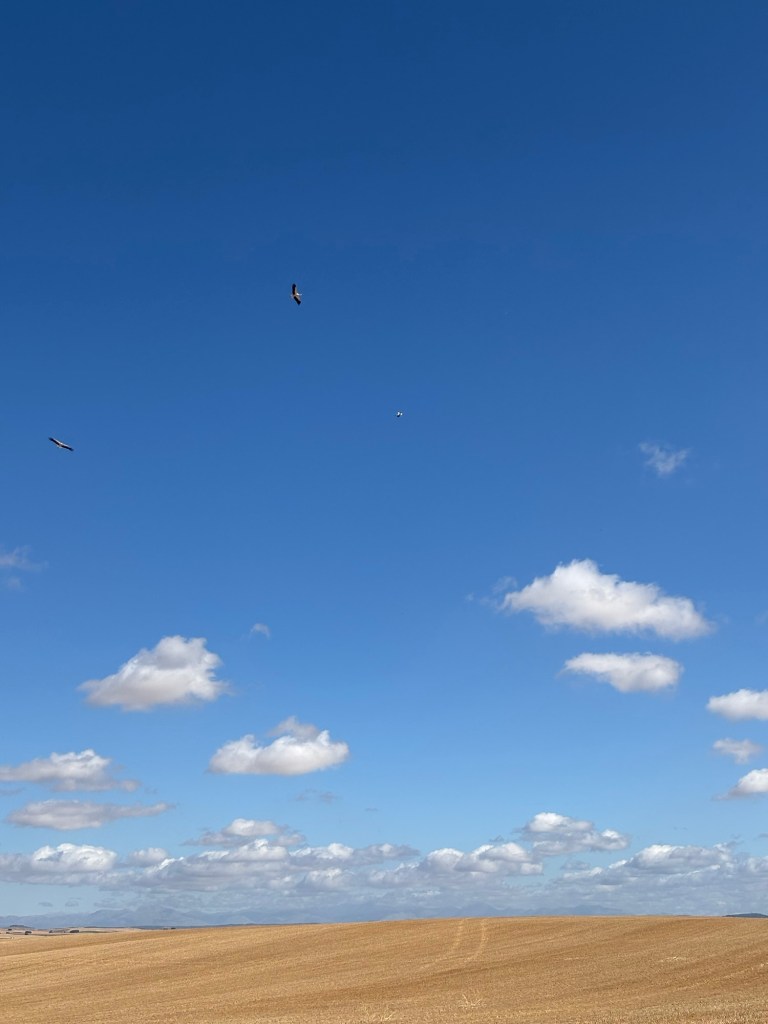
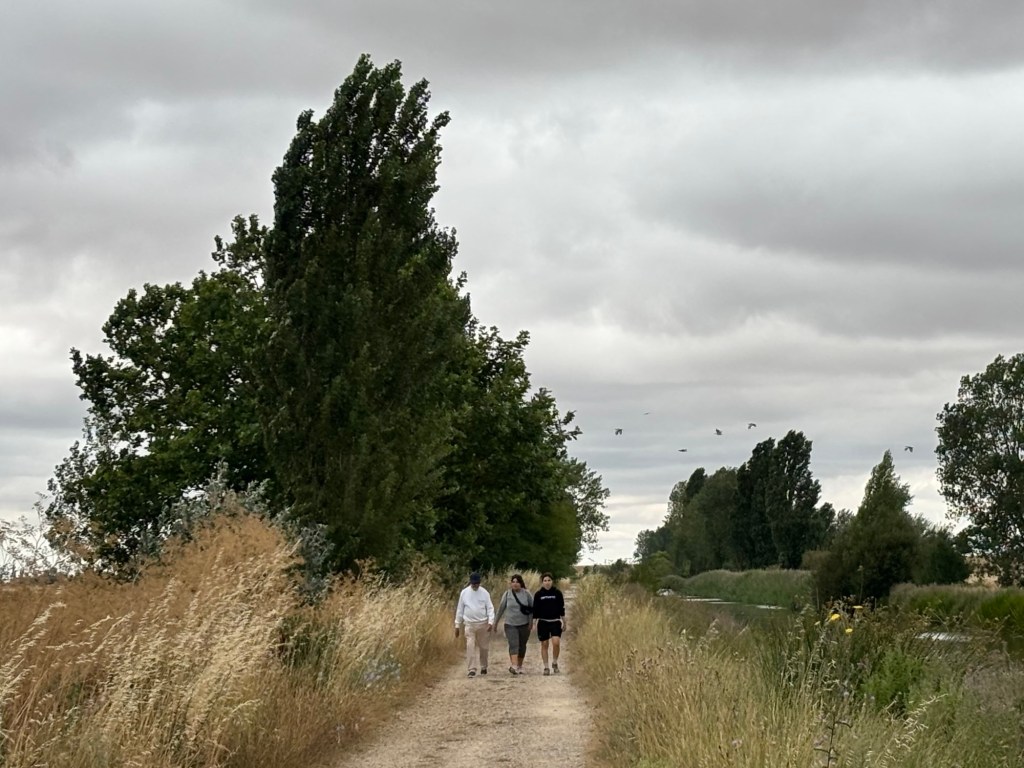
Not too long after sunrise, I saw flashes of white in a field by the road and trained my eyes on the spot: I counted ten great bustards, closer than I’ve ever seen them. Of course, they were far too distant for my iPhone (which makes for a superb camera, but is utterly useless as a telephoto lens), but you can just about make them out in the photo below (to the right).


After a brief pitstop for breakfast in Calzadilla, I raced on ahead once again. This time, I took advantage of the empty pilgrim road to do some singing practice, mostly from Jesus Christ Superstar, which I pretty much sang off-copy for all parts. I don’t have an eidetic memory, but I do have an uncanny ability to retain enormous amounts of information about things I’m interested in. Musical scripts fall under that category.


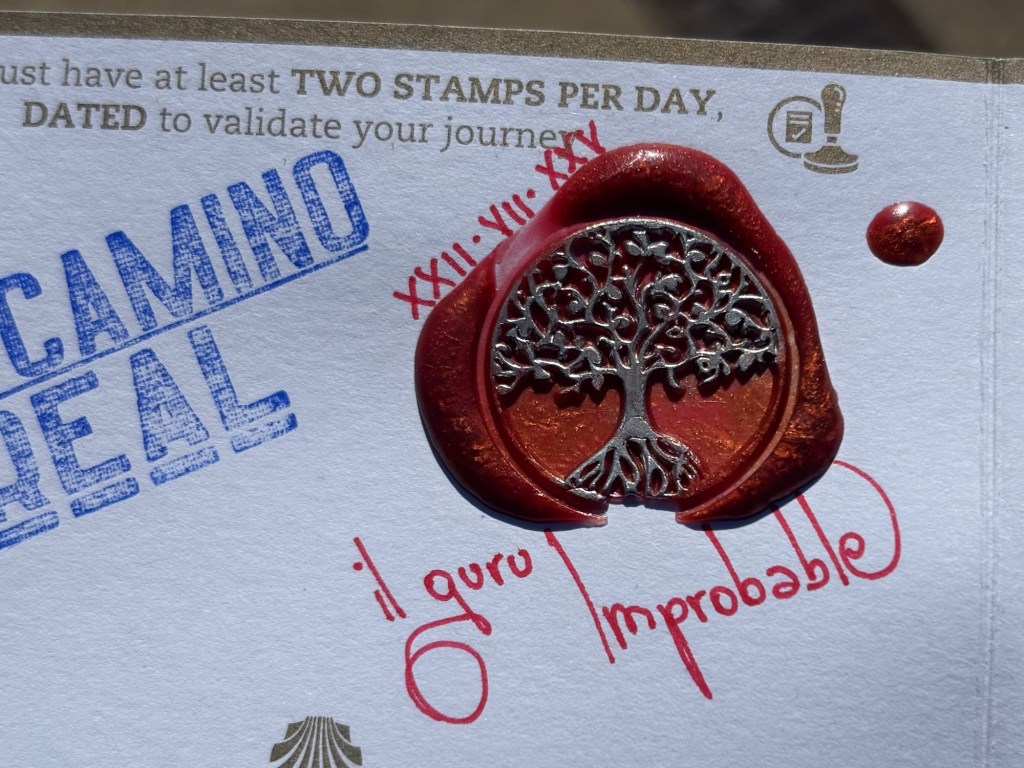
I stopped in Moratinos to pick up a beautiful wax stamp from Il Guru Improbable. I’ve missed this one before, as it’s much too soon after the usual staging post of Terradillos de los Templarios to obtain in the early hours of the morning, so I’m glad I pushed on today.


At Moratinos, I took up with a new group of pilgrims: Tom, a retired education superintendent from Michigan; a Finnish woman on her fourth Camino; and Tina, a Swiss-Guatemalan girl inspired to walk the Camino by a German comedian who hates walking. It made for a healthy change, and it was fun to tell my grandfather’s tale in full once again, which I haven’t done anywhere near as often on this Camino – last time, it usually preceded me by the time I met a new face!

Audrey caught up to me as we approached Sahagún and we entered the town together, seeking a pharmacy (for her feet) and an ice cream (for my appetite). At 13.10, it was the latest we’ve arrived at a destination yet, but it did mean no waiting for the albergue to open, which was a huge plus.


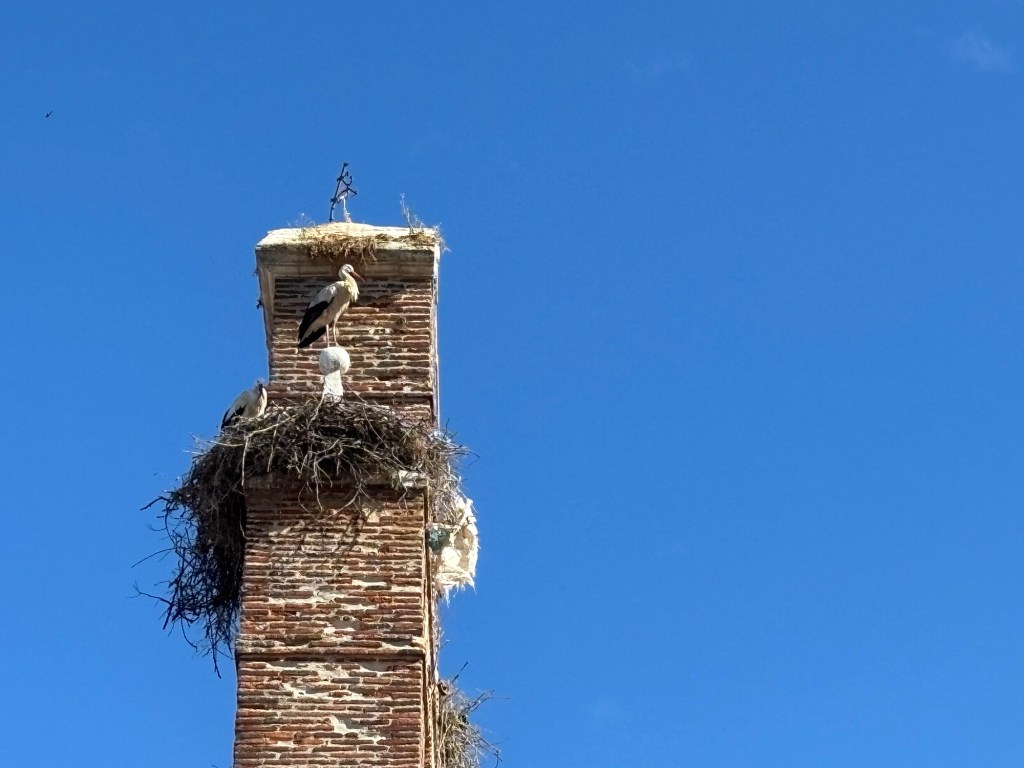
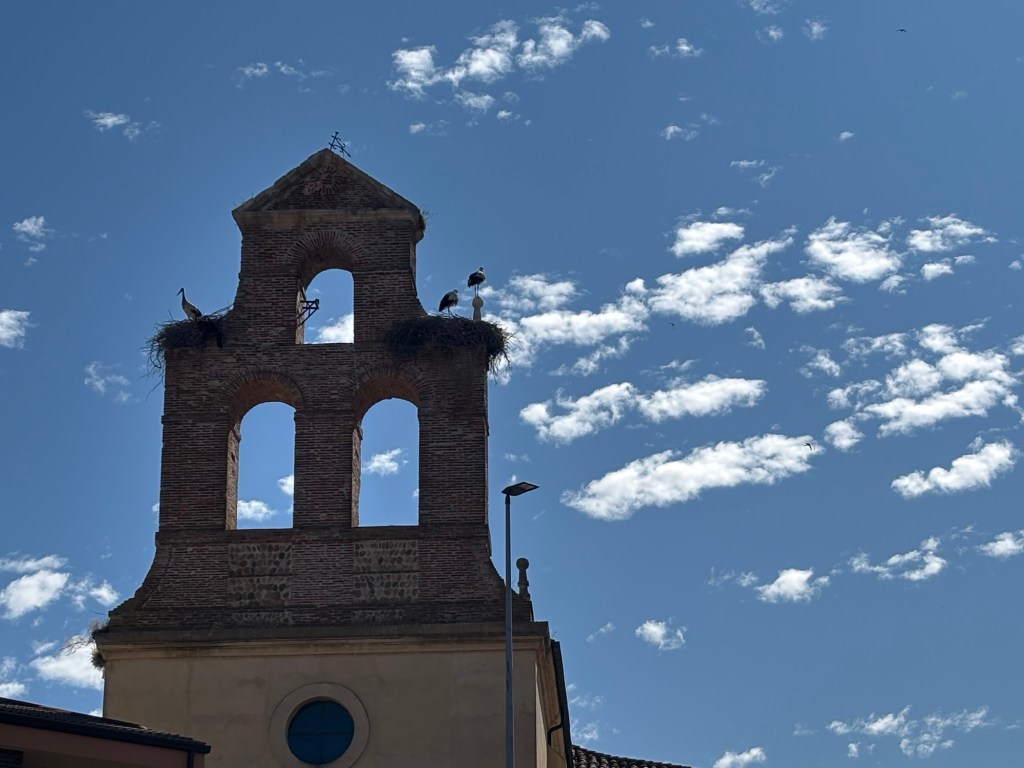
The bells are ringing for 22.00, and the white storks nesting on the bell tower are doing a lot of beak-clicking. That’s a sound I will always associate with Spain, no matter where else I may hear it.

Tomorrow we’re going to do another long slog, striking out for Mansilla de las Mulas if we can – which should, in theory, catch us up to the others who we lost on the road over a week ago.

Catch you later! BB x
Camino XXI: Carrionero

Albergue Parroquial de Santa María, Carrión de los Condes. 22.08.

Carrión de los Condes is a wonderful place. Which is odd, as it’s believed to have been named for the villainous counts who did their level best to defile the daughters of Rodrigo Díaz de Vivar in the Lay of El Cid, the (half) true story of Spain’s greatest hero. Even the proper name, Carrión, is an oddity: though it likely sprang from a mangling of the Latin name “Caro”, in its modern form, it carries a double meaning as a pejorative term used to describe somebody vile, useless or otherwise despicable. A carrion-eater, perhaps – one too weak and cowardly to do their own work, and happy or scavenge off the labour of others.

Which, curiously, serves as a good launch-point into today’s blog. Without putting too fine a point on it, I’ll paraphrase Hagrid from the Harry Potter films: not all pilgrims are good.


We left Frómista late (around 7.20ish) after making a valiant assault on the watermelon that Alonso bought last night. It made for a decent breakfast, but we couldn’t finish it all in one sitting, even between the four of us. We put it in the fridge for the benefit of other pilgrims coming after us. We were hardly out of the door when one pilgrim – who had been on the road with us for a while – appeared out of nowhere, made a beeline for the fridge, and took the melon for himself.

Well, that’s kind of what we intended by leaving the melon, right? So what’s the problem? As always, context is everything.


We cleared the 19km distance between Frómista and Carrión in a little over four hours, including a stop in Villalcázar de Sirga for an early lunch. It’s an easy walk, but easily the most tedious of the entire Camino, as it is an arrow-straight line that follows the P-980 highway in its entirety. Opportunities for wildlife observation are slim, and cultural tangents even less. It’s just a long walk in a straight line. At least the storks of Carrión kept us company. We also picked up a new companion in Edoardo, an effortlessly charismatic Italian soldier from Puglia, who was great company on the road.


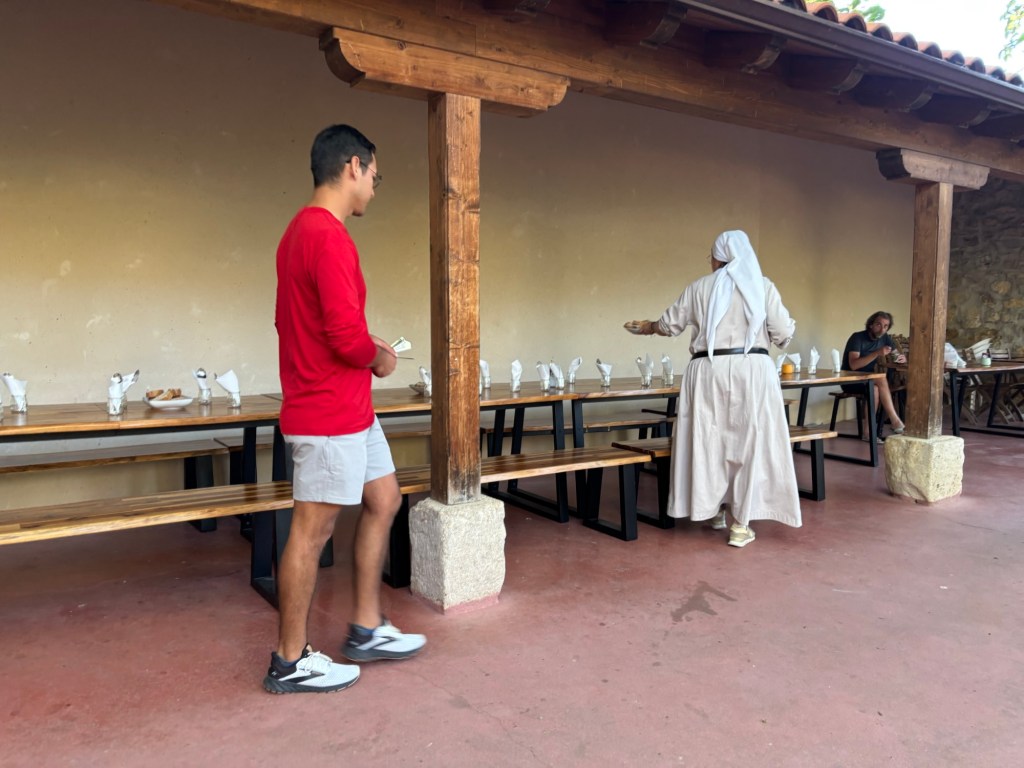
The Albergue Parroquial de Santa María opened at midday and we were warmly received by the Augustinian nuns and their young assistants, three university students from Galicia, Madrid and Granada. Marta, the granadina, was especially friendly – though that may have been on account of my Andaluz accent which always comes out roaring the moment I meet someone from the south. Edoardo was almost certainly smitten and did his best to charm all three of them, but the granadina especially. I’ve seen a fair amount of bare-faced flirting from older gentlemen on the Camino, but the Italians do it with considerably more panache. It also helps when they’re not over the age of fifty, I suppose.

Vespers was beautiful, as Carrión’s nuns are famously musical, led by the vocals and guitar skills of the Peruvian sister (who was here the last time I stayed in Carrión). The encuentro musical was especially magical this time, because unlike Grañón, they asked us outright to share our reasons for walking the Camino. I did, explaining how I’m walking for my grandfather and my great-grandparents who never had the chance – but also as a way of saying thank you to La Virgen del Rocío, who was instrumental in curing me of a tremendously broken heart earlier this year.

And what did they do? They decided on a whim to play us a song for La Blanca Paloma, just for me – the Salve Rociera, known as Olé, Olé. What a beautiful thing to do! I’ve included the lyrics below, because they are so wonderfully poetic:

Dios te salve, María
Del Rocío, señora
Luna, sol, norte y guía
Y pastora celestial

Dios te salve, María
Todo el pueblo te adora
Y repite a porfía
Como tú no hay otra igual

Al Rocío yo quiero volver
A cantarle a la Virgen con fe
Con un olé…


Fizzing with the warm glow of a satisfied acolyte, I went along to Mass. It was… eventful, to say the least. The Bishop of Palencia was in town to conduct the proceedings, which – unbeknownst to all but the townsfolk – had kindled the fire of a small but powerful rebellion.

As was later explained to me by one of the parishioners, their long-serving and beloved parish priest was in the process of being transferred, and the locals – who seemed to adore the man with a fervour rarely seen in the UK – decided to use the arrival of the bishop to make their feelings known. There was a loud buzz toward the end of the service as the doors were flung open, and in marched a large crowd of children and their parents, all of them carrying placards and banners with slogans saying “La voz de la iglesia es la voz del pueblo” and “Queremos que Don Ricardo no se vaya”. The press seemed to have been tipped off, and Don Ricardo made a rather humble exit – I wonder what he made of the spontaneous show of fealty from his flock? It must have been hard to hide any emotion.


After Mass (and the mass protest), I went back to the albergue to help Edoardo make dinner – I cut and cooked the spaghetti and laid the table as the Italian had already prepared an enormous serving of pisto (free from gluten and meat, as it’s hard to cater to everyone with one dish). Together with the nuns and their three volunteers, we put out quite a spread.


And who should have arrived at our albergue at the last minute but our melon thief! He was conspicuous in his absence from the preparations and did not lift a finger during the clean-up operation, plugging in his earphones and retreating to the other side of the table – present but idle. Not only that, but while the nuns were saying a prayer, he got up and helped himself to seconds and then thirds of the soup the nuns had prepared.

Perhaps I’m being harsh, but this is the fourth time we’ve seen him do this: turn up to an albergue, contribute nothing, extricate himself from the communal preparations and then arrive just in time to devour the spoils, without so much as a please or thank you. Worse, he had the gall to comment that he didn’t think the meal was worth 4€ when the Italian asked for a small contribution to cover the costs of buying the supplies at the end of the supper.

I have spoken to the man previously – who, I am ashamed to admit, is a fellow Englishman – and he admitted that he doesn’t pay in donativos because he believes they’re already dodging taxes, and therefore don’t need our contributions. Which is odd, as he seems quite happy to scavenge off the contributions of others.

Shameful doesn’t cover it. I’m this close to confronting the man, which wouldn’t be in the spirit of the Camino… but if there’s one thing I won’t stand for, as a pilgrim and a teacher, it’s selfishness. I was raised to always put others’ needs before my own, so that kind of behaviour really sets my teeth on edge.

I prayed for him – partly to temper my own frustration and partly out of habit (it’s a good way to deal with people you don’t get on with). I hope he starts to see the light on this Camino and learns to chip in, like so many of us do every day along the pilgrim road, as it would be a dreadful shame if his behaviour cast a dim reflection on the English attitude toward the Camino.

Rant over. I just needed to point out that we pilgrims aren’t exactly model citizens. He’s not. I’m not. I should be the better man and not let it get to me so. But the Camino is the world, and thus have we made it. It’s up to us to call out that kind of behaviour in such a way that everyone feels they can contribute, even in some small way.

I’ll sleep on it. Hopefully I can come up with a way to bring him amicably to the service of his kin. Me, or some higher power.

Our Lady of El Rocío, if you’re listening… give me strength!

BB x
Camino XX: Soup and Bustards

Albergue Municipal de Peregrinos, Frómista. 19.59.

Well, you’ve got to hand it to the good people of Castrojeriz. They may not sleep much, but they sure know how to party.

The Garlic Festival kicked off at around 7pm. While the others ordered pizza, I went without supper (with the free sopa de ajo in mind), which turned out to be a mistake. They finally started serving at 9.40pm, and queuing for half an hour, I reached the serving station only to find that you had to bring your own bowl. Turns out the identical brown bowls the townsfolk were all carrying can be found in every home in Castrojeriz and beyond. It would have been nice to know before getting in line – you know, like a sign or something – but then, Spain has never been overly fond of letting non-locals in on its secrets. So I was dismissed with an apologetic ‘ay, pobre’ by one of the volunteers and went to bed on an empty stomach.


I had about an hour’s sleep until the Orquesta Dakar started playing just after midnight. They didn’t stop until ten past two in the morning, after which they were followed by a DJ until half past four. I’d be lying if I said I didn’t enjoy the music, as it was absolutely my taste – Suavemente, Las manos pa’ arriba, Bailando, Madre Tierra, Mentirosa, El Tiburón and, randomly, You’re the One that I Want, to name just a few – but it did mean sleep was impossible. Then there was the family of locals who stopped beneath our window and, for whatever reason, decided to start howling and barking like dogs for a couple of minutes sometime between two and four (clearly all that garlic had no effect on the local werewolf population). I must have passed out somewhere around four, and was up again by five.

Thank goodness today was a shorter day!


There wasn’t much call for shooting off early on some monstrously long hike on no sleep (which I’ve been known to do when sleep-deprived), so I stuck around and had the fried breakfast buffet I’d paid for. We tackled the Alto de Mostelares and were up and over by half past seven. It was an easier climb of it than it would have been under the midday sun, but I couldn’t shake the feeling that I should have pressed on yesterday and made for the Ermita de San Nicolas for a more spiritual (and restful) stop.


Descending from the hill, I found a manic speed in my feet and took off at a vicious pace. I didn’t need to, really, considering I had left far too late in the morning for another mad rush to Carrión, but for some reason I wanted to go it alone this morning.

It did mean for a bit more wildlife observation than I’ve managed for a while. There were a few silhouetted harriers up on the high Sierra de Mostelares, and a couple of rabbits and red deer grazing in the fields beyond. I was accompanied all the way by small families of stonechats and huge flocks of serins, twittering merrily from the stands of trees by the road.

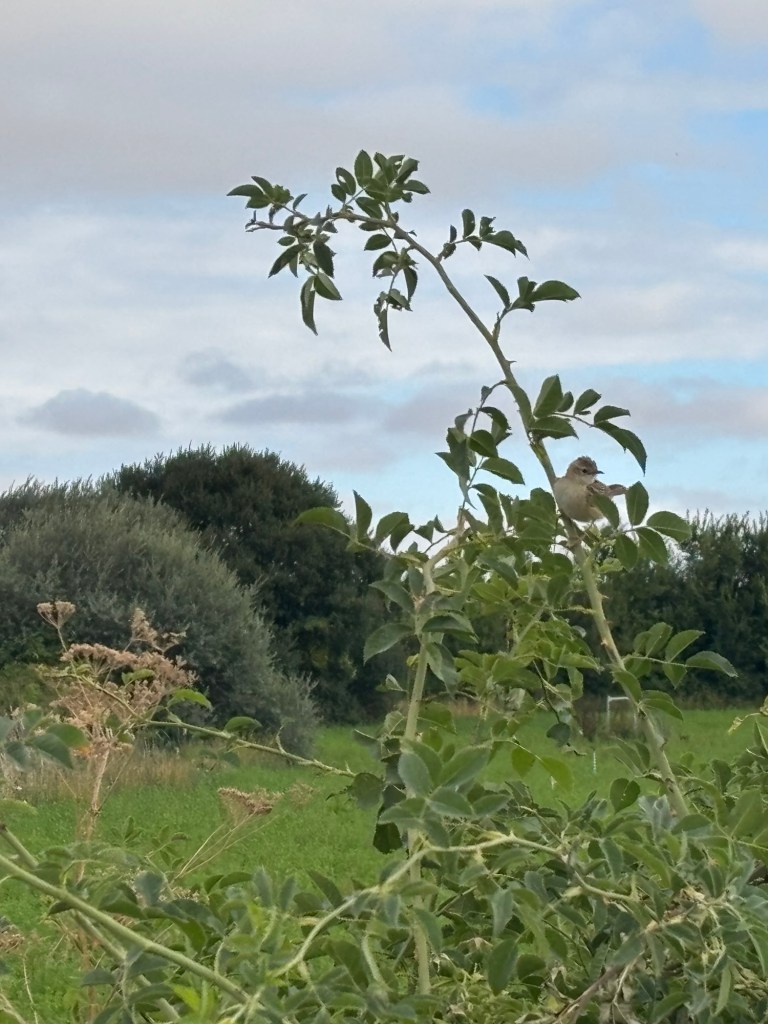
This morning I had a close encounter with a zitting cisticola, a characterful little bird with a name that pretty much tells you all you need to know to identify it. They’re usually heard and not seen, measuring around 10cm from beak to tail and zitting high in the air and out of sight, but this one was quite happy to watch me go by, and didn’t flinch when I stopped to take a photo.


I considered staying in Boadilla del Camino, but just like two years ago, I arrived around 10, about three hours before the albergue was due to open. So I waited for the others, had a drink and carried on.

From Boadilla, the Camino follows the Canal de Castilla, a strange 18th century project that irrigates the northern reaches of Castilla y León. I saw just the one family coming the other way and no pilgrims, but I did have a brief encounter with a magical creature of the steppe: a flock of great bustards, one of Europe’s largest, rarest and most impressive birds. I’ve only ever seen them in the distance from trains or buses, but they’re always unmistakeable in flight: enormous, swan-like things with mottled feathers and pure white wings. It made my heart soar a little in this strange and man-made part of the Camino.


Well, I’m here in Frómista, which I bypassed last time. You know what? It’s not so bad. The albergue municipal is decent and the company is highly entertaining. I guess I gave it the cold shoulder last time in my hurry to press on and meet the crowd. I’m glad I stayed over. BB x