Hôpital de Saint-Jacques, Borce. 14.42.
Today’s march was only a little under two kilometres more than yesterday, but boy, did it feel every step of them!
I set out from Sarrance just before 7am, conscious once again that I didn’t want to book it to Borce. I had at the back of my mind that it might be sensible to push on to Urdos, if only to save me some mileage during the long climb up to Somport tomorrow, but I’m very aware that I have to keep these legs of mine in decent shape for six weeks, so no unnecessary bursts of speed or marathon days for me, thank you.
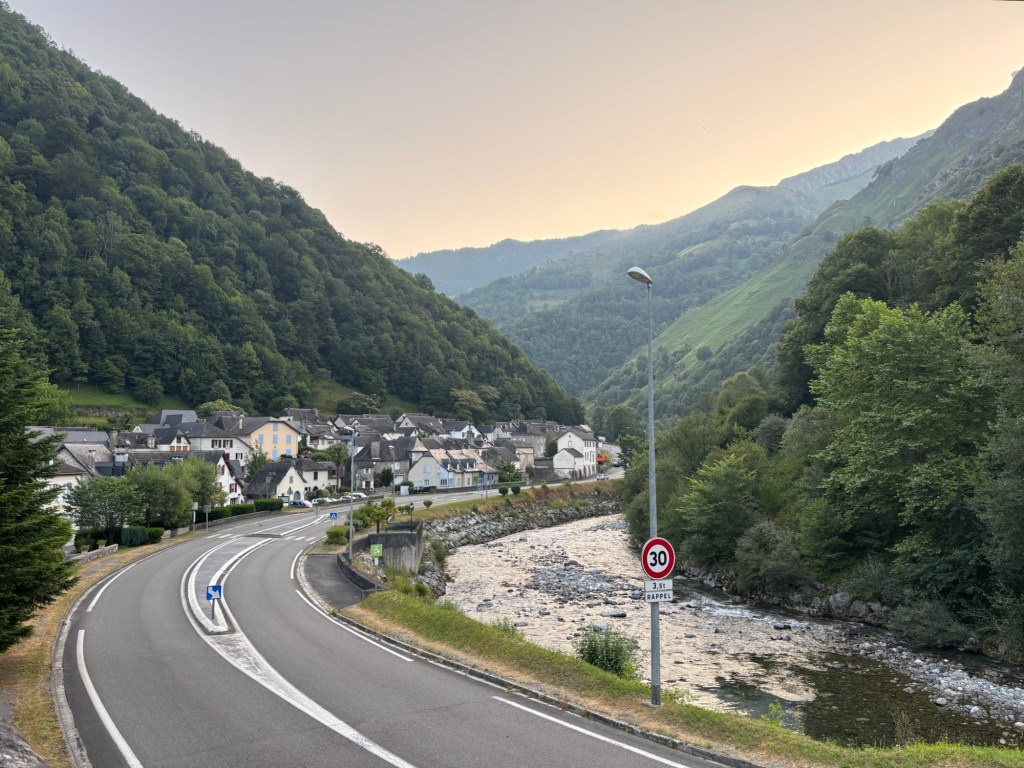
Much of the Camino today followed precarious paths along the river or the road. Arguably, the road stretches were considerably safer: rockfalls and erosion have conspired to make the cross-country sections of the road rather dangerous. Some thoughtful soul had fixed sturdy metal cords to the cliff wall for balance, but it’s plain enough that this section of the Camino sees considerably less traffic than the others.
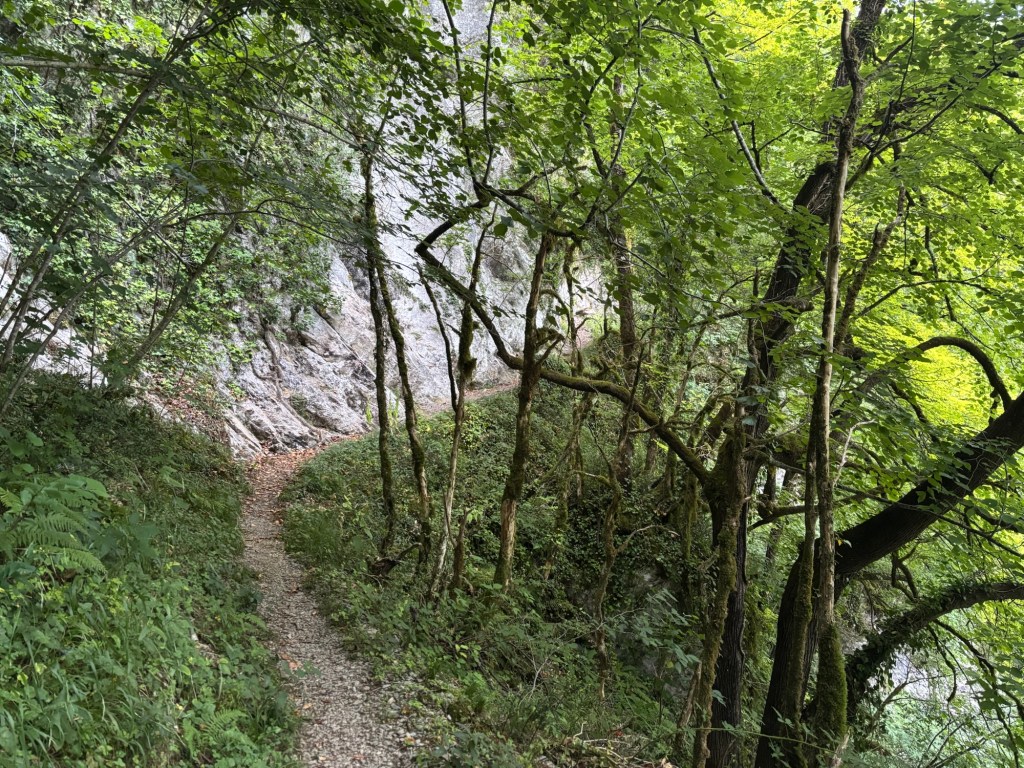
This is most obvious in the jungle of thorns and nettles that grow about the path. For most of the morning I had to tread a jaunty path through the stinging undergrowth (overgrowth might be a better term), moving with the precision of a mountain goat to avoid the worst of them – especially when the alternative was a steep plunge into the rocky riverbed far below. I didn’t get particularly lucky, as the scars and the great red welts on my shins and neck will testify.
Between them and the mozzies, it’s been a pretty rough start to the Camino as far as bites and stings are concerned!
I crossed the threshold of the morning sun as I reached the outskirts of Bedous, disturbing a whole pack of caged hunting dogs as I did so. Their mournful barking must have been audible across the entire valley. It reminded me of a hunt I heard once when traveling through France, with the curious blast of the horn rising over the excited barks of the hunting dogs. This lot weren’t going anywhere fast, but I had a sense of the primal fear they must invoke in their quarry.
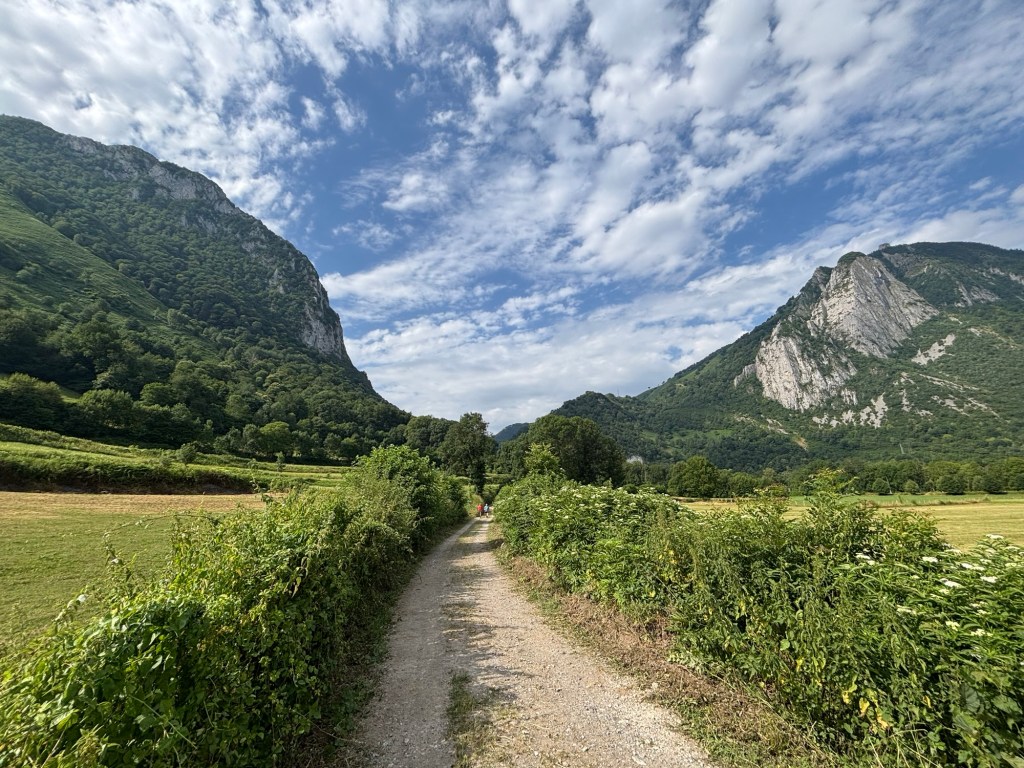
A far more pleasant sound became more and more strident as I entered Bedous: the plaintive whistles of kites. There were quite a few of them gathering in the trees around the Stade de Pierre Leyrat, the town’s rugby pitch (definitive proof that we are still in France). I didn’t give it too much thought as to why until I was flagged down by a local man out for a stroll, who pointed the kites out to me and asked me if I wanted to see a ‘spectacle’. I’m not much in the habit of saying no, so I stuck around to see what he was getting at. He was beaming and kept saying ‘ils sont impatients, ces milans… ils savent qu’il est en retard’.
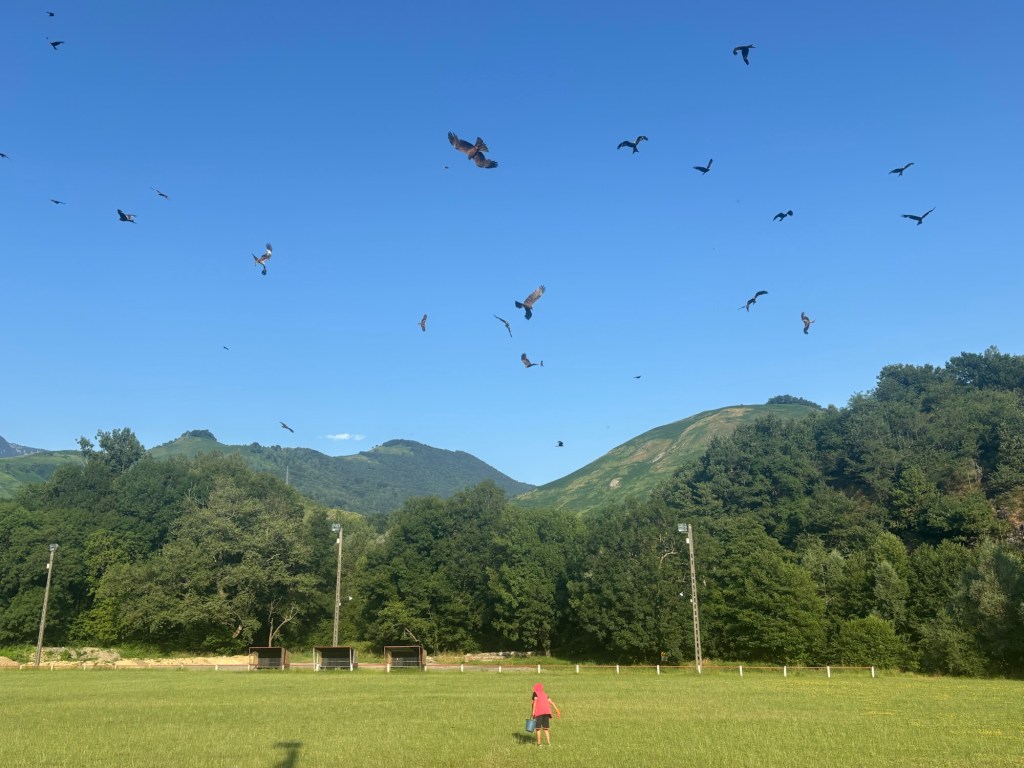
Just who it was that was running late became apparent a few minutes later, when a man dressed in a red hoodie and one red glove appeared, carrying a bucket in his hand. Within seconds the kites seemed to double in number. There must have been at least forty of them, or even fifty. I haven’t seen so many in one place since the day of the winged ants in Uganda.

A small huddle of locals had gathered to watch, so I just got incredibly lucky arriving just as the kites were gathering. The man in red only apologised that the vultures were missing: ‘c’est formidable, mais ils manquent les vautours’.
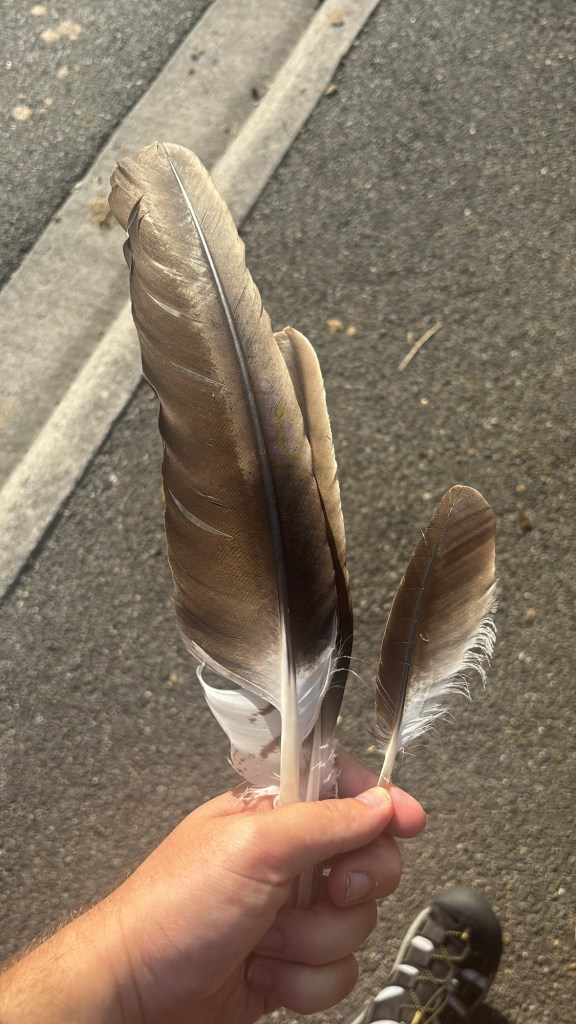
They weren’t entirely missing, though. I could see at least two of them riding the thermals up above the peaks of the mountains. And they’d left a trace of their presence behind on the pitch, because when I went to collect the feathers I’d spotted from the stands, I found one which was far too big to belong to a kite. A feather from quite possibly my favourite animal in all creation: I couldn’t have asked for a greater totem to carry with me on the Camino this summer.
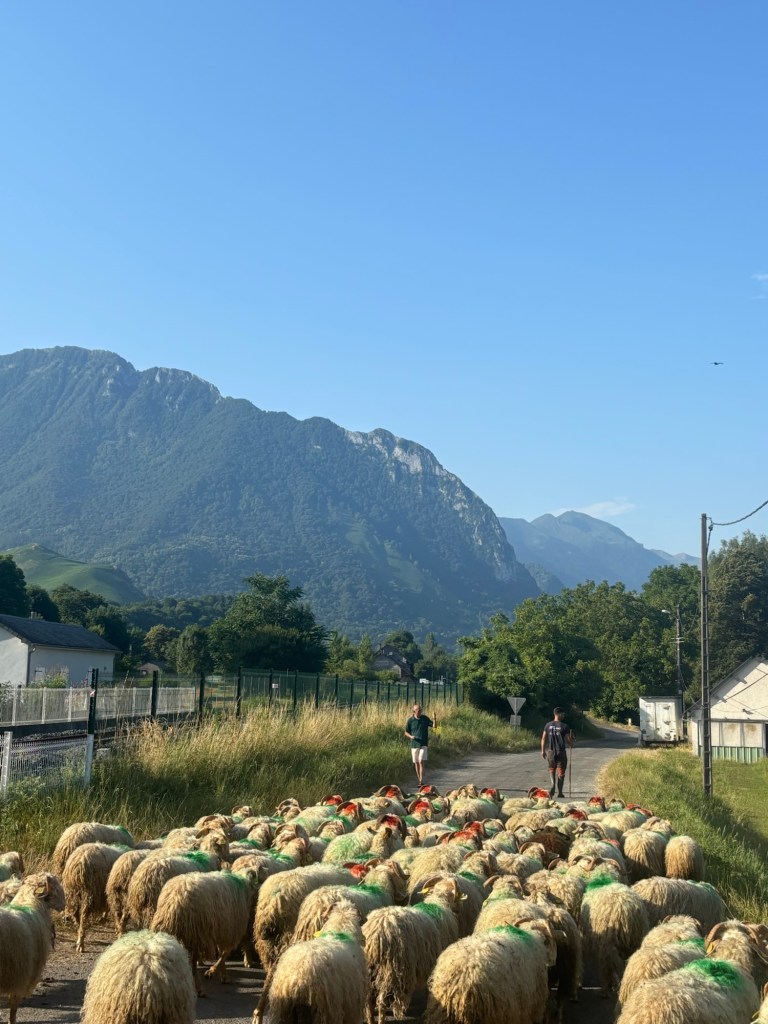
In case that wasn’t enough, a shepherd came down out of the hills with his dog and his flock of sheep. They seemed rather non-plussed by the small crowd gathered to watch the kites, and needed quite a bit of chivvying on from the shepherd and his dog before breaking into a run to catch up to him. Is it really a mountain adventure if you don’t see something like this?
Leaving Bedous and its kites behind, I followed the Camino about forty minutes later out of town and into the mountains. The road cut straight through a formidable gorge before winding a twisting path through via an EDF hydroelectric power station, fed by a pair of huge pipes running right up to the top of the mountains. The place seemed to be in full flow, but the only soul I could see was a woman smoking a cigarette outside the gates.

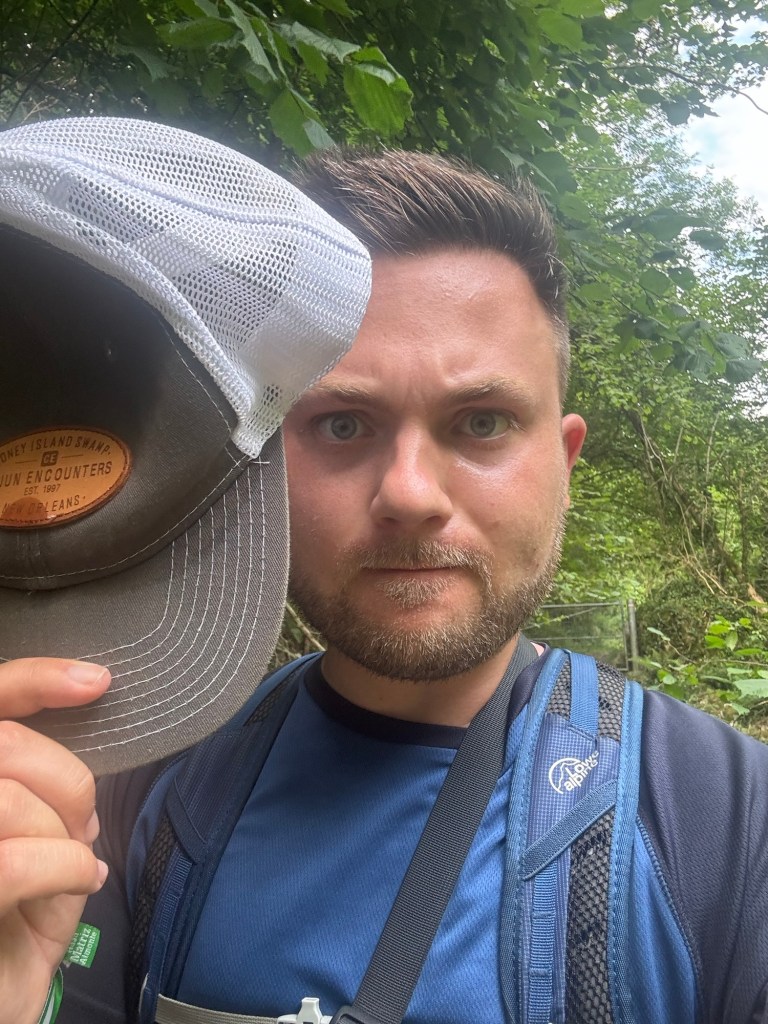
The following hour or so can only be described as an ordeal. After a brief stop in the woods, the Camino all but disappeared, and I had to improvise a path through several cattle fields. The cattle were nowhere to be seen, so their attendants – the murderous horseflies – turned their attention on me instead. And damn, they were persistent. For the best part of forty minutes or so I had to swing my baseball cap left and right like a medieval flail to keep the buggers off, and still they followed me, swarming about my head and legs through field and forest, determined to get a stab at me.
I think one of them got through, but it was hard work, flailing my arms around for so long. I guess they got as much of a workout as my legs today.
They only left me alone once I reached the cattle, at which point they must have decided that there were far easier targets than the fool with the baseball cap who had wandered carelessly into their lair.
It was quite a relief to see the road again. There wasn’t much traffic because of the repairs they’re making to the road surface, which was focused on the exact spot where the Camino rejoins the road. With any luck, that will mean they’re finished with the section between Borce and Urdos, which pilgrims have been catching the bus to avoid over the last few weeks.
The signs for Borce told a story of their own. It’s believed to come from an Occitan word, bòrça, which means farm or hamlet, but its phonic similarity to the French word for bear – ours – seems to have left a mark in its identity. Bears feature prominently in town, from local artwork and murals to the official signage on the road. And it’s this last that is the most interesting, because on both signs announcing the turnoff for Borce, you can quite clearly see the impact of a shotgun blast.
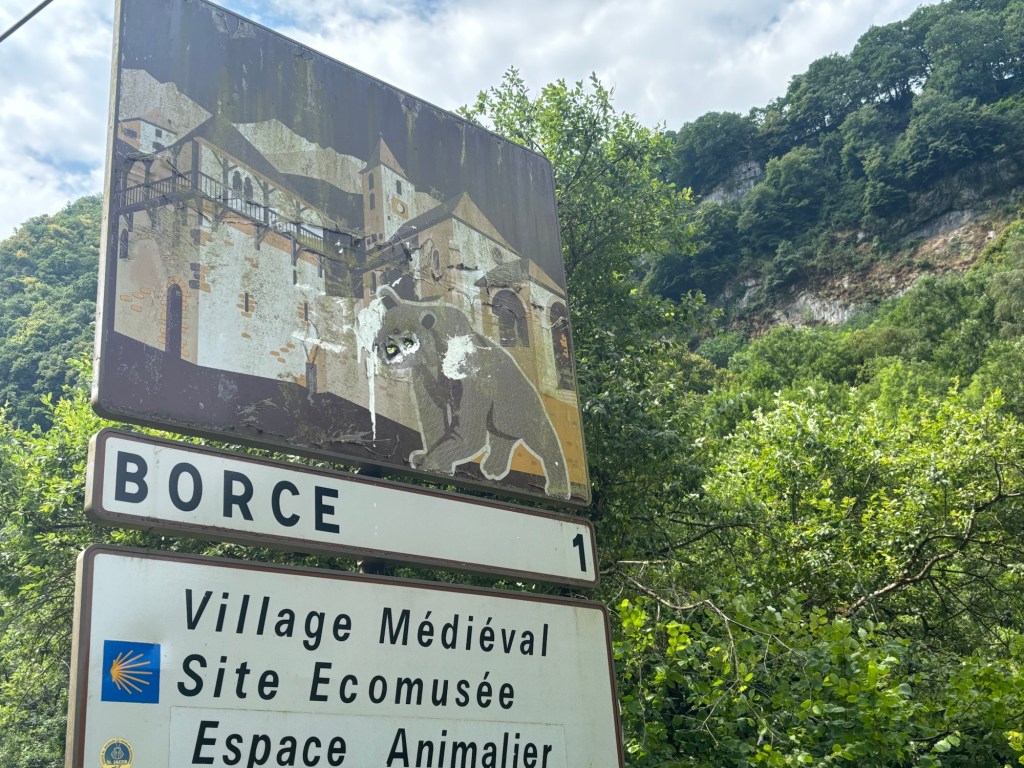
It could have been an accident, but the fact that it appears on the second sign – and only on the image of the bear – confirms that this is a local act of protest against the reintroduction of bears to the Pyrenees, after the last native bear was shot in 2004. The bears are back, thanks to conservation efforts involving the considerable population of bears in Slovenia, and they’re actually growing in number, but that’s not something that’s been welcomed by everyone.

When I was a boy, my parents took me on holiday to Les Cabannes, a mountain town on the eastern side of the French Pyrenees. There, they’d daubed the words ‘Non aux ours’ – no bears – in huge yellow letters on many of the roads (or rather, as I remember it, ours aux non, as they’d painted it in such a way that you’d read the words as you drove forward).
That was around fifteen years ago. The fury is still raw, with a local 81-year-old hunter jailed for four months for killing a bear that attacked him while he was out hunting in the mountains.
Spain has a similar problem with wolves, with one Cantabrian town leaving the severed heads of a local wolfpack on the steps of the town hall as a warning to those who would try to bring the wolf back from the edge of extinction. It’s been hundreds of years since we drove the wolf and the bear out of their homes in Europe, but the ancient fear we harbour towards these beautiful animals is still painfully present, so long as we try to share their world.
But I’m doing Borce a disservice. The village is tremendously charming, and full of running water – the most important amenity after such an arduous trek. Christian met me by one of the fountains, having lately returned from Canfranc; he and Miguel had caught the bus to the Spanish border this morning to see the impressive station, and Miguel had decided to press on from there, while Christian returned to Borce as his last stop before his journey home tomorrow. The two fellows have been a jolly presence for the first three days of the Camino, and I shall miss their company. Fortunately, it looks as though I won’t be alone for long, as there were quite a few pilgrims in Borce. It must be its status as the first (and last) stop after the train terminus in Bedous before Somport, the starting point of the Camino Aragonés.
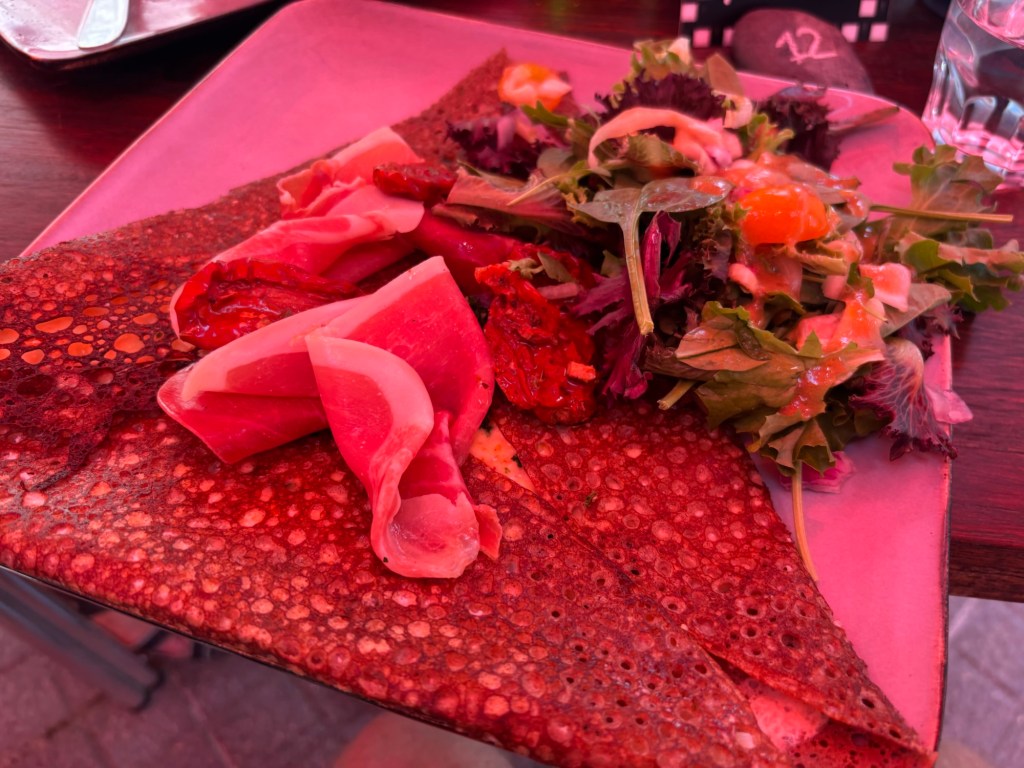
So this time tomorrow – with any luck – I shall be in Spain. To celebrate, I had a Borçoise crêpe at the Auberge de l’Ours, following a tip-off Christian had received from the bus driver. It really was quite spectacular, and I couldn’t have left France without having one of these delicious French specialities.
Well, that’s quite enough for one day. There’s no WiFi here, so I’m relying on data to get this through to you. It’ll cost me, I’m sure, but that’s what all the hard work over the last year is for, right? That’s what I keep telling myself, anyway. À demain! BB x
 The Book of Barnabas