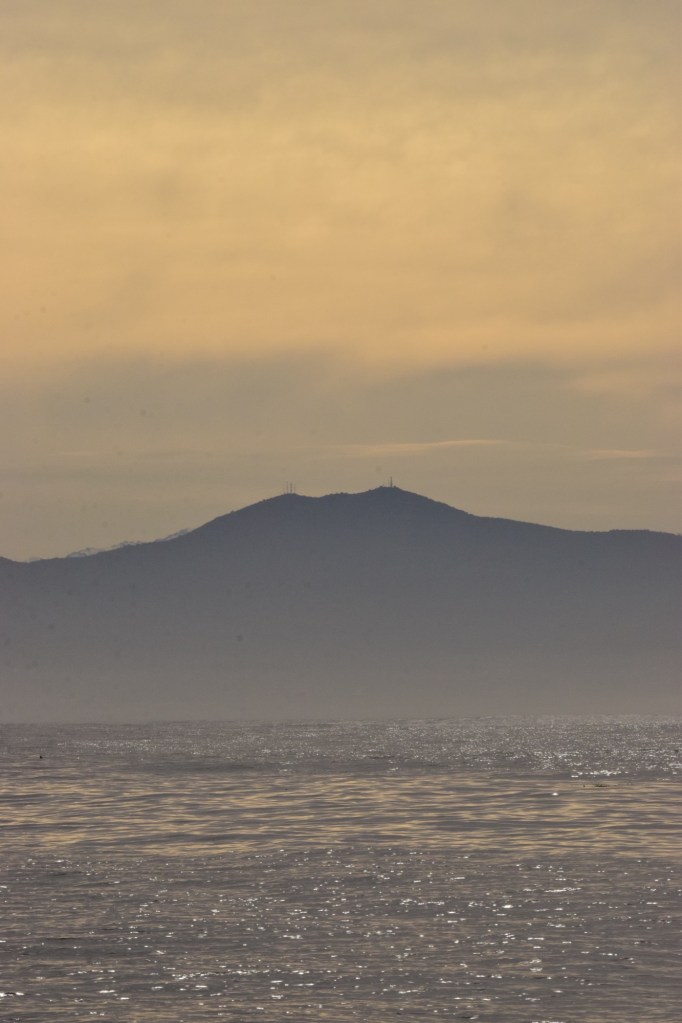
Puerto Baquerizo Moreno, Galápagos Islands. 04.57.
I woke up to the sound of the waves this morning. Well, I suppose morning is a stretch, since the clock on my bedside table said ten past four. I must have passed out around eight last night, beaten down by the lack of sleep on the plane and lulled into a Pacific lullaby by the sea. I can think of worse ways to spend a summer.
The garúa rolled in off the mainland last night, bringing with it relieving cloud and gentle rain. A passing shower came and went a few minutes back, but now it’s just the tap-tap sound of the lingering raindrops falling onto the roof of my cabin from the giant daisy tree.
There’s no point going back to sleep now, so I’ll spend some time writing up yesterday’s account of my first day on San Cristóbal.
The magic begins as soon as you’ve left the airport. Technically before, I suppose, since I could see the sharp-angled silhouettes of the island’s frigatebirds well before we landed. Outside the terminal, it’s a ten minute walk to the centre of Puerto Baquerizo Moreno, the largest settlement on San Cristóbal.
Three of Darwin’s keys can be found right next to the terminal building: small and medium ground finches, of evolutionary fame, and one of the island’s endemic species, the San Cristóbal mockingbird. It’s this last that’s especially important, as Darwin didn’t realise the significance of the finches until after he’d departed from the islands, but he did notice that the mockingbirds on each island were different in some way.
Like so many creatures on these islands, they are completely unfazed by the presence of man. They have a funny way of walking, with their cocked tail wagging from side to side. If I were a scientist, I might have called them metronomebirds for this singularly odd gait.
Most of the other travellers piled into taxis outside the terminal, which seemed a bit ridiculous, given just how close the town is to the airport, but I guess some habits die hard. I was quite happy pottering about with the ground finches. It’s not often you get to spend time with a species that literally changed the way we think about our place in the world.
The first thing you notice is the sea lions. They are absolutely everywhere. If you can’t see them, you can certainly hear them: that cartoonist arf arf arf you associate with children’s TV carries for quite some distance.
They don’t stick to the beach, either. A large number of them seek out shadier spots on the seafront parade, dozing quite carelessly on roads, park benches and boardwalks. It’s pupping season, so there’s no shortage of pups in varying stages of development sticking close to their mothers. I’d suggest giving them a wide berth – you never know where the bull might be.
In this case, I did know where the bull was – because he was announcing his presence every minute or so with that barking call, as though to remind everyone in the vicinity that the harem on the beach was his and his alone. Which, I suppose, is close to the truth.
You can tell the bulls apart from their size – nearly a third larger than the females – and the significant boss on their heads. I also hadn’t noticed before the claws in their flippers, but you can get so close to the great sea beasts here on the islands that there’s hardly a detail that will pass you by.
I had to wait a little while before checking in to my cabin on the edge of town, just a stone’s throw from Playa Mann. At a glance, there seem to be a lot of people who come to these islands for the beaches. To a dyed-in-the-wool naturalist like me, that does somewhat feel like going to the Serengeti for a tan, but I’m far too happy to judge. Who could possibly turn away from a chance to see these spectacular islands, given the chance?
I took myself straight back down to the sea once I’d checked in and found two more Galápagos specialities almost immediately. I’ve been mad about Sally Lightfoot crabs since they turned up in a wildlife spotting book I won as a prize for a sunflower growing competition when I was a kid. We have crabs in the British isles, of course, but none nearly so colourful as the Sally Lightfoot. They’re everywhere here, ranging from dark green to sunset red, hugging the molten rocks along the surf line and leaping between boulders with surprising agility.
The other specialty is a real treasure of the Galápagos, arguably as iconic as the giant tortoises that gave the islands their name. Marine iguanas, a short-faced ocean-going variant of the green giants found on the mainland, are often described as “ugly”, perhaps on account of Darwin’s first description of the creatures. Certainly, their patchy salt-washed skin and snub faces make them strange-looking beasts, and they’re not nearly as active as the sea lions as they soak up the sun on the beachfront, but they are tremendously interesting creatures.
Around midday, it gets rather hot here on San Cristóbal. Not unbearably so, but the humidity doesn’t help. I found a night heron sheltering from the heat in the shadow of the rocks earlier, and when I returned, it was sunning itself in a posture I haven’t seen in herons before.
A smaller heron was lurking among the boulders nearby: a lava heron, an island variant of the striated heron that can be found all the way up and down the coasts of the Americas. It was mesmerised by the dragonflies hawking over the beach, tilting its sharp beak and golden eyes every time one came close. I didn’t stick around long enough to see if it caught one.
After sorting out my snorkel gear for tomorrow’s expedition to Punta Pitt, I made for Cerro Tijeretas, a promontory to the north of town known as Frigatebird Hill. I passed a large Dutch contingent and a couple of Germans looking for a mockingbird, but other than that, I had the trail pretty much to myself. The Galápagos aren’t like Manu – you aren’t going to be tripping over a new species every few steps – but the encounters you do have with the island natives are more than a match in their total lack of fear. I found a Galápagos flycatcher hunting by the boardwalk and spent most of the afternoon followed by warblers.
From the top of the hill, you get a spectacular view out across the island to the east, all the way to the cliffs of Punta Pitt. The bay beneath Cerro Tijeretas seems to be a popular snorkelling spot, and I can see why. One shape drifting in the water seemed to the naked eye to be too compact to be human, but too mobile to be a rock, so I turned my lens on it to confirm my suspicions: a green turtle, one of a number that can be found around these islands. I’ve brought my own snorkelling mask so I’ll have to check this place out sometime, when it’s quieter, maybe.
I didn’t make it as far as Playa Baquerizo, which really is a proper hike from town, across several kilometres of molten rock and daisy trees, so I’ll have to check it out later. Instead, I perched myself on a boulder and watched the sunset in a beach I had to myself. Noddies dancing across the surface of the water. Boobies hunting offshore. Frigatebirds wheeling above the bay on those vast black wings. This really is a paradise like few others. I hope for the islands’ sake it remains that way.
It’s nearly seven o’clock. It’s light now, and the island is covered by a merciful blanket of cloud. There are birds called outside but Merlin is struggling to identify them. That may have something to do with the generator that keeps clicking and whirring noisily outside. I’d better have a quick shower and then head out. I’ve rented a GoPro for today’s snorkelling adventures, but there’s also likely to be a heck of a lot to see at Punta Pitt itself, so watch this space! BB x
Today has been a bit more of an admin day. One of my activities for next week fell through, so I spent a fair part of this morning re-arranging my plans with a couple of other agencies to keep my itinerary as close to the original as possible. It hasn’t been easy. I’ve been leaning heavily on AI, not as a lesson planner, but as a travel agent, and I have to be honest, I fear for the travel industry. ChatGPT and Copilot may need gentle nudging and correcting as they work, but they do a phenomenal job at trawling the net for deals, dates and travellers’ tales from TripAdvisor, Reddit and beyond.
I’m not the biggest fan of AI, but as an impartial entity to bounce ideas off, it’s an absolute doozy. It has really helped me to streamline my plans, keeping them within a very reasonable budget – especially important as my choice of location is not exactly famous for being a budget destination. I do often have to correct its mistakes, which is why I would caution any students of mine from meddling with it unless it’s on terms they understand – good advice for just about anything unknown – but as a rule it does a pretty good job at doing the heavy lifting.
I genuinely can’t wait – I’m practically chomping at the bit here – but I promised to keep it a secret, so I will leave just the smallest of clues in this post in case you want to hazard a guess at my intentions.
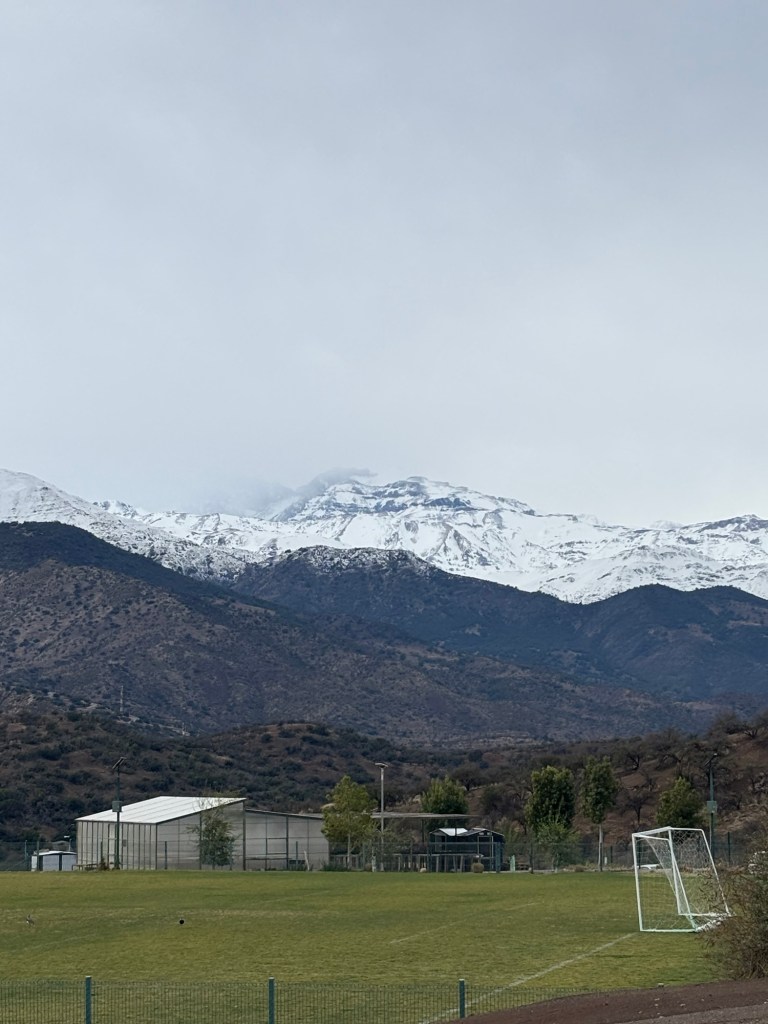
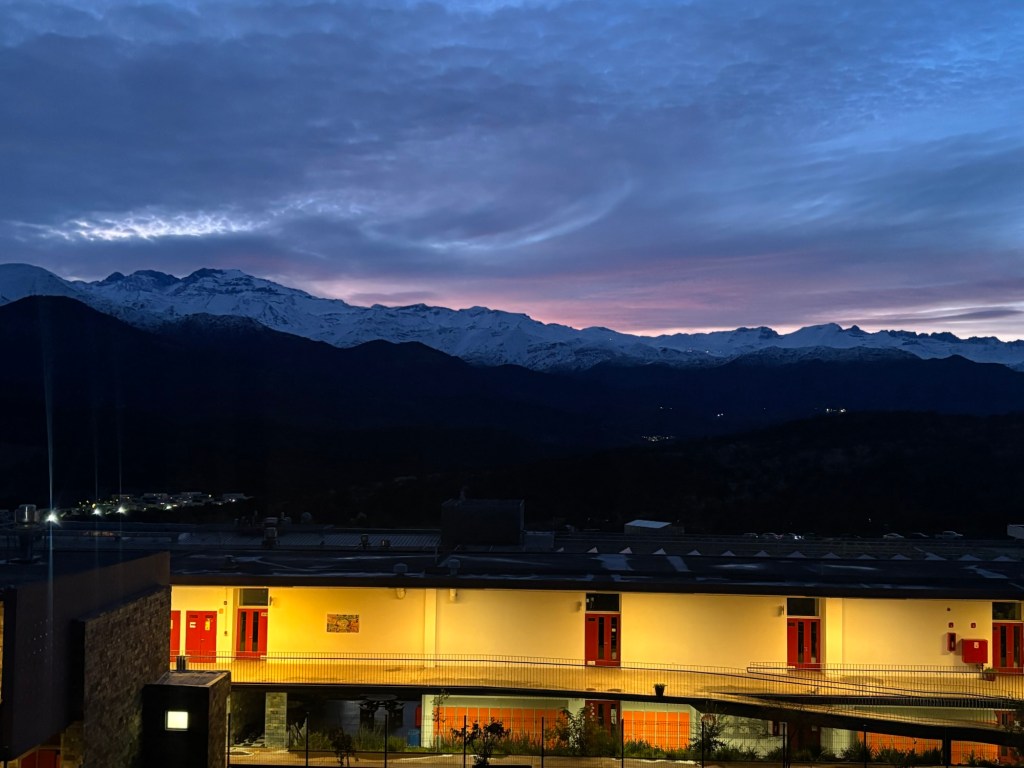
I’m currently sitting in the English office, listening in on the weekly department meeting on debating strategies and what constitutes a suitable number of poems within the Language A anthology. On my left, the windows open out onto the hill country around Manquehue, where I saw no fewer than sixteen condors circling shortly before lunch. That makes three days out of three this week where I’ve seen the titans of the Andean skies from my office. Normally it’s just the diucas and mockingbirds that pop in for a lookaround once the kids have gone back inside for the third hour of the day. On my right, the windows open out onto the enormity of the Andes to the north, still wearing a wintry mantle of snow. Further down the hill – just out of sight beyond the classroom blocks – are the school’s sports pitches. Our kids play rugby against the backdrop of a nineteenth-century clock tower and the Southwestern Railway. These kids have the towering heights of the Andes all around them. These are just the foothills: somewhere beyond stands the fearsome Cerro Plomo, reaching some 17,861 feet into the sky.
Upon reflection, by journey’s end, I will have spent an astonishing two months south of the equator this year. The last time I was this far south I was tracking mountain gorillas in the impenetrable cloud forests of Bwindi on the Congolese border.
I remember being of the opinion that Chile was a destination I was only prepared to visit thanks to some generous financial assistance with the flights, considering it otherwise a prohibitively expensive destination. I see now just how wrong I was. Not about the money – Chile is easily one of the more expensive South American countries – but about how much there is to see and to do.
I’m now genuinely considering coming back someday to pick up the things that I missed: Chiloé, Conguilio, Punta Arenas, San Pedro de Atacama and so much more besides. There’s simply too much to see here, even when you have five weeks to play around with, and for a naturalist like me, the fact that it pales in comparison to its megadiverse neighbour, Peru, means very little when a casual glance out gives you one of the most spectacular birds of prey on the planet.
Two weeks from now, I will be back home, a brief pit stop on the island before duty calls me to Athens for one last dance. I had a brief moment of nostalgia for it today when I popped in to help a colleague set up a game of Just a Minute to give her students a boost with their listening skills in debating. I love that game to bits – and the BBC Radio show from which I have poached it.
It’s getting to that stage of my time in Chile where I’m starting to take advantage of every moment remaining. Over the last few weeks I’ve gotten quite used to the sight of the Andes, the caracaras that seem to be constantly somewhere on the horizon and the wheezy call and response of the characterful meadowlarks. But soon I’ll have to say goodbye. So, while the weather holds at least, I’ll try to get out after work and soak up as much of that view as I can.
After a productive day spent exploring Carol Ann Duffy’s poetry (specifically Quickdraw, Demeter, Shooting Stars and Delilah) and hanging out with the Senior English team, I popped in to grab my camera and went straight back up the road to Observatory Hill (Cerro Calán). It was smoggy and overcast on my way up, but by the time I reached the summit, the sun had found a breach in the cloud line near the horizon and came shining through – just in time to light up the meadowlarks that were scrambling about the summit.
I went all the way to Patagonia for pumas and took a boat out into the Pacific to see an albatross, but the meadowlarks have been a feature wherever I’ve gone. For me, they’re probably the bird of Chile – after all, national bird or not, I’ve seen condors in Peru, albeit perhaps not as frequently as I have here.
If I had more time – and the weather were kinder – I’d head south again in search of the chucao, a smart little Chilean speciality, and try my luck in search of the Magellanic woodpeckers that reside within the forests of Chiloe. I’d also try to track down the elusive tucúquere, the largest of the owls of Chile, that has thus far eluded me. I suspect I’ll be absolutely knackered when I return from my final adventure next week, but if the sun decides to make a very overdue return, I might make one last jaunt out to Batuco, a wetland reserve to the north of the city, in the hope that I might find the burrowing owls that live around the lake.
Until then, I’m quite content to watch the meadowlarks bousting about.
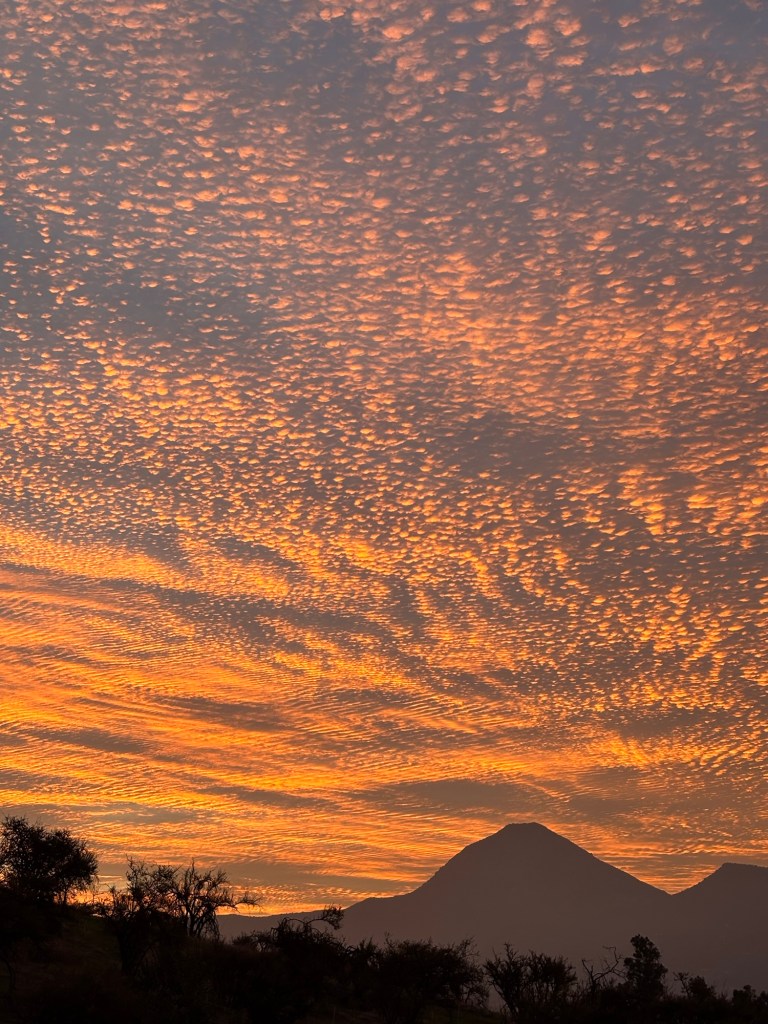
When the sun can be seen, Santiago experiences an incredible second sunset. The dying embers of dusk catches the peaks of the mountains and showers them in golden light, before they fade to an imperial grey against the iron skies beyond. Then, just when you think it’s over, the mountains erupt in an incredible crimson light. I’m not sure what triggers that second burst of light. Maybe it’s the sun hitting the Pacific, or some trick of the clouds. Either way, it’s breathtaking.
As I walked back down the road toward Avenida Charles Hamilton, the clouds became a mirrored beach, like so much stippled sand. To the north, the triangular summit of Cerro Manquehue rose into the ether like a child’s drawing. It’s been the eternal backdrop of my stay here in Santiago, visible from both my home in Las Condes and my office in Craighouse on the other side of the mountain.
Before I came here, Manquehue was just the name of a Chilean Catholic community who I met once in Durham, many years ago. Now it’s one of my favourite waymarkers in the Valle Central.
Tomorrow brings an observation – one of my last – and a planning session with the Deputy Head for a fully-fledged 90-minute lesson of my own on Thursday. If I didn’t know better, I’d say they were testing me. It almost feels like a job interview.
I saw a fox near the car park as I left today – a gold and silver vixen, rooting around the trees just beyond the fence. These culpeos are a lot closer to wolves and jackals than they are to true foxes, but nature clearly likes the design of the fox, because the culpeo and its cousin the chilla have both evolved to fill that niche.
I’ll take that as a good sign. Nothing that beautiful could be anything else. BB x
With strong winds and heavy rain forecast for much of central and southern Chile this weekend, I decided against any madcap travels beyond Santiago. It’s just as well, too: even my whimsical considerations of hopping over the border to tick Argentina off the list with a flying visit to Mendoza would have been impossible, after yesterday’s renewed snowfall blocked the mountain pass, closing the terrifyingly steep Ruta 60 for what is likely to be quite some time.
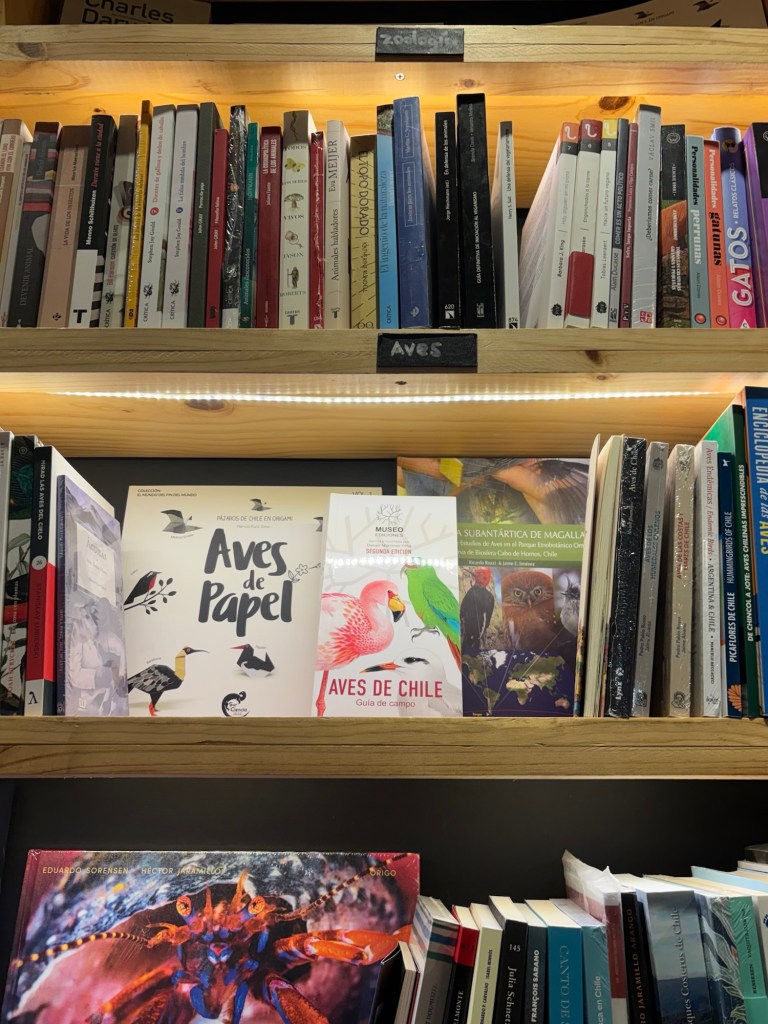
For once, I erred on the side of common sense and spent my Saturday in downtown Santiago, stocking up on a few important supplies for my final adventure in South America, now less than a week away. My main target was the sportswear giant Decathlon, but while I was hunting it down I stumbled upon a fabulous bookshop specialising in natural history in an underground mall at Tobalaba. I’ll simply have to come back here before I go – the selection of books on offer was incredibly tempting.
I still can’t get over how much birdwatching is a thing over here. I’m so used to Hispanics being generally disinterested in birds they can’t shoot out of the sky. It’s so heartwarming that that particular aspect of Hispanic culture is shifting, and that Latin Americans seem to be the driving force behind it.
With my Decathlon business concluded, I popped into Jumbo – Chile’s answer to Spain’s Mercadona – to grab a couple of snacks for the week ahead. Amazingly, the supermarket did me for lunch, too: they were giving out free samples of the seafood stew mix (which was amazing!) as well as free samples of strawberry yoghurt and pistachio ice cream. They weren’t exactly full-size dishes, but Tomás ordered far too much pizza last night, so I was quite happy with a couple of free nibbles for lunch.
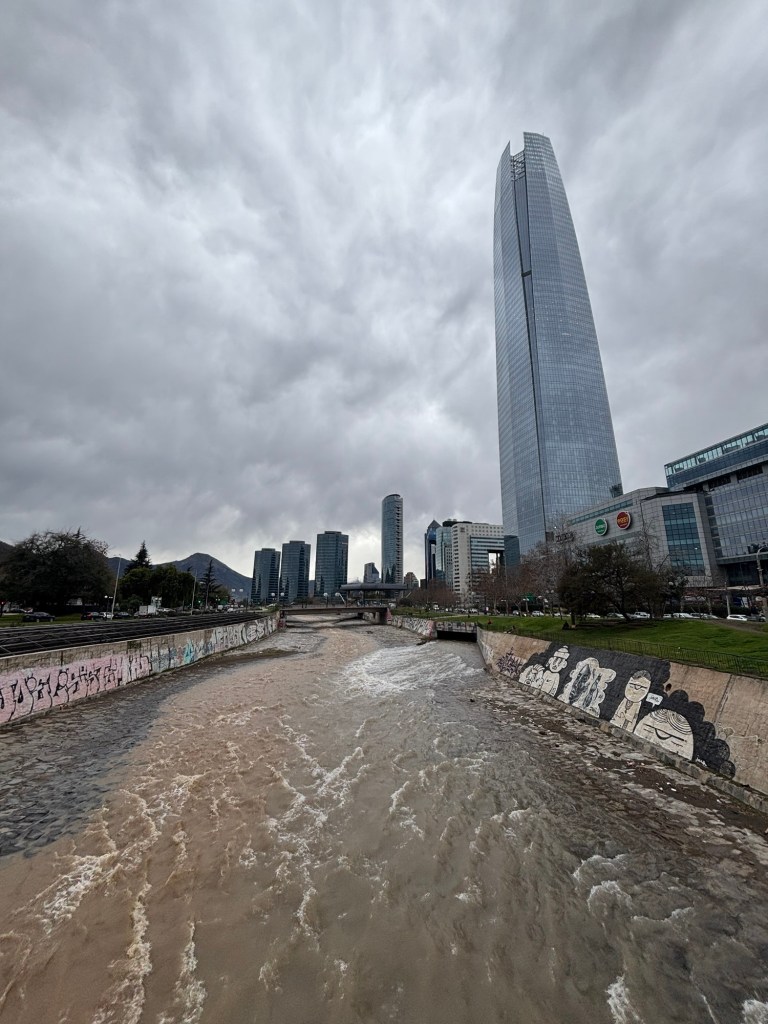
The heavy rains of the past couple of weeks have transformed the Mapocho River which runs through the city. When I arrived, it was little more than a steady flow in a largely dry canal. It’s now a roaring torrent that cuts above the din of the traffic when you’re close enough. Chile really is a country of extremes: when it rains here, people have to be prepared for property damage and flood control, even up here in the mountains.
By the time I reached the car park at the foot of Cerro San Cristobal, it was already half past one, and a lot of city folk had come to the same conclusion as me: that is, that it would be nicer to go for a walk today, rather than tomorrow, when the scheduled rains are due to come down hard. Parquemet was full of cyclists and runners, as it was on my last ascent now three weeks ago, but after a flying visit to the Japanese Garden – which was probably the noisiest zen garden in creation, thanks to it being located within a Hispanic capital city – I ducked off the road, following one of the many forest tracks intended for downhill mountain bikers. But for a lone jogger, I had this route to myself, which meant it was alive with wildlife.
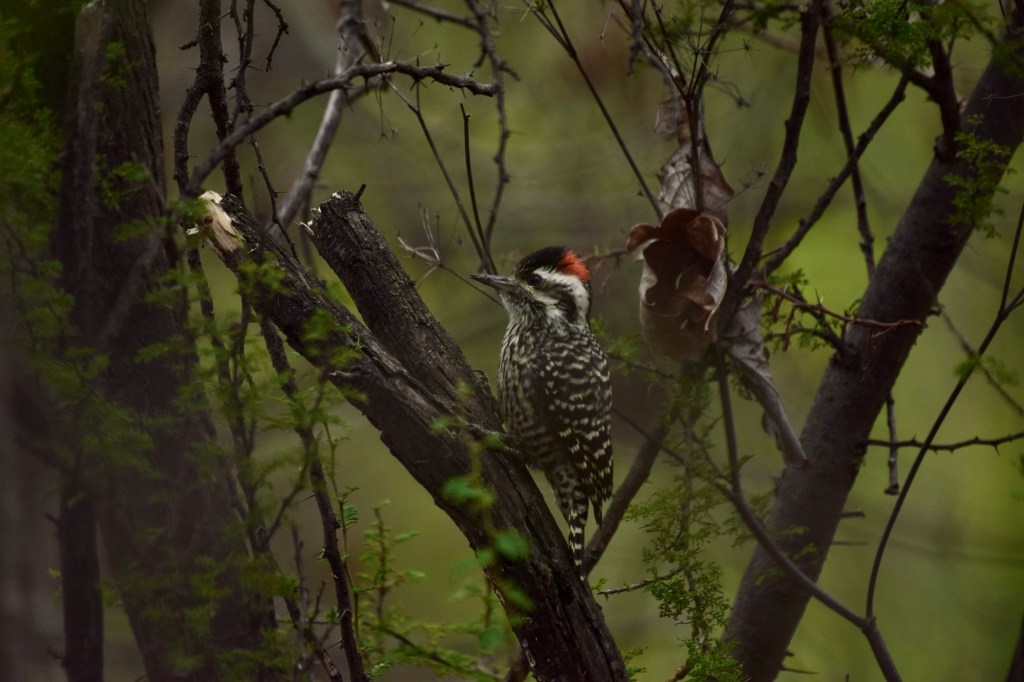
The first critter to show up was a woodpecker. I never did find the famous Magellanic woodpecker during my visit to Patagonia – a very good reason to come back someday – so this striped woodpecker or carpinterito is my first in Chile. Like most woodpeckers, it was a nightmare to capture on film, being in the darkest part of the forest, moving constantly and under a dark, overcast sky, but I just about managed a couple of shots before it disappeared among the trees.
A large flock of finches followed me along the spine of the cerro, feeding among the dead foliage at the side of the path. The siskins here look and sound a lot like the ones back home, but the sierra finches are really rather special. I saw some of these pretty birds in Cusco, but in Santiago they’re essentially garden birds.
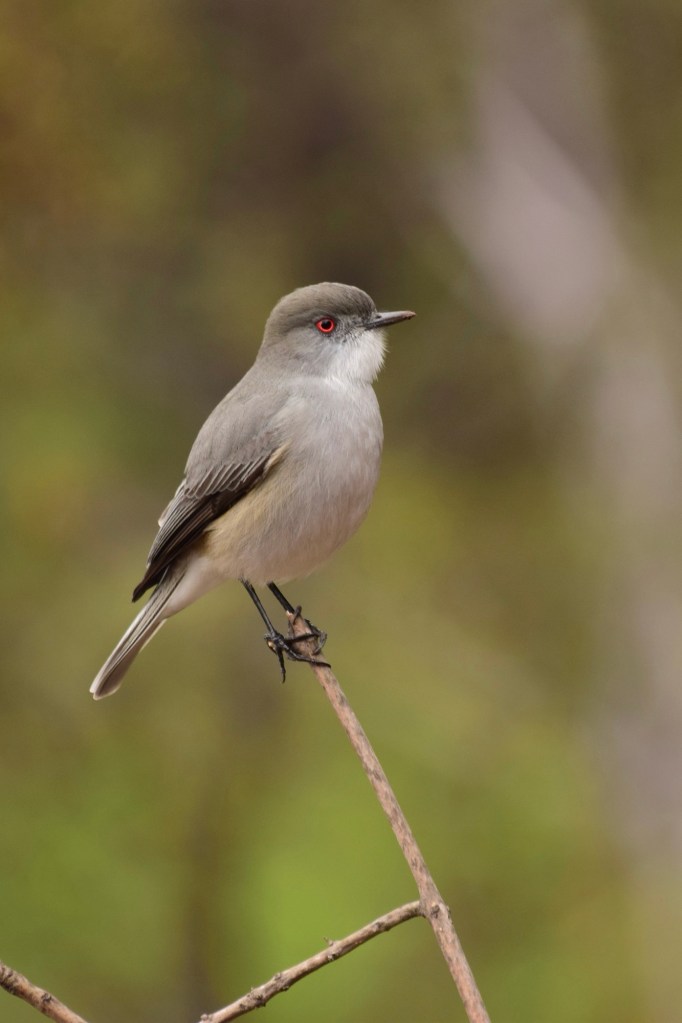
I hoped I might find some of the pretty diuca finches that are so common at school. There weren’t any on the cerro today, but I did keep running into diucons, their fiery red eyes even more obvious in the midday light than they were the other day, when I was shooting into the sun.
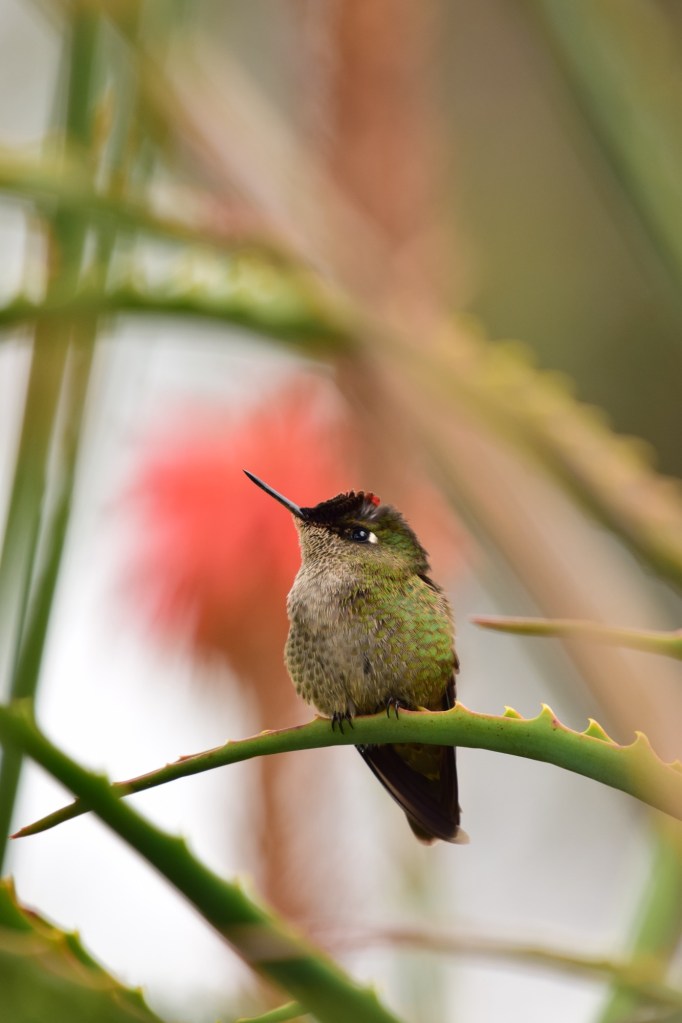
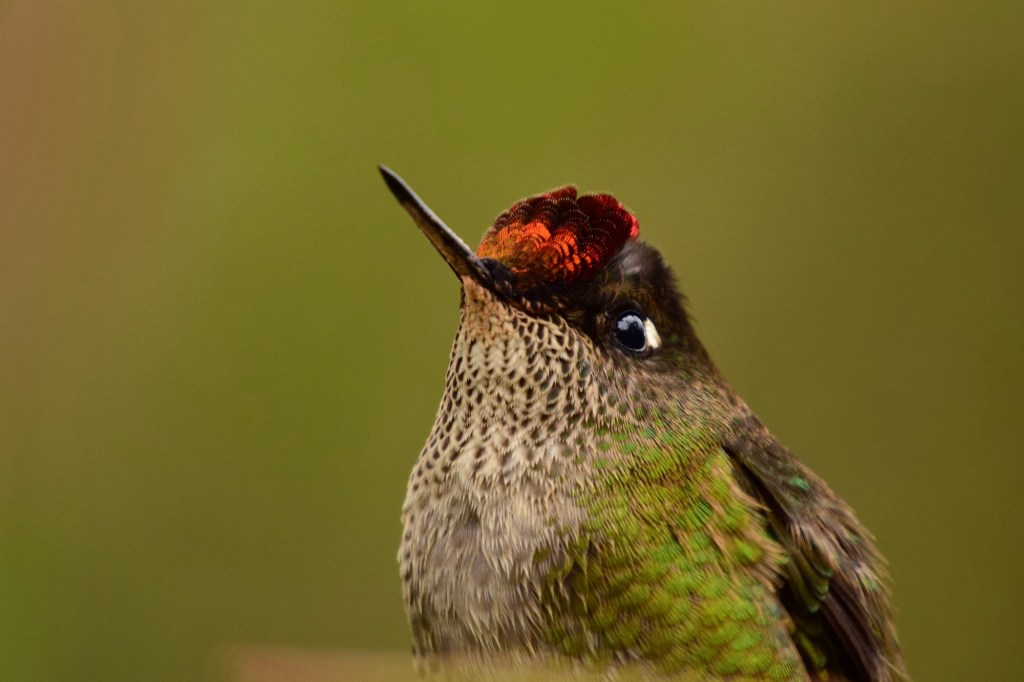
The best find of all, though, was a bird I’ve become very familiar with here in Santiago. I hear them every single day, and see them at least three days out of seven, whenever I should be near a poker plant. The green-backed firecrown is probably Chile’s most well-known hummingbird, since it seems to have a home on even the busiest streets in the city centre.
The last time I had a close encounter with one of these living gemstones, I didn’t have my camera on me. This time, I came prepared. Firecrowns are fearless little creatures, driven by an insatiable hunger that is a side-effect of their rapid metabolism – so, once again, I was able to sit quite close and watch, until the bird landed so close I could see its heartbeat and its tiny tongue tasting the air.
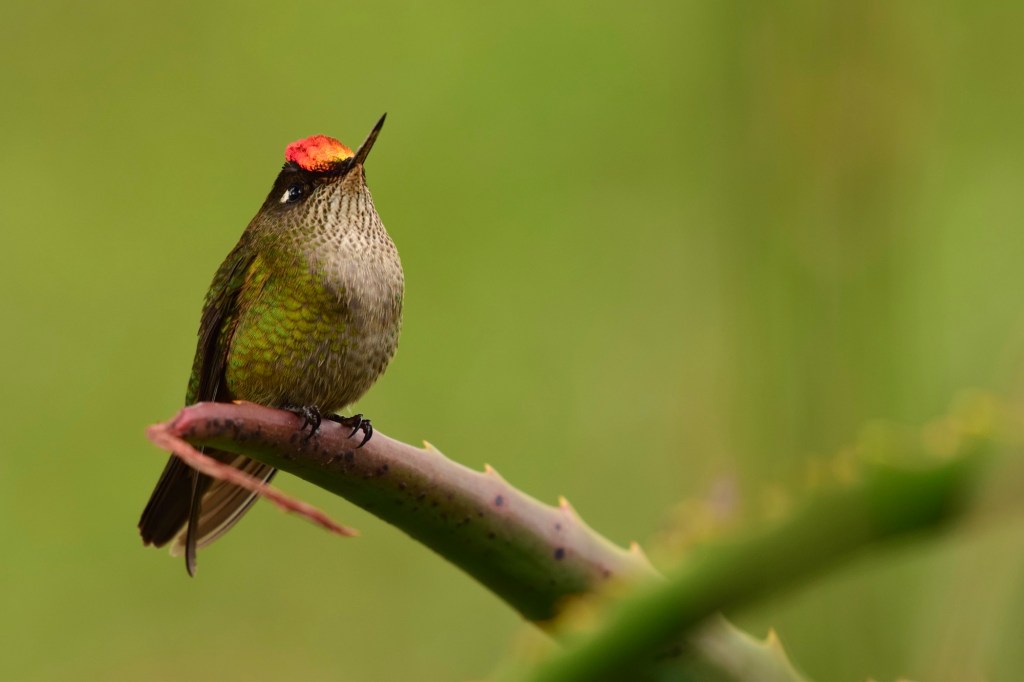
The firecrown gets its name from the male’s plumage, which really is quite something. Even with the naked eye, you can’t miss that sudden flash of scarlet when they alight upon a branch, just like hoopoes do with their crests when they land.
The secret is the iridescent sheen to its feathers, each one bending the light slightly differently depending on its position on the bird’s forehead. They can, of course, flatten and raise their crests at will, so I had to wait a little while before I was able to capture that ripple of red light.
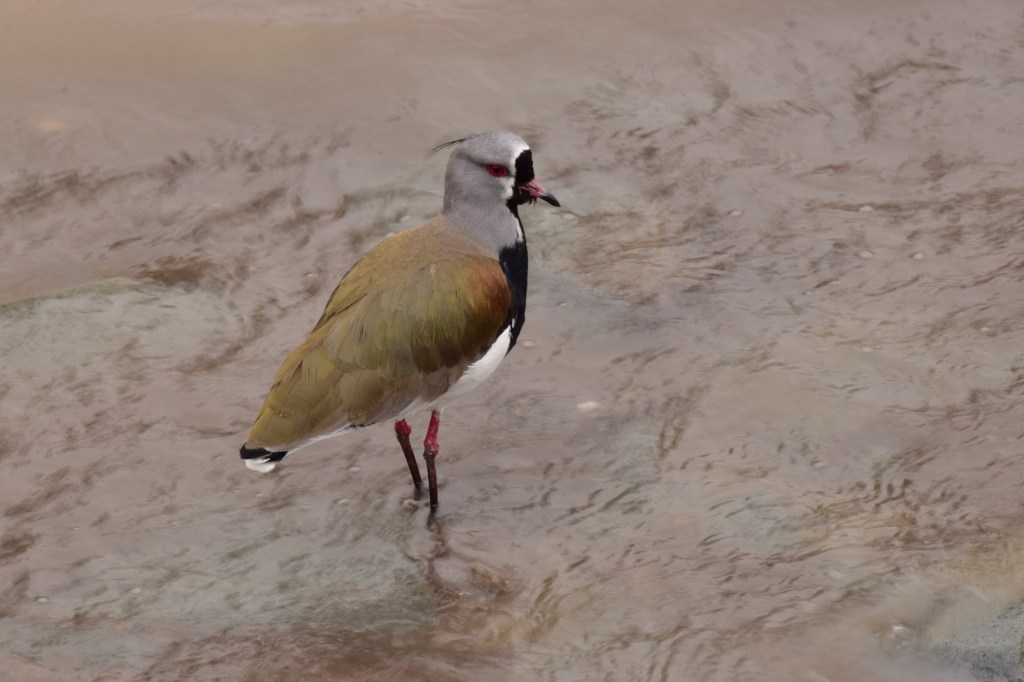
After spending a happy half hour or so with the firecrowns, I wound my way back down the cerro and used what little battery I had left on my phone to catch a bus back to Las Condes. I only stopped one more time, just before stepping on board the 409, to see a couple of Southern Lapwings that had flown in and gone down to the river. I see and hear these birds every day, too, as they’re a lot noisier than the firecrowns, but I haven’t yet had the chance to get a photo. They’re usually patrolling the rugby pitches in pairs, and they have a reputation for being ferocious with passers-by in the spring, when they have eggs or chicks near at hand.
Well, it’s getting dark outside. I didn’t expect to have such a good afternoon’s birdwatching on what was essentially an extended shopping trip, but sometimes, it’s the outings you don’t plan that turn out to be the best.
That said, I’ve done a lot of planning for next week’s mad adventure, so I hope that turns out for the best, too. It really is going to be rather special. BB x
I’m up early after falling asleep far earlier than usual last night (around 8pm – shocking!), so I thought I’d use the time to pencil in my afternoon’s adventures.
While I’ve been working around the Craighouse campus, I’ve had a lot of time to watch the comings and goings of the birds that make their home around the capital city. Taunton has its fair share of feathered friends, of course, but I’ve had thirty years to get used to herring gulls, crows and woodpigeons. I might be in my third week out here, but I still get a big smile watching the rufous-crowned sparrows hopping about. Naturally, I don’t bring my camera to work, so given that we actually had some sunshine today – and that my colleague Tomás was done an hour before the end of the school day – I thought I’d capitalise on the sunlight and do a bit of suburban birdwatching.
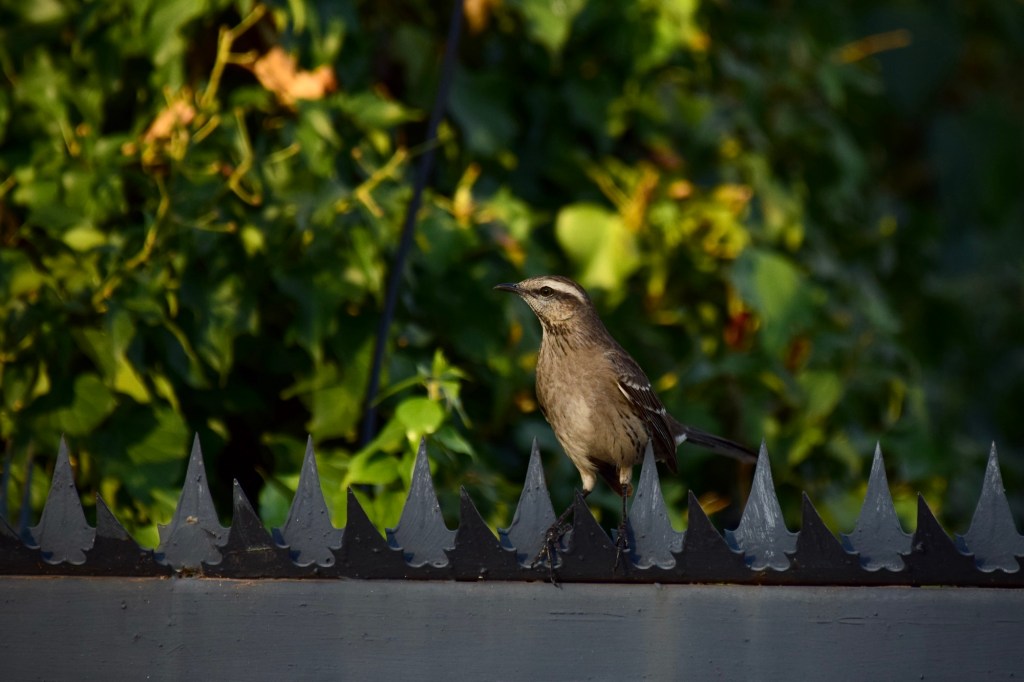
One bird that’s easy to find around Santiago is the mockingbird. I’ve come across these characterful creatures in New Orleans, Lima and the open steppe of Patagonia, but the cheerful Chilean mockingbird is very much a feature of Santiago itself. I imagine they’d be garden birds, if one had the money for a garden in this habitually dry part of the world.
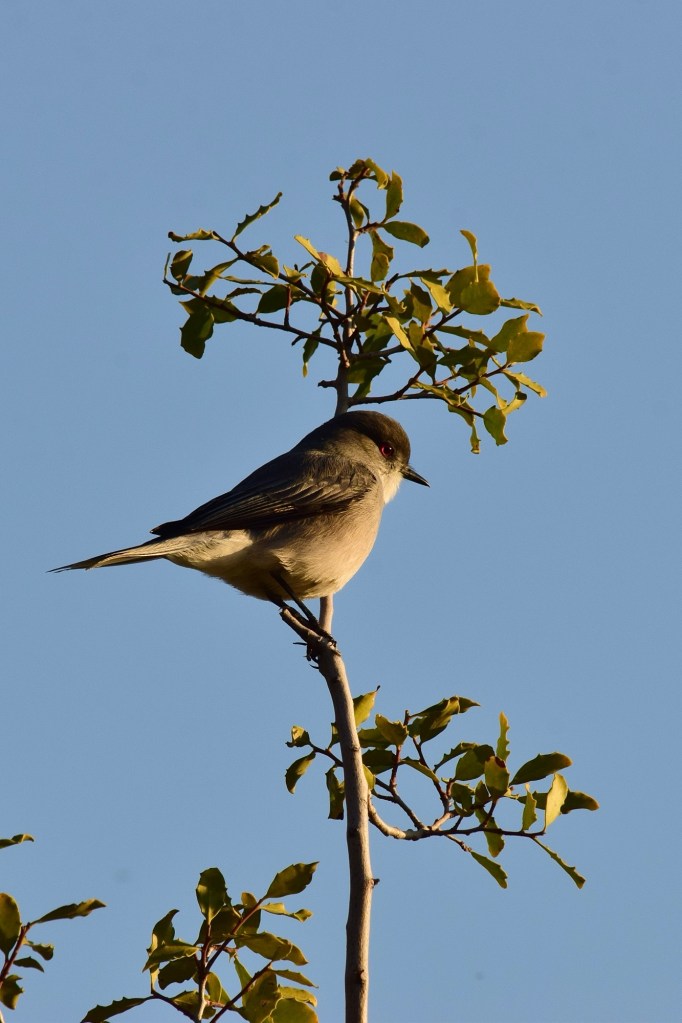
I thought I might try and snap one of the many Chilean swallows circling the heights of Cerro Calán, but they were much too fast and never came down to roost. I did, however, finally have manage to capture a fire-eyed diucon – a little grey bird with striking red eyes, almost like those of a Victorian doll, that moves just like a flycatcher from back home.
It was really encouraging to see more than a couple of other walkers up on Cerro Galán with binoculars and the BIRDA app on their phones. I can’t help but notice that birdwatching seems to be a lot more popular here than I anticipated. I suppose it helps a lot when your average city birds are really quite spectacular to start with.
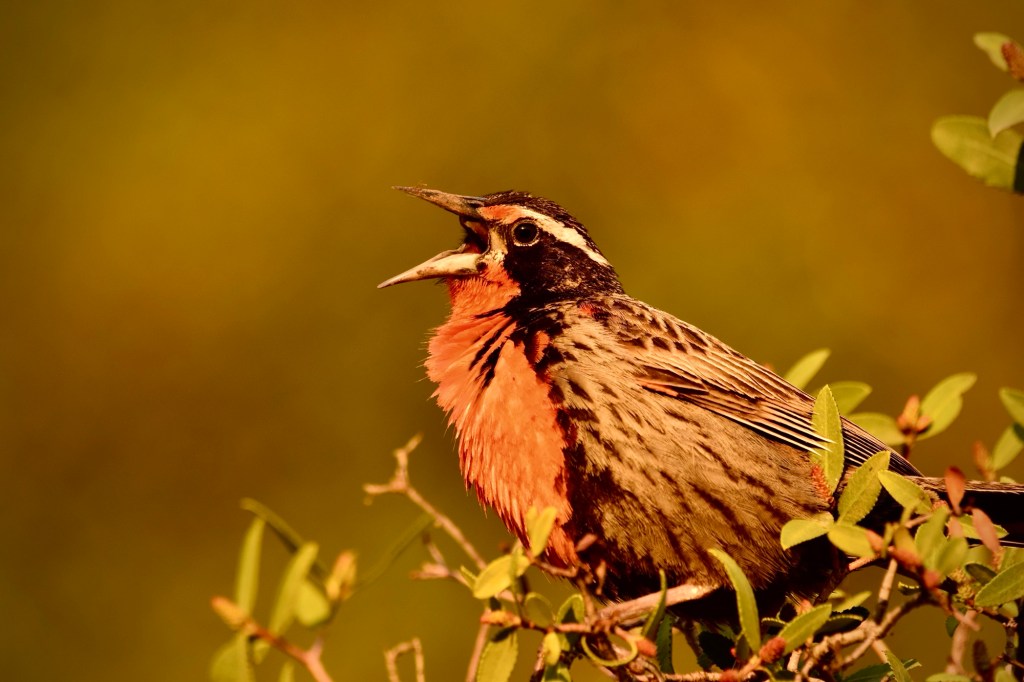
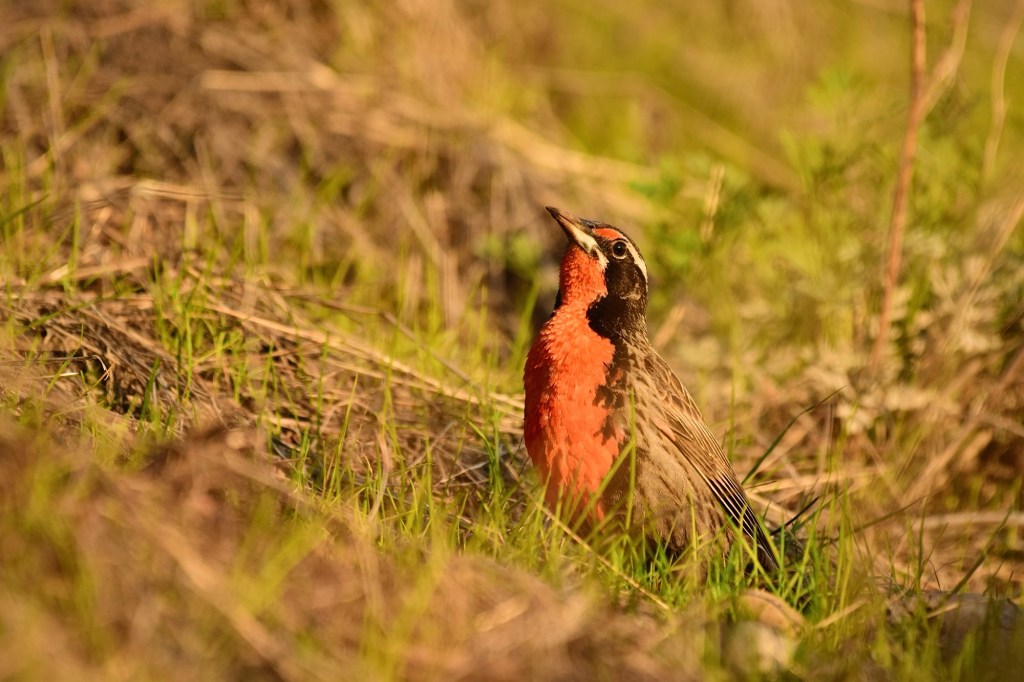
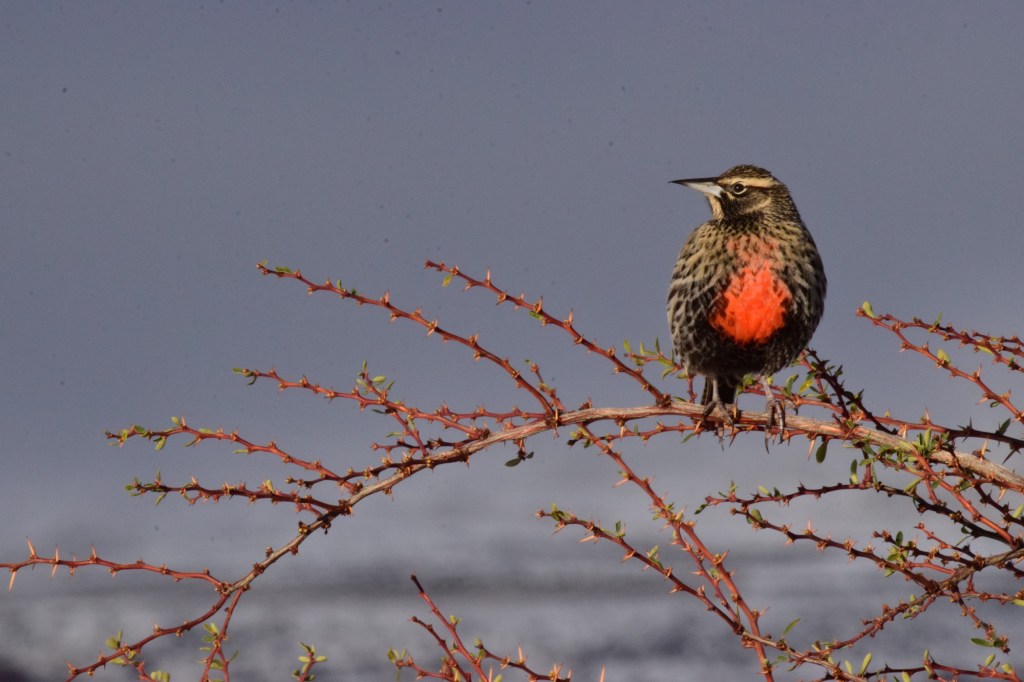
Take the meadowlarks, for example, who make their presence known with a tremendously loud wheezy call that goes off like a Mexican wave as soon as the first one in the flock puffs out its chest and sings. These are the birds that the locals in Santiago seem to love the most, and with such an eye-popping splash of red on the males’ chests, I can’t say I blame them.
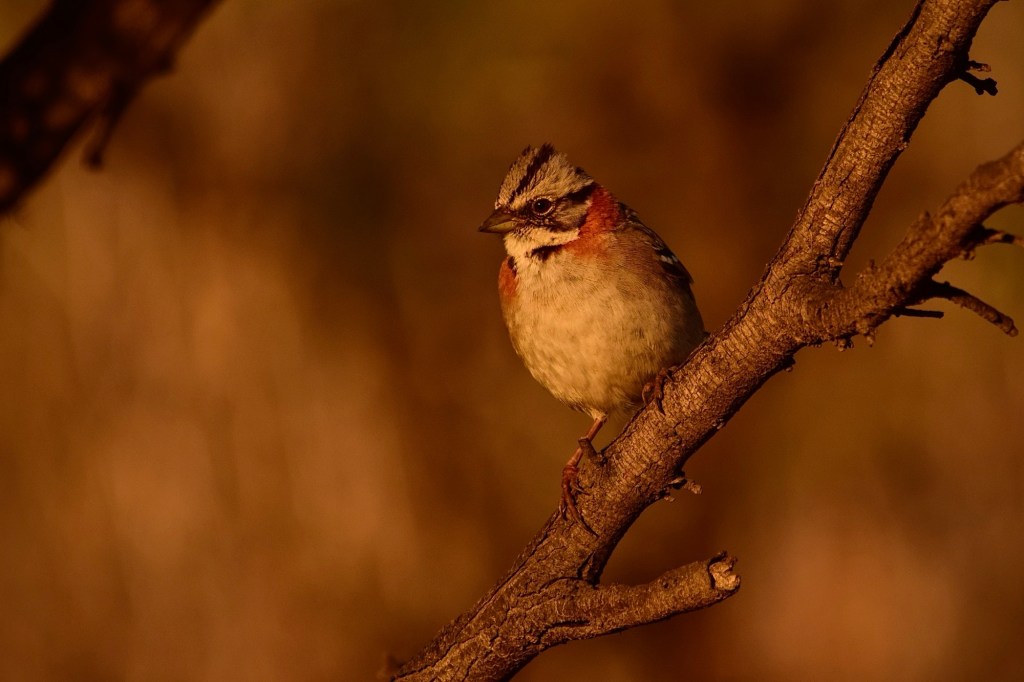
Definitely saving a corner of this post for my favourite little sparrows, though. Slightly smaller than our house sparrows, with an endlessly cheerful chip to let you know they’re nearby, they also have a beautiful song when they’re feeling more musical.
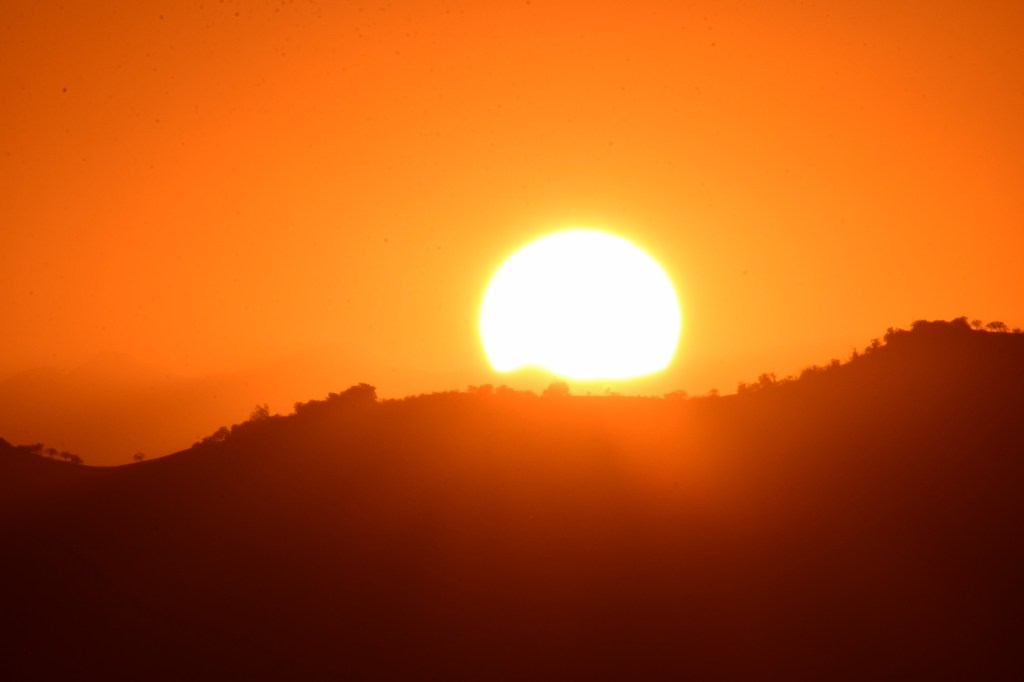
I was up on the cerro long enough to catch the sunset, which was an added bonus. It must have been tremendous from Valparaíso, no doubt, but even here in Santiago, with the forested mountains of La Campana between us and the horizon, it was quite a sight to see.
Today I think I’ll wander over to the Senior English department and try to catch a few more lessons. Be proactive for a change! BB x
Week two started slow today. A couple of meetings and a non-starter quest for a functioning laptop meant that I spent the day working on my books, which was a lovely way to spend the day productively – as well as a reminder to myself that I am technically on holiday – albeit perhaps not as exchange-heavy as it could have been. I have bigger events coming up this week, though, and I suspect it will be the last week of my exchange when it really feels like I have a fully functioning timetable.
There are always so many birds around campus. The nest boxes the students have put up all over the school site for their CAS project obviously help, but it’s not just the charming little rufous-crowned sparrows that make the place feel so friendly. The mockingbirds are always perched somewhere, every time I look up I see a caracara of some description hanging in the air, and just before break this morning I know I saw the faraway silhouette of a condor circling the heights of Manquehue.
It’s the meadowlarks that are currently lending some extra charm to the place, if I had to choose a standout. I first got to know these characterful creatures in snowy Patagonia, but it turns out they’re just as common up here around Santiago, hopping about in the car park and sitting quite fearlessly on the school fence, singing their hearts out as the Year 7s play some kind of tag game just feet away.
My BIRDA app tells me my total count of species I’ve seen so far is up to 818 after this weekend’s exploits. Even I have to admit that’s getting to be a dizzying figure, and well over three hundred of that total are birds I have seen in the last five months. I’m not a professional lister like many seasoned birdwatchers, chasing a particular total on my life, year or patch list, but it’s fun having an app where you can log it all, and in so doing learn something about the sheer diversity of species you have found – and, consequently, discovering what is still left out there to see.
I probably could have seen more species if I’d paid through the nose for that Abra Málaga trip, but I wasn’t really after that kind of number-obsessive behaviour. One albatross would have been magical enough on yesterday’s boat trip, and I was blessed with four different kinds. It does not pay to go out into the wild with great expectations. Nature provides on its own terms.
Not too much to report for now, but keeping my writer’s block at bay with regular note taking. And it does seem to be working! BB x
I grew up within sight of the sea. You’re never far from the sea in Kent: the furthest I ever lived from the coast was about ten miles as the crow flies, while the second half of my childhood was spent less than a mile from the white cliffs of Dover. As such, I am very attached to the sea and all its smells and sounds: the salt spray of the winter waves, the hushing rush of pebbles pulled down the beach by the tide and the cry of the herring gull. If I should be so lucky, one day, I should like to live by the sea.
Today I took that lifelong love for the sea and dialled it up a notch by taking a pelagic trip out into the Pacific – into the open ocean.
Rodrigo, my guide for the day, picked me up from outside my hostel in Valparaíso shortly after seven. A punctured tyre delayed him by forty minutes or so, so he was anxious to get going, so as not to hold up the crew of their ship up in Quintero, a seaside fishing town some thirty miles north of Valparaíso.
Shortly before we got there, the sun rose into a fiercely red sky. A certain old English saying came to mind:
Red sky at night, shepherd’s delight
Red sky in the morning, sailor’s warning
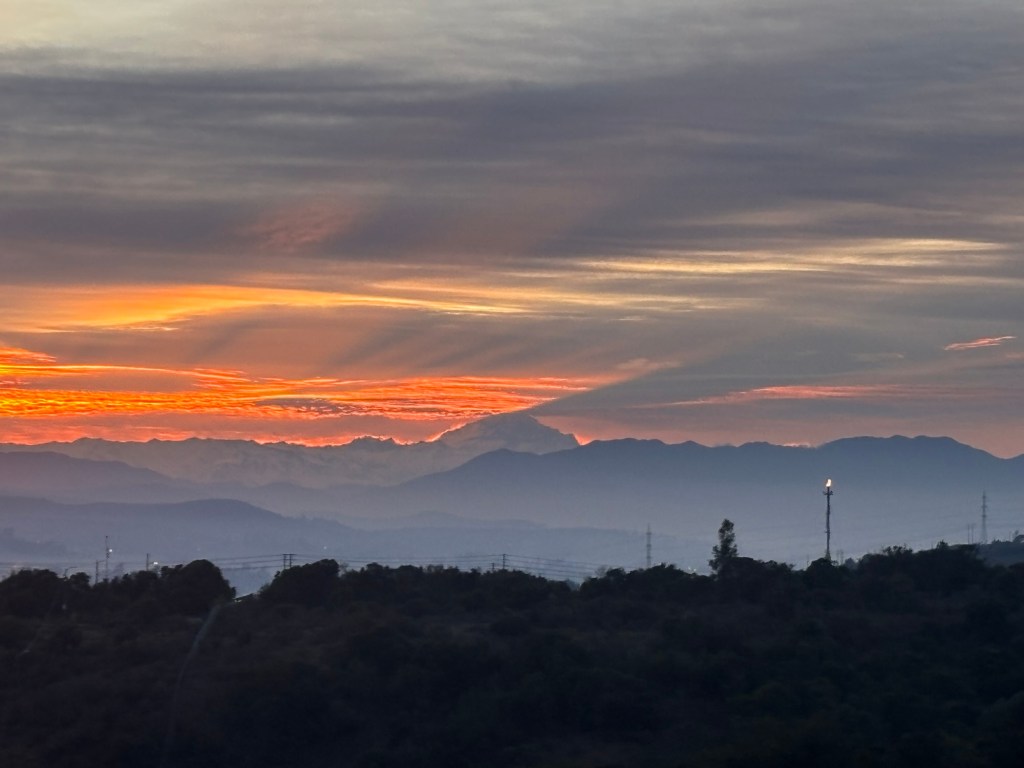
It was a beautiful sight, even if it did threaten rain. More spectacular, though, was a clear view of Aconcagua, the tallest mountain in all the Americas and the highest peak outside of Asia. The great white sentinel was so immense that by some trick of the light it seemed to throw the entire south of Chile into darkness. Apparently, only 30-40% attempts to scale Aconcagua are successful. The mountain is evidently as much an apu – a sacred mountain – as its better-known kin to the north of the cordillera, and not to be underestimated.
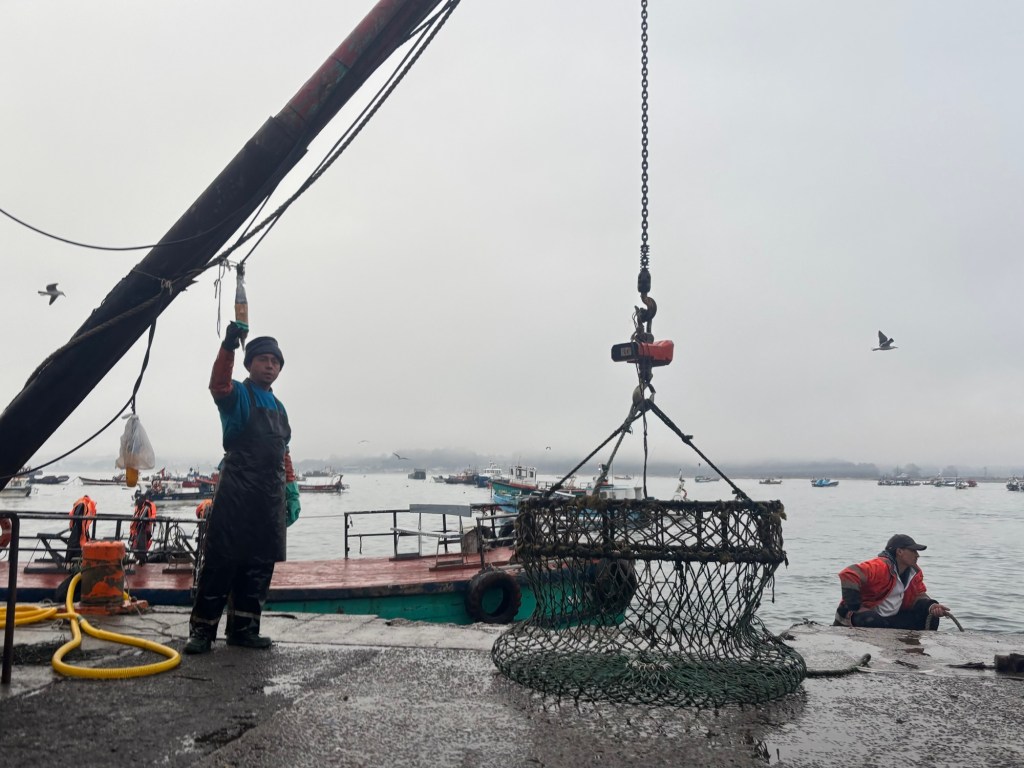
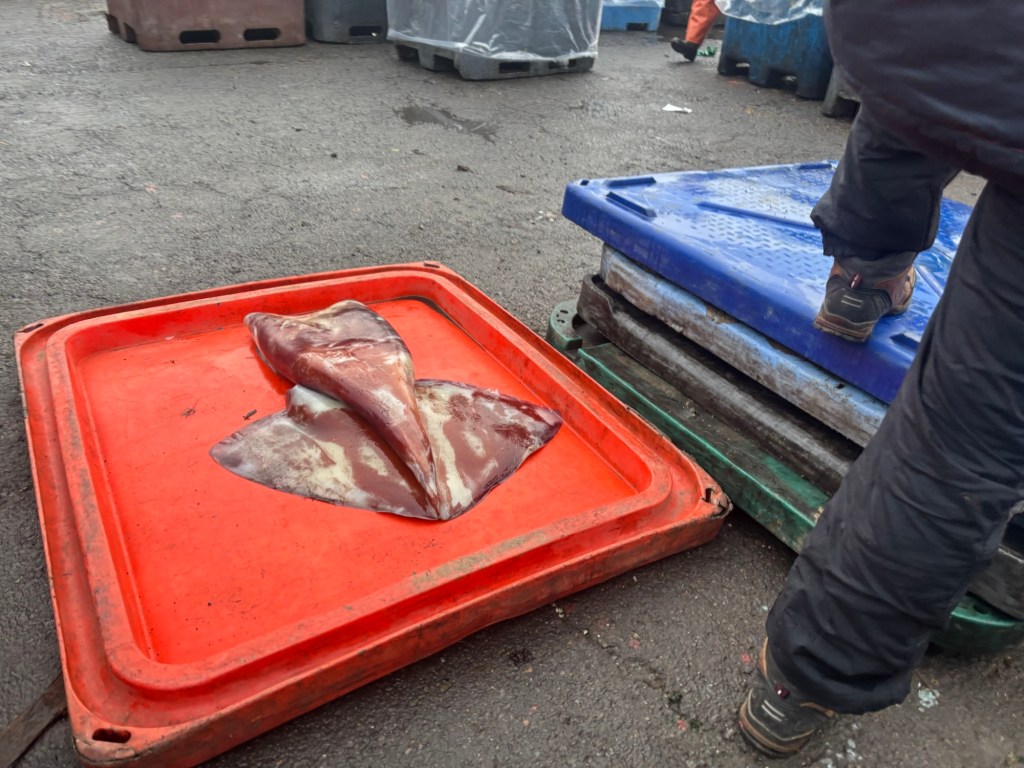
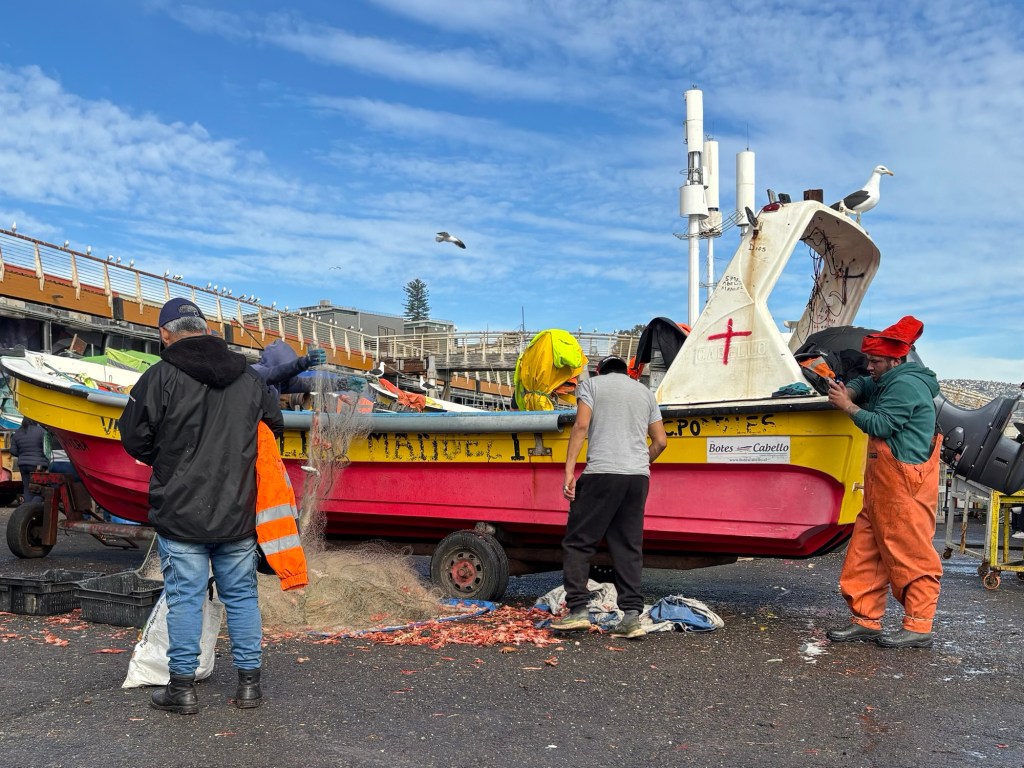
The local fishermen of Quintero were already hard at work as we arrived, slicing up some frighteningly large squid and cleaning their skiffs after a night out on the ocean. They seemed curious about the small group of day trippers herded onto a boat waiting in their harbour – all of them Chilean, with the exception of one wandering Briton – but paid us no more attention than the pelicans: a sort of intentional acknowledgement, as they went about their work.
I couldn’t help being totally bowled over by the frighteningly large squid laid out in the fishery. Humboldt squid – or jibia as they’re known in Chile – are among the largest squid species in the world, reaching a whopping five feet in length. They’re so numerous along the coast of the Americas that they represent a third of the squid catch worldwide – and despite the fact that nearly two thousand tons of them are hunted in Chile alone every year, their population is still expanding. That’s a testament to just how rich the Humboldt current truly is. It’s also why Chile has always been home to a healthy population of sperm whales, who devour these and even larger prey, including arguably the most famous whale of all time: Mocha Dick, an aggressive and exceptionally cunning albino sperm whale who survived nearly a hundred attempts on his life before being brought down off Mocha Island. His story inspired Herman Melville to write the American classic Moby Dick, but it’s the original tale that is taught here in Chile as part of the national identity-building curriculum. How cool is that?
We left the harbour – with its attendant sea lions and pelicans – and started out on the hour’s journey out into the open ocean. For most of that first hour, we were tailed by kelp gulls – Chile’s ubiquitous answer to the herring gull – and strange shapes in the water, many of which turned out to be discarded bottles or cans floating eternally along the Humboldt. I counted at least four Fanta bottles and two bicycle tyres, the latter floating nearly side by side. I wonder what happened to the bicycle itself?
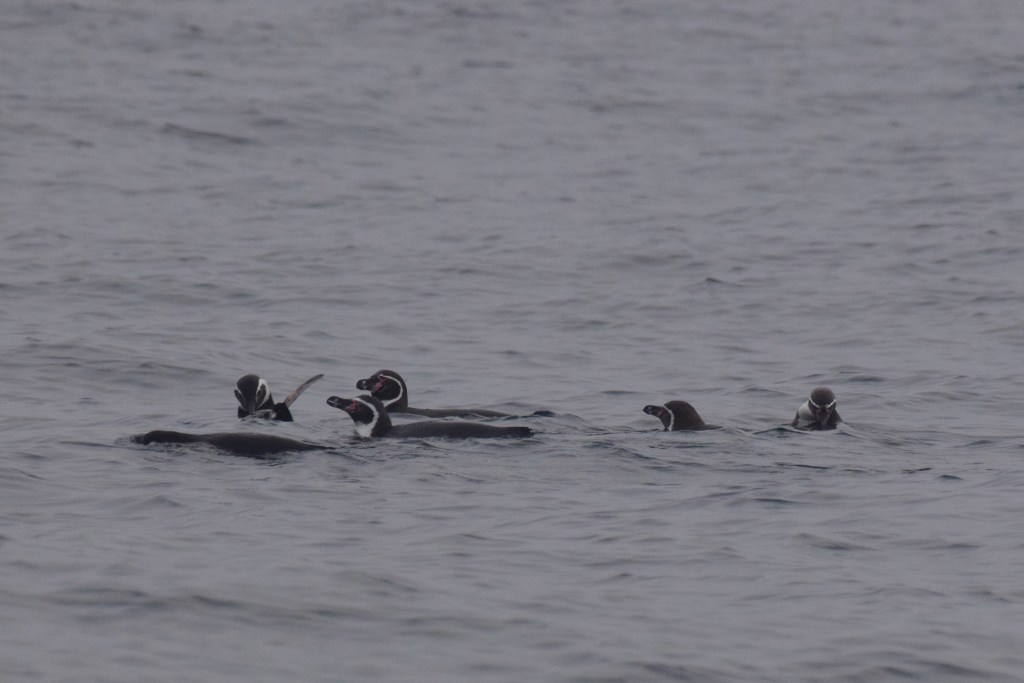
Some of the shapes moving along the surface of the water were a lot more interesting. A curious sea lion, a huala or great grebe fishing offshore, or a family of penguins, spending the winter at sea. Over the course of the morning we saw both species native to Chile: Humboldt penguins – the kind I saw in the Islas Ballestas in Peru – and Magellanic penguins, a more southerly species that have colonies right down to the Chilean Antarctic.
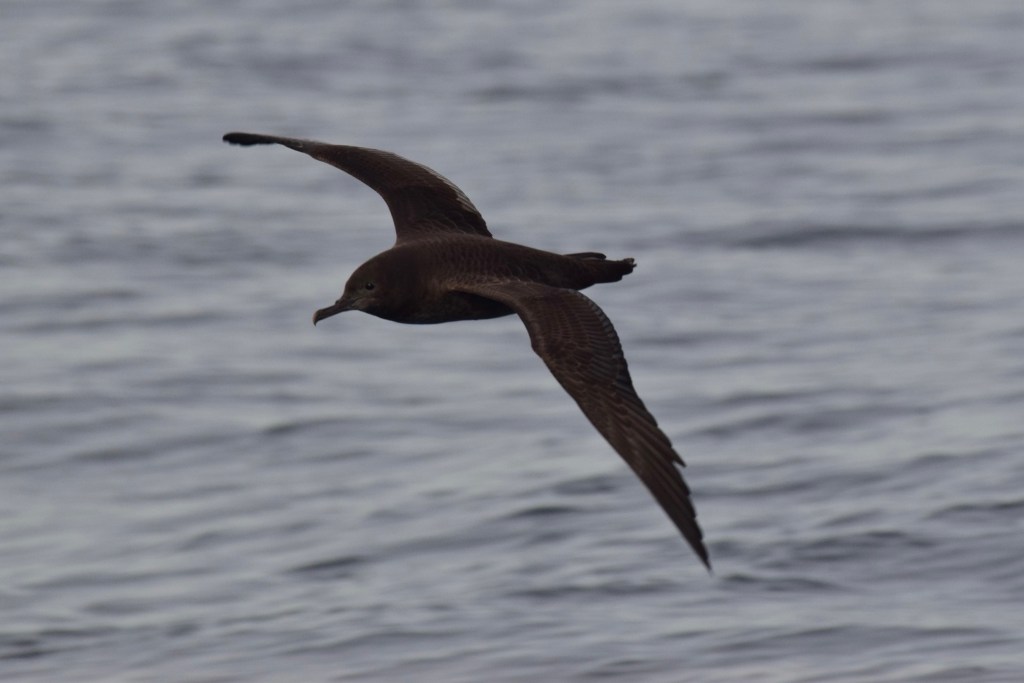
We didn’t have to go far from the harbour to see our first pelagic species of the morning. The first to make their appearance were the shearwaters, experts of the open ocean, zooming low over the surface of the water, banking this way and that. With the roll of the waves, they seemed to slice through the surface with the tips of their wings in the way that gave them their name, though I swear I never saw them touch the water once.
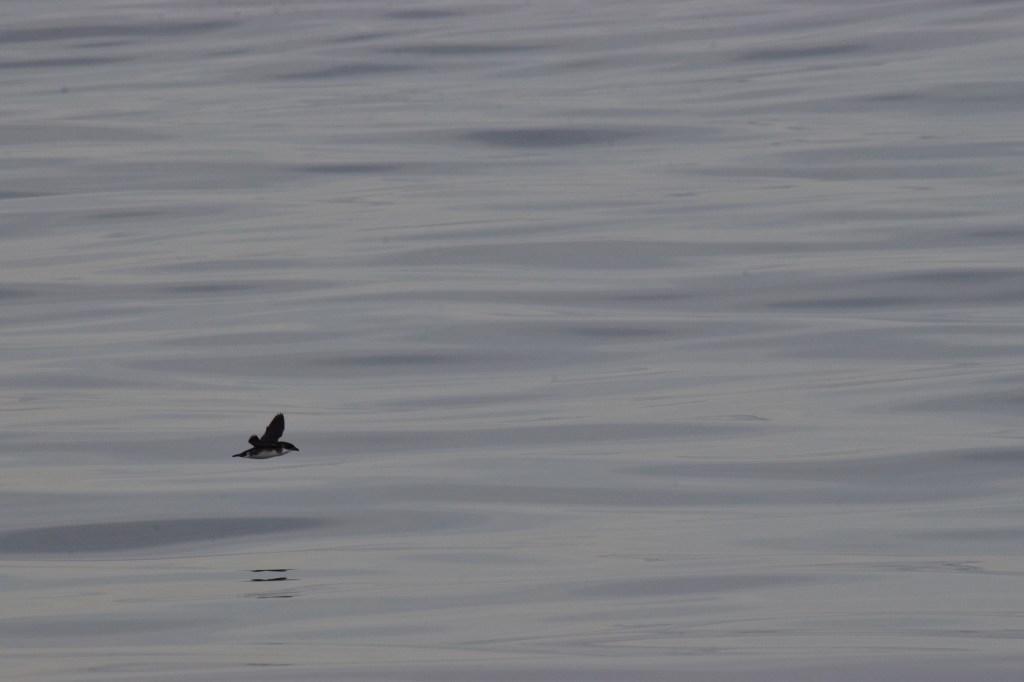
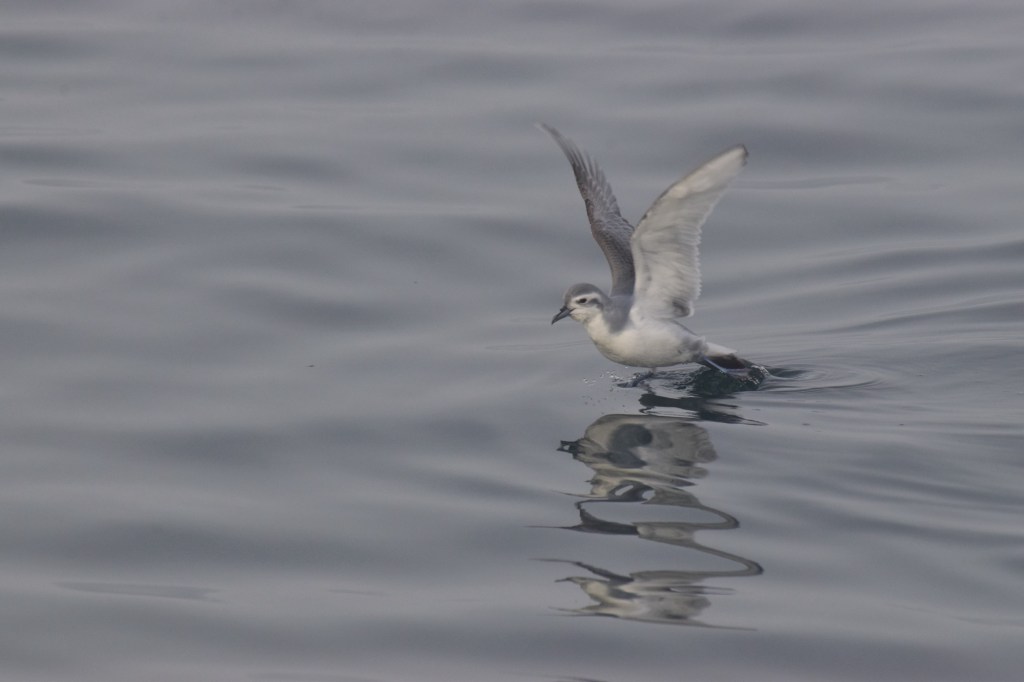
In the descending gloom, they were hard to catch on camera. A little easier were the diving-petrels, tiny auk-like birds that preferred to paddle away from the boat, popping in and out of sight beneath the waves in the habit for which I suppose they were named.
As the rocky headland of Quintero faded into the mist, we were almost entirely enveloped. This dense sea mist is one of the reasons there haven’t been any pelagic tours since April: if the visibility is this poor, the harbour doesn’t let ships out into the open ocean, lest they become lost, disoriented by the waves – or worse, collide with another ship.
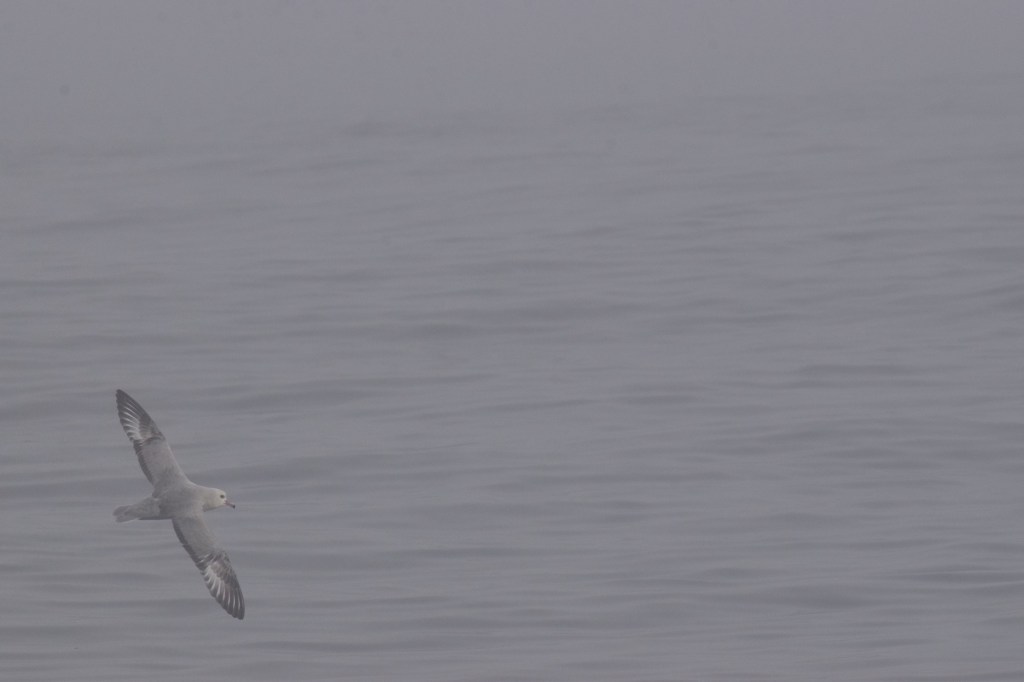
Only the fulmars kept us company in the mist, slicing through the fog on silver wings.
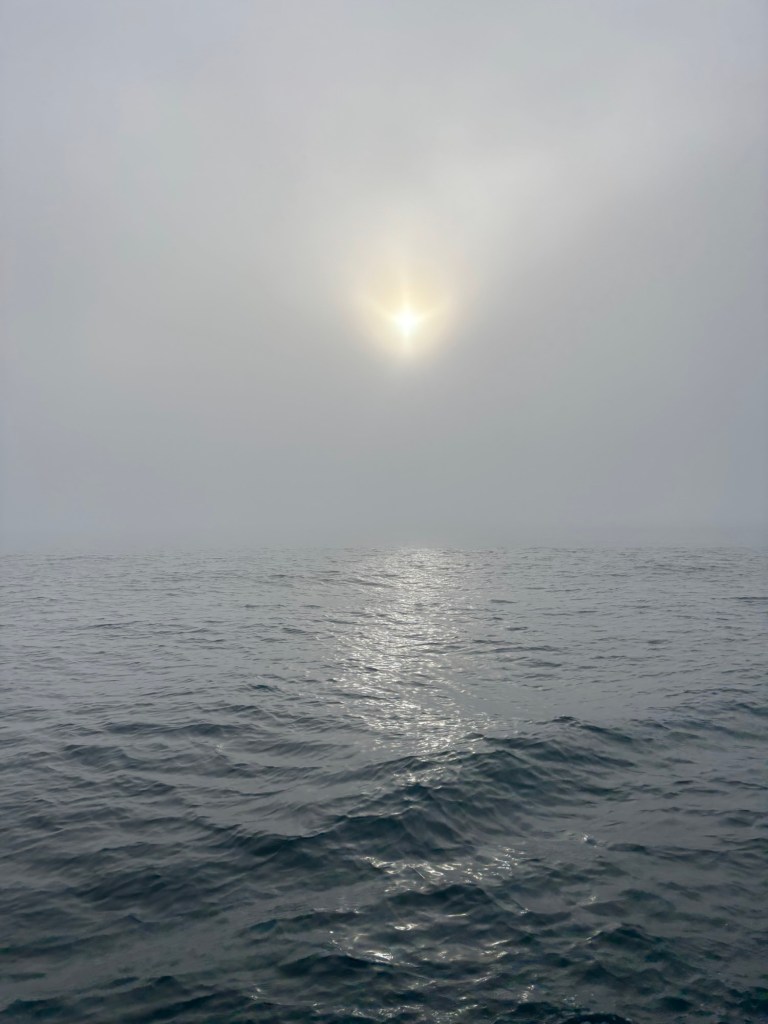
After what must have been an hour, the first sign of relief began to glow in the east: the sun, clear of the mountains and their attendant clouds at last, was trying to fight its way through the fog. Curiously, some trick of the light warped its shape into something that looked like a cross or perhaps even an angel with arms outstretched. It’s so easy to see how legends could form in such a strange and unsettling space as the open ocean, in a time when there was so much less knowledge and so much more wonder in the world.
As the mist began to clear, we reached the feeding grounds of the open ocean. There were plenty of shearwaters around, mostly sooties – a dainty species of southern waters that can sometimes be seen as far north as the British Isles on their wanderings. But this is their home, off the southern coast of the Americas, and there were plenty enough of them to prove it.
A young lad on the crew lifted the lid on one of the chum buckets – fish heads and squid tentacles, mostly – and threw some into the water for the birds that had followed us so patiently. They were watchful, at first, as wild things should be, but once the kelp gulls cottoned on, the shearwaters lost their timidity.
One bird I had not expected to encounter at all was a prion – known around here as a paloma marina or sea dove. These Antarctic birds had been driven north by weather currents in the South Seas, by the looks of things, and it was a real delight to watch them bobbing around beside the boat, dipping their heads beneath the water in a constant, frantic search for food.
The real prize of the open ocean took its time. A cry of “albatross” from the captain (one Chilean bird whose name is seemingly universal) drew our attention to an enormous shape gliding through the mist behind the boat. It was there for a moment and then it was gone.
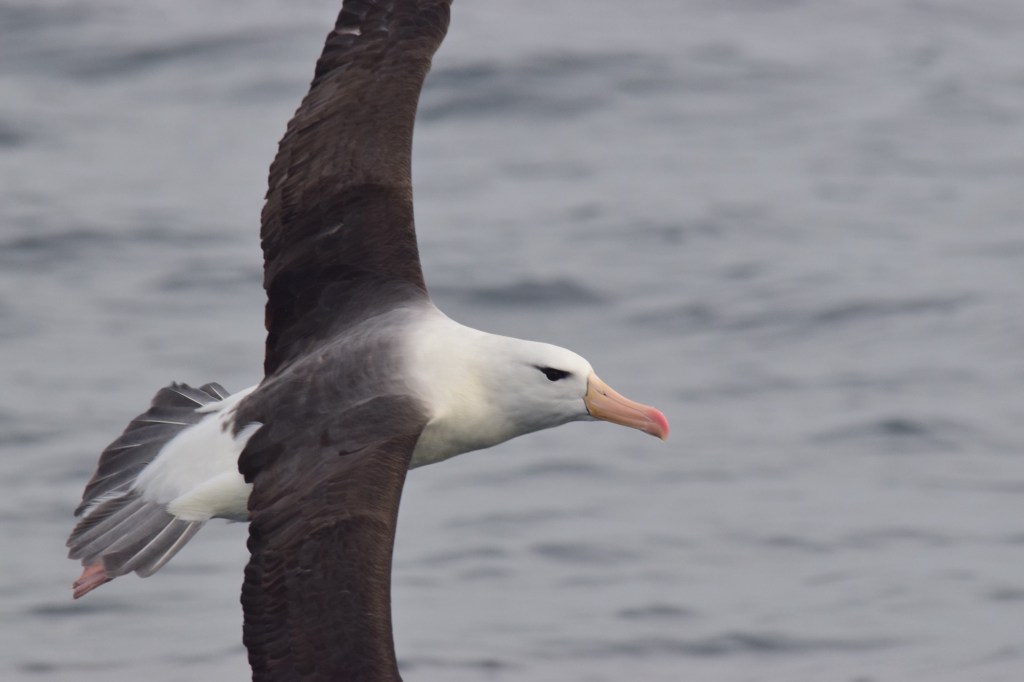
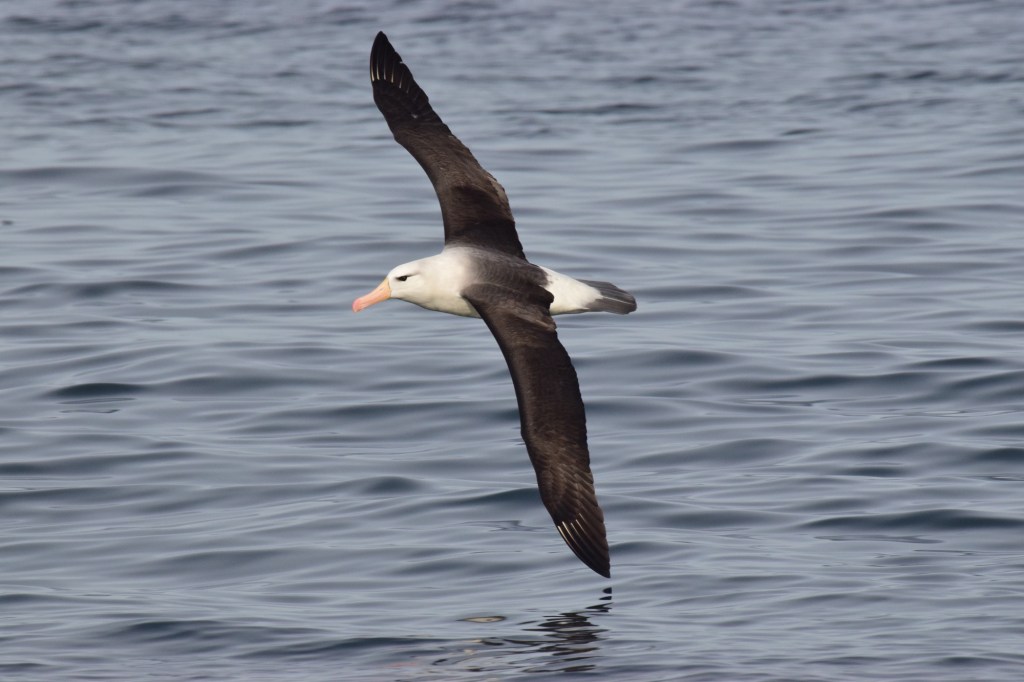
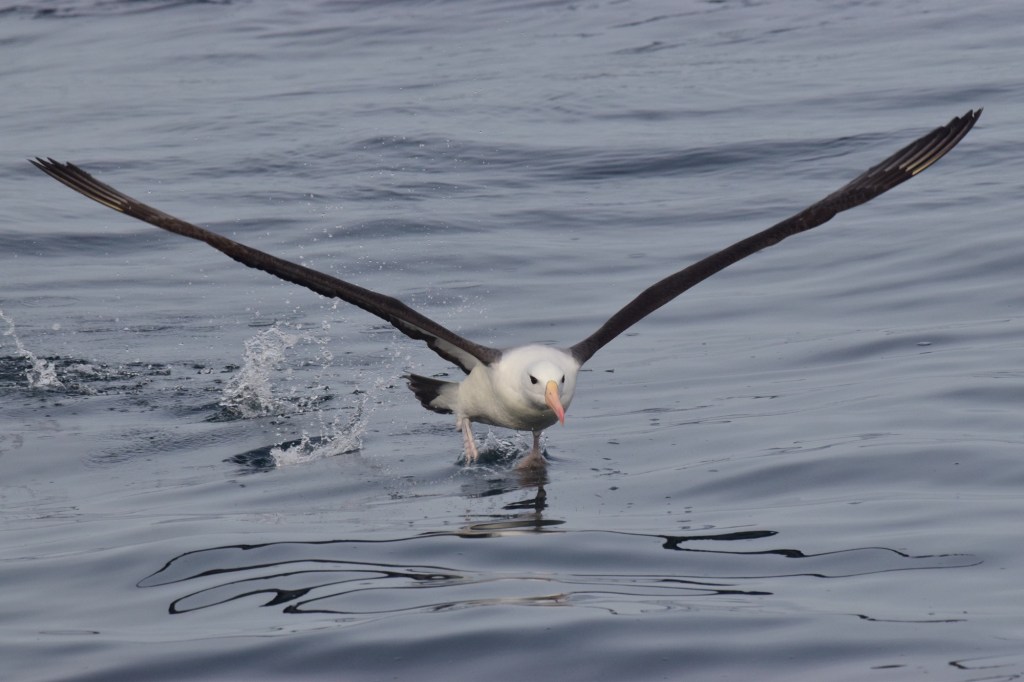
A few minutes later, one of the crew spotted it again. The giant – a black-browed albatross, and presumably the same individual – must have caught the scent of the chum and was following the boat at an increasingly shorter distance, arcing across the water in the kind of wide waves that children do on bicycles when following something too slow for their liking.
In time, it seemed to lose all suspicion of us whatsoever and flew in incredibly close, so close that you could see the glint of sunlight on the tip of its bill.
One of the Chilean birdwatchers sitting at the back of the boat beside me remarked somewhat ruefully that he had seen far more activity in previous July expeditions. To him, the ocean was unnaturally quiet today.
I couldn’t have cared less. I was hoping to see one albatross, but I didn’t expect it to be so close, and so bloody impressive. They really are magnificent creatures.
The albatross is a perfect gliding machine. The only time they need to beat their enormous wings is upon takeoff, which is a somewhat clumsy affair requiring one heck of a run-up – although, when you consider that said run-up usually takes place on the surface of the water, that feat is all the more impressive. To aid them in this endeavour, their webbed feet are absolutely enormous, giving them serious launching power as they race across the waves. Once airborne, they can glide for hours, riding the wind on wings that have evolved to make them the true masters of the open ocean.
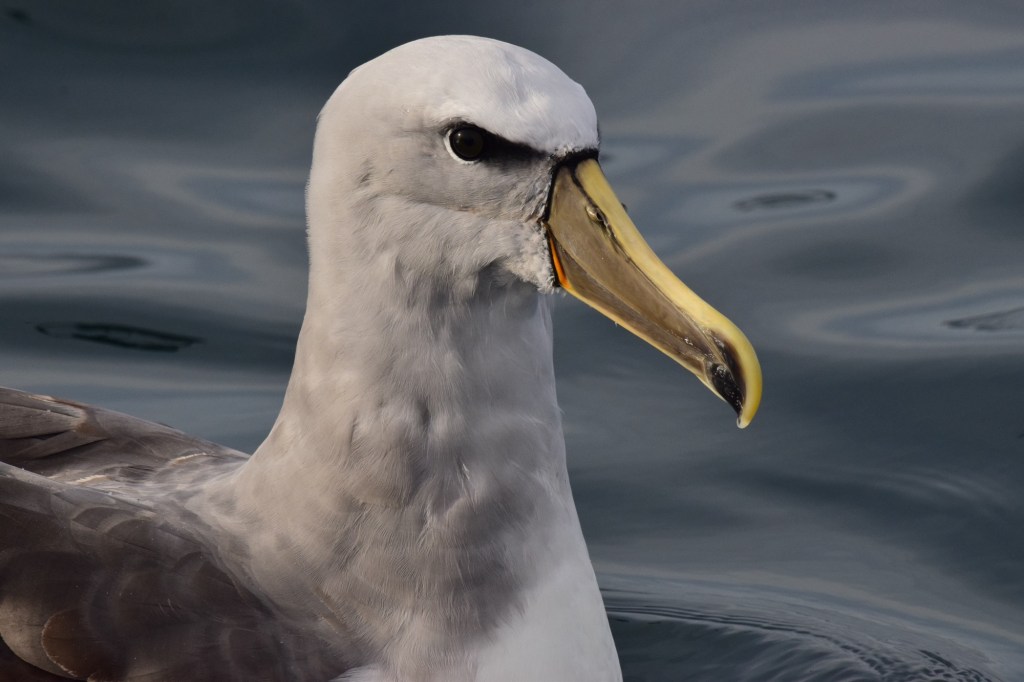
As the scent of chum in the water drew more and more seabirds, other species began to appear. There was much activity on the boat when a Salvin’s albatross came riding in to join the bounty: a larger, greyer species with a smart yellow lining to its bill. Like the black-browed, its eyes sit beneath a dark shadow, giving the peaceable bird a perpetual frown – though it looked stern enough when it came charging in to chase the other gulls away from the discarded fish heads thrown overboard.
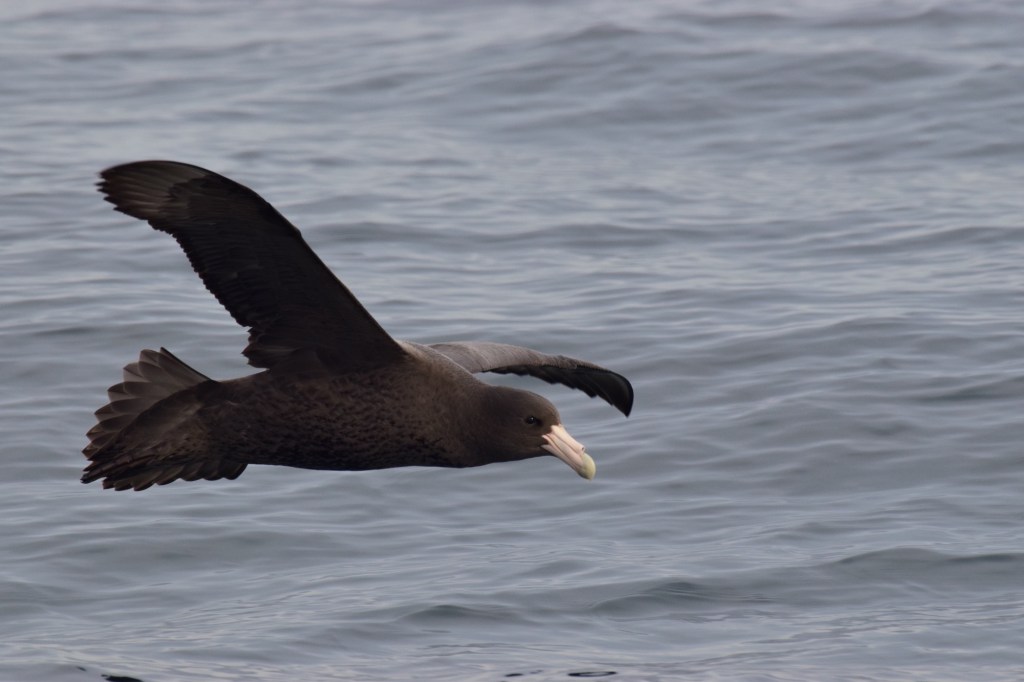
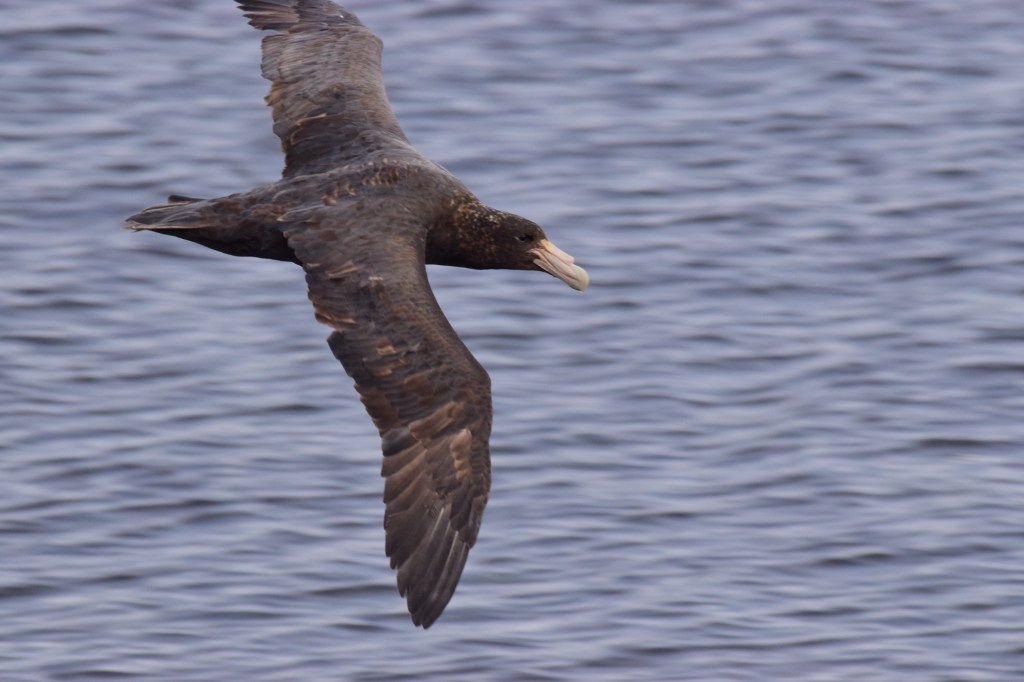
As more and more birds were drawn to the bounty, others besides the albatrosses came in to investigate. Petrels of every kind: smart pintado petrels, Westland petrels from New Zealand, tiny storm-petrels – known to Spaniards a golondrinas de mar (sea swallows) – and southern giant petrels, like the ones I saw in Natales. I quite like these dark morph birds, but there’s a pale morph that look truly sinister, with cold grey eyes – much more suitable for the vultures of the southern seas.
If it weren’t for the albatrosses, these giant petrels would have dwarfed everything in sight. As it was, the best they could take home was second-billing (no pun intended).
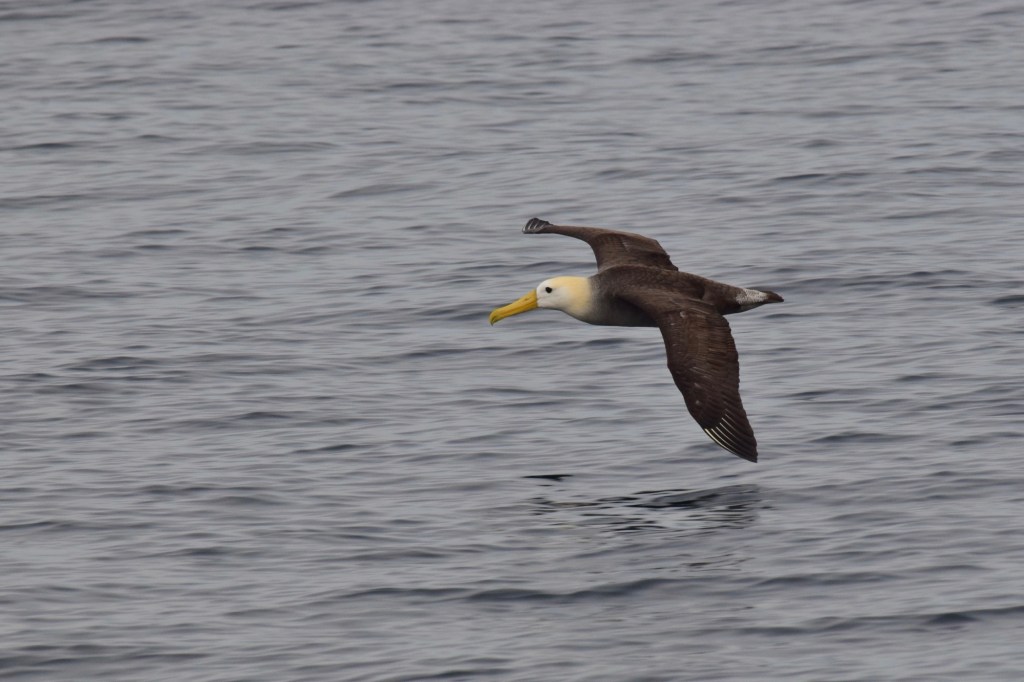
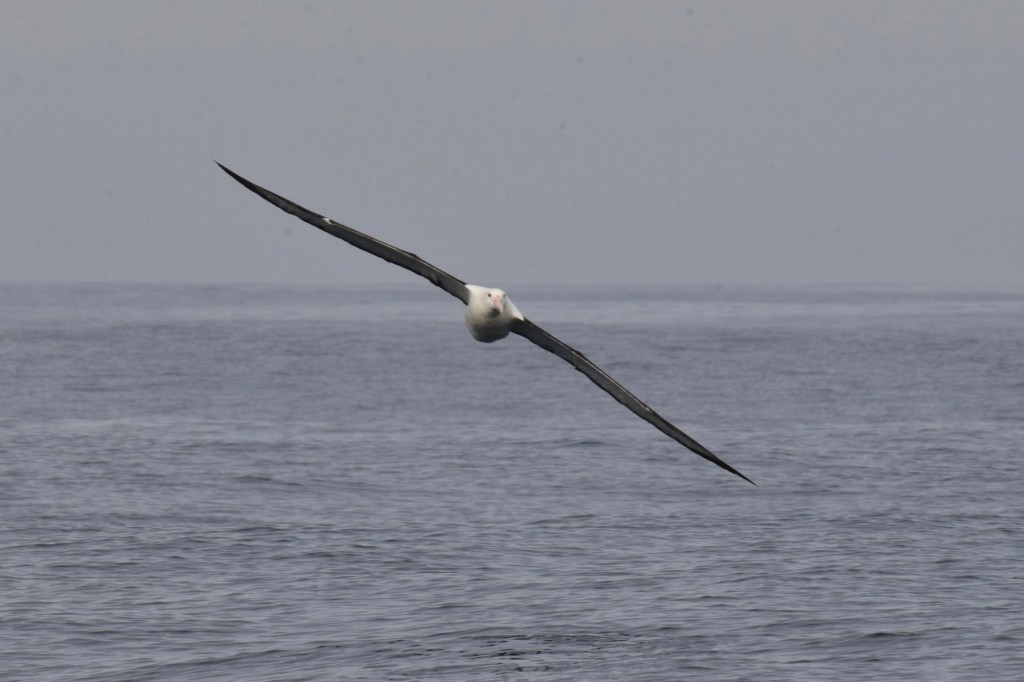
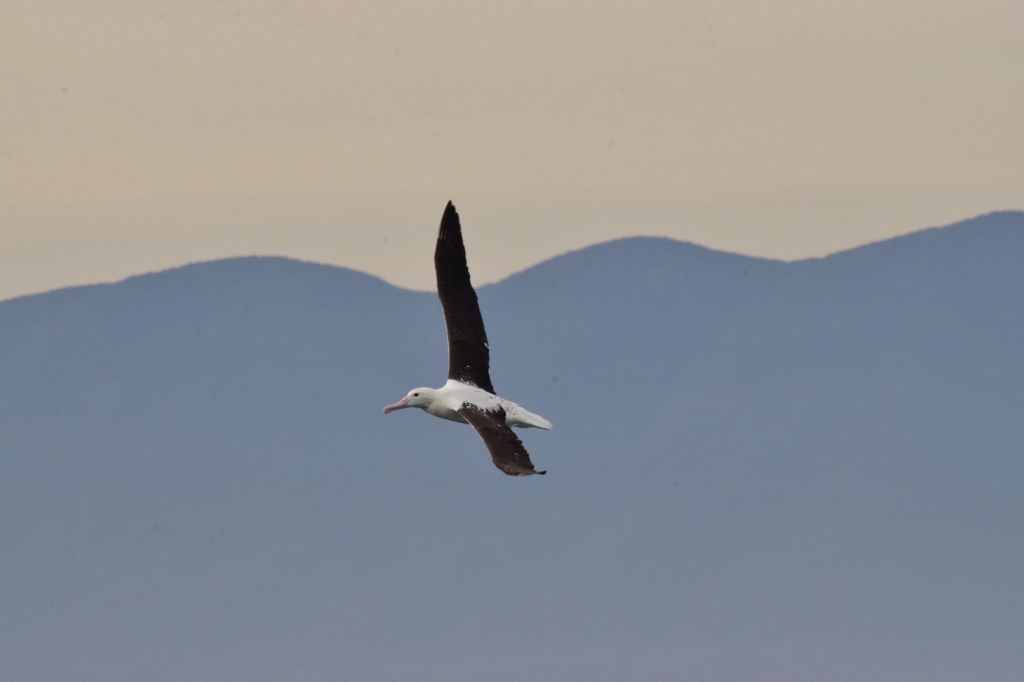
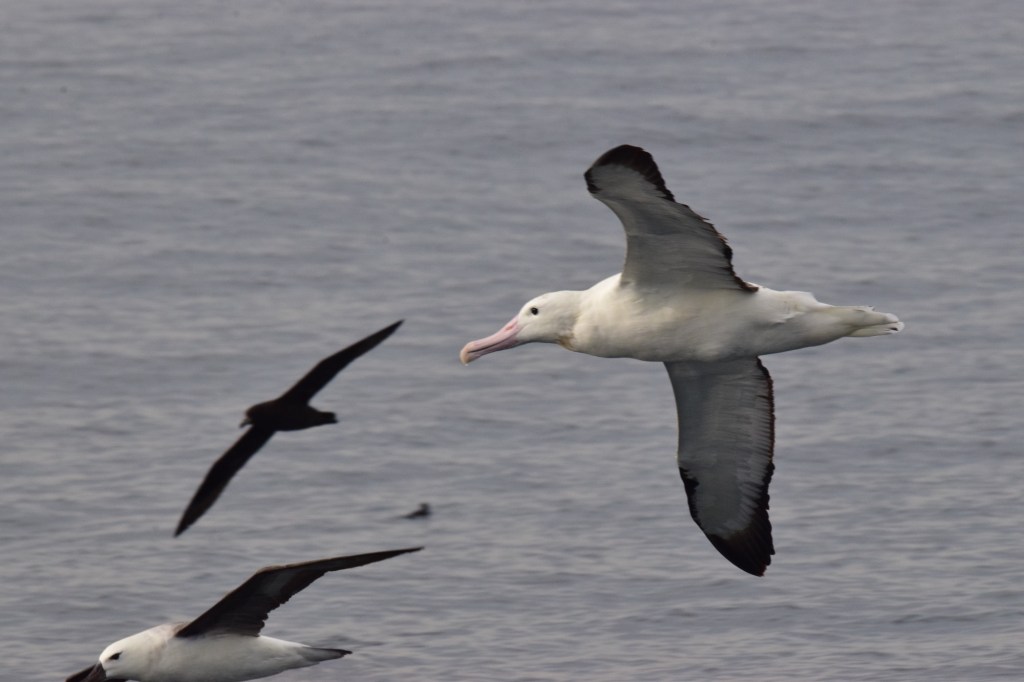
There was a great deal of excitement on board when another albatross appeared: a waved albatross, a stranger to these waters that usually makes its home in the Galápagos Islands to the north. The albatross is a true wanderer, scouring the length and breadth of the ocean in search of food, so they can turn up just about anywhere outside of the breeding season. Even so, the captain remarked that in the last twenty years he had only seen five of them, so it was quite a special sight.
For me, though, the most spectacular bird of all was the last to appear. Towards the very end of the expedition, a truly enormous shape coasted into view from the direction of the open ocean, riding in on the wind on three-metre-long wings. A royal albatross – tied with the wandering albatross for the largest wingspan on the planet.
More wary than its kin – or perhaps more stately – the wanderer kept its distance, gliding in enormous circles around the boat. I’m not sure where they stand in the pecking order, or whether the royal in their name is a flight of fancy on our part in allusion to their size, but the giant was indisputably the largest and most powerful of all those gathered to the feast.
Just once did the wanderer come in close enough to truly appreciate how much larger it was than everything else: even the other albatrosses looked like gulls beside it. Unlike the angry-looking black-browed and Salvin’s, the royal albatross has a kind face with deep black eyes and a clean pink bill.
To see one is to understand how sailors of old were enchanted by this bird, spinning legends about it, including the famous belief that to kill an albatross was to invite disaster – upon ship, captain and crew.
What an incredible encounter! I hoped for one albatross and saw at least fifteen, including the largest of them all. My ears may not have fully recovered yet, but I couldn’t feel more fortunate right now.
Upon returning to Quintero, we all had lunch together at a seafood joint opposite the harbour. Quintero is not on the tourist trail – it isn’t even mentioned in the Rough Guides book I brought with me – so the fare was local, fairly-priced and fresh – and absolutely divine. I mulled over the menu for a bit before opting for a mint and ginger lemonade – my favourite Chilean drink – and the caldo de congrío, a wonderfully warm Chilean seafood soup.
I would have caught the bus back to Santiago, but one of the birdwatchers was tremendously keen to offer me a lift as he was headed back south anyway, and thought he might show me parts of the interior I might otherwise not see. I don’t tend to turn offers like this one down, and I had plenty of time, so I accepted.
Manuel – a Chilean marine researcher of proud Basque extraction – was a proper fount of information. He has been into birds his whole life, studying ornithology at colleges across the United States and working primarily in pelagic research. His job has taken him from the coast of California to the Galapagos and the Pitcairn Islands, as well as both the North and South poles. He remembers when they were proper frontier territories, before modern tourism sank its teeth into the far-flung corners of the world. He remembers also when much of the coast of Valparaíso was a giant lagoon, with bird-rich wetlands that have long since dried up and turned into cattle country after so many years of drought. The recent downpour is an anomaly: the Chilean palm trees that grow in the hills to the east all bear the blackened scars of the fires that rip through the countryside when the summer heat is at its worst, aided by the invasive eucalyptus trees that do so love to self-immolate.
As well as a crash course in Chilean fauna, flora, history and politics, Manuel was something of a prankster, hellbent on stopping in the middle of nowhere to take a photo of me so that I could send it to Rodrigo, our guide, so as to let him believe that I had been dropped off in the middle of nowhere. The average citizen might have left the joke at a passing comment, but Manuel was adamant to see it through, passing over several promisingly desolate spots in the hills before finding one to his liking.
His puckish side satisfied, he made sure to send me on my way with some herbs for my tea and a fresh loaf of local bread, superior to any supermarket pan de molde. I had some this morning. It really was superb.
Manuel dropped me off in Melipilla, a one-storey town to the southwest of Santiago that has definitely seen better days. Several earthquakes – including one that had its epicentre in the heart of the town itself – have laid waste to what was once a very pretty Chilean town, with colonial adobe houses and two impressive churches. What remains is a sad mishmash of old and new, houses patched together with new materials, as though the whole town was rebuilt using six different LEGO sets. The street art of Valparaíso has made its way here, too, though it is perhaps less welcome here than it is in the cascading streets of the seaside city.
I bought a bus ticket for a paltry 2.000 pesos (just over a pound, I think) for the fifty minute ride back to Santiago, and as a bus arrived just as I was buying the ticket, I didn’t need to wait at all. It was half six by the time I made it back to the flat in Las Condes, long before Tomás and his family returned from their Sunday outing to see his grandfather. I meant to sit down and write, but after I had put my clothes in for a much-needed spin in the laundry, I pretty much collapsed into bed. It’s funny what a morning out on the ocean will do.
My second week begins. I will try to see some English lessons this week – and, with any luck, get a bit more involved after a week observing the middle and senior teams.
I have also reached a decision as to what to do with my last week out here. But that, for now, must wait. Let it be a surprise. There is a lot more magic in that. BB x
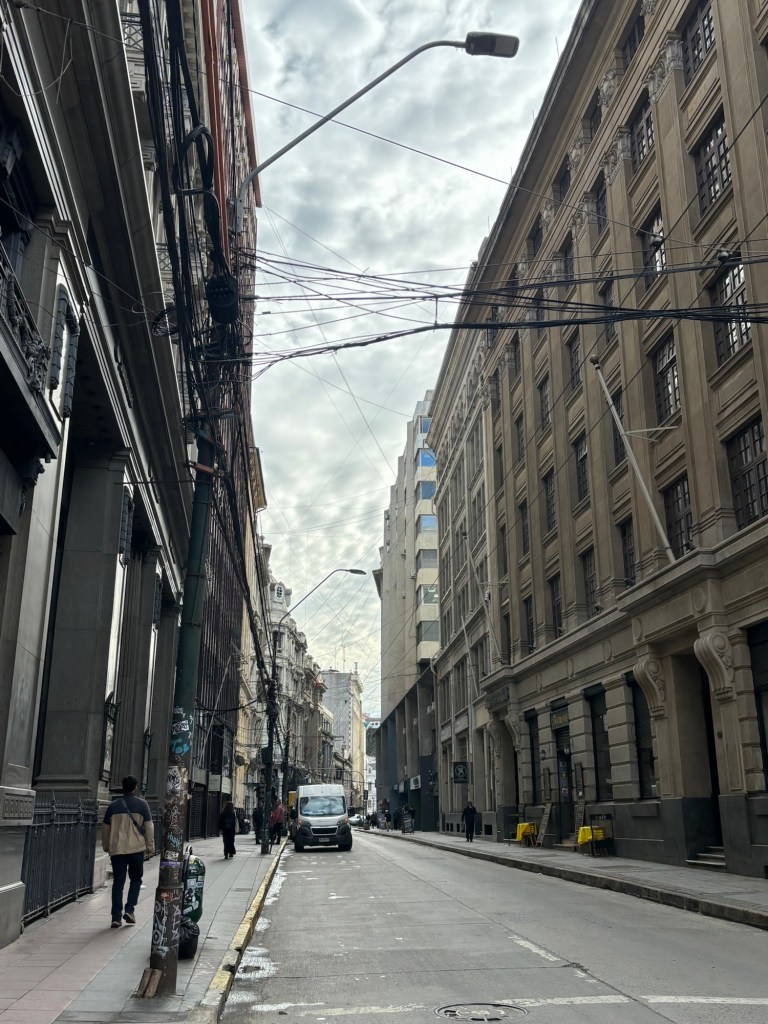
Santiago de Chile may be cursed to be a smog-bound citadel for the rest of its days, but in one particular sense, it is exceptionally well-placed: it is about an hour’s drive up into the mountains to the east for skiing during the winter months, while a hour and a half’s drive to the west will take you to the Pacific coast. Santiago’s summer sisters, Valparaíso and Viña del Mar, may only be a hundred kilometres out as the condor flies, but they are a world away from the Chilean capital. In some ways, they are decidedly European: winding streets with towering Parisian buildings, complete with tramlines and traffic lights. In others, they are absolutely Latin American: a fiercely compact cultural melting pot, with Peruvian outposts everywhere.
With my timetable still very much up to me (consisting entirely of lesson observations at the moment), I struck out early for Valparaíso today, very much in the mindset that the part of town where the bus station is – or so the books all tell me – is no place to be after dark. It took me about three hours to get here, all in all, so had I waited until I had got home, it would be around half past nine here – which is definitely pushing it, even by my standards.
So here we are, in Valparaíso, Chile’s second city. With a population of around 300,000, it’s a little larger than the hamlet of 47 in La Mancha for which it was named.
Let’s be real. I’ve come here for two things: sea lions and Pablo Neruda. I’ve been juggling my choice of poet for the Language A course for a while, between Neruda – arguably Latin America’s greatest poet – and Lorca, who I hold in especially high regard. In the end, it is Lorca who has won the day, if only because I have studied him so much over the years (and, no doubt, because I have skin in the game by being part Andalusian myself). All the same, it would be a crime not to include Neruda in the course, so I plan to use his poems to prepare my students for the unseen.
Neruda, for now, must wait. I’ll have time for that tomorrow, after the pelagic expedition. I arrived too soon to check in, so I turned my feet east and followed the coastline as far as the twin piers of Caleta Portales.
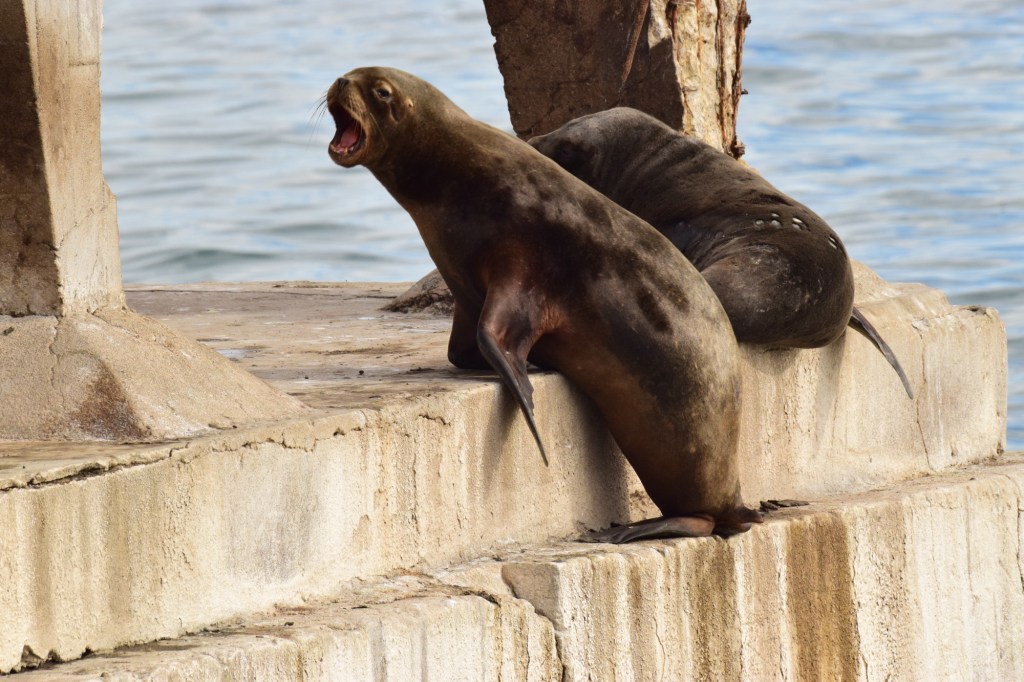
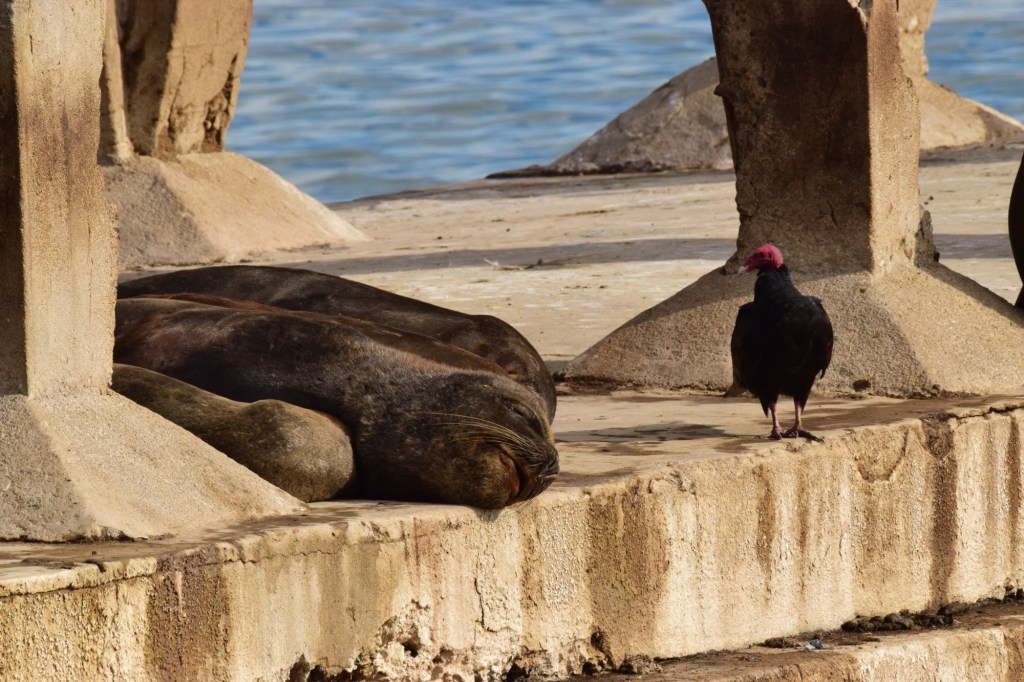
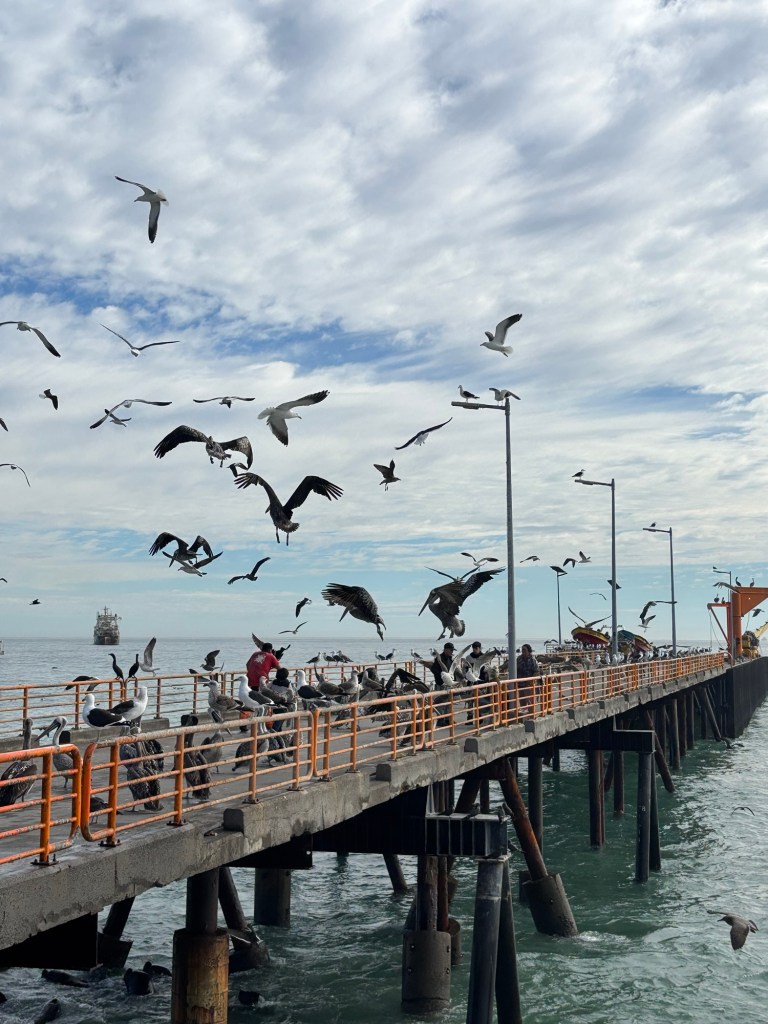
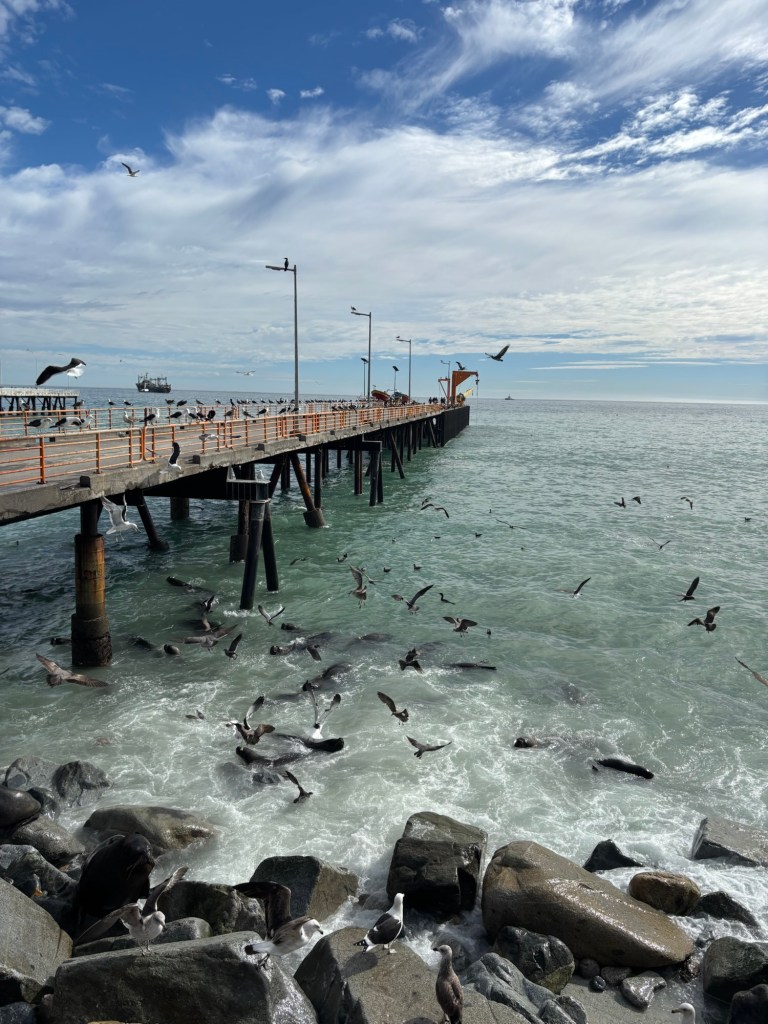
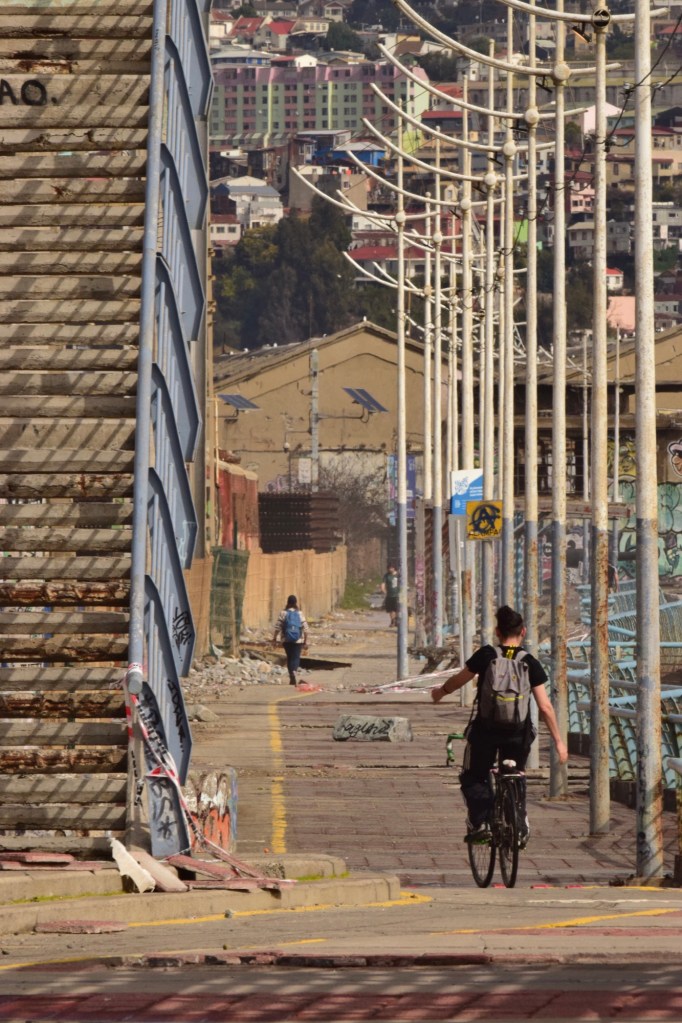
I didn’t have to go far to get my sea lion fix. The main pier of Muelle Barón may be out while the city pours time and money into what looks to be a seafront shopping mall in the making, but the real show is a few hundred metres to the east, where the skeletal ruins of an old gas company dock has become one of the favoured haul-out sites for the city’s sea lions.
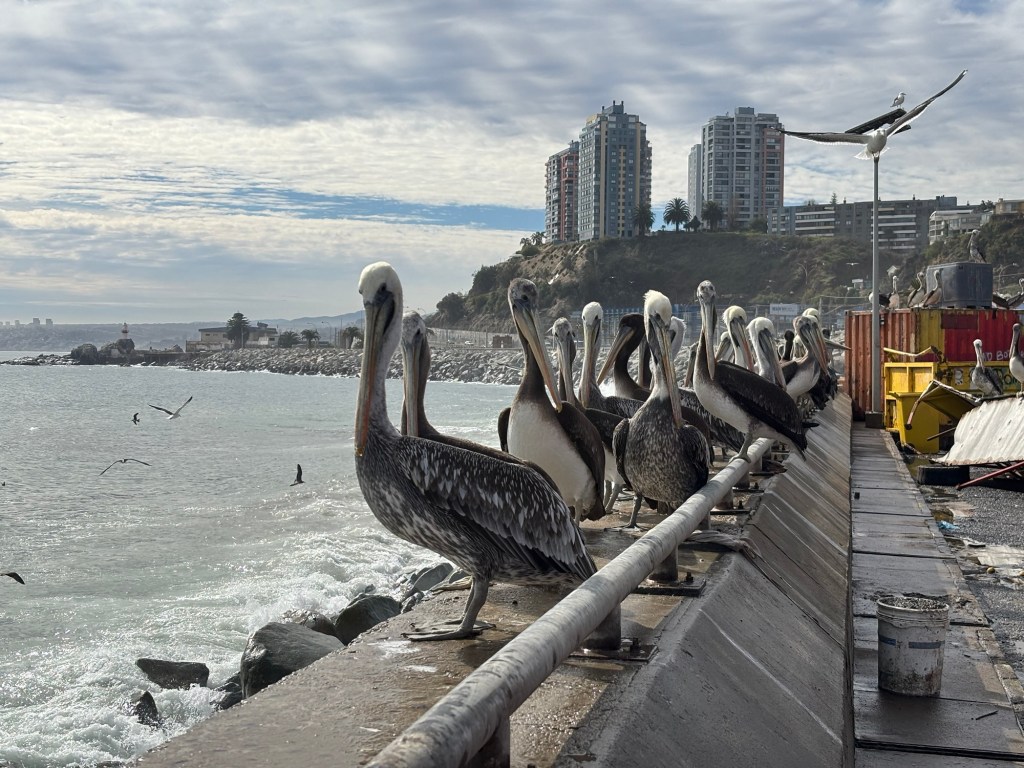
Alongside the sea lions, the structure is the perch of choice for a surprising number of seabirds, given its safe distance from the shore but proximity to the fisheries. I picked out kelp gulls, Inca terns, a couple of turkey vultures, Peruvian boobies, three species of cormorant and, of course, the Peruvian pelicans that I was hoping to see again.
I thought there might be something loose in my rucksack, as I kept hearing some kind of fabric shuffling sound, but to my astonishment a man in dirty overalls clambered out from among the boulders, seemingly from some crevice beneath the very rocks upon which I had been sitting for the better part of half an hour. He acknowledged me with a gravelly “wenodía”, set down his tatty red baseball cap to mark where he had slept and then picked his way across the rocks, crouching every so often to inspect something between the crevasses of the sea wall.
Valparaíso is a lot poorer than Santiago’s uptown districts like Las Condes. That much is plain.
Moving east, I had my eyes trained on the water, on the off chance that a wandering penguin might show up. I did spot one, a fair distance from the shore, but something else entirely caught my attention – something entirely unexpected.
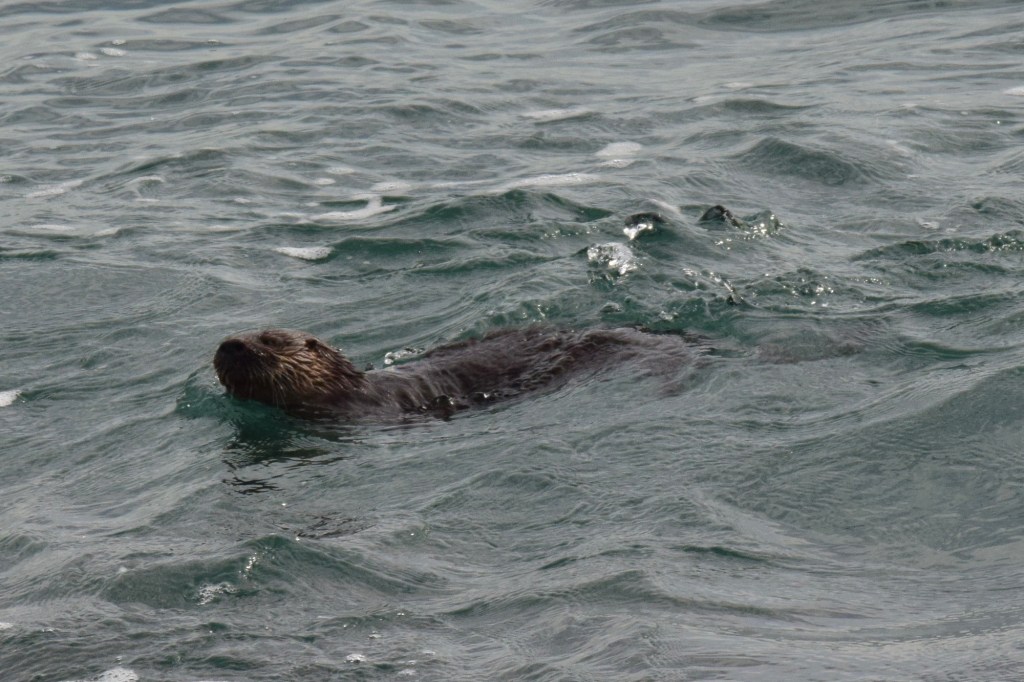
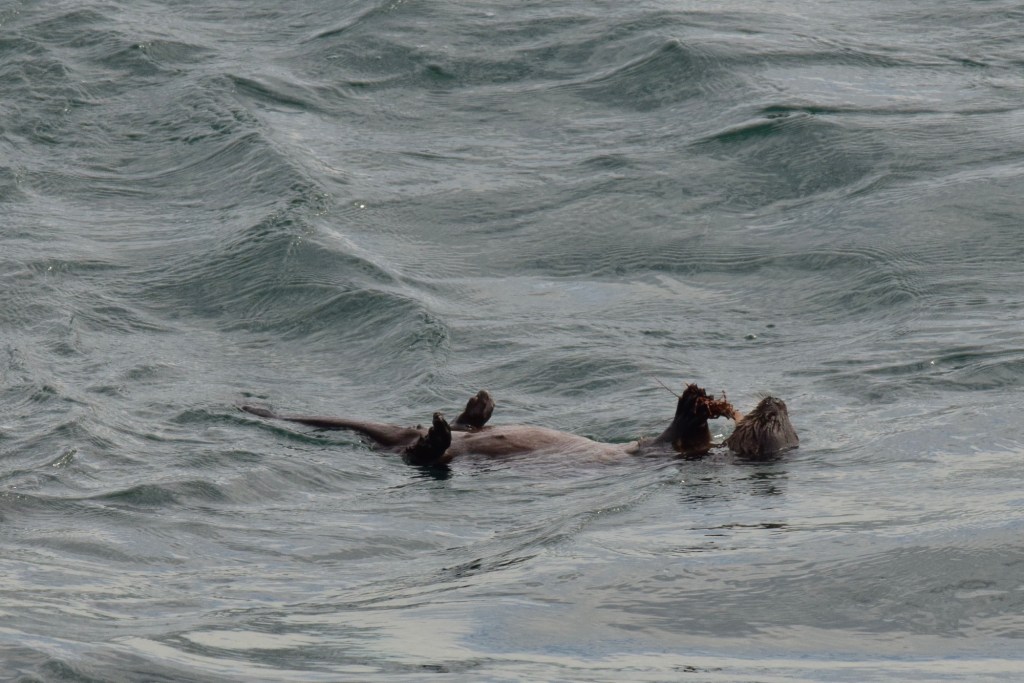
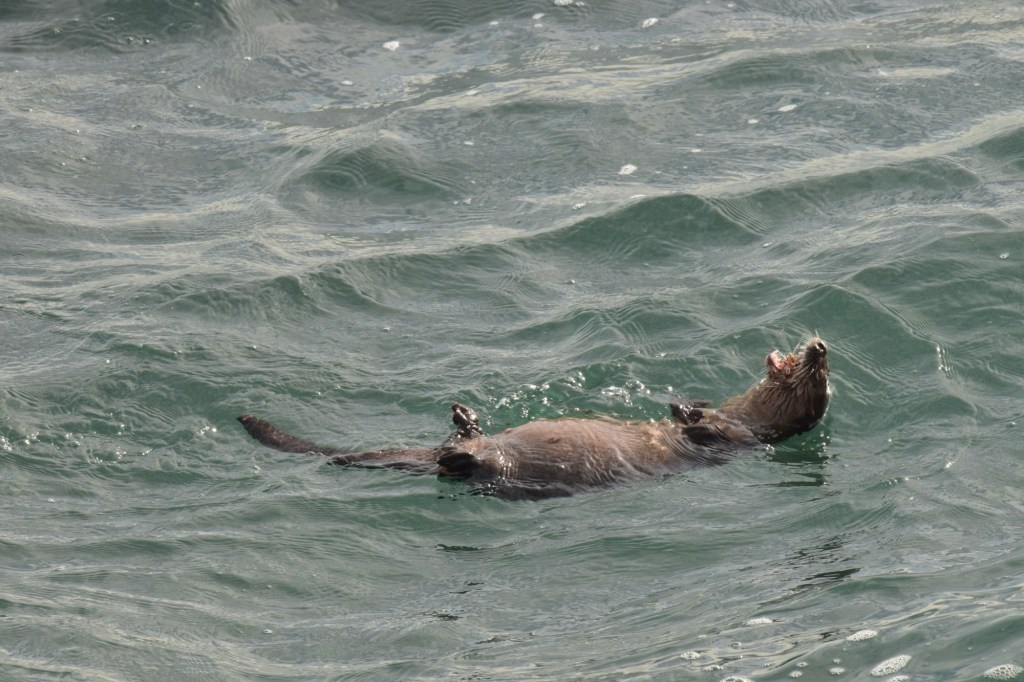
A marine otter.
Marine otters – known in Chile as chungungos or gatos marinos (sea cats) are not sea otters, like the fluffballs found from Baja California up along the North American coast, but they do live almost exclusively in the sea, rarely venturing into freshwater like other otters. Like sea otters, marine otters were once hunted for their pelts and are thus an endangered species, and quite a rare sight along South America’s Pacific coast. So I really wasn’t expecting to see one here, in the very heart of Valparaíso.
Apparently, marine otters are specialist feeders according to their location, with southern populations preferring fish and northern populations opting for shellfish. This must be one of the northern otters, because in the fifteen minutes or so I spent watching it before it disappeared, it must have caught and eaten at least four small lobsters.
That makes two species of rare otter I have managed to find this year: giant otters in the Amazon and marine otters in the Pacific. And I still haven’t tracked down the otters that live in the Tone, just a stone’s throw from my flat! I’m sure they’ll show up eventually. Maybe I should make that my mission, before the year is out: to see a third and final species of otter, preferably before Christmas!
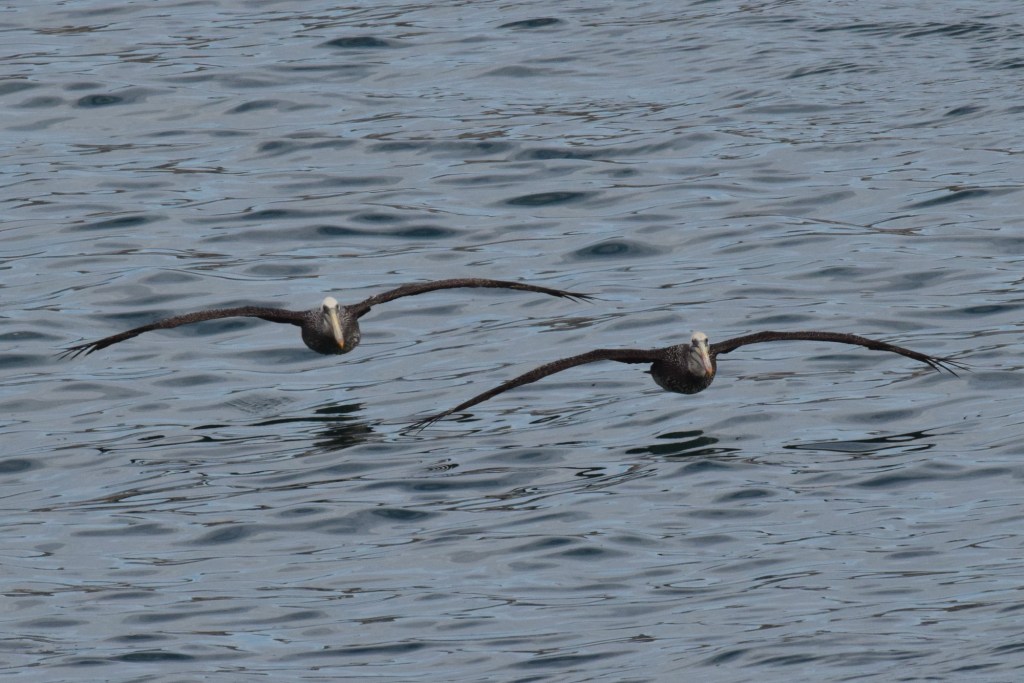
Not to be outdone, the pelicans put in a good show, sailing in low over the water in that spectacular flight pattern of theirs. I have wanted to see pelicans do this since my mother told me about it after her trip to Peru back in 2015, when I wanted to be just about anywhere but Amman, and I have had the incredibly good fortune to see that sight several times this year.
It’s not the stuff Attenborough documentaries are made of, for sure, and the good people of Valparaíso must see it all the time, but it is something I will never tire of seeing.
Eventually, I reached the busy fishing port of Caleta Portales. I reached it at absolutely the right time of day, too: around noon, the fishermen throw their bycatch back into the sea, loading the scraps into repurposed shopping trolleys and dumping them over the pier into the water below. The local wildlife is well aware of this daily bounty – and, thanks to a quick Google, so was I.
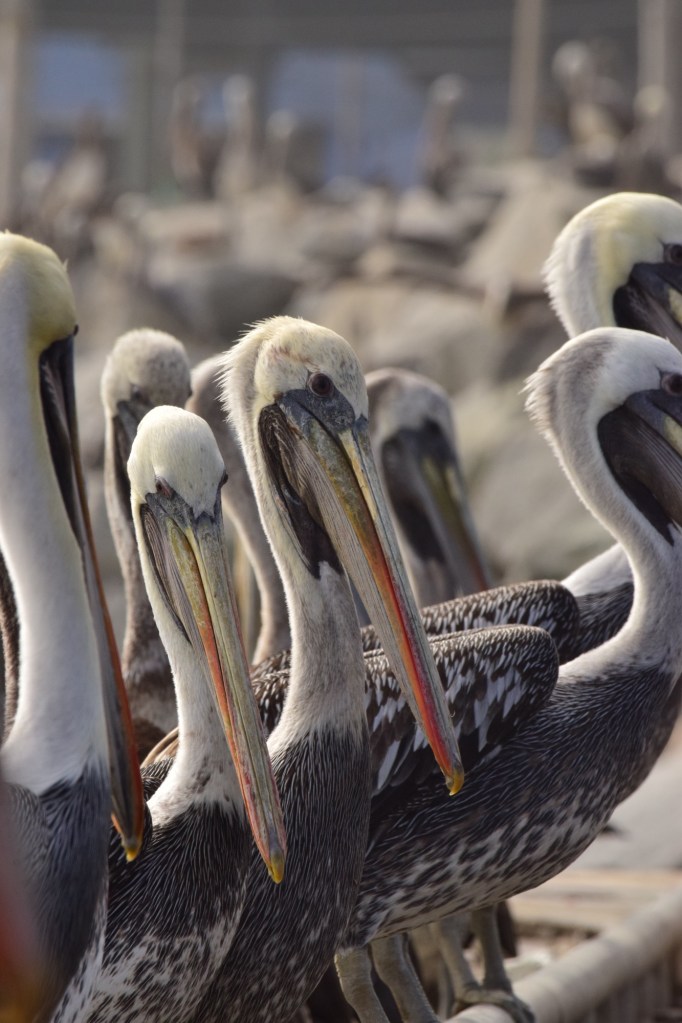
If you needed a clue that the drop was imminent, you only needed to count the pelicans. They had gathered in numbers so great I struggled to put a number to them – and pelicans are not small birds by any measure. They seemed to be perched upon every surface they could find: the sea wall, car roofs, billboards, shipping crates, stalls, bridges, lampposts and on the concrete among the fishermen themselves. After seeing them at a distance in Paracas, they were now far too close for my lens!
One small perk of being here now in midwinter is that some of the adults have started to put on their smarter summer plumage, with a smart yellow tinge to their more defined white faces.
I was already aware of the immense dark shapes in the shadow of the pier, but the appearance of the fisherman with his trolley worked like a magnet, drawing the dark mass along after him, following the overpowering stench of fish – or the sudden vortex of feathers and screeching gulls that followed in his wake.
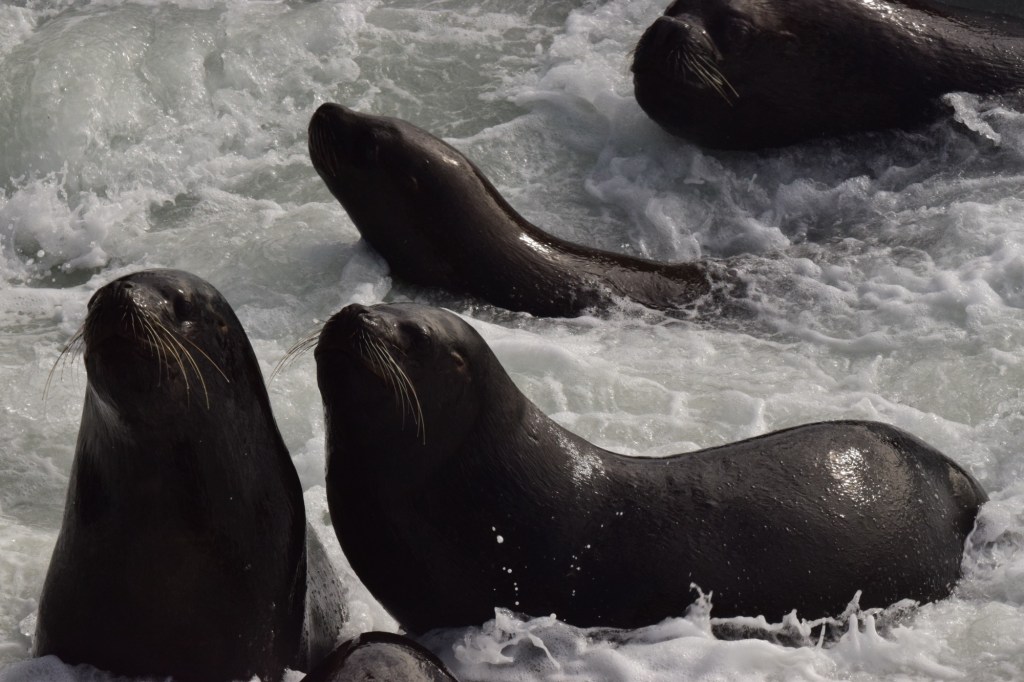
With the seafood sloshed overboard, the shoreline turned into a frenzy of activity. It didn’t take me long to pick out the bull among the sea lions massing around the shoreline: he completely dwarfed all the others, and that’s saying something.
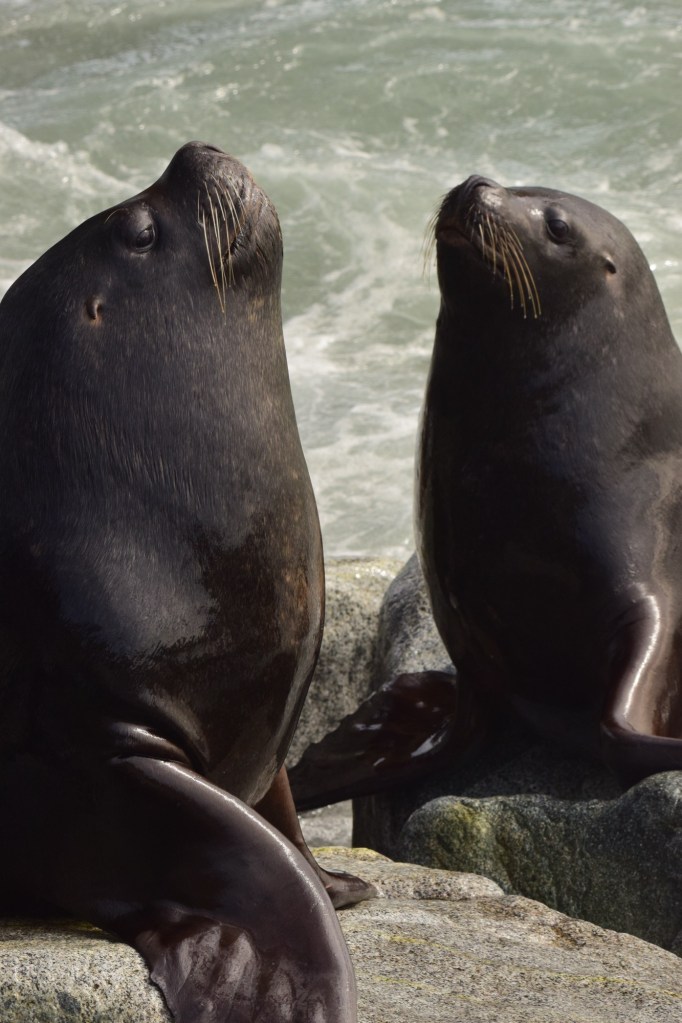
Forget the roly-poly dumplings that you find off the coast of Britain. Sea lions are an entirely different beast. Adult males can reach a whopping three metres in length and weigh in at around 325kg. They’re also fiercely territorial, as was plain enough from the deep scars on some of the males, including the old bull.
At that size – and at this distance – they were simply too big to get on camera. The 300mm would have been useful here, I think, but it’s sitting on top of my chest of drawers back home in Somerset. As such, I had to make do with portraits of the beasts that had hauled out onto the rocks to wait their turn while the bull ate the sea lion’s share of the bycatch.
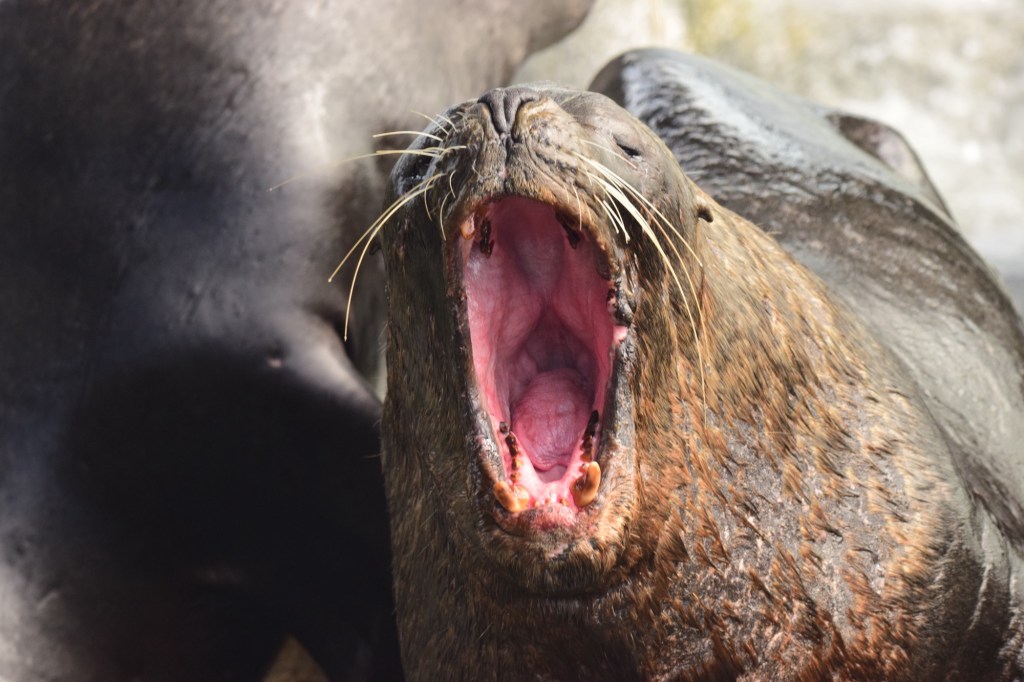
At this range, of course, you can make out a lot of detail. The thickness of their whiskers. The sharpness of their teeth. The minuscule ears at the back of their heads, and the scars on their torsos.
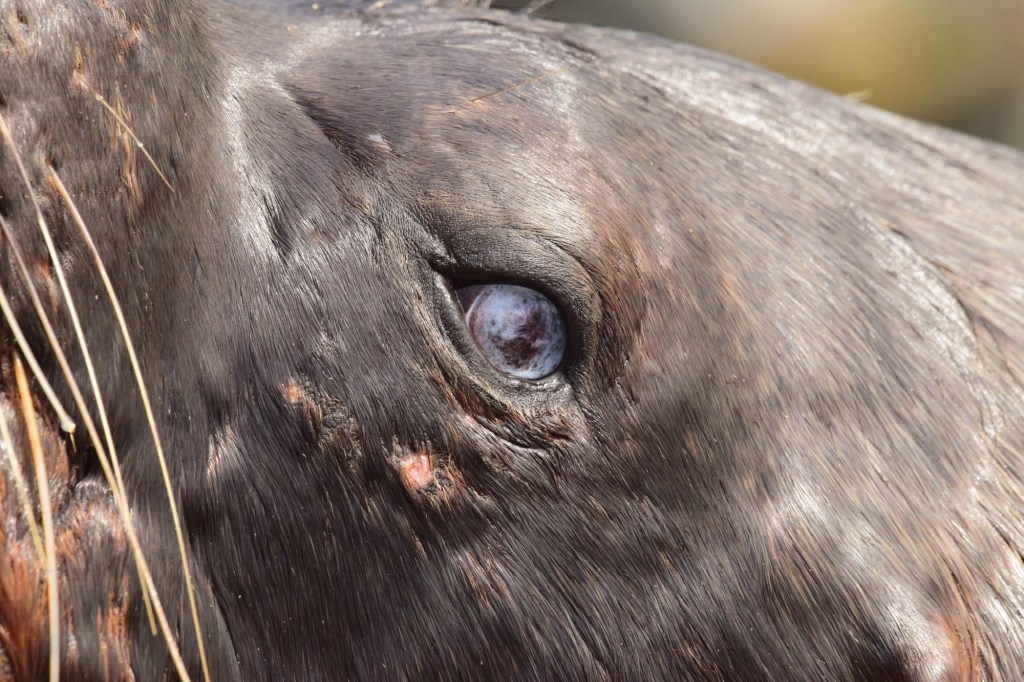
One male was so close you could see the whites of his eyes twice over. His eyes seemed to have misted over. He must be very old for a sea lion to have contracted such an infection. I wonder how old? They can live to be around twenty years old in the wild, I think, so this one can’t be far off that mark.
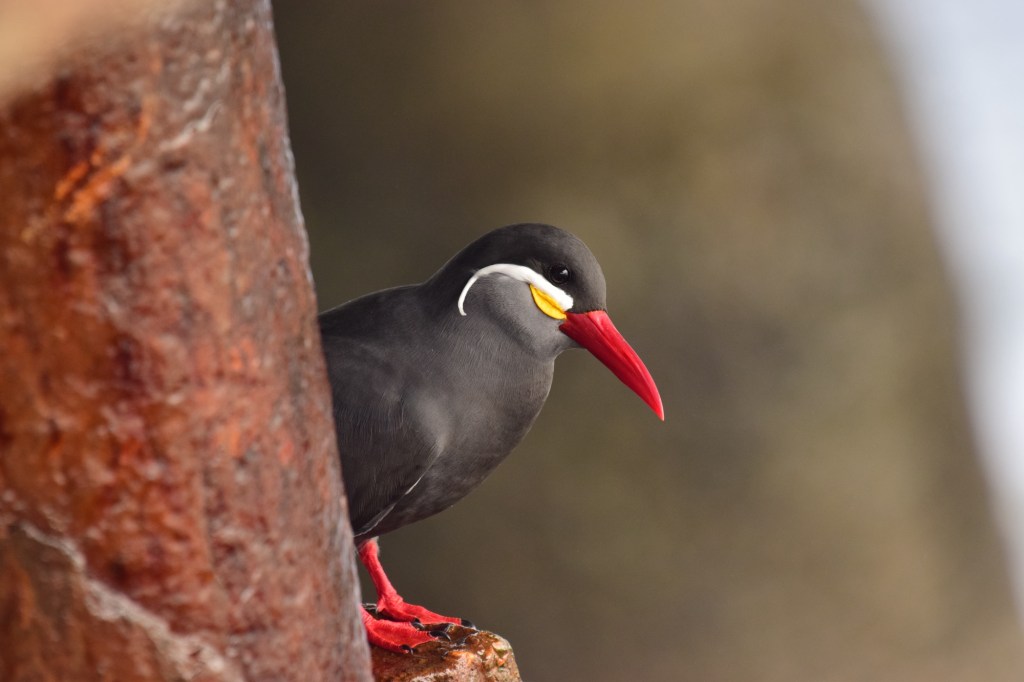
Arguably prettier than the titans hogging the spotlight was a small family of Inca terns, waiting patiently for their chance to swoop in and seize some of the scraps for themselves. This is another species I travelled all the way out to the Islas Ballestas to see, only to find them so close here in Valparaíso that they might have been eating out of my hand.
Here, at least, the lens really did put in the yards.
I hung around the port for well over an hour before deciding it was probably time to head on back to Valparaíso, have a decent lunch and check in to my hostel. The skipper advised against having a large supper ahead of tomorrow’s ocean voyage, so I made a mental note to have a decent lunch instead, and acquire some snacks for the journey home.
It’s not the most scenic route back to Valparaíso from Caleta Portales. In places, the city seems to be collapsing into the sea, and where there isn’t the salty tang of the sea, there is the sweet stench of sweat, marijuana and human faeces. There’s a lot of homelessness here. All the carriages of a derelict train seemed very much lived-in, with signs of recent occupation all over the place: a bouquet of flowers tied to the grille, a washing line strung out in the gloom behind a window, and a dog waiting patiently on the step of the driver’s car. It’s probably more homely than the crevasses among the boulders below the sea wall, though I imagine it’s not much warmer.
The city never seems to catch a break. The Spanish blew the city to pieces in 1866 during the Chincha Islands War. Forty years later, in 1906, Valparaíso was ripped apart by an extremely violent earthquake – a fairly common occurrence in this part of the world, with the city sitting squarely upon the Nazca plate boundary. Apparently, there was a small one just a few days ago off Quintero, where I am headed tomorrow. It’s quite something, seeing the tsunami warning signs all over the place.
The captain has just told me that the boat needs a service tomorrow morning, so we have rescheduled. Weather permitting, we are going ahead on Sunday. That should make my journey home a bit easier. Even so, it is likely to be my most out-of-pocket adventure yet.
Tomorrow, then, is wide open. A whole day to explore Valparaíso! I’ll make sure it starts with a good sleep and a decent breakfast. Those sea lions had a proper feast today – I might as well do the same. BB x
The shrill cry of lapwings precedes the school bell by seconds. There’s obviously more than a couple that will have their nest somewhere in the school grounds when winter is over, as they’re here every day, soaring and bouncing over the school with their odd, bat-like flight.
I’ve become quite used to the rufous-crowned sparrows that live around the school. There are house sparrows here too, the same as we have back home, as well as the handsome slate-grey diuca finches, but the characterful little South American sparrows are a joy to watch and to hear as they hop around the campus. Sometimes they’re joined by a mockingbird – I’ve seen the same individual at least once each day, usually around the goal posts in the patio – and today I had the treat of being reunited with the smart scarlet spectacle of a flock of meadowlarks that came rooting around the school car park around lunchtime. I haven’t seen them since I left the snowy hills of Patagonia last week, so it is lovely to be reminded of that wintry paradise when it is already some two and a half thousand kilometres to the south.
They say that even the mighty condor comes down from the high mountains when the weather is fierce, when it can be seen from the school grounds from time to time. Now that really would be a sight!
I’ve had a fair bit of thinking time today between observations and meetings, so I’ve had time to soak in the nature of my surroundings a bit more. I saw a couple of project classes again this morning, before organising a meeting with the Head of Senior Literature after lunch.
Senior Literature… Now we’re talking business! I’m painfully aware that my decision to embark upon this mad adventure with Spanish Language A makes us one of the few schools in the UK that offer such a Spanish-heavy course. It’s also not been lost on me how bizarre my exchange set-up is: I’m an British teacher working in the one department at school that operates entirely in Spanish. It tends to throw most of these kids (and teachers!) for a loop.
I feel a great sense of relief for having spoken to a colleague who coordinates the Higher Level Language and Literature programme here at Craighouse. At least a third of the books I have nominally chosen for my own course are on their list of set texts, and the Head of Department both knew of and really rated every one of my choices. My colleagues back home are largely linguists rather than literati: a passing glance and an apologetic wave of their hands was the best response I got to my admittedly annoying enthusiasm about my text choices. Now I feel at the very least as though I have not been operating entirely in the dark.
The conversation ended with a visit to the Inquiry Centre for inspiration’s sake and a jokey offer to consider working here. I’m keen to get out of England and back into the Spanish system – or, better yet, the IB – but I’m not sure Santiago is the place for me. Maybe it hasn’t grown on me yet. I’m also getting to that age where all I really want is to find Her and settle down. Santiago is – it should be said – about as far away from home and everyone I know as I could feasibly go with the skills that I have. All the same, I’ll admit I floated the idea in my head for a little while.
I’ll let it float a while longer. Two and a half weeks remain of this exchange, which may well prove to be a lot more useful than I anticipated. It was absolutely the right decision as far as my fledgling Language A course is concerned, but it may prove to have other uses that I have yet to discover. Time will tell.
Tomorrow I’m going to pop in on a few senior literature classes and maybe drop in on primary as well. There’s talk of the possibility of seeing how English Literature is taught here, too, which I’d absolutely love to see. I’ll keep you posted. BB x
Aeropuerto Teniente Julio Gallardo, Puerto Natales. 15.42.
My mad jaunt down to Patagonia is coming to an end. It has been easily one of the most amazing wildlife experiences of my life, thanks in a large part to my excellent guide Fabián, but also to the exceptional quality of the encounters I have had with the local wildlife, much of it within Puerto Natales itself. It has left me with an insatiable hunger for more adventures of this kind and a fierce desire to see more places like this: there is a haunting beauty to the polar regions of the world that I have ignored for far too long.
I am already considering a new adventure for the last week of the Chilean exchange, but that, for now, must wait. I do have a job to do, after all.
Check-out from my cosy B&B was at ten this morning, so I made the most of having a warm bed right up to the last minute before setting out to find something to do to kill some time before my 16.45 flight back to Santiago.
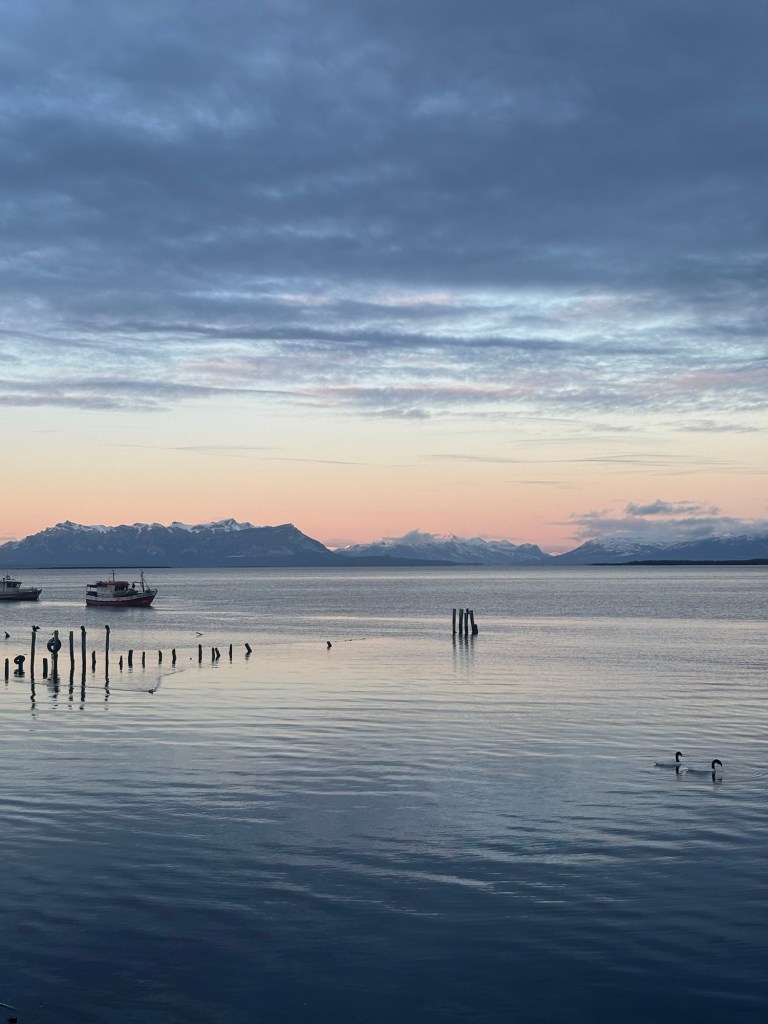
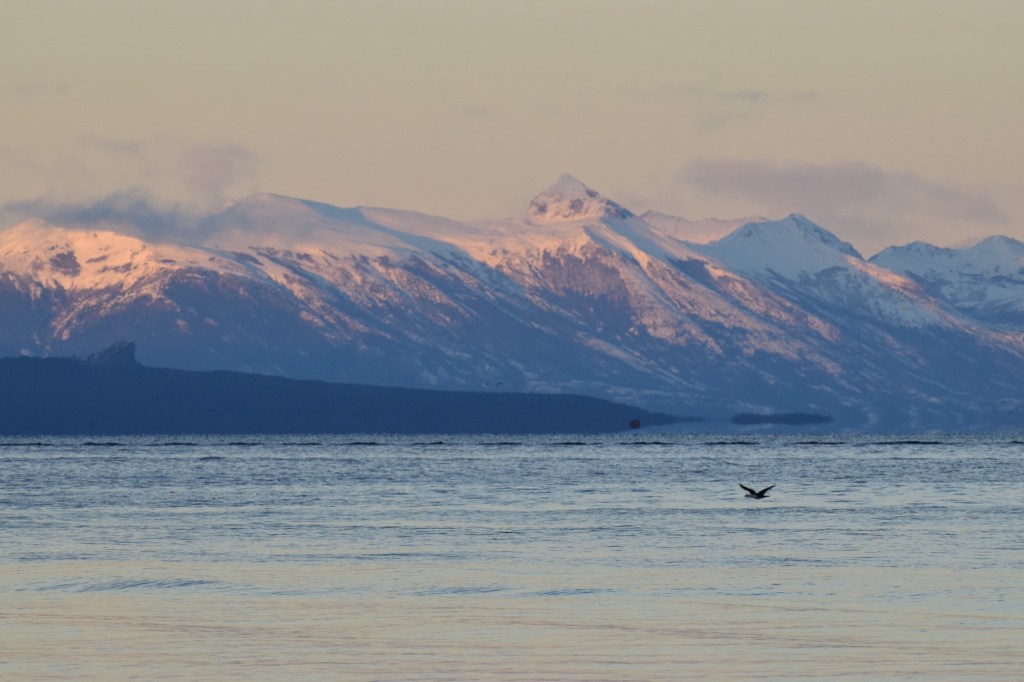
Predictably, I found my feet marching me straight back to the shore. A great carpet of cloud kept most of Puerto Natales in the dark, but away to the south, the sky was a spectacularly wintry salmon pink. A few estancias and the hamlet of Dinibor are the only settlements between here and Antarctica, if you were to head in a straight line to the south – a privilege only the birds know.
The vast network of fjords that criss-cross the mountains between Puerto Natales and the coast were once home to the Kawésqar, a nomadic people naturally stunted by their lifestyle, which saw them travel the fjords in search of food in their boats. Like the other native Patagonians – among them the Aonikenk, the Yagan and the Selk’nam – they suffered terribly at the hands of the European settlers. Many died of exposure when they were forced to trade their water-repellent sealskin clothing for Western dress, which could not protect them from the cold and the damp.
Others were wiped out by foreign diseases or brought low by the new vices of alcohol and tobacco. A great many were systematically wiped out by foreign mercenaries in organised Indian hunts, paid for by the ranchers, in an attempt to stamp out any perceived opposition to their dominion over these territories. Most heinously of all, entire families were kidnapped and shipped off to North America and Europe where they were displayed as evidence of human evolution in human zoos. Setting aside the painful matter of their obvious humiliation and fear, very few ever made it home: there are several cases of gross ignorance on the part of their buyers who, once the tour was complete, shipped the survivors back to a completely different part of Patagonia, where they were seen as outsiders by both the European settlers and the other natives.
It is nothing less than the bleak and bloodthirsty story of humanity, but it loses nothing in the retelling. It would do us a lot of good to remember what we are capable of at our very worst, if only so that we can strive to rise above the darkest heart of our nature.
My fingers were freezing up after a long walk along the seafront, even beneath two layers of gloves, so I stopped for a hot chocolate and a sandwich in a friendly café. The waitress was really cute and the chocolate was superb. I couldn’t help eavesdropping on the pair of Australasian backpackers when one of the waiters engaged them in conversation. They were here for the skiing, by the sound of things, which seems an odd thing to come out here for. The waiter was telling them how expensive it is to import oat-milk way out here in Chilean Patagonia, but how marketable it is to the tourist trade (it was literally the first thing the taller of the two New Zealanders asked upon entering the café).
I wonder what the Kawésqar would make of wanderers like us and our bizarre motives: be it the girls who have traveled across the ocean to race down the mountains on a pair of skis, or the equally odd chap in the felt hat who has flown across three continents to see the puma, the ñandú and the great black seabird that races up and down the fjords. I suppose they would be every bit as baffled by us now as they were then.
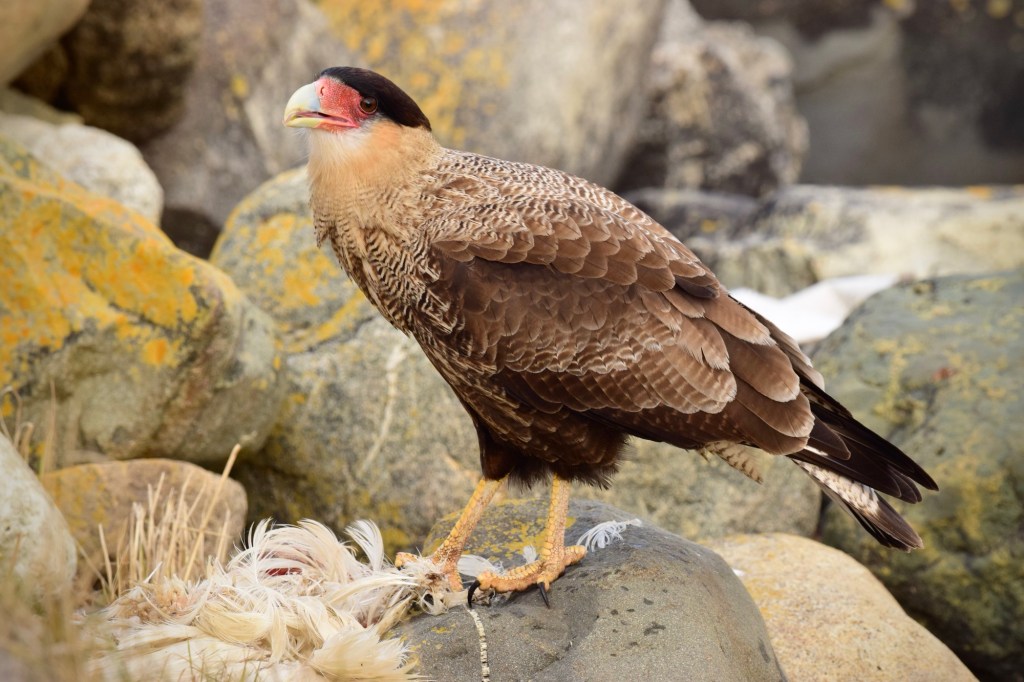
As if to say goodbye, a handsome crested caracara came down to the beach to pick at the coscoroba carcass under the sea wall. These intelligent hawks are favourites at bird of prey centres in the UK, where they perform fly-overs to the oohs and ahhs of parents and children alike. Bird shows are all well and good, but it’s nothing short of wonderful to see them here in the wild, where they belong.
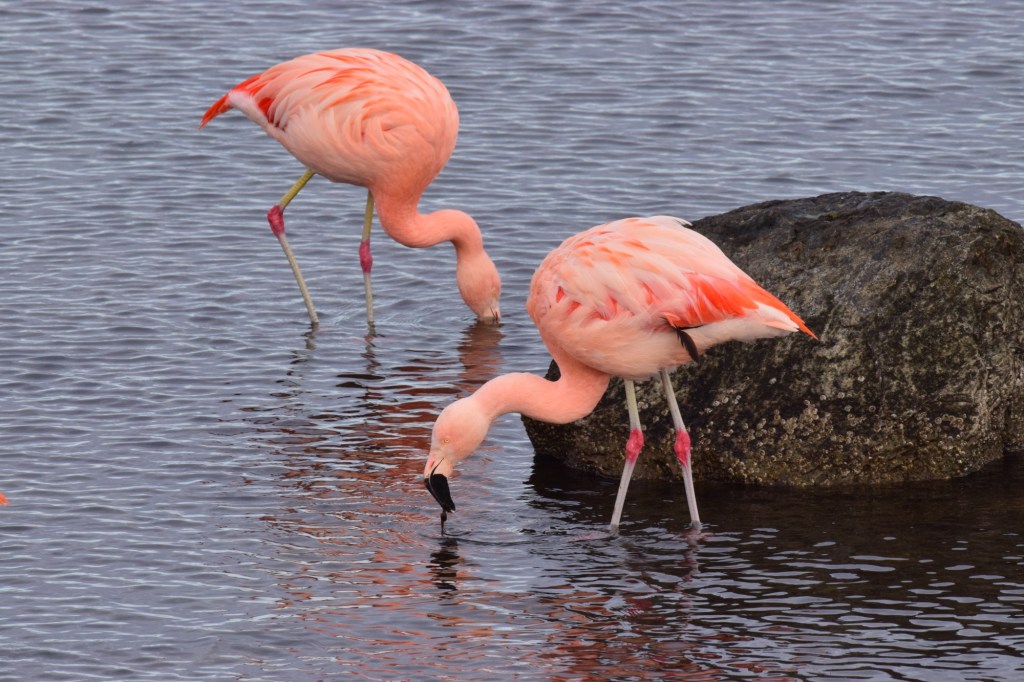
The flamingos were back in the spot they had been on the day I arrived. These Chilean flamingos – easily identifiable by the pink joints on their otherwise grey legs – are the kind I only saw at a great distance during my travels in the Peruvian altiplano, so it’s nice to appreciate their magnificence at such close quarters. They’re very popular with the locals, too, who were always stopping to photograph them or watch them for a while.
It’s hard to single out a special memory from this trip – it has been a series of miracles from start to finish – though I suspect the trophy does go to the pumas by default, as that’s what I came here for, and I did have some absolutely incredible encounters over the course of three days’ tracking. Timing my arrival with the first snow of winter was a master stroke of luck, I won’t deny that. It could just as easily have been a washout, as the rest of Chile has been experiencing torrential rain for most of the last week. You’d never know it here: beyond the intermittent cloud cover, it’s been sun, snow and crystal clear waters down here in Patagonia.
As always, thank you for joining me on another adventure. The Patagonian expedition may be at an end but this particular story is not finished yet, so stay tuned for more Chilean observations and adventures. Valparaiso is very definitely on my weekend list, and the placement itself should be something to write home about. Villafranca always was.
Until the next time, Patagonia – it has been a living dream, every minute of it. BB x