Creativity in the Classroom: A Step Too Far?

I´m falling into something of a routine out here, now. Three hours with the state school, two hours with the Catholic school, one hour´s private English lesson, one hour´s Spanish conversation with my flatmate, a couple of hour´s reading and then bed. That´s good. I like a routine. It lets me know what I´m doing. I tend to go a bit spare without exact orders.

As I guessed all along, the term ´language assistant´ is a very loose one, interpreted by different schools in different ways. Some of my companions are working as ´classic´ language assistants, taking individuals or small groups for short periods for conversation. Others attend class with an English teacher as a human dictionary, there to lend a hand whenever a native speaker´s touch is needed. In Spanish, the term ´language assistant´ gets shortened down to just one word – auxiliar – which leaves even more room for interpretation. And just as happened in the last two ´language assistant´ jobs I´ve had, I seem to be working a real teacher rota.

Granted, I had prior warning this time. The first time I was promoted, so to speak, I had no idea that I was supposed to be taking full classes on my own until I was told that the diminutive head of the French department had decided to benefit from my presence by taking a month´s holiday at short notice. This time I was given a couple of lessons´ observation to get the feel of it, and even though they mostly left me leading the events – a harbinger, I guess – it was good to know what I was getting myself in for in advance.

So I´m a sub-teacher. That´s not a problem. In fact, it´s exactly what I wanted. It´s just… well, it´s reassuring to know that it doesn´t matter where you go in the world, ´language assistant´ is always a very flexible term.

In one school I take entire classes on my own, from bawling primary level to studious upper sixth. In the other I also prepare an hour´s class for whichever groups of the twelve I have that day – equally widely-spread, but fortunately without the weekly terrors of the primaria – and these are almost always under the supervision and occasional assistance of one of the English staff. The irony there is that they´re probably doing what comes under my job description. The system in place is the one used by bilingual schools nationwide: one class where the language of conversation can only be English, to compliment the others which are spent on writing and grammar. Nobody likes grammar. So that means it´s my class that everyone looks forward to by default, which is something to smile about.

Taking a full class obviously means you need an hour´s worth of material, and with teenagers thrown into the mix, you need to be prepared for all eventualities. I´m learning what to do when they´re tired, and how to calm them down when they´re exciteable, without letting them know there´s a system to it all. I´m learning what ideas students wants to discuss and which ones turn them off, and which games work well, and which ones don´t. And though I should have seen it coming a mile off, I tried this week once again with what is and always has been the greatest stumbling block of all: tapping into the students´ creativity.

Now this is something I feel very strongly about, and I´ve already written one behemoth of a text this week, so I´ll tackle it as lightly as I can. The simple fact of the matter is that there isn´t enough emphasis placed on creativity in schools these days. To tell the truth, I´m not entirely sure there ever has been. One of my English teachers once announced at a parents´ evening that she was ´paid to teach, not to inspire´. I disagree entirely. Inspiration should be right at the front of teaching, if we´re not all to become mindless robots.

Ah, but this is beginning to smack of yesterday´s post. It´s vaguely related, primarily because the game I´ve been ending my technology lessons with – a simplified variation on the British radio show I´m Sorry I Haven´t A Clue´s “Good News, Bad News” – has, time and again, come up dead in the water. The reason? Because nobody´s able to tap into their own creativity. I don´t know whether it got stamped out of the education system in favour of textual comprehension or the study of presentational devices – the kind of stuff that actually comes up in an exam – but the art of coming up with stories seems to disappear once you hit secondary school level.

For a budding author, I find this nothing short of horrifying. I spent most of my school career writing stories, and yes, it probably did affect my grades, but I left with an impressive English mark, and it´s my English that has always saved my neck. I´d have been flat-out rejected from grammar school if it hadn´t been for my English, since my mathematical capability is comparable to that of a wet flannel. The only excuse I can think of is that I´ve never stopped writing: from short stories to novels, diaries to blogs, love letters to newspaper articles. It keeps me alive. More importantly, it keeps my brain alive.

The higher up the education system you go, the less you´re encouraged to think for yourself. At some point you have to start quoting other writers. Then you have to start referencing other texts you´ve read and basing your arguments on the standpoints of extinct luminaries. The result, of course, is that by the time you get to university and you´re suddenly encouraged to come up with your own argument, a lot of people are quite understandably left high and dry, because they haven´t been taught how to think that way.

Here´s the difficulty. Creativity cannot be taught. It can be encouraged, it can be inspired, but it cannot be taught. For starters, how do you mark creativity? This is a regular feature of the arts world, of course, but outside the tripartite kingdom of Art, Music and Drama, creativity doesn´t get all that much of a look-in. In a world where everybody is mark-centric, from pupils to parents to headmasters and the governors to whom they bow, that kind of question gets thrown out early on, and the baby with the bathwater. So me going headlong into a class of fifteen year-olds and expecting them to come up with a story in fifteen minutes of “Good News, Bad News” was the very height of foolishness, especially for somebody with two jobs´ worth of teaching experience under his belt. A different English teacher – one who certainly did know how to inspire – once told us that the truth of the matter is that there are those who can, and those who can´t. I´m still not entirely sure where I stand on that, since I´m none too keen to cut anybody off, but I acknowledge that there´s more than a kernel of truth in that statement.

Creativity, I believe, is something that we´re all born with. We all loved to listen to stories when we were children, and most of us will have tried our hand at making one or two, intentionally or no. Heck, it´s fuelled language growth, all the arts and technology for all human existence. The trouble is that so much of it disappears when we grow up, when we´re told we have to put fiction behind us and focus on the real world. Unless you´re a stubborn little bastard like me, and you decide early on to defy that and to hold on to your creativity and remain a child forever. Like a twenty-first century Peter Pan.

In short, it´s perhaps too much to expect every student to be able to create stories of their own, especially at secondary level. There are a few rogue elements – it´s not difficult to recognise your own characteristics in others – but on the whole it strays much too far into the awkward silence minefield. Well, I´ve learned my lesson (no pun intended). But I´m not about to concede defeat. Never. I doubt I´ll make story-tellers out of the lot of them, but if I can sow the seeds of a budding Cervantes or Lope amongst the drowsy horde, I´ll consider my job accomplished. At the end of the day, we´re all story-tellers in one way or another. All it takes is the courage to leave behind what is real and to dabble with what is not. I said right at the start that I like exact orders. True. But there´s enough of an anarchist in me to want to break free sometimes. I hope there´s a little anarchy in everybody. BB x

The Trouble with WhatsApp

By the time this blog post reaches you, it’ll have been several hours since I finished writing this article. In a world where so much of what we do is instant, from long-distance communication to microwaveable dinners, it’s both painful and exhilarating to be stuck on what seems like a desert island in the wavestorm. Perhaps even a little rebellious, too. So, in a way, quite a bit like sex. But what do I know?

I’m currently living in a very comfortable two-bedroom flat on the edge of town, just a three minute walk from school and a seven minute walk to the nearest supermarket. During the week I share it with a flatmate some ten years older than me who returns home to his family every weekend, leaving the flat all to me if I’m not traveling. That’s just to give you some background detail. We agreed early on that there wasn’t much point in getting internet for the flat, despite his having access to a discounted deal, as we have no mainline phone, but chiefly because there’s free internet whenever we want it at school.

That means one thing: I live under a communication curfew. When school finally shuts its doors at half past nine, I’m off the grid until the following morning.

To my knowledge there are two other WiFi access points in town, if you don’t count all the cafés and bars: there’s the hotspot in the town park, and the WiFi service operated by the town’s youth hostel. I’ve been leeching off both for the last month, but neither are reliable. The park is a very hit-and-miss affair; sometimes there’s WiFi, sometimes there isn’t. Usually, there isn’t. The albergue is normally operational, but it’s a longer walk, and you have to be inside the front door to get a good signal, and that just looks plain suspicious. Which it is. I only play that card these days if I’m out of all other options and really need to contact somebody.

The crux of the matter is that I’m leading a largely internet-free existence. I’m not fully weaned of the system by any stretch of the imagination, but I’ve taken the first few steps.

For one thing, YouTube no longer dominates my spare time the way it used to. I haven’t even accessed YouTube since I left England some four weeks ago. Nor do I have the option to spend hours trawling Facebook for whatever reason I used to do so. And since nobody out here ever uses SMS – this is a world where WhatsApp has well and truly taken over – my contact with the outside world is limited to an average of an hour a day: which, when you think about it, is still more than what you need. In an hour you can send and reply to a few messages, check your emails, Google a query that might have been troubling you and still have time to check the news. Anything more than that is unnecessary.

The trouble, as I’ve already mentioned, is WhatsApp. The whole world seems to turn on it, and Spain in particular has taken a really obsessive shine to it. All communication happens through WhatsApp. ‘Join our WhatsApp group’, ‘envíame una WhatsApp’, ‘don’t bother with Facebook, I haven’t checked mine in weeks, message me on WhatsApp’… I hear the same lines every day, unfailingly echoed word for word, like quotes from a cult film. It seems to be the only way people keep in touch, both personally and professionally. Even my colleagues among the staff have their own WhatsApp group, which swamps me with some three hundred new messages each time I’m back in wireless range. I asked a class to guess how many messages they send a day – upon investigation, every single one has both a smartphone and WhatsApp – and got the answer five hundred. As an absolute minimum.

I don’t know whether it’s the same in England, because I never could get WhatsApp on my old phone, so I never bothered. It’s an undercurrent I’ve done without thus far. And I don’t know whether, like Facebook, eBooks and Instagram, I’ll get sucked into the mire like everyone else in time, but I hope not. Face-to-face conversation is so much more worthwhile, worth waiting for. Surely there’s no need to go on talking into the small hours, firing round after round of thumbs-up, smileys, voice clips and the rest of the arsenal? I’m a very chatty bean when I want to be, but only if I’ve anything worth saying – small talk is something I’ve never really mastered, let alone understood – and anything worth saying is worth saying face-to-face. Cue Thumper: ‘If you can’t say something nice, don’t say nothing at all’.

The hypocrisy of my argument is this blog, of course. But as I said before, these posts are usually conversations with myself more than informative insights – as well as being my university job.

I thought I’d broach the subject because I had a particularly fulfilling debate with my Seniors class on this and other subjects last week. I had them explain to me the Spanish attitude to the online world and their stance on the blight of WhatsApp. They’re all well and truly connected, but they were at least able to recognize the foolishness of it. A few observations from my students, for the record:

  • Facebook is for older people. (This is notable because that’s how it was, once upon a time, in the UK, before it became a social staple for everybody from eleven and up.)
  • Instagram is only for artistic photos, not for food. (Preach.)
  • Checking in should be solely a holiday feature, if you ever use it.
  • WhatsApp is a problem, but it’s unavoidable – and cheaper than SMS.

In my internet-free evenings, I’m getting a lot more done than I used to. I’m reading more. I’m writing more. I’m even watching the odd film on TV. The news suddenly means a lot more to me, now that I’m not getting it ticker-tape-style every second. And the conversations I have with the people I live and work with on a daily basis are so much more entertaining for the silence between each encounter. News is fresh and comes in a wave, and I enjoy that. It’s a hermit life, but I’ve always been rather partial to that kind of existence.

Please don’t take this as a holier-than-thou condemnation of the rest of the world. I’m the one at fault, the Luddite, the Philistine; as usual, it’s probably yet another case of ‘it’s not the rest of the world, it’s you’. (More’s the fool I am for having left my weekly shop to a Sunday, when everywhere is shut… Tch. Catholic countries. Looks like lentils and rice for dinner once again…) What it is is a welcome break from the year abroad whines and shines that we’re all bombarding you with right now, though you might read it as a wake-up call to myself and others as well, before we’re all swamped by the touch-talk phenomenon of the twenty-first century… if you’re so inclined.

If you made it all the way to the end of this tirade, all I can say is I admire your stamina, and thank you for your patience – I had quite a lot to get off my chest! I’ll leave the musing and tell you all about this past weekend’s adventures as soon as I find a way of getting my photos off my old SLR. In the meantime, I’ll reward your endurance by giving you a final insight into something sweeter.

This coming weekend I’m finally returning to my old hometown of Olvera, some nine years after I left for England for good. I can’t wait to see my old friends again, as I was still a child when last I saw them, but there’s one in particular I’d dearly like to see. She was a good friend, and one of the only ones I haven’t yet got back in touch with, for whatever reason. But I’m saving all nine years of stories for when I see her, like something out of the fairy tales I spend my life writing. It’s childish, foolish and more than a little bit wet, but it’s a damned sight more real than a buzz in your pocket. That is the reality of it, and that’s this year’s big project: breaking free. BB x

Shrinking World

I got my new timetable last night, first from the Carmelitas, then from my own school. The end result, as of a few last-minute additions this afternoon, is a twenty-two-hour working week. Not a truckload by regular working standards, but the longest by a yard in my working life so far, and a world away from the twelve-hour maximum we had dangled in front of our faces at the first British Council meeting. So much for that holy four-day weekend! I’m lucky enough to have clung on to three days of freedom, and I had to stick out my neck for that. At the very least they let me have Friday off instead of Monday, which gives me quite a few more days off in the long run, though navigating back to Villafranca on a Sunday is going to cause some headaches, mark my words. Still, I signed up for the back end of nowhere and that’s where they put me. At the very least I’ll not be getting bored here. I don’t have time to get bored. And I haven’t even started on any of the music groups yet…
But hey, there’s thirty kids who now know what a loon is, what it sounds like, and consequently why we say ‘as mad as a loon’. That was an icebreaker and a half.

Teaching at both a state school and a private school gives me the opportunity to take a look into both worlds, and I’m sure I don’t need to tell you how very different they are. My main obstacle with the state school kids is getting them to be quiet. Their English is good, but they quickly revert to their mother tongue for argument’s sake. Conversely, my private school pupils have a very high level of English, but they just won’t talk. And in primario, it’s every man for himself. I’m expected to take those classes alone, so it’s a biweekly war with a small army of Spaniards in the making, shouting everything and everybody demanding attention at the same time. The one thing they all have in common is the inevitable ‘do you have a girlfriend?’ interrogation, to which the answer has reduced from ‘not anymore’ and ‘not yet’ to a simple ‘no’. It’s easier that way. It doesn’t stop them changing tack and asking ‘what about boyfriend?’, but hey, at least that’s as far they go. One kid in primario had a particularly unfortunate way of phrasing it this afternoon – are you gay or “normal”? – which I tried to rectify as best I could, Catholic school or no, but I guess it went over his head. On the plus side, I haven’t been hit on by a guy for several months now. It must be a new record. Maybe I’m doing something right! That, or I simply haven’t been going out. Probably the latter.

I’m now in the curious position where I find myself teaching across every conceivable age group, from the rowdy little tykes in primario right the way up to people my own age in grado superior; and then, of course, there’s the private classes for adults in the afternoons on top of that. Teaching kids and adults is one thing, but with students your own age it’s an odd feeling. I guess the real catch is that in a town as small as Villafranca (I remind you that, by my standards, it’s still pretty massive) the chance of getting to know anybody on a non-professional basis is rather slim. I bumped into some of the girls I teach whilst out walking last week and they were adamant that they were going to find me a girlfriend in Villafranca. The trouble is, where does one draw the line? Because, like as not, anybody roughly my age in this town who I don’t teach (a number which shrank even more this afternoon) probably has a sibling I do teach, and that makes things rather complicated. I wouldn’t say no to a Spanish girlfriend – sheesh, who would? – but it’s easier said than done. The auxiliares in Almendralejo, the nearest city, don’t have this problem, as there are plenty of young people there for the job prospects on offer, but here it’s a family town, like I said before. And I’m still very much in that mindset of ‘absolutely no fraternization with the students outside of class’, as I had drummed into me in my last teaching job last summer. Which means if I want to meet people my own age, I’d better check out Almendralejo.

Here at least, I’ve had a stroke of luck. There is another auxiliar placed here in Villafranca, though like more rational minds than mine she chose to base herself in Almendralejo. A bright and beaming button of a Texan. I must have gone berserk speaking English with a native speaker at last after almost two weeks without doing so, but she bore it patiently enough and gave me an insight into Almen life. Apparently there’s a nightlife scene. Who knew? I was beginning to forget what nightlife is. And yes, they abide by Spanish hours; ergo, a far more rational 11pm until 6am mentality. That, at least, makes the possibility of a night out in Almendralejo feasible, as far as buses are concerned, though it’d probably knock out a whole weekend in the process.

All in all it’s been a pretty long day at the office. Those 8:15am starts are very hard on the eye but I’m simply going to have to get used to them. It’s largely thanks to them that I have Friday off. Monday isn’t the longest slog – that’s Wednesday, from 8:15am until 6:30pm with one hour for lunch – but it’s certainly one of the more mixed. I teach a bilingual gestión y acogida class in the morning (essentially, life skills: interviews, CVs etc), then a mid-teens 3º ESO, then I have twenty minutes to walk to the other school and mentally prepare for the chaos of a class of six-year olds, after which I get a free lunch from the nuns (probably the best part of the job) and return to take my final class of the day, a private school version of 3º ESO, before hopping down the road to my private class with my lawyer friend. And thus is a light day.

It’s bonkers. Good bonkers, paid bonkers, but bonkers nonetheless. It’s like last year, but without the music. That’ll come, you just watch. It’s the only thing I’m genuinely missing right now (I sang through the entire Northern Lights set when I was home alone yesterday, until the neighbour told me to shut up. Oops.

So there you have it. Busy, busy, busy – but I’m never truly happy if I’m not truly busy, that’s what I always say! Yet another example of yours truly not knowing when to shut up. So here’s BB, shutting up. BB x

Outsider

I think I’m contracting hayfever, which is frankly ridiculous in a place that’s almost as dry as Jordan. Or maybe that’s just my sinuses reacting to an overdose of chorizo in last night’s risotto. Whatever it is, it’s spoiling the atmosphere.

It’s two o’clock on a Sunday afternoon here in the Parque de la Paz in Villafranca de los Barros, which means the town’s finally awake and everybody and their five children are out to enjoy the sunshine for a few minutes and then spend a good three hours in the shade, chatting noisily over a pint or a cafelito, more often than not the other way around to what you might expect. Where the students of the town are is anybody’s guess (I suspect they lead a more nocturnal existence at the weekends), but all the families converge on the park come Sunday morning. Scores of children on roller-skates climbing up and down the ramps by the Bar Atalaya whilst mami and abuela witter away with babi in a pushchair, getting ogled at every other minute or so with cries of ‘ay que linda, ay que linda’ or such like. One or two of the children who aren’t too fond of roller-blading are tottering around in oversized shirts, hands stuffed into crisp-packets and gaping in wonder at everything that moves. Especially the strange individual sitting on the bench on his own. Who even does that?

It’s both the easiest and the hardest thing about village life in Spain. Or village life just about anywhere, come to think of it, but especially in Spain. It’s a big family world, and if you’re not part of the family… well, you get the idea. Little Sunday idylls like this remind me just how much I’ve always wanted little dark-eyed curly-haired toddlers of my own, and whereas in England that kind of remark would probably earn you a wary look if not a second opinion from most people, here in Spain it’s a totally natural thing to be baby-centric. It must be – these Spaniards have giant families. One of the students I’m to be teaching put me in a tight corner when, during an introductory class, she asked ‘why is your family so small?’. My colleague apologised on her behalf and told me I didn’t have to answer that one, but the point had been made. I come from a family of four, including myself. Naturally, then, I’ve always loved the idea of a large family. It was one of the things I treasured most about my first relationship. We all want what we can’t have.

I suppose I ought to tell you that I’ve found somewhere to live for the next eight months. It was almost too easy. The new mechanics teacher from Plasencia made good on his offer and I’m now conveniently based just five minutes’ walk from the centro, and one minute’s walk from the park – which, ironically, is to be my internet hotspot for the rest of the year. I’m not going to complain about that. It’s a wonderful place to be. With any luck, in a couple of weeks I’ll have found the younger generation of this town and this may prove to be their hangout too – albeit at a different time of day, of course. That’s the only thing I envy the Erasmus students for; a ready-made social circle of people their own age. But at least I get the golden kernel in that I am, quite obviously, the only Englishman in town. And I mean that quite literally. There are two other auxiliares to be working here when October rolls around, but they’ll be living in Almendralejo, leaving me as the English-speaking bastion here. That couldn’t suit me any better. Because that means that, apart from when I’m teaching, or when I’m reading or writing my novel, the only language of communication I’ll be using out here will be Spanish. And unlike Andalucia, where (beautiful though it is) I might well miss half of what is said in the slur, I understand everything here. It’s an enchantingly countrified strain of Castilian, and that suits me down to a T.

When the time is right and I’m fully settled in and documented (the latter awaits in the Oficina de Extranjeria in Badajoz tomorrow, or as long as it takes) I’ll head for Olvera, where I’m lucky enough to have a host of old friends waiting to meet me, after I had to leave them behind to return to life in England, now almost nine years ago. I should thank my stars for that much. It may feel like I’m an outsider, watching all these families going about their Sunday paseo, but I’ve got my toe in the door already and I’m working the rest of my foot in as we speak. BB x

Flicking V’s

The first thing you should know about Villafranca: life may seem slow here, but the underground current moves lightning quick.

And here we go! The longest stretch of the year abroad has begun, and boy does it look it. It certainly felt it as I tried to bed down after packing everything I’ll need for the next nine months into a single suitcase. I got a bad case of cold feet in the last five minutes before I fell asleep, wondering when the next time I’d have a bed of my own would be. I’m hosteling it for the first three nights whilst I find my feet here, which takes me up to Friday night. It’s looking like it won’t all be resuelto by then, but, it’s still early days. If nothing’s been arranged by then, I’ll use the weekend to sort out a few vital affairs in Badajoz, namely acquiring an essential NIE, or número de identidad de extranjero, a turgid, long-winded process that looks to be quite the bureaucratic nightmare, worse by far than a flotilla of ICPCs. But we’ll just have to wait and see. If the Facebook page is anything to go by, some manage it with minimal hassle, others don’t. Luck of the draw. You just keep your head screwed on and tackle it sin compromiso, niño. This is no time to be shy.

Taking a breather under Alicia’s Bridge

Getting to Villafranca from Seville was not the simplest voyage I’ve ever undertaken. What really didn’t smooth things out was the singularly unhelpful bus driver, who told me that the 14:15 to Valladolid would not pass through Villafranca de los Barros; even if I wanted Mérida, I’d need a different bus. Fortunately this is Spain, and one of the passengers told me otherwise. So I took a chance on the Valladolid bus and, what do you know, it does pass through Villafranca. El Conductor was none too gracious with letting me take my suitcase from the bowels of his bus either, but he let it go in the end, and I took my first steps into Villafranca de los Barros fighting the temptation to flick several triumphant V’s in his direction.

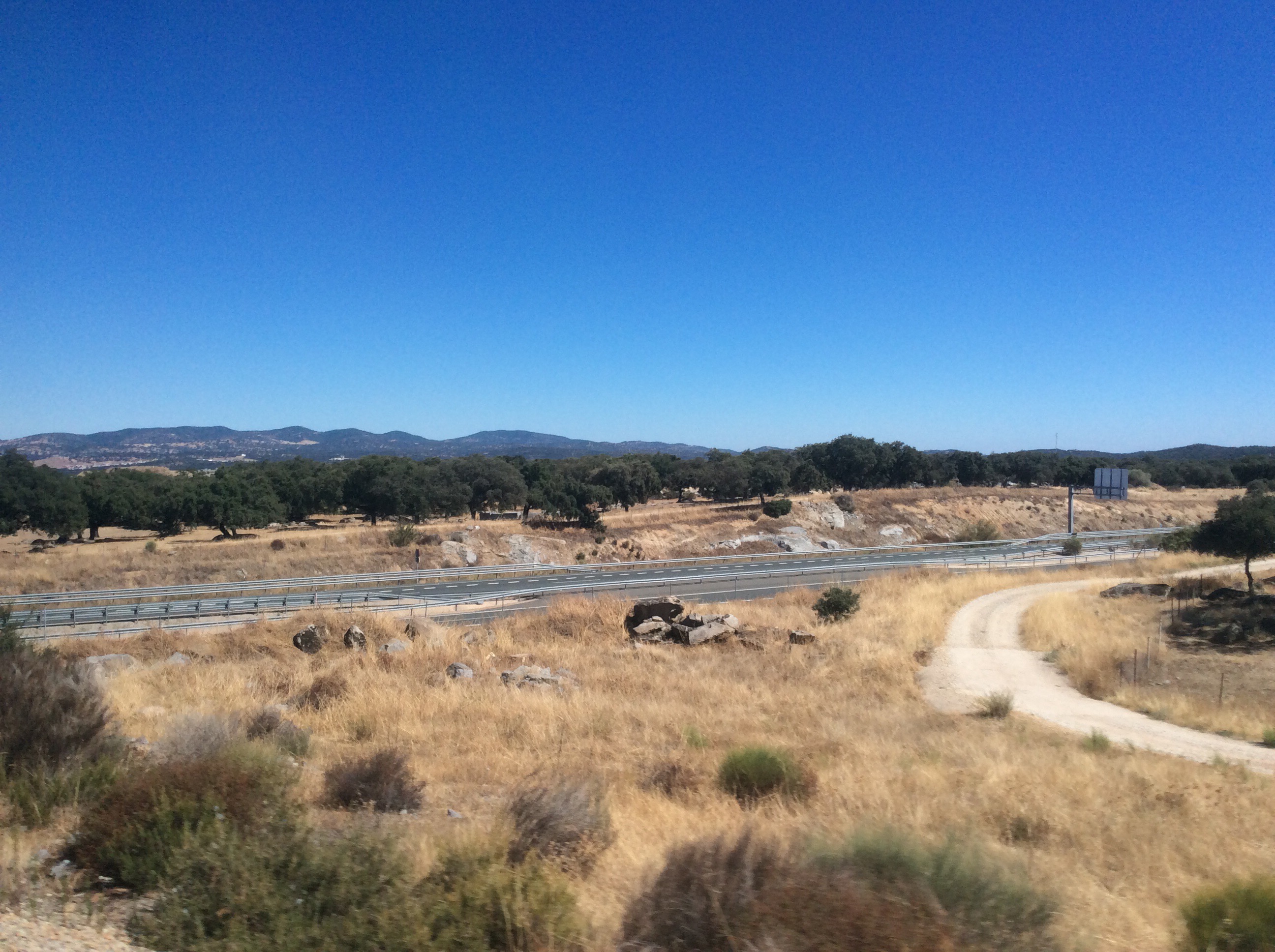
This place is a lot drier than I’m used to (discounting Amman)

At four in the afternoon, the place really is nothing short of a ghost town. I took a walk through the centre to have a little look-around, and for the most part the place was deserted. On the edge of town, where the comparatively large park meets the open countryside, you can see all the way to the Montes de Toledo to the north. A cold wind was blowing across the steppe, which only added to the frontier town vibe. I was entirely alone in my circuit of the northern part of town, but for a handful of chatty students leaving the walled confines of the Colegio San José, essentially a Spanish remodeling of Worth Abbey. Mum thinks I should put in some extra hours there if I can and I have to say I’m pretty tempted, but it looks like I might be kept quite busy here after all.

As arranged, I’ve come into school right away, and thanks to all eight of the Meléndez Valdés English staff, I feel like I know the place already. Must be that charming will to help out that most Spaniards have preprogrammed into their systems (I’m looking at you, Mr Bus Driver). It’s dead similar to IES Sierra de Lijar as far as memory serves, but then, I suppose all Spanish secondary schools follow a similar mold. A major confidence boost is the music teacher, who was particularly keen to see me – she already has her sights on a Christmas concert with a potential choir in mind. I’ll keep you posted on that one.

At any rate, it’s such a relief to be speaking Spanish again, even if I do keep tripping over invading Arabic words – especially ‘na3m’ and ‘qariib’. It’s like 711 in my brain. But if I can keep this up, I’ll be fluent in a matter of months. Which is no bad thing.

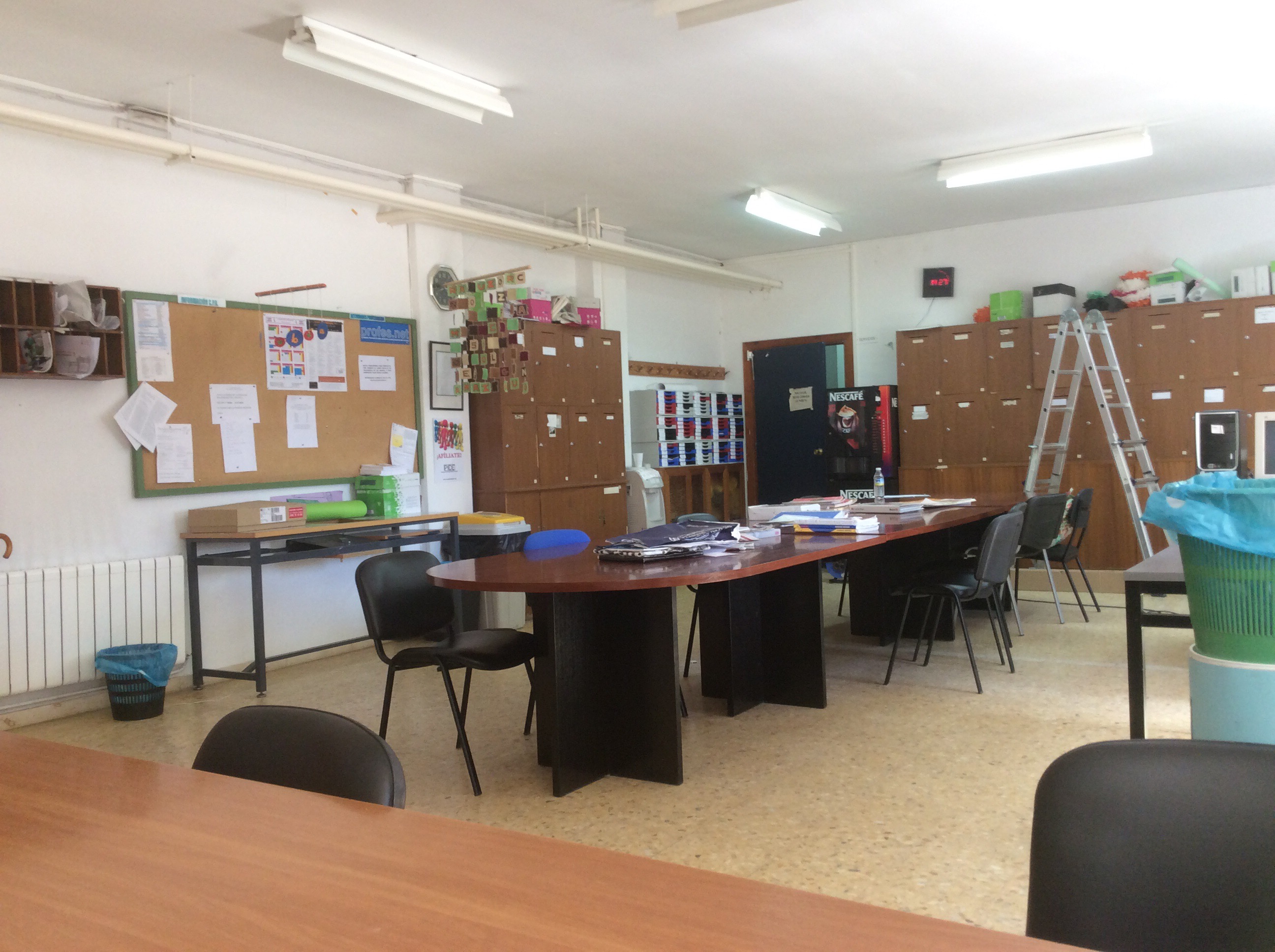
Back to the staffroom life!

I’ve been charged with assisting with a few ESO classes primarily, which in this case is the bilingual branch of the school, along with a couple of classes of bachillerato. I’m still not entirely sure what that entails, as it seems a lot of my lessons will be open-book. It’s less a case of ‘here’s what we want you to teach’ and more a case of ‘there’s your office, and here are some materials you may wish to use’. That said, the age-old rule where ‘assistant’ is a byword for ‘another teacher’ still stands, as it did in Dr Obote College and with my summer job last year; I might end up taking a full class once or twice a week. Or more. My horario still isn’t finalised so it’s still all up in the air, but we’ll see. What I do know is that I get a day off a week, on either Monday or Friday, and I’m free in the afternoons – ‘para viajar’. They seem keen that I do, and I’m not about to disappoint on that count. I’ll probably need that extra day anyway; getting to and from VdB isn’t the easiest of operations. Given the spread of Saint’s Days and national festivals (a poor year for puentes, I’m afraid) I should probably try for having my day off on Friday, but I’m not about to get shirking just yet. Besides, I think I’m going to like it here.

I’ve still got to sort out somewhere to live for the next nine months, but that might not be the Herculean task it first seemed. I was game for roving the town in search of se alquila signs, but the staff have been lightning-quick in the hour since I arrived here. I already have two apartments and two flat-shares on the table to choose from. One of the newer members from staff is very keen to help out on that front, sweeping all the other offers off the board in typically bombastic Spanish style with an offer from his primo for a very competitively-priced flat-share. He’s showing me the place after the meeting this afternoon, and since I can have the place until June, it seems the best offer yet. The dueño is a real gitano and I’m going to have to negotiate to get as good a deal as it is by the sounds of things, but if it means I can share with a Spaniard, so much the better, purely so that I don’t have to worry about company. As it turns out, Wikipedia’s estimate as to the population count of Villafranca de los Barros, currently at 13,000, was wildly off the charts – by about ten thousand. So in a curious twist of fate I’ve got exactly what I asked for. And since everybody seems to know everybody here, I’m hoping it won’t take too long to get comfortable.

As before, it’s going to be a mask-wearing game. In the staff room, it’s Spanish for everything, and they’ve been very complimentary already as to the strength of my castellano – but the children cannot know that. To them I’m just a native/naïve English speaker, here to improve their English. Here’s to hiding that fabulous Andalou drawl for as long as I can.

I guess that if chinks start to appear in my armour, I could always claim it’s the Arabic coming through instead. It’s not like it hasn’t tried several times already. BB x