Through the Looking-Glass

It’s been an interesting year. No, more than that, it’s been the very best of years. Not even that terrifying Monday primary class can put a damper on it. Incidentally, autocorrect suggested pterodactyl instead of primary, which is probably a very accurate description of the atmosphere. But like I said, that class alone has had next to no major impact on the year as a whole. As far as me goes, I think it’s been a resounding success.

This morning I found myself, for the first time, feeling genuinely fluent… and that was in the middle of giving a bilingual art class to a visiting school group from Romania, whose English was, in all likelihood, streets ahead of their Spanish. It’s the first time I’ve ever had to translate on the go, and being thrown the most dastardly terms that Dadaist impressionist art jargon can supply was a serious challenge, but one that I lapped right up. But that’s not the real crux: it’s that I’ve started getting tenses, idioms and (more crucially) agreements right without even thinking. It’s easy to think that the four-month point is the peak of language acquisition and after that it’s just vocab, vocab, vocab, but lately I’ve come to realize that the shoemakers’ elves have been at work and my grammar has been improving on the sly – which is grand, though it has made me wonder more than once whether I’m wasting £9000 a year and more on tuition fees if all I had to do to improve my Spanish was to come out here.

That’s a healthy dose of good news, because I was cut off from my principal means of improving my Spanish earlier this year. Or rather, I cut myself off. In a mirror-move of last year, I’ve fallen head over heels in love, had my heart broken and considered then walked away from a potential relationship over a niggling feeling that, as before, something simply wasn’t right. Story of my life, really. No matter how much I think, no matter how hard I try, I’m simply not cut out for the word casual. It’s not in my blood. Like my mother, I fill my every second with a job or project of some kind, be it work, writing or some other task to stave off sloth. I couldn’t ever commit any less than one hundred percent to anything, and though I’ve tried to convince myself of the ridiculousness of such a stubborn attitude, that’s something I can’t change. Whoever She is, she’ll be the kind of girl who gives a hundred percent back. Balance is key, and I’ve had my fill of one-sided love affairs. A couple of old friends I met over the Christmas holidays told me they’d reached the stage where they no longer have time for people who have no time for them. I thought it a rather selfish statement at first, but now I see the wisdom in it. After all, there’s no use in chasing stars over the horizon.

At the core of everything, but especially relationships – and I’m speaking from pitiful ignorance, as usual – is learning to love yourself. Love yourself and others will love you. That’s what they say. And loving yourself is no easy task.

I don’t think I’ve been truly happy with myself since I was fourteen; before girls, before exams and long before stepping out into the wide world (though I’ll make a three-month exception for that brief stint in Uganda). Physically, at least, I’ve always had complaints; why am I so small, why did I get the worst of my parents’ genes, why can’t I squat like an Arab without falling over… Petty, every one of them.

I’m also probably rather unhealthy compared to most of my generation, in that I don’t practice any kind of sport whatsoever (besides the occasional ridiculous trek). As I used to whine as a toddler, it’s not in my interest. And in my books, anything that’s not in my interest simply isn’t worth my time (until it is in my interest, of course, when suddenly I have to be exceedingly good at it). The gym doesn’t appeal to me – just hearing people bang on about their gym routine makes me want to jump down a rabbit hole – and though I’ve tried more than once, anything close to a workout routine tends to peter out after a few weeks because I get no enjoyment from it. The best I ever managed was those two months in Jordan, and that was only because Andrew stoically refused to let me back down. Left to my own devices, though, I’m my own worst enemy when it comes to sport. I’m simply not one of those people who gets a kick out of working up a sweat. I never have been. It’s only pure fear of what may become of me in the future that’s making me reconsider; now, when I should be at my physical prime.

So I have physical issues. That should come as no surprise. Fortunately, I’m either too stubborn or too indifferent to let them do me any emotional damage. Sure, I’ll probably have to start running soon, and that’s no bad thing. Especially in a country like Spain, where the food is a graver threat than terrorism. At least I eat well here.

This stream-of-consciousness was brought home to me by my headmaster in class this afternoon, when he whimsically commented that if I were a woman I’d be ‘marriage material’; “…this boy can draw, he can sing, he can dance, act, write, and he knows all of the names of the birds. He does everything”.

Yes, I basically got indirectly proposed to by my headmaster. Will this madness ever end?

But he was wrong. I don’t do everything. I happen to dabble in the arts, and whilst I consider myself reasonably accomplished in a few fields, there’s so many normal things I can’t do. Like mathematics. Or asking for help. Or driving. Or football. Or skiing. Or any other sport, for that matter. Sometimes I wonder whether it’s only because I’m so forthright with what I can do that I get by at all in this world. Because singing, drawing and writing are all well and good, but they don’t put food on the table – especially when you refuse to go mercenary.

Nonetheless, I’ve learned an important lesson this year, and that’s that I’m at my very best when I’m on my own. Jordan showed me that when there’s a crutch, I’ll use it, almost without thinking. That’s why I struck out for Spain alone, and why I’ll be doing the same in Morocco come June. Being alone forces you to work on yourself, which is never a bad thing, and allows you to truly live for you. I’ve been able to do so much this year, more than I ever thought I’d accomplish in eight months, and that makes me happy indeed. I still haven’t decided how much that’s got to do with being independent at last and how much it’s simply about living in my grandfather’s country. On a purely superficial level, I’d like to think the latter holds more weight.

I may not love myself quite as much for the time being as I should – that, like so much else, will come with time – and, dream though I may, until I am I don’t think I’ll ever be ready for a relationship, but simply being in Spain fills me up to the very top with all the energy I need to survive. Before, I’ve looked to others as charisma batteries, people from whom I could draw that precious life energy when mine was running low. Here I get it for free, right from the earth. And better still, I’ve learned how to manufacture that energy.

It’s the Spanish language. Nothing more, nothing less. Simply speaking in my grandfather’s tongue seems to be enough. If ever I truly love myself, it’s when I’m gesturing away in ehpañó. The earthy appeal of the semi-unintelligible southern accent is a serious draw for me, but it’s something about the raw dynamism of the language itself that really clicks, like a gear that’s been missing all my life. Here it’s functional, regularly oiled and, more importantly, spinning in its place. The very definition of perpetual motion.

So that’s the answer. I’ve simply got to come back and live here for good. The road to true happiness is hard to find, but I’ve found the map, at least, in both senses of the wording . The key is in the language itself. Perhaps it always has been. BB x
Be Kind, Rewind

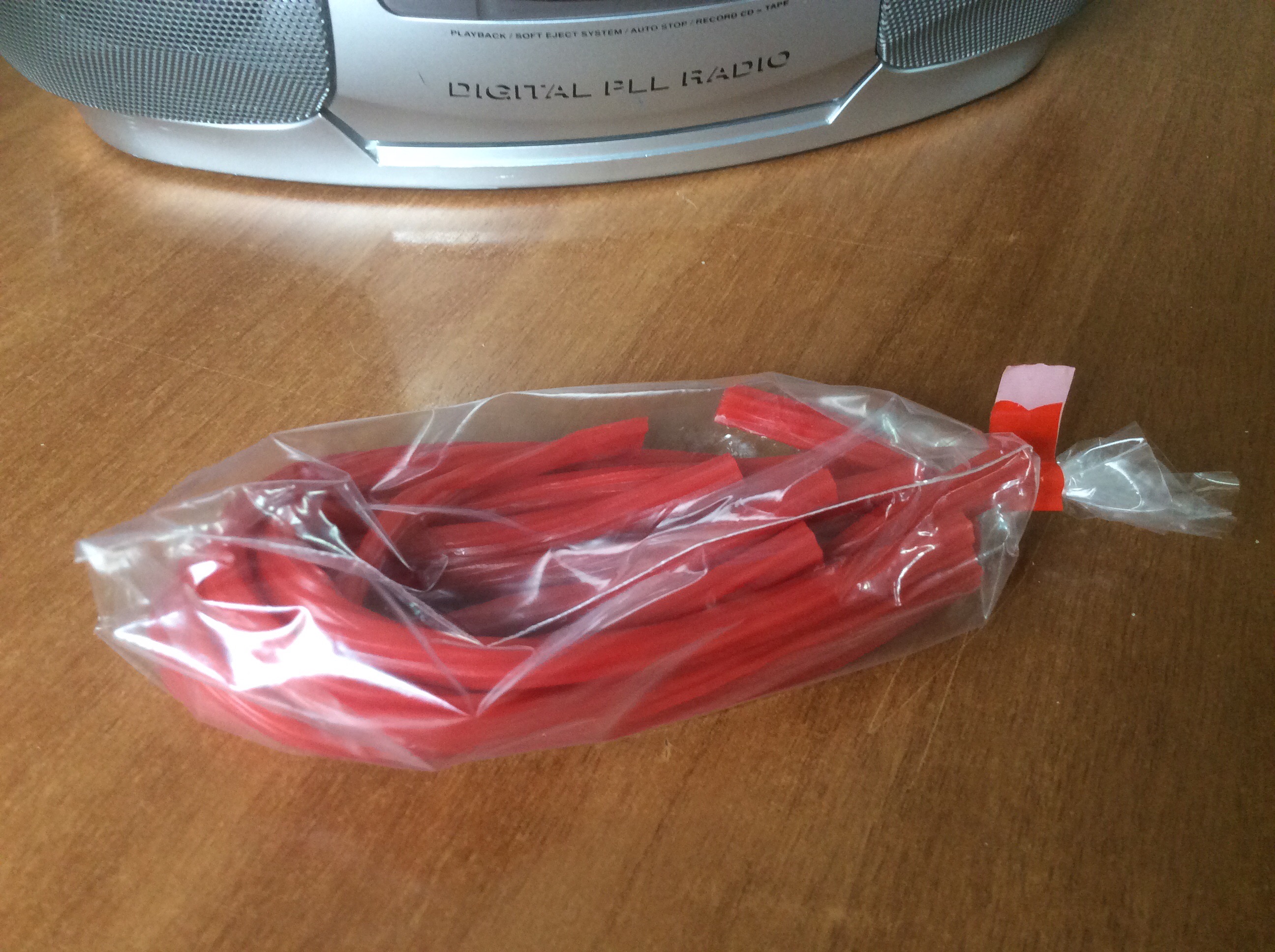
My primary function over the last week has been more akin to a substitute CD player than a teacher. The Epiphany term is drawing to a close and mock exams are very much in fashion. The trouble is, the school’s CD players are acting up, and have been for years. I was called in to help – in my free time, I’ll have you know – to ‘improvise’ a brand new listening text for them on the Tate Modern.

And I’ll also have you know it was totally worth it. Whipping up a different, two-minute text on the same subject to suit different ability sets every time might sound dull, but as a writer I found it deliciously challenging. And as a former Langtonian, to whom improvisation comes quite naturally (for want of a better term beginning with B), it’s something I’m rather good at.

I’m now quite used to doing favors for my school. I feel I owe it to them every time I get a lesson off (which isn’t often, but it does happen from time to time). But that’s a mercenary approach: it’s more because I simply love what I’m doing. If I didn’t have these occasional hankerings to go adventuring at the weekends, I don’t half wonder whether I’d throw my day off out the window and work Fridays as well. It’s not as though I don’t already come into school on the occasional Friday almost hoping to be asked to take a lesson. I really must be a few screws loose.

I appreciate that I’ve been damned lucky to have landed such a jammy set-up. I wouldn’t say it’s the best shift in the world – the kids are about as rebellious as you might expect from teenage Spaniards – but it comes very close. I’m still going to strike out for somewhere new in the year after Durham – and I’m thinking one of either Aragón, Andalucía or a different part of Extremadura – but I’m almost 100% set on coming back to Villafranca in September 2018. I mean that. It’s not the most exciting place in the world to live, but it’s a wonderful place to be from a people perspective. The only thing I lack is a friend circle of people my own age, and that’s due in part to my Olvereñan fatalism and my awareness that this was always going to be a year in transition; perfect for getting a taste, impossible for laying down roots.

Sadly, I’ve become painfully aware that there’s only ten teaching weeks left. It was Brocklesby who alerted me to that; beforehand, I’d barely given it thought. That does mean ten more weeks of new lesson plans, of riotous primary classes and of absent teachers, but the ups outnumber the downs.

And best of all, it really is spring now. I forgot to wear my hoodie to sleep last night as I’ve been in the practice of doing since October (Spamish duvets are stupidly thin) and I didn’t notice until I put it on this morning. Spain’s about to put on her very best dress and I can’t wait to see what her stylist has done with her this year. BB x

  
PS. One of my colleagues just came to the staff room to tell me that despite the difficulty of the text, quite a few of them actually overachieved, so it shows they were listening after all. Which is kind of what you’d hope in a Listening exam, but there you go. It’s little things like that that make my days! They were also shown the artwork which I chose to talk about, which just so happens to be an old enemy of mine. It’s Andre’s Equivalent VIII (The Bricks). I’ve met it once before. The students hated it. The teacher hated it. And if I’m perfectly honest, out of my entire art class of 2011, I couldn’t stand it either. Great minds, eh?

Counting Sheep and Blessings

February is over at last and the long, languid days of glorious sunshine are here.

Who am I kidding? This is Spain. We’ve had glorious sunshine on and off since September, and more on than off.

My private school whisked away the entire student body to Guadalupe today, yet another trip which I could have attended had I not a second job to balance. That gave me the afternoon off, which I sorely needed, having come down with a head-cold of some description since Monday morning. Frankly I’m surprised I got through almost the entire winter without a single incident, as I’m usually down with something or other in the first two months of the year. Not that I’d ever let it stop me from working, naturally, but it’s not all that easy to lead a conversation class when talking is just about the very last thing you want to be doing. Nevertheless, the stubborn endurance (or rather, total and deliberate ignorance of my condition) I inherited from my mother won out and I made a decent morning of it. Being ill, in a way, is just like being bored or heartbroken; the very best cure is to keep too busy to give it any thought.

On second thoughts, don’t take my word for that.

I took a detour through the park on the way home and, it being such a warm, sunny day, I sat by the water feature and tried meditating for a bit. I haven’t actually done any in months and boy, does it show. I’m out of practice, so I decided instead to simply soak up the sun, listen to a BBC Radio In Our Time podcast on the Spanish Inquisition and watch the goldfinches bathing in the water. I think I was there for an hour, or two… It could easily have been longer. For some reason when I’m ill I tend to lose track of time.

Something that occurred to me this week is how lucky I am to be where I am. I’ve been searching for a way of putting this that doesn’t come across as boastful, though I’d rather use the term proud; it refers to my ego, and it might just mark the final stepping stone in a healing process that’s taken all of seven years to complete.

I’ll explain. Since the day I moved to a junior private school at the age of eight, I’ve been surrounded by people vastly more capable than me. I was always something of a second-class citizen at that school: I didn’t have the brains to keep up with the best, and I didn’t have the money to keep up with the rest. I was swiftly filtered into the middle set, which is something of a no-man’s-land, from which it’s very hard to escape. I left that establishment after three years for other reasons, mostly financial, but also because (in one of the most pig-ignorant decisions of my life to date) my classmates were beginning to use ‘bad words’ and I’d got it into my head that a boys’ grammar school would be a more civilized environment.

I’ll be brief. It wasn’t. But as far as my surroundings were concerned, the wealth was removed but the feeling of being overshadowed trebled, not least of all because I actually failed the entrance test and got in purely on the merit of my writing. So I came in pretty much at the bottom of the pile, in a school where the average student was scoring eight or nine A*s at GCSE level. Add to that the number of kids on the ‘Gifted and Talented’ list, or on MENSA, with national-level CAT test grades; and the large proportion of students playing various sports at county level; and the musicians with Grade 8 on two or three instruments – most of these, I should add, heavily concentrated in the super-bright ones…

It was very hard to stand out at all in such a school. I guess that’s one of the reasons I’ve thrown myself at so many fields over the years: music, literature, history, dance, art, horse-riding, photography, ornithology… For want of an example, I led my school’s Funk Band, but I was a long way off from being the best singer. I simply did it because I was reasonably good at it and because I enjoyed it. The same with Art; there were some genuine Picassos in my art class. I was not one of them. So I was and always have been kind of a Jack of all trades and master of none, if we ignore a paltry average of 26% in my mock Maths exams.

Durham is not much better. Being the stomping ground of private and grammar alike, it’s just as much of a melting pot for the über-talented as either of my previous schools. That’s a great thing – really – as it brings great minds together. The result is some stellar orchestras, sports teams and research groups… at the cost of being ‘normal’ (which, I hasten to add, is not necessarily a bad thing, but then, nobody in my family has ever been or ever will be normal).

Coming to Villafranca, however, I’ve had my eyes opened for the first time in over a decade to what I can do. It’s not that I’m in a town of country bumpkins – there are some seriously bright stars amongst my students – but for the first time in my life I’m not surrounded by people who are leagues ahead of me in all fields. And for somebody who’s more than used to settling for second-best, it’s a wonderful feeling. Don’t get me wrong, I’m chomping at the bit to get back to a place where music for its own sake actually exists, but I intend to make the most of not being outshone this year. Maybe that’s one of the reasons I love travel so much. Getting away from it all.

That said, I’ve spent most of today in bed, drifting in and out of sleep. My dreams have been vivid and memorable of late, as tends to happen when I’m down with a headache. I can’t remember all the details, but I remember consoling Liam Neeson last night over the death of a family member, and then feeling slightly miffed that I didn’t get a photo with him.

If that’s the kind of thing that my brain does in its spare time, there’s probably a reason I’ve always been second best. But that’s ok. It’s a role that suits me just fine. B, after all, comes right after A. BB x
Out of Control

I’ve described being an auxiliar as a pariah state before; a grey blur between staff and student, neither one nor the other. The disadvantages include discipline control, ambivalent reactions from the students and generally feeling like you don’t belong in either group. It’s also pretty hard work, depending on how much your school wants from you. So what’s the upshot?

Well, that depends entirely on how much party you’ve got in your soul.

Ok, disregard that last statement. What I meant to say is that it’s a massive boon to the auxiliar job if you’ve got more than a few party tricks up your sleeve. Having had two teaching jobs before, I’ve been wiser this year and doled them out over the course of the year rather than all in one insufferable first lesson. And boy, do I need every one of them… because it’s not easy living in one of the world’s premier footballing countries when you really can’t see the attraction in the sport whatsoever.

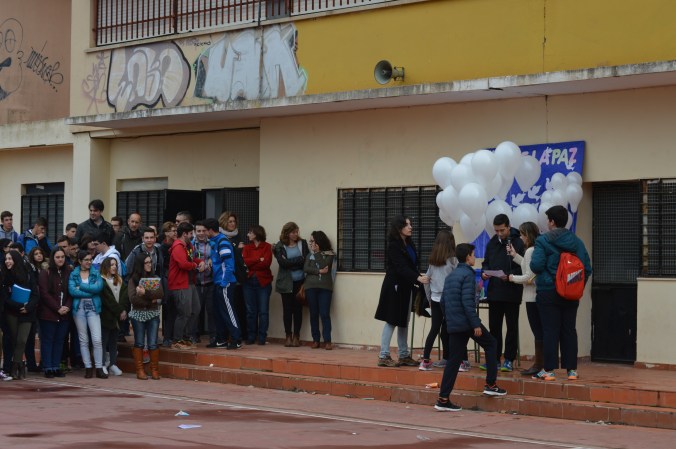
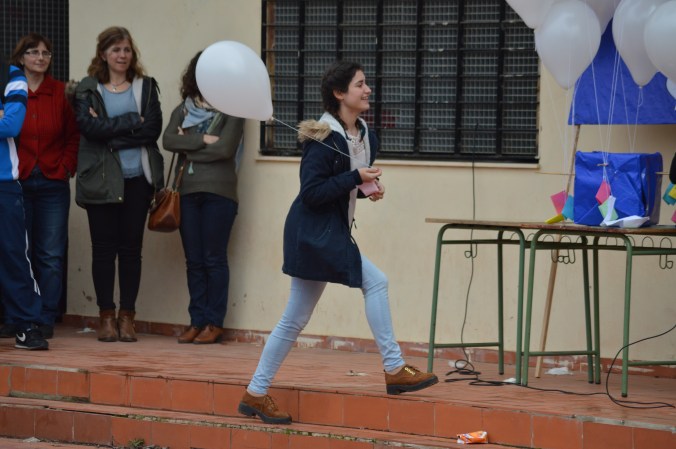
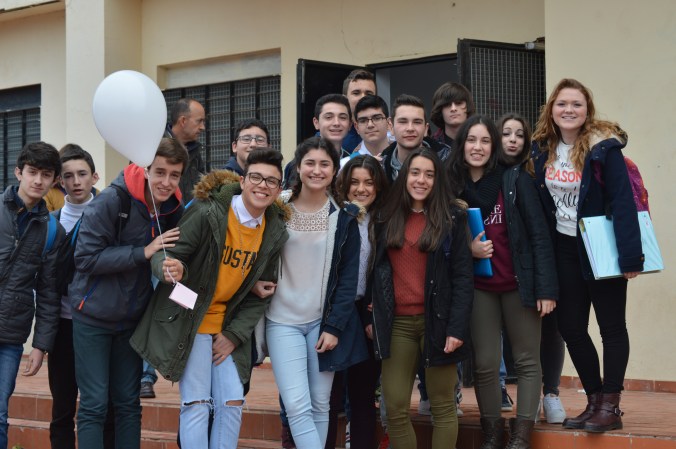
Kids like an entertainer – it’s why clowns exist – and as long as you can keep your head, there’s no harm in playing up to that every now and again. Since October I’ve drawn for them, I’ve sang for them, I’ve acted for them, told stories for them and cracked several bilingual jokes, usually at my own expense (the latter gets easier, or more effective, as you get to know your surroundings). Yesterday I rolled out another firecracker in the Día del Centro, our school’s annual celebration, in what I’m told saved the show (though I beg to differ – and if you could see the filmed results, you probably would too).

Where Thursday is usually my busiest day of the week, with a full ten hour shift from eight til eight, yesterday I didn’t have a single class in the morning. The day began instead with a free breakfast of churros con chocolate, which I must say is no bad start to the day. Anna and Tasha turned up, representing their schools, who seemed to have let them off for the day, too. I assumed that the other thirty schools in attendance would have brought their assistants with them, too, but with the exception of one giant blonde American who pulled a disappearing trick shortly a cameo appearance at the end of his school’s mini-production of Grease, there was no sign of any other guiris. That, or they were all so Hispanic that they evaded our searching eyes.

Not that I had all that much time to waste searching for fellow Anglophones. I was roped between two presentations to sing at both, for which I’d prepared a cover of Marvin Gaye’s I Heard It Through The Grapevine; my attempt at a social comment on the furious gossip culture in the Triángulo de Loro that is La Fuente del Maestre, Almendralejo and Villafranca de los Barros, a mildly humorous spin on India’s Golden Triangle. My cheerleaders had dashed out before me, as they too were needed in both productions, so I was left with an audience of the Mayor and three student representatives from each school. It was a fairly good show, but a relatively tame audience…

…which is more than can be said for the crowd over at José Rodriguez Cruz. Melendez Valdés’ resident dance troupe took their show across the road just before I got there, and then I had to re-run my Grapevine cover to a much warmer reception. The next act, however, was nowhere to be seen. Garci, our school’s magician-turned-technology teacher, was still only halfway through his magic show across the road, and we had to cover in his delay. That meant another number from yours truly, which, it hardly needs saying, was yet another solo rendition of Circle of Life. Unlike my cohorts back home, who were all too ready to drop the number along with the rest of the old repertoire – and who are currently doing exceedingly well – I don’t think I’ll ever get tired of it; and fortunately, I didn’t have to feel guilty for going over old ground, because this time it was my own students who requested it. So, despite having left the stage to pack my bags, I was launched back onto the stage with the kids chanting my name. I tell you, this job does no good for one’s ego. No good at all.

But the magician still hadn’t arrived. Then a professional choreographer, who was there for the day to lead various workshops after the presentation, stepped in to get the crowd dancing. If I mentioned before that Spaniards are none too keen on dancing – especially if it’s not Latin – then I forgot to mention that they have absolutely no problems with it if it’s fully choreographed. Think of the Macarena, for example. Give them a song where there’s a set routine and they’re off. MV’s dance troupe were the first to their feet, naturally, and after not even a minute, they relinquished the shadows of the back of the hall for the lights of the stage. Fired by the sheer enjoyment of it all, I could hardly help myself and found myself following them.

At least I had the sense to take a stand at the back, because to begin with, I had no idea what I was doing.

Dancing, however, if one of those few things I think I’m not that bad at, if only because I don’t give a damn what people think of me when there’s music playing (years of Michael Jackson and James Brown might also have helped along the way). We kept the show going for a full quarter of an hour until Garci finally arrived, which was pure laugh-a-minute, as I don’t think the dancers had any idea that I’d have gone up with them.

Oh boy, but it’s going to be tough going back to work on Monday.

But teaching, like so many arts, is on a stage. I used to go to pieces at the idea of speaking in public, but years of concerts, productions and musicals have worn down any stage-fright I might have had, and all this teaching’s done for the rest. One of these days I’ll grow up and learn to balance maturity with responsibility, but whilst I’m still young, I’ll dance and I’ll love every minute of it.

Enough of this reckless, youthful banter. I feel like it was necessary after the sobering social commentary of the previous post – if only to remind you that I’m still very much a work in progress. And long may that be so! BB x
The Call of the South

South Africa’s calling to me again. Only, this time, in the form of my younger brother, reminding me that he still wants to go. Admittedly I’d shunted it to the back of my mind, but in the sudden economic boom in BB’s world that is the belated arrival (of my own causing) of my Erasmus grant – a full two thousand pounds more than I’d budgeted on earning – it’s come back with a vengeance. It says something about my self-confidence that I’d actually budgeted on missing out on the Erasmus grant entirely through my own uselessness when it comes to paperwork.

I suppose that this is how most British students feel when the Student Loan comes in. Not me. For the last two years I’ve been reeling in the post-debt no-job spendthrift mode that suits me so well. My first year at university saw me so utterly swamped by living costs that my bank account was permanently in the minus figures well into the start of my second year. Every time the loan came in, it was snapped up by the debtors, and somehow I was still in debt after that every time. As a result, I went out a grand total of five times throughout the year, including Fresher’s Week, none of which I paid for, having no disposable money of my own.

My advice? Either get a job before going to university – easier said than done – or, better still, refuse point blank to live in halls. Durham City, bang in the middle of what is supposed to be one of England’s poorer counties, is a viciously expensive place to live, thanks to its students. I won’t get into that debate now. I’ll only state that, in my first year, it cost me upwards of £6,000 a year to live in college. That total is now closer to £7,000. The college system has a lot going for it, and it’s a friendly system too, but the price is simply crippling for most of us. And I’m speaking as one neither poor nor well off, but somewhere in between. Lucky for me, I guess, that one or two bad experiences gave me further justification to avoid living in college, besides being an already justified Scrooge about my limited funds.

The trouble is, as with so many things, it’s all about balance. The rising fees have got a lot to do with bringing the Durham staff onto the living wage, a subject for which the student body actually campaigned back in 2014. It’s truly ironic that the complaints began to resurge just months later when it was revealed that accommodation fees would necessarily have to be raised for this to be at all feasible. In the same light, years of fighting for freedom of speech have resulted in a nation where people are now complaining about the very smallest offence, the increasing access to mobile phones has come at the price of the clandestine employment of child miners in the Congo, and equality in the workplace may or may not have resulted to the splintering of family values. Speculations these may all be, but it’s a world truth that you have to give to get, piece by piece, heart by heart.

Maybe it’s the fact that I’ve spent most of this week listening to Michael Jackson’s Earth Song on a constant repeat that’s made me conscious all of a sudden. It could be that five hour conversation with the gaditano on my way back from Cantabria on Sunday. Either or. I think myself very lucky in many ways, not least of all that, as an Englishman in Spain, I have access to a wealth of opportunities from my birth right as a native English speaker alone that the locals could simply never have, starting with this jammy British Council job. I’m thankful every morning for my good fortune. I really am.

It’s why I teach, and why I believe I always will. Better to earn a modest sum and be eternally grateful for what you have than to climb to the dizzying heights.

Not that I’m saying a little ambition is a bad thing. I’ve just never really had my sights set on a life of fortune and prestige and I don’t think I’d enjoy it if I made it that far. I’ve been writing novels since I was five or so, but if I’m perfectly honest with you, all I want from that is to have them in book format, so that one day, if life should be so kind to me, I might have children to read them to. That’s the greatest dream of all. Sorry, Mum and Dad.

…Jiminy Christmas, did I go off the tracks or what? An hour ago I was trawling South African travel advice and now I’m trying to be socially conscious, as if my last few forays didn’t leave me scarred enough. Time to retreat back into my self-consciously middle-class headphones and dwell on the subject a little more. I’ll get to the bottom of it one day. Before I die, preferably. That’d be nice. Sala kahle. BB x
 

Adventures in Cow Country

Good morning Cantabria!

DSC_0069

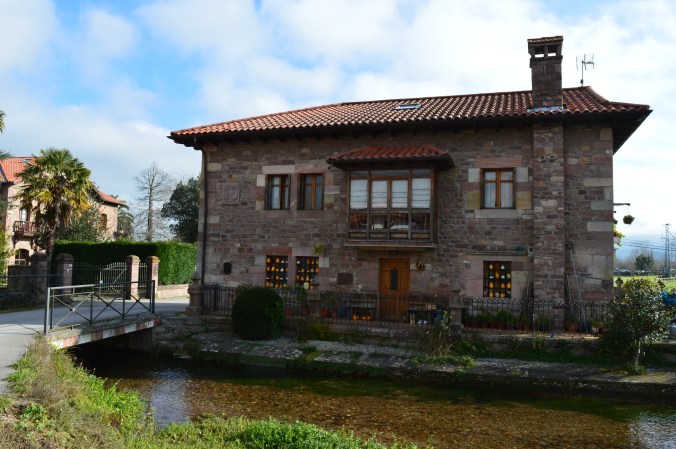
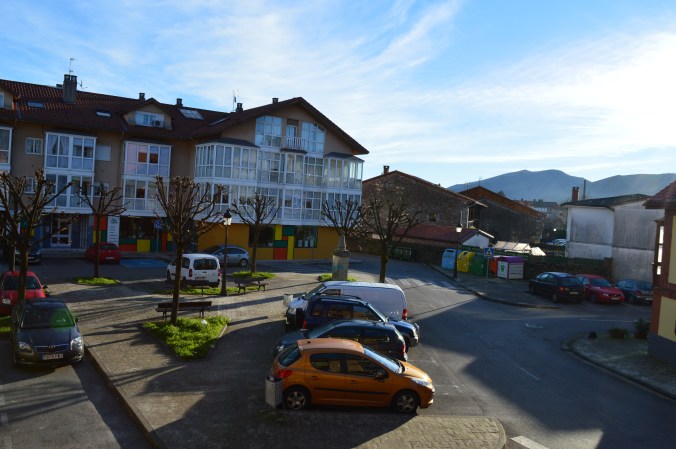
Cabezón de la Sal is a simply gorgeous mountain village sat in a cleft between the hills of Santillana and the Escudo de Cabuérniga, a mighty ridge stretching in a straight line all the way to the Asturian border. What makes it so immediately different from the south is the layout of the town: if anything, it’s more English than Spanish. Where small two-story flats hold the monopoly in the town centre, semidetached houses dominate almost everywhere else. Long gone are the snake-like rows of white houses with barred windows and marble porches; the Cantabrian norm is stone-brick dwellings with wooden roofs and quaint, upper-storey balconies. It’s charming, if a little alien to a habituated southerner like me.

DSC_0292

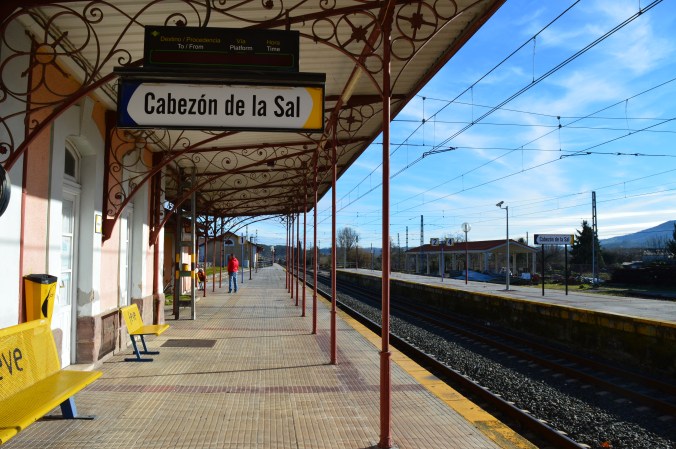
There are buses – apparently – but it’s the local train service that holds sway here. Quiet, comfortable and cheap at the price, Cantabria’s FEVE provides a reliable alternative to Extremadura’s LEDA – provided you arrive in town before ten to nine at night, that is.

DSC_0080

‘Let’s go to Potes,’ says Kate, ‘for a little walk.’ So off we went to Torrelavega, that city of burgeoning factories and towering flat-blocks that I passed through twice four years ago in the early days of my trans-Iberian adventure. In the sunlight, Torrelavega looks…

DSC_0089

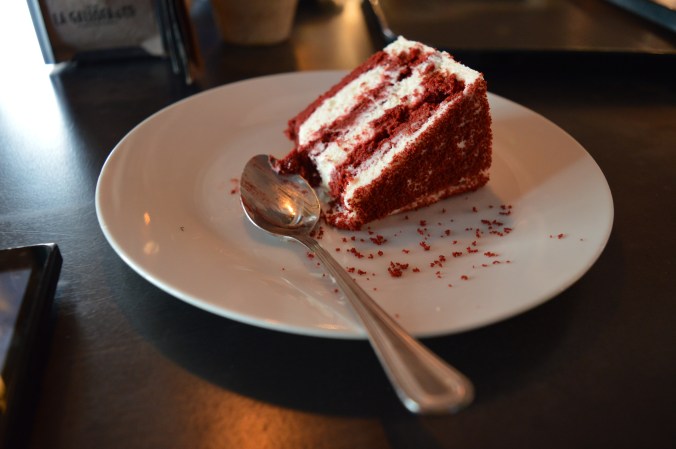
…well, I’ll not beat about the bush. Torrelavega is not exactly Paris. If Cabezón is a more rustic version of Villafranca, Torre is the Almendralejo equivalent in Kate’s neck-o’-the-woods. But like Almendralejo, it’s got its own charms. One of them goes by the name of red velvet sponge-cake.

DSC_0087

We arrived in Torrelavega looking for the bus to Potes, but the bus station proved singularly unhelpful, and a quick browse of the internet told us that the bus we were looking for left not from the bus station, but from the Palomera office by the train station we’d just left behind. In a scene which echoed the night before (albeit in slow motion), we half-ran back to the station… but there was absolutely no sign of the bus. Or any bus. Or even a bus stop, for that matter. Unless the Potes bus is a mystical bus which flies through the air and receives its passengers from the balcony of the Palomera offices on the second floor, I declare that bus stop to be an enigma. The city of Atlantis and the fabled kingdom of Shangri-La have captivated the imagination of man for centuries. Now I shall brazenly add the Palomera bus stop to that box of unsolved mysteries.

DSC_0088

Thinking on our feet, we dabbled with the idea of catching the train into Asturias in search of the equally mysterious inland bay of Gulpiyuri, but after all of that faffing around with the Potes bus we’d just missed the only practical train to Llanes by five minutes. As though calling out from a memory, Santillana del Mar came to mind and I decided we would grab the next train back to Cabezón and strike out for the coast via the Town of Three Lies. Public transport has as its advantages, but as a species, we should never forget that it was learning to walk on our own two feet that got us where we are today. And so off we went.

DSC_0096

The strangest thing about this last-minute change of plan was that it meant retracing my steps almost pace for pace from that ridiculous adventure, now some four years ago, right down to getting off at the very station where the driving rain turned me back to the shelter of Santillana del Mar. But for a few forks in the road, I had the entire route embedded in my mind as though I’d walked it ten times over rather than once. Perhaps that’s fate. She’s been playing a long game with me.

DSC_0119

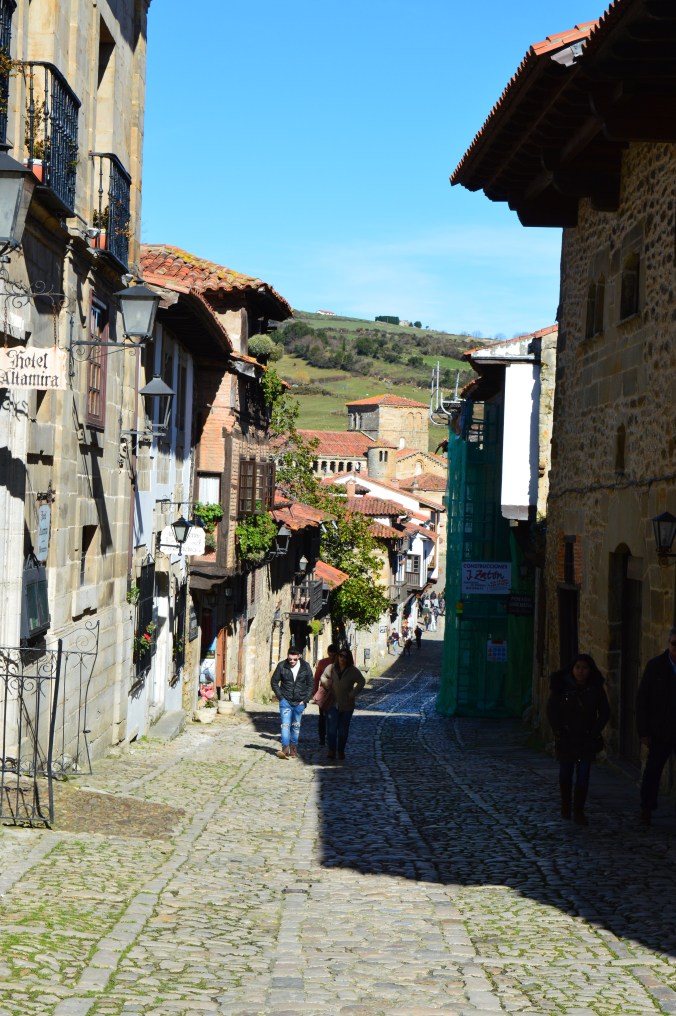
It felt decidedly weird coming down out of the hills into the cobbled streets of Santillana all over again. As Spanish villages go, Santillana has got to be amongst the very prettiest. It’s known as the town of three lies – being neither holy, flat, nor by the sea – but if that is so, then it’s a damned beautiful liar. As I so often find myself doing, I made sure to revisit all of the places I’d been before: the same church, the same quesada shop, the same Savage Culture boutique that I still don’t fully understand. I can’t explain it, but something about this town keeps pulling me back.

DSC_0130

We had a picnic lunch of peanut butter sandwiches on the steps of the Colegiata de Santa Juliana and basked in the afternoon sun. 15 degrees Celsius… not bad for Cantabria. In all the bad weather Spain’s north coast has been having of late, I must confess I think myself bloody lucky to have landed a whole twenty-four hours of glorious sunshine in the one day I had to explore the place. I could hardly have asked for better: better weather, or better countryside, or better company.

DSC_0160

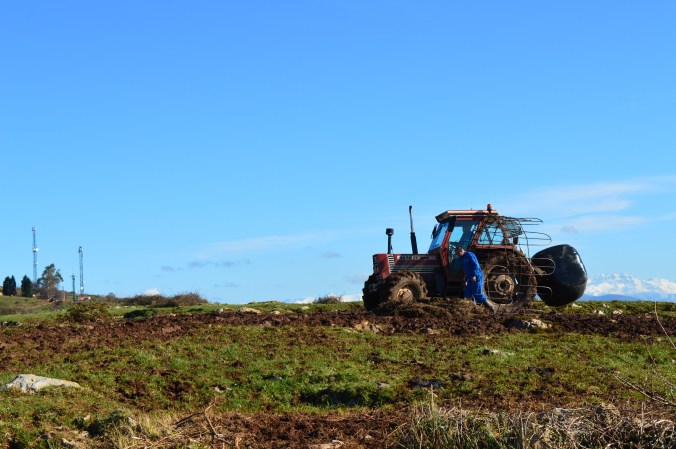
Leaving Santillana behind, we climbed steadily northwards across the rolling hills to the coast. Along the way we were misled by the Arch-Deceiver that is HERE Maps, which tried to convince us that what looked suspiciously like an overgrown stream was actually a main road, and we were caught up in a high-speed chase with a tractor, like an extremely low-budget Cantabrian version of Need for Speed. The stereotype lives: Cantabria truly is a land of green hills, of cows and of tractors.

DSC_0146

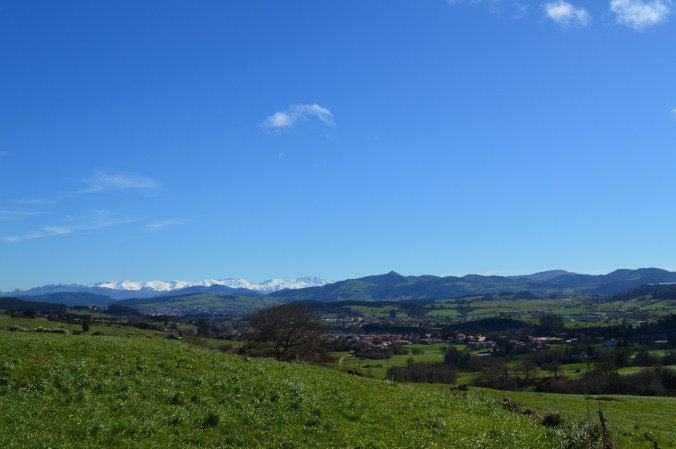
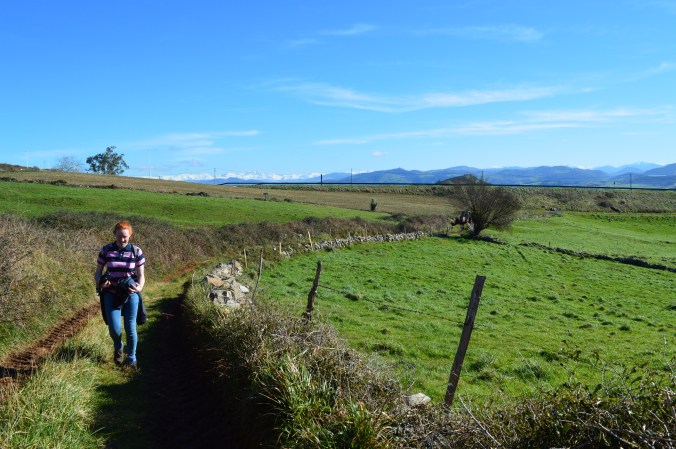
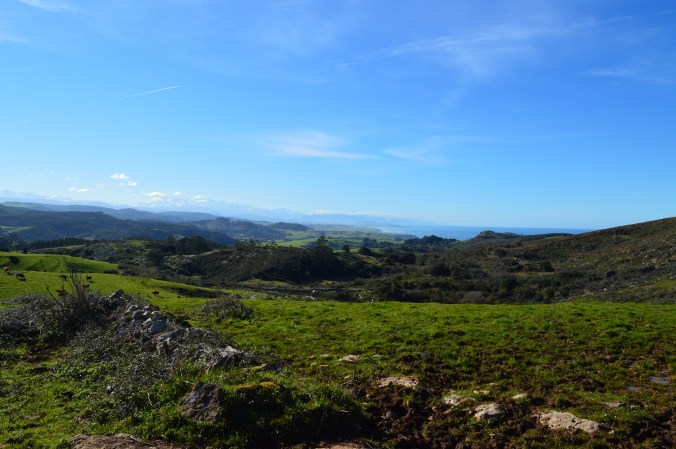
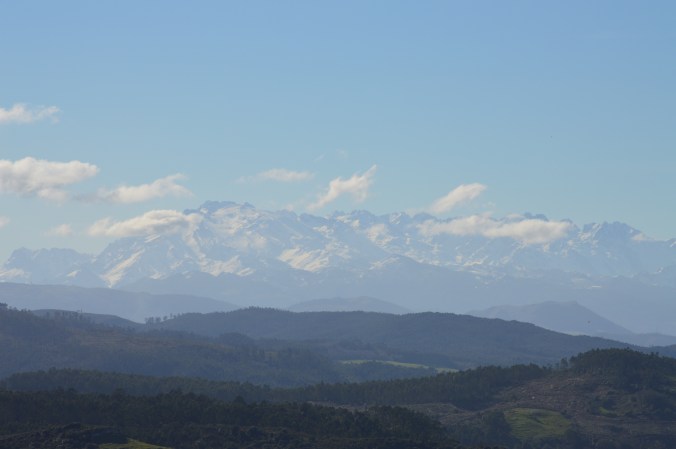
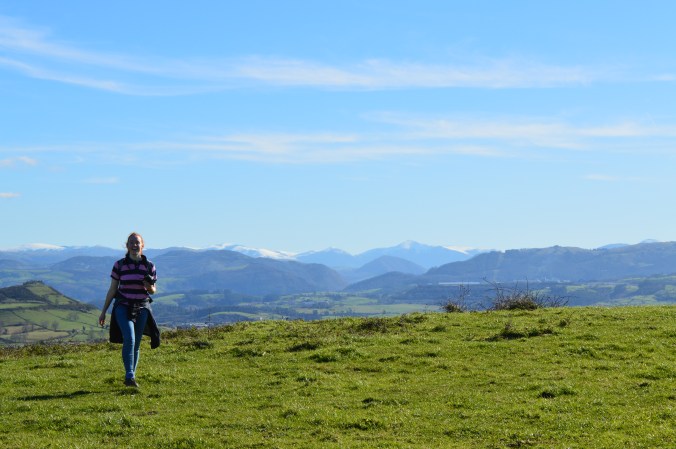
The last time I wandered these hills, the skies were iron-grey and I could only see as far as the next range of hills for the glowering rainclouds. I can’t have known it at the time, but I was seriously missing out. After abandoning the path and freelancing our way up a hill, Watership Down fashion, we were treated to what must be the most awe-inspiring landscape I’ve seen since I first stepped onto the plains of Caceres.

For once, I had the full works on me, so you can enjoy the view three times over, with the wide-angle 18mm…

DSC_0150

…and the macro 200mm…

DSC_0153

…and the telephoto 500mm.

DSC_0154

Sadly, the Nikon-compatible Sigma 500mm doesn’t come with an in-built autofocus motor, so it won’t be the powerhouse it has always been for rapid-fire avian photography, but at least I got some use out of it this weekend.

It was a beautiful view and all of that, but it was an equally beautiful dead end, so we had to climb back down the hill, cross the cow-fields and roll under a possibly electrified fence in order to get back to the road down to the sea (we didn’t check to find out – not when we were so close to our goal). After a very long and very winding road down one last hill, we made it – at last – to the sea.

DSC_0237

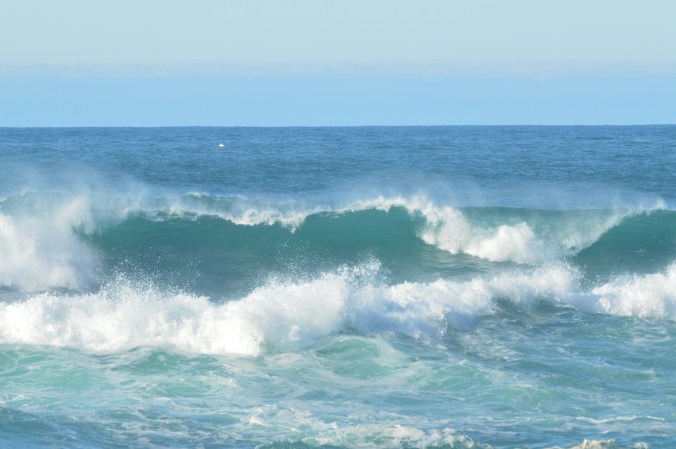
Extremadura has so much to offer, but there’s one thing it really lacks: the sea. You don’t notice until you think about it. Discounting Uganda, I’ve never lived more than an hour from the sea (much less in the UK) so Extremadura is the most inland location I’ve ever had to deal with. To see the Atlantic in all its cold fury once again was a real sight for sore eyes. The storm-force winds and murderous waves of the previous week are gone, but the waves still put on a formidable display for us.

DSC_0188

We spent about an hour by the sea, Kate and I, watching the waves pounding the shore and snacking on Cantabria’s finest delicacy, quesada pasiega. Yum yum. There’s a little ermita built into a cave in the cliffs which we didn’t get the time to visit, but I doubt it would have looked any more impressive up close than from afar. Imagine living in a place like that, with the sound of the Atlantic roaring all about you, twenty-four hours a day. The focus you would have to have – or learn to have – borders on the superhuman. Little wonder, then, that it is what it is. I wonder how an estate agent might describe it?

DSC_0201

It’s getting to that time of year when the sun starts to set later, but sunset was already fast approaching as we turned back for Santillana at about six o’clock. In the gloom of the oncoming night, we finished off the quesada on the banks of the Saja river by moonlight and killed time by making for Rudagüera, the next stop along the Cabezón line… and then legging it back the way we came when it became apparent that it was a little further than we’d thought (one last flick of the claw from HERE Maps) and that we’d probably miss the next train.

DSC_0261

Back in Cabezón, after a drink at a local hunters’ bar, complete with mounted boar heads and numerous black-and-white stills of hunting men of old stood proudly over the carcasses of Cantabria’s once widespread brown bears, Kate took me to visit one of her favourite eateries, El Paraíso. At 2,45€, I thought a ración of patatas bravas would be enough to fill a corner after so much walking (we crammed in about thirty kilometres today, all in all), but I forgot…

DSC_0276

We’re in the north. In my experience, northerners in any country seem to have a much better idea as to what constitutes a decent portion size. Maybe it’s the climate. Who knows? In my earlier traveling days, food was the last thing I was prepared to fork out for. How things have changed since then! Coming back from that Spain trek dangerously underweight four years ago has left a profound mark, and these days food is the one luxury I’m prepared to spend on, and spend well. A long day’s walking deserves a long night’s eating, and I think I did pretty well on both fronts.

So, all in all, it was a very successful trip, albeit a very brief one! I was lucky enough to get a BlaBlaCar on the way back that didn’t mess me around. Better yet, he was no more and no less than a gaditano. Oh, to hear that accent again after twenty-four hours and more of people pronouncing their s’s…! You have no idea how happy it made me.

DSC_0323

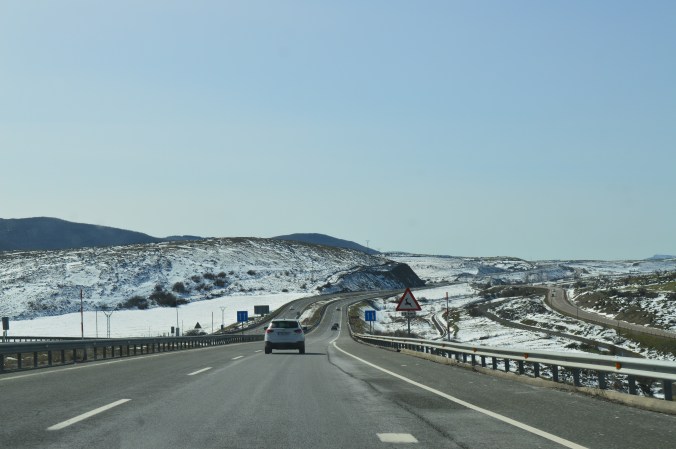
Cabezón de la Sal to Villafranca is still a bloody long way to go, but where the bus took all of nine hours, Rafa made it for me in six. In those six hours, taking in the windswept, snowy heights of Reinosa, I was treated to the finest conversation BlaBla can offer, up to and including:

  • Franco’s suppression of the education system
  • The legacy of al-Andalus
  • An anthropological history of Cadiz
  • The true nature of corruption in Spain
  • The Spanish Civil War
  • Gibraltan Spanglish
  • The rationality of England’s outside stance on the EU
  • Podemos and the total absence of a government at the moment
  • Why and how dubbing came to be one of Spain’s biggest businesses (and blights)
  • Piracy in the Old Mediterranean
  • The Growth of the Spanish film industry

I could go on. There were at least five or six hours of it. And all of it in Spanish, and in the very finest gaditano. Talk about a workout… and politics! The eighteen year-old me would never have believed a word of it.

Needless to say, my faith in BlaBlaCar is restored and I’ll be bound for Cadiz proper at some point to make good on that drink I’ve been offered. If I am to live up to the title of ‘Él que va conociendo al mundo’ that I’ve been given, BlaBlaCar is a damned good way of going about it.

DSC_0164

But last of all, I’d like to air high-five my good friend Kate for putting me up (and putting up with me) for two nights and a day in Cantabria. Yours truly is not the most pleasant company in a city, but in the countryside where he belongs, he’s just as insufferable, if only on the other side of the positive/negative spectrum. Kate’s seen me at my lowest in Amman and probably at my highest – quite literally – in the life-giving paradise that is Cantabria. Thank you, Kate, and I hope to return the favour when you’re down in the south! The adventure never ends. Not really. Not ever. BB x
PS. You can read about her side of things here. It’s a lot more tongue-in-cheek than mine.

Ned Stark was Wrong

Two weeks ago I saw the first martins wheeling about over the bus station. Last week the first swallows began to arrive and the lonely stork on the chimney of the old factory was joined by his mate. This weekend the chiffchaffs have finally joined in on the dawn chorus and, whilst it’s hardly been what you’d call wintry around these parts, today suddenly feels decidedly spring-y. The sun is blazing away in a sky of cloudless blue and everybody is out in the town square, soaking up the good weather and generally having a good Sunday of it.

The truth of the matter is, quite honestly, that winter has simply not come this year.

DSC_0733

Maybe I’ve been in the north of England for too long, but it stills feels like I’ve been cheated of a season out here. Extremadura is, as its name suggests, a land of extremes: of fiercely hot summers and bitterly cold winters. There are people in Villafranca who remember whole years when it never rained at all. It has rained here, but not often; about four or five times since I arrived, all in all. And whilst the presence of the cranes is a sure sign that it’s winter somewhere, it looks a great deal more like spring right now. The cherry blossom is already in bloom, over a month early, which is more than can be said for the unseasonably early arrival of the migrants. I think I’ll head on down to Tarifa next weekend to check on how things are going in the Strait. If spring has come early anywhere, it’ll be there for sure.

Which reminds me, I really must go looking for the cranes before they leave.

DSC_0736

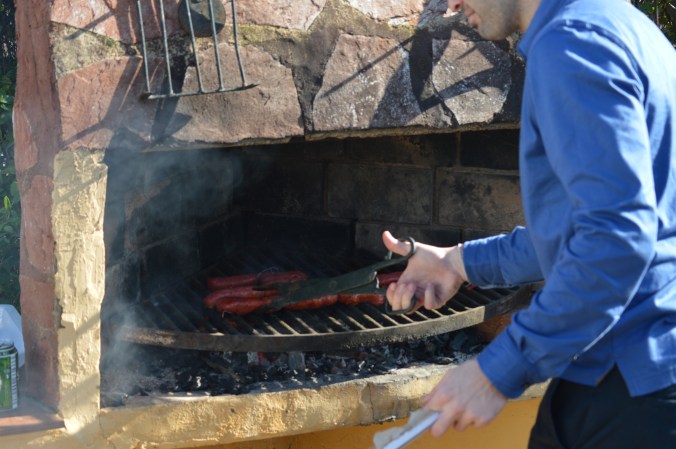
To celebrate the gloriously early return of spring (alright, so that wasn’t really the reason), a local friend and our would-be guide, Jesús, threw a barbecue gathering in his casa de campo out in the vineyards of the Tierra de Barros. A casa de campo is a real Spanish boon that I’m still struggling to translate. Country house might work, but that conveys a sense of grandeur that most such buildings – merely glorified sheds where your average town-dwelling Spaniard stores his produce, spare furniture and ‘all the shit that doesn’t go anywhere else’ – simply do not have. Ask a Spaniard to show you their casa de campo and you’ll quickly see why Spanish houses are so ludicrously tidy.

DSC_0650

A common mistake that foreigners make is that these are dwellings in their own right. Far from it. They’re almost all two-room bungalows, equipped with sofas, plenty of chairs and a kitchenette, purely for the purposes of hosting summer gatherings like the one Jesús held yesterday. The locals will pay regular visits to their campo, especially during harvest season when they’re more practical than pleasurable, but most of them would never stay in one. It’s simply not done. Would you sleep in the tool-shed?

DSC_0646

Jesús had invited a fair crowd, with an equal balance of Spaniards and guiris, the latter representing England, Wales and three American states. The Almendralejo crew, in all but name. I had the audacity to avoid them almost entirely last term, stopping by only twice, for fear of being sucked into an English-speaking failure of a year abroad (I speak enough English for my job). That was poorly done indeed. Quite unlike the infamous all-English compounds in many a Spanish town, the Almen lot are very much half and half. As the most fluent of the guiris (a title the Spaniards themselves have given me and which I cherish above all other compliments), I get more than enough practice in my grandfather’s language as the ultimate go-between and little could make me happier.

DSC_0655

Although, that said, the copious offerings of grilled chorizo, crackling and manchego cheese on offer yesterday did a damned good job of it.

DSC_0660

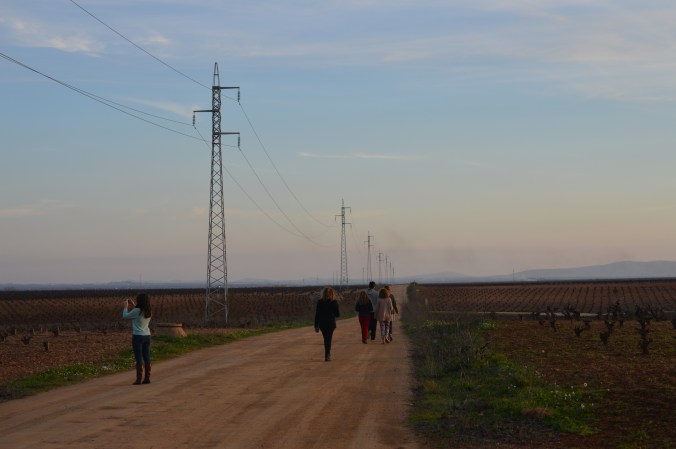
No campo gathering would be complete without una vueltecita, or stroll. Jesús’ casa de campo is just off the Vía de la Plata, the lesser known northbound Camino de Santiago and the old road from Seville to the silver mines in the Asturias. We didn’t stroll particularly far, but then, you don’t have to; the Tierra de Barros is so vast and flat that you can see for miles in all directions. It’s hard to imagine when you compare it, but the village of Hornachos, sat astride the high Sierra which shares its name, is as far from Villafranca as Walmer is from Canterbury. Twenty seven kilometers, or fifteen miles, there or thereabouts. And you can see one from the other. It’s that flat.

DSC_0672

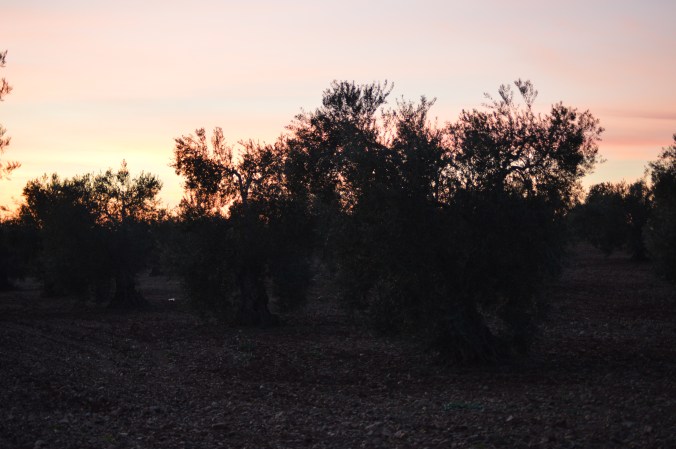
We didn’t find any unicorns (don’t ask) but we did find two very excitable dogs and an emu. And a characteristically gorgeous sunset over the olive trees.

DSC_0700

Andalucía, that dusky southern beauty, might have stolen my heart years ago, but honest Extremadura is doing her hardest to win me over and very nearly succeeding. If I end up returning to this land of endless steppe, of Kings and buses named after Zeus’ lovers and home of quite possibly the hardiest of all of Spain’s assistants (I maintain that you have to be at least a few screws loose to choose Extremadura as your home for a year), it wouldn’t surprise me in the least.

DSC_0717

Carnaval is coming, but it’s not here yet, and before that yawns our second five-day weekend; the best we get by way of a ‘holiday’ besides Christmas and Easter compared to the French assistants (a necessary sacrifice, I suppose, for being in a superior country). I’ll sign off before the Spanish blood in me goes to my head. BB x

Spoilt Rotten

Today offered up the perfect example of why you should save a weekly summing-up-style post for the end of the week. Because most of what I was talking about in yesterday’s mammoth entry happened again today, if only in miniature. But because it’s probably ranking amongst the best days I’ve had here yet, I’ll throw it in – if just to find an outlet for the photos I took today.

I should warn you; if you read yesterday’s post, today’s might smack more than a little of déjà vu.

So I went into class this morning and tried to do another round of ‘My Secondary School’ presentation. I must have jinxed the system last night, because it froze no less than six times, requiring six reboots and twenty minutes lost. Still, I managed to get most of the presentation done despite everything. Once you’ve been doing the same lesson for four or five hours a week, you hardly need to look at your notes to know what comes next. You find yourself saying the exact same turns of phrase, making the same gestures and cracking the same jokes, whether they worked or not. It’s a little strange, that. I only notice it when I look back.

My second class of the day was spent half on the workbook, and half on John Lennon’s Imagine. Considering the near-total absence of a choral tradition in this country, they did a damn good job for a class of twenty-nine twelve year-olds. They also reminded me that they haven’t forgotten that I promised to bring them some peanut butter. If mine hadn’t been confiscated at the airport, I’d have obliged them earlier, but as it is they’re getting restless… At least it’s on its way! The things I do for these children, honestly…

My third class of the day was (technically) my last class with one of my favourite groups, a lower sixth bachillerato class and one of the very best. I had a Uganda presentation planned for them, but if I expected them to sit and listen in silence, I had another thing coming. Halfway through OMI’s Cheerleader started playing and the ringleader of the group revealed three bags full of crisps, cups and Coke. After apologising for not paying much attention during my presentation, he explained to me that when they heard me announce that today was my last lesson with them, they arranged on the spot to throw a party. That explains why there was a general hum during the presentation (these kids are usually silent) and why Candi left ‘to take an important phone call’. A lot of hugs, a lot of puñados and a lot of love.

DSC_0587

Yeah, I really need an autofocusing lens. Nobody really understands manual focus

I never even got to finish my presentation; we’d only got as far as Kyambura. But I don’t care. I’m touched. And if I can find a way to claw back an hour with them, even if it’s out of my own free time, I will.

DSC_0605

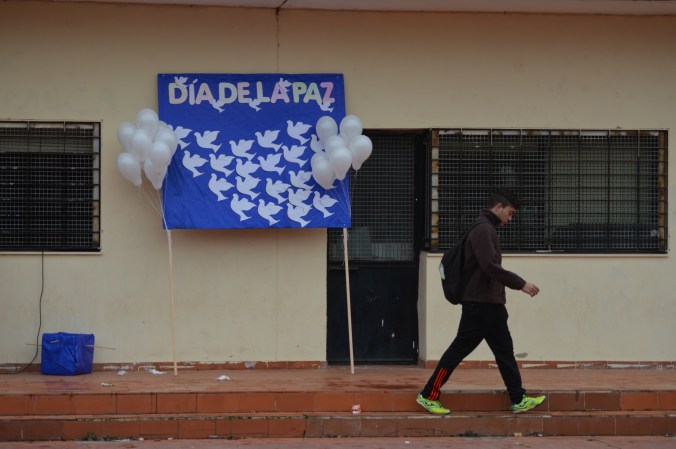
On to today’s main event. Today is Día de la Paz. It’s something I haven’t celebrated since I was last in a Spanish school myself, which was way back in 2007. I’m not entirely sure why, but English schools (or at least, the ones I went to) don’t deem it celebration-worthy. Must be something to do with the general negative attitude towards anything that might detract from that sacrosanct curriculum of ours.

DSC_0620

Now 2007 was a long time ago – almost a decade – and I can’t really remember what it was we did in C.E.I.P. Miguel de Cervantes to celebrate Día de la Paz. Something similar to today’s events – minus the John Lennon, of course. Melendez Valdés’ plan was heavy on the balloons, anyway. Handy, since I’ve been trying to explain the concept of a balloon race all week.

DSC_0631

We all gathered in a square the patio in the final hour of school, and two representatives from each class came up to the front to read a quote about peace, which was written on a small dove-shaped card and attached to one of many white balloons brought forward by the students.

DSC_0625

I’d brought my camera on the off-chance that Día de la Paz would be a good chance to finally grab some photos of the instituto; for my drawing, if not for the sake of it. Madrid with Ali should have been a reminder, but I’d plain forgotten just how willing kids are to have their photographs taken. That’s reassuring – because they make the very best of subjects. Always.

DSC_0595

When everybody had said their piece (no pun intended), I was called out of the square to lead the recorder orchestra (oh, now that takes me back) and the rest of the lower school in singing Imagine. I guess I should have seen it coming, but that basically resulted in the recorders playing a completely different version of the song to the one everybody else had learned – and, consequently, me singing on my own. Well, I can’t say I didn’t see that coming. Because I did. And in the background, the teachers began to release the balloons and their messages of peace, one by one.

DSC_0600

It’s not been particularly windy for a while, so wonder just how far those balloons will go…

DSC_0601

Here’s to hoping that wherever they end up, the messages of peace they’re carrying with them put a smile on somebody’s face – in irony or in truth, it really doesn’t matter. Just as long as they’re smiling. (Exit Sop, stage left) BB x

Go West

For once, it’d probably be better if, whilst reading this, you’re not hearing my voice saying it to you – because my voice right now is wrecked, and you wouldn’t recognise the guy on the other end of the line if you could hear him.

I put that down to three things: three hours of choir practice (most of which spent singing at the top of my range as there are no tenors or basses here), two hours of conversation with Upper Sixth-level students and one hour of wrangling with one of my two very-almost-out-of-control primary classes. First and foremost, I blame Ariana Grande, but that primary lot don’t help much. Still, I got my first hug from my two favourite kids in that class today, which was heart-warming, to say the least. Tasha’s been getting hugs since the get-go, and I guess it’s normal procedure for the female auxiliares, but not for me. It made my day, anyway. When they’re not launching a full-on assault against my sanity, my will to live and my voice-box, it’s nice to know they see me as a human being.

I catch myself saying to myself almost constantly: remember the Iraqi kids, remember the screaming, remember the chair-throwing incident… It can’t possibly get any worse than that. I think that’s probably the right way to go about it.

In truth I’ve not got all that much to report at the moment. In a couple of days’ time I’ll hit the road as it’s the December puente (when a national holiday falls close enough to the weekend to create an extended weekend; literally, ‘bridge’). This year it’s only (!) a five-day weekend as the national holidays on the 7th and 8th fall on a Monday and Tuesday respectively, but that’s enough for a mini-adventure at least. I’ve been juggling several ideas over the last few months as to how best to use the time – surprising my friends in Cantabria, Morocco or Granada was the main plan – but it wasn’t until last weekend that I hit upon a decision, and my decision is PORTUGAL.

Yeah. I don’t speak any Portuguese.

It’s only occurred to me recently to take an interest in this nation that just so happens to be lying RIGHT ON MY DOORSTEP. No, seriously, it’s less than half an hour’s drive in the car if you just keep heading west. I suppose the main thing that stopped me going in the first place was that, quite simply, I know nothing about Portugal. I can read Portuguese almost as well as I can read Spanish, but understanding it spoken is… well, it might as well be Russian. The odd word might sound familiar, perhaps, but otherwise it’s a different language in its own right. And rightly so. But, just as Andrew and I decided in Kiev, the mere fact that I don’t speak the language shouldn’t be a barrier in the slightest to an adventurer like me, so… there we go. I’ve booked a couple of nights at a hostel in Lisbon, and I’m leaving it until I get there to decide whether the plan is to head south and check out the Algarve whilst it’s still tourist-free (a tempting prospect) or the gob-smackingly-beautiful north, peppered with unforgettable villages like Monsanto, Marvão and Piódão. It’s a tough call. As always, I’d rather leave that decision until the day. I’d feel better, that way. Come the day, I’ll know which way to go.

As for the Portuguese, well, I’m not going in completely unarmed. In Kiev all I could say was a feeble ‘спасибо’ (thank you). I’ll brush up as many little phrases as I can before I go, as a little always goes a long way, however badly you pronounce it. I’m told the Portuguese are a fascinating people; proud, polite, gaudy and brilliant linguists. My bachillerato class also seem to think that the women have moustaches, but I’ll be the judge of that.

With any luck, I’ll return doubly keen to pick up another language and add it to my belt. I was planning on making my next big language attempt in Zulu, but it is a bit of a jump… Perhaps it would be better if I worked my way towards Zulu, say, via Portuguese…?

Oh Monty Python. How I miss you. BB x

Diamond in the Rough

This week started just about the same way as every week begins, with me waking up to the sound of my seven o’clock alarm, with the morning’s first class just an hour and a quarter away, and finding myself struck with the weekly conundrum that is ‘now, what am I going to teach today?’.

For the first three weeks I had some stellar lesson plans, but we’re filing into my fifth working week here now (I told you before, my observation week became my first teaching week) and my tried-and-true classes have come and gone. Four down, twenty-seven to go. Since in school I teach across the age-groups, from six to twenty-two, I have to split my material in half depending on their ability, which requires two new lesson plans each week. Not exactly a challenge, per se, especially when several of those are shared between groups, meaning it’s possible (and highly recommended) to recycle material; but it’s a weekly problem, after a weekend spent traveling, partying or what have you, that on Sunday night the question is always there on the tip of my tongue as I bed down for the night. What am I going to teach them today?

Today I thought I’d brave it and try literature on the kids. Foolhardy, I know, especially after my last attempt at sparking some creativity amongst the would-be dullards, but I’m not about to give up on them yet. To spark their interest – and since I’ve just spent most of the weekend reading the tale – I kicked things off by drawing a blackboard-sized Moby Dick on the board, complete with scars, harpoons and rigging. Most of them had heard of it, but understandably, none of them had actually read it.

Well, not quite. One of them had.

I did a little double-take at this and made him explain the plot to the class. The way he put it, in English, a language that is not his own, told the tale better than Herman Manville (personally, I found the text hard-going, turgid even, though the story itself was impeccable). Better yet, he beat me to it and cited Manville as the author. I thought I’d let him sit on his laurels for a while and ask the others for any books they’d read recently, but they just stared blankly at me, as though I’d asked them if they’d like to spend the rest of the day doing quadratics. Moby – the pseudonym I shall forthwith use for this very literate kid – had his hand up the whole time and went on to tell me about Bram Stoker’s Dracula, Jules Verne’s Around the World in Eighty Days and Edgar Allan Poe’s The Tell-Tale Heart. That he had read them in translation is beside the point. This is a boy of fifteen who’s busy working his way through the classics.

As I was struggling to elicit some kind of interest from the rest of the class – who, as you might expect, were getting visibly bothered by Moby’s contributions – my colleague spent the hour taking notes of other writers that he might enjoy, amongst them Arthur Conan Doyle and Charles Dickens. One of Moby’s companions lost it and complained loudly that it was unfair that only Moby was talking. My colleague and I soundly brought him down a size by repeating that all I was asking for was a story any of them had read, and that as Moby was the only one who was willing to talk, they only had themselves to blame for their silence. I opened the floodgates a little by allowing them to tell me about a film or television series they might have seen, but on that inch they took a mile and missed the point completely; three accounts down the line I had to remind them that match reports, game shows and reality TV are not stories, and consequently didn’t count.

Pushed into a corner, one kid looked very chuffed to say he thought his favourite TV show, a Spanish version of Match of the Day, was far better entertainment than any book he’d ever read. Granted, he probably hasn’t read very widely – I hadn’t at his age – but for good measure I told him that a show where two obnoxious early retirees discuss what happened, what might have happened, what should have happened and what might happen next time in a football match for an entire hour could hardly be as entertaining as a decent read. I could have done worse, of course, but I held back. Most of it went over his head anyway, as it was supposed to. I’m not foolhardy enough to let my personal prejudices against the tedium that is the world of football discussion ruin my relationship with my students, who already know I’m none too keen on it.

As you might have guessed, I was getting pretty frustrated by this point. I’ve learned to mask it after a month of teaching these kids, but it’s still pretty galling when you ask a simple question and all you get in return is twenty-three gormless expressions. But Moby came back with the goods, stating that he hadn’t read any books in English yet, but that over Christmas he was going to try with Tolkein’s The Lord of the Rings. You’ve got to hand it to the kid; starting to read in a foreign language with Tolkein…? That takes guts. My parents are prolific readers and they can’t stand his writing, and sadly they’re not alone (though I, for one, can’t get enough of the stuff).

In the other establishment I work at there are several kids like Moby in every class; students who are well-read, well-cultured and whose English is streets ahead of their companions. It’s the norm in a private school. And teaching in both private and state has its merits. But kids like Moby make the state school experience so much more worthwhile, for all the challenges. Here is a boy who, despite everything, is working his way through the literary greats for the pure pleasure of it, with his mind bent on attending university in Toronto of all places. It’s kids like Moby who remind me just why it is that I love teaching. Because for all the sour looks, disinterest and gossipping that goes on, when there’s at least one kid who’s shining with promise there’s a reason to go on. Obviously you can’t cater to that one child alone – if it were that simple, everyone would want to be a teacher, I think – but as long as you know that what you’re dealing is going towards somebody’s personal development, that’s reward enough for all your travails.

As for me, I’ve got a fair amount of catching up to do. Moby Dick was this weekend’s read; The Adventures of Tom Sawyer and Robinson Crusoe await, along with Allan Quatermain (after a two-month hiatus). Maybe I’ll recommend King Solomon’s Mines to Moby when I next get the chance. It’s certainly one of my favourites. BB x