Mirrors in the Mountains

Aeropuerto Internacional Alfredo Rodríguez, Arequipa. 16.20.

I have often seen it written of Uganda that it is Africa in miniature – that is, a concentrated version of the vast array of biomes you can find across the continent. The more I travel Peru, the more I’m convinced that this is South America’s equivalent: jungle, desert, glaciers, prairie, megacities and coastal plains. Peru really does have it all. No wonder it is home to the second largest number of bird species in the world (after Colombia).

If the Islas Ballestas are touted as the “poor man’s Galápagos”, then today I paid a flying visit to the poor man’s Salar de Uyuni. While my original plan for this adventure ended with a trip to Bolivia’s enormous salt flats on the edge of the Atacama Desert, my decision to go all in on an Amazonian side-quest to Manu got in the way. I really didn’t want to leave South America without seeing the salt lakes, though, as they were a fairly major inspiration for coming out here in the first place.

Luckily, there’s one tiny outlier of the Uyuni salt flats tucked away in the mountains east of Arequipa, within the Reserva Nacional de Salinas y Aguada Blanca. Getting there is a pretty arduous journey, but if you can find a way, the views are out of this world.

My onward flight to Cusco leaves at 18.05, so I needed to find a way to the salt flats and back in time to catch my plane. As luck would have it, there was a tour on GetYourGuide that fit the bill perfectly. It meant another early start, but after yesterday’s 2am kick-off, a 5.40am pick-up felt like a lie-in.

Not a bus or a people carrier this time, but a Land Cruiser. There were only two other travelers on board – a bilingual couple from Texas and Veracruz – so I got the front seat. Result!

Ah, but I’m not that naive. If something feels too good to be true, it’s usually because it is.

We had one more passenger to pick up before leaving Arequipa, but in a turn of events that would probably be familiar to a US Homeland Security officer, that one passenger turned out to be a family of five – they’d simply “forgotten” to mention they’d booked for more than one.

Not for the first time, being young and single became a major liability. As the most expendable passenger, I was asked if I would be so kind as to sit in the back.

I didn’t mind overmuch at the time – after all, one thing my superzoom isn’t very good at is in-transit photography – but I hadn’t considered the terrain… or the supreme manspreading abilities of the couple squeezed in next to me. The tarmac road stops shortly after leaving the Arequipa suburb of Paucarpata. From there on out, it’s a dirt track all the way up to the salt lakes – and the road winds a lot.

For all of two hours, I was rocked about in the back of the car, bumping my head quite a bit – which is more than can be said for the state of my legs! The relief when the lakes came into view… words can’t begin to describe!

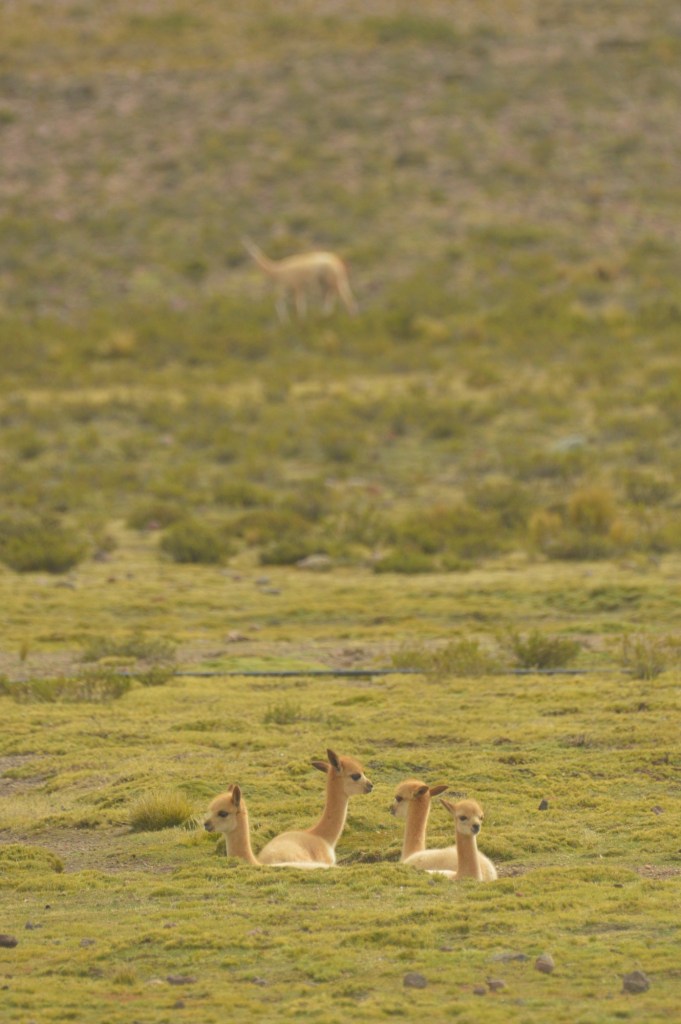
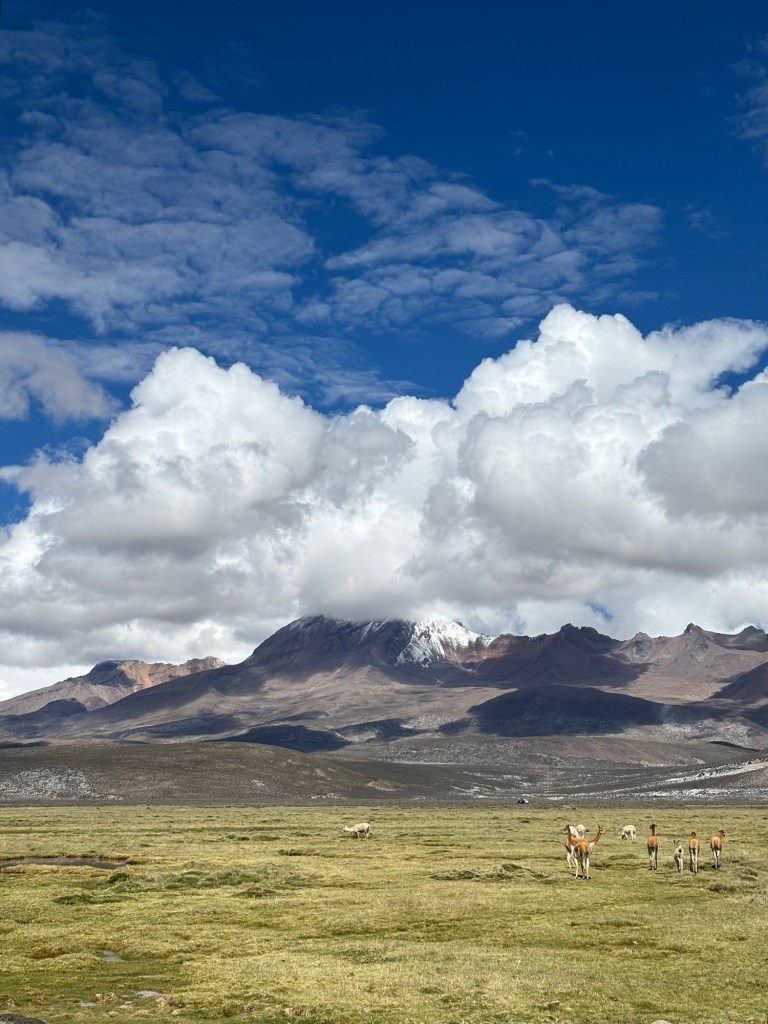
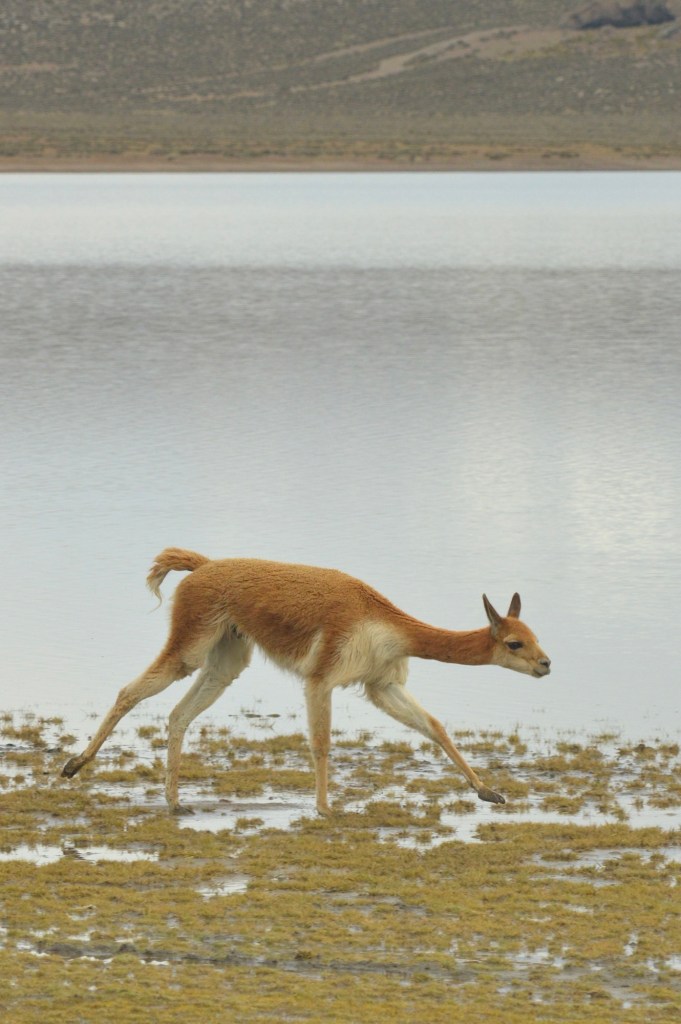
There was a fair bit of activity around the edge of the lake – mostly free-roaming llamas and alpacas, but a couple of small herds of vicuña, too.
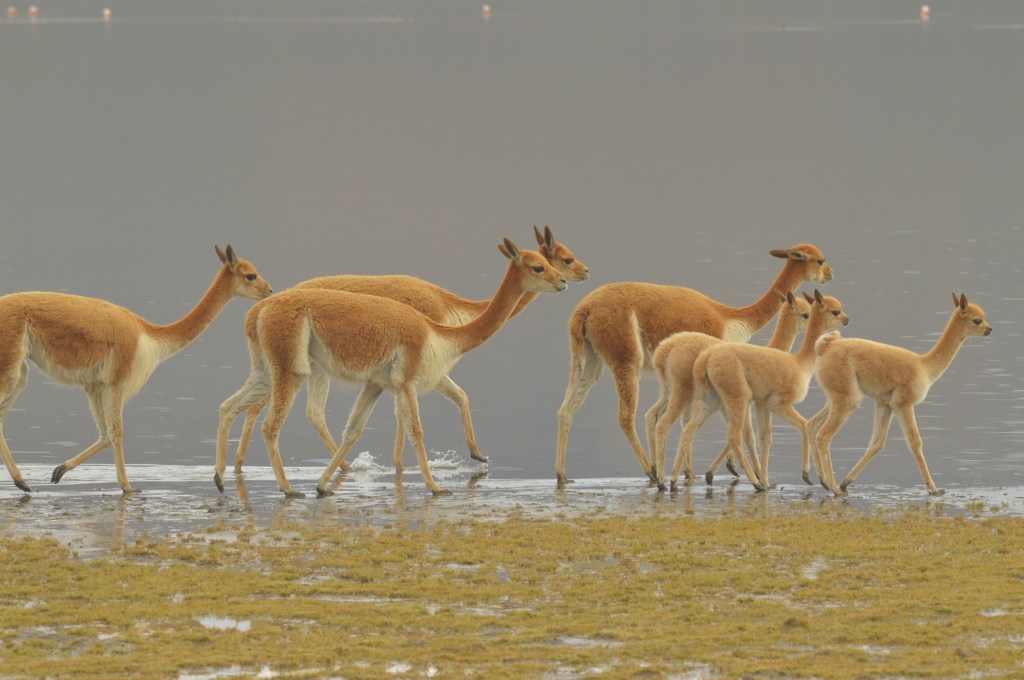

We stopped by the lake’s edge for a closer look. The herd’s dominant male wasn’t particularly chuffed, but he had his hands (or hooves?) full keeping one of the younger males in line with much running around and snorting.

Before going out to explore the area, our driver took us to the tiny lakeside community of Chilitia for a light breakfast. As an apology for the cramped conditions of the journey, breakfast was on the house for the three of us on the back row. Granted, we’re talking a grand total of 15 soles, but the gesture was very much appreciated – my legs were still pretty sore!

As always, the stop was also an incentive to buy local alpaca products. It’s getting to the stage where I’m considering breaking a lifelong aversion to souvenir shopping, but I’m still very conscious that I have to carry everything I have on my back – and it’s already a tighter squeeze than the back seat of that Land Cruiser once my lens is packed away.

So I just contented myself with watching the llamas and enjoying the palliative effects of a coca tea.
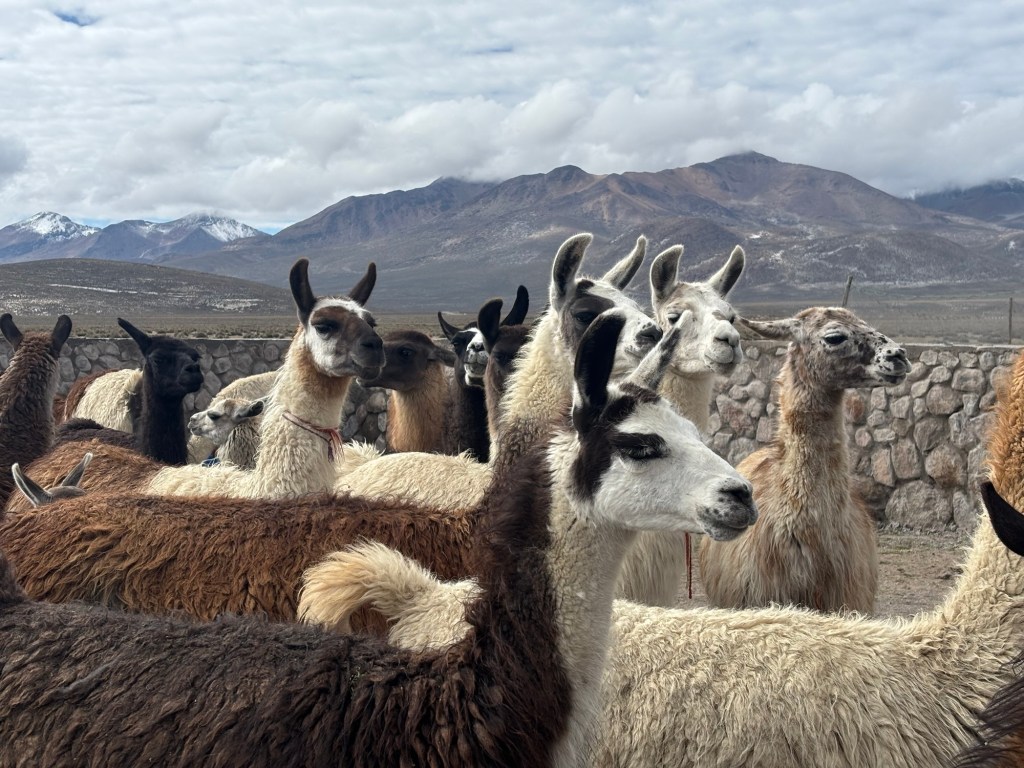

The most amazing thing about today’s adventure was the unrestricted freedom of it. Once we’d reached the water’s edge, we were given an hour and fifteen to go wherever we wanted – even out onto the flats, if we so desired.

Music to my ears! I’d already clocked a number of things I didn’t recognise, so I was anxious to get to work.
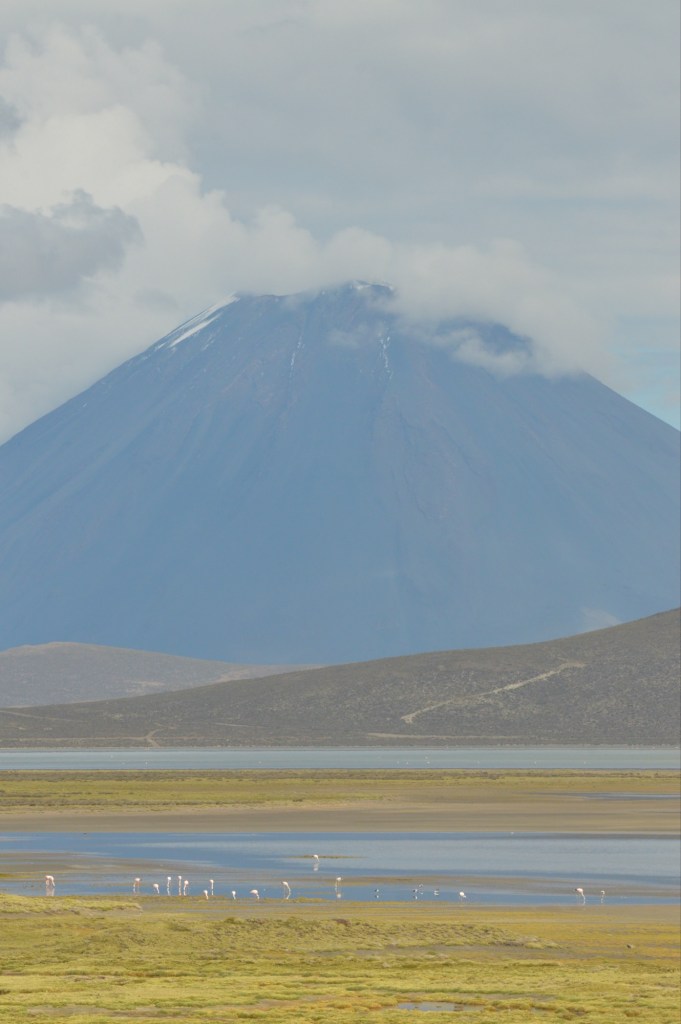

One of the big draws of the Salinas – at least for a naturalist like me – is that all three of South America’s flamingoes can be found here. The red-kneed Chilean flamingoes stayed far out in the centre of the lake, but a few flamboyances (yes, that is the collective noun) of Andean and James’ flamingoes were a little closer to the shore, so I tried to see if I could differentiate them by sight.
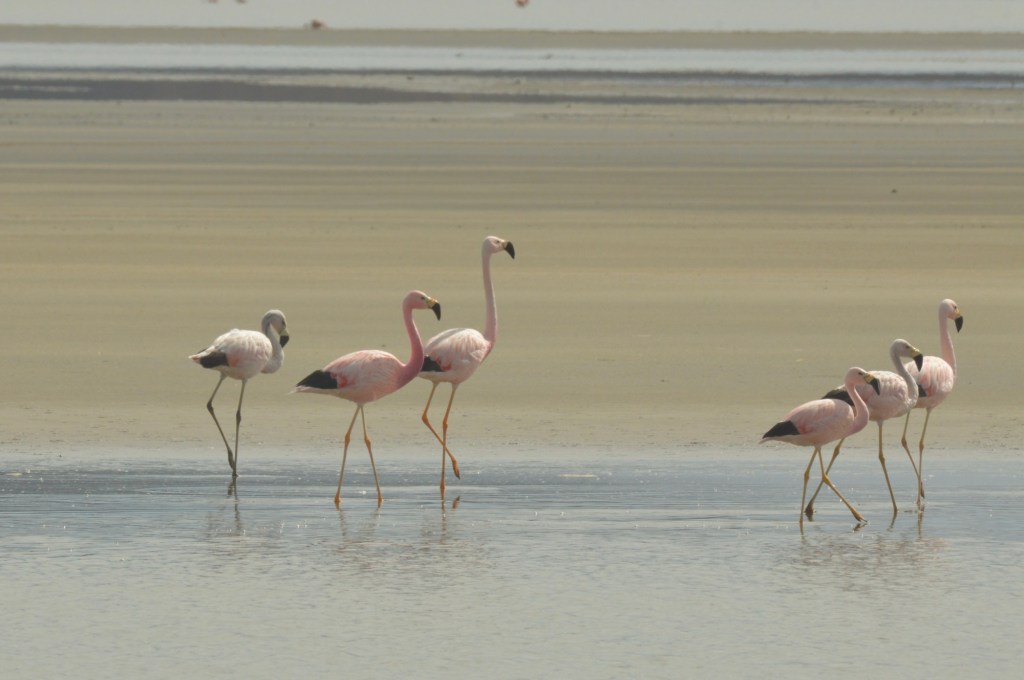

It’s mainly a question of checking their legs. Chilean flamingoes have black legs with distinct red knees. Andean flamingoes have yellow legs, and James’ flamingoes have red legs. If your eyesight is sharp enough, you’ll also notice that James’ flamingoes have red lores – that is, the patch of skin between the eye and the beak. Simplicity itself!
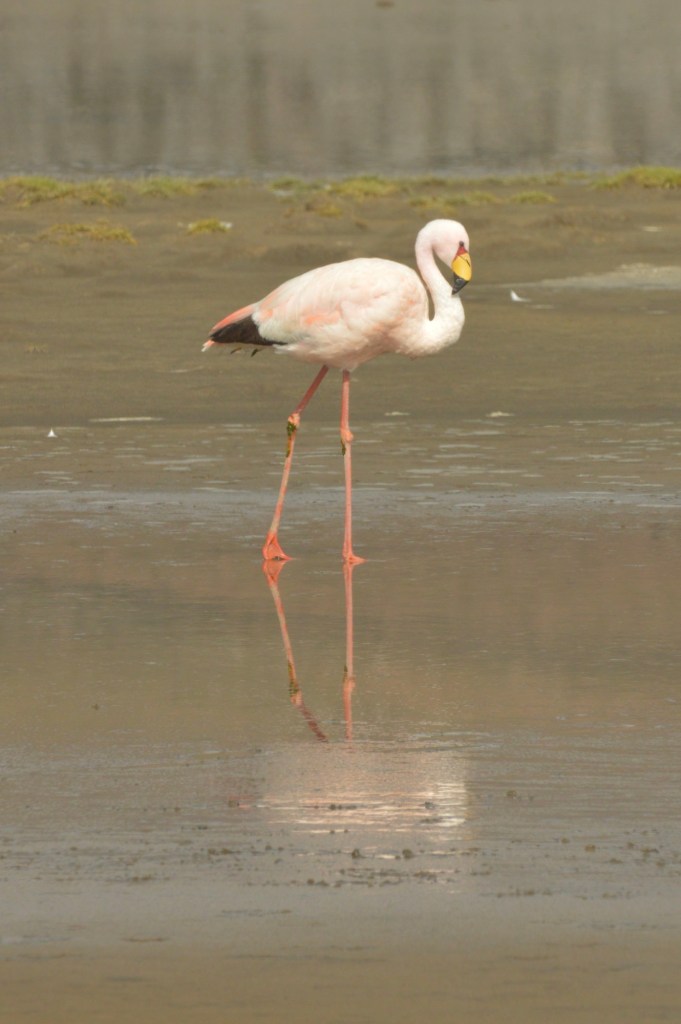

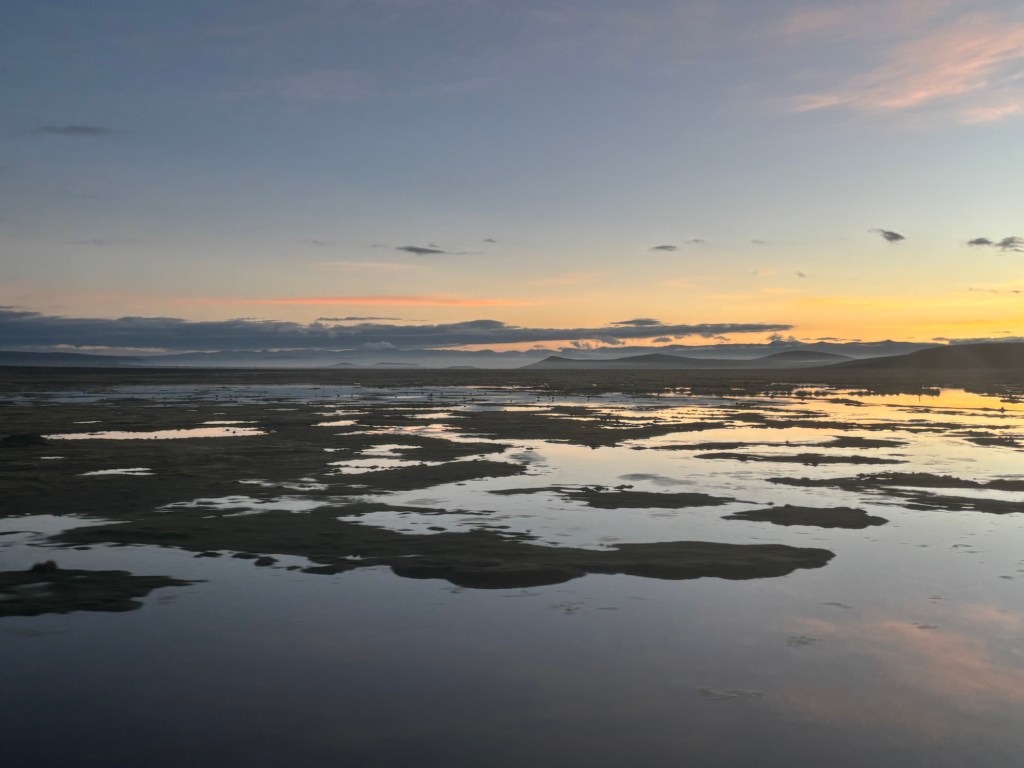
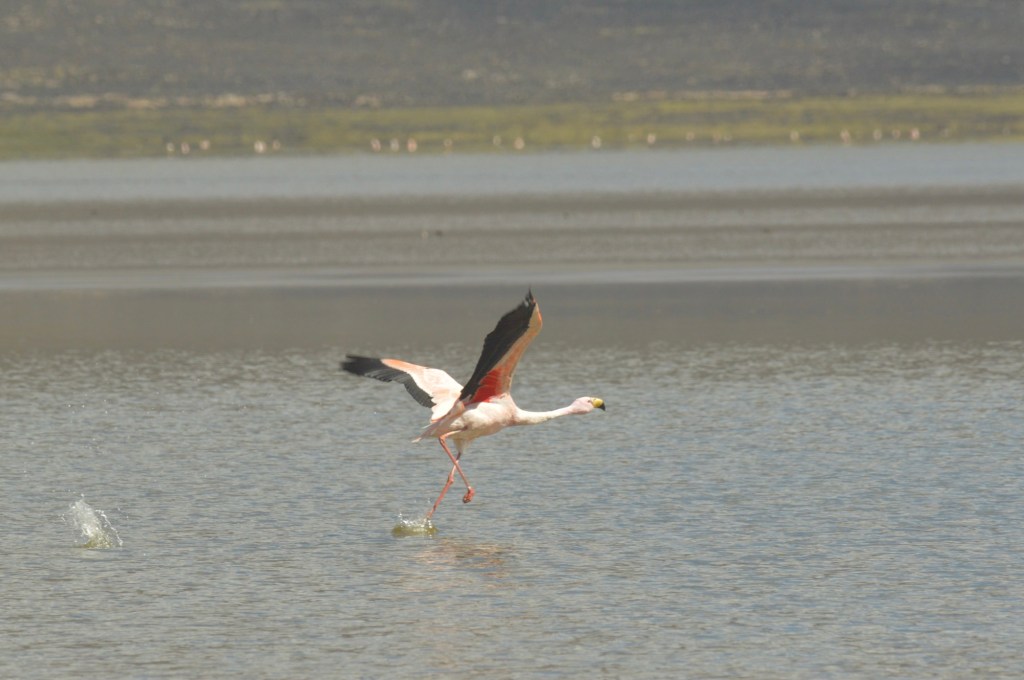
In the winter months, these lakes dry out and turn bone white under the unforgiving Andean sun, but now it’s the shoulder season, and there’s still enough water to keep the flamingoes around. Once it’s gone, they’ll leave these mountains and make for more permanent wetlands along the coast, like the Pántanos de Villa in Lima.

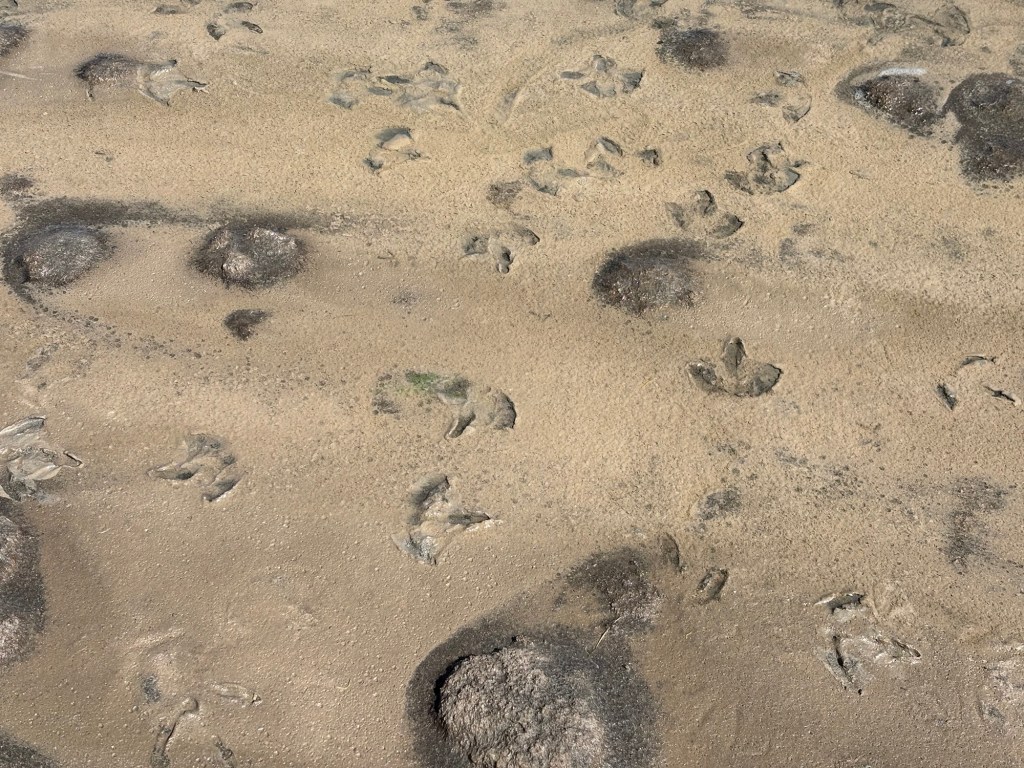
I’m still a kid at heart, so I scoured the lakeside for flamingo feathers. I found three bright pink ones, but they were kind of wet (as you might expect) so I cleaned them up using a couple of napkins I’d brought along and pocketed them. When they’re properly dry, I’ll put them in my journal with the others I’ve picked up along the way.

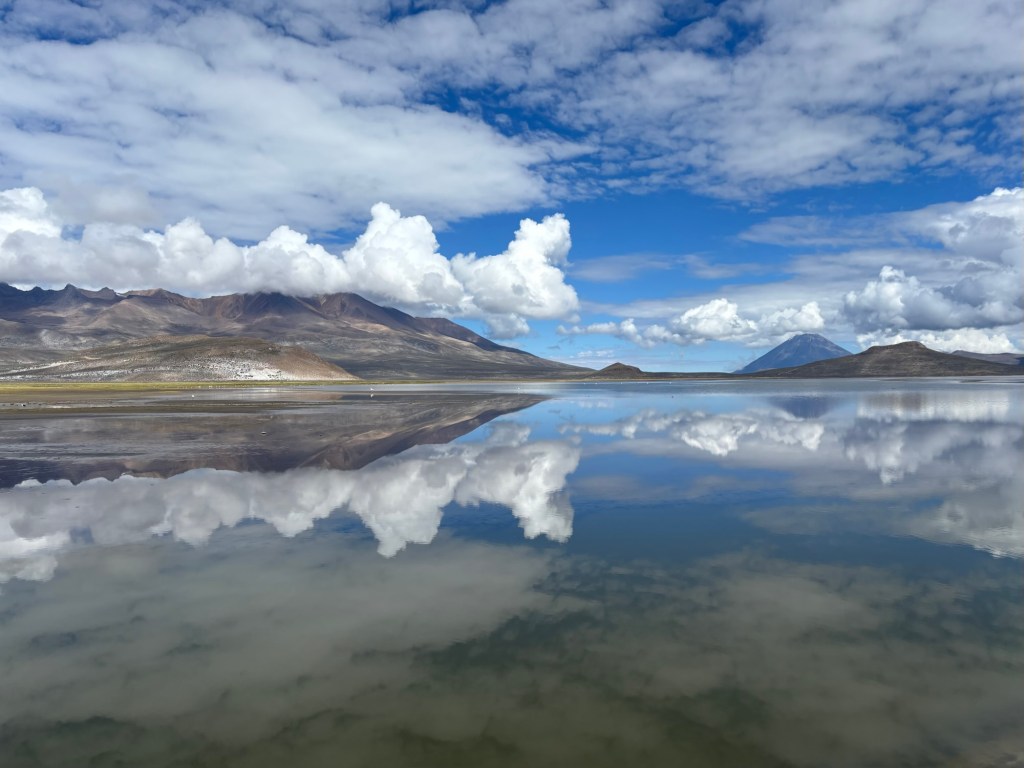
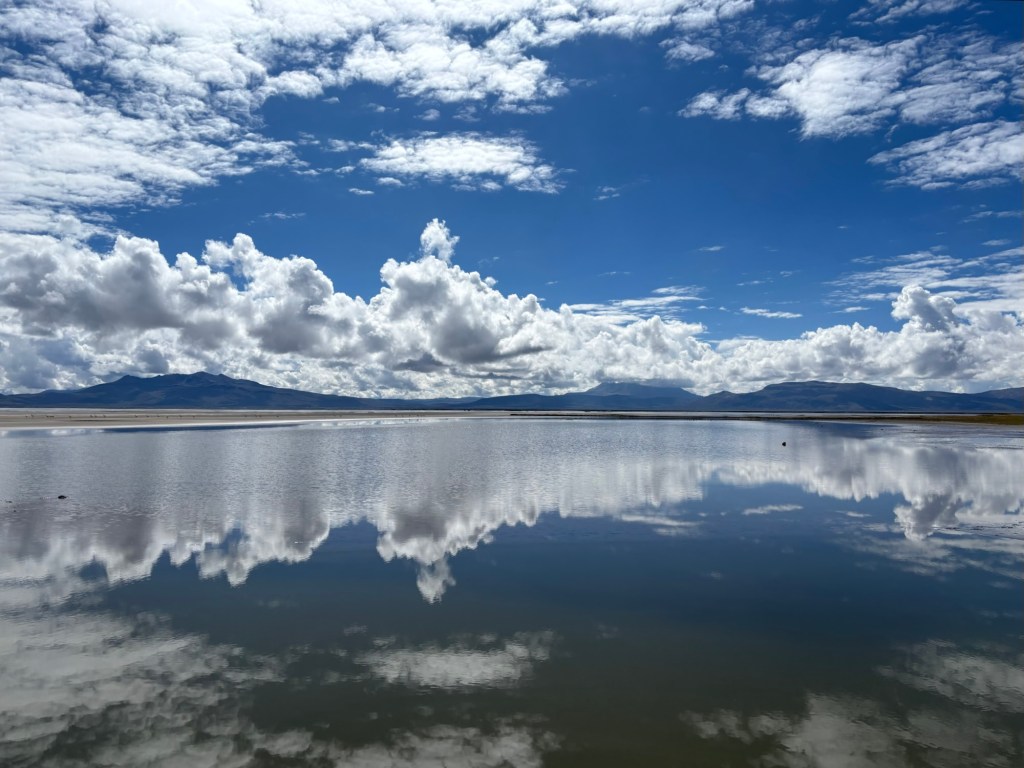
While there’s water, the salt lakes form an altogether different kind of miracle: an enormous natural mirror, broken only by the tiny ripples around the feet of the flamingoes. It’s places like this that make you especially grateful for clouds, because under a clear sky, half the magic of these magic mirrors would be lost.

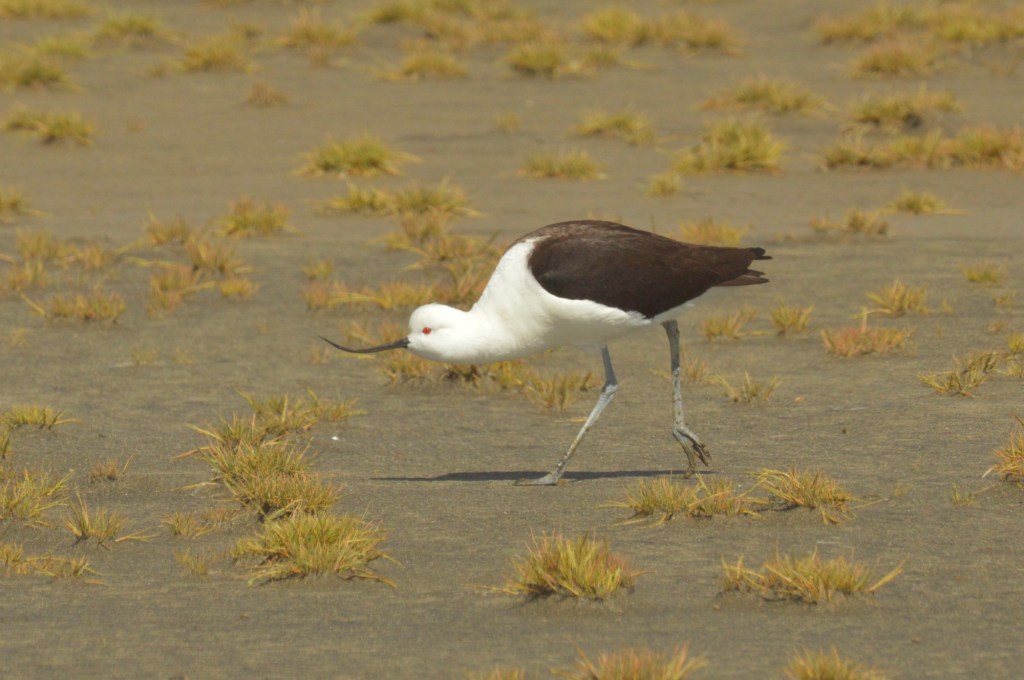
Flamingoes aren’t the only knock-kneed stars of the altiplano. A familiar and yet unfamiliar call alerted me to a couple of Andean avocets, who sounded like the ones we have back home, only… accented. As though they’re speaking a different language. Which, I suppose, they are!

This one spent a long time chasing sandpipers. I’m not sure what threat it thought the tiny little waders posed, but it wasted no time in putting all the sandpipers in the immediate area to flight.

I spent about half an hour exploring the lakeside before turning inland in search of highland species. I found quite a handful, all of which I had to look up later: cream-winged ciclodes, Andean negritos, Cordilleran canasteros and crested ducks, to name just a few.

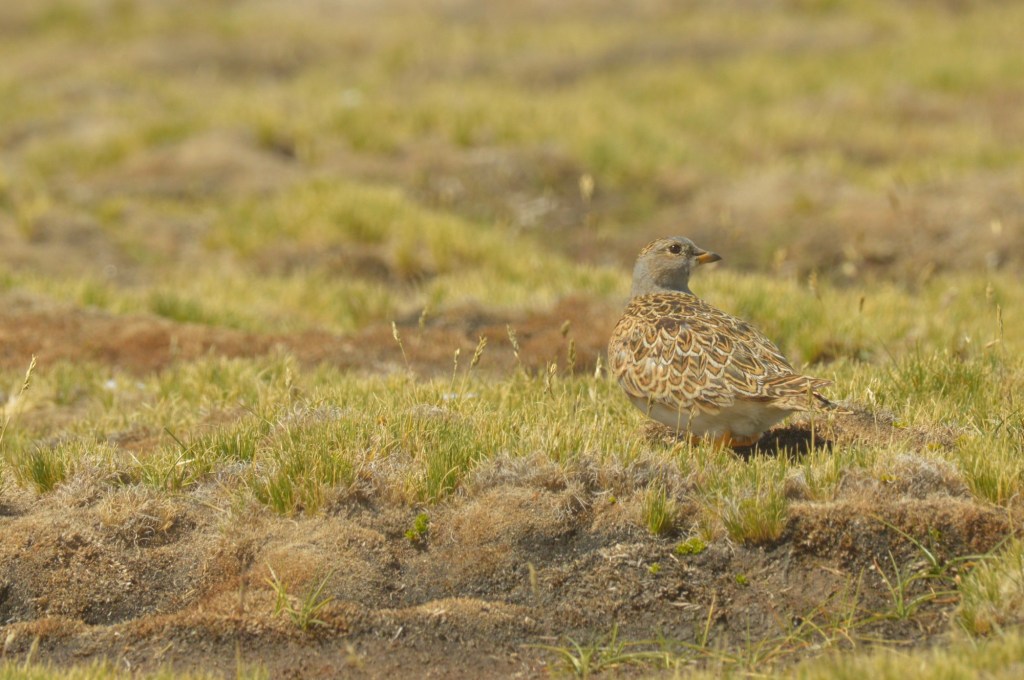
But the star find was a pair of adorable seedsnipes – a tiny wader distantly related to the plovers, but looking for all the world like a finch-sized partridge.

If it hadn’t been for the driver whistling me back to the car (fifteen minutes early, mind!), I’d have stuck around to see if I could find some more of them.

But alas! My traveling companions were bored and had seen all they had to see, taken the selfies they wanted to take, and were ready to go home. So I was summoned back to the car and we set off on the return journey to Arequipa.

Mercifully, I fell asleep for the first hour of the journey – probably on account of the sun! – but the last hour was even more cramped than the journey up had been, with both of my neighbouring passengers spread out in slumber. Once we were back in Arequipa, it took the best part of an hour before my legs had recovered completely.

That’s enough cramped conditions for one day. I’ve found my seat on the flight for Cusco and it’s wonderfully comfy (LatAm, you are a dream come true).

It’s time to go up again. The Inca stronghold of Cusco awaits! See you on the other side. BB x
Good Friday

Hotel Riviera Colonial, Arequipa. 19.00

Some days I am extremely grateful for being an optimist. Today was definitely one of those days.


I was up at 2.30am – by far the earliest start of the whole trip – to catch the tour bus to Colca from outside my hotel (or rather, the hotel I originally booked, as they made a mistake with their booking and put me in a sister establishment seven minutes down the road). Unlike the social media savvy PeruHop, I didn’t have an awful lot to go on as to precisely which bus I was meant to be looking out for… just a vague indication that I would be picked up from my alojamiento between 2.50 and 3.20am. I got there for 2.51 at a very brisk walk, passing a couple of buses along the way, and as the time went by and no bus appeared, I began to wonder whether I had missed it. It would be a first for South America – an extremely prompt bus – but your mind plays those sorts of tricks on you when you’re tired and traveling solo far from home.

Just as the numbers on my phone’s screen switched to 3.20am, a man jumped out of a small people carrier at the end of the road and asked if I was Benjamin. I was evidently their last pick-up, because as soon as I was on board we set out on the three-hour journey to Chivay, the gateway to Colca Canyon.

Unlike my companions – Peruvian to the last man – I’m not sure I managed any sleep. The windows were so heavily fogged up with their breath that my continued attempts to clear a viewing panel never lasted any longer than a few seconds. Even so, between the twilight and the condensation, I spotted my first herds of camelids out on the altiplano. Vicuñas, I suppose – I don’t think you get guanacos this far north.


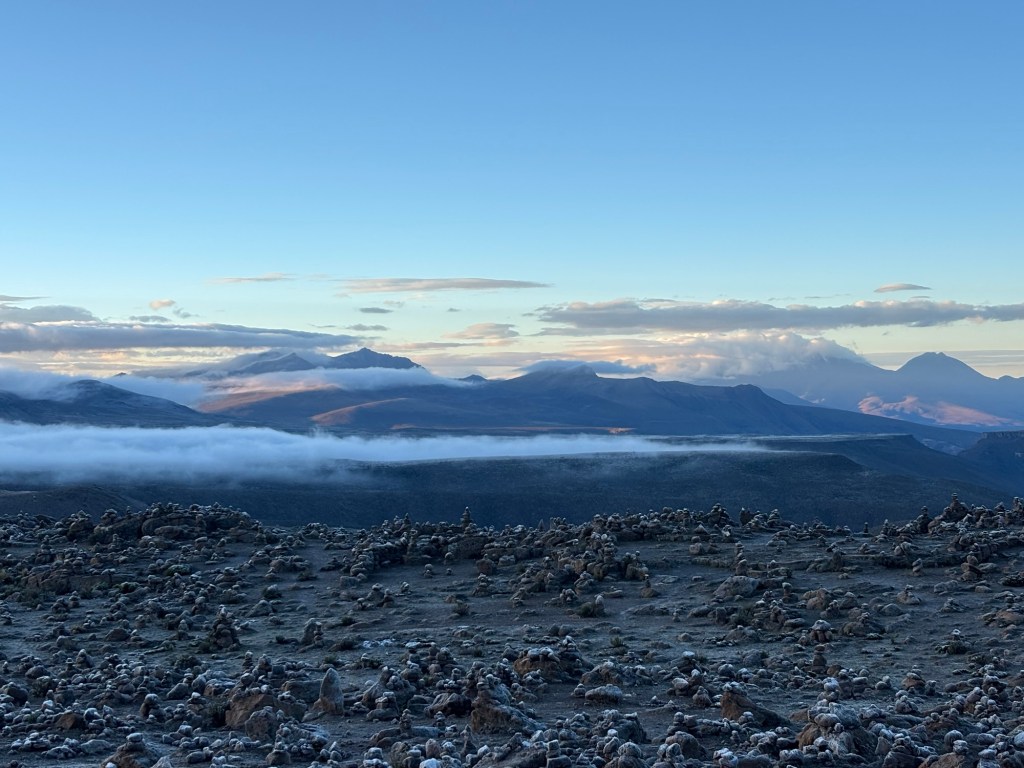
Today’s journey took me up into the Andes for the first time. We stopped at a mirador some 4.910 metres above sea level, which is easily the highest I’ve ever climbed in my life – and this isn’t even the Andes proper. The ground was covered in a thin layer of frost, turning the many hundreds of stone cairns all around into petrified snowmen. A few hardy native women wrapped up from head to toe in colourful scarves were bravely plying their wares to each and every bus that stopped by – which, this being Good Friday and thus a national holiday, was no small number.


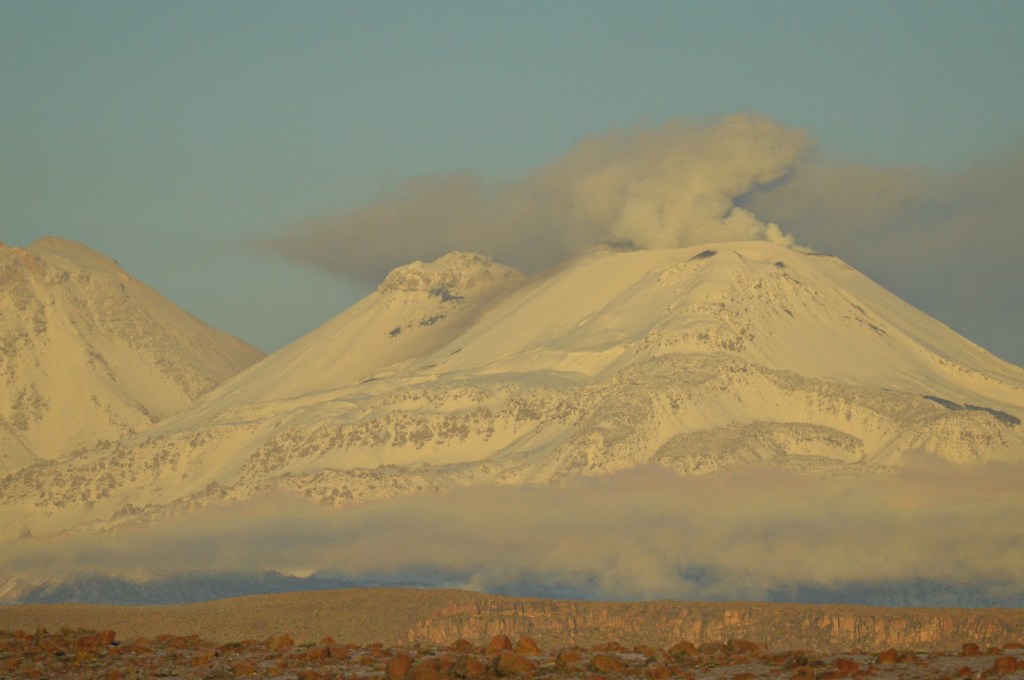
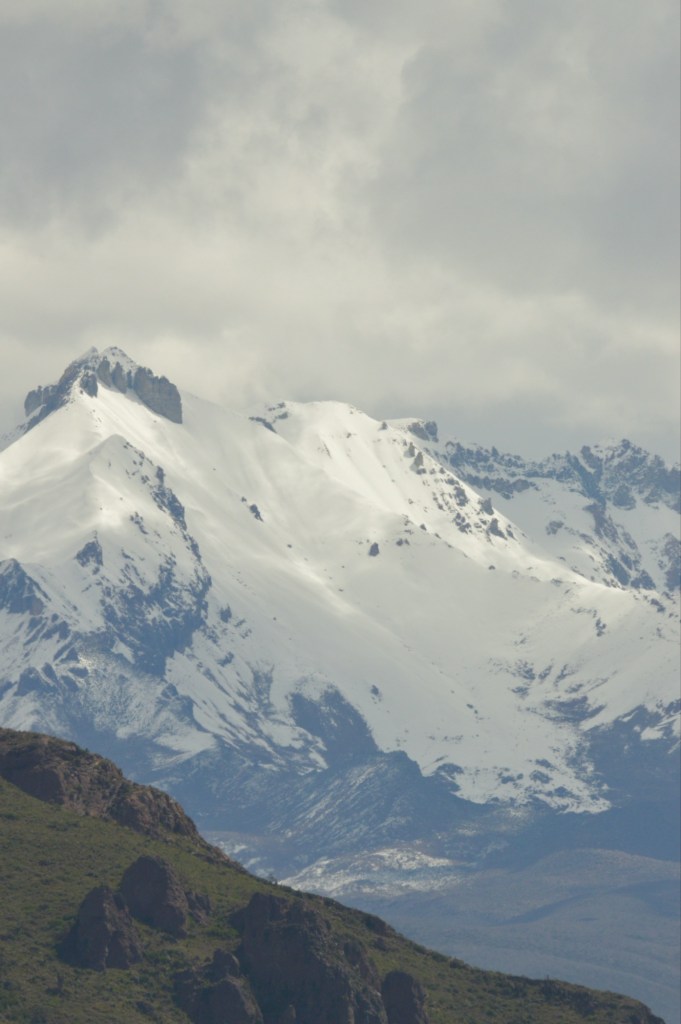
The snow-capped peaks of the Andes were all around us now. Away to the west, one of them was producing its own clouds, billowing slowly from its summit: Sabancaya, the Tongue of Fire, a volcano that erupted into life in 2015. I’ve heard an active volcano before, way back when I was looking for mountain gorillas on the Congolese border, I’ve experienced their terrifying tremors and I’ve even seen the sky glow red from their magma, but I’ve never actually laid eyes on one.


From the frozen heights of the Mirador, we climbed slowly back down into the valley below to the town of Chivay, where we stopped for a light breakfast of boiled eggs, flatbread and a watery but absolutely delicious kind of porridge. While the others dosed up on coffee, I made sure to sift through the teabags and find the one containing mate de coca. I had a feeling I was going to need it. I even took a couple extra for the road.

From Chivay, we made straight for the canyon. The sun was just about at that optimal point in the sky for thermals, and everybody knew it. Our daring driver tried to overtake a particularly stubborn tour bus on at least four occasions, but their driver was having none of it.

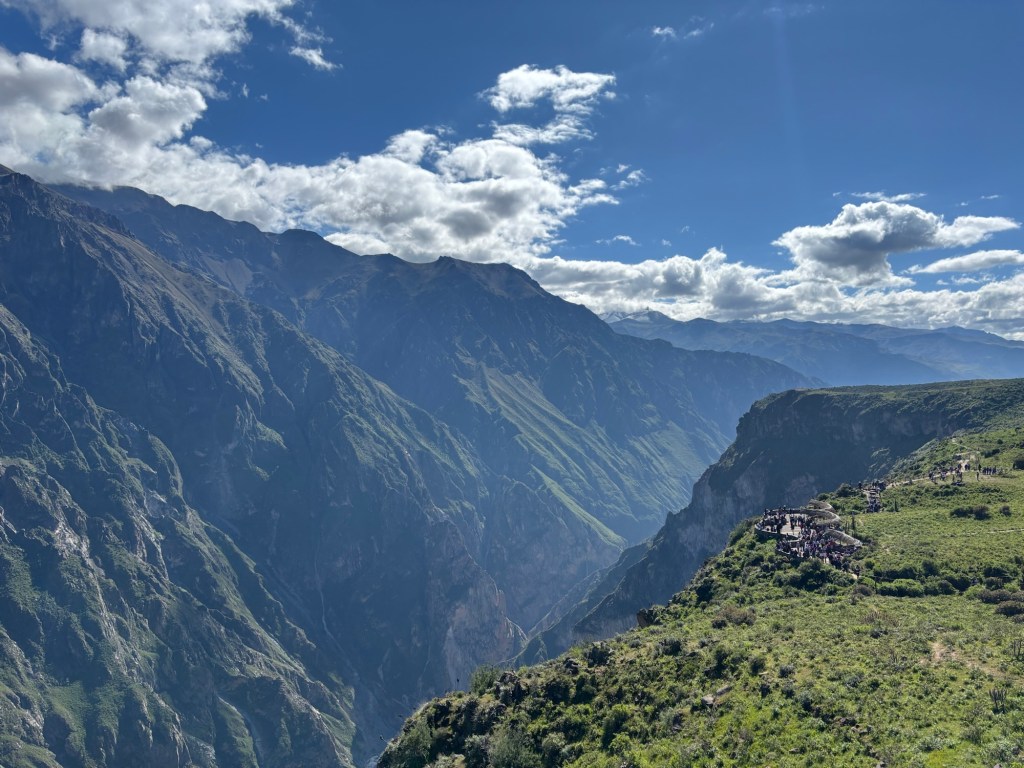
Fortunately, despite the potentially alarming number of graves and shrines at the side of the road, the bus cut a safe path through the canyon, treating us to spectacular views along the way.


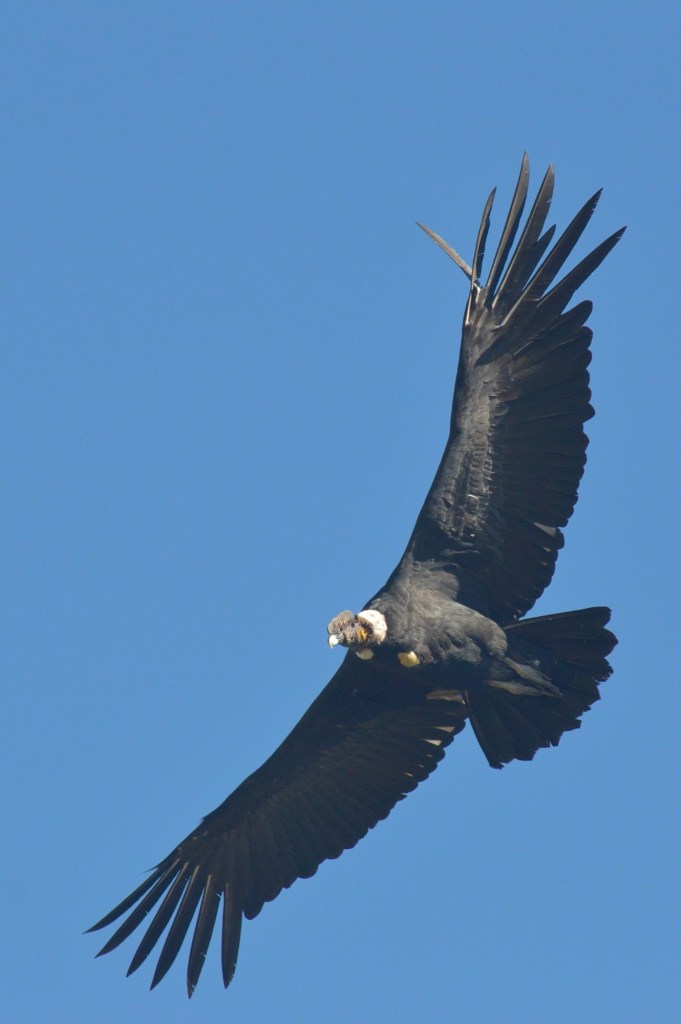
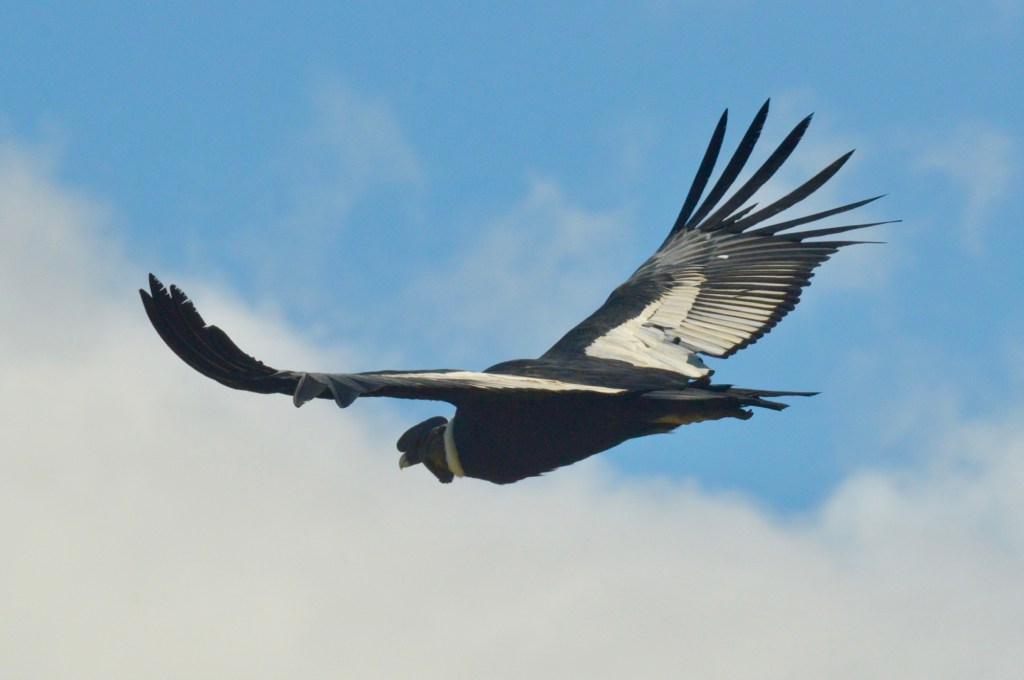
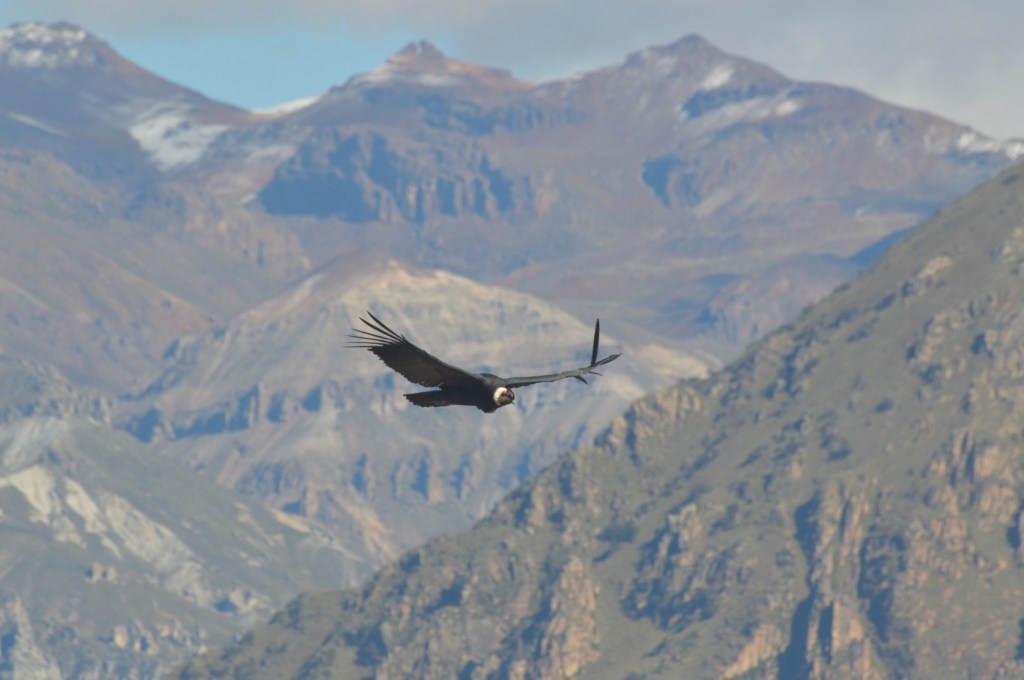
We reached the Cruz del Condor at around 8.45 – along with the rest of Peru, by the looks of things. And we couldn’t have timed it better! I had barely managed to get the camera strap around my neck when our guide pointed out a huge shadow cresting the ridge, right over the heads of the gathering crowd: a juvenile Andean condor. I didn’t need the lens to work that one out, since only the adults have the telltale white scarf.

I had to make a choice: climb up to the melee of the Cruz del Cóndor itself, or try my luck at the quieter vantage point further along the ravine.

I went for the former – which, in the circumstances, was absolutely the right thing to do.


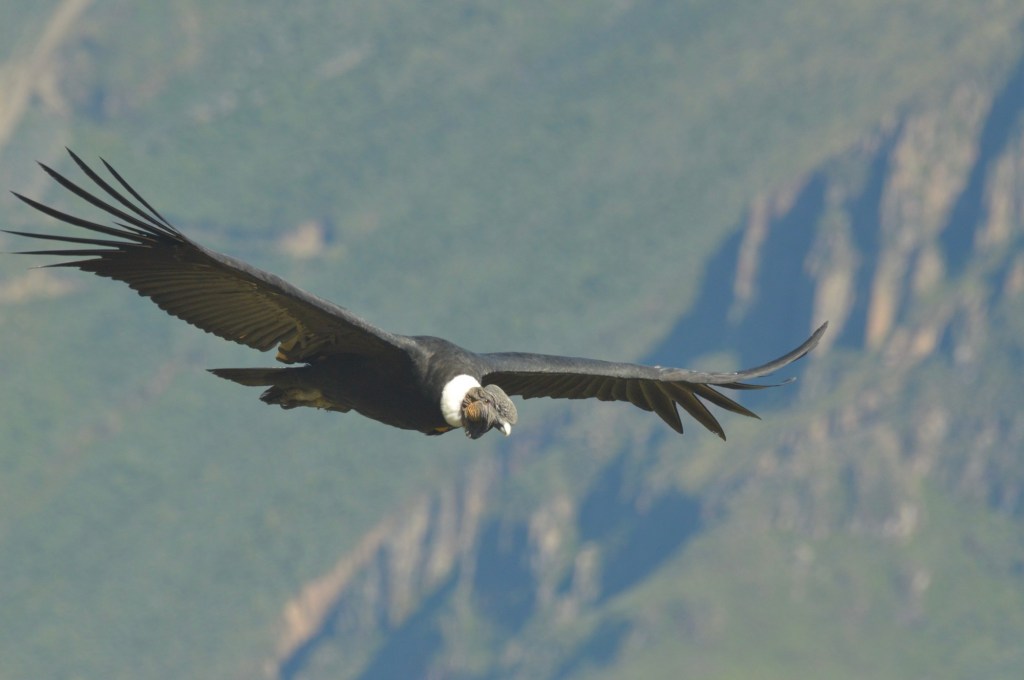
I found a space for myself near the top, where a young couple had lately been taking selfies. I didn’t have to wait long. Another enormous shape – this time a fully-grown adult – came soaring up the canyon toward us.


I knew the odds at Colca were good, but I had no idea the views would be quite this good. As my guide put it, I “came prepared with the big gun”, but I might just as well have brought the 300mm, since they came so close. I might even have got the whole bird in the frame, especially when one of them flew straight overhead at so low an altitude that I could hear the whoosh of the wind in its massive wings.


I’ll be honest with you – and with myself. This is why I’m here. It was condors or bust. The Amazon tour awaits – though that feels like a very distinct holiday – and the things that I have seen so far have been incredible, but it has all been a crescendo up to this moment. I am, unashamedly, a vulture fanatic, and there probably isn’t a greater quest out there for a vulture fiend like me than tracking down the largest vulture on the planet.


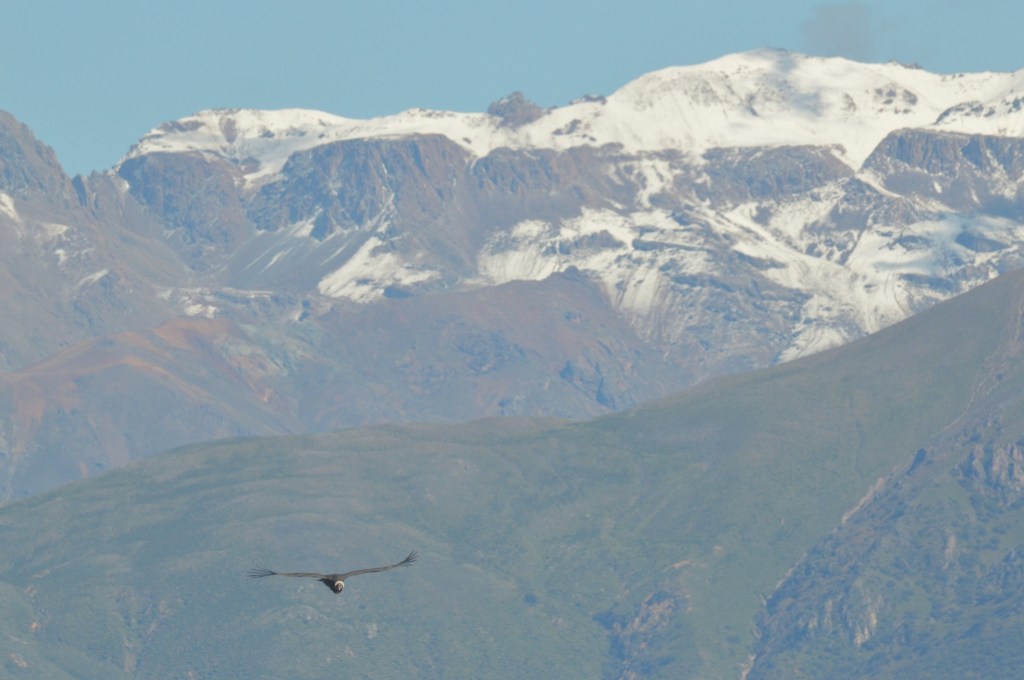
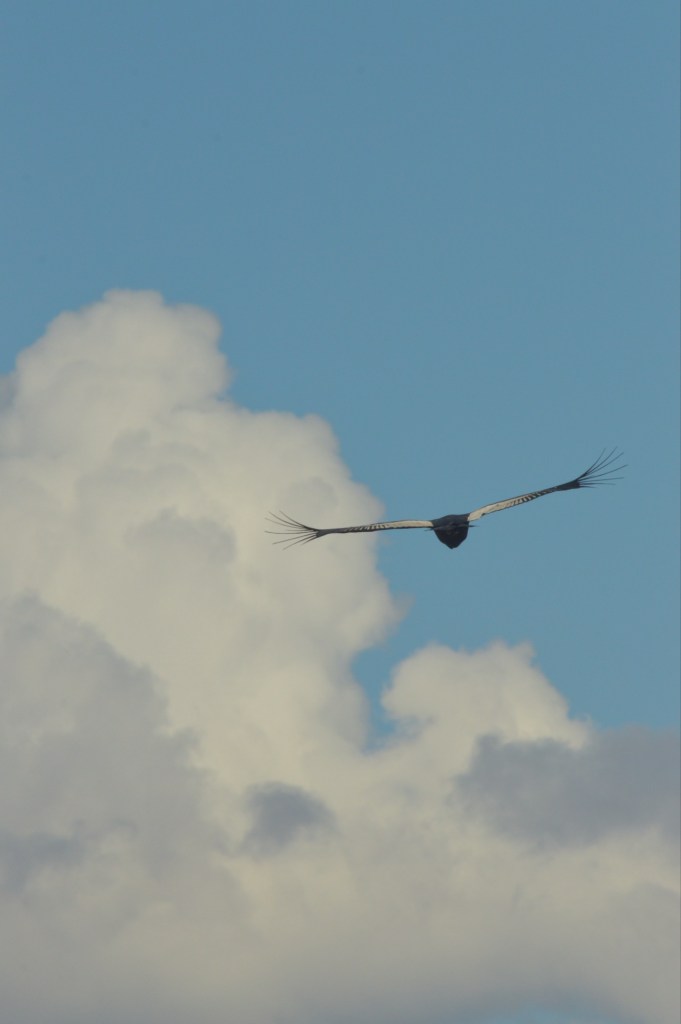
Genuinely, I’d have settled for a distant sighting against the backdrop of the mighty Andes, like the one below, but somebody up there is being extremely generous.

My only regret is remembering the continuous shoot mode on my camera after I had got back onto the bus. Then again, with 1,400 photos already on my memory card out of a possible 4,000 and six days in the Amazon still to go – other adventures notwithstanding – perhaps I could afford to be conservative!


There are plenty of other high montane species to be found around the Colca Canyon, including giant hummingbirds and hillstars, but I was quite happy to give all of my time to the condors – especially as we only had forty minutes. It’s moments like these that remind me (with no small amount of relief) that I am a naturalist and not a twitcher.

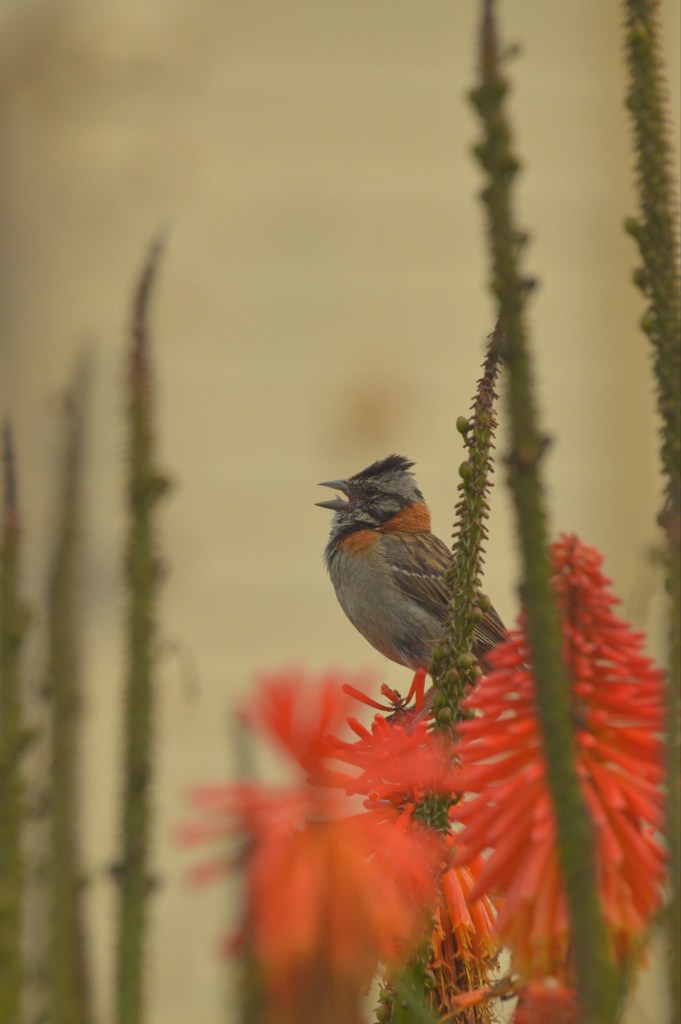
That said, I did finally manage to catch up with Peru’s answer to the house sparrow, the handsome rufous-crowned sparrow, as there were a few of them scampering about the car park.


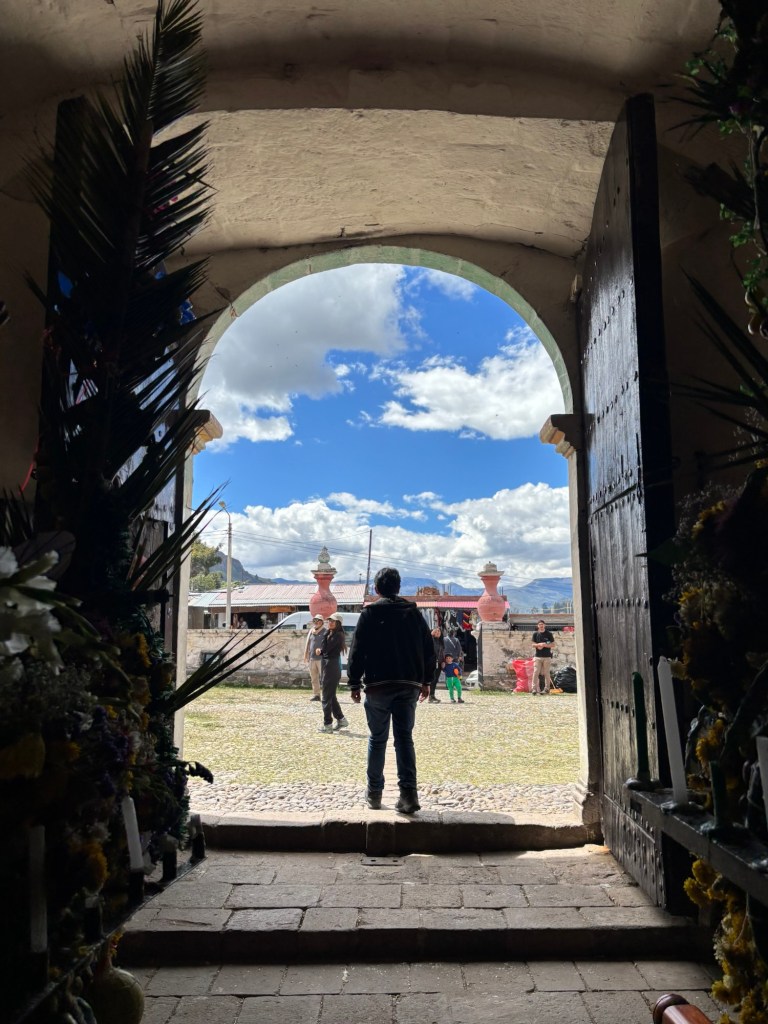
Leaving Colca and its condors behind, we returned the way we had come, stopping in the mountain hold of Maca for a bit of souvenir shopping. I’m useless at buying souvenirs, so I used the time to explore the town and its church. Earthquakes are common in this part of Peru, and Maca’s church – like every other church in the canyon – was held up both outside and in by a scaffold of supportive struts. Many of these churches date back to the time of the reducciones, when the Spanish forced the indigenous Quechua people out of the mountains and into the towns and villages, where they could be counted, controlled and – most importantly – taxed.


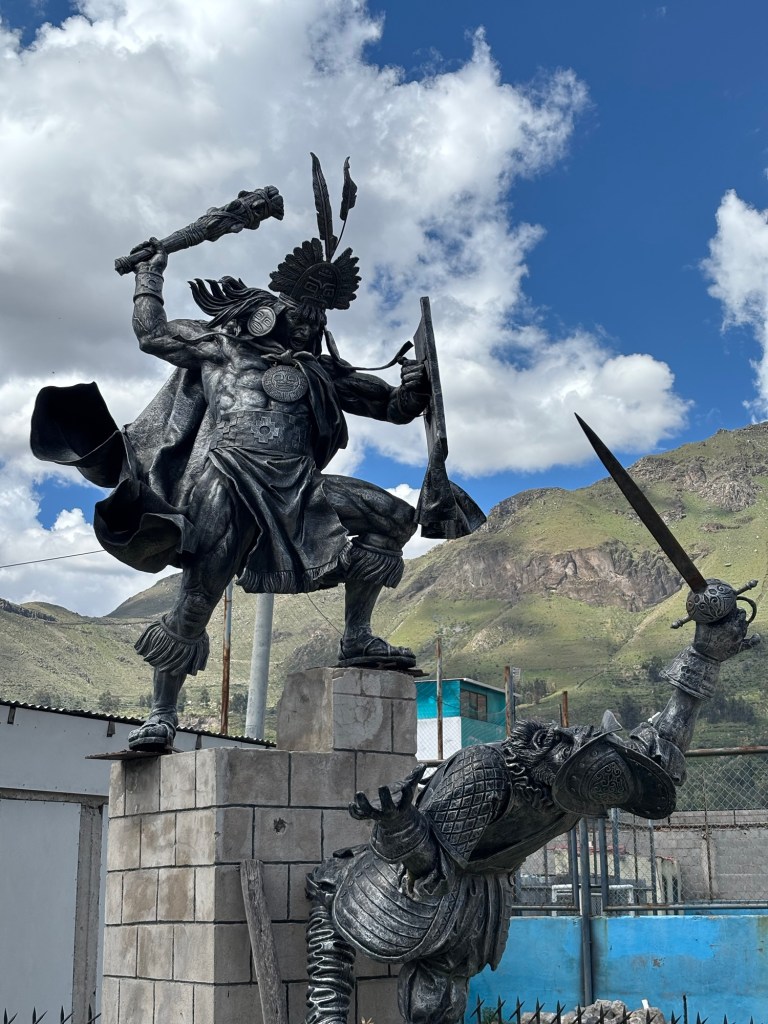
There are a number of statues and sculptures in town, but the one that really caught my eye was one I’d spotted on the way out, featuring an Inca warrior fighting off a conquistador. Apart from the churches, this is actually the first obvious reference to the Spanish invasion I’ve been able to find. I was expecting more. Perhaps they will become more obvious in Cusco.


The next stop on the tour took us to a river valley near Chivay famous for its hot springs. Most of the others went for a dip in the baths, along with hundreds of other Peruvians enjoying their Good Friday holiday. Following a tip-off from a blog I’d read recently, I set off in the opposite direction and climbed up into the hills, where it was significantly quieter. From there, you can see all the way up to a range of snowbound peaks where, if my guide is correct, the Amazon river is born.


I had another run-in with the tiny, sparrow-sized ground-doves that seem to be the only animal in Peru with a healthy fear of man – I hadn’t been able to catch a photo of one for love nor money! I also disturbed a tinamou, a Peruvian gamebird more closely related to the ratites (rheas, emus etc) than to the partridges and pheasants which they resemble. It too was much too quick for me, disappearing into the scrub below before I could distinguish anything more than a jagged crest. I’ll have to check later when I have signal, as there’s been precious little up here in the mountains.


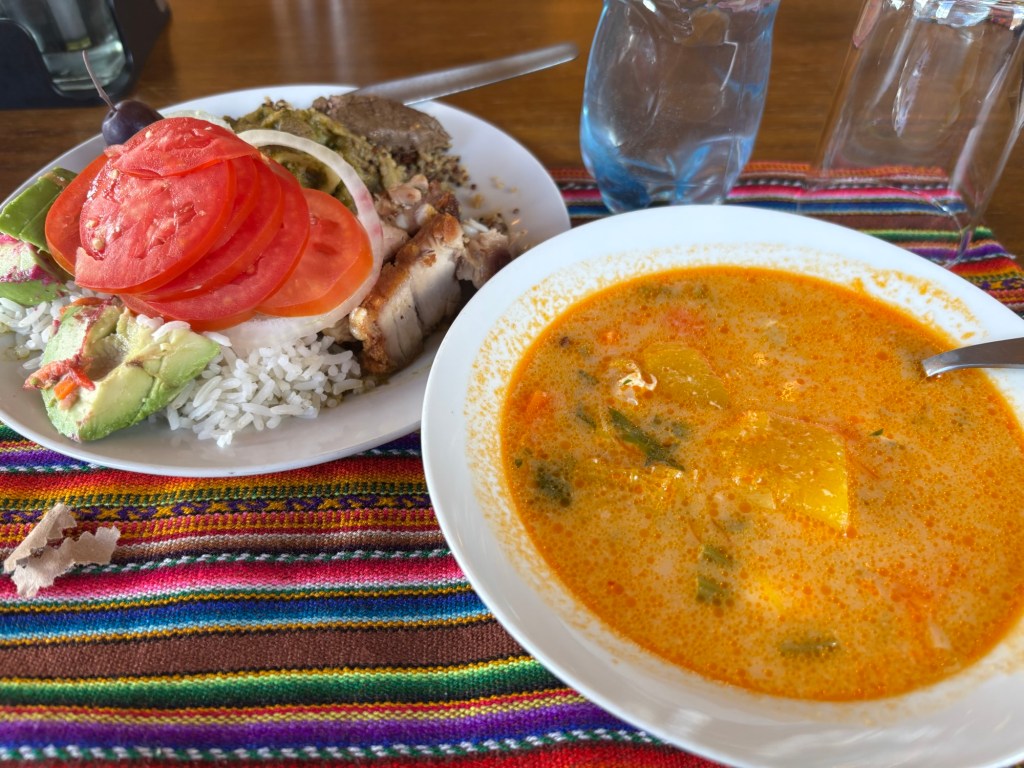
Lunch was a spectacular buffet with a wide array of Peruvian options, including alpaca (tough and beefy), lamb (in a delicious green Andean sauce) and chicharrón, an old favourite. The trout soup I had for starters was one of the best I’ve ever had in my life, and tasted almost exactly the way I always imagined Yeto’s superb soup in Zelda: Twilight Princess (right down to the rich cheesy flavour).

Half of our group was suffering from the effects of mal de altura, especially the young family of four from Lima (with the possible exception of their eight-year-old daughter, who seemed utterly immune to its debilitating effects). I thanked my stars for my constitution, my luck or the coca tea I had earlier in the morning, because I didn’t seem to have been affected at all.


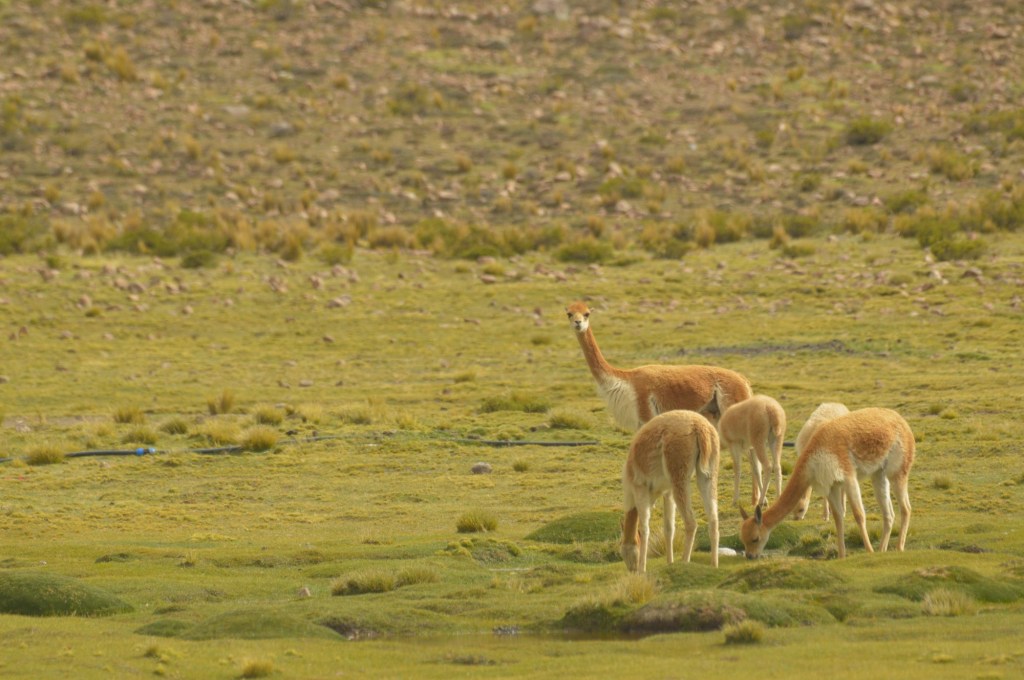
The return journey to Arequipa took us back across the altiplano which we had crossed in the darkness this morning. Once we were down and out of the high mountains, we reached a large stretch of Andean prairie, pockmarked with spongy pools. There was a small herd of alpacas grazing, but they weren’t alone. With the weather still holding out (and only just), I had the chance to see the vicuñas I’d only glimpsed this morning, grazing not too far from the road.


Alpaca wool is world-famous for its warmth and softness – and justifiably so – but vicuña wool is in a class all of its own. Like chamois leather, there must be something about a life lived high up in the mountains that makes their pelts unbelievably soft. I’m quite happy to see it on the body of the animal it belongs to, but I was concerned that this blog was becoming less informative and more “I went here and saw this”, so I thought a fact or two might even things out!


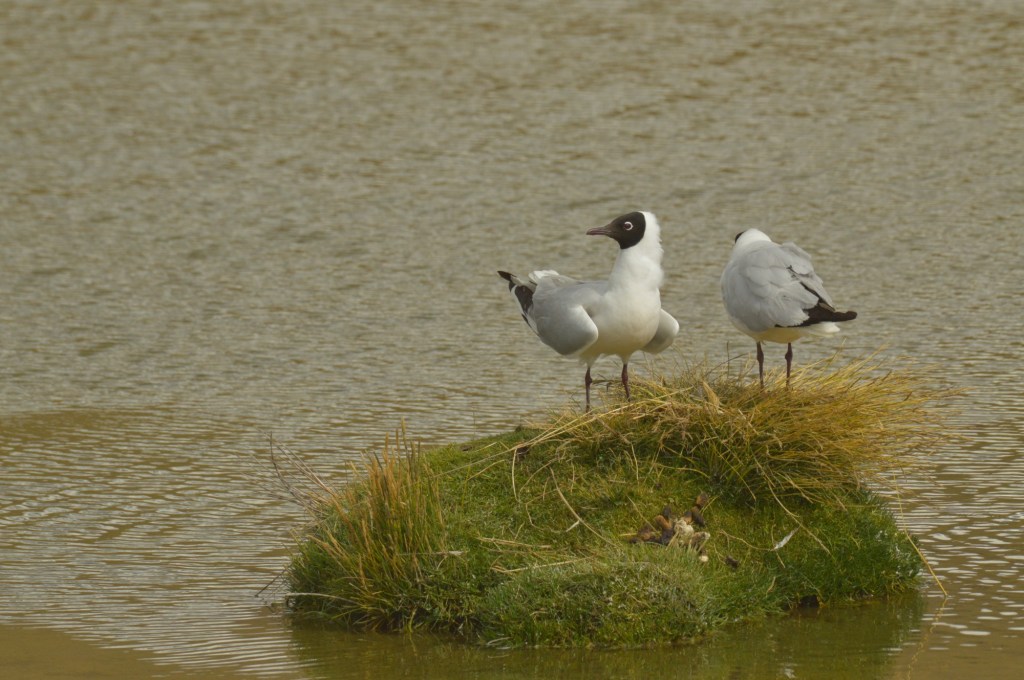
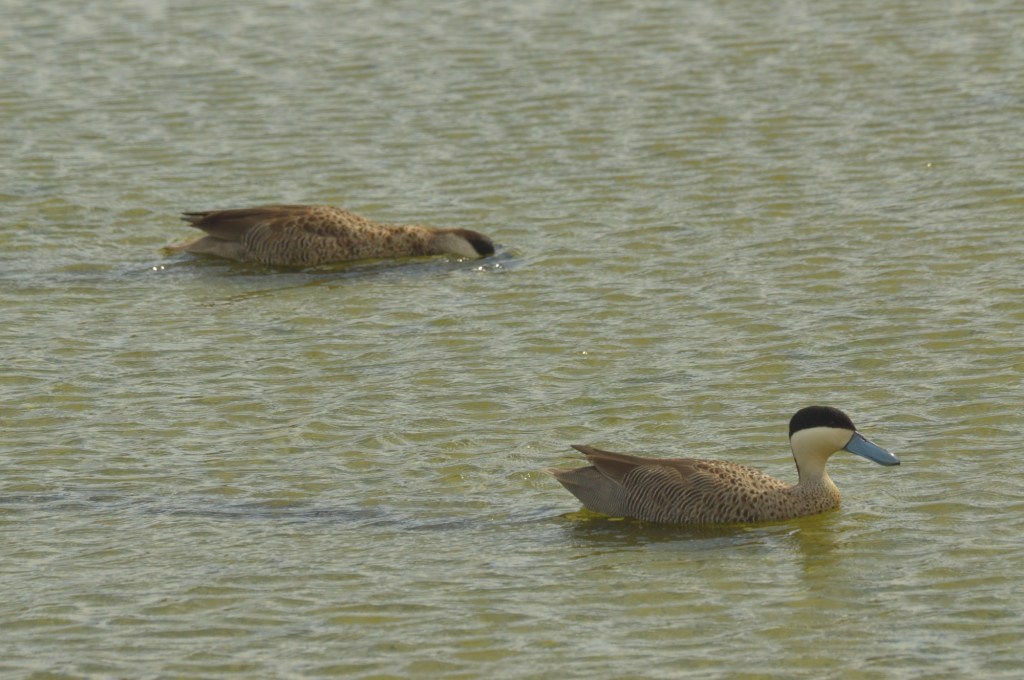
As well as the vicuñas, there were four other altiplano specialists in and around the pools: Andean geese, Andean gulls, a number of very handsome Puna teals and, further off, the swamphen-sized giant coots that can only be found high up in the mountains. It was only a five minute stop, and I’ll be back tomorrow to explore this part of the reserve, so I prioritised the gull and teals.


Teals of any variety are always well-dressed birds, as though the Creator gave them first choice of evening wear, but I thought these blue-billed mountain ducks were especially smart.


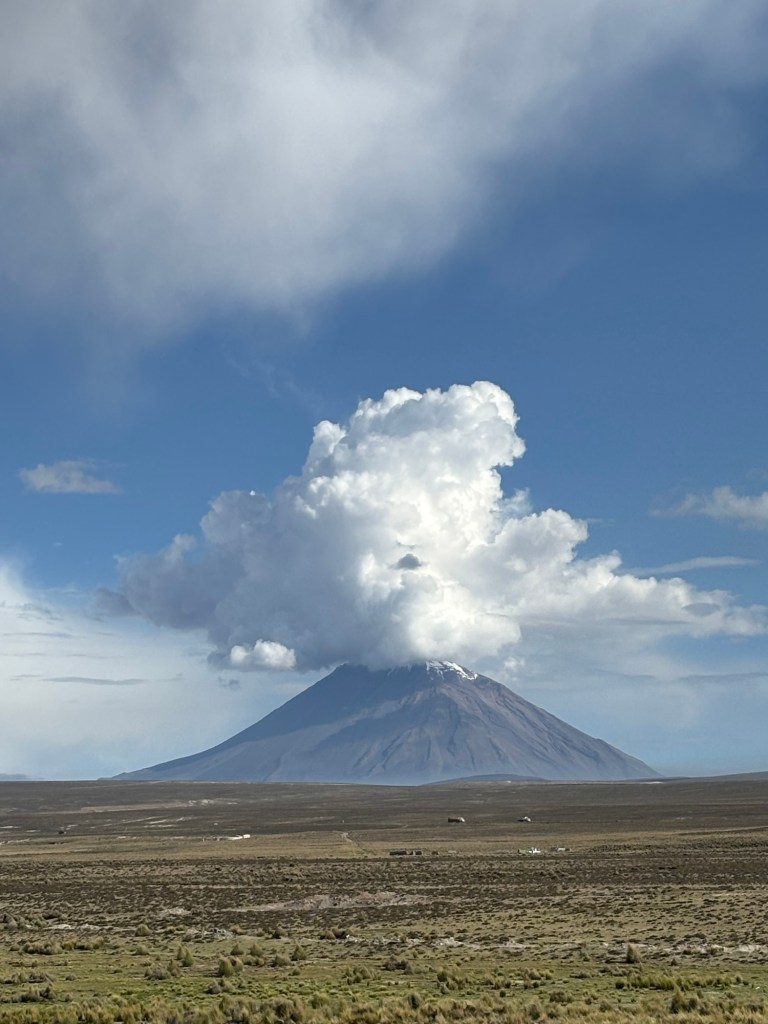
One last stop – a glorified toilet break, I suspect – set us down at the edge of the altiplano, with stunning views of the conical volcano that lords over Arequipa, known as El Misti. It was quite a sight as I touched down in Arequipa yesterday, but even more impressive without the sprawl of the city at its feet. The influence of El Misti is everywhere in Arequipa, also known as the White City, since most of the buildings are constructed out of the white volcanic ashlar stone that gave the city its title. It hasn’t had a major eruption since the time of the Inca Empire, more than five hundred years ago, but it remains an active volcano – and a potential threat to the city of Arequipa which lies at its feet.


Today started out potentially dicey and wound up being the best day of the adventure so far. I’ve had Good Fridays that were memorable, but this one really takes the biscuit. This was a very, very Good Friday. I’ll be sure to give the Lady of the Marshes the thanks she deserves tonight.

Once again, I am reminded that optimism is the right outlook, no matter how bad things get. It’s also categorically impossible to be worried or sad in a country as full of natural wonders as Peru.


This country has won me over. The Peruvians are so kind and seem to care a great deal more about the natural world than the average European. The salespeople understand boundaries. The food is incredible (I’m aware I’ve used the phrase “best ever” at least twice now). The mountains take my breath away, without leaving my head spinning (so far). The women are beautiful – and they give you the time of day. The plants are fascinating, the animals are incredible and the birds are nothing short of spectacular.

I’m often asked by my students which, of all the places I’ve been, is my favourite country. Spain has been uncontested for all my life, and it always will be. But at least now I have a definitive second place where there wasn’t before. Someday, God willing, I’ll be back. BB x

Going Up

Hotel Riviera Colonial, Arequipa. 19.14.

The time has come to leave Lima and the Pacific behind and make for the interior. I have enough sense not to go from 79m above sea level to 3.400m in one go, so I’m bound for Arequipa, the White City, which sits at a decent halfway house of 2.335m. That’s still a good thousand metres higher than Andorra la Vella, which is probably the closest I’ve ever come to sleeping at altitude, but it’ll have to do.

After spending ages writing up yesterday’s report, I sat back in the upstairs lounge area of Pariwana, finished off my (now rather crushed) Doritos and called an Uber. Whisked away by another speedy and efficient limeño, I said hasta la próxima to the city and its mighty Pacific shore – since I’ll be back, albeit briefly, at the end of my adventure.


Lima’s Jorge Chávez airport is a model of efficiency. Fine, so the USB charging ports don’t all work (I never did find one that was fully operational), but the security is slick and efficient and it has a lot of good places to eat offering real food, not just fast food junk (England, please learn from this). I’ve also been to shadier airports. Despite being in the heart of the run-down district of Callao – which is known for having a higher violent crime rate than the rest of the capital – I found it was perfectly safe to come and go.


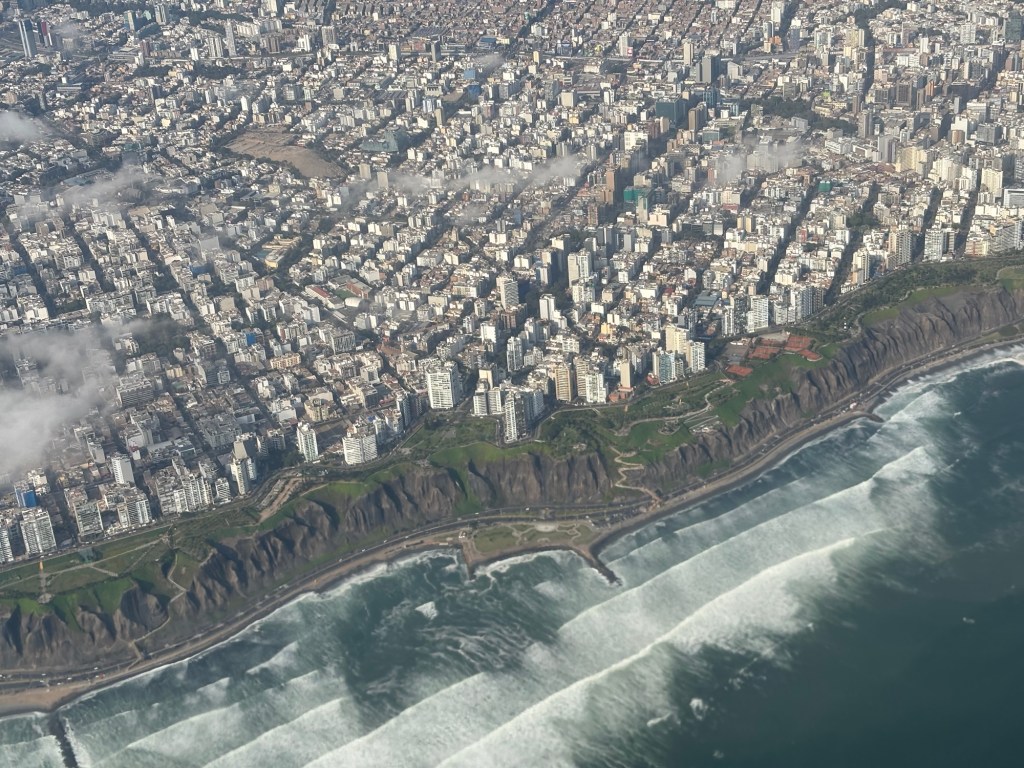
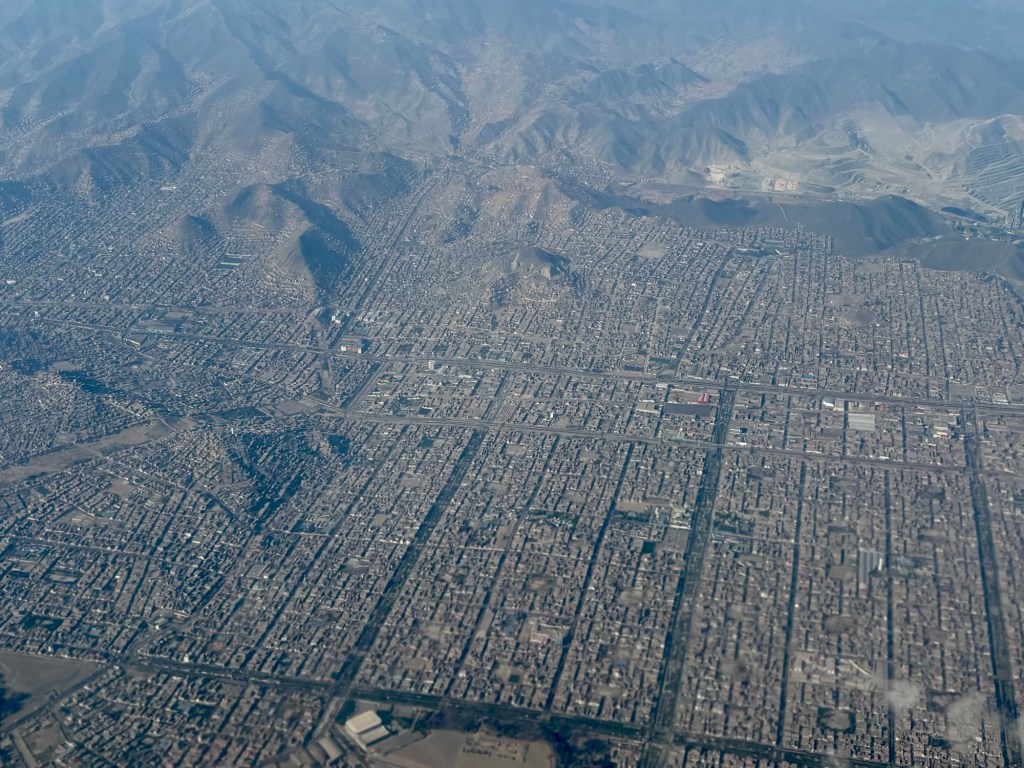
From the air, Lima looks a lot better than it does from the street. You can really appreciate the might of the Atlantic swell as its parallel waves break upon the winding coastal cliffs that separate the city from the sea.

Herman Melville described the city as “Tearless Lima – the strangest, saddest city thou can’st see”. I suspect he was referring either to the lack of rain or, more likely, to the garúa, the dense costal fog that usually clouds Peru’s capital in a white veil. I saw the garúa on the night I arrived, and it lingered into my first morning, but the city has been basking under the South American sun for most of my stay, so tearless is not a word I will be using to describe Lima anymore.


I can’t remember whether I paid extra for a window seat on this flight, but I had one, and that was pretty special. Looking back, it would have been foolish to pay the ridiculous 90$ for the privilege of a window from Madrid to Bogotá, as almost all of the Caribbean and South American leg was under a dense cover of cloud. You win some, you lose some. All I lost was the possibility of a good sleep.

I was on the wrong side of the plane for the Nazca lines, though I think we would have been a bit too high up to see them anyway. What I got instead was an unrestricted view of the mountains below as they climbed and climbed and climbed, up into the clouds and even up and above them.

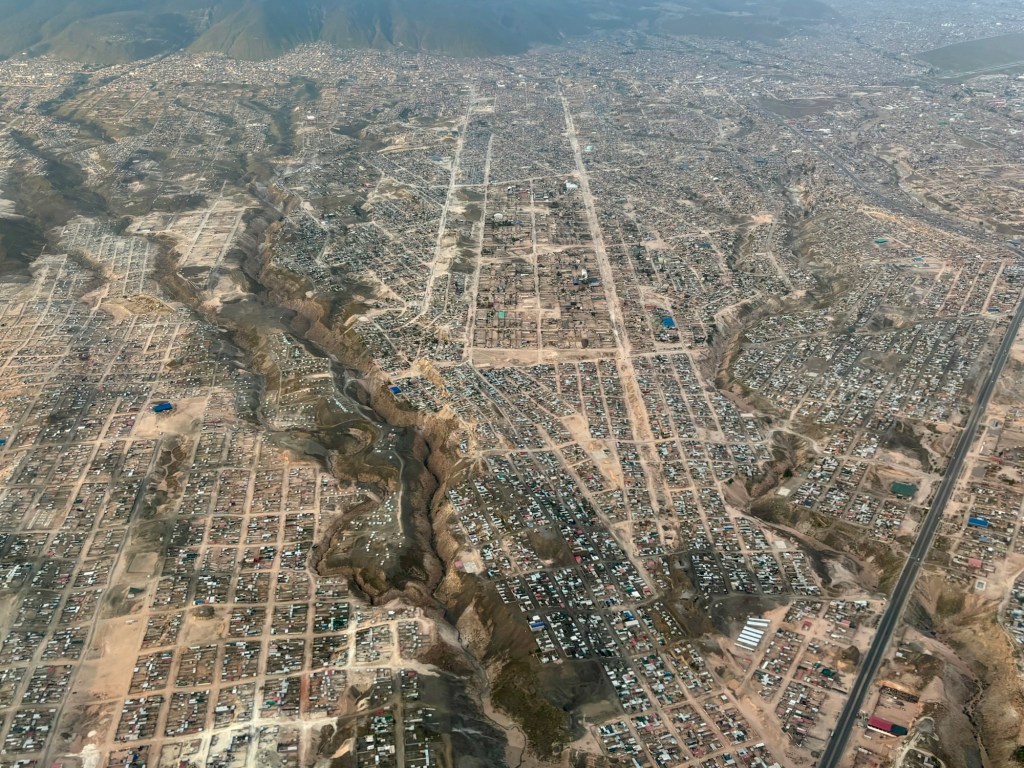
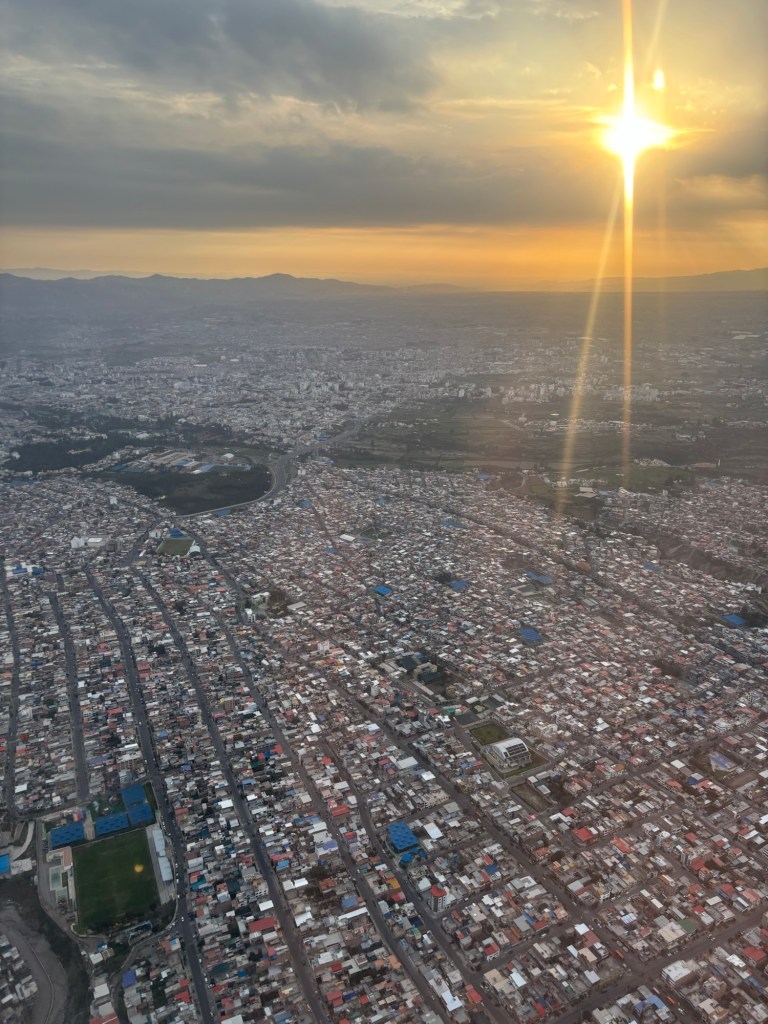
I could post some pictures of the mountains, but with my itinerary for the next week or so being largely mountain-oriented, I think I’ll spare you the overload. What is much easier to appreciate from the sky, however, is the incredible human geography of South America.

I’m no fan of cities – you know this – but that doesn’t mean I can’t appreciate their shape, their size and their strangeness – especially when they seem to blend into the very earth itself (something we don’t do nearly well enough in Northern Europe).


New World cities favour the grid system that, in Europe, is most famously found in Barcelona. It’s still alien to me and I find it quite fascinating to behold from the sky.

Arequipa, the second largest city in Peru after Lima, is also faithful to the grid system – even though the city is scored and cut through by canyons and rivers. Old Word architects would have worked around the landscape, twisting streets and warping estates to fit into the space, but here in the Americas, they just stuck to the plan, regardless of the complications.


Well – here we are in Arequipa, stage two of the Peruvian adventure. I think tonight’s Semana Santa celebration is a subdued one, so I will try to get some rest. It’s a 2.30am start tomorrow, so if I don’t get an early night, I’ll be more like the walking dead for Colca Canyon tomorrow.

Which probably isn’t the best advice when you’re looking for the largest carrion-eater on the planet. BB x