The Mother of the Marshes

Casa Los Tres Aires, El Rocío. 14.01.

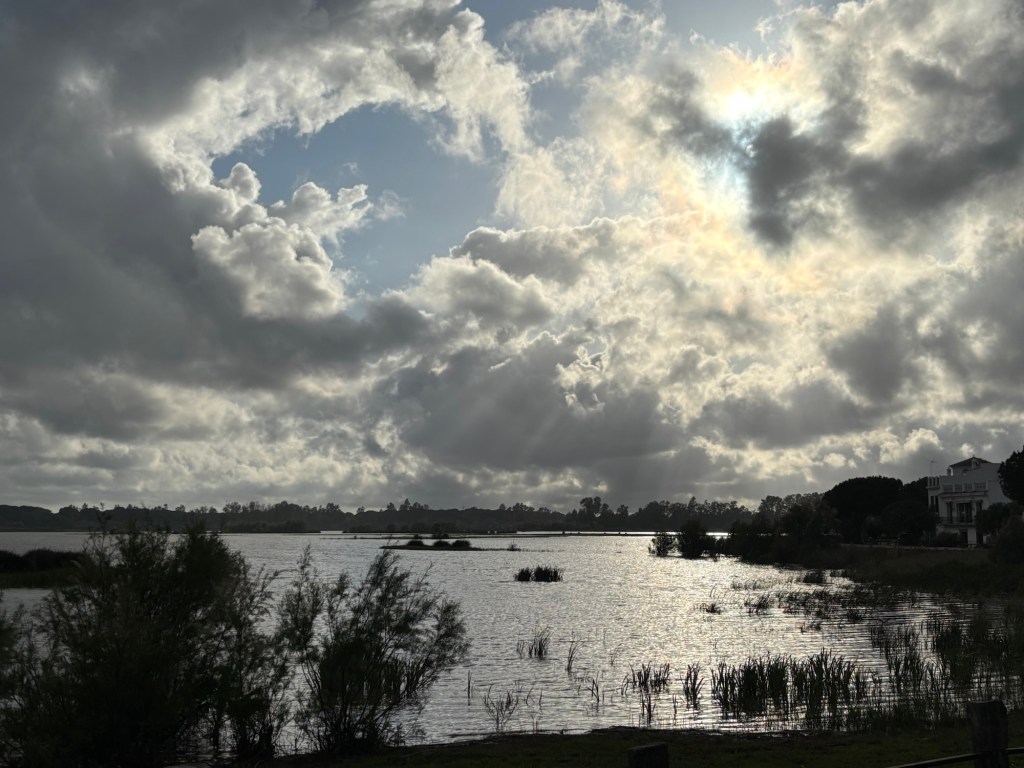
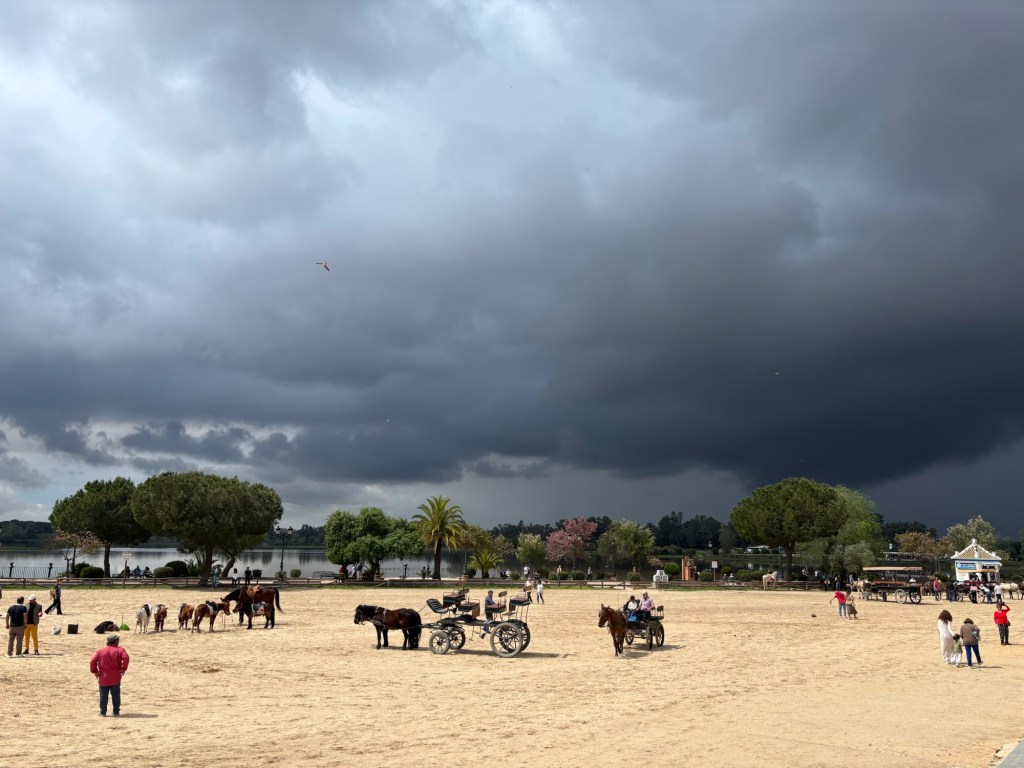
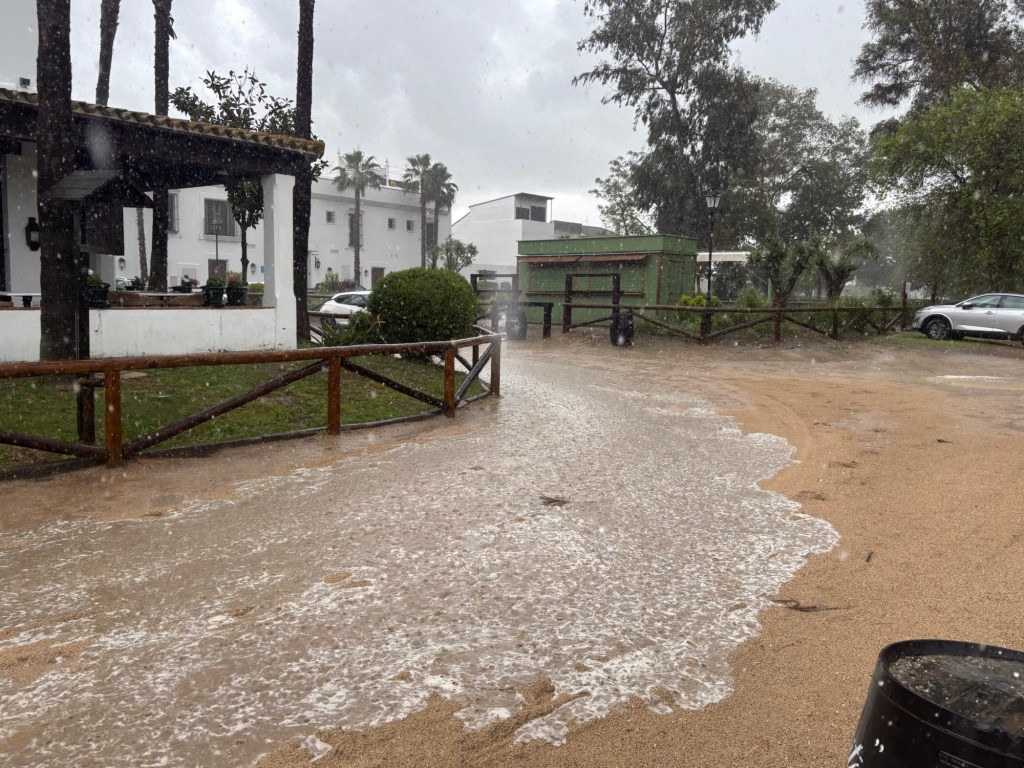
The long-promised rains have arrived. Buckets of it. It began with a sudden gust of wind in the palm trees and a ripple over the lagoon, turning the mirrored surface of the water into a sea of silvery sand dunes. Some of the locals wandering in the square turned to the west and pulled their jackets about them. The savvier ones pointed and moved toward the shelter of the church. Then the darkening sky turned a pale grey, and the trees beyond the road disappeared behind an advancing sheet of rain. Just as the church bell chimed for half past, an almighty drumroll of thunder sounded in response and the heavens opened, and down it came: sheet rain, a wall of water, turning the sandy streets of El Rocío into rivers in a matter of minutes. By the time I made it back to my casa rural I was soaked to the skin – and more alive than I’ve ever been.

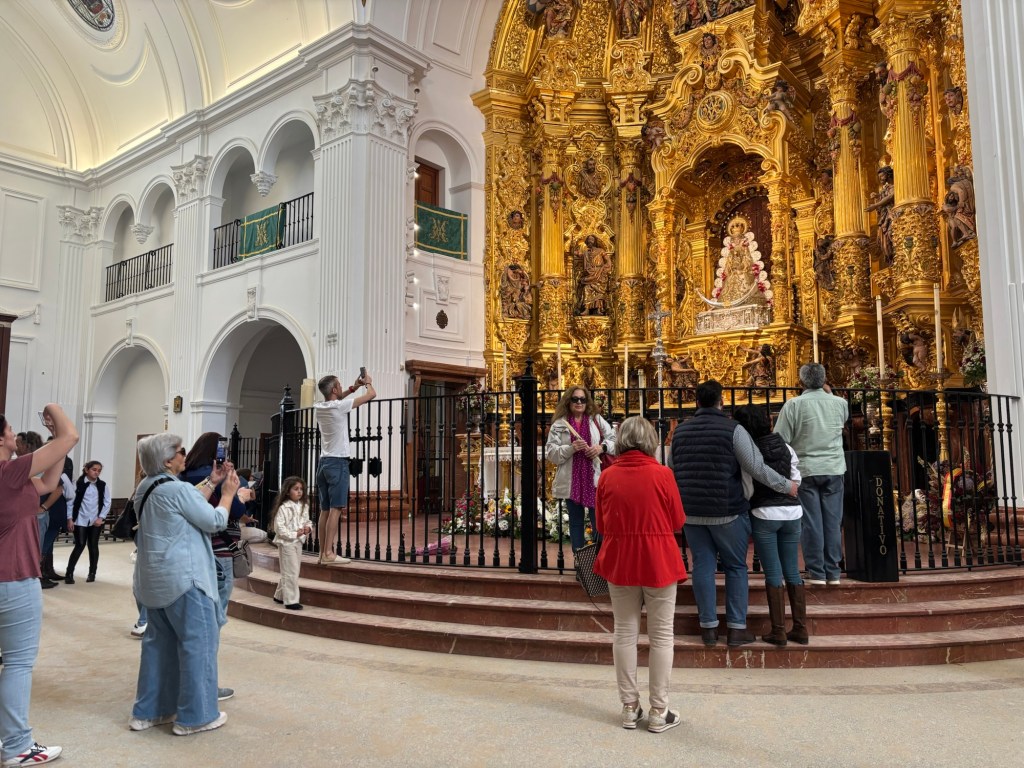
Some devotees of La Blanca Paloma – the White Dove, the nickname of the Virgen del Rocío – believe that her sudden appearance in the branches of an olive tree in the marshes of Almonte was a manifestation of the divine. More sceptical minds might be persuaded that the image was simply one of many hidden away from the conquering Moors and scattered across the countryside, forgotten until their chance discovery by bewildered countryfolk. Whatever you choose to believe, the Virgen del Rocío exerts a powerful influence over the town and its surroundings, bringing more than a million pilgrims to her shrine every year.

One legend has it that the townsfolk prayed for her intercession during the Napoleonic invasion, hearing that a raiding force of French soldiers was heading for the town. For whatever reason, they never made it as far as El Rocío, turning back at Pilas, just shy of thirty kilometres away. Maybe it was the unforgiving terrain of the marshes – or maybe it was the watchful power of the Virgen. Who knows? The fact remains that the village of El Rocío was untouched by both the Napoleonic War and the Civil War in the following century, a conflict which tore almost every town in Spain apart. It’s easy to see how many have come to believe that some great force watches over these marshes, shielding them from harm.

It hasn’t been able to protect them from everything. While it’s incredible to see Doñana restored to life, it’s important to bear in mind how it got into the state it was in: this time last year, the news were all full of woe, decrying the death of one of Europe’s last great wetlands as its life was slowly sucked out of it. Why, you ask? Climate change may be part of it, but the blame lies almost entirely at the feet of the monstrous theft of the land’s water by the agropiratas.

These mercenary industries have set up shop in the outskirts of Doñana and, over the last two decades, they’ve been draining its aquifers to grow strawberries on an industrial scale. Strawberries are a very water-hungry fruit, and the results have been catastrophic, causing the water supply to cascade, lakes to dry up and the local extinction of a number of species that can be found almost nowhere else, including the white-headed and marbled ducks, the salinete (a fish found only in Doñana) and the eel – formerly abundant and now almost completely eradicated from these marshes.

I could do a lot more for charity’s sake, but there are two causes I will not budge from. I will never visit Malta, on account of their refusal to abide by European laws concerning the protection of migrating birds (they still practise the vile tradition of bird-liming), and I will never buy strawberries from Spain, knowing what damage they are causing here. If only we could go back to a time before globalisation, when people were more patient, and prepared to wait for strawberries to be in season, for a short time each year…


It’s still raining out there. It cleared up for a few hours, and then the storm clouds came back with a vengeance. March 2025 has been one of the wettest months in Spain since records began, putting an end to four years of minimal rainfall. It hasn’t been unprecedented: the flash floods that swept through Valencia in October and claimed 232 lives are still a very recent memory. Even so, taken as a whole, the average rainfall over the last five years is still well below the average. Spain will need more consistent rain if places like Doñana are to survive in the long run.

That, and decisive action from the government on the villainous agropiratas and their strawberry farms.

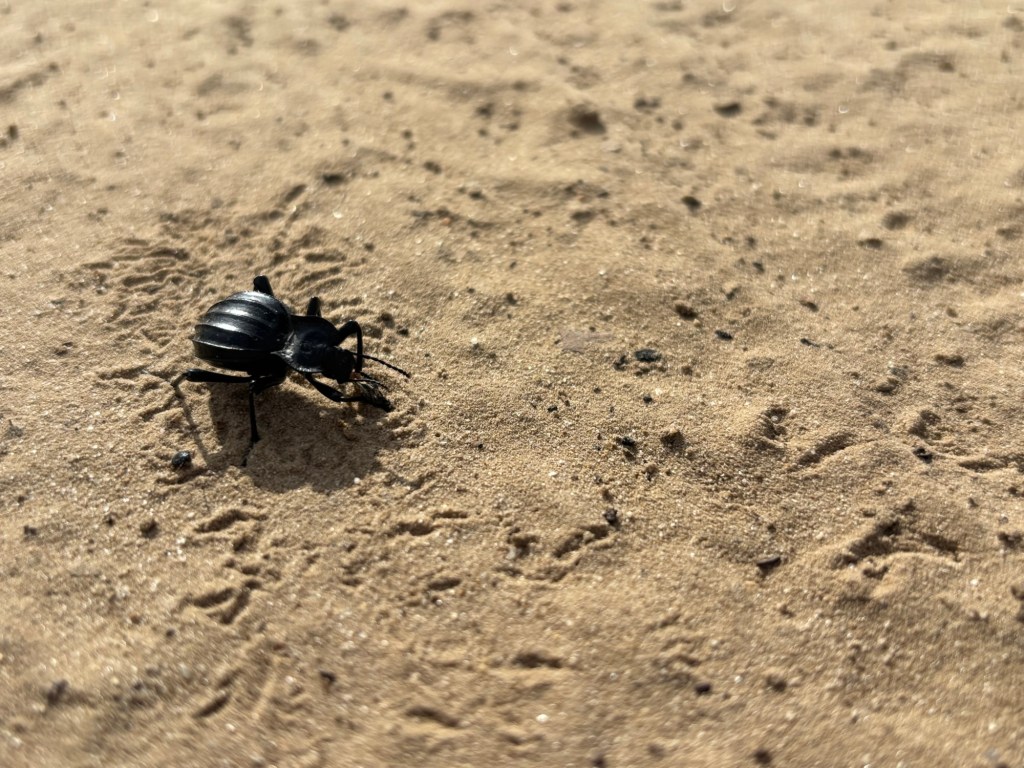
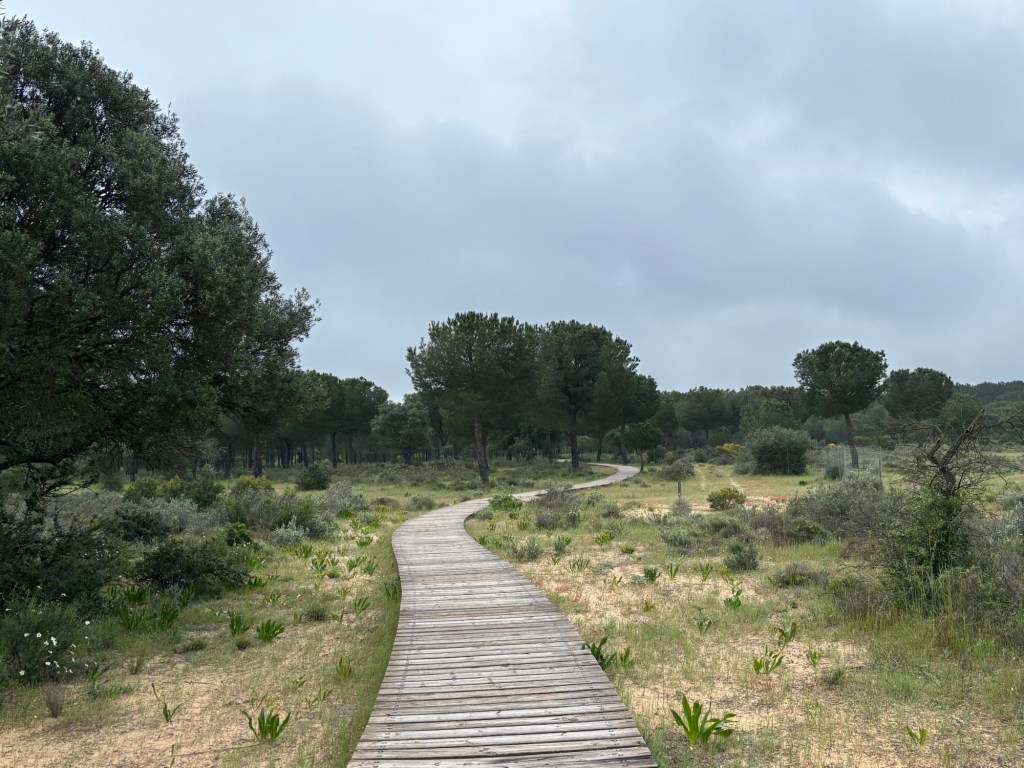
I wanted to make the most of the park’s rebirth, so I went for a long walk in the pine woods of La Rocina to the south of El Rocío. A boardwalk trails stretches for five kilometres along the side of the river that feeds into the Madre de las Marismas, the lagoon that sits under the eye of the Virgen del Rocío. Like the Raya Real, this place is very dear to me: I used to come here as a boy and look for bee-eaters, hoopoes and scarab beetles in the scrubland at the trail’s northern edge.

My sense of smell – mercifully restored after a debilitating cold had me in its grip at the start of my travels – was assailed on all sides by Spanish lavender and curry plant, and every bush seemed to harbour a nightingale. I even saw one, singing high in the branches of one of the pines – a fairly impressive feat, since these master ventriloquists have the uncanny ability to seek out the most acoustic spots in the forest, whilst also remaining invisible to the naked eye as they perform their vast repertoire. I’ve included a recording I took below – have a listen and you’ll see what I mean.


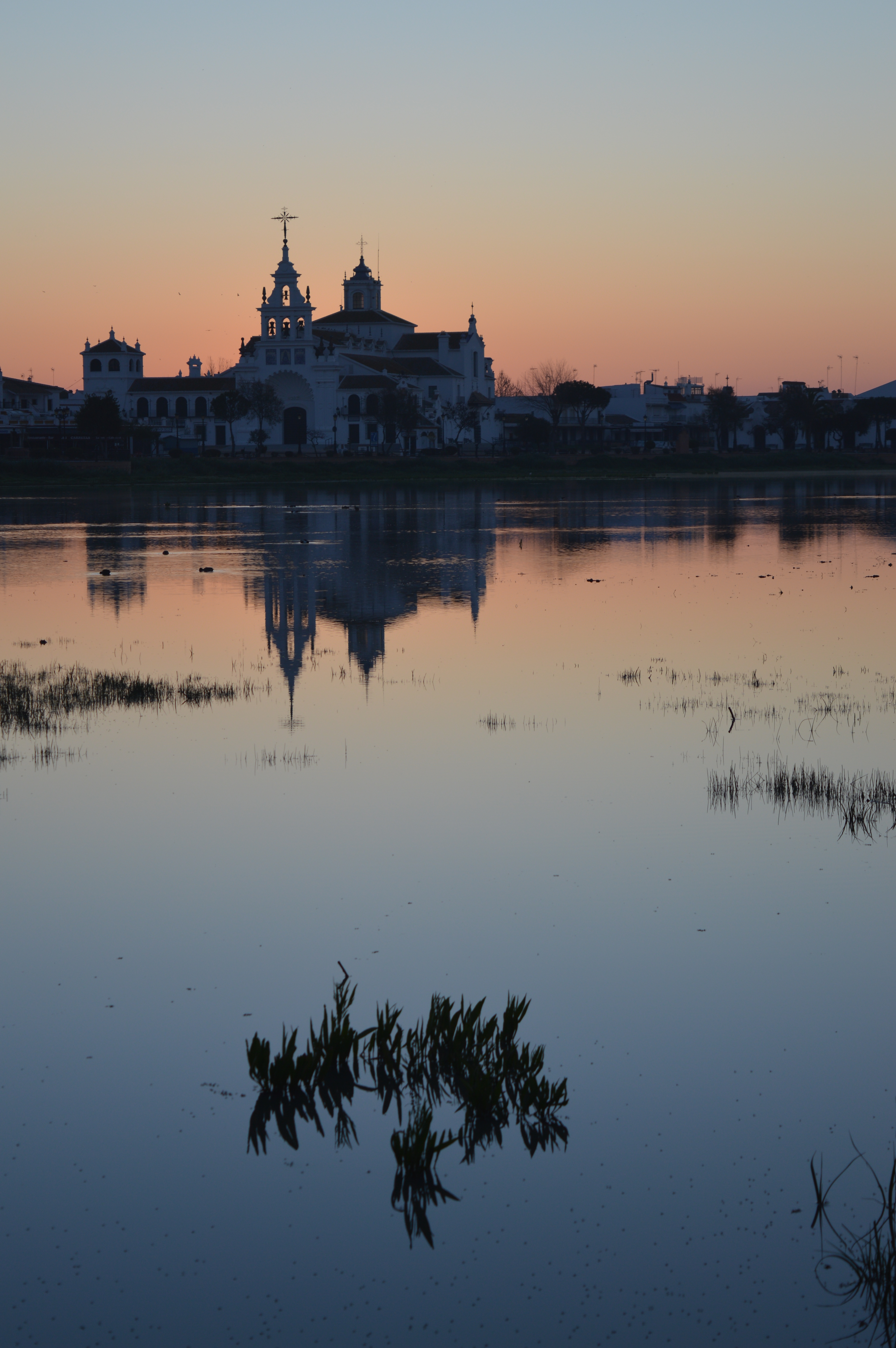
I spent my last evening in El Rocío enjoying boquerones fritos and an incredible torrija – a Semana Santa speciality – in Restaurante La Canaliega, watching the sun set over the Madre de las Marismas. The town’s drains were working overtime to deal with the rivers that had formed in the streets, but there was still enough water in the main square to form a second lagoon, reflecting the Ermita’s unique shell-shaped doorway.
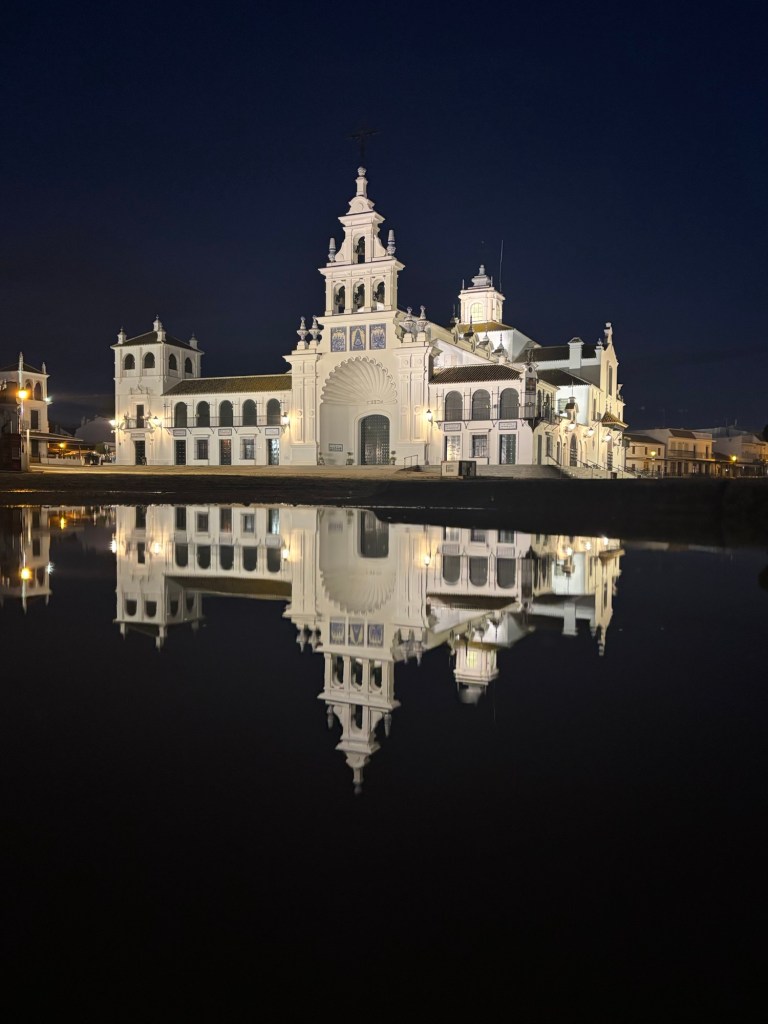

I would have traveled a thousand miles to see just this view, but the Virgen del Rocío saw fit to show me her rarest treasure of all on the day I arrived. I have come away with a new rosary of hers, so that I can offer my thanks wherever I am, and so that there will be some piece of her influence wherever I go.

I used to get the stuffing knocked proverbially out of me at school for defending my stance on faith, in spite of being a “rational thinker”. I stand by my beliefs to this day: I do think the world is a better place with a little more love and little more mystery. On the one hand, I adore the pursuit of knowledge for its own sake: the ability to look up at the stars and know their names.

But I also think it’s important to value the wisdom of the ancients. I may not be able to see the shape of a lion up there, but somebody must have done once to call a constellation Leo. And though it took me a long time to find Lynx, it’s taken me a lot longer to find the animal in the flesh. This year, Doñana – and whatever mystical force presides over these marshes – saw fit to show me a glimpse. You can call me credulous if you like, but that’s enough to make a man like me believe.
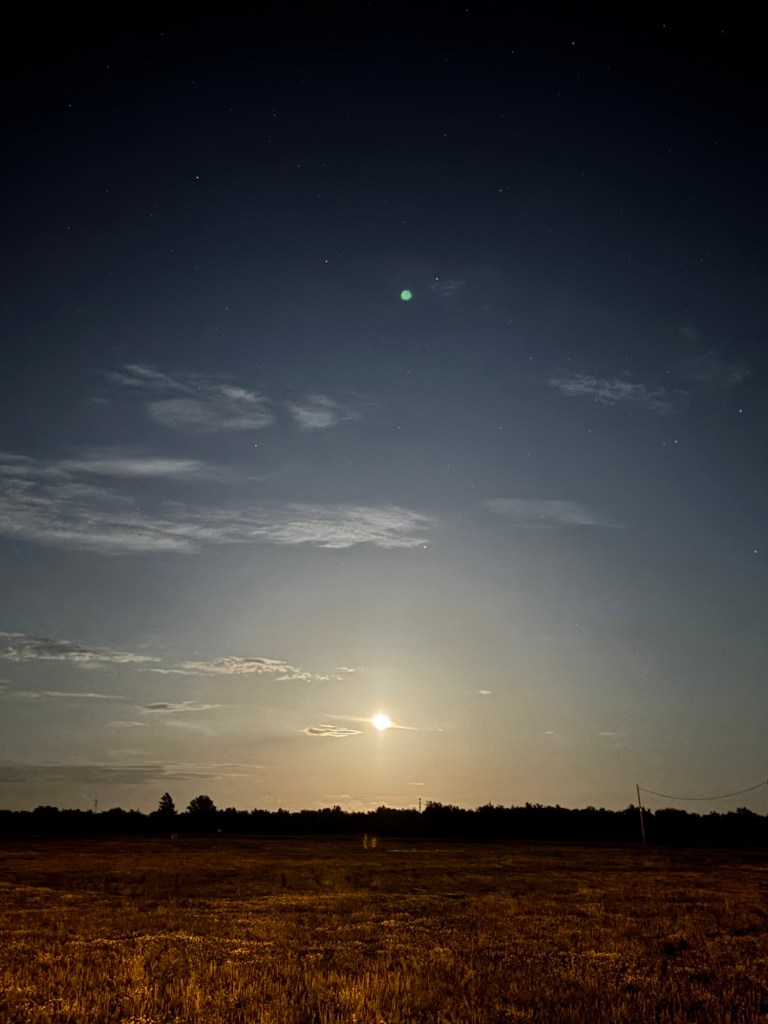

Not for nothing is the lake named the Madre de las Marismas: the Mother of Marshes. Doñana is feminine in every way, from its name to its essence: a provider, a life-giver, faithful, fickle and generous in turn. I have always said that Spain is my greatest love – but it’s probably fair to say that Doñana is that love crystallised into one place.

I have been gone too long. I must return someday. The fight to save these precious marshes goes on. BB x
Under the Lightning Tree

La Raya Real, El Rocío. 17.16.

There’s a place in Austria called Zell am See that’s a magnet for Muslim tourists because it supposedly matches a verse in the Qur’an that describes jannah, the paradise promised to the faithful. I’m not sure that’s strictly true, as I’ve never been able to track down that specific verse (or anything like it, for that matter), but that hasn’t stopped 70,000 tourists from the Gulf from holidaying in Zell am See every year, propagating what was, I am quite sure, a devious but highly effective marketing strategy.

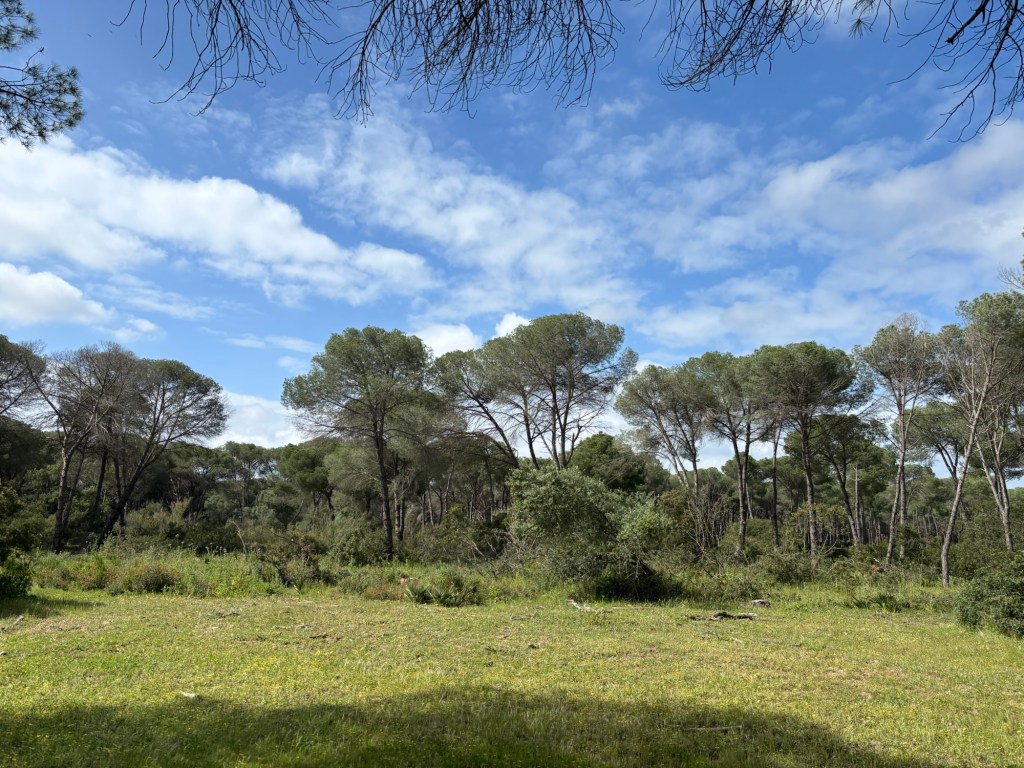
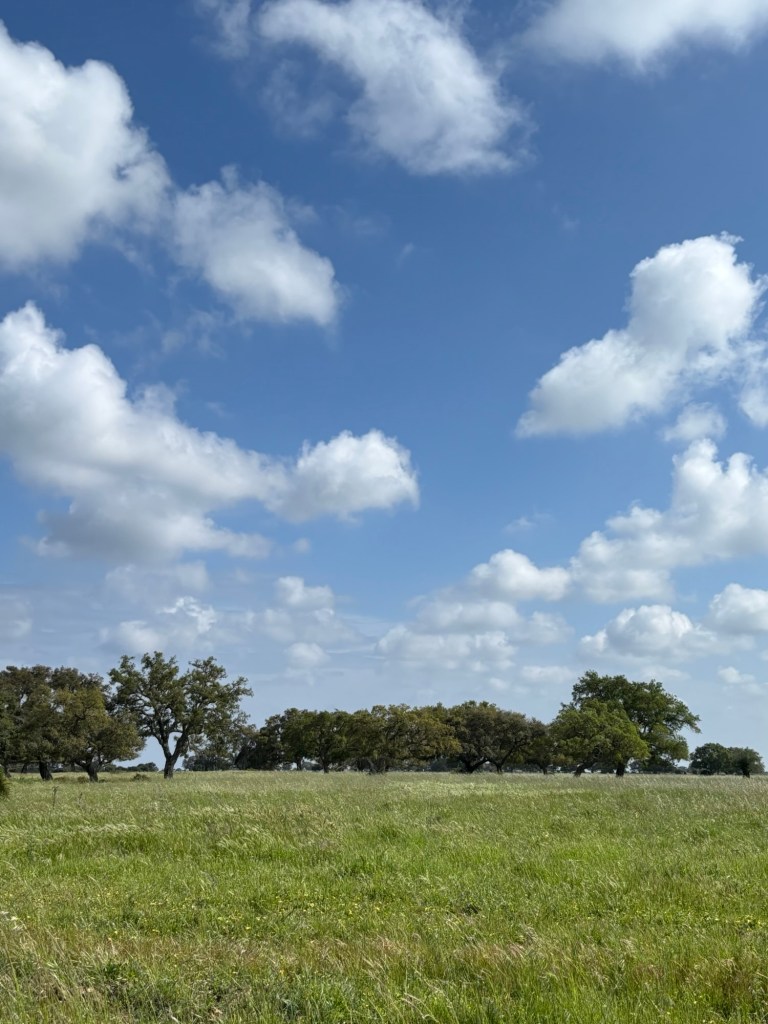
Now, snow-capped mountains mirrored in a clear lake might do it for some people, but for me, if there truly is a Paradise on Earth, it’s where I’m sitting right now: on a grassy verge of the Raya Real, between the stone-pine forests of the Doñana National Park and the silver-bladed fields of Matasgordas.

This is Heaven. It was when I first discovered it when I was only eleven years old, and it has been ever since.


I’m not ashamed to say I nearly wept when I got off the bus and set foot in El Rocío. It’s been nine years since I last came here – almost to the day. This unique little town on the edge of the Madre de las Marismas is probably not at the top of everyone’s list of Spanish must-sees, but it is unshakeably at the top of mine. I believe I described it then as having the smell of a mixture of a stud farm and an aviary, which isn’t far off, but doesn’t quite do it justice.

Ah, but I was writing in retrospect then. Let me tell you what I can see and smell and hear from where I’m sitting. I’ll leave the judgement of its Elysian qualities up to you.

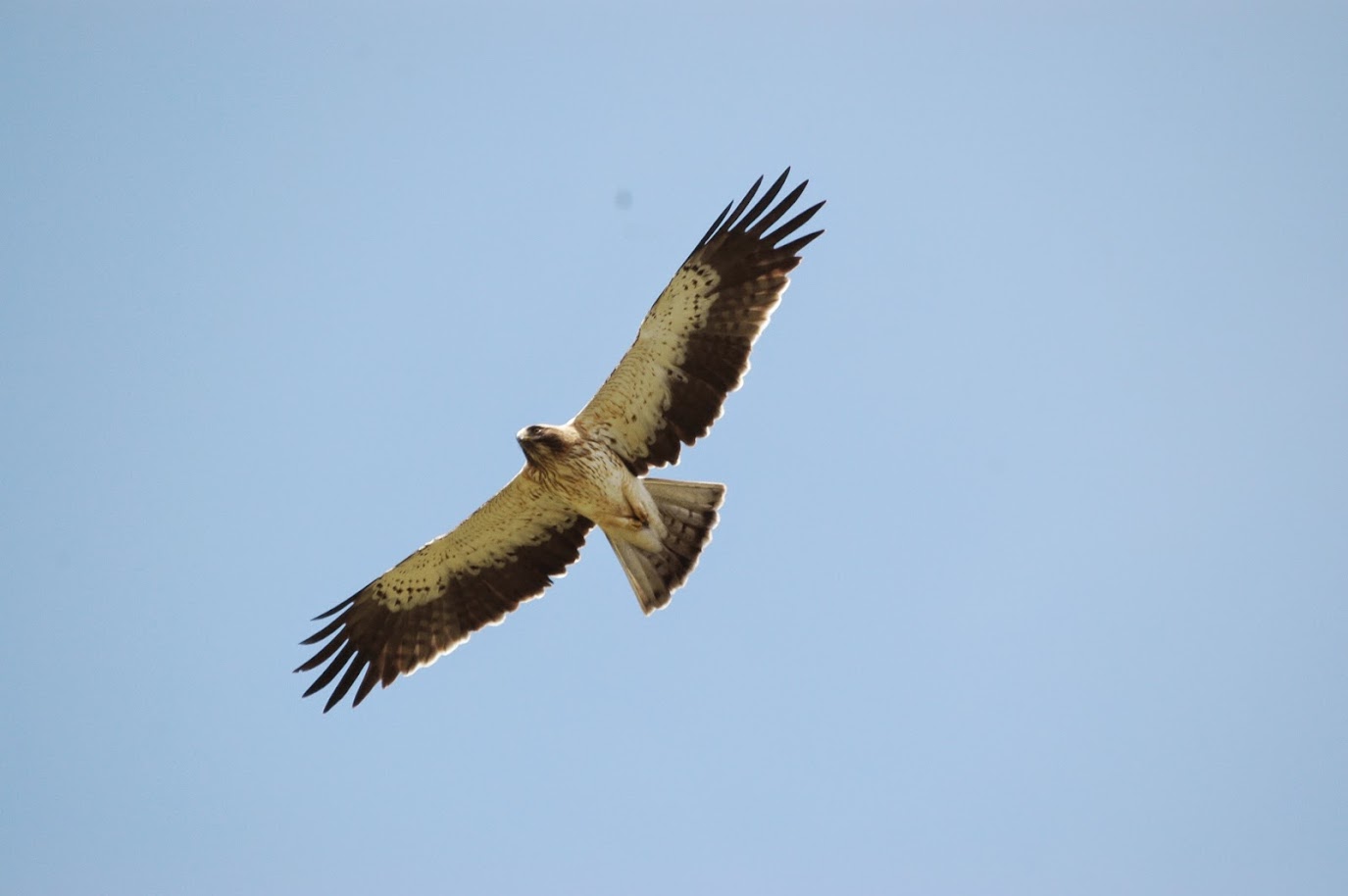
Sight. First, there’s the sunlight. Everywhere. Warm, spring sunlight chasing the iron-grey storm clouds into the west. Huge white clouds rush to take their place, and between them are enormous gaps of blue ether. Every time I look up, there’s a bird of prey up there somewhere: usually a black kite, but sometimes a buzzard or a pair of booted eagles.

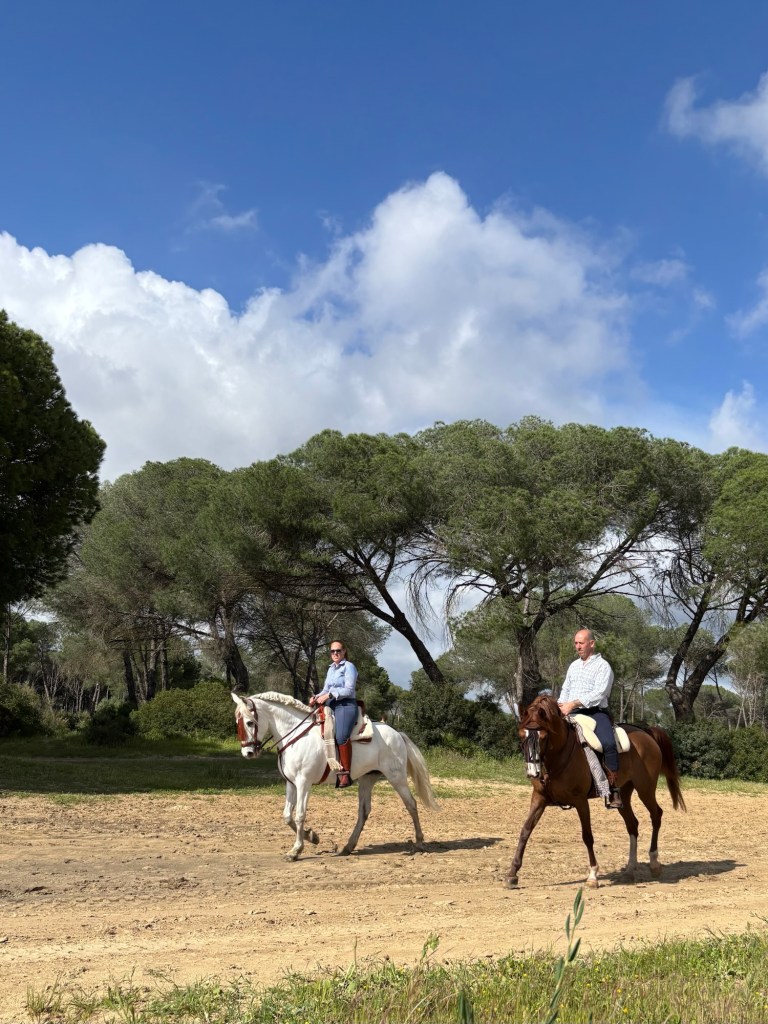
The Raya Real – the pilgrim road to Seville – stretches out before me. In a month or so, it will be crowded with rocieros, the men dressed in riding grey and the women in stunning flamenco dresses, singing folk songs as they near their final destination. But now, as it is for most of the year, the only travelers on the road are tourists and locals on horseback, and the odd jogger. And me, sitting in the same spot I have sought out since childhood, under the lightning tree.

Behind me, the wind blows through the fields of Matasgordas. Waves of silver ripple across the grass, dappled here and there by the golden heads of buttercups and dandelions. Holm oaks reach their gnarled and twisted branches skyward, providing little pools of shade on the prairie.


Smell. The warm scent of rain upon the earth, upon sand. The intensity of Spanish lavender, leaving a heady perfume on my finger as I touch its leaves. The clean air of the pinewoods, and the faint sweetness of sap.

There’s the faint scent of water in the air, but no sign of rain clouds – and still it’s there, promising a second bounty. There’s horse manure here and there, but it doesn’t add to the smells the way it does in England. It’s dry and processed and rolled away by the scarabs and other beetles before it has a chance to decay.


Sound. There’s the wind in the stone-pines, of course. It sounds clean and clear, like the distant swell of the Atlantic. But beneath the wind, there’s an orchestra. A rooster is crowing from a farm on the edge of town. The black kites whistle as they wheel overhead, and now and then I can hear the jolly whirrup of a bee-eater – surely two of the most beautiful sounds on Earth. Other birds sing from the heart of the forest: blackbirds, serins, robins and nightingales, cuckoos and hoopoes and treecreepers. Somewhere out in the fields beyond I can just about make out the tiny wet-my-lips whistle of a quail.

Then there’s the jingle of bells as a horse and carriage passes by, taking a local family out for a ride, and the whinnying of a stallion as a couple of proud locals ride on up the Raya Real. The heavily inflected illó shouted from one rider to another.


And then something incredible happens. I’m watching a couple of booted eagles wheeling about overhead and, as I look, one of them bobs its head as though it’s seen something behind me that I haven’t. I turn and look – and I can’t believe my eyes.

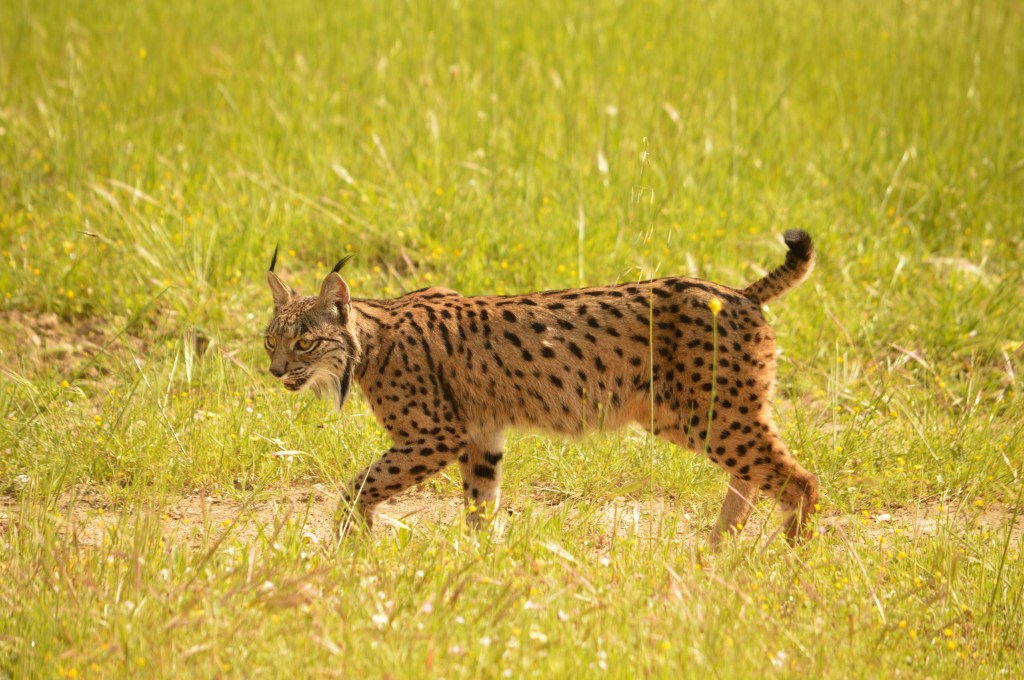
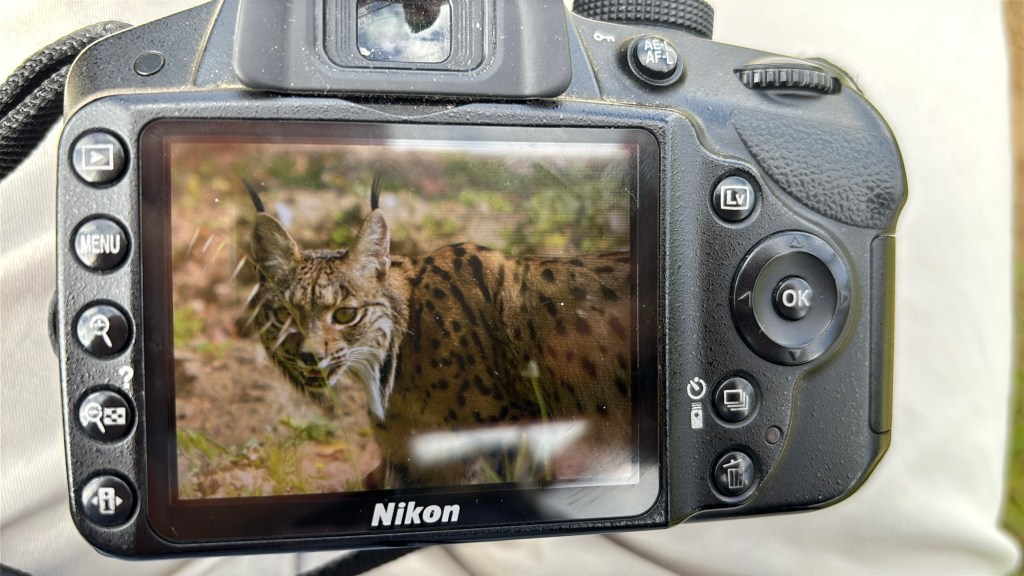
Literally feet away from me is a lynx. One of the rarest cats in the world, just walking along the edge of the field, completely unfazed – or unaware – that I’m standing there.


I have come to Doñana for years, ever since I was a boy, and always hoped to see one of these elusive, beautiful creatures, but never expected to do so. They’re incredibly secretive, they live deep within the heart of the national park, and – going off the last count in 2022 – there are only around a hundred or so spread across the 543 square kilometres that make up the Doñana National Park. I didn’t expect to ever see one in the wild – never mind quite so close as this.


If I needed a sign that my beloved Doñana had come back from the dead, that might have been it. But there was something more. Something even more personal still to find.

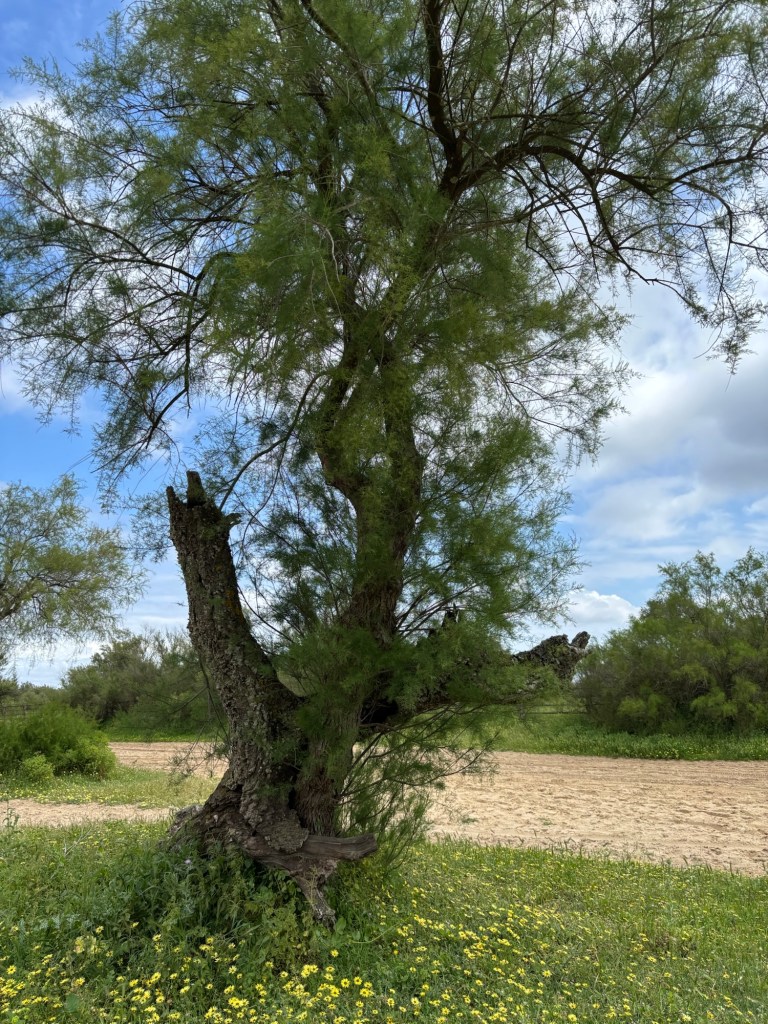
My lightning tree has come back to life. As a boy I used to sit beneath its scant shade and look for snakes and geckos in the cracks in its dead branches. Its gnarled silhouette was always a beacon, a recognisable wayfinder along the Raya Real. Now, a younger shoot of the tree has grown within its ancient cradle and blossomed into new life once again.

I was so sad on my last visit to Doñana when the lakes had dried up and the only sound was the wind – it really left an impression on me, and I was so afraid to return.

Just seeing how much new life there is in the place is enough to fill this man’s heart right up to the top and overflow. I’m giddy. This place has a magic that works on me like nothing, nobody and nowhere else on the planet.

It’s brought my lightning tree back to life. And, in a way, it’s brought me back to life as well.


I don’t need to seek Paradise in the Alpine lakes of Austria, or even in the pages of some holy text. I have found it here in the marshes of Almonte. I’m usually a little skeptical about the various Marian apparitions in locations up and down the country, but I’ll make an exception for La Virgen del Rocío. If I were an incarnation of rebirth and new life looking to relocate, this is exactly where I’d choose to appear. BB x
The Lost City

Cerro del Sol, Granada. 12.56pm.

They call it the Cerro del Sol, but the sun is hidden behind a white haze of cloud. It covers the snowy peaks of the Sierra Nevada so indistinctly that it’s hard to see where the snow stops and the clouds begin.

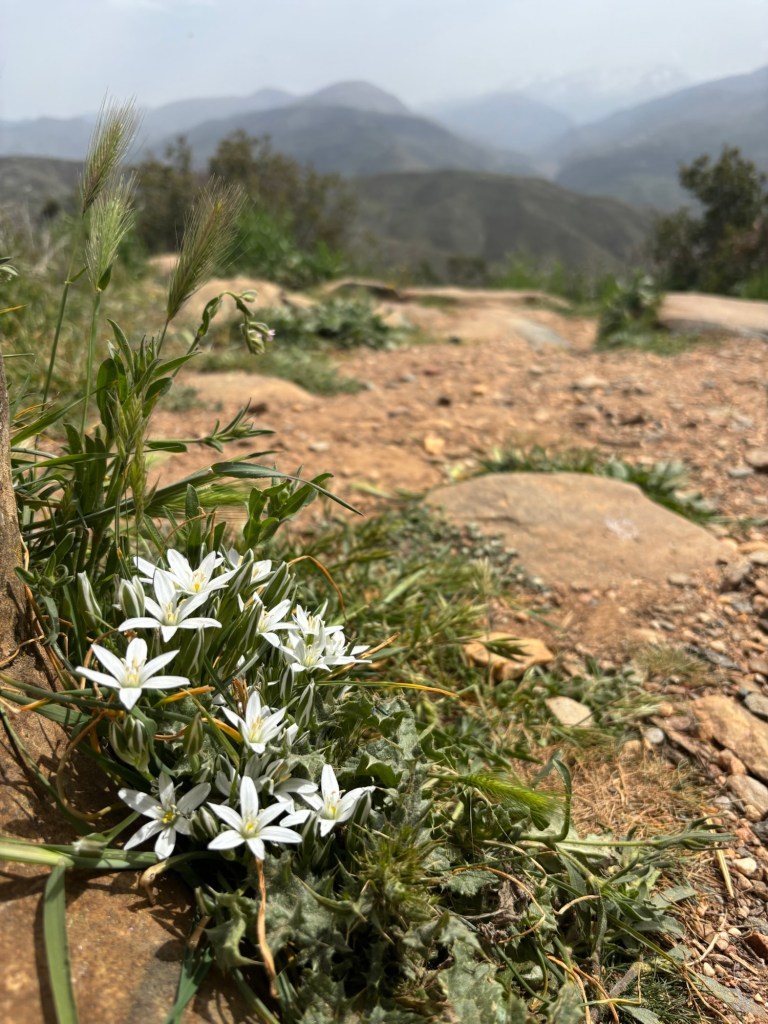
It’s pretty quiet up here. There’s a general soar of traffic on the road up to the skiing station of Pradollano in the Genil valley below, but beyond that – and the occasional rev and growl of some larger engine – it’s just me, the butterflies and the birdsong up here. Mostly fritillaries, coppers and marbled whites, though I did see a beautiful swallowtail float by a moment ago, before I put my cardigan over my head to shield my eyes from the white glare of the sun. It shines brighter than the garden Star-of-Bethlehem at my feet. Such a beautiful flower – I’m not sure why I never noticed them before.


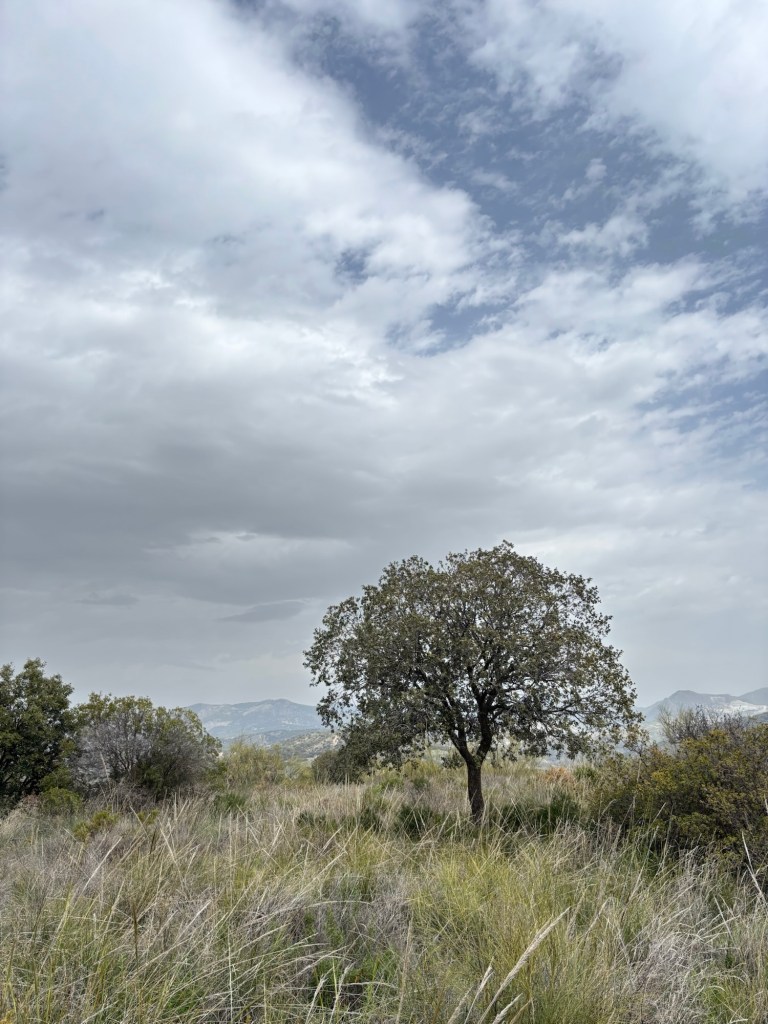
I’ve come up here to write – and to heal. I didn’t sleep well last night. Some wounds, it seems, take a long time to mend. So I’m up in the quiet of the dehesa, in the hills east of Granada, soaking in the best palliative that nature can offer. Herself.

The occasional buzz of a fly. The twitter of a pair of pallid swifts racing by. The summery buzz of a grasshopper and the chuk-chuk-chukar of a partridge somewhere in the scrub far below.

A couple of Sardinian warblers are engaged in a territorial dispute in the broom bushes below, rattling off their warnings like Gatling guns. And always and everywhere, I can hear the song of blackbirds – an ever-present symbol of Granada.

This is the Dehesa del Generalife. I suspect the Moorish sultan of old must have come hunting here with his retinue in the days of al-Andalus, as these hills are teeming with small game: wood pigeons, partridge and rabbits (I didn’t see the latter, but this is absolutely their kind of terrain). What a sight that must have been: the Moorish sultan and his hawks, looking up at the snowy peaks of the Sierra Nevada and across the Vega of Granada.

It’s far too easy to see why this place bewitched the Romantics and scores of travelers back in the day, before the modern tourist trade sank its teeth into the place. Well, here’s a corner of Granada they haven’t spoiled: quiet, ancient, magical. Sure, it’s an hour’s hike from the Alhambra, but some things are worth the trek.


On my way up here this morning, I paid a visit to the Capilla Real to see the tombs of Fernando and Isabel, the Reyes Católicos. I figured I’d made the voyage to El Escorial to see the other kings and queens of Spain, so I ought to pay my respects to the ones who started it all.

A surly security guard at the door gave me a long, hard look as he waved me in and warned me not to take any photos. I indicated the notebook and pencil in my hands and asked if I could sketch. He didn’t reply. His stoney expression might have been cast in the same marble as the sarcophagus behind him. I guess he didn’t see the joke.

It’s funny how some people get so uppity about tourists taking photos, but nobody ever seems to mind a sketchbook. I’ve stood on street corners for up to an hour sketching and nobody bats an eyelid, but whip your phone out in some places and there’s hell to pay.


I bought a couple books in the gift shop (I needed some reading material and they were relatively cheap, by Spanish standards) and climbed back up the Carretera Empedrada through the Alhambra forest, where I stopped to check in my flight for next week and sort out tomorrow’s bus to El Rocío. An enormous tour group of German pensioners ambled by. There must have been at least sixty of them, perhaps more. They were followed not too far behind by two outings from a Spanish private school – recognisable by the distinctive shade of blue uniform that is so popular with colegios privados out here.

That figure of eight thousand a day I heard yesterday really does seem more believable when you stop for a while and watch the tourist traffic.


A short amount of time in the wilderness was enough, so around midday I dusted myself down, left the swallowtails to their games and headed back the way I came. When I came to the Alhambra, I took the right fork this time, following the Cuesta del Rey Chico down along the Acequía Real. It’s a steep descent (and an even less forgiving ascent) but it follows one of the main water channels right down to the Darro, so you’re accompanied all the way down (or up) by the most beautiful sound of running water. The Alhambra’s watchtowers serve as waymarkers: the Tower of the Captive, the Tower of the Judge, the Tower of the Peaks, and the Tower of Comares, the seat of the Sultan of old. The Sultan and his family may be long gone, but their waterworks are still running as they did then, six hundred years ago.


As I came down the hill, a thought came to me that had come several times now since I arrived in Granada. Who would not defy the world for such a place? Who would not have fought off the very hordes of Hell itself to defend this paradise on Earth? And what greater heartbreak can there be than to be banished forever from a place that was more than just a home, to know in the very depths of your heart that you had lost the keys to Heaven itself?

It’s not hyperbole. I’m merely paraphrasing the laments of the Andalusian poets of old when Granada fell to the Christians in 1492. It puts my own petty broken heart into a much-needed broader context. There was a sense of loss here far greater than anything a single heart can withstand. I have felt the tremors of it before in Sevilla and Córdoba, but nowhere stronger than here, the last bastion of the Muslims in Spain. Such a raw outpouring of emotion leaves a mark. Ghost stories would spring from it in more credulous parts of the world. Here, it is an indistinct melancholy – something in the air that once was, and is lost forever in all but memory.

Writing two hundred years before Granada’s demise, al-Rundi’s lament for the fate of Sevilla captures the grief:

A pretty lady, splendid as sunlight,
Her beauty just like coral and jewels bright,
Dragged off by infidel for rape most vile,
Her heart perplexed, she’s crying all the while.

Abu al Baqa’ Al-Rundi, Ritha alAndalus

I wonder how the Muslim tourists to the Alhambra feel upon seeing such a place? There do not seem to be as many as I remember.


One week remains. Tomorrow, I make for a place that has always been close to my heart: my Granada, my Jannah, my paradise on Earth. It looks like it will be a rainy weekend. But nothing could put a damper on the thought that I will see that place again, after all this time: El Rocío. BB x
Memory Lane

AVLO Carriage 4, Loja. 17.40

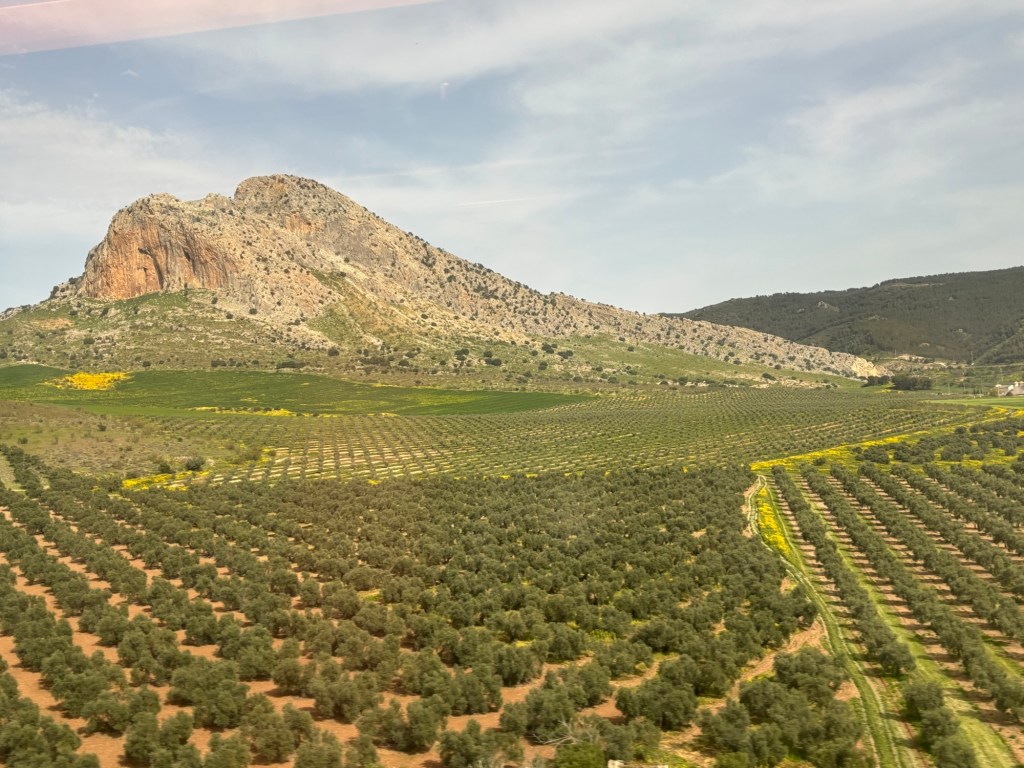
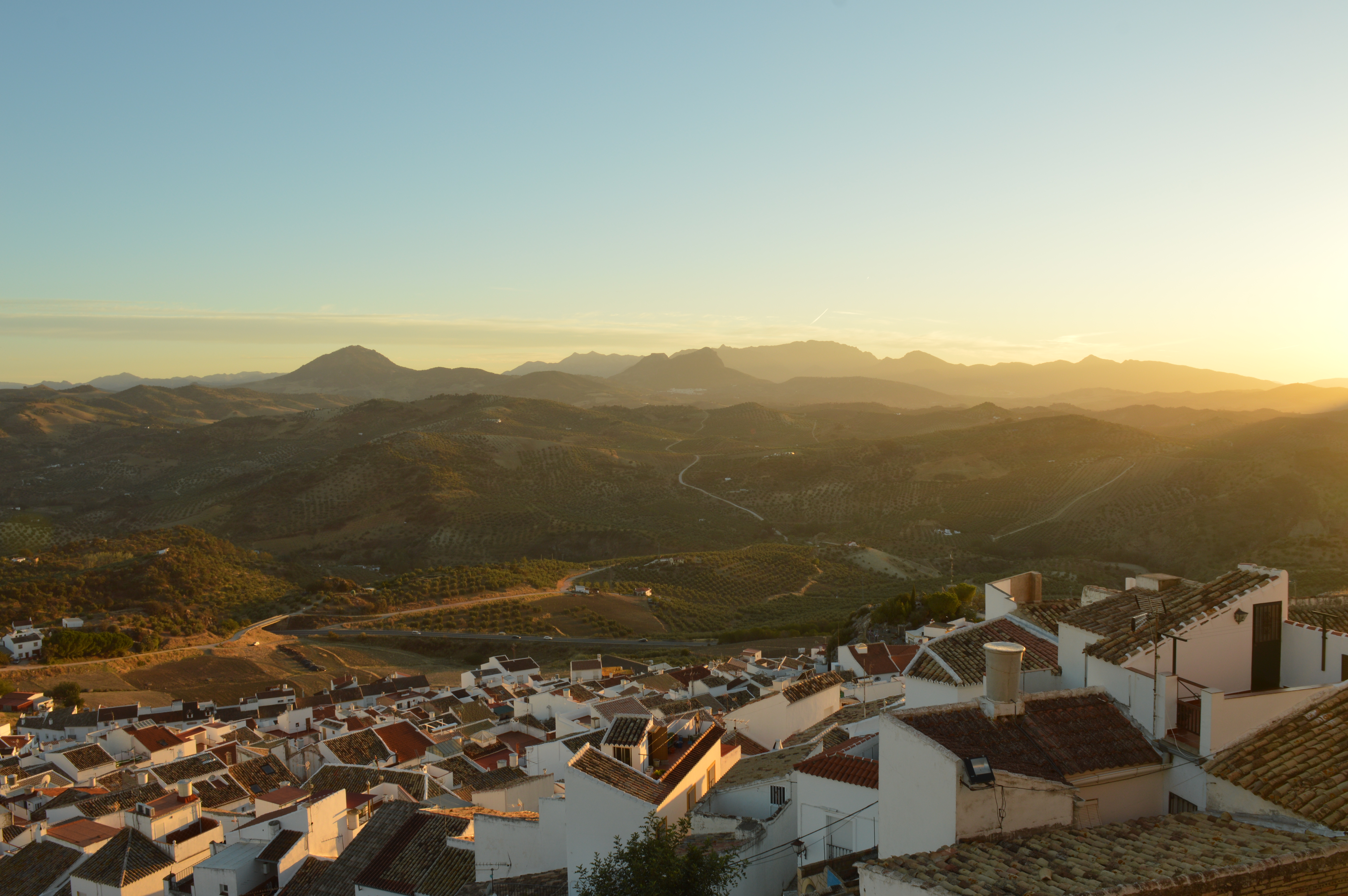
Andalucía hurtles by a in a blur of olive green and marbled brown. I’ve never seen it so green: all that rain Spain must have had last month has completely transformed the place, turning the golden fields of my memory into a paradise on earth. I could hardly ask for a better welcome home to the land of my childhood.

Landmarks sail past the windows like ships with friendly colours. There’s the jagged spires of El Torcal, high above Antequera, the first place that genuinely inspired me to write a book set in Spain. There’s the Peña de los Enamorados, a lonely bluff rising out of the fields where, legends tell, a Christian knight and a Moorish princess hurled themselves to their deaths rather than live divided by their warring faiths. There’s the limestone massif of Loja, crowned with wind turbines, their blades motionless in the afternoon air. And there’s the reason why they’re stood so still, standing in awe: the Sierra Nevada, dwarfing all the other sierras for miles around, covered in a vast blanket of snow. If the sunset is good, I will try to snag a spot at the Mirador de San Nicolas at just the right moment tonight, when the setting set sets the snowy peaks of the Sierra ablaze behind one of the most beautiful buildings in the world: the Alhambra de Granada.


Mirador de San Nicolás, Granada. 21.01.

How should I describe it – coming home? I never lived in Granada itself, but between coming here at least three times before and a year living over the sierras to the west, this place feels… so familiar, compared to the other places I’ve been on this trip, anyway. The accent, the noise, the simple fact that the music playing over car radios as they pass is flamenco and not reggaeton… This is the Spain that captured my heart many years ago, when I was just a boy.

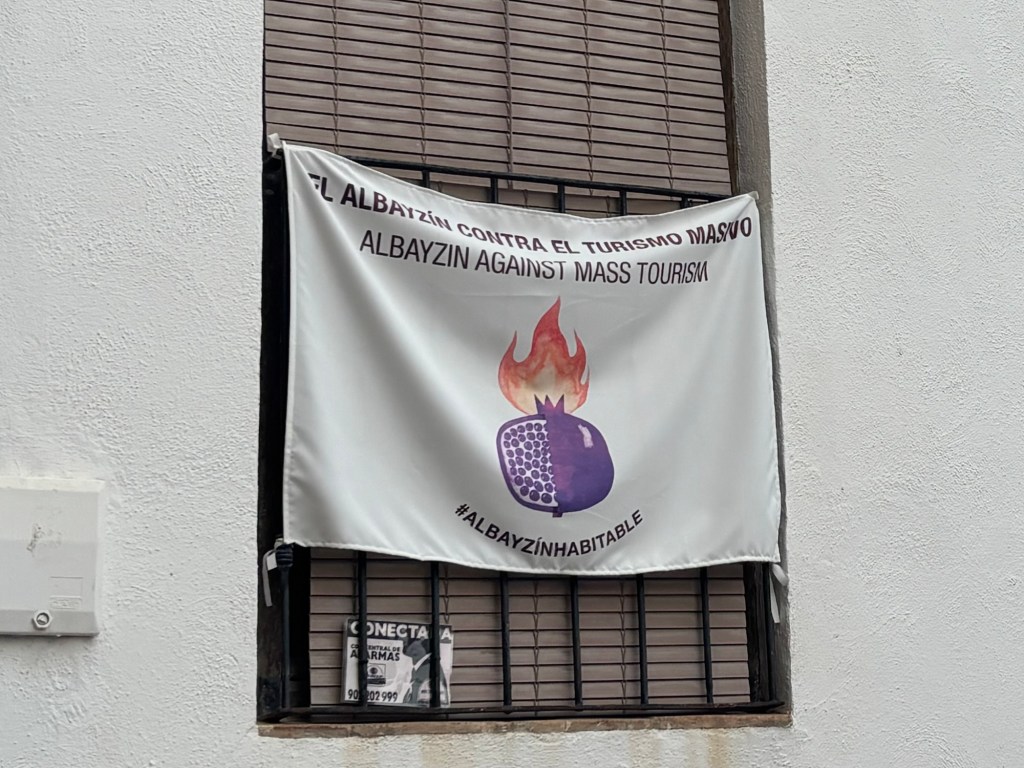
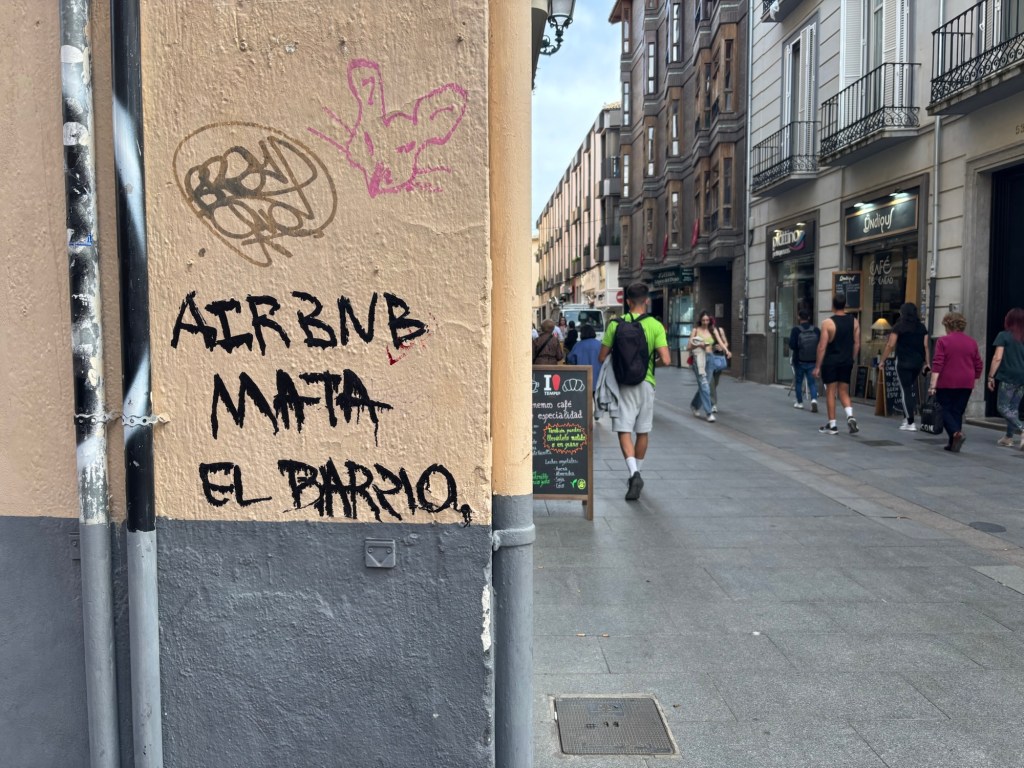
Things have changed since then, but not by much. There’s a lot of anti-tourist graffiti around, but then, perhaps I’m actively looking for it now. Here, in one of the most popular tourist destinations in Spain, that anger is directed at the American corporate AirBnB, an alternative accommodation method for the experience-minded traveler, which is currently being relentlessly advertised on TV with the tagline “don’t end up surrounded by a hotel”.


That’s all well and good, but much of Spain relies on the tourist industry to survive. In 2023, tourism accounted for an astonishing 12.3% of the country’s GDP, making it one of the most tourism-oriented countries in the world – and the numbers have only increased since then. Much of Granada, including Sacromonte – the formerly rundown gypsy neighbourhood beyond the city walls – has been given a makeover in the last twenty years to draw in as many tourist dollars as possible, and in its wake, a lot of the former pensiones – Spain’s traditional accommodation option, consisting of spare rooms rented out to travelers – have been replaced by glitzy “experience-oriented” AirBnBs. It’s an economy for the young and enterprising – or the international – and much of Spain simply can’t keep up. Adapt or die. And when the old ways are sacrificed on the altar of progress, some of the identity that made that place so special is lost. Eventually, even the tourists will realise this and stop coming, leaving these areas high and dry.

That’s why the phrase “AirBnB mata el barrio” (AirBnB kills the neighbourhood) is scrawled all over the place.


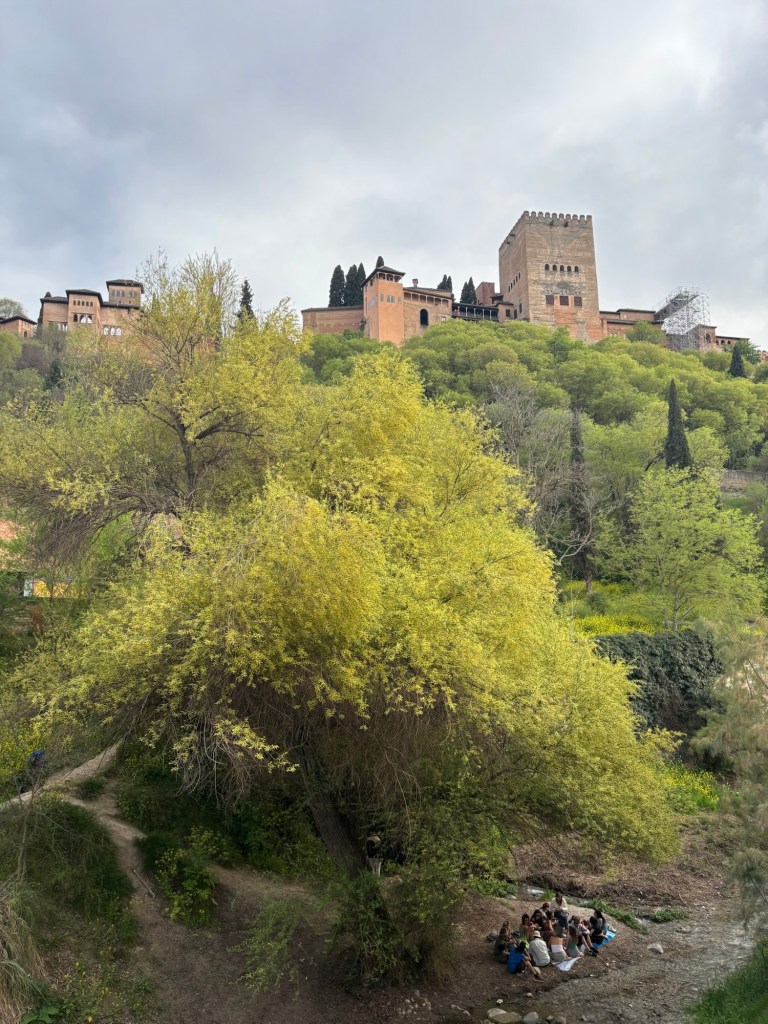
Fortunately, the magic of Granada continues to shine through the crisis. There might be a lot more of the American drawl on the street than there used to be, but it’s shouted down by the happy hubbub of the locals. Wandering along the Darro toward Sacromonte, I came upon a noisy group of youths on its banks, enjoying a picnic in the shadow of the Alhambra as their kind has done for centuries.

They weren’t too happy about a tourist family flying a drone nearby and threw a couple of colourful insults of the verbal and non-verbal kind at the buzzing menace as it passed overhead.


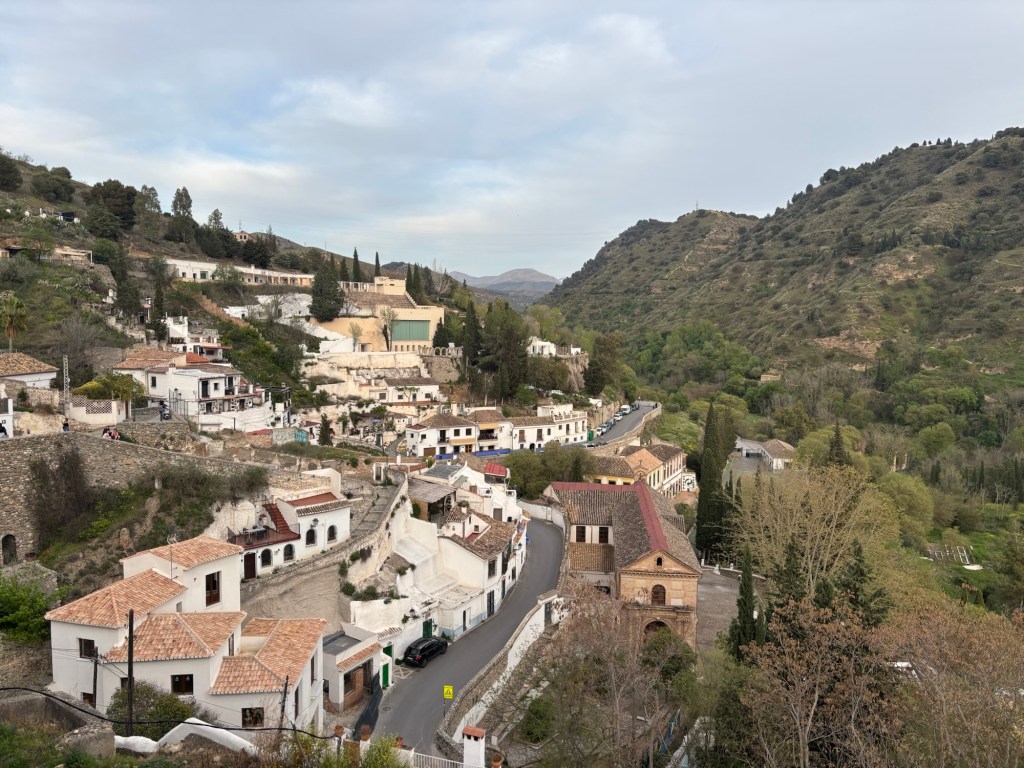
Sacromonte has hurled itself at the tourist trade as never before. Every other house seems to have decked itself out as a “tablao flamenco” where you can catch a live Flamenco show. Marketed as the “home of flamenco” – a title more appropriately applied to Sevilla’s Triana district, though the zambra certainly comes from here – Sacromonte was Granada’s former gypsy quarter, whose inhabitants lived in cave dwellings beyond the city walls since they were not permitted to live inside the city.

The heat of the summer is one reason they retreated into the rocks, and the zealousness of the Spanish is the other: this “pariah district” served to accommodate the unwanted, the unclean and the un-Christian – which amounted to the same thing for much of Spanish history. It even housed some of the city’s Jewish and Muslim population following the fall of Granada in 1492, as they were gradually driven out of the city by the conquering Christian warlords.

When my mother came here in the 1980s, this was not really a district you’d want to find yourself in after dark. Nowadays, that’s precisely the time the locals want you around, as that’s when the flamenco shows take place. I’m still considering whether to check one out. I’m hoping for something authentic, but I feel that star may have descended a long time ago.


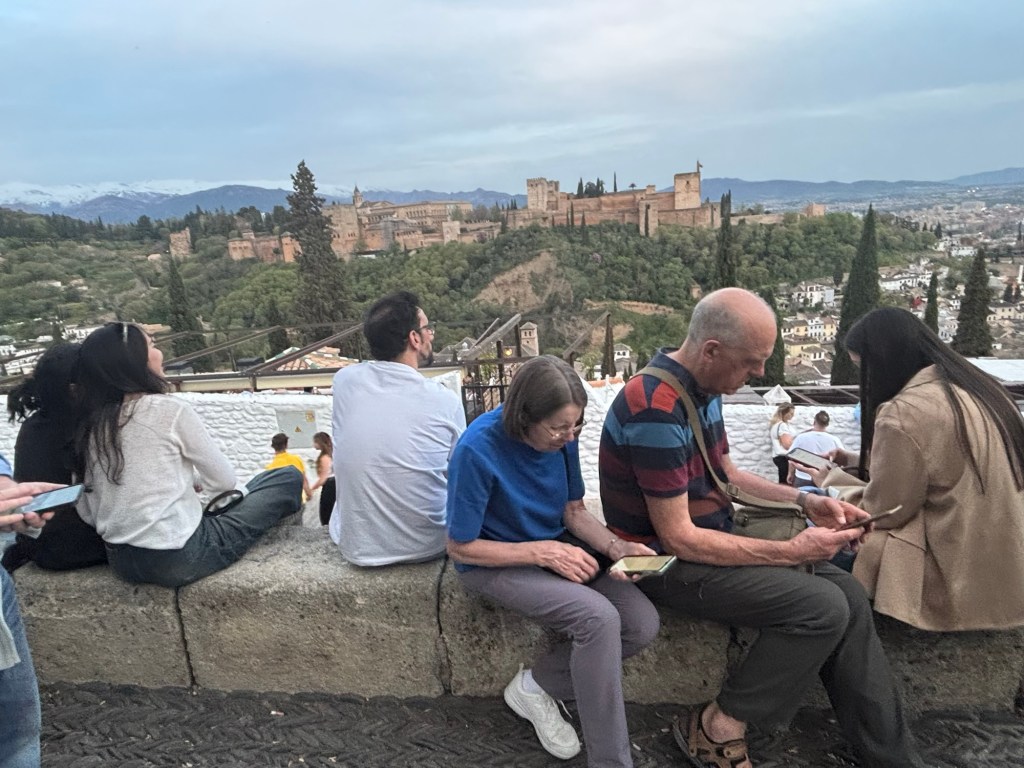
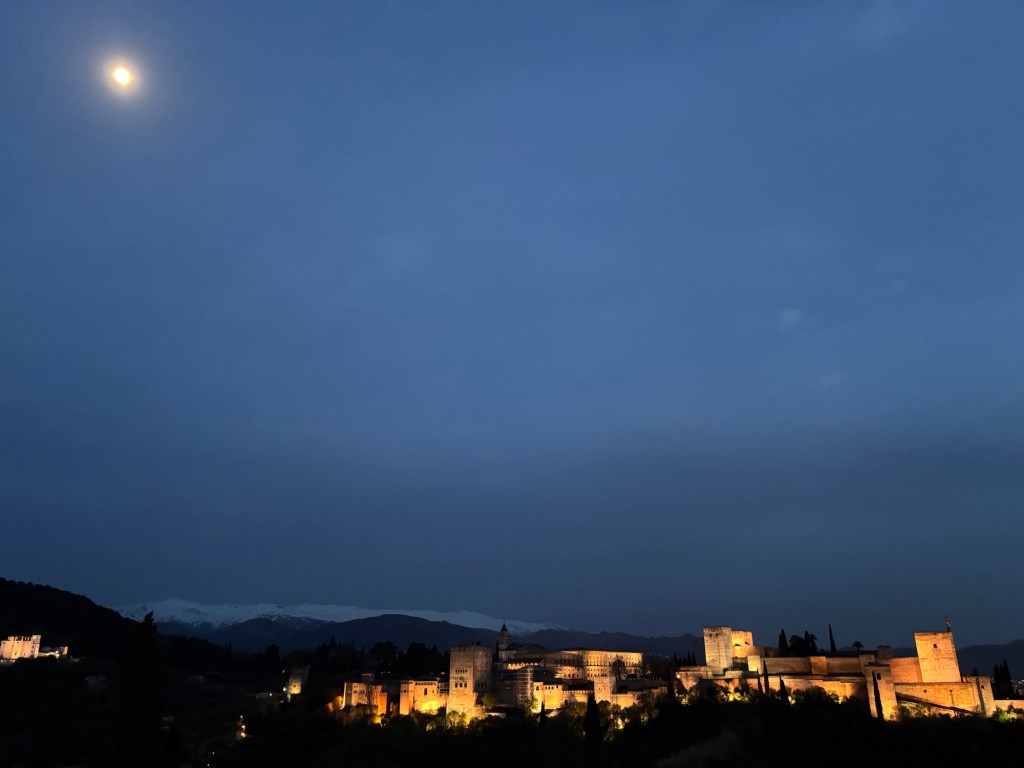
Up above, the Mirador de San Nicolás remains as busy as ever at sunset, with throngs of in-the-know tourists and locals waiting to see the spectacle of the Alhambra and the Sierra Nevada beyond bathed in red light. It was cloudy tonight, so a few of them ambled away disappointed. That at least meant I snagged a spot on the wall to sit and draw the mountains for a while. I didn’t take the camera. No need. I got the “famous” sunset photos years ago, and besides – there’s a fair bit of ugly scaffolding on the Alhambra now that wasn’t there before.


The Mirador de San Nicolás is a funny place. I imagine it’s raved about in all the guidebooks as the secret is most definitely out. There’s still a bunch of musicians here plying their trade as there were ten years ago, asking for “collaborations with the music” on the back of the guitar after every song. They’re not quite as tuneful as I remember. The men had a fair amount of duende but the girls singing along were absolutely tone deaf, which took away from the magic a little.

But not as much as the large number of folks on the wall with their backs to the Alhambra, staring gormlessly at their phones.


I must have been there for at least half an hour, because when I was finished sketching the moon was up, the Alhambra illuminated and the city lights twinkling away in the gloom of the vega below like velvet. I relinquished my spot on the wall and set off for my pensión.


On my way back, I was stopped by the piping call of a scops owl. I haven’t heard one in years, nor seen one even once, for that matter, so I set out to track it down. They’re master ventriloquists, especially in a city of infamously winding streets where their voices seem to come from all directions at once, but I did manage to follow its call to the Placeta Cristo Azucenas, where I spotted the diminutive creature as it took flight as a noisy van hurtled past. Hopefully I’ll see it again before my time here is up.


Well, it’s now 8.23am of the morning after. I’d better head into town, find a laundromat and get some breakfast. I’ve got a lot of things to see and do today – not least of all, the Alhambra herself. BB x
Under the Shadow of the Stone Pines

On a balmy September afternoon back in 2012, three friends and I were sitting on our suitcases in the bustling complex that is Heathrow Airport. We’d already played the find-the-most-expensive-item-in-duty-free game and were killing time for the gate to flare up on the departures board. We were bound for Uganda, to our partner school in the north, on what could so very easily be construed as your generic gap yah adventure. We were under no illusions as to that. Teddy made a joke about one of us ‘finding ourselves’ out there. Maddie was quick to reply that she’d already found herself right here in the terminal. That made me chuckle – probably because, with good reason, that joke about ‘finding yourself’ was squarely directed at me.

I’ll admit it. I have a habit of falling head over heels for things. Especially places. It goes with the terrain of being a self-confessed Romantic. Naturally, this obsession with location carries over into my reading. Setting is one of the first things that I look for when I read a book. Bother dialogue. Bother clever plot twists. If the cast doesn’t travel any further than their cul-de-sac then I’m out. Any author that can make the setting just as enthralling as the plot has me round their finger. That’s why I’ve always adored M.M. Kaye’s The Far Pavilions. India comes to life through her words, so vividly that at times I could almost hear it, smell it, feel it through the pages. Michelle Paver weaves a similar magic in her writing, and I earnestly try to conjure the same enchantments in my own efforts, though Spain is a fickle mistress and so very hard to please.

The funny thing about travel and this idea of ‘finding yourself’ is that no two people ever feel the same way about a place. I remember all the raised eyebrows when I used to tell colleagues that my favourite place in all of Spain was a town in the western marshes of Andalusia by the name of El Rocío. Outside of romería season, it’s ostensibly little more than a cluster of whitewashed houses overlooking a seasonal lagoon in arguably the flattest corner of the peninsula, where you can stare across the horizon and see nothing but mile upon mile of shimmering heat. And yet, there is something about that corner of Huelva that calls to me, some spell that weaved its secret magic on me a long time ago.

I’ve had the good fortune to travel across Spain a great deal over the last few years, and there are a number of contenders now for that ever-congested corner of my heart. The gorge at Ronda and the green hills of La Vera. The limestone maw of Zaframagon and the devil’s leap of Monfrague. The vast steppe of Caceres and fair Trujillo, a throne set upon Extremadura’s golden fields. The lonely silhouette of Olvera, and Hornachos, jewel in the Moriscos’ crown and once proud watchtower over the Sierra Grande. Putting my extremely biased affection for Andalusia and Extremadura into a basket, you can add the mysterious heights of Montserrat, the windmill-crowned slopes of La Mancha and the awesome majesty of the Picos de Europa that once guided the weary conquistadors home. All this, and I know I’ve only really scratched the surface.

All the same, though my heart is spread across Spain with a rigour that would reduce a piece of toast to crumbs, there is still one spot that reigns supreme over them all. If you’ve been reading this blog since the beginning, you’ll have seen it over and over again in the header up there. But in case you missed it, here it is again.

To the east of the sanctuary town of El Rocío lies the Raya Real, a sandy track that cuts through the heart of the Parque Nacional de Doñana. Once a year, it serves as the primary conduit for almost a million pilgrims who descend upon the town in colourful, bolshy gaiety (as only Spaniards can) to pay homage to the Blanca Paloma herself, the guardian patroness of the marshes. Like most pilgrimages, it’s as much about the journey as the destination, and listen to any one of the many sevillanas sung by the pilgrims and you’ll get a flavour for just how in tune they are with the world around them. What an excuse to journey through some of the most incredible scenery on God’s Earth, all while dressed to the nines!

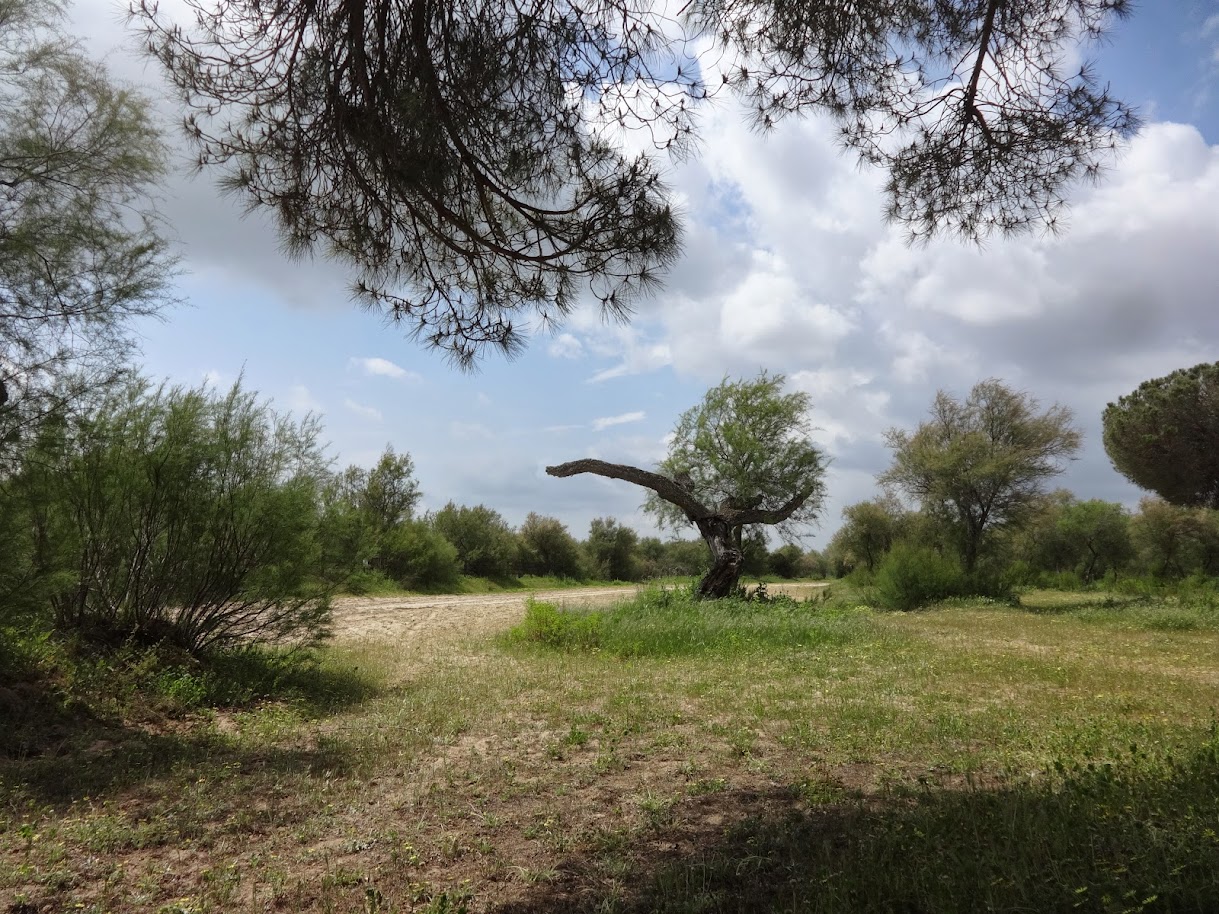
This is all romantically hypothetical, of course. I’ve never seen the Romería in full swing. All the same, there’s this one patch of the Raya Real that I can see in my mind’s eye right now, if I close my eyes for a moment. As for you, dear reader, you need only direct your eyes back up at the top of this post. It’s that tree on the left.

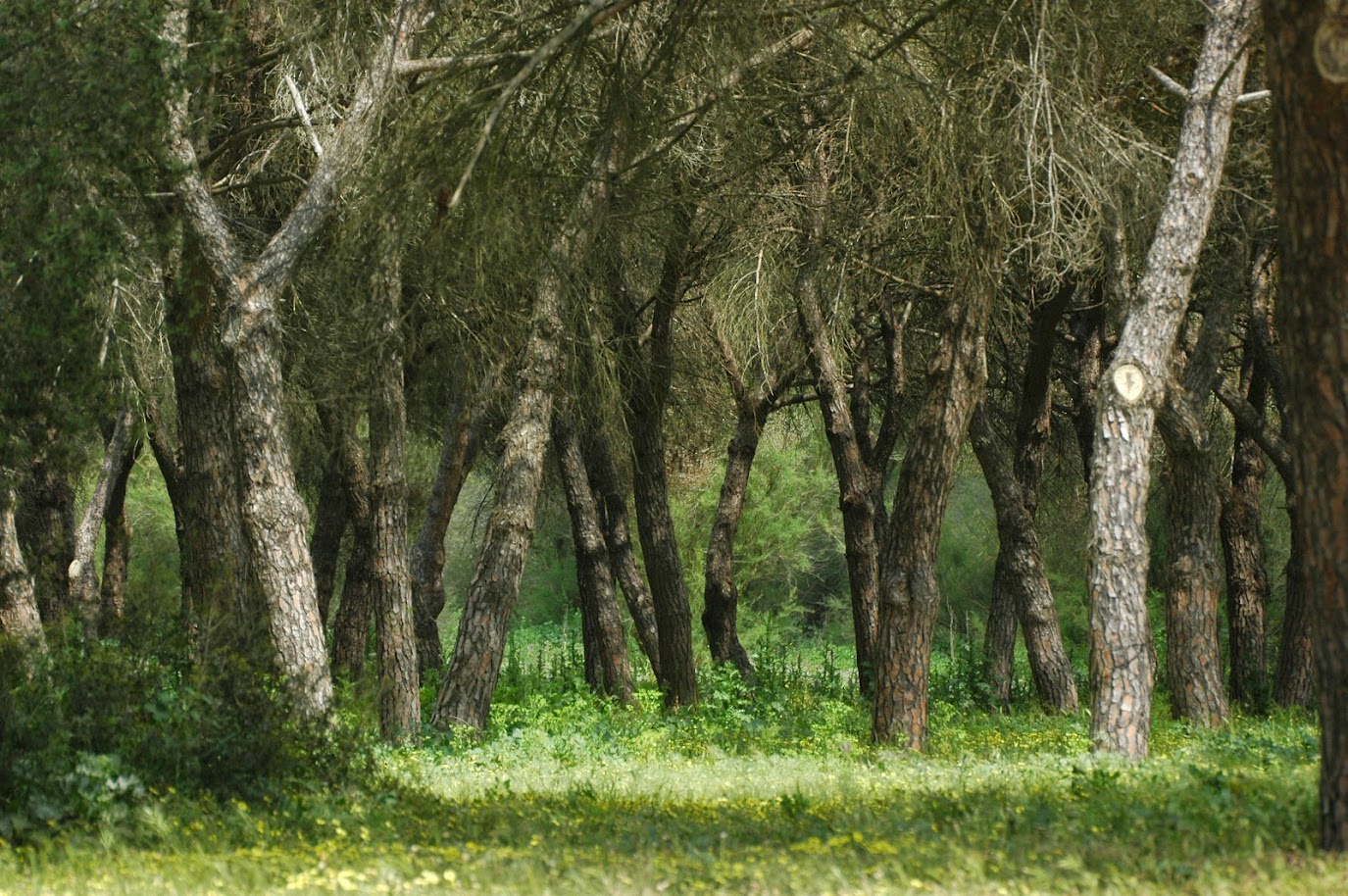
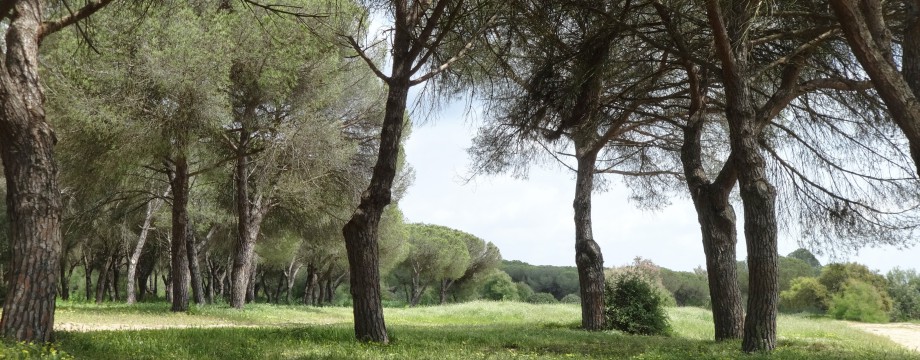
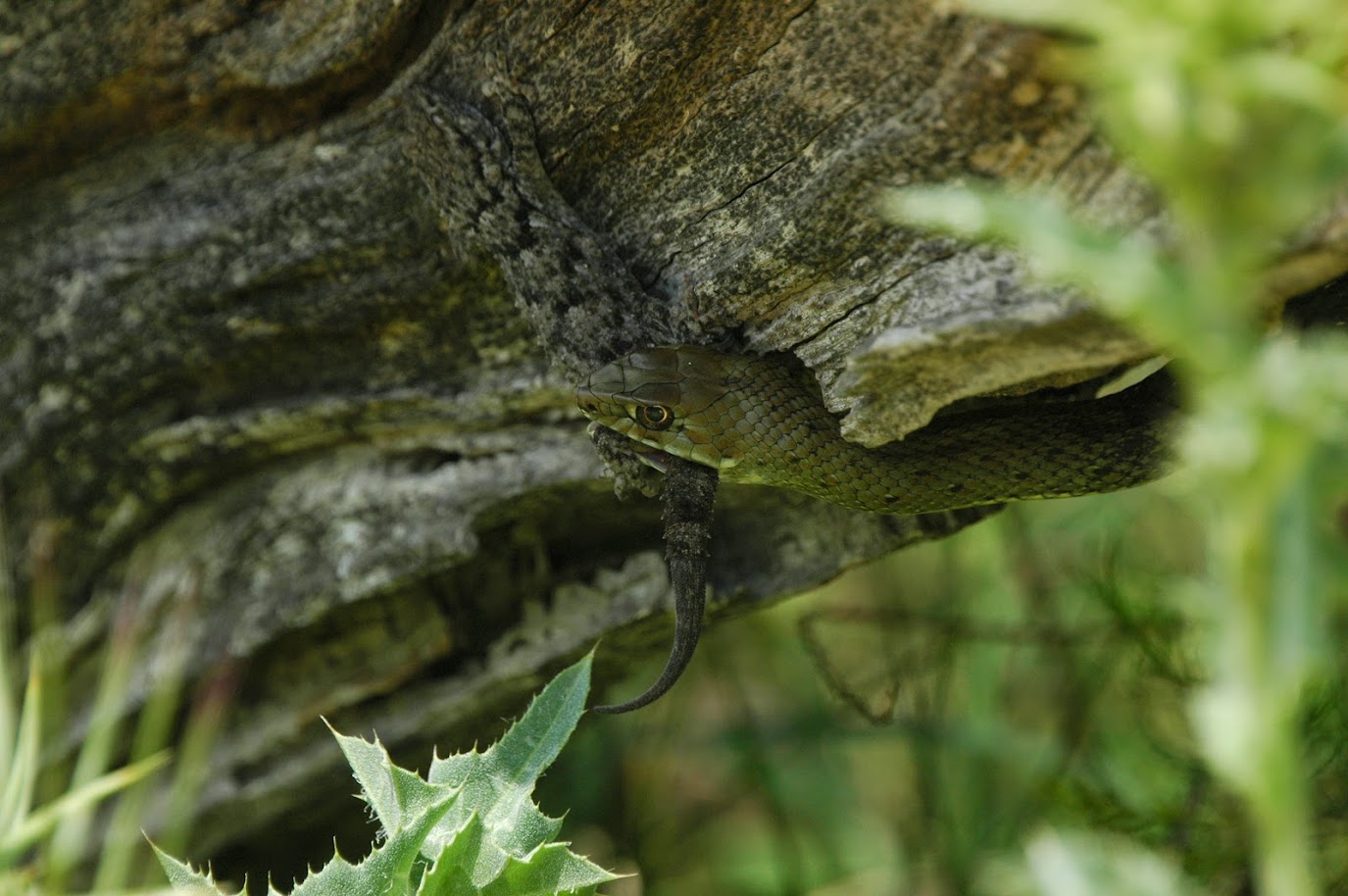
There’s a cluster of stone-pine trees (acebuches) that grow in an island of grass where the Raya Real forks temporarily, before the two tracks converge at the Puente del Ajolí, the last stop on the pilgrimage. A dead tree stands at its westernmost edge, which more often than not hides a gecko or two – I even spooked a Montpelier’s snake mid-hunt here once. A stand of ashes flank the edge of the great pinar, where cuckoos sometimes sing, and in the skies above the Raya Real, bee-eaters go wheeling and soaring in the spring, with bellies like sapphires, backs like rubies and voices like springwater.

Here, under the shadow of the stone pines, I used to sit when I was a boy and listen. After a few seconds you tune in to the silence and hear it all. The wind over the shimmering plains, the rustle of the ash trees. The whistling kites overhead and the mechanical clang of a butcher-bird in one of the branches nearby. From somewhere far off, a panzorrino (native) calling to his horses, or the bark of a dog. Open your eyes for a moment and stare into the blue, and you might see a tiny speck or two up high in the heavens; a griffon and his mate, perhaps, riding the thermals above the coto below. Just once I saw a Spanish Imperial Eagle here, soaring high above the kites below. Maybe that was the first wave of the wand for me – I was a highly impressionable novice birdwatcher at the time. And though it’s kites and booted eagles that have plied the skies on every return visit, the magic in those splayed wings is always there.

In my eighteenth year, I remember sitting beneath my tree, leafing through a copy of Lorca’s Yerma that I’d picked up in town, when a couple of horses rode down the track nearby, one mounted, one riderless. A local girl had fallen from her horse some way back and tried unsuccessfully to get back into the saddle for a few hundred metres. She asked if I could lend a hand, and so I did, giving her my hands to step up and back into the saddle. I watched them go, I heard them laugh and look back, and I went back to my tree, to Yerma and the kites. A golden opportunity to get to know the town of my dreams through its people slipped through my fingers like the sand on which it stands. I’d make some quip about the Virgen del Rocío being a jealous woman, but I really think I had my head in the clouds then and there.

Fool.

Is there a place you return to in spirit, even if you can’t be there in person? This is mine, beneath the shade of the stone pines on the Raya Real. Millions pass by that tree every year without knowing the connection I have to that singular tree, to the kites that nested in its branches once, to the snakes and geckos and their game of cat-and-mouse about its roots. And why should they, when their goal is in sight? They don’t need to do any soul-searching: la Blanca Paloma waits with open arms.

I’ll leave you with a couple of lines from one of my favourite sevillanas that conjures up some of the magic where my words fail. If you like, you can listen to it here – sevillanas should never be read when they can be sung – performed by that band which takes its very name from the road of my dreams: Raya Real.

Las llanuras ardientes de la marisma
El ganado retinto con paso lento
Se acerca hasta el arroyo que esta sediento
Seco está el monte bajo, seco está el rio
Los pastos del invierno ya se han perdido

El Rocío es un milagro, una mañana lo vi
Cuando Triana cruzaba el Puente del Ajolí

Until next time. BB x
A New Christmas

I’m back in Villafranca after a five-day sojourn in Córdoba. It was sunny when I left. The skies are grey and heavy with cloud now. There’s a strong wind in the air, and it’s blowing against the blinds, which are rattling all through the house. Olivia Ong’s bossa nova vocals fill the room, and keys click and thump intermittently as I type. Cars pass by. My family are so close and so far away. I find myself wishing I was back in Córdoba.

DSC_0622

There’s something truly special about Córdoba at any time of year. Granada is undeniably beautiful, Málaga has plenty of charm and Seville needs no introduction, but Córdoba is, surely, the jewel in the southern crown. After all, few other cities in Andalusia – or Spain, for that matter – can claim to have been one of the world’s greatest in their heyday. Like Granada, it’s been raped and meddled with over the centuries, but what remains is shadowy and beautiful in its fusion. I still get the shivers when I wander along the winding streets of the Jewish quarter, and if you stand on the Roman bridge after sunset and look towards the city from the south bank, the mosque shines like liquid gold in the river.

6319387365_2f4333ca2b_o

(No weddings this year, I took that one six years ago on a research trip here)

Normally on Christmas Eve I’d go to Midnight Mass with my mother. I could have done so here, but for me, the Great Mosque of Córdoba (or so-called Mosque-Cathedral) is like setting foot in the Holy Land. It’s an intensely emotional experience every time and I could not bring myself to open my heart in a place denied to those for whom it was far more important (have a read of this article to dig a little deeper). So I stayed at home instead, surrounded by a thousand babies on red carpets.

DSC_0623

Christmas Day in Spain came with the ringing of the bells across the city. Clouds drifted in from across the Sierra Morena, but as the day went by, sunlight came streaming down through the odd pocket here and there. I’ve never had a Christmas quite like it, but it was wonderful in a new way, seeing Christmas Day celebrated from start to finish in a very different family. We get glimpses into Christmastime when we visit friends and family, but it isn’t often you get treated to the whole twenty-four hour affair.

Doubly so, perhaps, when the food is also very different, too.

DSC_0643

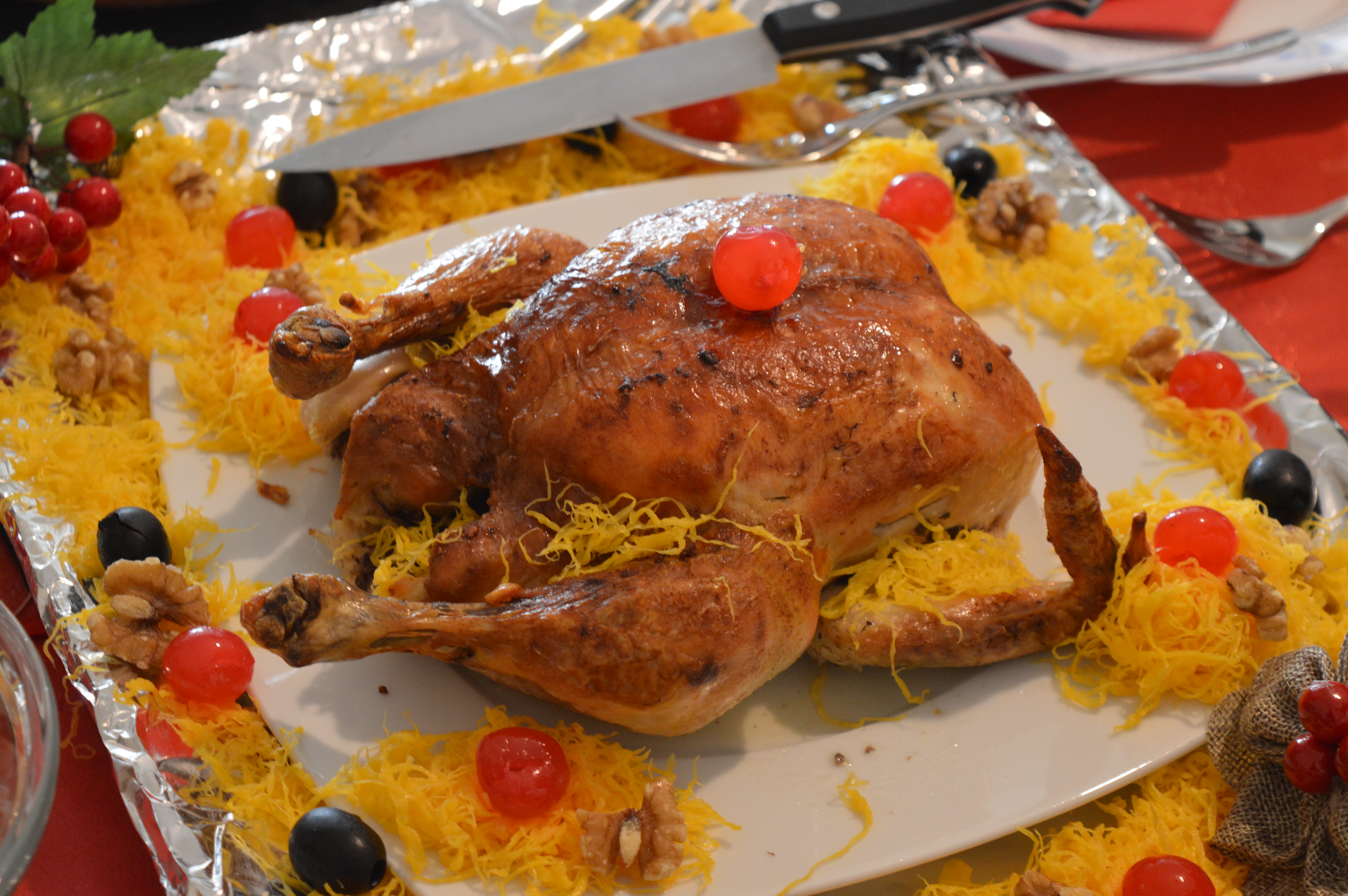
Roast chicken with fios de ovos –

Córdoba is one of those cities that is well worth a prolonged stay. That’s where AirBnB comes up trumps. For a short time, it’s as though I was living in the former capital of al-Andalus. Like most Spanish flats, the building looked unimpressive and samey on the outside – many of them are so identical as to fool you into thinking they’re carbon copies – but on the inside it was dreamily homey. Just what you need at Christmastime!

DSC_0686

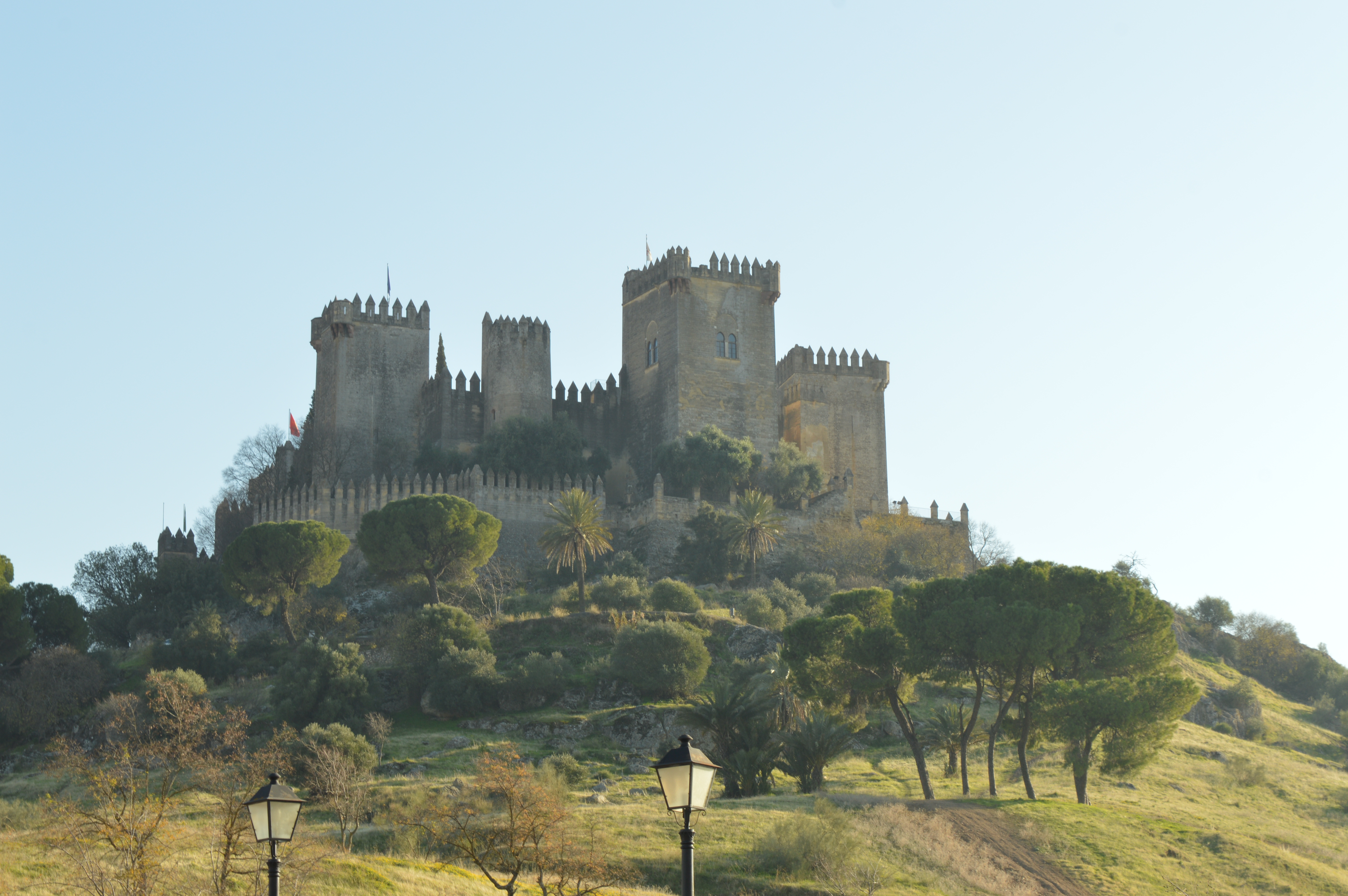
A short distance to the west of Córdoba, perched atop a formidable hill overlooking the Guadalquivir valley, is the castle of Almodóvar del Río. At a half-hour’s drive from town, and just ten minutes beyond the ruins of Medina Azahara, it’s well worth the trip for the day. Lovingly restored at the savvy hands of Adolfo Fernánez Casanova, it makes a welcome change from the rubble of the surrounding ruins. There’s also a fantastic asador at its feet that provides the perfect opportunity to wait out the hours until the sunset. I recommend the brocheta. It’s nothing short of divine.

DSC_0360

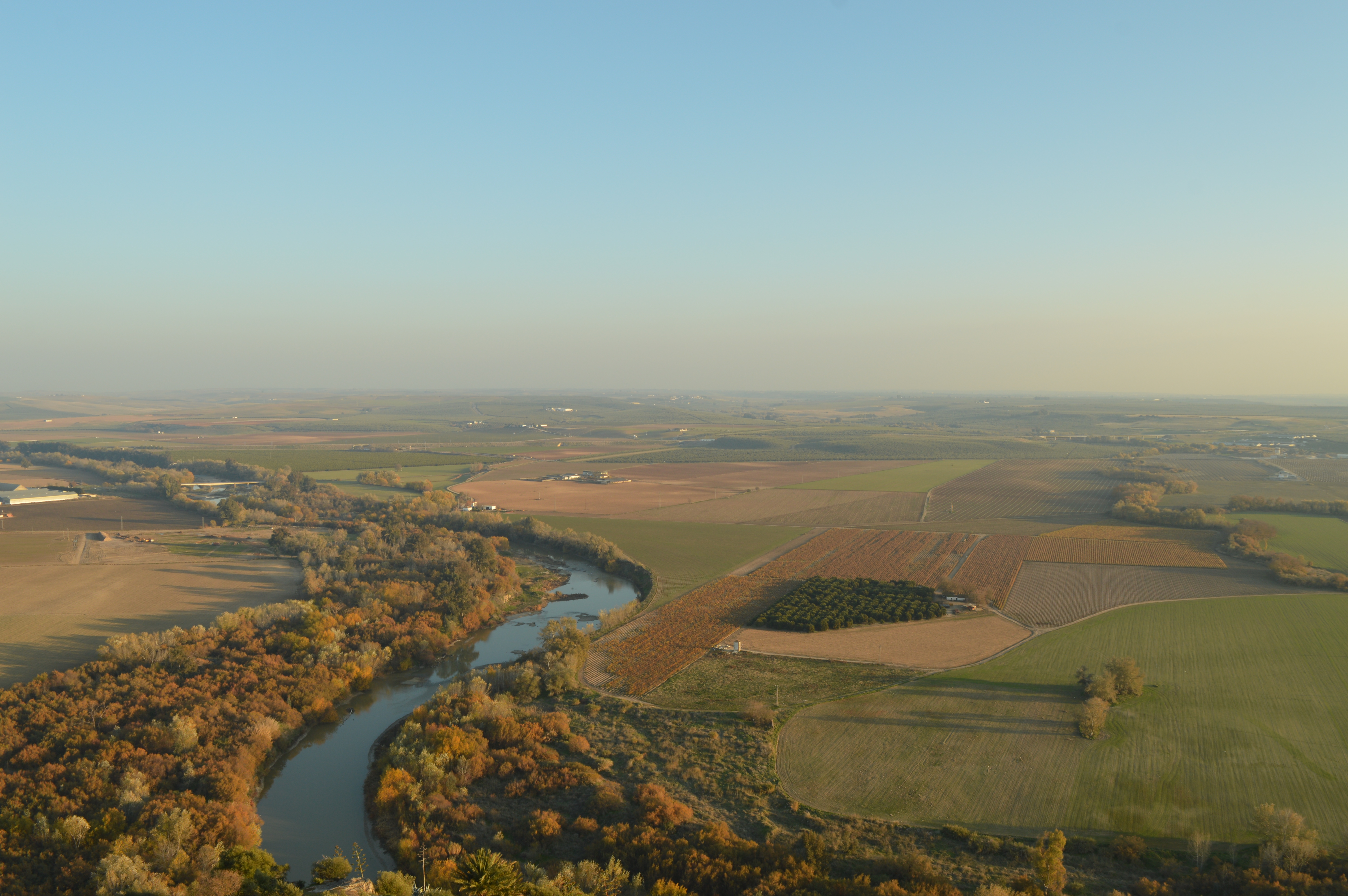
And that, of course, is precisely what we did. And we timed it just right to catch the winter sun as it was on its way down over the hills to the west.

DSC_0362

The fields around Almodóvar made Tierra de Barros feel like a barren wasteland. Crag martins zoomed about the castle walls, soaking in the last of the sun’s heat on the buttresses. Egrets and herons stalked the river, a single vulture flapped lazily overhead and I swear I heard the piping trill of a kingfisher. Best of all, within the space of five minutes I saw three black-shouldered kites on the road to the castle, a delicate, stunning little hawk I’ve never laid eyes upon with certainty before. I might just have to come back in search of them one day. In my books, vultures will always be king, but kites are the princes of my feathery kingdom. And what princes they are!

DSC_0379

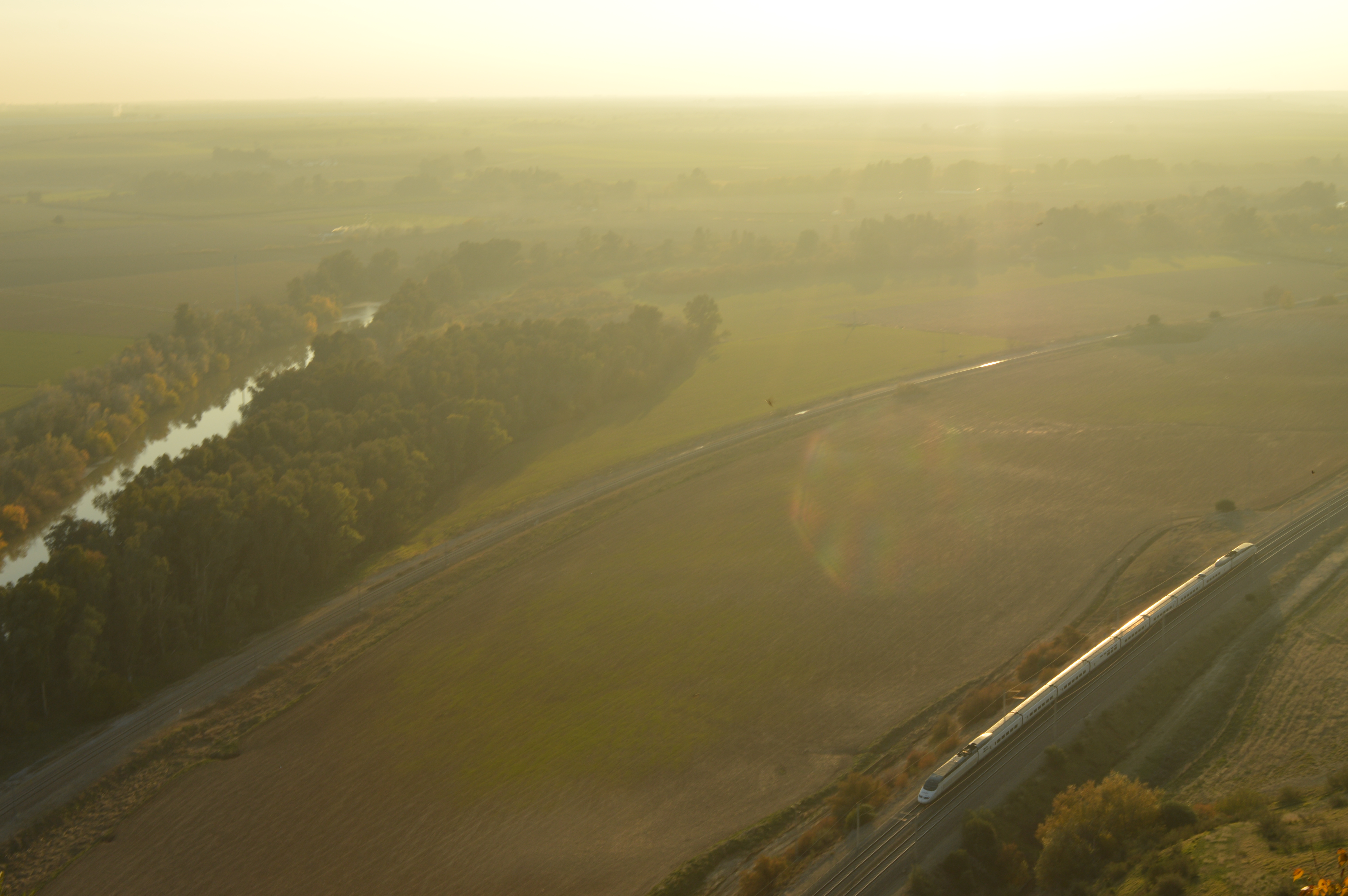
A couple of trains shuttled back and forth as we waited for the sun to go down. I haven’t travelled much on Spain’s train network. Besides the short trip I took with Kate in Cantabria last time I was here, the only train ride I’ve ever taken here was the one from Ávila to Madrid. I’m told the railroad passes through some truly stunning scenery. Perhaps I should give it a go someday. It’s something that yet to come our way (see the Tren Digno Ya cause for more) but in other parts of Spain, it’s a doozy.

DSC_0487

Winter sunsets. Moorish castles. Mosque-cathedrals. Rolling hills. Night herons, kingfishers and cranes in the cornfields in their hundreds. The entire province of Córdoba is a jewel. If I could say for certain that I’d have a shot at being placed here, I’d be sorely tempted to put Andalucía higher up on my list for next year. But I stand by my beliefs: comfort is dangerous. It’s time I thought about moving on, before I take for granted what I have here. Spain is more than one city. She is more than one province. And, if the last few months have taught us anything, she is, quite clearly, more than one country. The city of Córdoba alone is proof enough of that. Vamos, kid. It’s time to see the rest of this land. BB x
DSC_0577

Don’t Mention the Catalans

It’s 21.14 on a Sunday night, I’m still a little sleep-deprived and mulling over how I can make my lessons on Illness and Disease interesting the third time around for my 2° class tomorrow morning. As for news, I more or less wrote this Puente off as far as traveling is concerned. After briefly toying with the idea of a flying visit to Galicia to investigate its potential for next year, I decided instead to stick around and stick to my writing.

At least, that was the plan. But if life’s taught me anything, it’s that planning to take the emptier road usually leads to getting involved in more than you bargained for.

DSC_0276

And then Archie and Viresh showed up in Seville.

DSC_0279

It’s been far too long since I last saw these two fantastic comrades of mine, so it was a wonderful surprise to hear that they were on their way to Spain at the very time I had off! After the singular honour of being here to welcome Biff and Rosie, little could have made me happier than to be here to welcome more old friends. Leaving England and my friends behind has not been easy, so it’s magical moments like this that make the decision all the easier.

DSC_0290

The Belén market is in full swing, and the city air is thick with the smell of turrón and roast chestnuts. It’s Christmas in another country. The city was packed to its limits this weekend with the rush of Christmas shoppers and holidaymakers taking advantage of the Puente de Diciembre to get their money’s worth. Rather than spending two nights in the city – impossible at such short notice – I took the equally-crowded bus home and returned early the following morning, which worked out cheaper than even the cheapest hostel on offer, had there been any on offer at all. That’s LEDA for you. Thank heavens for the bus network.

DSC_0280

Between the catching-up, the memory-sharing and the tapas, we decided to hit the town at night, something I’ve never done before. From careful inspection I can report that Alfalfa is a fantastic place to start when looking for both decent restaurants and music bars. We found a nice spot where two groups of partygoers had broken out into song. I’m not sure whether your average Englishman takes a guitar on a night out, nor whether he can expect not just his friends but half of the bar to sing along with his songs, but it was entertaining to watch. If I knew any sevillanas, I’d probably have joined in, too.

I learned a lot about India that I didn’t have entirely clear from Viresh this weekend. My knowledge of the Indian subcontinent is bitty at best, gleaned in pieces from a DK Guide to World Mythology, Age of Empires III, The Far Pavilions and Valmik Thapar’s Land of the Tiger series, amongst other chance encounters. So to have both the traditional Indian wedding ritual and the Ramayana summarised – the latter in a mere ten minutes, the former stretched (rightfully so) over the best of an hour – was a real privilege. My love for India is sufficiently rekindled. I think it’s time I re-read Pavilions, too.

DSC_0301

In one of the bars, we got talking to a chatty Sevillano and his friends, who were quick to out us as guiris… Apparently only an Englishman would wear a Valecuatro jacket (I’m not sure how that works, since Valecuatro is a brand we can’t get hold of in Albion, but that’s beside the point). Archie decided to joke with him that he was actually Catalan, which made the guy unnecessarily angry. Before my eyes, it got out of hand very quickly, with the Sevillano hurling abuse at Archie and, by default, the Catalans at large, calling him a ‘puto guiri’ for ‘defending something he knew nothing about’. Hardly fair, when the guy studied Catalan for three years and lived with a Catalan family for several months last year. It’s not the kind of timeframe which makes one an expert on Catalan affairs, but it is a great deal more than knowing ‘nothing’.

It’s a telling response, though. That the very mention of Cataluña should provoke such a hostile reaction from a young Andalusian tells you a lot about the underlying anger resulting from the events of October. Not that Andalusians have a particularly sturdy leg to stand on – they, too, have their fair share of separatist stories, such as the Green Banner Revolts of 1642 – but the Cataluña question still has the power to raise hackles here. I wonder where my grandfather stood on the matter, having relinquished his family home in La Mancha to make a living on the young Costa Brava…

Christmas is coming. I felt naughty and opened a couple of Advent calendar chocolates two days in advance when my energy was running low. I’ll make amends for that in one way or the other over the next few days.

I do hope you Brits are enjoying the snow. BB x
DSC_0306

P.S. I have a bike! After months of half-hearted searching, I finally have a sturdy little mountain bike at my disposal! Hornachos, I’m coming for you!

The Best Margherita in the World

It must be time for the second half of Biff and Ben’s Andalusian Adventures. Apologies for the delay; work is picking up speed fast, just like it always does. Private lessons are adding up now. I look after a group of kids for an hour twice a week and suddenly the whole town is in on the game. It won’t be long before my previously timetable is fully booked, perhaps even more so than the last time I was here. The way things are going, I might even earn more than that year, too: private lessons pay a lot more in the long run than a regular assistant’s hourly salary.

So, after spending an enjoyable sunset watching bats skimming low over the water in the town park, I thought it was high time I got this post out of the way so I can justify giving you weekly musings and updates – which, I maintain, always make for much more entertaining reading than another ‘wish-you-were-here’ travelogue.

That said, here’s one such adventure.


After a day wandering about Seville and discussing the pros and cons of Salvation, I thought we could do with a trip further afield. Through our AirBnB host Emma we managed to rent a car at less than twenty-four hours’ notice. It took some doing, but we did it. All we had to do was decide upon a destination. It took some convincing, but I managed to dissuade Biff and Rosie from visiting El Rocío. Why they alighted on that one in particular is beyond me. I suppose the fact that I’d name-dropped the place for years and years had something to do with it. At any other time I’d have loved to show off my favourite Spanish lady, but after a year of bad droughts and worse forest fires, she’s hiding her skirts in shame at the way she’s been treated. I can only hope she finds her smile again.

Emma looked horrified when they mentioned their plans to her, pulling the same pained expression most Spaniards seem to pull whenever you mention you’re headed for Huelva (“but… why?”). I spent most of the night and a good twenty minutes of the morning making other plans and, over breakfast, I posited a route through the Serranía de Ronda an alternative. They took the bait. Thank the Lord.

With Biff at the wheel, we reached the intersection and headed east, instead of west. Towards the mountains. Always a good direction to be going in. There was a strange black fog over the town of Dos Hermanas as we left Seville behind. Not sure what that was all about. Time to head up into the mountains where the air is clear.

DSC_1107

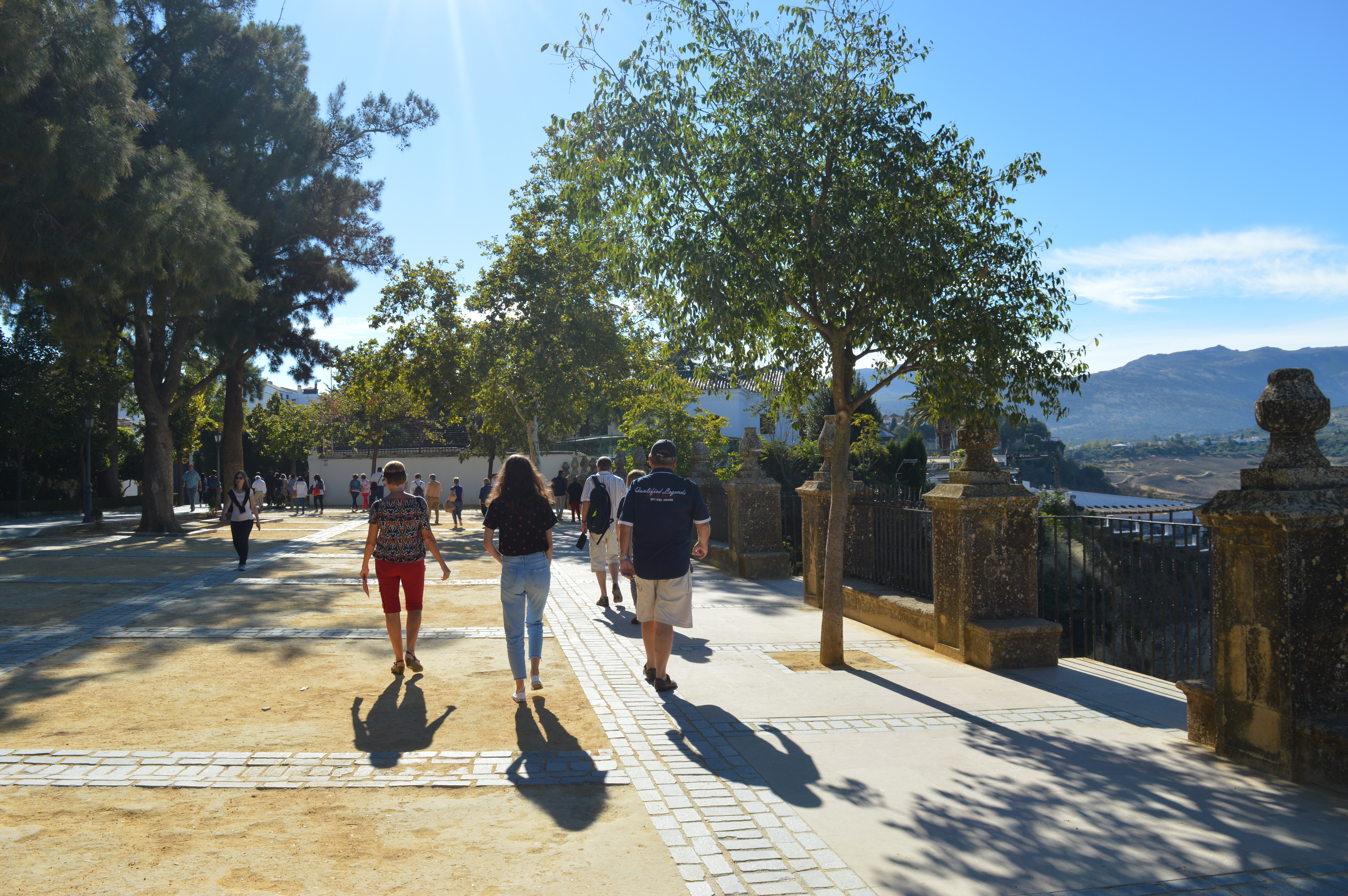
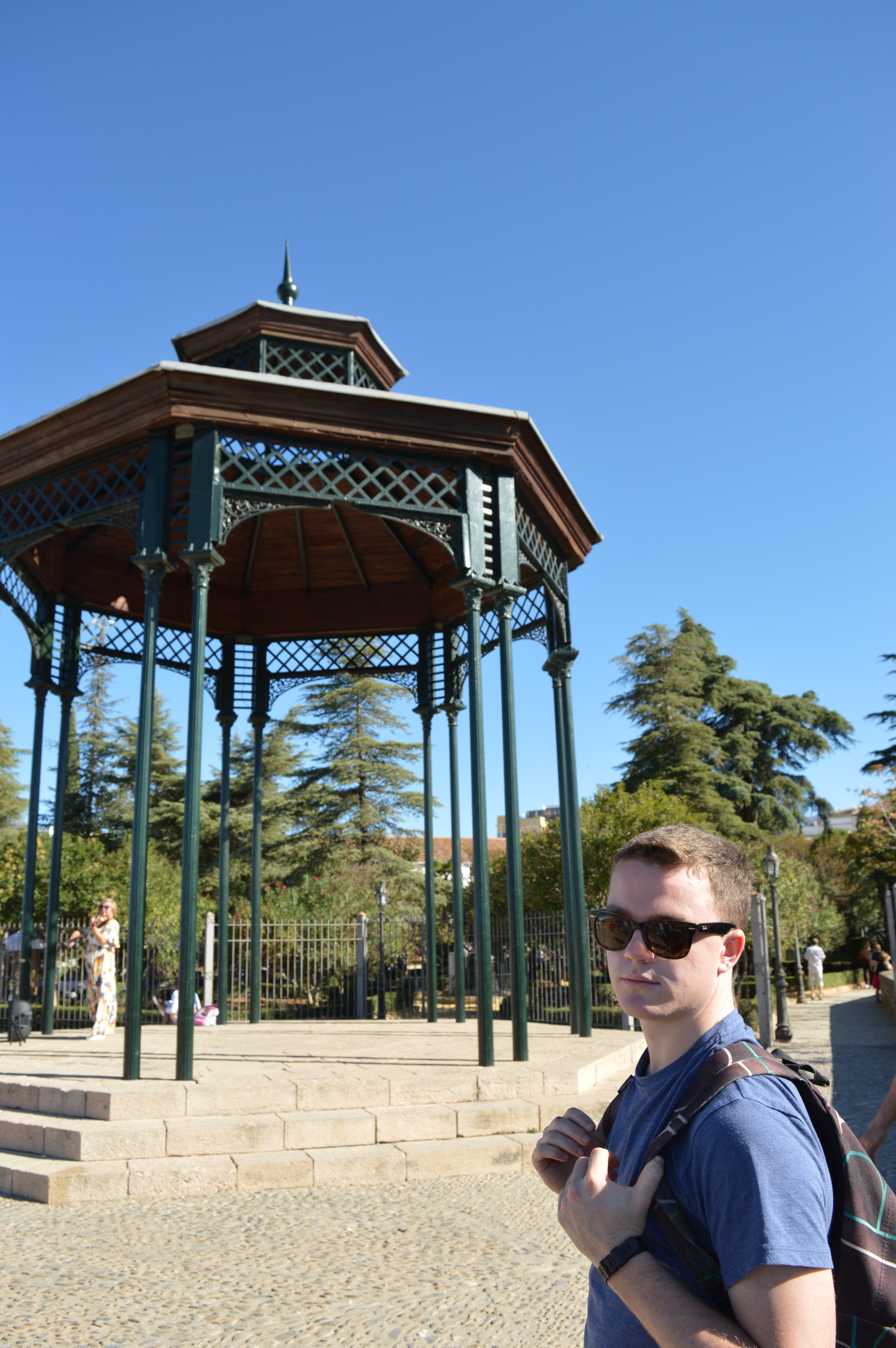
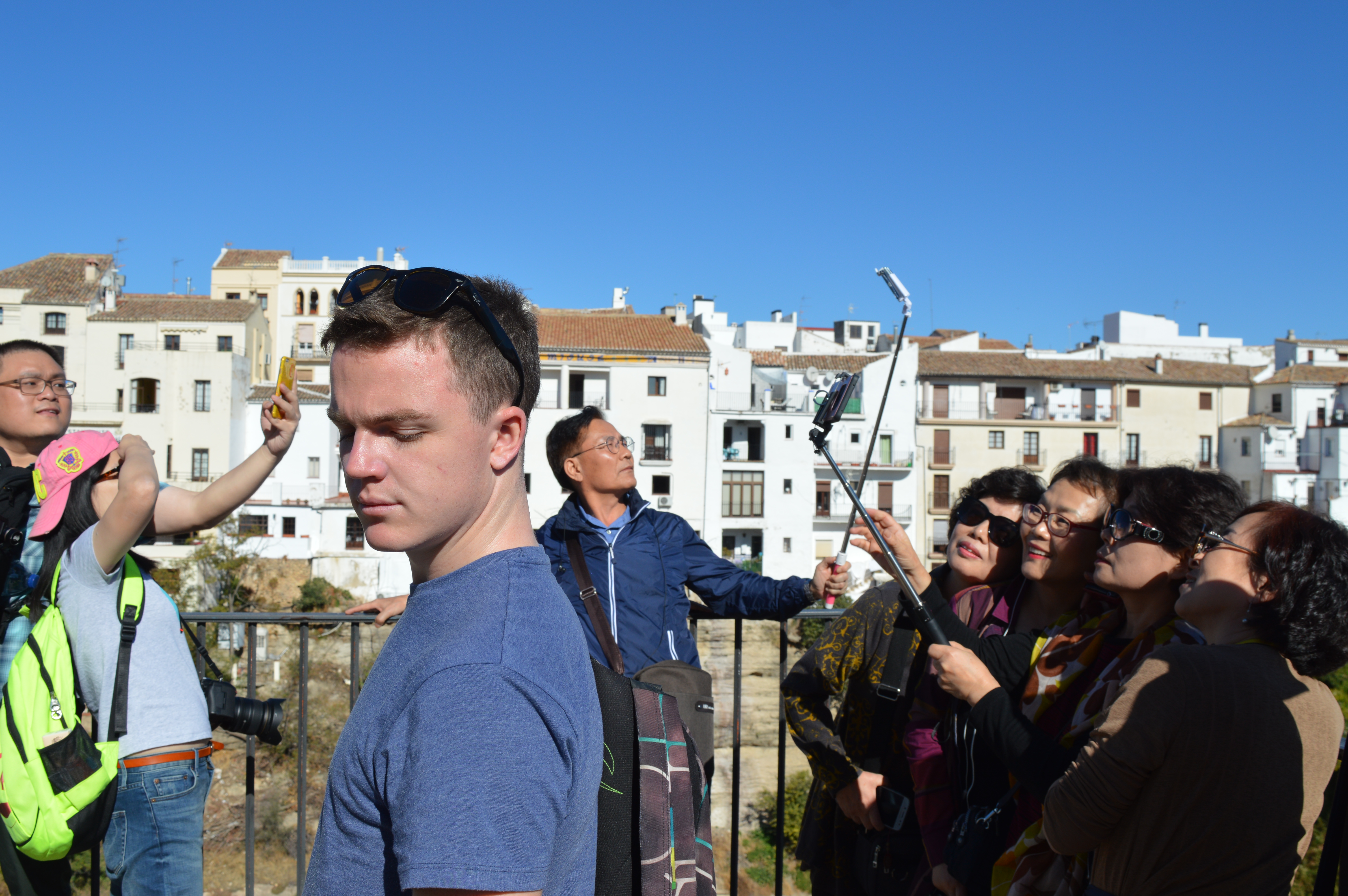
Ronda. It’s been ten years. It’s been more than ten years. And still I remembered my way about that most beautiful town, truly the jewel of the Andalusian sierras. Little wonder the famous bandoleros made the sierras around here their home. A guitarist and his accompanying dancer plied their trade before the balcony on the park promenade. A horde of Spanish tourists marched down the walk towards us, the noisiest of all the world’s sightseers. And now they’re armed with selfie sticks. They seem to be one of the few things the older generation has learned how to use – and discovered to be much to their liking. God help us all.

DSC_0006

We had plenty of time and a lot of shadows to kill. So we meandered along the cliff wall in the direction of the famous bridge, whilst I explained how GHOTI was fish and Biff threw me for a loop with the seven pronunciations of -OUGH. Trust me, when you’re in the English teaching trade, nuggets like these are fun. I’m serious.

DSC_0011

Or at least, they are for me. Biff may have other ideas

Rivalling the Spanish tourists in town were the Asians, who had come in great numbers. And upon the battlefield of the bridge, where Spanish and Asian met, selfie-sticks held aloft, it looked as though two armies wielding pikes were set to clash. It was rather difficult to find a good spot without crossing somebody’s line of fire, I can tell you.
DSC_0021

What’s wrong with a good landscape?

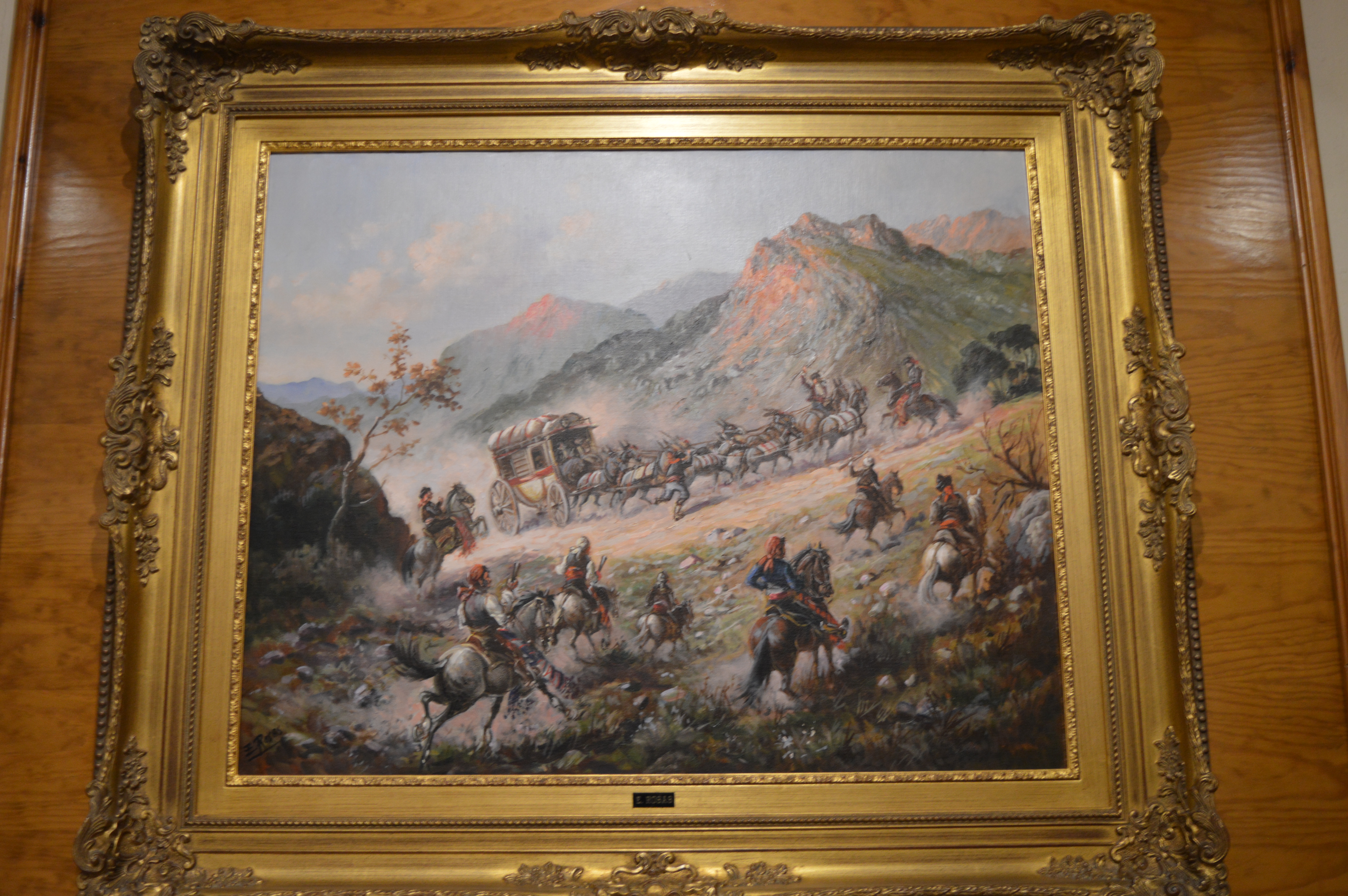
We passed the homage to the Romantic Travellers of Ronda where, despite the relatively sparse decoration, the selfie stick brigade was back in force. A little further on, past a curio shop and the Museo de Lara, we stumbled upon another blast from the past: the bandit museum. Had I had half a brain I would have made it priority number one to visit this little establishment whilst writing my TLRP on bandits two years back. I didn’t, and I still nabbed a decent 85% (thank you, Google Books), but boy, do I still wish I had! The place was a gold mine and – to my surprise – it didn’t drive Biff and Rosie out of their minds. On the contrary, they even seemed to enjoy the visit! Which made me happy. Though perhaps not as happy as having the chance to see an entire collection of bandit knives…
DSC_0041

Lunch – at Gastrobar Déjà Vu, directly opposite the museum – was spectacular. I haven’t eaten so well for so little since Amman’s Bab el-Yemen. Twelve euros for ten tapas. And that’s ten home-made, local produce tapas. Insane. England, please look and learn. Tapas shouldn’t cost more than three to four euros a head, if that. Not seven. Please remember that.

DSC_0064

Ronda’s streets look stunning under the azure sky, but it was the gorge we came to see. And this is where my ten-year-old memory failed me a little – because the last time I came here, I’m almost certain the path beneath the cliff wall went no further than a few metres or so.

DSC_0067

Not anymore. I guess Ronda must have hit the bigtime on the tourist circuit, because the track down to the gorge is in a brilliant state, complete with Via Ferrata routes, ropes and little cairns left by daytrippers here and there.

DSC_0144

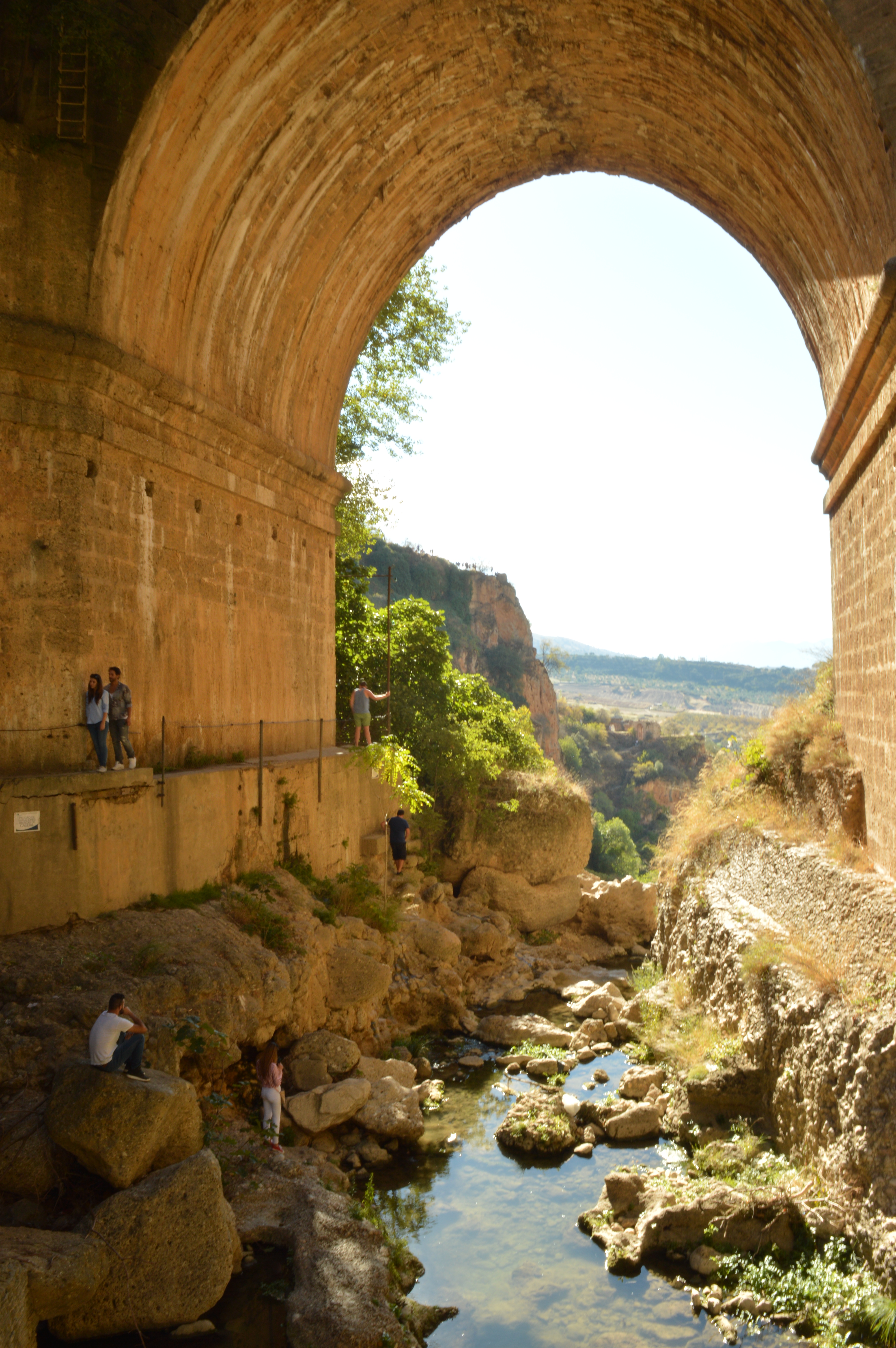
I could have sworn the Tejo river itself was polluted and closed off the last time I was here. Not so anymore! You can wind your way down the gorge and walk along the river valley, looking up at the bridge high above. It’s quite a surreal experience, and very humbling. The bridge looks enormous from on high, but it’s nothing compared to how it looks from below. And when you’ve got the sierras beyond framed by the archway…

DSC_0166

…I could hardly ask for more.

The only anomaly of the excursion was the well-hut a short way out on the other side of the gorge. Because, if memory serves, I remember getting as far as a small building like that when I was twelve years old… though this one lies so close to the waterfall at the bottom that one might as well be there already. I wonder just how far I got?

DSC_0192

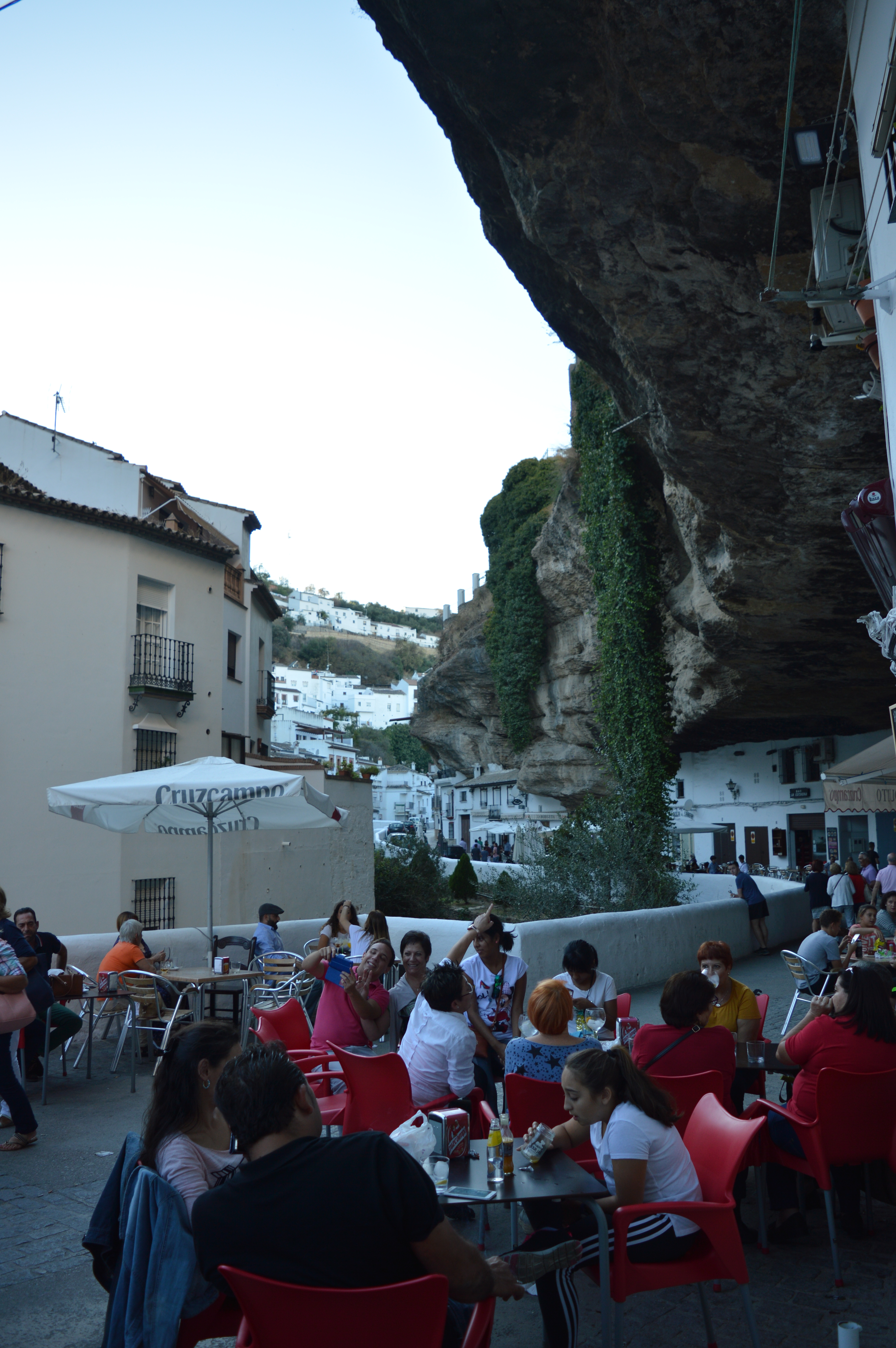
From Ronda we took a meandering north route home via Setenil de las Bodegas, another gorge town where the denizens decided to build under and over rather than just over. It’s well off the beaten track, and well worth the visit. The sun was quite low in the sky by the time we got there and much of it was in shadow, but as Biff pointed out, you could definitely feel the difference between the warmer, sunlit side of the street, and the cooler, forever-shaded side. Enterprising people, these Andalusians.

DSC_0221

The road home to Seville took us on a beeline towards a sight which is now very, very familiar to me: the silhouette of my old home, Olvera. The road from Setenil offers perhaps the best view of the town for miles around. So despite my better judgement, Biff and Rosie convinced me that we needed to pay it a visit.

So we did.

DSC_0248

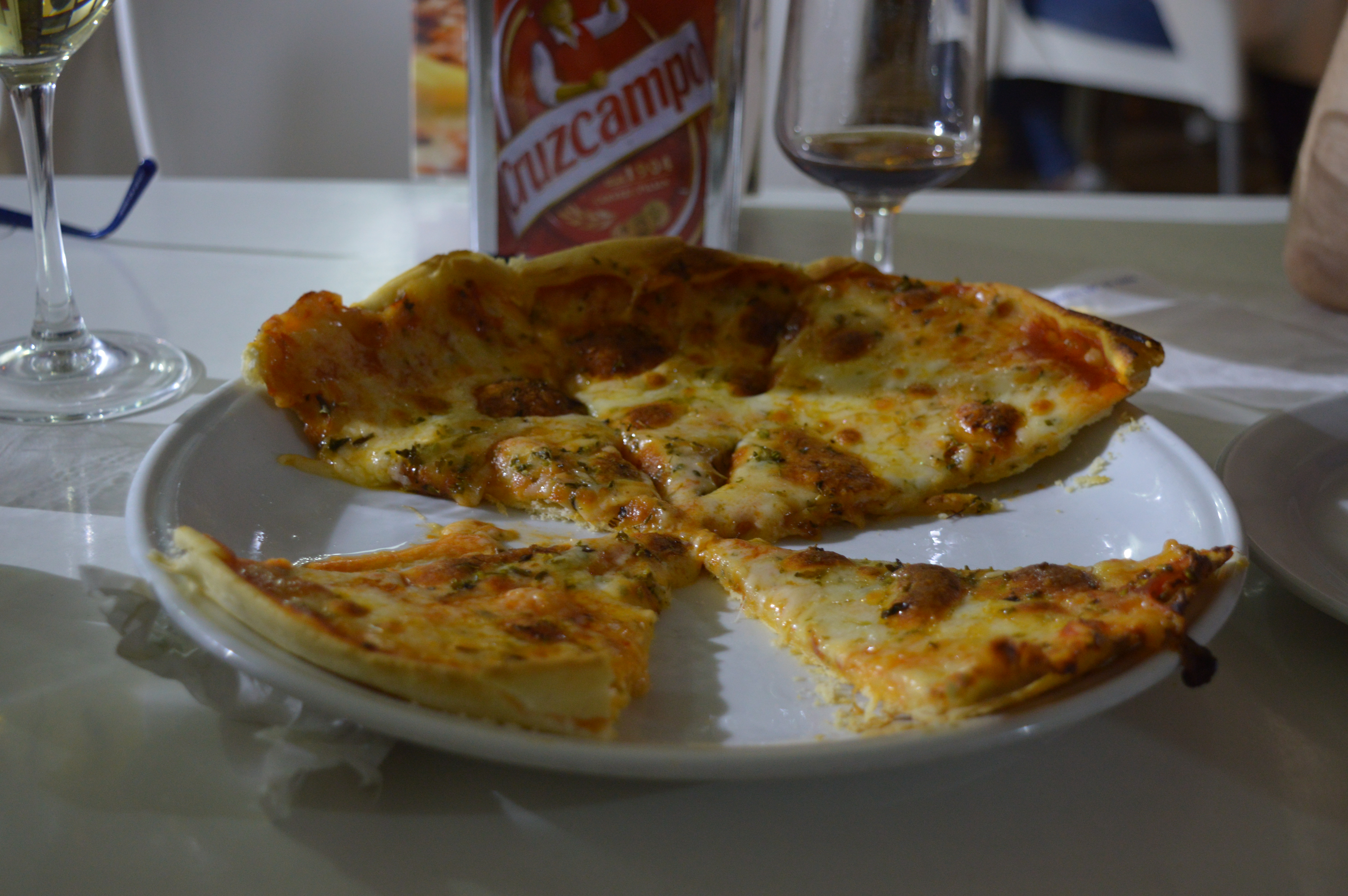
It was decidedly weird to see Biff – my oldest and closest friend – walking down the streets of a town which, until now, has stood like an island in my life, a year away and apart. Worlds collided. And I said as much several times. So, to recover from the weirdness of it all, I suggested dinner at Bar-Restaurante Lirios. And there’s a decision I had no second thoughts or qualms about. Because Lirios, in my humble opinion, serves up the best margherita pizzas in the whole world. And that’s worth travelling all the way over the hills and across the sierras for. I usually order margherita whenever I’m out at a pizzeria to see if anywhere can do it better. Having not been to Italy, my options have been limited, but thus far, I’ve yet to meet Lirios’ match. When last I came to this town, it was in search of an old flame of mine. Frankly, I missed a trick. What was really calling to me over the distance of years was not a brown-eyed beauty, but a well-seasoned pizza. As with most things in Spain, and in life, I suppose, it’s the simplest pleasures that speak the loudest.

DSC_0263

I’ve no travels on the books as of yet. The bike hunt is still in progress (I put a busy WhatsApp conversation on silent at just the wrong time), and I’m still waiting for a day when I have the time and the lack of errands to allow me to find a bike to take me to Hornachos and beyond, that prince of towns.

It’s winter, now. This morning was bloody cold. I almost got my scarf out of the drawer. It won’t be long until I’ll be less hesitant. Autumn lasted for a grand total of one week and three days. Fran’s complaining about the absence of an enagua for the table, and I have a cold. Summer’s finally taken her leave. Winter has arrived. BB x


Crash and Burn

Galicia’s forests are burning. They suspect foul play. Somebody somewhere truly does like to watch the world burn. Here in Villafranca, we were woken by the long-awaited crash of a thunderstorm, the one that usually rolls around on the second weekend of October. It was late this year, but it came nonetheless, and it came down hard. For just an hour or so, the roads were rivers.

Aeolus had more than the winds of wrath in his bag this morning. Some five or six staff are leaving for Seville tomorrow, perhaps for good. A bag of a very different nature – a bolsa extraordinaria, to be precise – has been opened there, offering the chance for many wayward Andalusians scattered to the far regions of Spain to return home. It’s no guarantee, but as the sudden glut of places for maths and science teachers overrides the need for success in the all-important oposiciones (the national exams that decide the fate of teachers here) there’s everything to fight for. My housemate was one of those called up. He packed his bags and left twenty minutes ago. He left some yoghurts in the fridge and a towel in the bathroom – ‘por si acaso‘.

For a few hours, I was in freefall. I made a stand here when the going was good in Almendralejo, adamant in my decision to improve my Spanish and stay true to Villafranca. It looked as though it had paid off. Two and a half weeks in, the storm broke, the floor vanished and I found myself staring into the abyss. Strong-armed out of the storm by a savvy Argentinian, I’m back on dry ground for the time being. After the ride that the last three days have given me, I’m lucky to be where I am, to know the folks that I do. It could be a lot worse. I could be in Galicia, where the fires rage, or Catalonia, where the cold arm of the state has begun to descend upon the separatists. It’s quite the year to be in Spain.

The storm isn’t over yet. The clouds were building thick and dark over the mountains to the east as I made my way home. We’re due for another night of thunder and lightning, and a lot of rain. Aeolus hasn’t done with us yet. But I’ve got the sails drawn and my hand on the rudder this time and I’m ready to ride it. That’s quite enough being blown about for one month. A handful of the staff were after some ‘Inglés de la calle’ at the staff lunch yesterday. Well, here’s an old classic for you, folks. Aeolus, come at me, bro. BB x