Dust and Ashes

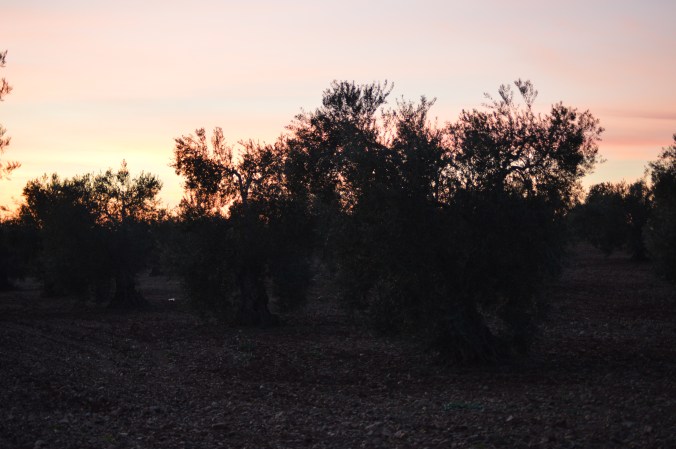
I watched a house being torn down on my way home yesterday. The sun was setting behind, casting beautiful golden rays through the dust as the maw of the digger ripped the walls apart. Destruction is an odd thing to witness. It obviously has its pull; there were some four or five others standing by who, like me, had paused in their perambulations to watch: an old man, a chap in blue overalls, a man and his dog, a mother and her daughter, and me; all of us gathered there to witness the last moments of a 60’s flat block. The walls came down like sand.

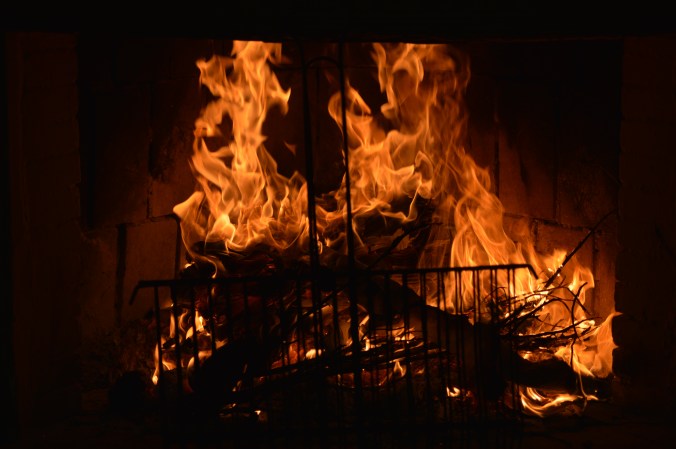
I once heard it said that it can be a thrill to watch somebody on a downward spiral. I never did understand what it meant, though I suppose it’s along the same lines as the death of the flat block. It’s a spectacle. We don’t pay to see movies where the hero overcomes every single obstacle and has a wonderful life thank-you-very-much, with no end to his or her wish-you-were-here lifestyle. We want to see suffering. We want to know they’re as vulnerable as us. And if they succeed, and they don’t always succeed, we want to know it came at a cost. Nobody is invincible, but everybody is human to some degree. It’s about what rises out of the ashes, rather than the ashes themselves.

I’ll have to think about that downward spiral case some more.

DSC_0012

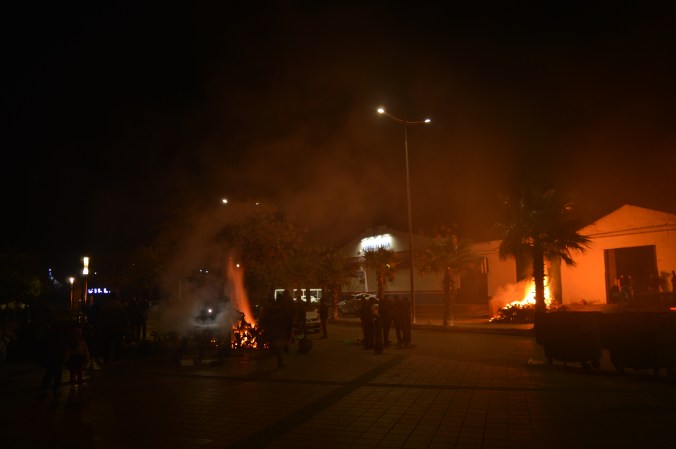
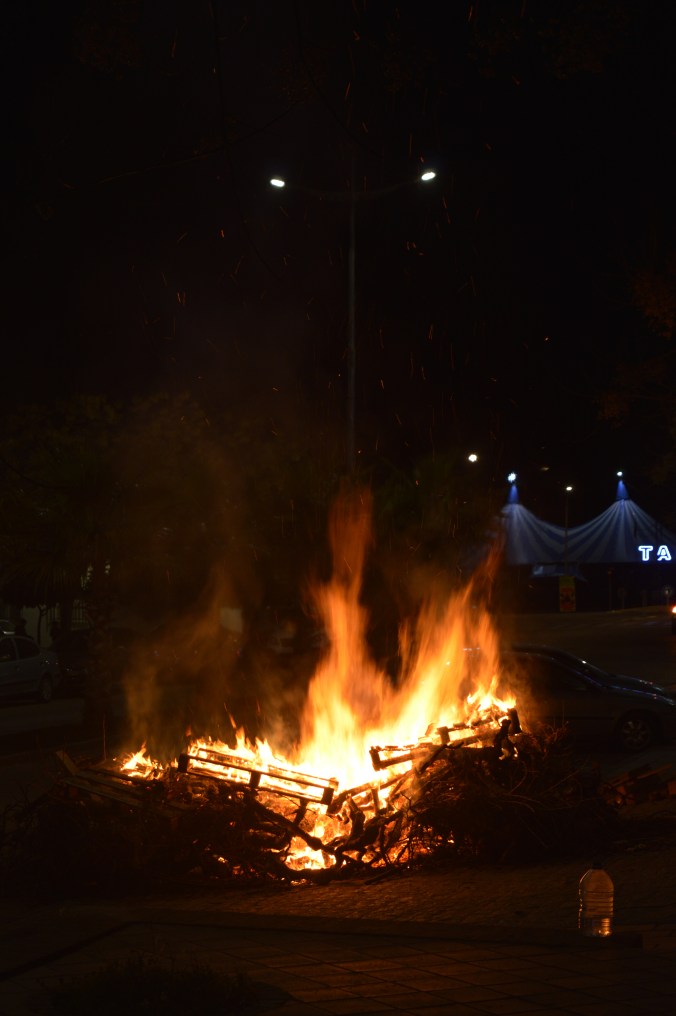
Villafranca celebrated Candelas last night. It’s a local festival, similar to the English custom of Bonfire Night only in that the main ingredient is a number of bonfires. Folk were gathered in front of the main bars in town, where a handful of small bonfires had been laid out and set alight. Whatever they were putting on them was coughing up thick smoke and a hellish rain of sparks. Beyond, on the town outskirts, the neon lights of a visiting circus glared through the haze. It looked like something out of a Don Bluth film. I tried to imagine the first candelas, four hundred years ago and more, then the only lights in this dark land. A friendlier festival than Halloween – or, perhaps, what Halloween has become – if only I had somebody around to share it with. That night I wandered the streets alone, knowing once again after a long time how it feels to be on your own.

DSC_0023

Our electricity bill is almost double what it was last term. That’s hardly surprising; since then, we discovered the flat’s heaters – both the presence of and the real need for them. No biggie. I’m keeping my options open on the job front, looking for work in both Spain and England. It may be some time before I have the enviable position of being able to make such a decision from a position of comfortable stability. Until then, I need to put Reinette through her paces (Hornachos is still beckoning), read a few more books, write a few more letters and apply some serious muscle to my novel. Time is in my favour this year, but still it slips through my fingers by the second. Orion watches from the night sky as he has for millennia, and the sight of him comforts me.

DSC_0030 (2)

I’ll be back in England in under a week. It’s a nice way round to have it, I’ll grant you, living in Spain and holidaying in England. There’s also talk of an upcoming gig for the Northern Lights which I might feasibly be able to make. The ground beneath my feet is moving. In the meantime, I’m relying on Thomas Hardy, Marvin Gaye and a never-diminishing rota of classroom games to keep my mind at work.

In other words, life goes on. I’ll see you around. BB x

Copper, Copper, Everywhere

I love history, but I’m no historian. It was always one of my favourite subjects at school, despite the fact that I wasn’t especially good at it (particularly when it became Historiography). Were it not for History, I might have achieved a string of straight As at A Level. I didn’t. The temptation to study a subject I loved but wasn’t brilliant at was too strong. It’s a lesson I didn’t learn when I went on to study Arabic at university. There, too, I paid for my interest. But I can’t help myself. I love a challenge, and I love history even more. Ever since getting my first Horrible Histories book as a kid I’ve been hooked.

Please don’t ask me about the Chalcolithic Age, though.

Yesterday I went to Almendralejo’s EOI (Escuela Oficial de Idiomas) to take part in an excursion to Huerta Montero, a Copper Age tholos or communal passage grave on the outskirts of town. The visit was primarily for the benefit of the B1 level students of the school, so that they could learn some of their history of their town at the same time as practising their English. We don’t get many tourists coming out here for the history (we don’t get many tourists out here at all, come to that), so rather than hiring the local guide, the EOI decided to use one of the auxiliares to give the tour. Tasha knew me for a history boffin and suggested me. Yours truly then had to clue up on this obscure Chalcolithic (please don’t make me pronounce that again) sepulchre, gleaning facts and titbits about Copper Age Spain to produce a reasonably interesting (and, crucially, intelligible) presentation for the students. I did say I like a challenge…

I learned a lot, I must say. I’ve never really looked into the Copper Age, or the Bronze Age, or even the Stone Age for that matter. Did you know, for example, that the average life expectancy in the third and fourth millennia BCE was around 23 years old? It was pretty humbling to be giving out that little factoid with twenty-three years to my own name. Also new to me, and perhaps more interesting still, was the knowledge that Almería, once home to El Argar, Spain’s dominant Bronze Age culture, is in part the product of Bronze Age environmental meddling. The El Argar civilisation, Spain’s most advanced in its day, developed at such a voracious speed that, together with a shift in climate, it resulted in the creation of Almeria’s vast semi-desert, such as the Sierra de Baza and the Tabernas wastes. A message for our time if ever there was one.

I’m not sure how much information the students gleaned from my presentation alone. I did my best. The ensuing hour or two over a pint in Almendralejo’s Hotel Acosta Centro was a great deal more informative, and it re-affirmed my faith in humanity in finding more than one avid naturalist amongst the Extremeño community. The fires of Catalonia are still smouldering, but on an environmental front, I do believe Spain is changing for the better. Whether it is too little too late remains to be seen, but a little awareness can do so much good.

Here’s to that. Chin chin! BB x

Back to the Grind

The orientation day for the auxiliares de conversación in Cáceres stands out so far in being the only quirk in what is, for the moment, an experience rather akin to Groundhog Day. But for the rain-starved fields of gold, it really does feel like I’ve stepped back in time. Here I am once again in Villafranca de los Barros, settled swiftly into a cosy flat on the same street as before, no less. Once again, I’m sharing the place with an interim teacher, this time a science teacher from Seville fresh out of university, which makes a healthy change. And, in another mirror of 2015, I’m currently feeling more than a little sleep-deprived, having spent the night in Almendralejo with Tasha and Miguel and the Concha Velasco Band. Some things never change.

Choosing between living in Villafranca and Almendralejo was a rather tough call this year. At heart, I guess I knew I wanted to stay put in the town I now know so well. Anyone who knows me well enough knows that, given the choice between a town of seventeen thousand and thirty-four thousand, it’s hardly even a decision I have to think about. All the same, I found myself rather tempted this year to put old habits aside. Life, as always, has other plans. A series of consecutive events guided my feet, including an incredibly warm reception from staff and students alike, the discovery that Extremadura’s primary avian ecology centre, AMUS, is located just a stone’s throw from the town (how on earth did I miss that before?), the sudden arrival of a twenty-four-year-old sevillano looking for a flatmate and, of course, the ever-present majesty of the Sierra Grande de Hornachos. Like a moth to a flame I find myself drawn ever closer into a spiralling obsession with that lonely mountain range, rising out of the Extremeñan steppe like Kilimanjaro. Just as I could never fully convey my inability to adjust to life in Amman, so too does the true nature of my fascination with that town elude me. It’s just a fact of my life. Some higher force pulls me towards it, and I cannot nor will not resist.

I could have thought of no better a homecoming – if I should be so bold as to reinvent the term for my own purposes – than to spend my first weekend of my new life in Spain with Tasha supporting the Concha Velasco Band. Music is one of those necessary sacrifices I had to make in coming here, and like any sacrifice worth its name it was a painful one to make, so it pieces my heart back together a little to have such a spectacular band to support so close at hand.

It may not be as all-consuming as my devotion to the Northern Lights back in the day, but it’s a start. And at the very least they have a Pon de Mambo-style number in Radio Futura’s Escuela de Calor, which never fails to get me jumping about like a mad thing. I never thought I’d turn roquero, but where funk and a cappella are scarce, needs must. BB x

DSC_0779

Pilgrim

That’s the first time I’ve ever walked twenty kilometres to get home after a night out. Suffice to say, I also sincerely hope it’s the last. Talk about a walk of shame…

Why did I do it? Because I could? Very possibly. I think it was more the thought of sitting shivering in the dark until the nine thirty bus that made me decide to walk the distance. It certainly wasn’t stinginess on my part; the Almendralejo bus fare is a paltry 1,31€. Perhaps I thought I could beat the earliest bus back to Villafranca on foot. That’s vaguely logical… in a very roundabout-Ben-way-of-thinking. But then, it was five forty-five in the morning. I don’t think I had any real sense of what I was doing. I just remember saying to myself “Alright, let’s do this” before marching off into the darkness like a low-budget Leeroy Jenkins.

As the crow flies, it’s just under twenty kilometres from Almendralejo to Villafranca. I had to take a detour to cross the motorway, so I reckon I clocked just over that. At night the distance looks deceptively close; the twinkling orange lights of the polígono merge with those of the hospital in the middle of the two towns, presumably so situated for industrial accidents in the field. Most of it is traced by the Via de la Plata, the pilgrim road to Santiago from Seville, so it wasn’t exactly a challenging hike. It’s also probably the first time I’ve been sincerely grateful for the vast, empty flat of the Tierra de Barros: navigation is as easy as pie when the nearest hills are a good forty kilometres behind your destination. 

The whole walking-at-night bit didn’t bother me in the slightest. I’d put that down to a six a.m. lack of awareness too, but then, it never has. Of all the things that frighten and frighten horribly in this world, I’ve never been afraid of the night. I learned a long time ago to consider night as just another shade of the day. It’s the same world, only somebody turned off the lights. No deep-seated fears of a shadowy assault or mugging either: I do believe that even the dullest criminal mind would have more sense than to be lying in wait in the countryside in the small hours. The countryside is safety. It always has been, in my eyes. In fact the only mildly unsettling thing in the whole walk was the occasional startled growls of the caged dogs in the farmsteads that dotted the early stages of the route. Alsatians, most of them. It’s a popular breed here. I remember saying to myself “Why can’t you people just keep cats?” and not for the first time. 

Besides the dogs, the soundscape of the early morning Tierra de Barros was really quite magical: roosters crowing, ravens croaking, the tinkle of a pipit overhead and, from somewhere far across the plains, the lonely cry of a stone-curlew. All of this as the sun rose dim and yellow into the clouds on the horizon. My feet might be punishing me two days later, but I don’t regret that walk for an instant. I just don’t think I’ll be repeating it all that soon. It’s a bit like that Spain north-to-south adventure of mine a few years back: it was there, it had to be done, and I did it. Now I can move on.

I don’t think I even stopped for one second to consider what I’d do if it started to rain. The forecast for the weekend was set to bucket it down. I guess I forgot all about that. That I will blame on my fatigue. If it had rained, I’d have been well and truly drenched, and in my best clothes, no less. Why is it that I’m always wearing my best clothes when I set out on these ridiculous adventures? At any rate, it did; a royal thunderstorm hit on the following night, sheet rain, lightning and all the works. Luckily by then I was holed up in my apartment with a cola cao and The Mummy: Tomb of the Dragon Emperor on TV. Someone up there likes me.

I’d like to think that it’s due to foolish misadventures like this that I get to see a side of Spain that most modern travelers simply pass over. You could be forgiven for thinking that Spain, like much of Europe, was fully humanised a long time ago: the sweep of olive plantations and vineyards in the Tierra de Barros certainly gives that impression. But all you have to is close your eyes and listen: the world survives on the fringes. The stone-curlews of these tilled fields and the mournful plovers that ply the once-pristine sands of the raped Costa del Sol hark back to an older Spain, one more ancient than even the oldest of the moorish forts that dot the distant hills. It puts me back in touch with that world to hear them again, just as though I were playing a record from a forgotten world.

It’s not a purely avian nostalgia. As I arrived on the fringes of Villafranca I saw another scene from a bygone age: a muddle of tents positioned about a small campfire where a couple of ragged-looking men stood cooking a light breakfast. Spain’s native gypsies (if such a term is not a misnomer) are a heavily romanticized lot and were mostly squeezed out if their old ways by government programs decades ago, but this new generation of travelers – Romanians, mostly – have taken their place. When I say tents I don’t mean the bright canvas of a modern traveler, nor the UNICEF-stamped donations you might encounter in a war-torn country. These ones might have been cut out of a picture book from the 1930s. Situated on the very fringes of the town, hidden from sight by the town’s waterworks, it’s the very definition of a gypsy encampment. And I thought such echoes had long since faded into history.

You don’t see them in Villafranca proper. The only encounters I’ve had with them so far have all been in Dia supermarket, where they are instantly recognizable by their clothes, by their language and by their complexion; a rich, ochre-brown, marbled like the soil. I’d like to get to know them, to know why they’re here, where they came from and what other stories they might have brought with them, but the townsfolk only have dirt to say on their account. And in my propensity for romanticising the underdog, am I really any better?

Seeing the Romanian encampment made me think of home for some reason, but I was really too tired by then to dwell on it for long. It was purely because I was still moving that I didn’t collapse from fatigue; on the two occasions I paused to get my bearings my head began to spin and I very nearly dozed off. It was only later that night, when sorting through my music collection and The Land Before Time‘s Whispering Winds came on, that my thoughts took me home again. I cried. Profusely. I always do when I hear that one. Damn you, Don Bluth, for producing a film that still brings tears to my eyes some twenty years later. Damn your genius.

Many auxiliares use the holidays to go home to be with their families. Some of my closest friends out here have done just that. It’s a very sensible move, but it’s only when I stumble over such memories that I remember how vulnerable and human I really am. Whispering Winds is on my iPod for exactly that reason; 1608 times around I can put my weaknesses aside and soldier on alone, but there’s that 1609th song that’s there to remind me that neither home nor family is ever truly put aside.

I won’t be seeing home until August. I won’t have time to do so until then, since the third and final leg of my year abroad across the Strait begins almost as soon as I’m done here. Fortunately my parents are coming out to visit me in a couple of weeks, so I don’t have to. I won’t deny that I’m looking forward to having a car at my disposal – being in Europe’s bird capital and relying on public transport is nothing less than tortuous – but more than that, I miss my parents. And there’s absolutely nothing wrong with that. Sometimes I need to remind myself of that. There’s only four of us left; my family is precious to me, no matter what impression my aloofness might give.

A lot of things have happened over the past year. Some good, some not so good. Now that I’ve got the time, I’m retreating for a couple of days to the one place in the whole world that makes me truly happy. It’s a place that has answers… of a sort. My rock, my cradle, my very own Shangri-La. BB x
The Line Must Be Drawn Here

Yes, that’s a Picard line. No, I’ve never watched even a single episode of Star Trek. However, it’s famous enough to transcend that particular level of pop culture, and it suits this past weekend just perfectly.

What with flight week drawing closer (I’m giving myself until the end of this week to buy my flights for good), I’m getting money-savvy and making fewer travel plans. And me being me, that’s resulted in a knee-jerk spontaneous Moroccan adventure with a few Spanish friends and a Semana Santa celebration in Córdoba. The former is largely reliant on my two friends actually getting back to me, so in a way I’m none too bothered whether I end up crossing the Strait or not – I’ll still be heading to Tarifa for the weekend anyway – but it’s there on the table and I’ve budgeted accordingly.

This term has been no less sparing on the adventure front, but I have been a lot more sensible money-wise, forking out on only one big adventure per month: Madrid in January, Cantabria in February and Tarifa in March. Accepting that I’m coming back for at least two years more after Durham has removed me of my desperate need to see all Spain whilst I can and that’s been a very healthy decision on all counts. It means that (with the exception of rent) I rarely need to draw anything out of my account: my weekly private lessons cover groceries and all other expenses, as well as buying the majority of my travel expenses. To fill the time, I’ve allocated at least one or two weekends a month to being sociable in Almendralejo, something I didn’t do nearly enough last term and am currently making up for lost time.

DSC_0015

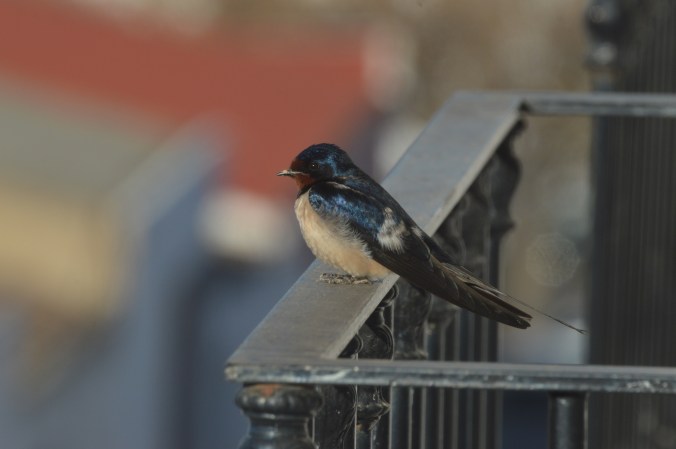
It’s been a big weekend for swallows – there’s a few here to stay now!

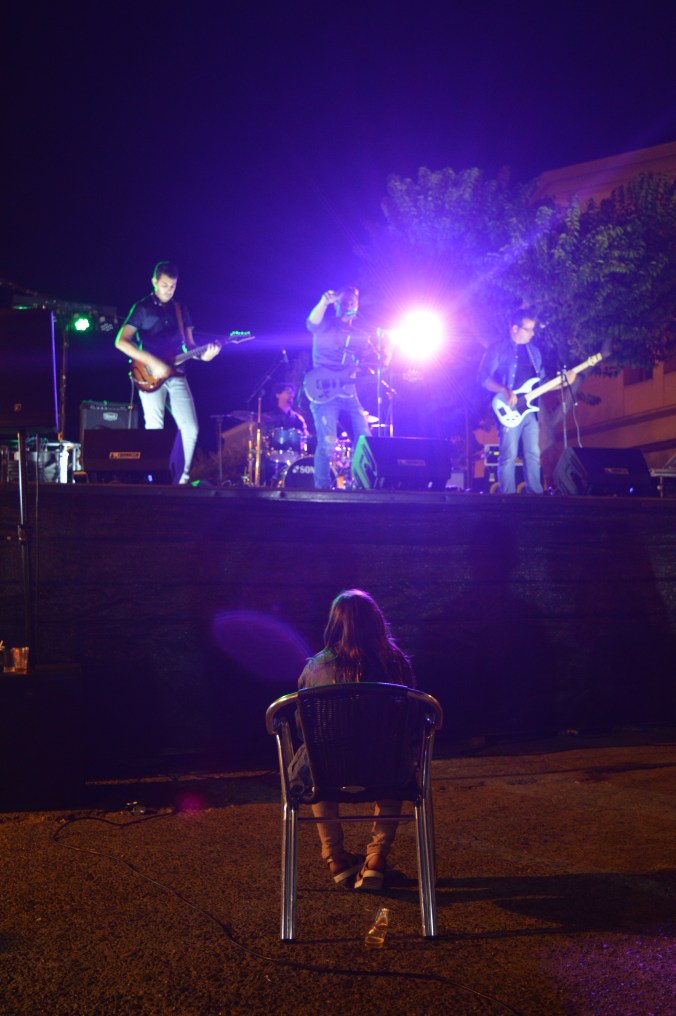
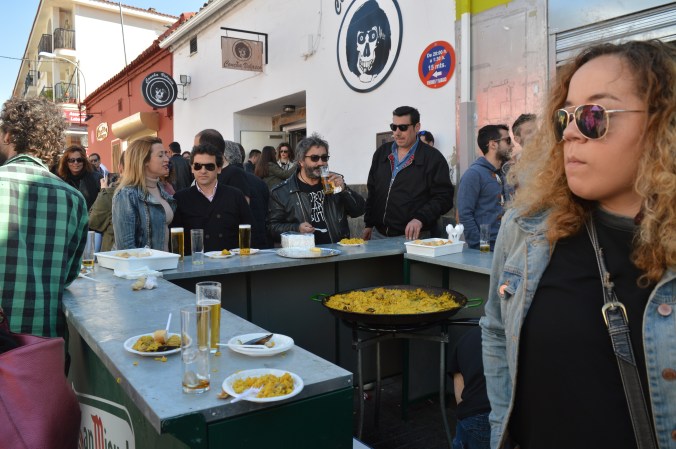
Almendralejo is a bigger town than Villafranca and as a result there’s a lot more to do, especially on the nightlife front. This weekend was the twenty-second anniversary of one of my usual haunts, the Concha Velasco, a kitschy bar decorated with Gothic props (most of them from a film set) and plenty of Goya paintings. It’s usually playing a selection of 80’s rock and it’s a nice place to chill before or after a dance. To celebrate, they were holding a concert for a few local bands, beginning with a free paella and caldereta lunch in the street.

DSC_0020

How long do you think a concert lasts? Four or five hours, perhaps? I’ve been playing in concerts for most of my life and the longest was about five. Not this one. There were about four acts and each one had a two-hour set, there or thereabouts. Due to start at half five, things finally got moving at around ten to six. That’s normal.

First up was the band we had come to support, with our friend Miguel on electric guitar. I’m told it was their best gig yet. I’ve only seen them perform this once and I’m sold. Rock is one of the last frontiers of music that I haven’t really reached into and I’m sold on a few of them. Beginning with the theme tune from Back to the Future sold me and I enjoyed the set immensely – and still found time to take some snaps. Consider me now a fan of Spanish 80’s rock (ed. BB, will you ever learn to be normal?)

I felt pretty voiceless and worn out when the set was over so Fran and I set off to De Blanco, a quieter local, for a change of mood and a few early birthday drinks. Having gorged on all the freebies on offer at lunch, I forgot dinner completely, which was a mistake for several reasons. The most obvious was the effect of a single rum and coke (ron barceló). Having been teetotal until this year, my alcohol tolerance still isn’t brilliant, and I felt rather dizzy for about half an hour. Motoring through a bowl of fizzy sweets the bartender brought didn’t help in the slightest. Fortunately, we weren’t in a hurry to get anywhere and I regained my senses after a time. Still, I know what I’m not doing in future.

One of the strangest things about being English abroad is the simple novelty of being English. Apparently it’s motivation enough to strike up a conversation, and this was just another example. A trio of Spaniards sitting next to us joined us after a few minutes out of curiosity and ended up inviting us out to go dancing with them at another nightclub, Almen’s Whisky A Go-Go. Apparently there was supposed to be a star from Spain’s Gran Hermano turning up, but whether she did or not, I have no idea. At any rate, there was no sign of her by ten to four in the morning, at which point Tasha and I returned to Concha to see if we could catch the end of the last set for the night.

Remember what I said about concerts? Well, here’s the thing. The fourth set hadn’t even started when we got there. At four in the morning. A DJ and saxophone duo (who knew?). This is probably the first time I’d heard a full set without even a single reggaeton number – all dance, from start to finish – and I went into a creative overdrive of at least half an hour before I ran out of ideas and returned to simple jives. The result was that several of the crowd were egging me on for the rest of the night every time I began to run out of steam. At about half five the five hours of almost non-stop dancing, ten hours of music, general fatigue and more pressing hunger began to wear me down. Tasha insisted that I could keep going and kept me fuelled on glasses of water, and I’d like to say that on any other night I’d have willingly stuck it out until the end… but we had been going for almost ten hours, and I hadn’t eaten since three o’clock the previous day. In the end we retreated at the ‘early’ hour of six o’clock for a quick bite to eat at the kebab shop opposite and then, gratefully, I crashed on Tasha’s sofa and slept.

Until the Breast Cancer fun run woke me up at nine o’clock the following morning, that is. I’ve been recovering sleep ever since.

Here’s to a more relaxed weekend to kick off the Easter holiday this weekend. I could do with it. BB x

Ned Stark was Wrong

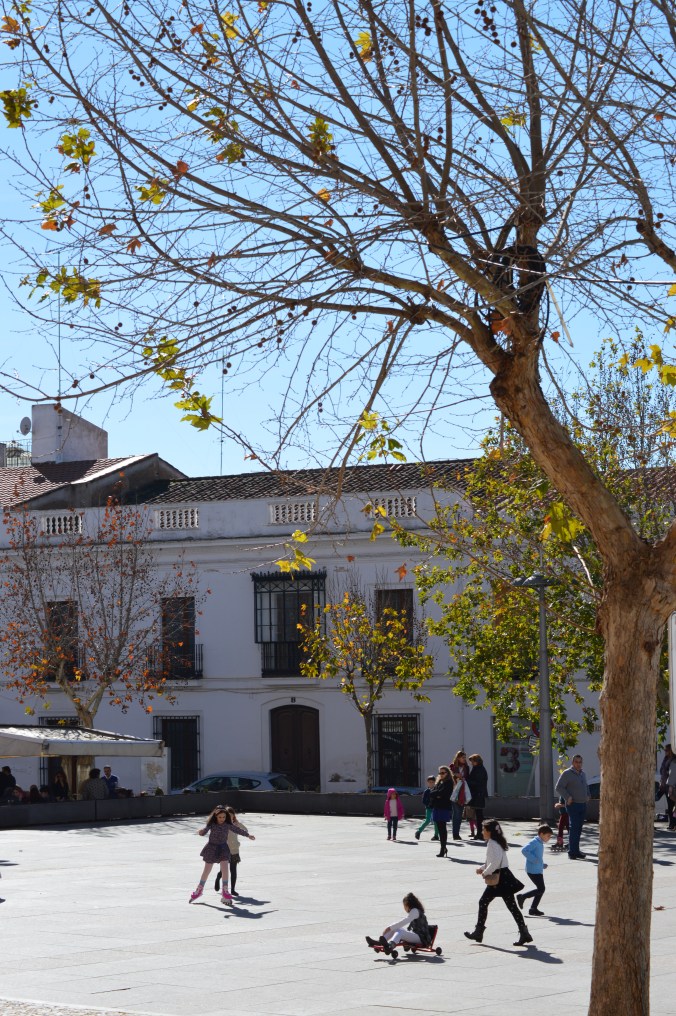
Two weeks ago I saw the first martins wheeling about over the bus station. Last week the first swallows began to arrive and the lonely stork on the chimney of the old factory was joined by his mate. This weekend the chiffchaffs have finally joined in on the dawn chorus and, whilst it’s hardly been what you’d call wintry around these parts, today suddenly feels decidedly spring-y. The sun is blazing away in a sky of cloudless blue and everybody is out in the town square, soaking up the good weather and generally having a good Sunday of it.

The truth of the matter is, quite honestly, that winter has simply not come this year.

DSC_0733

Maybe I’ve been in the north of England for too long, but it stills feels like I’ve been cheated of a season out here. Extremadura is, as its name suggests, a land of extremes: of fiercely hot summers and bitterly cold winters. There are people in Villafranca who remember whole years when it never rained at all. It has rained here, but not often; about four or five times since I arrived, all in all. And whilst the presence of the cranes is a sure sign that it’s winter somewhere, it looks a great deal more like spring right now. The cherry blossom is already in bloom, over a month early, which is more than can be said for the unseasonably early arrival of the migrants. I think I’ll head on down to Tarifa next weekend to check on how things are going in the Strait. If spring has come early anywhere, it’ll be there for sure.

Which reminds me, I really must go looking for the cranes before they leave.

DSC_0736

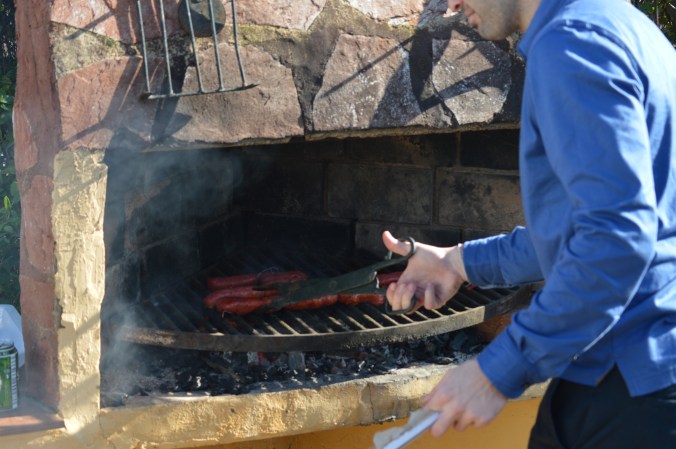
To celebrate the gloriously early return of spring (alright, so that wasn’t really the reason), a local friend and our would-be guide, Jesús, threw a barbecue gathering in his casa de campo out in the vineyards of the Tierra de Barros. A casa de campo is a real Spanish boon that I’m still struggling to translate. Country house might work, but that conveys a sense of grandeur that most such buildings – merely glorified sheds where your average town-dwelling Spaniard stores his produce, spare furniture and ‘all the shit that doesn’t go anywhere else’ – simply do not have. Ask a Spaniard to show you their casa de campo and you’ll quickly see why Spanish houses are so ludicrously tidy.

DSC_0650

A common mistake that foreigners make is that these are dwellings in their own right. Far from it. They’re almost all two-room bungalows, equipped with sofas, plenty of chairs and a kitchenette, purely for the purposes of hosting summer gatherings like the one Jesús held yesterday. The locals will pay regular visits to their campo, especially during harvest season when they’re more practical than pleasurable, but most of them would never stay in one. It’s simply not done. Would you sleep in the tool-shed?

DSC_0646

Jesús had invited a fair crowd, with an equal balance of Spaniards and guiris, the latter representing England, Wales and three American states. The Almendralejo crew, in all but name. I had the audacity to avoid them almost entirely last term, stopping by only twice, for fear of being sucked into an English-speaking failure of a year abroad (I speak enough English for my job). That was poorly done indeed. Quite unlike the infamous all-English compounds in many a Spanish town, the Almen lot are very much half and half. As the most fluent of the guiris (a title the Spaniards themselves have given me and which I cherish above all other compliments), I get more than enough practice in my grandfather’s language as the ultimate go-between and little could make me happier.

DSC_0655

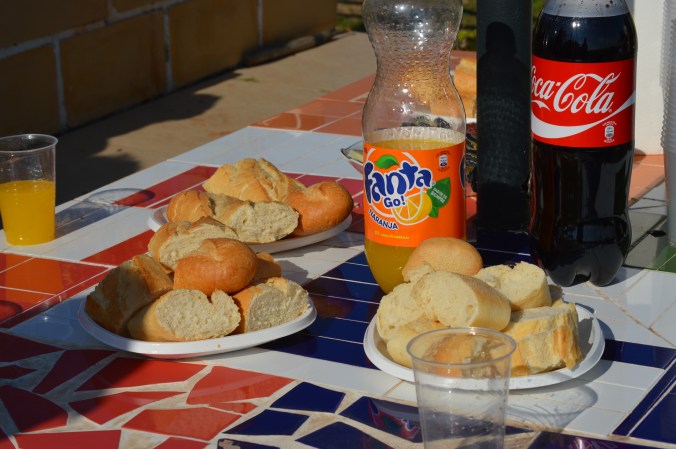
Although, that said, the copious offerings of grilled chorizo, crackling and manchego cheese on offer yesterday did a damned good job of it.

DSC_0660

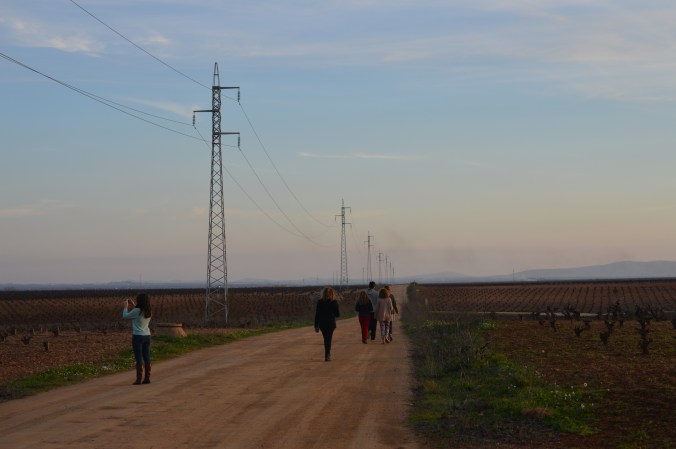
No campo gathering would be complete without una vueltecita, or stroll. Jesús’ casa de campo is just off the Vía de la Plata, the lesser known northbound Camino de Santiago and the old road from Seville to the silver mines in the Asturias. We didn’t stroll particularly far, but then, you don’t have to; the Tierra de Barros is so vast and flat that you can see for miles in all directions. It’s hard to imagine when you compare it, but the village of Hornachos, sat astride the high Sierra which shares its name, is as far from Villafranca as Walmer is from Canterbury. Twenty seven kilometers, or fifteen miles, there or thereabouts. And you can see one from the other. It’s that flat.

DSC_0672

We didn’t find any unicorns (don’t ask) but we did find two very excitable dogs and an emu. And a characteristically gorgeous sunset over the olive trees.

DSC_0700

Andalucía, that dusky southern beauty, might have stolen my heart years ago, but honest Extremadura is doing her hardest to win me over and very nearly succeeding. If I end up returning to this land of endless steppe, of Kings and buses named after Zeus’ lovers and home of quite possibly the hardiest of all of Spain’s assistants (I maintain that you have to be at least a few screws loose to choose Extremadura as your home for a year), it wouldn’t surprise me in the least.

DSC_0717

Carnaval is coming, but it’s not here yet, and before that yawns our second five-day weekend; the best we get by way of a ‘holiday’ besides Christmas and Easter compared to the French assistants (a necessary sacrifice, I suppose, for being in a superior country). I’ll sign off before the Spanish blood in me goes to my head. BB x

Shrinking World

I got my new timetable last night, first from the Carmelitas, then from my own school. The end result, as of a few last-minute additions this afternoon, is a twenty-two-hour working week. Not a truckload by regular working standards, but the longest by a yard in my working life so far, and a world away from the twelve-hour maximum we had dangled in front of our faces at the first British Council meeting. So much for that holy four-day weekend! I’m lucky enough to have clung on to three days of freedom, and I had to stick out my neck for that. At the very least they let me have Friday off instead of Monday, which gives me quite a few more days off in the long run, though navigating back to Villafranca on a Sunday is going to cause some headaches, mark my words. Still, I signed up for the back end of nowhere and that’s where they put me. At the very least I’ll not be getting bored here. I don’t have time to get bored. And I haven’t even started on any of the music groups yet…
But hey, there’s thirty kids who now know what a loon is, what it sounds like, and consequently why we say ‘as mad as a loon’. That was an icebreaker and a half.

Teaching at both a state school and a private school gives me the opportunity to take a look into both worlds, and I’m sure I don’t need to tell you how very different they are. My main obstacle with the state school kids is getting them to be quiet. Their English is good, but they quickly revert to their mother tongue for argument’s sake. Conversely, my private school pupils have a very high level of English, but they just won’t talk. And in primario, it’s every man for himself. I’m expected to take those classes alone, so it’s a biweekly war with a small army of Spaniards in the making, shouting everything and everybody demanding attention at the same time. The one thing they all have in common is the inevitable ‘do you have a girlfriend?’ interrogation, to which the answer has reduced from ‘not anymore’ and ‘not yet’ to a simple ‘no’. It’s easier that way. It doesn’t stop them changing tack and asking ‘what about boyfriend?’, but hey, at least that’s as far they go. One kid in primario had a particularly unfortunate way of phrasing it this afternoon – are you gay or “normal”? – which I tried to rectify as best I could, Catholic school or no, but I guess it went over his head. On the plus side, I haven’t been hit on by a guy for several months now. It must be a new record. Maybe I’m doing something right! That, or I simply haven’t been going out. Probably the latter.

I’m now in the curious position where I find myself teaching across every conceivable age group, from the rowdy little tykes in primario right the way up to people my own age in grado superior; and then, of course, there’s the private classes for adults in the afternoons on top of that. Teaching kids and adults is one thing, but with students your own age it’s an odd feeling. I guess the real catch is that in a town as small as Villafranca (I remind you that, by my standards, it’s still pretty massive) the chance of getting to know anybody on a non-professional basis is rather slim. I bumped into some of the girls I teach whilst out walking last week and they were adamant that they were going to find me a girlfriend in Villafranca. The trouble is, where does one draw the line? Because, like as not, anybody roughly my age in this town who I don’t teach (a number which shrank even more this afternoon) probably has a sibling I do teach, and that makes things rather complicated. I wouldn’t say no to a Spanish girlfriend – sheesh, who would? – but it’s easier said than done. The auxiliares in Almendralejo, the nearest city, don’t have this problem, as there are plenty of young people there for the job prospects on offer, but here it’s a family town, like I said before. And I’m still very much in that mindset of ‘absolutely no fraternization with the students outside of class’, as I had drummed into me in my last teaching job last summer. Which means if I want to meet people my own age, I’d better check out Almendralejo.

Here at least, I’ve had a stroke of luck. There is another auxiliar placed here in Villafranca, though like more rational minds than mine she chose to base herself in Almendralejo. A bright and beaming button of a Texan. I must have gone berserk speaking English with a native speaker at last after almost two weeks without doing so, but she bore it patiently enough and gave me an insight into Almen life. Apparently there’s a nightlife scene. Who knew? I was beginning to forget what nightlife is. And yes, they abide by Spanish hours; ergo, a far more rational 11pm until 6am mentality. That, at least, makes the possibility of a night out in Almendralejo feasible, as far as buses are concerned, though it’d probably knock out a whole weekend in the process.

All in all it’s been a pretty long day at the office. Those 8:15am starts are very hard on the eye but I’m simply going to have to get used to them. It’s largely thanks to them that I have Friday off. Monday isn’t the longest slog – that’s Wednesday, from 8:15am until 6:30pm with one hour for lunch – but it’s certainly one of the more mixed. I teach a bilingual gestión y acogida class in the morning (essentially, life skills: interviews, CVs etc), then a mid-teens 3º ESO, then I have twenty minutes to walk to the other school and mentally prepare for the chaos of a class of six-year olds, after which I get a free lunch from the nuns (probably the best part of the job) and return to take my final class of the day, a private school version of 3º ESO, before hopping down the road to my private class with my lawyer friend. And thus is a light day.

It’s bonkers. Good bonkers, paid bonkers, but bonkers nonetheless. It’s like last year, but without the music. That’ll come, you just watch. It’s the only thing I’m genuinely missing right now (I sang through the entire Northern Lights set when I was home alone yesterday, until the neighbour told me to shut up. Oops.

So there you have it. Busy, busy, busy – but I’m never truly happy if I’m not truly busy, that’s what I always say! Yet another example of yours truly not knowing when to shut up. So here’s BB, shutting up. BB x

Return of the Paperwork Fiend

I’ve been riding on an unfairly long streak of good luck for the last week, as you might have guessed by the cheery tone of the articles. As is to be expected, the honeymoon-period had to come to an abrupt end at some point as the stresses of making one’s own way in the world came to a head, and as usual, it’s the little things that take you by surprise. I managed to dodge the iceberg that was the NIE without even a scratch, only to plough straight into the reef that is trying to open a Spanish bank account.

What have the Romans ever done for us? Administration. You’ll hear a lot of horror stories about foreign administration, especially in France and Spain, where the foul creature was spawned long ago. The Spanish love their paperwork, arming themselves with signed forms, photocopies, rubber stamps and enough identity cards to start a national trading-card game. Obtaining an NIE – a numero de identidad de extranjero – is one of the most important parts of enrolling as an auxiliar de conversacion, as without it you cannot open a bank account or be a legal resident in Spain. Normally it’s this that gives most people a bellyache, when pencil-pushing fiends in the foreign affairs office at the local police station decide to liven up the tedium of their day’s work by sending you on a merry wild goose chase after that form that looks just like the one you brought in, but with one number’s difference, which of course changes everything. And of course, you’re not the only one after one of these precious little commodities.

Right now it’s coming up to harvest season and Extremadura is awash with migrant workers here to reap the benefit of a temporary boom in the job market. This year, the officials in Almendralejo have their hands full with a large group of Romanians, also requiring an NIE to validate their existence in this country. If it hadn’t been for the Director and my mentor in the English department, I honestly think I’d have turned back when they told us to return at nine o’clock the following morning. But the sad fact of the matter is that ‘big old whitie’ always prevails, and I was shunted to the front of the queue so that I could leave that very morning with my NIE stamped, cleared and ready to go. There’s something very sick about that system. Guilt aside, it wasn’t as clear-cut as I’d have liked. My landlord hadn’t thought to give me a contract, so I couldn’t apply for my tarjeta de residencia on the spot. That wasn’t too difficult to achieve, but it would have been handy to know in advance, before attempting to tackle the bank this morning – which, of course, needed that precious tarjeta also. Passport, NIE, proof of address and proof of stable financial employment are all well and good, but if you don’t have that little red card – if you’ll forgive the expression – it don’t mean jack.

Did you know that the United States has a Paperwork Reduction Act, dated from 1980? Spain could sure do with something like that.

Following on from this trend, today’s been a bit of a bad luck day all around. My timetable’s still in flux because of the absence of any bachillerato classes, which the authorities decree needs changing. And until that’s done, I can’t clarify the timetable of my second job with the Order of the Carmelites. And since both of those are paid affairs, this bank situation needs clearing up fast, or I’m going to end up high and dry soon enough, Erasmus grant or no Erasmus grant. Don’t even get me started on that.

As a final hurdle, I stumbled just short of the fence over the Jornadas de Formacion in Caceres this morning. My BlaBlaCar driver didn’t show up, the only bus that passes through this town leaves at half four, which is when the training day begins, and I haven’t received a smidgen of confirmation as to whether I’ve actually got anywhere to stay there tonight. So all in all, despite not having fully prepared any classes, I’ve decided to toss that in the towel and start work today. It’s not a major loss, as I’ve had two teaching jobs before and I’ve done half of the paperwork already, the main focus of these meetings. They’re also non-compulsory, so it’s no big deal, but I was hoping to go if just to formalise the whole shebang, though perhaps more so to meet some other auxiliares. I may be a blood traitor to my kin, choosing to eschew any and all English speakers by living with Spaniards way out here in the sticks, but that doesn’t mean I don’t miss my mother tongue. At the moment writing is proving my only channel for it, and Hell, is that benefiting from an absence of conversation…! I must have written a chapter a day for the last four days. That’s ten A4 pages a day. I have far too much time on my hands – for now.

How’s that for a healthy antidote to the ‘I’m having the best year of my life on my year abroad’ drawl I’ve been riding on for the last week? Alright, alright, I’ll quit putting myself down so. On the plus side (finally!) teaching’s been really fun, and that’s what I’m here for. My Spanish is improving daily, in vocabulary, grammar (I never did learn the simple past tense at school and I’ve been winging it for the last ten years) and stumble-rate. The latter is, of course, a problem in every language I speak – even English – and has more to do with my machine-gun rate of speech than anything else. Teachers have been telling me to slow down for years. ‘You never will learn, Benjamin’, as my father would say. He’s right on that count.

The shining light in my experience though, above and beyond school, is the couple of hours I spend a week with the husband of one of the staff here, who’s requested extra English lessons. Not only is his English at a much higher level than any of my students, but he’s also one of the most interesting men I’ve ever met: a genuine intellectual if there ever was one, his bookcases lined with legal tomes and a collection of certificates and photographs on his desk, featuring such leading lights as Umberto Eco, King Felipe VI and Mikhail Gorbachev. We had to cut our lesson short yesterday when, mid-meeting, he received an important call from a government official promoting him to high office, a decision which he had been labouring over for some time since it would require a drastic change in his life. He took the job and poured out his heart to me, and I felt more than honoured to be the first person to hear about it; before his wife, children and even his own secretary. ‘I feel like a child at EuroDisney… like a little boy on Christmas Day’. That was how he put it to me. I left him to open his Christmas presents and set off to treasure that warm fuzzy for an hour in the park. It may only be for a couple of hours, but it’s already the highlight of my week.

And there I am, fussing over kids, when the real gem out here is a man older than most of my teaching colleagues. Life has a funny way of playing around with you, sometimes. BB x