Camino XXXIII: Forty-Five

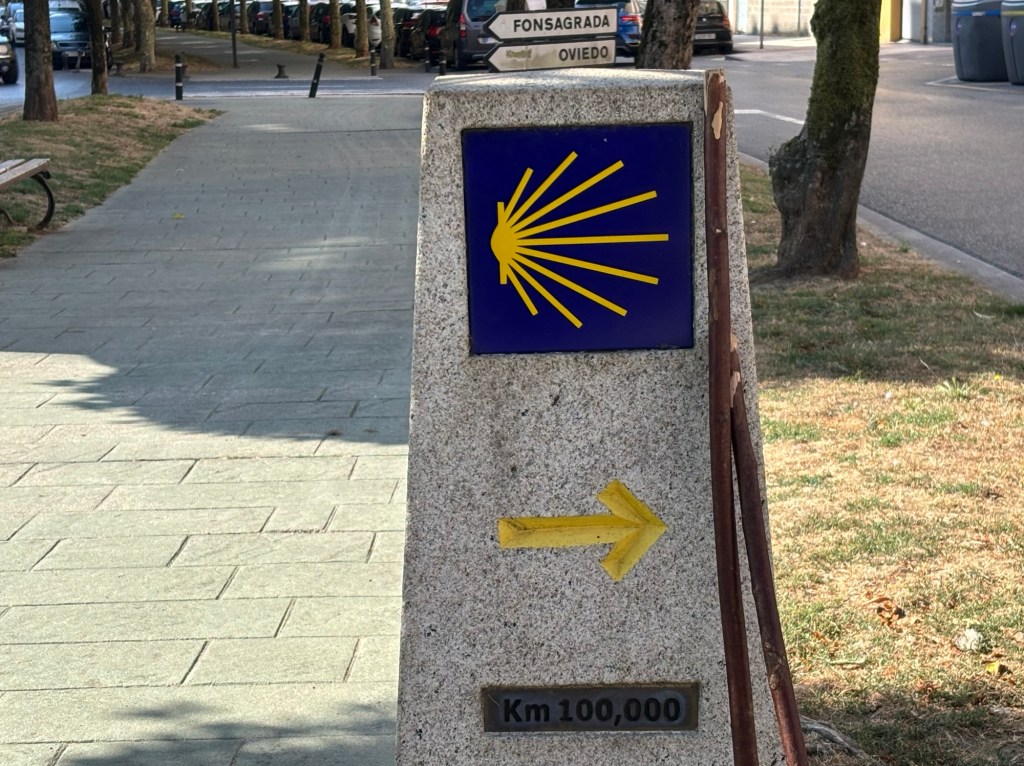
Albergue Pensión Casa Cuartel, A Fonsagrada. 17.15.

My feet are seriously tired, but I’ve done it – the longest stint yet on this year’s Camino. Forty-five kilometres of hills, sierras and reservoirs, of steep descents and sunlit climbs, which puts me one day closer to Santiago and gives me the peace of mind to spend a day exploring the city the day after I get there. I sacrificed seeing a local festival in Grandas de Salime for this, but after speaking to some of the pilgrims in this hostel, I think I made the right choice. It sounds just like the set-up at Castrojeriz, which – if memory serves – left me with a little less than two hours’ sleep after the local verbena went on into the small hours.

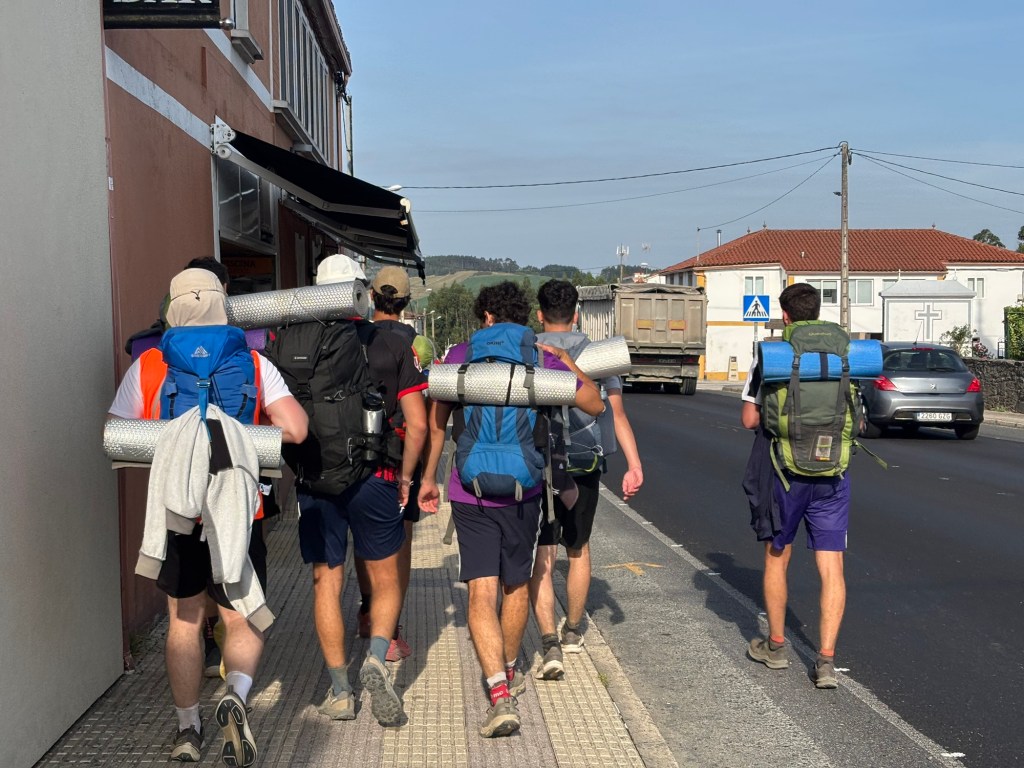
There are two English lads in this hostel who must be fresh out of private school, talking about “going for brekkie” in that easily identifiable southern drawl and using the same slang terms like “cooked” and “rizz” that my students do. They’re sitting on the steps outside playing one of those mobile phone games that their generation seems to be absolutely hooked on. They’ve been doing so for the best part of the last two hours, talking loudly about their tactics as they do. The two men from Valencia who went the wrong way today are both fast asleep in the next bunk, which is the quietest the shorter of the two has been all afternoon – he’s a particularly merry sort.


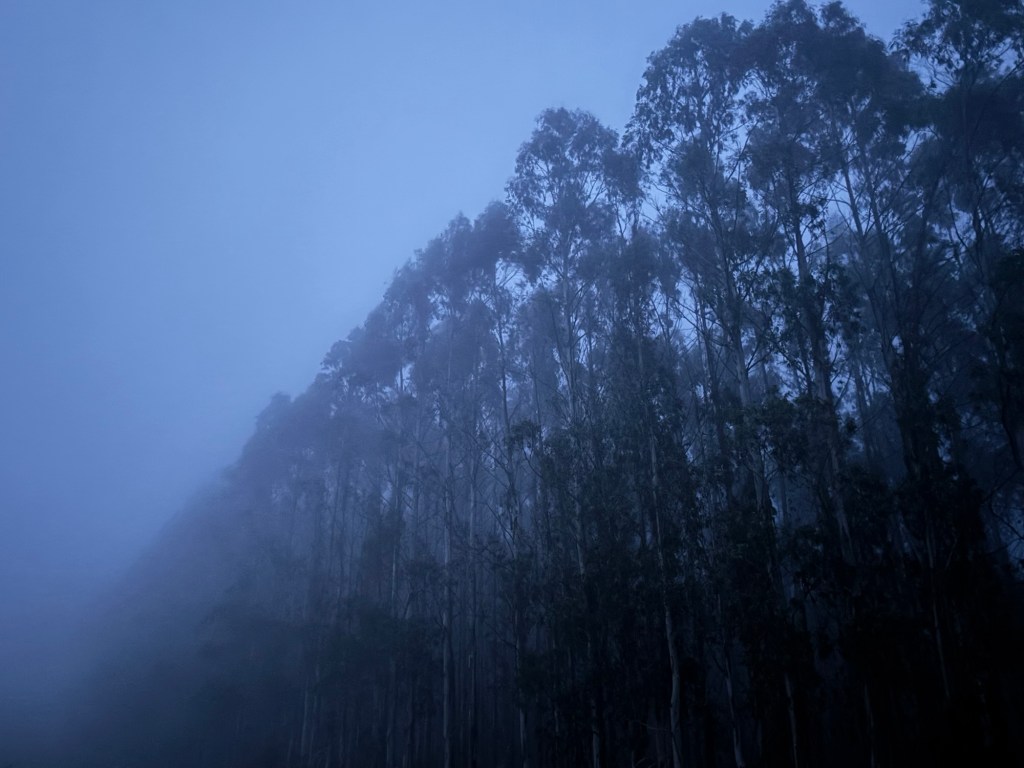
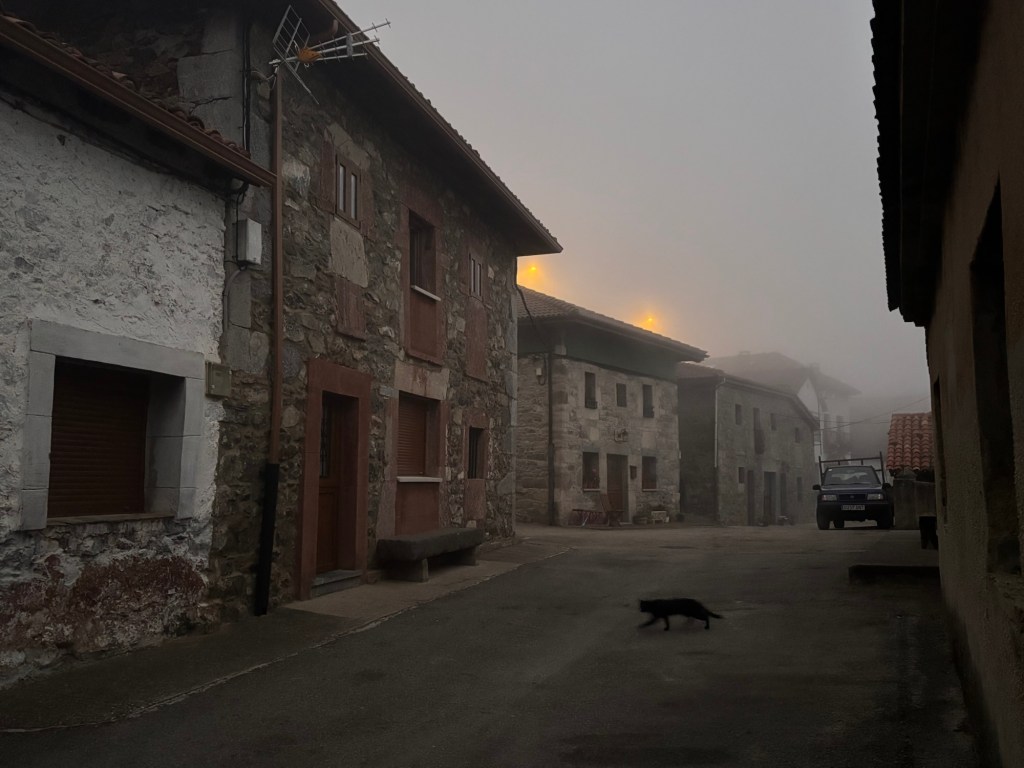
I left Berducedo a full two hours before dawn, long before any of the other pilgrims were up. There wasn’t even the faintest glow on the horizon, so I did have to use my phone torch for some of the trek, especially the hundred metres or so that cut through a forest (where a number of large bats seemed to enjoy the light and the moths it attracted). The constellations were a sight to behold, as was the arm of the Milky Way stretching away to the west, towards Santiago. It’s not quite Perseid season – that’s still a little over a week away – but I did see one shooting star away to the south and made a wish.


The first cold glow of dawn descended as I began my own descent into the valley before Grandas de Salime. It’s a very steep path that zigzags down the hillside, descending by 800m in a very short space of time. I was quite happily enjoying the Battle of Helm’s Deep when a nightjar almost clipped my face with its wings and one of the rocks in the path ahead suddenly grew wings of its own and took off into the morning air. There were at least three of them hawking about the track, looking for all the world like enormous feathered moths with their strange alternating flight, sometimes flappy, sometimes gliding with their wings held high.

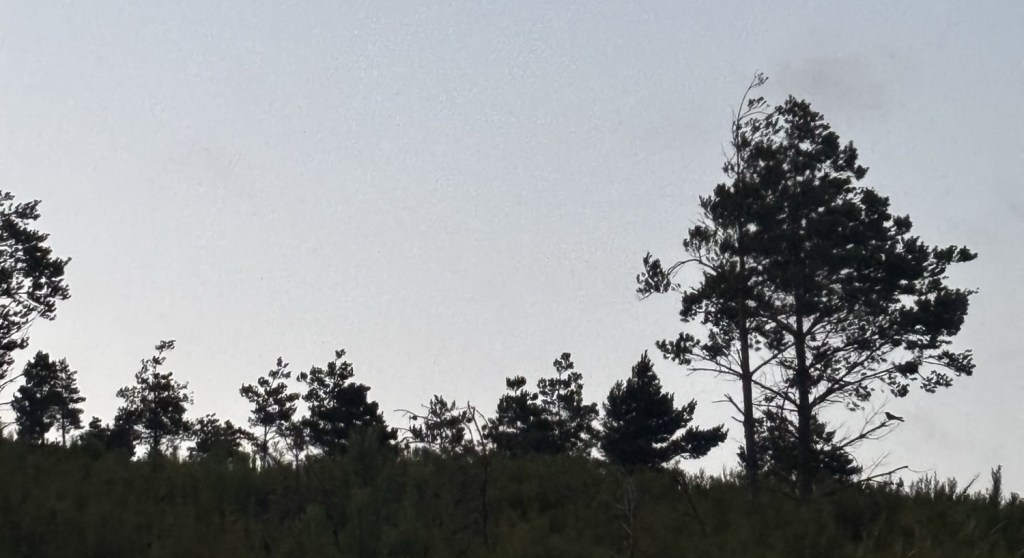
One landed in a tree nearby and set up its eerie churring call, which is almost as iconic to the Camino as the endless tread of my own feet.


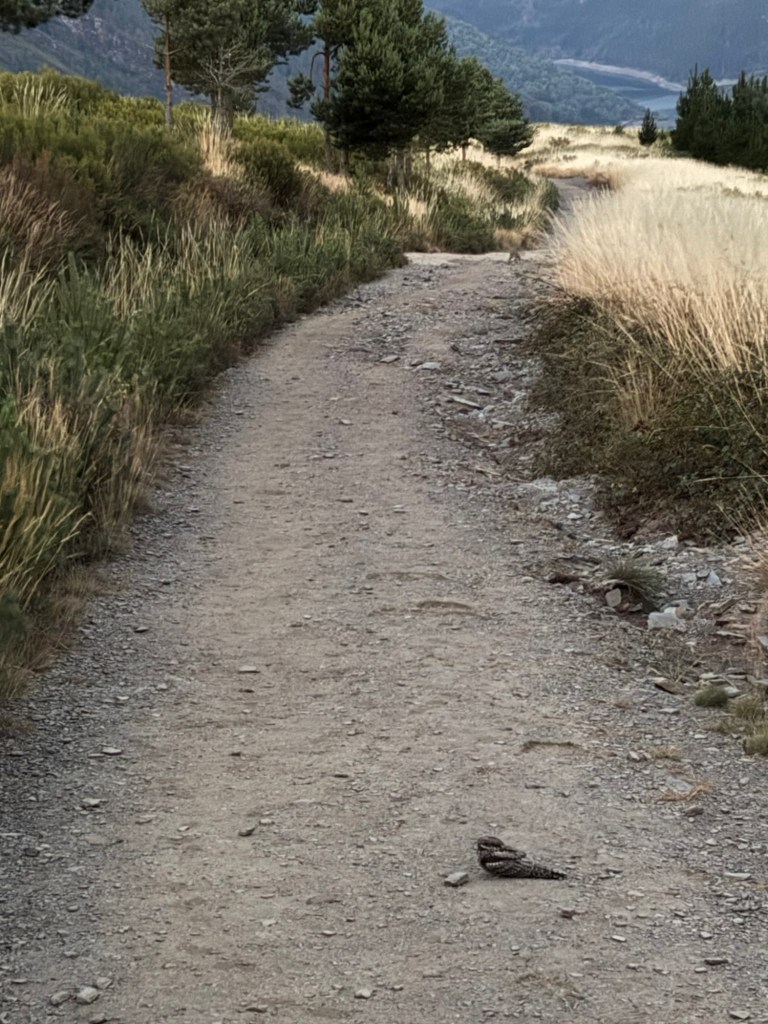
Another – the one I had mistaken for a rock – alighted on the track a little way ahead. I approached very slowly and, at least for a little while, it didn’t look like it was in any hurry to take off again. I got so close that I could see it yawn with my own eyes: their vast, gaping mouths are one of the features that gave them their Spanish name of “chotacabras”, or goatsuckers. I almost missed the hare that came bounding out of the grass behind it, appearing more clearly in the photos I took than it did in reality.

Of course, it took off before I could get too close, making its strange grooik flight call as it did so. It landed a little way back up the path but I left it alone and pressed on.

Nightjars are just one of the rewards of setting out early on the Camino. You might hear them, but you’d never see them if you set out after breakfast. I’ve been lucky enough to see quite a few on this year’s Camino, but never so close and never on camera. I haven’t wanted my SLR often on this Camino – I’m carrying enough as it is – but today I would have given a small part of my library to have had it in my hands!


I reached Grandas de Salime shortly after nine, making it a four hour walk from Berducedo (compared to the guidebooks’ suggestion of six or seven). This is usually the stage end, but as it was not even the halfway point, I allowed myself a decent breakfast of a tostada con aceite y tomate, a slice of tortilla and some fresh orange juice so that I might have the energy to push on. There were a few pilgrims having breakfast at the bar, but not that many. The townsfolk were setting up for the second night of their local festival, and I imagine a number of pilgrims had decided to stick around and have fun. I, however, had another twenty-five kilometres still to go and couldn’t stay for long.


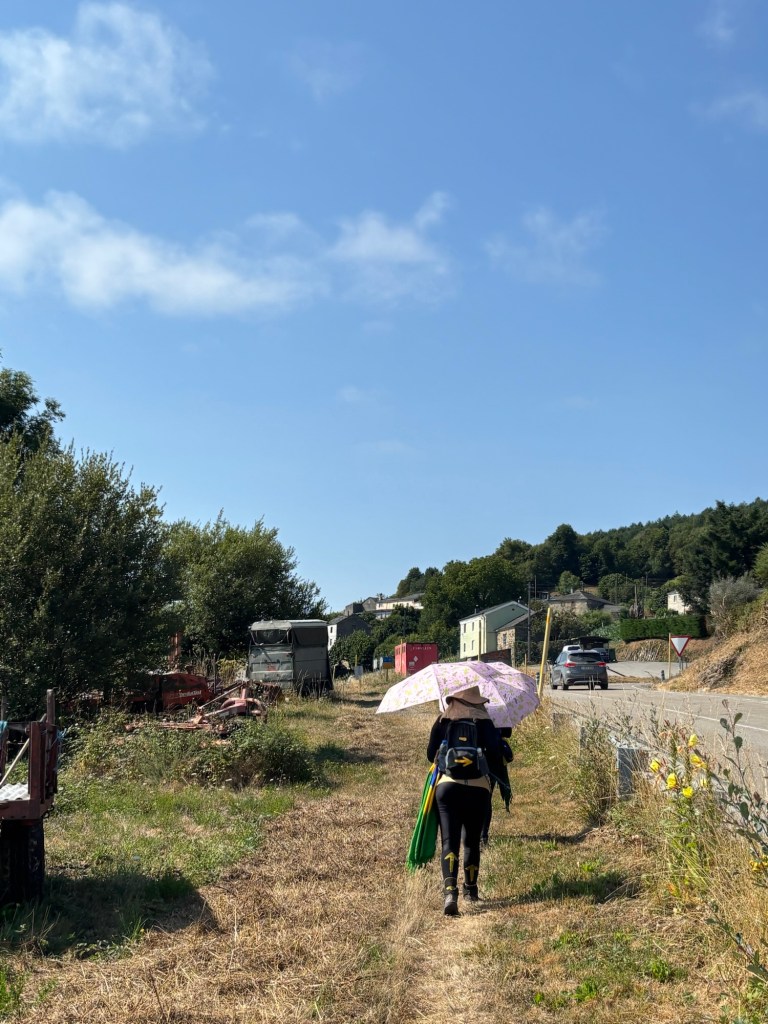
I trailed a couple of Brazilian pilgrims for a little while before Peñafuente, dressed in sporty Lycra, marching cactus-print parasols, a giant Brazilian flag and immaculate hair (something the Brazilian pilgrims seem to prioritise above all other things). I’ve become a lot less cagey about drinking from unmarked fountains along the Camino and the one at Peñafuente was absolutely incredible. The guidebooks recommended the one at Fonfría, but that wasn’t as good or as cold as the one at Peñafuente, so I drank deep and bottled deeper, as it was still a long way to A Fonsagrada. I had hardly begun the second leg, which the guidebooks suggested should take eight to nine hours, and what clouds there were in the sky did very little to block the sun. I was going to need all the water I could get. I can be a real camel on the Camino, but it’s always best to be prepared.


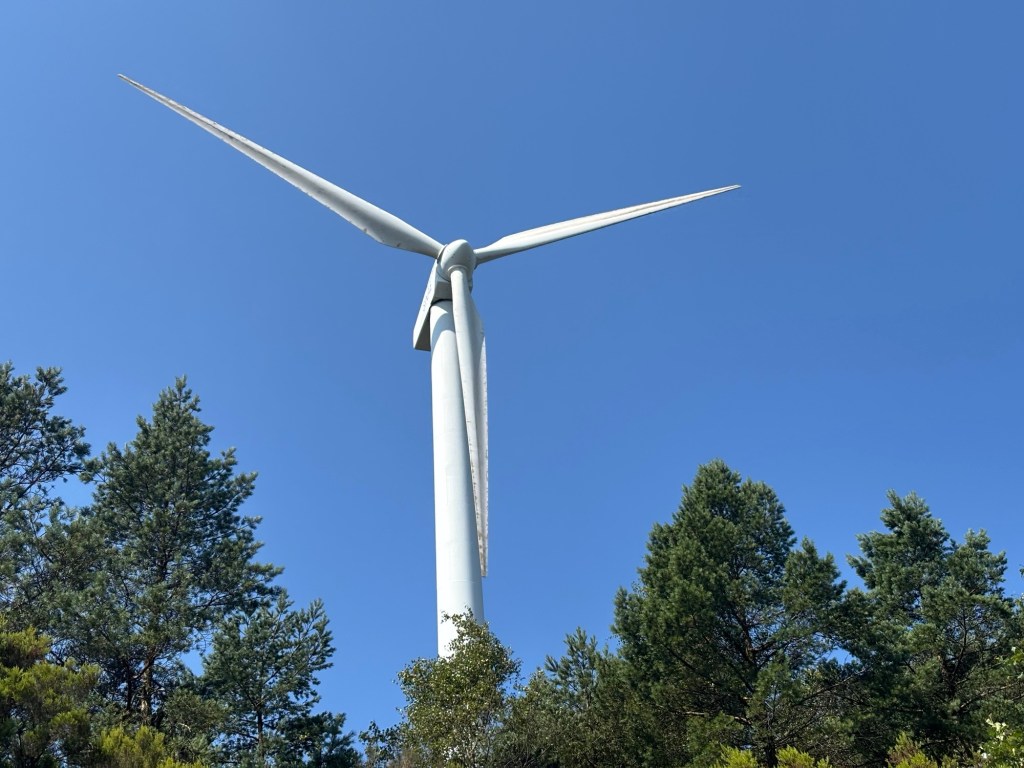
There are quite a few hills to climb between Grandas and A Fonsagrada, none of which were particularly easy under the midday sun. The Camino cuts right through one of Asturias’ many wind farms, though these ones are nowhere near as enormous as the turbines found up in the mountains on the San Salvador route. The heavy whoosh of their arms as they spin in the wind is quite something to hear up close, punctuated with the odd mechanical whirr when the head tilts one way or the other. The way the Spaniards were complaining about the wind up in the mountains yesterday, you’d think that wind was a rare occurrence in Spain – but the turbines that crown many of Spain’s hills and sierras say otherwise.


The Spanish are nothing if not practical with their high places. If there isn’t a watchtower, a sanctuary, a hermitage or a radio mast on top of this or that hill, there’s usually a row of wind turbines.

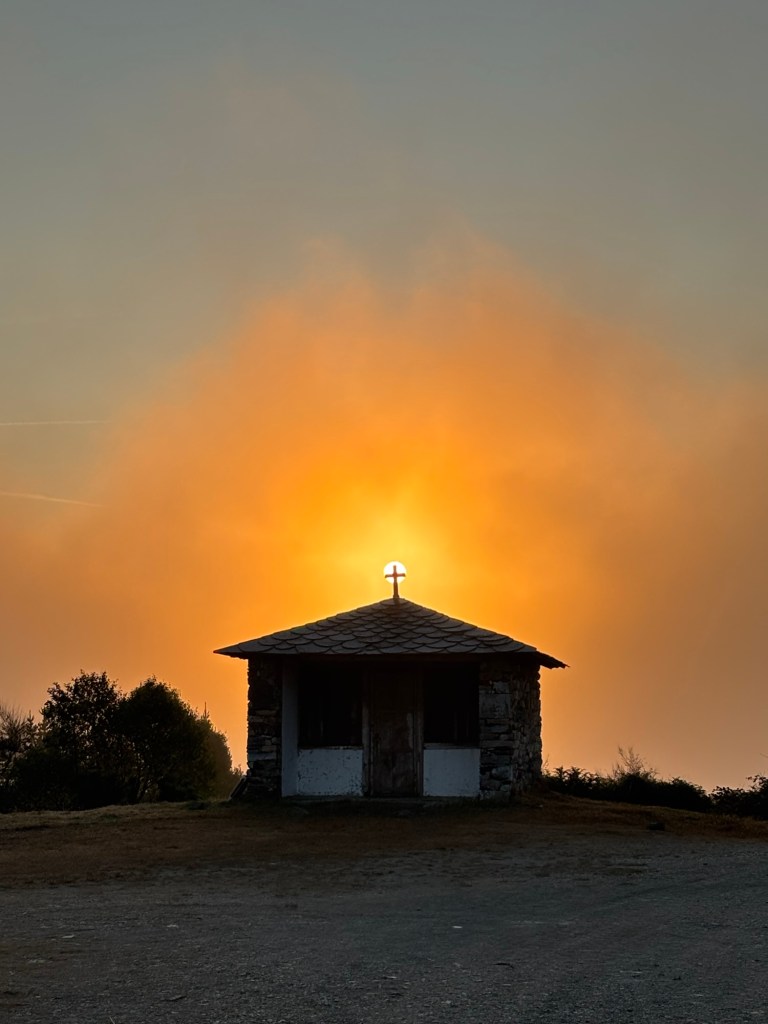
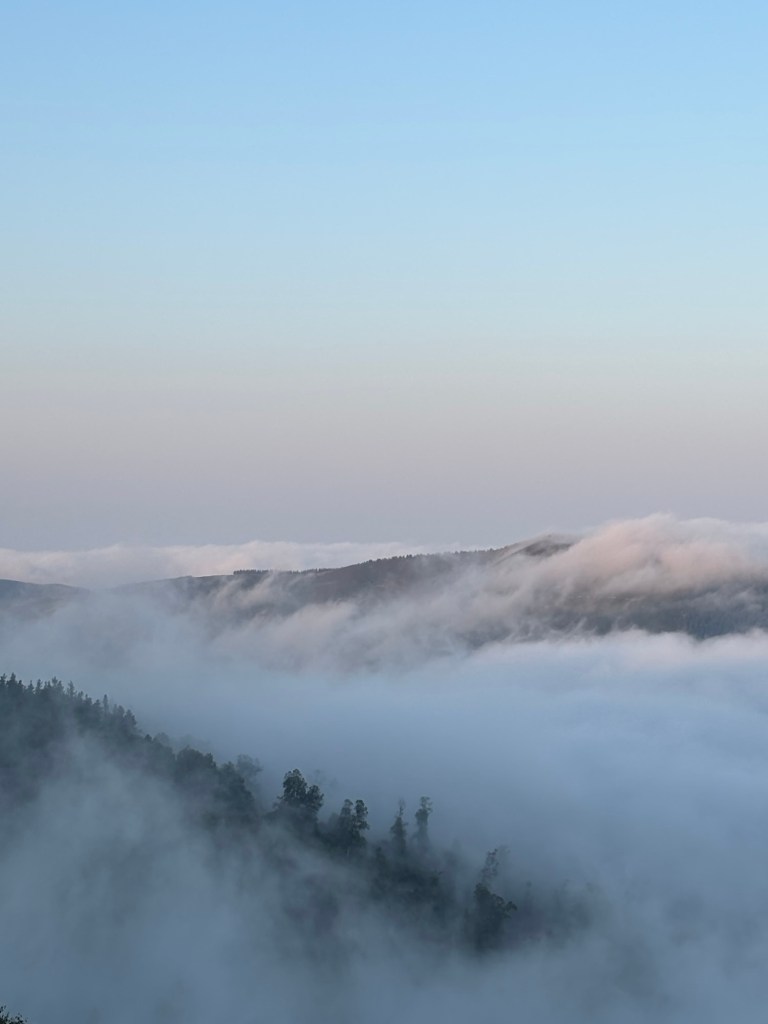
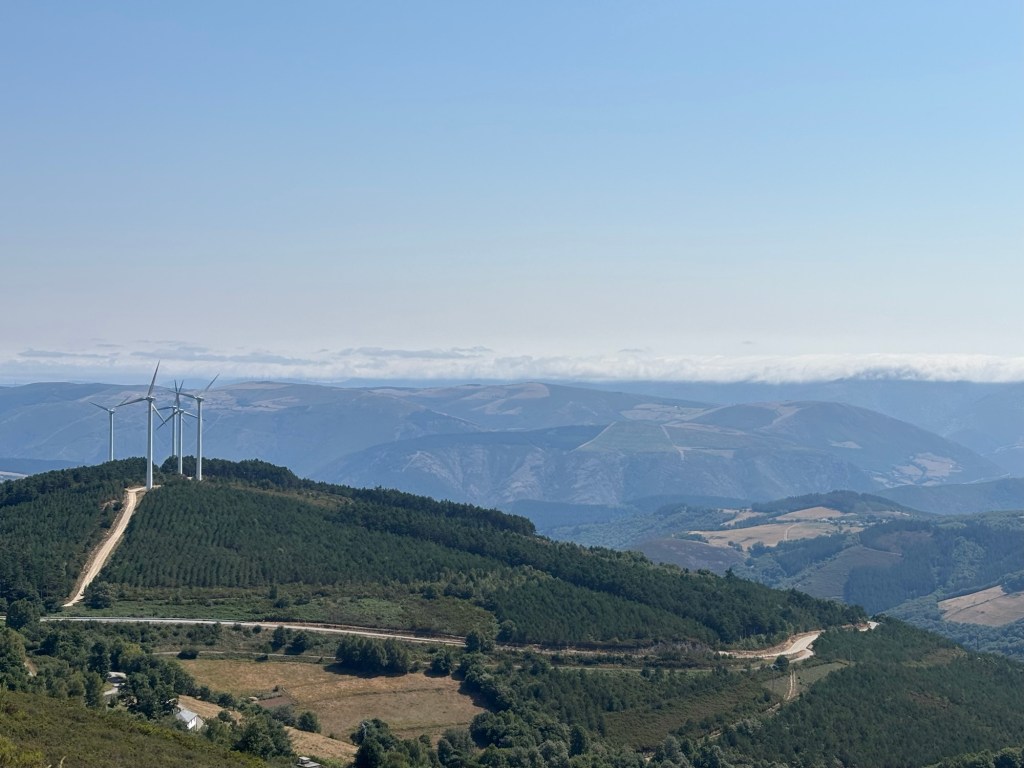
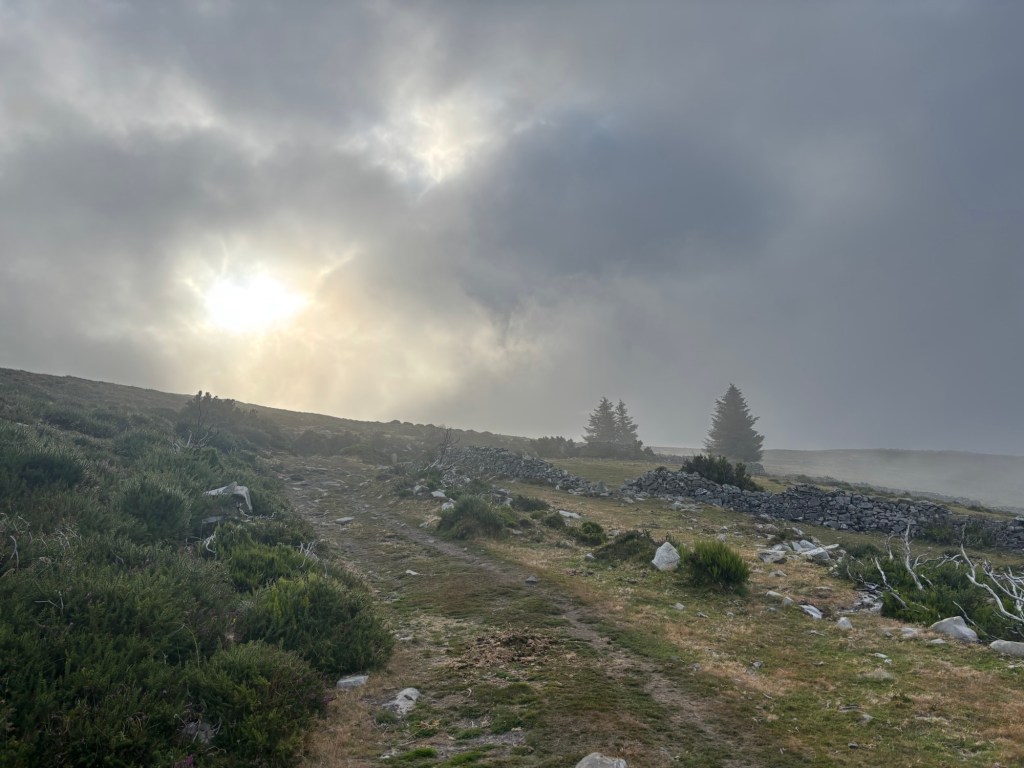
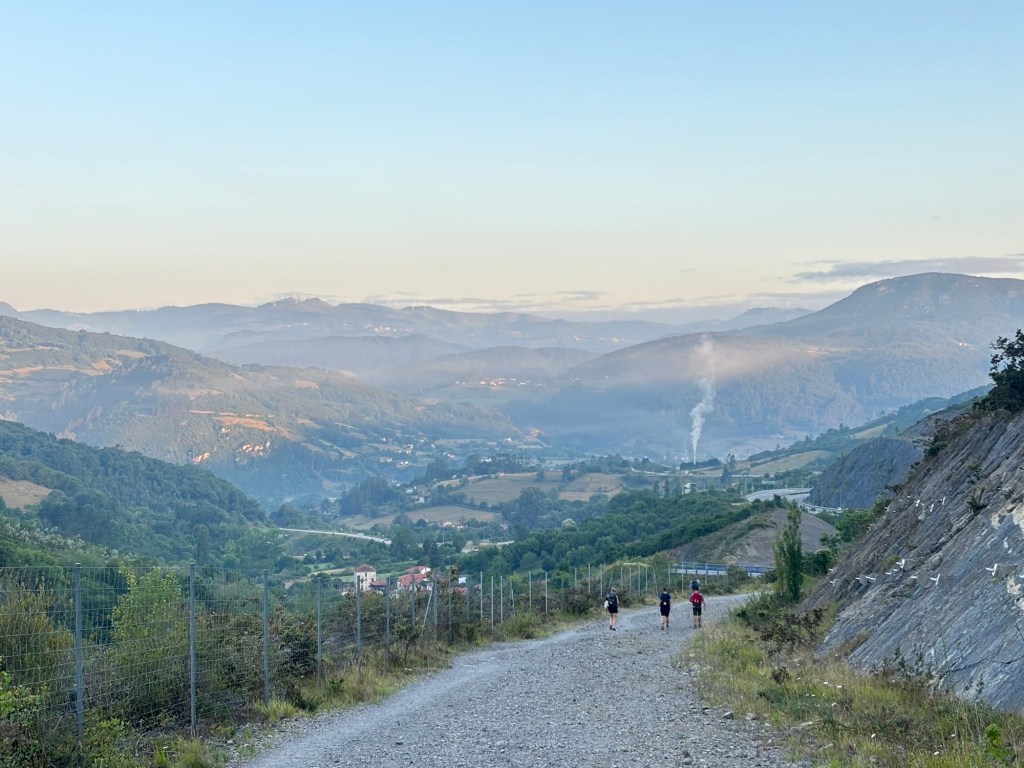
I passed the first row of turbines before sunrise this morning. You can just about see them to the right of the nearer turbines in the photo below, on the last range of hills before the wall of cloud held back by the mountains of Asturias. It’s a good indicator of just how far I walked today.


Shortly after passing the last row of turbines, I crossed the border into Galicia, the last of Spain’s regions on the Camino de Santiago. The marker wasn’t as grand as the one at O Cebreiro – just a crude line of flints and a small cement block featuring a Facebook link to a motorcycle page owned by a guy called Nando, which also happened to indicate that Asturias was on one side and Galicia on the other.

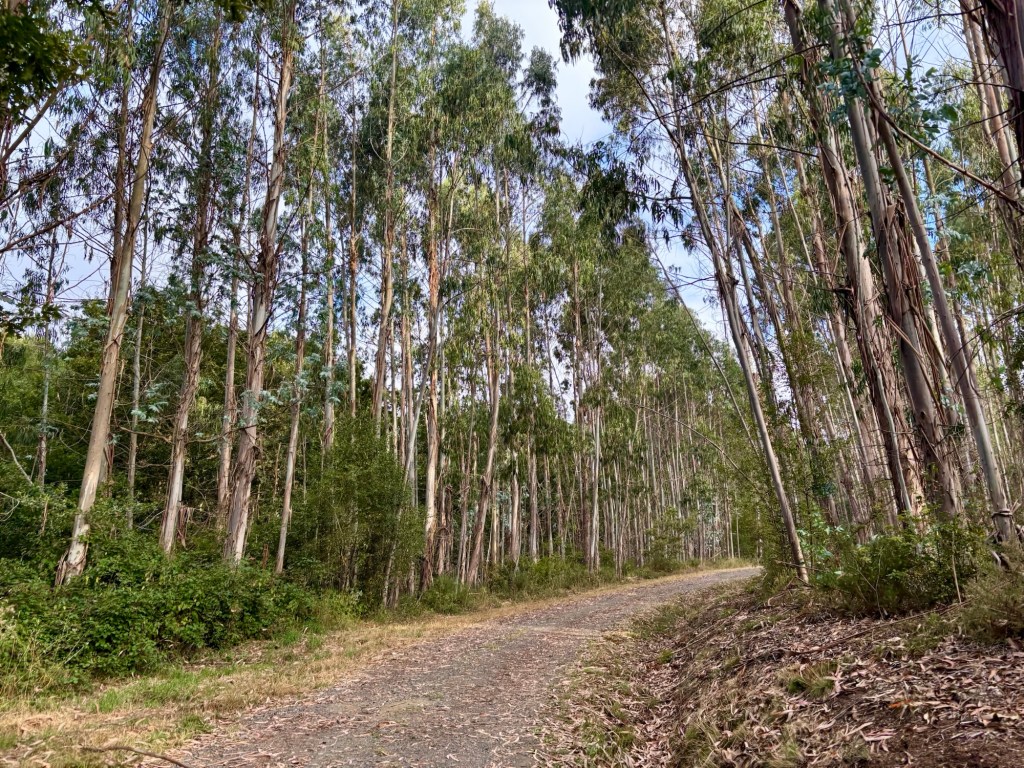
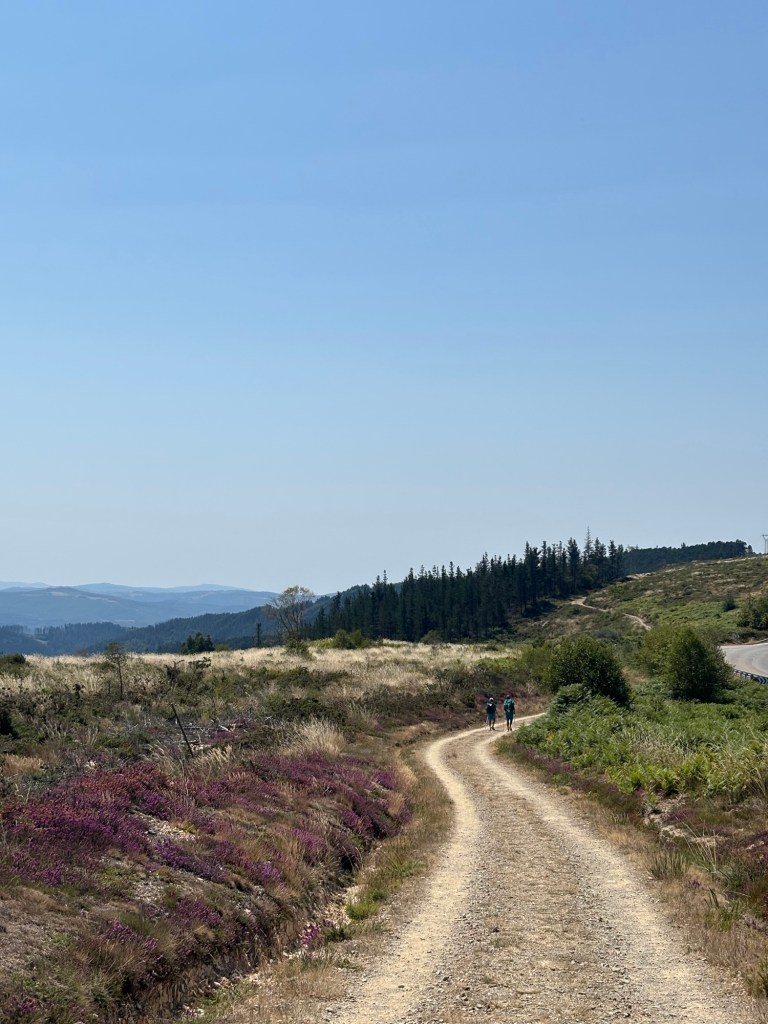
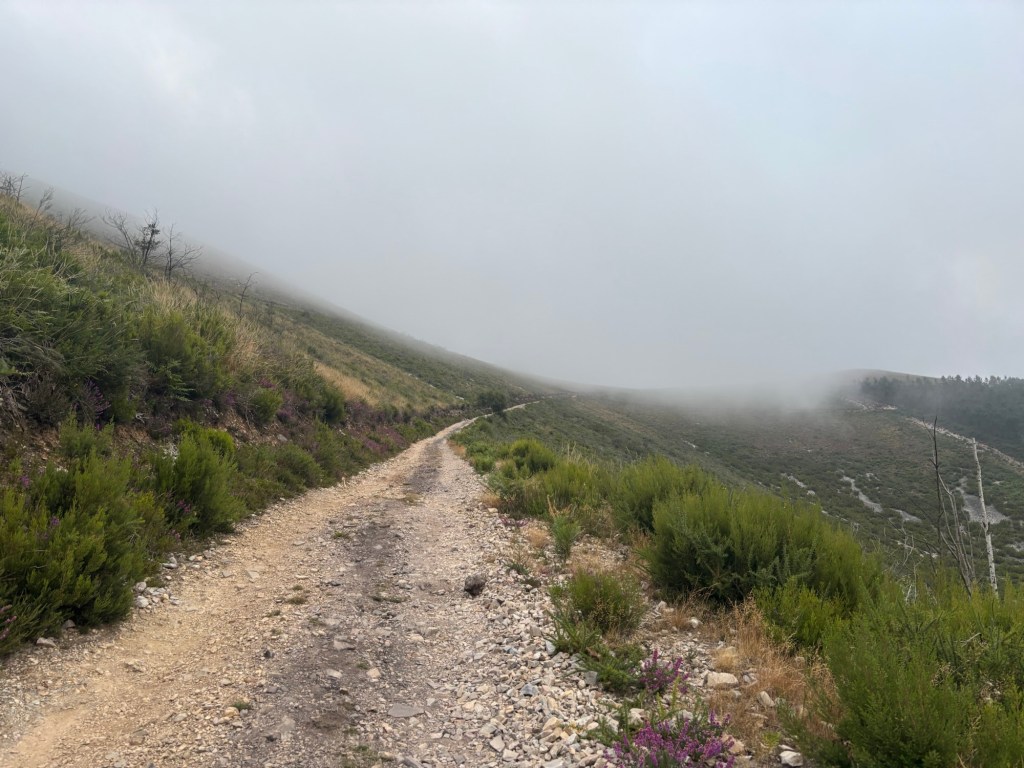
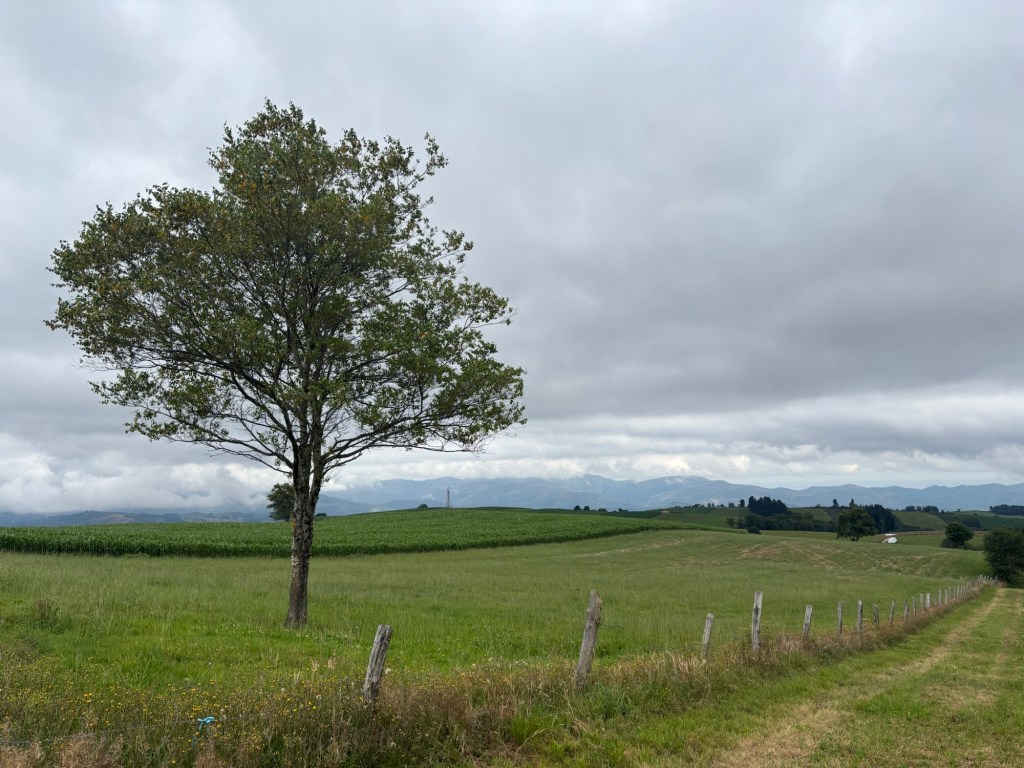
The scenery is already different. The hills are no longer quite as rugged. Instead, they’re carpeted in golden grass and purple heather. I was sorely tempted to get an ice cream at O Acebo, but decided to postpone that desire until I had reached my destination. It took another two and a half hours from the border to reach A Fonsagrada, and the last steep climb up to the hilltop town didn’t help, but I was relieved to learn that the albergue I had found was a bit of a step up from the usual, with real linen bedsheets, soap in the showers and an in-house washer-dryer complex (though I still prefer to wash my clothes by hand whenever I can).


So… forty-five kilometre days can be done, even on the Primitivo! That’s the longest I’ve done so far, and probably the longest I’ll do this year. There’s no sense in rushing to Santiago, which is a lot more expensive to stay in than the towns and villages along the way, so from here on out I intend to enjoy the Camino at a relatively leisurely pace.

Which is, of course, a white lie – because after 45km, 30km is relatively casual. Or 35. Or even 37… BB x

Camino XXXII: El Saltamontes

Albergue de Peregrinos, Berducedo. 17.10.

I have acquired a nickname on this Camino: the Grasshopper. It makes a bit more sense in Spanish, where the name literally translates as “mountain-leaper”. Evidently Hispanic grasshoppers are better at jumping than English ones. Well, not this one, anyway: I took the mountains today at something between a run and a hurdle, leaving the other peregrinos in the dust. I wasn’t in any particular hurry, as I’m still ahead of schedule, but let’s just say I didn’t want to end up walking another 40km day after yesterday’s fruitless endeavours.

Well – mission accomplished!


All the guidebooks indicate that making it as far as Pola de Allande puts the famous Hospitales route out of the question. Fortunately, that’s a load of nonsense. If you’re prepared to do some serious climbing, there’s a farm track that leads back up the mountainside, and I was more than prepared.

And so, as the Fellowship of the Ring tackled Caradhras and the Redhorn Gate (exceptional timing), I hurled myself at the mountain.


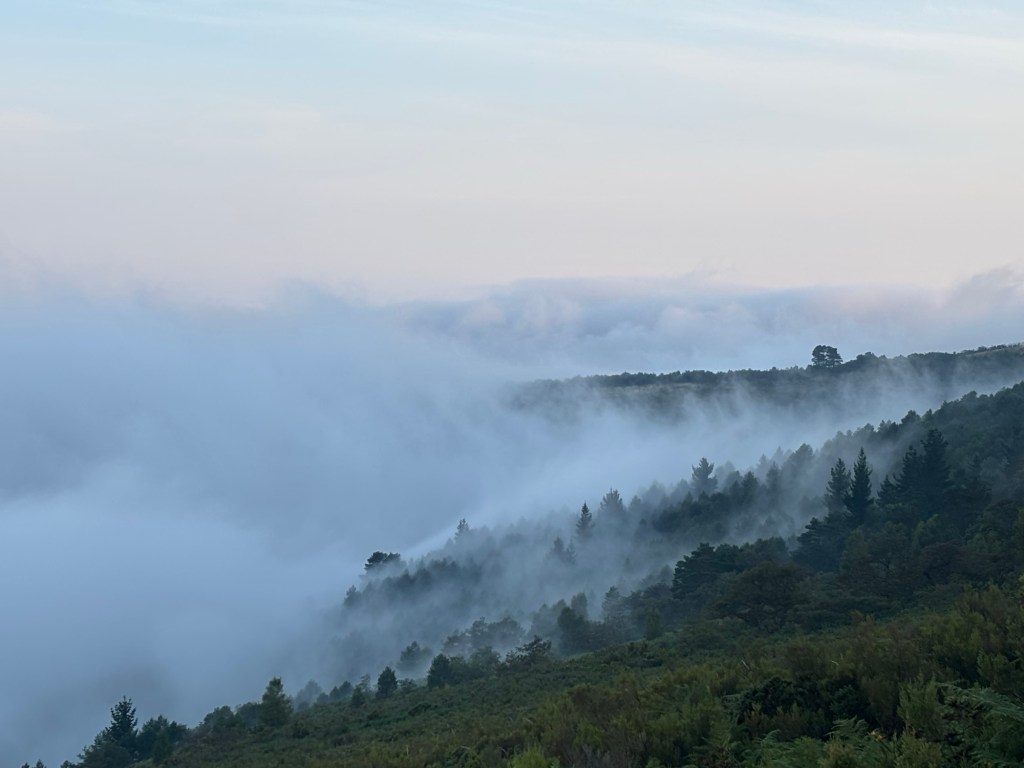
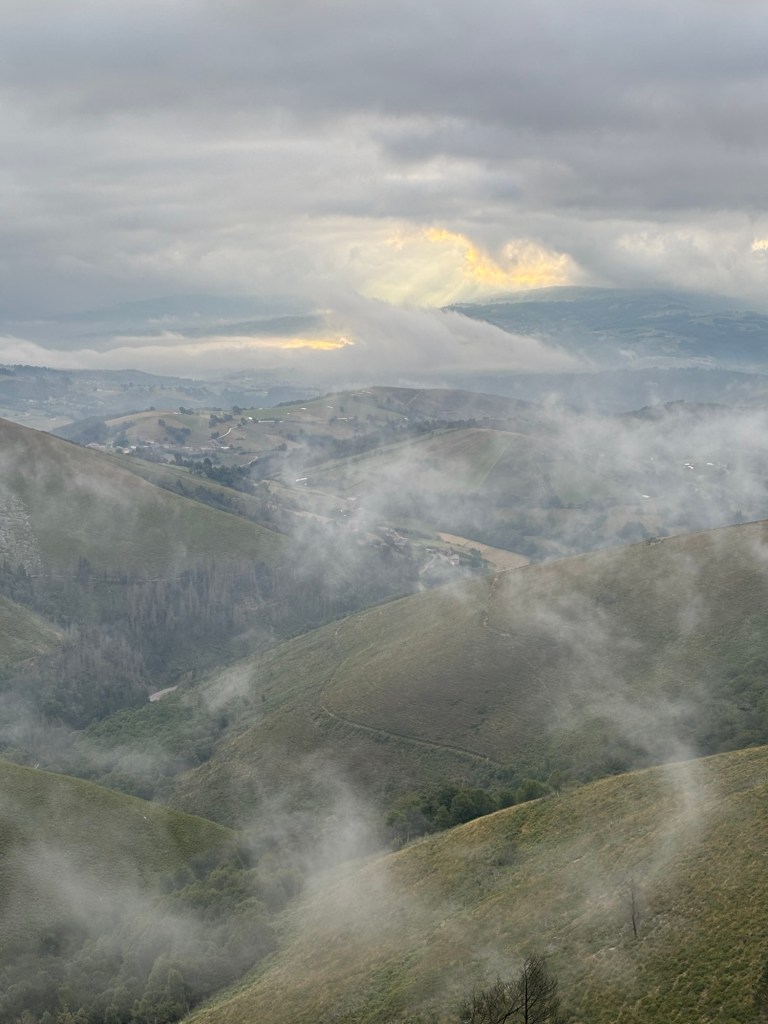
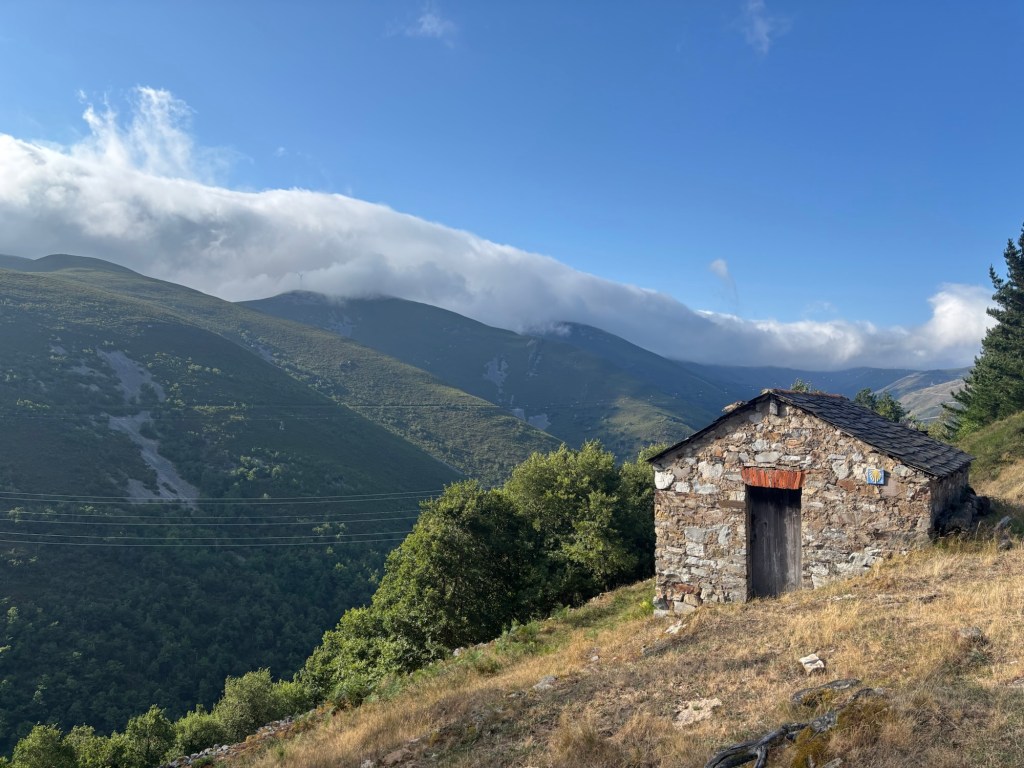
Uphill would be putting it lightly. Let’s just say that the company had already left Moria by the time I reached the top. But was it worth it? 100%. It wasn’t exactly the cloud sea that you get from the summit of O Cebreiro on the Camino Francés – which is around the same elevation – but it was a spectacular sight: pillars of golden light falling upon the green hills of Asturias to the east, dark forests of pine weaving through the valley floor below like a monstrous snakeskin, and great waves of clouds surging up the mountainside to break like water at its peak.


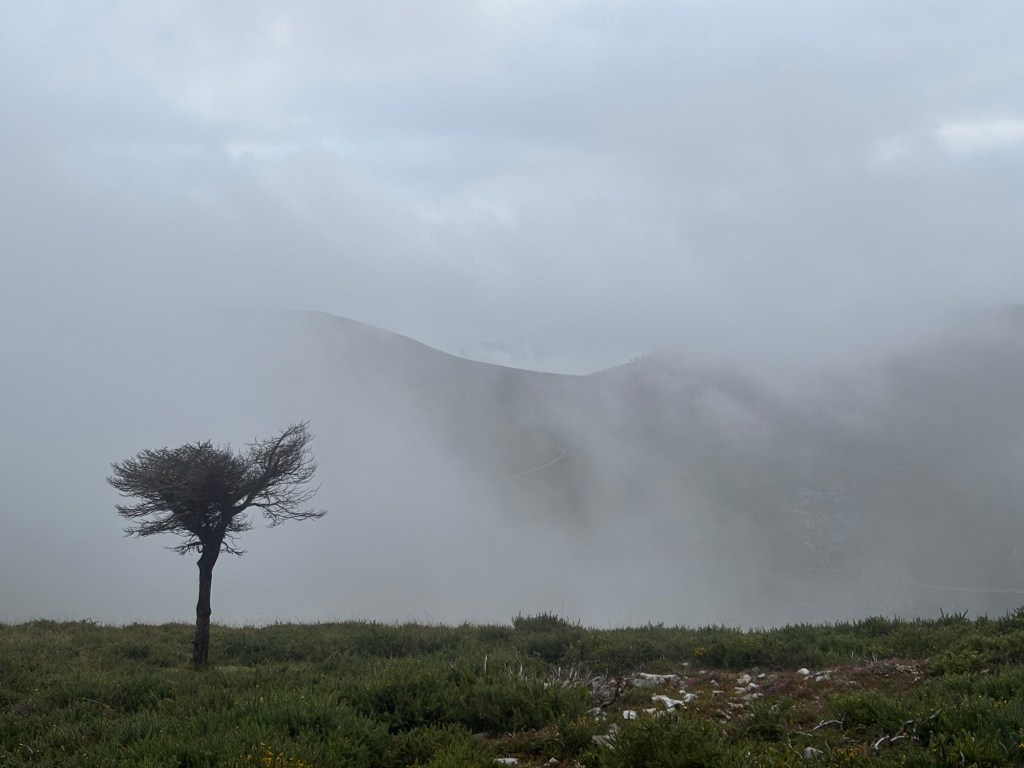
Standing here, upon the heights of the misty mountains, it was easy to see where the painters of Biblical masterpieces of old got their inspiration. Who wouldn’t be inspired with some sort of religious ecstasy in the high places of the world? Are not the mountains the closest we can get to the Heavens?


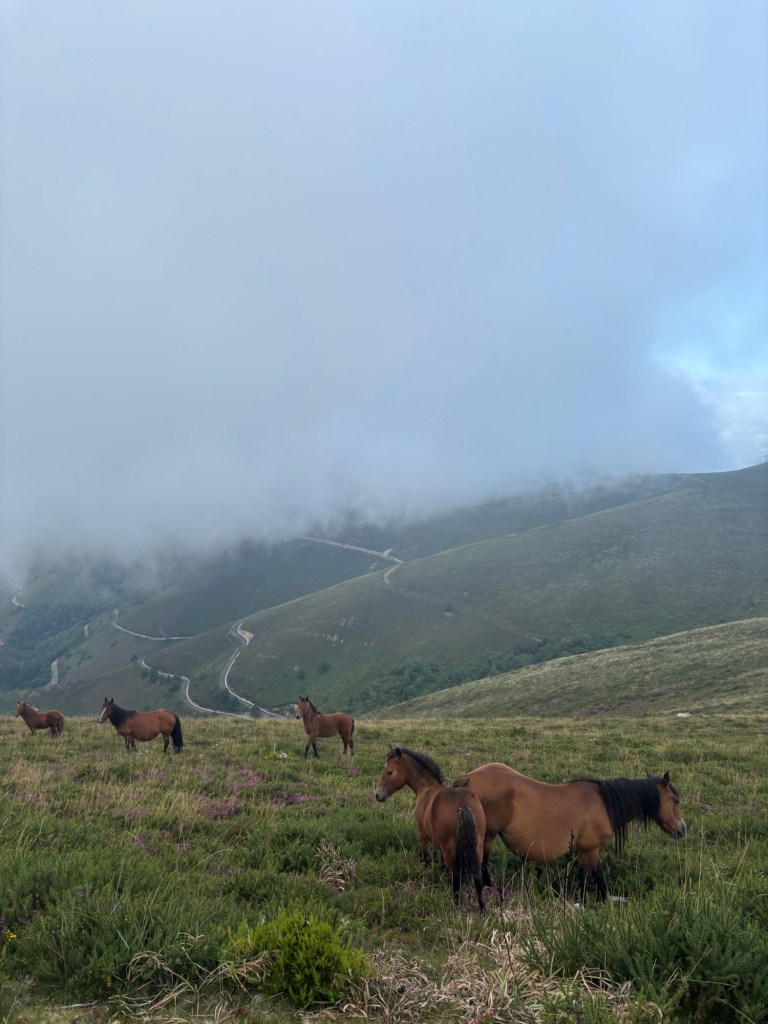
It’s still quite a schlep even when you’ve made it to the summit to reach the point where the Hospitales route joins up, so I had a fair stretch to myself. Me and the wild horses, that is, which were just about everywhere the cows weren’t. It must be a pretty charmed existence for them up here: all the fresh grass they can eat and all the space in the world, even if it is tremendously vertiginous…


After passing the ruins of the old pilgrim hospitals, I caught sight of the first peregrinos of the morning – mostly the crowd of twenty-odd who had reached Colinas de Arriba before me yesterday. Not to be outdone once again, I picked up the pace and vaulted past them. It’s hard to explain, as I don’t come from a particularly mountainous part of the world, but I have always been pretty nimble on my feet in the mountains, so there were large stretches where I confess I really was jumping from boulder to boulder. It feels right, somehow, in a way that a jog around the school grounds just doesn’t match. To think how fit and healthy I would be if I found a way to live in this country forever…!


The descent from Monfaraón was mightily steep, but then again, so is tomorrow’s descent to the Embalse de Grandas, so I looked at the exercise as good practice. The Camino climbs (or races) through the slumbering mountain villages of Montefurado and Santa María de Lago, and by the time I’d reached the latter I had put at least half an hour between myself and the last pilgrims I’d encountered on the road.


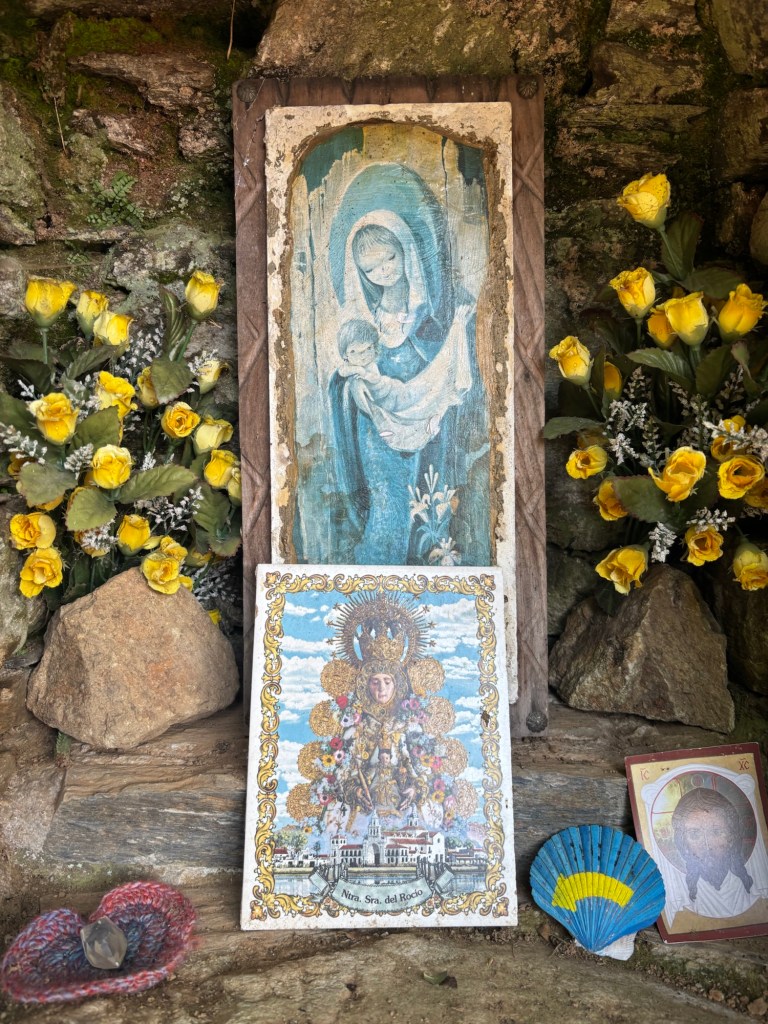
I didn’t see anything of especial note on the wildlife front beyond a veritable army of Dartford warblers in the heather on the mountaintop, but I did find a small shrine to the Virgen de Lago, in front of which somebody had placed an icon of the Blanca Paloma, which was a definite highlight. She has been a real guiding light on this Camino and my hearts soars whenever I find a space where she is venerated.


I got to Berducedo at around 11.40, all of an hour and a half before the albergue was due to open, so I could have pressed on – but after yesterday’s adventure, I wasn’t taking any chances, so I staked out the albergue and scored the first bed. A small victory, but one well-earned.

Not for the first time on this Camino, I bamboozled the other pilgrims by speaking only in Spanish and with a very thick southern accent which, I’m told, smacks of “La Línea o algo” – a mix of English and Andalusian, but more Spanish than English, which is plenty good enough for me.

I had lunch with a large group of Spanish pilgrims from all over: León, Toledo, Donostia, Madrid and Andújar, as well as an English lad here brushing up on his Spanish before the trials of Year 13. The fabada was phenomenal, and should give me all the energy I need for tomorrow’s mad trek, as I need to gain a day or two somewhere between now and Santiago.


There’s an Italian girl who is in tears because she can’t go on. One of the Spaniards is gently encouraging her to look after her health and to come back when she’s ready and pick up where she left off. She’s not the first casualty I’ve encountered on the Camino this year and she won’t be the last. I have to count myself lucky that I’ve made it so far in such good health. Maybe my daily prayers are doing some good for me after all. BB x

Camino XXXI: On and On

Albergue de Peregrinos de Pola de Allande. 20.04.

Yesterday, as it turns out, was only a test drive in fully-booked albergues. Today’s leg saw me walking a further fifteen kilometres in search of a bed after all the other options en route were exhausted, one by one. I’m not even at the logjam that is the Sarria-Santiago stretch, but the early warning signs are already here.

But I’m getting ahead of myself.


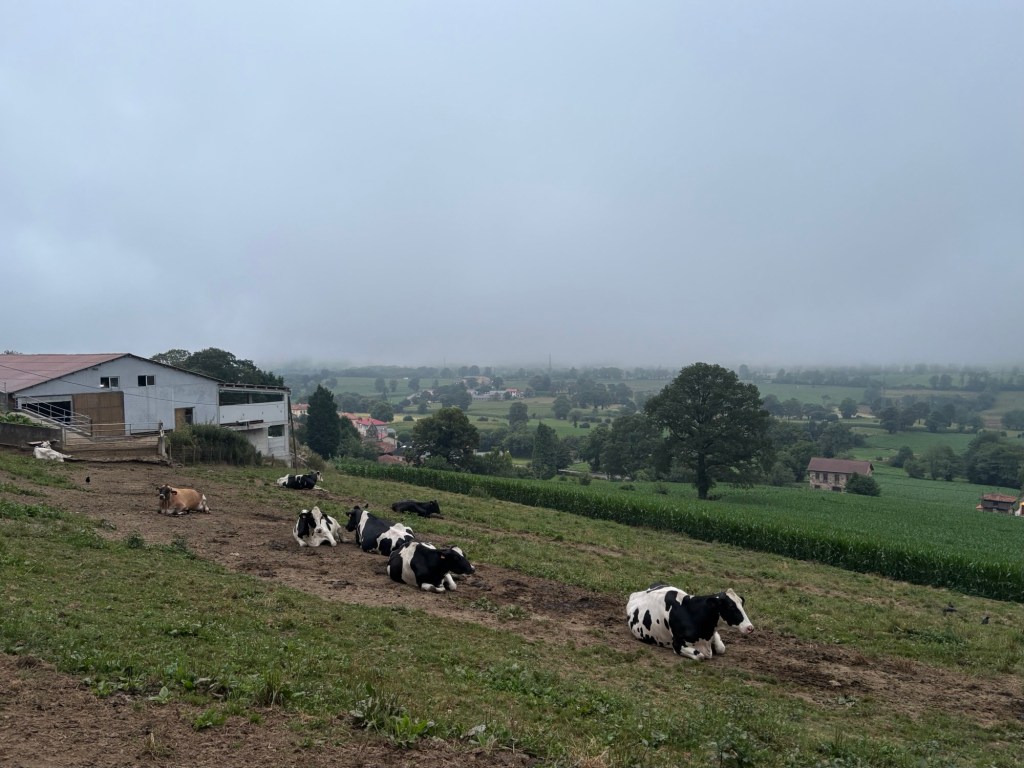
After a blissful night’s sleep in an albergue that was really a converted house (and quite possibly the best shower on this year’s Camino) I left at the relatively slack time of 6.45am, as the sun failed to materialise behind a heavy belt of cloud. The next major town, Tineo, was about two hours’ walk from La Espina, through a vast network of hillside cattle fields. My Spanish students in Extremadura used to joke about Asturias having only tractors and cows. It sounded like a gross stereotype at the time, but let’s put it this way: this part of the country would make for a very repetitive game of I Spy.


At Tineo, as I stopped for a drink at one of the fountains, I was almost jumped by a young pine marten which leapt out of the bushes above the statuette of Santiago. I should have known something was about because the blackbirds were kicking up a fuss in the trees, but I was thirsty so my senses weren’t as acute as usual. It didn’t hang around long enough for a photograph, though it did pop its head out of the bushes a few minutes later from the safety of a shed roof halfway down the hill. That’s the second one I’ve seen. They must be fairly plentiful in this part of the country.

At the edge of the woods above Tineo stands a little house that commands a spectacular view of Tineo and the surrounding hills. Until recently this was the home of Arcadio Rey López, the self-styled “Último de las Filipinas”, a former miner, local celebrity and dyed-in-the-wool Republican who once welcomed pilgrims on the Camino Primitivo. Arcadio died in 2018 and, since then, his former home has lost much of the poetry which once adorned the chalkboards around his house.

Curiously, the expression “ser el último de las Filipinas” means to be the last one to arrive, which was something of a theme of today’s adventure.


Up on the heights above Tineo, I could see all the way to the Bay of Biscay – my first (and potentially last) sighting of the sea along the entire Camino. I heard a quail for the first time in a while, but was followed all the way by the two most common spirits of the Camino: black redstarts and stonechats. These last are ubiquitous in Spain, no matter which Camino you choose to follow, and make for entertaining companions as they race ahead in pairs along the fences ahead of you.


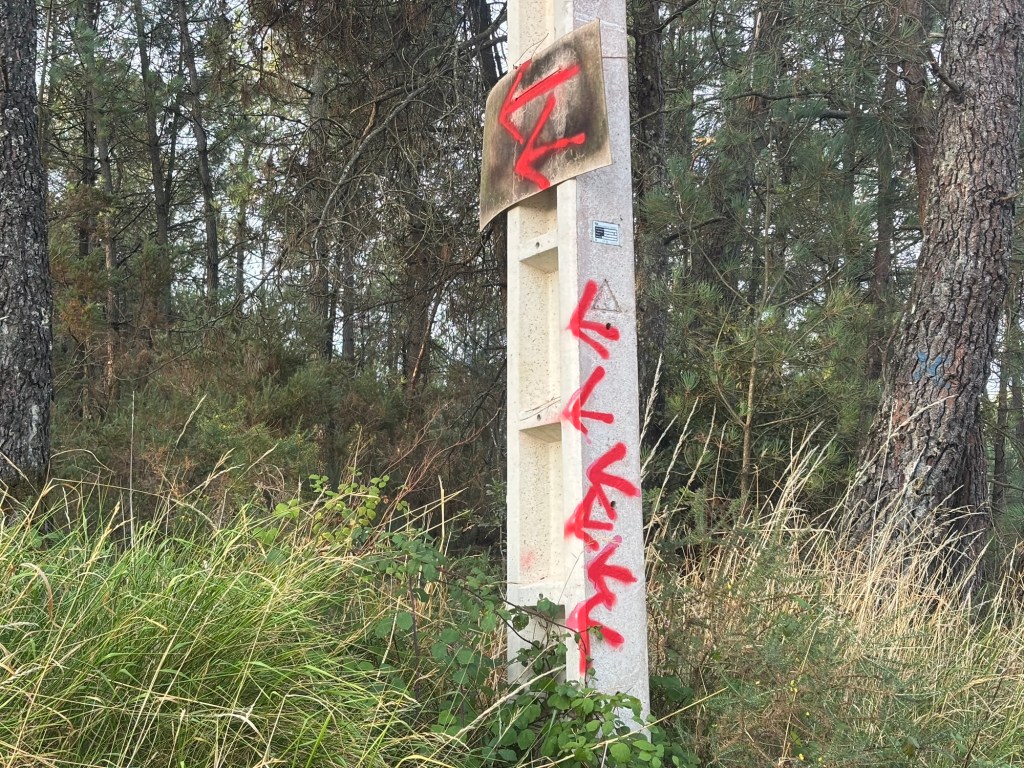
The Camino forks at this stage, offering a slow descent to Obona, but the path itself was roped off, so I took the regular route. When I was deep in the forest beyond, however, I came across a most confusing bit of signposting, which didn’t make it abundantly clear where to go, with the Camino arrow pointing right and the Obona arrow pointing back the way I had come, and a third path going straight ahead with no indication at all. It’s not often that the Camino signage isn’t easy to read, but this was a bit of a puzzle.

So, as Google Maps wasn’t being particularly helpful either, I turned to PolarTrek, an app I’ve been using to track my mileage each day. For whatever reason, PolarTrek is much better at seeing footpaths, which I used to double-back and visit the abandoned monastery of Obona, once a mandatory stop on the Camino.

Obona’s ruined monastery is… haunting, to say the least. It’s hard to tell when it was abandoned, though it must have been sometime in the 19th century after Mendizábal’s confiscation in 1835 of the “manos muertos”, the Church’s inalienable properties in Spain. People have obviously come and gone since then: graffiti both harmless and profane had been scrawled across one stretch of surviving plasterwork; somebody has lit a fire in one corner of the old refectory and written the name “Diego” into the fire-blackened wall; an empty packet of budget Bluetooth headphones lay between the naked beams that must once have supported a tiled floor at one end of the cloister; and a couple of empty bottles and a crushed can of Aquarius had been thrown into one of the antechambers alongside four stacked chairs and the top half of a choir lectern, which was in remarkably good nick if it was a genuine 19th century design.

The cloister itself, unfinished and overgrown, smelled tremendously strongly of mint, which was growing all over the place. I couldn’t resist chewing on a few of the leaves – fresh mint tea is a delicacy I don’t make for myself as often as I should.


Back in the forest, I tired of the lacklustre American reading voice of From the Depths and returned to an old favourite: the 1981 BBC Radio adaptation of J.R.R. Tolkien’s The Lord of the Rings. I was lucky enough to grow up with Peter Jackson’s films (which I adore) but before the films I had the radio series and it is still, in many ways, the superior adaptation in my head. How can you possibly go wrong with a voice cast of Ian Holm, Michael Hordern, Bill Nighy and John Le Meisurer? Not to mention Stephen Oliver’s beautiful orchestration of Tolkien’s verse to music…

Like Triffids, which I often take with me on any solo adventure, I like to listen to The Lord of the Rings whenever I’m on a walking holiday. So much of the saga is about a long journey, and the series’ denouement – which handles the slow sense of loss as each of the heroes part ways until Frodo is left alone – is easily its strongest point, and one which is all too familiar on the Camino. I cannot recommend it enough.


Thus armed, I was relatively sanguine about the subsequent disaster which was my attempt to find a bed for the night. After buying two sandwiches in Campiello – one for today’s lunch and the other for tomorrow – I tried the donativo in El Espín, hoping its relative obscurity would make it an early win. It was not to be. I was greeted with the now frustratingly familiar blue “HOY COMPLETO” sign.

I tried Borres, which I reached after a little tricky negotiation of some churned-up cow slurry. The municipal was noisy and looked half full. Three Spaniards in Lycra told me to check in at the bar in town, about ten minutes’ walk away. I ought to have done just that, but I didn’t fancy the place, and in my hubris I decided to push on to the spot that the Dutchman from El Texu had recommended in Colinas de Arriba.

When I got there, about an hour later, I found a large party of fifteen or sixteen Spaniards having lunch in the foyer. Two others sat at laptops in the bar. The landlady turned a rather apologetic look at me and shook her head – unless I wanted to rent the apartment, which wasn’t cheap, there was nothing they could offer me. I shrugged and said I was sure I’d find something. I should have asked if I could at least fill up my bottle – which I had almost emptied as I neared Colinas – but I forgot.

It took another hour and a half to reach Pola de Allande, now well off the track up to the highlands, arguably one of the Camino Primitivo’s most scenic spots. Finally, just as Frodo volunteered to take the ring to Mordor at the Council of Elrond, I reached Pola’s albergue to find it almost as empty as the Monastery of Obona: just two pilgrims had staked out beds in a room that could have housed at least eighteen. Relieved, I took off my sandals and bag – always one of the highlights of each day – and crashed out on the blue rubber mattress of the nearest bed.

I wasn’t feeling like a meal out, but I did buy myself a tin of fabada asturiana and a couple of arroz con leche puddings, which restored my energy reserves a fair amount. By the looks of things, today was actually one of the longest stretches yet on the Camino, and that’s before factoring in the elevation, which was considerable. So perhaps I did have something to celebrate after all.


I’m loving the scenery of the Camino Primitivo but I’m not enjoying this daily rigmarole of disappointment when faced with pre-booked albergues. The Camino Francés is popular too, but it has a lot more infrastructure to deal with the increasing numbers of pilgrims. The Primitivo’s charm is in its solitude, which isn’t as easy to find in August as it must be at other times of year.

But I remain optimistic. Tomorrow is another day. Tolkien’s walking song has ever been my companion on the road, and I often sing it to myself when I am alone and the road stretches out before me. If there is a more fitting song for the Camino, I haven’t heard it. BB x
The road goes ever on and on

Down from the door where it began.

Now far ahead my road has gone

And I must follow if I can.

Pursuing it with eager feet

Until it joins some larger way

Where many paths and errands meet

And whither then? I cannot say.

J.R.R. Tolkien

Camino XXX: Journey in Hope

Albergue El Texu, La Espina. 17.09.

One of the things I love the most about the Camino is that the planning required, relative to any other holiday, is minimal at best. In most instances, you can pick up your bag, start walking and stop in this town or the next when you’re tired. It helps to know which locations are truly special or worth seeking out, but you can always follow the Camino at your pace. For a teacher like me, for whom planning is a daily and often insurmountable chore, the last thing I want on a holiday is to have to plan all of my movements. The total freedom the Camino provides is one of its greatest blessings.

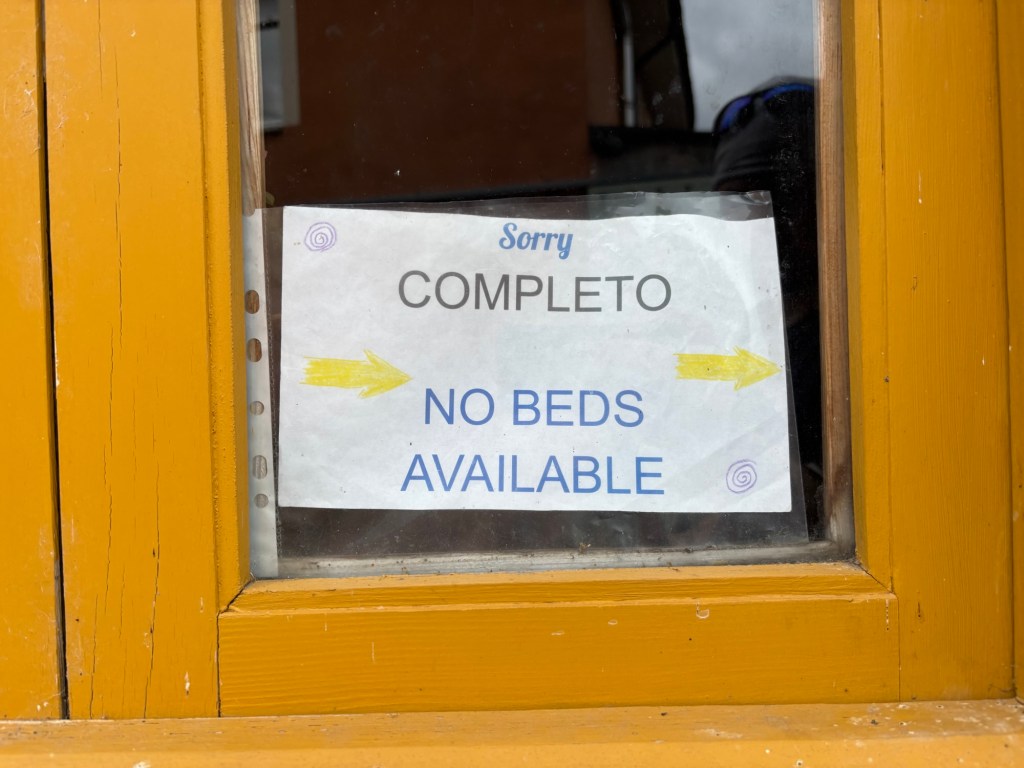
Except when you see signs like this.


I had read a lot about the quality of Bodenaya’s albergue, so I was a little disheartened to see this sign in the window when I got there at around half past one after an arduous climb up from Salas, only to find it was all full – already, and whole hour and a half before it was due to open. Bodenaya, like many albergues along the Primitivo, is small and personal, counting on just ten beds. However, this is not normally a problem if you’re quick on your feet and get there in plenty of time.

Sadly, popularity breeds on itself, and some pilgrims (sometimes with legitimate reasons) feel the need to book all of their accommodation ahead of time so that they can enjoy the walk in peace without worrying about having a bed for the night.

Which is great for them. But not for those of us who have to deal with the disappointment of doing everything right and being beaten to a bed by the eager beavers who would prefer peace of mind over the freedom of the Camino.

Everyone walks the Camino in their own way. That’s a fact. I just don’t agree with the idea of booking accommodation in advance along a route that is one of the few places in the world where you genuinely don’t need to. There are all sorts of other holidays where that kind of mindset is the norm. If I wanted to know where I’d be and what I’d be doing a week or a month in advance, I’d consult my teacher’s planner (or somebody else’s, as I hate writing in mine). Work is planned. The Camino is freedom.

There. I’ve said my piece. Let’s move on.


The hospitaleros at Grado put out a large breakfast spread, so I ate well this morning. I saw a few familiar faces along the road, many of whom had stayed at San Juan the night before after finding Grado’s municipal full (there’s a reason the municipales are often occupied by the younger and fitter pilgrims).

There were a few clouds on the horizon, but the sun rose in a warm, pastel pink, promising a warmer and drier day’s walk ahead. I was quite glad of the rain yesterday, but now that I am armed with more sun lotion, I am not as concerned about another day under the sun’s anvil as I was on the San Salvador trek.


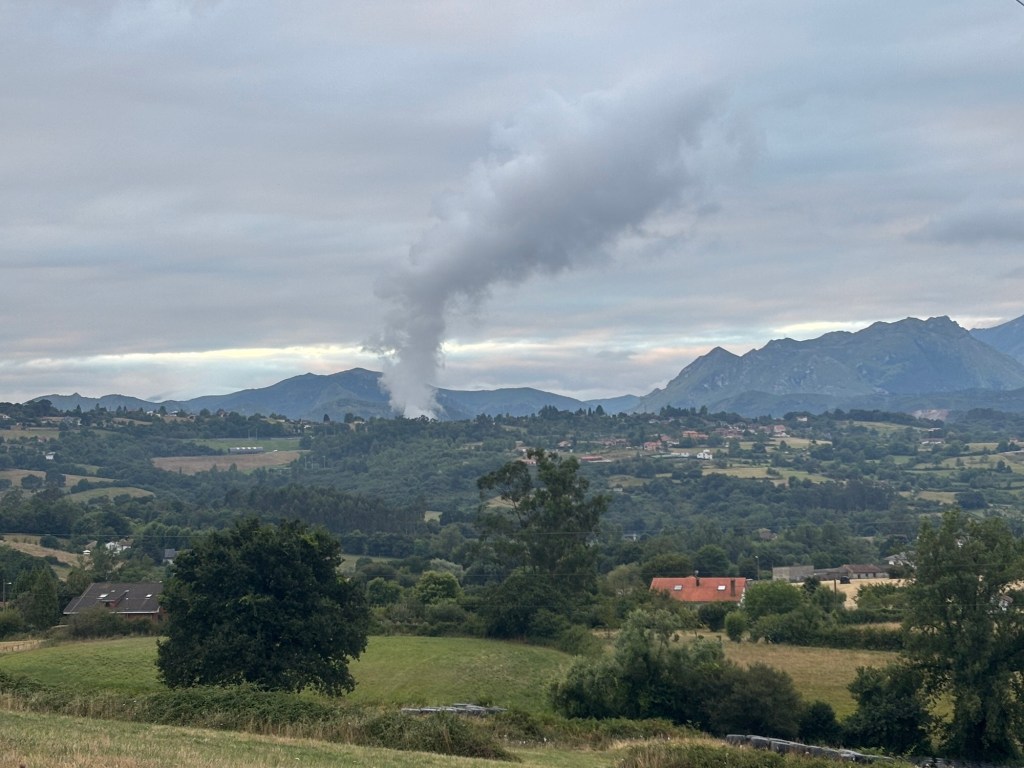
The climb up from Grado is not half as impressive as the descent on the other side, which provides a sweeping panorama of the valleys ahead, all the way to the turbine-topped hills of Pumar that lead to the Bay of Biscay. No Asturian landscape seems to be complete without a small pillar of smoke from some factory or quarry: in this instance, the chalk mines at La Doriga.


Spain’s north has always been its industrial heartland. This is largely due to its abundance of natural resources like iron, copper and coal, which gave the region all the tools it required to build what would become one of the world’s first global empires. There were even gold mines here once, when the Romans scoured their own empire in search of that most precious of metals.

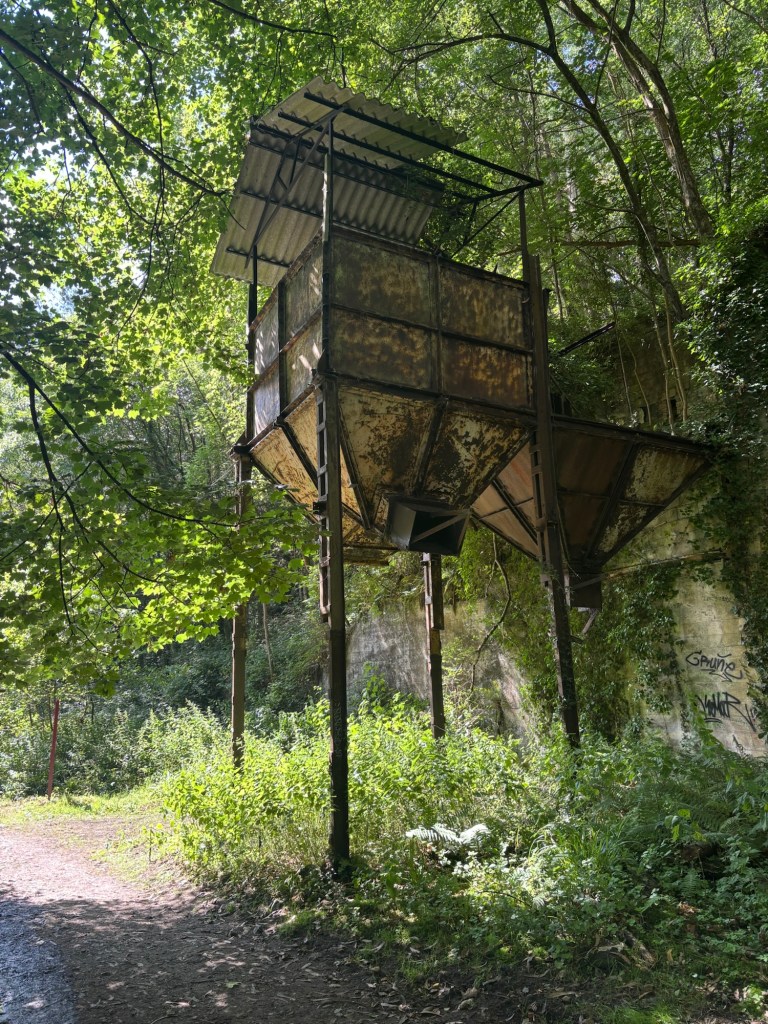
Many of the quarries are still in use, but some have fallen into disrepair, slowly disappearing within the dark forests of Asturias. This one caught me by surprise in the hills behind Salas. The vents through which the chalk must have been shuttled once had long since rusted shut, and vines and thick carpets of ivy had all but concealed the adjacent storehouses, but the tower remains standing. I’ve always been fascinated by abandoned quarries and factory buildings, and Asturias has plenty to explore, even along the Camino.


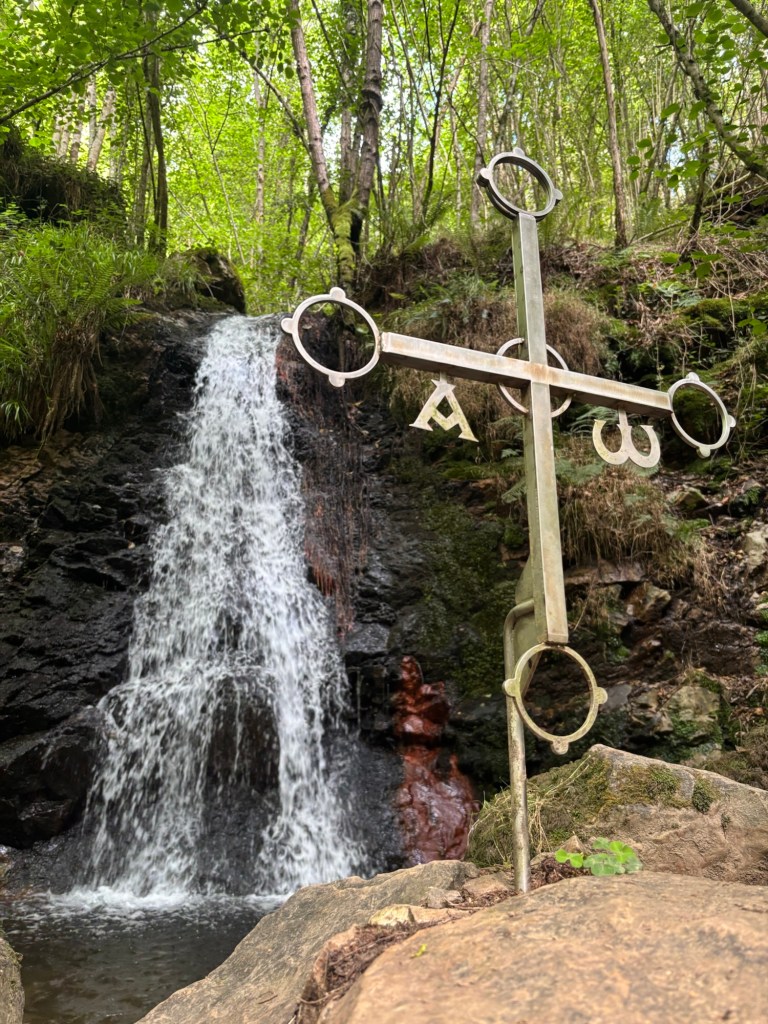
A short distance from the Camino (at the cost of a 200m descent) is the Cascada de Nonaya, a concealed waterfall hidden away deep in the forest. It’s easily missed from the pilgrim road, but Google Maps is a wonderful thing, so I knew what to look out for. Somebody has erected a metal simulacrum of the Victory Cross of Asturias at its base, so in the absence of a church, I made this one of my stops for a prayer today. It was a very special place: peaceful, dark, ancient.


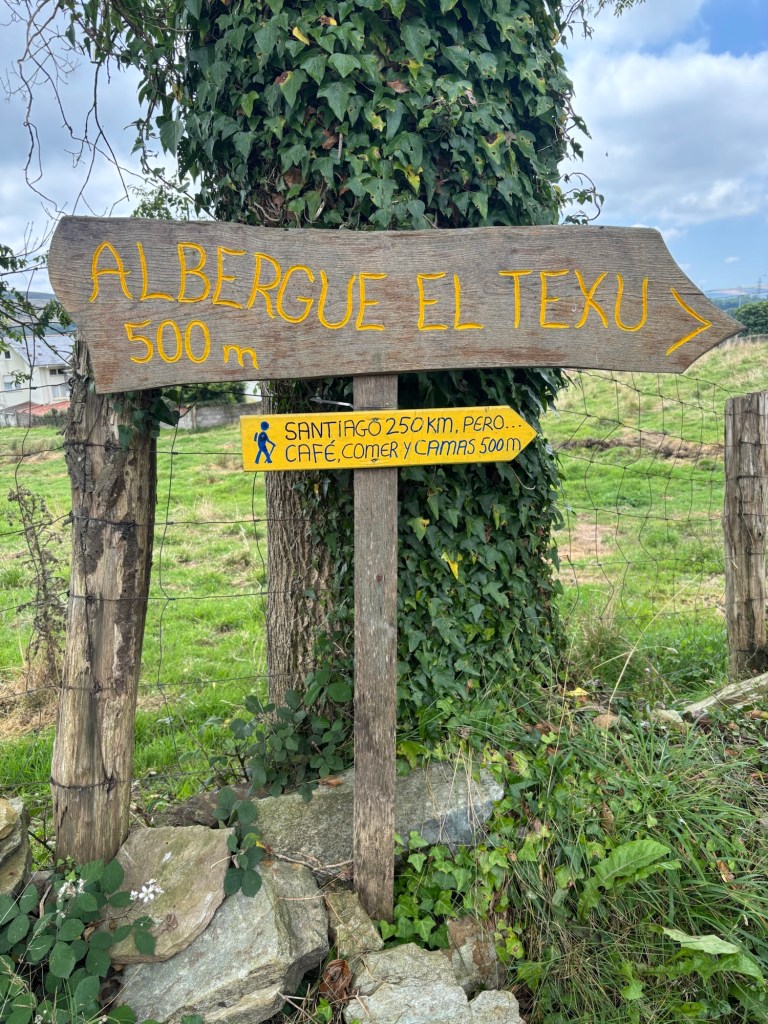
After the waterfall, the Camino makes a very steep climb up the mountainside before levelling out along the main road towards Tineo. My destination, Bodenaya, turned out not to be – as I had the slightest inkling might be the case – so I shrugged and moved on. La Espina seemed promising, but the municipal albergue didn’t seem to be what it had been cranked up to be online. Then I saw yet another sign for a well-advertised albergue that wasn’t in any of the websites, and the fatalist took over. I know better than to deny fate when it’s trying to tell me something.


El Texu is a beautifully peaceful setup, run by a Dutch family and their volunteers. It wins the award for best shower on the Camino, as far as I’m concerned, and I haven’t even had the Thai green curry that Nani is making for supper! I’m normally a purist for Spanish fare on the Camino, but right now, a Thai curry sounds incredible. I can’t wait! BB x
Camino XXIX: Asturias

Albergue de Peregrinos, Grado. 21.40.

Confession. I was genuinely considering skipping Grado to gain a day this morning. I think I still hadn’t shaken the idea that, if I could only walk a little faster, I might catch up to my companions on the Camino Francés before they left for home. But the Camino, like an old god, is fickle. I’m not sure whose idea it was – Santiago, the Lady of El Rocío or the capricious spirit of the Camino itself – but I was waylaid at the albergue this morning by a retired Swedish woman who wanted company on the road out of town. The Camino leads straight to the train station, and I might have made it in time… but the Swedish woman pointed left and I followed without thinking.

I lost her about half an hour later when I picked up speed at the city’s outer limits, but I see now that it was a signal: no tricks this time. This Camino must be walked from beginning to end. There is something along this road that I am meant to do or see. The fatalist in me takes over on the Camino, and right now he is utterly convinced of that fact. So here we are.


Welcome to the Camino Primitivo. If you were expecting something similar to the Camino Francés, think again. It’s almost like stepping out of a bus and onto a boat: the same feeling of companionship, but an altogether different vehicle in an altogether different environment.

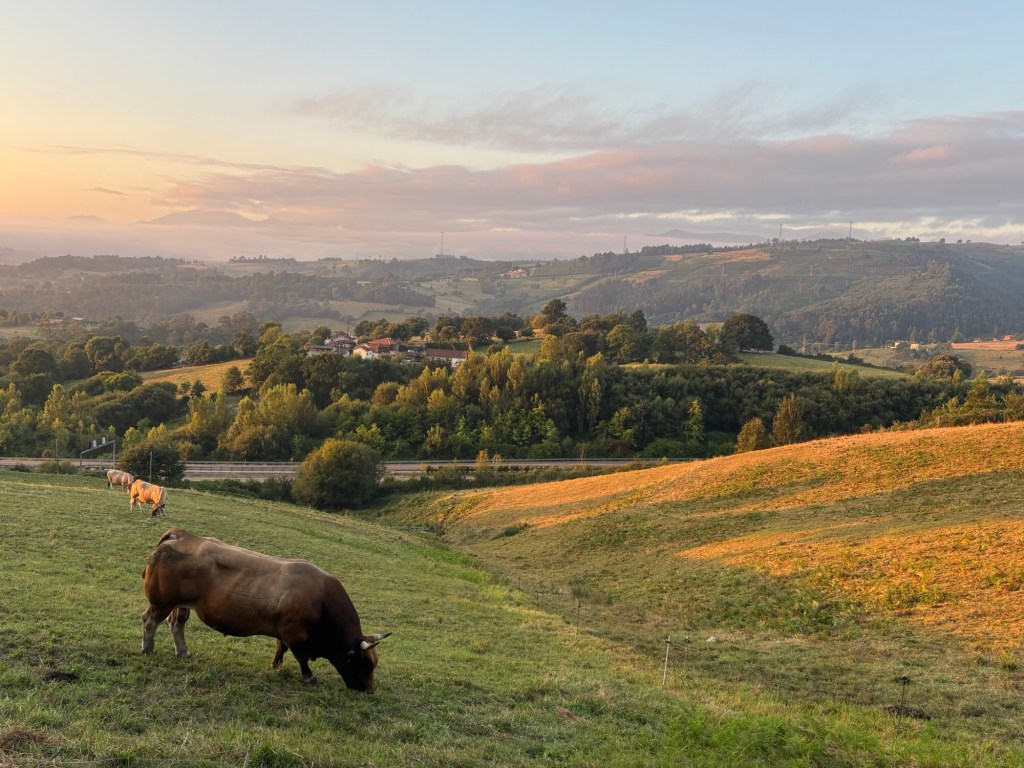
Asturias is, in a way, the grandfather of Spain. This green and clouded region, together with Cantabria and the Basque Country, was the final holdout of Iberia’s Christians during the Moorish invasion of 711, and it was from here – so the legends tell – that Don Pelayo established the Asturian monarchy, the earliest forerunner of the Spanish crown, and began the Christian reconquest of Spain – the Reconquista – which would take nearly eight hundred years to complete.

You might think such a place would be as Spanish as it gets. You would be mistaken. This is not a land of paella, flamenco and bull-fighting, or dark-skinned maidens flanked by guitar-wielding lotharios (a stereotype far more common among Italian pilgrims this year). This is a green and hilly country where the clouds descend as far as the tree-tops and sometimes beyond; where the rain rolls in off the sea in visible eddies and falls like mist on your face. Where the men are short but powerfully built, and the women breathtakingly pale. Where great clouds of smoke rise from the quarries and factories, and the air is thick with the constant ringing of cowbells. This is Asturias. It could hardly be more different to neighbouring León. It is a reminder – as though one were needed – that Spain is, in reality, a multinational state, where even the kingdom that started it all has its own distinct language and identity.


For the greater part of the morning, my road was cushioned by the clouds. Sometimes they moved with me, sometimes they moved against me. It rained for a half-hour or so, but it was not so much rain as a rain cloud that was so low to the ground that one could walk right through it. The Camino from Oviedo ducks and weaves through the hill country, sometimes following the asphalt roads, sometimes leading down dark trails into the tangled forests of oak and eucalyptus.

It’s very easy to see how this corner of Spain – behind the frontier of the Cordillera Cantábrica – shelters most of Spain’s lingering mythology. The forests are dark and watchful and the mist rolling through them plays tricks with your eyes. I heard something large kick up the leaves and dart into the deep at one point, but I never did see what it was. A deer, perhaps. There are plenty of them about.

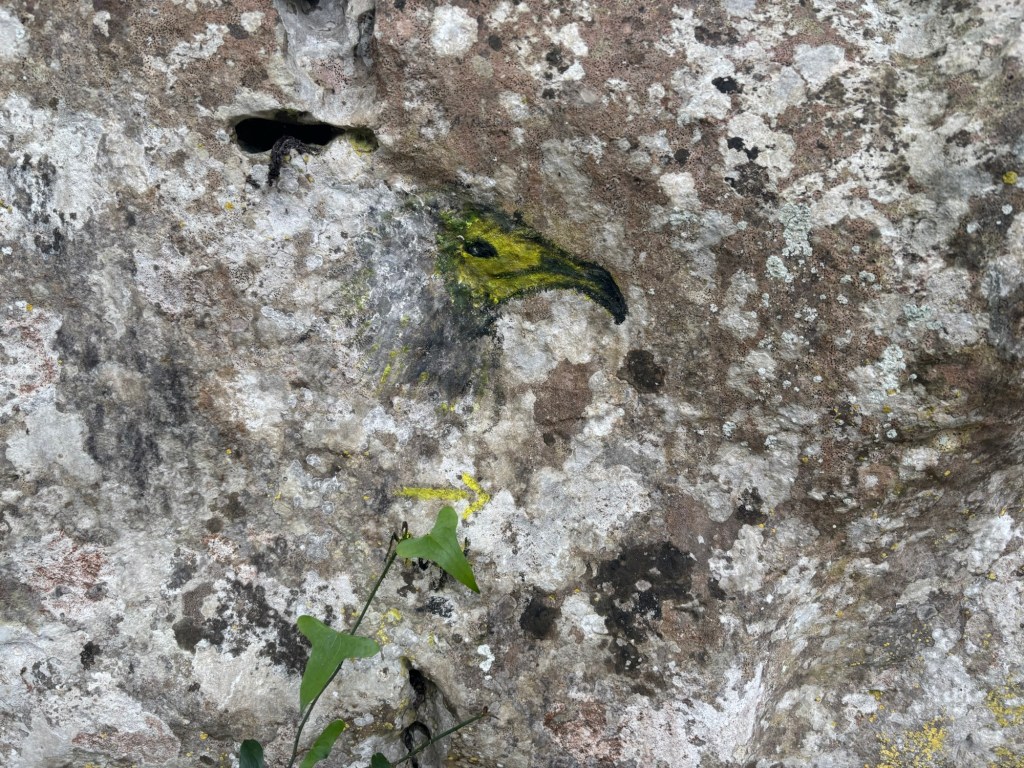
In one of the forested stretches, the Camino crosses a small clearing scarred with limestone teeth, like the bones of some ancient monster. A splash of colour on one of the rocks nearest to the road caught my eye and, on closer inspection, it was the head of one of the spirits the Lady of El Rocío sent to guide me yesterday: an Egyptian vulture.


Egyptian vultures are one of the oldest species of vulture still in existence. They are also the last of their kind, with their nearest relatives believed to have died out during the Miocene. They are incredibly intelligent creatures, being one of the few species to use not just one but two tools: using stones as hammers to break into eggs, and sticks as spools to gather wool or other nest-building materials.

They’re also amazing to look at, with their glam-rocker hairstyles and their black and white wings. I found myself wondering whether this bird was one of the inspirations for the Chozo, an ancient race of superintelligent avianoid aliens from the Metroid series. Their faces certainly match up to the earlier designs.

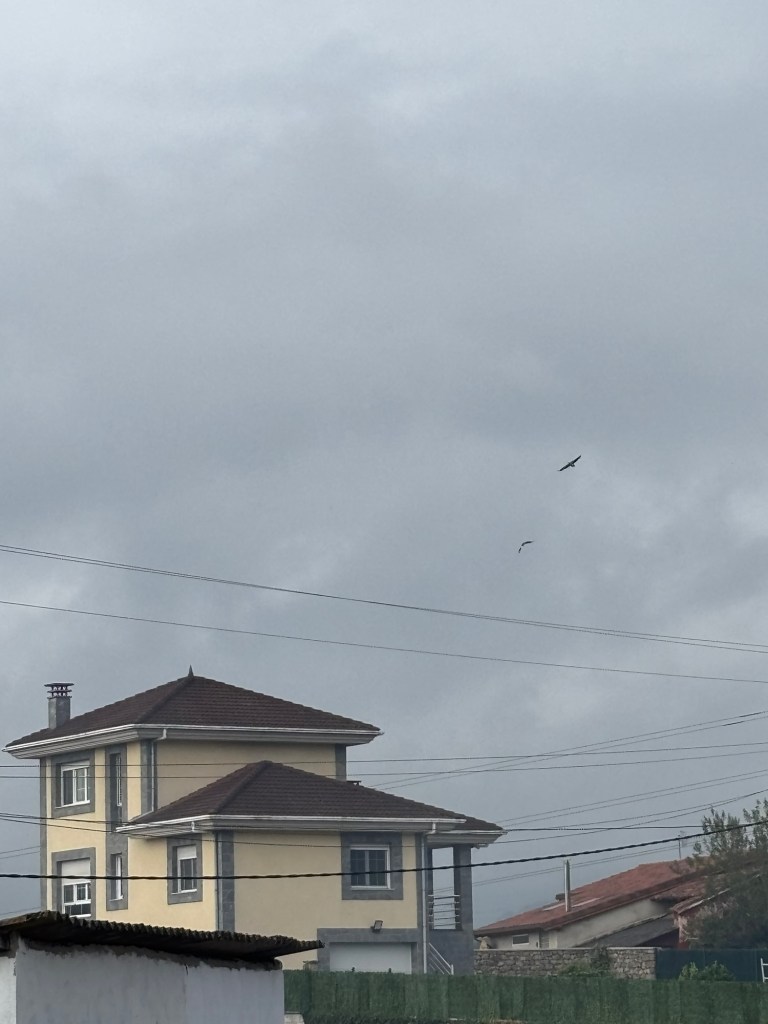
Well, while I had them on the brain, suddenly, there they were: a pair of them, circling low over a hamlet on the outskirts of Premoño. A local and his son were heaping refuse onto a small bonfire, which may be what drew them in, but before long they were riding the thermals high into the sky. It was enough to make me skip one breakfast stop just to chase after them and watch them ride higher and higher until I could no longer make out the diamond shape of their tailfeathers.


I tried to make amends on a breakfast stop in Valduno, but one of the waiters made frantic signs to be quiet as I opened the door: half the bar space had been given over to microphones and speakers, and they were in the middle of recording a podcast. I could get some water, they said, or wait in a corner. I felt I was intruding on something. I moved on.

I found a better spot in Paladín, where I had a nice long chat with the barman. He had some sort of alarm setup which sounded awfully close to Colours of the Wind from Disney’s Pocahontas, which went off whenever somebody walked through the gate – I guess that’s how he knew to appear the moment I arrived. He was keen to know how many pilgrims I had seen on the road. I told him only a handful, as I had been one of the first to leave Oviedo – which was true – but that there had been plenty at the albergue. He was quick to point out that not all of them would come this way, as the Camino Norte also runs through Oviedo, but seemed very appreciative to have a conversation with a peregrino. Spanish tourists bring money during the summer, he said, but they don’t bring much more than that: a place to eat and sleep and then they’re gone. He missed conversations with pilgrims and swapping tales from the road.

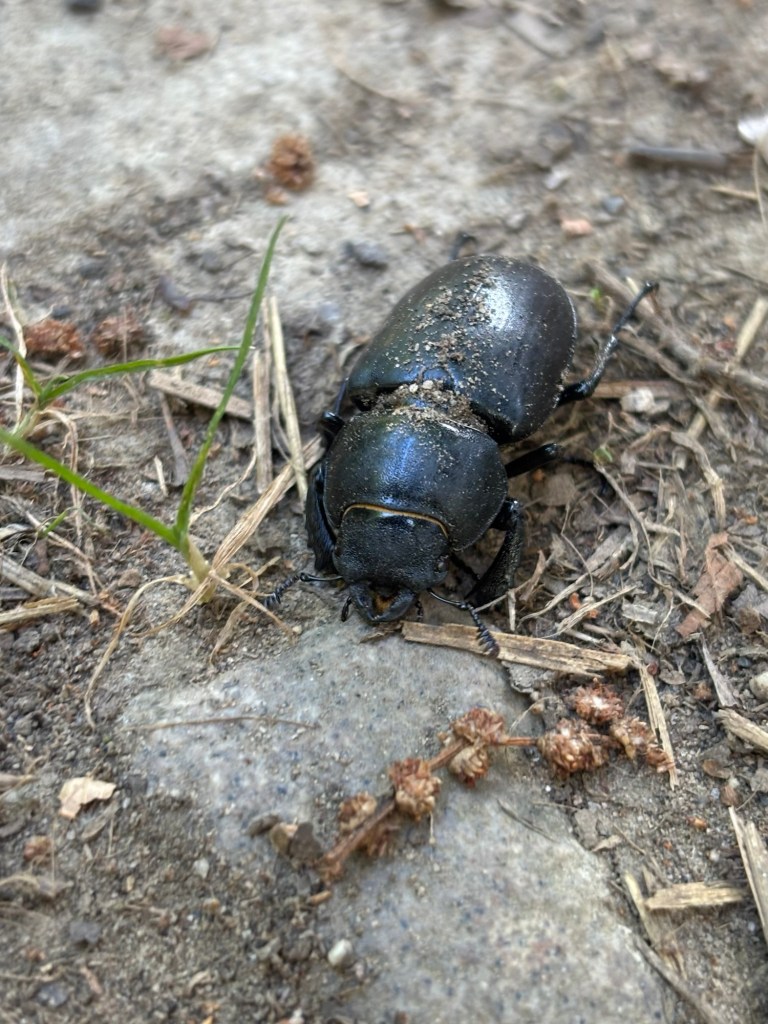
After Paladín, the Camino returns to the banks of the Nalón for a little while. I was so fixated on the beauty of the river that I almost stepped on a stag beetle. I have yet to see one of the impressive males, but the females seem to get about quite a bit during the day, as this is the sixth or seventh one I’ve seen along the Camino.


Like its sister, the Tajo, and a great number of other Spanish rivers and creeks, the Nalón cuts right through the craggy cliffs and sierras on its winding journey to the sea. The train from Oviedo seems to follow it, which must make for a spectacular journey. There’s a small bar at the foot of the Peñón de Peñaflor where you can stop for a drink, but I was much too busy drinking in the view. The old masters painted paradise as a garden with many mirrored lakes and fruit trees, but I think mine would be scarred with karstic crags just like these.


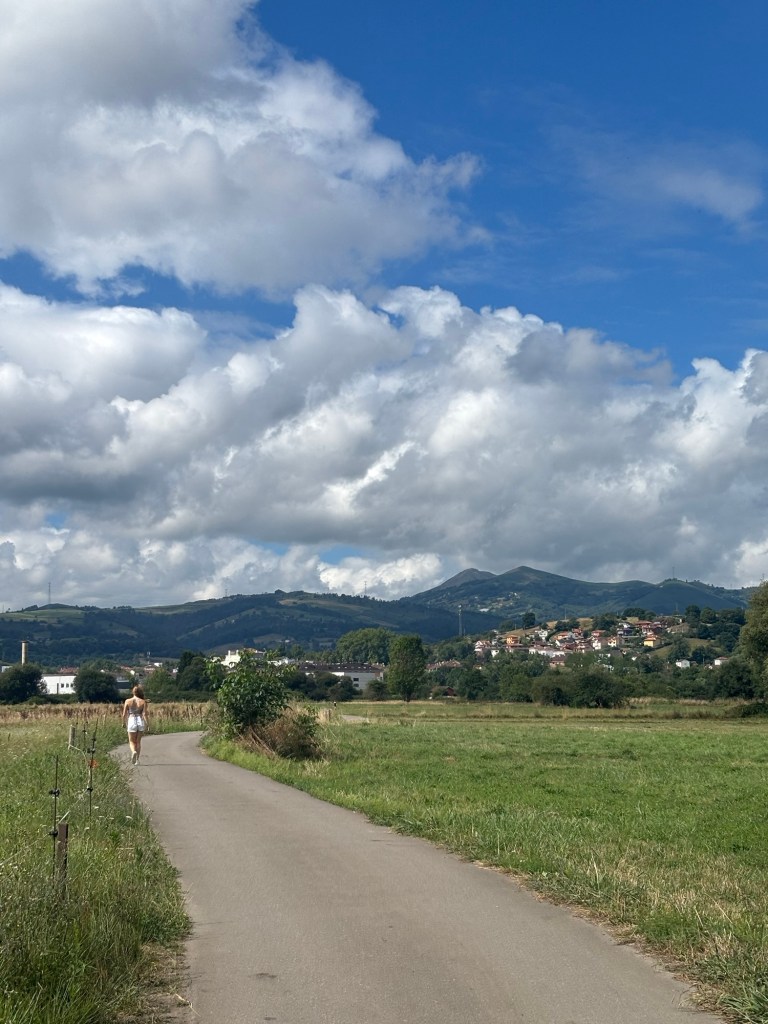
After crossing the river and the tiny settlement of Peñaflor – a small cluster of houses that seem to exist purely to justify the train station – the Camino cuts across the countryside toward the hill town of Grado. A local girl in white cut-off jeans stepped out into the road as I left town and sauntered on ahead with a jaunty, confident stride, toying with her hair over one shoulder and then the other, and then held up in one hand, as though she couldn’t quite make up her mind how she wanted it. It was about half an hour’s walk to Grado, where she finally disappeared into one of the apartment buildings. Spaniards aren’t known for being natural long-distance walkers, so I wonder what she was doing out here?


I reached the albergue a full two hours ahead of opening time, so I took off my sandals and zoned out for a bit. I’ve found a comfortable method in wearing my liner socks underneath the woolen socks (which may well be their original purpose). It’s not too hot and it meant no discomfort whatsoever from my blisters. Let’s see if it lasts.

Andrés, the cheery hospitalero from Badajoz (I’d recognise that accent anywhere) arrived just before 2pm and handled check-in, after which I had a good nap for two hours (that’s how I can justify still writing at this late hour, when all the other pilgrims have long since turned in). I considered going out to eat, but instead sorted out my flight home and popped out to a supermarket to get some supplies – namely, sun-tan lotion, as I’m all out and there are some long days ahead.

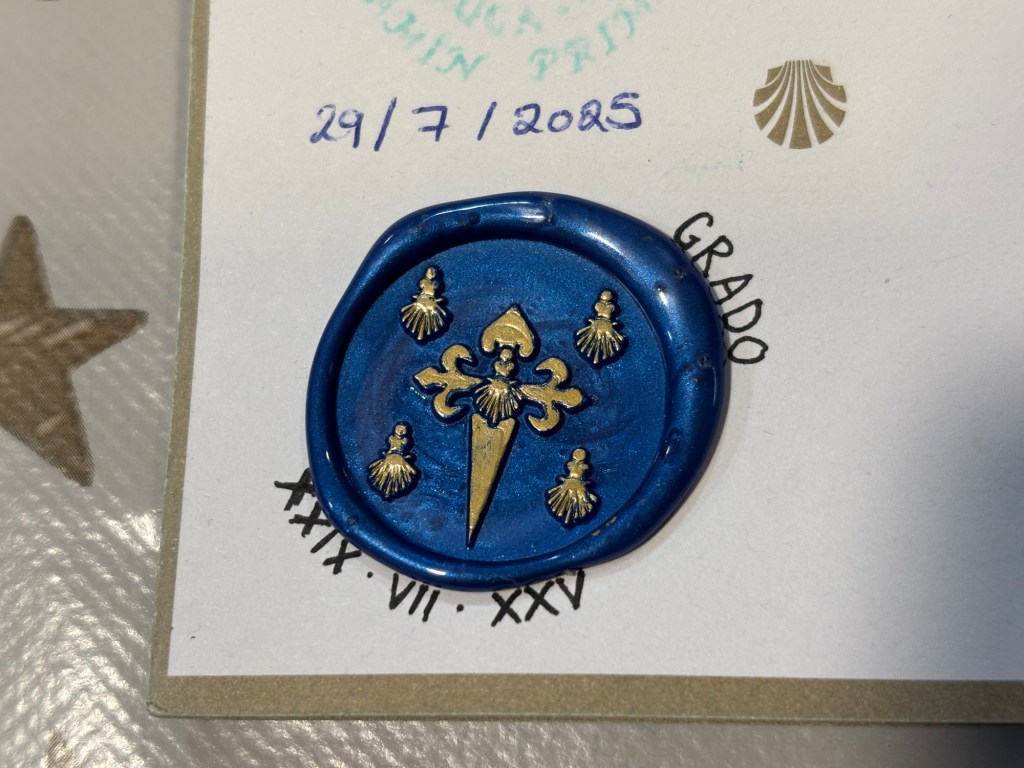
Back at the albergue, Andrés suggested making some wax stamps. This slowly brought all the pilgrims downstairs and got conversations flowing all around the room. Hospitaleros only typically work for around 15 days before moving on, but here was a master at work: friendly, accommodating, knowledgeable and unimposing. Just present.

He also had the spirit to call out a fellow Spaniard for a slightly tactless remark about how “easily” Moroccan migrants get Spanish citizenship. As a former civil servant, Andrés certainly knew his stuff – enough to put the man in his place with some hard facts about the reality of immigration policy in Spain.

I feel I learned a lot today. I also got a shiny new wax stamp for the passport, which I painted gold in a nod to the Asturian flag. Now when I look at it, I’ll remember this place.


I don’t know if I’ll find a “Camino family” again like I did on the Francés – that road does facilitate the group dynamic like no other. But this feels right. I’m learning so much and seeing so much more.

Somebody stopped me from catching that train, and they had the right of it. Here’s to another week and a half of wonder. BB x
Camino XVIII: Down and Out

Albergue de Peregrinos El Salvador, Oviedo. 19.27.

Ignore what I said yesterday. I’ve reached Oviedo a day ahead of schedule. There are a few reasons for this:

  1. The Albergue in Pola de Lena was due to open at 15.30, some three hours after I arrived. The website was pretty vague about the need to book ahead.
  2. The next town, Mieres del Camino, was about three hours’ walk on, but had no albergue – pilgrims are housed in the Residencia Universitaria for the princely sum of 25€.
  3. The flights home from Santiago go up by about 50€ after the 10th August, giving me an incentive to pick up the pace, but…
  4. …my feet could use a break after all that climbing, and speeding up is the last thing that I need.
  5. Oh, and I’ve had three days without WiFi, so my data has been cascading faster than my Camino buddy Alonso could finish a watermelon.

Hopefully you’ll forgive me for catching a train for the last 30km or so from Pola de Lena. I have been walking about 25-30km a day every day for four weeks, and I used one cheeky bus ride on my last Camino to circumvent the tedious industrial estate west of León. This time it’s my own health I’m looking out for!


It’s a good thing I jumped the gun and climbed up and over Puerto de Pajares yesterday, as when I awoke this morning, it was to a fogbound world. The rain that was forecast never came, but in its place a thick blanket of mist had descended upon the mountains, obscuring everything from sight. It didn’t clear until around half past ten, by which point I would have long since reached the Asturian border if I’d stuck to my original plan.


Two of the sportygrinos left around five minutes before I did, but I never saw so much as a whisper of them on the trail, and I was making pretty good speed. I’d get to wondering whether some of these lean Spanish pilgrims take the Camino at a run, but there was no such trace in the mud, so perhaps they took a shortcut. Or went by bike.


The initial descent into the valley below was positively murderous underfoot, so Pinta and Niña came to the rescue once again. It wasn’t helped much by the knowledge that once I’d got to the bottom of the valley, I’d only have to go back up again on the other side.

The Lady of El Rocío sent me a gift to speed me on my way. A pine marten came scampering out onto the path as I started to climb, stared at me for a few seconds, and then went bounding off into the trees. I raced after it on stealthy feet, but it had vanished.

About an hour or so later on, as the Camino threatened monotony on a 5km asphalt stretch, she sent another gift in the form of a white raptor: an Egyptian vulture, the first I’ve seen in years, smaller than its griffon cousins but by no means less impressive. Between these two gifts and the cries of buzzards that followed me all the way to Pola de Lena, I was in good company all morning.

Something that caught my eye along today’s route was the quiet fury at the Asturian AVE line. The AVE (Alta Velocidad Española, Spain’s high-speed rail line) arrived late in Asturias, with works completed in November 2023. The project took nearly twenty years to complete, owing to the difficulty of the terrain – namely, the formidable barrier of the Cordillera Cantábrica. The first attempt to dig a tunnel through the mountains hit an enormous aquifer that drained many of León’s rivers and reservoirs, requiring rapid repairs and a considerable sum of money to re-route the tunnel.

All in all, the final cost of the AVE line from Madrid-Gijón was around 4€ billion. For context, the Madrid-Barcelona line cost around 9.5€ billion to lay down, which is just under twice the length, but there is considerably more traffic between the two megacities, and the Catalans have always benefited from their access to the profitable Mediterranean Sea. The Asturians, on the other hand, are proud of the natural beauty of their mountain principality and the decision to mine straight through the mountains does not seem to have been universally welcomed here.


I reached Pola de Lena at around 12.15 and killed some time over lunch (alubias con orejas, chuletón and natillas – and all for less than £10!). I had the same rigmarole with the train ticket as I had in France: the ticket barrier wouldn’t recognise the QR code on my phone, so as there was nobody at the desk, I just bought a 2€ ticket to the next stop. And just like France, the QR code worked perfectly at the other end. No idea what that’s all about.

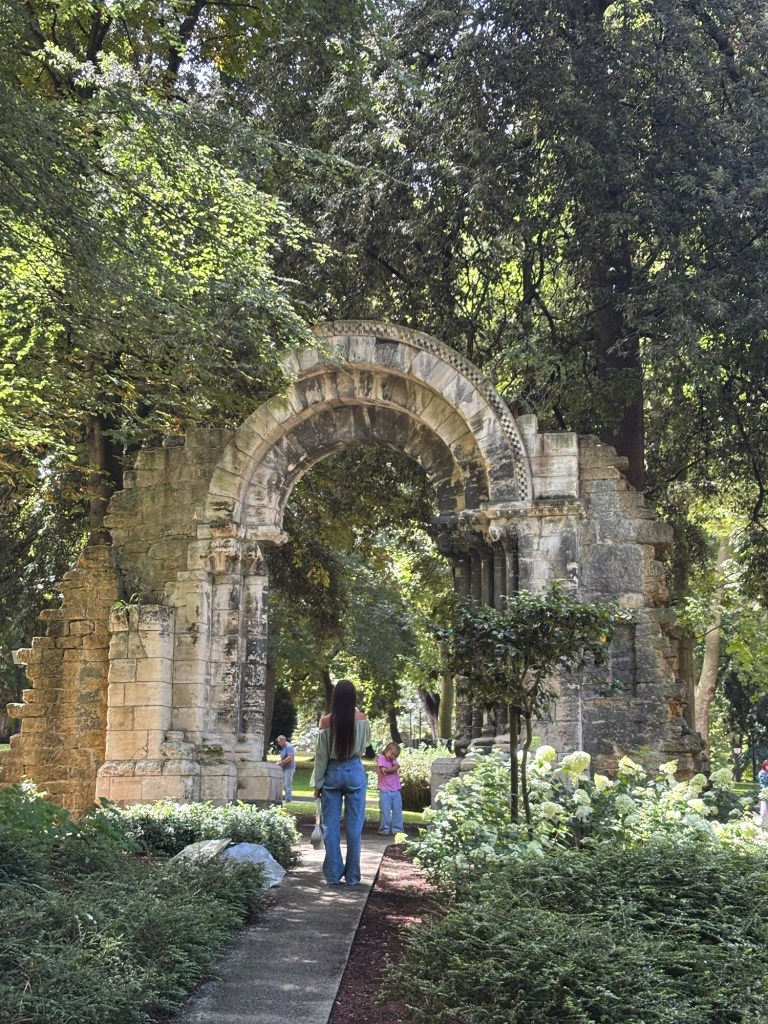
Oviedo is a very different city to the ones you encounter on the Camino Francés. It feels distinctly more European than Spanish: large green parks, blocky, modern buildings and no plane trees in sight. I had to cross one such park to reach the albergue and practically stumbled upon a statuette of Mafalda, the beloved creation of Argentine artist Quino. She’s a big hit in her home country (and in Spain), but Oviedo has a special place for Mafalda due to the presence of her statue in the park. That’s why you’ll find Mafalda-themed tee-shirts and toys in shops all across the city.


I got to the albergue in time for 16.00, when the hospitalero hobbled in, but it was gone 17.00 by the time I got to check in – despite being only seventh in line. The poor guy seemed to have learned the monologue like a script which he rattled off at high speed, too fast for even the Spaniards amongst us to understand. The only point he was crystal clear on was that we had to be in by 22.00h, at which point he would close the doors. I suppose that must be a recurring problem in the cities.

I can tell you one thing I’ve noticed immediately about the Camino Primitivo. It’s a lot more European. I haven’t met a single American (or Brit, for that matter). Lots of Spanish, lots of French and a scattering of German, Austrian, Italian and Portuguese. But no Americans. I wonder if that’s a thing? Do they only come across the Atlantic for the “big ones” – the Francés and the Norte? The Primitivo is just under a fortnight (I will be doing it in around 10-11 days) so perhaps it’s not worth the investment. It will mean a serious shot in the arm for my languages – and isn’t that precisely why I love the Camino so much?


It would be remiss of me to come all this way and not visit the Catedral de San Salvador, so I slipped in for a flying visit just before closing time. True to form, the scaffolding curse struck again: the cathedral was untouched, but the image of San Salvador was behind a heavy hemp screen, being carefully restored by a couple of painters. There’s plenty more to see, though, and I had a wander around the sacred relics and the pilgrim tombs in the cathedral’s antechambers.

Just before leaving, my eye was caught by a small but incredibly ornate chapel by the exit to Santa Eulalia de Mérida, a teenage saint from Extremadura who is venerated in Asturias. She’s a long way from home, up here in the cold mountains of Asturias; but then, so was the Lady of El Rocío in that shrine by the lake west of Logroño.

I’m only just beginning to take an interest in the cult of saints in Spain – and I feel all the more foolish now for dodging an entire module on the subject at university. Given my especial devotion to the Lady of El Rocío, it seems a subject I really should explore some more. Maybe there’s a space for Eulalia in there. She would be a bridge to the land that stole my heart.


French to my right. Portuguese to my left. Spanish out in front. It’s shaping up to be a good Camino choice for languages. And if my plan holds out, I might even get to say one last goodbye to at least one of the pilgrims with whom I shared the road from Puente La Reina. New friends and old. That would be a nice way to end this adventure. BB x
Camino XXVII: Columbus Rides Again

Albergue de Peregrinos de Payares, Pajares. 19.30.

Shortly after one o’clock this afternoon, I crossed over into Asturias and crossed off the penultimate Spanish region on my list. After a flying visit to Tenerife earlier this year and a long march across Aragón at the start of the Camino, now only Murcia remains. Which is tremendously ironic, as my family are technically Murcian, since the borders of Spain’s autonomous communities were only redrawn in their present form in 1983, with both Albacete and Villarrobledo falling within the formerly extensive region of Murcia. But alas! It remains on my list as the very last region for me to visit. At least I won’t be short on options.


The other pilgrims were all up at 5am this morning, but I still managed to beat them out of the door and was on the road by 5.20. I still had the crazy idea of combining two days into one – crazy, not on account of the distance (38km is child’s play at this point) but the elevation, which was considerable. It was pretty chilly, so I kept my fleece on for the first couple of hours while I finished I, Claudius.

The young folks of Pola de Gordón were starting to head for home after a Saturday night out on the town (read: village) as I walked in around 7am, though there was still music playing in the town bar, Los Gatos Negros. The Dane overtook me as I was fixing the straps on my bag, but I passed him later on (I have a vicious pace when I get going) and did not see him again.

I have managed to acquire two more books: Spanish translations of the Hungarian author Laszlo Passuth’s Tlaloc Weeps over Mexico, bound in red leather. They were fading away in a book bank at the side of the road and, as I have been looking for this book for a while, I rescued them. I have now acquired six books since starting the Camino and jettisoned the one I came out with. They don’t add too much weight to my backpack, but they’re not as easy to fold away like my clothes… still. This leopard’s spots don’t change so easily, I suppose.

Before reaching Buiza, there’s a spooky silhouette on one of the rocky spurs that juts out of the mountains. We are very definitely in wolf country, and the Lobo de Buiza – a metal sculpture that watched the road into the mountains – would be very easy to mistake for the real thing if you didn’t know to look for it. It’s certainly big enough: my lasting memory of the wild wolves I saw in Poland this Christmas was their size, which little can prepare you for when you see one in the flesh (a true wolf can be taller at the shoulder than a mastiff).

Sadly, I didn’t see any wolves today, though I think I saw one of their tracks. Wolf and dog prints are very similar, but their gait is totally different: a dog walks with its front and hind legs splayed out in two lines, while a wolf trots in single file, like a fox. I did see a fox in the half-dark of the forest, shortly before daybreak.


Wolves aren’t the only large predators that dwell in this rugged corner of the peninsula. Somiedo Natural Park lies 50km to the west, beyond the formidable peaks of the Babia and Luna Mountains, and it is famous for being the final refuge of the Cantabrian Brown Bear. They were once widespread in Spain but can now only be found in the Cordillera Cantábrica, though recent sightings beyond Somiedo seem to suggest that they are starting to creep back into the fringes of their former range – and Pajares in right on their doorstep.

Thirty years ago, this Iberian offshoot of the European Brown Bear was on the verge of extinction, hunted without mercy by the Spanish (and the Romans before them). I remember visiting my friend Kate in Cabezón de la Sal and having dinner in a bar full of dead bears: mounted heads on the walls and black-and-white photographs of groups of hunters standing proudly about the carcass of a slain bear, as though the murder of such a beautiful creature were something to celebrate.

With both bears and wolves about, I was on full alert and so I nearly jumped out of my skin halfway up the mountain when something very large suddenly appeared on my left, crashing through the undergrowth. It was, of course, a cow, but it still gave me a fright. It’s a good thing its English was about as good as the local Asturians, so the torrent of expletives went right over its head.


The climb from Buiza was formidable, but it was only Round One. By day’s end, I think I had climbed and descended no fewer than nine separate ridges, tackling most of the San Salvador’s cumulative 3000m elevation in one day. Little wonder my feet were complaining by the end of the walk! I’d have been done for if not for the valiant effort of Pinta and Niña, my two trusty walking sticks. How the pilgrims of old attempted this path in a time before clean water and blister plasters is beyond me. Faith truly is a powerful thing.

If only it were powerful enough to open the doors of the churches along the way, which have all been locked up since I left León!


The scenery here is a world away from the meditative plains of the Meseta. It feels like I’ve stepped into a completely different country, and yet the Meseta is only a day’s walk to the south. The mighty cliffs of the Cordillera Cantábrica were always visible in the distance from the Camino Francés, but now I’m cutting a path straight through them, I can really appreciate their majesty. My soul will always belong to the stone pines and salt flats of Doñana, but my heart soars whenever I am in the mountains. It is an elixir like few others.


I had some fun counting contrails and trying to guess where the planes where going. Sometimes I’d look up and see a raptor in the blue: usually a kestrel, which are abundant up here, and sometimes a griffon, soaring silently through the ether; and just once, it was a hen harrier, wheeling about and beating its long wings like a child’s kite come to life.


After a rough descent into cow country and its attendant muddy tracks (I had more than my fair share of that in France), the Camino hits the road and climbs up to Puerto de Pajares – climbs being the perfect word, as the farmers have put up a fence across the road, so I had to vault it where the barbed wire was at its least intrusive. The former parador which perches upon the ridge is little more than an empty shell, and its stripped foyer is rather eerie, but the cafeteria is still in action, no doubt kept alive by the fact that its terrace commands a spectacular view of the mountains of Asturias beyond. Access to the terrace is strictly limited to paying customers, which is a master stroke as without it I should be surprised if the café would survive at all.

The photos don’t quite do the view justice. This must be one of the best views of all of the Camino routes, including sunset from Finisterre and sunrise from O Cebreiro. My presence at the café drew no small amount of interest: as popular as the route seems to be right now, I don’t imagine they get many foreign pilgrims passing through, especially as young as me.


The descent from Puerto de Pajares was the toughest yet, compounded by the fact that it was now gone half past one and I had been climbing mountains for nearly seven hours. The sun was also fierce and I have now officially run out of sun lotion, so my right arm got burned on the way down. I’m currently rocking the classic “Camino tan” that consists of very brown calves and right arm, due to the constant north and westward trajectory of the Camino.

I reached Pajares at around 2.45pm, without being eaten by any bears (as one of my students thought might happen to me), and practically fell into bed – after climbing into the only top bunk remaining. The room I’m in is full of Catalans in their late 40s, most of whom have an odd habit of talking to themselves. Not whispering, talking. I was woken up twice from my nap by their charlitas. The hush and stealth of the Camino Francés seems a long way away.


I won’t be doing another two days in one tomorrow, as I’m already technically doing so by bypassing Mieres the day after, so hopefully it will be an easier day. A belt of clouds have rolled in this evening, so I should probably prepare for rain – rain, and an earlier arrival time, just in case. Pola de Lena looks a bit more “happening” than Pajares, and it does have a supermarket, so I should be able to resupply before the final push to Oviedo. Here’s hoping! BB x

Camino XXVI: The Journey Continues

Albergue de Peregrinos, La Robla. 16.13.

I’ve just woken up from an hour’s nap. It might have been a little longer, I’m not so sure. All I know is that when I fall asleep there were only three of us in the albergue, and now it’s looking astonishingly busy. Mostly sporty Spanish types in their 40’s, mind: tall and lean, with hawklike handsomeness in their Roman profiles and dressed from head to foot in short-sleeved Lycra and health-tracking smartwatches. The exceptions are a greying Dane and a Japanese couple, neither of whom speak any Spanish whatsoever. To be honest, I wasn’t expecting company at all, but then, perhaps it’s hardly surprising that others beside myself should seek out a more rugged and quieter version of the Camino during high season.

Hopefully it doesn’t get too busy. I’ve come here for quiet reflection and a spiritual challenge, not a hiking holiday.


I left León shortly after six this morning and took the north road at the Convento de San Marcos, leaving the Camino de Santiago behind. I will not see that road again until I reach Melide, a little under two weeks from now.

I cast a glance down the westward road into the empty but well-lit streets of León’s industrial district, across the bridge where I said farewell to Audrey, Talia, Alonso and Steven yesterday morning. By now my companions will have reached Astorga and beyond a few manic longer days there is little hope of catching up to them before they arrive in Santiago, and with the terrain ahead I would be foolish to try. I have to let them go.


I had the Camino to myself all morning: no flashlight-wielding pilgrims in front, no Italian conversations behind. Just me, the morning and the voice of Derek Jacobi in his retelling of Robert Graves’ I, Claudius.

The pilgrim detritus of the Camino Francés is nowhere to be seen. This is what I had heard: this is the Camino as it once was, where the occasional painted stone, makeshift cross and shrine to the Virgin Mary indicate the way, not a scourge of senseless stickers and pilgrim graffiti. It was perfectly easy to follow, though I am glad I set out early, as the cloud cover began to fade before ten o’clock.

One such shrine to Mary was a little disturbing: her disembodied head had been impaled upon a branch staring down at the road, while her hands stretched across her chest to her sacred heart had been similarly affixed to a nearby branch. I could not find what became of her legs.


The Camino climbs up into the hills a couple of times, forging a path through the forest between the road and the river. Now and then it breaks out into the open, but for the most part I wandered beneath the canopy of ancient trees covered in carpets of trailing lichen. There was a strong smell in the forest that might have been fox, though it was different to any fox scent that I have ever caught. I thought at first it might have been wolf, but wolves are not as pungent as foxes – they also are good at covering their tracks by rolling in dirt to hide their scent so as to hunt more effectively. So I am not sure what it was.


I reached La Robla for 11.30 and considering pressing on to Buiza, but as tomorrow is Sunday, I figured it wiser to stop here, buy supplies for the road ahead (as nowhere will be open tomorrow), and rest. I popped into the local AlCampo supermarket to get some fruit, some bread and a few tinned meals in case of emergency. I took the flip-flops (a bad idea over anything but a short distance, but I needed a change of shoes) and managed to smash my big toe against the step when my flip-flop caught. It’s fine now, but it wasn’t a lot of fun at the time, though it may take some of the discomfort away from the blisters on my heels.

The lady at the checkout was very keen to get me an AlCampo card which they were “giving away”. The whole thing took around fifteen minutes to fix (as I had to use my long-since defunct Spanish mobile number and the town’s postcode, since the website wouldn’t accept either of my English credentials), but it may save me a little money in the long run – provided I shop at AlCampo. Which, I am sure, is the whole point.

The hospitalero still hasn’t appeared, but it’s nearly six, so I’m sure they’ll be here soon. In the meantime, I’m going to do some reading. BB x

Camino XXV: R&R

Albergue Parroquial de las Carbajales, León. 21.33.

I’m not entirely sure I needed a rest day. I could just as easily have pushed on to La Robla today and been well on my way to Oviedo, but I wouldn’t have got to say goodbye to my friends, and that was important. We had one final breakfast together at a bar opposite the Parque del Cid, and then I walked with them as far as the bridge of San Marcos. They set off with hearts full of light and I turned back to the city, alone.


Leaving the Camino for any reason is always a hard thing to do. Choosing to remain behind, however – that’s probably the hardest thing of all. Knowing that the companions who have been your world for the last two weeks are somewhere out there, still going strong, as you open the door to the place where you stayed to find the place dark and empty.

Chip, the friendly gentleman from Utah and the father figure of our little group, had gone by the time I returned. So it was just me. I’m perfectly happy with my own company, but that sudden void of emptiness still hit hard.

I didn’t have too long to wait. I sat in the square by the cathedral and watched people come and go for a little while. When twelve o’clock came around, I checked into the Albergue Carbajales (where I stayed two years ago), bought myself the Salvadorana credencial and struck out into the city for a little culture – something to take my mind off my sudden isolation.

I’ve been to the Centro de Interpretación in the Palacio del Conde Luna before, but museums are always worth a second look. León is the rival faction in the alternative history saga that I’m writing, not Castilla, so I’m always looking for details in places such as this to help me build my world.

I especially love medieval art – particularly the Byzantine style with almost-shaped, almost cartoonish eyes. They are far more descriptive in their storytelling than any early modern masterpiece and very easy to replicate in my journal. I was lucky to arrive just in time for a free guided tour with a local historian, too, which was pretty special.


Today was mostly, however, about people watching. I saw a handful of familiar faces in town – the digital nomad couple from Texas, the retired American couple I met in Hornillos, the Effing Dutchman and two Texans from the other young group who took a rest day in León – but on the whole they were mainly stragglers, as the rest of the weekend wave all moved on today.

No – today was for watching the people of León.


León is a part of Spain I have got to know rather well thanks to the Camino. Andalucía and Extremadura will always have my heart, but there is a proud and noble beauty in this ancient corner of Iberia. Leonese Spanish is crystal clear, which is notable in that their regional dialect, llionés, is closer to being a language in its own right than a simple change in accent. If the Castilians hadn’t proved the greater of the two powers, the Spanish we speak today might have sounded very different indeed.

As it is, a combination of geographical, political and economic factors left the Leonese stranded, looking inwards, while the mobile Castilians raced to grab the former Muslim territories across the border and, in so doing, sow the seeds of one of the most successful languages of all time.


There‘s still some lingering resentment about León’s status as an autonomous community within Spain. If it wasn’t obvious from the Camino signs (where Castilla or León are scratched out on either side of the border), it’s even more so in León itself, where Leonese flags are sold on the cheap and some stores carry placards or banners in their windows promoting self-rule.

We focus a lot on Catalunya’s constant struggle for independence, but it’s worth remembering that Spain was once a republic comprised of individual states, many of which were once kingdoms in their own right. The Catalans are certainly vocal, but they’re not the only ones with a claim on self-rule: the Basques, the Galicians, the Leonese and even the Andalusians could all claim that their regions are distinct enough to warrant independence.

The Americans I have been walking with are young and carry that profound dislike for nationalism and state boundaries that is so common at that age. I remember it well. But for me, though I remain a fierce advocate of liberty and freedom of though, speech and expression, I am also a believer in the good that comes from having a sense of national identity. After all, in my case, finding out about my heritage in Spain has given me immense peace of mind. I’m not just play-acting at speaking Spanish anymore. It’s literally in my blood.


Tomorrow, we begin again. I’ve heard there may even be wolves up in the mountains. I’ll keep my eyes peeled. BB x

Camino XXIV: The Road Not Taken

Plaza Mayor, León. 21.03.

Tomorrow marks the end of one Camino and the beginning of another. And not a moment too soon. I fear my social battery is at maximum capacity. I got the jitters after showing up late to the dinner the others had arranged at the Royal Tandoori, to find a crowd of fourteen.

Maybe it was the sudden shift from the intimate setting of my haircut the hour before to a busy table of English and Americans holding court over an Indian meal; or maybe it was the location of my Siege Perilous as the final invitee, squashed into the corner; or the fact that they’d started without me.

Whatever it was, I know now that my decision to leave the Camino Francés is a wise one. It’s a little shameful to admit, but I could use a break. I’m not proud of the fact that these social settings continue to throw me every so often, but I am getting better at hitting the escape button before it escalates.


On the walk into León this morning, Talia asked me a question that has genuinely had me thinking all day. I think it was something like this:

When did you decide not to pursue a career in biology?

At first it seemed a pretty straightforward question. My grades in Biology were never all that great, the competition at my school was just too much and it never occurred to me even once to study Biology (or Natural Sciences) at university.

But with a little context, I can see why she asked me that out of the blue – and I’m frankly amazed how much I’ve suppressed what is nothing less than a core memory that might once have changed the course of my life.

Audrey was using an app to identify some of the birds we’d seen since leaving Mansilla de las Mulas – I think it was Seek. I pointed out a few things I could hear: serins in the branches of a nearby tree, a booted eagle circling in a field, the bee-eaters we’d heard the day before.

I guess it was that quickfire succession of names that prompted Talia’s question. My answer was fairly improvised, but I think it checks out.

When did I decide not to pursue a career in biology? When I realised that it was never going to be about zoology – not under the British education system, anyway. That, and my mathematical ability was (and is), quite frankly, dismal.


I have various interests. I’m a musician. A linguist. A writer, an occasional poet and a Hispanist. A mimic. A Catholic. But before all of these things, I am a naturalist. Before I found my fluency in Spanish and French, I could already understand the calls of every bird in the British Isles and could tell you what most of them meant: warning, alarm, hunger and mating calls. It was, I suppose, the first language I ever learned.

I was just as obsessive with my childhood interest in dinosaurs: I had to know them all. Where they were found, why they were called what they were called. It wasn’t enough to know the famous ones, like the T-Rex and velociraptors – I had to dig deeper. One such precocious example that comes to mind was my decision to bring along a Eustreptospondylus drawing to Show and Tell at primary school. Doubtless an elephant would have sufficed, but why would I ever have settled for something as basic as that?

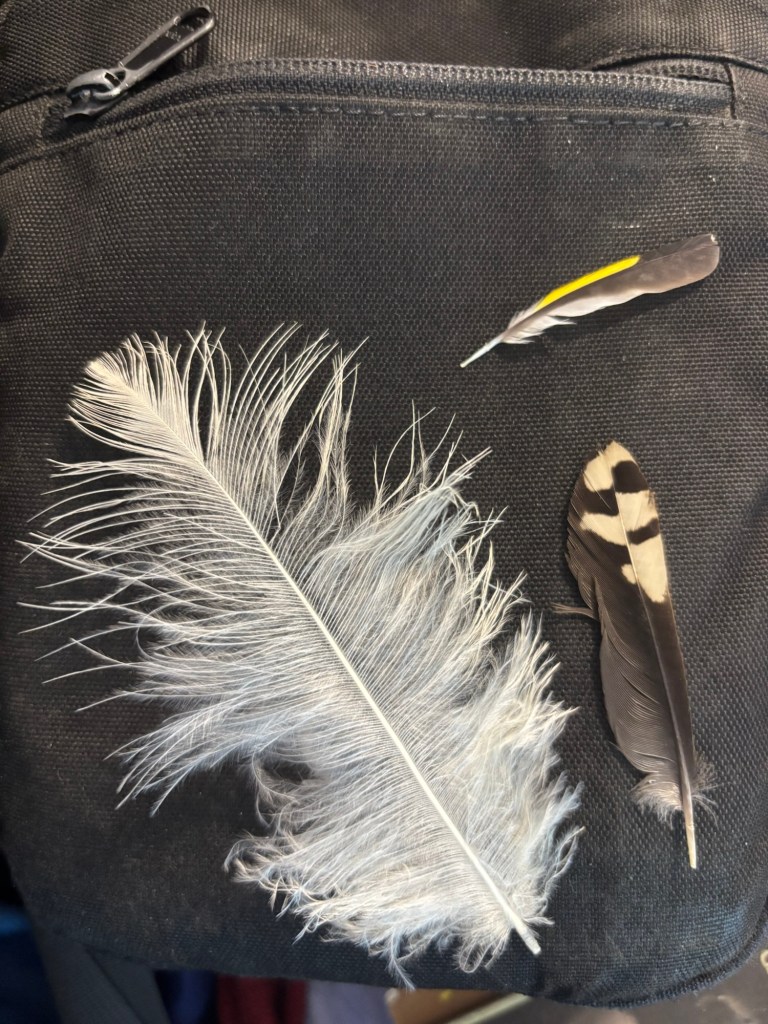
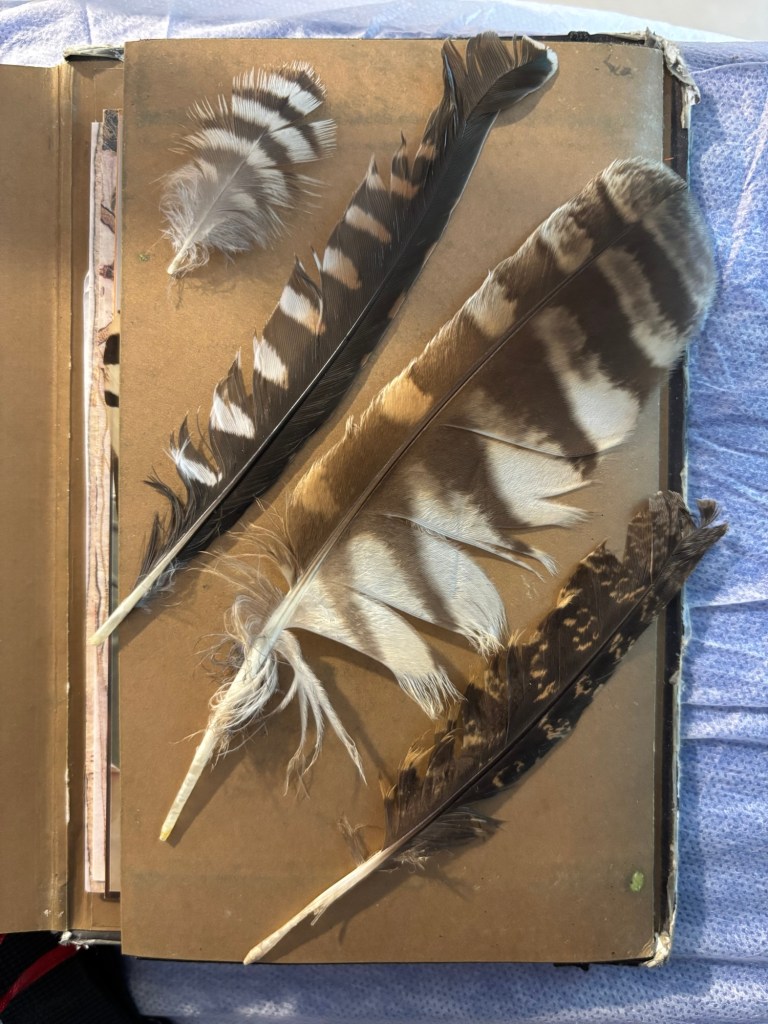
I still have discarded exercise books that my parents gave me where I logged all the species mentioned in wildlife documentaries. I always put down the title and locations covered, and I sometimes wrote the date, too. Others I used as scrapbooks, taping in feathers and sketching footprints and writing about when and where I found them.

You’d have thought that these might have been the early indicators of a scientist. Certainly, I wanted nothing more than to be a palaeontologist when I was a kid (which can be gently excused by the fact that the BBC’s peerless Walking with Dinosaurs documentary series came out just in time to capitalise on my five-year-old dinosaur obsession.

When I was a little older, I genuinely considered a career in conservation. I entertained the idea of a degree in Ornithology, or something similar, to allow me to put my fiendishly good memory for birds and their calls to use.

And then, suddenly, that dream died.


It was probably the maths that killed it. All the natural science degrees I explored required a basic level of mathematical competence and at the time I was struggling to scrape even a passing grade at GCSE. Chemistry, too – a lot of Zoology degrees suggested chemistry as an A Level, and chemistry was far too mathematical for me. Without maths, my conservation aspirations were dead in the water. That was that.

But there was another factor that pushed an old dream out of the nest: the slow decay of a child’s interest as the subject closest to his heart never even materialised in the subject that should have concerned it most intimately.

My memories of Biology center on two things: plant cells and sourdough bread. I was so excited when food chains and food webs came up, until I realised that, within the British curriculum, that was the one and only time that animals would be mentioned. Everything else was so cold, so clinical. Palisade walls and mytochondria. Genomes and inheritance, though usually in plants. The fact that I knew the names of every animal and bird in the British Isles (and most of Europe, for that matter) gave me no advantage whatsoever.

My school was a specialist science school. Our Biology department was doing really exciting things with MS research, and it was one of my Biology teachers who was instrumental in sending me out to Uganda on my first ever teaching post. But somewhere along the way, my aspirations as a conservationist were slowly choked by the strangling vines of the British science curriculum. Zoology, palaeontology, anthropology, ornithology and even primatology were all areas I was desperate to explore, but as the years went by and Biology concerned itself less and less with the natural world and more and more with the minutiae of bacteria and cell structure, the less I cared for it.

It must have been around then that I first entertained the idea of becoming a teacher – once I realised I would never be good enough at two of my weakest subjects to survive to the point when Biology became Zoology. Fifteen years old and already carrying the shards of a shattered dream.


One way or another, I think I realised early on that there was little that a Zoology degree could teach me that I truly desired. I didn’t need to pursue a career in science to justify my greatest love. Knowing the names of every animal and bird gave me a sort of spiritual connection with each and every one of them – no scientific research could work a greater magic than that. Still, it’s interesting to think where my life could have gone if I’d really committed to that path.

Instead, here I am, gone thirty, walking the Camino with a head that twists so quickly when I see the silhouette of a kite or vulture that it’s a miracle I haven’t twisted my neck yet.

It’s hard to say what my experience would be like if I walked all the way to the end of the road with these wonderful people. I will never know, because I have made my choice. And I know it is the right choice. It will take me up into the mountains and back into the natural world, where I am and have always been at my happiest.

Here’s to that – to good health and happiness, and a significantly harder road ahead! BB x