It’s been raining all day again. I was out late with Tasha last night catching up on old times – neither of us could really believe that it’s been nearly eight years since I left – so I didn’t begrudge the downpour for a long and cosy morning in bed. You don’t have to be busy every day of the holidays, even when you’re abroad.
Luckily, I was all over Mérida yesterday with my conjunto histórico ticket, granting access to all the city’s Roman ruins, so the only thing I missed out on was the Alcazaba, which I might visit tomorrow with Tasha and her boyfriend Antonio, if he’s up and about. I don’t think I’ve seen the Alcazaba before – one tends to focus on Mérida’s Roman history rather than its Moorish past, and there are older and more impressive alcazabas (the Spanish rendering of the Arabic qasbah) in Andalucía: Sevilla, Córdoba and Granada, to name just the obvious ones.
Mérida isn’t unique in having a Roman amphitheatre either. There’s a pretty spectacular one (albeit less often seen) in Santiponce that I’ve often seen from the bus on the way in from the north. But there are a few more unique treasures to be found in Extremadura’s administrative capital, and I thought I’d tell you about one such gem below.
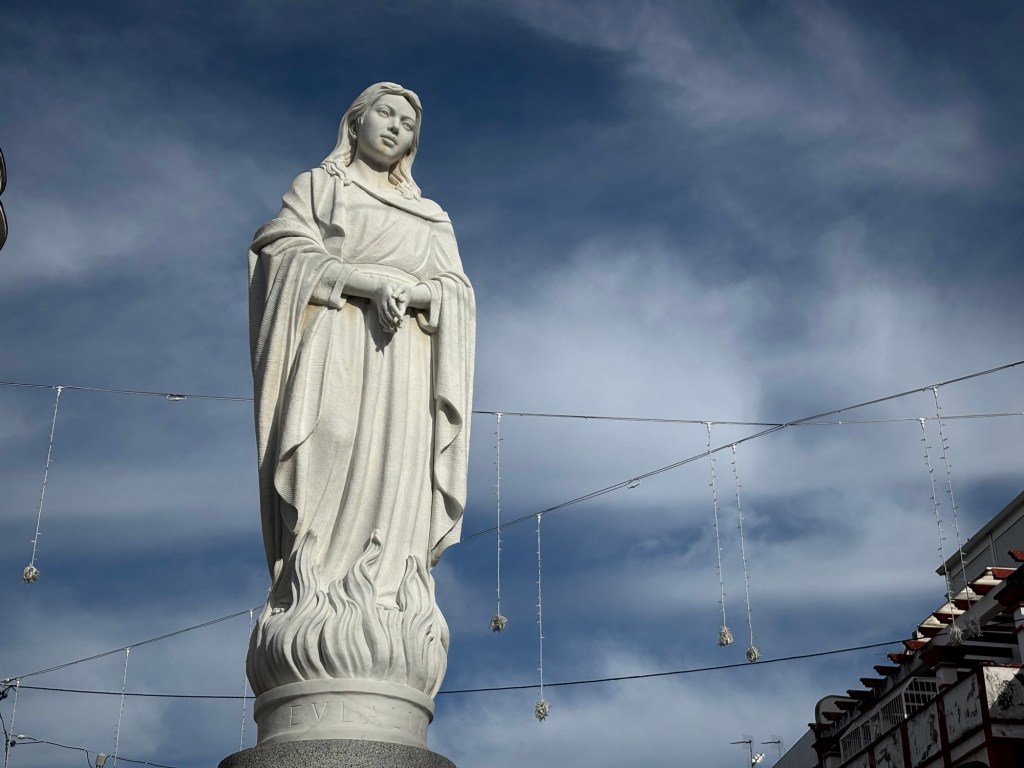
Let’s start with the lady of Mérida – because every Spanish city has its special lady. This one is Santa Eulalia.
Eulalia of Mérida stands tall above the other Christian saints of Spain, which is especially impressive as she only lived to around twelve years of age. A Roman Christian, she and her family were forbidden to worship God under the Persecution of Diocletian. Incensed, and unable to keep her faith to herself, Eulalia fled out of exile to the city of Emerita Augusta, where she openly challenged the local governor, Dacian, insulting the pagan gods whom she was commanded to worship. After a few desperate attempts to reason with her, Dacian had the girl beaten, tortured and burnt at the stake. According to legend, Eulalia is said to have mocked her tormentors until her dying breath, which came out in the form of a dove.
Eulalia was once a great deal more powerful than she is today. Before the rise of the cult of Santiago, it was Santa Eulalia de Mérida in whom the Christian soldiers placed their trust as they made war on the Muslims occupying the lands their ancestors had once held; and it was to her tomb in Mérida that thousands of pilgrims travelled during the Middle Ages, before Santiago Matamoros muscled her out of the picture.
At least one of my Protestant Christian friends has remarked at some point about the thin line between the Catholic Church’s veneration of saints and idol worship. Surely – they have reminded me – it is God and by proxy his son, Jesus Christ, to whom prayers should be made, not the pantheon of mortals who claim to be able to intercede on my behalf?
I can see the argument as plain as day. There are shops up and down this country selling nothing but saint souvenirs: votive candles, icons and fridge magnets, scented rosaries and car ornaments. I have a few myself – a family rosary from Villarrobledo and a more personal one from La Virgen del Rocío, which these days is on my person more often than not.
However, I don’t think it’s as simple as that. How frightfully urbane, to assume that the only true relationship with God is a detached and decidedly modern Western take on prayer. How tremendously big of us to assume that we can comprehend a force that it is, by its eternal nature, beyond our understanding. Community is a powerful agent – it seems only right that the spiritual world, Christian or no, has a network of pomps to streamline the neural network that binds us all together. On Earth as it is in Heaven, as they say.
Spain has a long history of wandering saints. Santiago journeyed beyond death to Galicia, sparking the most famous pilgrimage in Christendom. Guadalupe travelled from her mountain home to México to become one the most venerated Marian cults in the world. Eulalia was dug up and reinterred in Oviedo, where she became a figurehead of the Reconquista (I genuinely had no idea I was standing before her final resting place this summer). Teresa of Ávila’s body parts have travelled all over, most famously her Incorruptible Hand, which used to grace Francisco Franco’s desk.
Tomorrow, I make for Sevilla. Journey’s coming to an end. I’d better make sure I’m fully packed. BB x
The starlings have finished their shift for the night and turned in their timecards. The yappy dog has taken over the night shift and is busy barking at every car that goes past. What the appeal may be in such scrappy scamps I cannot guess. If I worked in a profession that allowed me the time to have a dog, I’d want one that looked like… well, a dog, I guess. A wolf, moreover. Like a sheepdog, a collie or a wolfhound.
I’m thinking out loud. But that, I guess, is what blogging is for. Anyway. Here’s my account of Mérida, capital city of Extremadura, former heart of the Roman province of Lusitania, and the seat of the king in my novels.
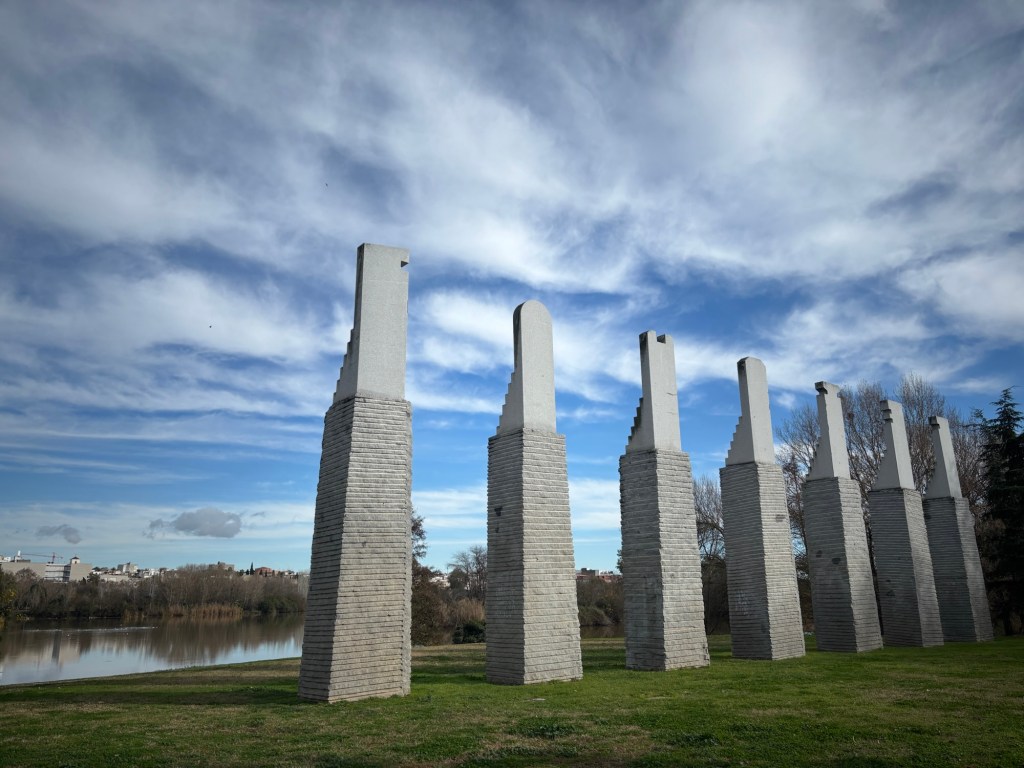
As you leave the bus station on the south bank of the Guadiana River, you’ll notice almost right away a cryptic row of sculptures on the riverbank. At first glance, they seem to spell out a word, but a closer look reveals that they aren’t letters at all, but rather figurative depictions of thrones (if they were letters, I suppose they might spell out “CEIOHAD”, which – besides looking more like Irish than Spanish – is about as easy to understand as the Muqattāt of the Qur’an).
They are the work of local sculptor Rufino Mesa, native son of Valle de Santa Ana, and they pay homage to one of Mérida’s most cherished legends: that of the Seven Chairs that once stood outside the city.
According to legend, these enormous block of stone were the seats of seven Muslim princes (or kings, depending on the teller), who sat upon these ancient thrones to discuss matters of state. Given the fractious nature of the various Berber tribes who occupied the Iberian peninsula during the period of the Muslim conquest and the ensuing Taifa period when Al-Andalus splintered into a network of warring states, it’s perfectly possible that such a drama might have played out at least once here.
Until the start of the 20th century, these seven chairs were still a visible feature of the city, sitting in a field a short distance from the edge of town: a strange but not entirely ignored feature of the city. The ring of stone had seen use as a bullring in the 18th century, and the story of the seven kings had evolved into legends of buried treasure, though no major excavation took place until the archaeological endeavours of Maximiliano Macías and José Ramón Mélida in 1910.
At the time, the site looked very different to how it does today:
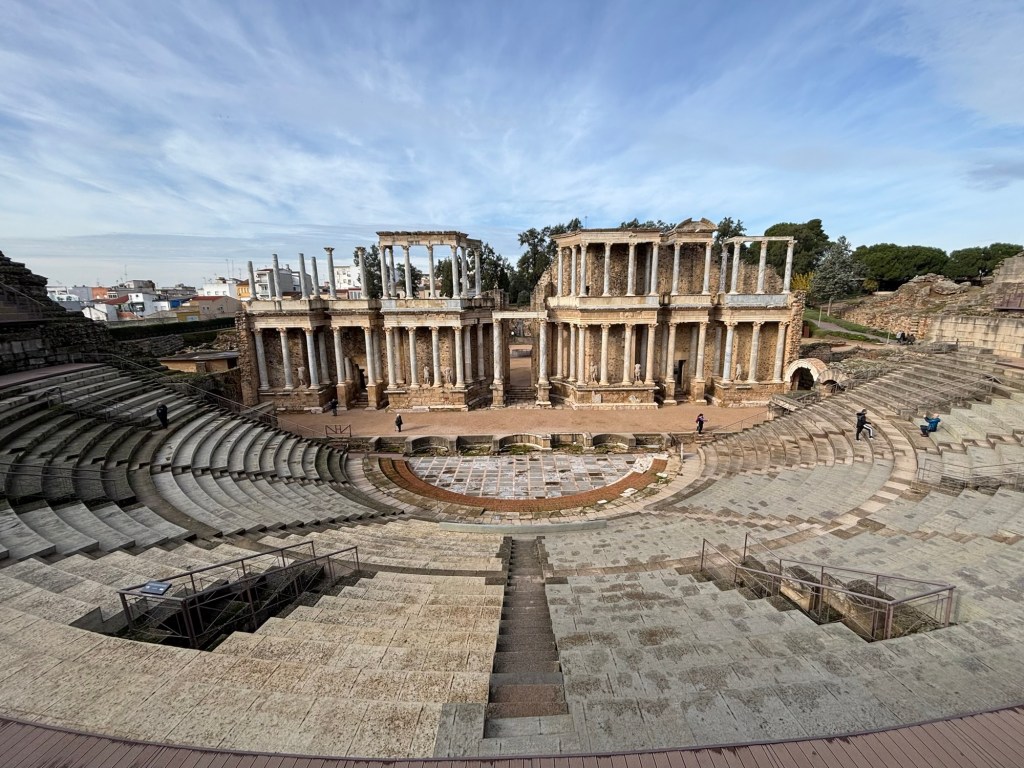
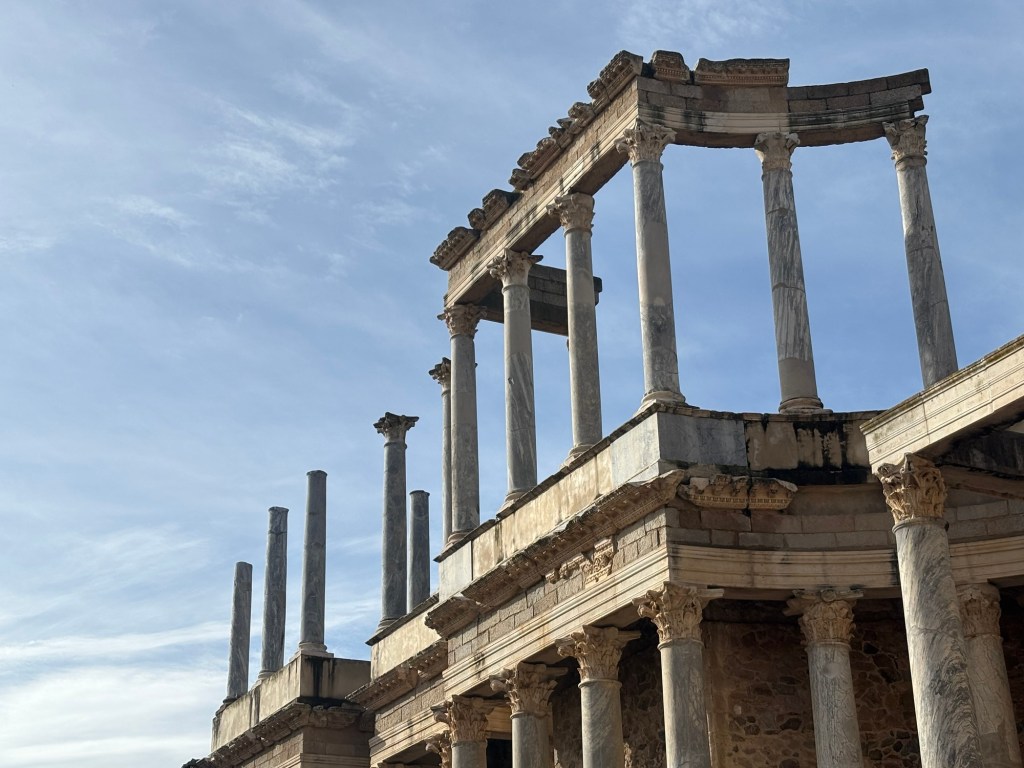
Digging deep, Macías and Mélida uncovered the roots of the seven chairs, revealing an enormous Roman theatre that had lain hidden beneath the earth for around fifteen hundred years. Its remains had long since been scavenged by the Visigoths and their Muslim successors for use in other constructions – such as the Grand Mosque of Córdoba, where there can be little doubt that many of its original pillars may be found – but the greater part of the foundations remained preserved beneath the earth.
It’s not quite as well-preserved as the Roman complex at Jerash, but then, Mérida sits on the bank of a great river – the Guadiana – and has been the site of battles both ancient and modern since the Teatro Romano was first built, and has therefore been a frontline city for much of its existence.
The modern reconstruction is an impressive feat, but more impressively still, it has been partially restored as a working theatre, hosting the Festival del Teatro Romano every summer. I’ve yet to see the festival with my own eyes, so it remains a bucket list item.
I spent nearly two hours wandering around the remains of the Theatre and Amphitheatre. I’ve been here before, of course – twice, at least, as I seem to recall a brief visit with IES Meléndez Valdés – but this place loses nothing in the rediscovery.
I caught myself touching one of the ancient slabs of stone and wondering what it would be like to be hurled backwards in time to the moment it was first laid there. I’m sure I’m not the first to have had that thought and I know I won’t be the last. The plethora of books both fiction and non-fiction on the Romans are proof of our ongoing fascination with the Roman Empire – even if it does come at the detriment of our interest in any of the other periods that followed (seriously, I’ve been to several bookshops now and I can’t find even one book on Mérida’s history between the fall of Rome and the Civil War).
I’ve more stories to relate, but I think I’ll split them up – Mérida has more than one story to tell. As the Córdoban scholar Mohammed Ar-Razi once put it:
No hay hombre en el mundo que cumplidamente puede contar las maravillas de Mérida.
So I won’t try to do so in a single blog post – or several. Instead, like the Visigoths, the Muslims and nearly a hundred generations of Spaniards before me, I’ll take what I can and use its bricks and mortar as the foundations for my own stories. BB x
Andén 13, Estación de Autobuses de Cáceres. 13.29.
That last post was a bit lacklustre. I can’t be at the top of my game all the time, but I’ll admit it is hard to write convincingly about my favourite topic – nature – when the rain kept me indoors for most of the day. I got out for a bit during the evening to have dinner at Mesón Troya, one of the restaurants in the square (usually a place to avoid in larger towns, but not so here), but beyond my short sortie beyond the castle walls, I didn’t get very far yesterday. Instead, I contented myself with watching the stars from the hilltop and counting the towns and villages twinkling in the darkness of the great plains beyond: Monroy, Santa Marta de Magasca, Madroñera, and the brilliant glow of faraway Cáceres.
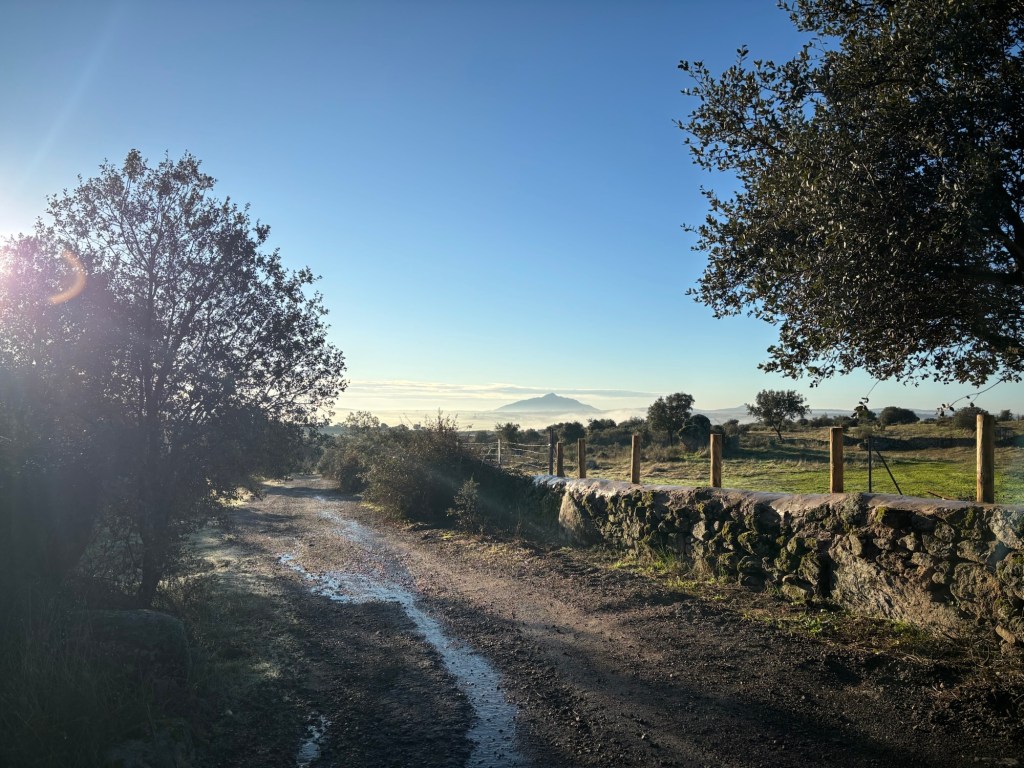
Morning summoned a slow sunrise into a cloudless sky. If I had brought walking clothes, I would have set out across the llanos on foot – but Chelsea boots, a smart winter coat and bootcut Levi’s jeans don’t exactly make for the most comfortable long-distance fare, so I erred on the side of caution and took a stroll into the berrocal – the rocky hill country south of Trujillo.
Idly, I set my sights on a restored 17th century bridge some five kilometres or so from town, but I was quite happy to wander aimlessly if the path presented any interesting forks.
My working life is so full of tasks that require forethought and planning that it’s nothing short of liberation itself to have that kind of absolute freedom that I crave: the freedom to do or not do, to turn back or to push on, to take this road or that, without any thought as to the consequences (beyond the need to get back in time for the bus). A freedom that becomes maddening when it’s taken away from me, like it was in Jordan, all those years ago. It’s a hardwired philosophy that I’ve become increasingly aware of as I’ve grown older, bleeding into my views on speech, movement and identity – and massively at odds with most of my generation.
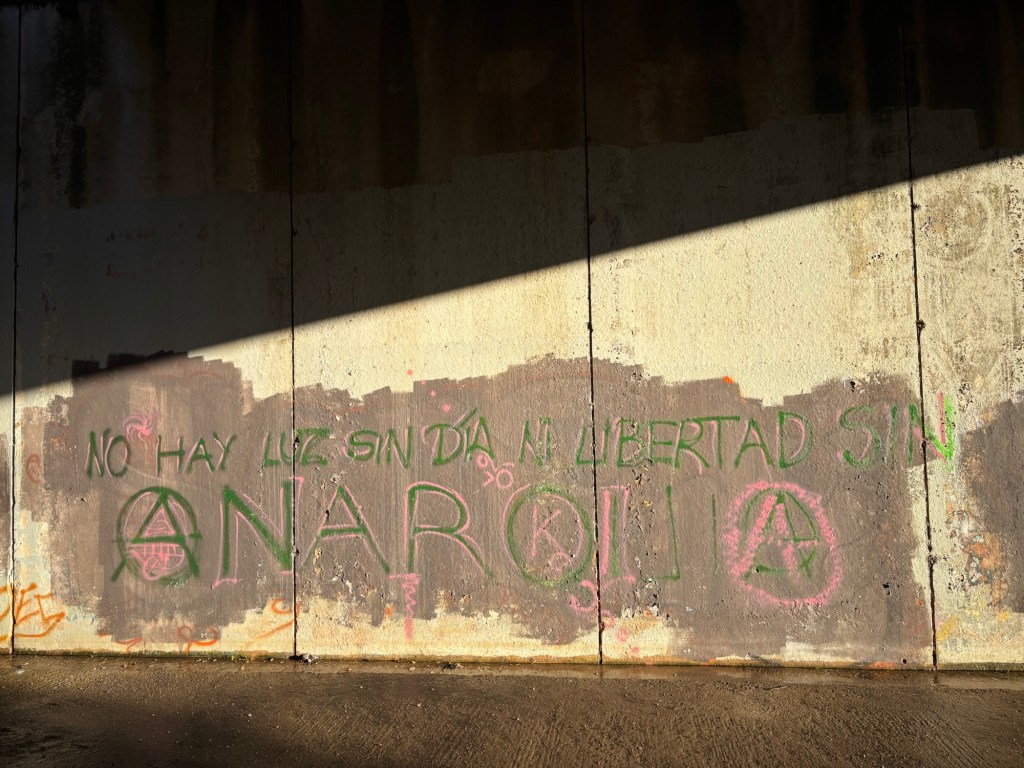
Perhaps it’s an inherited desire for freedom from my Spanish side: I do have family ties to Andalucía, a region that once made a surprisingly successful bid for anarchy, and my great-grandparents quite literally put their lives on the line to make a stand for freedom of thought under Franco’s fascist regime.
Or perhaps that’s just wishful thinking. Either way, it’s hard to deny just how important that sense of total freedom is to me. Maybe I’m more like the Americans than I thought.
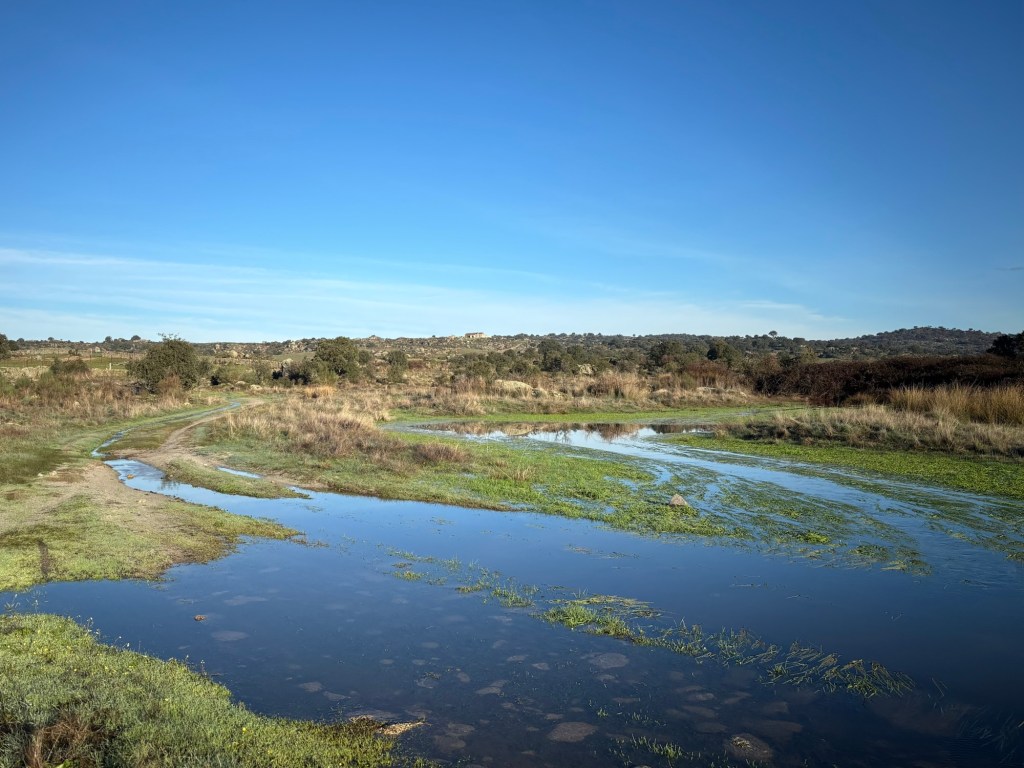
I didn’t make it as far as the bridge. The full day of rain from the day before had done more than dampen the sandy soil and form puddles and pools in the road. It had also swollen the Arroyo Bajohondo to the size of a small river. It didn’t look particularly bajo or hondo, but I didn’t trust the stability of the soil underfoot and didn’t fancy making way to Mérida with soaking jeans up to my knees for the sake of a tiny bridge, so I turned about and returned the way I had come.
Without a car at my disposal, I couldn’t make it out onto the plains, home to Trujillo’s more emblematic species (bustards, sandgrouse and stone curlews), but the berrocal was teeming with wonders of its own. Hoopoes, shrikes and stonechats watched my coming and going from the rungs of rusting farming stations, while woodlarks and skylarks ran this way and that along the stone walls that marked the boundaries of cattle stalls along the way. A flock of Iberian magpies kept me company on the way back, their jaunty black caps almost shining in the sunlight, and I nearly missed a lonely lapwing sitting in one of the fields – a curiously English sight in far-flung Extremadura – before it took off on powerful, bouncing wingbeats.
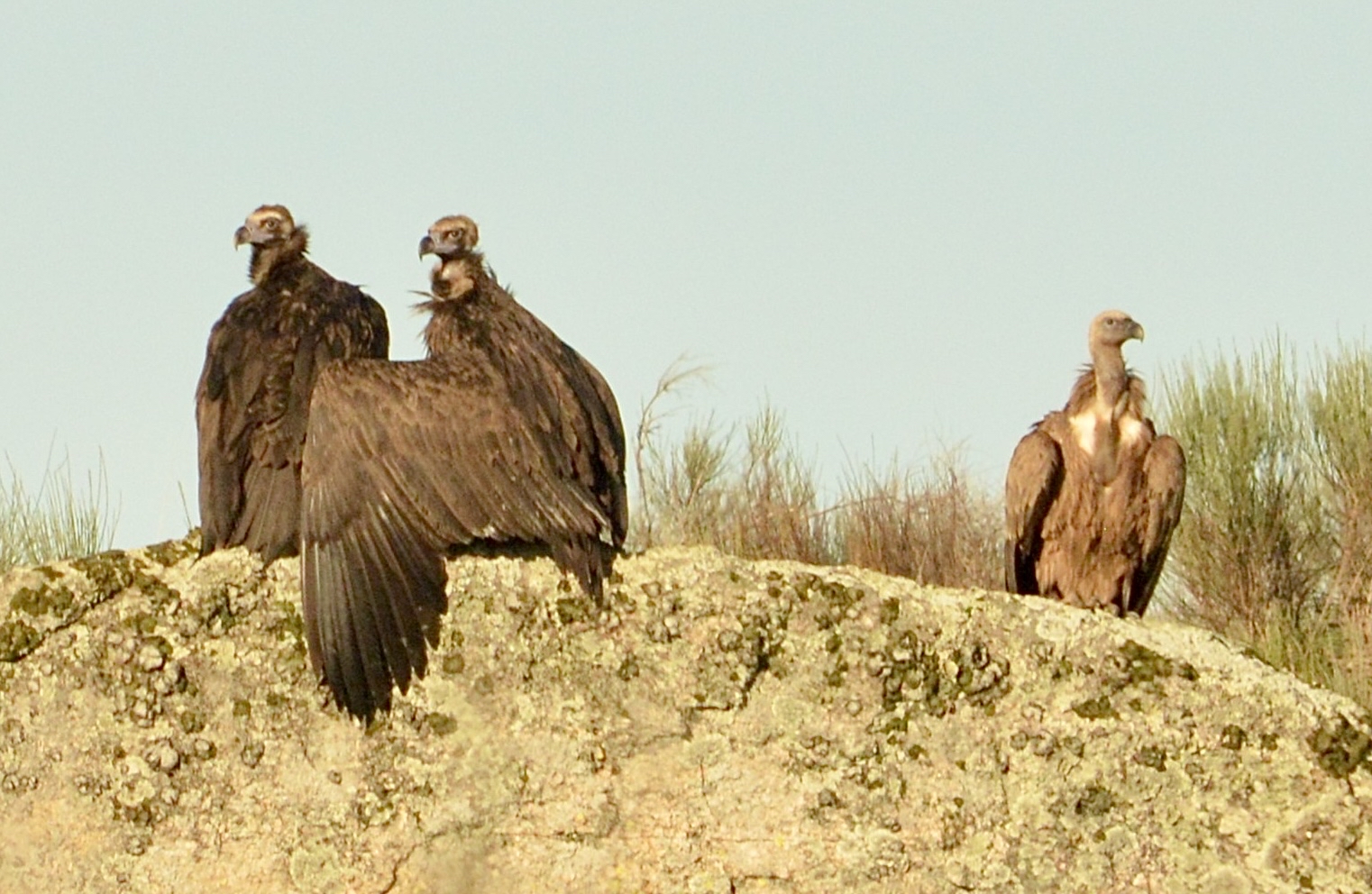
Speaking of powerful wingbeats, I was practically clipped on my way down to the arroyo by three hulking shapes that flew overhead. I clocked one as a griffon – there are few silhouettes I know better – but I had a feeling the other two might have been black vultures – something about their colossal size and the heaviness of their beaks. They seemed to have disappeared by the time I turned the corner in pursuit, which is hard to imagine for creatures with a wingspan of around 270cm.
A change in perspective always helps, however. I found all three on my way back, sunning themselves on a granite boulder not too far from where I’d first seen them. I suppose I’d have had my back to them on the way down. And what an impressive sight they are! Hulking great things, even if they were some way off.
Even with the full day of rain, I’ve scarcely had a moment out here where I’ve felt lost or alone. Spain works an incredibly potent magic upon me, whether it comes in the form of the music of its native language, pan con aceite y tomate, the immense blue skies of Castilla or the spectacular sight of its vultures, forever and always my favourite sight in the whole world.
I conveyed this jokingly to an old lady from Villafranca on the bus. She gripped my arm with a talon that the vultures might have envied and told me in no uncertain terms to “búscate un trabajo aquí”. It does feel like the universe is trying to help me to set things right and come back. But I have to get it right. I need this to work this time. So – fingers crossed.
If I could spend the rest of my life in the passing shadow of the vultures, I’d die a happy man. BB x
It turns out the rain in Spain does indeed fall mainly on the plain. And when it does, it does so with a Biblical vengeance. I made it to my hotel in Trujillo with just seconds to spare when the heavens opened. Any hopes I might have harboured of exploring the city’s surrounding countryside were swiftly washed away, as the rain came down all afternoon, all through the night and long into the following morning.
This would be a real downer if I’d had plans. But my itinerary is an open book and I’m always happy to improvise – it is my preferred method of travel. So I enjoyed a late morning, a proper breakfast and the blissful quiet of one of Spain’s most beautiful (if isolated) towns.
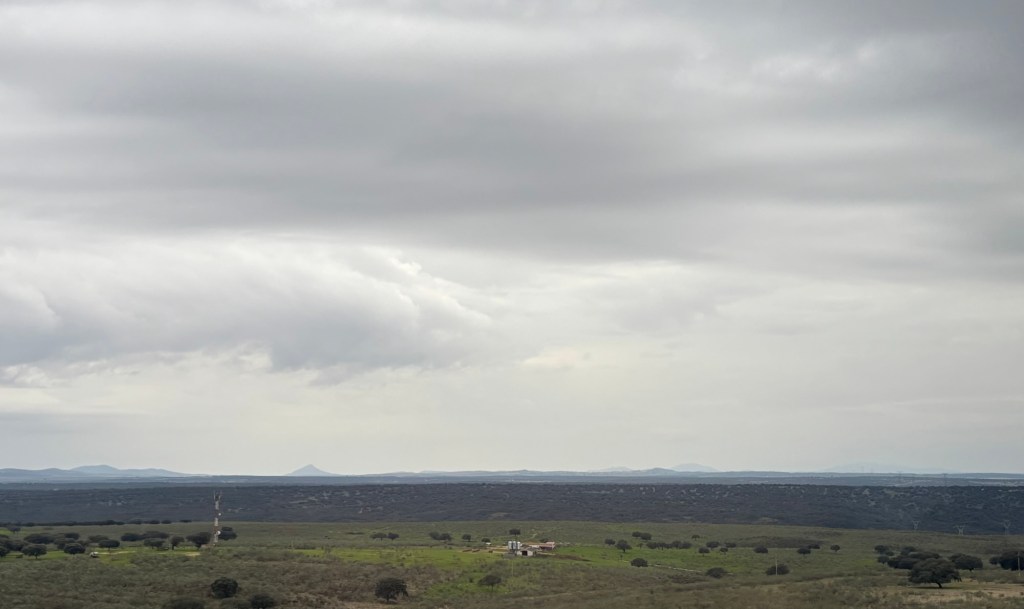
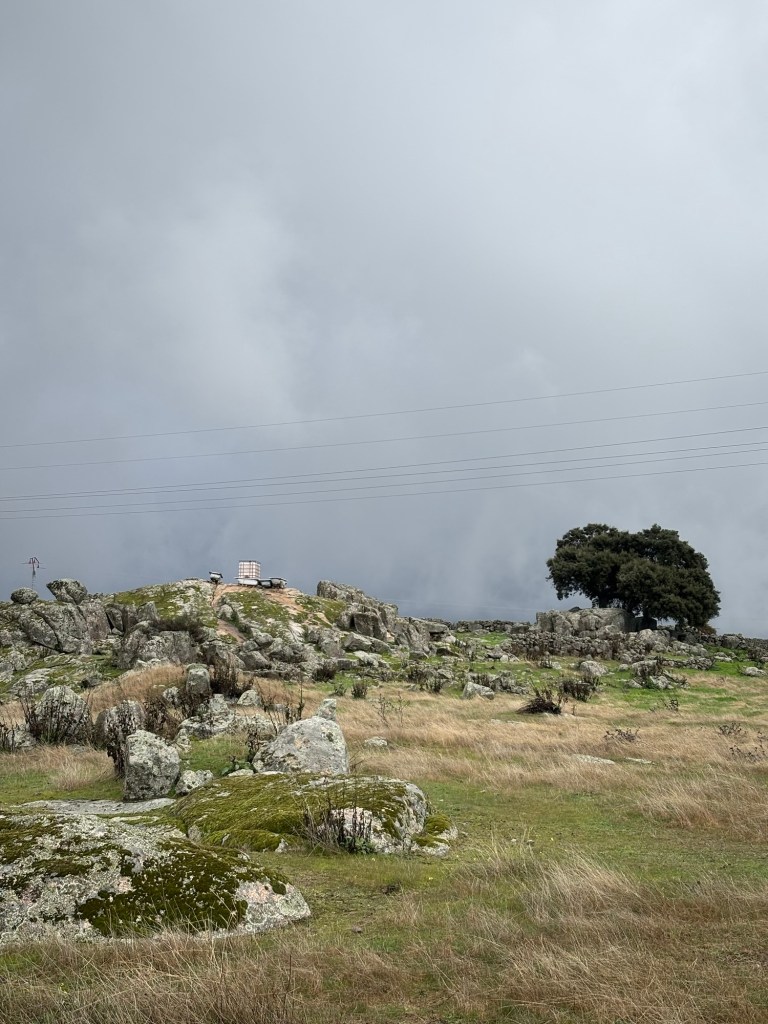
Trujillo sits atop a small granite ridge in a boulder-strewn corner of the Llanos de Cáceres, a vast and featureless steppe that stretches between the Sierra de San Pedro in the west and the Ibor Mountains to the east. There’s nothing like it in Western Europe. You’d have to go as far as the Puzsta in eastern Hungary to find anything close to its vastness. Lichen-covered granite boulders rise out of the earth like giant’s teeth and the odd tree stands alone in the fields, but beyond that, it’s like staring into the infinite.
Little wonder, then, that Hernán Cortés and Francisco Pizarro – both native sons of this part of the world – set their sights on nothing less than the horizon – they’d had no choice but to do so since the day they were born.
Extremadura can be a desolate place in winter. It can be pretty desolate in summer, too, but there is a virgin beauty in its isolation. By avoiding the grasping arms of the hordes of tourists who have strangled much that remained of Old Spain into submission, Extremadura has managed to hold on to the embers of an ancient fire which exists only in the memory of those living among the tower blocks of the southern coast.
Perhaps that’s why it’s often considered one of the main contenders for the Birdwatching Capital of Europe, since so many rare and otherwise elusive species still flock here in droves, taking advantage of our absence to go about their lives as their ancestors have done since before we came to this land.
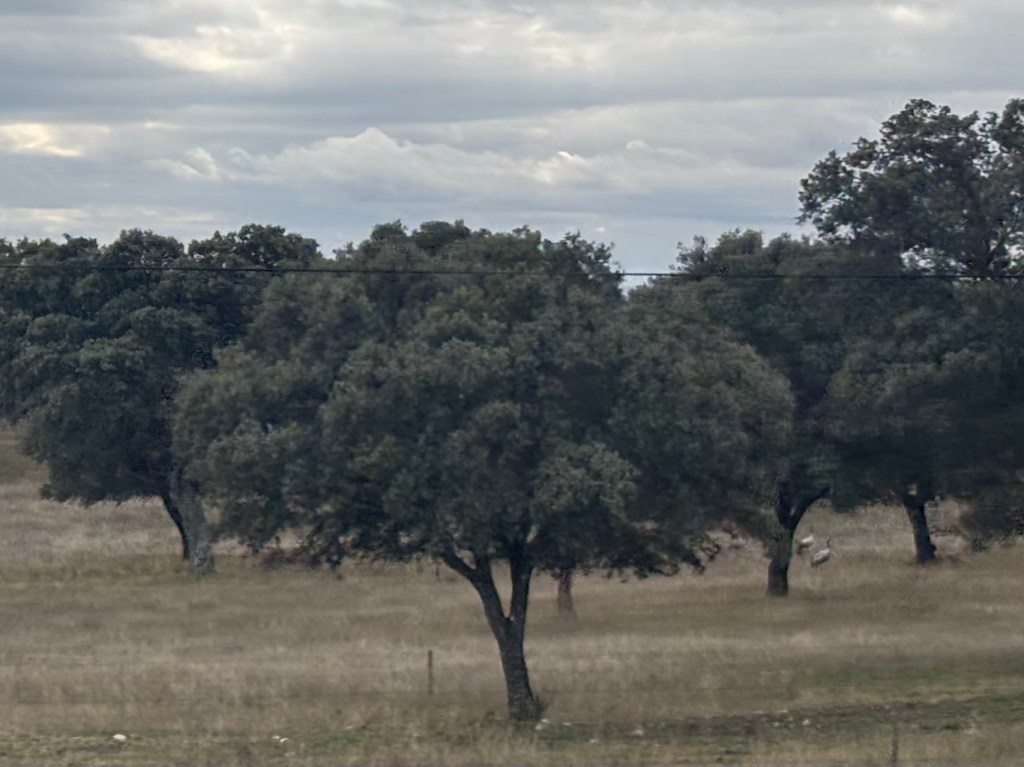
You can see some of that without even leaving the motorway. Every winter, more than 75,000 common cranes travel from their breeding grounds in Northern Europe to this remote corner of the Iberian peninsula. They spend the colder months in the shade of the dehesas, feeding on acorns. They’re a rather common sight if you look beneath the trees, and at over a metre in height, they’re hard to miss.
When I first came to Trujillo in the spring of 2016, I promptly fell in love with the place. It wouldn’t be the first remote corner of Spain that’s stolen my heart – El Rocío and Hornachos are up there – and it won’t be the last. It’s found its way into my saga as the elected home of my hero, partly out of practicality and partly out of a sense of wish fulfilment on my part. Half of me wishes I’d been brave enough to flat out ask to be sent here for my second British Council placement back in 2017. It would have been a lottery, of course, but what would it have been like to live here, I wonder? Trujillo is a lot smaller than Villafranca de los Barros – and a lot more out of the way – but infinitely more scenic.
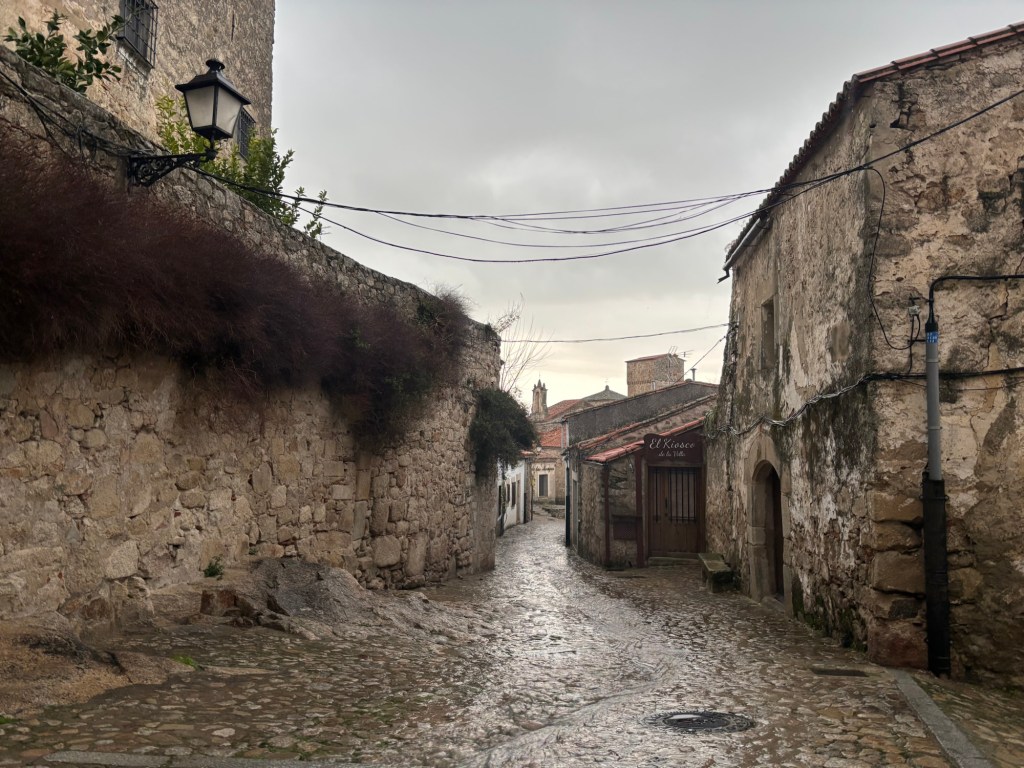
I managed a short reccie to the north of town, before the skies turned dark once again and I had to admit defeat and return to the hotel. The cobbled streets running down from the hilltop had become rivers in their own right. It wasn’t yet siesta time, but nobody else was out and about. And with good reason!
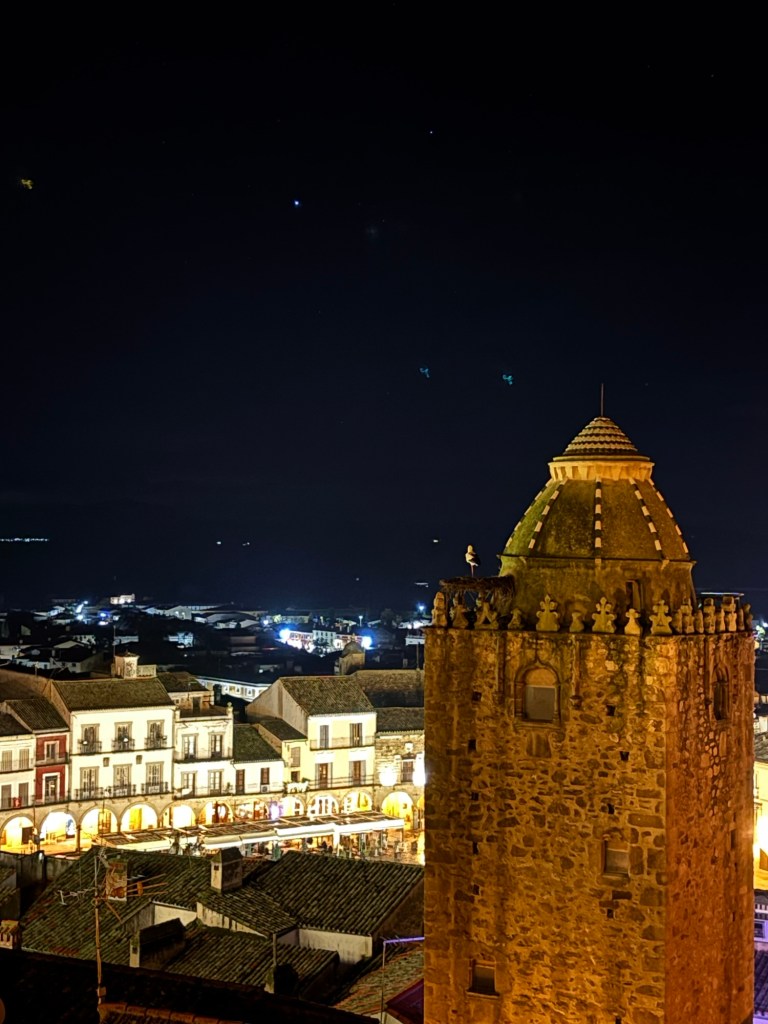
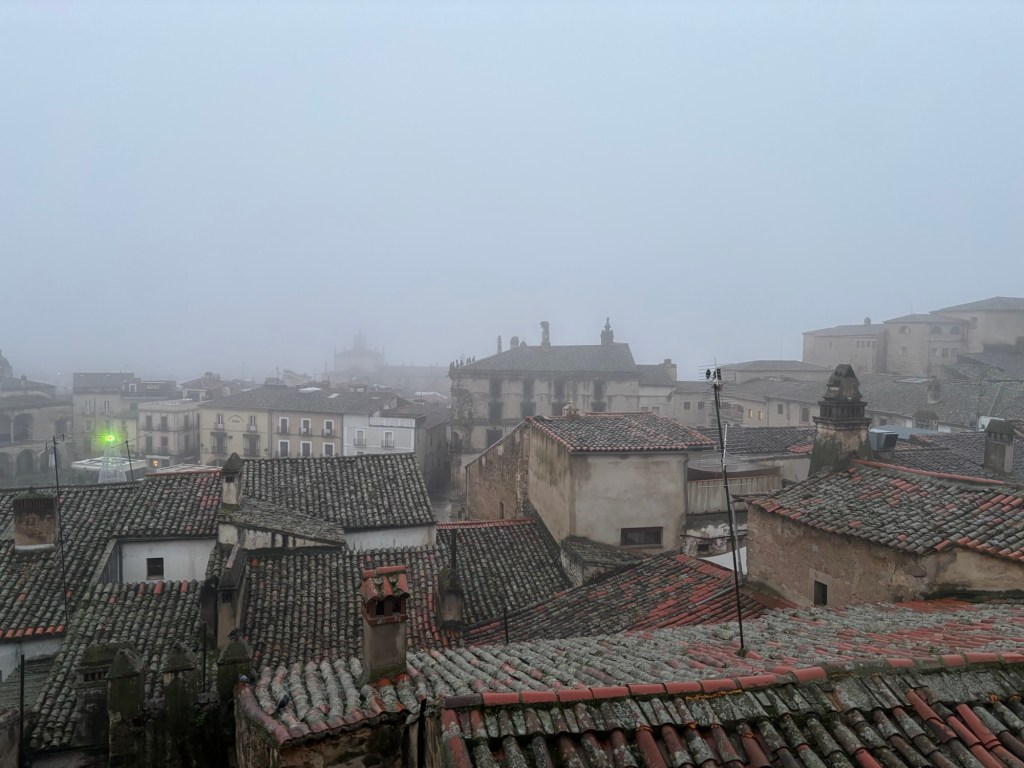
From my vantage point on the second floor of the hotel, I can see out across the plaza and the rest of town. There isn’t all that much to see, with the rain clouds obscuring most of the world from view, but when the sun is shining, you can see straight across to the pyramidal Sierra de Santa Cruz – and the town at its feet, curiously named Santa Cruz de la Sierra (I’m not altogether sure which came first).
If the weather had been kinder I’d have set out at first light and tried to reach the old Moorish settlement at its summit… but then, I haven’t exactly come dressed for a hike. Perhaps it’s for the best that I have had a day to take it easy in Trujillo.
Tomorrow is a new day. 0% chance of rain. I don’t need to rush off anywhere, so I might go for a stroll after breakfast and try to soak up the countryside while I’m here. BB x
Chocolatería 1902, Calle de San Martín. Centro. 10.22.
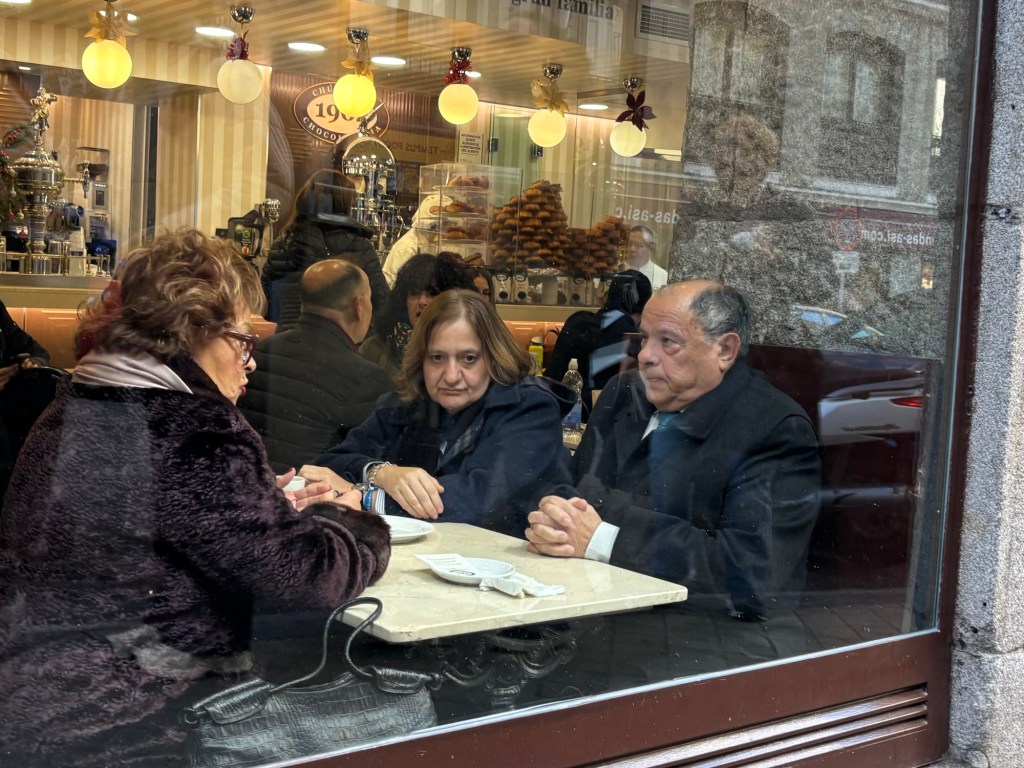
I’m waiting in line to grab some churros con chocolate for breakfast at 1902, the same chocolatería I drop in on every time I’m in Madrid. It’s not yet half past ten on a Sunday, so the interior is still pretty busy with the usual morning traffic. The handsome lady manning the takeaway stall bustles in and out of the booth to resupply for the family of three in front of me. My attention is drawn to three punters sitting by the window. Locals, surely – only a Spaniard would keep their winter coat and furs on inside when there’s even the slightest chance of a draft slipping in. After all, it is a bitingly cold 16°C out there.
They look to be in their seventies, there or thereabouts. That means that the man on the right served his country for at least a year in the mili, before Aznar did away with national service in 2001 in a bid to win votes. It also means they probably remember very well what Madrid used to be like under Franco, before La Transición and La Móvida swept the city into the twentieth century like the rest of the European capitals.
Do they miss the way things were, perhaps? It must have been an altogether different place, back when the city’s demographics were primarily madrileños de raíces, before scores of regional migrants were drawn to the capital for work, followed by a larger tally of visitors from further corners of the world. Before Ale-Hops and Starbucks replaced the boarded-up shopfronts of local businesses. Before every sign and tannoy needed an English translation tacked on, to cater to a growing tourist class who were not expected to learn the language for their visit – another reminder of Spain’s falling status on the world stage.
I do not regret the end of Franco’s Spain – after all, it’s because of him that my Spanish family was torn apart. But I do understand why some might look back fondly on a time when the world seemed a whole lot more familiar.
Librería La Central, Calle del Postigo de San Martín. Callao. 10.36.
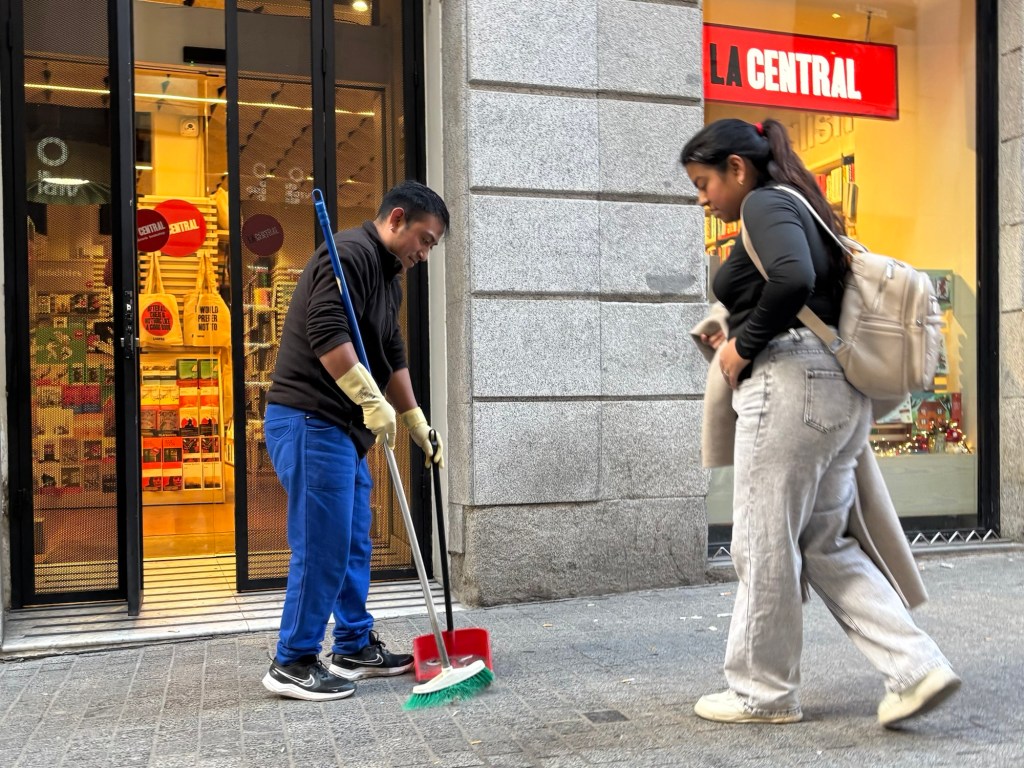
Further up the street toward Gran Vía, I pass La Central. It’s not yet open, and an Amerindian in marigolds and workers’ blue pantalones laborales is sweeping the street in front of the door, which is open only just enough for a person of slender build to squeeze in untouched. It’s mostly confetti and spent chasquibumes that he’s clearing away – there aren’t nearly as many cigarette butts as there used to be.
A girl stands nearby, picking up some of the easier wrappers by hand. She’s dressed like a passer-by, but there’s a familiarity to their easy interaction: she could be a relative, a friend, or a lover. Neither of them are wearing the white worm-like earbuds that seem to have encrusted the faces of so many of the city’s inhabitants, and that makes them stand out.
I bought four books in the nearby Casa del Libro (after nearly two hours’ decision) and it cost me around 70€. Spain is often ranked as one of the least literate countries in Europe, with fewer than 9% of the country reading books on the regular. Statistically, that’s not all that far behind the UK, but there’s no escaping the fact that reading is a luxury activity in Spain. FBP (Fixed Book Price) might be a worthy attempt to level the playing field and prevent the market being swamped in Taylor Swift trash and cheap chick lit, but it does drive up the prices of everything as a result.
My great-grandfather dreamed of having his own library, and I’m doing pretty well at bringing that dream to fruition. But it’s not a cheap enterprise in this country. I wonder how much traffic the man in marigolds sees.
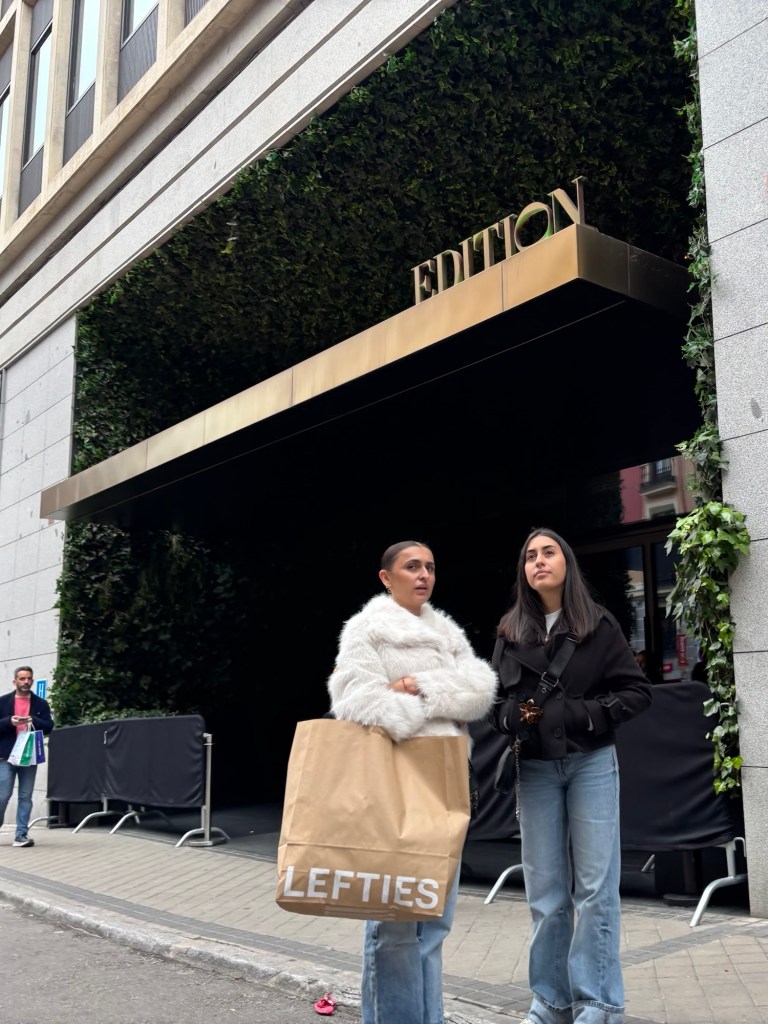
Outside The Madrid Edition, Calle del Maestro Victoria. Centro. 12.55.
The queue forDoña Manolita’s legendary lottery shop stretches all the way along Calle de Mesonero Romanos and away up Calle de la Abada and onto Gran Vía. The throng of hopefuls is a real mix: young and old, local and out-of-town, Spanish and French and American. El Gordo – Spain’s Christmas lottery – is much more of an event in Spain than it is elsewhere in the world.
At the end of one crowd, another begins: a great mass of children and their parents waiting for the giant animatronic train and its attendant polar bears on the Cortylandia shopfront to come to life and sing, as it does every hour, on the hour (until 10pm, it seems – it’s within earshot of my hostel room).
Two glamorous citizens standing apart from the hubbub seem to be above it all, watching the crowds come and go with unmoving eyes. One leads the conversation, the other listens, eyes skyward. Sometimes it’s hard to see how the haughty, angular beauty of a youthful Spaniard finds its way into the compact, shrunken shape of its senior citizens, but every once in a while there’s a flash of that future in the expressions of its youngsters: that look of casual ennui would be right at home on the face of a woman three times her age, still dressed in expensive furs and commenting on the world going by.
Outside Heladería Galia, Calle del Arenal. Puerta del Sol. 12.57.
A West African mantero plies his wares alone on the Arenal. They usually operate in groups – there being safety in numbers, I suppose – but this one seems to be his own agent. He has also upgraded his drawstring blanket to a couple of glassware boxes. While other mountebanks dressed as a gorilla, Eevee and Mickey Mouse try to fleece passing tourists of their loose change, he hawks a number of luminous splat toys, which he promotes by blowing into a bird whistle and hurling his devices onto the flat surface of the box, where they slowly revert to their original shape.
It’s hardly worthy of a moment’s notice to most of the adults passing by, but it’s the children he’s after. One girl is absolutely entranced and convinces her mother to buy one – no, two, as they will have to get one for her brother.
It can’t be an easy job, hawking cheap goods on the street, but from my casual observations, these manteros do seem to have a fairly good hit-rate when it comes to a quick sale.
Plaza de Isabel II, Puerta del Sol. 12.59.
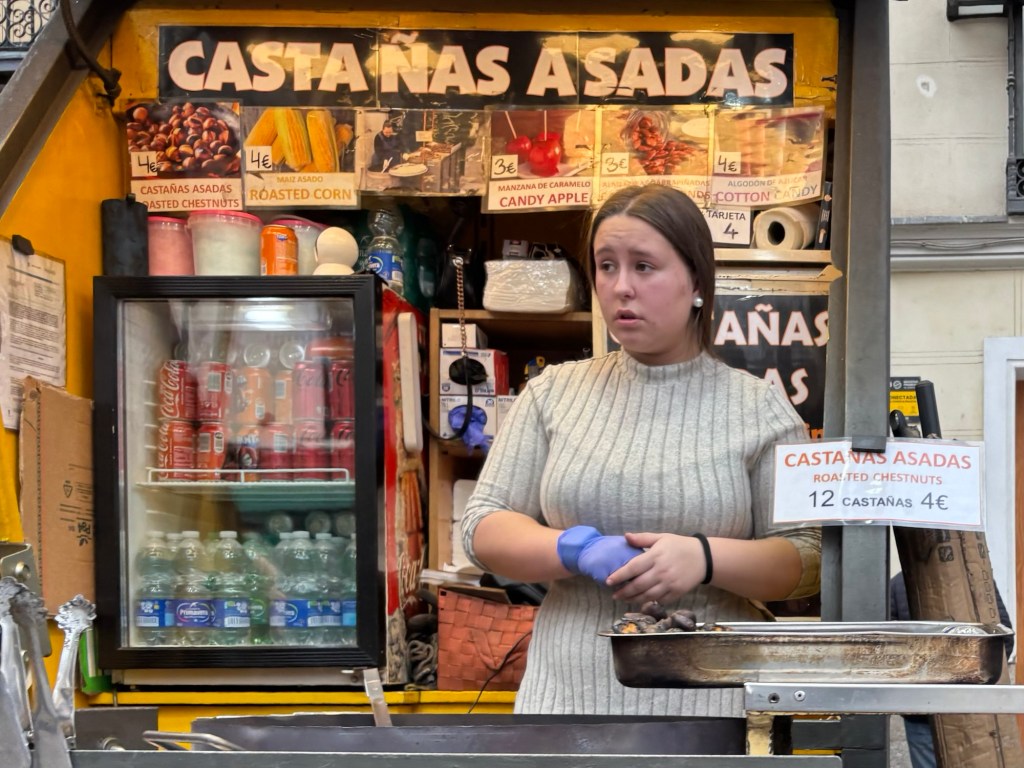
Before it became synonymous with one of C.J. Sansom’s greatest works, winter in Madrid always meant roast chestnuts. These warm, smoking stalls are as much in evidence now as they ever where, though they now often come with the modern niceties of a wireless card machine and an Aquarius-bearing fridge. Here, like everywhere else, the signs are written twice: once in Spanish and once again in inglis. The point I try to make in the classroom about the usefulness of this or that topic for traveling is increasingly redundant in the face of the relentless march of the English language.
The girl with the pearl earring isn’t as heavily dressed for the chill as the other madrileños in the street – but then, she is standing in front of a roasting dish all morning. She looks bored. The telltale rounded edges of a smartwatch bulges beneath the tight elastic of a sanitary glove on her right hand, and a swish handbag – presumably hers – sits nestled in an alcove behind her, so the chestnut business must be doing a reasonably good trade. I haven’t seen as many people tucking into the delicacy as I have in previous years, but then, it really isn’t quite that cold. Not yet. Not until the peaks of the Sierra de Guadarrama are covered in snow and the north wind blows chill across the plain and into the capital.
She’s cute – in a genuine, homely sort of way. There’s a natural beauty to people here. Not as many piercings, lip fillers, unconventional hairdos or fake tans. I don’t know why we go in for that so much in England. I already miss this place, and I’ve only just arrived.
Jardines de Lepanto, Plaza de Oriente. 13.26.
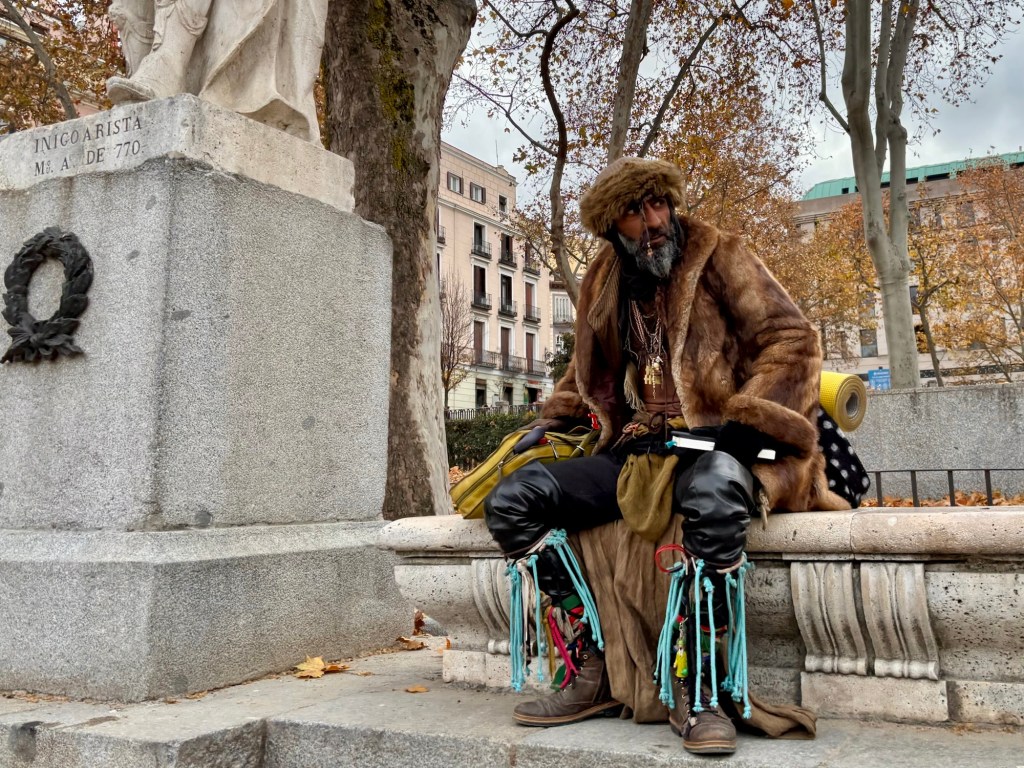
Sitting between the marble statues of the Asturian kings Iñigo Arista and Alfonso I is an exceedingly odd fellow. Like many of the city’s inhabitants, he is dressed in furs for the cold, but the similarities stop there. If the tassels on his black leather buckskins weren’t a metallic shade of blue, he might be a fur trapper from the Old West lost in time.
No – wrong continent. His regal nose, his dark, hooded eyes and the salt-and-pepper beard emerging in a neat diamond from his black headwarmer gives him the look of an Arab trader. A wise man, perhaps. It’s that time of year.
A curious assortment of symbols hang by threads across his naked torso: the Tau cross, an ivory pawn, a set of small keys and a card cut-out of the words “Ho-Ho” in gold letters that looks like it came out of a Christmas cracker. A fold-up umbrella pokes out of the smart yellow satchel at his side and there is a roll mat strapped to his waist. If he is a tramp, as his demeanour implies, he is a wealthy one.
Today the city of full of people in fancy dress. Ecuadoreans in tasselled hats and masks. Mountebanks in oversized costumes. Zambomberos in black and white and red. But he belongs to none of these clans.
When I return from watching the first of the zambomberos parade past, he has disappeared. I do not see him again.
Palacio Real, Plaza de Oriente. 14.36.
The fiesta zambombera is over. The crowded musicians begin to disperse, and with them, so too the clouds, bathing the Jardines Reales in warm winter sunlight. A modern dance troupe takes up where the traditionalists left off, showing that movement is as much a part of this country’s soul as its music. Still dressed in their folklore finery, the folcloristas return to their groups and prepare to depart. One huddle near the dance troupe stops to take a selfie. The red banner of Castilla flutters in the wind and the little cymbals in the tambourine shudder for a moment.
I must be a fool to have traded my life out here for England. So help me God, I will find my way back out here. I have to. It’s the only way I’ll ever assuage this restless heart of mine. BB x
It is categorically impossible to be down at heart in Madrid. Whatever my thoughts and feelings were, they were altogether altered the moment my feet were back on Spanish soil as I left the plane at Barajas last night. It’s not as though I need reminding that Spain is always the answer to my lonely heart, but it is good to know that its medicine is none the weaker for every visit – especially as this is my *fourth* visit this year (though if you count my sorties to and from the Canaries and Gibraltar, it would be my sixth). Anyone would have thought I had an itch that needed scratching…
Ah, Madrid. Like the girl next door in every American romcom, I have come to regret dismissing you so lightly when first we met, now that you have captured my heart. There is something undeniably homely about La Capital, which neither London nor Paris nor Berlin can match. Even now, bustling as it always is in the run-up to Christmas, it still feels more like a large town than a capital city.
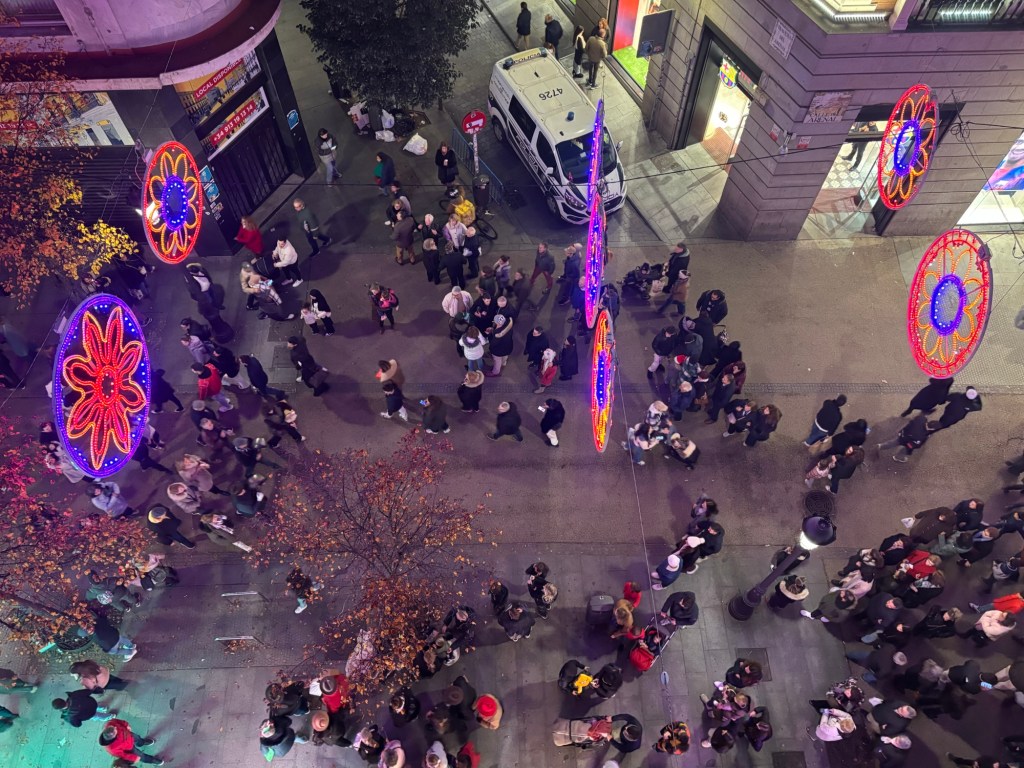
From my vantage point in the hostel, overlooking the glittering Calle del Arenal, the hubbub below is a merry melange of conversation, villancicos, far-off snatches of song and the intermittent underground rumble of the metro. The near-constant snapping of chasquibumes (bang snaps) makes the city sound like a crackling fire.
I don’t say this often, but here is a city I wouldn’t mind living in.
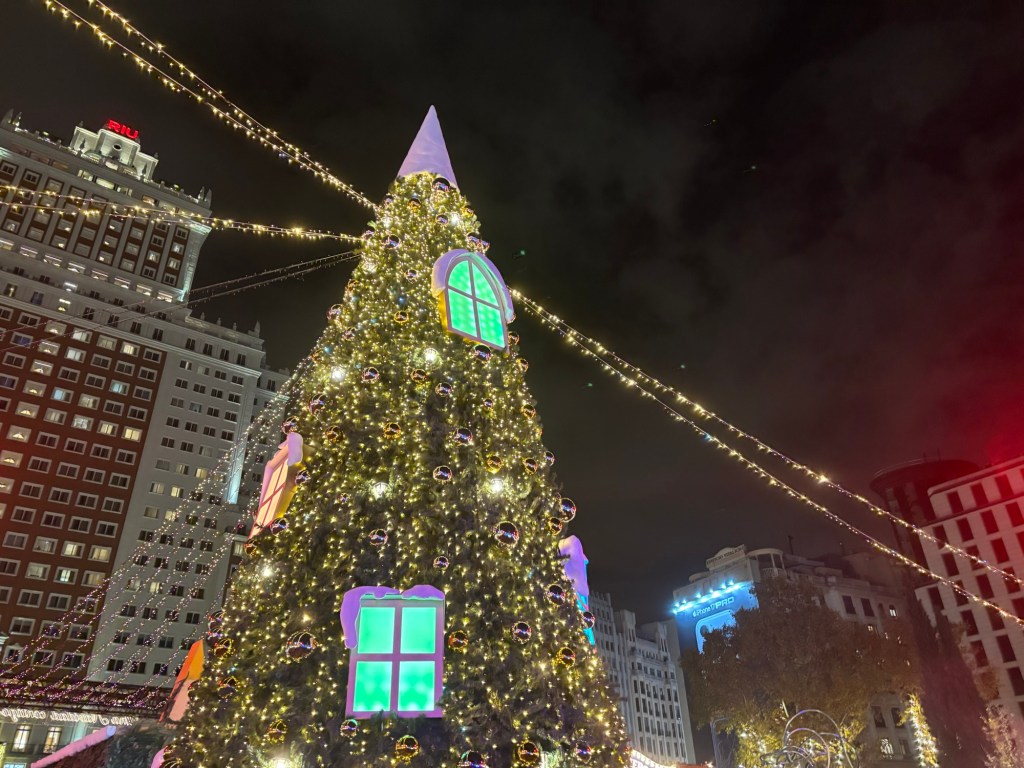
Merry-go-rounds, ice rinks and various Christmas-themed stalls have been set up in the various squares and open spaces throughout the city. Traditionally, it’s the Reyes Magos (the Three Wise Men) who bring children presents in Spain – which has always struck me as a much more logical excuse to celebrate the giving of gifts – but that doesn’t seem to have stopped the Spaniards from starting the festivities several weeks prior. And why not? Any excuse for a celebration will do.
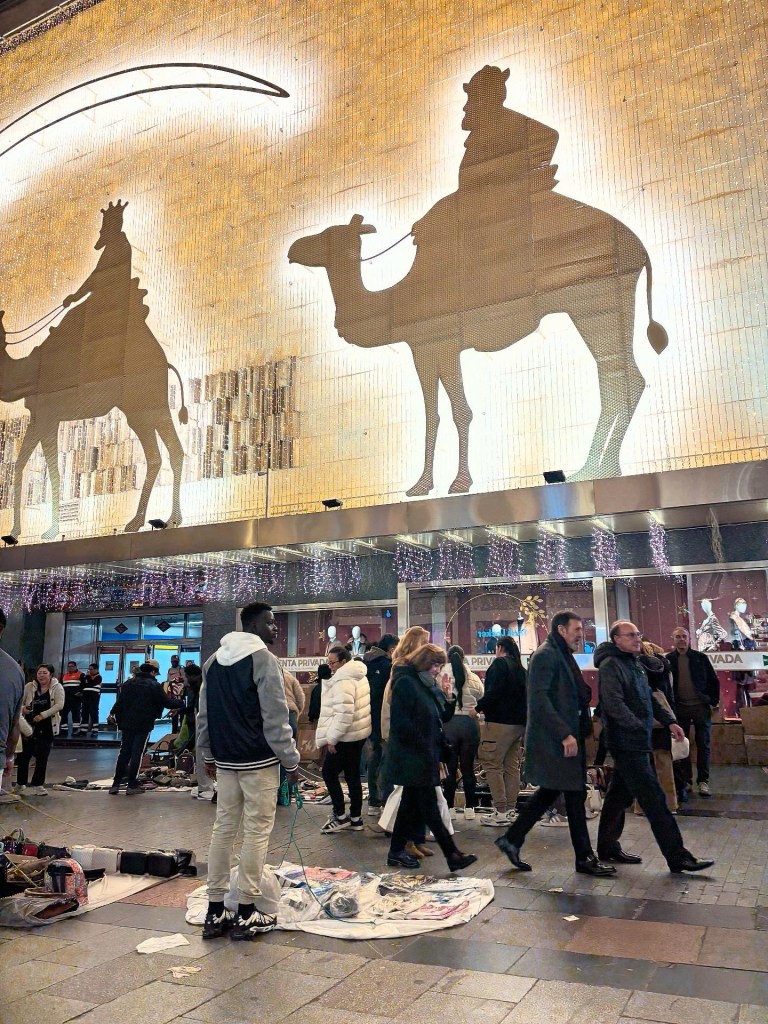
By far the brightest lights can be found on the walls of Callao’s Corte Inglés, which draws a constant stream of shoppers into the night (it was still heaving at half past nine when I passed by en route to the hostel last night). Wherever there’s a crowd, there’s usually a ragtag bunch of pedlars clinging remora-like to its underbelly. Sure enough, I found three manteros hawking the usual array of glasses, handbags and Yamine Lamal shirts outside the main entrance, the strings of their cloth blankets twitching in their nervous hands at every distant blast of a police car. Their location of choice – beneath the three wise men – seemed almost poetic.
I don’t suppose the Baby Jesus would have had any more call for a Barcelona tee-shirt than he did for frankincense. Neither, it seems, did the madrileños. But who’s to say that these three wise men didn’t follow a star of sorts to Europe?
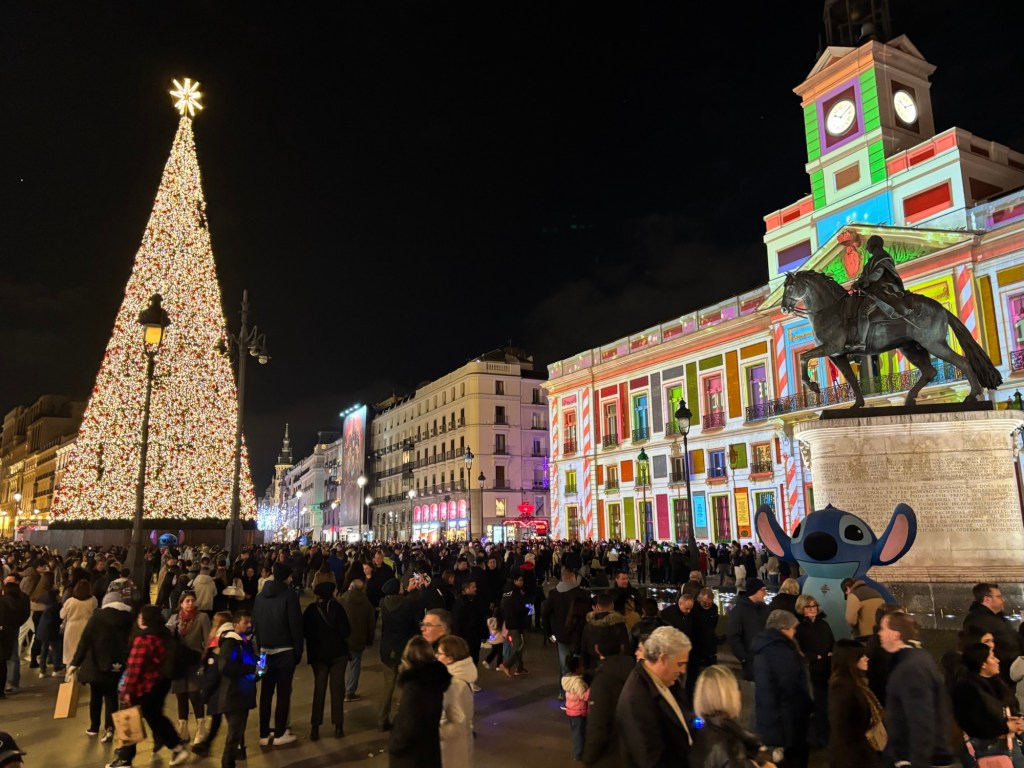
Down the street in the Puerta del Sol, the Real Casa de Correos is lit up like an advent calendar – though in its technicolour array it looks more like a dollhouse – and the usual conical tree of lights stands between Carlos III’s smug smile and the oso y madroño statue on the other side of the square.
Could you call La Puerta del Sol a square? It functions like one, more so than the nearby Plaza Mayor (which really is a square) but it’s really more of a semicircle – a giant protractor radiating in multiple directions from Kilómetro Cero at the feet of the Casa de Correos. At least, it would be, if the centre of the semicircle were just a few yards to the left.
I’m only here for a couple of nights. Extremadura is calling. It has been too long since I last laid eyes on the corner of Spain that well and truly stole my heart all those years ago, and since then, it’s been nothing more than a beautiful word on my lips. I’ve already had my fair share of nostalgia trips this year to Finisterre, Gibraltar and El Rocío, but one more won’t hurt. Holidays are for healing, and that’s exactly what I intend to do. BB x
I can’t remember the last time I flew Ryanair. It’s definitely pre-Covid, but it might be even as far back as 2017, which isn’t that far off a decade ago. If memory serves, that last flight under the sign of Brian Boru’s harp was so dreadfully delayed out of Toulouse that my flatmate had to pick me up well after midnight from Sevilla Santa Justa airport – back when Sevilla was a conduit rather than a destination, nearly a lifetime ago.
But, at £15 for a flight to Madrid, I could hardly say no. It isn’t often that I can escape to Spain for less than it costs me to get to the airport. My grandfather’s country has become something of an elixir of late, and one upon which I have become heavily reliant… So here I am, once again, hightailing it out of the country less than twenty-four hours after the end of term, in search of peace, joy and healing – and three blissfully Teams-free weeks.
The train up from Taunton was absolutely packed with revellers, cackling and guffawing and generally reeking of booze, weed or the cheap, sickly stink of vape smoke. A new party seemed to jump on board at every station en route to Bristol, before the 13.18 stopped in its tracks at Weston-super-Mare and, at a signal from the station manager, disgorged the contents of its swollen stomach onto a smaller Great Western train on the opposite platform.
I tried to zone out with a copy of Samantha Harvey’s The Western Wind which I had swiped off my bookshelf before I left – a hasty decision, admittedly, as I don’t tend to return the books I take on holiday, so it needed to be fiction. I got about a hundred pages in before losing interest in the plot when I realised it was marching backwards in time. I’m not the easiest to please when it comes to fiction, but I do tend to blanch pretty quickly at any kind of narrative structure that deviates from a logical chronology.
Here’s hoping my fallback, S.J. Deas’ The Royalist, is a little easier to read. Failing that, I’ve downloaded the audiobook for Dune – and there’s always Madrid’s Casa del Libro.
It’s going to be a rather full flight. There’s a large and boisterous throng now gathered here at Gate 23, most of them under the age of twenty. Either Bristol’s entire population of Spaniards are riding this flight home, or several school trips are coming back for Christmas (though I can’t see any teachers). Either way, it’s a good thing I’ve packed light, as I don’t imagine there’s going to be much room on the plane.
They may be noisy, but their language is a lot sweeter on the ear than the F-bomb-littered slurring speech of the revellers on the train. The older I get, the more I feel the sands of time slipping through my fingers. Destiny is calling me back to Spain – I must not turn my head from her. I cannot. BB x
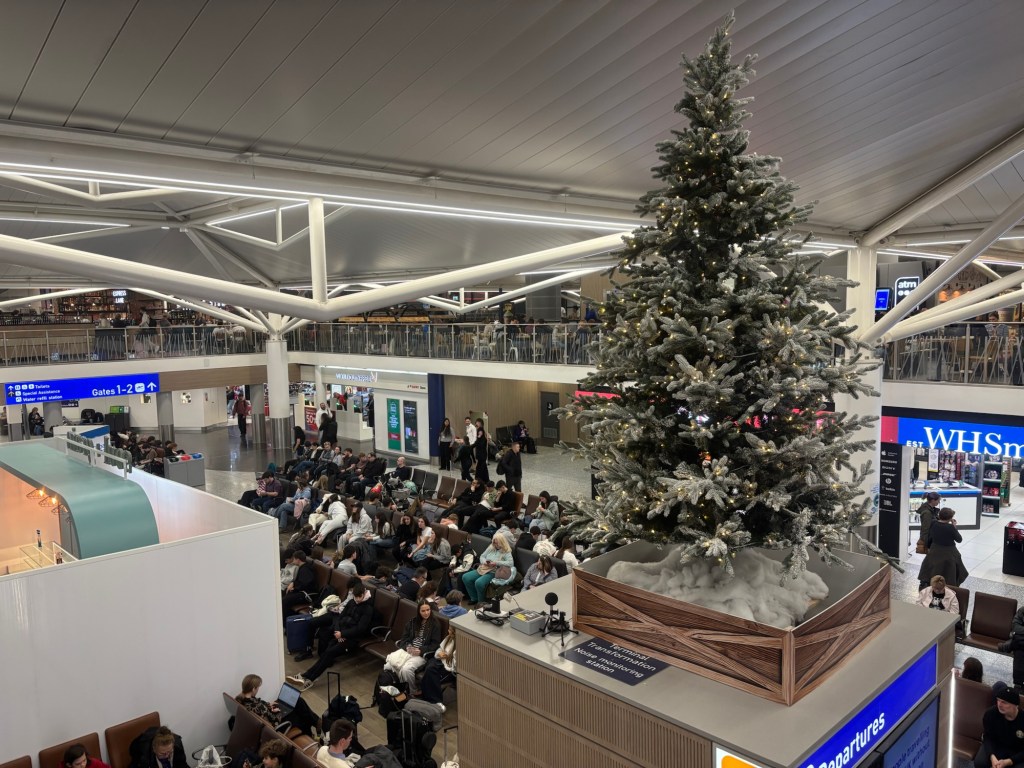
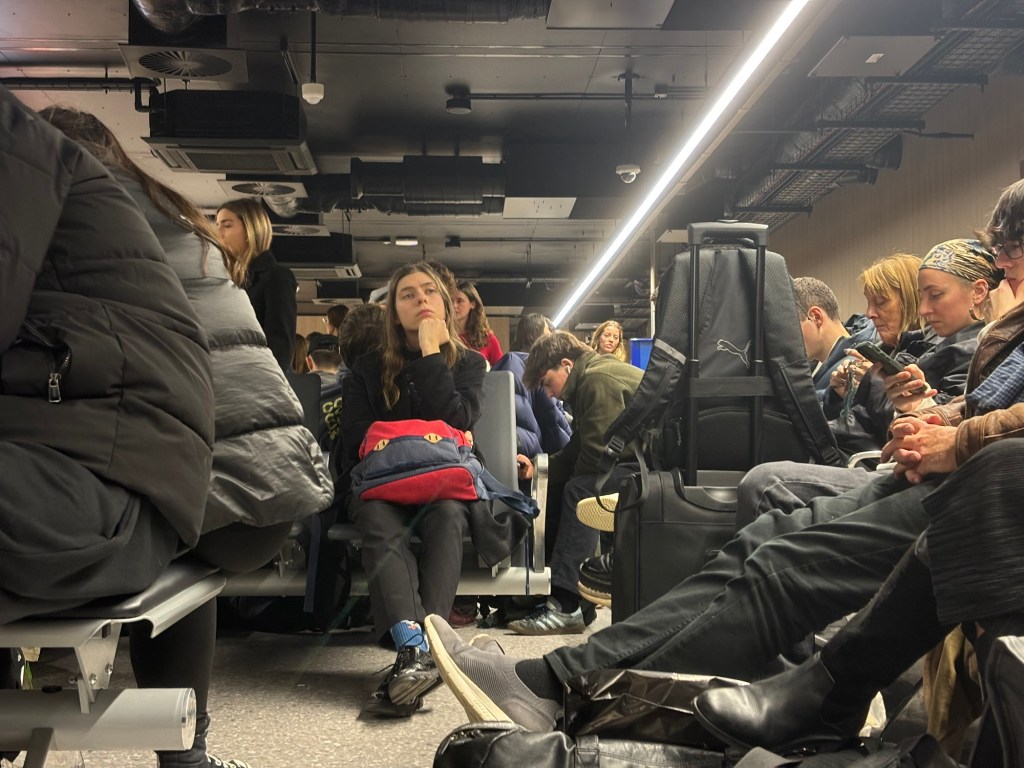
The Camino isn’t truly over until you’ve made it home, so here I am on the 19.50 from Heathrow’s Terminal 5. It wasn’t the best welcome back to England. Somebody pinched the flip-flops from my bag. They weren’t exactly in the best condition and frankly I could care less, but it’s the principle of it. Six weeks of relatively careless travel across two countries and the first item stolen from me is within minutes of landing back in the UK. Add to that the grey hellscape that is Heathrow, the cost of just about everything, and the facelessness of London…
No. I don’t want to think about that. Not right now. My nerves are shredded enough as it is. I want to think about where I’ve been. Who I’ve met. What I’ve learned.
Nearly six weeks ago, I locked myself out of my flat, caught a late flight to Bordeaux and set out for the Spanish border with little but a few spare clothes and my journal. I did not know quite what to expect from such a last-minute decision: it had been a toss-up between the miserable money-sink of more driving lessons or a second Camino, and after a stressful year in a new school, the decision was just too easy.
My reasons for setting out upon the Camino this year were varied. I had an uncommonly wonderful holiday in Spain at Easter and wanted to say thank you. A dear friend lost her father and I promised to pray for him at every church I found. I needed some healing after last summer’s heartbreak, which was mostly healed in El Rocío, though this wound has proved difficult to recover from fully.
I also needed to get away for a while. Social media has been leering at me with a stream of weddings of old friends, and with each one, I am reminded of how much I have been forgotten – or rather, how much I have allowed myself to be forgotten by going radio silent and burying myself in my work for the last eight years. I am still coming to terms with what I am now fairly certain is my undiagnosed ADHD, which came to a head somewhat this year, and would go some way to explaining much of my behavioural quirks and communication issues. I ended the year on a major high with the triumph of my new funk band – something I’ve wanted back in my life for thirteen years – but I still needed a change.
I come into my own on the Camino. There’s no pressure to communicate, but so much reward for doing so. Fleeting but powerful friendships based on shared adventures and the sharing of stories. A chance to swap languages constantly, and to learn new things about myself and the world each day. A chance to be back in my grandfather’s country, and to feel his spirit at my side. To walk in the light of the Blanca Paloma and to see the wonders of her world. To patch up the wounds in my lonely heart with an alchemy of golden fields, griffons and the churring of nightjars. To sing, to write, to read, to tell stories, to laugh, to walk, to climb, to run, to swim and to be surrounded by the one thing in this world that has never let me down: nature.
In short: to walk the Camino is to be myself.
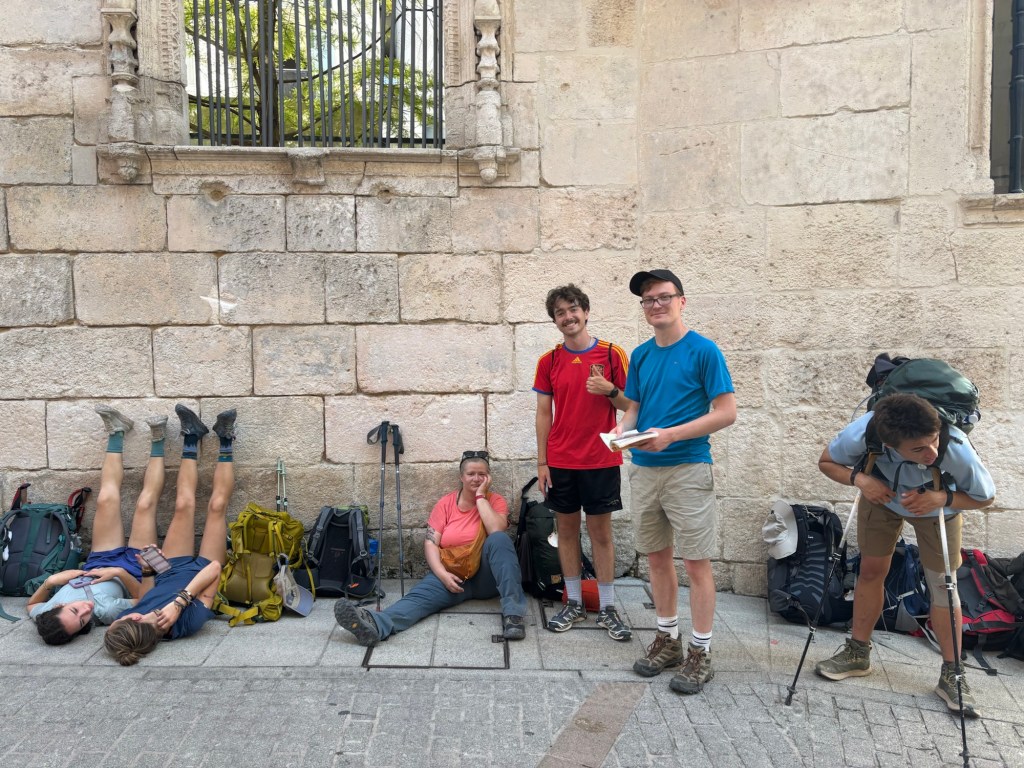
When Gust left this morning, I was the last of us left in Santiago. I have been incredibly fortunate this year with my companions, who have been the most wonderful company – even for this lonely wanderer who so often set off on his own to walk the road alone, for days or even weeks at a time.
Alex. The lawyer. My fellow countryman. Lost to us far too soon in Burgos. In many ways, the one who brought us all together. You set the pace – sometimes too fast for even me to catch up. You came to my defence against the Dutchman and his beer-fuelled football rant. I would have walked with you to the end.
Audrey. The marine biologist. The trooper. A seeker of solace and of silence, with a kind word for everyone and a pure heart. This was your Camino, I feel. The rest of us just fell into orbit. And who could resist the gravity of such a warm disposition? I hope you found the peace you were looking for in the shining Aegean Sea.
Talia. The neuroscientist. The brains of the operation and the questioner. Sage and sober and endlessly perceptive. You awoke in me an awareness of paths untraveled that I had long ignored, shining more light upon the road than any headtorch-wielding peregrino – which I, in my preference for the starlit dark, sorely needed.
Alonso. The diplomat. The wanderer with a thousand-yard smile. Powered by kudos and watermelon. Chasing the Sun across the horizon “for the bit”. Your wits were almost as fast as your Strava-fuelled sprints down hill and mountain, and you brought humour to every town and village we found. 100%. For you, the journey goes on.
Chip. The agent. The sunniest Salt Laker this side of the Atlantic. Friend to the saint, the sinner and the sandhill crane. Fountain of wisdom and wit and the only thing holding me back from being the eldest of the family (for which I was very grateful!). We never did get to say goodbye, so perhaps I will have the chance to say hello there again someday.
Gust. The drummer. The free-spirited Waldorf wayfarer. Blighted by blood blisters, broken sandals and Italian blessings and still one of the bravest of us all at seventeen years of age (or eighteen, if your credencial was to be believed). A chip off the old block who slept in a bus shelter to secure an earned Atlantic sunrise. You give me hope.
I’m already thinking ahead to my next Camino. I love the sociable side to the Camino Francés, but now that I have done it twice, I feel it may be time for a sea change. The Camino Mozárabe is calling to me, looping through the marbled hills of Andalusia and winding across the green fields of Extremadura. I don’t think I’d be likely to meet such an excellent and eclectic cast as the one with which I have shared the road for the last six weeks, but it would be another genuine adventure – as the Camino Aragonés, the Primitivo and the San Salvador were this summer.
Of course, for the same budget, I could probably have a week’s holiday somewhere really exciting: a tiger safari in India, chimp-tracking in Tanzania or an adventure around the deserts of northern Mexico. But would it make me as happy as another five or six weeks in Spain? Probably not. I know what makes me happy. Happiness has a name and her name is Spain.
Well, I’m back in England now. But the story isn’t over. Not yet. I’ll be back tomorrow to muse a little more. I just wanted to put some thoughts down while the memories are fresh in my mind. BB x
AlbergueSeminario Menor, Santiago de Compostela. 22.00.
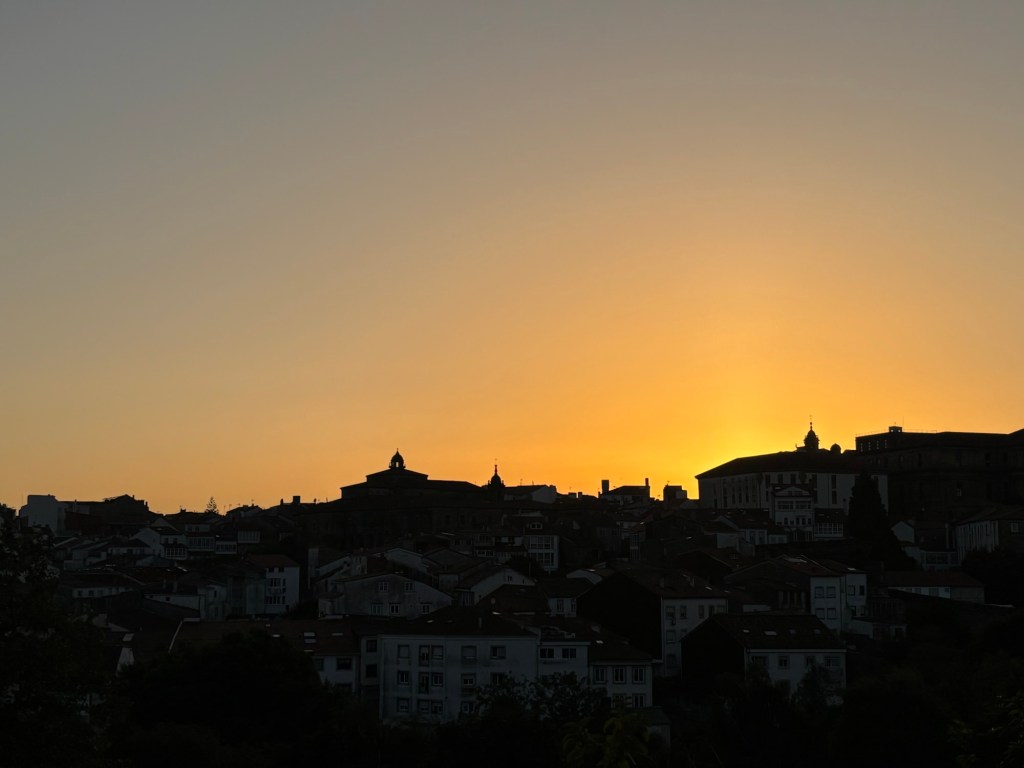
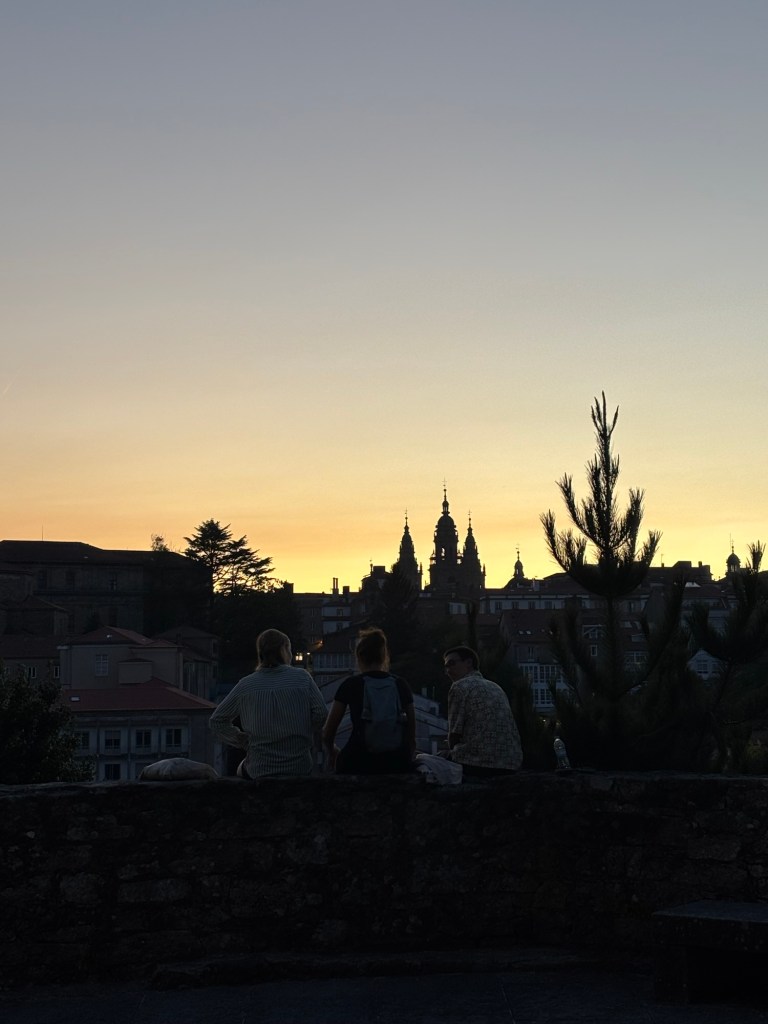
Santiago’s bells are ringing for ten o’clock. A smaller two-tone chime begins behind the echo, for just a few seconds… and then it’s gone. The city is quiet again and the world beyond is in darkness, broken by the slate-blue glow of the vanished sun and the twinkle of streetlights. It is a darkness that has become a fundamental part of my life for the last six weeks, and one that I will not know again until I set out on my next Camino, whenever and wherever that may be.
The breaking of the fellowship is nearly complete. Today I said farewell to Alonso, who sets out on the lonely road to Lisbon, walking the Camino Portugués in reverse. I suspect he was a little reluctant to leave, but to his great credit, he stuck to his plan. Gust and I accompanied him for a farewell breakfast of tortitas and huevos revueltos before parting ways in the Praza dos Obradoiros.
With Alonso gone and southward bound, Gust and I are now all that remains of a Camino family that, at its height, numbered around seven: Alex, Audrey, Talia, Alonso, Gust, Chip and myself. But for Gust and I, they have all departed the sacred city: some for home, some for the next adventure. There is always something sad about that. Gust and I are the lucky ones: with the last stragglers making it into Santiago today, we have been able to say a stoic farewell to pretty much everyone we knew.
Some small show of mercy, I think, for my decision to leave them behind for two weeks to pursue my own lonely trail over the mountains to Asturias.
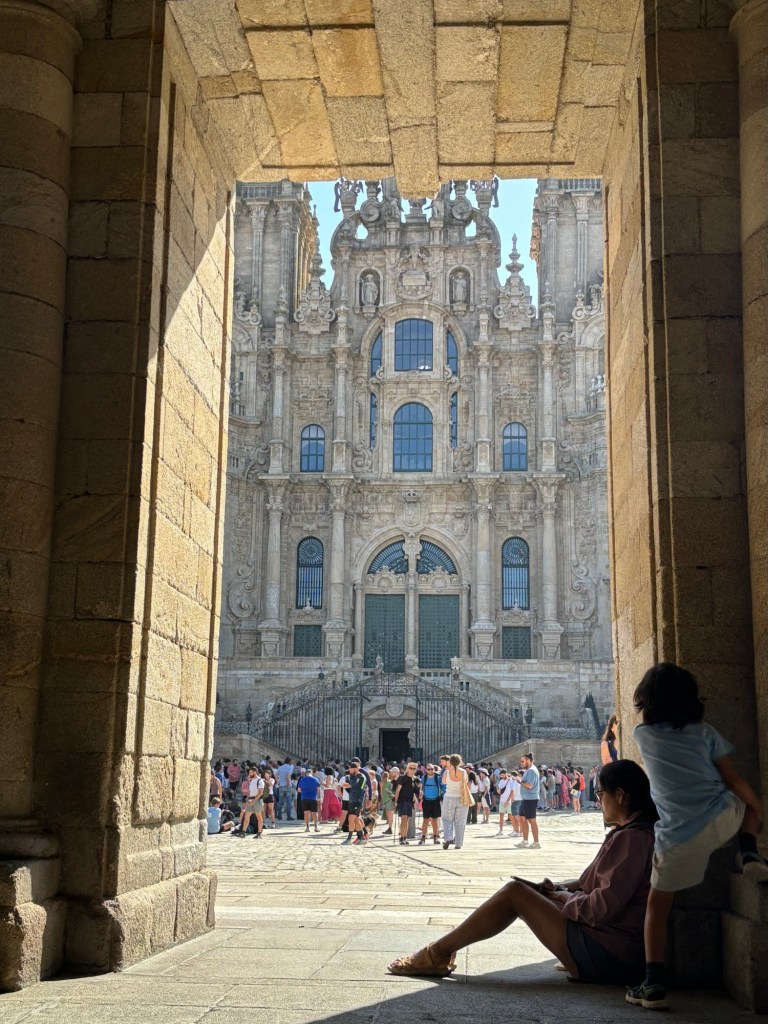
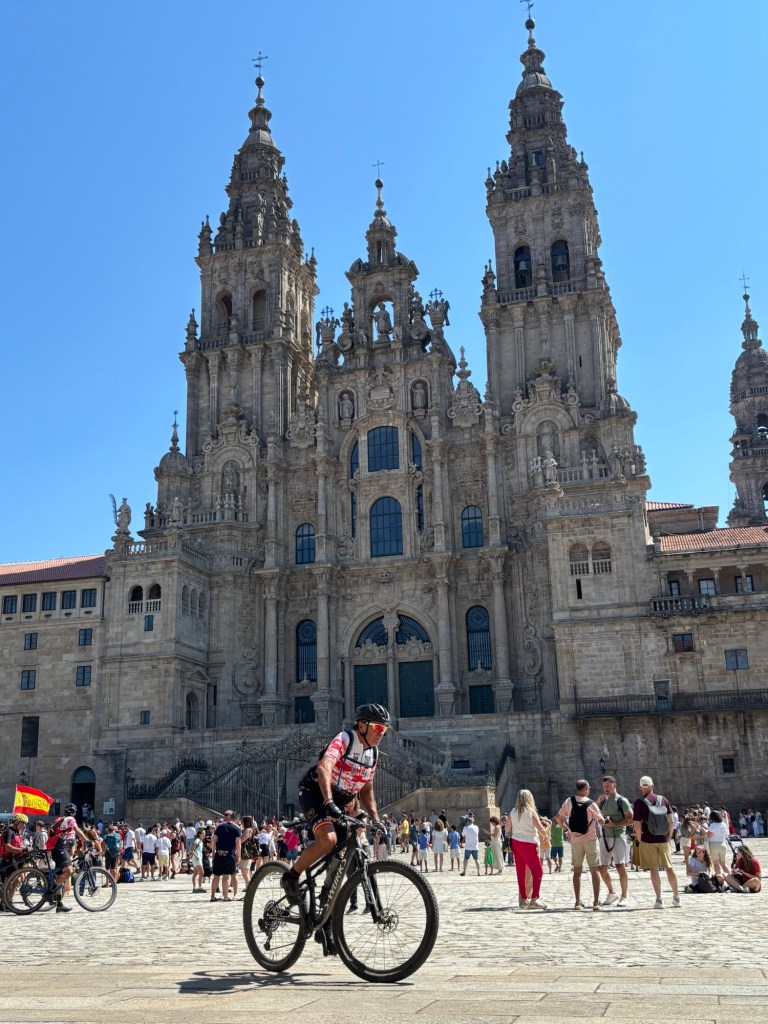
There were even more pilgrims marching into Santiago today than yesterday, their numbers swelled by several huge scout groups with their colourful scarfs and boisterous songs. Many of them had tears in their eyes as they embraced before the steps of the cathedral. It’s easy to raise an eyebrow at this overflow of emotion after a four (or, at most, five) day march when you’ve been on the road for nearly ten times that amount, but it’s easier still to forget that – in reality – walking 100km is no small feat. Well may they cry. They have earned those tears.
There’s a clear divide in the pilgrims from Sarria and the others in the square: the Sarria pilgrims crowd the plaza in great colourful throngs, while the more seasoned peregrinos (with the possible exception of the Italians) sit alone and in silence in the shade of the arches of the Pazo do Raxoi, eyes shut and faces drawn, contemplating the weight of their road and its inevitable end.
This is my third time in Santiago and yet the city is already so familiar I could navigate it in the dark. I had a look around the Faculty of Galician Studies in Santiago’s grand university building and tried to imagine myself as a Masters student here. It wasn’t easy. It wasn’t easy to imagine Santiago de Compostela as anything other than a pilgrim town, a never-ending terminus for a thousand-thousand emotional journeys. But outside the old city, there’s a modern sprawl with its own beating heart.
I had no map, as I have no more mobile data to guide me (and only just in time!), but my feet (and some scrap of memory) guided me to Casa del Libro in the new town. I only bought the one book, but I found a children’s encyclopaedia of Iberian mythological creatures and took notes in my journal. Not every book has to be possessed. To learn, sometimes, is enough.
I’m falling asleep as I write. I should turn in. This time tomorrow, I will be back in England. My grand adventure will be over. It’s a bittersweet feeling, even if I have accomplished all I set out to do. The end of an adventure always is. BB x
Albergue Seminario Menor, Santiago de Compostela. 18.11.
Two years ago, when I walked into Santiago’s Praza do Obradoiro under a cool white cloud, I could not shake the feeling that I had not quite earned the triumph that the end of the Camino usually entails. I had walked in alone, in the early hours of the morning, after setting out from Burgos some twenty-one days prior. My credencial showed that I had walked all the way, but not all at once: my circuitous route had taken me four years, starting in the summer of 2019 and continuing in the spring and summer of 2023, after COVID and a number of other factors prevented me from walking further.
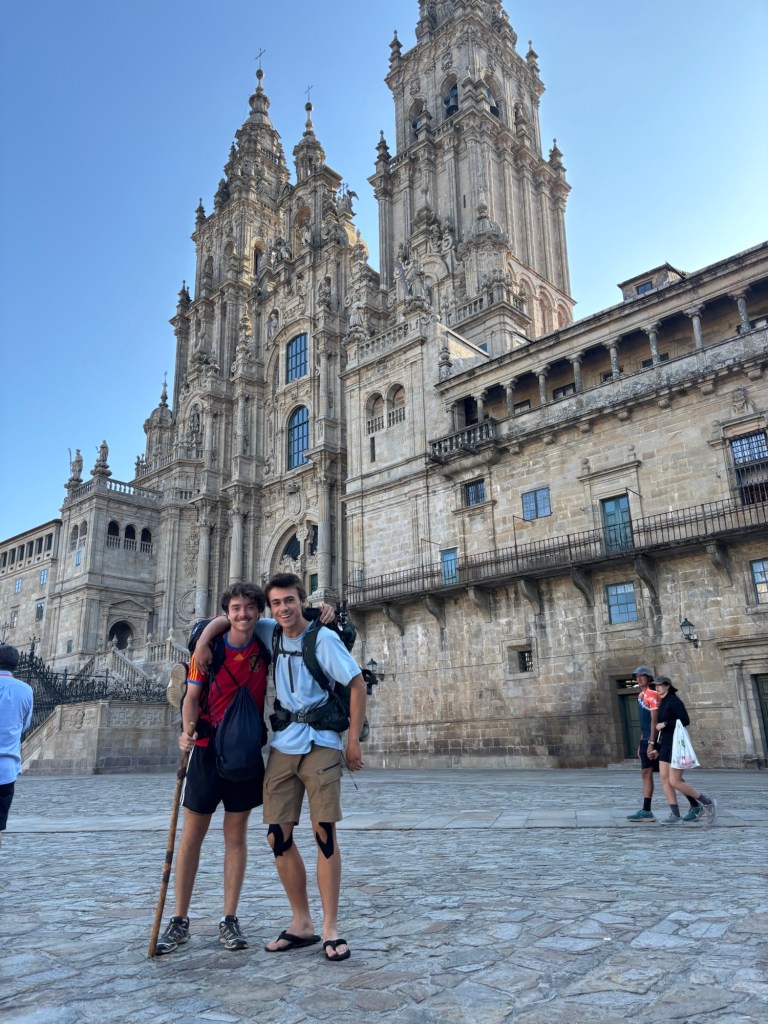
Not this time. Today felt like the finish you read about in books and in the films. Today, after walking over a thousand kilometres across France and Spain, to be welcomed like a hero by old friends in front of a crowd of thousands before a cathedral bathed in light… I was on the verge of tears this time.
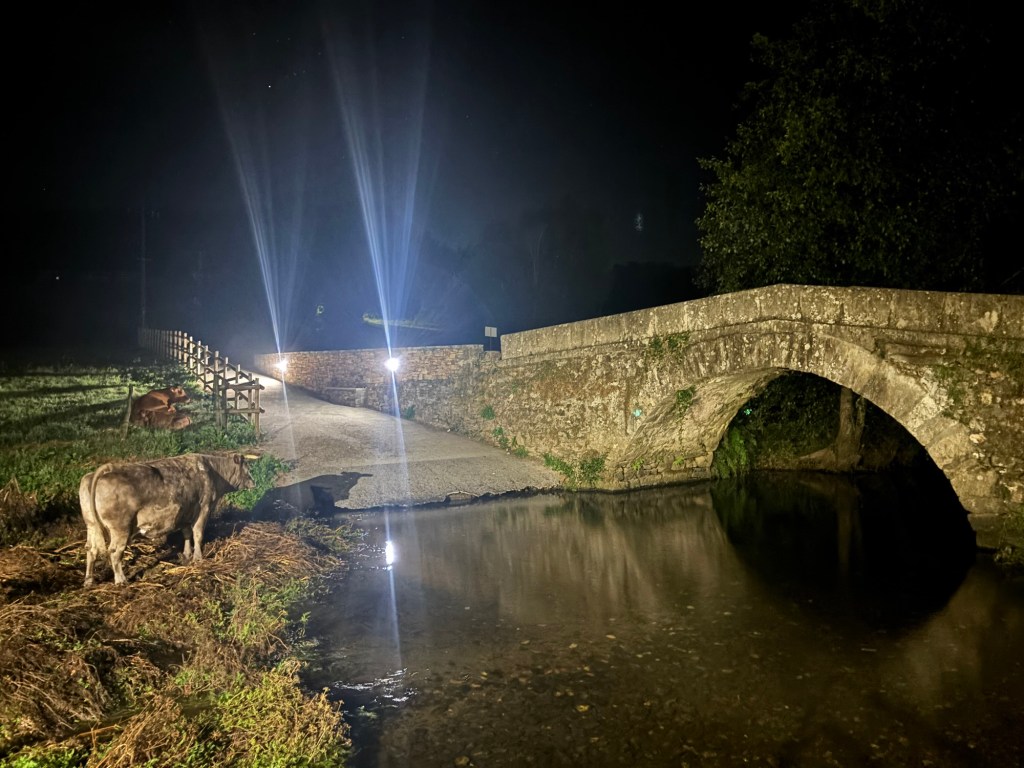
Ribadiso was silent when I left at around a quarter to five this morning – the earliest I have set out along the entire trek. A few cows had wandered down to the river for a drink by the reflected light of a few lamps along the bridge, but I could hardly make out more than their silhouettes in the gloom. My phone did a much better job than my eyes could do.
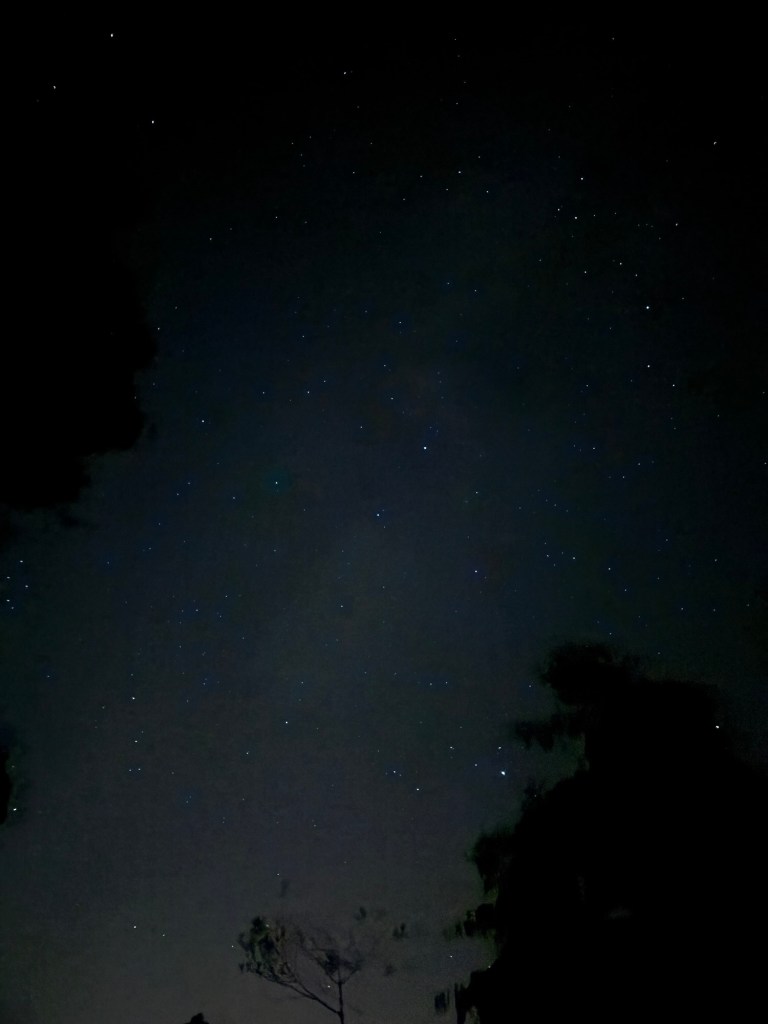
Darkness shrouded my steps until well after seven o’clock, so the first two and a half hours of my walk were made in the long shadows of night. As usual, I avoided using my phone’s torch as much as possible, navigating by starlight and the shadows of the trees against the sky, turning it on only to check I was not in any danger of leaving the trail. I passed a few pilgrims on the road who turned their glaring flashlights on me as I motored past, no doubt perplexed as to why I had decided not to light up the way in front of me.
I picked up considerable speed whenever I saw the dim moving light of a headtorch on the road ahead. I have not been a huge fan of headlamps and torches since two were trained on me like searchlights at two o’clock in the morning on a beach in Almería, during my mad trek across Spain at the age of eighteen. The fright that experience gave me has never really gone away, which may go some way to explaining my general disdain for the invasive, almost threatening white light of a handtorch. But there’s also my natural stubbornness, which I suspect has much more to do with it. You don’t really need a torch to navigate by night… not when your eyes grow accustomed to the gloom. So why bother?
I considered stopping for breakfast at a number of cafés once they started to open their doors after 7am, but every time I neared one, it looked packed to the gills, so I moved on. If I’d known that this would be the case all the way to Santiago and that I would not stop again until I reached the holy city, I might have shrugged off my pride and popped in for a tostada. But I didn’t, and when I accidentally took the forest route bypassing O Pedrouzo altogether – the usual staging post before the final push to Santiago – I decided to push on to the end on the power of a Bolycao and the last of my Nakd blueberry bars. It wasn’t much of a breakfast for a forty-three kilometre hike, I’ll admit, but it did the job.
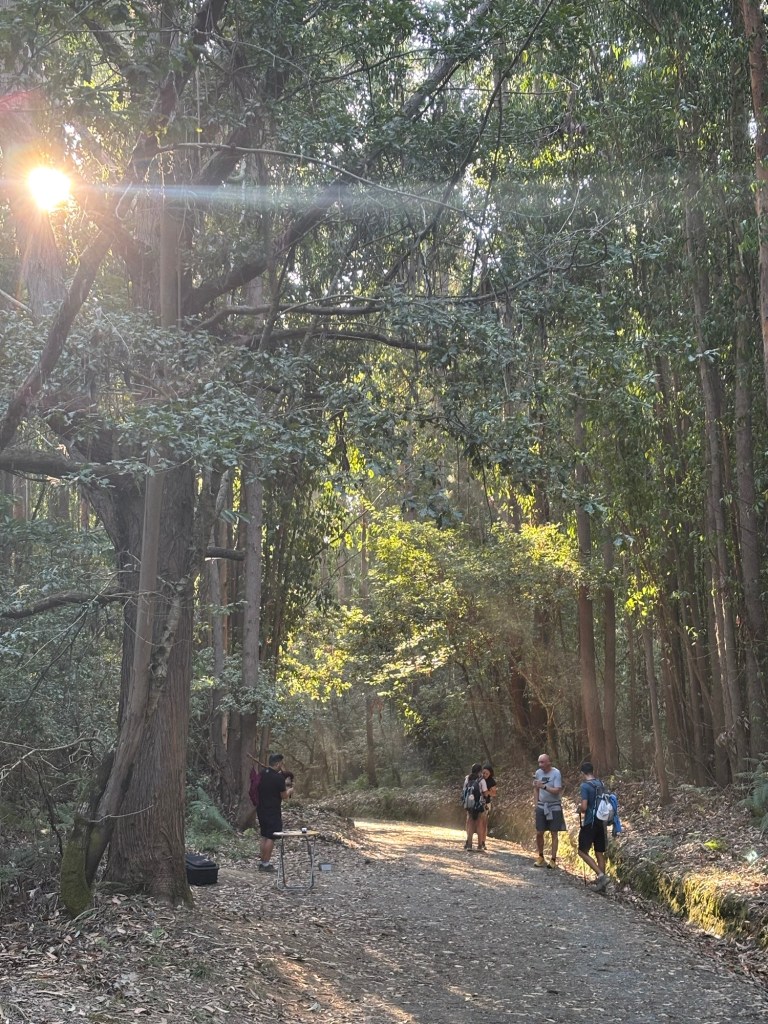
The road got quieter before O Pedrouzo after I had overtaken all of those pilgrims who had set out from Arzúa, only to ramp up again as I hit the back of the O Pedrouzo brigade. I met a few new characters as well as the first of a few old faces from the Camino Francés: Don Decibel, a raucous Spanish soldier whose phone call to his friends ten kilometres back hardly required the use of a phone at all (though I’m not sure I’d count the repeated phrases “oyé maricones” and “viva España putamadres” as a conversation); the Shadow, a French pilgrim who seemed to catch up to me constantly despite my attempts to race on ahead; Tim & Jackie, an Australian couple who fell behind us at Carrión de los Conded when Tim’s legs started to cause him trouble; and Edoardo, the charismatic Don Juan, who had slowed down to walk with a large group of Italian pilgrims.
And then there were the school and university groups. Hundreds of them. Well over a thousand, if I’d bothered to count them all. The ticker in the Pilgrim Office in Santiago showed that 847 had already made it to the city before I arrived at around twelve o’clock, so that number is not as much of a hyperbole as you might think.
The post-Sarria rush is real. It wasn’t quite as obvious two years ago as it is now, in the middle of August, when the crush is at its highest. I’d wager that I’d have seen even more if I’d left even a little later. They were all in very high spirits and many of them were draped in the colourful flags of their home regions: Andalucía, Valencia and Asturias were the most obvious. I looked for the black bars of the Extremaduran flag, but I didn’t see one.
I wondered, if I’d carried a flag, which one I would have the right to bear. Not Andalucía, surely, as I only lived there for a little under a year as a child (though it has forever marked my accent and identity), and not Extremadura either, since I have no familial connection to that earthly paradise whatsoever. La Mancha, perhaps, as that is where my cousins reside – but when my great-grandmother was born, that part of La Mancha was part of Murcia. My grandfather and his father, on the other hand, were from the Valencian province of Alicante.
In short, I have no claim to any of the regional flags. So I would have settled for the rojigualda instead.
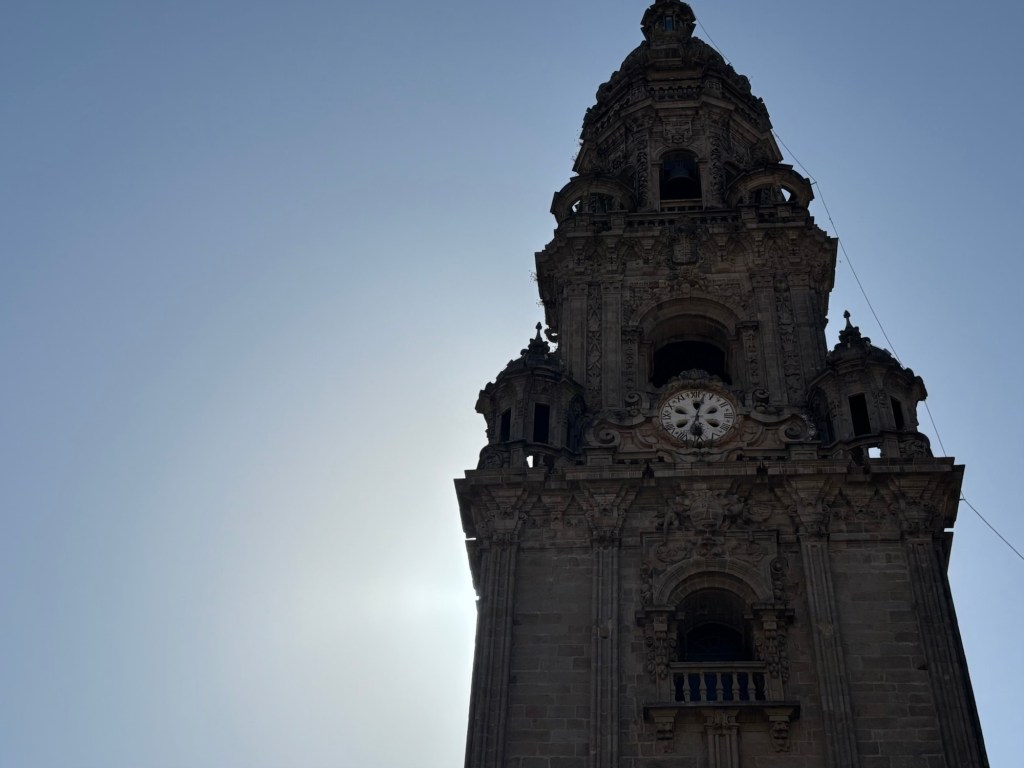
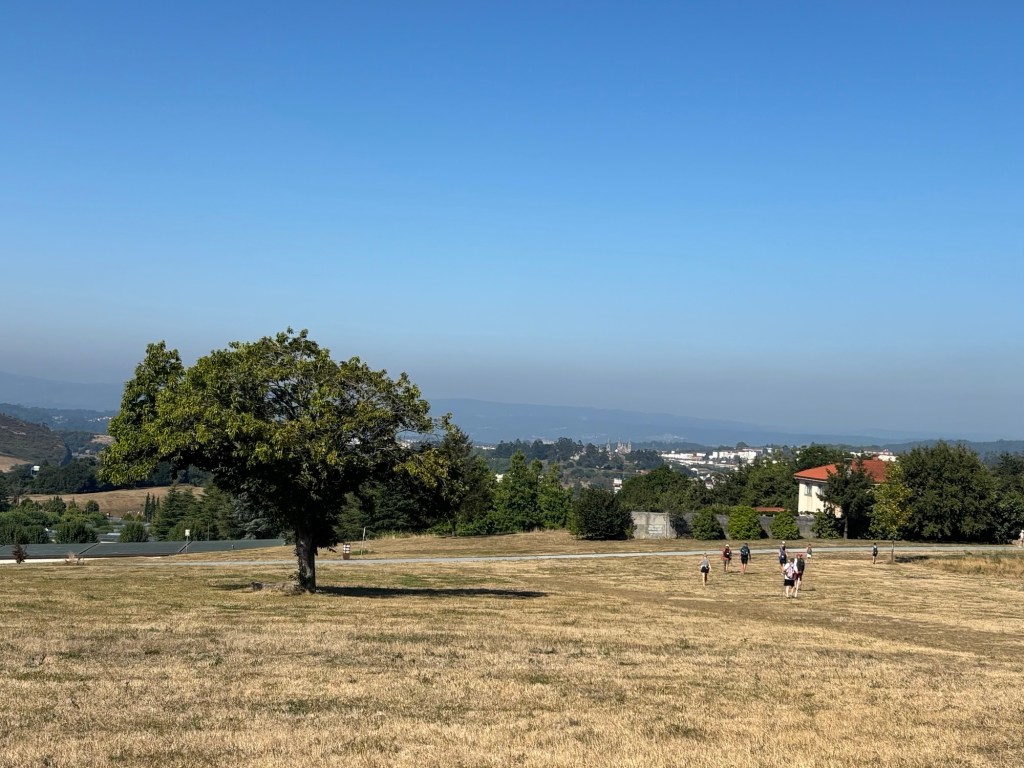
I couldn’t find the famous pilgrim statues on Monte do Gozo – I wonder if they’ve been moved to a different location? Their pedestal was where Google Maps said it would be, but I could not find them. I did, however, see my destination for the first time, and that was motivation enough to proceed: the twin turrets of Santiago’s cathedral, between the gleaming white houses and the towering eucalyptus trees.
When I left Ribadiso this morning, Google Maps thought it would take me around nine hours to reach Santiago. It took me seven. I had some powerfully uptempo music to get me through the last ten kilometres, up to and including:
Rhythm is Gonna Get You – Gloria Estefan
Higher Ground – Stevie Wonder
Voodoo Child – Rogue Traders
El Cid March – Miklos Rozsa
It’s a Big Daddy Thing – Big Daddy Kane
Qué Pasa Contigo – Alex Gaudino
Walk Right Now – The Jacksons
Deliver Us – The Prince of Egypt
The last one was the killer. I get emotional listening to that track at the best of times, but the timing was absolutely perfect, reaching the triumphant crescendo finale just as I reached the back of the square and turned to face the cathedral. There really were tears in my eyes this time.
Let’s face the facts. I walked a bloody long way.
I had hardly arrived in the main square when I was jumped by three old friends: Juha the Finn, Max the Austrian and David the American. To be honest, I was not expecting to run into any of the old guard at all: my side quest over the San Salvador and along the Primitivo put me almost a week out of sync with the crew I had walked with, and even three double days wouldn’t have been enough to catch up to them all.
However, with the exception of Chip (who left for home several days ago) and Audrey and Talia (who I missed by a matter of hours), everyone else was here, including Alonso and Gust, the last remaining members of our little band of seven. I could not have hoped for a better welcome wagon.
Alonso, Gust and I are all at the Seminario – along with a good number of familiar faces – and we had a decent lunch (if a bit pricey for what it was) and a phenomenal Gujarati supper at Camino Curry, a brave new enterprise by a family from Birmingham that was both the most delicious and the friendliest meal I have had on the entire Camino. Given that the fellows had been advertising on my Facebook posts, I’d say they earned my custom.
We said farewell to Max and Juha for the last time on this Camino and returned to the albergue for a couple of rounds of Go Fish (instead of watching the 10pm screening of the Superman movie at the local cinema and risking the nine minute dash back to the seminario before lock-up). I’m normally averse to card games but I had a great time. It reminded me of those dark internet-free nights in Uganda long ago, with Teddy and Maddy and Mina. That feels like a lifetime ago.
Well… tomorrow is another day. No more 5am starts. That’s something to look forward to! BB x









 The Book of Barnabas