Seehund

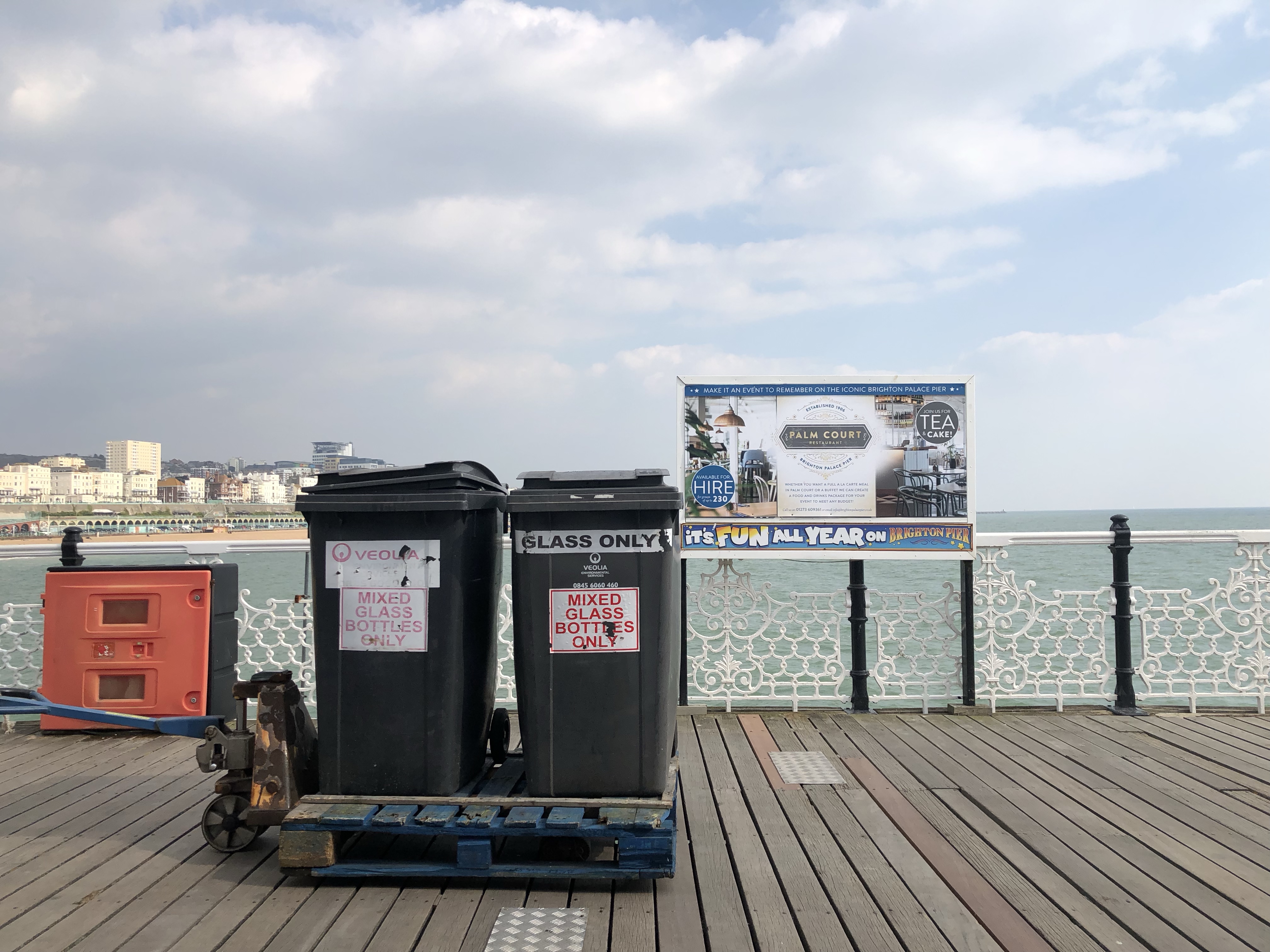
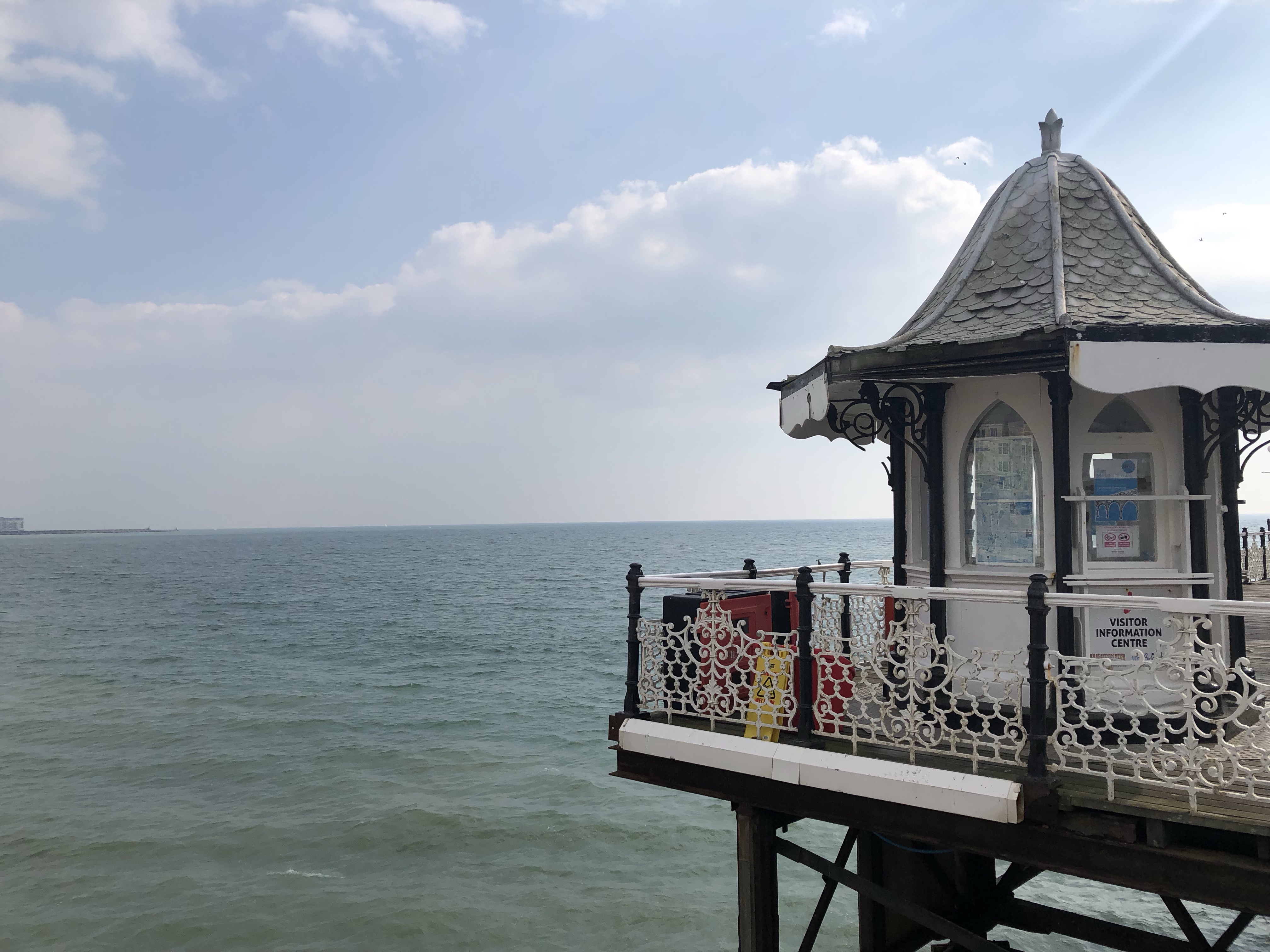
2:45pm, 20th March. I’m sitting on a bench on Brighton’s Palace Pier, sheltering for a moment from the wind. A sign in front of me reads “It’s fun all year on Brighton Pier”. Somewhere down the coast to the east, there’s a few mad folk towelling off after a swim. The sea doesn’t exactly look inviting today. I look down through the slats. The bottle green waters of the Channel heave and swell about the centipede legs of the pier below. I wonder what creatures of the deep might be looking back up at me, besides the silent starfish in the silt.

Two men wander over to the parapet, gazing down at the beachgoers below. One of them watches in silence, nodding occasionally. His companion holds a recording device of some kind in his hand and is whistling a crude but not inaccurate imitation of the gulls. Is he trying to lure them in, perhaps? To what end? I can’t quite make out his game. He keeps it up the whole time, occasionally saying something in Arabic to his companion and chuckling, and then whistling his gull-call again. After a while, they move on, whistling. His friend must have the patience of a saint. You get all sorts in Brighton.

A few seconds later, a herring gull lands on the parapet. It’s not there for long, as a gang of girls in tracksuits race up the aisle towards the gloom of the arcade, screaming and swearing, sending the panicked bird into the air in their wake. Two scavengers in a truck trundle by in the opposite direction, trailing two heavy GLASS ONLY bins behind them. The planks tremble beneath my feet. I imagine, for a moment, the structure collapsing beneath its weight. In slow motion I see the bins rolling over backwards and a cascade of bottles plummeting into the sea below, some of them shattering on the struts of the pier before they hit the water. I have a pretty active imagination.

I move on up the pier, past the booming darkness of the arcade, which still seems to draw in a faithful clientele, despite the mobile lure of pocket entertainment. In fact, I’m actually pleasantly surprised by the absence of phones on the pier – for once, I’ve got mine out more than most as I take notes. Beyond the arcade, I reach a collection of outdoor game stands. Tin Can Alley with a bored-looking brunette in a red shirt waiting for custom. Dolphin Derby with an enthusiastic announcer who wouldn’t look out of place in a pinstripe waistcoat and boater a hundred years back. An Indian family points out across the water talking in a language that isn’t English. A couple walk past, hand in hand, one of them gamine with a grey-tinged ponytail over shaved sides and a nose ring, and her partner robust, black, ripped jeans and winged eyeliner, a rainbow lapel badge pinned to her sleeve. The air is thick with the pungent smells of Brighton: fish batter, candy floss and the distinctive damp tang of weed. The breeze coming in off the sea cancels out one of the three at a time, but not for long.

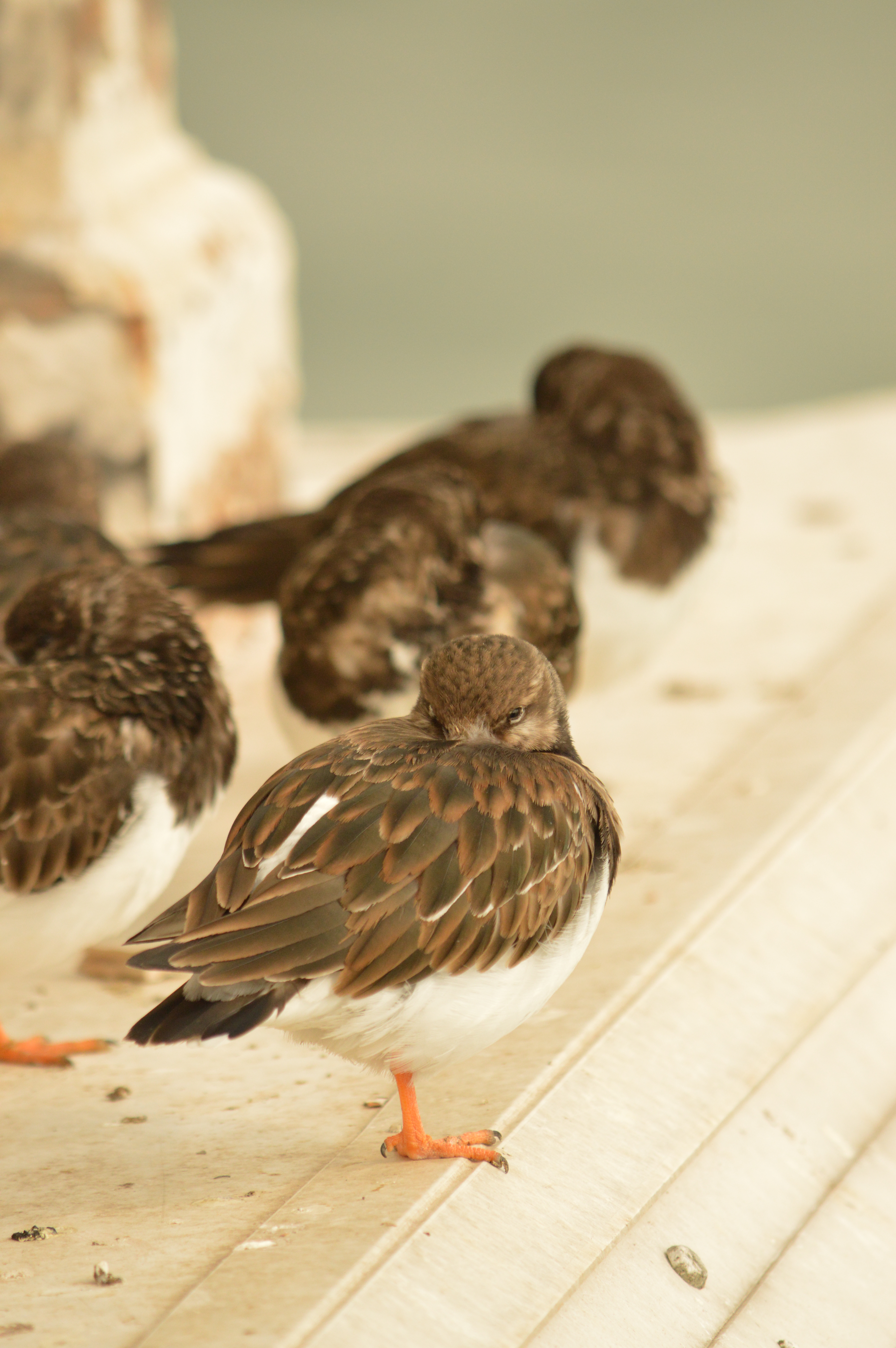
Behind the Tin Can Alley shack, a huddle of turnstones get some shut-eye. These often hyperactive creatures look out of place when static, and one wonders how they manage to get any rest at all with the thumping bass from the fairground rides at the end of the pier. It almost looks as though there’s a physical pecking order to the clan, and the ones at the bottom aren’t having much luck, hopping from strut to strut with remarkable dexterity. A passer-by sees what I’m looking at and stops to take a few photographs on her phone. The turnstones don’t seem to be fazed by me, or her, or any of this. After all, it’s fun all year on Brighton Pier. They’re probably used to it.

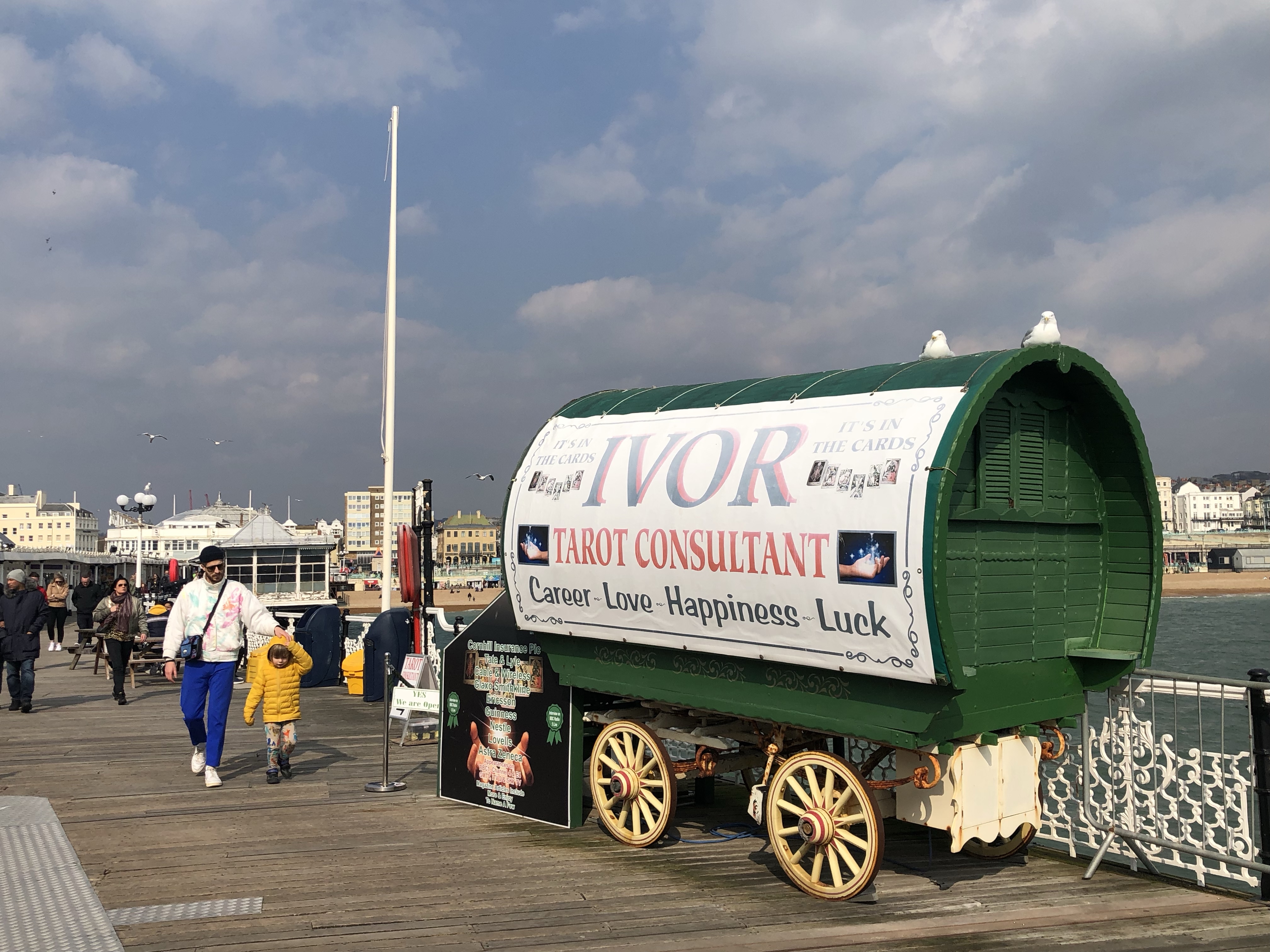
Nearer the fairground, an old gypsy-cart sits awkwardly beside the parapet, offering Tarot readings for a modest sum. Career, love, happiness and luck mingle strangely with Nestle, Astra Zeneca and Cornhill Insurance plc. I remember finding an abandoned gypsy-cart in the woods once when I was a child, its richly-painted woodwork fighting a losing battle with the forest’s silent army of moss, lichen and brambles. The gitanos in Tierra de Barros had no such fancies, eking out a living from beat-up cars and shabby tents. There is an old song of theirs I have consigned in part to memory, telling of their love for the Guadiana River, that came to mind:

The region of Chal was our dear native soil,
Where in fullness of pleasure we lived without toil,
Til dispersed through all lands ’twas our fortune to be,
Our steeds, Guadiana, must now drink of thee.

Gypsy ballad, translated by George Borrow (The Zincali, 1841)

I doubt the gitanos camped outside Villafranca de los Barros would know the song. It comes from an older world, much like the incongruous cart parked at the end of Palace Pier.

The fairground plies a busy trade for a chill-if-sunny Sunday in March. I feel like I’m walking through a childhood I haven’t known in twenty years, not since the distant summers in Dymchurch. Tea cups, log flumes and merry-go-rounds. A helter-skelter – see the Isle of Wight on a clear day! – painted up like a stick of Brighton Rock (or maybe the sticks are painted after the fashion of the fair). The static gilded horses on the merry-go-round look no less terrifying than they did when I was a boy. The ghost train reels in customers one at a time, lethargic, a chameleon in the cold. A father explains the “this high to ride” sign to his son, who is just a little too short for any of the attractions. I get the impression I’m snooping a little too much and wander away from the noise.

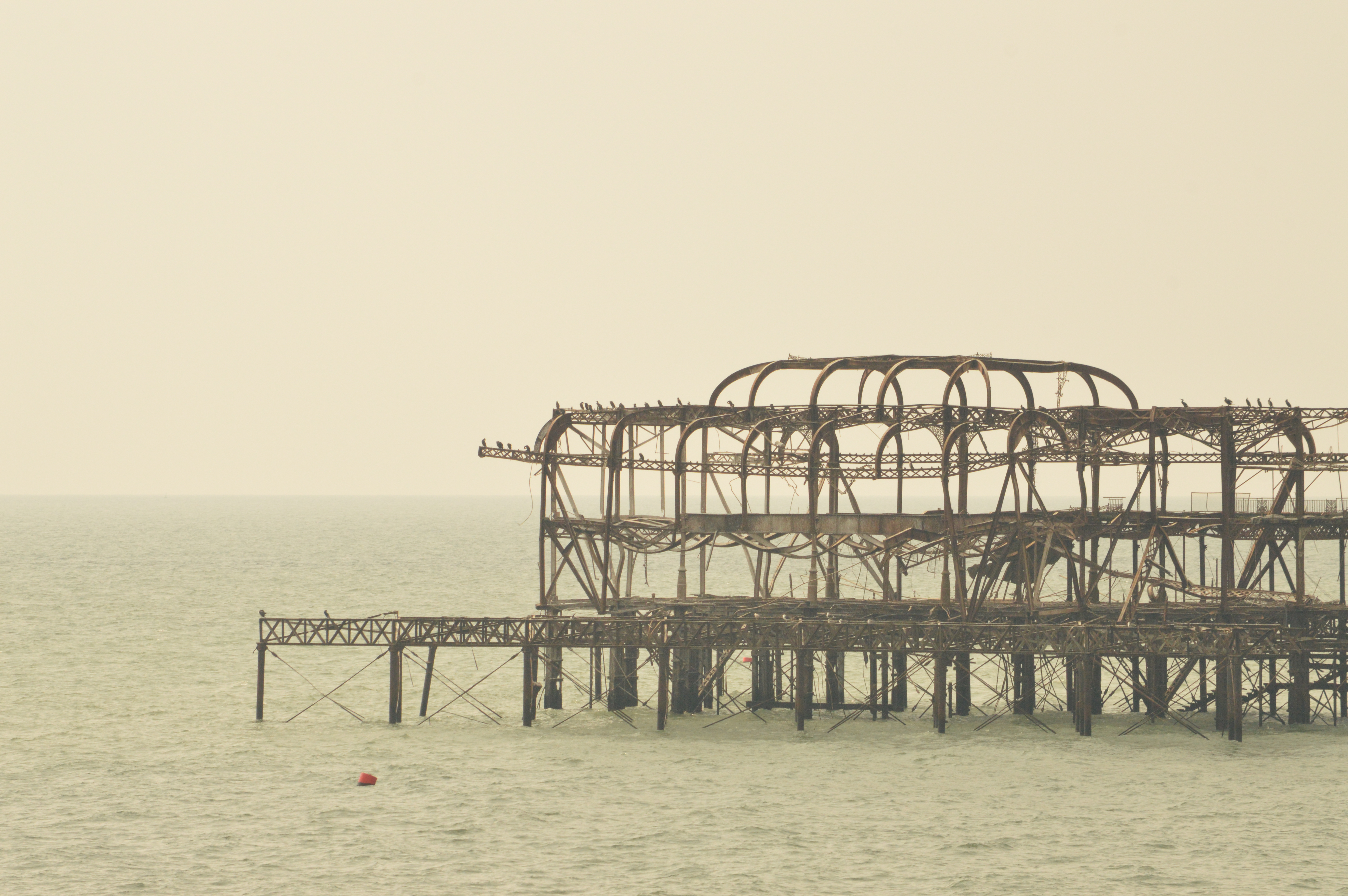
There’s a quiet spot behind one of the rides, looking out towards the mouldering wreck of the old pier. Seen from its sister with the city behind it, the Western Pier looks small and unimpressive. From the shore it looks a little more mysterious, where its mangled skeleton claws at the horizon like the blackened bones of a giant, mechanical whale, picked clean by the cormorants that sit on its ancient struts. In their oil-black funeral garb, they might as well be an extension of the wreckage. Brighton’s gargoyles.

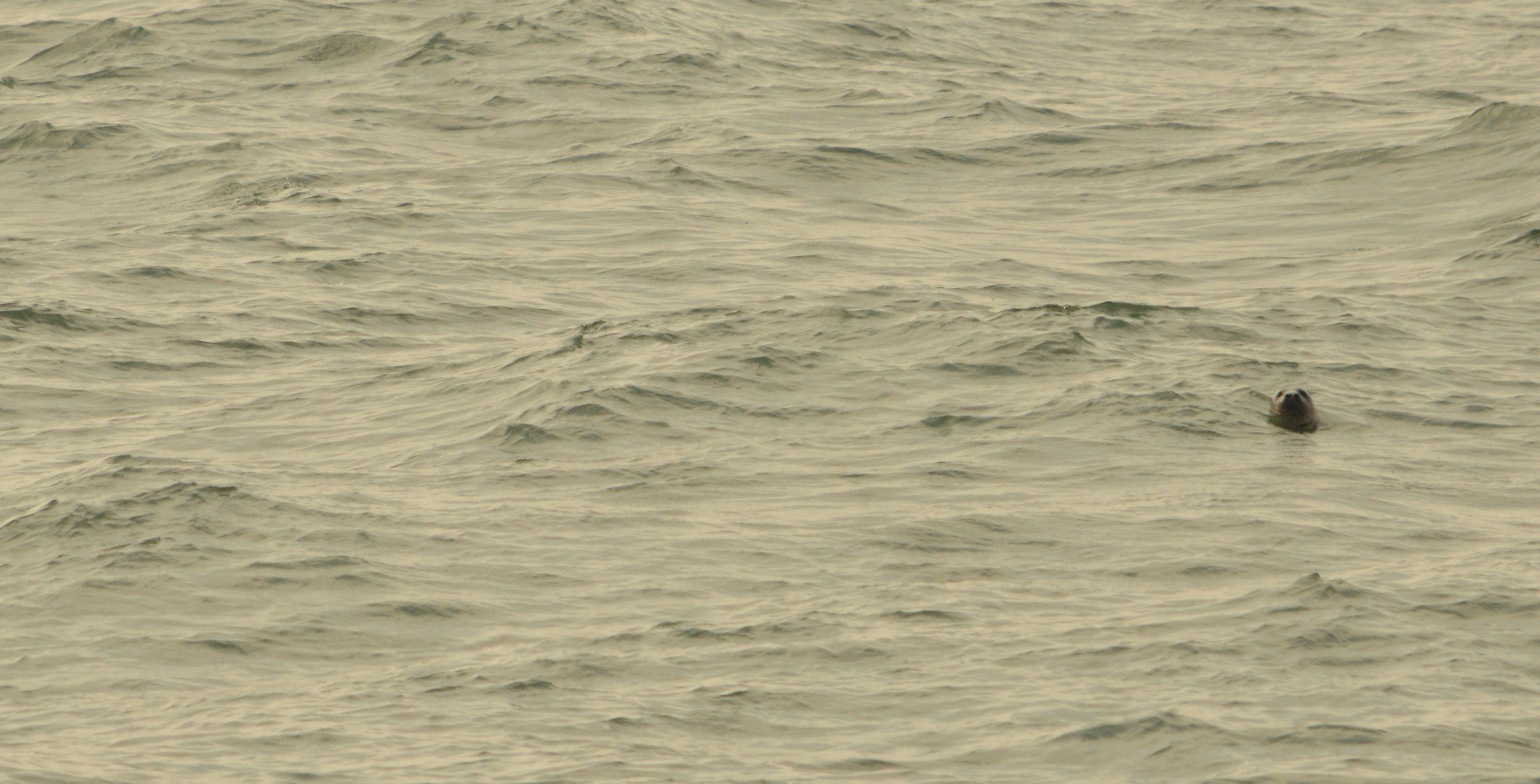
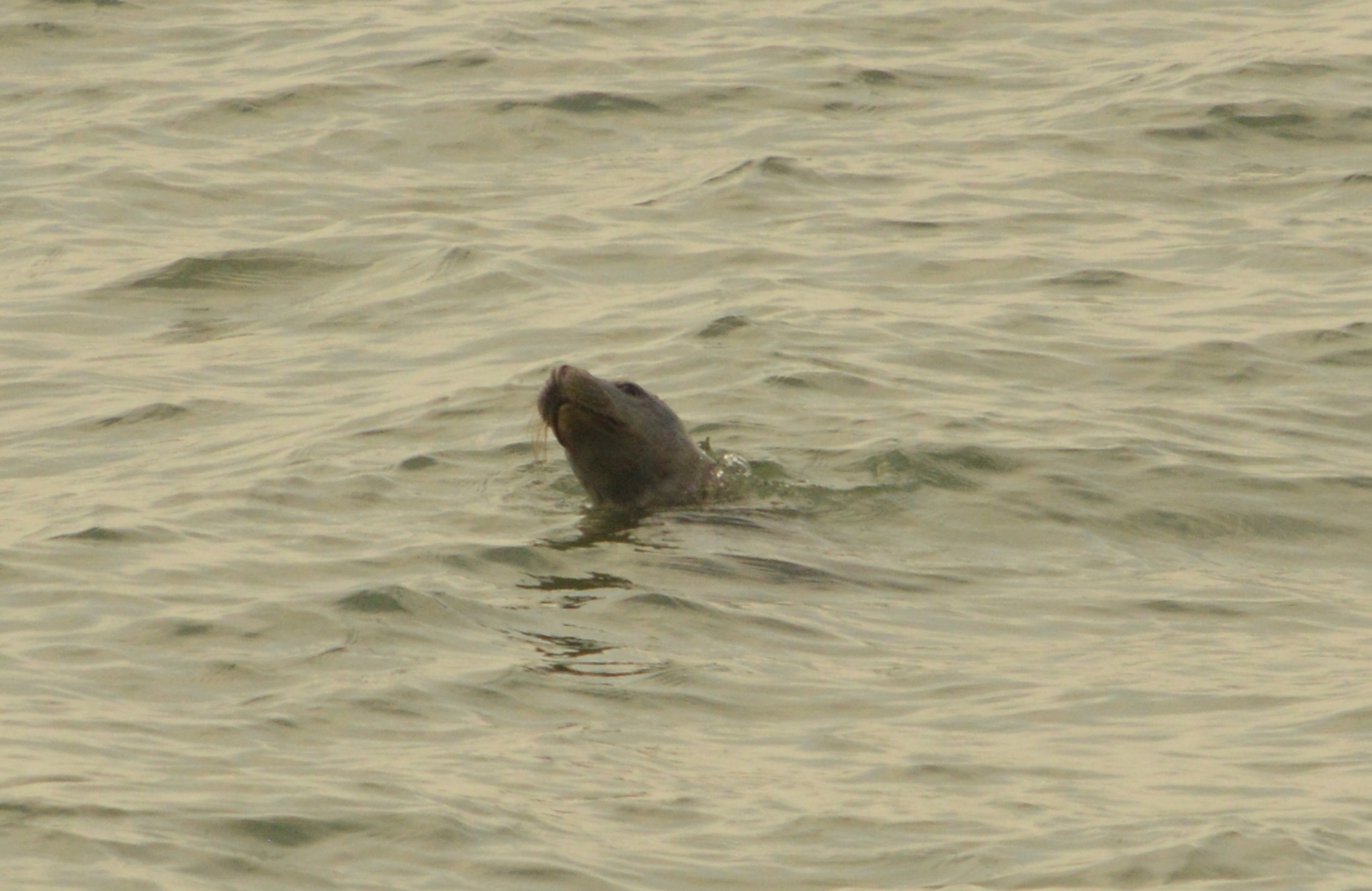
Something bobs in the water closer to the Palace Pier, and without looking through any lens it looks too misshapen to be a buoy. It turns for a moment revealing long whiskers and those baleful black eyes, before sinking beneath the waves. I’ve been scanning the water all morning for that sight, and now I’ve found one, I can’t let the moment pass me by. I count the seconds. One, two, three…

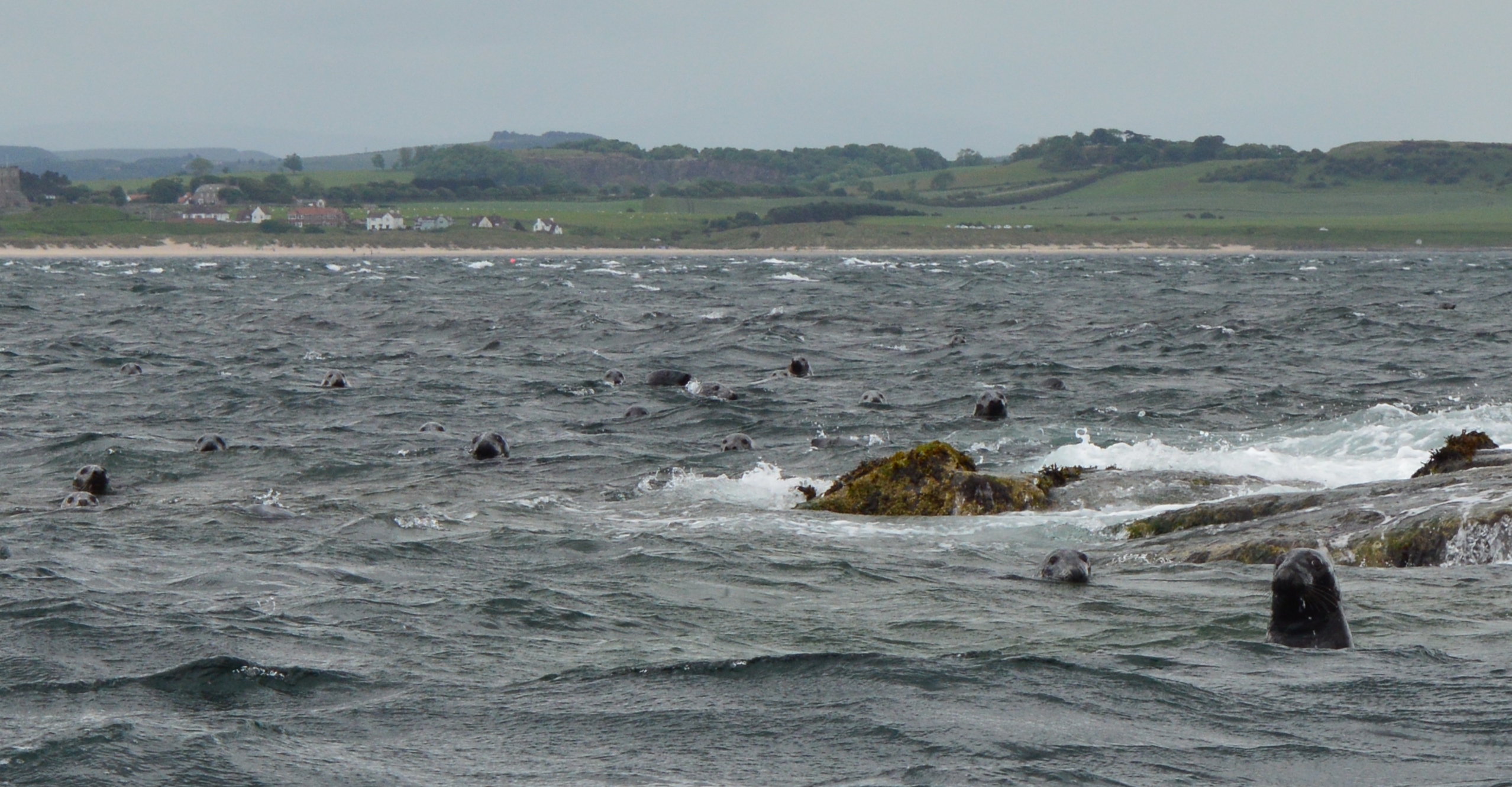
Seals are such mesmerising creatures to watch. It could be their friendly faces, the way they seem genuinely curious about the world above the waves. For me, it’s all about their eyes. There are few creatures out there with eyes like a seal’s: enormous, black orbs that seem to see forever. You only see the whites of a seal’s eye when they’re really close, otherwise you might as well be looking into the dull glaze of a shard of volcanic glass. I used to watch them bobbing about in the waves from the white cliffs when I was a teenager, and once or twice I was lucky enough to see them closer still, lounging about on the mudflats of the Stour Estuary and snorting their indignation at the noisy ferry-boat off the Farne Islands.

Those were greys: hulking, dog-like beasts of considerable size, especially the bulls who came charging after the boat. It’s not hard to see why so many languages label the creatures sea-dogs, or sea-calfs, or even sea-cats. But unless you’re in the water with them, all you see is the inquisitive face, bobbing above the surface. The seal comes into its own beneath the waves. I should love to see one in its murky underwater kingdom one day.

Some creatures command the eye. The ghostly silence of the male hen harrier, or the aerial mastery of the kite. The sunken eyes of the fox and the stern gaze of the stag. I once sat in my bedroom poring over bird guides of Spain and the Mediterranean, bemoaning how drab our world was by comparison. With age comes understanding, I suppose. If the seal hadn’t drifted further and further out to sea, I could have watched for hours.

I spent most of my teenage years growing up on the pebbled shores of this same stretch of ocean. The salt breeze and yellow-grey skies of the Channel are written into my skin like age-lines. I should make a point of coming down to the coast more often in future, if not to blast the cobwebs of work aside with a healthy salt spray, then to find the writing material I’m always searching for. If I can find my way to a quieter spot than Brighton, I might even be able to sidestep the bookshops that always draw me in. Fortunately, I’ve been such a loyal customer to Waterstones over the last couple of months that I was able to walk away from today’s haul for a steal of a price. Just don’t ask how many books I bought – or how big the discount was. It’s all for a good cause. I’ll keep telling myself that. BB x

Death of a Bridge

There’s a great big mound of earth down in Downside Wood where the old bridge used to stand. The stream that once ran gaily beneath its mossy arches hiccups and lurches through two black plastic pipes, swallowed at one end of the slump and regurgitated out the other. The vegetation hangs back from the mire, keeping a cautious distance, thorns and nettles recoiling as though stung by the mud. Caesarโ€™s legions made siege ramps that looked more sightly. At either end, where the track leads up and out of the forest, smoothed slabs of brickwork poke out of the mud like the bones of the bridge that was. The rest of the rubble lies buried deep beneath the mound, I suppose, making a barrow of the dell. Do bridges have ghosts? I suspect this one might.

I sat up in the branches of a tree during a break between lessons one summer, listening to M.M. Kaye’s Trade Wind and taking in the view of the bridge as for the last time. That was the year I saw the first signs of what was coming: a waterlogged sheet of A4 paper in a plastic wallet, fastened to the masonry by a tag, bearing the stamp of the local council. The word “SAFETY” written in bold black ink is all I can remember, smudged and blued at the corners by a couple of days of dew and rain. Safety… how satisfying it must sound to the inspector, and how terrifying to the stonework of the old buildings of the world. If stone could shake, it might do so at the word.

The world cried out in despair when Palmyra and the Buddhas of Bamiyan went up in smoke, reduced to dust by religious bigotry, but when I see the Great Slump in Downside Wood, I wonder how many other beautiful works of man and God disappeared under the councilor’s red pen without a word of protest.

As I looked down upon the devastation, a nightmare from my childhood came back to me: a scene from a film that haunted me so terribly that I remember every word, every brush-stroke, every note pulled from the strings of the violins. I’m talking, of course, about the nightmare fuel that is the 1978 Watership Down:

Holly: Our warren… destroyed… Men came… filled in the burrows… couldn’t get out… There was a strange sound… hissing… the air turned bad… runs blocked with dead bodies… Couldn’t get out…. Everything turned mad. Warren, earth, roots, grass… All pushed into the air.
Hazel: Men have always hated us.
Holly: No… they just destroyed the warren because we were in their way.
Fiver: They’ll never rest until they’ve spoiled the earth.

Richard Adams, Watership Down

I know so little of the bridge that once stood in Downside Wood. Was it only a fanciful exercise by a local mason for the lord of the manor, or did it have stories to tell? Did lovers sit upon its parapets before the ramblers and the cross country team tramped across its back? Did a poet or writer pause for thought over the archway and listen to the buzzards crying over the meadow beyond, before cigarettes were hastily stamped out into the mud as somebody saw Sir coming?

The bridge is gone. Safety and development swept it aside like so much that was beautiful. The old meadow behind St Aidan’s College, where I once saw a barn owl drifting in the evening air looking for voles, lies deep beneath a building site as the students choke the city. Like Richard Adams before me, I can only look on in dismay and add my voice to the thousands. There is a mystical beauty in the ruins of man’s work that is surely greater than any single life, if we can but look beyond our own existence for just a moment. These things around us, these rocks and trees, will be here long after we are gone, and will tell their own stories from generation to generation.

I hope that, one day, a generation will come along with mercy in its heart. It’s too late for the Downside Bridge, but not for a thousand other unsung relics scattered across this island. Not every fern is sacred, but in the grand scale of things, the world around us is worth more than a human accident. BB x
Rewind, Reset, Refocus

Diary Entry: 14th March, 2012. Ten years ago today.

Heavens above, the first night of Fiddler is less than a day away! This year has flown by… Today went by in a similar blur: four frees (essentially), Spanish and English raced past with a quick thrashing of Peter at chess over lunch and a Yearbook planning session. The dress rehearsal was superb – a lot to be ameliorated for the night itself (apparently) but otherwise very good. I must say, personally, I’m impressed with everyone. Our Tevye in particular: he’s come a long way since only just deciding to put his oar in… One of the big five is almost out of the way! The only question is… what next?


When I was seventeen, lists to me were everything. I think it was a long hangover from the teenage bird-watching days: garden lists, patch lists, year lists and lifers. That kind of thing. I wasn’t really the kind of kid who had it all figured out from the beginning, but I did appreciate a tick list to motivate me. I must have the original “bucket list” of fifty miscellaneous tasks I wanted to achieve before the age of fifty stored away on a memory stick, buried deep beneath a hundred other forgotten half-finished jobs, books and games. The irony isn’t lost on me.

I still remember the big five, though. They were the “ultimate goals”, the quests that I had to complete, come Hell or high water. It went something like this:

  1. Play the part of Motel in Fiddler on the Roof
  2. Get a place at Durham University
  3. Travel from Cairo to Cape Town
  4. Get married
  5. Publish the book

You’ll notice that two of them are struck through. Completed. Dicho y hecho. You might well think it more than a little foolish that I managed to get two of my five “great quests” completed within six months of each other, and by the age of eighteen, to boot. You might also question the logic of making the First Quest so very specific, which relied upon a great many external factors, but as the descendant of a lost Jewish family driven into hiding, Fiddler on the Roof holds a very special place in my heart. I was also uncommonly blessed with a musical director for a mother, so I did, I admit, have a significant advantage in achieving one of them early on.

Is there a blessing for a sewing machine?

Durham? Durham wasn’t even up for debate. I simply had to get there. And though I do my very best to advise my own students against such stubborn folly, I was more than prepared to take a gap year and have a second shot when I didn’t get a place at the university of my dreams the first time around. Call it madness, but I wasn’t prepared to accept anywhere else. It was a gamble I ended up making good on, shored up by a much more favourable set of A Level grades. A combination of luck, hard work and stubborn pride secured me the Second Quest.

Of the remaining three, one was swapped out a few years back for a new quest:

3. Find the family

As I got older and my desire for reckless travel steadily fell away – the pressures of holding down a job and being in a relationship will do that to you, I guess – the idea of making the great overland trek from Cairo to Cape Town by any means at hand drifted further and further into the nether realms of lost dreams. Living in Uganda very much whetted my appetite for all things African, but in the years since I’ve been made to question that interest so often, through the lens of anti-colonialism, BLM and the downfall of my Gospel Choir. Eventually, the risks outweighed the allure. I buried that dream a long time ago, and replaced it with a much more personal Third Quest: finding the lost family I had never met.

I found them. That was five years ago – you can read the story here, if you missed it. Of all my quests, the search for my family has been the most precious, and I live in its afterglow twice a week every week as I guide my youngest cousin towards his English B1 exam.

That leaves only two of the original five: arguably, the two chambers of my heart. The book, and the one. I’m not afraid to admit that my single greatest ambition since childhood has been one and the same, and combines those two into one; and that is to read my own stories to my own children one day. It’s an image I’ve had in my head for almost twenty years: sitting on the edge of the bed, my life’s work in my hands, putting on all these silly voices and painting the world I’ve spent decades creating for my children. Leading them there, chapter by chapter. Watching them grow up with my heroes, until they find stories of their own and take up the mantle my great-grandparents passed on to me.

Of course, there’s a small but fundamental stepping stone that must be crossed first: the Fourth Quest.

Getting married and publishing the book. The two quests go hand in hand. That, perhaps, is why coming out of a long-term relationship has been a bit more jarring than I thought it would be. The derailing of two quests at once. A future rerouted, rewritten, a page of thoughts and ideas and names scrubbed blank. It’s not disheartening – nothing can be when the birds are singing and the year is on the turn – but it does leave you knocked out of orbit.


Ten years ago tonight, I was psyching myself up for the first night of Fiddler on the Roof. Tonight, Russian forces continue to cut a burning path through Ukraine. Kiev shelled. Mariupol in flames. Hospitals in ruins. As Motel, I took my young family and fled west into Europe. The radio today was talking about how the British government is offering a tax-free allowance of ยฃ350 per month to those willing to put up Ukraine’s refugees. According to the Beeb, some 43,000 have already signed up to help, only five hours in.

The events described in Fiddler took place in 1905. More than a hundred years later, the parallels seem alarming. They put one’s troubles in context. Personal quests and family pride must be denied and set aside and mortified and all that. Perhaps it’s high time I set myself a new quest. In the meantime, there is work, and work is good for the soul, even if marking GCSE translations is a far cry from any soul food I’ve ever eaten. BB x
Tevye: Work hard, Motel. Come to us soon.

Motel: I will, Reb Tevye. I’ll work hard.

Fiddler on the Roof, Act II, Scene 8

Half Time

Saturday afternoon finds me out on the side lines, camera in hand, supporting the boys. We put up a valiant fight and place third, thanks to a surprise goal and some seriously impressive goalkeeping. The ball comes my way at some point and I aim to block it, but apparently the ball was way over there and my leg was somewhere else. One of the boys saw fit to rib me about it in house later. I can laugh it off now as I did then. Football has never been my forte, or any other sport for that matter.

Working in a boarding school has got me more invested in sports than I ever was at school. There’s something magnetic about watching your charges do themselves and their team proud, whether they win or lose, that I never really felt when I was obliged to play the game. It’s not that my parents didn’t try to get me into sports when I was younger – goodness knows they tried their best – it’s just that then, as ever, it wasn’t in my interest. Which is why I’m here, not far off the age of thirty, and I still couldn’t name you more than about ten footballers at best. Somewhere along the line it seemed a great deal more important to consign to memory the sight and sound of every single feathered animal in the UK. I guess my excuse for stretching myself thin with the things I do – making music, speaking five languages, writing books and knowing my way around the natural world – might be construed as compensating for the fact that I could never do the one thing that comes naturally to most boys… that is, kicking a ball.

I can’t really remember a great deal about my sports lessons at school. If the truth be told, I’m pretty sure I used what cunning I had back then to wangle my way out of sports for good by the time I was sixteen. I think it was along the lines of “rehearsals for a musical” that I managed to stretch over two years. At least in my first year at school I was given an excuse when an angry sixth former stoved in a few lockers, including mine, with my sports kit trapped blissfully inside. Two memories alone remain: being made to play on through a blizzard in woefully short football kit, and the humiliation of being made to keep attempting the high jump until I was finally able to clear it – by which point it was almost level with the mat. And while I’d normally pull a face at using the same verb twice in succession, “being made to…” sums up my sporting experience pretty well. Understandably, this air-headed naturalist wasn’t ever really at home on the sports pitch.

Which is why it’s all the more surprising to me that I get such a kick out of supporting my boys in their games at the weekend.

Because leopards never change their spots, I turned my camera skywards a couple of times on the buzzards that came drifting over the pitch, as I once did during the summer fixtures a decade ago. Spring is here and the birds are pairing off already. There’s a part of me that sighs, but a sunnier, more hopeful side that smiles, and I cross my fingers and I hope theirs is a successful pairing. Successful being the appropriate word, since happiness seems out of sorts. We still don’t know for sure whether birds feel emotions like we do, but I’d like to think they have something close to it. You see hints every so often that they might: a swallow mourning beside its partnerโ€™s tiny body, crows sliding down snow-bound rooves, choughs hurling themselves from great heights seemingly for the sheer thrill of it.

It’s uplifting seeing the smiles on my boys’ faces during a game, and I find myself wondering whether that’s the same electric feeling you get after a concert, or from sighting one of our island’s most beautiful creatures riding the spring thermals. And now the sun is out again, I might just go for another heart-healing walk in the Weald. The forest weaves a magic that never dies. BB x

Pygmalion

Yesterday was International Womenโ€™s Day. If you hadnโ€™t noticed, you probably have a much healthier relationship with your devices than I do. Being naturally cautious when it comes to writing about trending topics โ€“ and keeping a wary eye on the growing stack of marking on my desk โ€“ I wasnโ€™t originally going to write anything on the matter. In previous years I might have jumped on the bandwagon and sang the praises of women from history who I find inspirational, but that muse didnโ€™t find me today.

It only occurred to me after a couple of hoursโ€™ highly productive procrastination on the novel last night that thereโ€™s one woman who Iโ€™ve been writing about since I first got bit by the writing bug, now twenty years ago. A divisive woman who has been at times a distraction, at others a channel for my doubts, but always a polestar, burning bright, night after night, though the other stars around her blink in and out of the darkness.

This is Leonor. And this her story.

Iโ€™ll be twenty-eight this summer. For no less than twenty of those years, the red-haired princess has been living rent-free inside my head. Whether she was inspired by a childhood friend, the Little Mermaid or a double-page cartoon from an Art Attack! magazine, I donโ€™t suppose Iโ€™ll ever be certain. Like as not, she sprung into being as a combination of the three. One thing I know for sure: of all the cast and characters of the books Iโ€™ve spent the greater part of my life writing, sheโ€™s been the one constant. The world has shifted beneath her feet several times, sometimes drastically, but she has weathered every storm, survived every crush unaltered and resisted every rewrite. When I brought the book over to Spain a few years ago, she was the final frontier, the last character to trade in her name for a nombre.

Leonor in her “Stephanie” days, back in ’04

Without giving too much away, Iโ€™ll introduce you. Leonor is one of the two central characters in the story, though arguably it’s her story that’s the one being told. The princess of Meridia, she’s playful, sharp-witted and short-tempered, with a sense of duty almost equal to her stubbornness and pride. Descended from two legendary heroes from our own timeline, she is catapulted into the role of Queen by a series of tragic events and, amid the fires of war and personal tragedy, she becomes one of the greatest rulers Meridia has ever known, captaining the sinking ship of her doomed kingdom to its final hour.

Sheโ€™s an avatar of hope and a rallying flag in human form for her people. And yes, Iโ€™m sure I play into the โ€œfiery impetuous redheadโ€ stereotype more than once.

My little princess grew up so fast…! ’18

In the saga’s early days, when the concept was still very much a fantasy/sci-fi adventure, I had her imbued with magical powers. These days her greatest power is her charisma: in a saga filled with reluctant rulers, ambitious bureaucrats and silver-tongued servants, Leonor comes into her own as a woman who stands her ground in a man’s world: adored by her subjects, respected by her contemporaries and feared by her enemies. It’s no surprise that in recent years I’ve looked to two other fierce red-headed rulers to bolster her character: Boudicca of the Iceni and Elizabeth I of England.

Now here’s the question. Am I in love with my own creation?

Of course not. For one thing, I wouldnโ€™t dream of playing the third wheel to my hero! But youโ€™d be surprised how much of a flashpoint itโ€™s been in the past. Two previous girlfriends have challenged me about my attachment to her. Try to put yourself in their shoes. I suppose itโ€™s not all that different to inviting a partner over, only for them to discover objects left behind by a former lover. As Iโ€™ve tried to explain before, if you want to get jealous about one of my characters, you might as well take it out on the rest of the cast โ€“ I have no less love for my other creations.

And yet the fact remains that, by the age of twenty-eight, I’ve had a longer and arguably closer relationship with my central characters – Leonor included – than I have with anybody I know, outside of my family. I wonder whether that’s why I’ve always been so comfortable with my own company. It’s easy to handle solitude when you’re never really on your own.

She’s not my idealised woman by any stretch of the imagination, though it’s possibly due to my long connection to her that I’ve always had a weakness for dark eyes and red hair. She’s no imaginary friend, anymore than Desalma is a shadow that haunts my dreams. I neither love the women I conjure out of the air, nor do I fear the monsters I create. She is a figment of my imagination, and though she’s found her way into journals, homework diaries, used envelopes and maths book margins over the years, if I were to disappear one day, so would she. Perhaps that’s why I’ve never stopped trying to tell her story.

Do you know what I’d like? If I should be lucky enough to have a daughter of my own one day, I’d love to tell them her story. To bring them up to tales of her courage, her unflinching hope in the face of overwhelming odds. To show them that, though she wasn’t perfect, though her pride got her into trouble, she kept on fighting for what she believed in.

She’s not my Galatea, but she is my muse, my inspiration, and her story needs to be told. That’s why I write. That’s why I’ve always written. After all, it’s hard to say no to a princess. BB x
For the Sport of Your Own Crows

My phone is telling me I walked some twenty-five kilometres today. After trekking to Three Bridges Station there and back on foot, various perambulations through Reading and London and walking the Combe Gibbet Circular, I can’t say I’m surprised. What I can say is that I bloody well ought to learn to drive, because it’s frankly ridiculous how much of the world I could be exploring at weekends which is just too far away to reach on foot. Dammit.

Fortune favours the bold, which is another way of saying if you want to get lucky, you have to make your own luck. Fortunately, today’s little outing got off to a cracking start with luck knocking on my door. With the kids off site this weekend, the grounds were eerily quiet, even for a Sunday morning. I guess that’s why one of the forest’s more secretive residents made it all the way up onto the main drive this morning.

Muntjac deer are such fascinating little creatures. They keep some of our boys up at night with their barking in the summer, and unlike some deer species they’re quite fearless if you cross paths with one in the wild: I’ve had what can only be called a stand-off with a buck in the woods on my way into town more than once (and probably with the same individual). This one didn’t hang around for long, and if I’d not happened to look out of the window as I was getting dressed I’d probably have missed it.

I managed to make it out into the windswept wilds of Berkshire this weekend. I haven’t been up that way since a school retreat to Daoui a few years ago, and I remember feeling spellbound by the place then (well, I was certainly spellbound by the evening prayers, that much is true). On the way, signs that the year is very much on the turn were everywhere. Masses of frogspawn in the usual spots in the forest. Crocuses pushing up through the bracken as the snowdrops wilt away. The explosive chattering of a roving band of siskins in the treetops. And, Berkshire being Berkshire, red kites absolutely everywhere. I swear I saw more kites than pigeons today.

Climbing high up onto the downs above the hamlet of Inkpen, I even heard my first skylark of the year, merrily singing its heart out as it soared skywards. I haven’t seen any swallows or martins yet, but spring is certainly well on the way.

Standing tall upon the summit of Inkpen Beacon is a lonely-looking structure that can be seen for miles around: the Combe Gibbet. As we climbed towards it, my dear friend and learned guide Kate (one half of the dynamic duo that were Langlesby Travels) regaled me with its dark history: as the story goes, it was built in the year 1676 for the hanging of local murderers George Bromham and Dorothy Newman after the double murder of Bromham’s wife and son, the only obstacles to their unrequited love. For Bromham’s infidelity and the brutality of their actions – they supposedly bludgeoned the mother and child to death before hiding the bodies in a nearby dew pond – they were hanged by the neck in Winchester and their bodies displayed high upon the hilltop for all to see. Apparently the sight could be seen from “several counties”, which seems a bit of a stretch, though it really did feel like you were on top of the world up there on Inkpen Beacon. It’s always an incredible feeling when you’re looking down on the raptors wheeling through the air below.

I was particularly keen to see the gibbet because I’m currently looking into the Great Plague of Seville and the curious habits of the plague doctors of the 17th century. There – I’m sure you’ve got that image in your head already: the broad-rimmed hat, the long, heavy black robes, leather gloves and – of course – the sinister, raven-beaked mask. It’s hardly surprising that the plague doctor became associated with despair. I’ve read somewhere that when Venice was devastated by the plague, the bird-like plague doctors were quite a common sight along its canals. I’ll have to do some exploring to that effect when I’m out there in just over a month’s time.

We were followed on the way down the Beacon by one of the Combe’s kites, wheeling lazily in the spring sunshine, its forked tail steering it effortlessly over our heads without a single wingbeat. I’ve always been in awe of kites. If it weren’t for the utter majesty of the griffon vulture, I might well hold the kite close to my heart as my favourite bird of all. It’s certainly a bird that’s been a part of my life for years, from the black kites of the Raya Real to the termite-hunting horde that haunted the Bishop’s Residence in Lira, Uganda, almost a decade ago. A solitary raven drifted mightily on the wind on the way home, a couple of hares skidded up the banks and out of sight as we passed, and a bullfinch was singing its mournful song from the hedgerow as we reached Kate’s car. Berkshire’s an expensive part of the UK to live for various reasons, but I never knew just how healthily wild it was until today. I guess the downs I can see from my window are every bit as breath-taking, if I could only reach them somehow. Still – that’s something to look forward to, I suppose.

Walking home in the dark, I almost had a conversation with a fox. A vixen, I think it was – it didn’t have that long face with the sunken eyes that dog foxes do. She froze in the middle of the track like wild things sometimes do, and if a man hadn’t come by walking his dog, I could have sworn we might have gone on looking at each other. Dogs and foxes have something of a chequered past, though, and at the first sound of the approaching mutt it was off into the verge and gone without a trace.

Today was a wild day, and wild days are always easy to write about when you’re as big a nature nut as I am. Write what you know, I suppose. Now if only there weren’t already a famous nature writer called BB, I might just squeeze my way into that very cramped market. Since when was BB short for Denys Watkins-Pitchford, anyway? BB x

I’m the Bad Guy: Writing Villains

Somewhere in my room there’s a programme from a school play I was in back in my prep school years. A few of the lead roles were interviewed about their respective parts, and the boy playing Cardinal Richelieu said he “liked playing the baddie because it is more of a challenge.” My reaction to that line has changed very little over the last twenty-odd years.

Bull. Shit.

If twenty years of writing stories have taught me anything, writing villainy is easy – sometimes, alarmingly easy. Ambition, greed, selfishness and ego are everywhere. Depending on the orientation of your moral compass, you might even be inclined to disregard some of these behaviours out of hand as simple human nature. If you want a challenge, try writing or playing a hero. Finding convincing dialogue and/or motivations for a hero is hard because heroes require hard work: they are what we can become if we can find the strength and the courage to rise above our own desires. Selfishness, the root of villainy, however, is in us all by default. It doesn’t take much to make a villain, just – what did Heath Ledger’s Joker say again? – “a little push”.

What’s the first image that comes into your head when you think of a villain? I imagine it’s rather different to the image in my head. If I were a betting man, I’d wager it’s probably not the moustache-twirling Dick Dastardly-type, which went out of fashion a long time ago. The movie-going public seems to have lost its taste for gleefully evil baddies (so much for Palpatine!) in favour of the tormented anti-hero with quasi-legitimate motivations (a la Thanos). Avatars of utter darkness are on the out, and they’re taking their more rational minions with them. In some cases, this has led to the near-total disappearance of the bad guy altogether (see Inside Out and Moana, or even Encanto).

As a writer, this saddens me, for much the same reasons as the destruction of statues bothered me a few years back. Doing away with the villains of our world is like smashing up a mirror; just because you can’t see them anymore, it doesn’t mean to say they’ve gone altogether. We need to be reminded of the depths of our depravity from time to time. Every villain is a warning in his or her own way of the capacity for darkness in all of our hearts, and from them we learn to avoid their mistakes.

Unlike the heroes of my tales, the primary baddie has hardly changed since his inception. His wardrobe may have been updated a couple of times over the years, but his appearance has never shifted. The bald, skull-like head, the high cheekbones, the small black goatee and those piercing, eye-blue eyes… The latter have always seemed to me the most treacherous, wicked eye colour around, though that may have something to do with Daniel Craig’s early-career role as the fantastically sadistic Afrikaner Sgt Botha in The Power of One. Until very late in the Spanish rewrite he bore the name Jasper Snyde, and it was primarily the strength of his surname that held me back from Hispanicising the rest of the names in the book. It took a long time before I found a Spanish equivalent I was happy with. In the end I opted for De Salma, for the simple reason that, if elided (or spoken at the speed at which your average Spaniard speaks), it winds up sounding a lot like desalmada, meaning “soulless” – or, more literally still, “deprived of a soul”.

That’s right, middle school me. Authors do put that much thought into the names of their characters. It’s not just a trick English teachers play on you to get you thinking when it’s coursework season.

I think the thing I like best about Desalma is that he is nothing more and nothing less than a product of my own jealousy. Perhaps that’s why jealousy is one of his defining traits. Some villains you create to serve a purpose within the wider story arc, others are heroes who just weren’t good enough. Desalma is neither of these. He appeared fully-formed in a moment of weakness in my teenage years, moulded about an imagined rival for the attentions of a girl I had a thing for at the time. The crush didn’t last long, and the jealous rage that birthed him was even shorter-lived, but Desalma stayed, growing cancer-like from that first appearance into an evil that transcended all of the villains I’d written into my stories.

Like the Batman’s Joker, he wasn’t supposed to survive the story in which he first appeared, but over time his hold on me grew too strong, and for the greater part of the last decade he’s been the primary antagonist and tormentor of my hero. An avatar of desperation and despair to counterbalance’s the hero’s unyielding clutch on hope.

The other villains in the saga are, predictably, drawn from the other dark desires of my heart. One of my hero’s primary flaws was almost certainly one of my own in my younger years: that is, a magnetic hero worship of the tall, dark charismatic types who hold all the cards. The ones who have the looks, get the girls, crack the jokes and seem to have it all together. It was only too easy to morph the idols of my youth into adversaries whose intentions were not what they seemed, if only to repeat that old saying that has never lost any currency: handsome is as handsome does – or rather, looks can be deceiving.

If I’m being honest, there’s been more than one occasion in my life when I’ve asked myself that question: wait – am I the bad guy here? It was especially poignant in my university years, where my tendency towards strong opinions and the sharing of said opinions got me into hot water with my fellow students. I found my views challenged so often, so vehemently, and seemingly by everybody else that, for a time, I genuinely started to doubt my own convictions. It’s so easy to start thinking you’re in the wrong when it seems like the rest of the world is against you. Israel. Free speech. Gospel music. No matter where I went, I always seemed to be on the wrong side.

Fortunately, most people aren’t walking around with a fictional universe that exists only inside their heads, and have long since learned to see the world through the mature eyes of a working professional adult. Perhaps it’s only those of us who cling to the world of good and evil, and light and dark, that insist on still making such a clear distinction between right and wrong. The grey in between is good enough for your average Joe.

I’ve been working on a new villain this week, between teaching the passรฉ composรฉ and marking Year 9 Spanish assessments. In recent years I’m much more inclined to letting my heroes suffer if it makes them into stronger characters at the end of it. I gave up on Ildefonso Falcones’ La mano de Fatima years ago because I lost all faith in the protagonist, but the more I read my Spanish histories, the more convinced I am that the world was a much darker place back then, just as Ildefonso Falcones painted it, and my stories need to adapt to reflect that. It takes a serious brush or two with the dark side of our hearts for us to see whether we have hero material in us or not.

I’m leafing through Leanda de Lisle’s White King to clue up on the politics of Charles I (the Civil War era being contemporaneous with my saga), but also to glean some inspiration for a better-dressed baddie in the mould of a Buckingham or Richelieu. Desperados I have aplenty, and their motivations are easy to script: hunger will make a villain out of anyone. It’s the folks at the top I’m working towards now. Time, I think, for an exploration of power and its malicious influence.

Four years in, I think I have a much clearer idea of power. Because if you want to get a real handle on power, work in a boarding school. And that’s all I’ll say on the matter. BB x

Worldbuilding

I have a confession to make. For a wannabe author, I’ve always been rather guarded about my stories. As a teacher I make no secret about the fact that of my various hobbies I love writing best of all, above drawing, above being out and about in nature – and, yes, even above music. Why? Because writing is one of the few things in the world that you can truly call your own. You can’t compare your voice to somebody else’s any more than you can compare your ability to think. But, for all the show of carrying a journal around and self-consciously dropping into conversation now and then that I write for pleasure, I don’t really talk overmuch about my books.

There’s a couple of reasons for that. The first one is simple self-defence, the fear that somebody could steal your ideas and tell your own stories as though they were their own. Laugh if you will at that idea – what story hasn’t been told and retold a thousand times over since the dawn of time? – but an incident involving my artwork, DeviantArt and an alarming case of identity theft back in my schooldays has left me cautious about putting my work out there. In that case, I was lucky that the thief had been indiscriminate in their robbery: though some of the drawings they claimed as their own were odds and sods from the novel, more than a few were portraits of friends from school, so it wasn’t just my intellectual property on the line. Together with some friends, we kicked up a fuss and had the thief’s account taken down. To their credit, DeviantArt were pretty quick. I don’t suppose I’ll ever know who the culprit was, though reason tells me it could only have been somebody I knew. I learned a valuable lesson, though: art is easy to steal.

The second reason is the simplest one: there’s just too much to say in one sitting. I can see that on those occasions when somebody leafs through one of my journals. There’s so much going on in there and none of it in any particular order, and without a map, you’d never know where to start. Entering into a writer’s world is probably a rather daunting experience, like arriving at a house party and finding you don’t know any of the guests. You could try. You could sum up the Lord of the Rings saga by saying it’s all about a quest to destroy a magical ring, but that leaves out the silent terror of the Mines of Moria, the treachery of Gollum and the mournful autumnal kingdom of the elves; the details that make the world come to life. Story-telling is a necessarily one-sided pastime, and since my day job places such an emphasis on listening, my favourite hobby is something I try to avoid at all costs, because it feels selfishly out of sync.

Today, I’m going to break a habit. I’m going to let you into my world.

We can start where it all began. Where it all began to take shape, I mean. According to my journal, that was at 15.30 on Friday 13th November, 2015, on a rocky outcrop beside the Santuario de Nuestra Seรฑora de la Montaรฑa just outside the city of Cรกceres. I’d been writing “the book” for about twelve years by then – I can trace the first draft back to 2003 – but it was here in Extremadura that everything suddenly fell into place. As I looked out across the plains of Cรกceres and upon the city thrown into shadow by the setting sun, something magical happened. It was as though I was staring at a giant jigsaw puzzle that was suddenly arranging itself into perfect order before my eyes. I wrote myself a note in my journal – “What might this place have looked like in the 1600s?”. Sometime later I pencilled in two words above that line: “it begins!”.

And so it began. The cast of characters I had carried in my head and in my heart for over a decade moved to Spain, and the kingdom of Meridia was born.

Picture a corner of the world where the fields go on forever. A land of immense blue skies and sparsely-populated hill-towns, clustered like barnacles about the few slopes that rise out of the motionless sea of earth, where the merciless sun comes down with unfettered fury in summer, and in winter, chill winds howl unimpeded across the plains. A kingdom that has seen people come and go: Moorish forts atop the limestone crags that the vultures have not claimed for their own; Roman arches and theatres rising out of the earth like the bones of some long-dead giant; and, deep in the mountains that ring this hidden kingdom, the faded artwork of a people so ancient that they have long since faded into oblivion. And such mountains! Look to the north on a clear day and you can see them towering mightily over the fields, vast and blue like the sky above, their peaks scarred with snow well into the spring. That’s where the old forests cling on, fugitives from the axes that carved the Roman Empire from Spanish lumber many centuries ago. And where the forests give way to the water, powerful rivers bubble up from the deep, thundering through the hills and carving sheer ravines through the finger-like ridges that splay across the plains from the Sistema Central.

The best of it is that I don’t have to invent this world at all, because it actually exists, and her name is Extremadura. All I had to do was to imagine her in somebody else’s hands. My hands.

When I first set out to create Meridia – named, of course, for the city of Mรฉrida – I initially wanted to keep the real-world location a secret, until the close of the story, at least. It didn’t take me long to realise just how impossible that was going to be from a worldbuilding perspective, particularly over a saga spanning seven books, but since “big reveals” are and always have been a majorly appealing part of story-telling, I played along for a time. I was also still reluctant to fully transition to the use of Spanish people and place names, so I had a go at creating names of my own.

Casiers. Barosse. Meroon. Looking back now, I’m cringing already at how disgustingly English they sound. But then, few tales come into being in a matter of moments. Worldbuilding takes a long time, longer by far than it takes to tell the story itself. I can only guess at how many hours Tolkien must have poured into the creation of Arda. It’s taken me all of twenty years.

Here’s the same map, drawn about a year later. It’s the eighth of a total of ten maps of the peninsula in the same journal (when students ask me how I can draw a map of Spain from memory… this. This is how). It’s probably the most accurate, and the one I still use today when mapping out the events of the saga, the exception being the retroactive introduction of the “corredor cordobรฉs” that cuts a swathe from Cรณrdoba to the city of Cรกdiz, separating Meridia from Granada and providing a political flashpoint for the plot. Ringing the map, you can see the history I’ve had to build up around it. I tell you, writing a historical novel is one thing, but writing allohistory – that is, an alternative timeline – is a messy, time-consuming business. If I didn’t keep a journal, I doubt I’d remember all the details. Nevertheless, they’re absolutely essential to giving your world an identity of its own, just as the “Greatest Generation” and the “fight them on the beaches” speech are integral parts of our collective memory.

Creating five hundred years of history for a kingdom which never existed is quite the task. Beginning it is easy, as is the wrapping it all up at the end. It’s what you do in between that’s the trouble. How do you explain away, for example, the men who changed the world who hailed from that corner of the real world? How do you rewrite an essentially Spanish history in a timeline where Granada did not fall until the middle of the seventeenth century, where Seville was in foreign hands for the greater part of the Age of Discoveries, and – perhaps most importantly of all – where almost all of Spain’s conquistadors from Cortรฉs and Pizarro to Francisco de Orellana and Nรบรฑez de Balboa hailed from a land that did not carry the flag of Castile?

To be honest, that’s half of the fun, trying to find radically new ways of retelling history. It’s why I wrote my dissertation on the Cronica sarracina, arguably one of the greatest works of fiction ever sold as fact in Spain (or was it fact sold as fiction?). I’m doing the same thing with Meridia: I’m telling the story of Spain through a glass darkly, holding up a devil’s mirror to the country I know best.

And once the world has taken shape in your head, it’s time to set your characters running across its empty plains, so your voice can follow them, painting their footprints with words.

I take my inspiration from the world around me. From books, mostly, but also from photographs, legends, paintings and even conversations with strangers. More than one character has slipped between the pages of the book over the years after a brief encounter with one of those larger-than-life types. In essence, the saga is my paean to my grandfather’s country, so I try to weave as many details in as I can. The madmen of the Hurdes. The seven chairs of Mรฉrida. Goya’s fight with cudgels. The mystery of who really got to the New World first and the Lisbon Earthquake. The odd real person makes a cameo appearance from time to time: Diego Velรกzquez, Michiel de Ruyter and the lost children of the sack of Baltimore. I get the same satisfaction threading their tales into the narrative as I did from peppering each and every essay I wrote at university with “ursulas” (unnecessarily farfetched sidetracks that somehow relate back to the essay question, named for the sea witch in The Little Mermaid). When you’ve been writing the same story for twenty years, you’ve got to find new ways to keep the game fresh.

And sometimes, it’s not a book or a person that finds its way into the worldbuilding effort, but the real world itself, in real time. Like this little snippet from the journal. I’ll leave you with the date (24/6/2016) and let you guess what it’s referring to.

Worldbuilding is laborious. It takes a bloody long time if you plan to do it right. It took me a matter of seconds to decide to move the fictional kingdom of my childhood into Extremadura, but it’s taken my characters all of five years to finish unpacking. The central characters of the story have only borne their new Spanish names for a little over a year. But it’s easily one of the most entertaining parts of the story-telling business, and it doesn’t half smooth out the writing process when you finally find the time to sit down at the computer and have a solid crack at the next chapter.

So… what would you like to know? Asking for somebody else’s thoughts on what is nothing more or less than the single most precious creation of one’s life is more than a little unnerving – I’m not afraid to admit I got the shivers writing that question – but the purpose of story-telling is to share, and I could do with airing the world inside my head for a change.

Alternatively, if you’re a writer too, does my experience with the worldbuilding process sound familiar? I’d love to hear your thoughts. BB x

Byzantine

Alright, so first things first – why the name change? That I can tell you in two words. Assassin’s Creed. To be precise, give me three: Assassin’s Creed: Odyssey.

Up until a few years ago, the old blog was easy to find, not least of all because my choice of a pen name is not exactly one of the most commonplace names around. When was the last time you met a Barnabas?

Then, suddenly, 2018 saw the next instalment in the Assassin’s Creed series, and would you believe it, one of the many “side quests” in the game was actually titled “Barnabas Abroad”. Curious, I read up on the mission and spoke to a couple of people who have played the game, and I still can’t find a legitimate excuse as to why they chose that title. It has seemingly no bearing on the in-game mission whatsoever (mind you, since I’ve been grounded for the last four and a half years, it wasn’t really an honest title for my own blog anymore). Anyway, what that meant in a nutshell is that hits for my blog plummeted. Time was when Googling “Barnabas Abroad” took you straight here. Not anymore. Even if you knew the name of the blog, you’d have to sift through two pages of Wikis and related forums about Assassin’s Creed in order to find any of my content.

So this is me, BB, the artist formerly known as Barnabas Abroad, rebranding.

And no, it’s got nothing to do with The Book of Boba Fett either. Nor the Gospel of Barnabas, though I’ll admit I like the connection. Honestly? I just wanted something that started with the letter B.


I heard it said that in London you’re always looking for either a job, a house or a lover.

Amy Liptrot, The Outrun

Spring in the air. Robins singing. Long shadows on the drive. An electric blue sky and the promise of summer. Crocuses, snowdrops and daffodils. A deepening red hue in the silvery-ochre wash of the Weald. In the forest, masses of frogspawn in the usual spot, most of which will be gobbled up by the thrushes long before the hatchlings see the light of day. Hope stamped out but not extinguished. Despair has no place in the springtime.

Today was an odd day. So much of it felt like walking backwards through time. And not stepping back to a specific point in the past, I mean literally walking backwards. I spent the morning moving a tumble-dryer into the flat with a colleague. I took a taxi to the station, with the company I used to use a year ago, before our school changed its providers. I remembered the driver – you get to know them pretty well when they’re your only rapid means of getting to and from work, wheel-less as I am. I went to Victoria in the sunlight with a giant suitcase for a friend. I handed it over, talked things over, and left the station, more than one load the lighter.

I think my mind was elsewhere, so my brain went into autopilot. My feet took me into the nearest Waterstones. I found myself in the philosophy section. My great-grandfather was something of a philosophy nut, if his letters are anything to go by. Maybe, when we’re at a loss, the spirits of our ancestors come back to guide us. I’d like to think so. I couldn’t find Mill’s On Liberty (recommended to me by a student a few weeks back), so I found the nearest thing: Andrew Doyle’s Free Speech and Why It Matters. Figures that if I’m to cleave to the value I hold dearest – and the one that’s always proved the most divisive in my various circles – I should see what others of a similar persuasion have to say.

The quote at the top of today’s entry comes from a book I read while I was up at the Edinburgh Fringe five years ago. Something about the frankness of the writing style appealed to me like no other nature writer had. Nature writing lends itself very well to the sort of comfortable, fatherly, did-you-know style of speech that isn’t always what you want when you’re after a page-turner. The Outrun was something different, and I felt I could resonate with so much of it. It came to mind this afternoon, or rather, that quote did. Though to be honest, what I was really looking for in London this afternoon was a bit of peace and quiet. Itโ€™s been quite a hectic term.

I’ve been in orbit for a few months now, enthusiastic as ever in my job, listless in my spare time. Writing has helped. Reading has sort of helped, when I’ve had the will for it. Running a new choir after the upheaval of last term has been a real palliative, doubly so since my hearing has fully recovered. And yet, there it is. That sense that the future isn’t as clear as it used to be. I still have the vague notion of where I want to be, and it still very much looks like a boarding school on the outskirts of Madrid, but where before the rope bridge stretched across a river, the abyss below seems void and limitless. A myriad paths I could take, crossing and weaving and leading down roads I don’t fully understand. I don’t suppose I realised how much I had built my future upon the present, until that present shifted beneath my feet. It’s just as well that the news right now is all chaos; if nothing else, it provides a healthy reality check.

I’m hoping that my adventures in Italy break the back of this funk when they come around. I’ll travel light, I think. Take only my journal, a camera and some changes of clothes. No headphones, no travel guides, no extras. Just the one book – and a slim one, at that.

The Waterstones near Victoria looks out upon the impressive faรงade of Westminster Cathedral, and that’s where I headed next. There’s a silent solace in bookshops, but something greater and more powerful can be found in the holy places of this world (see my account of the climb to Montserrat a few years ago). I found a chair, made the sign of the cross and shut my eyes.

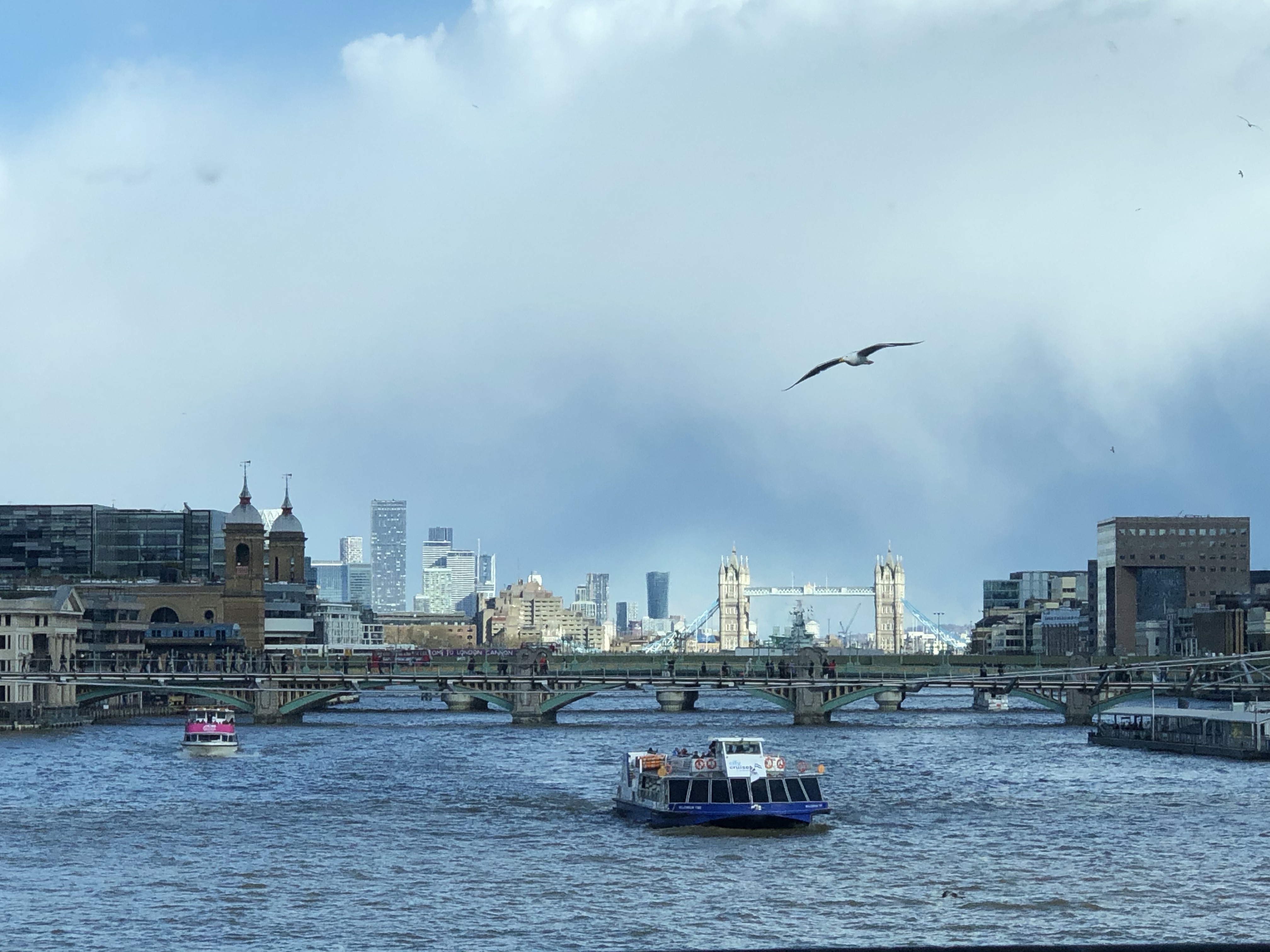
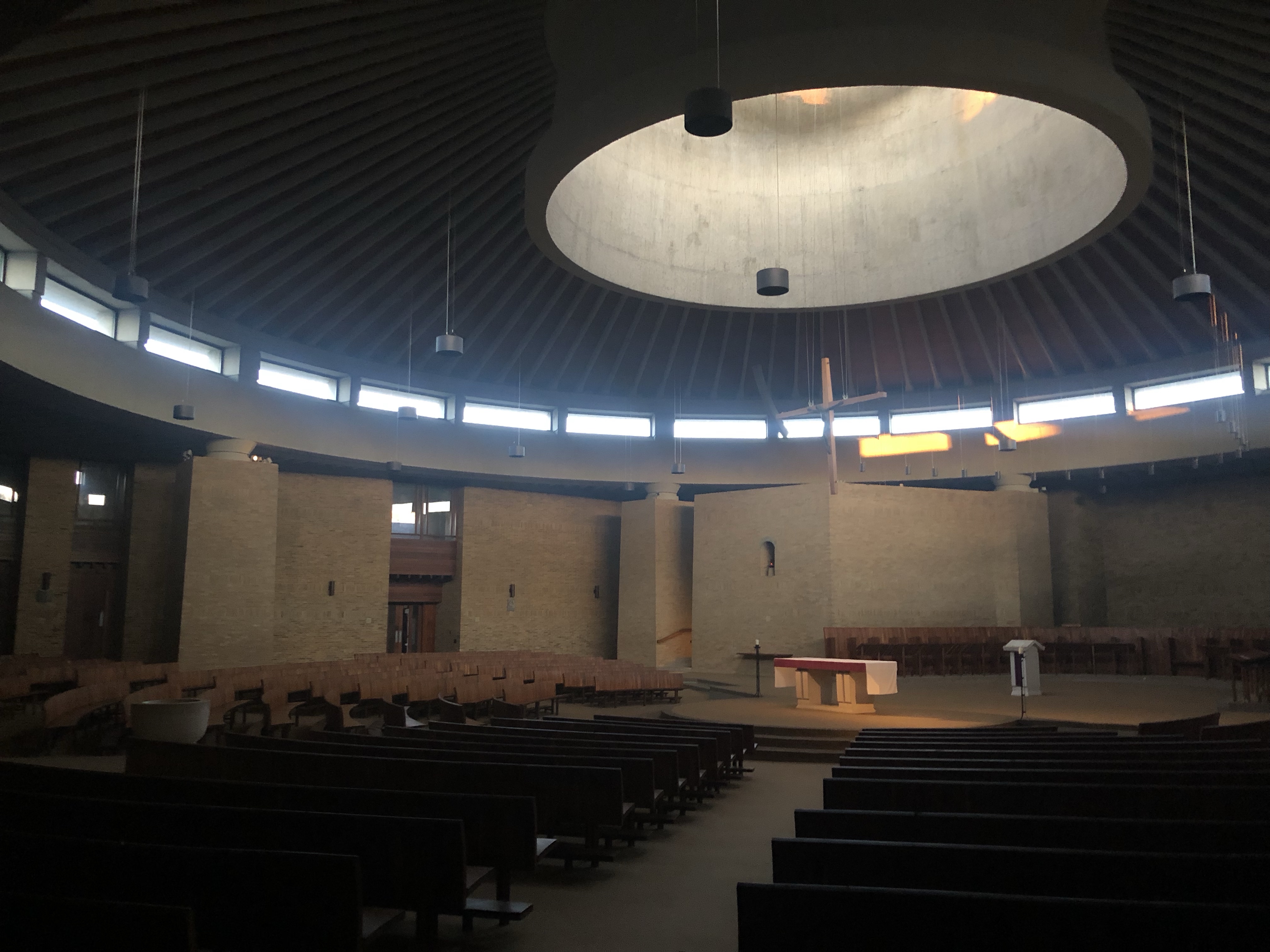
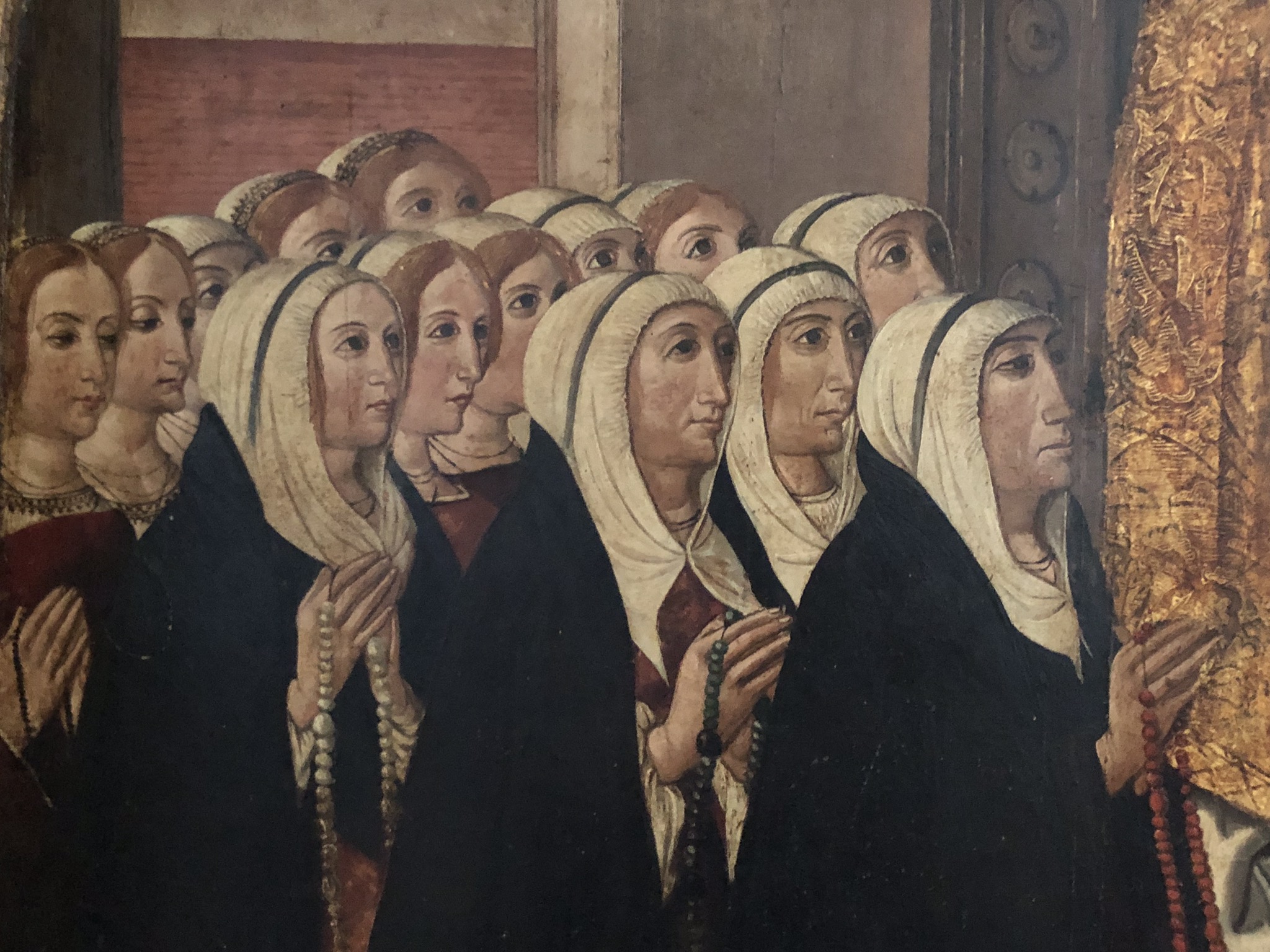
The rumble of the buses outside was drowned out by the magisterial rumble of the organ overhead, then piping and blasting, then humming and whispering. I caught snatches of Spanish in the pews to my right. Byzantine eyes burned into my temples from the glittering walls of the aisles. I counted the stations of the cross as far as I could see them and thought about my abortive visit to Jerusalem, laid low by Covid the week the schools closed. Simon of Cyrene carrying the cross, and a man propping his smartphone up against his feet in the nave to take a full-length photo down the aisle, once, twice, three times. A lady in a wimple watching three rows down with an expression that might have been contempt or indifference. Me, a pretender with a Daunt Books tog-bag I forgot I had, crossing myself once again and leaving.

I sought answers in a church once before, during a summer school trip to Crawley town mall many years back. I think I had similar questions then. But now it’s gone ten on a Sunday night, and there are more important lessons to think about. The weekend, thankfully, is come and gone. Life goes on! BB x

Wailing World

“Sir, what’s your opinion on Russia v Ukraine?”

In the vocabulary of a child, it sounds harmless, like a friendly football match. It tears away the shock and the hysteria. It tells a story of immediate information, of children monitoring the dawn of war on the screens of their smartphones. It seems almost absurd, watching a war unfold in real time.

I couldn’t answer the student because I don’t know enough about what’s going on in Ukraine to give anything like an informed opinion of my own. My meddling with Russian affairs amounted to nothing more than a short-lived attempt at after-school Russian classes in my sixth form days. The two other chaps in the class went on to study Russian at Oxbridge. I had no such intentions. I happened to be studying the Russian Civil War in A Level History, I was intrigued by the art style of the Soviet propaganda machine and felt like learning a new language. Not for the first time in my life, I felt like a foolish hobbyist amongst eager professionals. I don’t think I ever made it to the second class.

I chose to focus on Arabic instead, for equally casual reasons. I didn’t want to be a spy, or a civil servant, or an ambassador. I don’t have the cunning or the sense of national pride. All I wanted to do was to read my history books, and to draw back the curtain on al-Andalus. I had the chance to explore an entirely different world, and I took the other road. God only knows where my life might have taken me had I made it to that second Russian class.

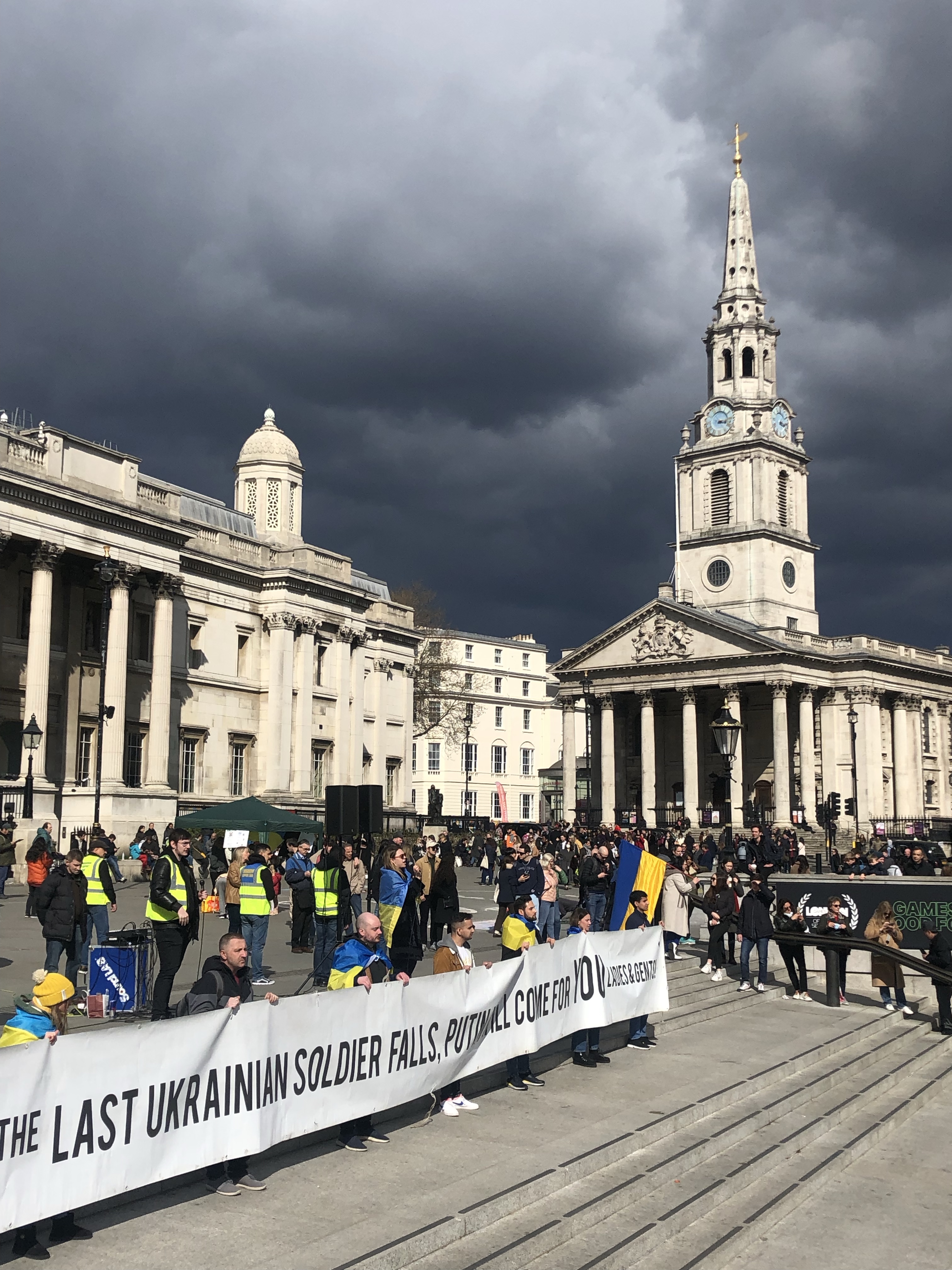
As the fighting intensifies in Kiev, I remember flashes of my brief stop in the city almost seven years ago. Bearded, sweat-scarred and looking forward to coming home, however briefly, after two trying months in Amman. The decision to take advantage of a twelve-hour layover and make a flying trip out to Kiev from Boryspil Airport was a fool’s fancy on my part, as it so often is, but it did mean that I got to see with my own eyes a city that is now in headlines around the world.

That was back in 2016, only a couple of years after the Revolution of Dignity and the subsequent annexation of the Crimea. The city was quiet, but the stress lines were there to see, if you looked closely. Beneath the People’s Friendship Arch, a monument to Russian and Ukrainian unity, a messaged daubed in Cyrillic: “Slava Ukraini” – Glory to Ukraine. The nationalist call-sign, forbidden during the years of the Soviet Union.

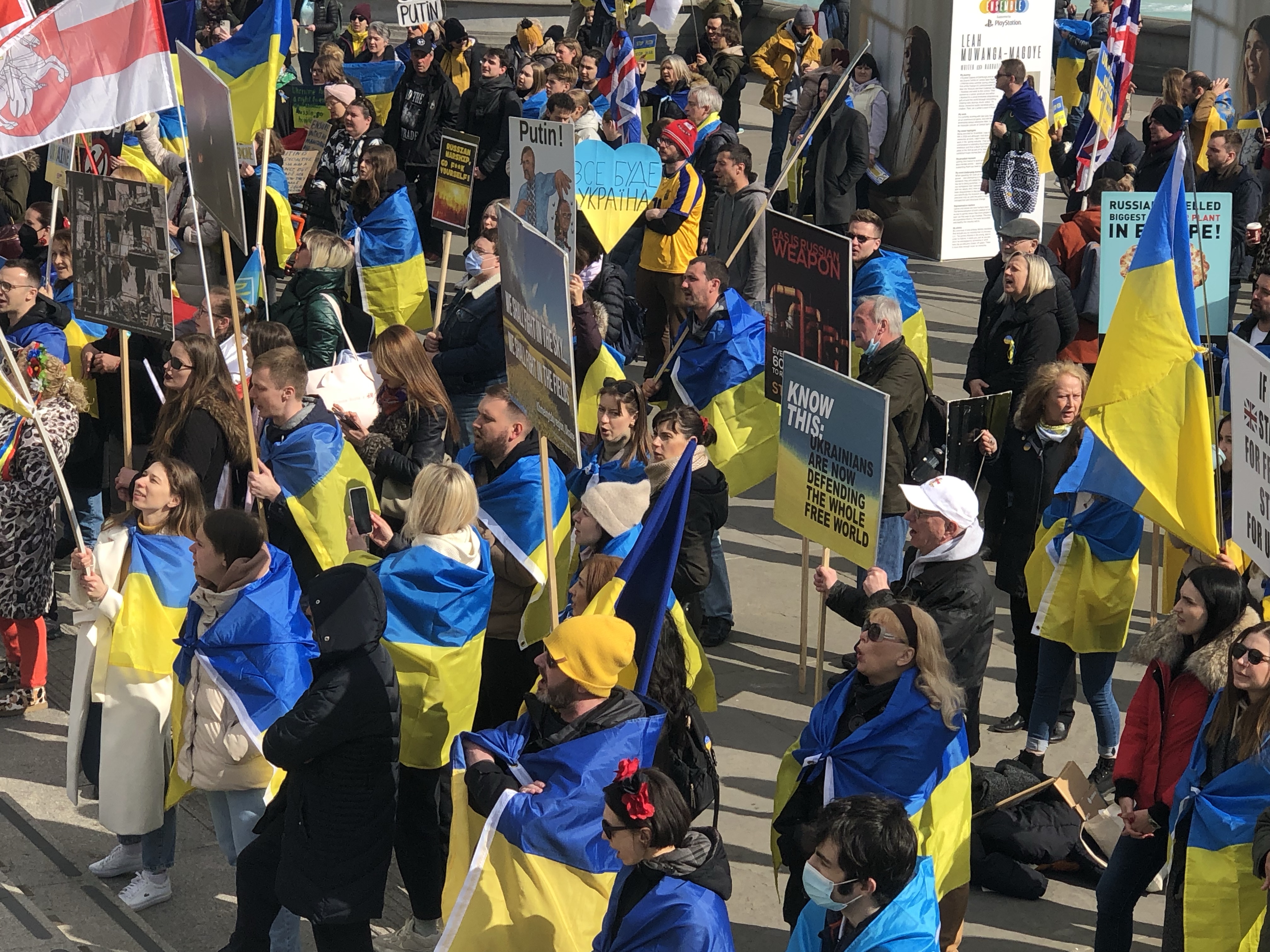
The blue and yellow of the national flag was everywhere, almost as fiercely ubiquitous as the rojigualda in the months following the 2017 Catalan rebellion. Even the street artist dressed as a minion in the Maidan Nezalezhnosti (Independence Square) seemed intentionally patriotic.

The blue and yellow from the city streets of Kiev has since fanned out across the web. Profile pictures bear its bicoloured hue. Thoughts, prayers and shares tell the story of the conflict to millions. And while part of me feels this is the way things should be, there’s something that keeps cropping up that I feel the need to talk about.

As is becoming customary in the Instagram Era, there’s just as much anger on my social media feed about the underrepresentation of conflicts happening elsewhere in the world as there is about the fighting taking place in Ukraine. For every “thoughts and prayers” post there’s a story bemoaning how much less of a fuss was made over Israel’s actions in Palestine, or the Indian occupation of Kashmir, or the assault on Yemen, as though one ought to be losing one’s head every time a gun is fired anywhere around the world. All of them immensely valid causes, no more or less than the chaos unfurling in the land of the Rus right now. Still, the phrase “pick your battles” comes to mind, and perhaps I’ve never used it more accurately. You can’t fight every war.

War. It’s not a word I’m used to using in the present tense, jaded as we are in the West by decades of relative peace. Thousands of us – maybe even millions – have never known what war means beyond what we studied at school. There’s a strong argument against the virtue-signalling “thoughts and prayers” response trending across social media, but maybe that’s just the knee-jerk reaction of a generation so far-removed from war that the word has all but lost its meaning.

Thoughts and prayers for the people of Paris after the Notre-Dame fire. Thoughts and prayers for the people of Afghanistan. Thoughts and prayers, but never enough of them, and never going to all the right places at the right time.

There’s so much human suffering that the whole world should be wailing.”

Joy Chambers, My Zulu, Myself

Taking the colonialist argument off the table, just for a moment, I don’t know whether we’re even capable of feeling a genuine sense of outrage at every injustice there is in the world – even my generation, which does a very good line in being outraged and incensed at everything. Every injustice, though? How can you fight for every cause and still remain true to your own beliefs? That much pain would be enough to tear the soul apart. It’s bad enough being a bleeding heart about the natural world – which, when the chips are down, is the first thing people forget to care about.

Fight, by all means. Resist. Shout about the things you care about. But pick your battles, and don’t attack those who didn’t come when you called, just because the fire in their hearts was not burning so bright.

What’s my opinion, then? Bewilderment. Jaded bewilderment, like so many of my generation. Bewilderment at the aggression. Bewilderment at the inaction. Bewilderment at the comparison to the Sudetenland saga I’ve heard so many times this week.

I studied the Soviet Union for years, but I’m no nearer an answer than any other armchair expert – probably because of my innate aversion to 20th century history, having studied it to the exclusion of every other century at school. Before I speak out, though, I will do what I do best. I will read. I will research. I will inform myself, as we were so often commanded to do during the BLM movement. I will speak to those who know more than I do, when the time is right.

While the world watched the city of Kiev, five islanders returned from the Chagos Archipelago in the Indian Ocean. It was their first independent trip home since they were forcibly removed by the British authorities during the 1970s as part of a deal to secure Mauritian independence. Mauritius wants its territory back. The Chagossians just want to go home.

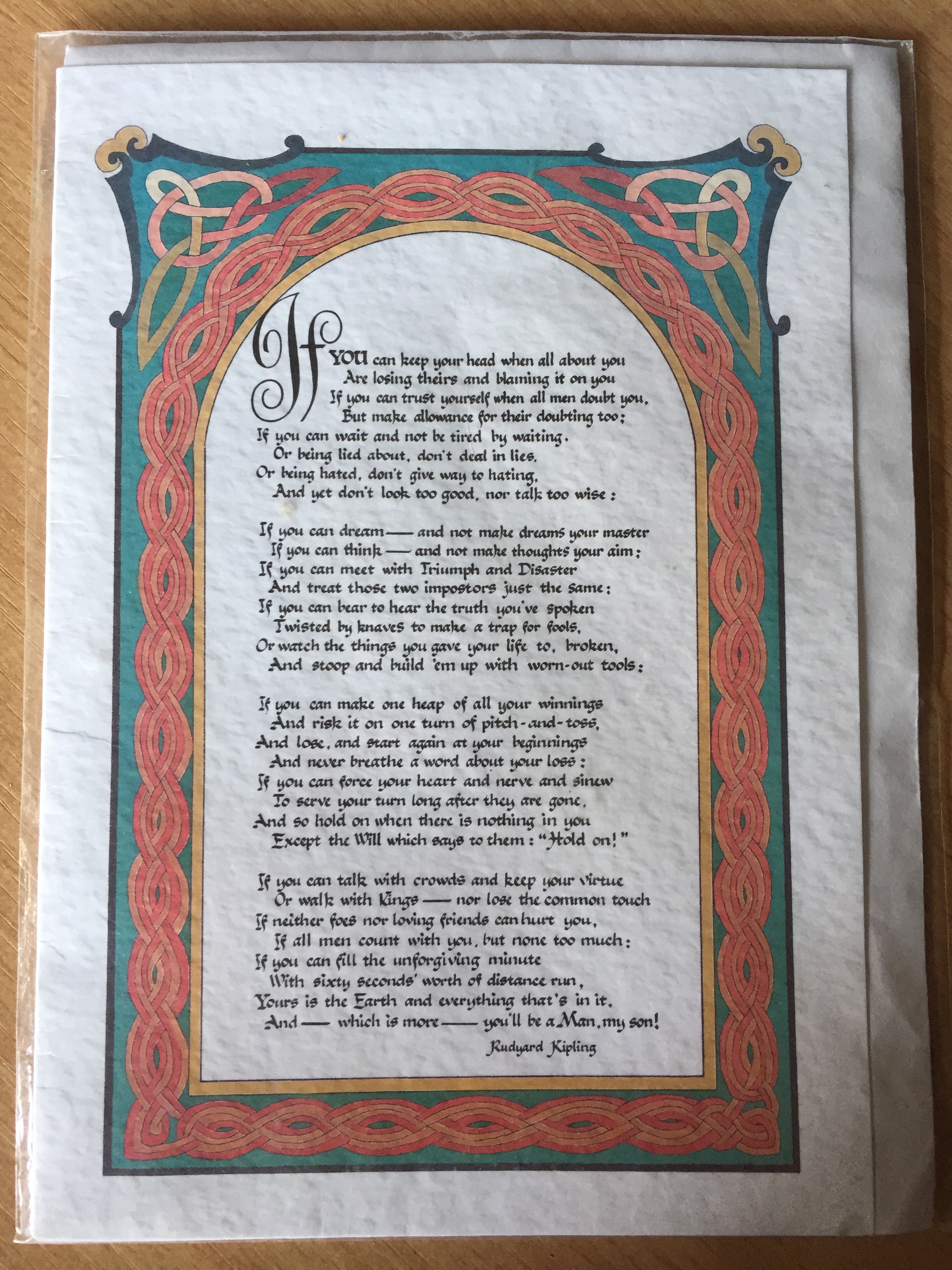
Just one more injustice to add to the pile. Perhaps the whole world should be wailing – but for whom? Our world is full of people who think differently, and long may that be so. I will defy my generation and risk the use of a colonial poet to conclude, because I do believe Kipling had the right of it in this verse… BB x

Oh, East is East, and West is West, and never the twain shall meet,
Till Earth and Sky stand presently at God’s great judgement seat,
But there is neither East nor West, Border, nor breed, nor birth,
When two strong men stand face to face, though they come from the ends of the Earth!

Rudyard Kipling, The Ballad of East and West