I was woken from my afternoon nap by the melody to Greensleeves, of all the pieces in the world – the guitarist from Villafranca must have caught up to me. Now that my pace has slowed a tad, it’s likely I’ll be running into a few familiar faces over the next couple of days.
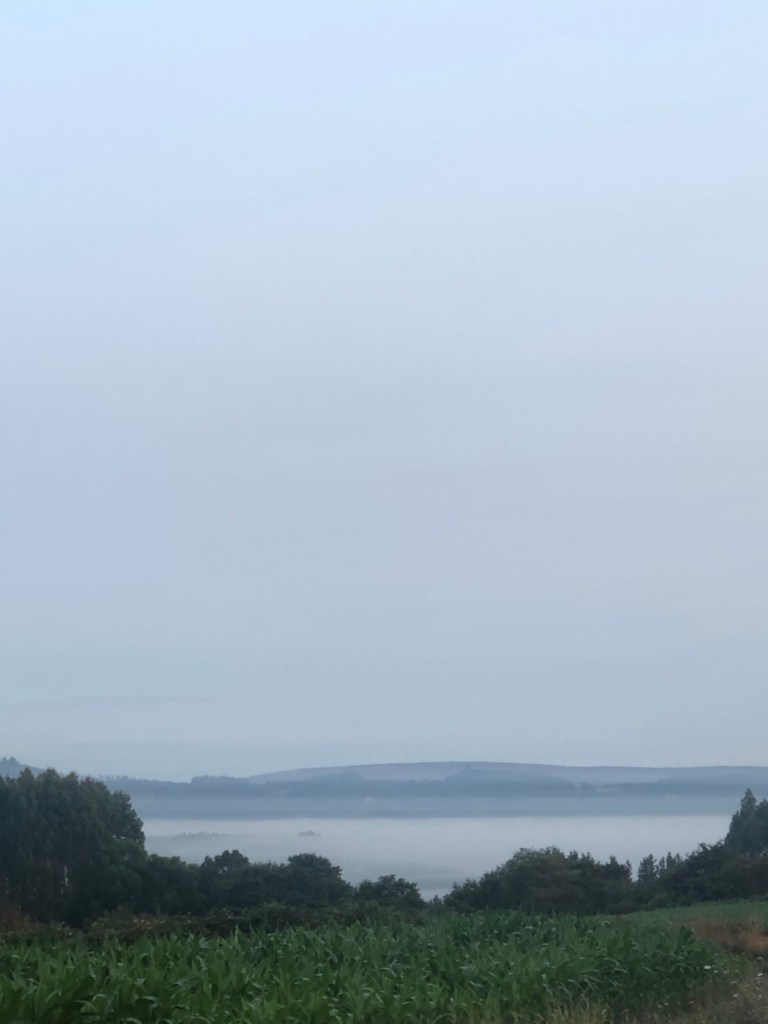
I set off late from Airexe this morning, being its sole inhabitant for a couple of hours after the Belgian pilgrim set off at five thirty for Ribadiso. I was in much less of a hurry, still mulling over whether to dawdle in Vilar de Donas and wait to see the peerless medieval murals of its famous church. Even at the disgracefully late departure time of 7.30am, the whole world was steeped in a sea of mist, from which only the tops of the trees and the hilltops of the valleys beyond emerged like the ruins of a sunken world, much like Portomarín yesterday.
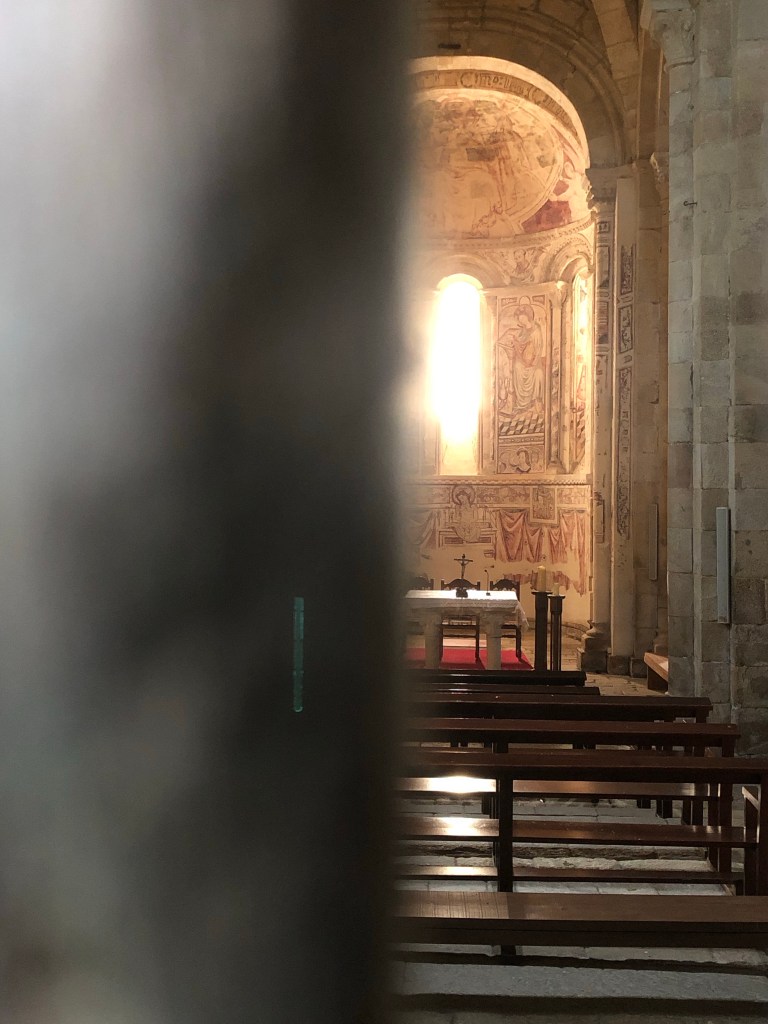
I decided to make for Vilar de Donas in the end, seeing as it would be a relatively short one today (23km) and I had time to kill. It’s a small detour of 2km to the north from the hamlet of Portos, but you’ve got to time it right. I arrived shortly after 8am, and while the internet and guidebooks give various times, for the record, the church is open from 12.00, and no earlier. A local electrician told me I could seek out the ageing sacristan who lives in a house nearby and ask, but as it was still so early, I decided it would be best to leave him be – not least of all as he is in his mid-nineties! I did, however, get a reasonably good view of the church through a crack in the door, and I can only conclude that the 12.00 opening time is a crying shame: the church is at its most magical in the morning light, when the rising sun throws down a golden beam across the floor through the opaque marble window. I’ll have to come back and see this marvel again sometime.
The road to Melide cuts through a number of forests, from carefully planted rows of pine and silver birch to the once-so-alien stands of eucalyptus, which are such a feature of the Galician landscape. Most magical of all, however, were the truly ancient forests that the Camino traverses, with wildly twisting branches and an undergrowth so dense it would need a machete to pass through.
Sometimes the arching trees seem to create tunnels, as though intentionally sheltering the pilgrim road as they must have done for over a thousand years and more. The colourful turigrinos passing through had their heads down on their phones, unfortunately, but the marvel wasn’t lost on those few true peregrinos left on the road.
I reached Melide shortly after one in the afternoon, but it was twenty past by the time I found the albergue – by which time a horde of turigrinos (a pejorative term used by pilgrims to describe the sudden mass appearance of tourists sharing the pilgrim road for non-spiritual reasons) had descended, which meant my first queue for an albergue municipal of the whole Camino. Given that this is often a Camino staple in high season, I should really consider myself lucky!
More than lucky, however, I was certainly hungry, having eaten little more than the last of the homemade biscuits for breakfast this morning. Melide is famous for its pulpeiras – restaurants specialising in the Galician speciality, octopus – and the name thrown around for the last few days has been Pulpería Ezequiel, an award-winning family business on the high street. A ración of the famous pulpo costs 11€ and is more than enough to sate the appetite – and it really is sensationally good. Do drop by if you’re passing through. There are plenty of other options, but Ezequiel himself must have been cutting and chopping octopus all morning, since that was what almost everybody seemed to be ordering! One wonders just how many octopuses (octopi?) the Galicians get through each day, never mind the Spanish at large…
I’ll try to catch a pilgrim mass this evening, as there was none to be found last night. I’m still deliberating whether to shoot for Santiago a day early on Sunday, but we’ll just have to play that one by ear. Until the next time! BB x
Trying to justify this slower pace is hard, man. After two weeks of five a.m. starts, it’s a real culture shock to convince yourself that leaving the albergue after seven is an acceptable thing to do. However, if I’m to arrive in Santiago for the fireworks, as planned, I have to go at a much slower pace. The easy solution, I guess, would be stopping for breakfast for often and people watching. I suppose that’s not so unappealing an idea.
Rather than try to dogleg and catch up on yesterday’s account ahead of today’s, I’ll merge the two into one.
We’re into Galicia proper now. The mornings are bright but overcast and the endless horizons of Castilla y León are a distant memory in this green, wooded country. After saying farewell to Samos, the Camino led a meandering route back north to Aguiada along the Río Sarria, through forests alive with the songs of cirl buntings, wood warblers and golden orioles. I even found a stag beetle on the path at one point, but while I kept a trained eye on the river, still no otters. I guess you have to go more remote than the Camino to find them!
I made slow progress, feeling genuinely tired for the first time on the Camino, probably on account of the five hours of sleep I managed thanks to dealing with Mamasita and his drinking problem the night before. As a result I kept catching up to and being overtaken by the bell-ringing pilgrim from yesterday, whose jingling presence was practically unavoidable. An hour of it was almost maddening, so rather than keeping pace with my companions, I got back into my usual pace – and, what do you know, suddenly I wasn’t so tired anymore. Paolo was right: you really do have to go at your own speed on the Camino and nobody else’s. It’s amazing how moving slower tires you out faster.
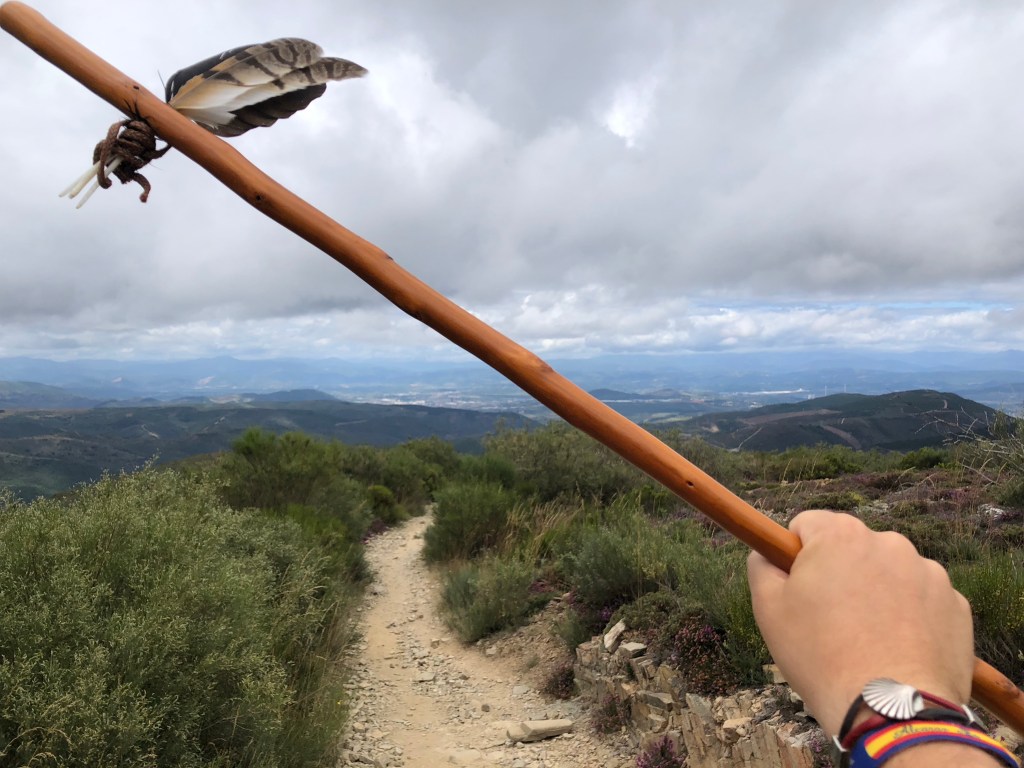
Just before Sarria, I found a single buzzard feather caught on a hedge near a farmstead. Naturally, it’s now fastened to my bastón. To quote Sweeney Todd, my arm is complete again!
Sarria itself was a much less daunting town than it has been made out to be, though that may be because the pilgrim horde had long since moved out. I picked up a few stamps and some friendly advice from the Amigos del Camino and cut right through to the countryside again.
Now, at last, I began to see the tail end of what is probably the great rush to Santiago. The dominant language of the pilgrims on the road is, finally, the same of the country itself, as Spaniards young and old (but mostly under twenty) attempt the final 100km of the Camino, easily identifiable by their fluorescent sports wear, portable speakers and undersized Quechua backpacks. I’ve had a lot of fun screwing with their expectations by responding to their cheery ‘hello, buen camino’ with a decidedly un-British ‘igualmente, chavales, ánimo’.
I had my second unpleasant encounter of the Camino in my original destination for the day, Barbadelo, where an overzealous salesmen lurking spider-like outside his store tried to convince me to buy all the pilgrim tat he thought I was lacking. After pointing out that my ‘missing’ shell was packed away as it kept rattling against my bottle (truth), and that I had already obtained two handmade rosaries from the monks at Samos (also truth), he insisted I needed a pulserita, as mine was not of the same quality as his mass-produced ‘El Camino es la meta’ bands (what does Gandhi have to do with the Camino anyway?). Since the one on my left arm was a locally crafted item from that phenomenal café in El Ganso, and the one on my right was a gift from my aunt featuring Nuestra Señora de Cortes, one of La Mancha’s most venerated icons, I begged to differ. When he tried to forcefully pin a Union Jack pin badge on my rucksack strap, he crossed a line (I *will not* be identified so stridently as a Brit, thank you) and I told him politely where to take his business and left.
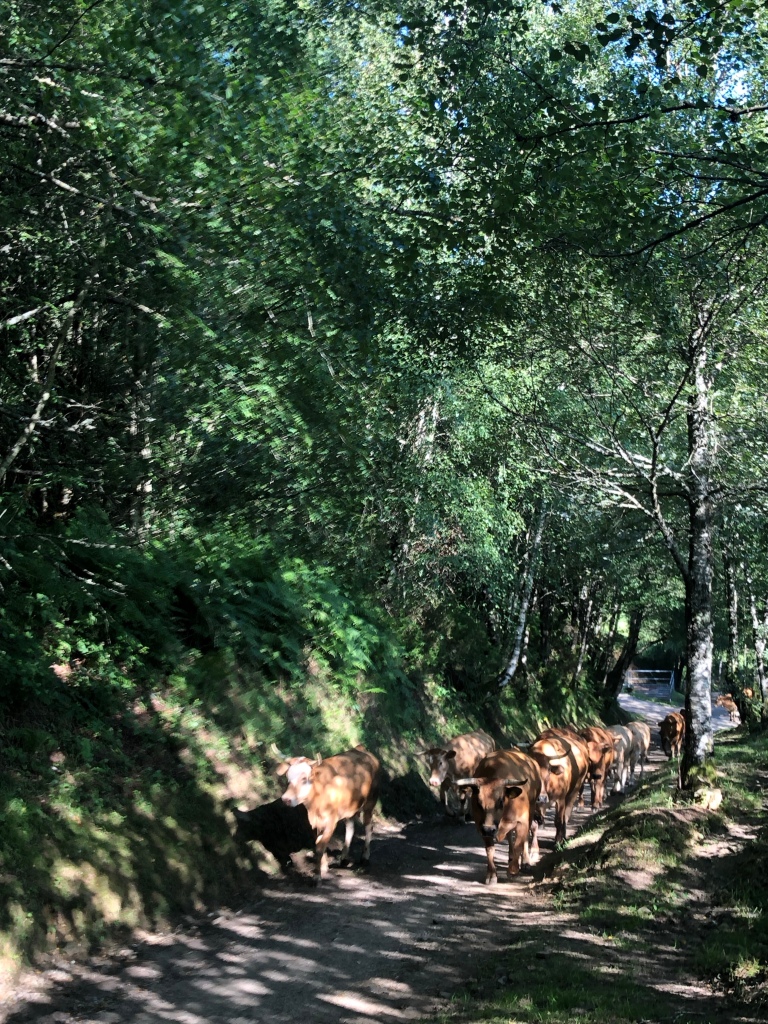
The price was a ten kilometre hike to Ferreiros, but it was worth it. I had the wonderfully tidy Xunta albergue pretty much to myself, and though the sixty-strong Scout group I passed on the road chose to camp in the woods opposite, they were from Jérez de la Frontera, which made for a nostalgic soundtrack to the evening. Dinner came with a show, too, when a local cowherd led his cattle right through the heart of their encampment, which provided some amusement!
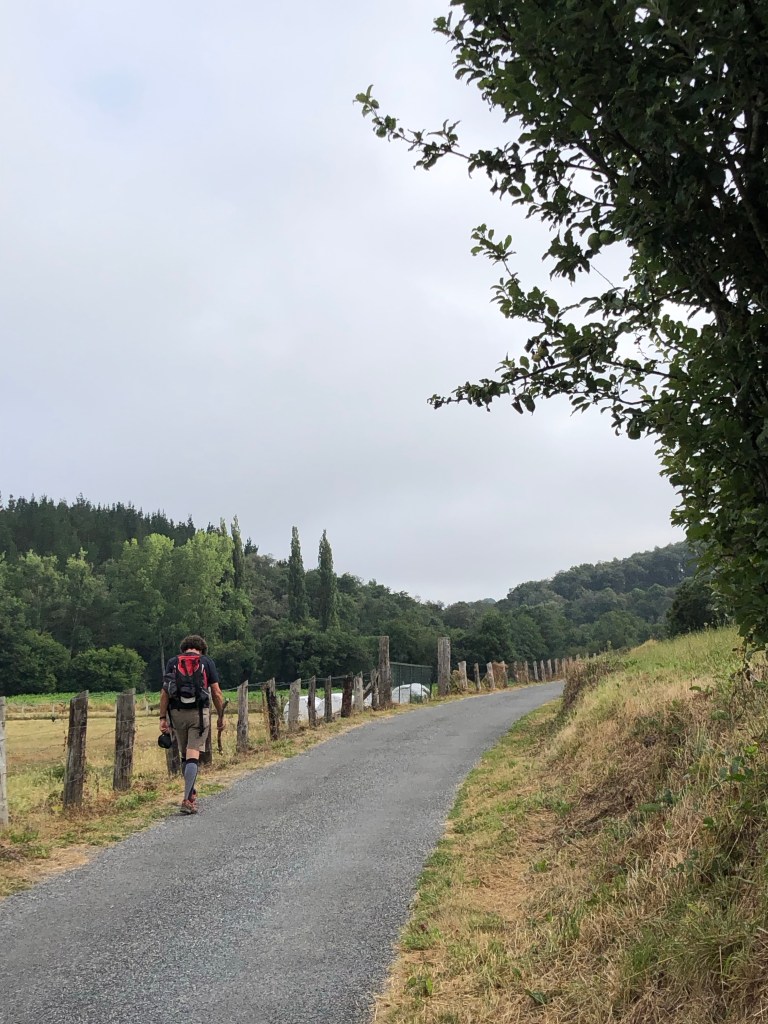
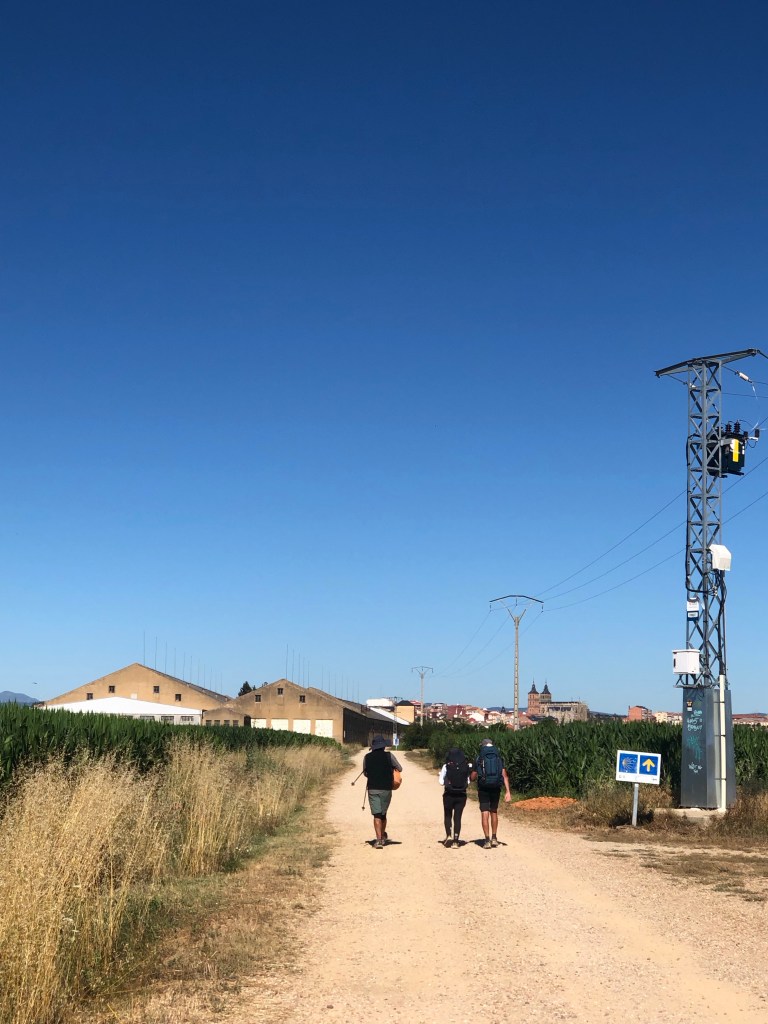
I moved on shortly after sunrise the following morning, making the sunken village of Portomarín shortly before nine o’clock. Today I finally got a real sense of the Sarria stampede, as there was rarely a stretch of the Camino without a good number of pilgrims on the road. I shared the road with Dean, a Californian who matched my pace perfectly, at least as far as Gonzar, where I stopped to catch up with a Belgian pilgrim I’d met the day before and have a drink. The Guardia made an appearance on horseback this morning, trading their usual two-hundred horsepower Alfa Romeos for… well, one horsepower horses. But they did look a damn sight more impressive.
The Camino treks right through the ancient Iron Age hill fort of Castromaior, which is meant to be one of the most popular sights on the Camino, but the memo must have been lost on today’s pilgrims, who trekked right past it as though it wasn’t even there. Sure, it’s not as impressive as Stonehenge, but the earthworks are quite something, and as it only requires a thirty metre detour from the path, it’s definitely worth a look.
Well now, I’ve come to a stop in the hamlet of Areixe. It doesn’t have much more than a church, a restaurant and a Xunta albergue, but it’s blissfully quiet. With Palas de Rei just another hour down the road, the Sarria stampede have marched right on by, meaning I have the entire albergue to myself tonight. For company tonight, I have a small but vocal flock of chickens, a handful of locals and a toddler zooming around on a motor-operated mini tractor, surely in preparation for a life driving the real thing up and down these country roads.
The various Camino guidebooks really do dictate the fortunes of the towns you pass through on the way, pouring thousands of pilgrim pennies into the hands of those fortunate enough to live in the ‘chosen’ start and endpoints. How the villages that thread the line between them survive is anyone’s guess – especially those nearest the nuclei – so it feels good to know I’m doing my bit by staying in the quieter spots. The Sarria to Santiago stage is often touted as the busiest stretch, and while that’s certainly true when you’re on the road, if you’re brave enough to avoid the cities and stay in the villages, you’ll find the peace and quiet of the earlier stages of the Camino isn’t really as elusive as it’s claimed to be.
Though the rival roosters on either side of this albergue are a factor that cannot be easily ignored! BB x
It’s 6.18am on Wednesday morning. I didn’t get any time to write last night, as it was nearly midnight by the time I was in bed, for reasons which I shall endeavour to explain.
Before leaving O Cebreiro this morning, I decided to climb Cebreiro’s peak, where a lonely lichen-covered cross looks out over the layered hills and valleys to the east. It was scored up its sides with a thousand little grooves, into which a thousand small coins had been slotted. Time and the elements had worn down their edges, and some grooves were empty – perhaps the work of quick-fingered pilgrims over the years. From the summit, you can see all the way to Foncebadón, offering one final glimpse of the faraway meseta before the descent into the rolling hills of eastern Galicia.
I walked and talked a fair amount this morning, sharing the road first with Simas, then with a Catholic mother and daughter from Ohio, then with three more Ohio boys, then finally Simas again until Triacastela. Along the way we hit another Galician roadblock (read: cows), met the first of what will presumably be many school trips (this one a sixty-strong outing from Mengíbar, Jaén), and talked about American history, which is always really eye-opening when it comes from Americans themselves.
At Triacastela, after a hearty breakfast of empanada, zumo and Cola Cao, the road forked north and south. Simas and I parted ways here: he headed north and west over San Xil to the hamlet of Calvor, and I took the south road to Samos, on the recommendation of Bridgette, the Australian pilgrim I met just over a week ago.
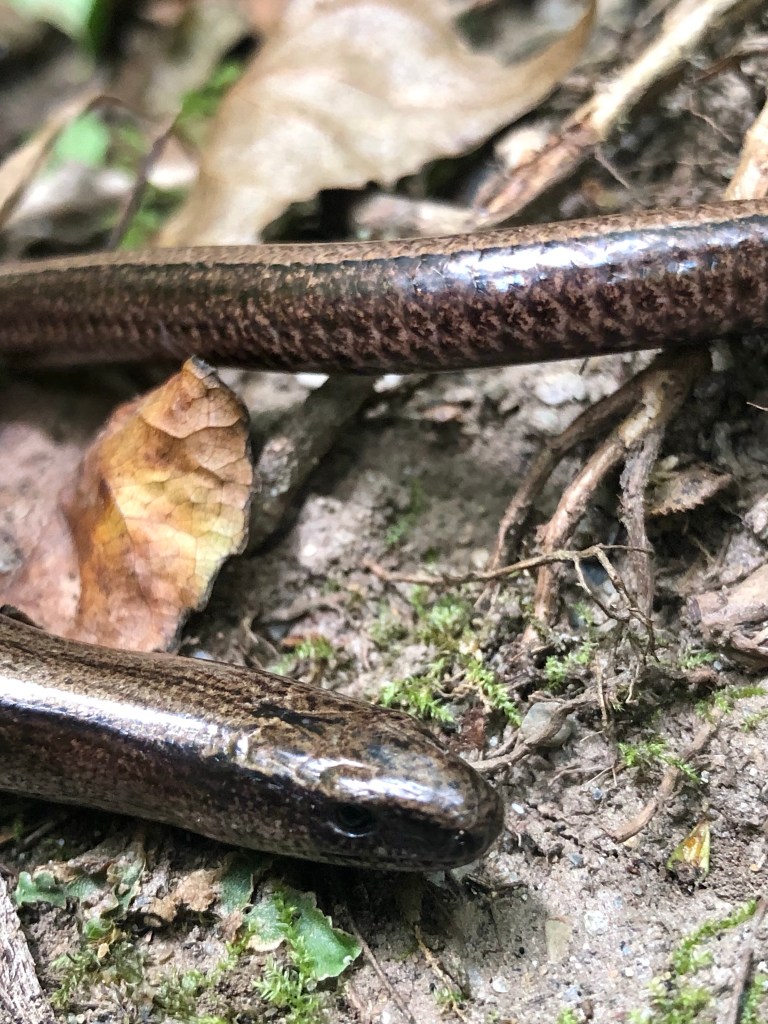
The road to Samos is beautifully remote. The Americans from lunch yesterday zoomed by on rental bikes – some calling out with a cheery buen camino, some not – but other than that I walked the road alone. Seeing as I had plenty of time, with the Samos albergue opening late, I dawdled a lot, leaving the Camino at one point to explore the woods that sloped down to the river Oribio. I had to be careful where I set down my backpack, after almost stepping on a slow worm that lay perfectly still near the riverbank. I have fond memories of finding this false-lizard on the grass-heap at home as a child, so it was nostalgic to find one here, deep in the Galician valleys.
Galicia has avoided most of the ferocious heat that is ravaging the rest of the peninsula – unlucky pilgrims at the Pamplona stage would have endured 46°C heat after midday – but the UV rays must have been just as fierce, because I definitely caught the sun before reaching Samos. However, all the prickling in my arms could not detract from the beauty of the countryside I was passing through: the tiny hamlets like San Cristovo do Real with their dragon-spine slate roofs and empty streets were like something out of a picture book of a Spain that has long since disappeared.
With the last hill before Samos in sight, the tinkling of a bell broke the silence. I overtook a Spanish pilgrim a minute or so later, carrying a stick to which a small bell was fastened, releasing a merry jingle with every step. If he’s walked all the way from St. Jean with that, he must have the patience of a saint. Or perhaps it’s a deliberate act of penance on his part.
The Monastery of Samos, my destination (and digs for the night), is a stunning jewel of the Camino and seriously worth the detour if you reach Triacastela too soon. The hospitalero, a talkative chappie from Madrid in a black triskel tee, was very friendly, apologising in his own way for the lack of traffic. ‘In July I should be turning people away,’ he explained, ‘but this year there are almost no Spaniards on the Camino, only foreign tourists. Nobody has the money anymore to spend four or perhaps even two weeks on the road.’
There’s a general election on the 23rd – you can hardly miss the posters along the Camino, as though pilgrims were a vital demographic – and I expect a change of government. In which direction, though, I cannot say. It’s an exciting time to be in Spain.
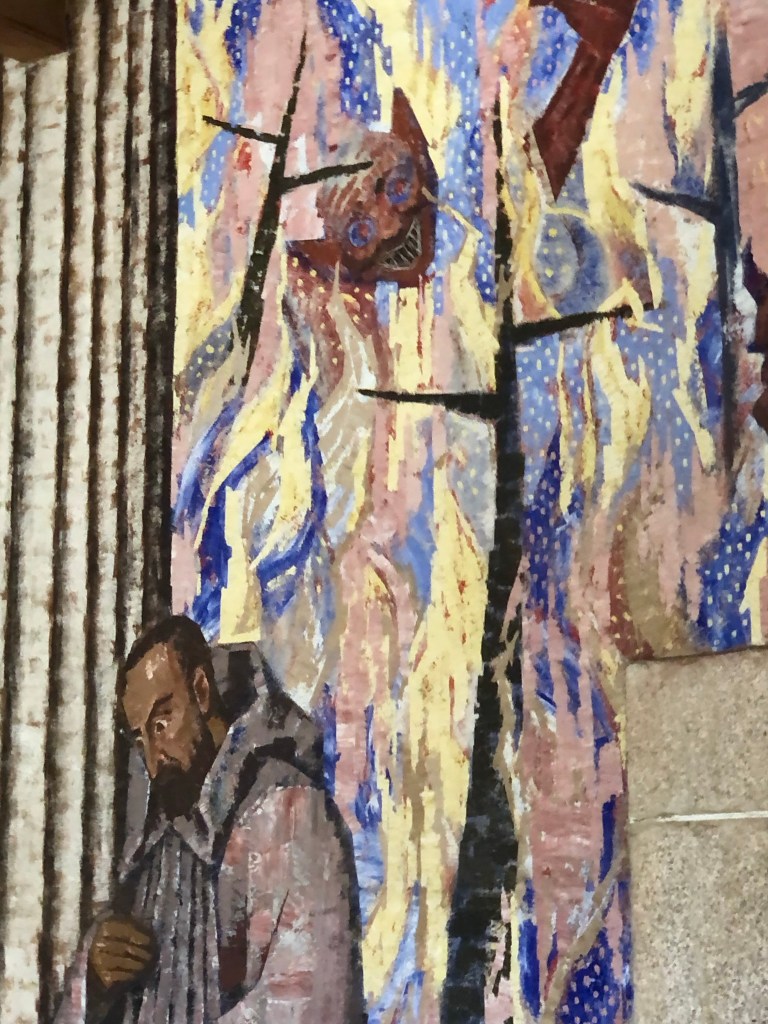
After a short siesta, I tagged along with two jolly pilgrims from Albacete and a couple of stragglers from O Cebreiro to a guided tour of the monastery, while the Chinese pilgrim and her curiously dressed German companion who arrived after me went looking for somewhere to drink. Our guide was very knowledgable and the complex was mind-blowingly beautiful in places, despite having been gutted by a fire in the early years of the last century. Like the walls of the albergue, giant paintings stretched along the corridors, depicting scenes from the life of Saint Benedict. As is often the way, the artist used the faces of contemporaries as his models. Some were local figures, some notable monks of the order, and some were members of Franco’s cabinet. Surprisingly, silver screen stars Charlton Heston and Sophia Loren even made a cameo appearance at one point!
But by far the most intriguing paintings were of the occult: devils, demons and dark spirits grinning and leering amidst the serene countenances of over a thousand years of Benedictine worshippers. There’s nothing like it in the Abbey back home, but even if there were, I’d have been just as transfixed. Isn’t there something deeply intriguing about the fascination with the dark held by those who cling to the light?
I bought a few souvenirs in the gift shop, staffed by two of the eleven monks who reside at Samos. They were pleased to hear I worked at a Benedictine school in England and we had a lovely little exchange while I obtained some homemade biscuits for the road ahead, and a new rosary for the road beyond.
Dinner at the Hotel A Veiga was sensational, and far and away the best menu peregrino I’ve had on the whole Camino, including the previous two stints this spring and back in 2018. The arroz con leche was heavenly and the churrasco (and all the sauces they brought with it) was divine. I ate better than I have in days – which is just as well, because I would need all the energy in the world an hour or so later.
When I got back to the albergue, it was already five to ten, so I packed for tomorrow and got my things ready for bed. I thought I’d pop outside and use the erratic signal (nonexistent inside the albergue) to book my flight home next week and write up my blog, and catch up with the two pilgrims from Albacete I met earlier on, but fate had other ideas.
Not five minutes after the hostalero grabbed his bag and left without a goodbye, the waiter from the bar across the road came and asked for our help: the German pilgrim was causing a scene and trying to pick a fight with the other punters. Miguel, the larger of the two Manchegos, followed her back to the bar and was back in five minutes, half aiding, half dragging the German across the road to the albergue. He was in a dreadful state, reeling and tottering in every direction, and evidently suffering the adverse affects of too much drink and too many drugs. It was all we could do to get him to sit down without falling over backwards, and he turned hostile every time he heard Spanish, making childish imitations of what he heard and bookending every line with a violently delivered ‘motherf*ckers’ or, more charmingly still, spitting at whoever spoke last. The only practical solution seemed to be to talk to him slowly in English, which he seemed to command well enough to tell us all the things he wanted to do to the waitress in the bar.
The waitress returned shortly and asked for her phone, which she had lent to the pilgrim so he could call home. He got aggressive and insisted it was his, so Miguel had to wrestle it off him. He then fell back and cursed the night sky and the three of us for about half an hour, stoping only to say the word ‘mamasita’ every minute or so, chanting it in a suddenly calm and lobotomised voice as though in a trance.
Eventually, Miguel and I decided the safest place for him was his bed. I prepared a bed for him at the other end of the room, right next to the bathrooms, while Miguel and Diego hauled him to his feet and carried him inside. Between the three of us we got him to the bathroom and stood by for ten minutes to make sure he didn’t hurt himself, and then managed to get him into bed, from which – mercifully – he did not get back up.
Ten minutes later, the unexpected arrival of two locals from the petrol station that is curiously twinned with the monastery almost undid our hard work, when they tried to fix the adjoining door to the garage by slamming it to several times, unaware or uncaring for the sleeping pilgrims just a few feet away. The German swore loudly after every bump in the night, until sleep finally found him – and turned him into a human onboard motor, snoring loud enough to wake the whole monastery, if not just the room in which he lay.
But now I must put down my phone and set out. It’s going to be busy from Sarria onwards, and the sun is already high in the sky. Until next time! BB x
Well, here I am in Galicia, just about the only part of Spain that isn’t suffering the ferocious heatwave that is sweeping across Europe right now. With temperatures soaring into the 40s in a red wave from Madrid to the south, I’m more grateful than ever for the merciful Atlantic winds that keep Galicia fresh and green. Santiago certainly picked his spot with Spanish summers in mind…
I didn’t sleep much last night, though I must have dreamed a fair amount. I’m pretty good at waking myself up on command, because I knew I needed to be up in time to charge my phone (the sockets were all in use when I got back last night) and lo and behold I was up without provocation at two in the morning.
I’m already used to functioning on less sleep than is healthy from my work in a boarding school, so when five thirty came around I was already on the road. The vending machine gobbled up my euro and gave me a self-satisfied LISTO! when all it gave me was a plastic cup and a deceptive whirr that most definitely did not produce any hot chocolate… but, serves me right for using a vending machine.
I was sorely tempted to join the less than 1% of pilgrims who take the Dragonte route up through the mountains this morning, but as yesterday was a Sunday, I hadn’t been able to buy supplies, so I chose caution over valour and took the basic route. If I’d had my faithful stick I might have chanced it, but… it is what it is.
I did, at least, have the sense to stop for breakfast at a bar in Trabadelo, where the tortilla was decent, the napolitana was delicious and the Cola Cao was divine.
I’ll say this much, it might be the basic option, but it’s a lot better a route than it looks. On a map it seems to follow a road almost all day, which it does, but with the construction of the A-6 Noreste motorway, pretty much all the traffic took the high road, leaving the Camino almost devoid of cars. And since even the sight of a car at the moment makes me think of the intensive course that may or may not be coming my way when I get back (it’s proving hard to find an instructor who’s free), that was some relief!
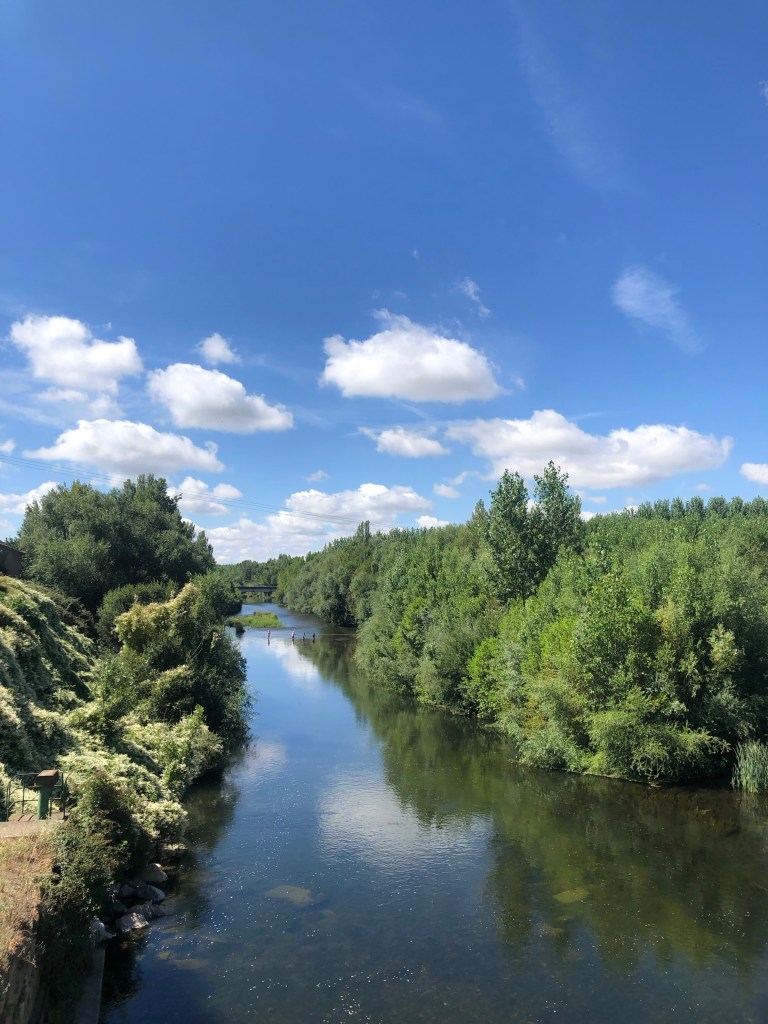
The Valcarce river flows alongside the Camino for most of the route, providing a gurgling backdrop to the walk. I kept my eyes open for otters, which are sometimes seen in the river, but I didn’t see any. I did see the other thing I was looking for though: a dipper, just as I left the road at Las Herrerías. The characterful little things are a feature of most highland rivers in Spain, if you keep an eye out for them.
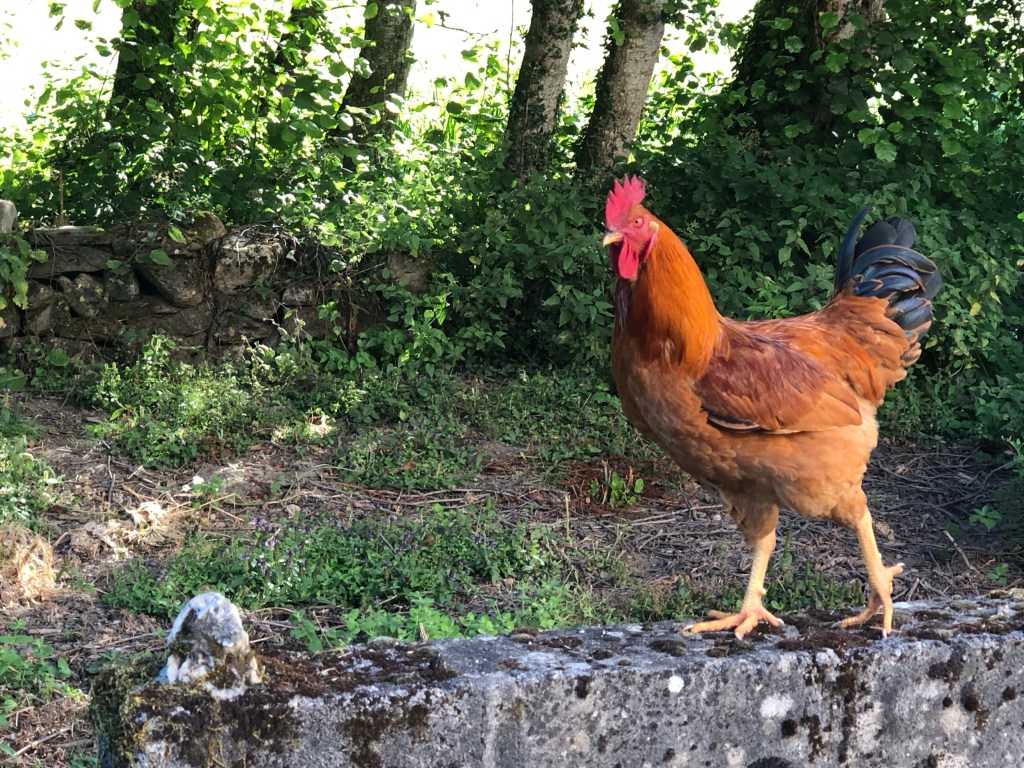
It wasn’t easy to catch on camera, but I found considerably more willing subjects in a gang of long-legged Spanish chickens further up the road. The way they were going, they looked as though they might have been making the pilgrimage themselves! Though I was briskly disillusioned when the rooster started sizing himself up to me, squaring off like a boxer in a title fight. Feeling a hard pass on letting him test his spurs on me was a good move, I left them be.
After the picturesque village of Las Herrerías, the real challenge begins. A 600m climb and then some stands between you and O Cebreiro, the first town beyond the border, and boy are the first few hundred metres a challenge. Thank God I played it safe this morning and took the easy route! It’s a beautifully forested climb, but a climb all the same…
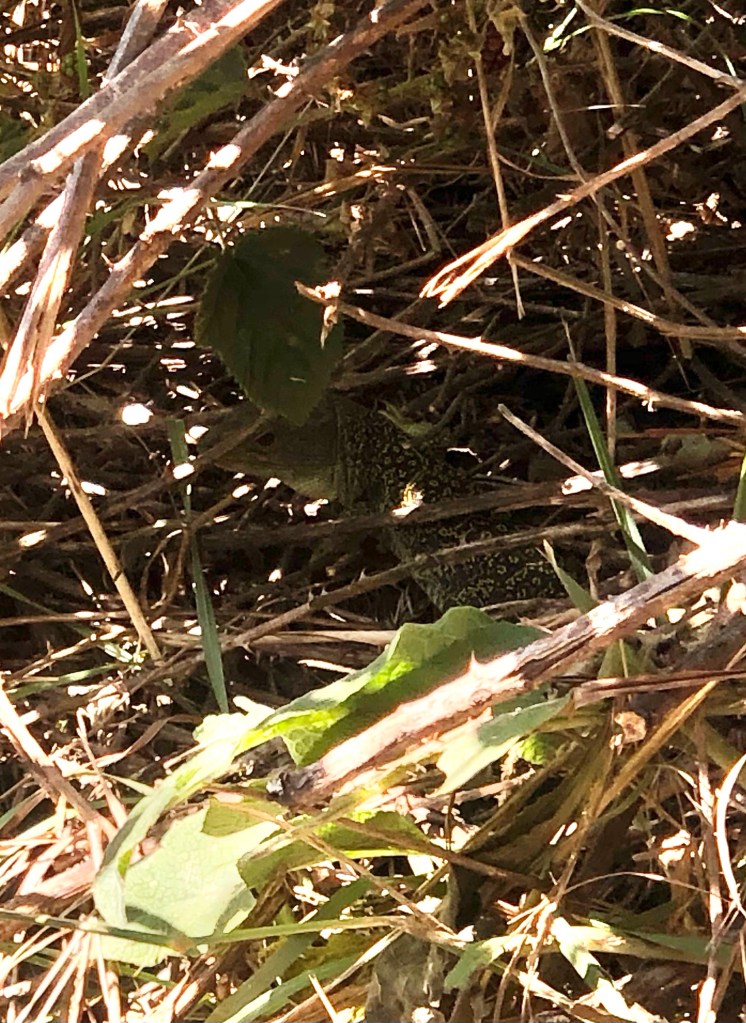
After La Faba (where the fountain water is so deliciously cold that my bottled water needed jettisoning immediately) the Camino climbs ever higher through one last stretch of forest and then up into the sunlit highlands of Castilla y León’s final outpost. I must have gone on ahead of the others, because I only passed a few intrepid pilgrims up here. It might not have been heatwave material, but the sun was high up by this point and the lizards were out, including the giant green occelated kind that used to fascinate me as a kid. Most of them were well under cover before I saw them go, but one lingered long enough for me to see where it was hiding. Can you see it?
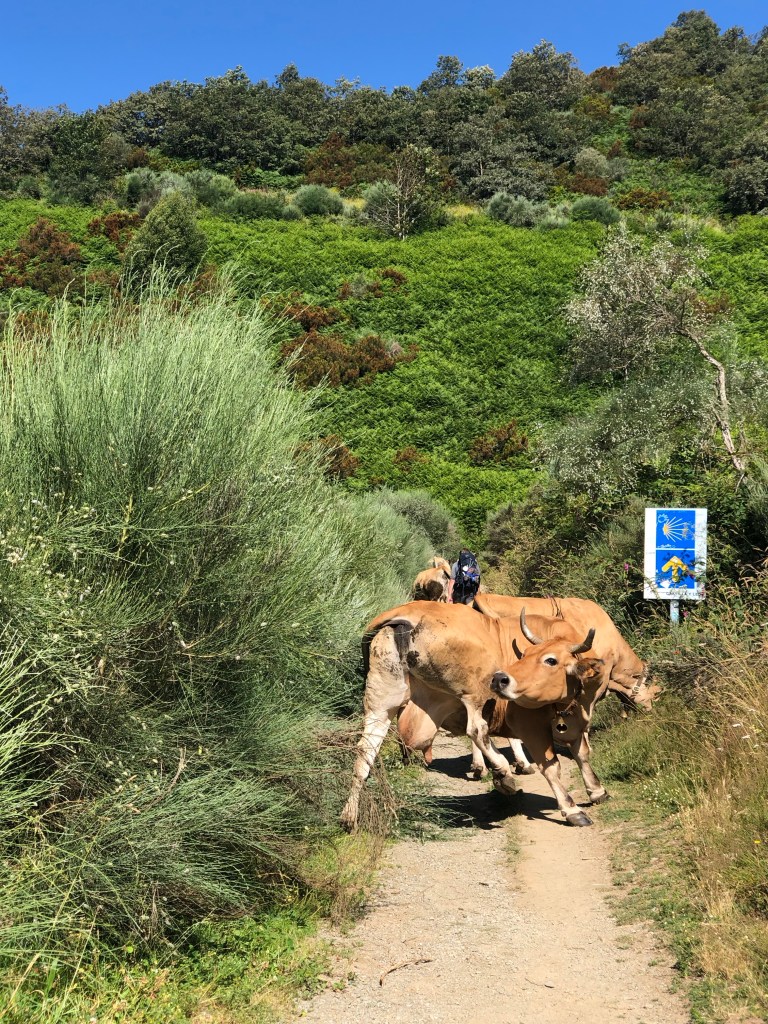
La Laguna was little more than a cluster of farm buildings, and after that it’s only a few more hundred metres up to the border. I did have one unexpected roadblock in the form of a wayward herd of cows, whose youthful cowherd was desperately trying to coax away from the path. The cows had other ideas, and it took a few minutes to get by.
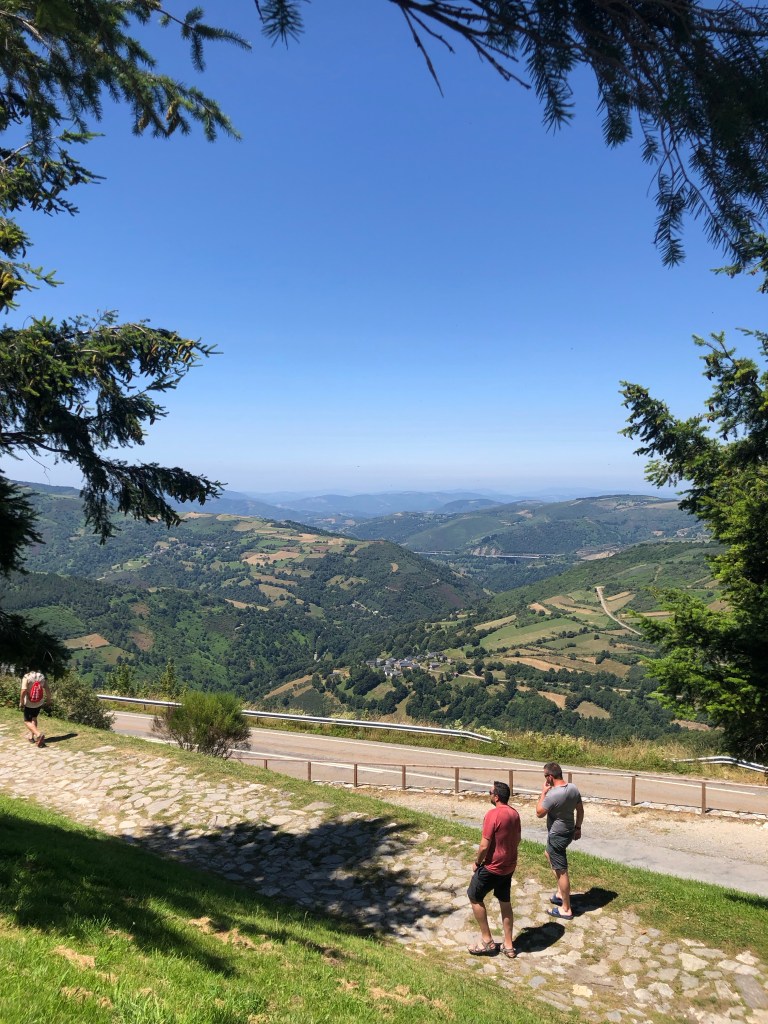
A colourful stone statue marks the border. Now I’ve set foot here in Galicia, there are only two comunidades autónomas left in Spain which I haven’t explored: Murcia and the Canary Islands (assuming one doesn’t count the Moroccan enclaves of Ceuta and Melilla). I almost stepped on a stoat that shot out of the verge on the final climb up to O Cebreiro, and while it was much too fast for a photo, the views from the top of the mountain absolutely screamed for one – or several.
I managed to beat Google’s initial suggestion by forty-five minutes, but since the albergue didn’t open until one, I had a sitting nap and waited – my feet were just dead.
I had lunch with a random assortment of new pilgrims, mostly Americans, in a hotel-restaurant-giftshop affair. How to put it politely… I’ve had more tolerant company for lunch. Most of the Americans I’ve met abroad have been the most refreshingly open-minded and charismatic characters I can recall. This bunch were memorable only for their moans. Two of them were off on one for the full hour about how rude the Spanish are, slating the food, the service and the hostaleras, all while unironically claiming their status as Americans entitled them to fair treatment.
I excused myself to go to the bathroom. I paid my fare and apologised to the chef. I did not go back.
Fortunately, my faith in America was restored by the welcome return of a meseta pilgrim, Simas. A chat over a half pint with another open-minded pilgrim was just what the doctor ordered. Bumping into two more Catholic Americans while paying the bill was an added bonus.
Mass in O Cebreiro’s 6th century church was really special. The priest spoke from the heart, juggling several languages throughout, and blessed us all with holy water and words of power. At the pilgrim’s benediction at the end, I volunteered to read the closing prayer when an English speaker was required. Perhaps I just wanted to read a prayer for my fellow pilgrims, or perhaps it was a subconscious dig at the fact that, Americans aside, there was only one inglés in the room. (If that was it, God, please forgive me that little victory!)
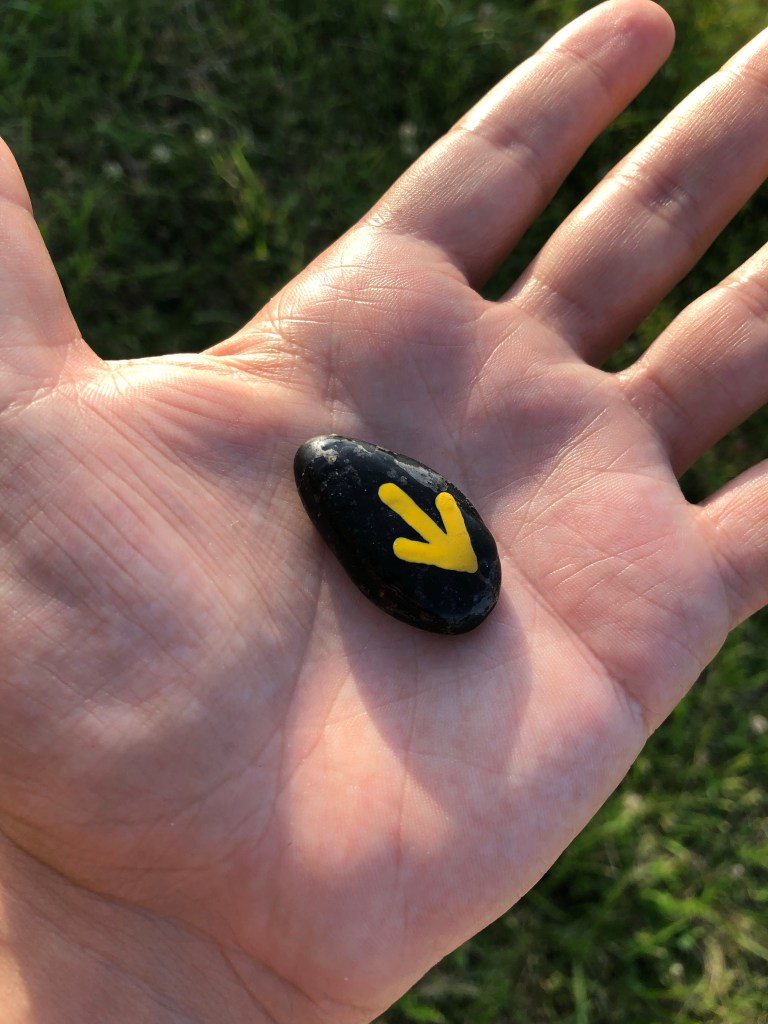
As a parting gift, the priest gave us each a little stone with the yellow arrow of the Camino. I’m holding mine now, its tiny yellow arrowhead forking through my fingers to the northwest.
Now I’m watching the sun set over the rolling hills of Galicia. It’s been a long day, but a good day. Simas and I will make for Triacastela tomorrow, while others shoot for Sarria in a mad rush to Santiago. Here’s to eveybody’s journey – may they find what they’re looking for! BB x
P.S. I have a new stick!!! (It was only 10€ and after today I’m not chancing the last 140km without one!)
I’m sitting at a table for one at the Bar Sevilla in the Plaza Mayor in Villafranca del Bierzo, after a 37km trek across the Valle del Bierzo this morning. I ordered a pizza almost without thinking, and now I’ve had a closer look, the menu del día looks fab. But, the caldo gallego and pig’s ears will have to wait until I’m in Galicia proper. The important thing is that I eat decently tonight, as I walked a lot today, and I’ve got a fair bit of climbing to do tomorrow.
I allowed myself a slightly later start this morning as breakfast was on offer at the albergue. I took the opportunity to make myself a sandwich for the road and warm myself up for the road ahead with a Cola Cao substitute, which was needed – it was quite a scramble down the mountain from El Acebo to the valley floor. If ever there were a bad day to be deprived of a good hiking stick, it was definitely today.
On the plus side, the mountains held the rising sun at bay long enough for me to get clear of the mountains, so I had a fairly cool descent. It’s always quiet high up in the mountains before sunrise, but the cheery song of blackcaps, the trill of a robin and the eerie, extraterrestrial whirr of a nightjar from somewhere in the valley below kept me company all the way down.
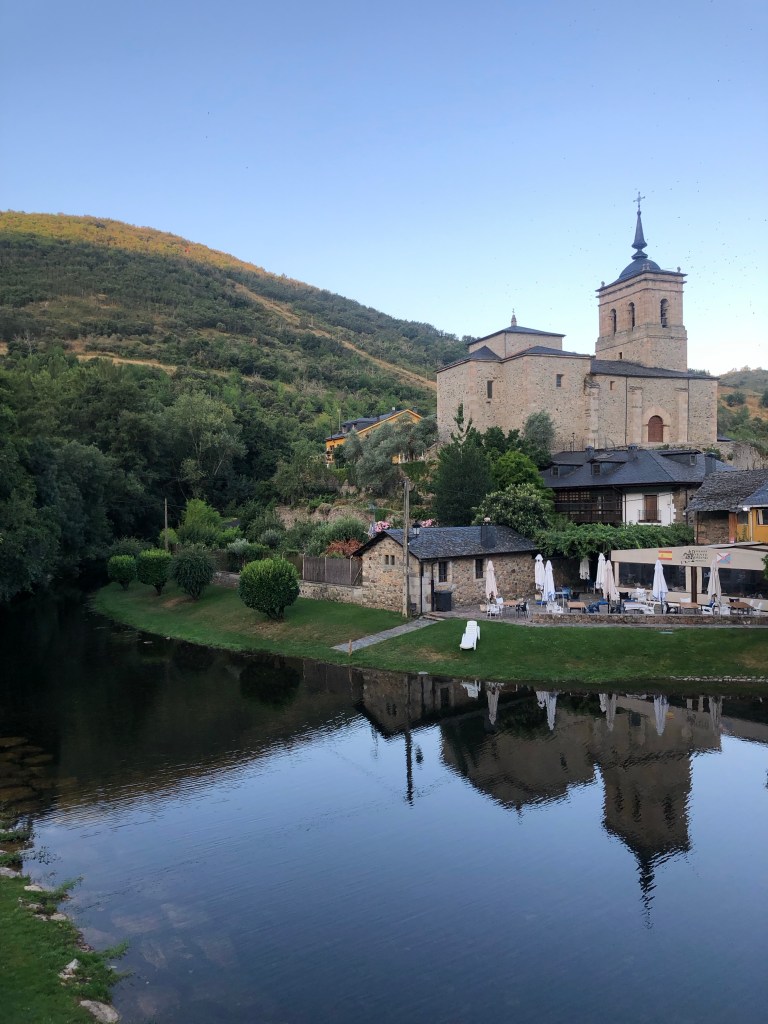
Molinaseca was a stunning slate-roofed chocolate-box town, albeit frozen in time by the fact that it was 7.30am on a Sunday morning when I arrived. Like Castrojeríz, it had a big sign declaring its status as one of the ‘pueblos más bonitos de España’, and I guess it deserves that title. I’ll just have to come back sometime – I’ve already marked it in my Camino guide for next time.
I managed to clear Ponferrada and its extensive suburbs in just over an hour. Rather than follow the way-marked route I made a straight shot through the heart of the city, following what must once have been the original Camino down an arrow-straight road called Calle Santiago that didn’t move an inch left or right until it had cleared at least two outlying towns. After that, the Camino reappeared and, once the minor matter of the motorway had been cleared, it led down into the green vineyard valley of El Bierzo.
I stopped for a drink and ate the sandwich I’d plain forgotten about in the shade of an oak by a stream. A few pilgrims were having a similar pause in the next town, but other than ducking into a church for a stamp and a prayer, I didn’t really stop for much longer than fifteen minutes all morning.
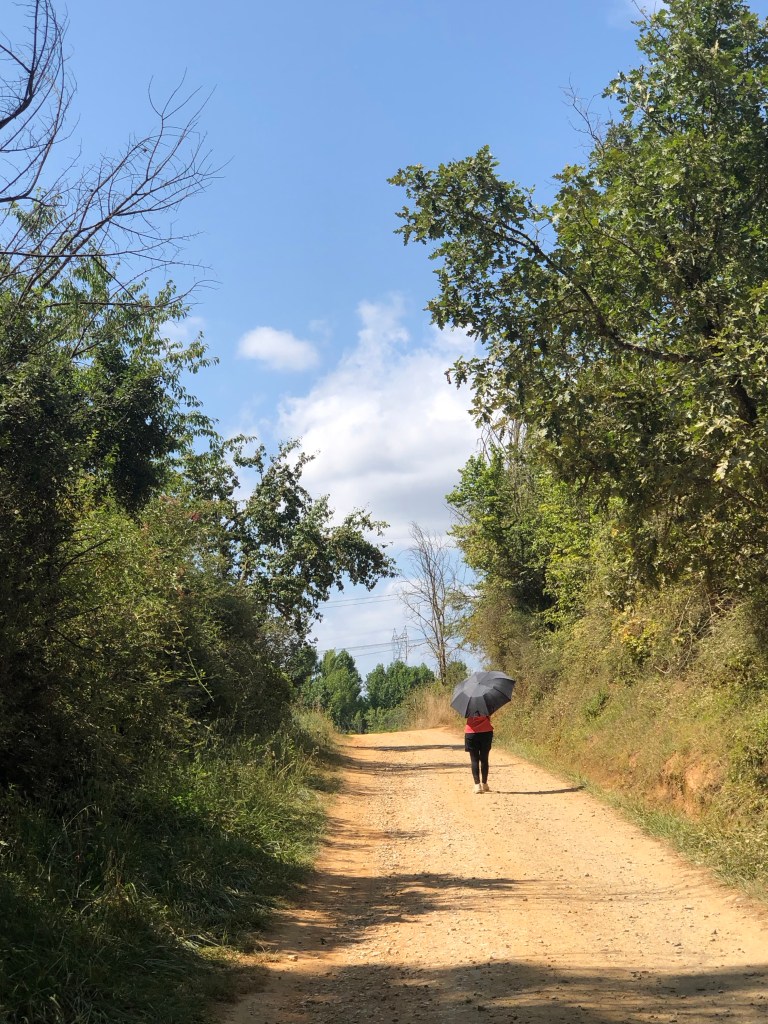
Finally, a few kilometres short of Villafranca, a few pilgrims came into view – always a promising sight. You can spot the Koreans a mile away: they’re often covered from head to foot, gloves and socks and all, to avoid tanning the pale skin that is so valued over there – or so they tell me. One was even carrying a parasol. Then again, am I any more sane for wearing no protective gear on my head or eyes whatsoever? (Ever since I lost a treasured flat cap years ago, I don’t do hats…)
Villafranca del Bierzo seemed quiet when I got here, but I’d only got a few groggy minutes into my afternoon nap when I became vaguely aware of a throbbing bass from somewhere beyond the church on the opposite hill. One of the bicigrinos (cycling pilgrims) told me he’d heard there was a festival in town, so I tagged along with an American pilgrim and went to have a look.
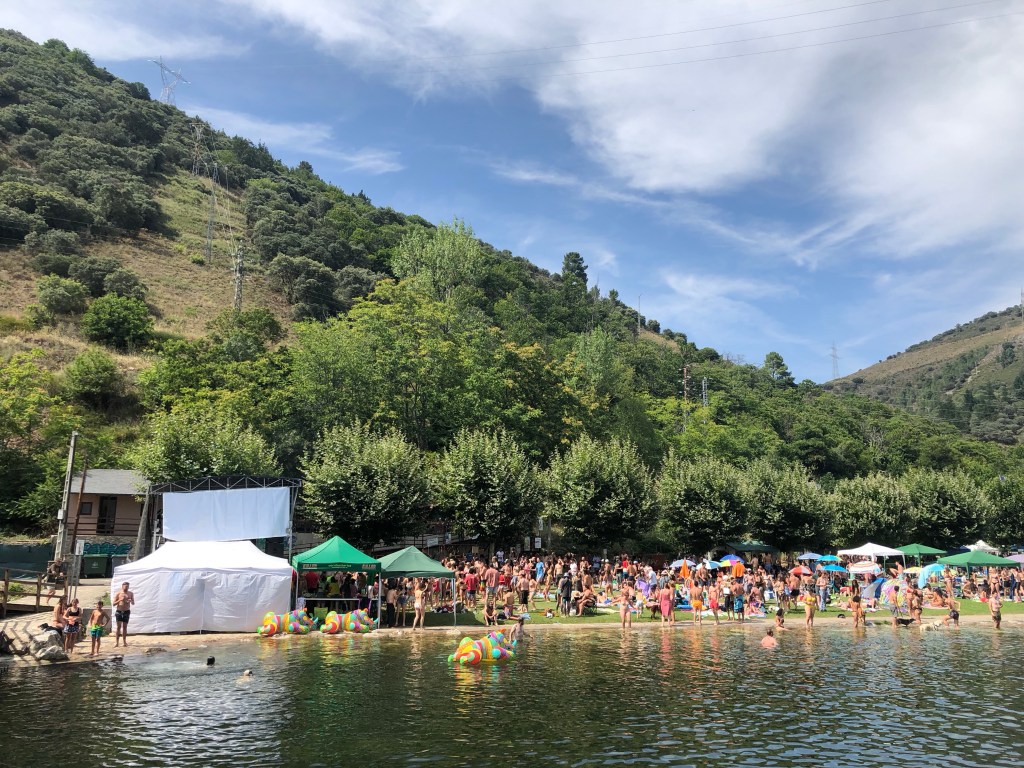
I’m not quite sure what to make of it still. Did I miss a turning and end up back home in Brighton, or was it Woodstock? All I really remember is an endless stream of seriously groovy Afrobeat rhythms sailing across the river from a crowded lawn, where a stage had been set up, and a frantic crowd of party-goers in varying states of undress – with swimwear being as formal as it got, and starkers being the standard. They seemed to be having the time of their lives, but I felt more than a little voyeuristic, so I went back into town to find a less hedonistic way to spend the afternoon. Free weed, fire jugglers and naked breasts wherever you look might be a standard summer if you’re a festival follower, but I’m on pilgrimage here!
That being said, I could have picked a holier spot than the local natural history museum.
Set up by the Pauline Fathers, a religious order, it’s a small museum that contains a number of curios like Hispano-Roman and 17th century Spanish coins, fossils and crystals, an enormous collection of seashells and an impressive array of stuffed animals, with the quality of the taxidermy (and labelling) varying considerably.
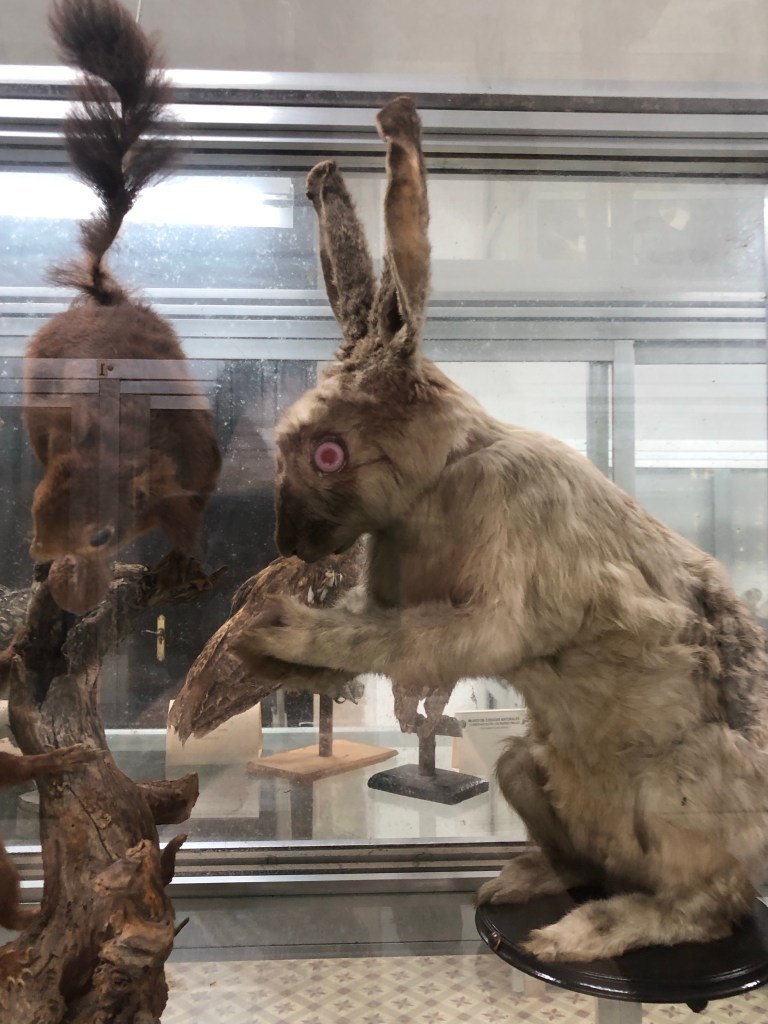
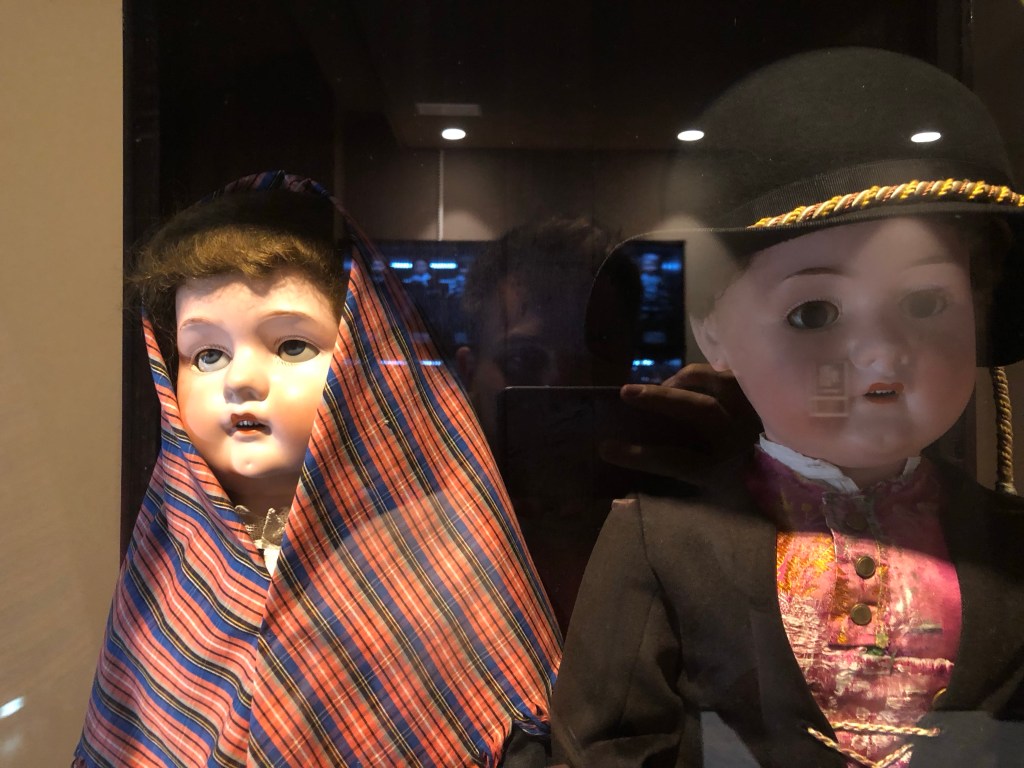
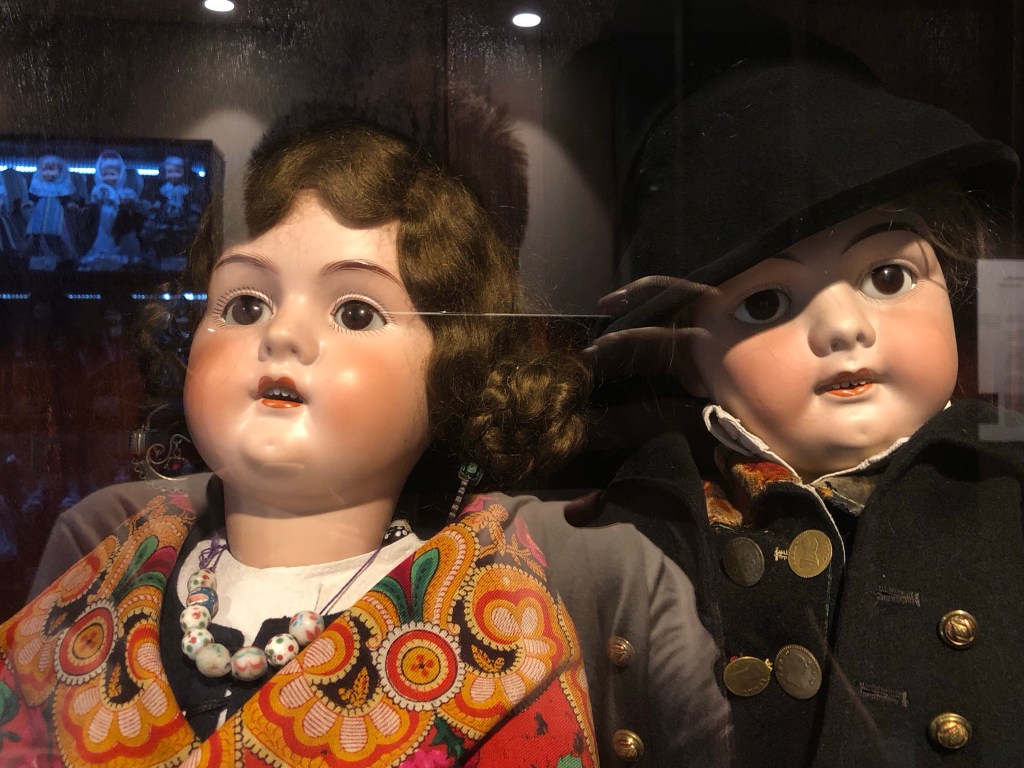
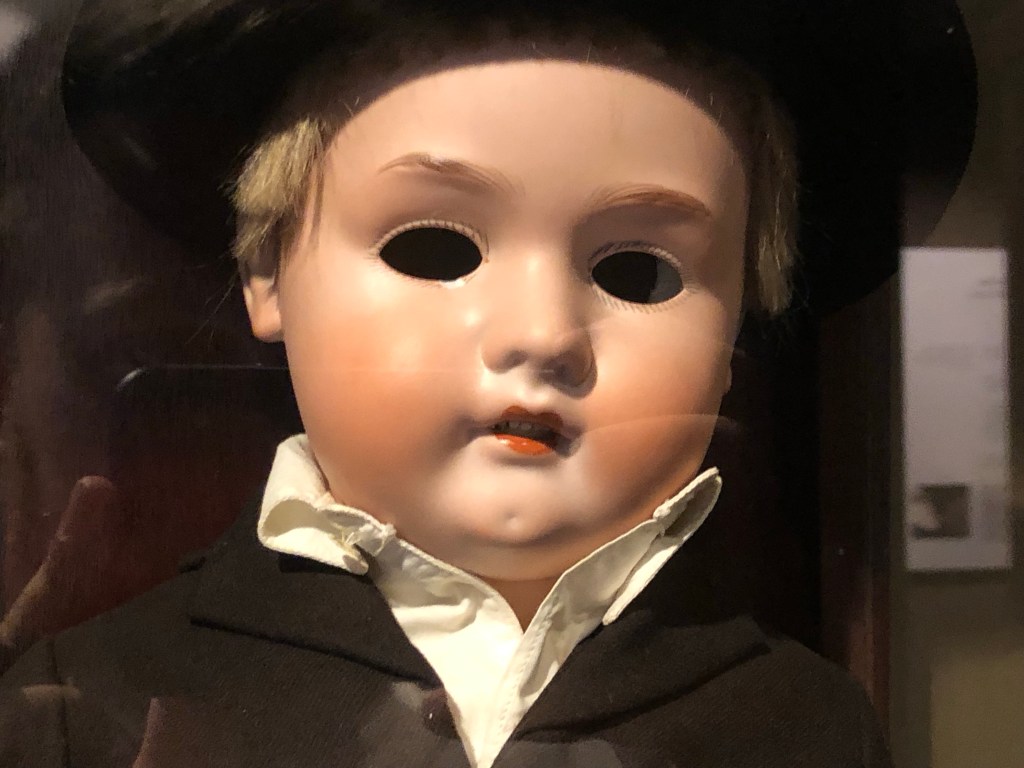
Some of the exhibits are unique to the museum, thanks to the collector’s taste for the bizarre. There are a number of mutant animals, including a two-headed goat (with two vestigial legs poking out of its back), a lamb with one head but two bodies, and a piglet with a similarly unfortunate birth defect. An enormous albino hare with bright red eyes threatened to knock the eyeless dolls of Mansilla from the top spot of creepiest museum artefact, and while the bird collection was clearly the work of an ornithologist, it’s always surprising how easy it is to botch a stuffed cat.
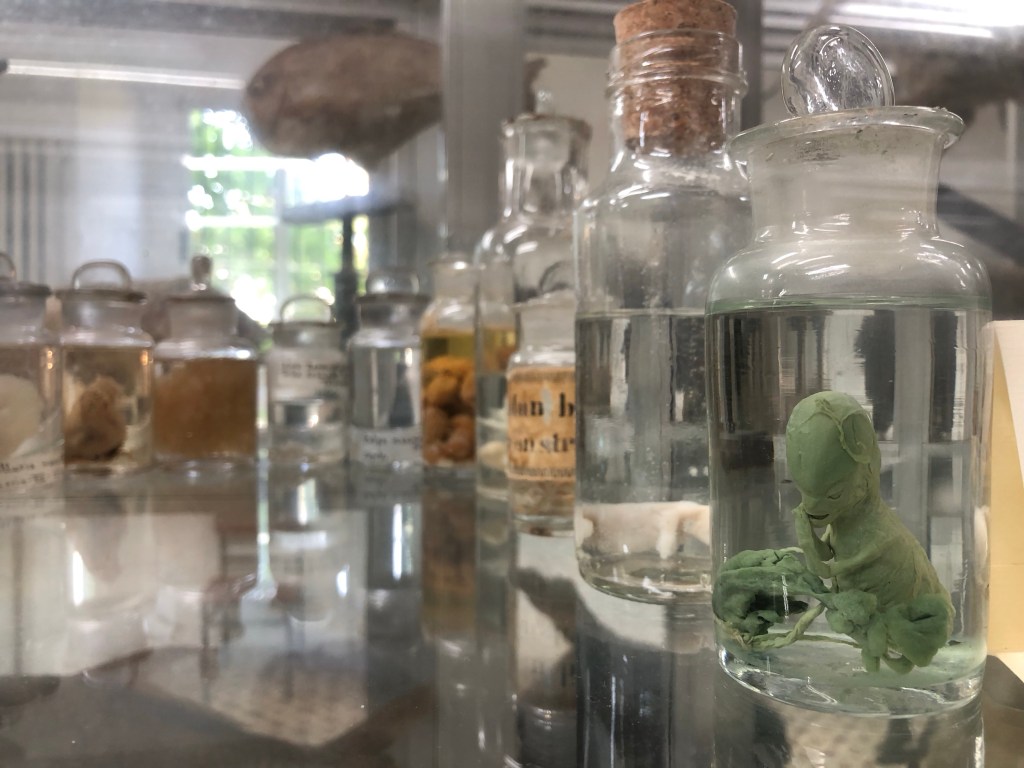
But perhaps the most disturbing exhibits were the specimens in the vinegar bottles. You expect to see the usual array of frogs, snakes and crustaceans in these soulless bottles, their contents looking a lot healthier of complexion than their stuffed neighbours, albeit a lot less alive. But while pickled geckoes was definitely a novelty, the two human fetuses on display were a nauseating shock. That the museum is housed inside the church of San Nicolás, and the collectors in question were monks, only adds to the disturbing nature of this particular exhibit.
Definitely worth a visit, but not for the faint of heart.
For a change of scene, I dropped in on the Colegiata de Santa Maria. Unlike the usual friendly old parishioner in charge of pilgrim stamps in churches along the Camino, a young lad in his late teens loitered near the desk inside. He looked as though he would have preferred to be at the festival which could still be dimly heard through the church’s stone walls, but was very well-spoken and wished me well on the road, so perhaps I misjudged him.
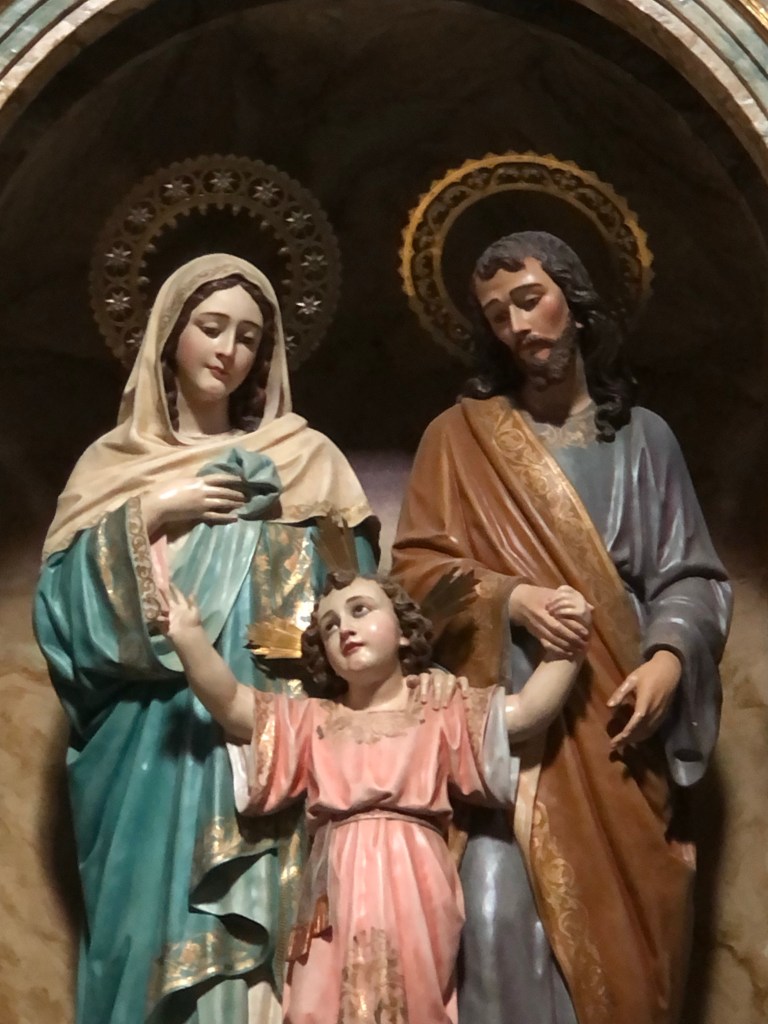
All I’ll say is to end on is that my last lap of the building took me to an image of La Sagrada Familia: Joseph, Mary and Jesus. I don’t think I’ve ever seen all three depicted together as a family so, and I was genuinely struck for a minute or so. The Bible talks a lot about Jesus coming down and becoming Man, but it stands to reason he was a Child before that. And in a country so intrinsically Marian in its devotional practices, it was quite something to see Joseph standing shoulder to shoulder with his wife, the halo about his head just as radiant as hers. The likeness between father and son – or at least the son depicted as a grown man elsewhere in the church – was an interesting detail.
Was the artist trying to make a statement? After all, the short form of José (Spanish for Joseph) is Pepe, which is the same sound as two P’s, standing for ‘padre putativo’ (probable father). Or maybe he just wanted to tie the son of God that bit closer to man on Earth. In any event, I was moved.
Tomorrow, I make for the frontier. I will either stop at La Faba, the last Leonese outpost before Galicia, or climb the last couple of kilometres up to O Cebreiro and be over the border by nightfall. Either way, I’m looking forward to a shorter day. Catch you later! BB x
I’ve made it to the mountain village of El Acebo, the first town of El Bierzo, León’s westernmost outpost before the green hills of Galicia. I didn’t mean to shoot this far, but after arriving at Foncebadón before 11am I decided to press on with a couple of other pilgrims. It’s been a long hike today, and one of the most beautiful of the whole Camino.
I was up before 5am, which is just as well, as one of the pilgrims in my dormitory was impervious to his 5 o’clock alarm, which continued to ring for well over ten minutes, waking everybody up but him. I’d had the foresight to dress for the road ahead of time, so I simply slipped away from the phoney alarm clock (ha ha) and retreated to the downstairs kitchen to pack.
The doors of the albergue were closed until 6am, but some of the pilgrims must have been impatient, because after I’d had my breakfast and went upstairs to wait, I found it already ajar. So, not too long after half past five, I was out in the windy streets of Astorga and on my way.
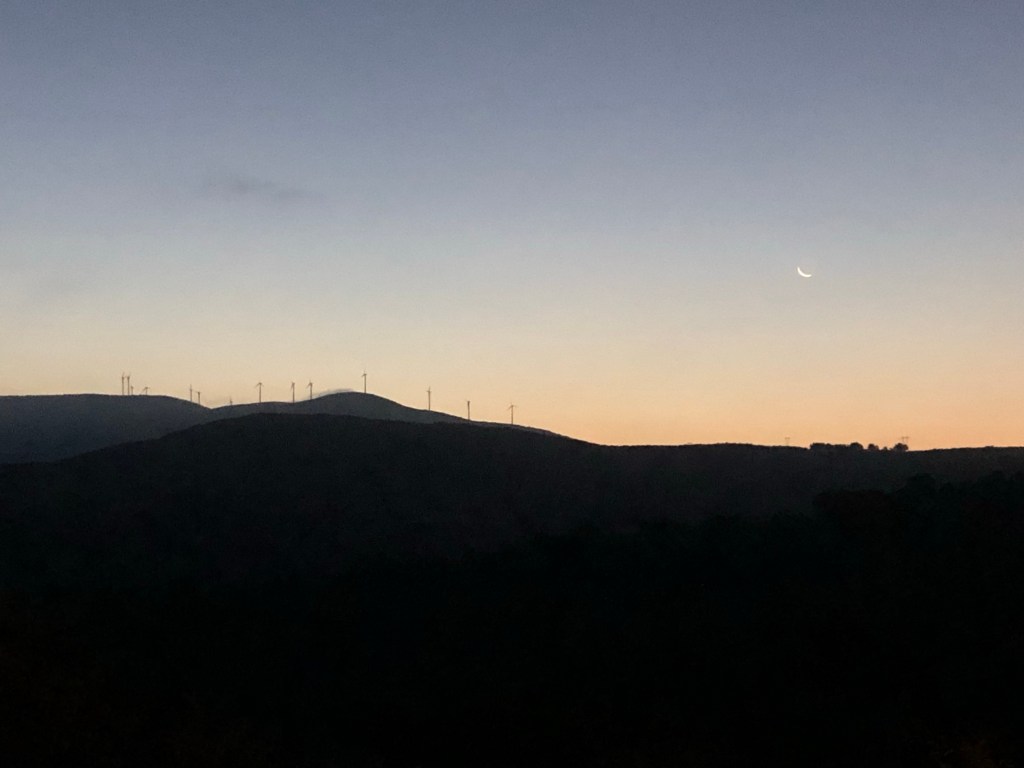
I did my first bit of serious journaling for a while last night, so I had the company of all the characters of my novel in my head for the first few hours of the morning. Spain is working its usual magic: just being here gives me ideas, threading new storylines into the patchwork where life in England simply leaves me in a creative block. I must have run through some of the same dialogues over and over to keep them fresh in my mind before reaching the picturesque village of Santa Catalina de Somoza, where I stopped in front of a giant stone die to watch the sunrise. The clouds tumbling over the mountains ahead glowed a fierce salmon pink for just a few seconds, which I missed by a whisker with my phone, but it was worth the early start to catch even a glimpse of that morning wonder.
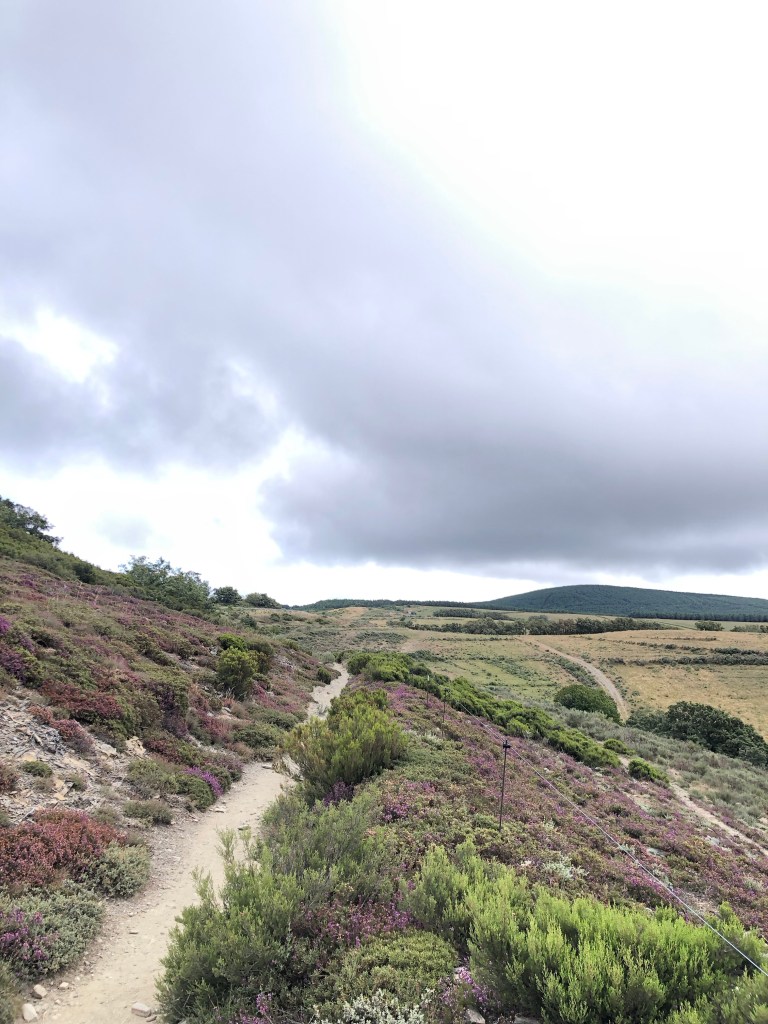
The meseta is well and truly behind me now. It was never low – most of the meseta from Belorado is over 800m above sea level – but from the lofty heights of the Montes de León, surrounded by a changing landscape of heather, broom and drystone walls, it feels a great deal more than two hundred metres down.
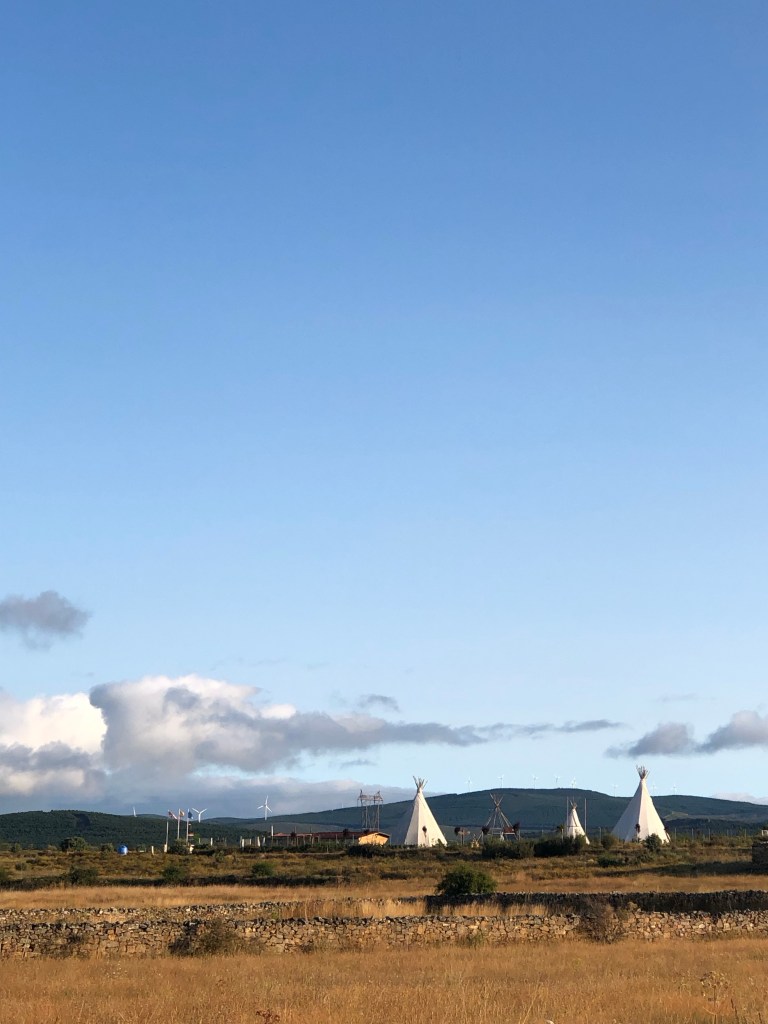
Even the wildlife has changed. Rock buntings replace corn buntings, and woodlarks sing in lieu of skylarks. The kites and kestrels of the plains are nowhere to be seen: instead, I clocked a peregrine and an eagle of some kind from a great distance, though I couldn’t tell what kind against the clouds. I practically stumbled upon a couple of red-backed shrikes near the decidedly out-of-place pueblo indio outside El Ganso, which is a first for me! You don’t find them further south than this.
The shrikes, I mean. I don’t know how far you’d have to go to find another faux-Indian setup like this one…
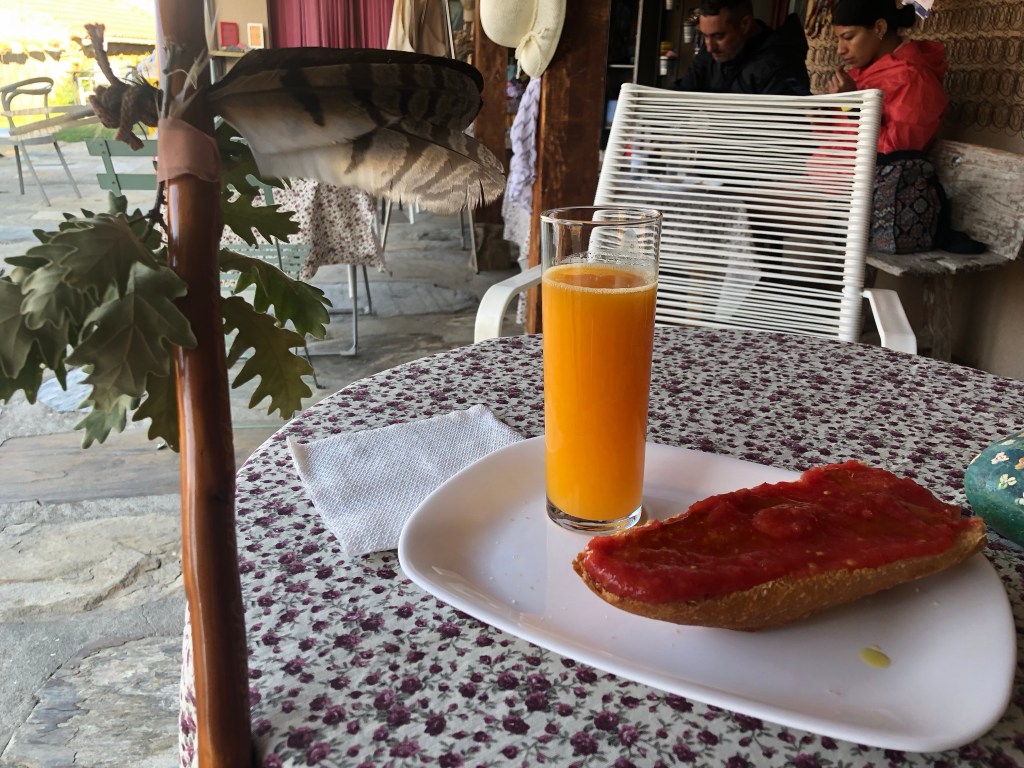
I made an uncharacteristic stop for breakfast in El Ganso, and what a fantastic idea that was. I had probably the best tostada con tomate y aceite of the whole Camino with a tall glass of fresh orange juice, and snagged a leather bracelet for the road as a keepsake. I missed the famous Cowboy pilgrim stop as it was too early, but at 5€ for the below, I think I found what I was really looking for.
Walking songs carried me on and up the mountainside toward Rabanal del Camino. I took advantage of my solitude in this forested part of the Camino and burned through my repertoire from Tolkein to all my favourite sevillanas, only shutting up when the town was in sight.
I shared the road thereafter with an Australian backpacker, Alex, for a little while, before reuniting with Belgian pilgrim Louis for the last push to Foncebadón. I even doubled down on my food pitstops and dropped into a bar for a cider. I even came away with a free tapa of tostada con jamón serrano. Win win!
And based on that boost, I threw caution to the wind and decided to press on with Louis to El Acebo. I’ll admit it was another linguistic flight of fancy on my part, based on his interpretation of the town’s name in French: là, c’est beau (it’s beautiful there).
The clouds descended to punish me for my hubris just a few minutes out of town. I haven’t needed my poncho thus far, so it was buried at the very bottom of my rucksack, and I needed to do a lightning-quick pack and unpack to retrieve it as the rain came down. As luck would have it, the shower was over only a minute later, but I kept the coat on, and the showers came and went intermittently throughout the climb. The only thing that got really bedraggled were my owl feathers, but then, owls aren’t exactly famous for being waterproof.
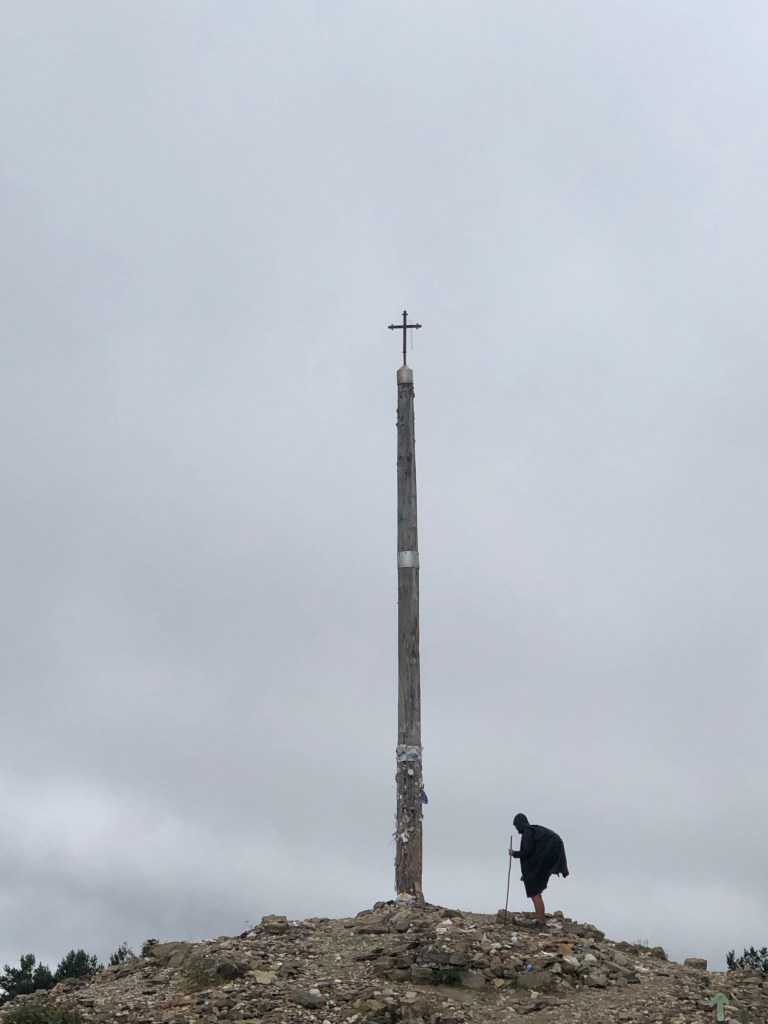
At 1498m above sea level, Cruz de Ferro marks the highest point of the Camino Francés. It’s perhaps more famous for the mountain of stone offerings at its base, which is a pilgrim tradition. I added my own to the stack and went on my way. I met Louis once again, who had gone on ahead but retreated because of a couple of stray dogs on the road. I’ll admit I hoped he’d stumbled upon some wolves, which are known to live in this part of the world, and I would dearly like to see one someday… but no, they were just a couple of strays. Louis’ wariness was understandable, and he wanted to go back and wait for them to pass, but there’s safety in numbers, so I led him past the dogs and back to the Camino. They followed us for a bit, but soon lost interest and returned to the road.
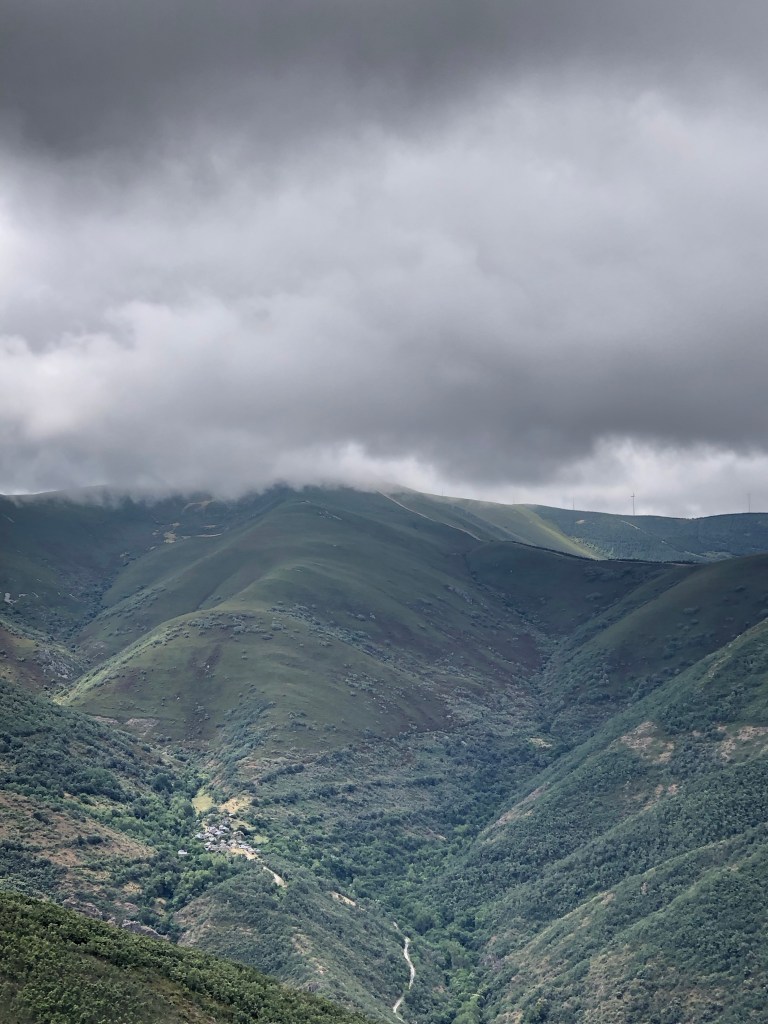
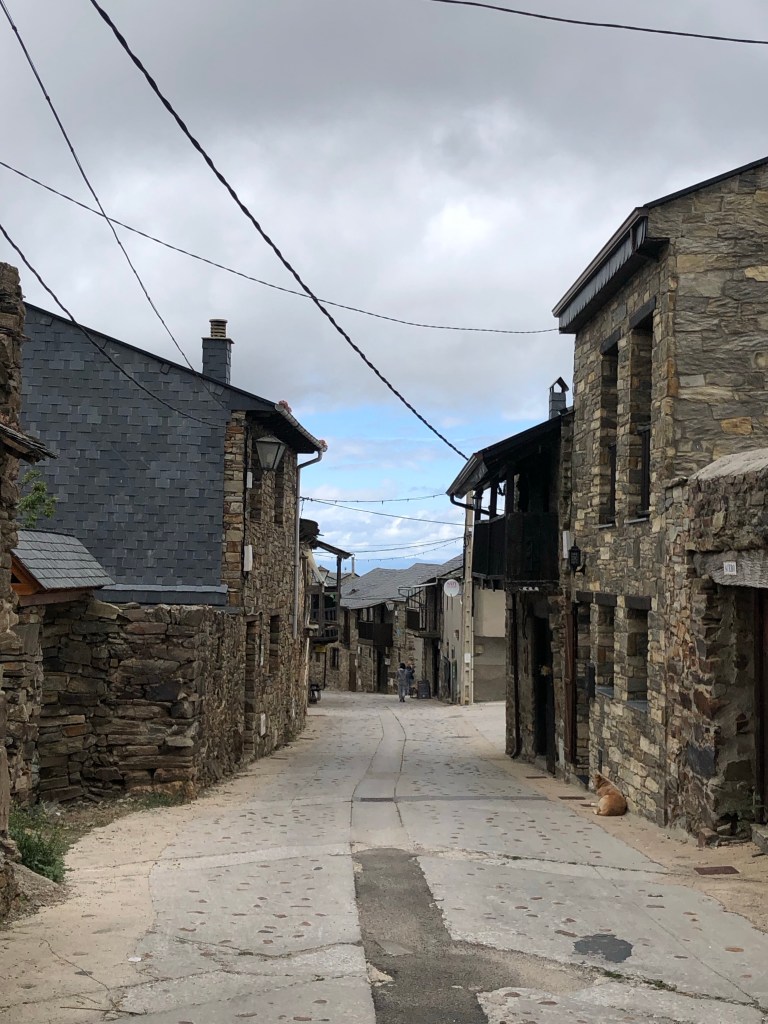
The rest of the hike winds its way through the spellbinding mountain countryside of the Bierzo borderlands, where the trees are covered in hanging moss and slate-roofed villages appear and disappear in clefts in the valley below. The bloody Welshman continues to make his presence known, daubing Cymru am byth in luminous white paint on roads, benches and even the odd boulder, but other than that, it’s a truly wild trek.
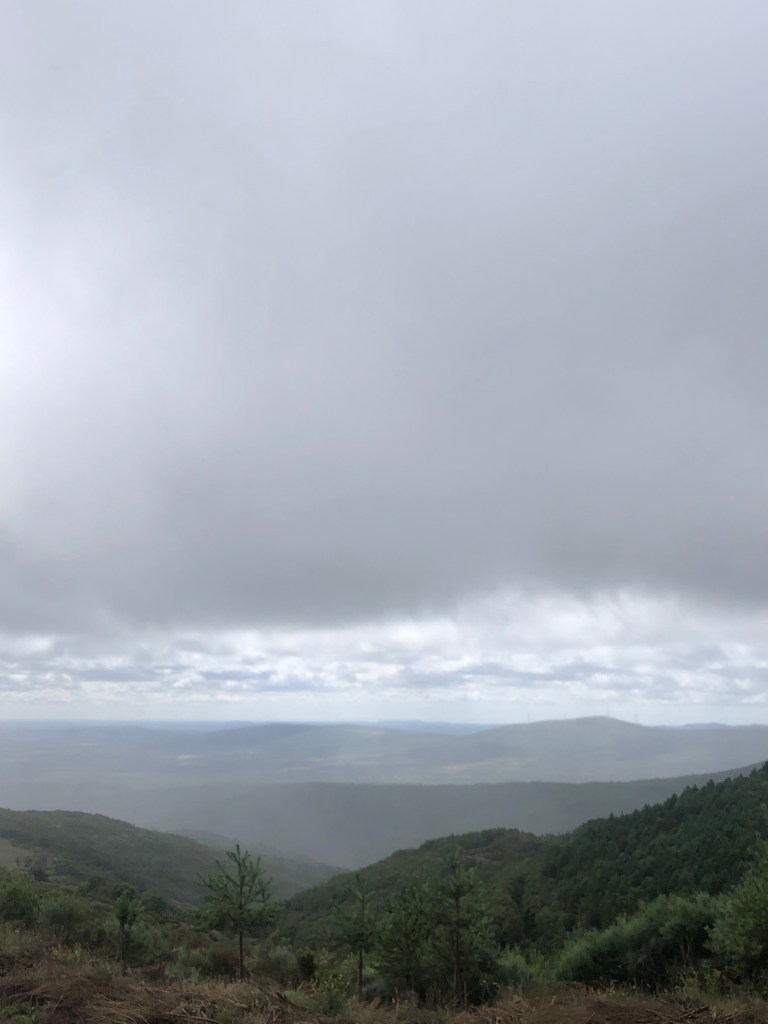
Finally, after what seemed like hours (and probably was), the ground underfoot began to descend and the city of Ponferrada came into view in the valley below. It was still some time before I was back below cloud level, but my feet were grateful for the sight of the finish line.
El Acebo is a stunning mountain village, and I’d probably have better memories of the place in future but for a minor disaster after my arrival.
I walked with Louis to the Casa del Peregrino, a new hostel touted as ‘the best albergue on the Camino’ with a shop, bar and swimming pool… Only, upon arrival, it turned out there was an additional charge for the pool, dinner came to the tune of 25€ and needed advance booking, and the whole place looked decidedly out of place – a chic hotel with a dorm option, rather than an albergue. I decided to double back in search of the albergue parroquial instead.
I realised I must have looked a sight in my bright red poncho and rainproofed rucksack, so I put my things down by a ruined barn to remedy the situation. I was a good 200m up the road when I realised I had my raincoat in one hand and my satchel in the other.
But no stick.
I kid you not, I legged it back to the barn where I’d propped it up against a door, but it was gone. I raced back to the other albergue to see if I’d left it there, but it wasn’t there either. I even went charging after the pilgrims I’d passed on the way up in case they’d picked it up, but they only had metal guiri sticks. I swore a lot – and badly at that – and had another look in town, but it was nowhere to be found. In the space of a single minute it had simply disappeared.
Oh, stick my stick! I was always going to have to leave it behind at some point – ideally near Finisterre – but the loss of it still bothered me more than it should have done. I can only hope that whoever took it away – pilgrim or child – finds some better use for it. And I suppose I did at least keep my word and give that owl one last journey, even if it wasn’t as long as I’d have hoped.
The Camino is all about letting go, when you think about it. From leaving the busy world behind and the ritual of placing stones on the cairns you find, to the very real possibility of losing weight along the way, it’s very easy to end the Camino with a great deal less than what you had when you started out. All the emotional baggage you carry out with you somehow finds its way through your fingers and out into the ether as you walk. There’s an ancient magic in that.
I’m not ashamed to admit my primary reason for throwing myself back onto the Camino this summer was to help with the healing process after a recent break-up. I know I made the right decision for both of us, but that doesn’t mean it hurt any the less to go through with it. Losing a partner often feels like losing a part of yourself. The Camino always provides, just as easily as it takes away, and I hoped it would help me to let go of the last of the hurt and find myself again.
Perhaps losing my faithful stick today was a reminder that, when it comes down to it, the only thing you need to be you is you.
What is life but loss upon loss, til life itself be lost? But in death, we may find all that we have lost.
Henry Rider Haggard, Allan’s Wife
Well, my brief sojourn as a shaman is over, and there’s no use grumbling about it. I’ll take a leaf out of another Haggard book and seek out a new stick for a new journey tomorrow. But for now, I’ll give my feet the rest they deserve. It’s been a hard day’s hike and then some. BB x
After yesterday’s long walk from León, today’s itinerary was mercifully short. Astorga is only 15km from Hospital de Órbigo, but it’s such a friendly city and so well set up for pilgrims that it’s worth a stay – if for no other reason than to rest up for the next couple of days of hiking as the Camino climbs into the Montes de León.
I set out later than usual this morning, since Google and the guidebook were suggesting only 3-3.5 hours’ walk to Astorga. To kill the time, however, I took a detour in search of an ancient oak tree said to grow deep in the old forest north of Valdeiglesias.
Joined on my random quest by Anna-Marie, a Danish ceramist from Aarhus, it took half an hour to track down the location (with a little help from Google Maps). A local out walking his dog was justifiably baffled by my madcap mission but it was a good excuse to have a chat in my favourite language.
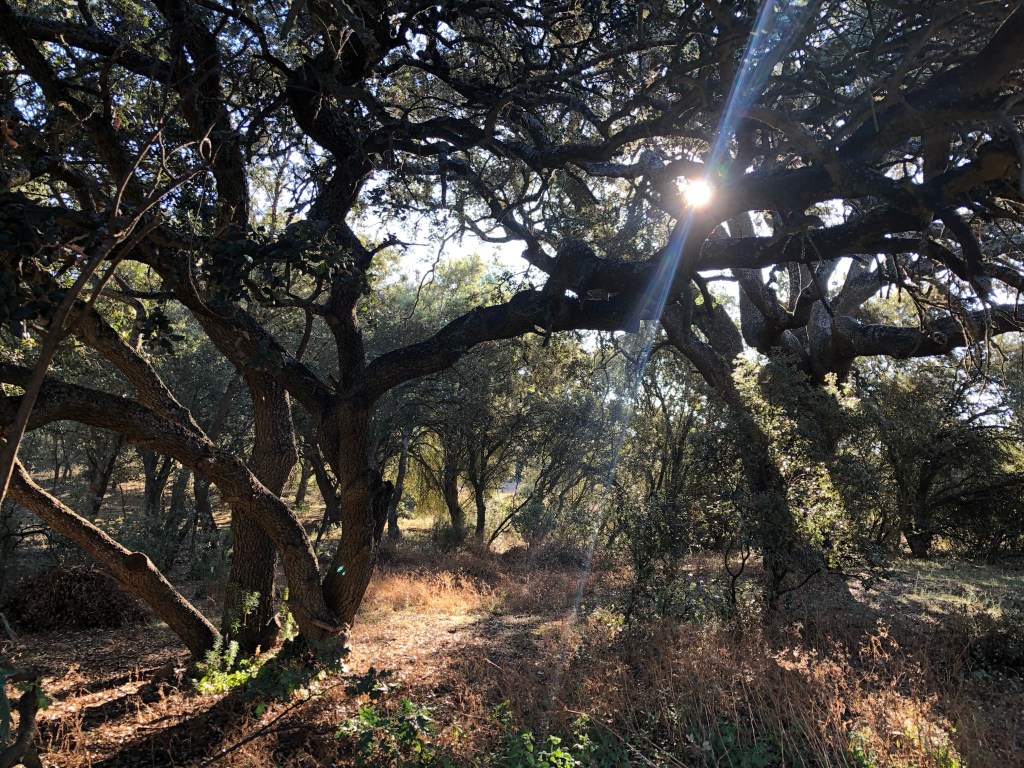
We found the spot where the tree was supposed to be, but whether we found the tree or not is anybody’s guess. The trailing lichen from every branch certainly made the forest look considerably older than the others I’ve passed thus far, but that probably has more to do with the health of the forest and its relative altitude above the last kilometre of the meseta.
The jury’s out on the tree. Still, it was an adventure!
Anna-Marie took a break and I pressed on, making a mental note that our detour left us over an hour behind the other pilgrims. Once again, I had the Camino to myself, which meant that I was much less inclined to pause at the couple of rest stops I encountered. Which meant I gave the Casa de los Dioses a miss, though it looked like more of a hippie love-in than even this crazy shaman could handle!
I must have gone like the clappers (or they must have breakfasted long), because I wasn’t all that far out of San Justo de La Vega before I caught up to a familiar bunch: Tadeo, Christophe and Estrella. It was good to have company for the final stretch, so I slowed down my pace and fell into step.
We made it to Astorga on the back of Tadeo’s wonderful singing voice and Estrella’s remarkable knowledge of Spanish ballads (apparently they pop up here and there in Korean dramas – who knew?).
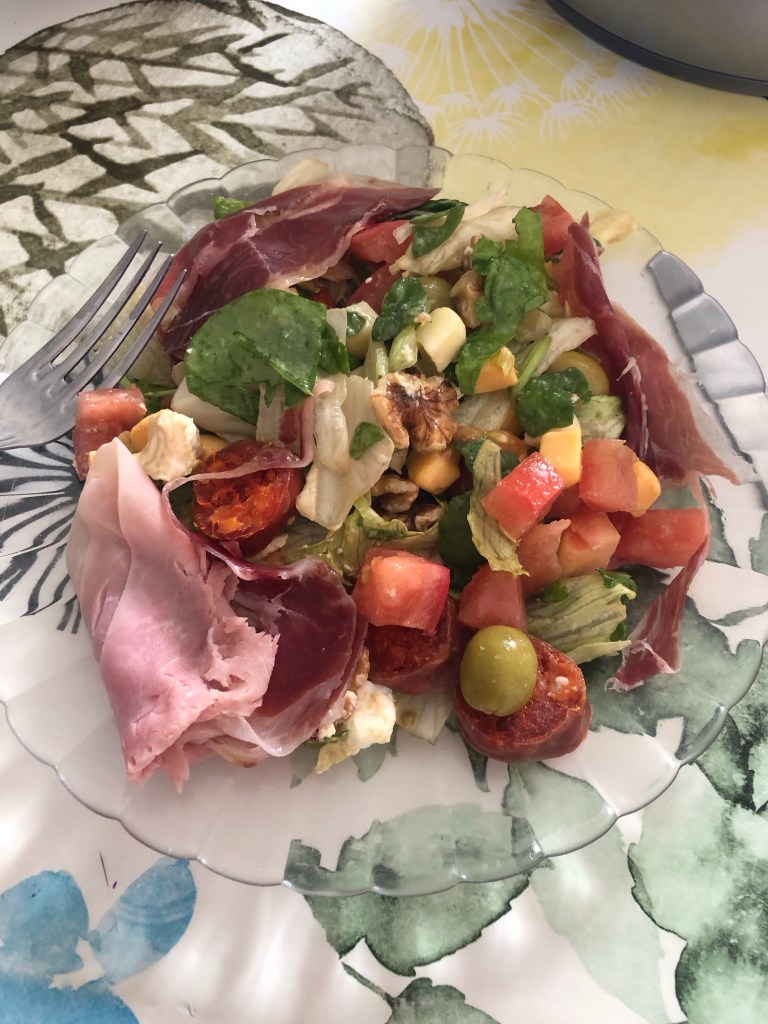
In lieu of a menu peregrino – which can get a bit samey – we bought supplies at a local supermarket for a communal salad. And what a salad! I haven’t even so much since starting the Camino. Good food, good company, good language practice and great exercise. There’s really very little to fault the Camino.
Unless you don’t like Italian. Because there’s a lot of Italians on the Camino! They must be the biggest demographic out there by a country mile… BB x
León is already a distant memory. I’m sitting in the shade of an awning in the garden of the albergue parroquial, having just spent a blissful twenty minutes with my feet in the foot-bath. The meseta stage is almost over and the foothills of the Montes de León are but a day’s walk away. Change is coming!
I slept very well last night, though perhaps because I wasn’t one of the Italians who tried to have dinner at the hostel ten minutes after lights out, incurring the wrath of the hostalera. All the nearby sockets were in use, so I had to leave my phone to charge down the hallway, which deprived me of an alarm for the morning… but, if the last few days are anything to go by, you hardly need an alarm on the Camino. You might just as well use the fifteen others that go off around the same time.
I was out the door by 6am and racing back to Plaza Santo Domingo – and with good reason. After yesterday’s mindless urban trudge into the city, I found a way to circumvent León’s even more extensive westward sprawl: the A1 city bus to La Virgen del Camino, on the very edge of the city outskirts. Thirty years ago I might not have bothered, but I couldn’t quite face an hour and a half’s march through characterless modern development, so I was more than happy to stump up the 1.60€ fare and rub shoulders with the orange-tee brigade of SOLTRA workers headed for their 7am shift in La Virgen. Two other pilgrims were in on the secret, but I lost them a short distance out of town when they stopped to check their bags. From then on out, I barely saw another pilgrim for the rest of the trek.
After yesterday’s easy 19km wander, I opted for the alternative scenic route via Villar de Mazarife. The original Camino follows the N-120 in an unbroken line for 32km, while the Mazarife road winds its way through the countryside to the south for 36km. I was up for a challenge, and I didn’t fancy another roadside walk, and for once, I know I made the right call.
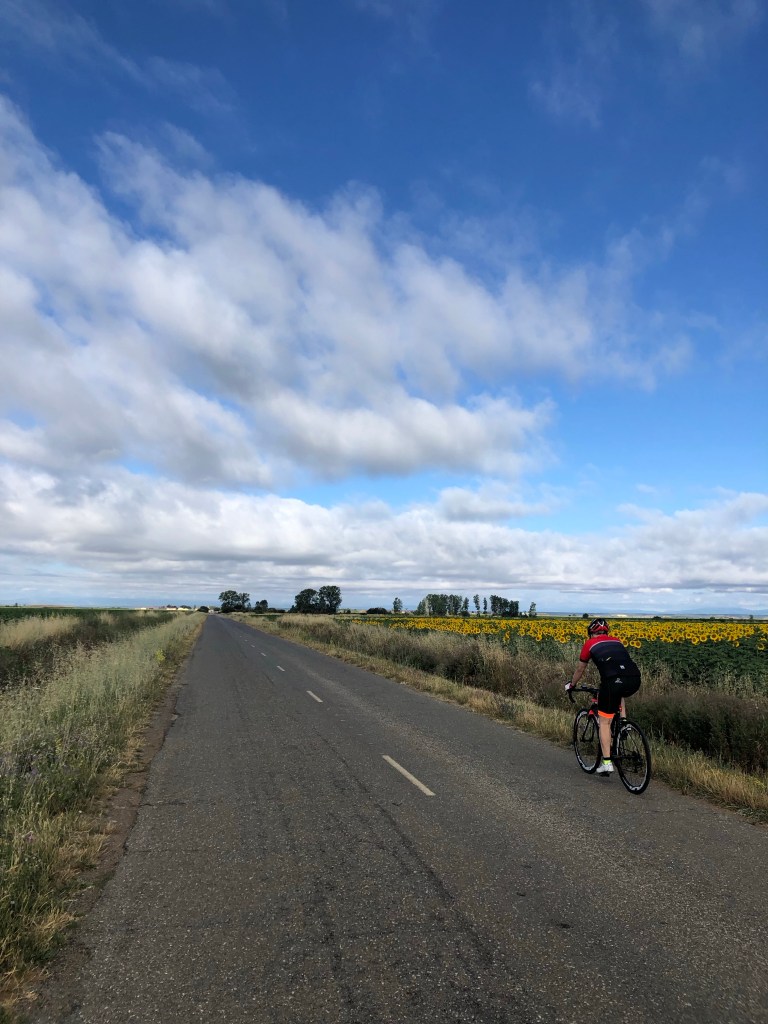
Southwest of León, the Camino carves a path through the scrubbier hinterlands of the Meseta. Fields of wheat and sunflowers give way to open dehesas, with sparse yellow grassland interspersed with stands of ancient oak trees. In a way, it felt like being back in Extremadura.
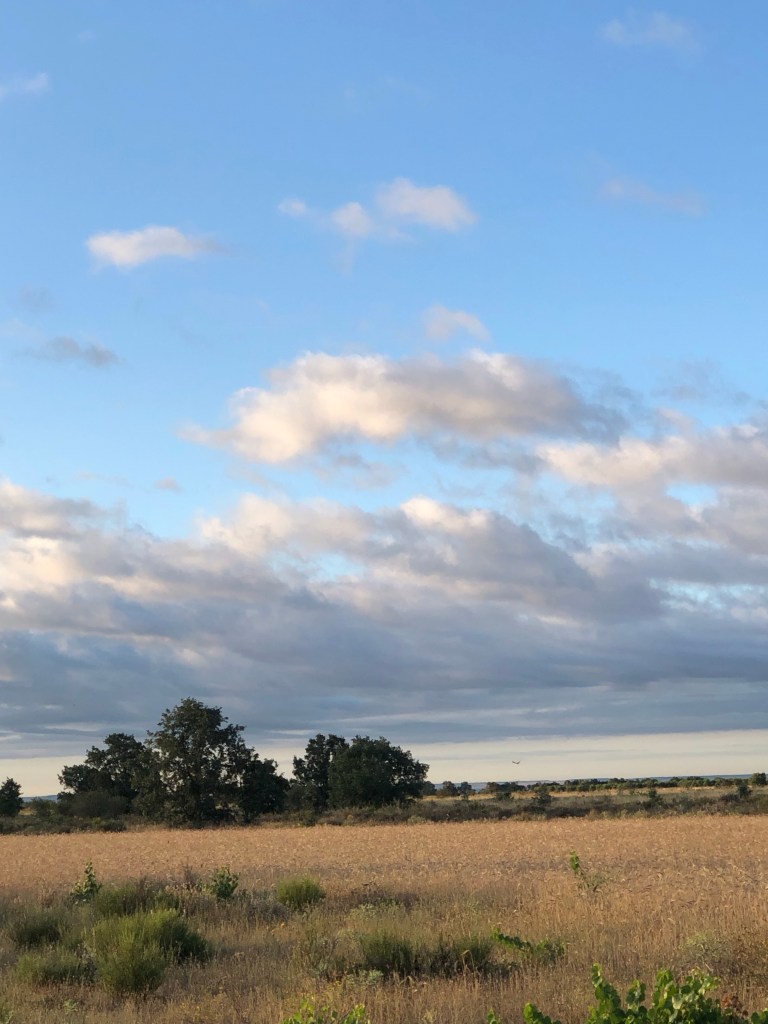
Better yet, the first hour after sunrise yielded some of the best birdwatching yet on the Camino. The usual backdrop of quail, turtle dove and stonechat provided some musical continuity to the meseta movement, with a colourful inclusion of golden oriole, blackcap and nightingale. There were quite a few kites about, whistling in that very plaintive way they do, and the calls of bee-eaters will never fail to make me smile. While I can also add great grey shrike, honey buzzard and whitethroat to my list this morning, I think it was the fleeting encounter with a greater spotted cuckoo that was the standout from today’s walk, tearing ahead through the scrub in front of me as I neared the first town on the trail, Chozas del Camino. As usual, a phone camera is next to useless for this kind of thing, but I did manage a snap before it was gone (look to the right of the second tree from the left).
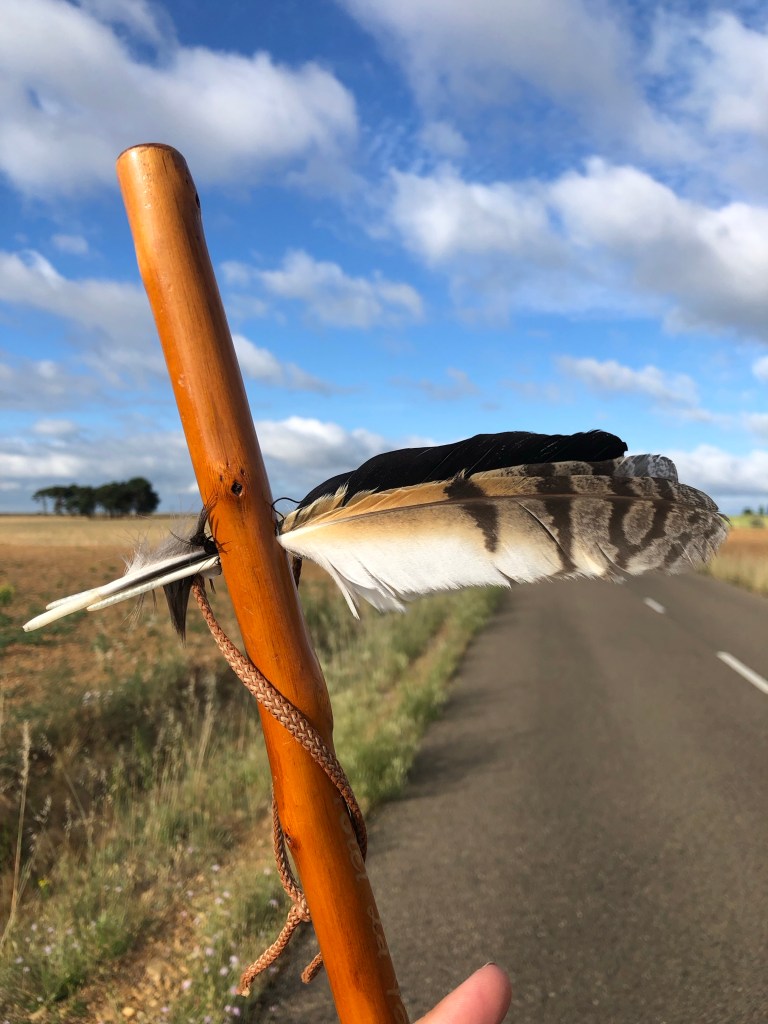
After narrowly avoiding a major desvío at Chozas, I followed the road to Mazarife for the next hour or so. Along the way, sensing rather than smelling death, I guess, I came upon a mass of feathers at the side of the road. On closer inspection, it was a long-eared owl, and a relatively young one at that. Given its condition, it must have been hit by a car less than a day ago, or else it would have been devoured long since. Acting on an intuition beyond simple curiosity, I picked up two of its wing feathers and fastened them alongside the raven feather to my staff. Besides the fact that owl feathers are one of nature’s most intriguing artefacts – they are engineered to move silently through the air – I think my desire was to give the unfortunate creature (a migratory species in most parts of Europe) one last journey, as it were. I will carry them to Santiago and Finisterre… and beyond, if I can.
With a feathered staff and a satchel full of pens, pencils and sharpenings, I’m rather conscious that I’m starting to take on the appearance of a tin-pot shaman. My silent reasoning that ravens represent life, light and hope (they brought the knowledge of fire to man in Scandinavian mythology) and owls death, darkness and wisdom (via the Greek tradition) probably doesn’t help, either. I’m still searching for a stork feather, though despite their abundance, these are proving hard to find.
All I can say is I had this coming. In my first teaching post in Uganda, I was given the moniker ‘Ojok’, meaning ‘healer’ or ‘witch doctor’. It wasn’t anything more than an attempt at humour by my hosts, but hey, I guess such titles should be earned, right?
From Villar de Mazarife, one of the straightest roads of the entire Camino leads for some ten kilometres to the hamlet of Villavante. With the exception of the occasional buen camino from a field worker clad in orange hi-vis overalls, and the need to duck and weave to avoid the mechanical water jets every now and then, it was a fairly uneventful walk, but a beautifully quiet one at that.
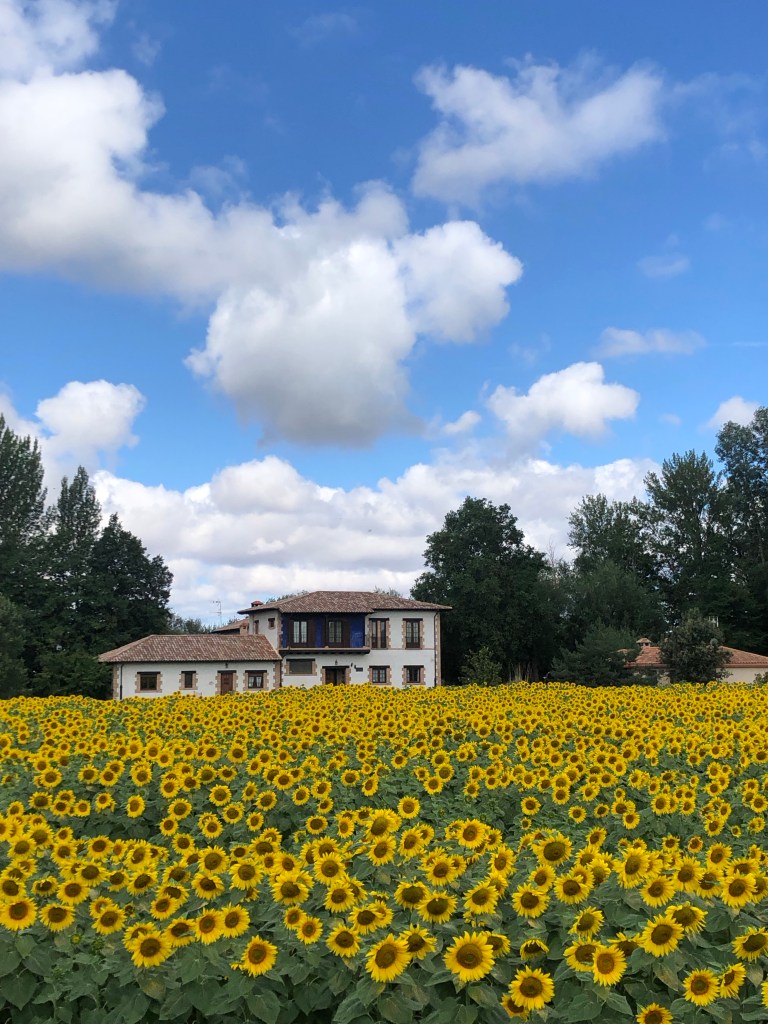
At Villavante, the Camino forks to the north to cross the León-Astorga railway line. It’s practically worth the trek for the view of the Casa Rural Los Molinos, nestled behind what appears to be a private tree-lined sunflower grove.
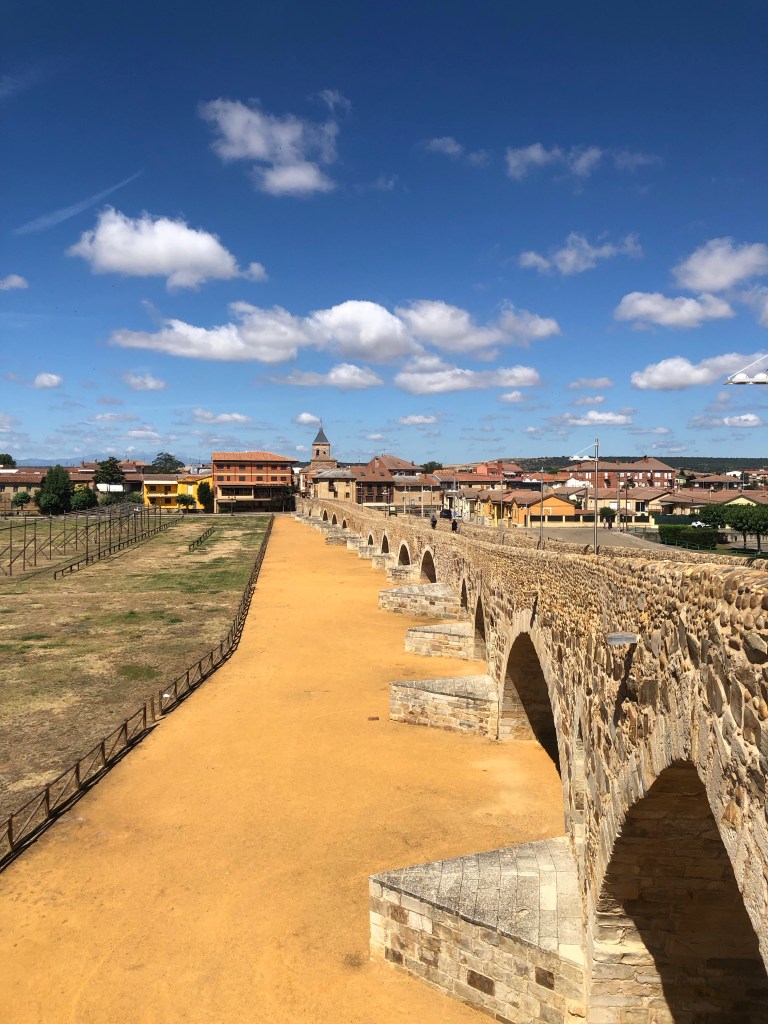
After that, it’s only a short distance to Hospital de Órbigo. It’s a good-sized town and, at 12pm on the dot and after nearly five hours’ walking (with a sum total of fifteen minutes’ break), I was more than ready to throw down my pack for the day. The entrance to the town over the medieval Puente Honroso (which I’m 90% sure featured in my dissertation) simply sealed the deal. This place is incredibly beautiful.
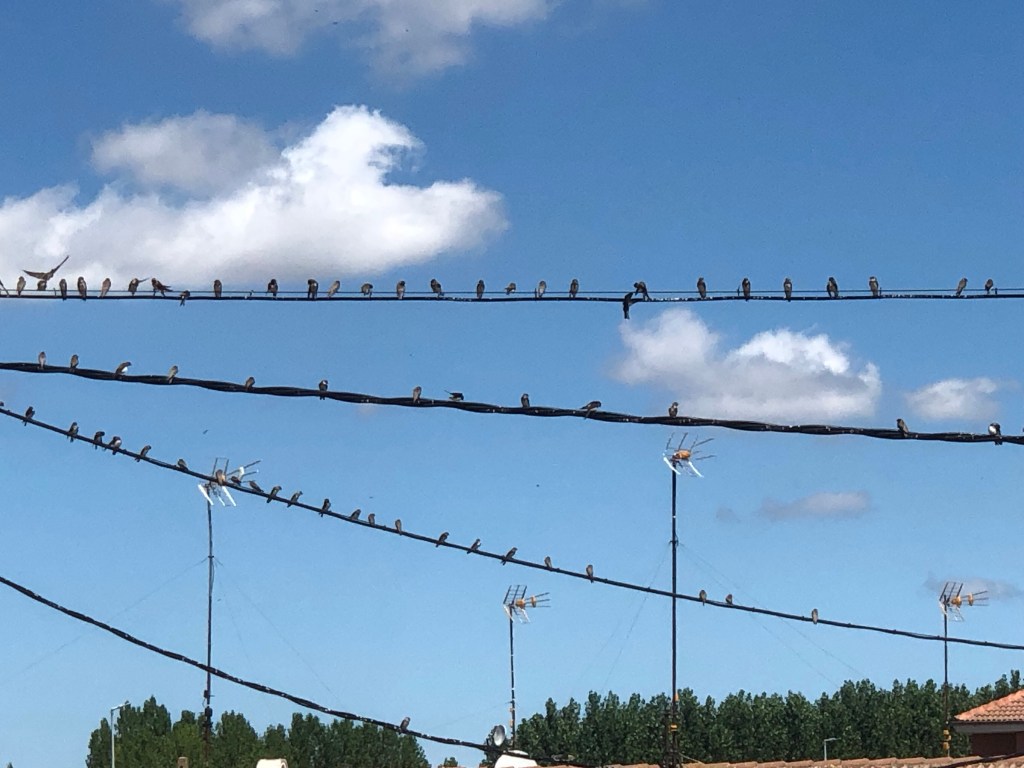
It’s said that a certain Don Suero, a local knight, challenged all comers to the bridge to win the heart of a lady, breaking 300 spears in as many jousts before an ever-growing crowd. The lords, the ladies and the medieval gaiety may be long gone, but the endlessly chattering sand martins lined up along the wires by the bridge make a good substitute.
Well, there goes my siesta. Tomorrow is a much shorter walk – three and a half hours at most – but I hear there’s a thousand-year-old oak tree near Santibáñez de Valdeiglesias, so I will extend my walk to take a look. Now I have the trappings of a new age shaman, I might as well play the part. BB x
I at least made an effort to wait for my fellow pilgrims this morning, but impatience got the best of me. When half an hour passed and all but a trickle of the pilgrims from my albergue had come and gone, I gave up and set out for León. I wasn’t in any particular hurry, but a conversation over dinner with an Italian veteran of the Camino (this would be his tenth rodeo) had me reflecting on his words: you can never do the Camino at any pace other than your own. Well, there I was, trying to match the speed of another pilgrim or two. In the end I have to be true to myself. So off I went.
It’s not far from Mansilla de las Mulas to León – four hours, tops, though I could probably have done it in a little over three. But for the Museo de los Pueblos Leoneses, which I really did want to visit, I might have pushed on yesterday and done two days’ work in one. But I am being kind to my feet, seeing so many pilgrims in varying states of deterioration, and so I made my way leisurely this morning.
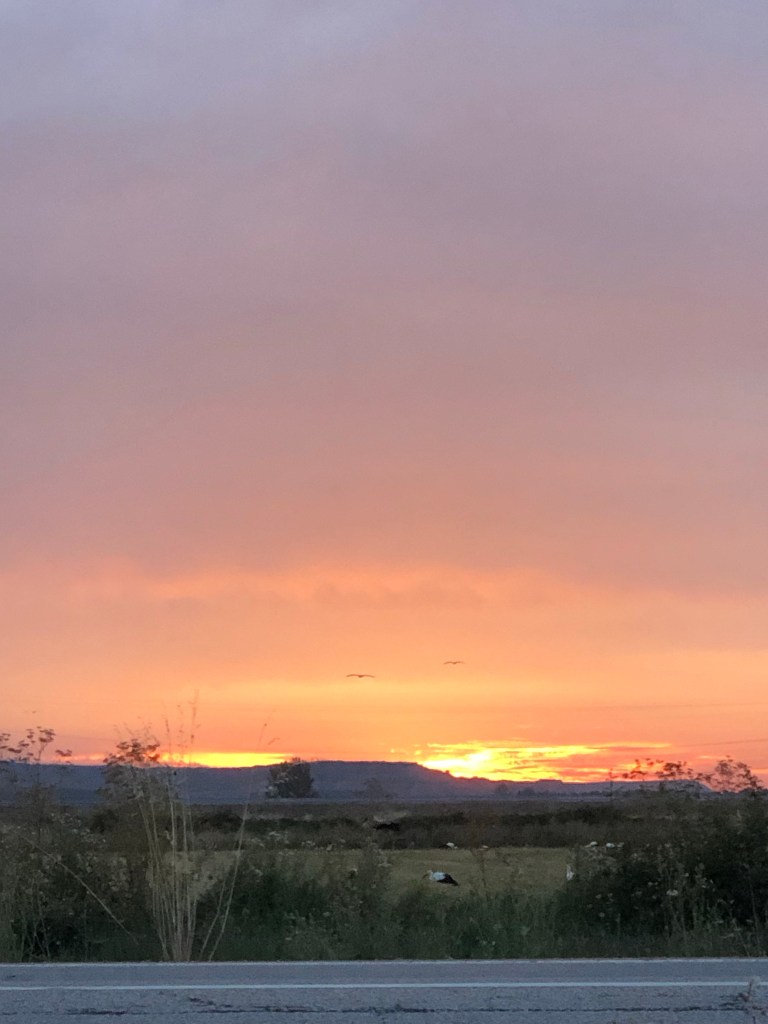
The approach to León is not the most scenic of the Camino by any standards – most of it passes through an extensive suburban industrial estate – but there was still some magic in the sunrise when it came over a roadside field where a large number of storks were flying in to feed from all directions.
I dawdled for a bite to eat in Arcahueja, still in the hope that a few of my pilgrim companions would show up. They must have been tardy this morning, because I never did see them. Instead my French got a serious polishing over a conversation with Jean-Paul from Carcassonne and Adine from Versailles. It might be lacking the instant spark of my last Camino, but if I remember this leg for one thing, it will be the constant linguistic gymnastics – I don’t think I’ve had to bounce between languages so often ever before. It’s bloody good fun!
I reached the outskirts of León at around 10 but it was almost 11 by the time I reached the Benedictine albergue, my digs for the night. Of the old guard, only Sean the Irishman and Alan from Rennes elected to stay here – I haven’t seen anybody else I know. It’s equally possible others will join here. It’s an established fact that the road gets seriously busy from Sarria, so that’s something to look forward to.
For future reference, July is – surprisingly – low season. The Camino is at its busiest in May, June and then August and September. For whatever reason, July is a quiet month on the Camino. Well – now I know!
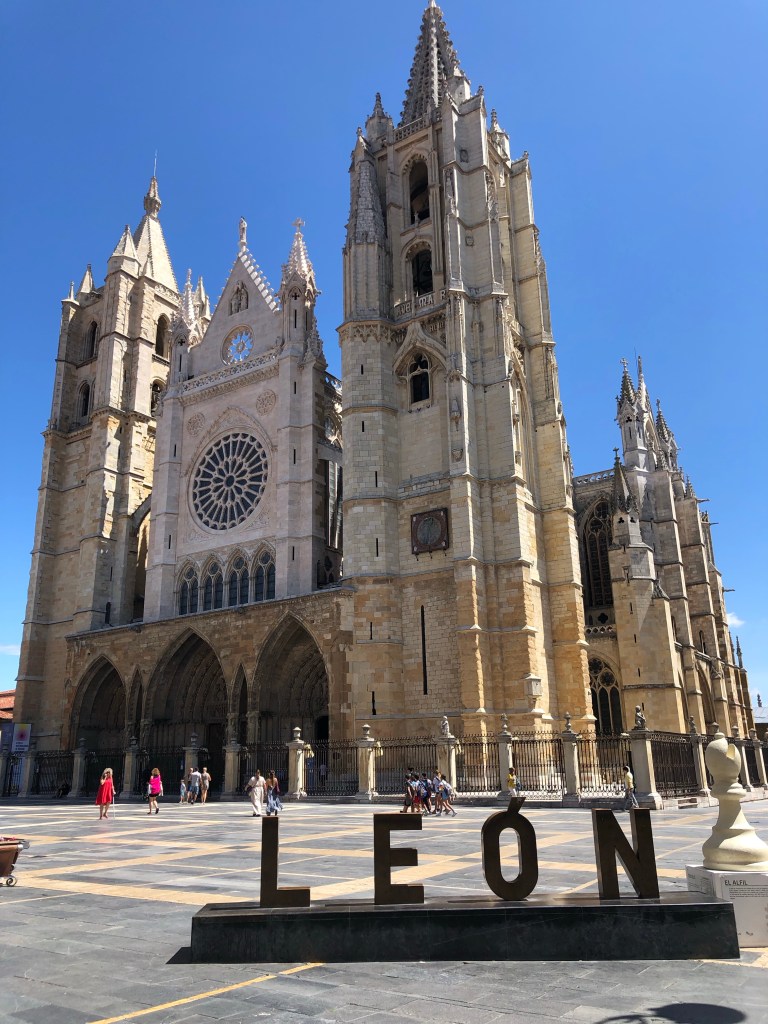
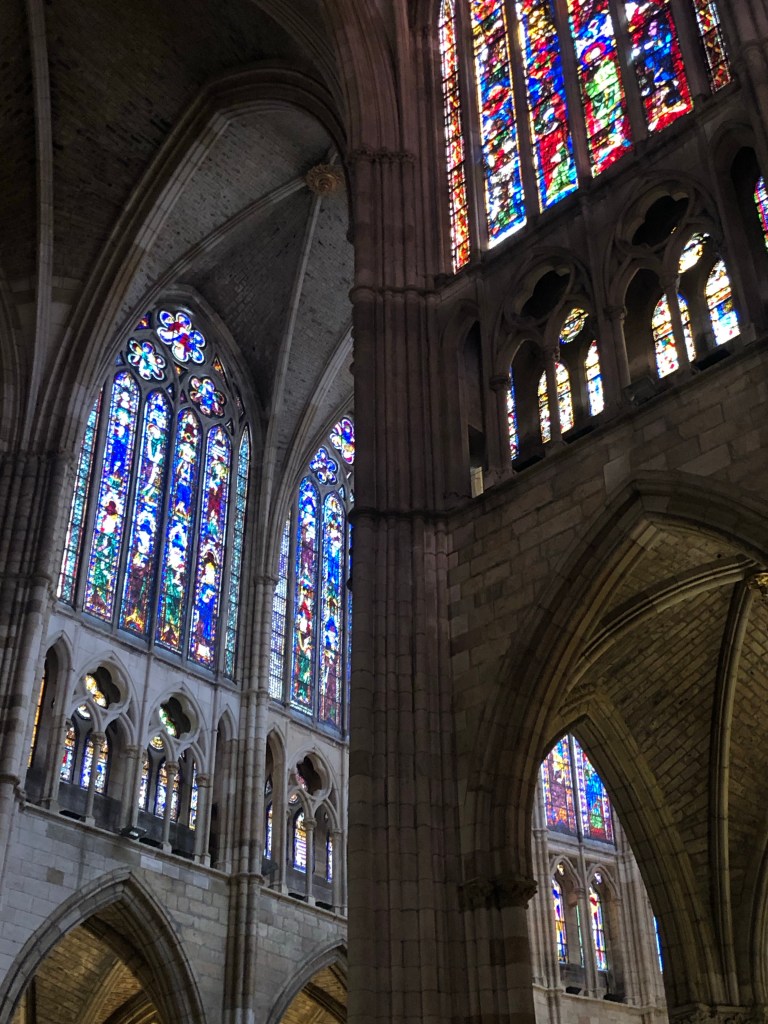
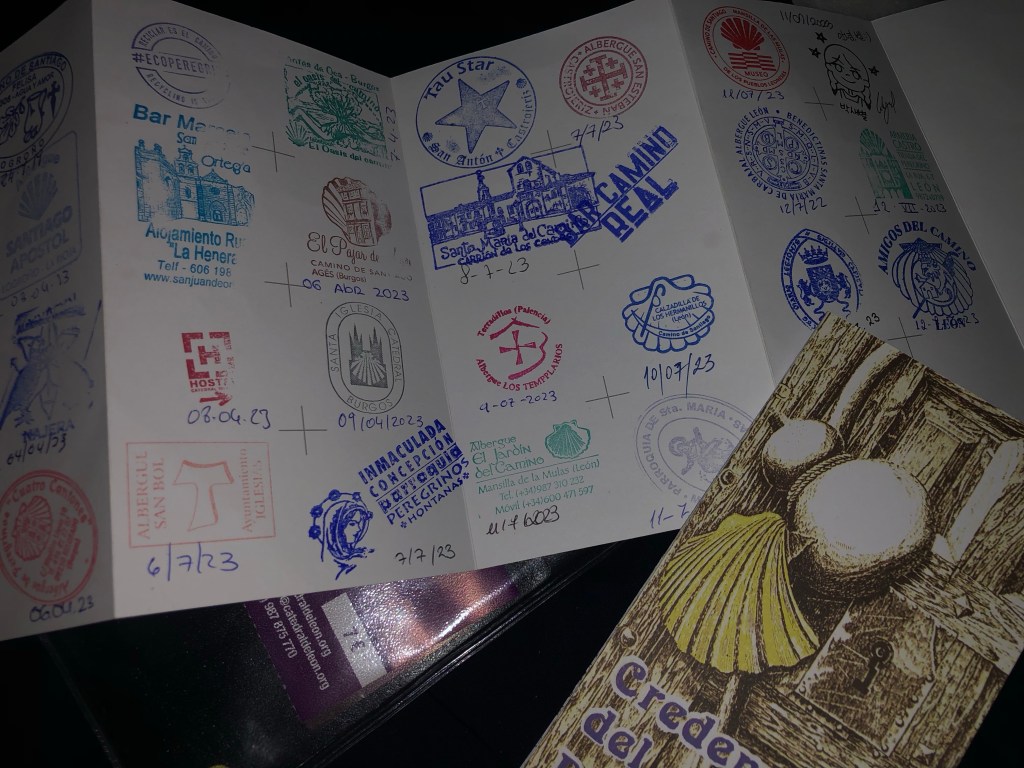
León’s enormous cathedral was under heavy scaffolding the last time I visited so I thought I’d pop inside. It’s pretty magnificent as cathedrals go, but I still think that spending so many hours of my childhood in Canterbury Cathedral has left me somewhat jaded when it comes to cathedrals. More importantly, it produced another stamp for the pilgrim passport, which is now dangerously close to completion…
I had a snack lunch in the kitchen with a very cheap spread from a nearby Coviran and had a short siesta to while away the hours before everything reopened at 6pm. Conscious that the Galician stage requires a minimum of two stamps per day (or something like that), I went to the Asociación de Amigos del Camino de Santiago to seek a new credencial. It wasn’t immediately obvious, but rather, tucked away in an office on the fifth floor of an unassuming tower block above a bank near the Plaza Santo Domingo. The socios inside, however, were wonderfully friendly and I had a good long natter after their initial confusion over my names (Spaniards always seem to have issues gettin their heads around the British custom of middle names). Armed with a new credencial (and with my mood improved by a humorous argument about whether or not to stick the two credenciales together, which was a bone of contention between two of the socios), I am now prepared for the final two stages of the Camino. Bring on the stamps! BB x
I’ll say this much for Calzadilla de los Hermanillos: it’s a beautifully reflective way to end the meseta experience, before you say farewell to the plains and reach the Órbigo floodplains at Mansilla de las Mulas. Sure, I ditched the other pilgrims to strike out upon that road, but it was totally worth it.
The hostalera in the donativo laid out a real spread for breakfast, so I helped myself to a better start than I’ve had in days: boiled eggs, yoghurt, pastries, flat peaches, cherries and a sandwich and a half for the road. Fuelled on such a feast, I was more than ready to tackle the Roman Camino.
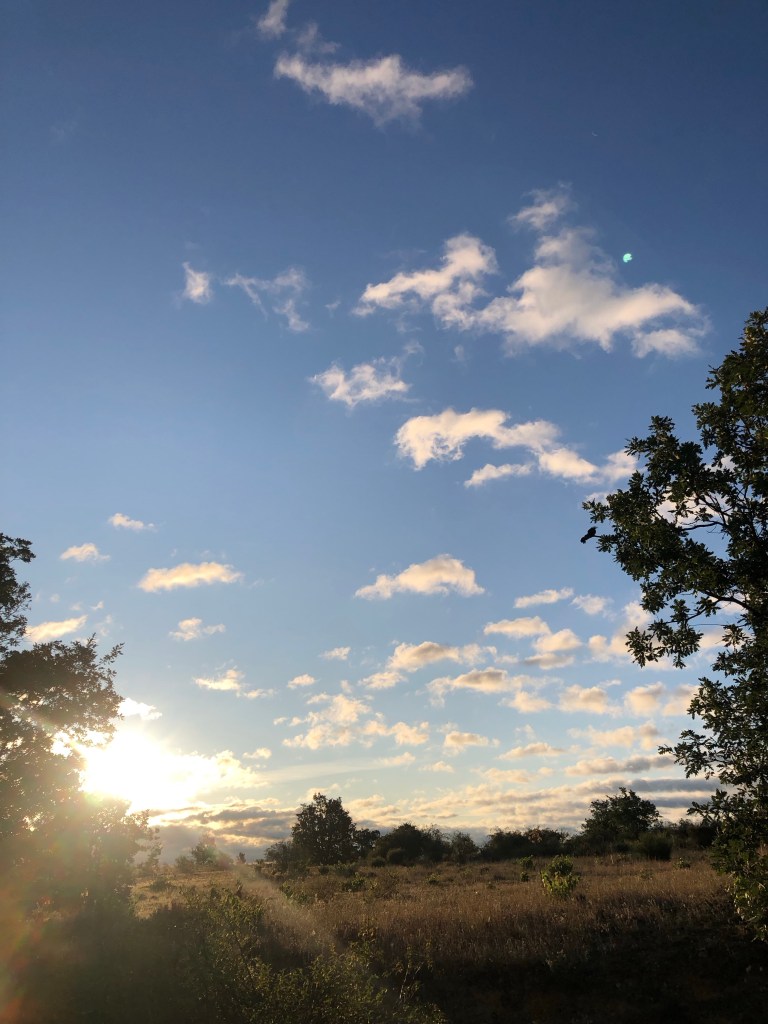
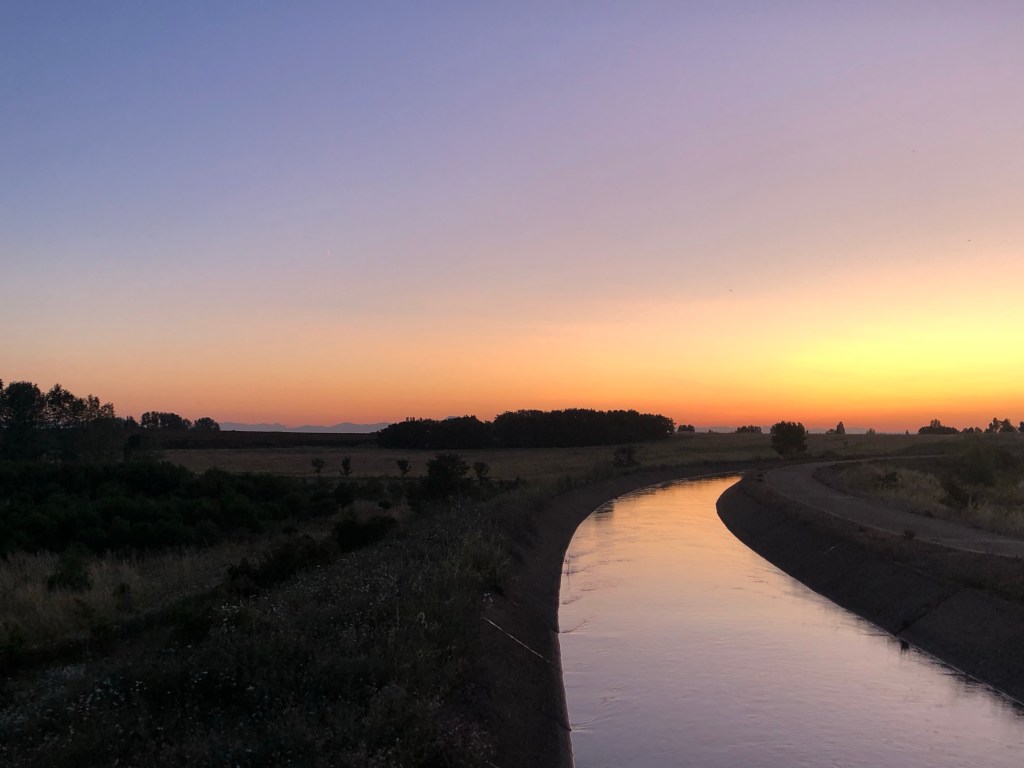
After outstripping the other pilgrims, I had the rest of the Calzada Romana – the ancient Roman raid to the mines – all to myself. And what a morning for it! From the rise, you can see all the way to the distant peaks of the Picos de Europa, ringed with fire by the rising sun. The intermittent canals that cut across the causeway worked like mirrors, carving mercurial strips out of the earth, so that each one seemed to be a continuation of the sky above, and the fields around it a floating world. One of the best sunrises I’ve had on the Camino yet, and I’ve had a good one every day.
You get a good sense of the infinite on the Camino, walking in the footsteps of a thousand years of pilgrims who came before you (the earliest recorded pilgrimage to Santiago was in 930 A.D.), but walking on an old Roman road added another level of grandeur to the experience. The rough stone path made a change from a week of dirt tracks and concrete, and while it may well be wishful thinking in my part, it’s possible, however unlikely, that my feet touched the same stone that some long-forgotten legionary trod two thousand years ago. Nuts!
Sadly I didn’t bump into any ghostly centurions in the early hours of the morning, but the irrigation system provided a jump scare of it’s own: one of the mechanisms was so close to the path that I only had a five second window to clear the distance if I didn’t want to get soaked! That sure woke me up.
One huge plus of not taking the Bercianos route was the wildness of the calzada romana. I had my usual encounters with stonechats and wheatears (both northern and Iberian), but this unfrequented section of the Camino was a real gem for wildlife-watching. I saw my first quail whirring across the fields on tiny wings, and a couple of partridges, rabbits and a lone red deer rounded out this morning’s game. Every arroyo was alive with singing frogs – which is possibly how the nearby village of Burgo Ranero got its name – but a lonely nightingale had them beat toward the end of the road. A couple of ravens loitering around the ruined Villamarcos station chased off a buzzard that perched too close, then eyed me suspiciously as I walked on by. I found one of their feathers a little way on. It’s currently fastened to my walking pole for luck.
After several encounters with the grey males over the last few days, I finally saw a female Montagu’s harrier in the distance, and I must have clocked about nine or ten hoopoes by journey’s end. But best of all was a cuckoo that came out of nowhere during the morning’s only river crossing. Normally you hear these birds rather than see them, but this one was sitting in the middle of the road when a hoopoe gave it a merry chase for several minutes while I removed the grit from my sandals.
I got to Mansilla de las Mulas well ahead of schedule. I knew staying in Calzadilla would shorten today’s walk, but I still got to the albergue for 10.30am, meaning I had a good two and a half hours to kill before anything was open for business. All the same, this time it was as well that I did so: of the three albergues in Mansilla, one was fully booked and another, the municipal, was closed for renovations (and has been since April, at least), leaving me with no options but the pricier Jardín del Camino. I can’t complain after a very affordable night in a donativo, but when you’re used to paying 10€ as a standard, 16€ for a bed and a further 16€ for a menu peregrino is a bit steep… still! It’s all relative. Just think what that would cost back home….!
After a mid-afternoon snooze, I made a beeline for the Museo de los Pueblos Leoneses. Do check it out if you pass through – it’s a veritable gold mine of knowledge about the region and immaculately presented across three floors. I was especially interested in the local festivals and Maragatos, but the collection of dolls was equally memorable… though perhaps for all the wrong reasons!
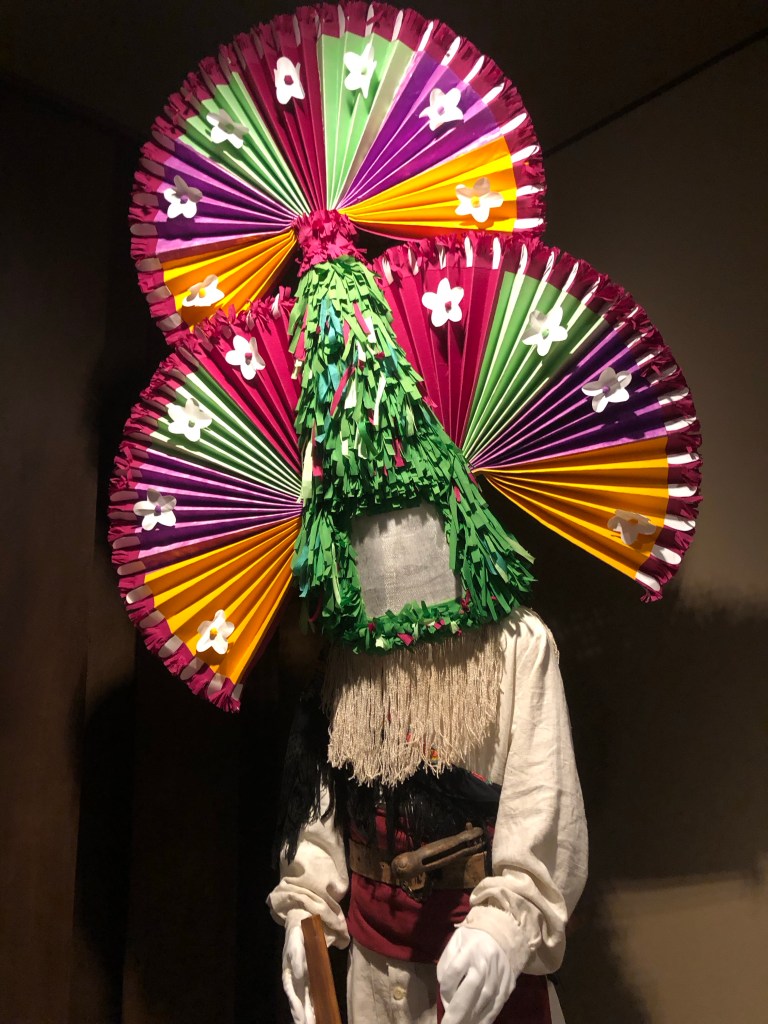
I quizzed the lady at the desk about the signs and she laughed before I’d even finished the sentence. Apparently everybody asks the same question! Yes, she said, it’s not a random act of vandalism but rather the action of a movement which has deep roots in the region, thanks to the fiercely strong regional identity of the Leonese people. Given the chance, many would rather not be conflated with their neighbours. That much is clear from their local customs, costumes and festivals, which differ considerably from the Castilians. I’ve seen vaguely similar outfits in northern Extremadura (which was part of the kingdom of León at the zenith of its power) but the colourful guirrio is almost Latin American in its manic display. I was reminded of an Apache festival I saw in a book once. It’s funny how some people come up with the same concept despite a distance of many thousands of miles.
Tomorrow, I shoot for León. It’s not an overly long walk, or a particularly interesting one as it reaches the outlying industrial suburbs of the great city of the north, so I’ll tarry a little tomorrow and find some company on the road. I should probably also think about booking ahead for Santiago, since at the rate I’m going I really will be there in time for the festivities, and I hear they’re a spectacle that really oughtn’t to be missed if you can help it.
But until then, goodnight – everybody else has been in bed for a half hour already. Time to hit the hay! BB x










 The Book of Barnabas