The Power of Words

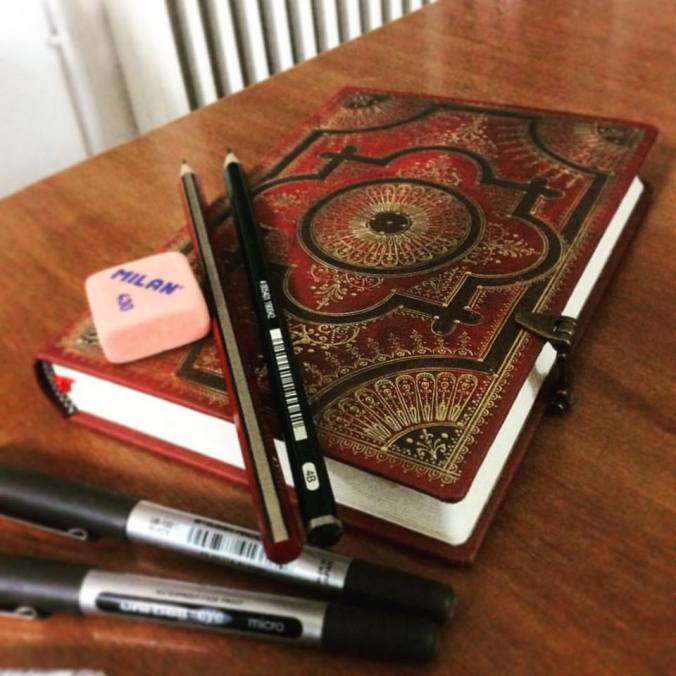
Working life in a boarding school doesn’t exactly give me the time to write I crave. It hardly offers much time for reading, for that matter. But, when a moment comes along when I don’t have lessons to plan, PDPs to fill out, reports to write or duties to carry out, I grab a book and my quote diary and escape for as long as my tired brain allows. I’ve kept a quote diary since 2015, charting my progress through the books I’ve been reading and jotting down any particularly wonderful words or beautiful descriptions – writing that stays with you long after you close the book, like the smoke in the night sky left by a magnificent firework. It’s not the most labour-intensive of blog posts, and yet it is the work of five years of reading. Here’s a selection of my favourite lines from the books I’ve read in that time.

Oh, and if looks as though there’s a lot of H.R. Haggard and M.M. Kaye in there… it’s because there is. Together with Bryce Courtenay, Michael Morpurgo and John Wyndham, they’re my all-time favourite authors.


The Garden of Eden, no doubt, looked fair before man was, but I always think that it must have been fairer when Eve adorned it.
Henry Rider Haggard, King Solomon’s Mines

Her father was a man “led by a star”, as the natives say, and would follow it over the edge of the world and be no nearer.
Henry Rider Haggard, The Ghost Kings

It is certain that few build up the temple of their lives upon some firm foundation of hope or hate, of desire or despair… but rather take chance for their architect – and indeed, whether they take him or no, he is still the master builder.
Henry Rider Haggard, Montezuma’s Daughter

Almost every flock of vultures has its king.
Henry Rider Haggard, Marie

“Duty is a fool-word that makes bones of a man before his time and leaves his girl to others.”
Henry Rider Haggard, Marie

“There’s so much human suffering that the whole world should be wailing.”
Joy Chambers, My Zulu, Myself

“A man’s half licked when he says he is.”
Jack London, White Fang

For most of the years of my life I have handled human nature in its raw material, the virgin ore, not the finished ornament that is smelted out of it – if, indeed, it is finished yet, which I greatly doubt.
Henry Rider Haggard, Child of Storm

There is nothing more uninteresting than to listen to other people’s love affairs.
Henry Rider Haggard, Child of Storm

“He who walks into a storm must put up with the hailstones.”
Henry Rider Haggard, Child of Storm

“First serve, then ask for wages.”
Henry Rider Haggard, Allan’s Wife

“What is life but loss, loss upon loss, til life itself be lost? But in death we may find all the things that we have lost.”
Henry Rider Haggard, Allan’s Wife

Complete happiness in this world is not allowed for even an hour.
Henry Rider Haggard, Allan’s Wife

“Music is a living art, ambassador. It’s meant to illuminate the emotions of the one who gives it life. How can written music have any feeling?”
Thomas Hoover, Moghul

“The Infinite will of God is always mysterious, mercifully granting us what we need more often than what we want.”
Thomas Hoover, Moghul

“We are all searching for our own self. But the self is not easy to find, so we travel afar, hoping it lies elsewhere. Searching inward is a much more difficult journey.
Thomas Hoover, Moghul

Kings have frequently lamented the miserable consequence of being born to great things.
Daniel Defoe, Robinson Crusoe

There was something in Johnny’s character that was pure gold without a trace of alloy.
M.M. Kaye, Shadow of the Moon

“No man goes so far as he who knows not where he is going.”
M.M. Kaye, Shadow of the Moon

Conway Barton possessed a love of two things that have never yet failed to ruin those devotees who have worshiped them to excess: Drink and Women.
M.M. Kaye, Shadow of the Moon

It was an age of lavishness. Of enormous meals, enormous families, enormous, spreading skirts and an enormous, spreading empire. Of gross living, grinding poverty, inconceivable prudery, insufferable complacency and incomparable enterprise.
M.M. Kaye, Shadow of the Moon

It is darkest under the lamp.
M.M. Kaye, Shadow of the Moon

Ten men with one heart are equal to a hundred men with different hearts.
M.M. Kaye, Shadow of the Moon

“No sport is worthy of the name that does not include an element of risk.”
M.M. Kaye, Shadow of the Moon

“Though I can feel the wind and hear the thunder, I do not yet despair of avoiding the storm.”
M.M. Kaye, Shadow of the Moon

“I put my hand upon my knife and walked as a cat walks in an alley full of dogs.”
M.M. Kaye, Shadow of the Moon

“The Lord helps those who help themselves.”
M.M. Kaye, Shadow of the Moon

“I have yet to learn that cure is preferable to prevention.”
M.M. Kaye, Shadow of the Moon

Dasim Ali was a placid and pleasant person who harboured no bitterness towards anyone – except on occasion towards God, who had granted him no sons.
M.M. Kaye, Shadow of the Moon

“Fire is a good friend when men are few and foes are many.”
Henry Rider Haggard, The People of the Mist

What a vast gulf there is between love and loved! It is measureless.
Henry Rider Haggard, The People of the Mist

The devil – a very convenient word at that – is a good fisherman. He has a large book full of flies of different sizes and colours and well he knows how to suit them to each particular fish. But white or black, every fish takes one fly or the other, and then comes the question – is the fish that has swallowed the big, gaudy lure so much worse or more foolish than that which has fallen to the delicate white moth with the same sharp barb in its tail?
Henry Rider Haggard, Allan and the Holy Flower

“If the snake had the strength and brain of the elephant, and the fierce courage of the buffalo, soon there would be only one creature left in this world.”
Henry Rider Haggard, Allan and the Holy Flower

“You don’t understand. If only you understood, you would understand.”
Henry Rider Haggard, Allan and the Holy Flower

“You white men are very clever and think that you know everything, but it is not so, for in learning so much that is new, you have forgotten much that is old.”
Henry Rider Haggard, Allan and the Holy Flower

The night is dying, the day is not yet born.
Henry Rider Haggard, Allan and the Holy Flower

“New journey, new stick, Baas!”
Henry Rider Haggard, Allan and the Holy Flower

Love is the best of medicines – if it be returned.
Henry Rider Haggard, Allan and the Holy Flower

“I am a cosmopolitan. But then the gods of nationalism rose up.”
C.J. Sansom, Dominion

In the summer of 1929 he left for England for a year at Oxford; he felt alone and out of place the whole time there, surrounded by people who mostly seemed either to be decadent aristocrats or pretending to be.
C.J. Sansom, Dominion

“This view reminds me of a story I learned at school: He took Jesus to a high place, and showed all the kingdoms of the world, and the glory of them; and said, ‘All these things I will give thee, to have dominion over, if you will fall down and worship me’.” He frowned. “That is not quite right. Was it ‘dominion’ or ‘power’? Anyway, it was something like that.”
“Jesus was a Jew, wasn’t he? Who was it who took Jesus to the high place?”
Gunther shrugged. Then he remembered, with a superstitious shiver, that it had been the Devil.
C.J. Sansom, Dominion

“You don’t see it, do you, people like you? That all you’re doing is standing against the tide of historical destiny. Which, by the way, is about to drown you.”
C.J. Sansom, Dominion

“Love’s a game for the young and lovely, and the mirror, my dear, never lies.”
Aimee Liu, Cloud Mountain

One hundred wireless networks password protected; one thousand humans in an acre holding their wallets close to their genitals.
Amy Liptrot, The Outrun

I heard it said that in London you’re always looking for either a job, a house or a lover.
Amy Liptrot, The Outrun

I wonder if it’s possible to really come back once you’ve lived away for a while, or if it’s called coming ‘home’ when you never belonged.
Amy Liptrot, The Outrun

One day you’ll boast of coming here, but realise you remember nothing about it.
Jane Johnson, Court of Lions

Like eyes they were, and seemed to watch him. The few cliff-dwellings he had seen – all ruins – had left him with haunting memory of age and solitude and something past.
Zane Grey, Riders of the Purple Sage

“Proselyter, I reckon you’d better call quick on that God who reveals Himself to you on earth, because He won’t be visiting the place you’re going to.”
Zane Grey, Riders of the Purple Sage

European women are so cold they give you a chance to say no at every turn, and you feel good about it, too.
Pedro Juan Gutiérrez, Dirty Havana Trilogy

He didn’t worry that the man was going to get him, because the man had got him.
Neil Gaiman, American Gods

Wednesday looked like he had learned to smile from a manual.
Neil Gaiman, American Gods

Ideas are more difficult to kill than people, but they can be killed, in the end.
Neil Gaiman, American Gods

If he were a real woodsman, he would slice off a steak and grill it over a wood fire. Instead, he sat on a fallen tree and ate a Snickers bar and knew that he wasn’t a real woodsman.
Neil Gaiman, American Gods

A salesman in America is naked without his smile.
Neil Gaiman, American Gods

Three may keep a secret, if two of them are dead.
Neil Gaiman, American Gods

That is the tale; the rest is detail.
Neil Gaiman, American Gods

We need individual stories. Without individuals we see only numbers: a thousand dead, a hundred thousand dead.
Neil Gaiman, American Gods

“The Americas just swapped Liberty for sugar.”
Thomas Hoover, Caribee

“What can a man know of wine if he samples only one vineyard?”
“A woman might say it depends on whether you prefer flowers or wine.”
Thomas Hoover, Caribee

“You are hungry and honest, and that is very rare in this country.”
Chimamanda Ngozi Adichie, Americanah

When he was younger he had admired people with moneyed childhoods and foreign accents, but he had come to sense an unvoiced yearning in them, a sad search for something they could never find.
Chimamanda Ngozi Adichie, Americanah

“My name is Gabriel Oak.”
“And mine isn’t. You seem fond of speaking it so decisively, Gabriel Oak.”
Thomas Hardy, Far from the Madding Crowd

Poets must first be hanged, then mourned at the gallows.
Orhan Pamuk, The Red-Haired Woman

My empire is of the imagination.
Henry Rider Haggard, She

“Swift – be swift- death is in the air we breathe.”
Henry Rider Haggard, She

Mediocrity is the best camouflage known to man.
Bryce Courtenay, The Power of One

“My mouth tastes like the splash-board of an Indian lavatory in the mango season.”
Bryce Courtenay, The Power of One

I imaged hundreds of eyes hungrily devouring my freedom as they watched from the prison darkness.
Bryce Courtenay, The Power of One

“Animals, that’s my speciality. You can ask me anything about animals. You name it,” – he brought his hands up as though he were squinting down the barrel of a rifle, pulled an imaginary trigger and made a small explosive sound – “I’ve shot it.” He lowered the imaginary rifle and grinned at me. “I love wild animals.”
Bryce Courtenay, The Power of One

The concept of a white man coming along and forgiving everyone’s sins and then getting nailed to a post for his trouble seemed a highly unlikely story. As Dum pointed out, white men never forgive sins, they only punish you for them, especially if you are black.
Bryce Courtenay, The Power of One

Ruthless logic is the sign of a limited mind. The truth can only add to the sum of what you know, while a harmless mystery left unexplored often adds to the meaning of life.
Bryce Courtenay, The Power of One

“All I know about the Bible is that wherever it goes, there’s trouble.”
Bryce Courtenay, The Power of One

A natural leader, I have found, need never explain. In fact, they less they explain the more desirable they are as leaders.
Bryce Courtenay, The Power of One

“To play black, the music must come from your soul and not from your head.”
Bryce Courtenay, The Power of One

Once a man has lived long enough, every moment is a reflection of some other moment.
Naomi Alderman, The Liar’s Gospel

The name of God is now in the water.
Naomi Alderman, The Liar’s Gospel

Every person wants to feel that some other man can guide them back into the light.
Naomi Alderman, The Liar’s Gospel

Storytellers know that every story is at least partly a lie.
Naomi Alderman, The Liar’s Gospel

“Put your God away. You have one too many loyalties.”
James Clavell, Shogun

“Endeavour” is an abstract word, and unsatisfactory.
James Clavell, Shogun

“Love is a Christian word.”
James Clavell, Shogun

Mutiny breeds in idleness, not in hardship or hard work.
C.S. Forester, The Gun

“The hand of God is at work in León.”
C.S. Forester, The Gun

He had seen for himself, on a brief visit to the interior, one of the slave routes that wound across Africa. A trail that had been clearly marked by hordes of vultures that perched among the flat-topped thorn trees, and the bleached bones and rotting corpses of the innumerable captives who had been unable to go any further, and been left to die where they fell.
M.M. Kaye, Trade Wind

Men were covetous, and the world no longer wide enough.
M.M. Kaye, Trade Wind

“If it is a traveller’s tale, where then are the travellers?”
M.M. Kaye, Trade Wind

One day the old cities, if they were not destroyed by war, would be pulled down and swept away, and in their place would arise a flavourless uniformity of brick and mortar, populated by once-colourful people aping the white men’s dress and speech, so that all cities would in time become identical masses of houses and factories, shops, boulevards, and hotels, linked by trains and steam-ships, and filled with imitation westerners imitating western ways.
M.M. Kaye, Trade Wind

The pinkness overwhelmed a person, as an aphid might feel suddenly thrust into the petals of an overblown rose.
Bryce Courtenay, Tandia

If you went indoors for a moment, you’d sense from the change of light that something had happened and then, when minutes later you came out again, there were the towering castles of grey tinged with white, real estate for gods and frightening giants.
Bryce Courtenay, Tandia

“Altruism costs a great deal.”
Bryce Courtenay, Tandia

Suspicion feeds upon itself like a cancer.
Bryce Courtenay, Tandia

People are people through people.
Bryce Courtenay, Tandia

The law cannot stop a man and a woman.
Bryce Courtenay, Tandia

Doris with the wonderful tits was about as subtle as a meat-axe.
Bryce Courtenay, Tandia

“My people [the Jews] have an instinct for knowing when to move. The only we denied that instinct we paid too big a price.”
Bryce Courtenay, Tandia

“I do not suffer from the affliction of being white.”
Bryce Courtenay, Tandia

Together since the world began, the madman and the lover.
Bryce Courtenay, Tandia

God allows no fragmen tof our souls, no atom of our dust to be lost from his universe.
John Rollin Ridge, The Life and Adventures of Joaquín Murrieta

“The usual trouble with liberal-minded men is that they think others are, too.”
John Wyndham, The Kraken Wakes

A city is a desert of bricks and stones.
John Wyndham, The Kraken Wakes

“There are times when one fails to see why God invented the ostrich.”
John Wyndham, The Kraken Wakes

The Bomb appears to have no other destiny but to be held up and shaken threateningly.
John Wyndham, The Kraken Wakes

Listener, the joy of a story is in its telling.
Laila Lalami, The Moor’s Account

Quote Unquote: THE LIFE AND ADVENTURES OF JOAQUÍN MURIETA by John Rollin Ridge

This week I’m looking into a rather different kind of novel, albeit one much more in line with my usual taste. Often considered the first novel by a Native American writer, John Rollin Ridge’s The Life and Times of Joaquín Murieta: The Celebrated Californian Bandit is a remarkable account of the life of one of America’s most infamous outlaws. I have no misgivings in making such a claim: Joaquín Murieta may not be a household name like Butch Cassidy or Billy the Kid, but as the primary inspiration for Zorro, and by proxy Batman, the Californian bandit’s legacy is alive and kicking.

As might be expected of a bandit narrative, Joaquín’s tale is a tragic one. Ridge paints a picture of a man who set out with honest intentions but turned to villainy after being wronged once too often on account of his being a Mexican in an increasingly intolerant America (a situation that still resonates painfully across the ages). Finding himself on the wrong side of the law, Joaquín sets out on a career of vengeance against the nation that would not let a man like him earn an honest living. Along the way he gathers about him a colourful cast of characters, including his sweetheart Rosita, his brother-in-law Reyes Feliz, his nemesis Captain Love, and his bloodthirsty second-in-command, the unforgettable Three-Fingered Jack. The end is never in question – millions before and after Murieta have paid the price for defying the might of the United States – but such is the degree of Joaquín’s panache and gallantry that you might be forgiven for willing him to succeed, no matter how many bloody crimes are committed in his name.

To the modern eye, Ridge’s account comes across as half-story, half-history. This is not altogether untrue: the events within the narrative have been, to a greater or lesser extent, subjected to a fair degree of fictionalisation. An overarching narration of events takes precedence over dialogue and character development, and though Joaquín is very much the star of the show, this is as much the tale of his friends and foes as it is his alone. There are elements of the story that make for some hard reading in the twenty-first century – namely, the casual racism employed towards the Chinese, who fall before Joaquín’s men like wheat in the wind. Where Mexicans and Americans stand their ground and fight to the death, all of Ridge’s “Celestials” (an outdated slur used frequently in the narrative) are cowardly weaklings who habitually grovel and flee at the first sign of danger. They feature as a nameless swarm, fodder for Three-Fingered Jack’s bloodlust and a lawless whetting stone for the sorties of Joaquín‘s gang, since their slaughter rarely if ever provokes any reaction from the Americans. Ridge is, of course, speaking with the voice of his time, but given how evergreen the anti-Mexican sentiment of the narrative remains a century and a half later, it is hard not to draw comparisons to the present. Joaquín’s vendetta is in many respects a racial one, but it is rationalised through his personal tragedy. The xenophobia of his enemies cannot be so easily waived, and the indifference of the Americans upon his slaughtering of the Chinese miners speaks volumes.

I have been passionate about bandits since university. I am not entirely sure why. There is something raw about the idea of banditry that appeals to me, as it must have appealed to the Romantics of the nineteenth century. I chose to study Spanish bandit legends for a research project in my third year at university and I have been hooked ever since. I suppose it could be summed up as follows: the further removed one is from violence, the more exciting that violence appears. Some travellers in the 1800s came to Spain with the express purpose of seeking out an encounter with the bandit chiefs they had read about, leaving bitterly disappointed when they returned home unharmed. As I sit down to write of the legend of Joaquín in the comfort of my study, with the faces of surly Andalusian highwaymen staring down at me from the framed Doré prints on the walls, I am no less afflicted than my predecessors. Joaquín Murieta joins their ranks as a fearsome commander, standing tall alongside other such legends: Serrallonga and Roque Guinart; Diego Pernales and El Barquero de Cantillana; Tragabuches, Pasos Largos and El Tempranillo.

It is easy enough to conjure up a fantasy in one’s mind of the lawless world of Gold Rush-era California, but to do so with any degree of accuracy from the niceties of the present day would be no small feat. To write convincingly about the past, one must ignore the attitudes of the present and fully espouse the zeitgeist of the era in question. Therein lies the pitfall, for where is the storyteller who writes for an audience long since dead? And where is the book that is totally free of the truths and prejudices of the day? The very act of putting work into the public domain is to subject it to the scrutiny of the present-day readership, and it is upon this anvil that a story’s success may be made or unmade. To tell Joaquín’s story with more than a kernel of truth today would be to wind the clock back beyond one hundred and fifty years of social change, to a time when it was not essential to take into account the sensibilities of every featured demographic. Ridge’s account sounds so very believable because it was written not long after the events in question occurred, but even then his account is not unbiased: the author’s sympathy for Joaquín bleeds through his writing, for Ridge, a Cherokee, had plenty of reasons of his own to hate the Americans, having lost his father at an early age at the beginning of the events which would lead to the infamous Trail of Tears. History is warped by the age in which it is scrutinised, like a kaleidoscope that twists with each passing year.

August 3rd, 2019. A lone gunman walks into a Walmart in El Paso, Texas, and shoots twenty-two people dead, supposedly in retaliation for the Hispanic invasion of Texas. Within forty-eight hours, a Mexican spokesperson calls the attack “an act of terrorism” against Mexicans living in the US. The men who assaulted the young Joaquín Murieta and raped his wife got the sticky end they richly deserved in Ridge’s account, but in reality they were merely the heads of a greater hydra; the intolerance and hatred they represent is with us to this day. The story of Joaquín Murieta is all the more important now than it ever was. Here is the legend of an ordinary Mexican who was made into a monster by the land of opportunity, but who, like countless bandit heroes before him, rose above the darkness in the hearts of his people to become something eternal: a folk hero.


Favourite Scene:

The parallels between Joaquín Murieta and his illustrious descendants, Zorro and Batman, are mostly subtle ones, drawing largely on the bandit’s sense of nobility and his fight for justice. But there is one scene in particular that is especially poignant in its cultural impact. Having met with an old acquaintance on the road, Joaquín warns him to tell nobody of his presence in the state. The traveller swears he will be true to his word and goes on his way, but upon arrival at the nearest town, he hears talk of the bandit chief and talks of his recent encounter. Unbeknownst to him, Joaquín has friends up and down the country and, hearing of this betrayal from one of his spies, takes the matter personally. He comes to town in disguise, seeks out his old friend and, before dispatching him with a single shot, removes his disguise and declares the immortal line “I am Joaquín!”. It becomes a recurring staple of the legend of Joaquín that he fearlessly reveals himself before making a kill, and it would not surprise me in the slightest if Batman passed over Zorro and got his line directly from the Ridge’s book.


Favourite Character:

Murieta is a man worthy of three legends in one lifetime, but there’s another man in his saga who towers above the rest, and that’s Manuel García, more commonly known as Three-Fingered Jack. Next to Joaquín, Jack is easily the most memorable character, serving as a gruesome foil to Joaquín’s nobility and a grim reminder of the reality of the nature of banditry. Three-Fingered Jack’s unfettered violence is truly galling whenever and wherever it occurs and casts a long shadow over the villainies of his compadres, whose handiwork seems almost gentlemanly in comparison. There seems to be nothing at all redeeming in his character, and yet there is something immensely appealing about the monster – I honestly expected more of the wolverine in his last stand than he actually got.


Favourite Quotes:

They might as well have attempted to catch the red-winged spirit of a storm.

“If you betray me, I will scatter to the winds all that you have and all that you love.”

That terrible, three-fingered hand, which had dyed itself in many a quivering heart, had torn with its ruthless talons the throats of many an agonised victim, and had shadowed itself forth upon the horrified imagination of thousands who only knew that it existed.


I Need A Hero: My Favourite Fictional Leads

I’m off on another adventure in a couple of days. A fortnight in Catalunya awaits – because where better to spend the fallout from all this Brexit madness than with a people who have tussled with independence for centuries? I doubt the Catalans will be all that interested in the petty squabbles of a rather recalcitrant Guirilandia – and anyway, I’m a good deal more interested in their own history – but with another adventure looming, my mind turns back to the world of fiction. I always take a book with me when I travel, as it’s pretty much the one time in the year I can guarantee I’ll get some serious reading done. Frankly, given how important fiction is to me, I’m surprised I haven’t turned my hand to it as a topic more often. So tonight’s post is about putting that to rights. And I thought I’d start with an illustrated list of my favourite storybook heroes.

Perhaps the collection below says a lot more about me than I at first thought possible…


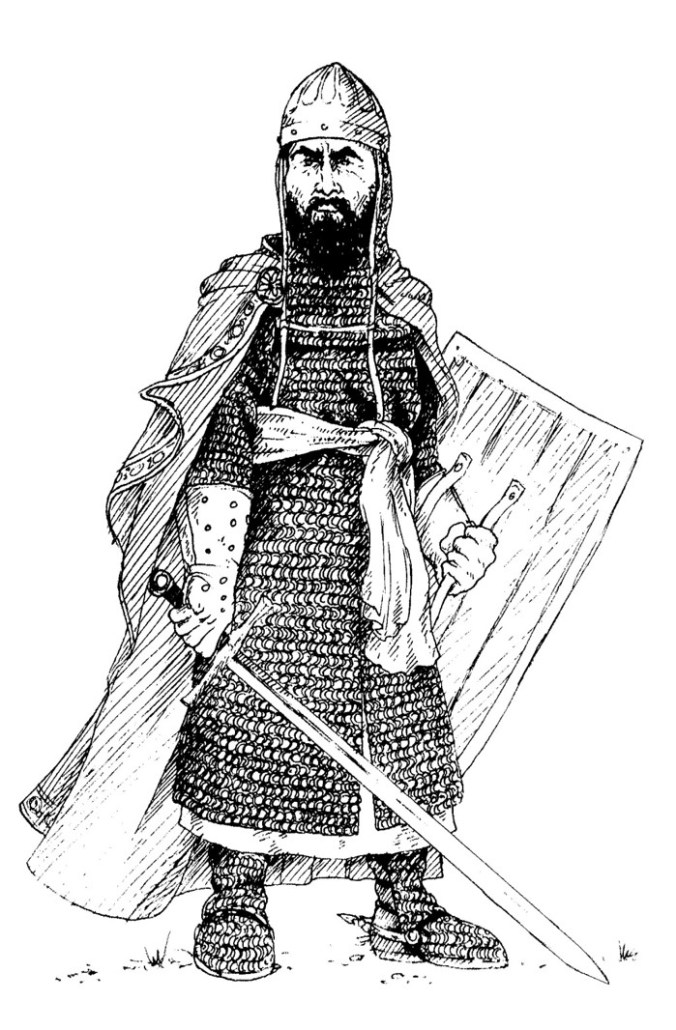
8. El Cid (Cantar del Mio Cid, Anonymous)

Kicking off the top ten with a bit of a controversial one, as this particular hero was a man of flesh and blood before he was a fictional character. Whether or not you choose to see him as a hero rather depends on whose account you choose to follow. Certainly, the Muslim chroniclers of the day didn’t exactly paint a very pretty picture of him. All the same, Rodrigo Diaz de Vivar is a larger-than-life character in his epics, and the seesaw story of his rise and fall and rise again is – for want of a better word – one of my favourite tales. And now that I’m not at university anymore and don’t have to analyse him as a masculine image, or a symbol of religious fervour, or any of that academic nonsense, and can instead indulge in boyhood fantasies once again, he’s a damned impressive hero who is good to his men, be they Christian or Moor, loyal to his wife and king, protective of his daughters and a generally wise arbiter. It’s just a shame about the episode involving the Jews Raquel and Vidas, or he might have placed higher on this list. For some reason they didn’t include that little episode in the 1961 film…

H_Cid


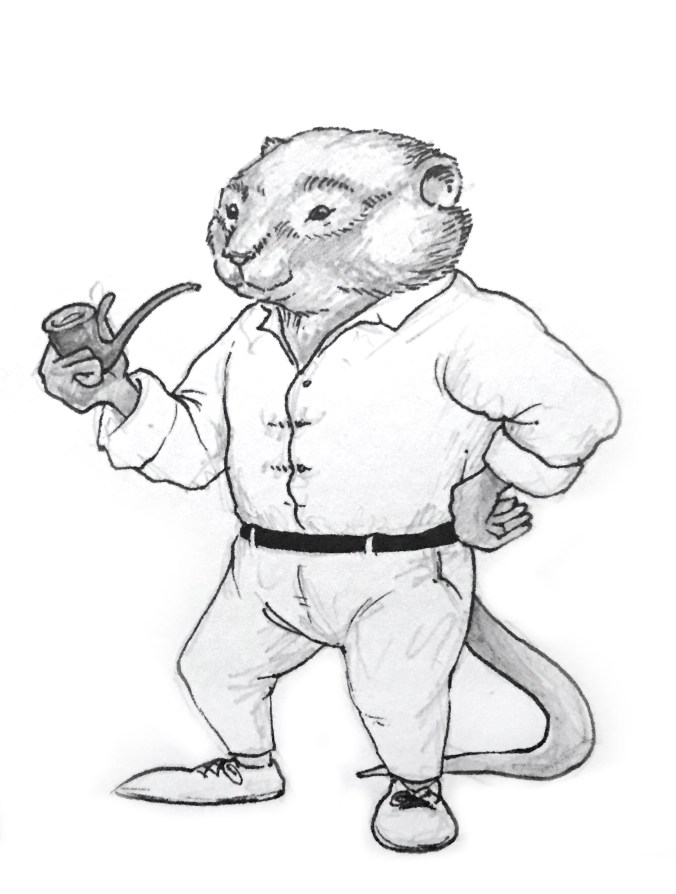
7. Rat (The Wind in the Willows, Kenneth Grahame)

I think one of the things that shocked me most when compiling this list is how quintessentially British most of my favourite heroes are. Come to think of it, there are only really two characters on this list who are not Englishmen by birth or blood. I’d pretty much given up on my homeland for the beauty of foreign lands during my teens. Rediscovering the joy of reading in my early twenties completely turned that around, and made me appreciate on a deeper level characters from my childhood that I’d perhaps not understood fully until that moment. Rat is definitely one of them. An English county gentleman, who balances his seasonal desire to travel and see the world (depicted as a sudden madness) with his unshakeable attachment to his riverside home and his often poetic delight in the countryside around him. Rat always made me think of an England long since gone, albeit much beloved and not entirely forgotten. I could always empathise with Mole stumbling blindly around the new world and Toad still makes me laugh (especially voiced by Rik Mayall),  but I think my heart always did and always will go out to courageous, country-loving Rat.

H_Rat (2)


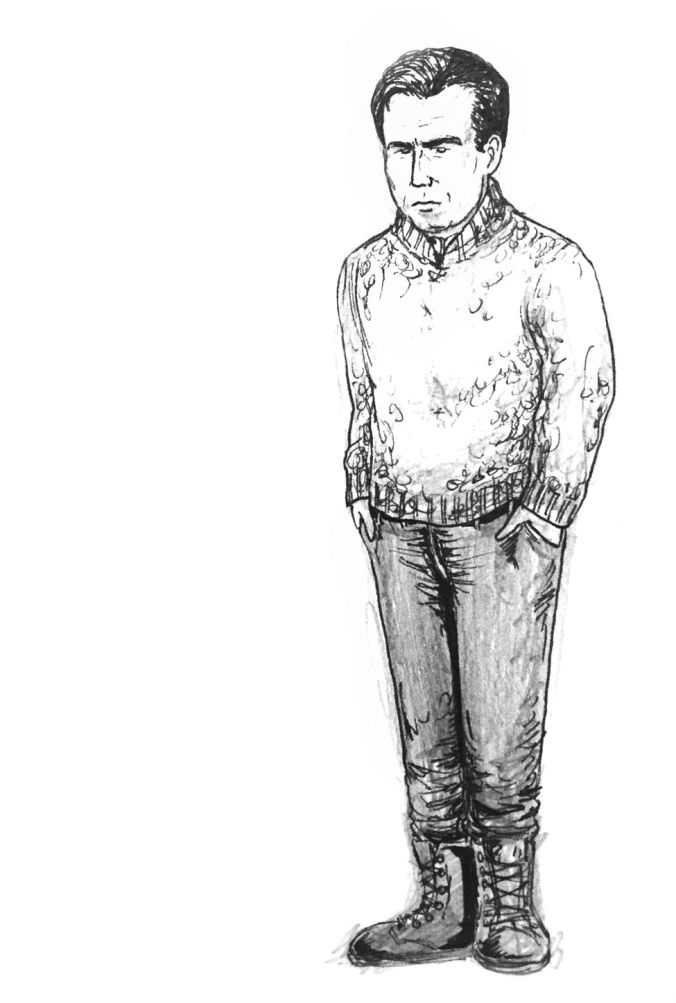
6. Bill Masen (Day of the Triffids, John Wyndham)

There’s something about the quiet, reflective protagonist of Wyndham’s Day of the Triffids that has always drawn me in. Another Englishman, and in many ways as much a caricature as Rat, Bill Masen takes the apocalypse with just the right amount of melancholic reflection and stiff upper lip that you might expect. For a sci-fi book – and a thumping good one, if I might say so – there’s a refreshing absence of the brash, gun-toting, “gotta save the world” Americanisms of your average apocalypse narrative. When he’s not dodging paramilitary groups or sinister man-eating plants, Bill spends most of the book musing on the state of the world after man, the foolishness of man and the loneliness of the human spirit. Triffids will be one of those books I treasure when I grow old, as it was Bill Masen’s thoughts on loneliness that gave me solace when I travelled solo across Spain.

H_Masen


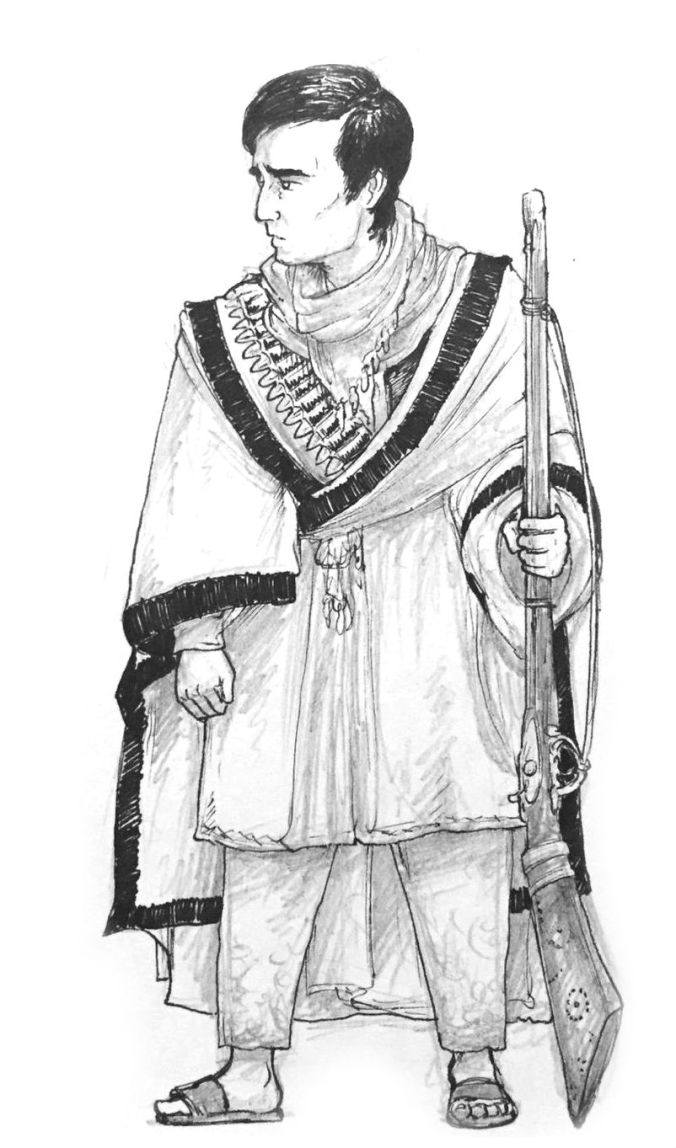
5. Ashton Hilary Akbar Pelham-Martyn (The Far Pavilions, M.M. Kaye)

Let’s be perfectly honest here, to write a list of my favourite fictional heroes and not include the central character of what has always been my favourite book of all time would be nothing short of criminal. Orphaned shortly after birth in an opening that never ceases to chill me, Ashton (Ash) is raised by his father’s syce and spends his childhood under the impression that he’s Indian, before being rudely awakened to his English heritage after a series of adventures. He spends most of the book dealing with the fallout from that revelation, never entirely sure where his loyalties lie, and consequently never truly fitting in anywhere. The only trouble with Ash is he’s just too perfect. He slips up and gets hurt, and you can really feel his pain and his anger when he does, but even as a naïve young man he comes across as just a little bit too good to be true: fluent in more than five languages, an extremely talented sportsman, a natural with the ladies from his first experience and frustratingly good-looking, so much so that he spends most of the book being able to pass for Englishman, Afghan, Nepali or just about anything the plot requires, without having a drop of Pathan blood in him at all. Even so, I confess myself charmed by his tenacity from the beginning and have rarely felt so strongly about a protagonist as I have for Ashton Pelham-Martyn.

H_Ash


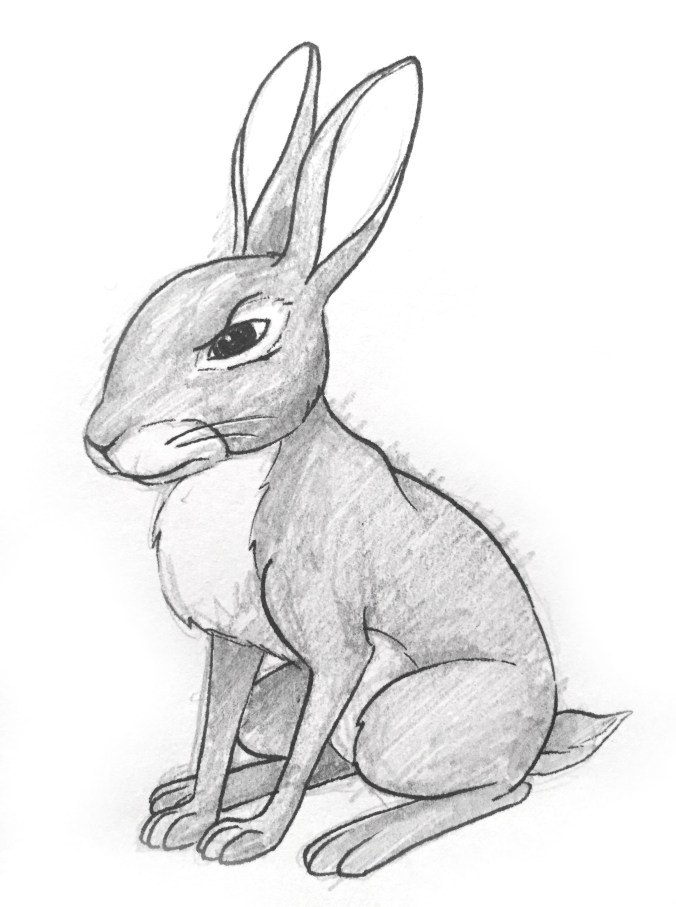
4. Hazel (Watership Down, Richard Adams)

The second anthropomorphic hero on this list is a rabbit, and this one doesn’t even dress like a hero. He’s just a rabbit, and neither the strongest nor the fastest of the rabbits of the Sandleford Warren, but in many ways he’s a greater hero than many of the characters on this list. John Hurt’s voiceover in the 1978 film only sealed the deal. I admit that I saw the animated movie before I read the book, but it evidently didn’t scar me for life as it did to many others as I did go on to read the book (though whoever decided that a visual representation of rabbits being gassed en masse was deserving of a U-rating obviously had some demons). Hazel is wise, caring and self-sacrificing; a true leader, equipped with all the merits of El-Ahrairah, the Prince of Rabbits (a sort of lapine Anansi/Coyote). I know Bigwig has always been the traditional fan favourite, but for me, it’s got to be Hazel, because he’s the kind of leader I could believe in. A hero with no pretensions to glory or leadership, but who looks out for every single member of his clan, and who becomes a leader quite organically as the story develops.

H_Hazel (2)


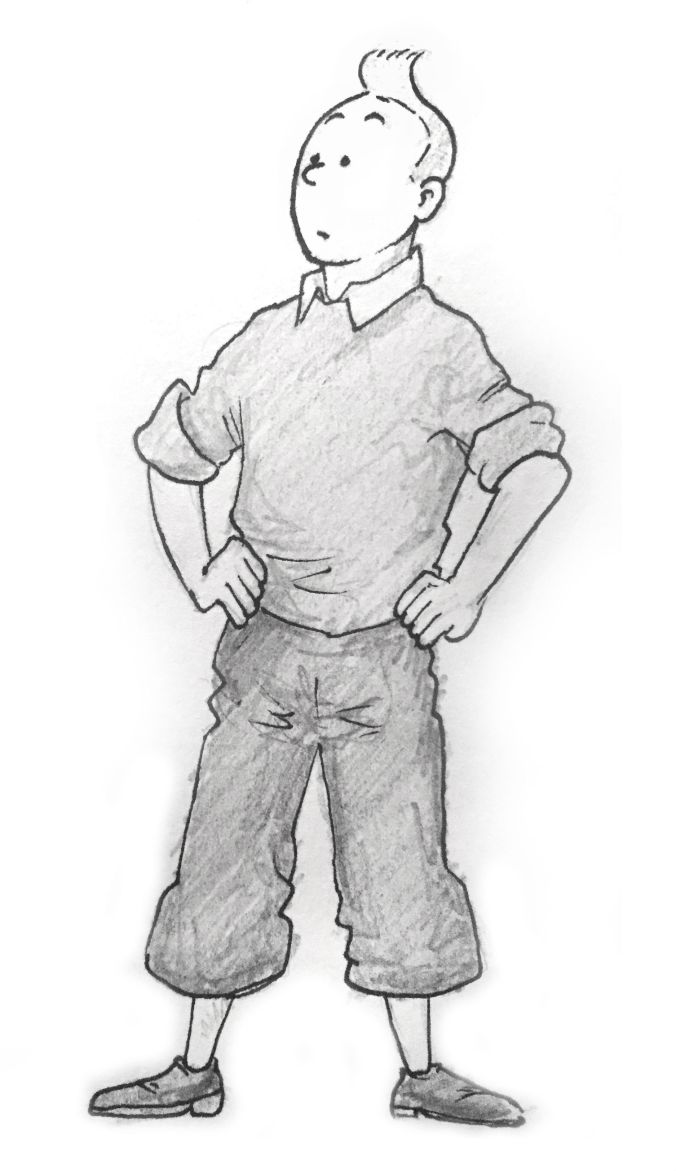
3. Tintin

Probably the most well-known character on this list, Tintin has been in my heart since I was a lad. His agelessness, his never-ending sense of adventure, the fact that you could essentially paint yourself into his shoes wherever he went… and the fact that I’ve been compared to him in every single line of work I’ve ever had, due in part to my round face and strange quiff-thing going on with my crowns. If we forget his earlier iterations (Tintin au Congo was written by a Belgian in a very different age), Tintin is a young man with a heart of gold. Tintin in Tibet is probably his finest hour, showcasing the Belgian reporter’s winsome determination and hope to find his lost friend, who pretty much everybody else has given up for dead. I had every Tintin book bar one as a kid (Dead Sea Sharks), and he’s one of those rare heroes whom I value above the supporting cast, no matter how colourful and memorable they may be (here’s looking at you Captain Haddock, Cuthbert Calculus and, of course, Thompson and Thomson).

H_Tintin


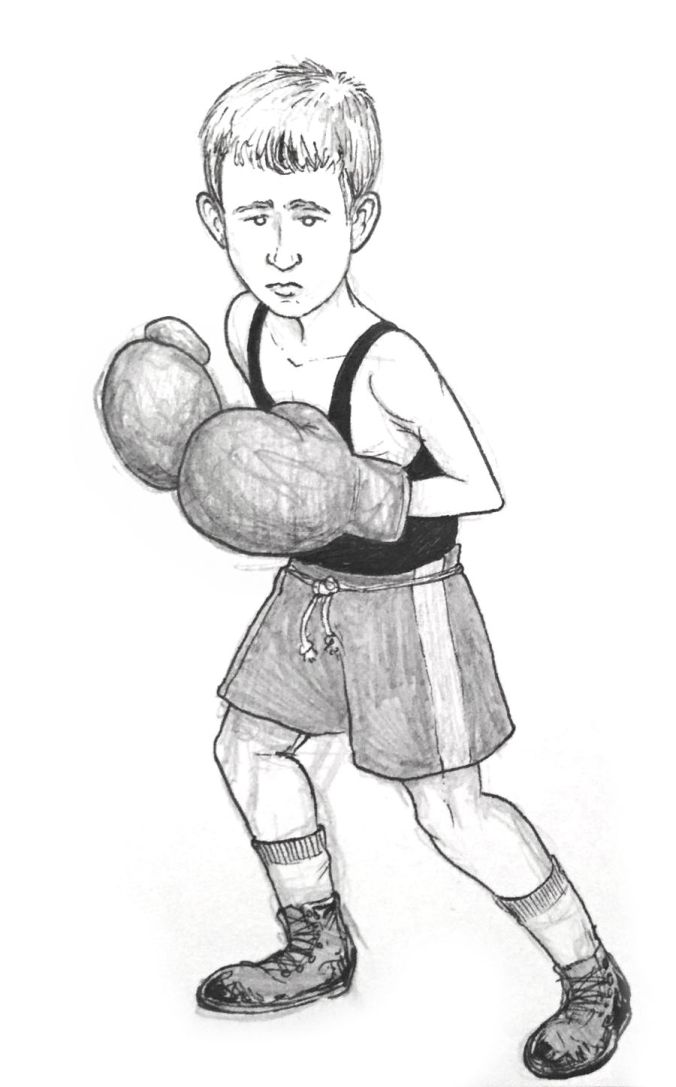
2. Peekay

The top two spaces go to two heroes who share the same country: South Africa. British by blood, Peter Philip Kenneth Keith – unfortunately named by his parents, more fortunately shortened to Peekay by the author – has a hard lot growing up as a little boy in an adult world. You hardly even notice him age as he often seems mature beyond his years, the result of being forced to land on his feet by his born-again mother and his tormentors, including the Judge and the vile Sergeant Bormann. The way Courtenay has him describe loneliness is every bit as powerful as Wyndham, if not doubly so in that it comes from the voice of a child. And Peekay’s fierce sense of justice and morality – a common feature in Courtenay’s heroes – is exactly the kind of thing I could go for. Throw antiheroes and bad-guys-gone-good at me all day, but I love a hero with a strong moral compass. I wanted to learn to box when I read the book and watched the film, so greatly did I fall under the spell of this particular fighter. All the same, when it comes to the title bout for my favourite fictional hero, there’s one man who just beats Peekay to the punch…

H_Peekay


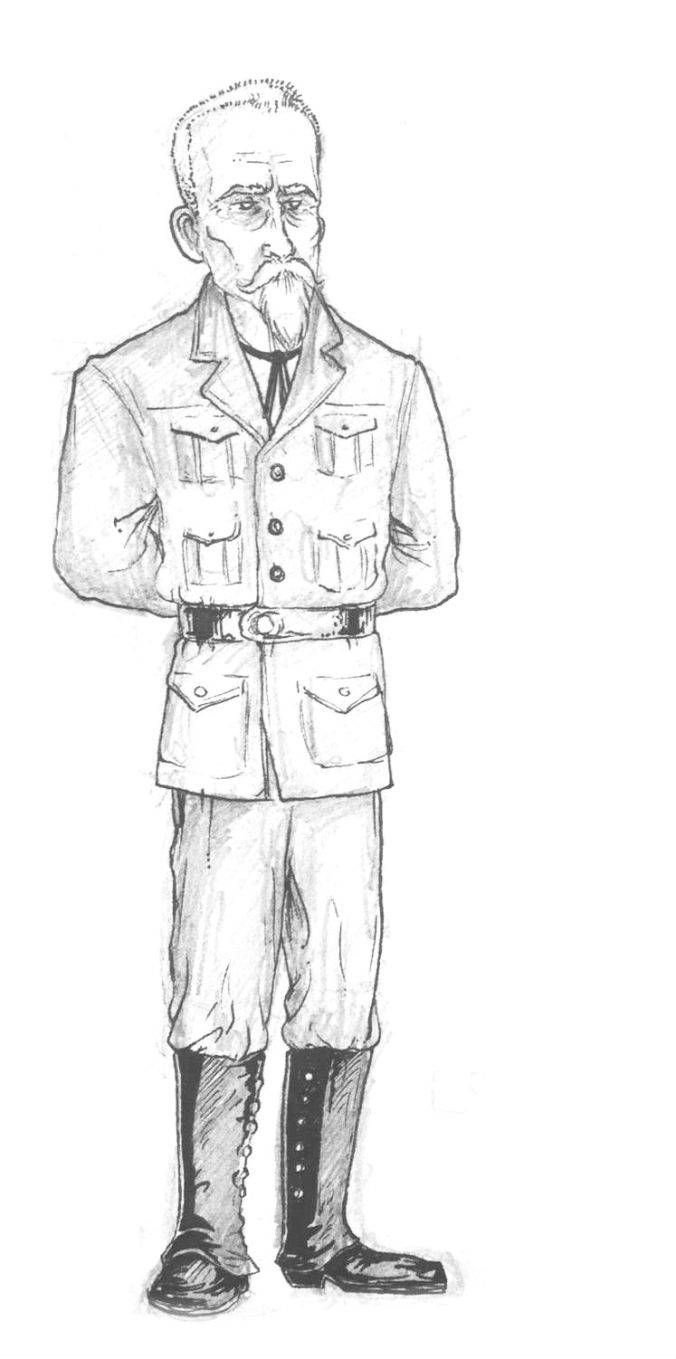
1. Allan Quatermain

If you’ve read my writing before, this will be no surprise. Allan Quatermain is my favourite fictional character, hands down, no contest. Not the version you might have seen in League of Extraordinary Gentleman movie (though the graphic novel is close enough), I’m talking about the original. Humble. Wise. Melancholic. Cynical, but not unadventurous. And, though modern readers might find his language more than a little antiquated and even offensive, rather advanced and liberal-minded for his day. Allan Quatermain was the inspiration for such legendary figures as Indiana Jones, but I’ve always found the source material a good deal more inspiring. Maybe it’s his undaunting appearance – a wiry old man with bristly hair, a short stature and a shrinking habit – that makes him so likeable. He lives alone, but keeps good company and is a ceaseless fountain of wisdom, whether that wisdom comes from his own mouth or the mouths of his sage companions like Hans, or Umslopogaas, or Indaba-zimbi. Perhaps, above all else, the true quality of Allan Quatermain is the quality of his writer. The old adage, write about what you know, can be a little restrictive for those who enjoy historical fiction. Henry Rider Haggard, however, was at the very heart of the world about which he wrote, seeing the Boer Wars at first hand and even taking an active role in them himself. Quatermain taught me a lot about the world when I started reading again, but most importantly of all, he gave me a reason to embrace my homeland once again. It will be a while before any hero, great or small, topples the great Macumazahn from his seat at the top of this list.

H_Allan

Special mention: Quint & Maris (The Edge Chronicles, Paul Stewart & Chris Riddell), Harry Flashman (Flashman, George MacDonald Fraser), Richard Sharpe (Sharpe’s Tiger, Bernard Cornwell) and Tommo (Private Peaceful – but just about every protagonist from Michael Morpurgo’s books would do)

Did you like this list? Feel free to copy the idea for posts of your own. BB x

Old vs New

It’s been a mad week. Over the last week I’ve had to fret over dwindling career prospects, squeeze answers out of a class that don’t appear to have improved at all in two years, hurdle a new wave of needlessly ambiguous admin, wrangle with pushy internet dealers and, to top it all off, deal with a flatmate and a friend who could still disappear at any given moment should a better offer arise. It’s not been easy. The first few weeks of term are always an uphill struggle but I’ve never known one week quite this bad.

Five days of mental block were torture. None of my attempts at writing came to fruition. I needed a break. I had to get away from it all. And Fate, as she often does in such situations, came up with the goods. At the end of an afternoon spent filling in forms for Student Finace and the local Junta – and venting my hysteria through last week’s Have I Got News For You – an offer to join the other auxies for a Halloween Party came through. I ummed and ahhed and was on the verge of turning it down when I had one of my spontaneous urges and decided to go for it. I had no time to prepare an outfit, so I came as an un-ironed shirt. Perhaps that’s the least of the small-world horrors I’ve had to deal with this week, but it was easier to explain.

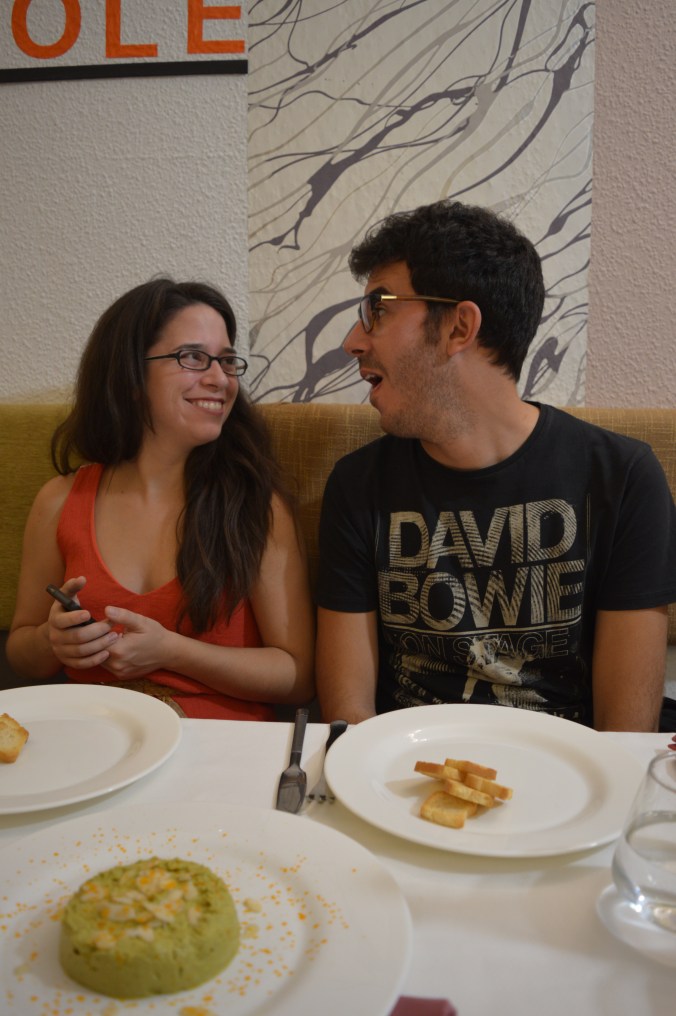
It was an enjoyable if tame night, for which I was truly grateful. I had the chance to discuss my music withdrawal issues with a kindred spirit, and to gather opinions from the new auxies on their new home. I also got to put my dancing shoes on at Concha when Billie Jean came on. I needed that. But most importantly of all, I got to spend some quality time with two of the brightest stars of the Tierra de Barros, Tasha and Miguel.

DSC_0807

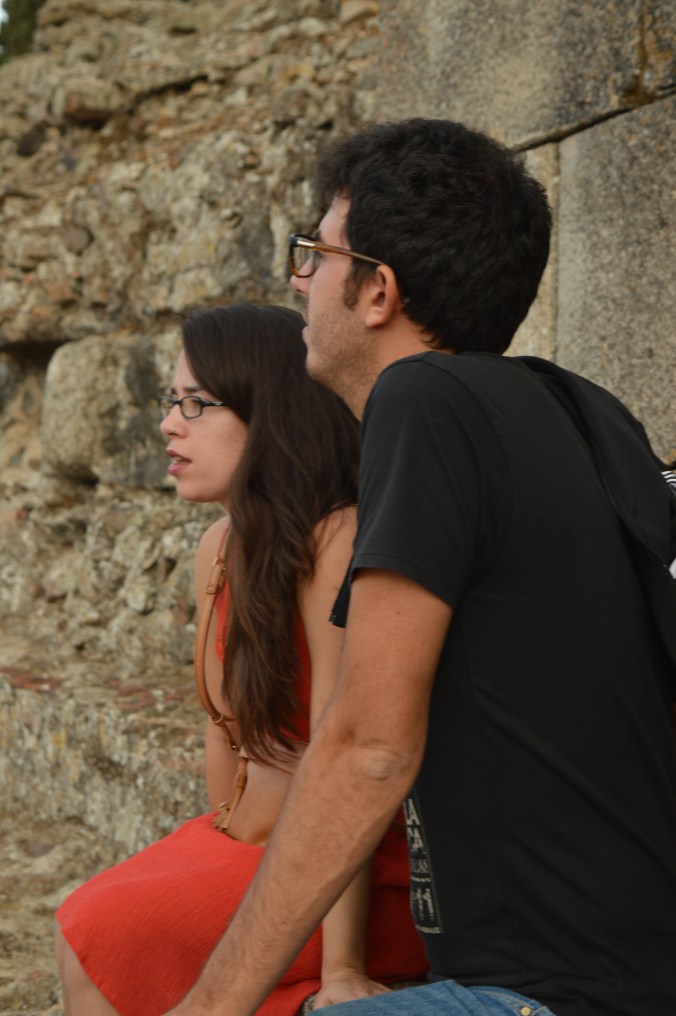
If I needed a reaffirmation that I had made the right choice in coming back to Villafranca and not striking out somewhere new, this was it. These two are perhaps the greatest of all reasons for my return. Vultures, Hornachos and migas were waiting, but these two goofballs were a greater lure yet. And it isn’t often you can so easily allow yourself the luxury of moving your workplace to be near to your friends.

DSC_0889

We spent the day in Mérida, where Fate once again showed me a kind hand for my spur-of-the-moment decision. Because I spent time with Tasha, I learned that the Junta needs a stamp from the bank and a paper copy of our ICPC, which have to be mailed, not emailed. Even though I went to the Orientation days this year, that detail wasn’t spelled out, nor was it included in the emails. It’s a good thing I spent Friday morning hunting for envelopes and stamps, albeit for a different purpose. If the man at the estanco hasn’t been so dishearteningly begrudging at surrendering two rows of stamps rather than the twenty I was asking for, I might have used them all. Forewarned is forearmed.

She also demonstrated a knack for knowing my desires by meddling with Miguel’s car’s CD player. The Red Hot Chilli Peppers CD kept pausing, so he put on a Galician band who played the unmistakeable lullaby-dream of Erin Shore, albeit to the name of Romance de Novembro with Galician lyrics – this, after gallego has been so on my mind after my parents’ visit this week. Fate, or whatever it is that organises these things, sure knows what she’s doing. At twenty-three years old, I still cling to the storybook belief that everything that happens happens for a reason. It’s hard not to see the lines when you want to.

DSC_0811

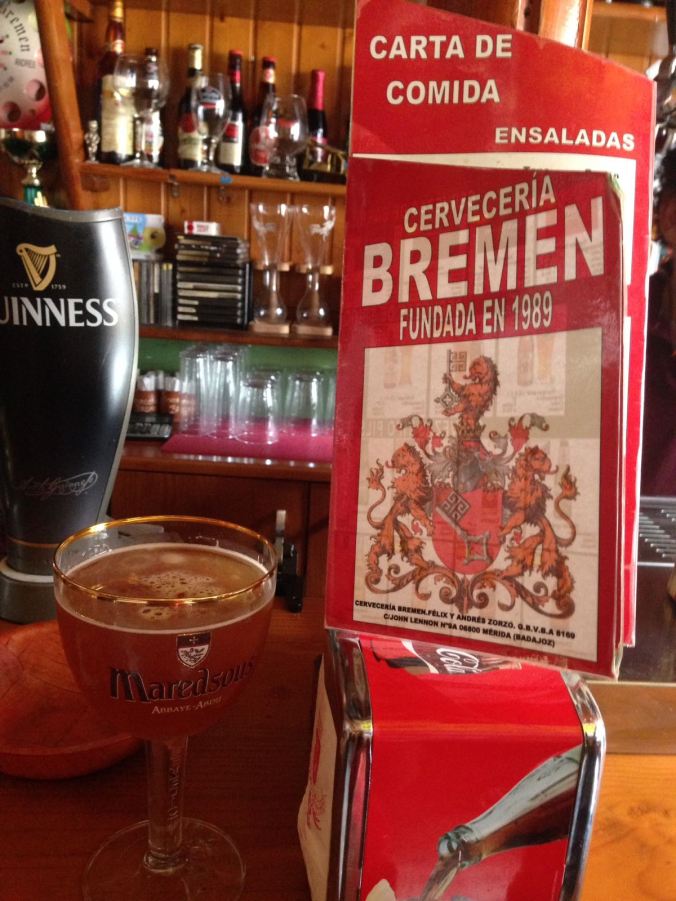
 We had a couple of beers in a Bremen-themed bar on the curiously named John Lennon Street, complete with memorabilia of the former Beatle plastered on the wall beside buxom stein-bearing belles and German insignia, whilst the bartender bemoaned the loss of jobs in the wake of Catalonia’s defiant pursuit of independence. Spanish flags still hang from balconies across the region a week and more after the Día de España celebrations, in solidarity with a nation that’s being pulled apart by old wounds. My beer tasted like strawberries and wasn’t unpalatable. I guess beer is like tea, coffee and sitcoms: unappealing at first, but you learn to appreciate it over time. Effort leads to endurance, eventually, enjoyment.

IMG-20171021-WA0013

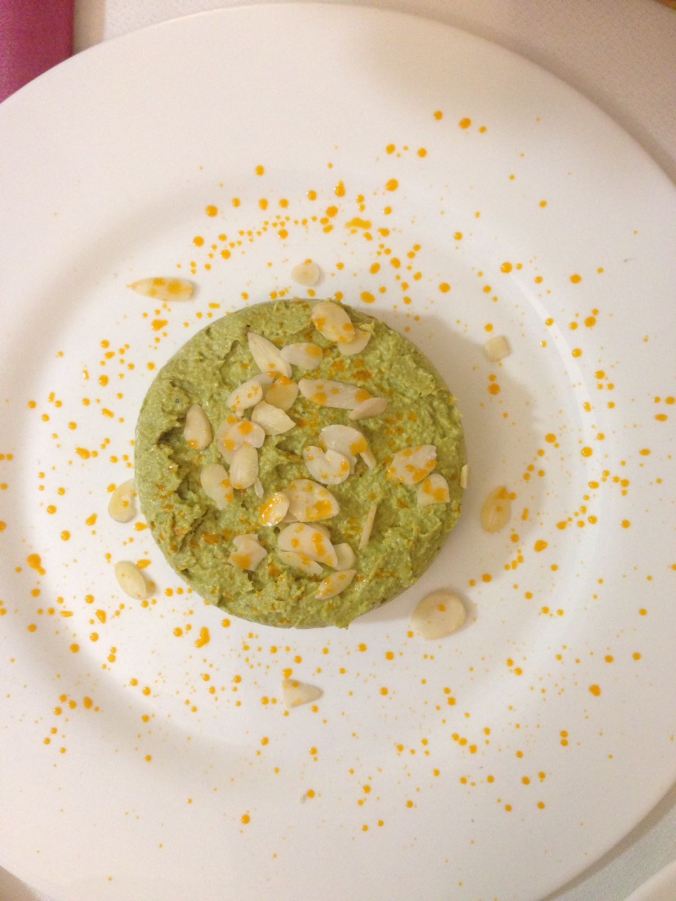
Lunch was superb. We visited La Taberna del Sole on the recommendation of a student of Tasha’s and we were not disappointed. Four courses (including a green asparagus and almond pâté and the ever-reliable croquetas de jamón) left us fit to bust, and at under twenty euros a head, it was a steal for a fancy lunch. The city is finally opening up to me.

IMG-20171021-WA0014

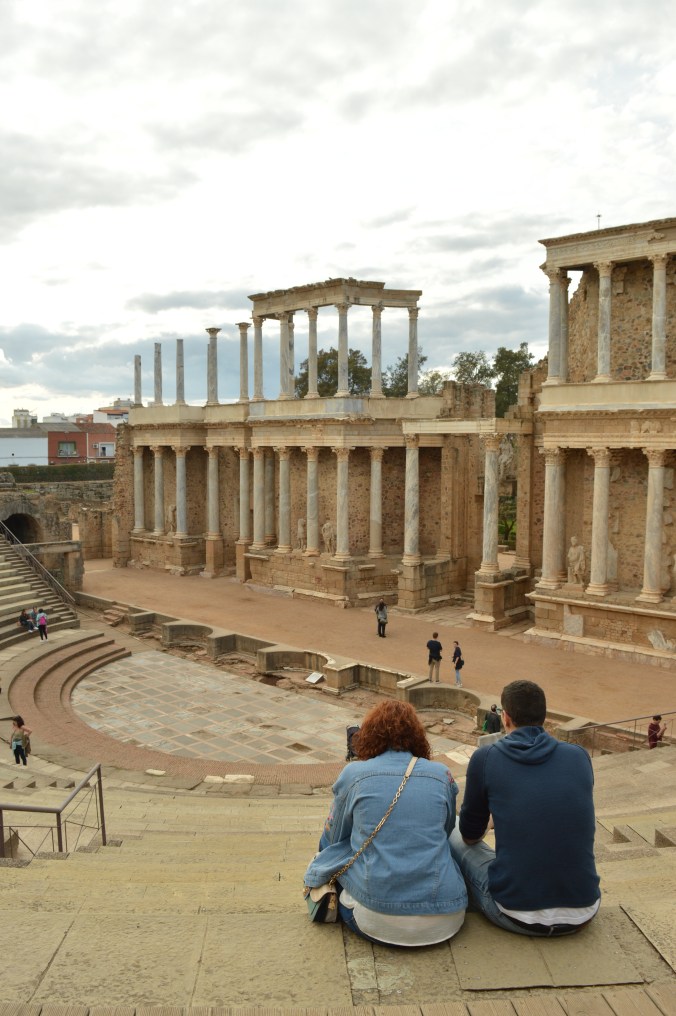
Despite having already lived here for a year, I never visited Mérida’s famous Roman theatre. Tasha and Miguel thought it was high time that was remedied. I guess I’m spoiled from having wandered the ancient beauty of Jerash and Petra, but Mérida’s reconstructed theatre complex is nothing to be scoffed at. It’s hard to believe it was all but underground a few decades ago, back when the city was confined to the north bank of the Guadiana and the Los Milagros aqueduct still marked the northern edge of town. Stradivarius and Burger King now adorn the old streets, rubbing shoulders with the Temple of Diana and Saint Eulalia’s basilica. Times are changing quickly here.

DSC_0873

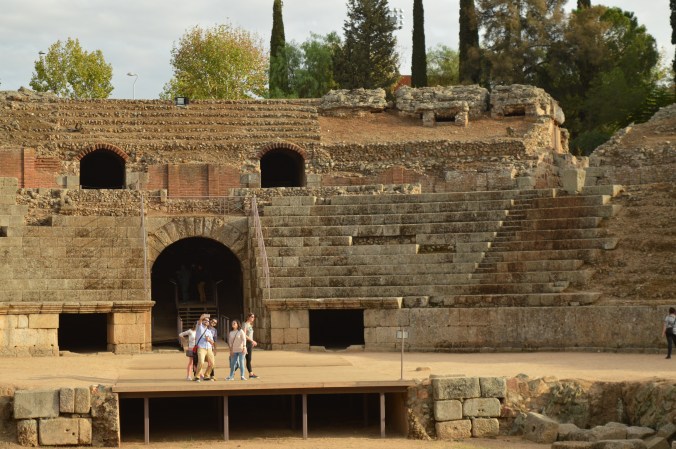
The amphitheatre is equally impressive. Complete with a sunken arena that wouldn’t look out of place in an episode of Pokémon, the building is in remarkably good nick for its age. It’s always a little hard to tie the two together, the sophistication of the Roman Empire and the bloodlust of its citizens who paid to watch men and beasts kill each other. Man, the noblest of all beings, and the one who delights most in killing his own kind. In Rome we see man for what he truly is, perhaps. A vainglorious hypocrite.

DSC_0902

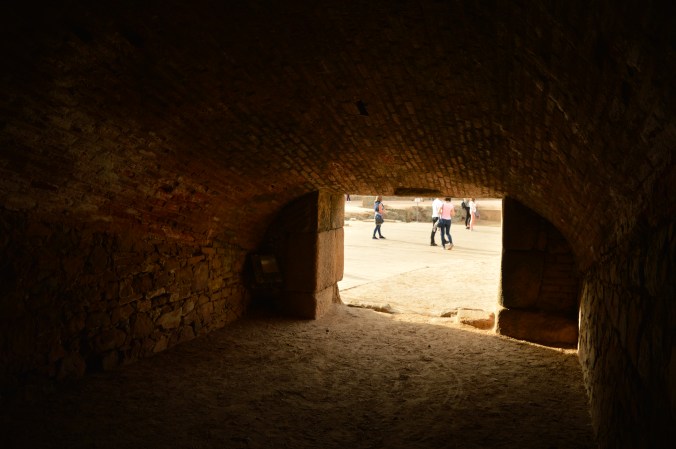
I entered via the dens where the wild beasts were kept for venato fights, ducking low so as not to bang my head on the way out like I had on the way in. I wonder what unwilling denizens of the Empire were caged here for the sport of a Roman carnival: boar from the surrounding hills, bears from the Cantabrian hills, lions from across the Strait… Maybe they even had aurochs here, mighty shadows of the toros bravos that still fight on in the Roman games of a land that saw fit to preserve them. I wonder how many beasts in all lost their lives in this arena.

DSC_0893

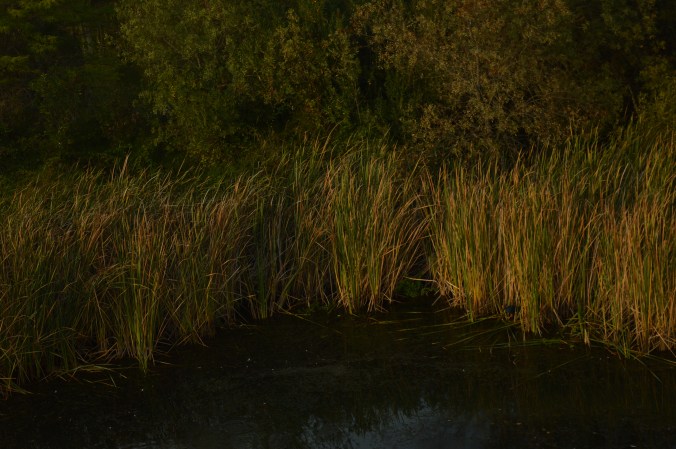
We crossed the Roman bridge on the way home. I looked, I listened and I spotted the swamphen that often haunts the reeds on the island, gnawing away at a reedstem clutched between its gangly toes. I wonder if it’s the same bird that I so often saw here two years ago? It always brings a smile to my face to see it, and it was a pleasure doubled to share it was my friends. Durham had its goosanders. Mérida has her curious calamón. Overhead, the impressive silhouette of a black vulture glided noiselessly to the west. For all the fury and doubt that the modern world brings in its wake, there is such beauty left in the old world.

DSC_0921

The storm has passed. The last of the rain fell during the night. I woke up this morning and opened the window to a cold breeze that had not been there before. I smiled. Everything seems better in the cold light of day. I can do this. Autumn has come at last. The long, dry Extremeño summer is over. BB x

DSC_0924

NB. It’s a pain when you have to write a blog post twice. This time it was because I wanted to italicise Have I Got News for You, erased it by accident, and, when Undo didn’t return them, rebooted to save the effort of writing those six words again. This will all be so much easier when WiFi finally comes to the flat in just under two weeks’ time…

My Most Treasured Possession

My first dissertation extract is complete, and after three somewhat hectic days I can finally relax in the library and read whatever the hell I want for a little while. My field of research and my area of interest are closer than I could ever have imagined, but the very fact that I have to focus on them makes them a little less attractive than they were before. That’s natural, and it’s primarily why I’d never make a career out of art or music. The minute something you like becomes something you have to do, it loses a lot of the magic it once held, I find.

Perhaps the greatest roadblock to making great strides with my dissertation is the fact that, wherever I go, I carry with me a battered little red notebook chock-full of notes, sketches and observations from the last year and a half. I’m almost never apart from it. If it’s a knee-jerk reaction to years of being warned against electronic addiction, it’s a damned healthy one. And whilst it might have got in the way of focused academic research from time to time, it’s actually been responsible for guiding me to some of the most useful books for my degree this year.

notebook

Fresh from the Libreria Talia back in October ’15

At twenty-two, a one year old notebook seems like a strange object to consider my most treasured possession. You’d never know it was that young, looking at it now. It’s battered and bruised and dog-eared on all sides, and the binding holding it together has been heavily reinforced with generous layers of sellotape. But it’s been with me almost everywhere I’ve gone since I first tracked it down in a bookshop in Villafranca last year and, to me at least, it’s more than just a notebook. Leaving for Spain without a sketchbook was one of the more stupid things I’ve ever done, but the result is this absolutely priceless little book of memories. I wouldn’t trade it for the world.

DSC_0363

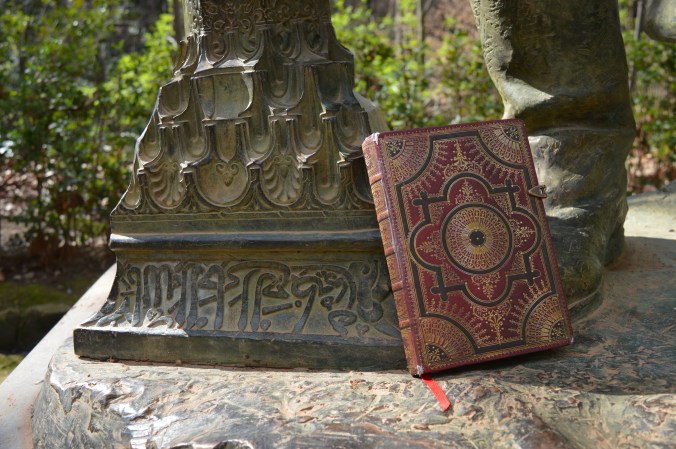
The Red Book at the feet of Washington Irving, Granada

It’s been all over the place. It’s been carried over the holy ground of Moulay Abdessalam and watched the sunset over the Aegean Sea. It’s sat on the walls of the Alhambra, felt the sea breeze of the Atlantic from Cape Roca in Portugal and sampled tapas in Salamanca (with the olive oil stains to show). These days it contents itself with regular trips to and from the library, which is intellectually stimulating at the very least, but perhaps not what the Red Book was necessarily born for. I expect it’s just as hungry for another adventure as I am. The trouble is, there’s only thirty pages left until it’s all filled up, and with the rate at which I’m harvesting new ideas, Greece may have been my eternal companion’s last fling. When I stop to think about it, that’s more than a little bit saddening.

We’ve had some pretty special memories, the Red Book and I. But probably the most treasured of all was its first ever outing to the sanctuary mountain east of Cáceres where, as the sun set over the old city, I had an epiphany and decided to base my series of novels in Spain. And, suddenly, it all made sense. What had been for some fifteen years a mishmash of fantastical borrowings and cliché leapt out of the chrysalis into a vast historical saga. The moment was recorded with two simple words scrawled at the top of a heavily-smudged first page: it begins.

img_5155

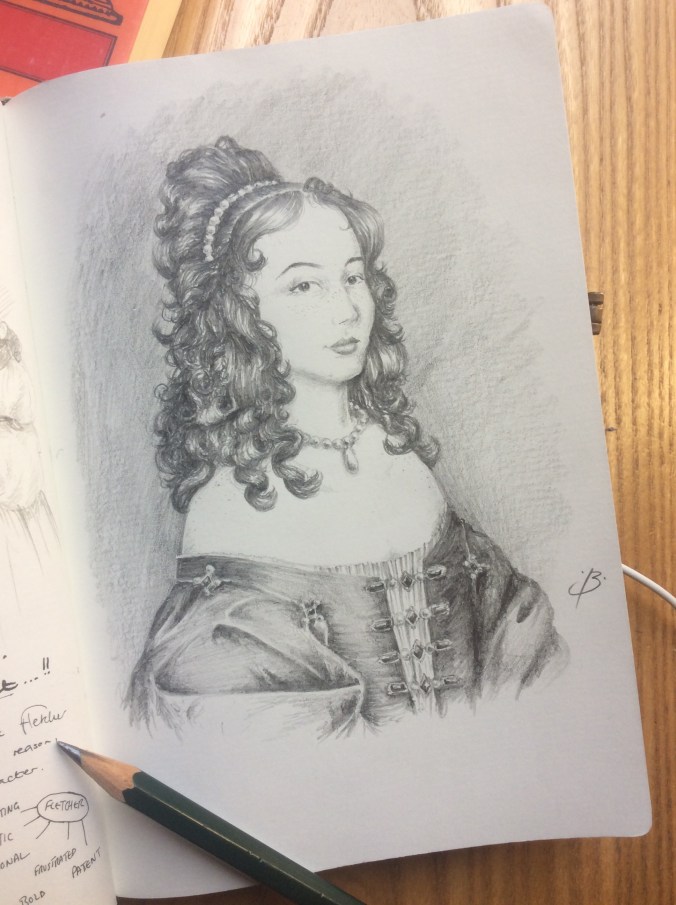
Full-page sketches like this one are not helping on the page-saving front…


Of those who have commented on my faithful travelling companion, the general opinion seems to be that I could get ‘so much money if I ever sold it one day’. Sacrilege incarnate. This little book and I have been on so many adventures now that it’d be like pawning off a loyal pet. But I suppose it’s more than that, because what the Red Book is, beyond a well-travelled journal, is an extension of my very soul. My whole world, the one I don’t tend to share with anybody, is stored within its pages in scrawled notes and sketches. Most of it wouldn’t make a jolt of sense to anybody else, but to me it reads like a map. I’ve kept a working notebook on me in various formats for the last five years – since I could hold a pencil, if you count the sketchbooks as well – but the Red Book is the prince of them all.

The sister notebook is already waiting, an equally eye-catching blue-and-gold journal of identical dimensions. It’s also a Paperblanks notebook. I swear by the things. It’ll be tough, starting afresh with a new book after all this time, like starting up a new relationship. Quite literally: all the memories I’ve stored in the Red Book are ours to share. The Blue Book will need new memories of her own. One day, many years from now, I’d like to think there’ll be a whole shelf of these things, tattered, bandaged and well-thumbed, but loved, and I’ll be able to take them down to explore them with my children, taking them into the worlds I have spent so many years creating.

An ode to a notebook… Well, it was a strange post for Valentine’s Day, I’ll give you that, but with all the time, care and attention I’ve lavished on this little book over the last year and a half, perhaps today’s a fitting day for such a post after all. BB x

Life Lessons from the Mixed-Up Chameleon

‘How small I am, how slow, how weak. I wish I could be big and white, like a polar bear. And the chameleon’s wish came true. But was it happy? No…’

Do you remember reading The Hungry Caterpillar as a child? Eric Carle, the author, wrote another book around the same time called The Mixed-Up Chameleon. It’s about a chameleon that becomes dissatisfied with its own skin and so mimics the animals it sees, until it has transformed into something monstrous. The moral was clear: be true to yourself. For some reason it stuck in my mind far more vividly than the ever-popular Caterpillar, and for good reason: I don’t think there’s a children’s book out there that would have been a better beginning for me.

Adaptability is, in my honest opinion, the greatest asset in the human arsenal. It is, in a way, the most human of traits. We thrive because we can adapt. The trouble with trying to adapt is that at some point you have to put on the brakes and remain true to yourself, or run the risk of being many things and none: a mixed-up chameleon in the flesh. I sometimes wonder whether I am one of those who did not heed the warning signs and simply forgot to brake.

Before I even get into tackling this subject, I know straight off the bat that I am not the most qualified person to write about this. I’m mixed-race, but not enough physically for it to have had a significant impact on my growing-up (we’ll leave the mental impact out for now). In many respects, and despite my best efforts, I am a picture-perfect Englishman. There are people from whom this article would make so much more sense, to whom it would ring more true. And that’s exactly why I’m writing about it: because I’m not the man for the job – and, as a result of that, because I am.

As we grow up, we mould ourselves around the things around us, just like the chameleon: the people we associate with, the expressions we use, the music we listen to. We absorb these aspects of our surroundings along the way in a never-ending process, some voluntarily, some involuntarily, and these little changes can affect our lives in the subtlest ways. In years gone by, when the world was smaller, the number of directions life could take you in were, perhaps, more limited than they are today. YouTube can take you to downtown Los Angeles. Spotify can take you to Mali. Everything is just a click away these days, and so the possibilities for discovery are far more accessible than they once were.

And so we go on absorbing. But herein lies the problem: when does one stop? Is it a subconscious action? Or is there a point when we ought to work on what we are rather than search for the self elsewhere?

Growing up, I always felt that some people were ‘more complete’ than I was. Fellow classmates who had firm opinions of their own, or skills they had mastered. Friends who spoke in complete sentences that made sense, an eloquence I could only hope to achieve with a pen or keyboard. These were people who just seemed to have it all together, to be happy with where they were and confident in what they did. I don’t think I ever was. I wanted to be complete, like them. I even went through the motions if and when I could, but I always felt like a fish out of water. I was a romantic in a cynical age; a funkster in a decade when acoustic was King; an Afrophiliac in a white boy’s body.

So much of what I liked or wanted to be was not what I was on the outside. It made me hate what I was for years, and I fuelled that hate by reading into the worst of my race’s actions. For a long time I was obsessed with the brutalities of the Raj, the inhumanity of the American genocide and the barbarism of the West. It taught me a great deal about the world, but none of it did any wonders for my attitude towards my kin.

In one of life’s beautiful ironies, it was actually a fictional Imperialist – Allan Quatermain – who saved me from my condition, at a point in my life when my will was at an all-time low. He may not be the ideal balanced man by twenty-first century standards, but there was something about his acceptance of his lot that spoke to me, and brought me back from the brink of misanthropy.

Even so, I am still something of a mixed-up chameleon. I can be, but I am not. I suppose that’s natural for a mimic – or, perhaps, a linguist. And of all of the factors that mix me up, the strongest by far is music.

As the child of two music teachers, I admit I find it impossible to imagine a world without music. I was exposed from a very early age – before birth, if you listen to my mother – to all kinds of music. I got the full range of classical music from my father, and the most eclectic mix you could imagine from my mother, up to and including klezmer, jazz, gypsy jazz, disco, punk, broadway classics, film soundtracks, zulu chant and flamenco. As a result, my musical upbringing was incredibly mixed-up. I could have gone down any particular route – except perhaps acoustic-guitar-and-voice, which nobody in my family really went in for – and yet, despite my classical training (or perhaps because of it) I grew tired of that very Western world and threw myself headlong into ‘black music’; the blacker, the better.

It probably wouldn’t be too far-fetched to say that my taste in music and its subsequent effect on my identity has had a massive impact on my attitudes to talking about race, either. How else do I explain my willingness to discuss the one subject guaranteed to make most of my countrymen blanch?

Where am I going with this? We had solo auditions this afternoon for a few new numbers in our repertoire and – after the usual fit of nerves – it dawned on me that I was, once again, fighting for something that wasn’t me. I suppose my problem is that musically, as with so many other aspects of my life, I have made myself something of a Frankenstein. I have tried to be so many different things over the last twenty years and, in complete honesty, a great many of them I am simply not: I could go on and on about how much I dig the tune, but James Brown’s Say It Loud (I’m Black and I’m Proud) was, quite simply, not written for a white middle-class English boy. And it sure ain’t easy singing about the ghetto when you were born and raised in a quiet country village.

My mother’s gift to me in diversity may not have helped my case much. I worship the things that I am not. And whilst I go through the motions, others around me have grown up singing the ‘right’ music for their world. I rebelled, and here I stand, somewhere in the middle, neither here nor there. The fact remains that I am out of place, and it is entirely of my own doing.

‘Just then, a fly flew by. The chameleon was very hungry, but the chameleon was very mixed up. It was a little of this and a little of that. “I wish I could be myself”. The chameleon’s wish came true – and it caught the fly.’

So in choosing to favour diversity over working on what I do best, I have become something of a jack-of-all-trades, master-of-none. A good mimic, but not the best at what I do. Versatility has its drawbacks, it must be said. But, given the chance, I would not trade my position for all the world. I may not be the master of the art, but I love the art to death. Funk music gives me a beat I just can’t shake. Michael Jackson makes me feel alive, African voices lift me to the heavens and flamenco stirs me into a passion I can’t explain. Who gives a damn if I’m white? Music transcends that. It’s how I feel on the inside that really matters.

If catching the fly is the key to getting the job done, I’m still a long way off. But if it symbolises happiness, then I’m better off a mixed-up chameleon. BB x

The Lion, the Witch and the Wardrobe

100 Days of Writing: Day Three

Me and my wardrobe. It’s probably the best love affair I’ve ever had. Twenty-two years of bad ideas, gaudy shirts and triple denim disasters. Is it any wonder I change up my style every year or so? No matter what I wear, it always seems to be something… different. But that’s the beauty of clothes: the way you look is entirely up to you. If birds could change the colour of their feathers at will, I’m almost certain they would.

In my time I’ve favoured yellow dungarees, corduroys and camouflage (for birdwatching purposes), waistcoats and neckerchiefs, denim jackets and oversized t-shirts, peacoats and puffer jackets and, notoriously, Joe Browns shirts. Each and every one had its day and faded away (with no small amount of motherly relief) but it’s the latter that I’m probably the most well-known for, since it was the phase that kicked off in my first week at university and the trait for which I became known. Two years ago I could have been identified at a distance of a hundred yards from my shirts alone. These days I’ve opted for a more modest outdoor look. I daresay it’s a good deal more than possible that there’s a reflection of my ego there.

Clothes are a bit like food. There’s really no need to wear anything more than what is necessary, just as you don’t need to eat a mouthful more than what fills you up – but since when did anybody ever have any fun working on the basis of sufficiency alone? It’s taken me a long time to find a style that’s really my own, one that I feel comfortable wearing; one that I wear for myself, and not for the rest of the world. That, I think, is the cut-off point. Naturally, hispanophile that I am, it’s a certain range of Spanish wear that I’m into at the moment, and it’s one that I feel immensely comfortable wearing – and that despite the fact that most Spaniards would have me down as a foreigner for wearing them, because it’s simply not the thing that young people wear these days. But if that means hanging up the jackets, shirts and chinos for a sporty-looking set of leggings and a hoodie, excuse the pun and jog on. I know what I like and it suits me.

You might also have noticed that in all the ridiculous fashion trends I’ve tried, shorts don’t feature once. That’s still a thing. I wouldn’t be seen dead in them.

The clothes I tend to go in for these days are the high-maintenance kind. That is, I have an awful lot of shirts, and these need careful washing and regular ironing. Fortunately, I have no problem taking the time to do either of these things. True, it’s a longer-winded process this year than it was in Spain – you can’t just hang your shirts out over the balcony and expect them to dry in an hour up north – but I give it my best shot. If you can be disciplined with your wardrobe, you can be disciplined in your other affairs, I find.

In short, clothes are important. They’re essential to non-verbal self-expression. They can be great conversation starters (especially my infamous London Underground shirt – to this day, probably my best acquisition ever). They can make you curse in the morning as you mull over what to put with what and smile when something works out – and even more when it really doesn’t, especially in retrospect. And even if I could go back in time and beg my younger self to lay off the triple denim, I think I’d still let him go through it all. Because whatever I decided to wear in the future, I don’t think I could possibly go any worse than that.

That or the yellow dungarees.

Love out of Love

100 Days of Writing: Day Two

It’s been a long time now since I was in the vicious grip of infatuation. And long may it be until it gets me again! I don’t remember ever feeling so free or so happy over the last few years, and I suspect it’s got a lot more to do with me growing up than anything else. Today’s topic would have been easy enough to tackle, but the stipulation was that it had to be in verse…

Now I’m not a massive fan of poetry, even good poetry. And poetry about love is seldom good. Reading some of the tripe you came up with in younger years is gut-wrenching, to say the least, but if you thought that was hard, trying writing it when that’s all in the past… The words don’t come to you as quickly as they did then, when a bleeding heart makes for an endless inkwell (with the verbal talents of a stroppy teenager). And isn’t there something about the very art of love poetry which belies imbalance?

Nevertheless, orders are orders. So here’s Day Two: The Unrequited Love Poem.

Chasing Cars was playing
As we stepped into the light
And we went our separate ways.
I went up the road
And she went down.

There’s no easy method
To describe a broken heart
When the breaking is so soft.
‘Let’s be friends’
Hurts much more than it should.

Looking back is easy
From the freedom of release
When the world is more than two.
You can see
When you were blind before.

The traffic light is blue
The battle flag is waving
But it’s painted all in white.
There are no rules
All’s fair in love and war.

—–

Her every word is wisdom
And her laugh is summer rain
And hearts, parts and cupid’s darts
All blind you to the pain.

I’ve heard that nice guys finish last
Or something of that kind
That romance died off years ago
And love is hard to find.

The front row of the theatre
The poems she shared with you
They all mean next to nothing
If that’s what a friend would do.

Pity is a murderer
Luck does not keep giving
Fate is just a child’s word
Hope is unforgiving.

—–

It saddens me to think that when you’re young and love’s the end
The worst thing you could bear to hear is to be called her friend.

—–

I’ve said it before and I’ll say it again. I am not a massive fan of poetry. Unless it’s Arabic poetry. I can totally dig that. BB x

Reflections from a Little Window

Since I’m no longer abroad (for the time being), the primary function of this blog is somewhat defunct at the moment. Even so, since it’s been such a crucial tool for keeping me writing this year, I see no reason why I should just leave it there for a year. So, to keep the old writing muscles flexed, I’m taking on the 365 Day Writing Challenge and using this blog as the medium. They won’t be especially long entries, but hopefully they’ll be good reading, and better still, good warm-ups for the essays I’m due to be writing over the course of the year, not least of all my twelve-thousand word dissertation.

So, without further ado, here’s Day One: Outside the Window

Mine is a little window. Perhaps that’s just as well, as it looks straight across the road to the girl in the house opposite. She’s been working flat out since eleven o’clock this morning, and if she were to look up from her studies, she’d have a pretty good view of my bedroom. But when I sit down at my desk to work, I’m invisible to the outside world. I like that. I might not be the shy, retiring figure I used to be, but I haven’t lost my fondness for disappearing from time to time.
The local jackdaw brigade is out in force. There’s a roost nearby, I think, maybe in the trees over on the Avenue. It’s nice to have something wild close at hand this year, but I don’t half miss the kites, or the storks and swallows I used to see every day from my balcony in Villafranca. The trade-off is regular rain, which is something I find myself curiously attached to.
It’s raining now, as it happens.
There’s nobody out and about on my street at the moment. I suppose that’s because it’s a Sunday afternoon. Everybody who’s not at the library or the gym is inside, wrapped up snug in their rooms and noticing, like me, that we’ve already reached that time of year when your breath comes out in a cloud, inside or out. Sooner or later I’ll have to stock up on hot chocolate.
I walked home in the rain the other night. It was after midnight, and the rain was coming down hard. It’s hard to say exactly how it felt, walking over Palace Green in the half-dark getting gradually soaked in my hoodie, with the mighty cathedral and its scaffolding-crown towering overhead. It’s not the first time I’ve seen rain since I got back from Morocco, but it was probably the first time I really thought about it. I always used to think that standing outside in the rain was something to be shared, something intensely romantic. Now that the six-year blinkers are off I see things a good deal more clearly. It’s a feeling as personal as a diary, and every bit as important. And if we really are sixty percent water, there must be something naturally therapeutic about getting soaked in the rain.
I’ve missed it.
It’s not raining anymore, and the sky is still light, in that English yellow-streaks-through-grey kind of way. The slate tiles on the roof across the road are proof enough that it has been raining, though, and that’s something beautiful to see.
The girl in the window opposite isn’t there anymore. She must have taken a break, and about time too. That’s what Sundays are for. Quite by accident, I’ve been working flat-out this week, all the while duping myself that I was ‘merely helping out with a few things’. I guess I just can’t help myself. When it comes to spare time, there’s only one day of the week when I can forgive myself for doing nothing.
The sky’s opened up. Through the fifty shades of grey in the clouds above there’s a break of blue up there, and the sunlight on the trailing edges of the breach is a brilliant golden-white. It’ll be gone again by the time I pen this down, but whilst it was here, it was one of those fleeting little moments of beauty you just have to stop and watch.

Bit of a reflective first run, this one. I’ll play around with style and voice over the next few and we’ll see where this takes us.

If you’d like to do something like this, the challenge list I’m following is this one here: http://thinkwritten.com/365-creative-writing-prompts/