Knowledge – For its Own Sake

Bristol Temple Meads, 9.02am.

The May half term is drawing to a close. I’ve stayed put for a change, using the time to mentally decompress after another very busy term. Four weeks remain of the school year, and while there’s not as much teaching going on, it’s still going to be an intense gauntlet of exams, reports, events and rehearsals. I’ve done a lot of much-needed spring cleaning, idle Camino planning, bouncing ideas off ChatGPT and now, a little stir crazy, I fancy a day out. So I’ve grabbed some Y8 marking and a few books (Adrienne Mayor’s The First Fossil Hunters is my current obsession) and I am now on the train bound for Oxford.

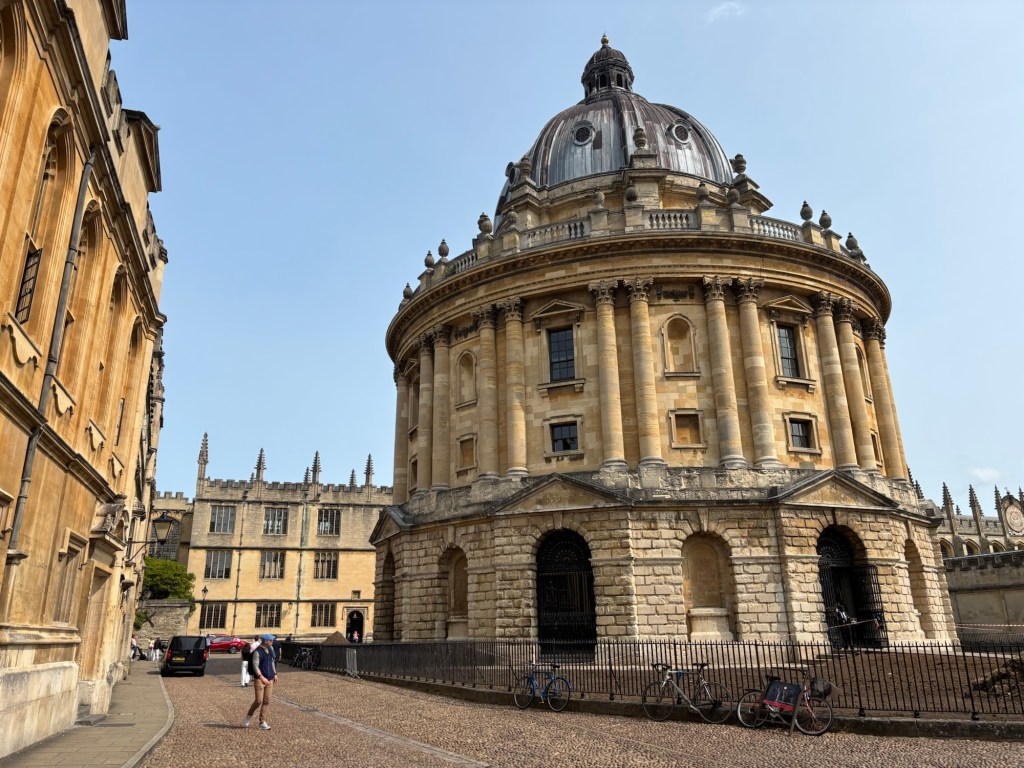
Why Oxford? Partly because I haven’t really been to Oxford before. I was there two months ago for the Oxford Schools Finals Day, but as I was leading a school trip I didn’t really have any time to appreciate the city for itself. It’s also partly for the Museum of Natural History, which is supposed to be exceptional (I never did grow out of the dinosaur phase). But it’s also because over the last few days I have started to flirt with the idea of a possible career change: setting my teaching and boarding duties aside to pursue a Master’s degree in Medieval Studies.

There’s a couple of travelers next to me on the train having a very interesting conversation. They are a curiously paired ensemble: one, with a patchy beard, AirPods in and his shirt unbuttoned to the sternum, talks in a streetwise drawl about how he stole a few cans of Red Bull from Tescos once, and how the worst thing in the world is that parents don’t discipline their kids right anymore – if he’d disrespected his dad, he’d have “had a black eye”. He drops his T’s in the words right and football and drops F bombs in the gaps. The man next to him, a young Asian in a smart shirt with his sleeves rolled up nearly to his elbows, calmly (and without a hint of profanity) explains the difference between Asia’s bullet trains and the UK’s privatised public transport system (which he calls the public torture system), the importance of location when investing in property and celebrates a model aircraft he recently won at an auction. That seems to be their connection – they’re model plane collectors. I was beginning to wonder what could possibly tie these two together.

Why a Master’s degree? Why Medieval Studies? And why has the idea only come to me now, eight years after graduating with a BA in Modern Languages and Cultures? To be honest, I’m not entirely sure. A number of reasons come to mind. Citing my Y9 class seems churlish, but it’s probably part of the bigger picture of just how much of a gear change this year has been. Challenging and engaging, but occasionally uncomfortable. I suppose that’s only natural when you up sticks completely and change schools. Perhaps that’s why some teachers never leave.

It’s a little deeper than that. I do miss academia. I have always loved the pursuit of knowledge for its own sake, and just occasionally, I find that hard to square with a job where success is so often scored against a mark scheme that shifts according to the national skill level.

I’ve just started to sink my teeth into A Level teaching, but I’m both disappointed and mildly alarmed by the lack of general knowledge of my students. Only one of mine could tell me what Scylla and Charybdis were, and that was a child in Year 10. I’ve had sixth formers before to whom I’ve had to spell out the story of Adam and Eve – we’re talking Catholic Europeans here, too – and mine was the only hand to go up in chapel two weeks ago when we were asked if we knew the parable of the man who built his house on the rock.

You could chalk that last one up to nobody wanting to look foolish putting their hand up in church on a Tuesday morning, but classical (and even general) knowledge of even the most basic sort seems to have fallen away by the time our kids reach sexual maturity. They all seem to know who Mr Beast is, though.
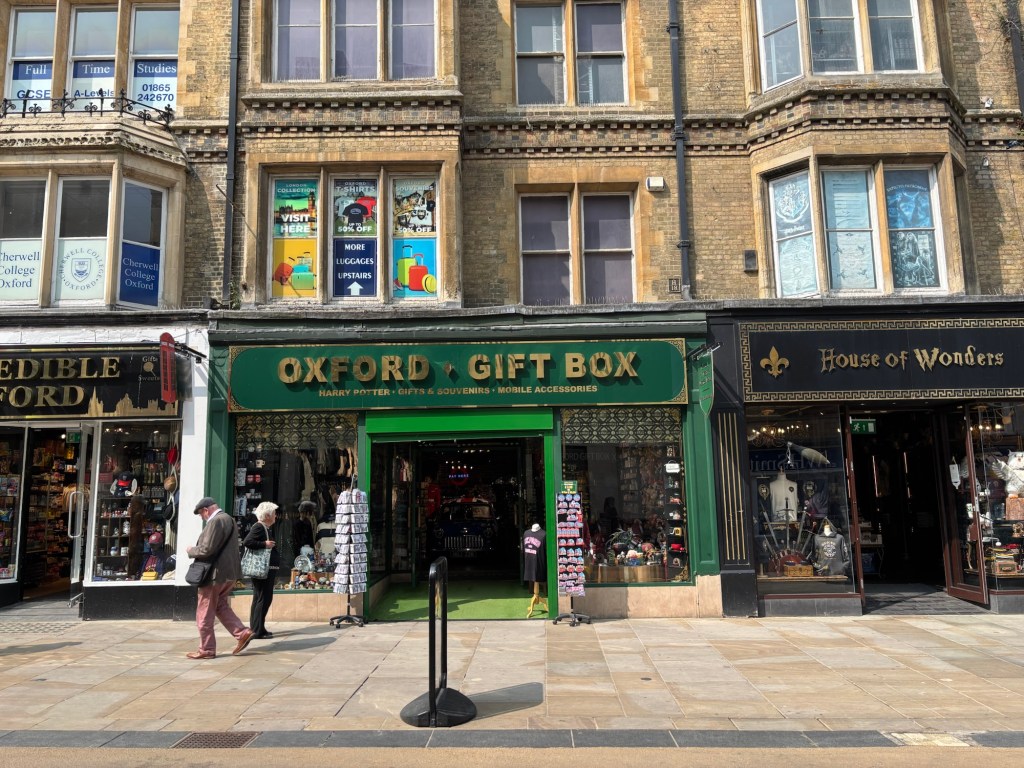

Something I wasn’t expecting in Oxford was the Pottermania. I deliberately haven’t waded in with an opinion on J.K. on here because, as with a number of topics, my thoughts are not in line with those of the rest of my generation. But one thing that is really quite depressing is that I ran into no fewer than five Harry Potter themed tours, pointing out turrets, windows and other locations used during the filming of the saga back in the early 2000s. It seems a little trite that tourists flock to a city that harbours one of the oldest universities in the world just to snap a selfie in the style of a still from a movie… I took a cohort of summer school kids on one of those trips once and they were deeply disappointed (I think they were expecting Harry Potter studios, not a Chinese woman with a ring bound pad of stills).
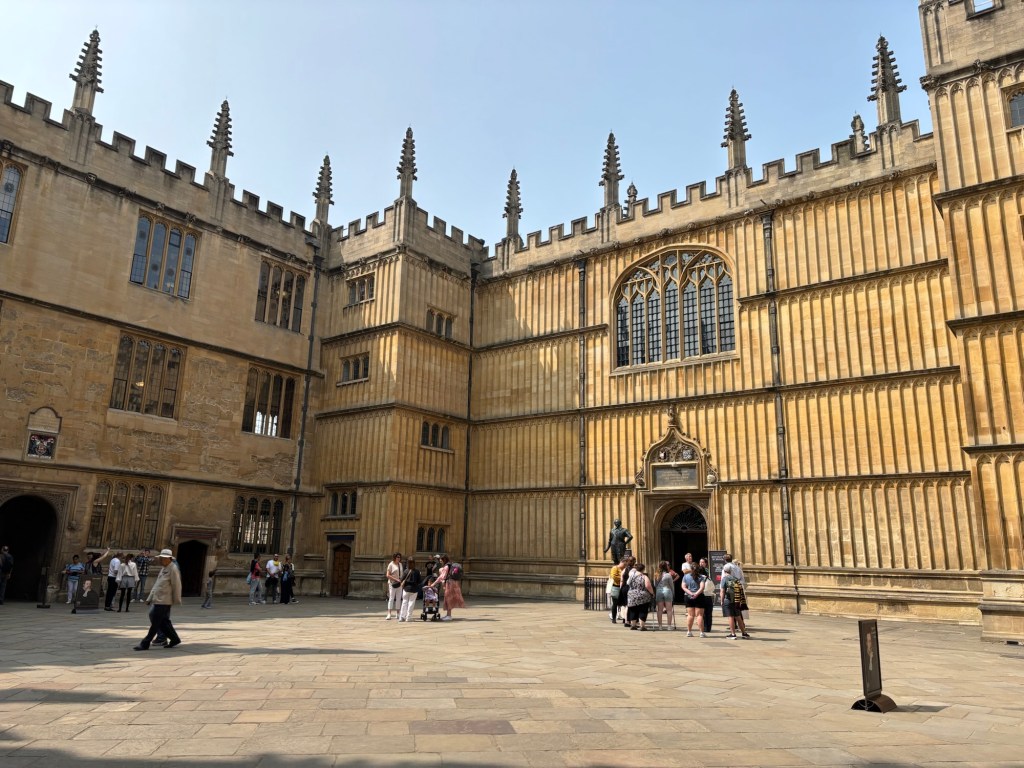

It’s times like this that I need a good kick in the shins – somebody (besides myself) to call me out for being so judgmental. Maybe that’s something I miss about university, too.


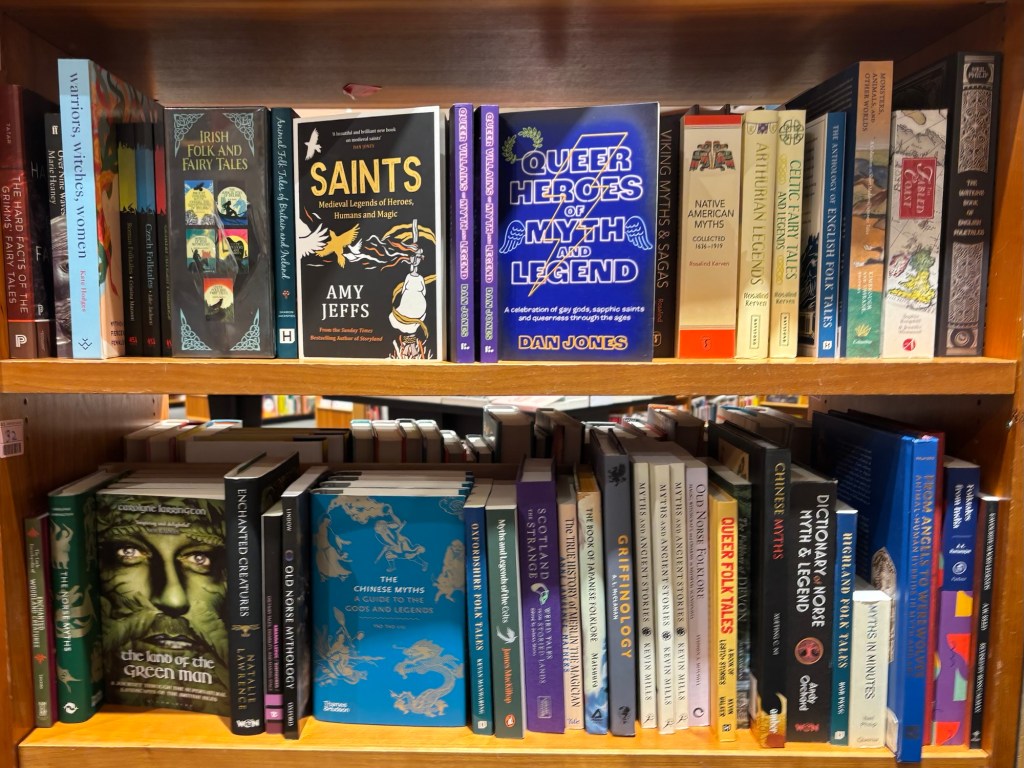
Before checking out the museum, I explored Blackwells, Oxford’s famous bookstore. The shop is particularly well-known for its Norrington Room, a literary Aladdin’s cave beneath the city that seems to have everything. I made a beeline for the Mythology and Folklore section and looked for anything Iberian.

Nothing. Tome upon tome on Norse mythology, endless volumes of British folktales, a beautiful gold-bound compilation of the tales of Anansi the Trickster and no fewer than five collections of Queer Fairytales – whatever those are – but nothing on Spain or Portugal. Nothing at all. Even Google didn’t seem to have anything.

Spain isn’t lacking in colourful folklore of its own. From my reading, it’s apparent that the combined efforts of the Almoravids, the Almohads, the Spanish Inquisition and Franco’s regime weren’t able to snuff it all out. But the literature simply doesn’t appear to exist.

I think somebody should write about it. And I’m starting to think that somebody should be me. Oxford University has a Masters course on Medieval Studies that occasionally covers Iberian founding mythology – the subject I chose for my undergraduate dissertation – and that just might be the way in… if I can get in.


I’m not really Oxbridge material. I got as far as an interview at Cambridge, but my meekness was torn to pieces in the French interview – and I really haven’t read enough of the classics. But I have read a lot of books.

I grew up on a privileged diet of literature. We had more books than anything else at home, largely on account of the fact that my mother rips through books in a single night and was thus always on the hunt for a replacement. The bookshelves in my bedroom were (and still are) crammed full of colourful dinosaurica, but sandwiched in among them was a mountain of mythology and a feast of fantasy. My mother may not have been an outspoken supporter of “fantasy shite” but she did encourage my voracious reading habits. And I know my Dad used to read to me a lot – he even read the Harry Potter books to me when they first came out.

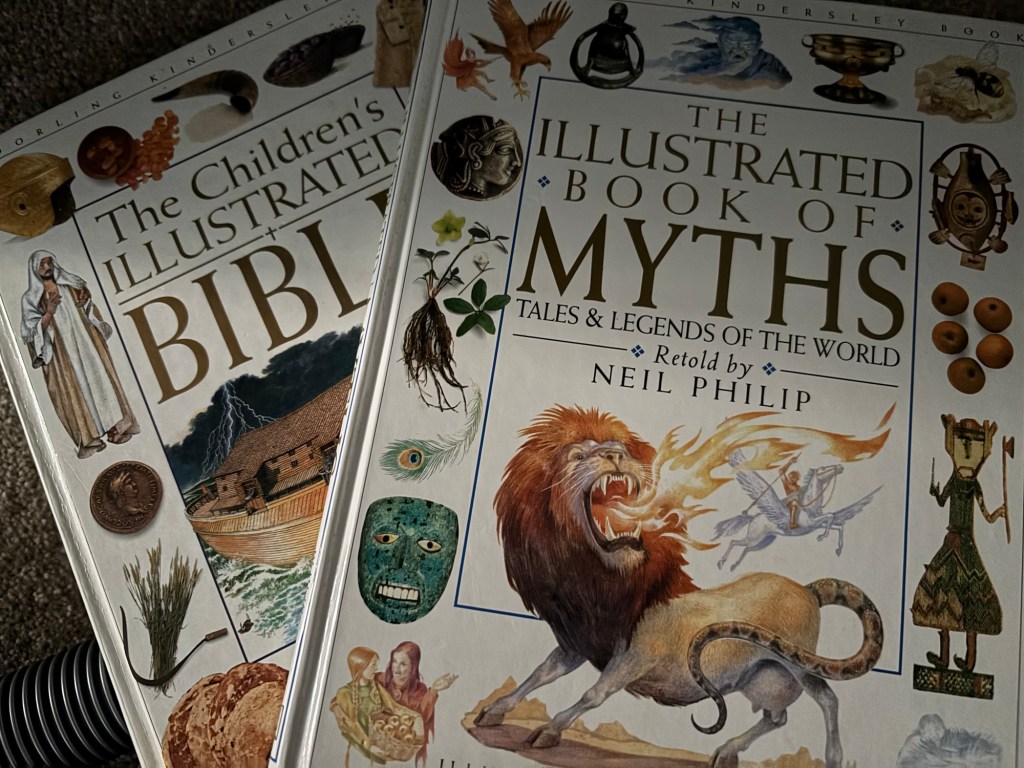
Neil Philip’s Illustrated Book of Myths played an especially large role in all of this. Atticus the Storyteller had a similar hand (and, to a lesser extent, the Age of Mythology games), but the colourful illustrations in the Dorking Kindersley compilation made it especially impactful. I must have spent literal days poring over the pictures in that book, cramming my childish head with stories of Athena and Anansi, Izanagi and Izanami, Glooscap and Gilgamesh. All tremendously important things to know – and none of it serving any practical purpose beyond the pages of the book where they were written. I haven’t even been able to use much of it in the odd pub quiz, which seem to rely on a more grounded understanding of Emmerdale and the last FA cup final than the exploits of Gilgamesh and Enkidu.

If I’m lucky enough to have children of my own someday, I will read to them from that book – even though I know most of the stories by heart. The pictures are so beautifully illustrated that I can see most of them still when I close my eyes, though it may be over twenty years since I last saw them.

Stories are how I make sense of the world. I’ve been writing stories for as long as I could write my own name. There’s not an awful lot of call for storytelling at work, but I do my best to share them with my students when the curriculum allows.

And it’s taken me a long time to realise that, after Spanish interest and natural history, the third largest collection of books in my library is all folklore and mythology – the oldest stories in the world.

Maybe – just maybe – I’m scratching the surface of the real me. I did always want to be a writer. I just didn’t ever think I could do it.

I’m still unsure. So much of my identity has been built upon the rock of being a teacher, and casting off those robes to dive into the world of myths and legends seems… well, childish at best, selfish and reckless at worst. And there’s the question of stability, job security, money and the fact that all I really want to do is find the One, raise a family and tell stories. But the void in all those bookshops is tremendously loud. Stories that aren’t told will eventually disappear, taking their worlds and their characters with them. It would be a terrible shame if the generations of the future looked back on our time and accused us of letting the ancient wisdom of the past slip through our fingers while we were so violently hypnotised by the bewitching glare of this or that Pied Piper of Instagram.

Who will remember Mr Beast five hundred years from now? What stories will they tell of him? Will his legend amaze and inspire, or will it push more and more children toward the worship of Mammon? I worry about that. I worry about that quite a lot.

I’ll give it some more thought. These are not decisions made lightly. The Camino will provide. It always does. BB x
Shuffling Along

I’m sitting in the rest area at Bristol Parkway Station, watching the blinking lights of cars cruise around below me in circles like so many coloured beetles in the darkness. If I’d made my original train, I’d be at my mum’s place by now. But there was an incident on the 20.35 from Bristol that the authorities had to deal with, so a twenty minute delay has turned into an hour’s setback as I missed my changeover. I’d chalk it up to some Friday night jollities from some of my ruddy-faced countrymen in the next carriage. The only highlight was the very comical collective groan from the other passengers when the announcement came through. Can I still use the term passengers? It’s been recently outlawed by National Rail, who apparently fear it sounds “too formal” – what has the world come to?

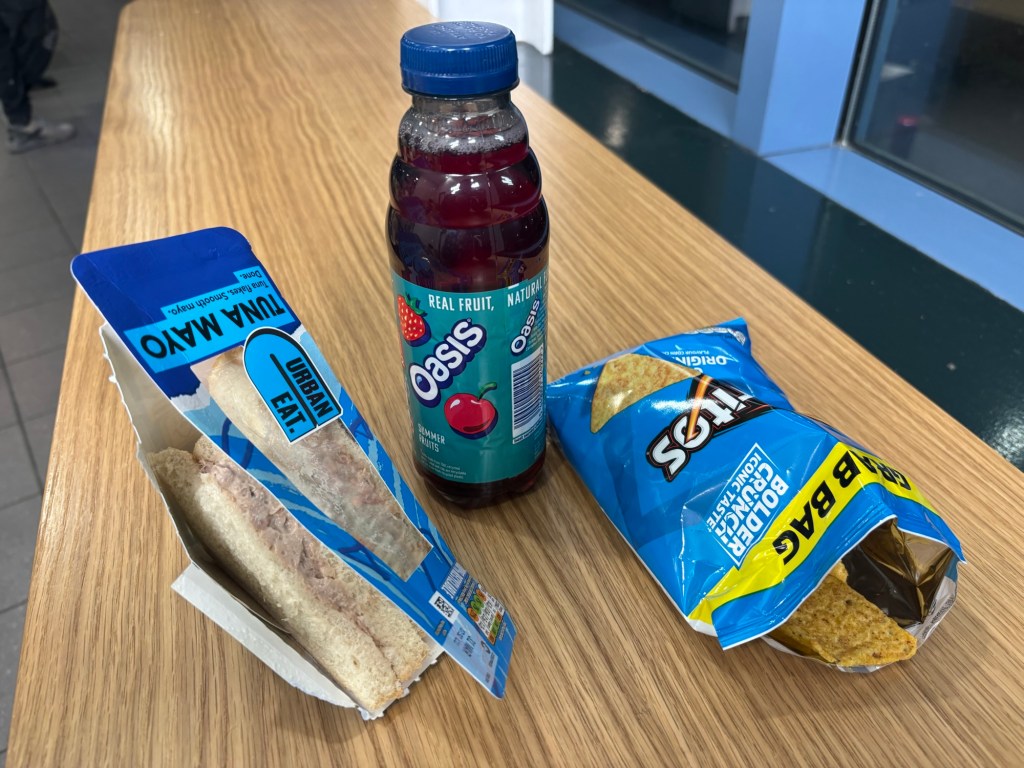
So, I’m stuck here for another half hour. I’ve wolfed down a meal deal and am now watching the world go by with my Spotify on shuffle. The holidays are here at last, so I guess it’s time to blow the dust off the blog and flex my rusty writing arm with a little exercise. I’ll use the first five songs on shuffle as a jump-off point and see where we go from there.


Stronger – Kanye West

Ah, the latter days of 2007. After largely eschewing popular music, my brother and I were simultaneously introduced to modernity with Now That’s What I Call Music! 65 around Christmas 2006, our first away from home during our short-lived attempt to up sticks and move to Spain. Maybe it was because it was a link back to the world we’d left behind, but I leapt upon the novelty, and it’s fairly safe to say that my awakening as an explorer started with that CD. I used to get almost all of my music from those Now! compilations. Thank goodness Spotify came along and broadened my horizons!

It was a good time for music, anyway. Rihanna was still pumping out hit after hit (Don’t Stop the Music had just hit the scene), Ed Sheeran was unheard of, and Kanye was famous for his beats and his bars, and not his antisemitism or his (now ex) wife’s rather large bottom. Those were happier times.


Bailando – Enrique Iglesias

Wind the clock forward around ten years. Durham’s Music Society released the theme for the summer concert (Around the World) and the Northern Lights – then in the early days of our ascendancy – hit the books to find a suitable number to fit the bill. I wasn’t anywhere near as talented as some of my peers (at least four of whom have gone on to moonlight as professional musicians since) so this was my one chance to take the reins with a song where I might be able to do something the others couldn’t – that is, singing in another language.

By that point, aged 22 and fresh from the year abroad, I was spoilt for choice. But let’s face it, it would have been a tall order to get an English a cappella group to sing the Arabic smash hit M3allem, and all the sevillanas I had committed to memory were much too demanding, even for those who could speak a little Spanish. Luckily, Enrique Iglesias was famous enough to provide a bridge between the two languages, and after some negotiation with my musical director, I managed to get Bailando onto the set. I put my heart and soul into my Grapevine arrangement, but I honestly had a lot more fun performing Bailando with the gang, not least of all on account of the choreography.


Mammati – Willie Mohlala

Somewhere at my dad’s place is a little red memory stick containing a number of MP3 files: mostly obscure Ugandan pop and folk music, with a few Dolly Parton numbers sprinkled in for a little variety. That playlist was the soundtrack to the various marathon road trips of my time in Uganda, since the full playlist was never enough to span the enormous distances we used to travel. Shazam still struggles to identify the greater part of that playlist, and since Willie Mohlala was one of the only artists labelled on the tracklist, he was one of the few to travel with me out of Africa. Him and Dolly, of course, though quite how she wound up in central Africa beats me.


AM to PM – Christina Milian

Given my guilty pleasure for early noughties R&B, I’m surprised it took me until the summer of 2024 to discover this banger. I have vivid memories of boogying to this one in a club in town with a girl I’d met on Hinge, the first of several attempts to move on from my American heartbreak. It didn’t come to anything. None of my dates have since. But I did pick up this little number, so I did manage to take something away from the experience. I’ve been using the same excuse to justify traveling more than four thousand miles to discover AC/DC’s Thunderstruck, but since that electric anthem has catapulted itself into my top ten, I’ll allow the hyperbole.


Get Me Home – Foxy Brown ft. Blackstreet

I did a Spotify audit the other day and found I’d amassed about 97 playlists. More than half of them (52, to be precise) are ones I made myself. One of them is definitely a ‘mood’ collection, staffed by Missy Elliott, Blue Six and the legendary Foxy Brown. It’s not one that gets an awful lot of airtime, but it is seriously groovy.


I Go to the Rock – Whitney Houston (with the Georgia Mass Choir)

The London Community Gospel Choir did a school visit to the girls’ school over the road when I was around fifteen. This was back before they were a big deal – and back when there was such a thing as the subject specialist initiative in schools that provided money for that sort of thing. I Go to the Rock was the song they taught us that day.

Like so many of the greats in the music industry of old, gospel was where I truly learned to love singing. It was a true release from years of staid hymnals – which I look back on fondly, but not with the same awesome power that gospel provided. It felt like singing from the deepest reaches of my soul. It’s probably no great leap to say that I wouldn’t have launched myself at the funk band if I hadn’t had that crucial awakening through gospel.

It’s a shame that global politics prevented me from sharing that pivotal joy for so many years. I will always carry that scar, I suppose. At least these days I am in a more tolerant establishment that understands the importance of offering diversity through music. I dread to think where the other road leads. I don’t doubt the talents of Taylor Swift and Ed Sheeran, but if that’s what people like me will be limited to in years to come, my music tastes will be so much the poorer for it.


For the Love of Money – The O’Jays

Well, would you look at that. When I started writing this post, I was shivering in the upstairs waiting area at Bristol Parkway. I’m now inching closer to the rammed check-in desk at Gatwick Airport. Turns out most everyone on this flight has the same problem: directed to the check-in desk to collect their boarding pass, due to the sheer number of people on board. I could have dodged this by buying priority, maybe. But with prices up everywhere (the Alhambra visit is costing me nearly £100!) I decided to dodge the £8 priority add-on this time. That’s on me!

Money is the root of all evil – do funny things to some people. Spain is in the throes of an anti-tourist rebellion, centred on Barcelona, Mallorca and the Canary Islands. And not without reason: the tourist trade has been allowed to run rampant in some parts of the country, to the point where it has utterly destabilised life for the locals, forcing a dependence upon tourist money that only comes but a few times a year. Unlike Santa Claus, however, it doesn’t seem to be spreading much joy. Some protesters vented their frustration last year by hosing down tourists at cafés along Las Ramblas with water pistols.

I’m hoping to investigate this blight a little during my adventures over the next three weeks. I appreciate the irony of doing so as a tourist, but I’d like to think that by avoiding resorts and foreign hotels, I’m doing my part to contribute to the local economy in parts of the country that aren’t necessarily overrun. Speaking Spanish helps.


Well, ten minutes until take-off. My arm feels exercised. See you on the other side! BB x

Tiny Wings

3rd October, 10.40pm. The Flat

The October half term holiday came to a rather unorthodox end this evening with a last minute trip into town to catch a talk by celebrated English nature-writer, John Lewis-Stempel, on his latest release: England: A Natural History. It isn’t every day you get to meet people who you have grown up reading, and as this is a year for saying yes to things, why not? I came away with a signed copy and a really interesting chat with the author about the importance of names – not just the scientific names of the animals and plants around us, mind, but the old English names that are disappearing even faster than some of the creatures themselves: you might have heard of a peewit or yaffle, or possibly even a dumbledore, but would you know a bumbarrel or cuddy bear* if they were sitting in a tree in your garden? (Answers at the end!)


I’m feeling much recharged after ten days’ leave. These boarding school terms really do knock the stuffing out of you, though as I like to say, I’m happiest when I’m up to my eyeballs – it leaves less time for dwelling on things. I left it a little late for any far-flung adventures this year, but I did make it to Dartmoor a few nights back, taking advantage of the last few days of the public bus service that crosses the moors before they shut down over the winter.


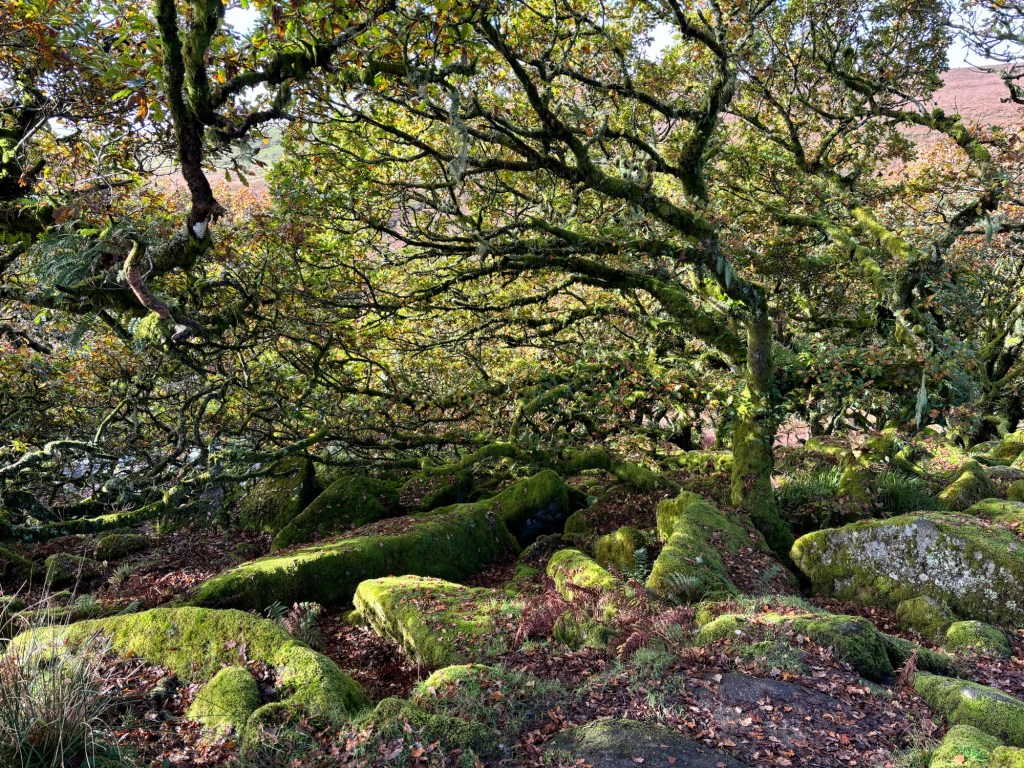
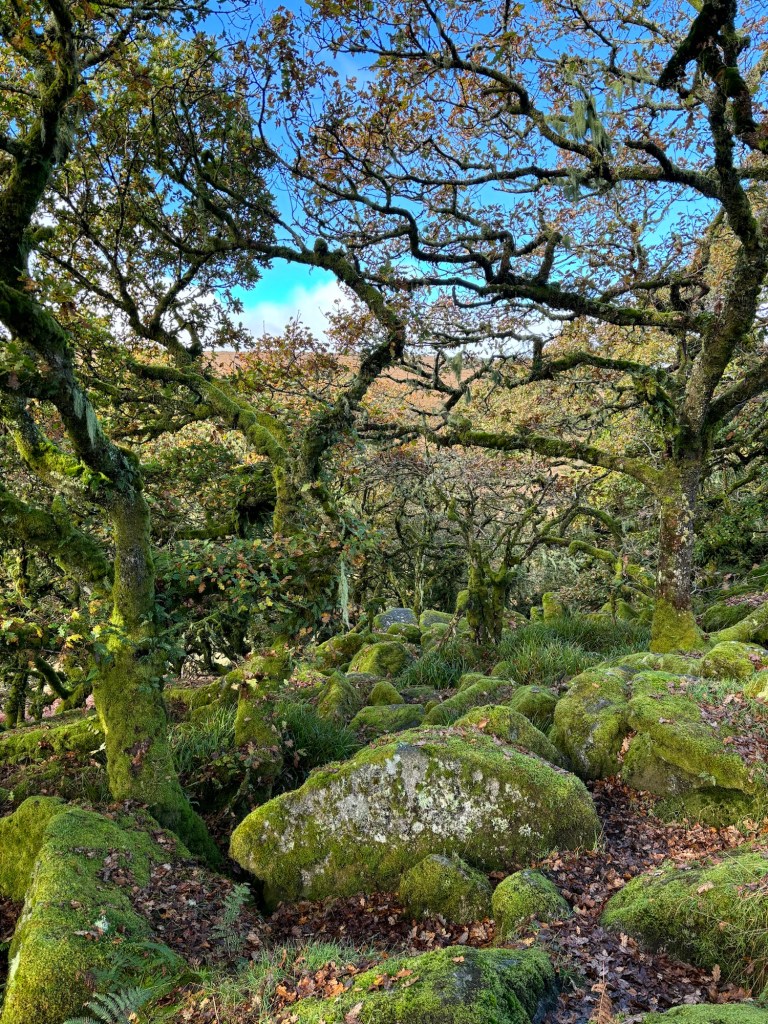
Why Dartmoor? Possibly because it’s arguably easier to get to by public transport than Exmoor, which is a lot closer, but mainly because I had an insatiable itch to see the legendary Wistman’s Wood, a tiny sliver of temperate rainforest nestled deep in the heart of the national park. It popped up in a number of ghost stories I read a while back and again in Guy Shrubsole’s The Lost Rainforests of Britain. The desire to see that last fragment of the Great Wood that once covered this island ended up pressing against the inside of my skull like Wistman’s own stunted trees.

I was holding out for mist and fog, but I had neither. The weather was actually remarkably pleasant for fickle Dartmoor, so instead of mirk and mystery I was treated to soft clouds and sunlight through the ancient branches; the kind of warm glow that Tolkien bestowed for a moment upon Fangorn Forest, an ancient wood of his own design. Did he pass through here, I wonder? His faithful illustrator Alan Lee certainly must have done at some point.


Just as it sits in a valley in the innermost chamber of Dartmoor’s heart, so too is Wistman’s Wood at the heart of much of Dartmoor’s folklore. It is said to be haunted by the spirit of a terrier who can still be heard scampering through the boulders, while by night it is prowled by the far more sinister wisht hounds, a local variant of the hell-hound myth that can be found across the British Isles, from the gytrash and Barghest to the Beast of Bodmin. The wisht hounds were believed to be kennelled in Wistman’s Wood by Old Crockern himself, the ancient pagan spirit of the moor whose foreboding tor rides the crest of the hills a short distance to the west of the woods.

There were no malevolent spirits during my brief stay, of course – at least, none that I could see from my perch atop a boulder on the fringes of the forest (visitors are no longer allowed to enter the wood proper, so as to protect the longevity of this sacred and truly unique ecosystem). But that is not to say the place was lifeless: quite the contrary, in fact. There was no wind, but the trees were alive with rustling leaves that turned out to be the beating of tiny wings. In the space of a single minute I clocked three species of tit (blue, great and coal), blackbirds, redwings, wrens, robins, tiny treecreepers and the truly pint-sized goldcrest, our smallest native bird. I haven’t seen a forest so alive in a long time. Even the air itself felt different, a fact that would have been obvious to all but the senseless by the thick, mossy lichen growing on every surface, a perfect natural yardstick for a healthy forest.


I spent the next five hours or so wandering in a wide arc around the surrounding moorland, following a rather makeshift path swiped from the internet the night before. I haven’t hiked around Dartmoor since I was at primary school, so I’d forgotten that, up on the moors, river crossings are often not bridges but rows of stepping stones. Which are a delightful challenge in balmy summer weather, no doubt, but something of a roadblock after the first heavy rains of autumn. I made the tactical decision to not tempt fate and so I took off boots, rolled my trousers up to my knees and waded across.

I hardly need to point out that Dartmoor’s rivers are devilishly chilly – and surprisingly deep. I was just shy of the other bank when the water came almost up to my waist. Thank goodness I’d brought a spare pair of trousers, or I’d have had a very wet hike back to the inn!


Luckily, as I crested the hills due south of Two Bridges, the sun came out to guide me home. It seemed to turn the grass to gold, in a wave that washed down the hillside until I was stranded in an ocean of golden blades. I straggled up to the Crock of Gold, a small stone-strewn vantage point where, as if on cue, a shining rainbow daubed itself across the grey sky to the north. No leprechauns on this occasion, but I got my gold one way or another.


Well, I’d better put down my proverbial pen and get some sleep. Back to work tomorrow, and another busy term awaits! BB x


*Bravo for holding out for the answers! A peewit is of course a lapwing, a yaffle is a green woodpecker and a dumbledore is a bumblebee, while cuddy bear and bumbarrel are old English names for the wren and long-tailed tit respectively! Go figure!

Saudade

SAUDADE – (n.) a deep nostalgic longing for someone or something absent, infused with a melancholic awareness that it may never return.

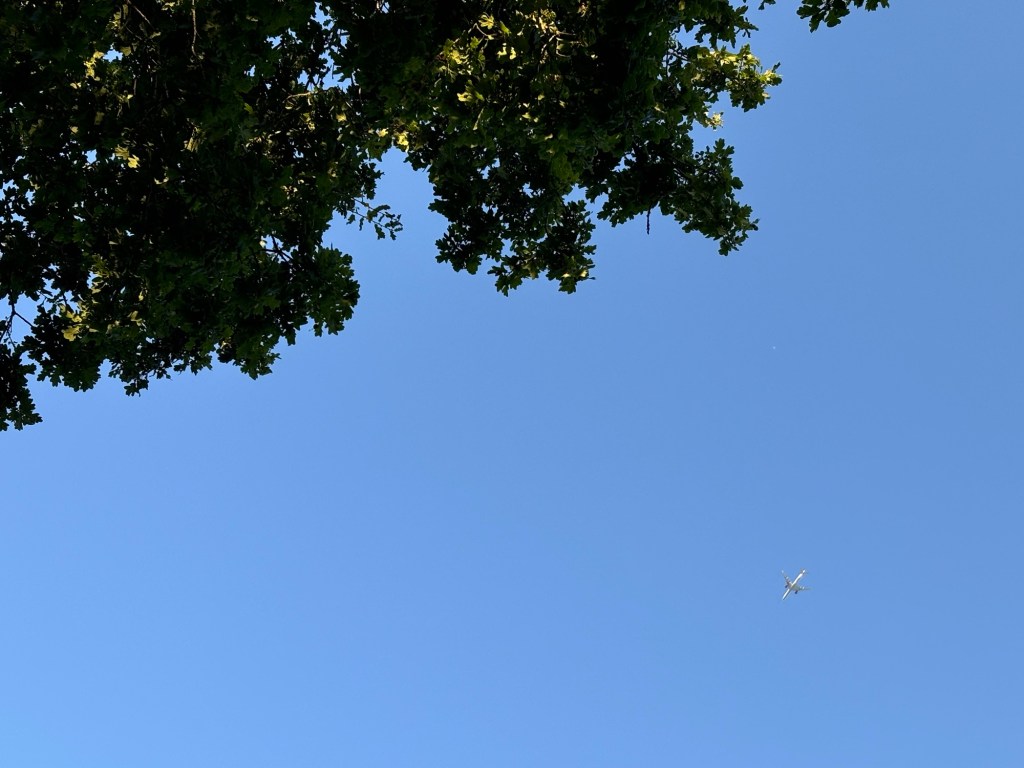
I looked up last night and saw a plane coming in to land at Heathrow. One of the big ones that comes in from across the Atlantic, like the one I flew home on nearly five weeks ago. It made me think of that Monday morning, seeing the sunrise over London, knowing in my head – even if I didn’t want to admit it in my heart – that I had come to the end of a cheery chapter in my life.

A plane like that one brought her here to this cloud-covered island many months ago. I wonder what my summer would have looked like if it hadn’t?


The Portuguese have this wonderful untranslatable expression called ‘saudade’. It’s often taken to mean the feeling of missing someone or somewhere, or more precisely a sense of longing for that thing, but many Portuguese and Brazilians will tell you that it’s a lot more subtle than that. There’s a sense of finality to it, also: an understanding that what you once had may never come back at all, an acceptance of that, but a wistful longing for it all the same. Not the raw kind that breaks you in the days and weeks that follow, but a tempered and reflective sense of nostalgia for what once was and what could have been.

It’s not unique to the Portuguese, but it is especially common in their culture – and perhaps even more so among the Brazilians. It is said that the expression may have evolved during the Age of Discoveries, when the wives of the great explorers of the day bade farewell to their husbands and lovers as they set out for the Americas (how ironic) knowing full well that they may never see them again, and that if they did, they would return as changed men.

Among the Brazilians, it has taken on the sense of a nostalgia for a lost future: a golden country that never was. The American dream isn’t just limited to the States – a shard of it can be found embedded like a splinter in the subconscious of all the descendants of the colonists, I believe. Why else should they have made such a journey if not in hope of a better tomorrow?

I feel that way about Spain, sometimes. Perhaps that’s the generational shockwave of my grandfather’s death in his mid-twenties, rippling across the years to the present, an echo of a lost world that could have been. Spain calls to us. It has been calling for sixty years. Come back. Come home. Sometimes you spend hours, days and even weeks waiting for somebody to reply (looking at you, folks on Hinge) without realising that something greater has been waiting for you all the time, if only you knew how to answer.

I have been the architect of my own saudade by choosing to devote my life to gazing upon that dream from afar: teaching Spanish to the English, sharing my love for a country I can only touch a few times a year. It is a test of endurance, to look upon a thing of beauty and not to touch. Spain has always been that thing. It fills me with awe, excitement, a deep-seated admiration and an infectious appreciation for life itself, but a sense of longing all the same, knowing that it is in my heart, but beyond my reach. Like there’s something blocking the way that I can’t see. Perhaps it’s akin to sleeping beside a former lover, after the love has gone.


I wandered through the woods as the sun came down. I think the nightjars have already gone back to Africa – there must be plenty of them around for a local bar to bear the name The Nightjar – but I was followed across the heath by a pair of stonechats. In that year I spent growing up in the Andalusian sierras, that was a sound that accompanied me every weekend on my forays down to the abandoned railway at the foot of the mountain where we lived: a whistle followed by a song like the clash of two small stones.

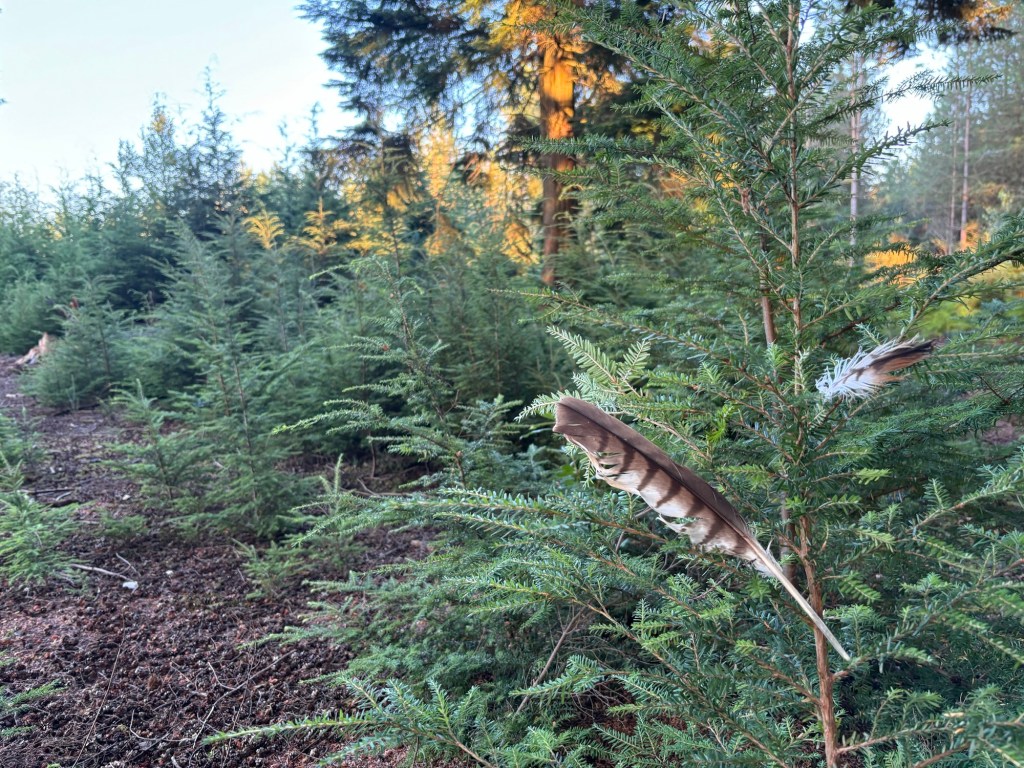
Further in, I found a couple of kite feathers. There are so many in these woods. When I was a child, you would have been lucky to see a buzzard – poison and poor public perception very nearly wiped them out – but now they’re everywhere once again. The red kites that once quartered the streets of London before their extirpation in the 19th century have also come back with a bang, and their feathers turn up in the forest quite regularly. I left some in a small tree for another person to find – some bright-eyed kid like me, perhaps, who might take them home as a treasure. Something they can look back on in years to come, and remember the day, remember the smell of the forest, remember the one who took them there by the hand – the feel of their hand, the sunlight in their laugh. I’d like to think that. BB x


Half Time

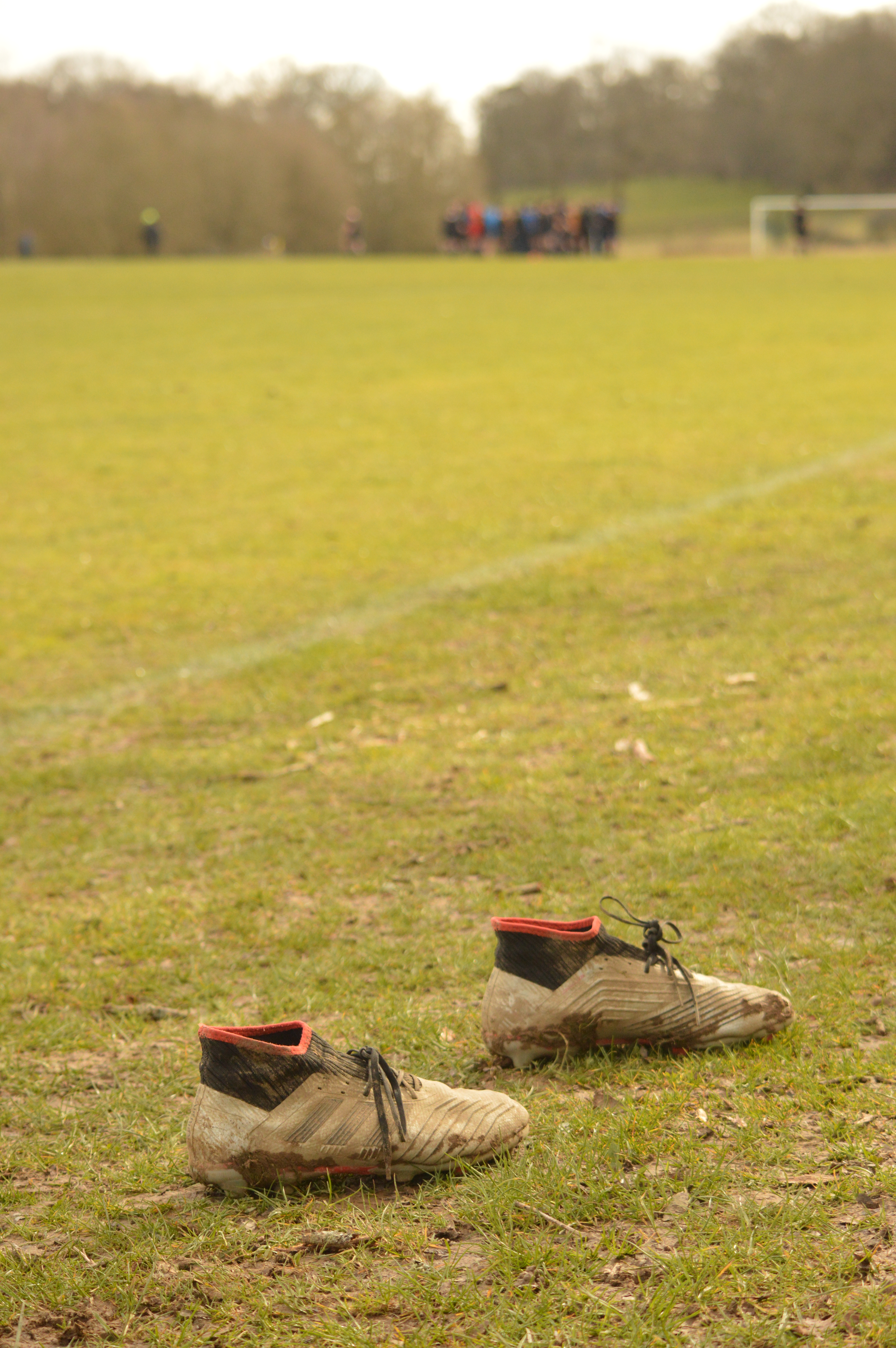
Saturday afternoon finds me out on the side lines, camera in hand, supporting the boys. We put up a valiant fight and place third, thanks to a surprise goal and some seriously impressive goalkeeping. The ball comes my way at some point and I aim to block it, but apparently the ball was way over there and my leg was somewhere else. One of the boys saw fit to rib me about it in house later. I can laugh it off now as I did then. Football has never been my forte, or any other sport for that matter.

Working in a boarding school has got me more invested in sports than I ever was at school. There’s something magnetic about watching your charges do themselves and their team proud, whether they win or lose, that I never really felt when I was obliged to play the game. It’s not that my parents didn’t try to get me into sports when I was younger – goodness knows they tried their best – it’s just that then, as ever, it wasn’t in my interest. Which is why I’m here, not far off the age of thirty, and I still couldn’t name you more than about ten footballers at best. Somewhere along the line it seemed a great deal more important to consign to memory the sight and sound of every single feathered animal in the UK. I guess my excuse for stretching myself thin with the things I do – making music, speaking five languages, writing books and knowing my way around the natural world – might be construed as compensating for the fact that I could never do the one thing that comes naturally to most boys… that is, kicking a ball.

I can’t really remember a great deal about my sports lessons at school. If the truth be told, I’m pretty sure I used what cunning I had back then to wangle my way out of sports for good by the time I was sixteen. I think it was along the lines of “rehearsals for a musical” that I managed to stretch over two years. At least in my first year at school I was given an excuse when an angry sixth former stoved in a few lockers, including mine, with my sports kit trapped blissfully inside. Two memories alone remain: being made to play on through a blizzard in woefully short football kit, and the humiliation of being made to keep attempting the high jump until I was finally able to clear it – by which point it was almost level with the mat. And while I’d normally pull a face at using the same verb twice in succession, “being made to…” sums up my sporting experience pretty well. Understandably, this air-headed naturalist wasn’t ever really at home on the sports pitch.

Which is why it’s all the more surprising to me that I get such a kick out of supporting my boys in their games at the weekend.

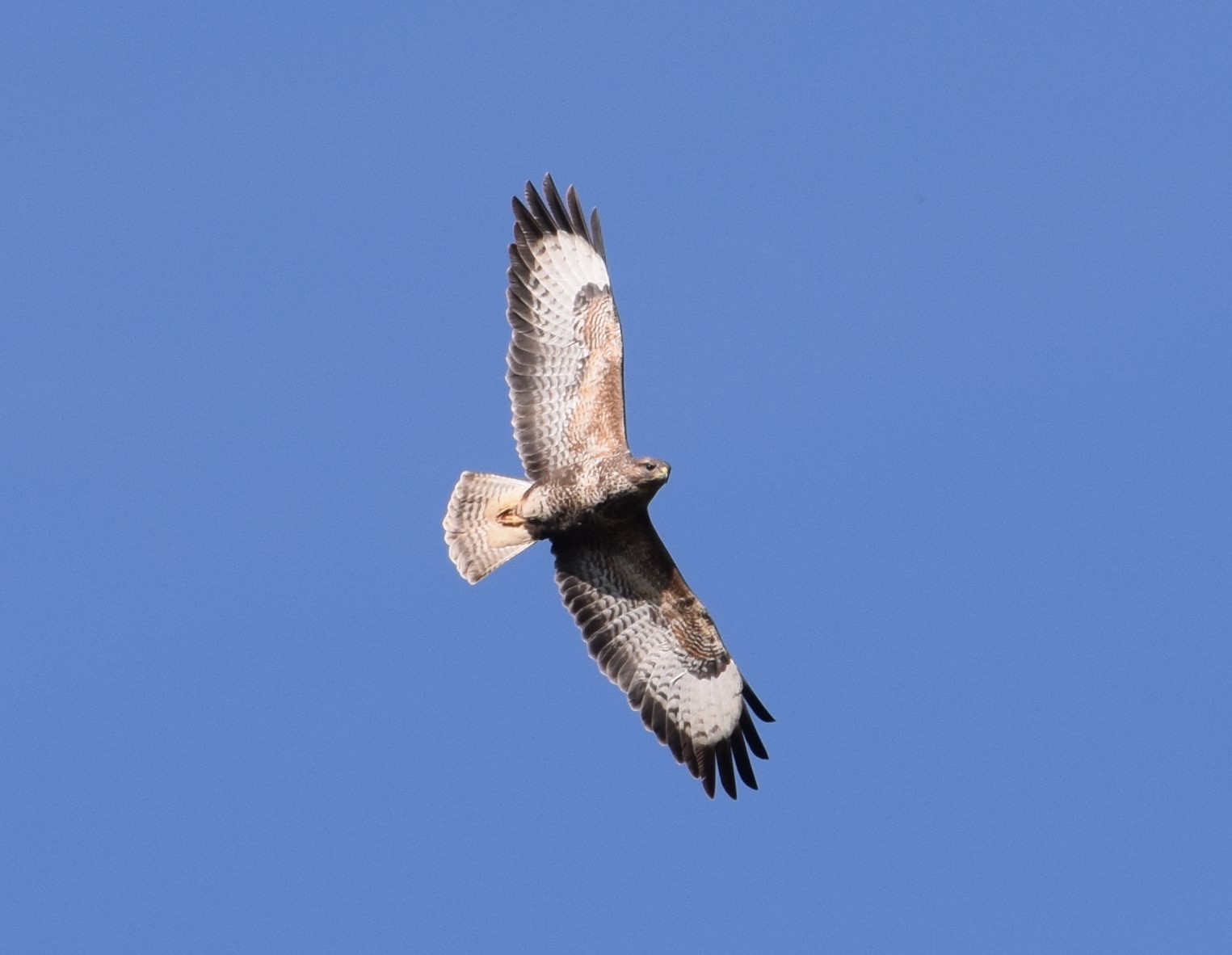
Because leopards never change their spots, I turned my camera skywards a couple of times on the buzzards that came drifting over the pitch, as I once did during the summer fixtures a decade ago. Spring is here and the birds are pairing off already. There’s a part of me that sighs, but a sunnier, more hopeful side that smiles, and I cross my fingers and I hope theirs is a successful pairing. Successful being the appropriate word, since happiness seems out of sorts. We still don’t know for sure whether birds feel emotions like we do, but I’d like to think they have something close to it. You see hints every so often that they might: a swallow mourning beside its partner’s tiny body, crows sliding down snow-bound rooves, choughs hurling themselves from great heights seemingly for the sheer thrill of it.

It’s uplifting seeing the smiles on my boys’ faces during a game, and I find myself wondering whether that’s the same electric feeling you get after a concert, or from sighting one of our island’s most beautiful creatures riding the spring thermals. And now the sun is out again, I might just go for another heart-healing walk in the Weald. The forest weaves a magic that never dies. BB x
Pygmalion

Yesterday was International Women’s Day. If you hadn’t noticed, you probably have a much healthier relationship with your devices than I do. Being naturally cautious when it comes to writing about trending topics – and keeping a wary eye on the growing stack of marking on my desk – I wasn’t originally going to write anything on the matter. In previous years I might have jumped on the bandwagon and sang the praises of women from history who I find inspirational, but that muse didn’t find me today.

It only occurred to me after a couple of hours’ highly productive procrastination on the novel last night that there’s one woman who I’ve been writing about since I first got bit by the writing bug, now twenty years ago. A divisive woman who has been at times a distraction, at others a channel for my doubts, but always a polestar, burning bright, night after night, though the other stars around her blink in and out of the darkness.

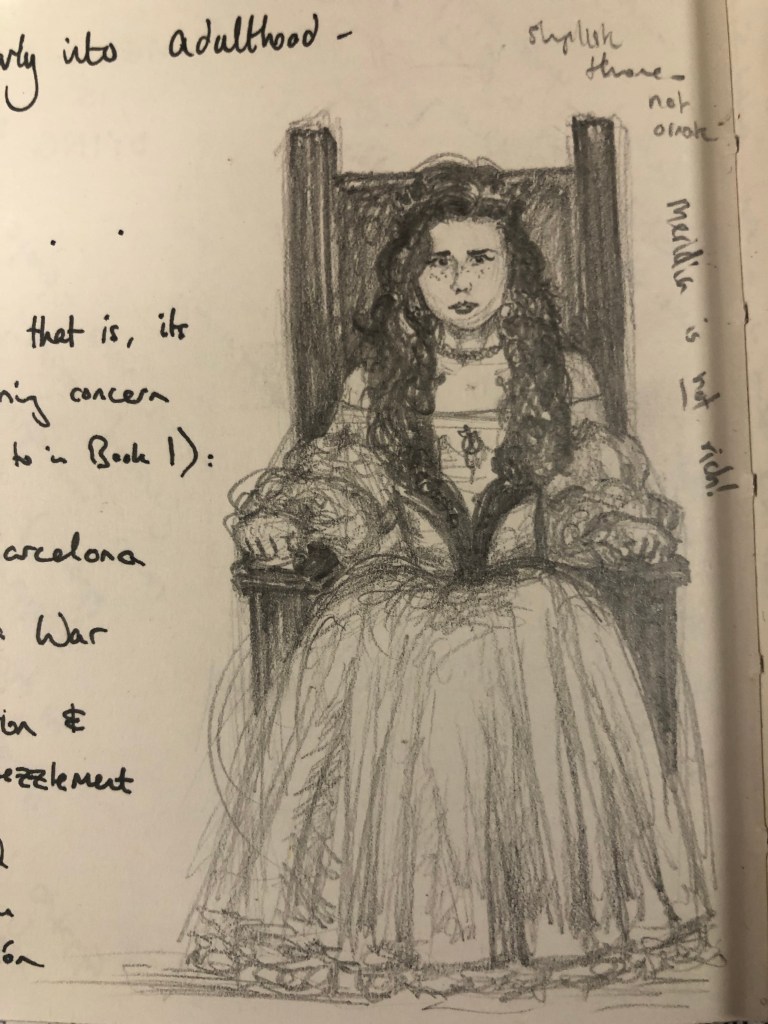
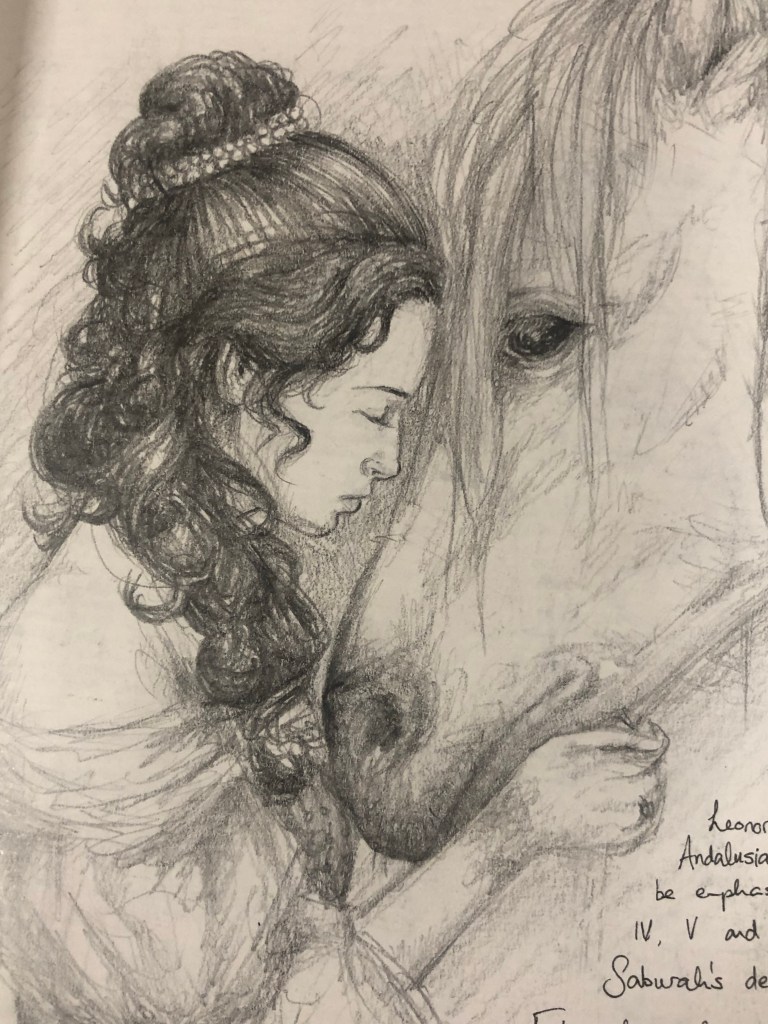
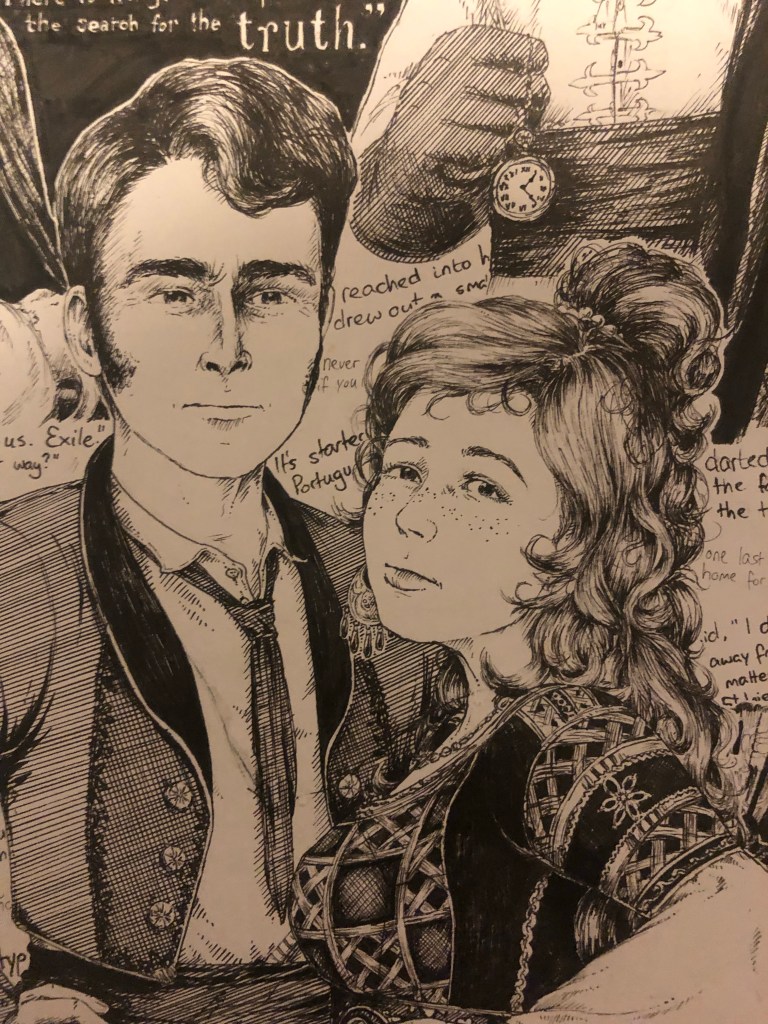
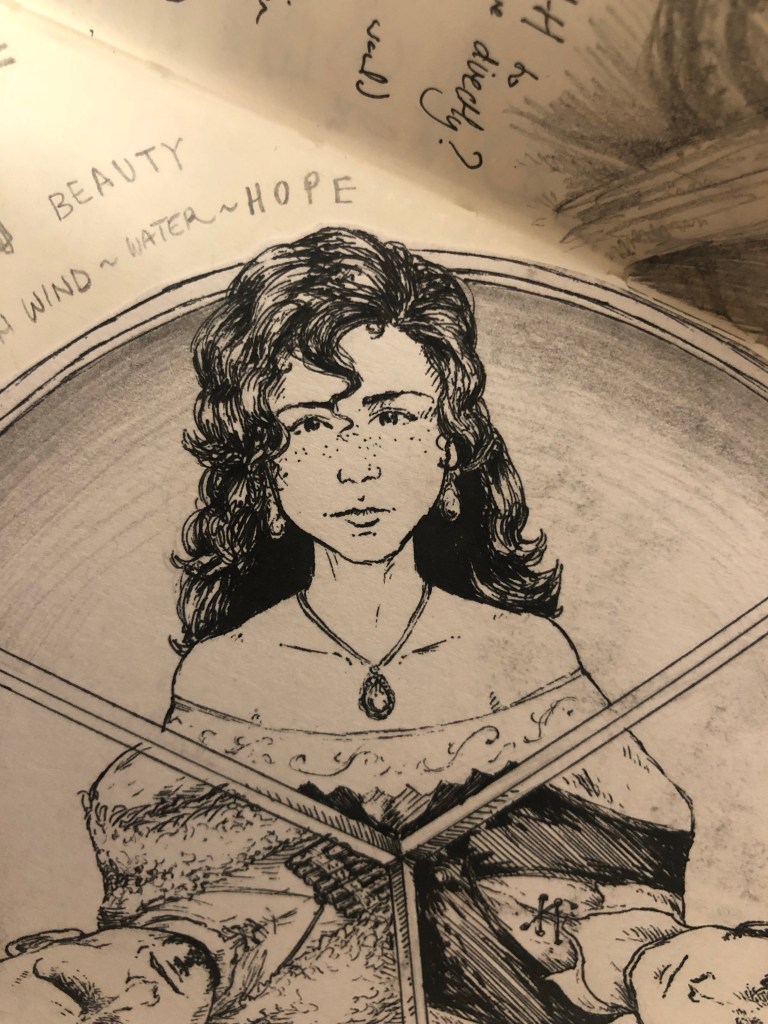
This is Leonor. And this her story.

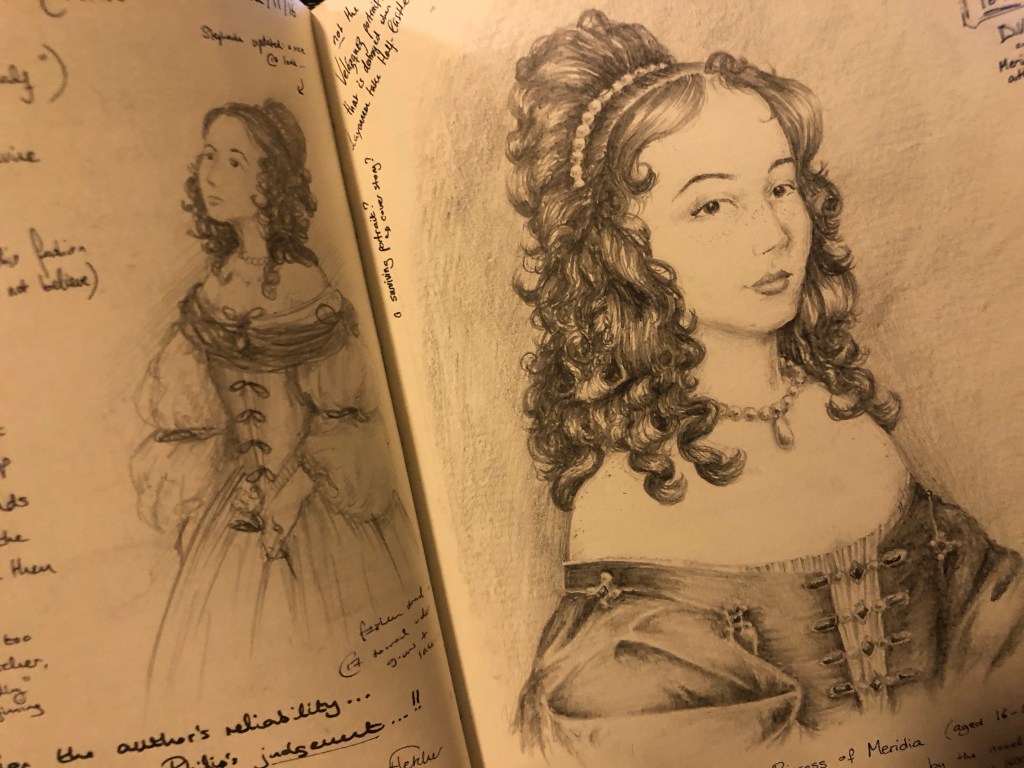
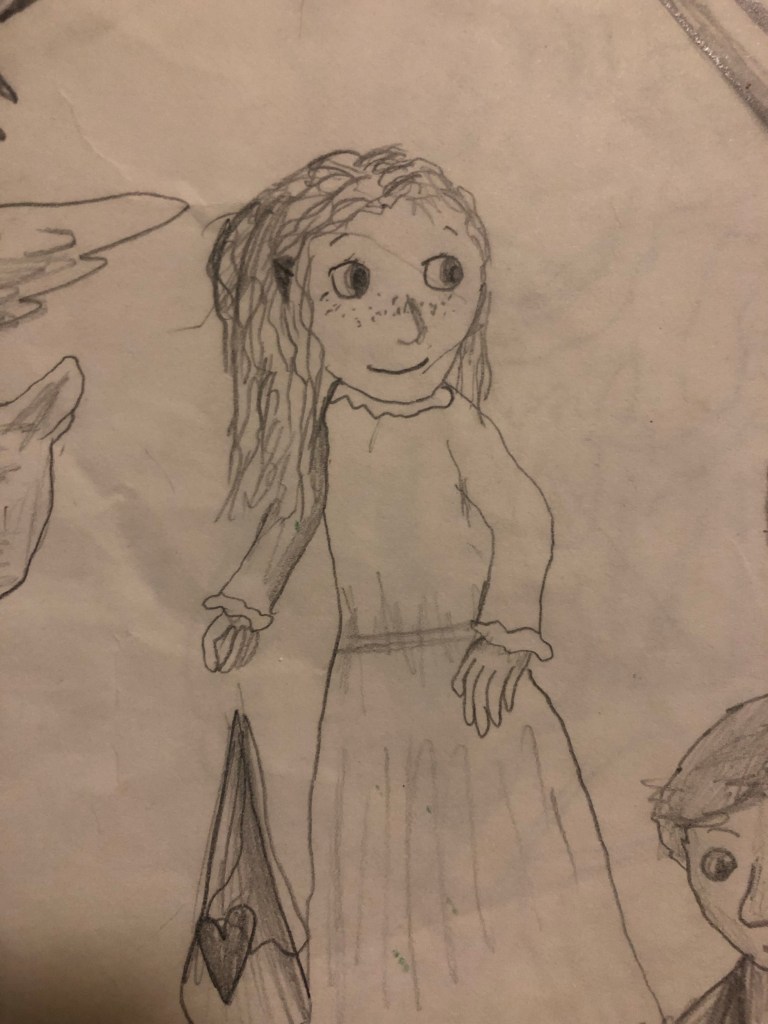
I’ll be twenty-eight this summer. For no less than twenty of those years, the red-haired princess has been living rent-free inside my head. Whether she was inspired by a childhood friend, the Little Mermaid or a double-page cartoon from an Art Attack! magazine, I don’t suppose I’ll ever be certain. Like as not, she sprung into being as a combination of the three. One thing I know for sure: of all the cast and characters of the books I’ve spent the greater part of my life writing, she’s been the one constant. The world has shifted beneath her feet several times, sometimes drastically, but she has weathered every storm, survived every crush unaltered and resisted every rewrite. When I brought the book over to Spain a few years ago, she was the final frontier, the last character to trade in her name for a nombre.

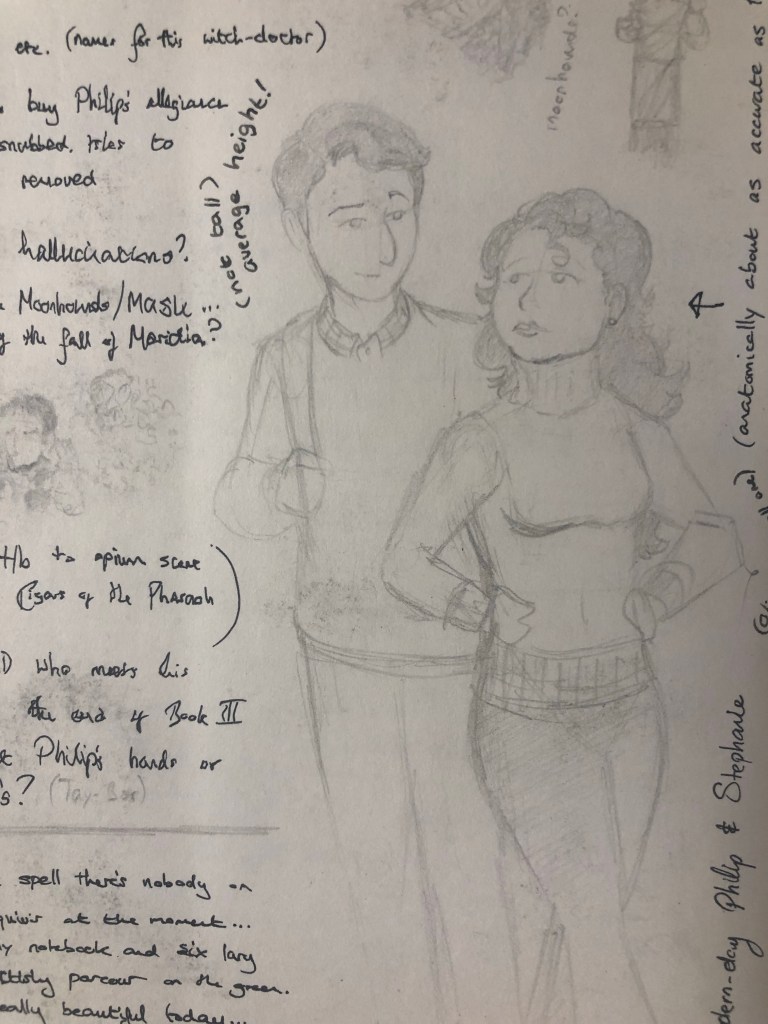
Leonor in her “Stephanie” days, back in ’04

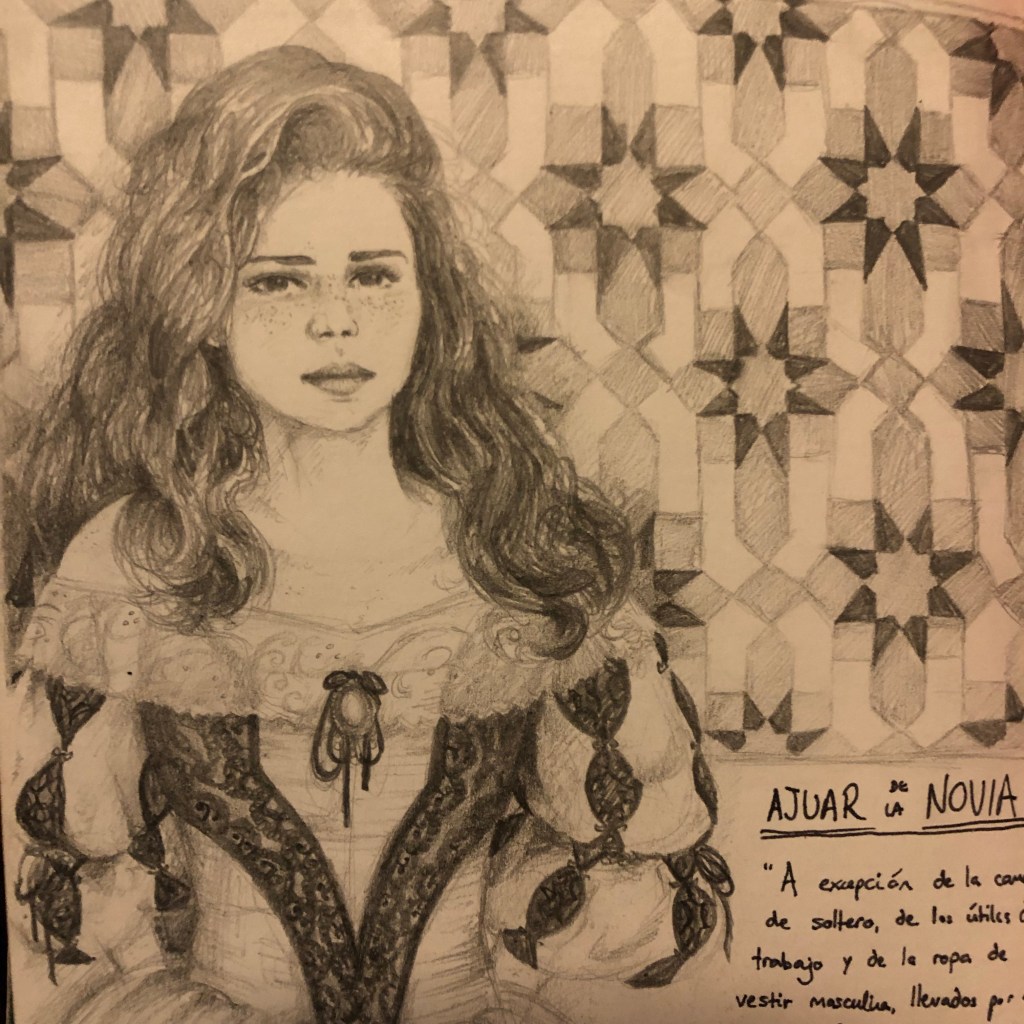
Without giving too much away, I’ll introduce you. Leonor is one of the two central characters in the story, though arguably it’s her story that’s the one being told. The princess of Meridia, she’s playful, sharp-witted and short-tempered, with a sense of duty almost equal to her stubbornness and pride. Descended from two legendary heroes from our own timeline, she is catapulted into the role of Queen by a series of tragic events and, amid the fires of war and personal tragedy, she becomes one of the greatest rulers Meridia has ever known, captaining the sinking ship of her doomed kingdom to its final hour.

She’s an avatar of hope and a rallying flag in human form for her people. And yes, I’m sure I play into the “fiery impetuous redhead” stereotype more than once.

My little princess grew up so fast…! ’18

In the saga’s early days, when the concept was still very much a fantasy/sci-fi adventure, I had her imbued with magical powers. These days her greatest power is her charisma: in a saga filled with reluctant rulers, ambitious bureaucrats and silver-tongued servants, Leonor comes into her own as a woman who stands her ground in a man’s world: adored by her subjects, respected by her contemporaries and feared by her enemies. It’s no surprise that in recent years I’ve looked to two other fierce red-headed rulers to bolster her character: Boudicca of the Iceni and Elizabeth I of England.

Now here’s the question. Am I in love with my own creation?

Of course not. For one thing, I wouldn’t dream of playing the third wheel to my hero! But you’d be surprised how much of a flashpoint it’s been in the past. Two previous girlfriends have challenged me about my attachment to her. Try to put yourself in their shoes. I suppose it’s not all that different to inviting a partner over, only for them to discover objects left behind by a former lover. As I’ve tried to explain before, if you want to get jealous about one of my characters, you might as well take it out on the rest of the cast – I have no less love for my other creations.

And yet the fact remains that, by the age of twenty-eight, I’ve had a longer and arguably closer relationship with my central characters – Leonor included – than I have with anybody I know, outside of my family. I wonder whether that’s why I’ve always been so comfortable with my own company. It’s easy to handle solitude when you’re never really on your own.

She’s not my idealised woman by any stretch of the imagination, though it’s possibly due to my long connection to her that I’ve always had a weakness for dark eyes and red hair. She’s no imaginary friend, anymore than Desalma is a shadow that haunts my dreams. I neither love the women I conjure out of the air, nor do I fear the monsters I create. She is a figment of my imagination, and though she’s found her way into journals, homework diaries, used envelopes and maths book margins over the years, if I were to disappear one day, so would she. Perhaps that’s why I’ve never stopped trying to tell her story.

Do you know what I’d like? If I should be lucky enough to have a daughter of my own one day, I’d love to tell them her story. To bring them up to tales of her courage, her unflinching hope in the face of overwhelming odds. To show them that, though she wasn’t perfect, though her pride got her into trouble, she kept on fighting for what she believed in.

She’s not my Galatea, but she is my muse, my inspiration, and her story needs to be told. That’s why I write. That’s why I’ve always written. After all, it’s hard to say no to a princess. BB x

I’m the Bad Guy: Writing Villains

Somewhere in my room there’s a programme from a school play I was in back in my prep school years. A few of the lead roles were interviewed about their respective parts, and the boy playing Cardinal Richelieu said he “liked playing the baddie because it is more of a challenge.” My reaction to that line has changed very little over the last twenty-odd years.

Bull. Shit.

If twenty years of writing stories have taught me anything, writing villainy is easy – sometimes, alarmingly easy. Ambition, greed, selfishness and ego are everywhere. Depending on the orientation of your moral compass, you might even be inclined to disregard some of these behaviours out of hand as simple human nature. If you want a challenge, try writing or playing a hero. Finding convincing dialogue and/or motivations for a hero is hard because heroes require hard work: they are what we can become if we can find the strength and the courage to rise above our own desires. Selfishness, the root of villainy, however, is in us all by default. It doesn’t take much to make a villain, just – what did Heath Ledger’s Joker say again? – “a little push”.

What’s the first image that comes into your head when you think of a villain? I imagine it’s rather different to the image in my head. If I were a betting man, I’d wager it’s probably not the moustache-twirling Dick Dastardly-type, which went out of fashion a long time ago. The movie-going public seems to have lost its taste for gleefully evil baddies (so much for Palpatine!) in favour of the tormented anti-hero with quasi-legitimate motivations (a la Thanos). Avatars of utter darkness are on the out, and they’re taking their more rational minions with them. In some cases, this has led to the near-total disappearance of the bad guy altogether (see Inside Out and Moana, or even Encanto).

As a writer, this saddens me, for much the same reasons as the destruction of statues bothered me a few years back. Doing away with the villains of our world is like smashing up a mirror; just because you can’t see them anymore, it doesn’t mean to say they’ve gone altogether. We need to be reminded of the depths of our depravity from time to time. Every villain is a warning in his or her own way of the capacity for darkness in all of our hearts, and from them we learn to avoid their mistakes.

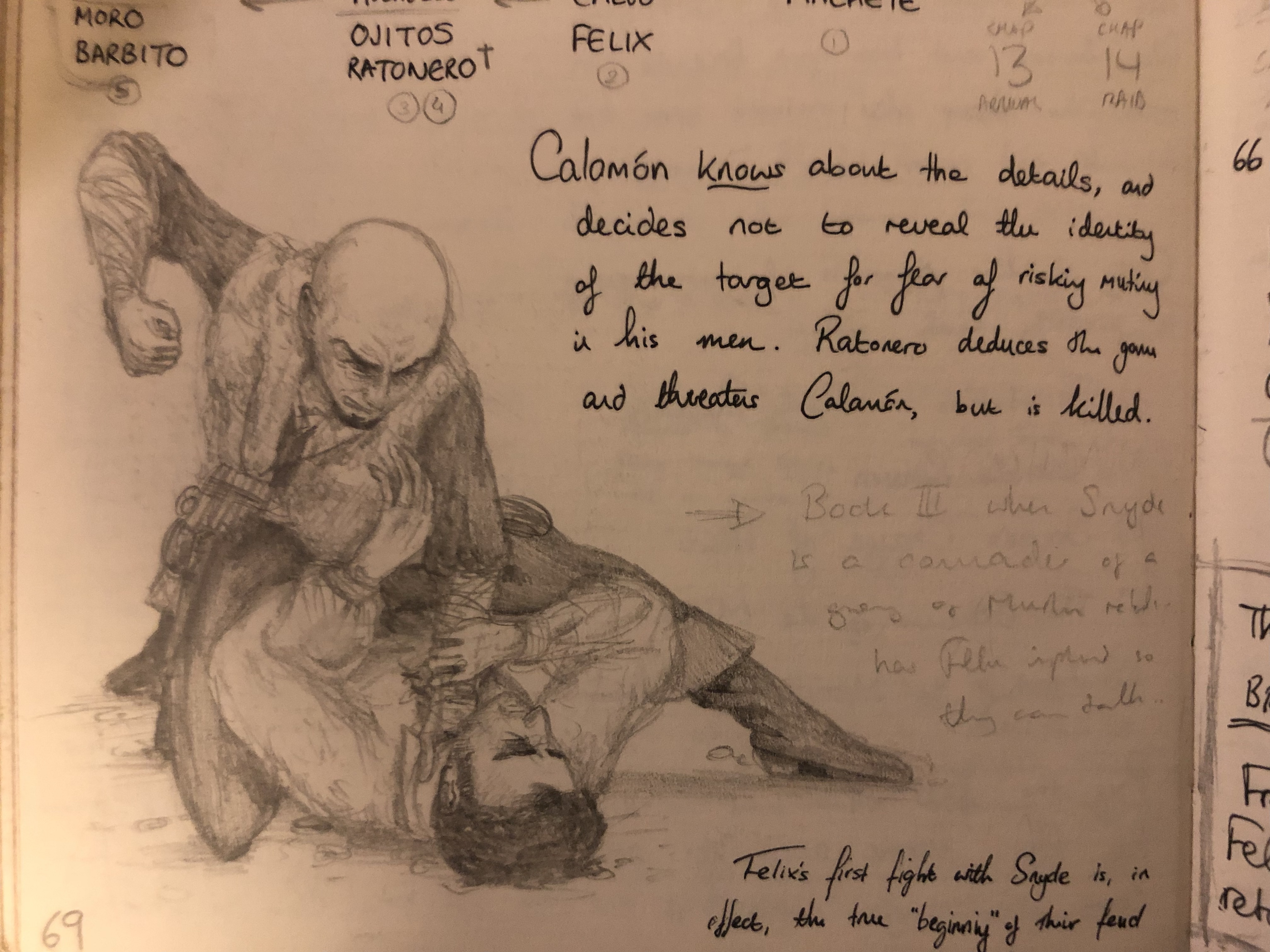
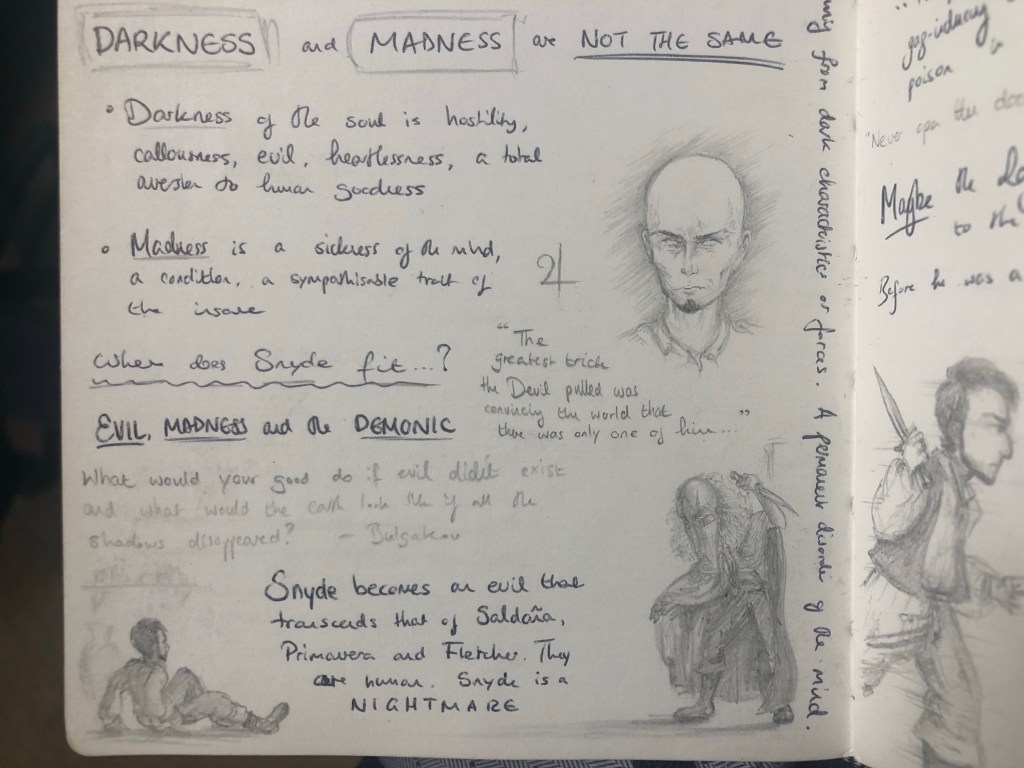
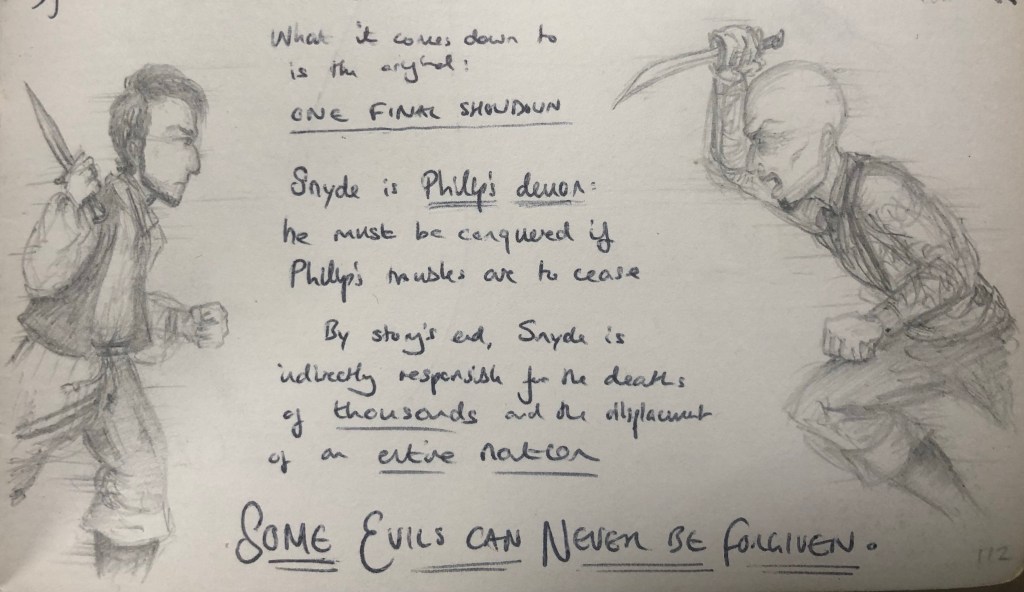
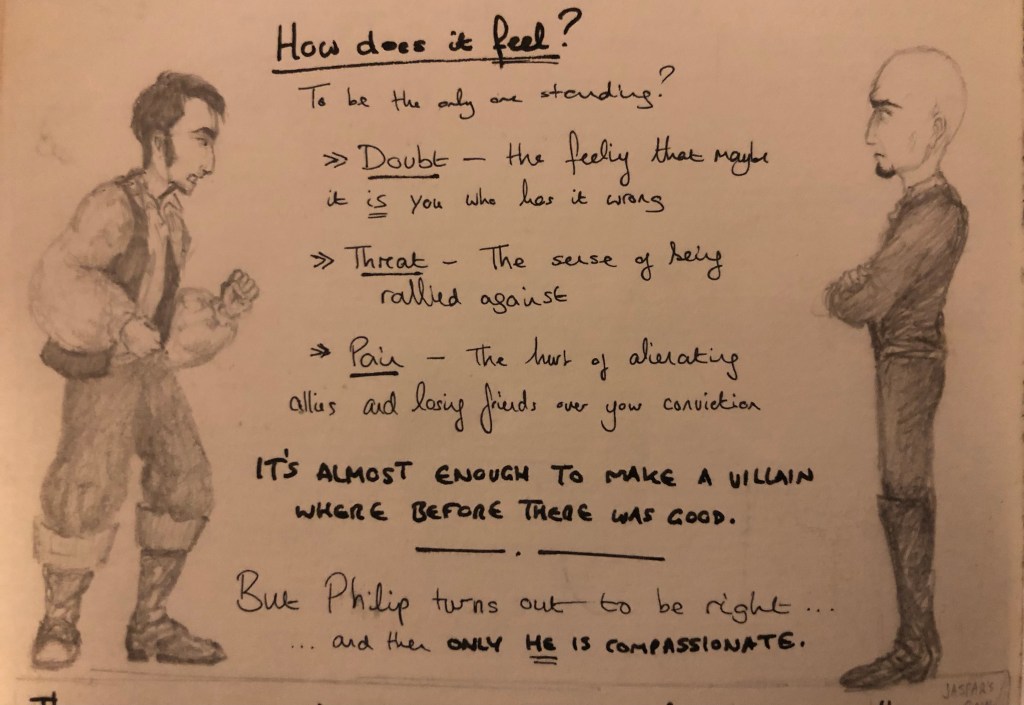
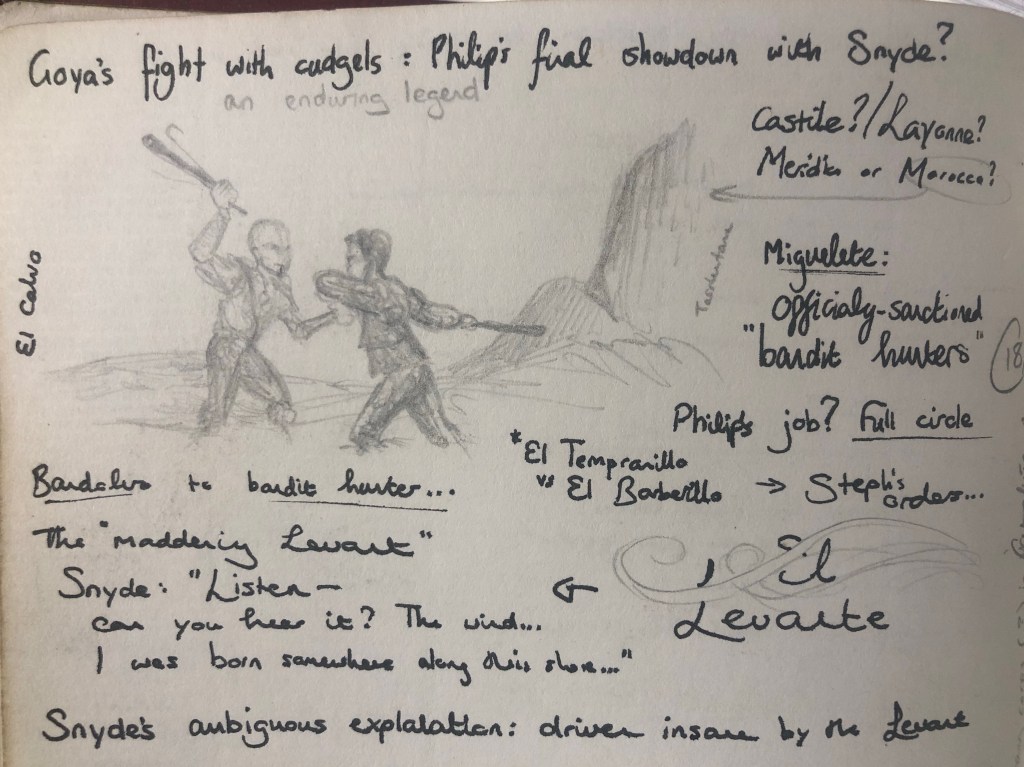
Unlike the heroes of my tales, the primary baddie has hardly changed since his inception. His wardrobe may have been updated a couple of times over the years, but his appearance has never shifted. The bald, skull-like head, the high cheekbones, the small black goatee and those piercing, eye-blue eyes… The latter have always seemed to me the most treacherous, wicked eye colour around, though that may have something to do with Daniel Craig’s early-career role as the fantastically sadistic Afrikaner Sgt Botha in The Power of One. Until very late in the Spanish rewrite he bore the name Jasper Snyde, and it was primarily the strength of his surname that held me back from Hispanicising the rest of the names in the book. It took a long time before I found a Spanish equivalent I was happy with. In the end I opted for De Salma, for the simple reason that, if elided (or spoken at the speed at which your average Spaniard speaks), it winds up sounding a lot like desalmada, meaning “soulless” – or, more literally still, “deprived of a soul”.

That’s right, middle school me. Authors do put that much thought into the names of their characters. It’s not just a trick English teachers play on you to get you thinking when it’s coursework season.

I think the thing I like best about Desalma is that he is nothing more and nothing less than a product of my own jealousy. Perhaps that’s why jealousy is one of his defining traits. Some villains you create to serve a purpose within the wider story arc, others are heroes who just weren’t good enough. Desalma is neither of these. He appeared fully-formed in a moment of weakness in my teenage years, moulded about an imagined rival for the attentions of a girl I had a thing for at the time. The crush didn’t last long, and the jealous rage that birthed him was even shorter-lived, but Desalma stayed, growing cancer-like from that first appearance into an evil that transcended all of the villains I’d written into my stories.

Like the Batman’s Joker, he wasn’t supposed to survive the story in which he first appeared, but over time his hold on me grew too strong, and for the greater part of the last decade he’s been the primary antagonist and tormentor of my hero. An avatar of desperation and despair to counterbalance’s the hero’s unyielding clutch on hope.

The other villains in the saga are, predictably, drawn from the other dark desires of my heart. One of my hero’s primary flaws was almost certainly one of my own in my younger years: that is, a magnetic hero worship of the tall, dark charismatic types who hold all the cards. The ones who have the looks, get the girls, crack the jokes and seem to have it all together. It was only too easy to morph the idols of my youth into adversaries whose intentions were not what they seemed, if only to repeat that old saying that has never lost any currency: handsome is as handsome does – or rather, looks can be deceiving.

If I’m being honest, there’s been more than one occasion in my life when I’ve asked myself that question: wait – am I the bad guy here? It was especially poignant in my university years, where my tendency towards strong opinions and the sharing of said opinions got me into hot water with my fellow students. I found my views challenged so often, so vehemently, and seemingly by everybody else that, for a time, I genuinely started to doubt my own convictions. It’s so easy to start thinking you’re in the wrong when it seems like the rest of the world is against you. Israel. Free speech. Gospel music. No matter where I went, I always seemed to be on the wrong side.

Fortunately, most people aren’t walking around with a fictional universe that exists only inside their heads, and have long since learned to see the world through the mature eyes of a working professional adult. Perhaps it’s only those of us who cling to the world of good and evil, and light and dark, that insist on still making such a clear distinction between right and wrong. The grey in between is good enough for your average Joe.

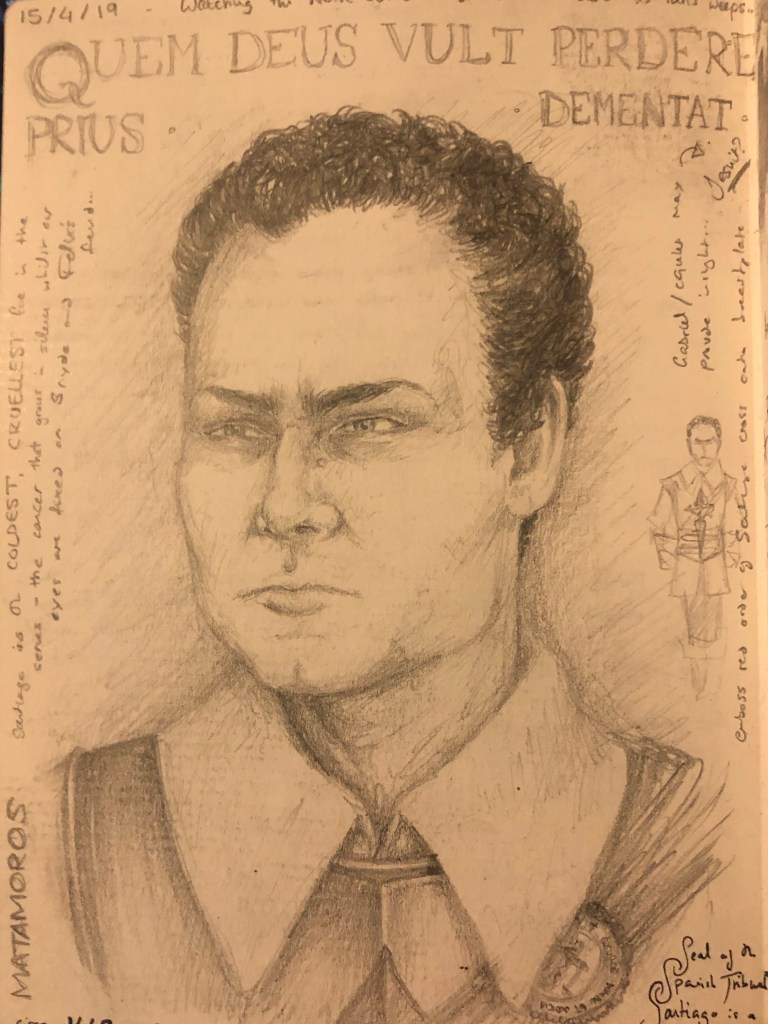
I’ve been working on a new villain this week, between teaching the passé composé and marking Year 9 Spanish assessments. In recent years I’m much more inclined to letting my heroes suffer if it makes them into stronger characters at the end of it. I gave up on Ildefonso Falcones’ La mano de Fatima years ago because I lost all faith in the protagonist, but the more I read my Spanish histories, the more convinced I am that the world was a much darker place back then, just as Ildefonso Falcones painted it, and my stories need to adapt to reflect that. It takes a serious brush or two with the dark side of our hearts for us to see whether we have hero material in us or not.

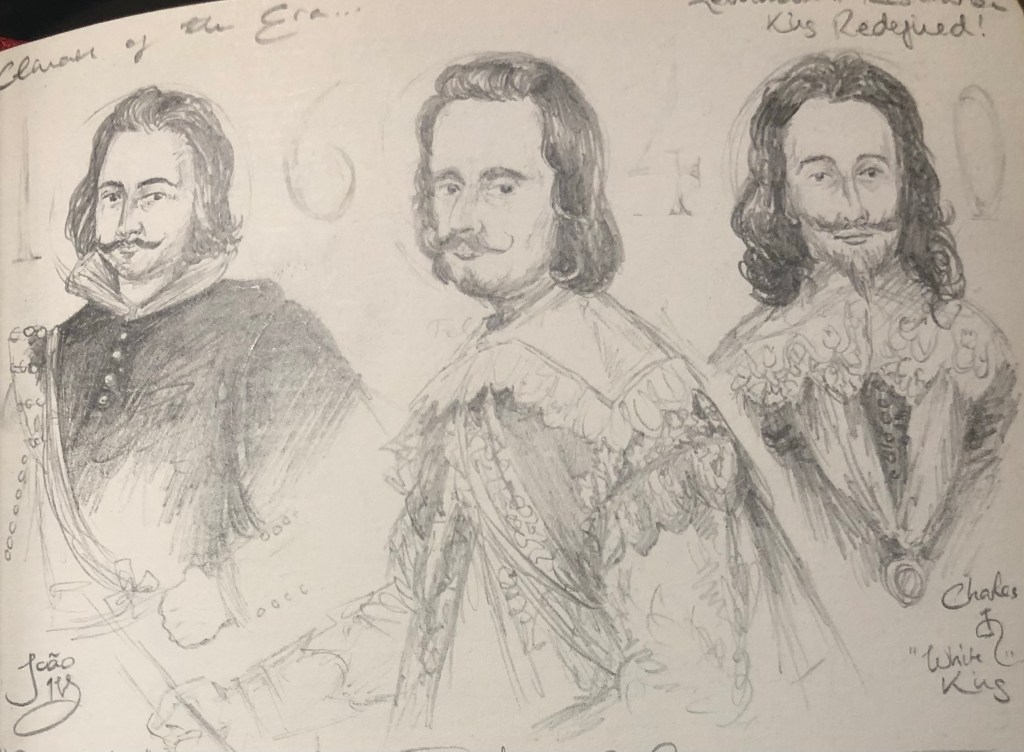
I’m leafing through Leanda de Lisle’s White King to clue up on the politics of Charles I (the Civil War era being contemporaneous with my saga), but also to glean some inspiration for a better-dressed baddie in the mould of a Buckingham or Richelieu. Desperados I have aplenty, and their motivations are easy to script: hunger will make a villain out of anyone. It’s the folks at the top I’m working towards now. Time, I think, for an exploration of power and its malicious influence.

Four years in, I think I have a much clearer idea of power. Because if you want to get a real handle on power, work in a boarding school. And that’s all I’ll say on the matter. BB x
Worldbuilding

I have a confession to make. For a wannabe author, I’ve always been rather guarded about my stories. As a teacher I make no secret about the fact that of my various hobbies I love writing best of all, above drawing, above being out and about in nature – and, yes, even above music. Why? Because writing is one of the few things in the world that you can truly call your own. You can’t compare your voice to somebody else’s any more than you can compare your ability to think. But, for all the show of carrying a journal around and self-consciously dropping into conversation now and then that I write for pleasure, I don’t really talk overmuch about my books.

There’s a couple of reasons for that. The first one is simple self-defence, the fear that somebody could steal your ideas and tell your own stories as though they were their own. Laugh if you will at that idea – what story hasn’t been told and retold a thousand times over since the dawn of time? – but an incident involving my artwork, DeviantArt and an alarming case of identity theft back in my schooldays has left me cautious about putting my work out there. In that case, I was lucky that the thief had been indiscriminate in their robbery: though some of the drawings they claimed as their own were odds and sods from the novel, more than a few were portraits of friends from school, so it wasn’t just my intellectual property on the line. Together with some friends, we kicked up a fuss and had the thief’s account taken down. To their credit, DeviantArt were pretty quick. I don’t suppose I’ll ever know who the culprit was, though reason tells me it could only have been somebody I knew. I learned a valuable lesson, though: art is easy to steal.

The second reason is the simplest one: there’s just too much to say in one sitting. I can see that on those occasions when somebody leafs through one of my journals. There’s so much going on in there and none of it in any particular order, and without a map, you’d never know where to start. Entering into a writer’s world is probably a rather daunting experience, like arriving at a house party and finding you don’t know any of the guests. You could try. You could sum up the Lord of the Rings saga by saying it’s all about a quest to destroy a magical ring, but that leaves out the silent terror of the Mines of Moria, the treachery of Gollum and the mournful autumnal kingdom of the elves; the details that make the world come to life. Story-telling is a necessarily one-sided pastime, and since my day job places such an emphasis on listening, my favourite hobby is something I try to avoid at all costs, because it feels selfishly out of sync.

Today, I’m going to break a habit. I’m going to let you into my world.

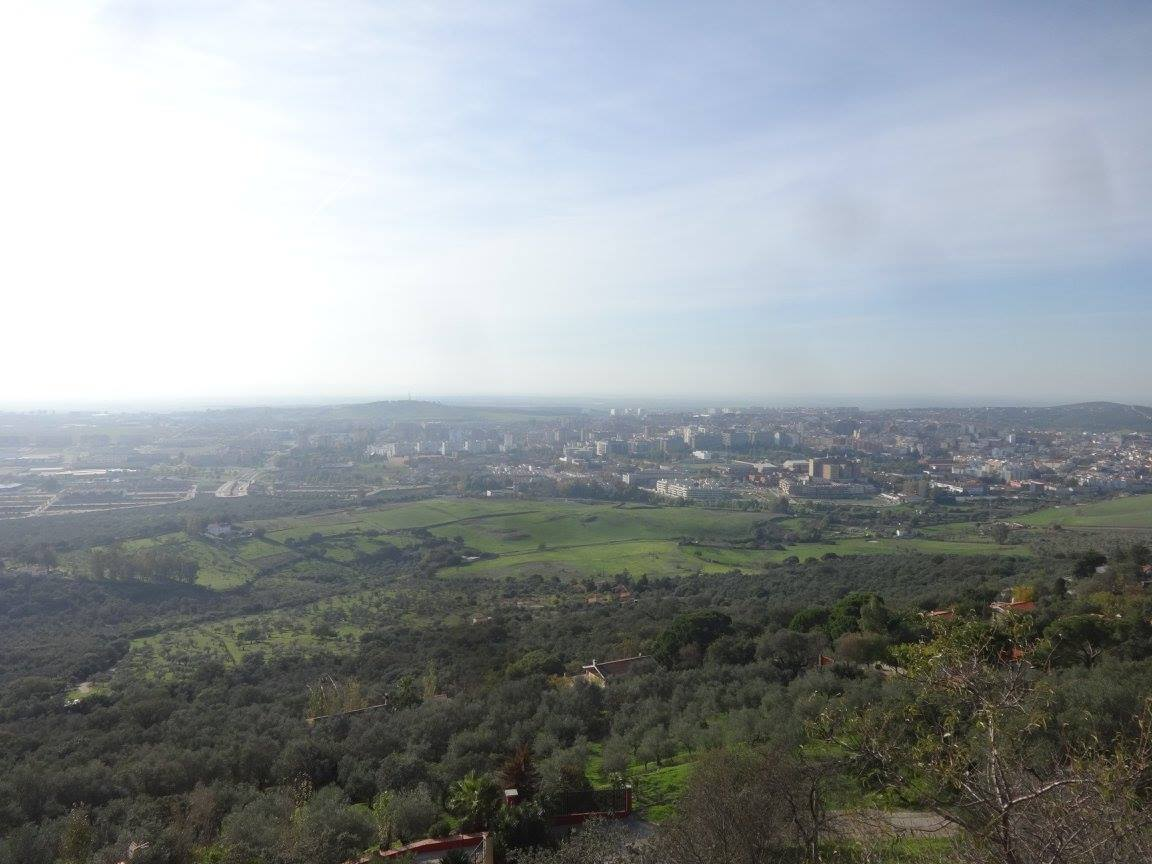
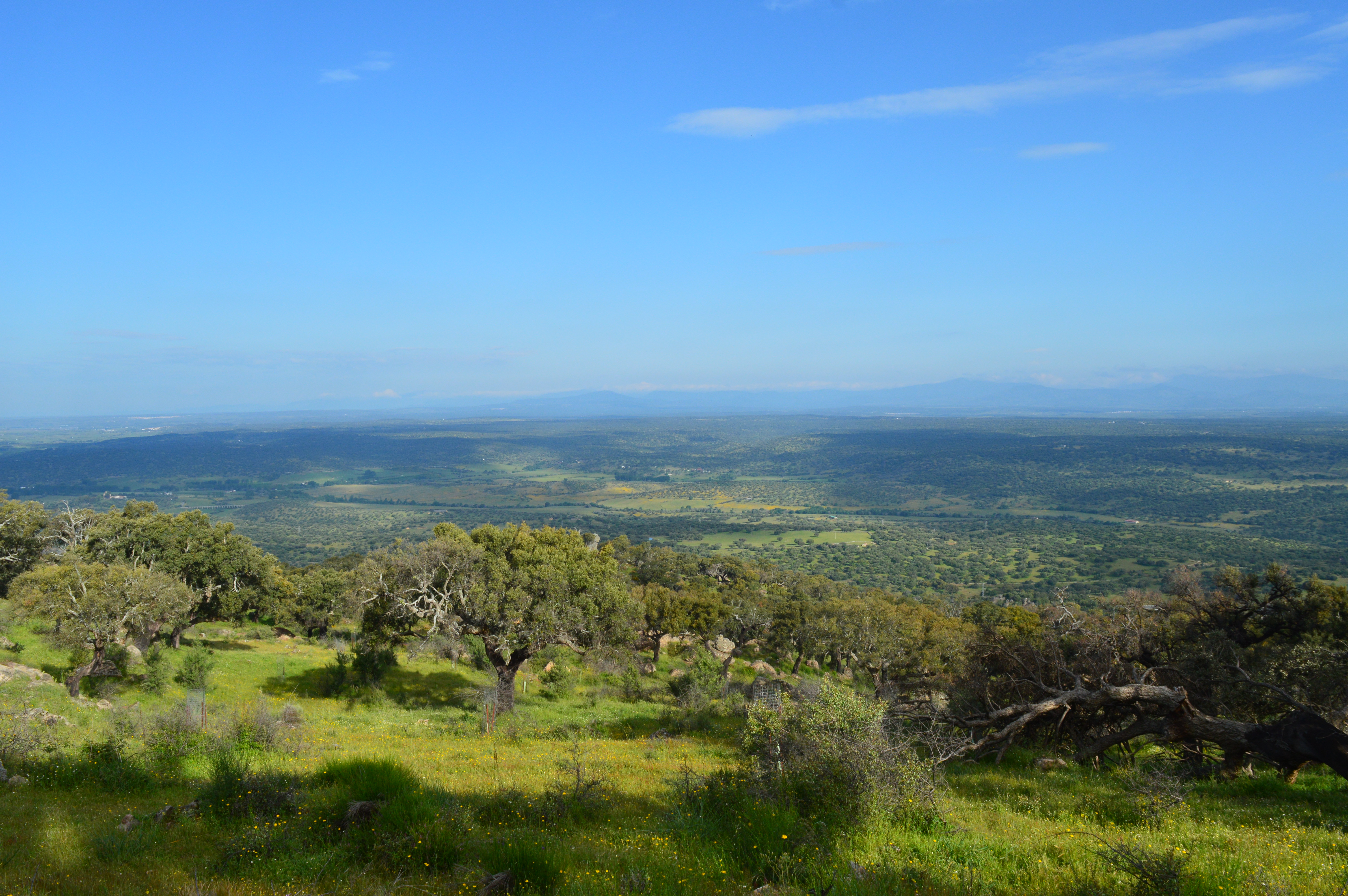
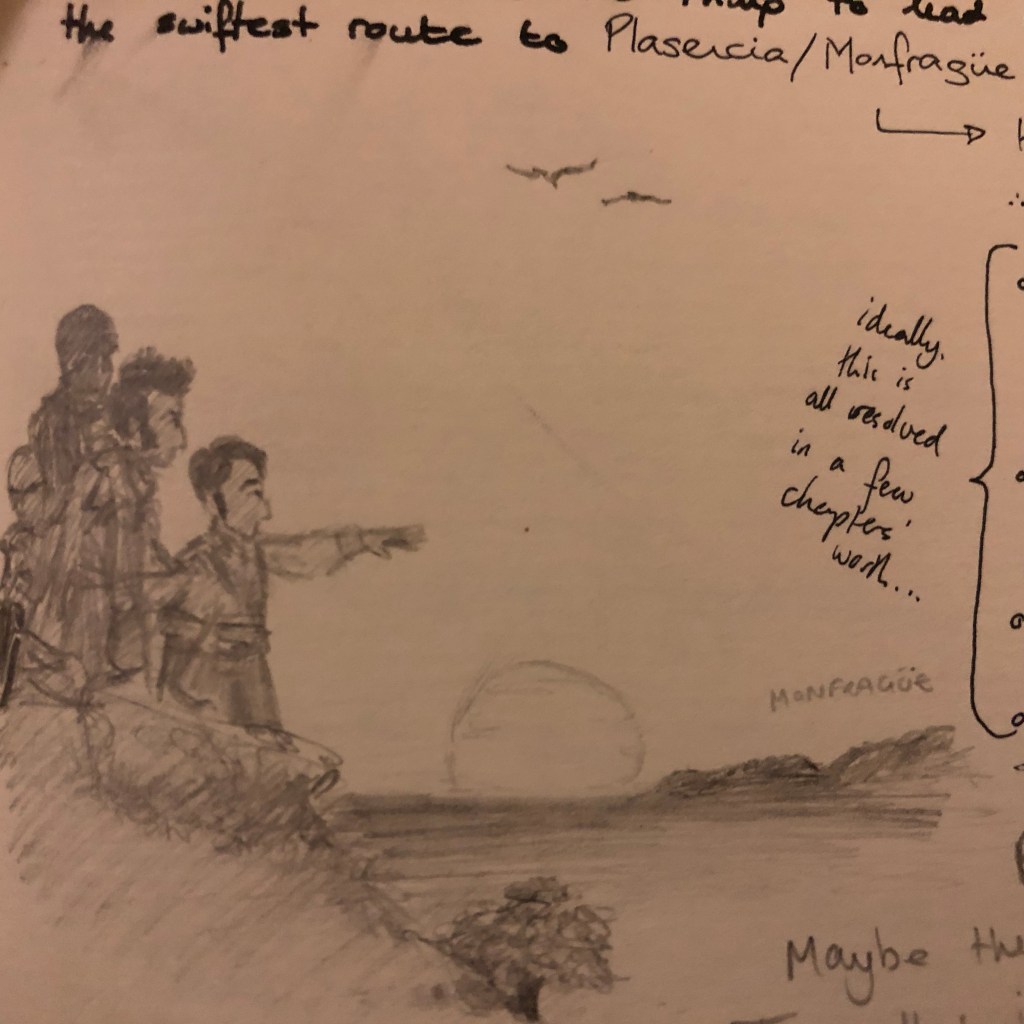
We can start where it all began. Where it all began to take shape, I mean. According to my journal, that was at 15.30 on Friday 13th November, 2015, on a rocky outcrop beside the Santuario de Nuestra Señora de la Montaña just outside the city of Cáceres. I’d been writing “the book” for about twelve years by then – I can trace the first draft back to 2003 – but it was here in Extremadura that everything suddenly fell into place. As I looked out across the plains of Cáceres and upon the city thrown into shadow by the setting sun, something magical happened. It was as though I was staring at a giant jigsaw puzzle that was suddenly arranging itself into perfect order before my eyes. I wrote myself a note in my journal – “What might this place have looked like in the 1600s?”. Sometime later I pencilled in two words above that line: “it begins!”.

And so it began. The cast of characters I had carried in my head and in my heart for over a decade moved to Spain, and the kingdom of Meridia was born.

Picture a corner of the world where the fields go on forever. A land of immense blue skies and sparsely-populated hill-towns, clustered like barnacles about the few slopes that rise out of the motionless sea of earth, where the merciless sun comes down with unfettered fury in summer, and in winter, chill winds howl unimpeded across the plains. A kingdom that has seen people come and go: Moorish forts atop the limestone crags that the vultures have not claimed for their own; Roman arches and theatres rising out of the earth like the bones of some long-dead giant; and, deep in the mountains that ring this hidden kingdom, the faded artwork of a people so ancient that they have long since faded into oblivion. And such mountains! Look to the north on a clear day and you can see them towering mightily over the fields, vast and blue like the sky above, their peaks scarred with snow well into the spring. That’s where the old forests cling on, fugitives from the axes that carved the Roman Empire from Spanish lumber many centuries ago. And where the forests give way to the water, powerful rivers bubble up from the deep, thundering through the hills and carving sheer ravines through the finger-like ridges that splay across the plains from the Sistema Central.

The best of it is that I don’t have to invent this world at all, because it actually exists, and her name is Extremadura. All I had to do was to imagine her in somebody else’s hands. My hands.

When I first set out to create Meridia – named, of course, for the city of Mérida – I initially wanted to keep the real-world location a secret, until the close of the story, at least. It didn’t take me long to realise just how impossible that was going to be from a worldbuilding perspective, particularly over a saga spanning seven books, but since “big reveals” are and always have been a majorly appealing part of story-telling, I played along for a time. I was also still reluctant to fully transition to the use of Spanish people and place names, so I had a go at creating names of my own.

Casiers. Barosse. Meroon. Looking back now, I’m cringing already at how disgustingly English they sound. But then, few tales come into being in a matter of moments. Worldbuilding takes a long time, longer by far than it takes to tell the story itself. I can only guess at how many hours Tolkien must have poured into the creation of Arda. It’s taken me all of twenty years.

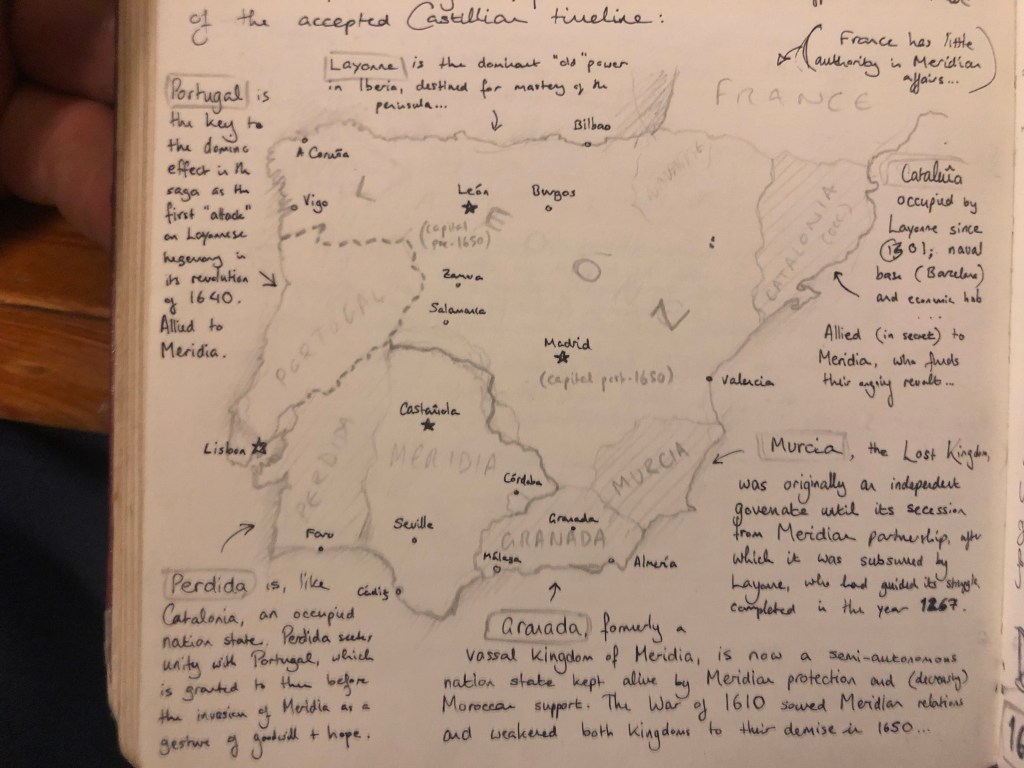
Here’s the same map, drawn about a year later. It’s the eighth of a total of ten maps of the peninsula in the same journal (when students ask me how I can draw a map of Spain from memory… this. This is how). It’s probably the most accurate, and the one I still use today when mapping out the events of the saga, the exception being the retroactive introduction of the “corredor cordobés” that cuts a swathe from Córdoba to the city of Cádiz, separating Meridia from Granada and providing a political flashpoint for the plot. Ringing the map, you can see the history I’ve had to build up around it. I tell you, writing a historical novel is one thing, but writing allohistory – that is, an alternative timeline – is a messy, time-consuming business. If I didn’t keep a journal, I doubt I’d remember all the details. Nevertheless, they’re absolutely essential to giving your world an identity of its own, just as the “Greatest Generation” and the “fight them on the beaches” speech are integral parts of our collective memory.

Creating five hundred years of history for a kingdom which never existed is quite the task. Beginning it is easy, as is the wrapping it all up at the end. It’s what you do in between that’s the trouble. How do you explain away, for example, the men who changed the world who hailed from that corner of the real world? How do you rewrite an essentially Spanish history in a timeline where Granada did not fall until the middle of the seventeenth century, where Seville was in foreign hands for the greater part of the Age of Discoveries, and – perhaps most importantly of all – where almost all of Spain’s conquistadors from Cortés and Pizarro to Francisco de Orellana and Núñez de Balboa hailed from a land that did not carry the flag of Castile?

To be honest, that’s half of the fun, trying to find radically new ways of retelling history. It’s why I wrote my dissertation on the Cronica sarracina, arguably one of the greatest works of fiction ever sold as fact in Spain (or was it fact sold as fiction?). I’m doing the same thing with Meridia: I’m telling the story of Spain through a glass darkly, holding up a devil’s mirror to the country I know best.

And once the world has taken shape in your head, it’s time to set your characters running across its empty plains, so your voice can follow them, painting their footprints with words.

I take my inspiration from the world around me. From books, mostly, but also from photographs, legends, paintings and even conversations with strangers. More than one character has slipped between the pages of the book over the years after a brief encounter with one of those larger-than-life types. In essence, the saga is my paean to my grandfather’s country, so I try to weave as many details in as I can. The madmen of the Hurdes. The seven chairs of Mérida. Goya’s fight with cudgels. The mystery of who really got to the New World first and the Lisbon Earthquake. The odd real person makes a cameo appearance from time to time: Diego Velázquez, Michiel de Ruyter and the lost children of the sack of Baltimore. I get the same satisfaction threading their tales into the narrative as I did from peppering each and every essay I wrote at university with “ursulas” (unnecessarily farfetched sidetracks that somehow relate back to the essay question, named for the sea witch in The Little Mermaid). When you’ve been writing the same story for twenty years, you’ve got to find new ways to keep the game fresh.

And sometimes, it’s not a book or a person that finds its way into the worldbuilding effort, but the real world itself, in real time. Like this little snippet from the journal. I’ll leave you with the date (24/6/2016) and let you guess what it’s referring to.

Worldbuilding is laborious. It takes a bloody long time if you plan to do it right. It took me a matter of seconds to decide to move the fictional kingdom of my childhood into Extremadura, but it’s taken my characters all of five years to finish unpacking. The central characters of the story have only borne their new Spanish names for a little over a year. But it’s easily one of the most entertaining parts of the story-telling business, and it doesn’t half smooth out the writing process when you finally find the time to sit down at the computer and have a solid crack at the next chapter.

So… what would you like to know? Asking for somebody else’s thoughts on what is nothing more or less than the single most precious creation of one’s life is more than a little unnerving – I’m not afraid to admit I got the shivers writing that question – but the purpose of story-telling is to share, and I could do with airing the world inside my head for a change.

Alternatively, if you’re a writer too, does my experience with the worldbuilding process sound familiar? I’d love to hear your thoughts. BB x
Living out of a Book: Adventures with a Journal

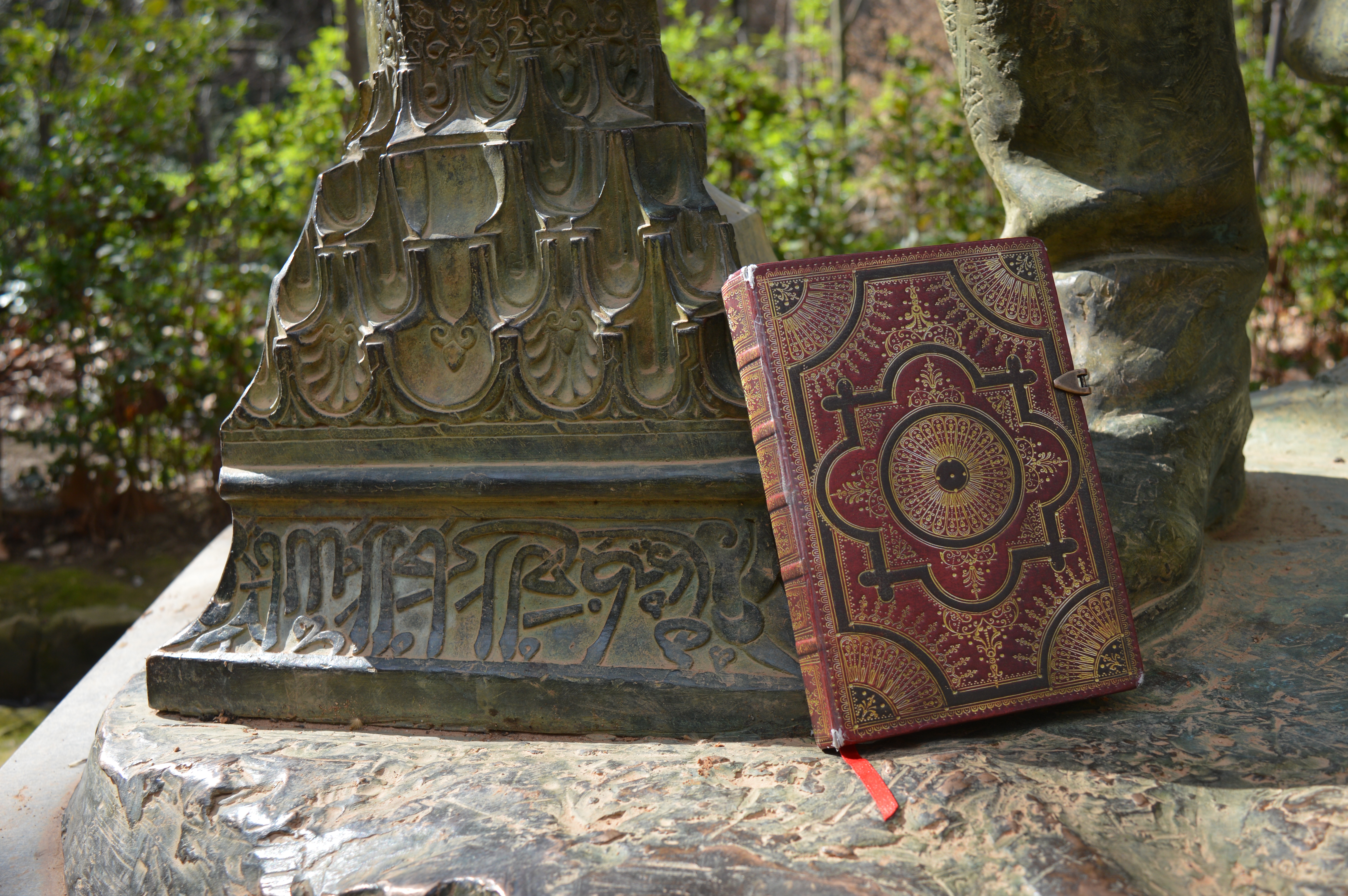
The Red Book (my first “Renaissance” journal) at the feet of Washington Irving, Granada (March 2016)

Let me tell you something for free: full-time employment is a writer’s bane. You knew that already, so neither of us lost anything in that transaction. Except me, and the ever-increasing gaps between the dates in my journal.

I spent so much of this weekend powering through marking after a week of KS3 assessments that it only occurred to me as I filed my Year 9 papers away that last weekend was the first time I’d given my novel some serious thought in a year and a half. Since you can chalk that “blip” up to the first lockdown, it’s probably safe to say the last time I made any real headway with my book was before I took up a post in a boarding school back here in the UK. That is to say, back when I was living in Extremadura, now almost four years ago. If it weren’t for the fact that I still carry a journal around with me, I’d have made no progress in that time whatsoever.

But since I’m more of a glass-half-full kind of guy, I’m going to focus less on the killing instinct of working life and more on the magic of keeping a journal. Because, as always, there’s a story behind it – and in my case, it’s a lot more personal than I ever knew.

I’ve written reasonably extensively about my journalling habit before, but in case you missed it, click here for an earlier piece on one of my favourite journals, the Red Book.

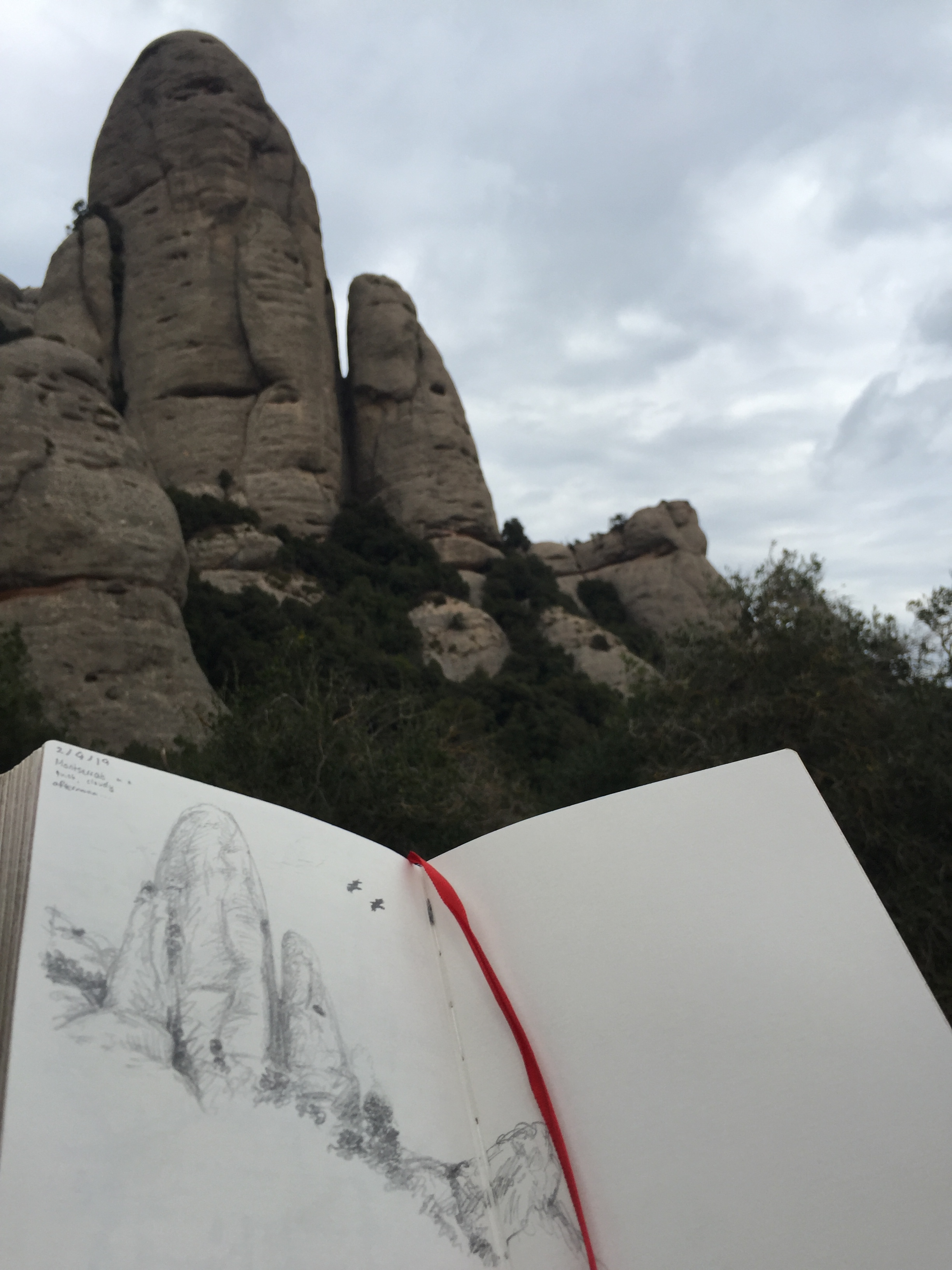
Sketching the windy peaks of Montserrat (April 2019)

I don’t think I’ve ever been without a sketchbook of sorts. Going back to my parents’ place for Christmas turned up quite a few of my oldest surviving books, dog-eared, half-filled and almost all of them featuring the same cast of characters that share a space in my head and my heart to this day. Studying Art for GCSE and A Level naturally fed the habit, though I seem to remember having separate sketchbooks for school and for myself right the way through. I suppose I should reach out to a couple of early inspirations here: to Mr Howe, for his no-holds-barred approach to sketchbook work (“unfinished pieces are often more interesting than finished pieces” has stuck with me); to my old friend Freddie, whose handwriting I secretly admired and have long since adapted into my own; and, of course, to my own mother, who must have kept several journals of her own when she was younger.

These first attempts were more art than word, though. It wasn’t until my eighteenth year that I took the craft of journalling more seriously, riding off the back of having successfully kept a diary for a little over a whole year – to date, the longest successful writing streak in my life. With many long months to go until the first day of my degree, I picked up a small flip-journal from Waterstones and penned some thoughts. At first, it was just lists: locations in my novel, possible pen names, key elements for fantasy fiction. On the second page I branched out and jotted down some facts that I found interesting, for a change of pace (my brother was quick to point out this was a considerably less interesting way to use a journal). I guess not everybody needs to know that the underside of a waterfall is called an undercutting; that Mullah Omar donned the mystical Cloak of the Prophet to drum up support in 1996; and that Dr William Bryden was the sole survivor of the Khyber Pass massacre of 1842.

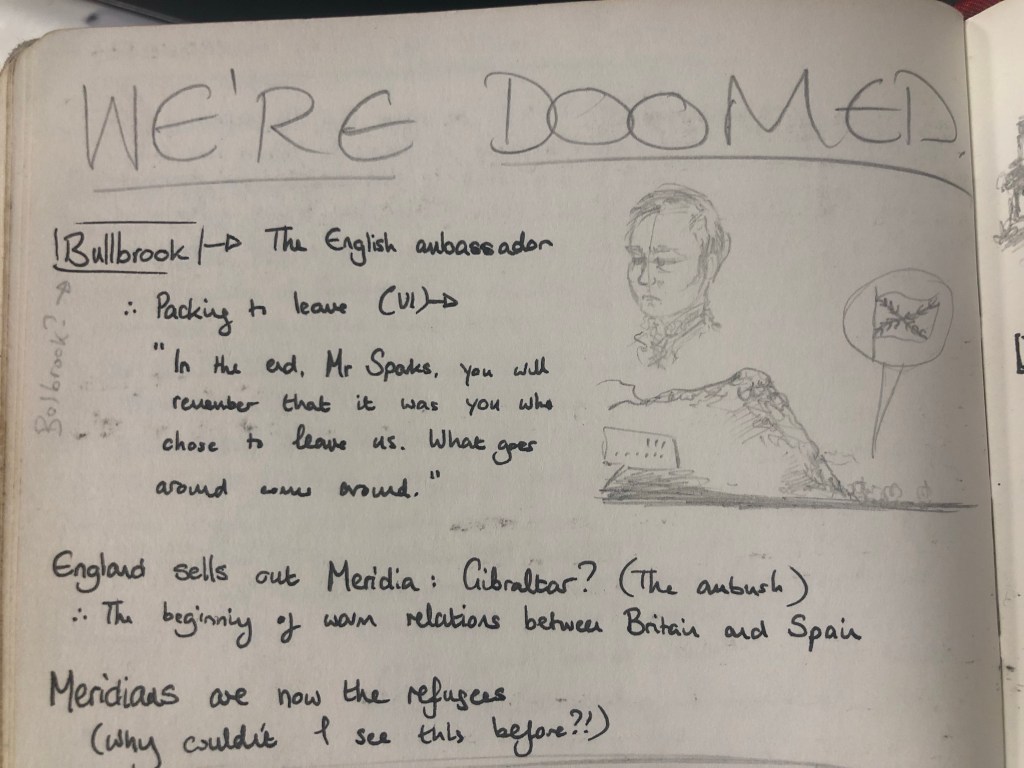
Three pages in and the novel is the back in the limelight – and so it continues. Every so often, I find something in a book or on the news that I deem worthy of recording, but as a rule, the bulk of my pen-and-pencilwork concerns the fate of my cast of characters and the world in which they live, ever-growing, ever-crystallising. Sketches in pencil duck and weave through the gaps like weasels, giving over onto full page illustrations when I really found my mojo. It’s a formula I have deviated from very little for nine years now.

Gypsy Legends and Grenadine Gifts (2020)

When I was younger, and I still had these crazy notions (as the young and reckless always do) of embarking upon death-defying expeditions to Afghanistan and beyond, I remember thinking that, if something should happen to me, the world in my head that I had spent all but the first seven years of my life creating would disappear completely. That is, unless I left enough material behind for somebody to pick up the pieces. I suppose that morbid justification stuck, because there is now enough information spread across my various journals for somebody to put together the various stories I have always wanted to tell.

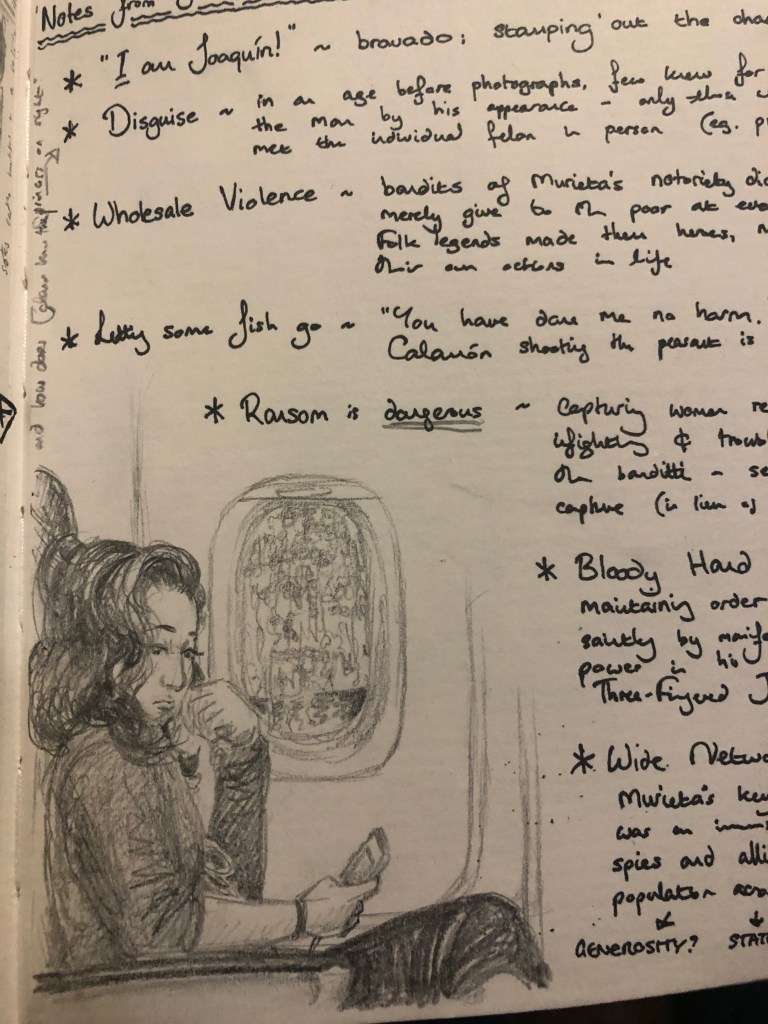
The rain in Spain on the plane (August 2019)

And perhaps there’s a logical explanation for that mindset.

My great-grandmother Mercedes was a woman ahead of her time. In a Spain teetering on the brink of Civil War, she found love with a poet and musician called Mateo. They corresponded in verse, quoting Oscar Wilde and Keats and Plato and Engels. Their handwritten letters to each other – safeguarded by my family for over fifty years – tell of a truly devoted husband and wife on an equal intellectual footing, flying in the face of the dictadura and the expectations of women outlined in the Guia de la buena esposa. Mercedes was well-known about town for her journal, which was as much a part of her character as her glass of brandy and cigars. Though her locally legendary journals themselves are lost to time, it is chiefly through her precious letters to her Mateo that I can see through a window in that past. It is a past which comes clearer into focus the more I get to know my family out there. The fatalist in me cannot help but wonder at the sequence of events that led to me arriving at my family’s door with little more than my journal in hand, unconsciously carrying the one item that would prove my connection to a great-grandmother I never had the chance to meet. Mercedes left this world the very same year I came into it.

I spent the greater part of my search for my family focused on the grandfather I never knew, but it is my bisabuela Mercedes who guides my hand these days. I’m a strong believer in upholding family traditions, and it doesn’t half lend a sense of purpose to the scribblings in my journals, even if they never lead anywhere. My ancestors left me a literal paper trail and I must follow.

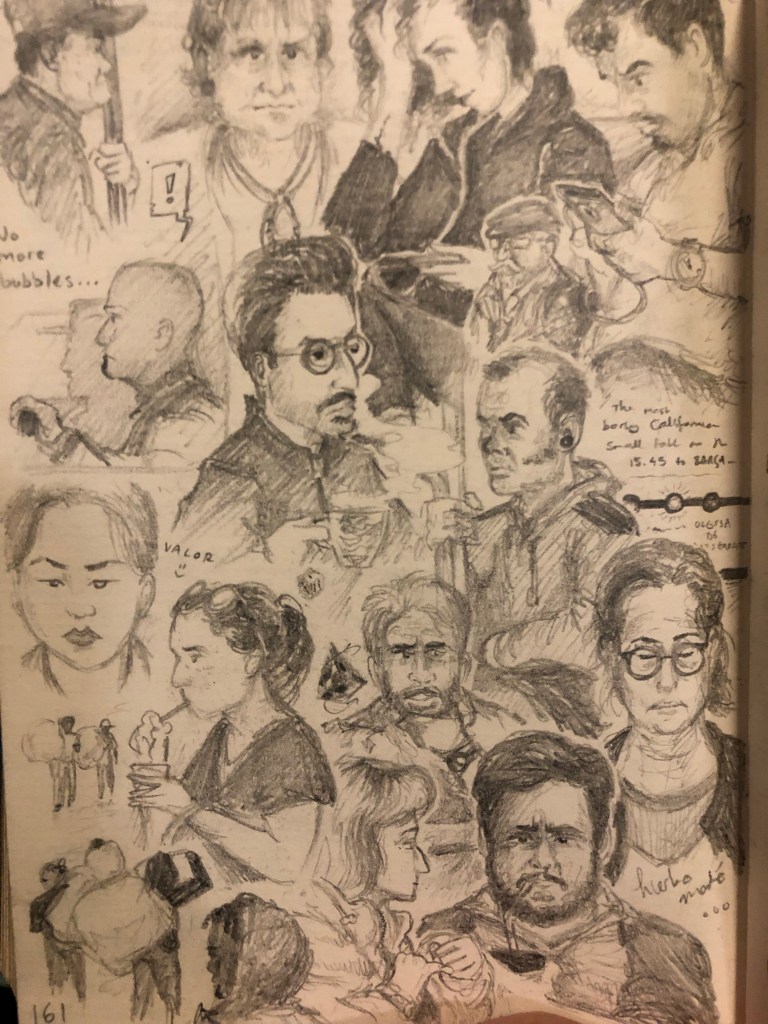
Barcelona vignettes (March 2019)

Have you ever kept a journal? I’d highly recommend it. It’s less onerous than a diary and a beautiful thing to look back on. Through mine, I can read the world around me through the strokes of my pen: the euphoria of success in the a cappella semifinals; my bewilderment at Brexit; the shockwaves of the fire of Notre-Dame; and my bottomless love for the country of my ancestors. It’s all there, and since boarding school life makes it nigh-on impossible to knock out a couple of chapters a week like I used to, my journals do a thumping good job at telling the story.

And maybe, one day, that’s exactly what they’ll do, when they fall into the hands of my grandchildren. I’d like that. I think Mercedes would have liked that, too.

BB x
Waldmusik

Monday night. Five weeks in. The first load of reports are due soon. I close my inbox, tired of leafing through the daily barrage of emails in my windowless office, and open my eyes. Packs of SureSan wipes on every shelf. Seven empty bottles of water from last week’s packed lunches, amassed in quiet protest. The number for the IT department scrawled in pink highlighter on a piece of paper folded and blue-tacked to the wall. A wall planner that hasn’t been updated since lockdown began. A chewed-up biro, an oak leaf and a buzzard feather. Karl Jenkins on Spotify. The ventilator roars overhead.

Tomorrow will be seven months to the day since the music died. Seven months since a final lucky fling at a friend’s wedding, which might as well have been a paean to the love of music itself. In retrospect I suppose “elegy” might be the better word. Rome burning and all that. COVID robbed the world of so much, and in the panic over its impact on work, health and the daily grind, music slipped quietly over the edge into silence.

I can’t think of a point in my life when music hasn’t been a constant. Having two music teachers for parents afforded me an incredibly privileged upbringing with regards to my musical education. I wanted for nothing, except perhaps an escape from Classic FM. Scarlatti and the Spice Girls. Klezmer, Raga and Jazz. The Stranglers, The Bee Gees and The Corrs. By the age of ten I had amassed a real symphony of diversity from all the CDs in the house, with an early preference for folk music and anything from the 1970s.Primary school, secondary school and university were a seamless pageant of choirs, bands and orchestras, with the occasional assignment as a reminder that education was happening somewhere within. Whether in a church or a school hall or a smoking stage, I was always singing.

The ventilator continues to growl. It’s about as close as I get to music without Spotify in here. The government directive against singing felled the school choir, the chamber choir and my gospel choir in a single axe stroke. Christmas waits at the end of the tunnel that is the Michaelmas term, but without the usual musical beacons to light the way, it simply doesn’t feel like it.

The last time I felt like this was half a lifetime ago, during my family’s earnest but ultimately unsuccessful attempt at a move to Spain. Then, too, the years of emerging into the frosty night after choir practice with carols ringing in your head melted away like snow in the sunshine. Spain has many beautiful musical traditions, but the buzz of advent – or, at least, the advent I had always known – isn’t one of them.

“Vosotros los ingleses, os flipáis con la música. No hay ese mismo afán por la música aquí, ¿sabes?”

Do I agree with her? The girl who told me that once? I do not know if I do. Years on, I’m still mulling it over.

Without the music, the days are long. They blur, one into the next. Web players and Bluetooth speakers are a poor imitation, like listening to the sound of the ocean in a seashell. There is nothing – nothing – like the exhilaration that comes from making music. It’s the difference between seeing and doing. Watching a cyclist and feeling the wind in your hair. The gulf is immeasurable. It’s the third half of my brain, the fifth chamber of my heart.

COVID cases continue to rise. Whole areas of the country are retreating back into lockdown. People stagger out of pubs at closing time and complain blindly at the loss of their freedom – or so the pictures in the Press seem to scream. Schools remain defiantly open as children come and go into and out of isolation. How long can it last, the question on everybody’s lips. In the music hall, silence hangs like mist.

I put on my hat and coat and set out into the evening. Music was always my tonic of choice, but if one elixir is out of stock, the other at least is deathless. It waits out there in the dying light, eternal. Autumn chill is in the air and the martins are long gone. Soon the hedges will be alive with the cackle and chatter of fieldfares, and the liquid sound of redwings traveling by night will follow me home from duty. For now, the old guard plays the same music it has always played in the forest beyond the fields. Blackbirds chatter down in the gully. The staccato of a wren breaking through the hedgerow. And, perched on the exposed branch of a dead tree, cock robin sings his heart out.

The song of the robin is, I think, the most beautiful music that England has ever known. Gentle, melodic, like water – it cannot be put into words. Not by an unqualified amateur such as myself, anyway. The robin for me is a symbol of hope. Maybe it’s his boldness, his charming friendly nature; his defiance of the cold on a January morning, as if to let the world know the darkness cannot last forever. He pays no heed to government directives or social distancing measures. He sings as his ancestors have sung for generations, since the world was cold and dark and unforgiving. Hearing his voice now, at a low ebb, it lifts my spirits again.

Half past nine. Directionless text books. Vocab tests, marked and unmarked. Me and the tuneless ventilator, and the memory of the robin’s song. I think I’ll call it a night.