Rome III: Respighi’s Quest

For my last two days in Italy, I decided to embark on a rather esoteric quest: to see all the pines of Rome featured in the orchestral piece of the same name by Italian composer Ottorino Respighi. If you grew up with Disney’s Fantasia 2000 – like I did – you may remember it as the number with the flying humpback whales. The symphonic poem in question is divided into four movements, and though I didn’t manage to hit the correct time of day for each one, it was an enjoyable musical challenge to round out my time in Italy!

It’s also a fitting challenge since music provided me (and my mum) with our first Italian connection, and I’ve been scraping by out here on a combination of guesswork from Spanish, DuoLingo and twenty years of orchestral jargon…

So, play the music below and read along as the Chicago Symphony Orchestra takes you through the movements!


I. The Pines of the Villa Borghese (I pini di Villa Borghese, allegretto vivace)

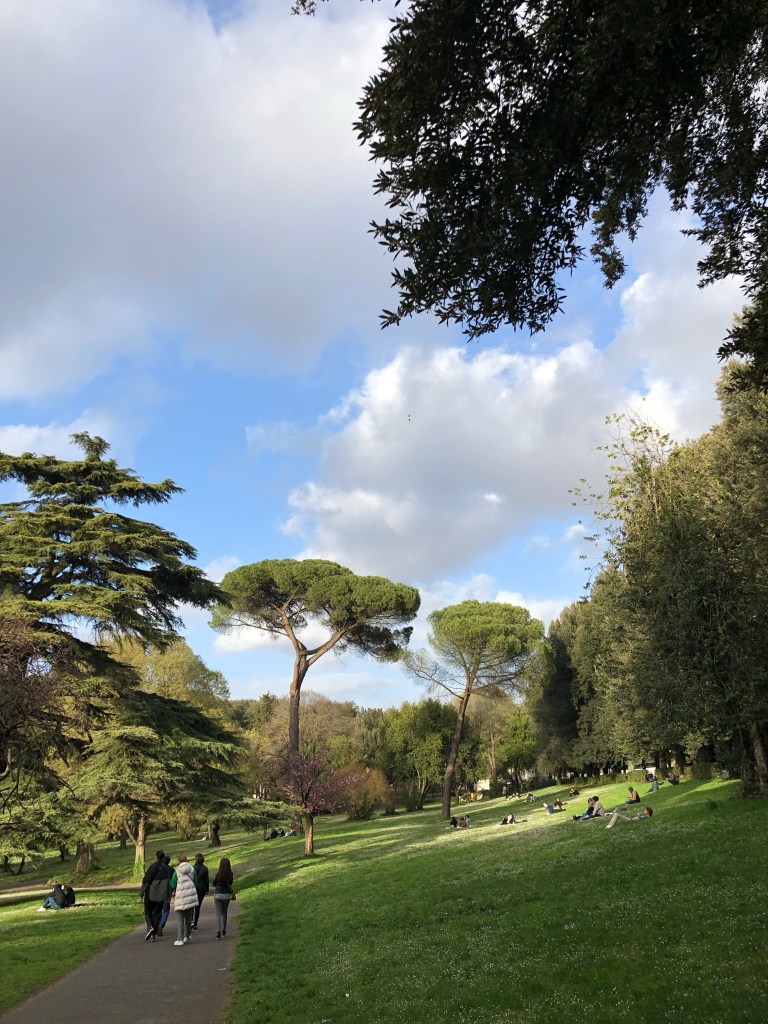
I clocked these pines last night on an evening wander towards the Spanish Steps. Respighi wasn’t wrong to write this movement as the jolliest, most playful of the four: when I was there, the Giardini della Villa Borghese were full of children playing in the evening light. A couple of fairground rides replaced the Roman ring a ring o’roses game in the original, but in all other respects it still fits perfectly. The man knew his source material!

The Borghese gardens also appear to be a favourite spot for Roman romance. As the sun starts to sink behind the trees, the long shadows cast by the stone pines stretch like rivers between the patches of sunlight, where in one corner of the gardens couples clustered like mayflies in the light. A girl in her twenties was picking daisies to fashion into a chain, four Spaniards laughed their heads off as they wheeled up and down the paths on rental bikes, while in the middle of the gardens a priest gave a homily to a small crowd in front of one of the chapels.

If I should find the One someday, I’ll take her for a walk here, too.


II. The Pines near a Catacomb (I pini presso una catacomba, lento)

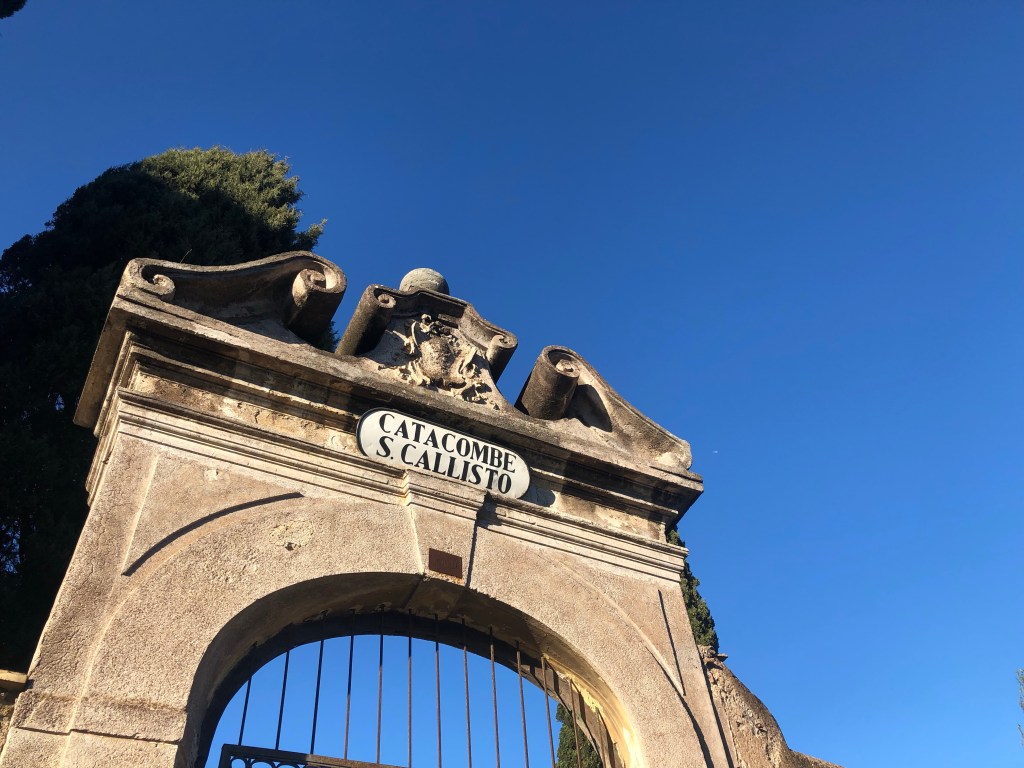
By the time I reached the catacombs, they were all shut up for the week… but that’s what you get for prioritising the Pope over a blog post. Compared to the rest of the Appian Way, the area around the catacombs was quiet and shaded… though that may have more to do with the lateness of the hour by the time I reached them. Here in Rome, as in Spain, cypress trees mark the resting places of the dead, lining the roads to the catacombs. They’ve been symbols of death since ancient times, since they cannot regenerate when cut back, and so they stand as sentinels outside tombs, cemeteries and graveyards all across the Mediterranean. The Romans’ beloved stone pines tower above them, but I think its the sad and stately rows of cypress trees that Respighi is alluding to in this movement.


III. The Pines of the Janiculum (I pini del Gianicolo, lento)

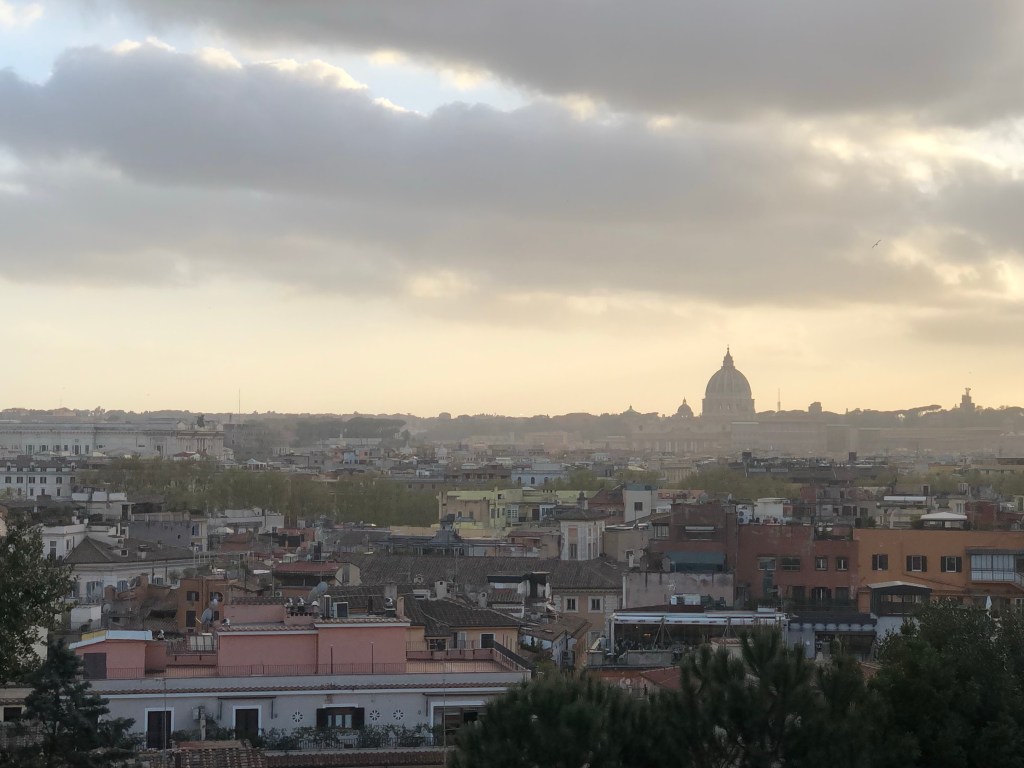
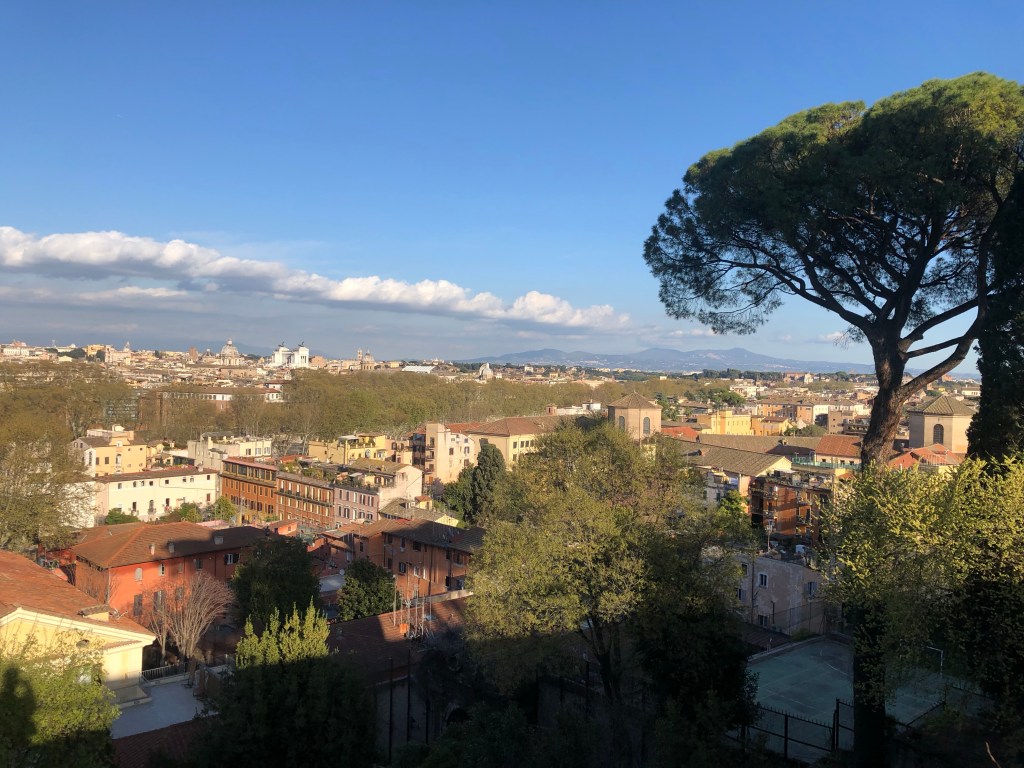
My first night in Rome was spent watching the sun set over the Eternal City. A girl I once put on pedestal told me to make the most of every sunrise and sunset. I left behind both girl and pedestal years ago, but it’s still a rule I live by when I’m on the road. Snacking on a focaccia from the hilltop, I had a sweeping view of the city, from the Vatican to the distant towns of Tivoli and Palestrina. The pines that grow here are the stone pines of Doñana, the trees of my childhood. The Romans had a special love for this tree and planted it wherever they went, especially along roads like the Via Appia.

Down in the dark branches below the viewpoint, some of the city’s monk parakeets screeched this way and that (oddly enough this South American species began to colonise Rome around the same time the Argentinian Pope Francis was elected), but my eyes were drawn to a tiny black-and-white shape moving up the trunk of the tallest stone line overlooking the city: a lesser spotted woodpecker, the first I’ve seen in many years. The rising and falling flute in Respighi’s movement pairs well with all the birds I saw here: the parakeets racing by, the pigeons wheeling over the roofs below, the tiny woodpecker climbing up and up. But I didn’t hear the nightingale that Respighi insisted on featuring at the end of this movement. Perhaps it’s too early in the year – though I suspect it’s more because it’s much too crowded here for such a self-conscious minstrel.


IV. The Pines of the Appian Way (I pini della Via Appia, tempo di marcia)

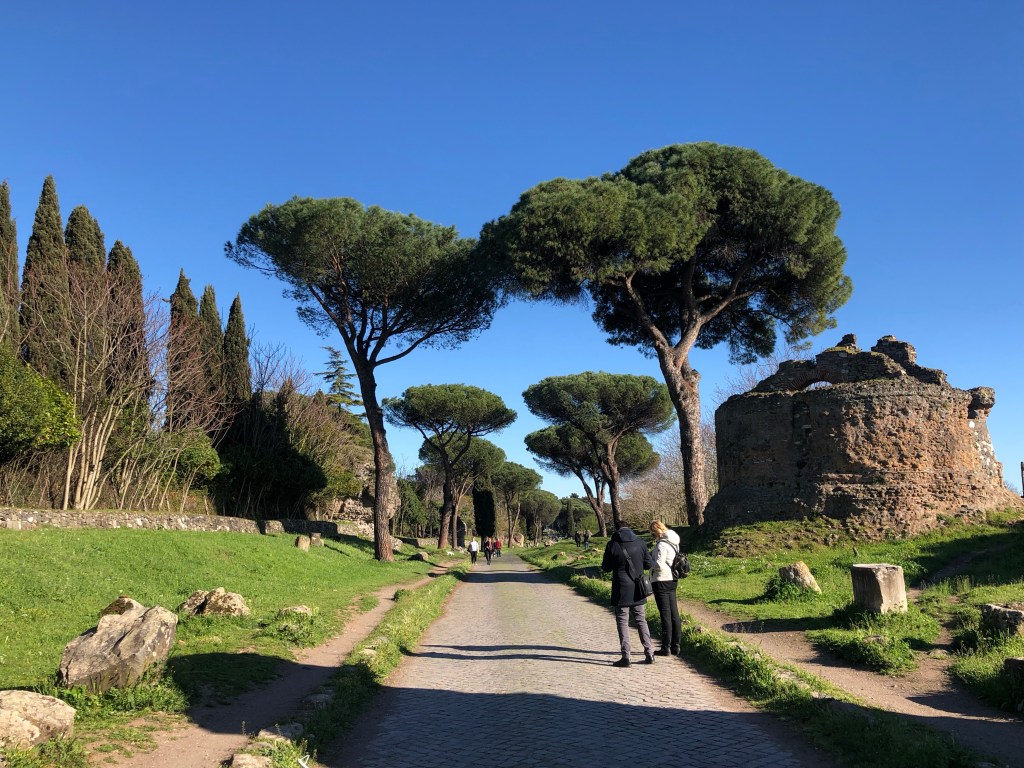
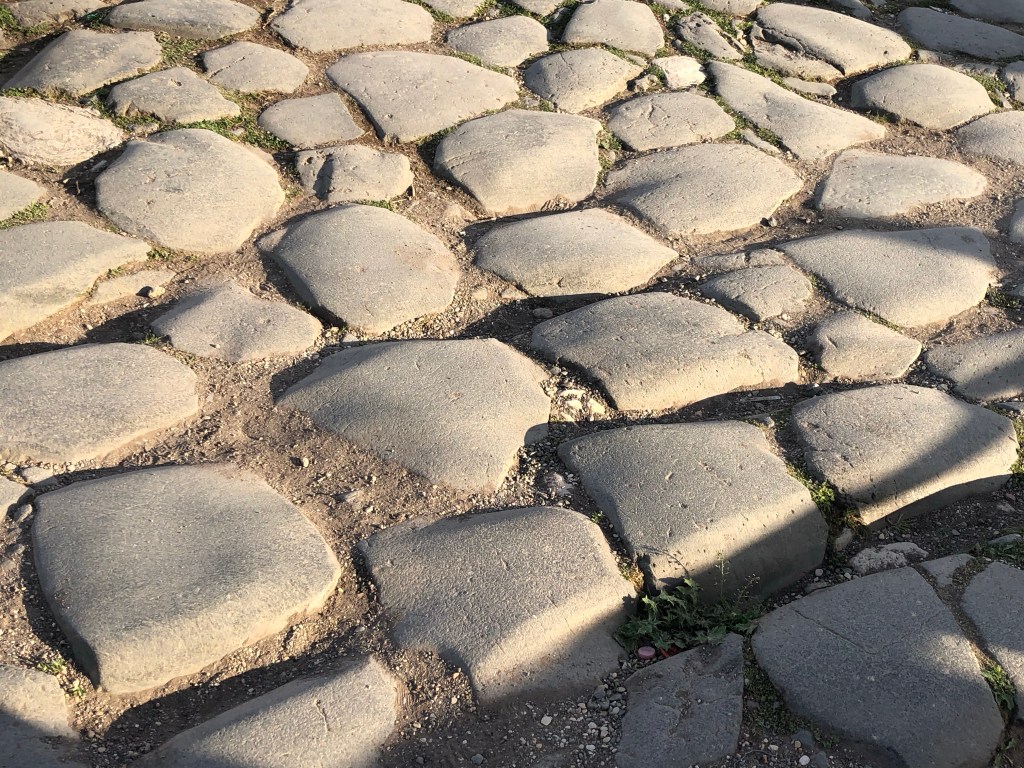
This was always my favourite movement – and what a sight! No visitor to Rome should pass up the chance to take a walk on the Via Appia, especially on a Sunday when the road is closed to traffic and the Romans descend upon the ancient highway in their droves for an afternoon passegiata. Walking the forum is one thing, but this is something else. The Via Appia is probably the oldest road still in use in the western world, and you really do get the feeling you’re walking in the footsteps of the ancient Romans as you walk this road. The things this road has seen…! This is where soldiers marched to the port and on to Egypt, where nobles lived in luxury beyond the confines of the city, and where the great orator Cicero was assassinated. I fell into the Romantic trap of many travelers before me as I passed one old Roman sitting on a marble colonnade, with skin of burnished bronze, black, sunken eyes and an aquiline nose that would have looked supreme on any Caesar; and I wondered whether he was the descendant, through many fathers, of Romans who had lived on this road two thousand years ago.

I also heard a nightingale here – he must have missed his cue in the Third Movement.

If Cannaregio was my favourite spot in Venice, the Via Appia takes the top spot in Rome. It’s breathtakingly beautiful, flanked with ancient Roman treasures along its entire length, and absolutely mustn’t be missed. And Respighi nails it with his final movement: it’s heroic, majestic and the perfect finale to both my long walk and my time in Italy.


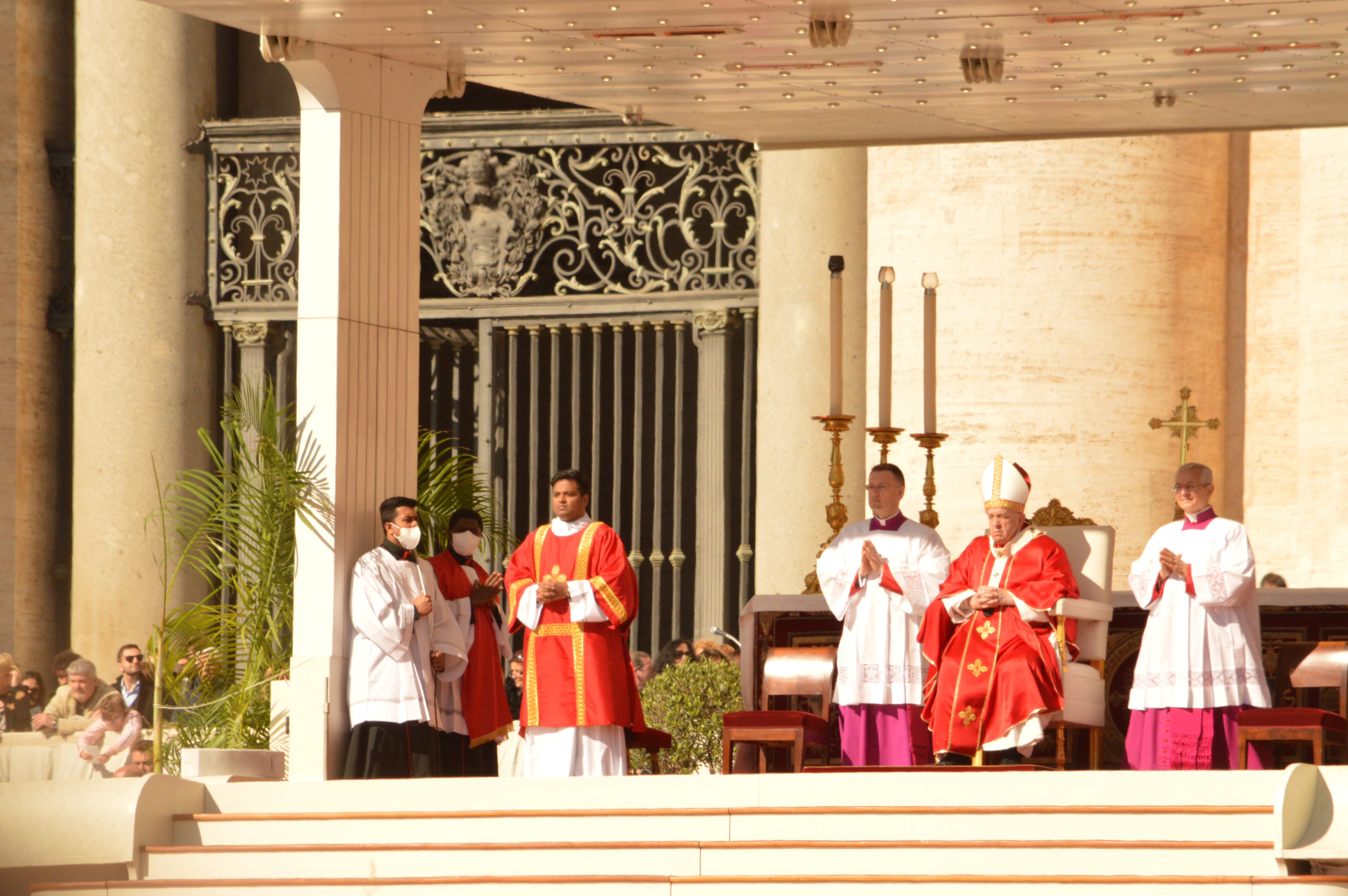
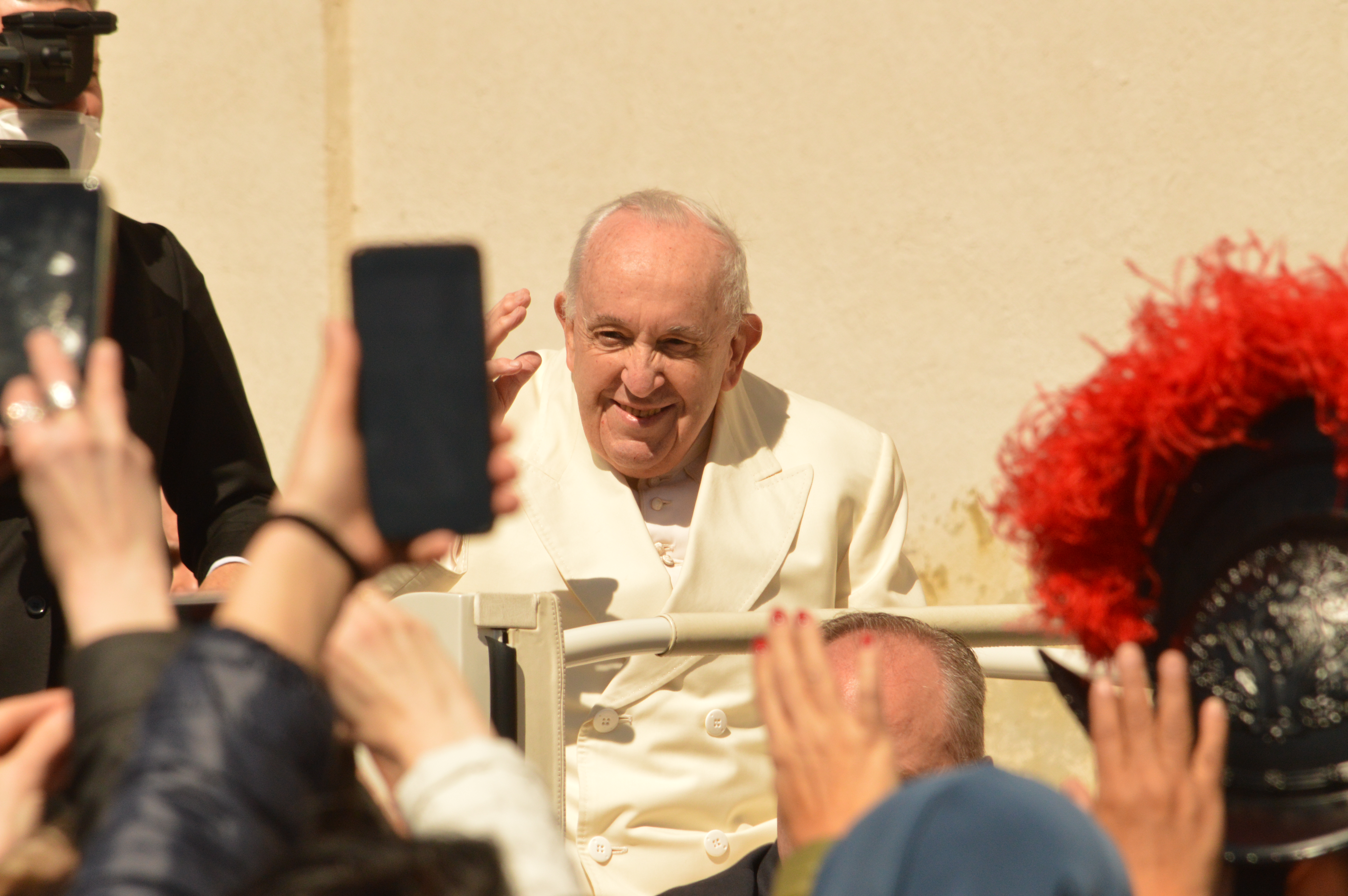
I’ll tell you the tale of my incredible Palm Sunday experience as soon as I get my hands on a computer, as my phone photos simply don’t do it justice, but until then, arrivederci Italia! Sei bellisima e tornerò presto! And that’s a promise. BB x

Rome II: Vatican Two

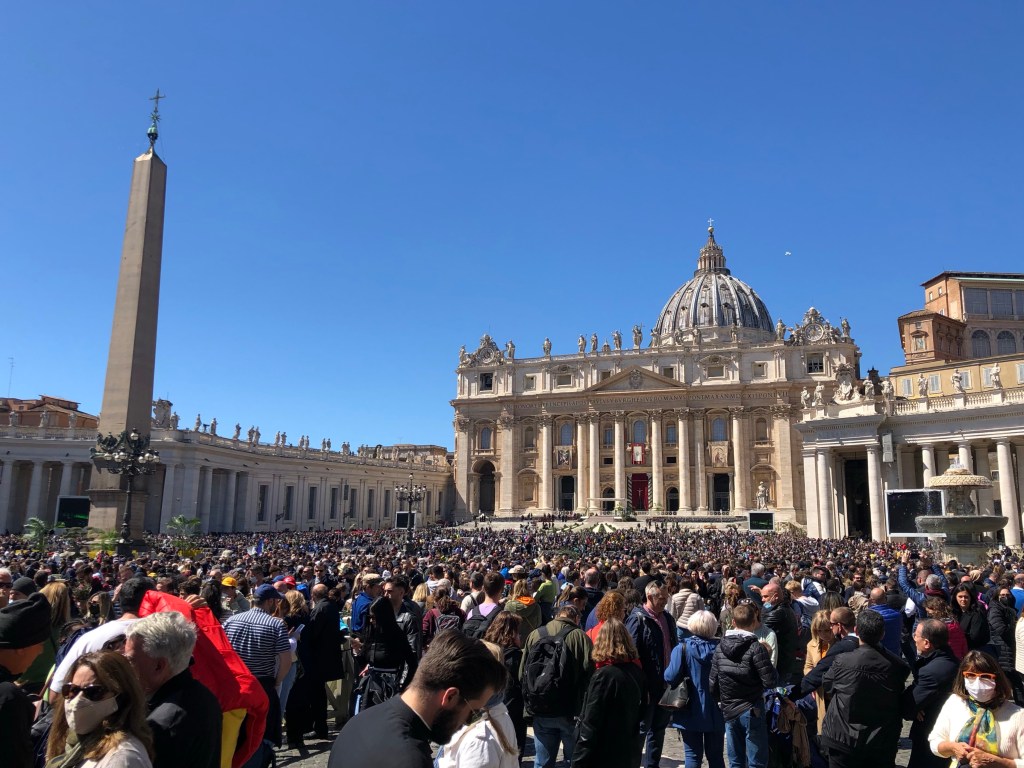
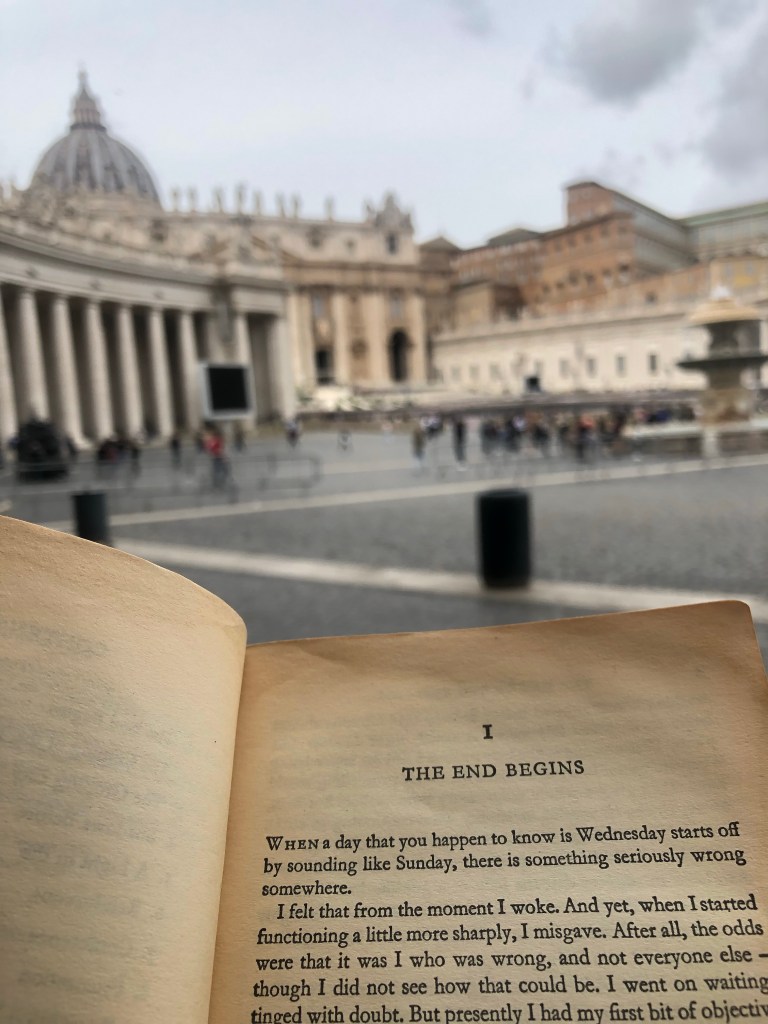
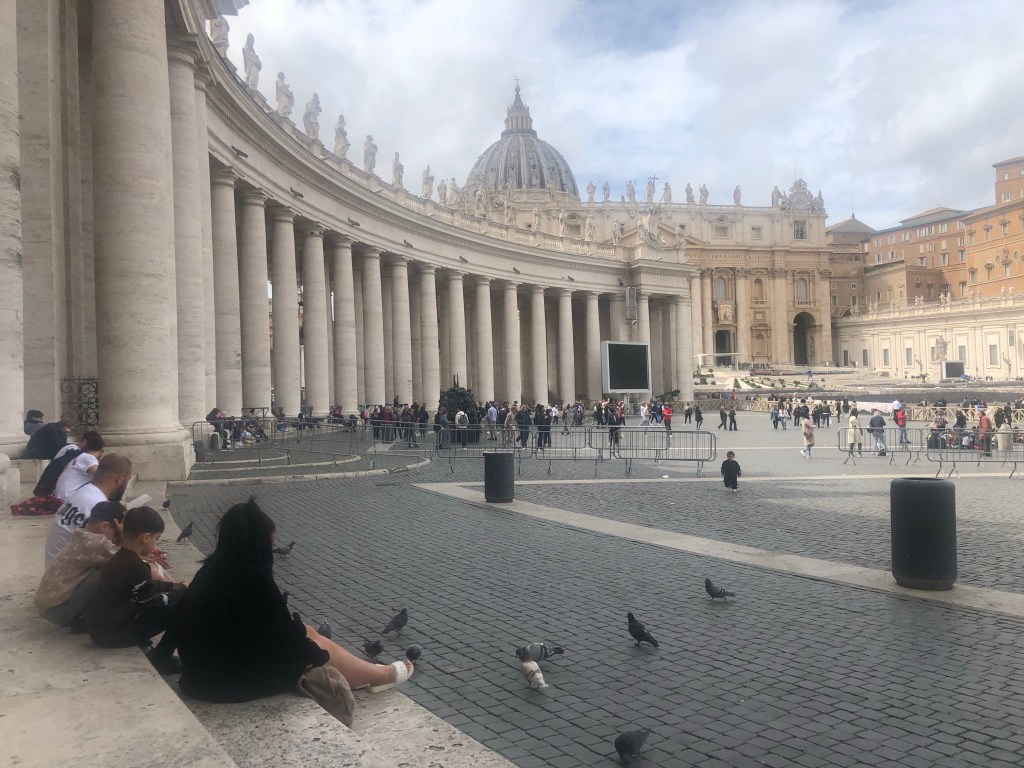
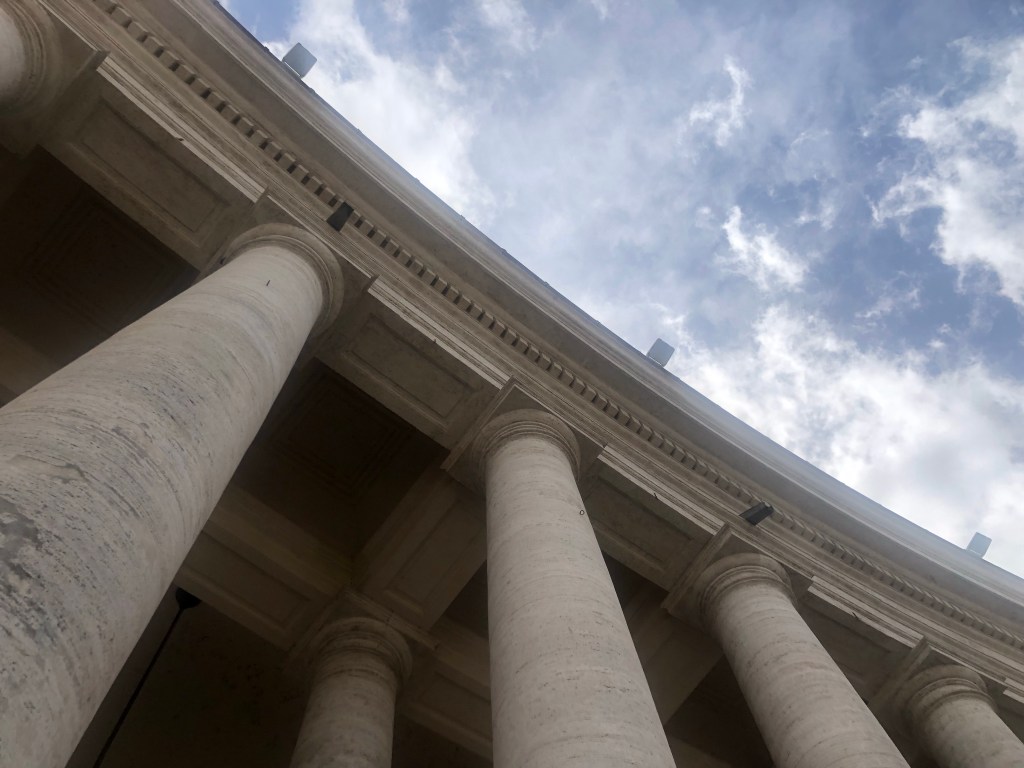
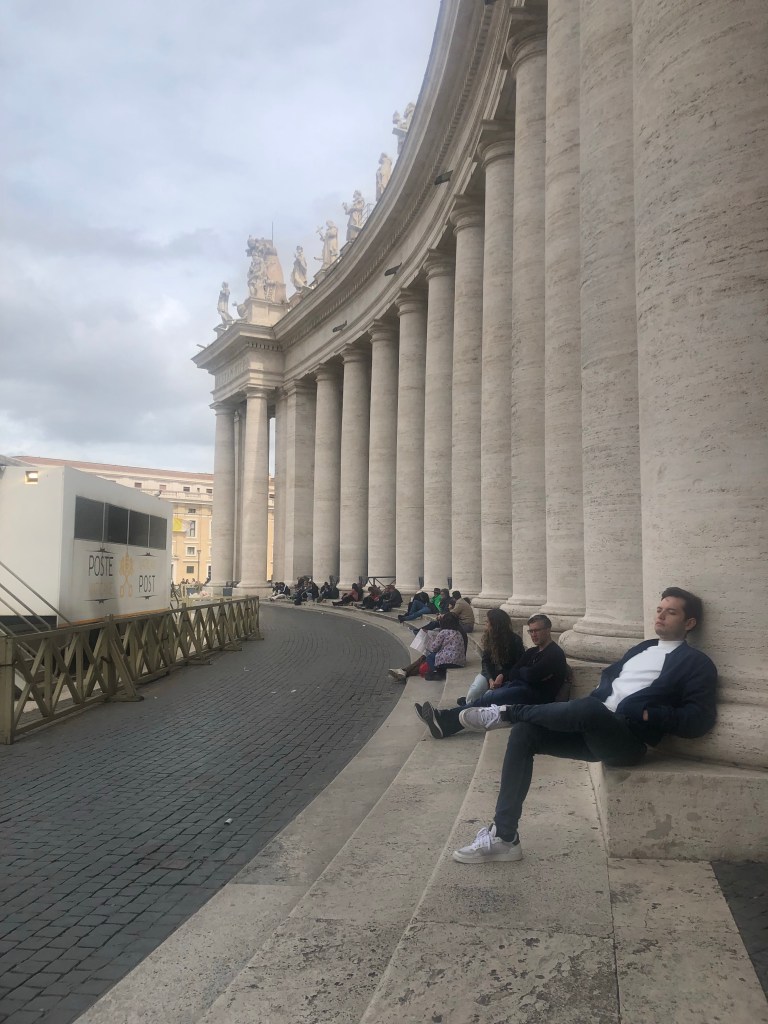
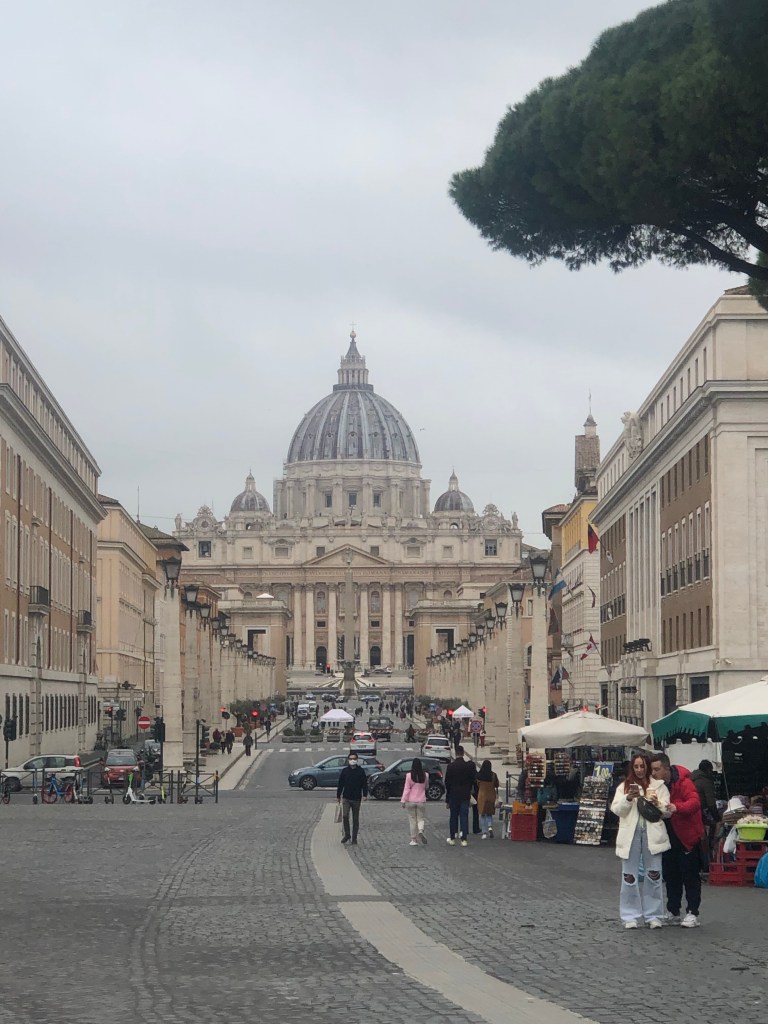
13.25. The surging throng of visitors to the Vatican Museums is steadily beginning to thin out. I could still probably count a thousand or more within the pillared walls of St Peter’s Square, but the morning rush is almost over. From my outpost under the statue of St Philip, I can see most of the piazza, except for the part obscured by the Vatican Post Car parked a few feet away. The postman came to pick up the mail around 11.30, some two hours ago. Since then I’ve been watching the visitors, tuning into the various languages around me and observing the interactions of the many thousands who pass through the Vatican every day. You could call it snooping, I suppose. I prefer to think of it as people watching. As I leaf through the first chapter of Triffids – my solo traveler’s Bible – I try to capture everything I see around me.

Two very well-heeled girls have been taking photographs of each other in front of the pillars for at least half an hour now. One of them is kitted out in a striking tea green trouser suit; the other is more noticeable for her red hair. Let’s call them Green and Red. I imagine what they’re trying to do is one of those time-lapse images for this or that social media network, since Red keeps strutting backwards and forwards in a highly artificial manner, flickering her hair over her shoulder and looking back to Green’s phone. The Vatican City seems an odd place for a glamour shoot, but then, what do I know? It’s a changed world.

A toddler is having the time of his life chasing pigeons in front of me. He’s so caught up in the chase that he keeps falling flat on his stomach, but the brave little soldier hasn’t cried once. He just gets right back up and charges headlong into the flock, giggling wildly and scattering the panicked sky-rats in his wake while his parents watch and mum takes a film on her phone.

After the people and pigeons, the next most numerous living thing here in the Vatican is the city’s gull population. Apparently they’re only a recent arrival: until as recently as the 1970s, gulls were a rare sight this far inland. Now they’re everywhere, raiding bins, snatching bread from hopeful pigeons and circling St Peter’s basilica like dirty angels – or do I mean vultures?

Three locals have dropped by with a pizza box for a snack lunch in the square. It seems the obvious spot for a lunch break: the domed sky is immense – you have to really open up your eyes to take it all in – and there’s always something going on here. A few minutes ago a woman was screaming something on the other side of the square – I never did see her face nor did I catch what she was shouting about over the cascade of the fountain, but from her constant used of “ustedes” I’m going to guess she had that evangelical fire that you only find in Latin American Catholicism.

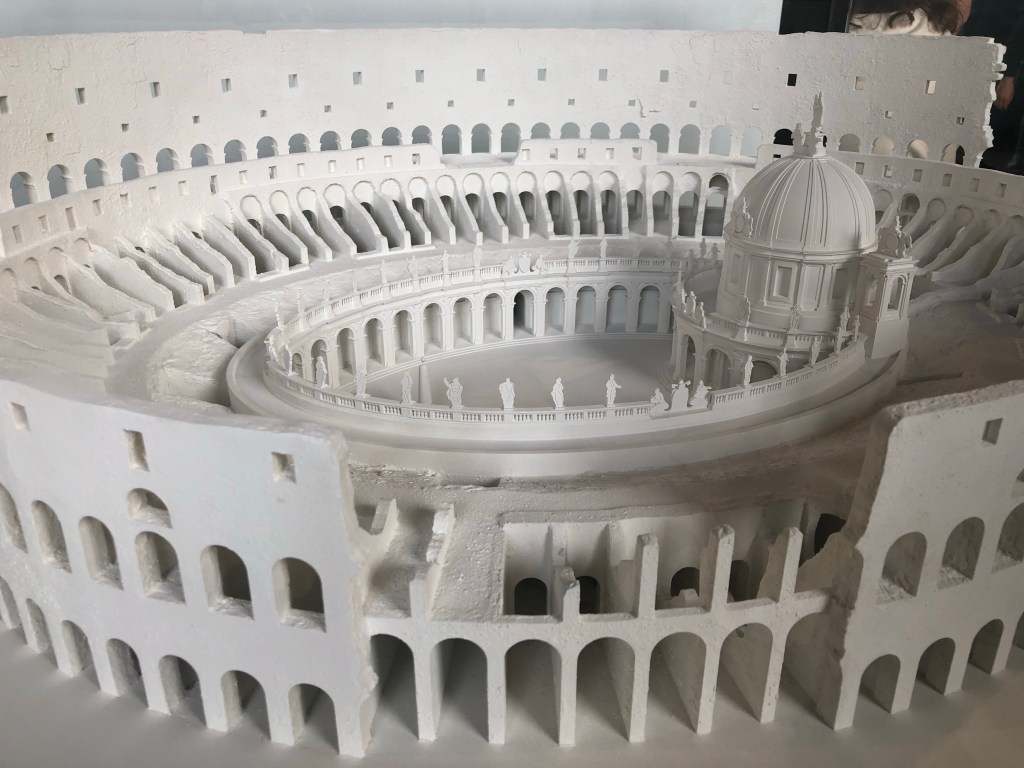
Did you know there were plans to turn the Colosseum into a church? Fortunately they were abandoned many years ago, sparing Italy the shame that Spain has to bear in the desecration of its greatest Islamic treasures of the Alhambra and the Great Mosque of Córdoba.

Well, perhaps not entirely. A casual walk around Rome reveals that many of its ancient churches are carved out of the bones of other Roman carcasses, perhaps most notably the basilica of Santa Maria degli Angeli e dei Martiri, housed in what was once an impressive frigidarium. Still, it’s worth remembering that this fate is probably what saved it from the twitching fingers of the stone-thieves that reduced many of Rome’s treasures, including the Colosseum itself, to the picked and dismembered skeletons we see today.

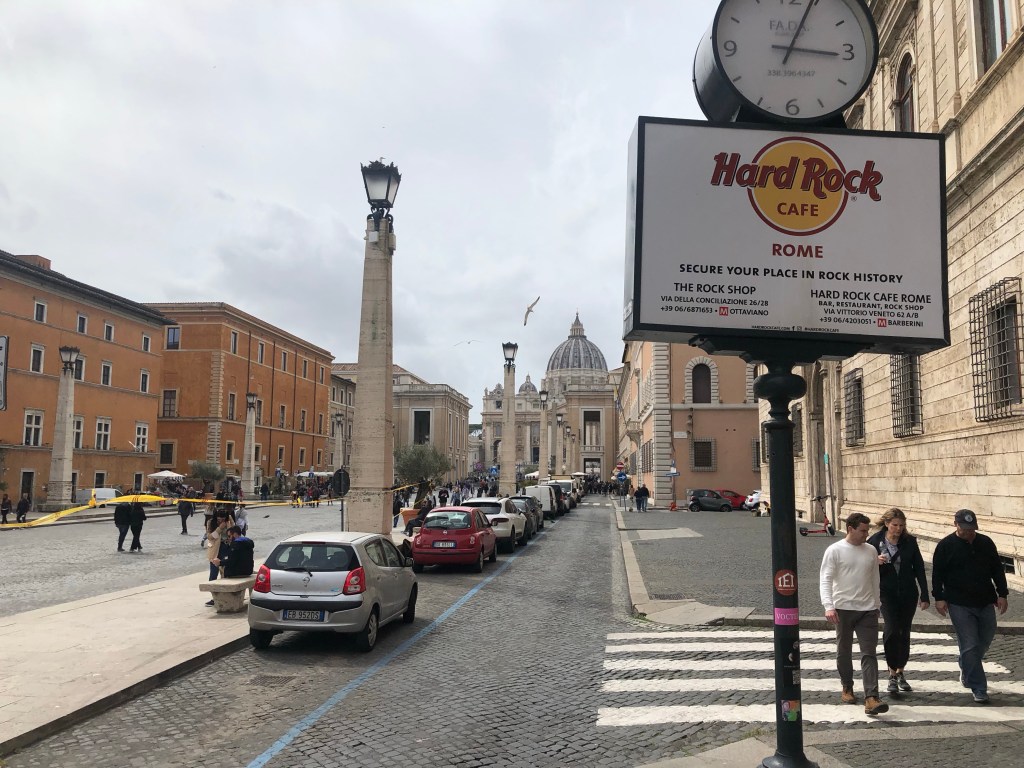
These days the Church has lost interest in “reclaiming” ancient wonders for Christ. Now it’s faithless corporations like Hard Rock and MacDonalds that play Columbus in the ancient places of the world, stamping their flags as close to the action as possible so as to draw in their customers like spiders. In that sense there’s not an awful lot of difference between them and the hawkers offering line cuts in St Peter’s Square at “special special” prices. They’re simply out to make a quick buck at the expense of the next band of pilgrims. It is a little disheartening that the first shop down from St Peter’s Square on the Via della Conciliazione sells branded British tee-shirts.

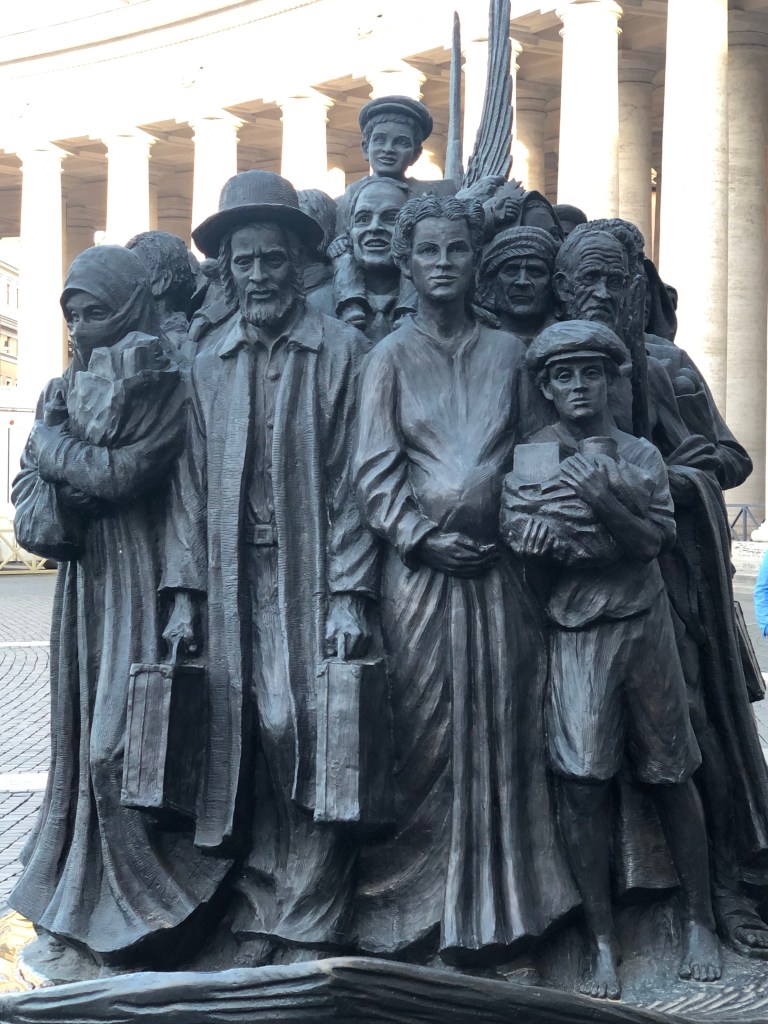
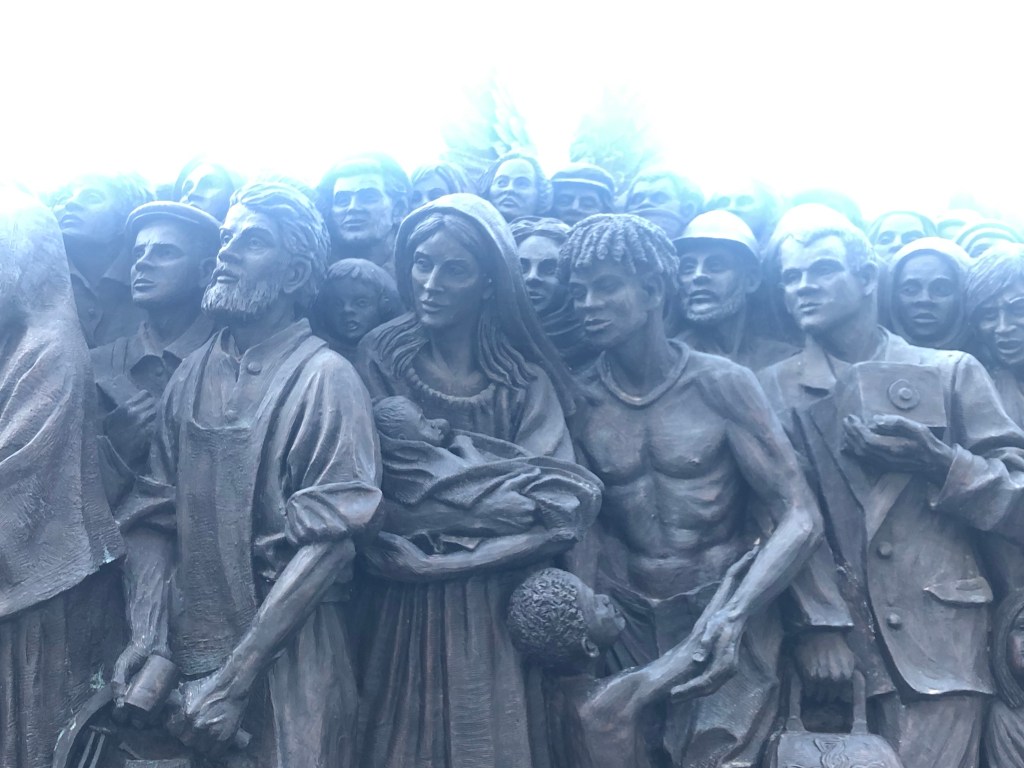
Speaking of which, the newest addition to the square is drawing a steady crowd. Timothy Schmalz’ Angels Unawares depicts a muddled group of refugees from every corner of the globe and drawn from across several ages in history: a Syrian mother and child, a Polish Jew, a family of African migrants, even a Native American nobleman. In a square full of righteous saints and martyrs, it’s a necessary homage to the real sufferers around the world: the everyday folk whose worlds are turned upside down because somebody somewhere thinks their world view has the right of it.

It’s 14.30. I’ve kept my vigil here for over four hours, and now I’m getting peckish. My feet, however, are immensely appreciative of the break from yesterday’s constant Roman around (ha ha). Time, I think, for a spot of lunch. BB x

Rome: Marching on the Capital

They weren’t wrong when they called Rome the Eternal City. It seems to go on forever and ever – which is probably why everybody I asked told me not to walk, but get the bus or metro. But I’m stubborn when it comes to walking – years of not driving forces you to master the art – so I spent today exploring Rome on foot. The only foolish thing was that I did it twice: once to scout the city, then once again to visit the Colosseum for my timed entry slot. My heels are aching and frankly I can’t blame them. But if anything should be aching, it’s my eyes… because there’s more to see in Rome than in any city I’ve ever seen in my life.


I’m staying in a cosy AirBnB behind Castel Sant’Angelo, situated within a condominium that’s just a stone’s throw from the Vatican City. I figured it would be nicer to be in a quieter part of the city as I’m not much of a city boy, and I wasn’t wrong… Rome is loud. Somebody grabbed the volume dial on the train from Venice and ramped it up to max. Noisiest of all are the ambulanzas… the way they hurtle down the streets with sirens blazing every ten minutes you’d think the Romans had one of the highest mortality rates in Europe. Given the Vatican’s population growth rate of 0% and the average age of its citizens, perhaps that’s not surprising.

It’s telling enough that between writing the word ambulanza and this line, I’ve heard four go by in the space of two minutes. Ils sont fous, ces Romains.

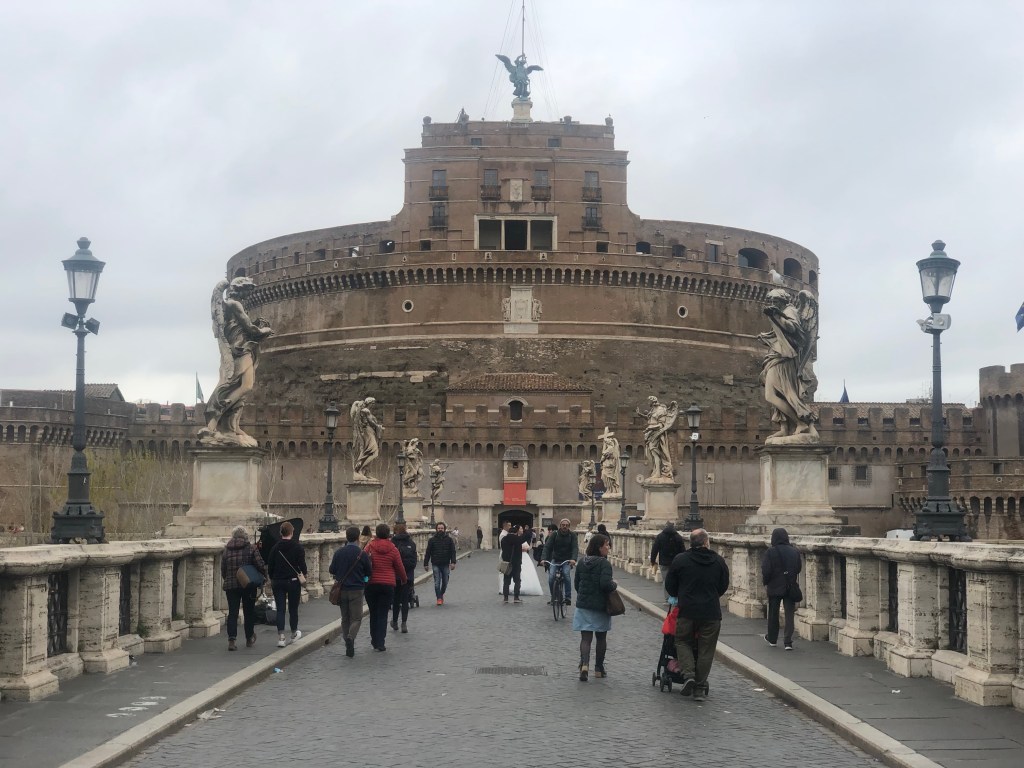
I started my route by crossing the Tiber over the Ponte Sant’Angelo. A Korean couple posed for their wedding photographs on the bridge while two local men dressed as legionnaires did the same with a family of tourists before bullying them for cash. It’s been a long time since I’ve done real tourism – my usual holiday destinations are well off the beaten track – so the vast number of selfie stick sellers, water hawkers and tack touts caught me off guard. They seem to swarm about the oldest parts of the city like flies around a wound, preying especially on the young, the old and the Chinese. For the first time, as a single male traveler, I passed most of them as though invisible. I guess I’m not prime real estate – nor would I have much need of a selfie stick when I’m armed with my trusty Nikon D3200.

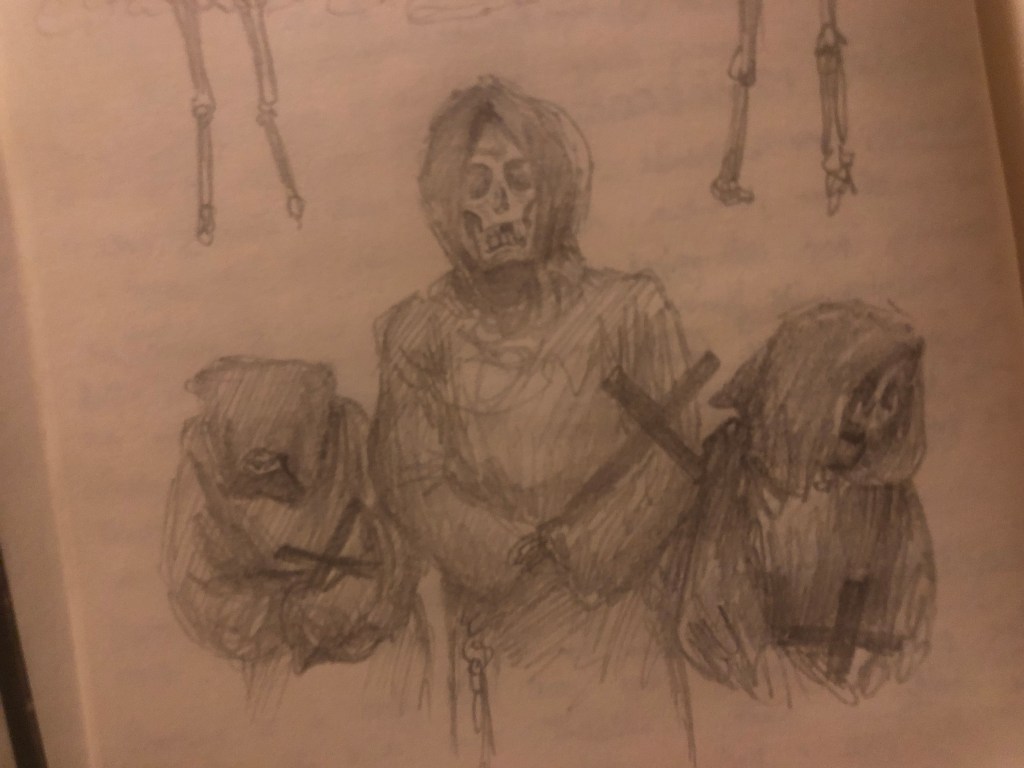
The Pantheon was a little underwhelming on such a cloudy day, so I saved it for later. The famous Trevi Fountain was being cleaned as I walked past, knocking two items off my itinerary early on. Instead, I spent some time in the bizarre Capuchin Crypt to see one of the most alarming sights in Rome: the disinterred and rearranged bones of hundreds of monks, dressed up and set on display in a grisly but remarkably intricate work of art. As a mark of respect to the bodies (which does seem odd when they’ve been played with so) cameras aren’t allowed, but fortunately nobody ever seems to have any issues with sketching, so I spent some time drawing the macabre display instead.

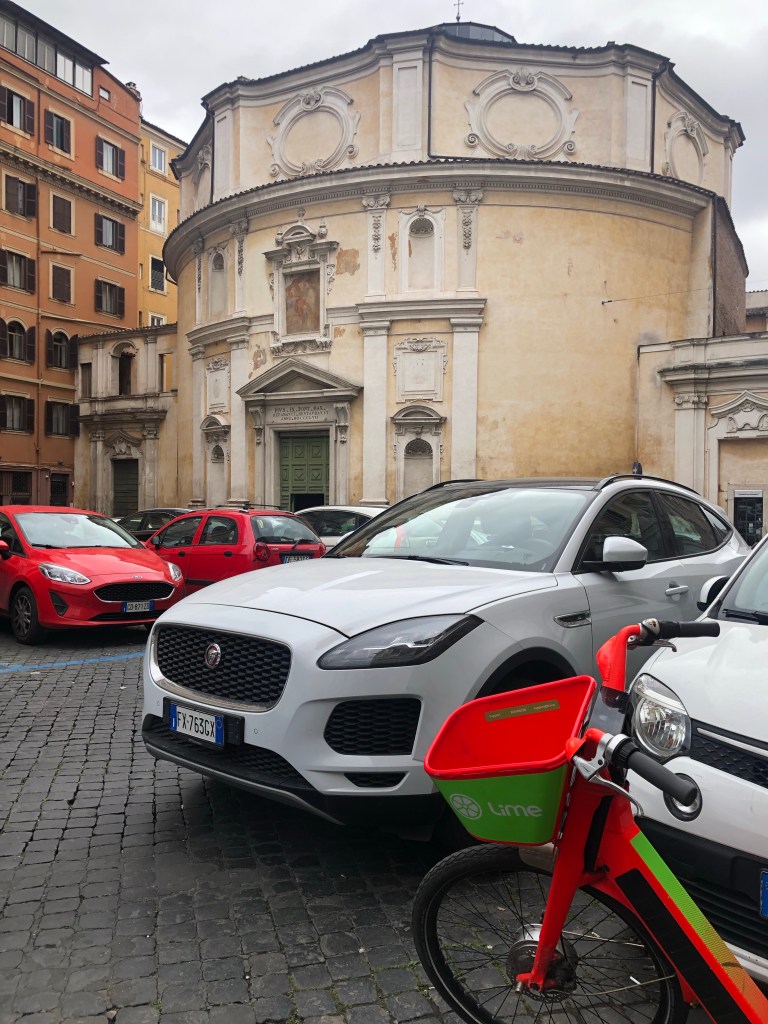
Moving on through the squares and streets, past sharp-dressed polizia and fire-breathing carabinieri, I made a point of dropping in on a couple of Rome’s churches. Not too many – there are so many here one could burn out easily – but enough to get a flavour. Even if you’re not religious in any way, they’re blissful refuges from the constant hubbub of the city.

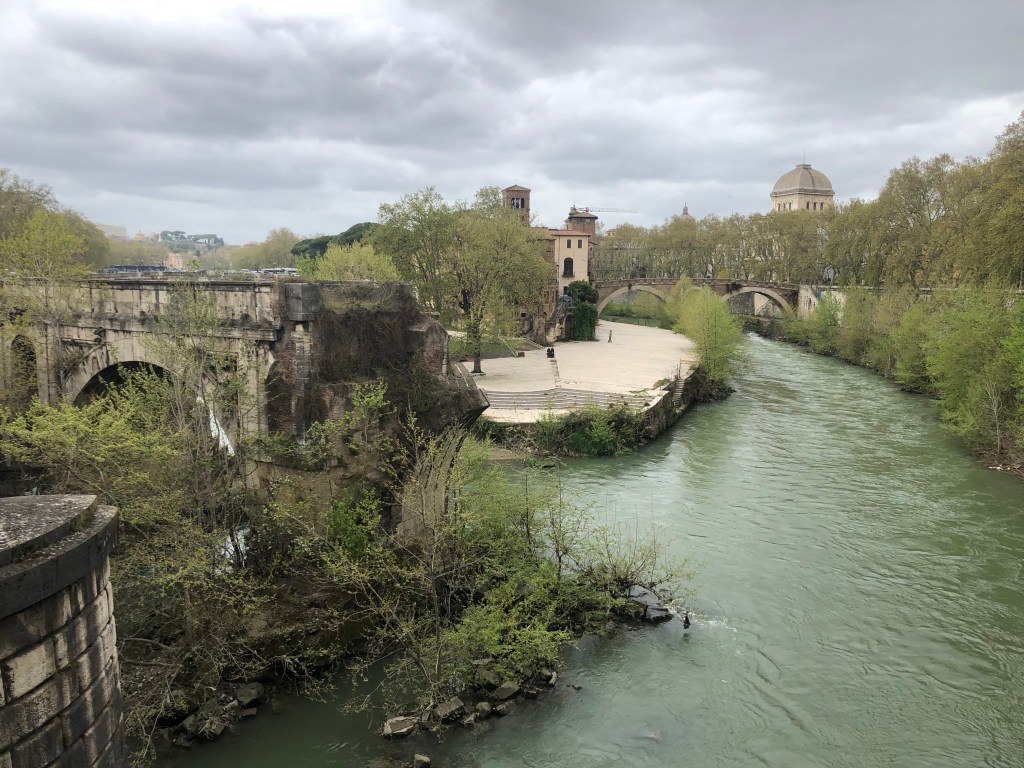
After four days in Venice, the near total lack of traffic along the River Tiber was hard to believe. And not just on the water – its banks too were almost deserted, but for a couple of joggers and a few clusters of homeless folk. Even the usual river fauna was nowhere to be seen… just a motley crew of gulls and a couple of hooded crows. By contrast, the Guadalquivir is usually heaving with both birds and sunseekers. Perhaps Rome is just too busy to afford the Tiber either.

After an all-too brief recharge back at the AirBnB I trekked back across the city toward the forum, where sadly no funny things happened. I made it to the Colosseum in more than enough time and they let me in fifteen minutes early, so I guess the newly imposed time slots are more guidelines than a point of law.

Standing in line, I watched a German family try to take a selfie where they all try to jump at the same time. Ein, zwei, drei! Ein, zwei, drei! A gang of twenty-something-year-olds sauntered by, and one of them who clearly thought himself a first class joker kept jumping into their shots, sauntering off with an unflattering imitation of their countdown. The same thought occurred to me as it had with the phoney legionnaires: some people are just goons for no reason.

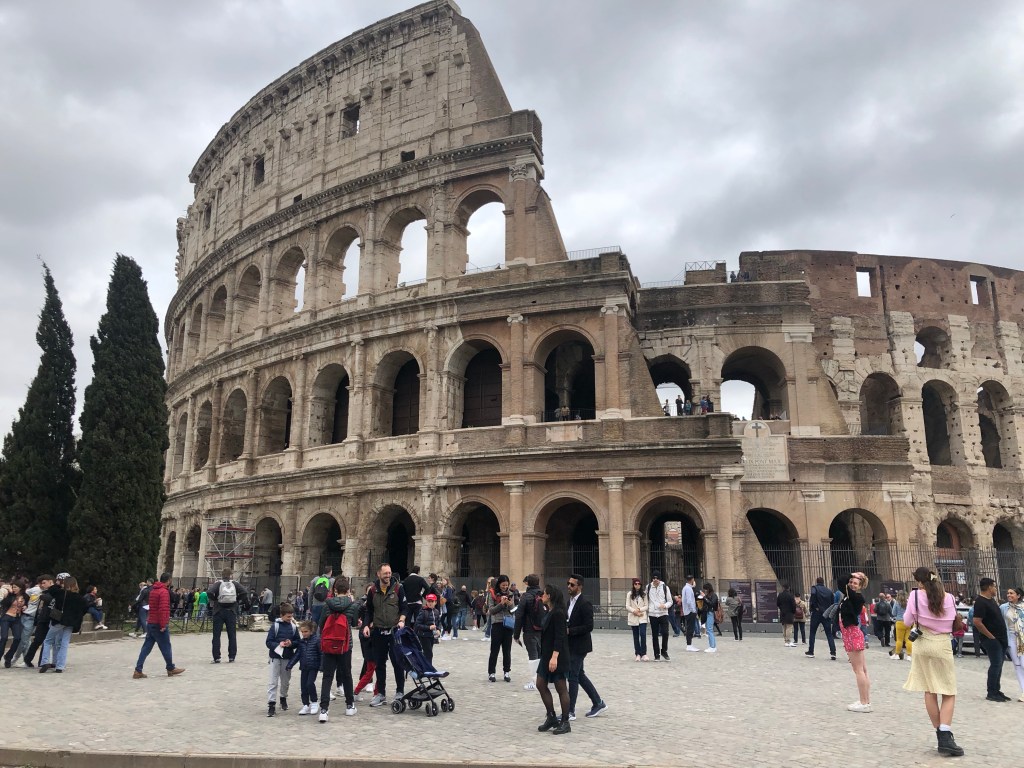
The Colosseum… was it worth the entry fee? I think so. It is without doubt one of the most impressive buildings in the world, and though it’s a lot more imposing from the outside, with all the scaffolding and building work going out around it, it’s easier to get an impression of its ridiculous scale from inside these days. They’re currently building a new metro line that will service the old city, which I saw advertised all over today. Great news for my feet, not so great news for the Colosseum, which won’t enjoy the additional underground reverberations.

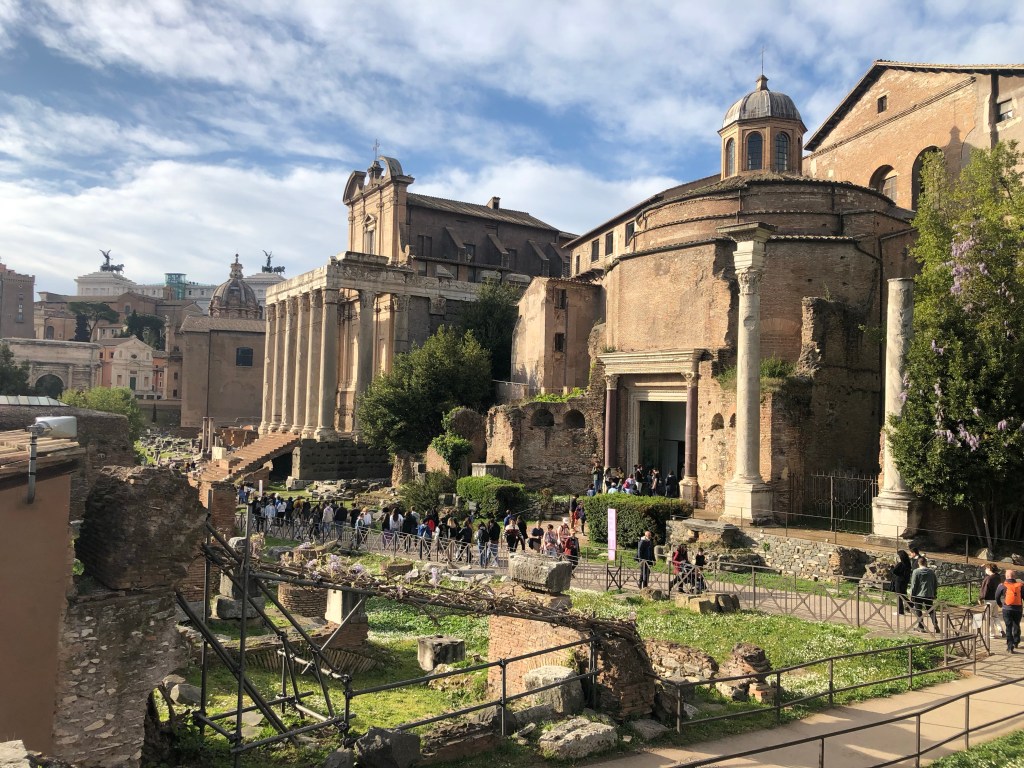
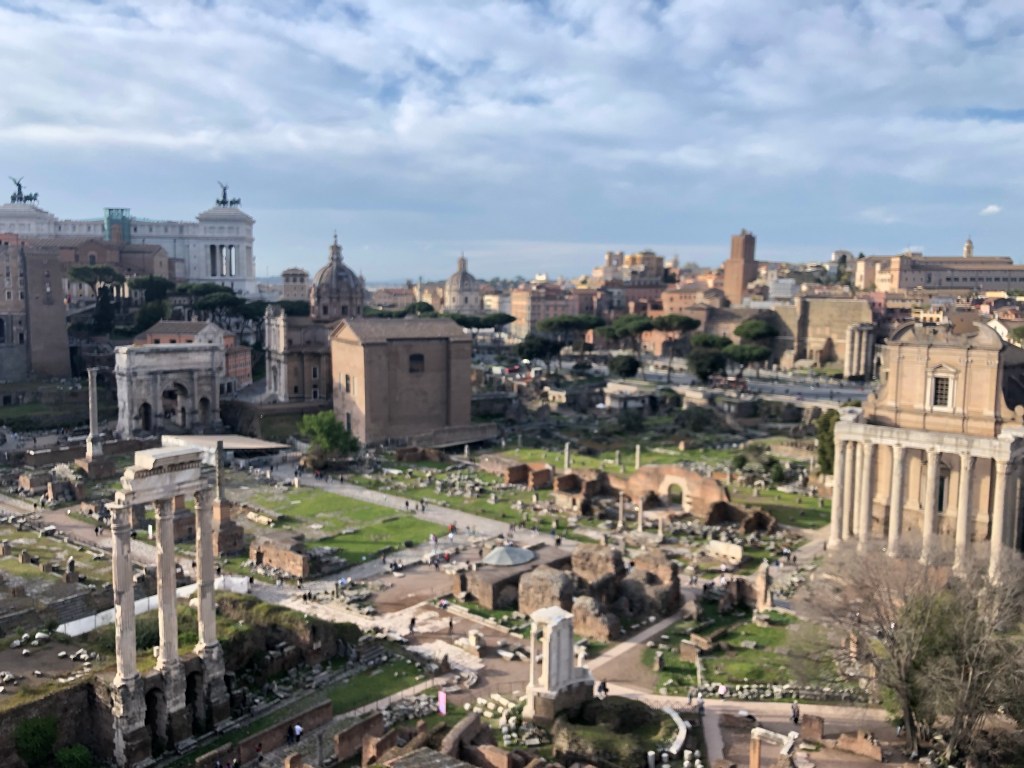
I did get one thing right today, and that was my timing: the blinding white clouds that covered the city all morning were gone by five o’clock, which meant my walk home through the Forum landed right in the golden hour. Blackbirds and blackcaps sang from the olive trees and the crumbling walls as they must have done since before the Romans came. Children played leapfrog between the pillars. A British Indian family had an argument about “too much history for a holiday”, while a Turkish girl made her boyfriend take her photo again and again and again and again under the wisteria tunnel. My services as a family photographer were called upon three times between Titus’ Arch and the Temple of Saturn, but that’s what you get for obviously wandering about with an SLR camera.

I don’t really have anything profound or original to say about my adventures today, which is a little disappointing. I guess you could say that everything that could be said about Rome has been said by thousands before me. So tomorrow, after a decent rest for my beleaguered feet, I think I’ll investigate somewhere further afield. There’s something very appealing about spending the day in Ostia Antica – not least of all because of the mild amusement I get as a Spaniard from the name alone. But that’s not set in stone. For now, I should get some shut-eye, and give my blistered heels a well-earned break. BB x

P.S. Oh, and I also had my first Italian pizza this evening. It was… OK. Nothing to write home about. Which is ironic, since that’s exactly what I’m doing right here.

Venice IV: Ghettos, Glass and Gold

The Italo high-speed train races across the Ponte della Libertà, leaving Venice and its islands far behind. I’m bound for Rome, the Eternal City, my final stop in this first expedition to Italy. In what is possibly a crime against humanity, I’m skipping Florence this time, on the pretext that to spend anything less than two full days in Dante’s city would be to woefully undervalue one of Italy’s greatest treasures. Next time – and there will be a next time – I’ll come back for Florence, and Trento, and maybe even Milan. But since it’s my first time here, and my Italian is rudimentary at best, I’d rather depart with a hunger to return.


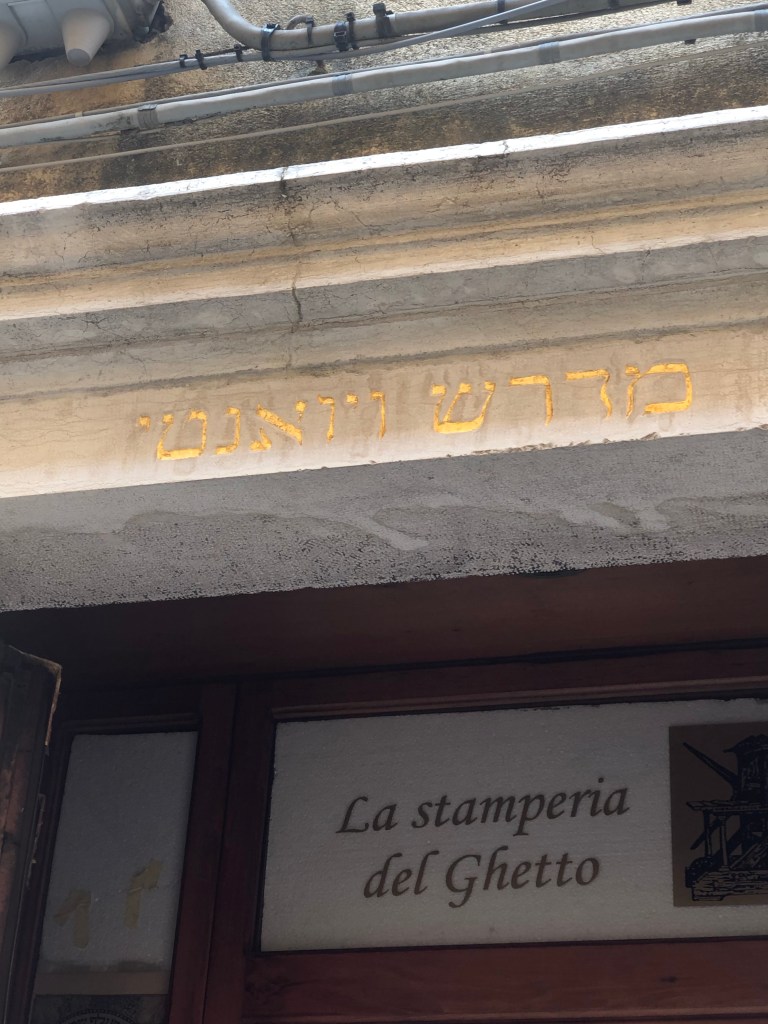
Far and away my favourite corner of Venice is the Cannaregio district to the north of the island. It’s marked with a Star of David on most maps, and it’s where you’ll find the city’s former Jewish ghettos (not in confusingly named Giudecca which, despite being a mangling of judaica, was never home to the city’s Jewish population). It’s a quieter corner of the city, dark and understated, but take a moment to stop and take stock of your surroundings and you’ll see some surprising sights – chiefest of all being the Jews themselves, hanging on tenaciously in the same corner of the city in which they were once corralled.

My contact with the Jewish world has been ethereal for the greater part of these last twenty-eight years. I played a Jewish tailor in Fiddler on the Roof and Klezmer stalwarts like Hava Nagilah and Tants, Yidelekh, tants (Dance, Jew, Dance) were my go-to violin pieces as a child, but that’s about as close as I ever got. Doubly so after Covid derailed my trip to Israel two years ago. To tell the truth, I could probably count on the fingers of one hand – two, tops – the number of Jews I’ve ever had a conversation with. So coming to Venice and seeing not just a sizeable but highly active Jewish community in the flesh has been nothing short of heart-stopping.

As usual, the Spanish connection was the real draw. Among the Italians, there are a great many Spanish surnames carved into the various memorials commemorating the disappeared and the dead. Morenos. Navarro. Vidal. Grim reminders of the centuries-long fate of the Jews, fleeing from one intolerant regime into the arms of another. At some point in their history, many of Spain’s Sephardim must have been faced with the painful choice: to abandon hope and their homes, or to abandon their faith. If the stories I do so want to believe are true, then my ancestors made the bitter decision to remain under the unforgiving aegis of a Christian God, rather than leaving behind the land that had been their home for generations. Could you blame them for that?

As I wandered through the ghetto nuovo, I saw a Haredi gathering through a window. A boy stood outside the window, shawl at his waist, shuckling at prayer. A girl on the vaporetto at Murano had a gold necklace bearing the Hebrew letter he (ה). Out in the backwaters of Burano, a man sped by on his boat as I ate my lunch, sidelocks flying in the wind. I didn’t expect Venice to be such a centre of Jewish activity, but it’s a miracle to behold.


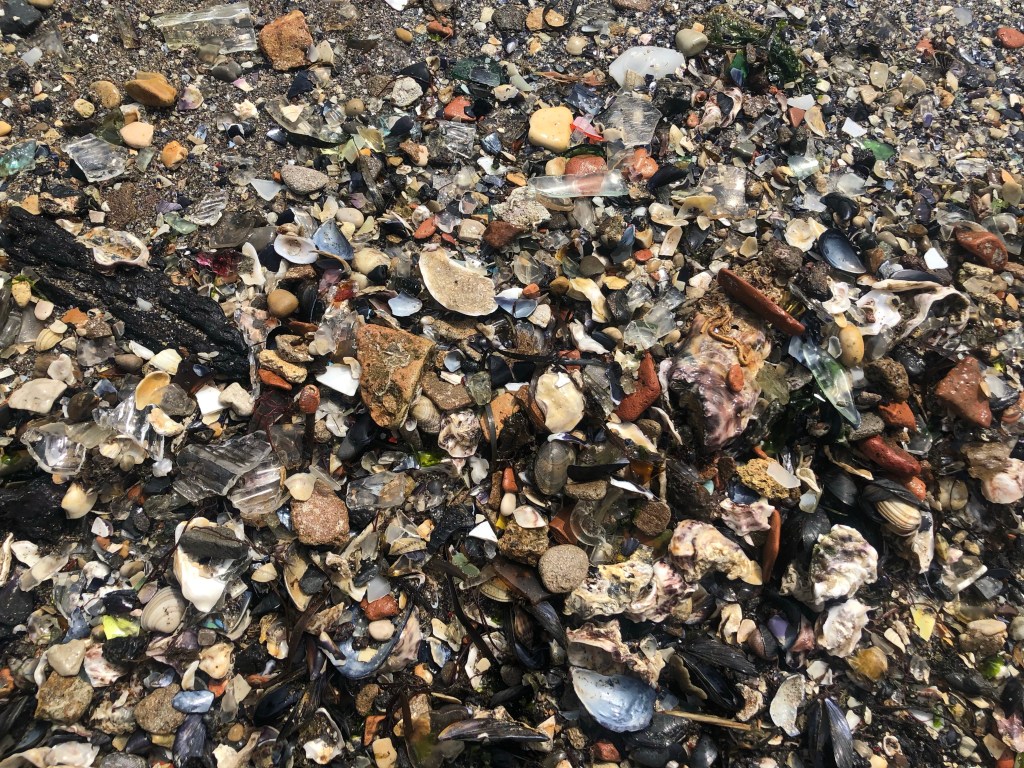
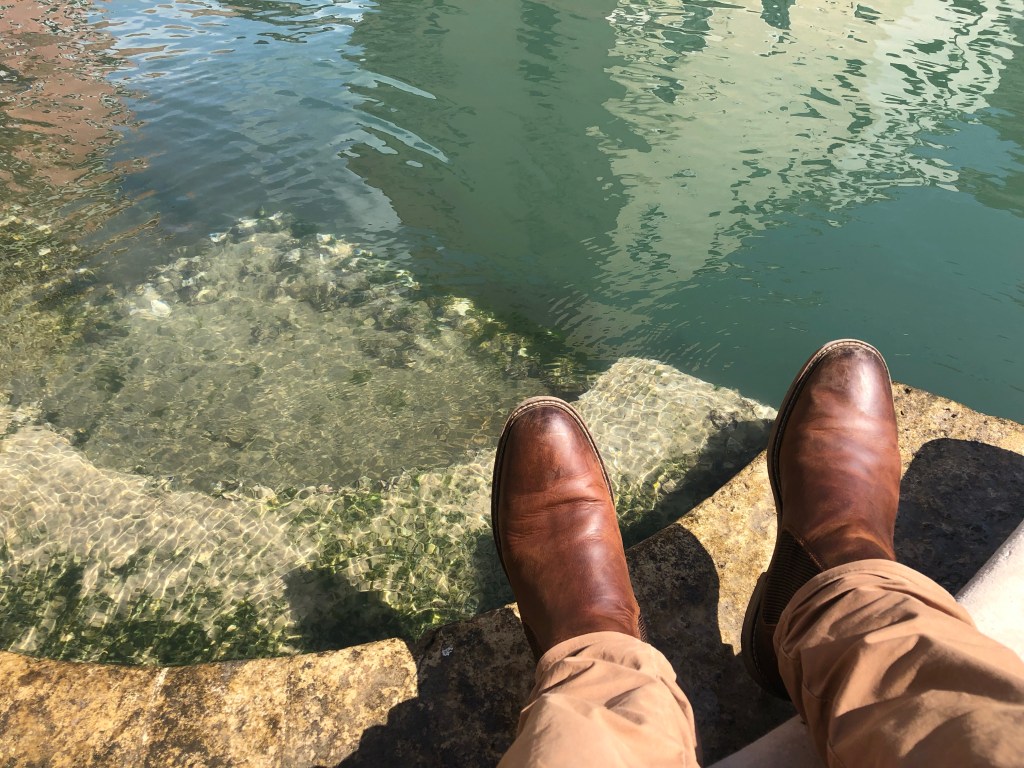
My eagle eyes were trained on other things than just bird life and Hebrew paraphernalia. If you visit Murano for its glasswork, something you ought to do is go beach-combing by the vaporetto stop near the lighthouse. For one thing, it’s ridiculously easy to spend a week in Venice without ever touching the water once, and this is a very accessible point to make contact. For another, an island whose primary output is glass and clumsy tourists makes for a mudlark’s dream: scattered amongst the lagoon’s mussel and oyster shells you’ll find all manner of glass washed up on the shore. Who knows how old the shards are? Some of them might be decades or even centuries old. A great many more were probably dropped in yesterday by this or that day tripper who was careless in boarding the boats. Whatever their history, there’s a rainbow of debris along Murano’s shoreline that’s well worth a careful investigation, if you fancy getting your hands on some free if highly fragmented Murano glass.

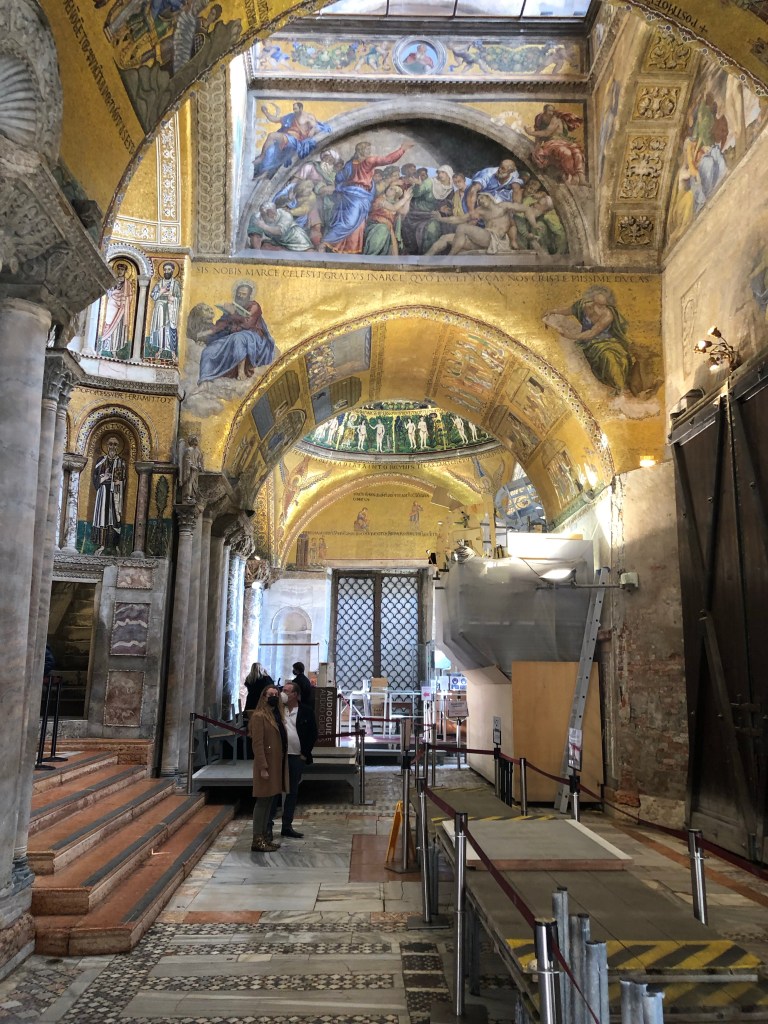
With only a few hours left on the clock, I very almost missed Venice’s main attraction entirely. Despite passing St Mark’s Basilica every time I got off the vaporetto from Giudecca, I confess I hadn’t considered going in to explore at all, until the realisation that I might let my private feud with scaffolding debar me from seeing one of the most beautiful churches in Christendom finally got the better of me. And not a moment too soon – after my island-hopping excursion around the lagoon, I only just made it back in time for the final opening hour.

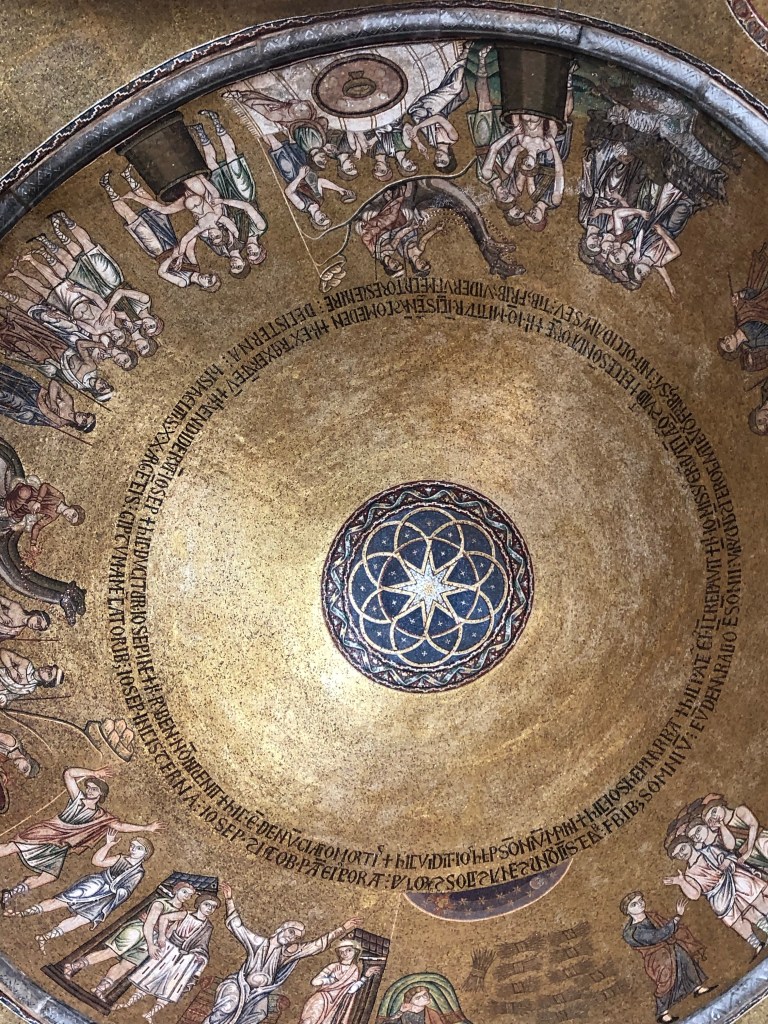
In short, I’m glad I did. It’s not free to enter like it once was, but 3€ is a pitifully small sum to pay to see the glittering Byzantine majesty that is St Mark’s ceiling. Heathen that I am, I don’t have a lot of time for Renaissance art, but there’s something about the sunken, staring eyes of Byzantine saints that I find absolutely spellbinding. And St Mark’s certainly isn’t short on saints.

Probably the most awe-inspiring part of the interior is the entrance itself – while you’re busy buying your ticket, don’t forget to look up at some of the best lit (and best preserved) of the basilica’s mosaics!

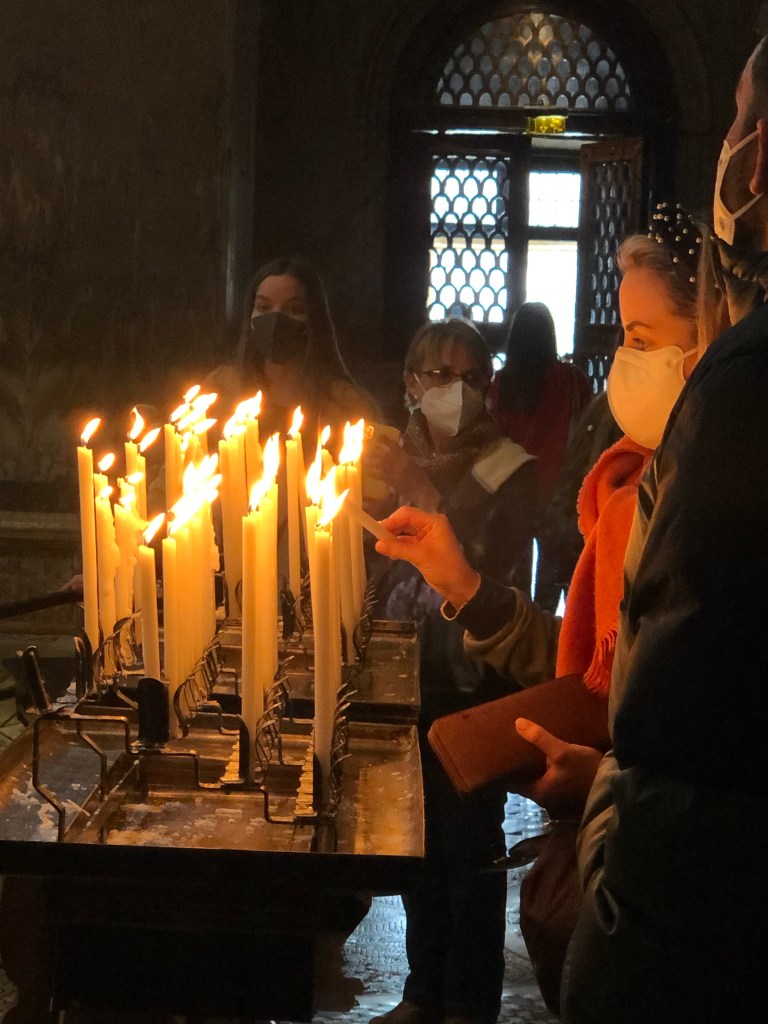
I lit a candle for my ancestors before leaving. My grandfather was a traveler, but I doubt he ever made it this far. So when I travel, I travel for him; just as when I write in my journal, I do so in memory of my great-grandmother. Traditions are everything. Insert your Fiddler on the Roof pun here.

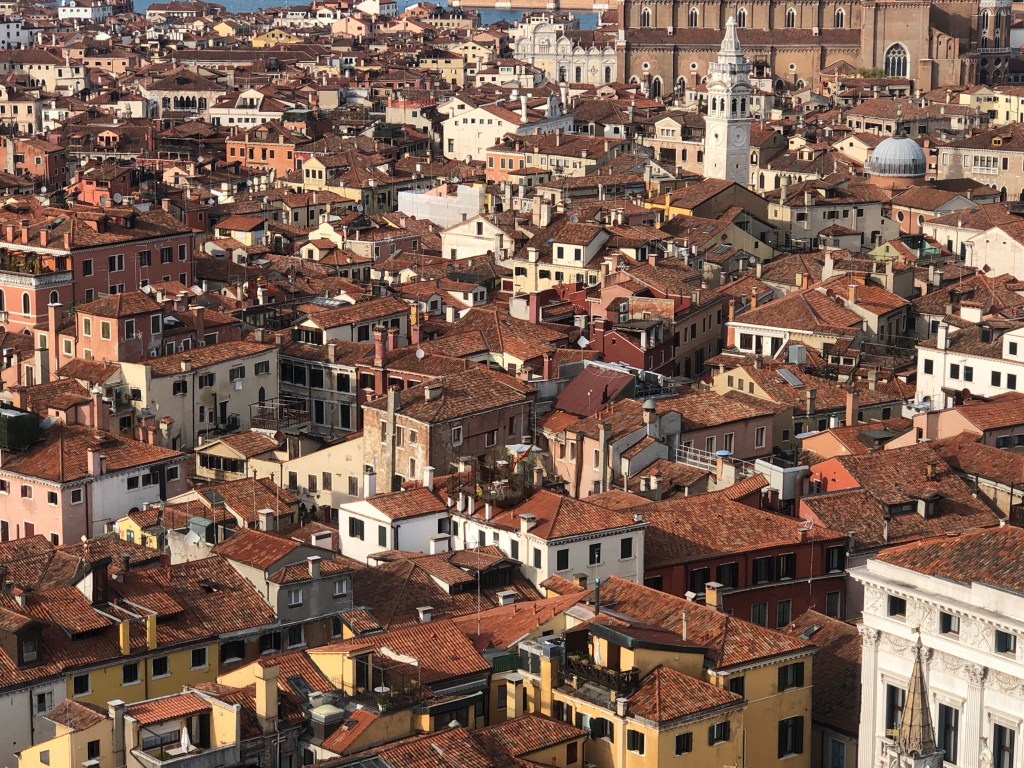
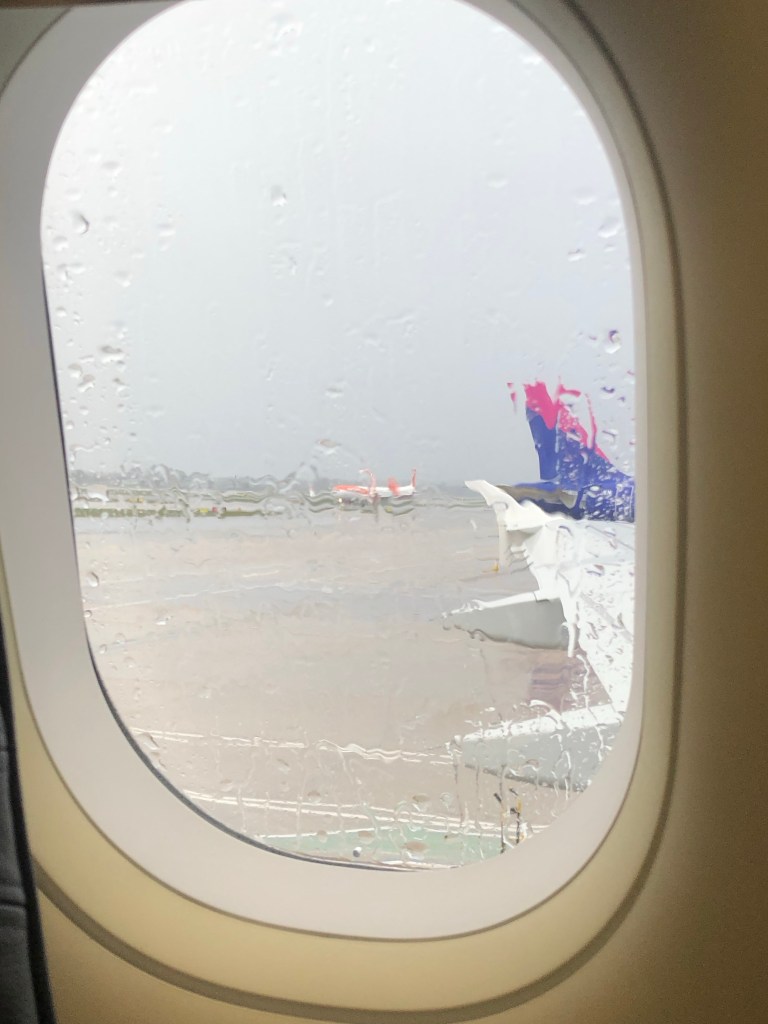
To round out my stay in Venice, I took the lift up the campanile to see the city from on high. It’s worth the 10€ – the views are spectacular and it really helps to put your adventures around the lagoon in context, as you can see most of the islands from up there. There aren’t many cities in the world that aren’t eaten away at by modern cement monstrosities, so Venice is a city you should see from as many angles as you can. And since I didn’t have the window seat on the flight in, this was the next best thing!

The train is slowing down. We’ve cleared the long dark tunnel through the Apennine Mountains and left clouded Florence far behind. The group of four American travellers from Badiddlyboing, Odawidaho (right out of the frighteningly accurate Harry and Paul skit https://youtu.be/BGc3zFOFI-s) have finally stopped talking about Geoff’s wine tour and are playing Candy Crush in silence. Outside, the sun shines on Lazio, and I’m ready for the next adventure. Andiamo di qua! BB x
Venice III: Spirits of the Marshes

Three days in and I’m already a day behind. I guess that’s a good thing, as it means I not only had a packed day yesterday, I also had a busy sociable evening swapping stories with fellow travellers. It’s travelling done right, and all I ask is your patience, dear readers – such days make for good writing.


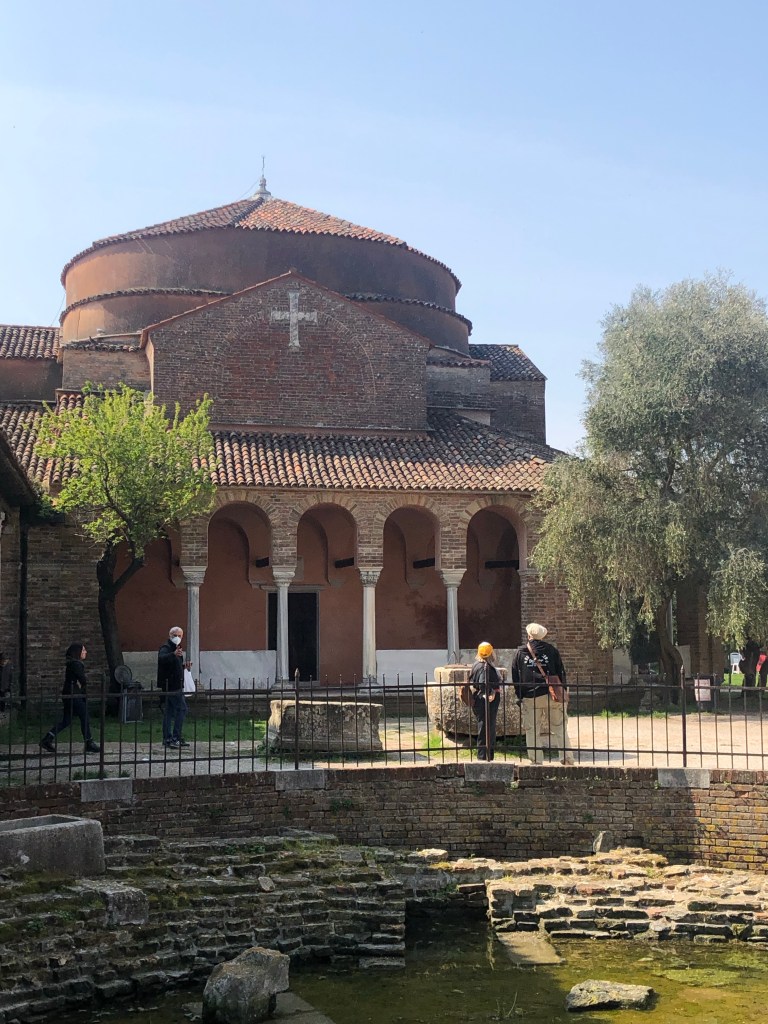
Wednesday was another make-it-up-as-you-go kind of day. I had it in mind to visit the smaller islands out in the lagoon – namely Murano and Burano – but as the vaporetto rolled up to Fondamente Nove, I suddenly decided to take a chance on mysterious Torcello, Venice’s predecessor. Most of the guidebooks pointed out it was almost deserted with very little to see other than an ancient church – the oldest in the lagoon – but if you’ve been reading for a while, you’ll know that’s one big fat tick in the box for me.

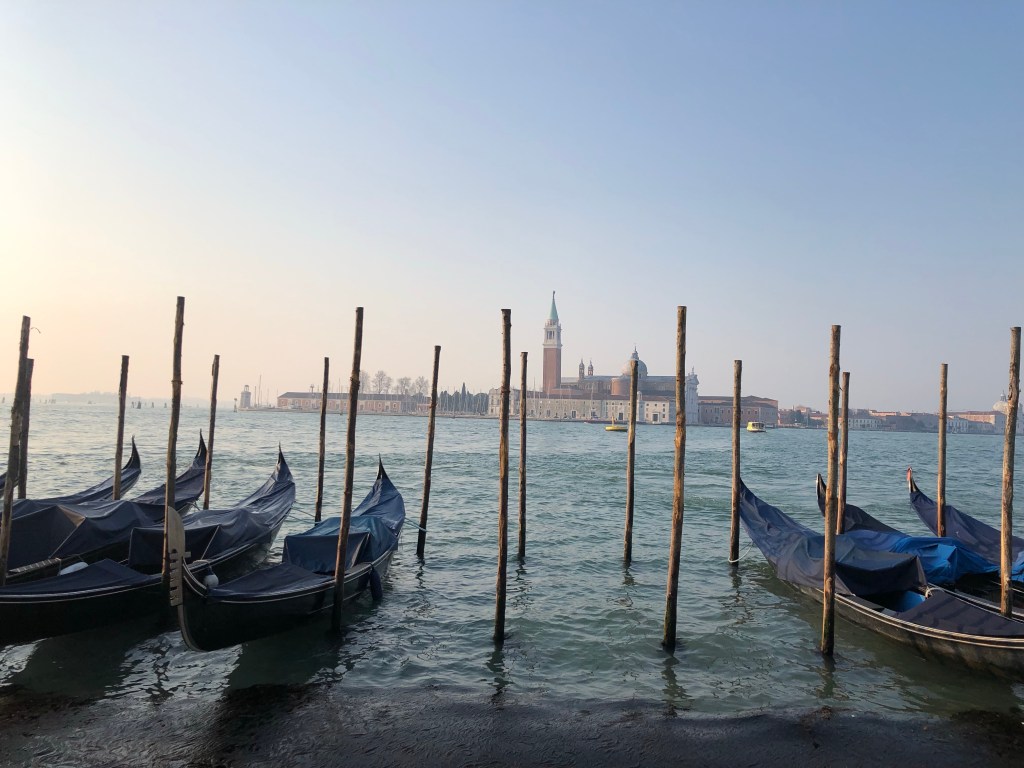
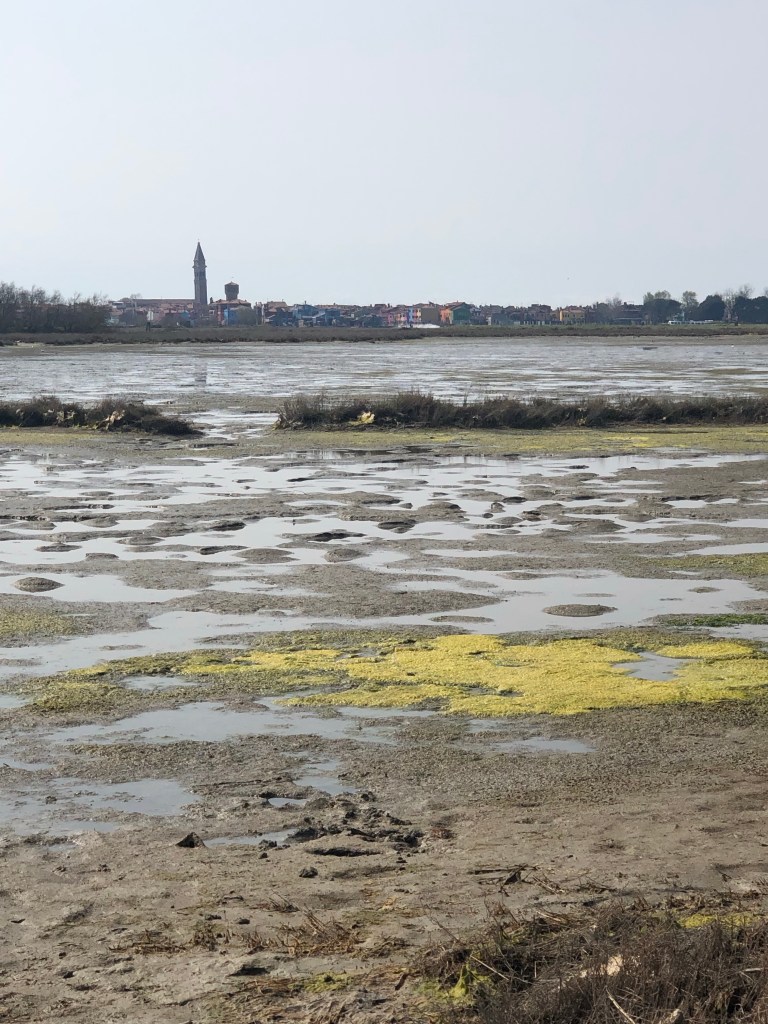
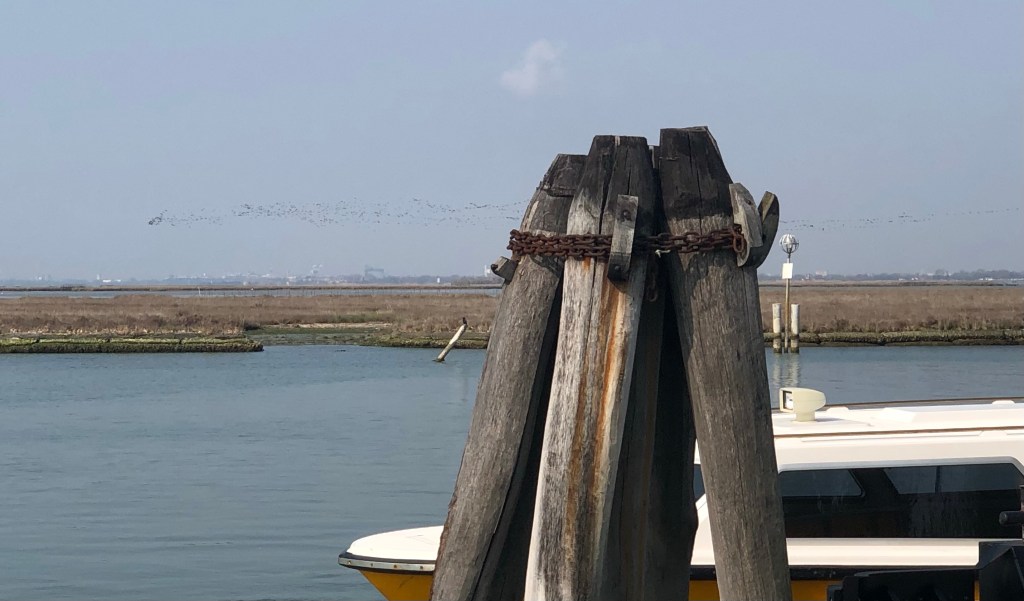
The lagoon feels truly vast once you’re out on it and Venice is behind you. Wooden struts stacked in threes mark what can only be described as water highways, giving the lagoon the appearance of a race course – until you realise it’s not mere practicality but also a safety measure for sailors, as there are multiple areas of the lagoon that are considerably shallower than they seem. Here and there, large expanses of mudflats rise out of the water, giving the lagoon’s waterbirds a place to retreat from the noise of the city.

The vaporetto chugged into Murano, city of glass, and then Burano in turn, city of lace and paintbox streets, but I spurned both of these for the diamond in the rough that is Torcello, risking a stranding for a chance to see one of the lagoon’s hidden gems. (In hindsight, I needn’t be so melodramatic – Torcello is surprisingly well serviced by the vaporetti, with a boat every fifteen minutes from neighbouring Burano).

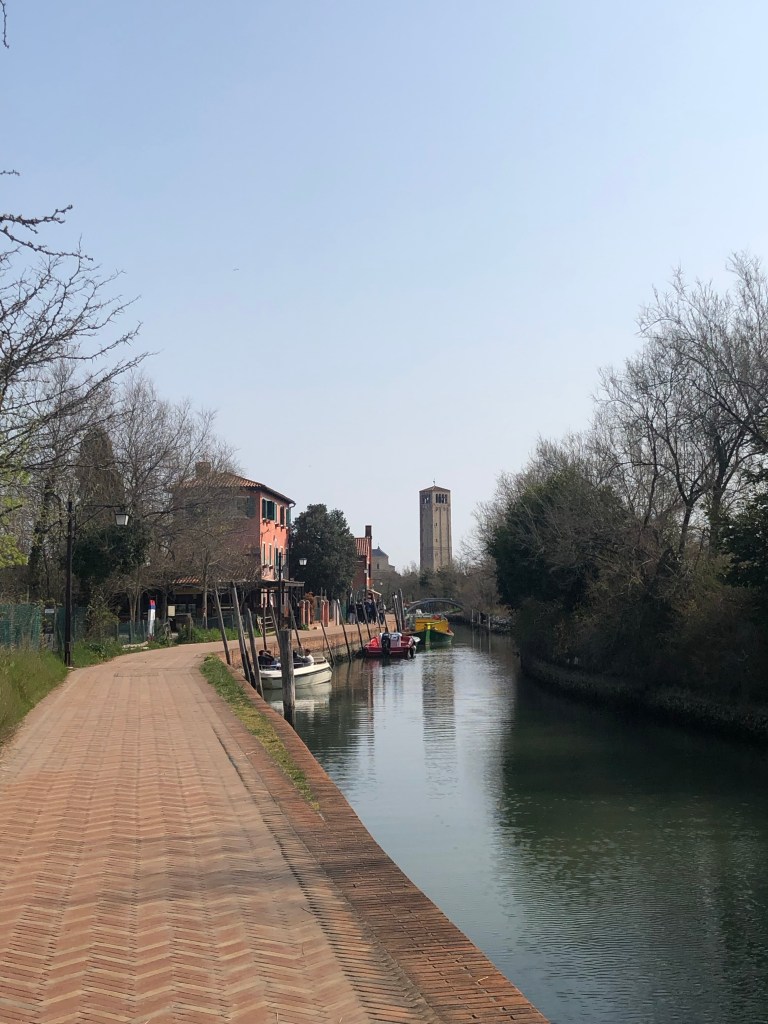
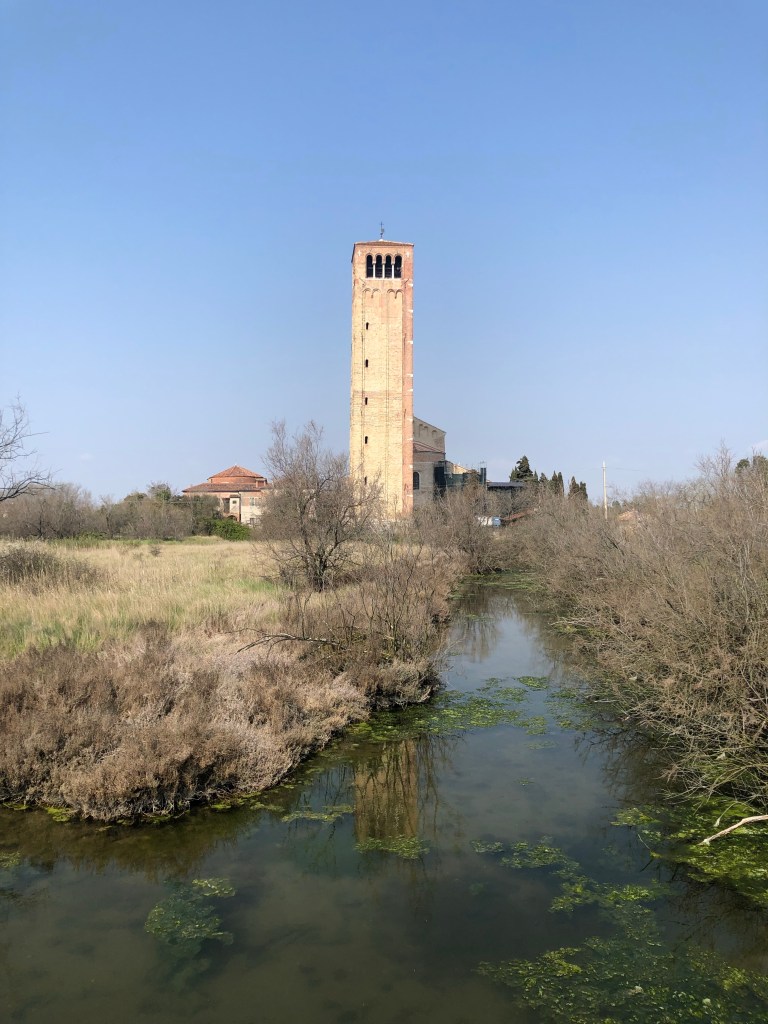
Why come way out here? Easy. Torcello is nothing less than Venice’s ancestor, home of the first Venetians who arrived in these islands around the year 422 fleeing the forces of Attila and his Huns as the Western Roman Empire fell beneath fire and the sword. Guided by the visions of their priest, the refugees escaped into the lagoon, believing the great water would hide them from the Huns. They named their new home Torcello, meaning “Tower and Sky” – which is eerily apt today, as that’s almost all that’s left of what was once a thriving city.

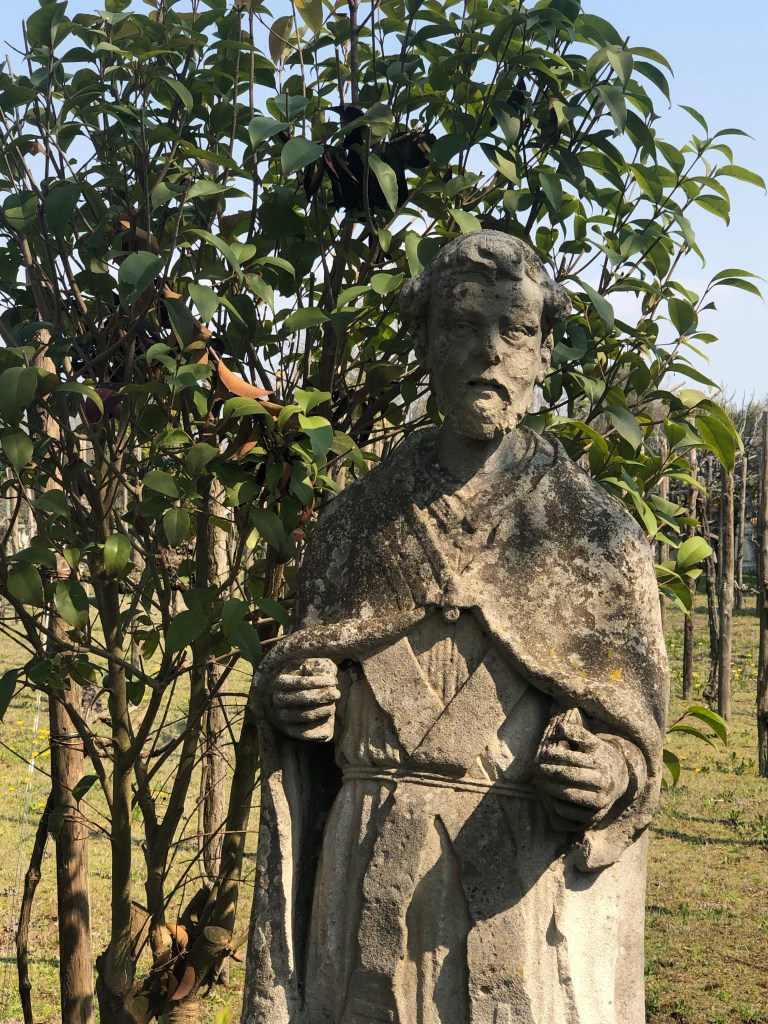
In its heyday, some twenty thousand people called this island home, and it punched well above its weight as a centre of commerce and tolerance until at least the tenth century, though you’d never guess to look at it today. All that remains are some twenty residents, a few houses, some scattered allotments, a collection of Romanesque statues abandoned to time and an old church in the Roman-Byzantine style, whose bell-tower still dominates the landscape – the “Sky Tower” that gave the town its name. On a clear day you can just about see it from Venice itself, staring jealously across the lagoon.

Several factors brought about Torcello’s decline, not least of all the lagoon itself. Just as she did during the first COVID lockdown, Nature showed how quickly she can regain control when she wants to. Over time the island began to sink back beneath the water, swallowing up the villages and turning the once prosperous salt-flats into malaria-ridden marshes. Torcello’s disciples fled in the wake of the tide, seeking refuge on the other islands.

And then, of course, there was Venice herself. What was originally an offshoot of Torcello quickly took advantage of its father’s plight, absorbing its fugitives into its own ranks. Eventually, the son far outshone the father, and as more and more citizens abandoned their former home to its fate, the glory of Torcello faded into memory. The many thousands who once called this island home simply disappeared.

I had my lunch on a jetty east of the Roman church with four ducks paddling hopefully in attendance below. Venice is quiet, but Torcello is something else. Sure, maybe not so much that afternoon, as one of the locals had his radio on full blast as he scoured his fishing boat upriver, but I can imagine this place is as silent as the desert most days.

I’ve always been attracted to the desolate corners of the world. A childhood spent exploring Dungeness, Stodmarsh, Elmley and Doñana National Park has left me with a voracious appetite for marshlands that has never really gone away. So when I look out across the mudflats and listen to the cries of the shorebirds, my heart falls into step and I feel calm and content. But marshes are lonely places. I can think of few places in the world with a lonelier atmosphere. The mournful cries of plovers and sandpipers out on the flats give the place an eerie sadness. The gulls almost sound as though they’re laughing at you for losing yourself here. Solitary herons and egrets prowl the canals like watchmen. And of course there’s the mournful curlew, whose bubbling trill is possibly one of the most haunting sounds in nature. What unholy terror drove the first Venetians to such a lonely place? Their fear of the Huns must have been great indeed to seek to build a home out here in the lonely marshes.

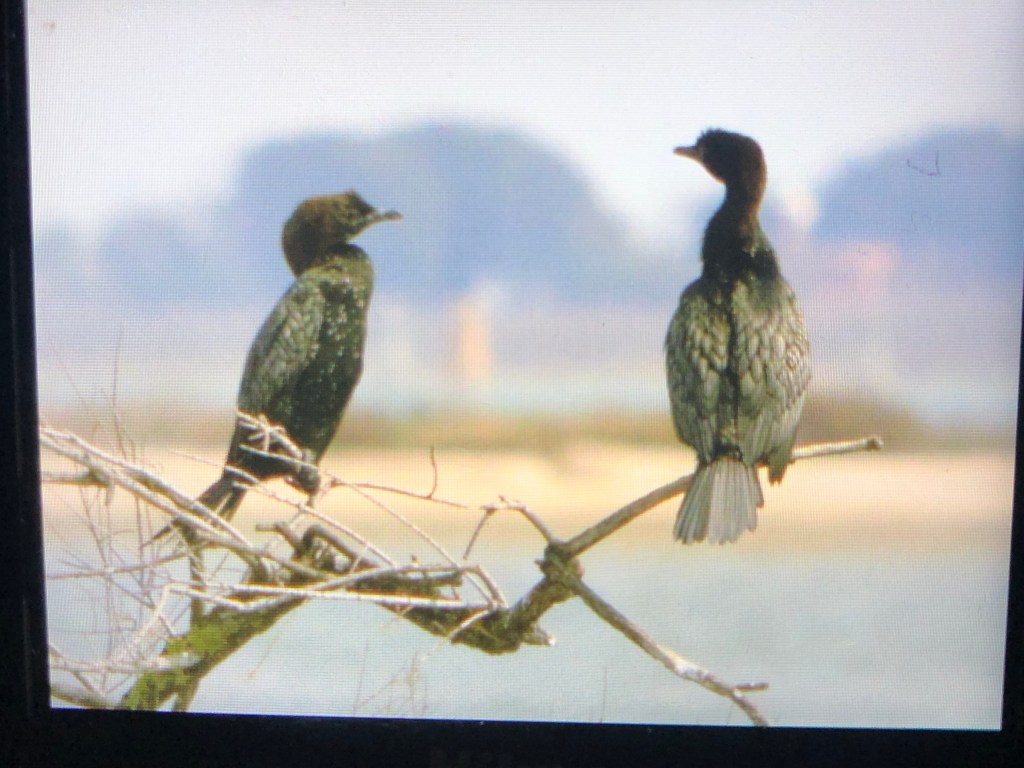
As I leave the island, a thin dark cloud appears on the horizon, moving fast toward Burano. As it draws near, I see it is no cloud at all but a raft of pygmy cormorants, thousands of them, flying in a loose formation that surely stretches for half a kilometre in length. Like oversized starlings, they sail over the marshes, moving deeper into the lagoon.

Perhaps these little sea-crows are the perfect metaphor for the Venetians themselves. A creature of the land that took to the water, making himself a master fisherman, building his nest out on the lagoon. I’m not the first to jump to that conclusion either. A sixth century Roman official wrote of the denizens of Torcello thus:

You live like sea-birds, with your homes dispersed, like the Cyclades, across the surface of the water.

Cassiodorus, 523 AD

Standing on the forgotten shore of Torcello, it’s easy to imagine that the thousands of cormorants passing by really are the spirits of those first Venetians, making the same exodus from land to lagoon every morning for generation after generation, like the denouement to a tragic Greek myth: some cruel trick of the old gods, granting the refugees an eternal escape from their would-be oppressors. That such creatures should choose to haunt Torcello, the forgotten ancestral home of the Venetians, only adds to that mythos.

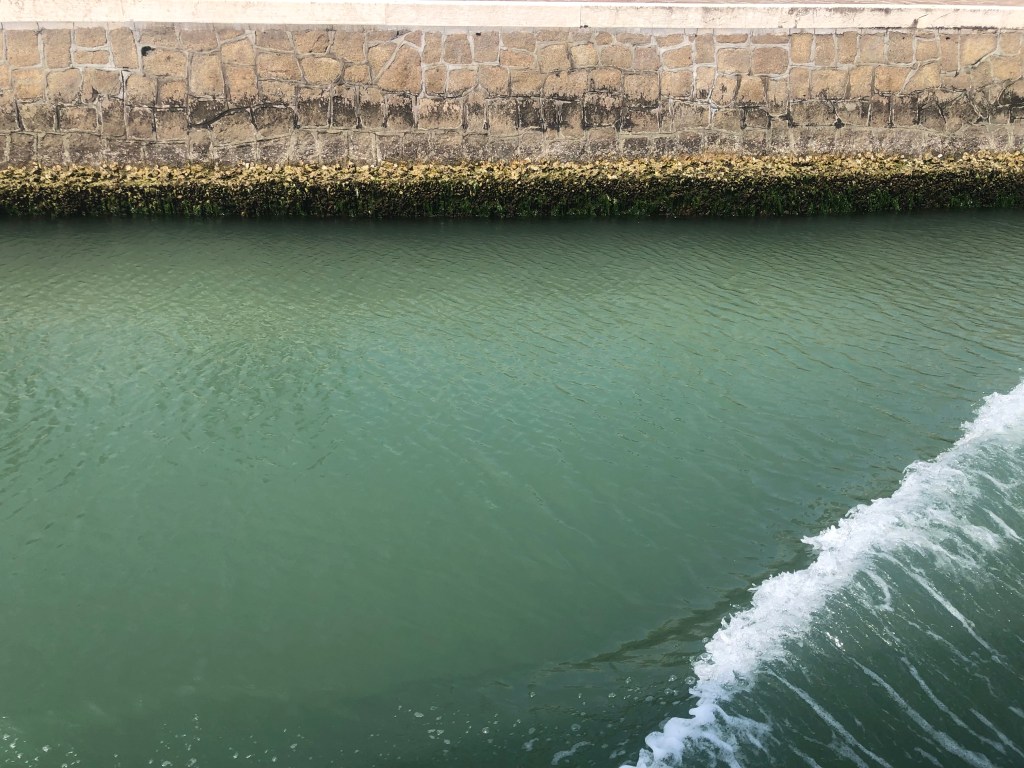
The outlying marshlands of the Venetian lagoon are full of such spirits, if you’re prepared to leave the bustle of Venice and its glass-blowing cousins behind for a couple of hours. If you truly want to see what Venice might have looked like before its canals become cloudy and green from all the water traffic, come to Torcello, whose ancient canals are clear as daylight, revealing a colourful array of sea grasses, seaweed and scuttling crabs on the silt below. And listen, just for a moment, to the ghosts out on the mudflats, knowing you’re hearing the same haunting sounds that the first Venetians defied to make their home here, over a thousand years ago. BB x

Venice II: Madonna and the Amazons

This morning I struck out alone, early, just after sunrise.

So early, in fact, that most things were closed, even after a false start on the wrong vaporetto. St Mark’s Basilica wasn’t taking any visitors when I arrived, though at the moment it looks like a building site with all the scaffolding on its central façade.

The scaffolding curse strikes again. After my last piece on the subject disappeared under mysterious circumstances (I swear I remember publishing a piece called “Ode to the Scaffold” and Facebook tells me I’m not lying), I’m all the more convinced there’s a global conspiracy that has every major world heritage monument under restoration when I’m in town. Altamira, Fes’ tanneries, Lindisfarne, León’s cathedral, Gaudí’s Casa Battló and now the Basilica di San Marco. I’m truly cursed.

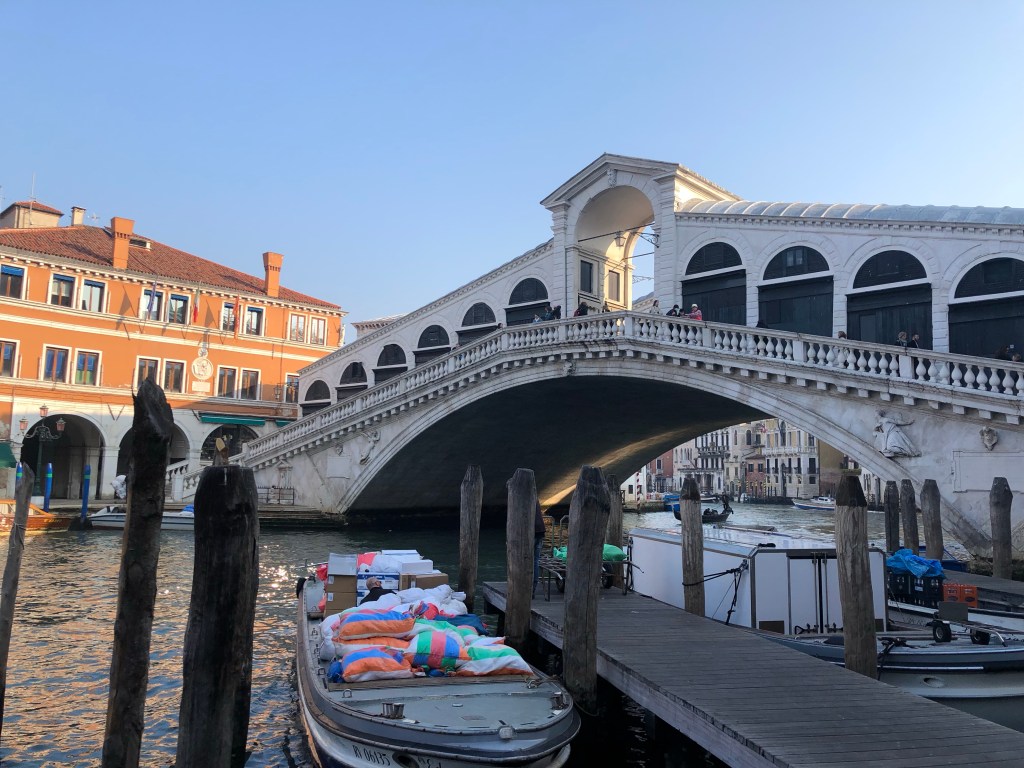
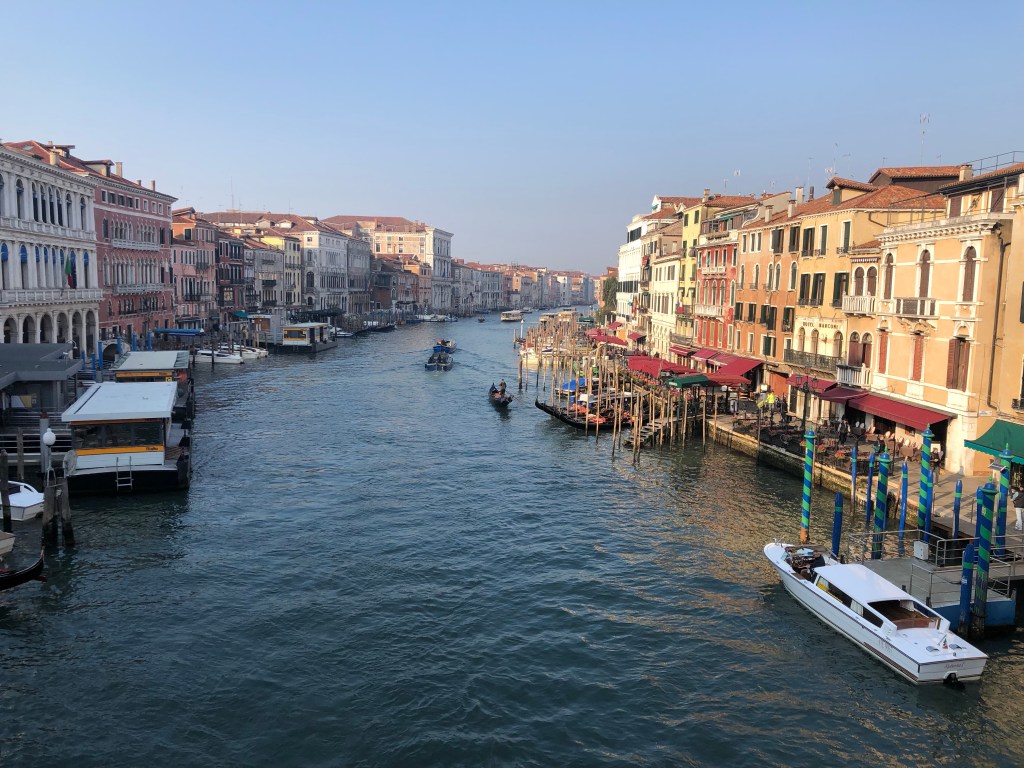
Fortunately, building interiors and Renaissance paintings don’t hold as much fascination for me as the city itself, so I set off in search of some other parts of Venice with stories to tell. And where better to begin than the Rialto? The great bridge over the Grand Canal where Shylock learned of his rival’s ruin?

I’ll admit that today was something of a schoolboy-fanboy morning. Othello and The Merchant of Venice were two of my A Level texts back in the day and walking down the very streets where some of Shakespeare’s greatest works were set felt nothing short of magical. Some come to Venice seeking romance, fine dining and Renaissance majesty, but I’m wired differently. Jews, plague and Shakespeare – that’s why I’m here.

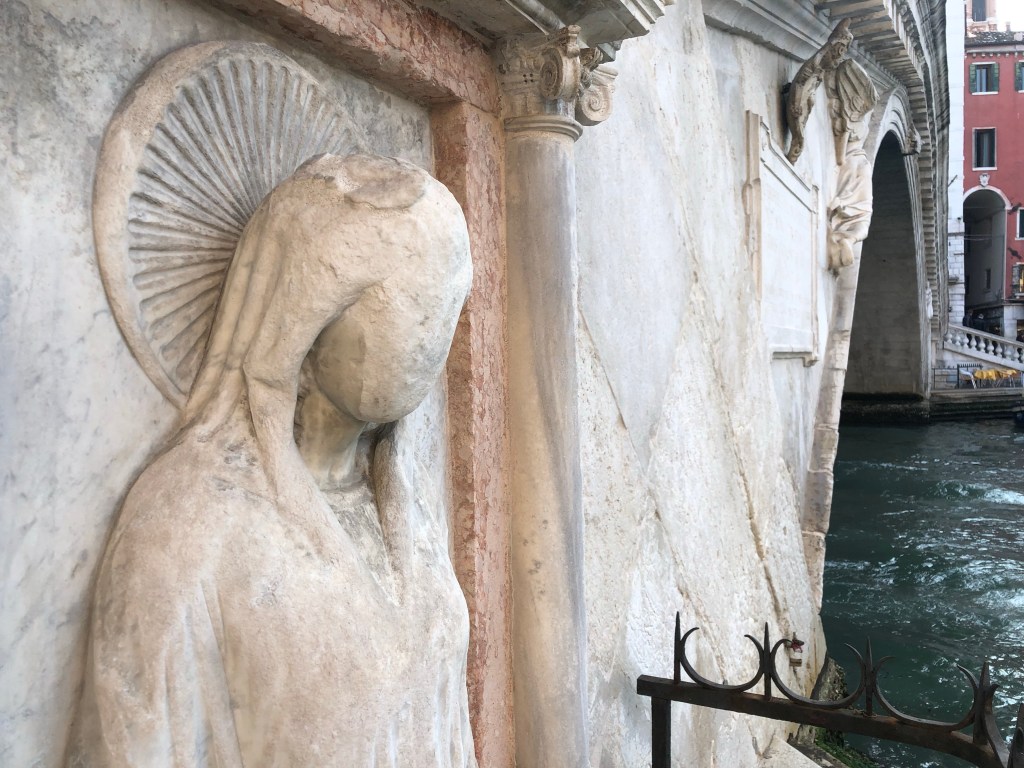
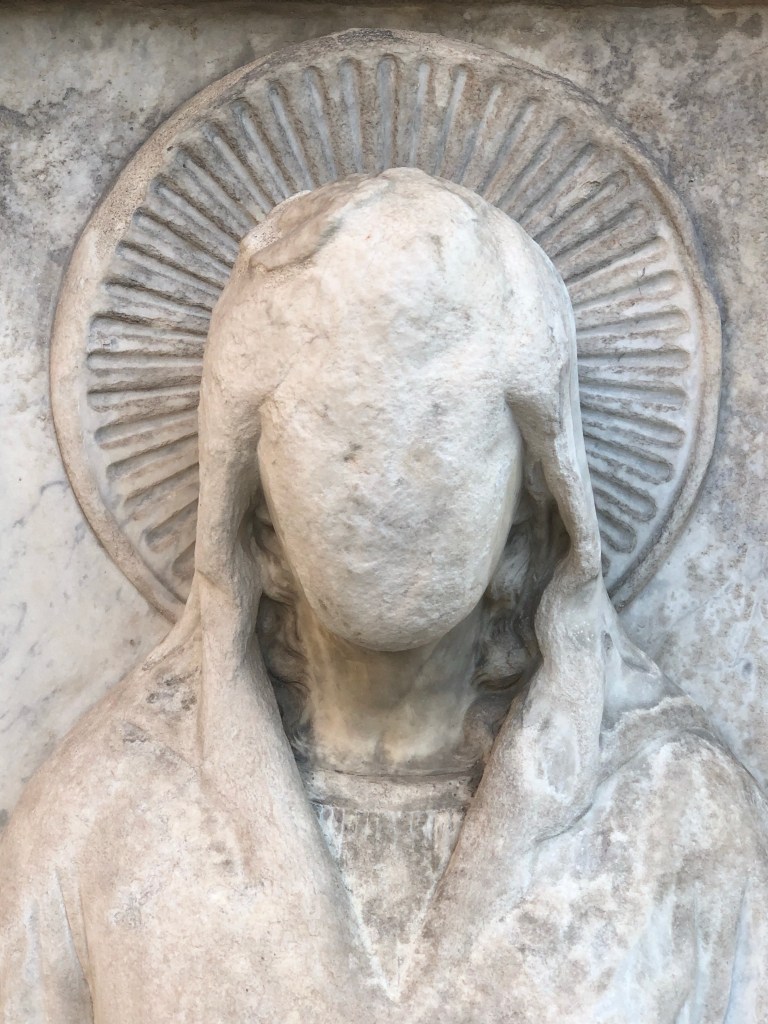
A faceless bust of the Madonna sits carved in marble on the west side of the bridge. I can’t find anything on her, and my Italian isn’t quite up to scratch to ask a local yet, but in a city filled with busts of Mary, this faceless one grabbed my attention.

How many have touched her face over the centuries in adoration? How many have asked for her intercession? I see that many of the older Venetians, like their coreligionists across the sea, cross themselves whenever they pass one of these ancient busts. Were their wishes granted, or did their ships founder on the Goodwin Sands (or not, in a rather silly plot twist from the Bard)?

Onwards from the Rialto and deeper into the heart of the city. I’m seeking Cannaregio and the ghettos, but I keep getting distracted by the Venetians themselves. How tall these Italians are! We of Spanish blood are a stocky folk at the best of times, and I feel blessed to be taller than average for once whenever I’m there, but here I am dwarfed. Broad-shouldered gondolieri swaggering about with bolshy Italian charm, thickset old-timers puffing on cigars as they vent about che succede, exceptionally elegant young women on long legs and perfectly chosen outfits. And that especially fetching eye colour that is so particular to the Italians, a fair and greenish brown that arrests the heart for a moment.

Ok, I’m staring. Time to move on.

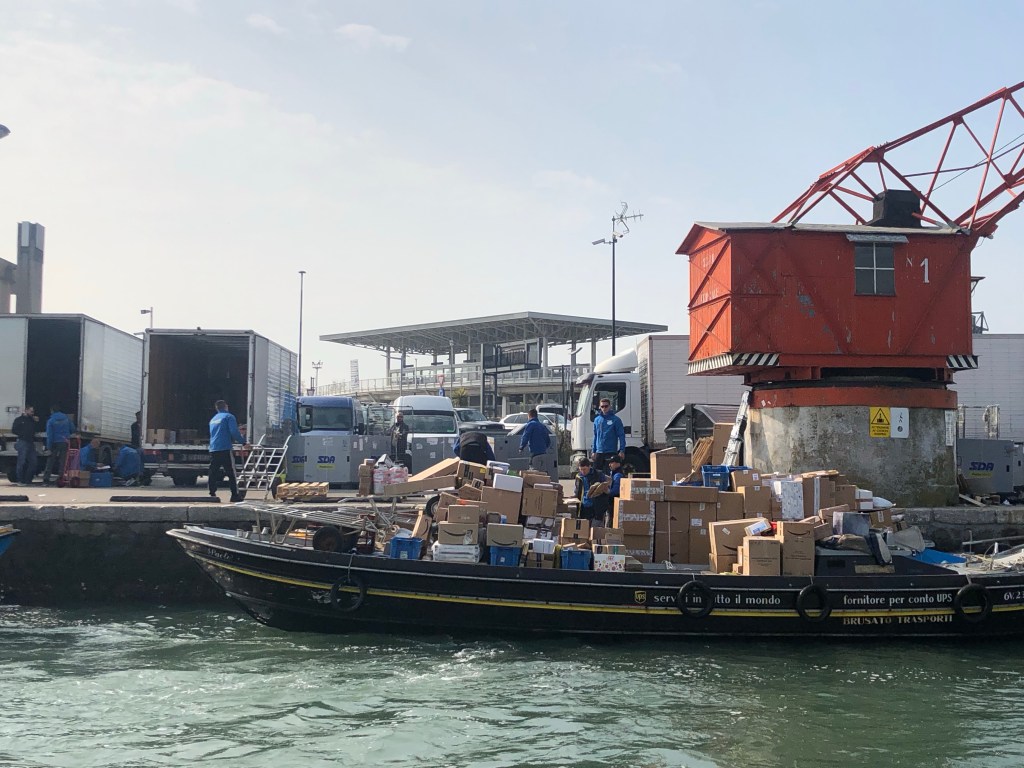
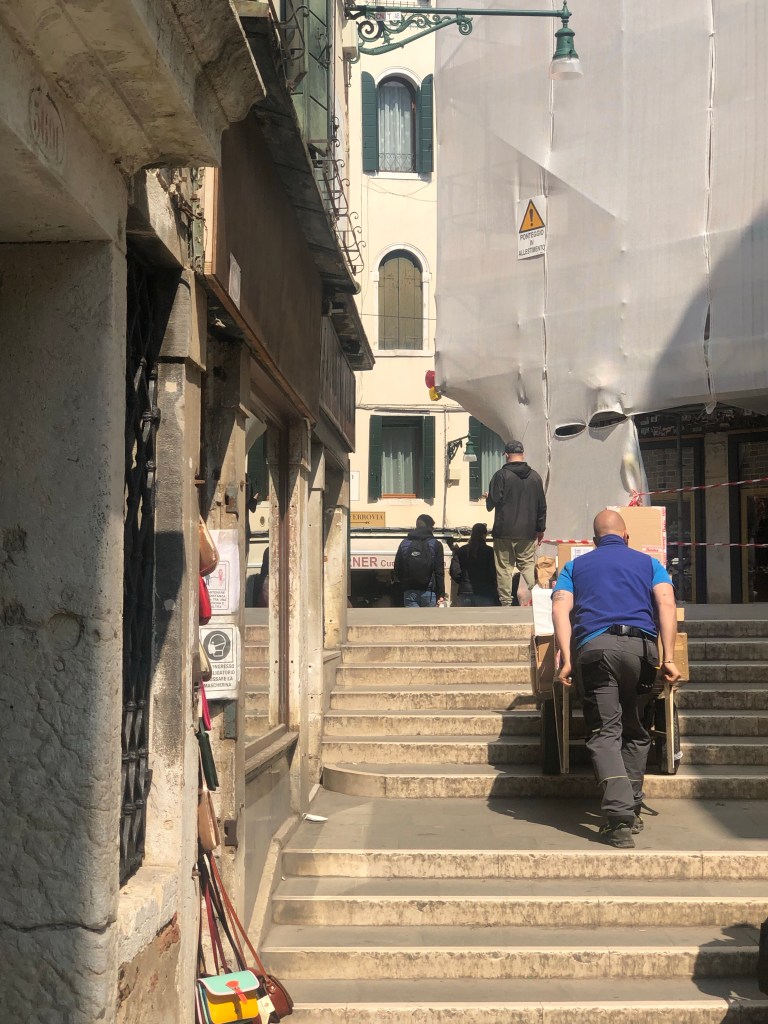
One thing that’s really got my attention today is how Venice has adapted to the age of Amazon Prime. In a city with no cars, the usual “white van man” has no jurisdiction. Instead, I’ve watched boats ferrying parcels in from the mainland all morning, while wiry, suntanned porters haul the day’s Amazon payload up and over the city’s many bridges using a purpose-built trolley that seems designed to tackle Venice’s myriad steps. Ingenious!

I could think of better places to work for Amazon, but as Venice has been a trading hub since its inception, I expect the Venetians are used to it.

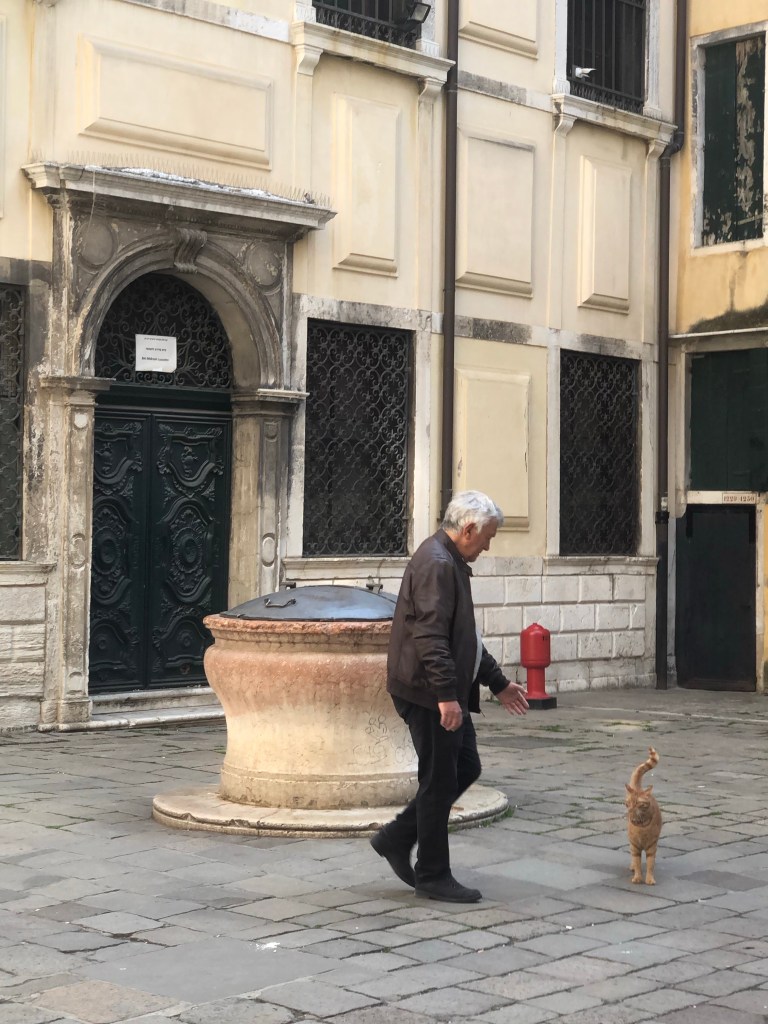
I ate my lunch/brunch of a focaccia ai olive and an extremely filling lemon ricotta cheesecake in Campo San Geremia, after overshooting the ghetto district by a bridge or two. I listened to a Senegalese busker and wondered if African minstrels were a thing in Shakespeare’s Venice, too. His music was fun and his voice captivating. My dad would have said it was repetitive. I would have said it was catchy. Mr Busker would probably have said he was just having the time of his life – and raking it in in the process Seriously, I’ve rarely seen a busker’s cap so full – there was more shine coming off the euros on his guitar case than ripples on the Grand Canal. Venice must be a minstrel’s dream.

My thoughts and feelings wandering through the ghetto vechio and the ghetto novo were much too powerful to sum up in what is already a comprehensive article. I’ll save them for when I return tomorrow. Right now, the brightest part of the day is almost over and I’m feeling rested. Time to go and explore again. BB x
Venice: First Impressions

My eyes hurt. The 4.15am start probably didn’t help, but I’d wager the blinding light of the Venetian sky has something to do with it, too. The good weather is supposed to start tomorrow, but today the city is draped in a lagoon of cloud – and that’s no ugly thing.

Check-in was easy. Considerably so. Though it’s a little sad the world has gone and got itself in a big damn hurry and replaced most of the human interactions in airports with machines, it doesn’t half cut the time spent queuing. Despite one of the smoothest transitions from home to gate, however, the plane was all of forty five minutes late leaving Gatwick. Apparently they’d oversold the flight by one and by the time they’d sorted that one out, we’d missed our slot. I was listening to Ravel’s Boléro which only made the anticipation all the more amusing – that piece is basically thirteen minutes of build up to a two minute finale. I could have listened to it three times over in the time between our original departure time and takeoff… but, as I’m not a masochist, I didn’t. Fifteen minutes of snare drums is good enough.

Have EasyJet seats shrunk over the years or have I just forgotten? In any event, Venice’s Marco Polo Airport is very easy to navigate. Passport control is also machine-operated, though I did still get my stamp from a singing security guard. The one upshot of Brexit is that my passport is beginning to look well-travelled again, after years of “ghosting” between the UK and Spain.

Those who’ve traveled with me before will know I prefer to keep an open book when I travel. That can make me either the most liberating or the most frustrating person to travel with. However, it’s a rule I stick to. It is, of course, considerably easier to do when you travel alone.

I thought about sailing into Venice on one of Alilaguna’s water transports and even got as far as buying a ticket, only to be told that the Rosso service via Giudecca wasn’t running today. Nobody thought to tell the machine. This, I suppose, is one example where machines will be the death of us – starting small, bleeding the shy and the awkward of their petty cash, before bloodying us when Skynet takes over.

Joking aside, I decided to skip the hassle and take the bus. A much better idea – it’s a short ride and at only 8€ it’s an easy, affordable trip. And though I was planning on heading straight to Giudecca to drop off my gear, in the end taking the bus swayed me to get to know the floating city a little along the way.

I’ve been good this time. I haven’t actually done a lot of research. I haven’t binged in Venice photos or read up on travel blogs. The only real binging I’ve been indulging in is my Italian, which is already paying dividends out here. As a result, I’ve managed to dodge the Petra Effect this time. Hype really is a killer – so I’ve arrived blissfully underexposed. And what an impact that has!

First impressions? I think one of the most surprising things about Venice is how quiet it is. I was expecting one of the most beautiful cities in Europe to be absolutely heaving, but it’s not. I lost count of the number of times I found myself crossing a bridge in an empty, silent street, with nothing meeting my ears but the rippling water and the crying of gulls overhead. Even the Venetians themselves seem toned down (but then, I am used to Milanese Italians who are especially vocal). But no. None of that. It’s incredibly peaceful here.

The vaporetti couldn’t be easier to use. I’ve bought a three-day pass for 40€ that will allow me to bounce on and off them over the next few days. If you stay on Giudecca, you’ll be making frequent use of them just to get to the city and back, and at 7.50€ for a single trip you’ll make a saving even if you only plan to make a return trip from Giudecca once each day. I have a few days to play with, so I’m going to try to explore the outlying islands of Murano and Burano. Better hold on to that ticket!

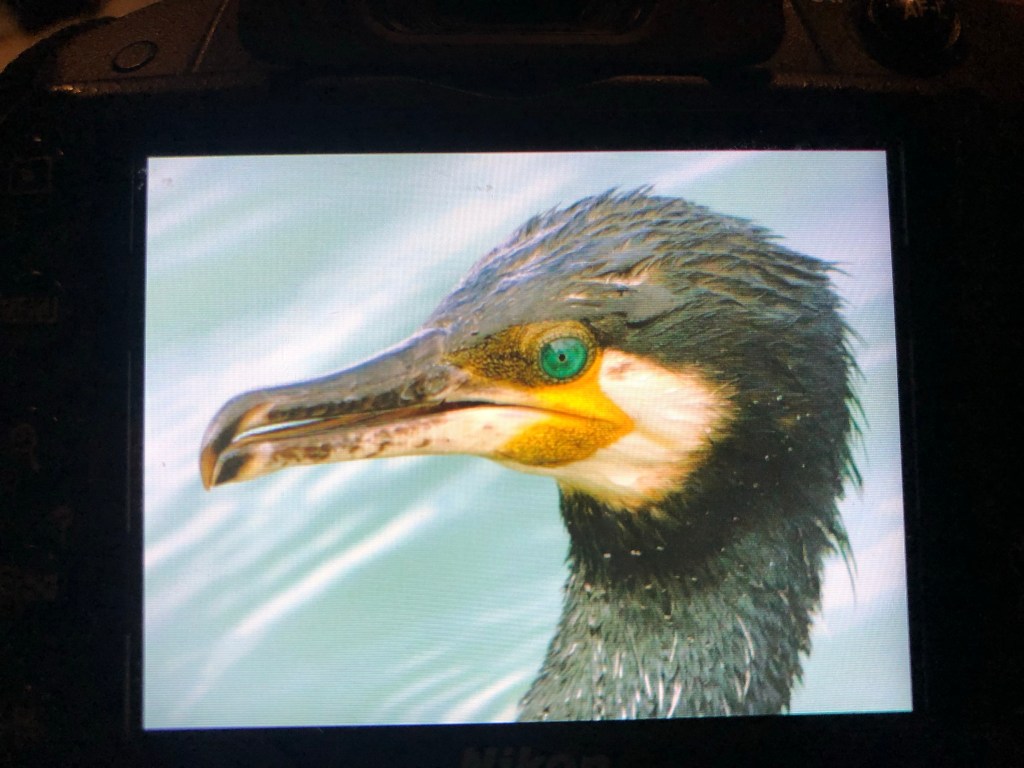
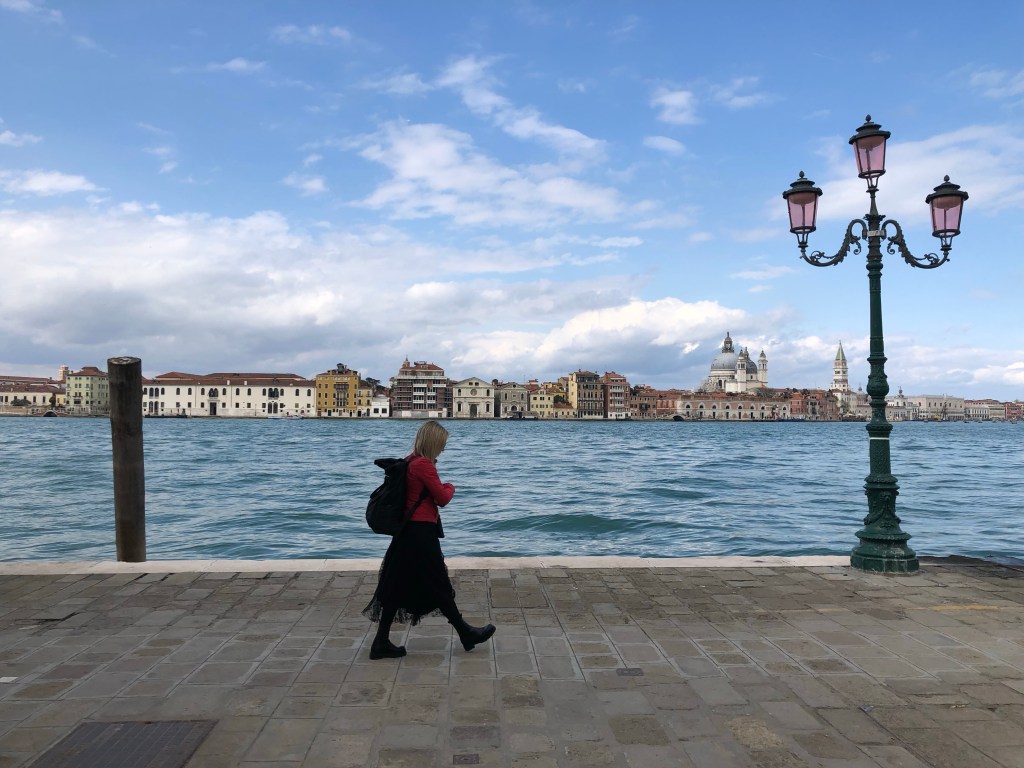
Giudecca is a quiet place to stay. I spent most of the afternoon snagging photographs of the cityscape in a mirrored window and chasing a cormorant down the waterfront. For once I’m armed with my trusty 300mm and can get back to my roots as an amateur wildlife photographer. I ought to invest in a means of transferring my photos straight to my phone for on-the-go reporting like this, but for now, a grab shot from the old iPhone will have to do.

Looks like the other occupants of my dorm are stirring. I noticed a Spanish book on someone’s bed as I came in. I can see a Pembroke College Cambridge tog bag hanging from one of the bunks and I know I recognised a French accent back there. Time to break a habit and instigate a conversation for once. I fancy dinner and a chat. I’ve missed this way of life. Catch you later! BB x
Dagobah: The Longest Night of my Life

Planning ahead for Italy this April has got me thinking about the last time I travelled solo, now almost a decade ago.

When I was eighteen years old, my mother gave me a copy of Laurie Lee’s As I Walked Out One Midsummer Morning and a map of northern Spain. I joined the dots and bought myself a one way flight to Santander, planning to walk south as he did, until I reached the Mediterranean Sea.

It didn’t exactly pan out like that, but it was and is to this day one of the toughest and most formative adventures I’ve ever made in my life.

Travelling solo is not for everyone. You’ve got to be comfortable with your own company for long periods of time. You have to be able to think on your feet and adapt to whatever happens around you, because nobody is going to look out for you but yourself. Most importantly of all, you need to be brave. You’ll hear plenty of stories about the kindness of strangers, but nine times out of ten, it’s a case of shy bairns get nowt; if you aren’t prepared to talk to people, the loneliness birds will start to circle.

That’s what happened to me, all those years ago. My Spanish was good – more than good enough to hold my own in a conversation – but my courage was lacking. The bottomless charisma that comes almost by osmosis from working in a private school hadn’t sunk in yet, and I would have rather bitten my own tongue than enter into a conversation with a stranger. Consequently, I spent the greater part of those four and a half weeks in what can only be described as a state of monastic silence.

As a rule, I’ve tried to find a travel partner on every adventure since, as there are few things more reassuring than good company on the road. Back then, halfway through my gap year, I was cut off like never before: everybody I knew was either at university, at work or halfway across the globe on gap years of their own. So I didn’t have much choice.

I was young, inexperienced, and woefully naïve about how much I ought to be spending daily on food. Little wonder, then, that when I came home I was dangerously underweight. That first encounter with solo travel taught me a lot, but most of all it taught me never to skimp on food. Ever.

Looking back, it’s so easy to focus on the negatives, largely because of how didactic they all were. One stands clear above the others like a lonely mountain. Sleeping rough in the mountains above Madrid with nothing but a sleeping bag and a rucksack for a pillow. That endless night will be with me forever. Let me paint it for you.


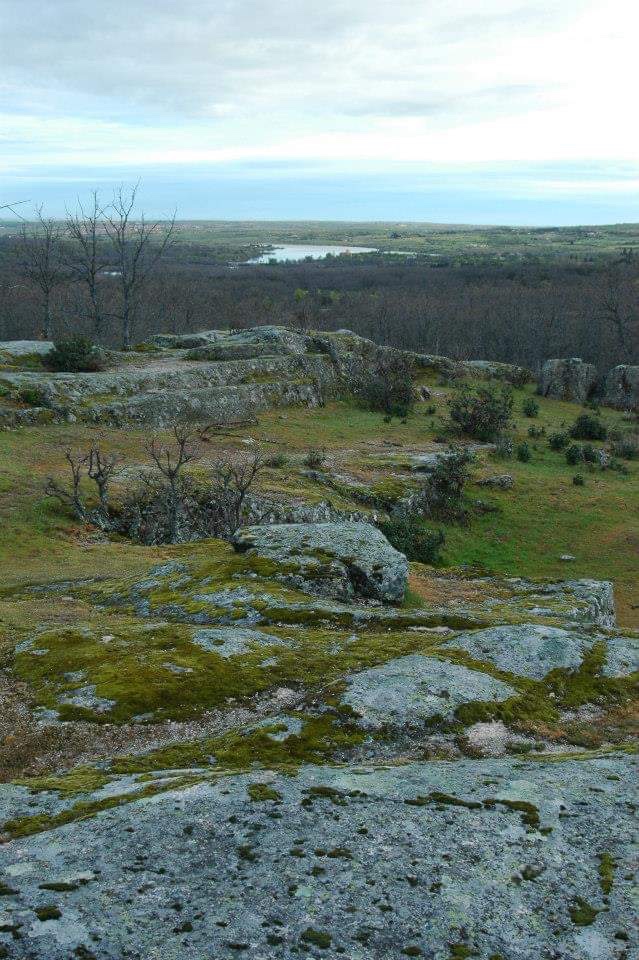
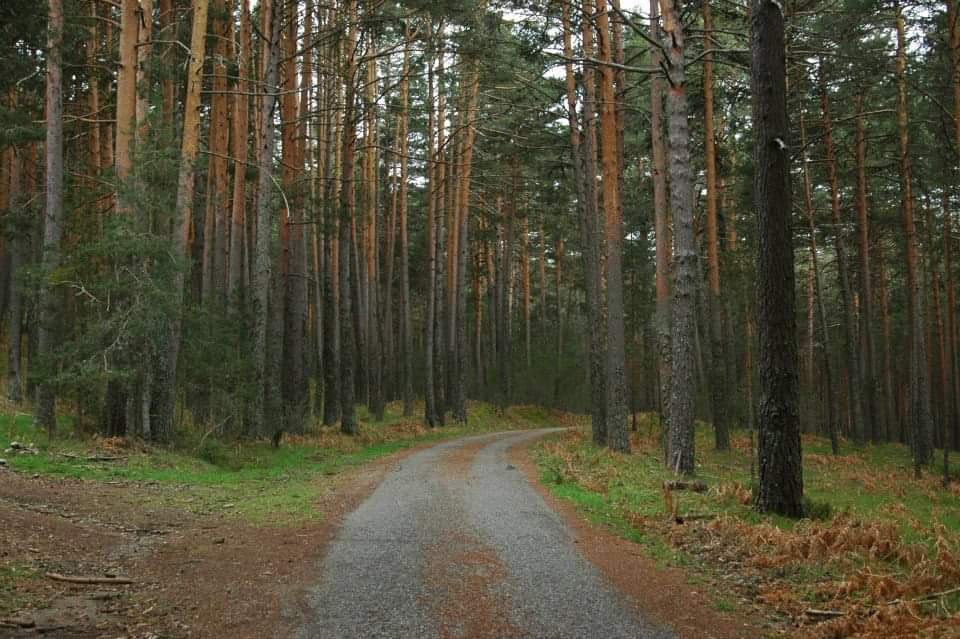
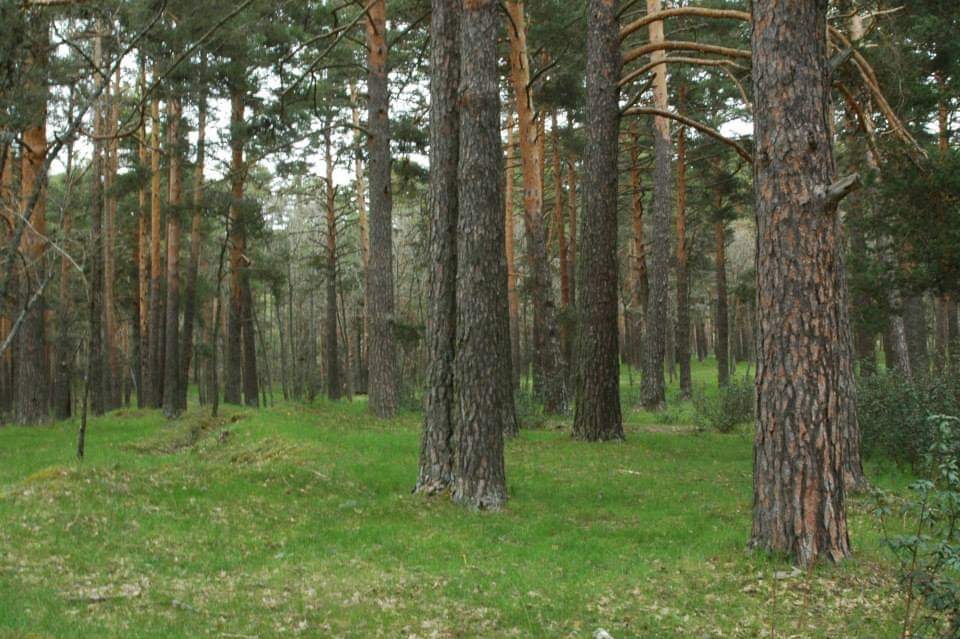
Picture it. A patch of relatively stable ground in the heart of a dark pine forest, on the lower slopes of the mountains. At least two hours’ walk from the nearest settlement. Pine needles where the grass doesn’t grow, and the roots of the trees poking out of the ground here and there like toes in the sand. The light fading as dusk sets in, no sunset, just a gradual darkening of the grey light between the trees as the world before your eyes starts to fuzz and crackle like static on an old television. From somewhere far off, a raven croaks, and once or twice, an owl.

You put your head on your rucksack and try to shut your eyes, but sleep doesn’t come. Maybe it’s because it’s still light out there. Minutes feel like hours. You turn on your iPod and ration a few songs to pass the time. Maybe fatigue will get you in the end. But it doesn’t.

Night falls, but there’s no moon. The ground under your sleeping bag is cold. Wet. It sinks through the lining and into your skin. Your teeth are chattering. You put on all the clothing you’ve brought; three layers of socks, two sweaters and a makeshift scarf. It doesn’t stop the chattering. Then there’s the gentle sound of rain as the clouds roll across the mountainside, scattering water through the trees.

You check your watch. It’s only been twenty minutes. It’s still only just after nine o’clock. Most Spaniards aren’t even in bed at this time. You ration some more music.

The darkness is almost absolute. You can only just make out the silvery light of the trunks of the nearest trees, lit by the ghost of the moon, buried deep in the clouded night. The patter of rain echoes through the whole forest.

Suddenly, a harsh bark breaks the silence. It shouldn’t scare you out of your wits, but it does. You freeze, listening, half expecting – wait! There it is again. It’s a roe deer, you know that. You’re sure of it. You’ve heard that barking cry so many times before back home. It’s just a deer. Harmless. But what good is that knowledge when you’re wrapped up in a sleeping bag, alone, and nobody knows you’re up there? And what if you’re not so sure? What if it’s something… else?

It’s funny how the mind plays tricks on you in the darkness. How quickly you can unravel. For a time I am certain I had managed to convince myself it was not deer but wolves I was hearing – that ancient terror of the deep forest that all of us carry, buried deep inside.

The barking goes on for hours. Or maybe minutes. The minutes feel like hours. The hours feel like days. Time seems to have slowed to a crawl. The night is endless. No moon, no stars, no light from the distant towns. Just the static darkness that creeps through the trees, and the rain, the endless, endless rain.

You count the barks. You count sheep. You call home, consider bailing there and then. You talk to yourself, argue with yourself. You turn to God, perhaps for the first time. You swear. You laugh. You cry. You drain the iPod to zero to keep your spirits up, trying not to picture the prowling things between the trees that your eyes are so keen to paint.

Sleep is fleeting: a minute or two of semi-consciousness here and there, leaving you more and more tired, and yet less able to find that rest you now desire above all things.

And when the dawn comes, that first blessed grey light between the trees, you don’t even care anymore how little you’ve slept. You hardly notice the gnawing aches in your legs, or the numbness in your teeth from all the chattering. You’re just overjoyed to see the light once again – because there’s a magic in the dawn that is timeless. The darkness is on the run, and there’s a new day on the way. Dawn was ever the hope of men.


Looking back now, there’s so much I didn’t do that I know I should have done. I didn’t tell anybody where I was going. I didn’t pack enough food. And any of you with even a little camping experience will have spotted one glaring absence: never mind the obvious lack of a tent, I didn’t even bring a roll mat. No wonder I spent the night shivering.

One thing’s for certain: there’ll be no repeats of that night in the Guadarrama, not in Italy, not ever. I’ve had some long and painful nights in my life, but that one stands head and shoulders above the others. I don’t think I’ve ever felt more alone. But that makes it all the more powerful a memory. It’s a lightning-rod for my fears. Whenever I’m feeling down for whatever reason, I think of that night in the mountains. I was miserable, I was lonely, I was terrified – but I survived.

In the old Star Wars stories, Master Yoda went into exile on the swamp world of Dagobah, a planet with a strong connection to the dark side of the Force. Hubris had laid his order low and taken everything from him; only by humbling himself in isolation and communing with the dark was he able to understand it – and, in so doing, learn to rise above it all.

At some point in our lives, we all need to be brought to our knees, if only to understand who we really are when it all falls apart. I wouldn’t say I look back on that night with pride – the whole enterprise was nothing short of madness to begin with – but it did settle once and for all what I believed.

Darkness is not something to run from. It cannot be escaped. There’s darkness in all of us, as sure as shadows lengthen in the light. But, like a shadow, it must be faced head on if you would not be afraid. We have to confront our fears if we wish to understand them – and to understand how we react it to them. And to face your demons, whatever and wherever they may be, you need your starlight. I call that starlight Hope.

Hope and despair. The light and the dark. All that I am today is built on that bedrock. Hope is my raison d’etre, my polestar, my core value if you will, and it was forged in that endless night on Guadarrama.

Travelling alone can be tough – especially if you’re inclined to sadistic escapades like sleeping rough in the mountains like I was – but I can think of few better ways to find the meaning of life.

And if you’re wondering why I put myself through that ordeal, there’s a perfectly logical answer: there’s a chapter in my book where my protagonist is abandoned in the wild, and my English teacher once told me to “write only about what you know”! The things we do for art…

I don’t expect anything nearly as dramatic in Italy. Heck, I’m mainly going to fill some pages in my journal. But I am going with a hopeful heart once again, to feel that brush with the world beyond.

And to find a better Margherita pizza than the ones they make at Lirios. Maybe. BB x
Kicking the Habit

I can’t believe it. I’ve done the unthinkable: I’ve booked myself a holiday, and for once, it’s not Spain. Well, that’s not strictly true. I should say I’ve booked half a holiday that isn’t in Spain, because there’s nowhere else in the world I’d rather be in Holy Week than with my family, especially since the procesiones haven’t happened for two years now. But after an evening spent stuck in a rut over where to go and what to do in the week prior, I decided it was high time I broke the mould and explored somewhere new for a change. It’s a place I’ve never been before, and yet it’s also a place I’ve had so much to do with over the years that it would be nothing short of criminal to keep ignoring it.

The destination…? Italy!

For years the excuse for passing over Italy has been my (completely unfounded) belief that “everything Italy can do, Spain can do better… plus they speak Spanish”. Spoken like a true tercio, but not exactly the most grounded of opinions, nor a particularly sensible idea for somebody who’s supposed to be a modern foreign languages teacher.

So I’m giving myself a week out there to open my eyes and blow my mind.

I have six weeks to teach myself some basic Italian. Given the almost daily contact I have with Italians at work, that shouldn’t be too difficult – and hey, I could use a challenge.
Part of me feels I’m getting a little old for this solo travel malarkey, and yet there’s another part of me that’s been getting restless for months. I need something to take my mind off how messy 2021 was, something to jumpstart the thrill of adventure I used to feel all those years ago… and, most important of all, something that will give me stories to tell on here that aren’t always about my grandparents. I could certainly do with some fresh material for a change.

A slightly mad move on my part, but if I have to spend another holiday at home I’ll almost certainly go mad. 2017 Me is wagging a finger and calling this kind of behaviour entitled, but then, 2017 Me thought he had it all figured out – and he had just spent a week up at the Edinburgh Fringe, which was probably one of the most expensive holidays I’ve ever had. To throw more fuel on the fire, this year’s summer holidays are going to be little but driving lessons, and as the Camino de Santiago has yet to return to normal, I have no excuses. So it all hangs on Easter.

I have a start point in Venice. And I have an end point in Rome. Eight days is what I have to play around with. I suspect there’s so much to see in both cities that I ought to split the week in half between the two rather than trying to cram in anywhere else en route, but I’ll cross that bridge later. For now, I have a language to learn.

Gee, I haven’t felt this motivated in ages. It’s time to fall in love with the open road once again. Fatti sotto, Italia! BB x

Streets of London

2.20am. I’m riding home on the 2.08 from London Victoria. I didn’t even know trains still ran at that ungodly hour of the morning. Apparently they do: one every hour at eight minutes past the hour. They lock the station until ten minutes or so before the train leaves, and there’s quite a crowd loitering outside the gates just before they open them. Three Bridges is clearly the place to be at two in the morning. Who’d have thought it?

I did some much needed “getting out” today. With a couple of exceptions I’ve more or less turtled for four years or more. I guess that’s the nature of life in a boarding school: whereas most other folks can play their weekends and snatch evenings here and there, in teaching you block out your free time by your holidays…

The chap two seats ahead is fast asleep in his seat. His phone alarm is going off for the third time. The lads on the row of seats opposite looked annoyed at first, but one of them has struck up a conversation with the sleeper and asked if he’s going to get home OK.

I killed some time with my sketchbook on the Underground this afternoon, and again waiting in the street in Holborn before the party. A homeless man wandered over, cap in hand, to ask for help. Normally I have to admit I’d probably turn a callous blind eye, but something about London draws me in, makes me think differently. I asked for his name and we got talking. He said his name was James, and that he was trying to find a place that would take both him and his dog for the night. I gave him something to start his hunt – for once I happened to have a loose note on me. We shook hands and he set off at a run.

I didn’t have to make the trek home quite so soon. A friend offered me the key to his place for the night, if I could find my way there. I turned it down, partly out of habit, partly out of pride, and partly because of James. Having such an easy solution in London when so many are out on the streets… for some reason it didn’t sit right. You think in a different key in the small hours.

I remember sleeping rough in the wastelands beyond Almeria years ago. Gaunt from a month of under budgeting and undereating and feeling hollow. I remember the fear of that first night, the isolation. It could never compare to the real thing, of course, but I was young, foolhardy, and I wanted to have an idea of how it felt. One night I was curled up in the dunes when a couple of cars rolled up onto the beach around two in the morning. Men with flashlights climbed out and scanned the beach. I got the jitters and decided to move – they were probably night-fishing, but your brain plays all kinds of tricks at night. I don’t think I’ll ever forget the genuine pit-of-my-stomach terror when, barely a few yards down the beach, I saw two of the torch beams slowly sweep the beach and lock onto me. I ran. My God, did I run. I don’t think I’ve ever run so fast in my life. I must have gone at least a kilometre or more before I collapsed in the dunes.

Almeria seems a long way away. London is surprisingly busy in the small hours. Not the city that never sleeps, per se, but one that keeps at least one eye open all night. Offices lit up, calendars and Macs on desks. Lads coming home from the lash. A girl tottering home on heels, makeup streaming, eyes weeping. And many, many sleeping bags in doorways.

It felt good to go out again. I haven’t danced in years – not since university, I shouldn’t wonder. And as it’s London, the music was both a) quality and b) perfect for dancing shoes. I should do this again sometime. Not that I’d make a habit out of catching the 2.08, though.

Gatwick Airport ahead. Only another five minutes or so to go, and then it’s the long walk back through the forest. I’ll probably be in bed by 4, with or without the moonlight to guide me – I’ve made that journey so often I could probably do it blind.

I’ll sign off now so my phone has enough juice for another chapter or so of Michelle Paver’s Ghost Hunter on Audible. That will take me at least as far as the forest – there, at least, I will feel safe again. BB x