Camino XXIII: Sacrifice

Albergue El Jardín del Camino, Mansilla de las Mulas. 22.20.

I’ve developed my first blisters of the Camino, but typically for unconventional me, they’re not on my feet at all. They’re on my lower back, where the frame of my rucksack has been rubbing, despite my best efforts to adjust the straps. If I adjust them any further, I won’t be able to fit my arms through the straps, or take them out for that matter. I’ve put some Compeed over them and that has helped a little, but it’s a bummer to have to slum it with the rest of the world after such a glorious blister-free run of it.


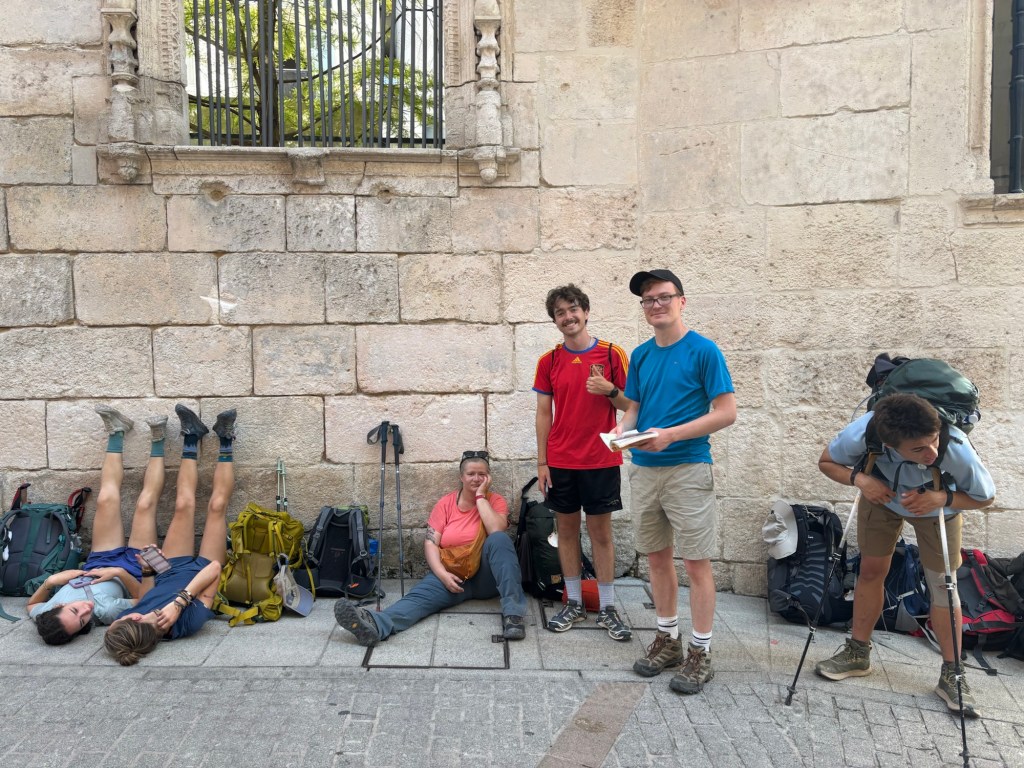
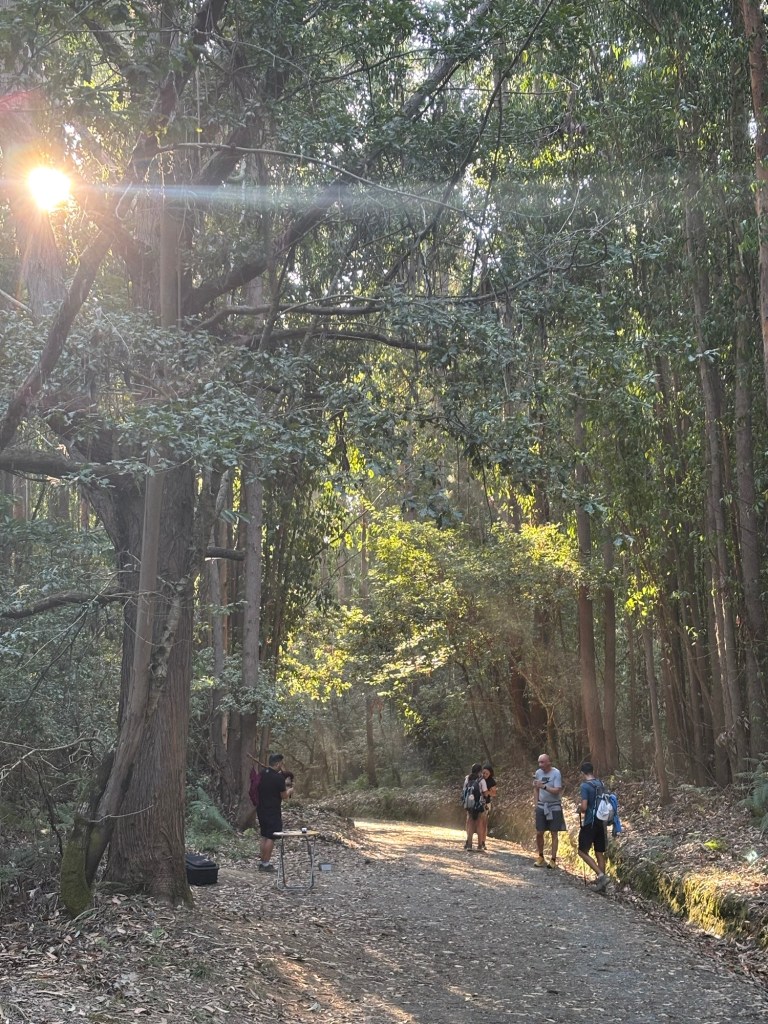
We left Sahagún early, lingering for half an hour later than yesterday to take advantage of the breakfast left out by the Benedictine sisters and their volunteers. It was still dark when we set out – not as pitch-black as yesterday, but still dark enough to warrant the use of torchlight to find the signs here and there.


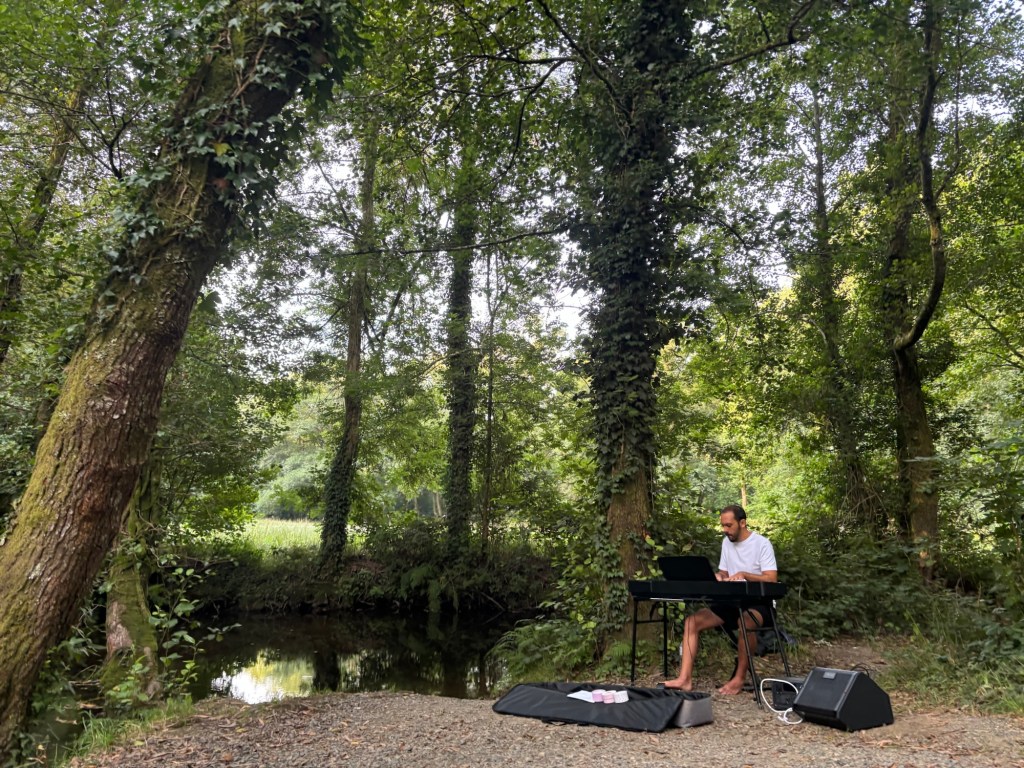
We passed Bercianos early and most things were shut, after which I started to get itchy feet and took off ahead. Along the way I heard the strumming of a guitar in a slim stretch of forest – a brief oasis in the golden fields of the meseta – and there I found Steven, a Chilean-South African who we haven’t seen for about a week. He’d found a solitary spot beneath the trees where the orioles sing to play his heart out. That’s something I’ll admit I’ve been missing a bit in this fun but busy Camino.


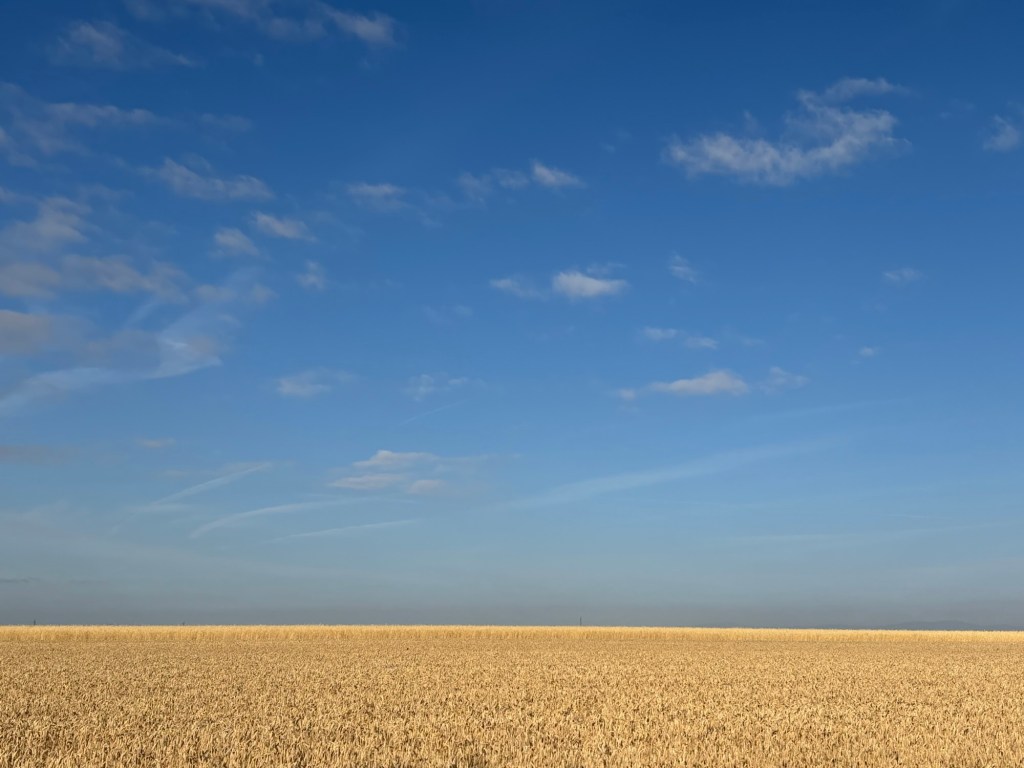
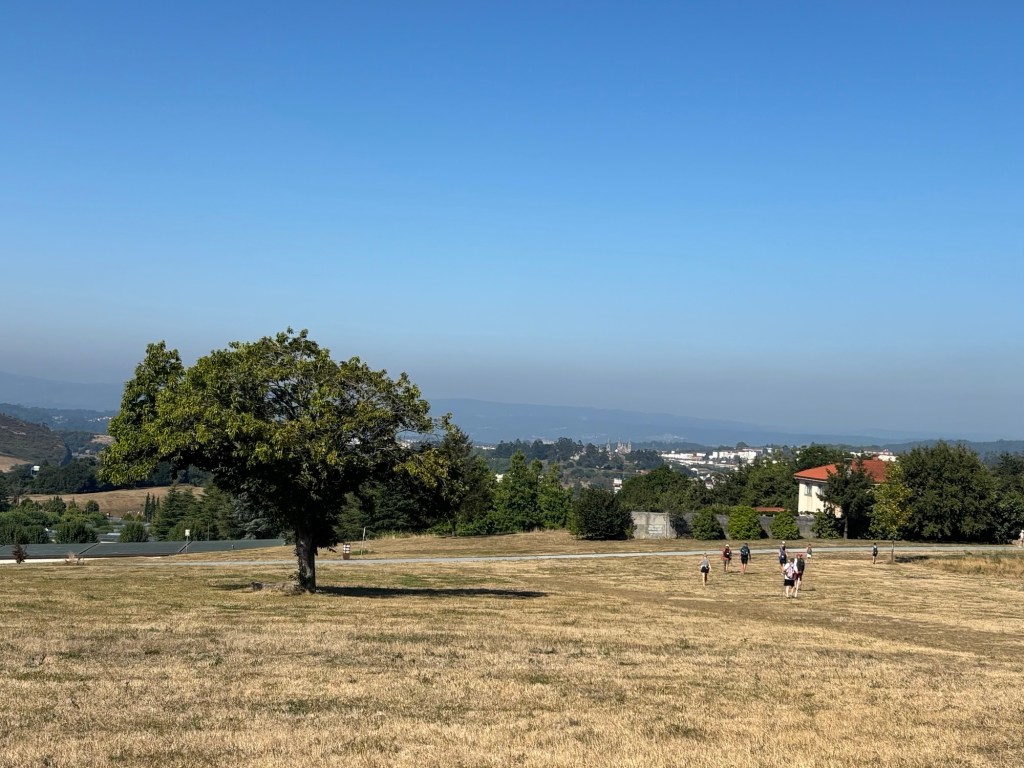
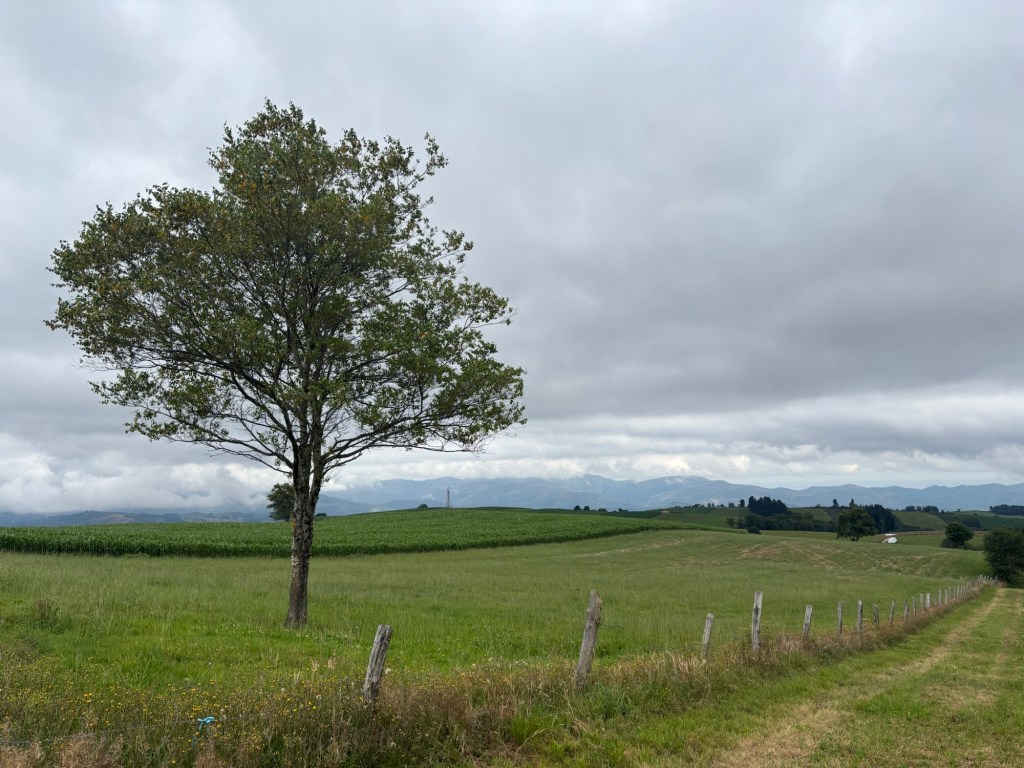
I stopped a couple of times during today’s walk to appreciate the silence of the meseta. There’s not much like it. I imagine the Dakotas might have the same sound – or rather, the same total absence of it. I suspect it’s that all-encompassing stillness that leads some pilgrims to abandon the Meseta altogether, fleeing the self-imposed stillness that surrounds you from the moment you leave the city of Burgos and step up into the golden highlands. I am not even out of it yet and I know I shall miss it when it has gone.


Today, as I have done on my solo strike-outs, I allowed myself a moment to listen to some music. Mostly from my favourite musicals so I could sing along (Jesus Christ Superstar, West Side Story, The Prince of Egypt and Fiddler on the Roof), but also my recordings from my various musical endeavours with my students over the years.

Rutherford House’s Rolling in the Deep and their house band’s covers of Stayin’ Alive/Without Me and Thrillie Jean. My short-lived Gospel Choir’s Ain’t No Rock. My new funk band’s one-day run at Lauryn Hill’s Doo-Wop. I forget more than half of the lessons that I teach, but every rehearsal and every performance stands out in my memory like an island in a wide, wide sea. The voices of the children I have taught surround me like a vortex in the Meseta and I am lifted up by the smiles on their faces as they experience the same giddy thrill that the music gave to me when I was their age. It makes the whole thing worthwhile – the long hours, the nerve-shattering email and Teams threads, the windowless flats and the social life that I have sacrificed upon the altar of my calling for the last nine years of my life.

Without the music, it would all be for nothing. It would all be a mistake.

There’s all sorts on the Camino. Sane and insane. Students and soldiers. Culture vultures and racists. Free spirits, free lovers, free thinkers and freeloaders. People who seem to think it’s ok to slap stickers advertising their YouTube channels on every flat surface and people walking so fast they don’t have time to read. And yes, while many pilgrims blanch at the idea of singing together (barring the Italians, these are frustratingly common), there are plenty of us who leap at the chance to connect with others through the medium of music, the truly universal language.

I’m a little disappointed that the most popular Camino-related song one encounters along the Camino (besides Ultreia, Suseia) is a mawkish folk song in English called The Way that is currently being aggressively marketed in sticker form wherever you go. By comparison, even the Taizé songs that have now sunk their claws into the Camino are a breath of fresh air – at least they respect the multilingual world of the Camino de Santiago (which I refuse on principle to translate as “the Way”).

I’m having a much more spiritual time on the Camino this year. I’ve managed to attend Mass most days, despite traveling with a group of non-Catholics, and all the pilgrim blessings have been very special. Yes, I’m still a little annoyed by the rampant secularisation of the Camino and the way it gets treated as a big and sociable walk across Spain, as though that’s all there is to it… But every day is an exercise in tolerance and I’m doing my best to listen and learn.

I miss Spanish food. I’ve sacrificed my usual diet to facilitate the dietary requirements of my fellow vegetarian and gluten free pilgrims and it’s meant a lot of bland and global meals for the last fortnight. But that’s just one more lesson the Camino has to offer: life is all about sacrifice, especially if you live to serve, as I believe we do. Sometimes we have to give up the things we want the most – a job, a lover or even just a plato combinado – to make sure that those around us can be the very best versions of themselves. It isn’t an easy path, but I know that it is the right one.

Faith in its most literal manifestation may not be as ubiquitous on the Camino de Santiago as it once was, but it can always be found in the small actions and interactions of others. That gives me hope. My back might be hurting from the friction of the weight I’m carrying, but my heart is light. BB x
Camino XXII: Starlight

Albergue de la Santa Cruz, Sahagún. 21.17.

Today was a lot more like the Camino Francés that I remember: long, unforgiving, sociable and under the stars for the first half of the morning. I’ve been taking it easy with all these post-sunrise starts with the other pilgrims, so with my fork from León now very much on the horizon, it’s good to get back into the routine.


We agreed the night before to strike out for Sahagún, partly because Audrey wanted to go further and potentially save a day to add to the end of her trip, and partly because I wanted to get to Sahagún after having had the place recommended at least twice. There was also the very real possibility that we could both shake the freeloading Englishman and catch up to the endlessly entertaining double act of Juha and Mad Max, who have been at least a day ahead of since Grañón, where the floor beds didn’t agree with Max’s back.

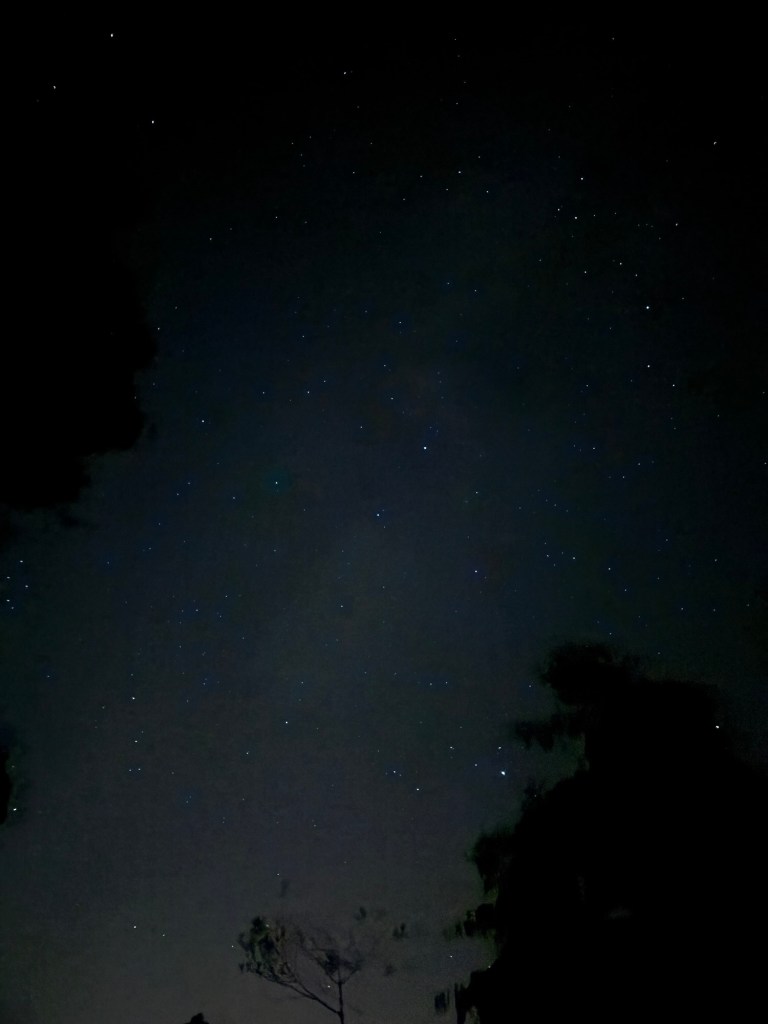
So, at five on the dot, the five of us set out from Carrión and into the night. We lost Edoardo sometime before sunrise – I’m not sure he could keep up, as he does appear to be carrying the biggest stick on the Camino (which probably might be better described as a branch or log). I also got lost: in my stubborn refusal to use artificial light, I completely missed the turn-off to the pilgrim road after Carrión and lost twenty minutes backtracking once I’d realised my mistake. On the plus side, it did mean total silence and an unrestricted view of the night sky, which was spectacular this morning.


There’s no lighting along the nineteen kilometre road between Carrión and Calzadilla, and all the towns are distant, so the stargazing was almost as good as it was on Tenerife. Even the Milky Way was visible, stretching westwards toward Santiago like the songs describe.

I spent a great deal of the morning racing ahead, mostly because of an obnoxious pilgrim who was lighting the entire path with a brilliant LED head torch, even though visibility by star and moonlight was perfectly good enough once your eyes had adapted. With him in the dust, I allowed myself some time to listen to a couple of chapters of an audiobook (some short stories about the Sargasso Sea from Strange Tales from the Deep and I, Claudius).


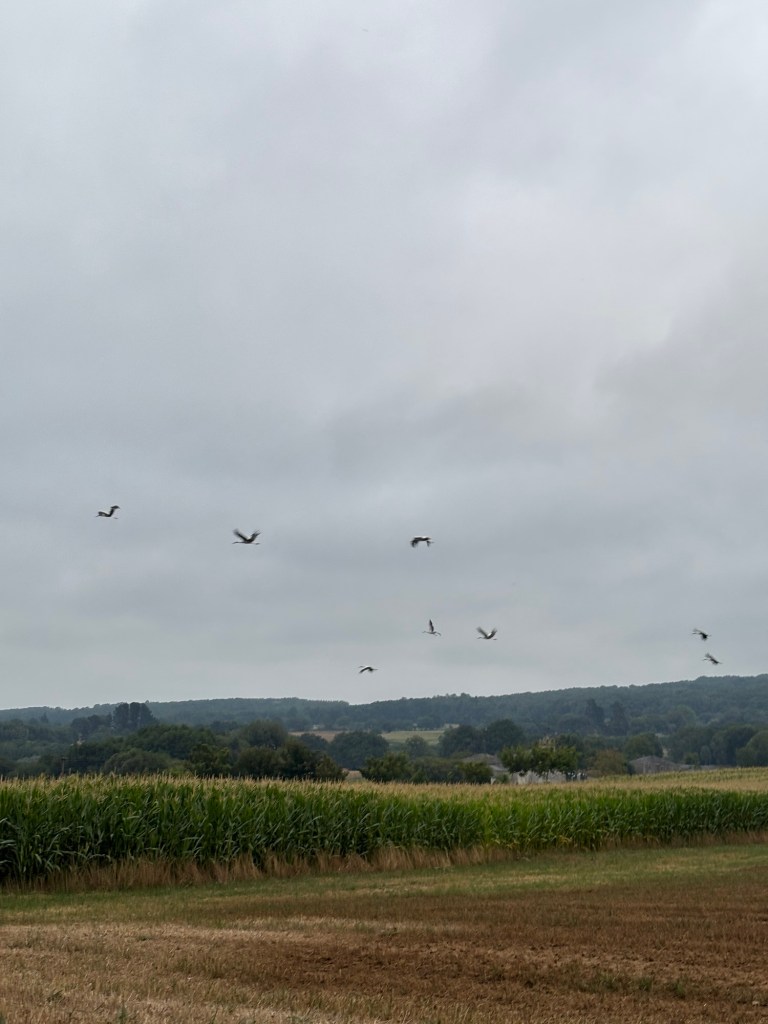
Not too long after sunrise, I saw flashes of white in a field by the road and trained my eyes on the spot: I counted ten great bustards, closer than I’ve ever seen them. Of course, they were far too distant for my iPhone (which makes for a superb camera, but is utterly useless as a telephoto lens), but you can just about make them out in the photo below (to the right).


After a brief pitstop for breakfast in Calzadilla, I raced on ahead once again. This time, I took advantage of the empty pilgrim road to do some singing practice, mostly from Jesus Christ Superstar, which I pretty much sang off-copy for all parts. I don’t have an eidetic memory, but I do have an uncanny ability to retain enormous amounts of information about things I’m interested in. Musical scripts fall under that category.


I stopped in Moratinos to pick up a beautiful wax stamp from Il Guru Improbable. I’ve missed this one before, as it’s much too soon after the usual staging post of Terradillos de los Templarios to obtain in the early hours of the morning, so I’m glad I pushed on today.


At Moratinos, I took up with a new group of pilgrims: Tom, a retired education superintendent from Michigan; a Finnish woman on her fourth Camino; and Tina, a Swiss-Guatemalan girl inspired to walk the Camino by a German comedian who hates walking. It made for a healthy change, and it was fun to tell my grandfather’s tale in full once again, which I haven’t done anywhere near as often on this Camino – last time, it usually preceded me by the time I met a new face!

Audrey caught up to me as we approached Sahagún and we entered the town together, seeking a pharmacy (for her feet) and an ice cream (for my appetite). At 13.10, it was the latest we’ve arrived at a destination yet, but it did mean no waiting for the albergue to open, which was a huge plus.


The bells are ringing for 22.00, and the white storks nesting on the bell tower are doing a lot of beak-clicking. That’s a sound I will always associate with Spain, no matter where else I may hear it.

Tomorrow we’re going to do another long slog, striking out for Mansilla de las Mulas if we can – which should, in theory, catch us up to the others who we lost on the road over a week ago.

Catch you later! BB x

Camino XXI: Carrionero

Albergue Parroquial de Santa María, Carrión de los Condes. 22.08.

Carrión de los Condes is a wonderful place. Which is odd, as it’s believed to have been named for the villainous counts who did their level best to defile the daughters of Rodrigo Díaz de Vivar in the Lay of El Cid, the (half) true story of Spain’s greatest hero. Even the proper name, Carrión, is an oddity: though it likely sprang from a mangling of the Latin name “Caro”, in its modern form, it carries a double meaning as a pejorative term used to describe somebody vile, useless or otherwise despicable. A carrion-eater, perhaps – one too weak and cowardly to do their own work, and happy or scavenge off the labour of others.

Which, curiously, serves as a good launch-point into today’s blog. Without putting too fine a point on it, I’ll paraphrase Hagrid from the Harry Potter films: not all pilgrims are good.


We left Frómista late (around 7.20ish) after making a valiant assault on the watermelon that Alonso bought last night. It made for a decent breakfast, but we couldn’t finish it all in one sitting, even between the four of us. We put it in the fridge for the benefit of other pilgrims coming after us. We were hardly out of the door when one pilgrim – who had been on the road with us for a while – appeared out of nowhere, made a beeline for the fridge, and took the melon for himself.

Well, that’s kind of what we intended by leaving the melon, right? So what’s the problem? As always, context is everything.


We cleared the 19km distance between Frómista and Carrión in a little over four hours, including a stop in Villalcázar de Sirga for an early lunch. It’s an easy walk, but easily the most tedious of the entire Camino, as it is an arrow-straight line that follows the P-980 highway in its entirety. Opportunities for wildlife observation are slim, and cultural tangents even less. It’s just a long walk in a straight line. At least the storks of Carrión kept us company. We also picked up a new companion in Edoardo, an effortlessly charismatic Italian soldier from Puglia, who was great company on the road.


The Albergue Parroquial de Santa María opened at midday and we were warmly received by the Augustinian nuns and their young assistants, three university students from Galicia, Madrid and Granada. Marta, the granadina, was especially friendly – though that may have been on account of my Andaluz accent which always comes out roaring the moment I meet someone from the south. Edoardo was almost certainly smitten and did his best to charm all three of them, but the granadina especially. I’ve seen a fair amount of bare-faced flirting from older gentlemen on the Camino, but the Italians do it with considerably more panache. It also helps when they’re not over the age of fifty, I suppose.

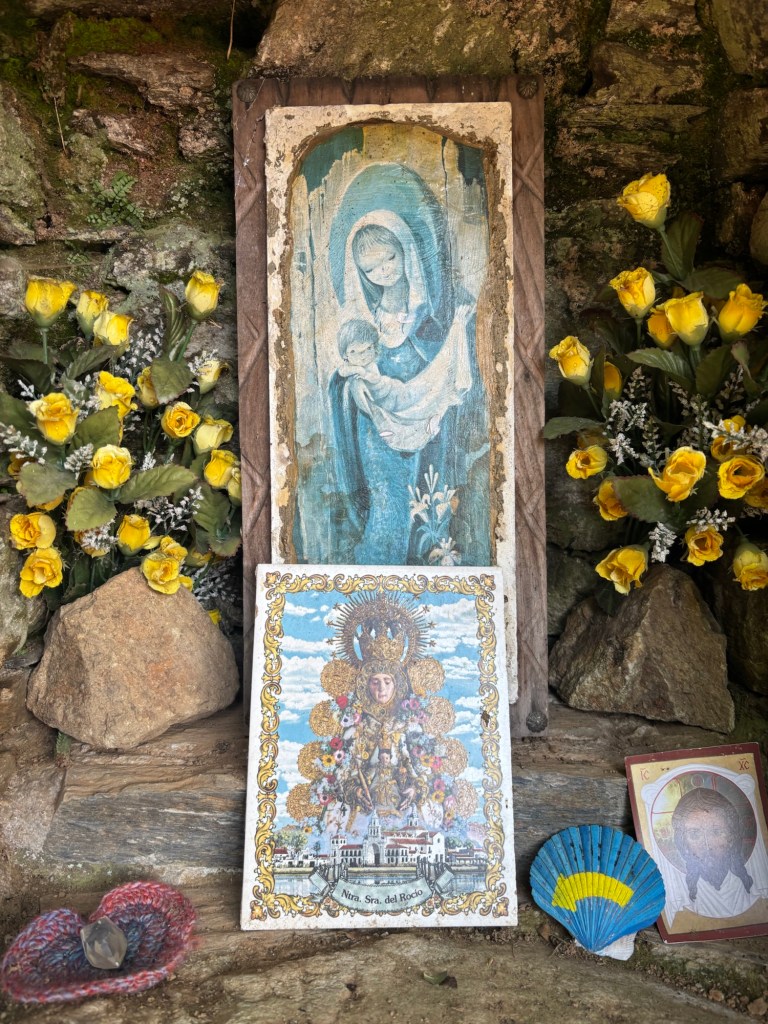
Vespers was beautiful, as Carrión’s nuns are famously musical, led by the vocals and guitar skills of the Peruvian sister (who was here the last time I stayed in Carrión). The encuentro musical was especially magical this time, because unlike Grañón, they asked us outright to share our reasons for walking the Camino. I did, explaining how I’m walking for my grandfather and my great-grandparents who never had the chance – but also as a way of saying thank you to La Virgen del Rocío, who was instrumental in curing me of a tremendously broken heart earlier this year.

And what did they do? They decided on a whim to play us a song for La Blanca Paloma, just for me – the Salve Rociera, known as Olé, Olé. What a beautiful thing to do! I’ve included the lyrics below, because they are so wonderfully poetic:

Dios te salve, María
Del Rocío, señora
Luna, sol, norte y guía
Y pastora celestial

Dios te salve, María
Todo el pueblo te adora
Y repite a porfía
Como tú no hay otra igual

Al Rocío yo quiero volver
A cantarle a la Virgen con fe
Con un olé…


Fizzing with the warm glow of a satisfied acolyte, I went along to Mass. It was… eventful, to say the least. The Bishop of Palencia was in town to conduct the proceedings, which – unbeknownst to all but the townsfolk – had kindled the fire of a small but powerful rebellion.

As was later explained to me by one of the parishioners, their long-serving and beloved parish priest was in the process of being transferred, and the locals – who seemed to adore the man with a fervour rarely seen in the UK – decided to use the arrival of the bishop to make their feelings known. There was a loud buzz toward the end of the service as the doors were flung open, and in marched a large crowd of children and their parents, all of them carrying placards and banners with slogans saying “La voz de la iglesia es la voz del pueblo” and “Queremos que Don Ricardo no se vaya”. The press seemed to have been tipped off, and Don Ricardo made a rather humble exit – I wonder what he made of the spontaneous show of fealty from his flock? It must have been hard to hide any emotion.


After Mass (and the mass protest), I went back to the albergue to help Edoardo make dinner – I cut and cooked the spaghetti and laid the table as the Italian had already prepared an enormous serving of pisto (free from gluten and meat, as it’s hard to cater to everyone with one dish). Together with the nuns and their three volunteers, we put out quite a spread.


And who should have arrived at our albergue at the last minute but our melon thief! He was conspicuous in his absence from the preparations and did not lift a finger during the clean-up operation, plugging in his earphones and retreating to the other side of the table – present but idle. Not only that, but while the nuns were saying a prayer, he got up and helped himself to seconds and then thirds of the soup the nuns had prepared.

Perhaps I’m being harsh, but this is the fourth time we’ve seen him do this: turn up to an albergue, contribute nothing, extricate himself from the communal preparations and then arrive just in time to devour the spoils, without so much as a please or thank you. Worse, he had the gall to comment that he didn’t think the meal was worth 4€ when the Italian asked for a small contribution to cover the costs of buying the supplies at the end of the supper.

I have spoken to the man previously – who, I am ashamed to admit, is a fellow Englishman – and he admitted that he doesn’t pay in donativos because he believes they’re already dodging taxes, and therefore don’t need our contributions. Which is odd, as he seems quite happy to scavenge off the contributions of others.

Shameful doesn’t cover it. I’m this close to confronting the man, which wouldn’t be in the spirit of the Camino… but if there’s one thing I won’t stand for, as a pilgrim and a teacher, it’s selfishness. I was raised to always put others’ needs before my own, so that kind of behaviour really sets my teeth on edge.

I prayed for him – partly to temper my own frustration and partly out of habit (it’s a good way to deal with people you don’t get on with). I hope he starts to see the light on this Camino and learns to chip in, like so many of us do every day along the pilgrim road, as it would be a dreadful shame if his behaviour cast a dim reflection on the English attitude toward the Camino.

Rant over. I just needed to point out that we pilgrims aren’t exactly model citizens. He’s not. I’m not. I should be the better man and not let it get to me so. But the Camino is the world, and thus have we made it. It’s up to us to call out that kind of behaviour in such a way that everyone feels they can contribute, even in some small way.

I’ll sleep on it. Hopefully I can come up with a way to bring him amicably to the service of his kin. Me, or some higher power.

Our Lady of El Rocío, if you’re listening… give me strength!

BB x
Camino XX: Soup and Bustards

Albergue Municipal de Peregrinos, Frómista. 19.59.

Well, you’ve got to hand it to the good people of Castrojeriz. They may not sleep much, but they sure know how to party.

The Garlic Festival kicked off at around 7pm. While the others ordered pizza, I went without supper (with the free sopa de ajo in mind), which turned out to be a mistake. They finally started serving at 9.40pm, and queuing for half an hour, I reached the serving station only to find that you had to bring your own bowl. Turns out the identical brown bowls the townsfolk were all carrying can be found in every home in Castrojeriz and beyond. It would have been nice to know before getting in line – you know, like a sign or something – but then, Spain has never been overly fond of letting non-locals in on its secrets. So I was dismissed with an apologetic ‘ay, pobre’ by one of the volunteers and went to bed on an empty stomach.


I had about an hour’s sleep until the Orquesta Dakar started playing just after midnight. They didn’t stop until ten past two in the morning, after which they were followed by a DJ until half past four. I’d be lying if I said I didn’t enjoy the music, as it was absolutely my taste – Suavemente, Las manos pa’ arriba, Bailando, Madre Tierra, Mentirosa, El Tiburón and, randomly, You’re the One that I Want, to name just a few – but it did mean sleep was impossible. Then there was the family of locals who stopped beneath our window and, for whatever reason, decided to start howling and barking like dogs for a couple of minutes sometime between two and four (clearly all that garlic had no effect on the local werewolf population). I must have passed out somewhere around four, and was up again by five.

Thank goodness today was a shorter day!


There wasn’t much call for shooting off early on some monstrously long hike on no sleep (which I’ve been known to do when sleep-deprived), so I stuck around and had the fried breakfast buffet I’d paid for. We tackled the Alto de Mostelares and were up and over by half past seven. It was an easier climb of it than it would have been under the midday sun, but I couldn’t shake the feeling that I should have pressed on yesterday and made for the Ermita de San Nicolas for a more spiritual (and restful) stop.


Descending from the hill, I found a manic speed in my feet and took off at a vicious pace. I didn’t need to, really, considering I had left far too late in the morning for another mad rush to Carrión, but for some reason I wanted to go it alone this morning.

It did mean for a bit more wildlife observation than I’ve managed for a while. There were a few silhouetted harriers up on the high Sierra de Mostelares, and a couple of rabbits and red deer grazing in the fields beyond. I was accompanied all the way by small families of stonechats and huge flocks of serins, twittering merrily from the stands of trees by the road.

This morning I had a close encounter with a zitting cisticola, a characterful little bird with a name that pretty much tells you all you need to know to identify it. They’re usually heard and not seen, measuring around 10cm from beak to tail and zitting high in the air and out of sight, but this one was quite happy to watch me go by, and didn’t flinch when I stopped to take a photo.


I considered staying in Boadilla del Camino, but just like two years ago, I arrived around 10, about three hours before the albergue was due to open. So I waited for the others, had a drink and carried on.

From Boadilla, the Camino follows the Canal de Castilla, a strange 18th century project that irrigates the northern reaches of Castilla y León. I saw just the one family coming the other way and no pilgrims, but I did have a brief encounter with a magical creature of the steppe: a flock of great bustards, one of Europe’s largest, rarest and most impressive birds. I’ve only ever seen them in the distance from trains or buses, but they’re always unmistakeable in flight: enormous, swan-like things with mottled feathers and pure white wings. It made my heart soar a little in this strange and man-made part of the Camino.


Well, I’m here in Frómista, which I bypassed last time. You know what? It’s not so bad. The albergue municipal is decent and the company is highly entertaining. I guess I gave it the cold shoulder last time in my hurry to press on and meet the crowd. I’m glad I stayed over. BB x

Camino XIX: White Magic

Albergue Rosalía, Castrojeriz. 16.44.

I’m back in Castrojeriz, a Castilian hill-fort town some twenty-one kilometres down the road from last night’s stop in Hornillos. I probably could have gone a little further today, but there’s a local festival in town and I wanted to check it out. It’s much too easy to lose track of things on the Camino over a good conversation, and in so doing miss something special.

I mean – it is a garlic festival. So it’s nothing extraordinary. But I happen to love garlic (sopa de ajo is my favourite dish in the whole world) so I feel duty-bound to check this one out.


The hospitaleros at Hornillos left out a proper spread for breakfast, so we ate well today. Even so, we were up and gone by 6.20am, shortly before sunrise – which is getting noticeably later each week. The turbines on the surrounding hills continued to spin in the twilight, their red warning lights blinking like eyes along the blue horizon.


A gentle blanket of cloud shrouded our ascent up to the high meseta west of Hornillos. Apart from a few simple crosses erected along the road, the terrain was featureless, and all the shadows harrier-shaped: I counted at least seven Montagu’s harriers quartering the fields between Hornillos and Hontanas, from the agile ring-tailed youngsters to the ghostly silver shapes of the adult males. Vultures always take the top spot in my animal pantheon, but Montagu’s harriers are absolutely in my top five.

There’s not much a mobile phone can do with these elusive spirits, but you can just about make out the long-tailed shape of one in the photo below.


The sunrises over the meseta are peerless. It’s amazing just how many colours come out of the fields of gold, which pairs better with the sky than the grapes of La Rioja with the local jamón. I can’t imagine walking this route in winter, when the fields are stripped and bare. It must be spiritual then, too, but I would miss the warm hues of the wheat.


To reach Castrojeriz, you have to pass through the ruins of the Monasterio de San Antón. According to my route planner, I had intended to stay here, but it was only ten o’clock, and the day was still very young, so I pressed on – but not before snapping some photos of what is easily one of the most breathtaking buildings along the Camino Francés, with its ruined arches spanning the road to Castrojeriz.

The monks quartered here used to treat those afflicted with Saint Anthony’s Fire, a sickness we now know as ergotism. Advances in agriculture have more or less eliminated the disease, but the source is all around us in the wheat and rye that once carried the sickness. Before the causes were understood, the spasms and hallucinations that sufferers endured were believed to be a form of divine punishment or demonic possession. It’s hard to say whether the monks’ sanctified treatments truly worked, or whether the cutting-out of rye from their diet was what made the Order so effective. Either way, the monks resorted to a Christian form of white magic to keep the locals safe back in the day.

I like to imagine their ministrations might have saved the lives of at least a few pilgrims bound for Santiago over the centuries.


Gust was waylaid by a photographer for about half an hour on the road to Castrojeriz, and I was only spared the same fate by his silent warning to stay away and the timely arrival of two British university students, one of them a Durham undergrad. They stopped a little way along with their group so I couldn’t walk with them for that long, but I hope I can catch up to them again at some point before León.

I rejoined the Americans at Castrojeriz and we grabbed a drink before lunch, partly out of curiosity to see whether Gust could extricate himself from the photographer’s grip. We were more than a little surprised to see a MAGA hat, but nobody dared to engage the man in conversation. If he was a pilgrim, he was traveling very light indeed.


Downtown, the garlic festival was in full flow. A charanga band was marching around town, playing their oompah-like music wherever they went (just like back in Nájera), while old folks huddled around their collection of cloves and groups of kids in matching tee-shirts ran rings around the market stalls.


I suspect the Feria del Ajo is a relatively recent innovation (I’ve seen the number 46° floating around), but I shouldn’t wonder that this kind of harvest festival has been happening here for far longer. There’s a food-tasting event we’re going to check out later, and even a concert by the New York Youth Orchestra at 8pm tomorrow – though we’ll be long gone by then.


Garlic is famous in folklore for its protective characteristics, especially against malevolent spirits like vampires and demons. It’s also mightily medicinal, and has been fighting off disease and bacteria in humans for far longer than it has been used to ward off the undead. Given its life-giving properties, it’s easy to see how the latter superstition came about, in an age when Galen’s law of humours was widely accepted as gospel and any and all imbalances, including light and dark, required correction.

Frankly, I can’t think of any imbalances that couldn’t be corrected by a nice, hot bowl of garlic soup. It really is the very best of restoratives.


Audrey has popped out to explore the town. Alonso is watching a movie and Talia has fallen asleep. I might head out for a wander in a moment too, now that things are starting to open again after the afternoon siesta. Here’s to a little more white magic this evening! BB x
Camino XVIII: Exodus

Albergue El Alfar de Rosalía, Hornillos del Camino. 20.03.

I was up at 4am this morning, probably due to the racket put up by the Koreans snoring next door. In any event, they were up and about with headlamps on by five and, since I couldn’t get back to sleep, I figured I’d get ready for the day, too.

It was as well that I did so. I had to intervene with a frantic Spanish woman in her fifties who was weeping into her phone with frustration because she couldn’t find the emergency exit that would allow her to leave the albergue before the main doors opened at 6.30am. I calmly pointed out the stairwell and a minor outflow of five or six similarly lost pilgrims followed suit, including Gust, the young Belgian lad we encountered in Grañón, and Lur, an enigmatic Basque girl with raven-black hair who has hardly said a word but who has been a feature of the Camino since Puente La Reina.

We said farewell to Alex after a last breakfast together outside the albergue and set off just after seven o’clock. Burgos’ Cathedral looked as magnificent as ever in the morning light, its twin towers visible for nearly four hours on the horizon after we left the city.


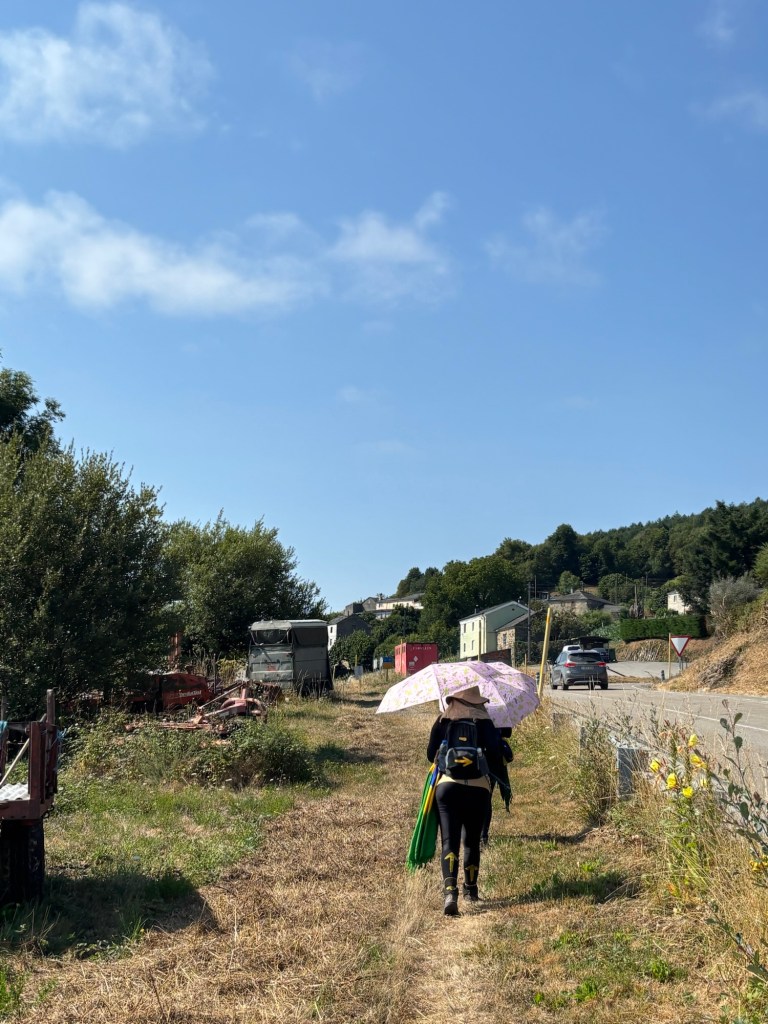
Leaving the city of Burgos is almost as laborious as entering it, but the west side of the city is a residential district and thus makes for a much more pleasant walk. An old lady redirected us near Villalbilla de Burgos, and while I don’t think it would have made an awful lot of difference if we’d kept going the way we were going, it’s nice that everyone around here id so invested in the Camino that they’re out to help.

I found a couple of storks feeding in the Arlanzón river just after the crossing. They’re always so unaffected and untouchable in their nests atop the turrets and towers of Spain’s churches, so it’s not all that often that you encounter them in their “natural” habitat, where they are surprisingly wary and don’t let you get too close.


Tardajos’ church was open so I dropped in to collect the second stamp of the day, and a tip-off from pilgrims further ahead alerted us to a nun blessing pilgrims in Rabé de las Calzadas. The sister in question, a little old lady in her seventies dressed all in white from the Daughters of Charity, stood at the door of a little chapel on the edge of town, waving passing pilgrims over to approach. We went over for a blessing.

Spiritually, we’re a mixed group: a lapsed Catholic, a Reform Jew, an Agnostic and a Catholic who has found his way to God relatively recently. But for this last, this moment was one of the most magical of the entire Camino so far.

Taking us firmly by the hand, the Sister talked to us awhile about the spirit of the Camino and what it truly means to be a believer, in the least preachy way I have ever heard. Some of the would-be youth pastors I have worked with in the past would have learned much by her example. She quoted a poet who she could not remember (and I cannot locate) and asked us to go forward with the eyes of an owl, always searching, the heart of a child, always feeling, and the feet of a pilgrim, always walking.

Perhaps she was paraphrasing the Spanish poet Antonio Machado’s Olivo del camino, which has the following line:

Que en tu ramaje luzca, árbol sagrado,
bajo la luna llena,

el ojo encandilado
del buho insomne de la sabia Atena.

She gave us each a small token of the Lady of Charity, blessed us with a gentle hand on the forehead and sent us on her way. A purer soul on the Camino would be hard to find.


After Rabé de la Calzada, the Camino climbs up one last time and then the Meseta begins in earnest: a vast and unbroken expanse of gold beneath the immensity of the Castilian sky, pushed beyond the reach of man by a thousand generations of Castilian countryfolk.

It is hard to describe the true beauty of the Meseta when so many pilgrims describe it as the “hardest” stage. The “least interesting” stage. The “most boring” or even “the ugliest”. It is certainly true that the spectacular Pyrenean scenery of the first few days is now little more than a distant memory.

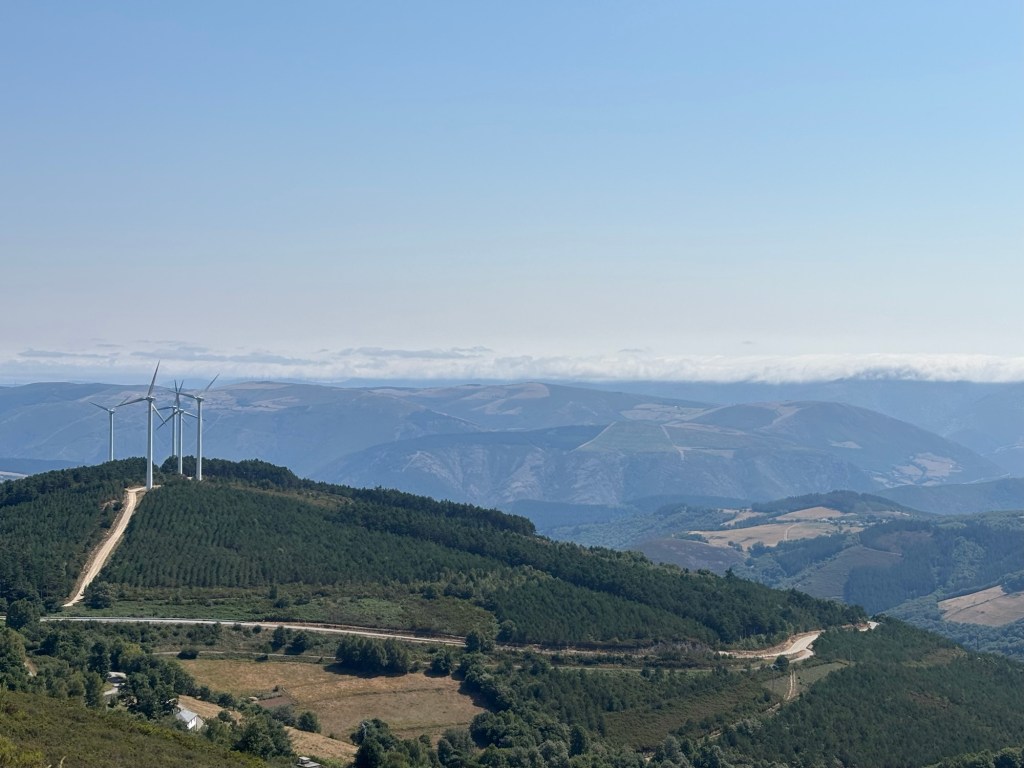
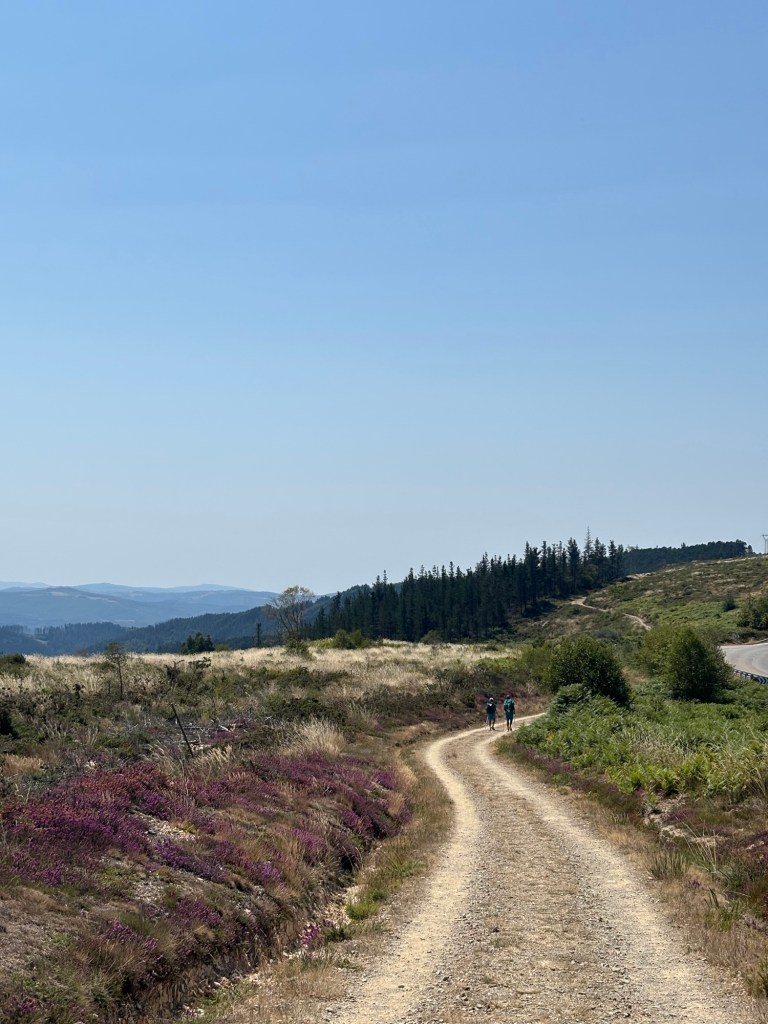
But to do so is to ignore the magic of the Meseta. The whistling wind in the golden fields. The gentle throb of the wind turbines on the hills all around. The near total absence of birdsong, interrupted only so often by the twitter of a linnet or the call of a quail. This is a road that can be walked with a companion, but is best walked alone.

For me, this is where the true Camino begins: the road inside, into your head and into your heart, with nothing between you and your thoughts but the sapphire sky.


I was going to spend the afternoon writing, but I heard the church bells ringing for the afternoon Mass so I set down my things and wandered over. It wasn’t an especially large gathering, and I was the only Spanish speaker present until a small group of pilgrims from Urgell arrived, so I was called upon by the priest to do the reading. I could certainly have dressed more modestly, even though my options are limited out here, but I wasn’t expecting to be delivering the Lord’s word this afternoon, so… a sports vest, toe socks and Hawaiianas it was.

The reading was from Exodus, 11:10 to 12:14 – by far my favourite book of the Bible. For perhaps the first time in my life, I felt something in that church. It moved me. Not just the sacred words, but… something. Like a voice I could only perceive, that spoke to me without words. For a moment, I felt as though my great-grandparents and my grandfather were right there beside me. It was nearly enough to move me to tears.

When Mass was ended, the priest called us up to the altar for the pilgrim’s blessing. Everyone read the blessing in their own language. I read twice – once in English, once in Spanish. Spanish feels more natural for prayer – after all, if they prayed at all, that’s the language my ancestors would have spoken. And isn’t this all about a closer walk in their footsteps?


I have been on the road for eighteen days now. Twenty, if you count the day and night it took me to reach Oloron-Sainte-Marie and the start of the Camino. It has taken this long to find the spiritual side of the Camino for which my heart has been longing so. I feel more fortunate than ever and my heart is full of hope.

The Meseta stage can be a trial. It can deter many weary pilgrims, especially in the heat of the summer. But I remain convinced that it is where the unspoiled heart of the Camino can be found, in every sense of the word.

The way ahead is clear and my eyes are wide open. I shall follow that road, wherever it may lead, and trust in His plan, whatever that may be. BB x

Camino XVII: The Bones of Burgos

Albergue Casa del Cubo, Burgos. 22.55.

There’s a grumpy old Spanish guy in the bunk below mine. He made a point of asking me earlier if I snored in that direct, you had better not way that Spaniards do (‘No roncas, eh?’). He put the same question to my two companions just before bed. Well, after a couple of rounds of solitaire in his phone, he’s snoring away down there, along with the Koreans in the bunks next door. Like it matters…! You’d have thought a pilgrim might have learned a little patience by Burgos.


We got lucky yesterday. The Albergue in Atapuerca had a room of six beds so we had a room to ourselves, complete with an en suite bathroom. Along the way we’d picked up Gust, a seventeen-year-old Belgian student who was struggling with his blisters, so we took him under our wing for the rest of the day. There weren’t many restaurants in town, so I bought some supplies from the only shop in town (where the Central American shopkeeper was having a great time rapping to a backing track while I browsed the vegetable aisle) and rustled up a rice and vegetable pisto for the six of us. It felt good to cook for company again. It’s been a while.

We set out shortly before sunrise, finding our way up the Sierra de Atapuerca by moonlight. The sun was not yet over the horizon when we crested the hill, and the soundscape was still very much that of the Spanish night: a couple of scops owls called their piping call from the trees, the high-pitched twittering of a bat occasionally caught my ears and, from somewhere far off, the unmistakeable churr of a nightjar.


We stopped for breakfast in Cardeñuela Riopico at the same place I came with Mikkel, Sofia and Lachlan two years ago. It was just as good as it was then, only this time, I allowed myself to stay and eat rather than tearing off harum-scarum for Burgos on my own.

The signs are still defaced all over the place with images of the Star of David equaling a swastika. They’ve tried to cover them up with pilgrim pointers here and there, but the pilgrim preference for the Palestinian cause is obvious.


We reached Burgos early, despite missing the turnoff for the Río Arlanzón alternative (which I maintain is bloody well hidden, as I’ve now missed that turning twice). The result was at least half an hour of trudging through Burgos’ deeply unattractive industrial estate on the eastern side of the city, so we amused ourselves with a protracted game of Just a Minute, at which Talia proved to be a past master.

It was just before eleven when we reached the albergue, which meant we still had an hour to kill, so we took it in turns to do an ice cream run / sightseeing. Gust parted with us to meet up with his brother. We might run into him on the road, or we might not. I hope he looks after his feet – they were in a bad way.


There was a Mexican wedding or quinceañera or some kind of celebration in town, dressed in the decorated black, white and red that could belong to just about any traditional European country – though the loitering mariachis rather gave the game away.


After an afternoon nap (complete with one snoring Spanish hypocrite), I set out to investigate the Museo de la Evolución Humana, one of the world’s best human evolution museums. I managed to convince the team to check it out, but set out ahead of them to take out some money for the meseta stage (where, if memory serves, ATMs are hard to come by).

I’ll be honest with you. Human evolution is one of those things that absolutely fascinates me. In another life I’d have studied anthropology and primatology. Maybe seeing chimpanzees and mountain gorillas in the wild drove it home all those years ago, or maybe it’s an offshoot of a childhood obsession with all things palaeontological, but it’s genuinely one of my major passions in life, albeit one I don’t talk about so much.

I had a similar experience with the Museo de Tenerife in the spring, but the MEH in Burgos is even more jaw-dropping. The knowledge that I was looking at the real bones of some of our earliest ancestors was genuinely spine-tingling.


The caves of Atapuerca are one of the most valuable dig sites for the bones of ancient humans in the world, with over twenty-eight specimens found to date, alongside a host of other Pleistocene and earlier animals that no longer grace these hills, such as hyenas, jaguars, Irish Elk and the mighty cave bear.


I gleaned everything I could about our ancestors the last time came here in 2013, but there was plenty more to clue up on that if missed before: this time I learned a lot about Ramón y Cajal, Spain’s most eminent scientist and the man who discovered the neuron and its function. Maybe that’s why so many of the main streets and squares in Spanish towns and cities carry his name, connecting people and places like synapses firing daily.

In this morning’s walk-and-talk, one of my companions said she was intrigued by my quest for knowledge. That’s probably the biggest ego massage I’ve had in a while, but I’ll take it. I’m glad to have learned something very new, and it is very much an integral part of my personality to be always on the hunt for a new story, a new tale to tell.


I’ll pick this last one to finish, because it’s getting late, I’m behind on my blogging and the Koreans next door are on the verge of creating an unconscious four-part harmony with their cacophonous snoring.

There’s a small replica on the third floor of the MEH that is, as the plaque reads, quite possibly one of the precious of all the treasures in the collection. It is a mammoth task carved into the shape of a human – but with one strange detail. The head isn’t human at all. Rather, it’s quite clearly the head of a cave lion: stocky, bull-nosed but intensely leonine. It’s known as the Löwenmensch figurine – or the Lion-man of Hohlenstein-Stadel, and its concrete evidence of our ancestors’ ability to imagine around 40,000 years ago. Quite possibly, it’s the earliest evidence for mythology out there: man-beast hybrids remain a fairly common feature of world mythology to this day. Just look at Hinduism.


I’ll have to look into this incredible artefact some more when I get hole. But for now – sleep. I’ll be up again in five and a half hours… unless the Koreans wouldst wake Heaven with their snoring. BB x

Camino XVI: Silent Hill

Hostal la Plazuela Verde, Atapuerca. 15.50.

After yesterday’s paltry fifteen kilometre walk, today’s 30km+ hike across the Montes de Oca felt like much more of a feat. We’ve landed, at last, in Atapuerca, the last post before Burgos and the end of the line for several peregrinos.


I’ve enjoyed a few later starts over the last few days, so it felt good to get back to another 5am departure under the stars. It was a little chilly this morning, though not as cold as it was the last time I made this trek, when (if my memory serves) I required the use of gloves to stop my hands from shaking in the spring of 2023. The sun rose late, so for at least the first hour of today’s march I was under the aegis of the morning star, Venus, sitting alone in the firmament to the east.


The signs for Santiago are getting shorter. The kilometre count is nearly down to 500, so I’ll be passing the halfway point of the Camino at some stage between Burgos and León. I’m looking forward to the flats of the Meseta, but the mystery of the Camino de San Salvador and the Camino Primitivo are becoming more and more appealing by the day as I hear stories of these less-traveled roads from some of the pilgrims that I meet. It will certainly be a very different Camino to the one I’ve had for the last week or so.


Shortly after leaving Grañón yesterday, we entered the immensity of Castilla y León, Spain’s largest territory. The rivalry between the twin kingdoms remains in the signage, with most of the Camino markers defaced in some way so that the word “León” is crossed or blacked out. The reverse is true once you enter the old Leonese territories around Sahagún, where the graffiti becomes even more markedly separatist in nature. It’s a not so subtle reminder that Spain had always been a conglomerate of different peoples rather than one singular nation, from the Castilians and the Catalans to the Leonese, the Basques, the Galicians, the Andalusians and the Asturians.

How do you even begin to govern such a diverse nation, with such ancient and deeply-rooted territorial disputes?


After a much-needed breakfast stop at Villafranca Montes de Oca, where the bar (El Pájaro) opened just minutes after we arrived, we set off up into the forested hills. The Montes de Oca are the very north-westernmost reach of the larger Sierra de la Demanda. The name comes from an old dispute over land use in the hill country rather than the difficulty of its terrain, but after the relatively flat and easy days from Puente La Reina to Logroño and beyond, it is a demanding task before the endless expanse of the Meseta Central.


The Montes de Oca are a mystical place. Toward the top of the hill, the birdsong seems to die back into silence. Not even the vultures circle here. I’ve encountered this eerie silence before in Sachsenhausen, an olive grove near Víznar (Granada) and a remote village in northern Uganda, where the Lord’s Resistance Army marched in and executed the entire village. It is the silence of the dead.

A small concrete block marks the spot where around three hundred men and women were executed during the Civil War: Republicans, political dissidents, liberal thinkers and just about anyone who disagreed with the vision of the Nationalist state that was to come. They were dragged from their homes during the night to this lonely stretch of forest, summarily shot and thrown into one of a number of mass graves that can be found less than a hundred metres from the Camino itself.

This is the fate that might have befallen my great-grandfather Mateo, had he been any more outspoken in his beliefs than he already was. Instead, he was dismissed from his post and sent away to a village where he would not cause trouble, and only when he went to hospital for a minor operation did they find a way to deal with him quietly, leaving him on the hospital bed to die.

I suspect this, however, is what happened to the rest of his friends: the circle of poets, free-thinkers and philosophers to which he and his wife Mercedes belonged, before Franco and his nationalist forces turned their world upside down.


Many of the trees here are new: plantations of pine trees that were planted after the ancient oaks burned down in a fire some fifty years ago. Somewhere beneath them all are the remains of other victims of the war, concealed by Spain’s painful attempt to forget. The official Pacto del Olvido – the Pact of Forgetting – passed in 1975 after Franco’s death was an attempt to move on from the divisive horrors of the past and forge a new country, but for many, the memory of the silenced dead is still very raw. Even the birds of the forest seem to abide by it, nearly a century later.


A jolly chappie called Ángel had set up shop in the spot where there was a food truck a few years ago, selling fruit juice and watermelon slices, and at 2€ a throw for the latter, it was simply too good to pass up.

We stopped for a snack lunch at San Juan de Ortega (if tostada con tomate can be considered lunch) before pressing on to Atapuerca. Today and tomorrow are going to be the hottest days for a while with an average high of 35°C, so we were keen to reach our destination before the sun got too high in the sky.

I brought the team to a halt at Agés, the village where I stayed the last time I came this way, to drink and re-supply before the final two kilometre push across the shadeless fields of Atapuerca. Being an average of nine years older than the others in my group (ranging from seventeen to twenty-five), I have somewhat fallen into the position of leader, which seems to happen rather easily these days. I guess it’s the teacher in me. I don’t resent it at all. It’s quite nice to be able to look out for them and to serve as their guide, especially since one of them is still at school and doing the Camino as part of an IB project.


There aren’t that many options for eating out in Atapuerca, so we might cook together tonight. That would be nice, as tomorrow will invariably involve a farewell meal out in Burgos, so a communal dinner of own creation would make a welcome change.

My pilgrim passport is looking a lot healthier. One whole side is nearly complete. It’s getting easier to pick up three or more stamps per day (which was near impossible in the first week or so). I may not need my third credencial after all, though I suspect I will still need my second! BB x

Camino XV: Grañón

Albergue Cuatro Cantones, Belorado. 20.57.

The grand majority of Camino guidebooks operate in such a fashion that some towns become natural starting and finishing points. At 21km from Nájera, Santo Domingo de la Calzada is a perfect example (with your average pilgrim walking around 20km a day). On the one hand, this is a very good thing, as it means any deviation from the recommended staging posts may give you a feel of the Camino as it used to be. On the other, it means that some towns soak up all the trade and leave the others dry. So how do you fight the industry?

Grañón has the answer: by being the most memorable and unique albergue on the entire Camino de Santiago.


After leaving Santo Domingo just before midday, I used the last of the cloud cover to beetle across the plains for a further 6km to Grañón, feeling slightly guilty that I was abandoning my Camino family again but confident that I was making the right decision – I’d missed Grañón before out of ignorance, and I wasn’t going to do so again in full knowledge.

Upon arrival I was greeted by the hospitaleros Kevin and Juan Manuel, a Chinese-Australian and a sevillano. For the first hour and a half it was just me and three Koreans, and it looked to be a rather cosy night ahead, but then Alex showed up, followed by Audrey, Alonso and Talia, and then Johan and Max. For whatever reason (possibly the clouds) they’d all decided to push on to Grañón after me. I must have sold it pretty convincingly without meaning to. My heart was lifted and I was tremendously grateful.

I fell into conversation with Juanma in the garden who asked after my Camino story, I told him about my grandfather and the grim fate that had befallen my great-grandparents, both victims of Franco’s regime – one murdered, the other dismissed and sent into a sort of internal exile. I’ve told this story so many times that it’s become second nature, but that’s the first time it’s drawn tears in a listener. Juanma explained that it had touched him deeply: his family, and so many others in Andalusia, had suffered a similar fate after the Civil War, which left thousands of families across the country broken, scattered and changed forever.

I’ll make a beeline for any Spanish accent, wherever I can find one, but I will always have a soft spot for an Andalusian. He was the only person thus far to recognise my Virgen del Rocío wristband for what it was, which was a tremendously good start for me: it’s not often one encounters a fellow devotee of the Mother of the Marshes on the Camino (or even another Catholic, but that’s another matter).


After preparing dinner – where for some reason I was assigned the role of sous chef and tasked with handing out jobs and ordering the entire operation – the hospitaleros requested some music. Johnny, an Irishman, was one of two who could play the guitar, but his repertoire and mine were worlds apart. The other guitarist, a young Danish kid fresh out of school, had only been learning a few months. So (not for the first time in my life) I ended up singing a cappella the only song I could think of that works: Pata Negra’s Yo me quedo en Sevilla.

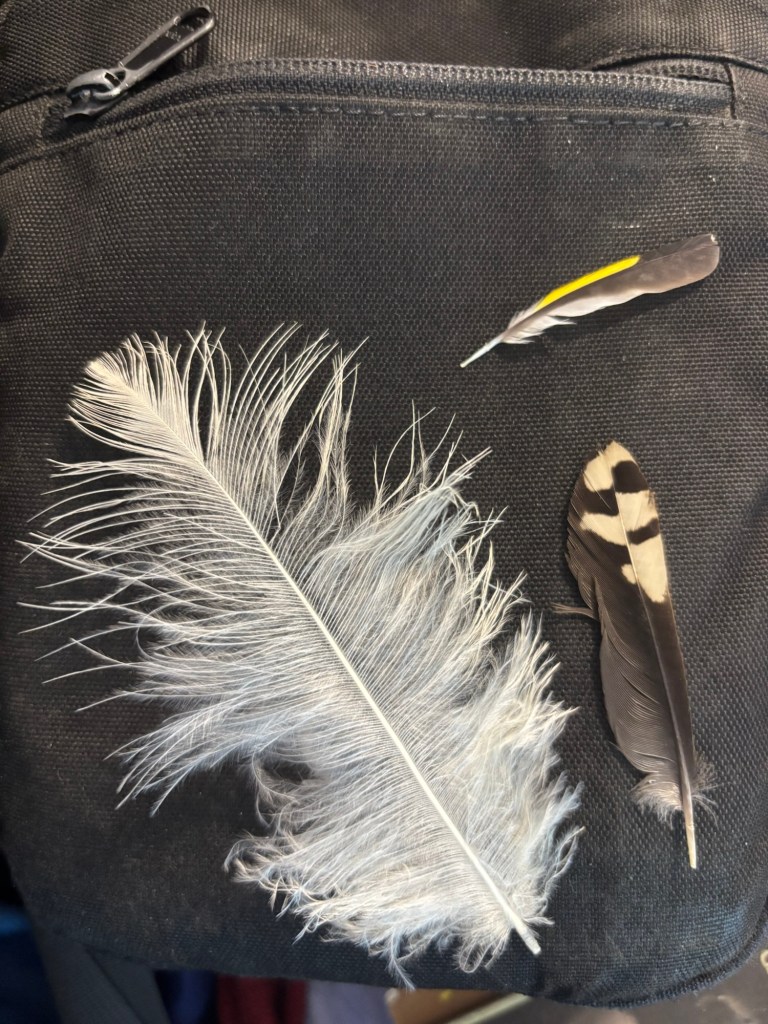
It’s a gypsy love song to the city of Sevilla itself, and one that I’ve known since I first heard it on my mother’s Rough Guide to the Music of the Gypsies aged seven or eight. Back then, of course, my language skills weren’t really up to scratch, and I knew the song as “Single Feather”; my little brother and I used to run around the house holding a pheasant feather or something like that when it was playing in the old CD player. Ironically, it’s been a mainstay of my repertoire ever since, and one I usually wheel out if I’m called upon to sing in moments like this.

It’s amusing enough to be mistaken for a Spaniard because of the way that I speak, but delivering a gypsy ballad with all the frantic passion and duende that I can muster is both an ego trip and an out-of-body experience. I don’t think I have any gypsy blood at all, but the music speaks to me on a deeper level, touching my heartstrings in its dance through the blossom-scented squares of Sevilla.

God knows what the other pilgrims made of it but the Spaniards were impressed.


Later, after Mass, we had to go to the village bakery to collect our potatoes, as the albergue has no oven. There followed a strange ritual where we had to sing for our supper, divided up into nationalities. The Italians did two numbers (one I didn’t catch and Bella Ciao) and the Spanish committee (to which I defected) was psyched up for a tongue-in-cheek rendition of La Macarena, but since we were almost entirely hospitaleros (yours truly temporarily excluded), we were let off the hook. The English-speaking team (about 75% of the pilgrims, including my family and all the Koreans, Germans, Slovenes and Japanese) came up with… uh.,, Twinkle Twinkle Little Star.

Turns out they could easily have done Bohemian Rhapsody, but they didn’t organise in time. Never mind! One way or another, we got the potatoes.


After dinner, we went back into the church for a candlelit reflection in the choir. Prayers in multiple languages followed by the passing of the flame (the “pilgrim candle”) where we had a chance to say something: a reflection, a prayer, a wish for the Camino. Most of them just said “Buen camino” and passed it on. I held on for a good couple of minutes, I think.

I prayed out loud – something I don’t do all that often. It felt like the right thing to do. I prayed for my grandfather, José, and my great-grandparents, Mateo and Mercedes. I prayed for David, the father of one of my closest friends, for whom I have chosen to walk the Camino this year. I prayed for all of us, for a safe and spiritual road to Santiago. I prayed my thanks to God and to La Virgen del Rocío for all she has done for me this year: through heartbreak and healing and natural wonders, she has always been there to guide me.

Maybe it was a bit much. That would be very me. But it was (and may easily be) one of the only chances to worship together on the Camino and I took it with both hands.


I’d just brushed my teeth for bed when Juanma asked for a favour: he was taking over the albergue as hospitalero the day after and wanted help with translating his script into English. I worked it out with him from a notebook in a bar in town over a caña while he ordered his “usual” (a Maxibon ice cream).

We discussed a lot of things. Why there aren’t many Spaniards on the Camino (they’re all on bicycles, competing against each other to complete it in the fastest possible time). Why there are so many Koreans (it’s nationally regarded as a major CV booster, as well as a temporary solution to widespread youth unemployment). And where the Germans, who used to be everywhere, have gone (the Via de la Plata and the Via Mozárabe, to avoid the crowds on the Francés).


I’ll have more to say later about our next stop, I suspect. But I wanted to get this all down now while it’s fresh in my mind. It’s taken at least an hour, but it has killed the time and allowed me to stay and wait for the others to wake up, and that’s no bad thing. BB x

Camino XIV: Black Eyes

Cafetería La Concha, Grañón. 16.15.

A red sky in the morning is usually a herald of rain. I saw the rising sun for just a fraction of a minute as I left Nájera: a huge blood-red disk, perfectly circular, disappearing almost as soon as it appeared behind a low curtain of cloud that stretched at least as far as Aragón, and perhaps beyond. It’s certainly true that it was a cooler and cloudier morning than most, but whatever promise of rain the sun made it the early hours was forgotten once it was out of sight, like a fickle lover. The clouds have almost entirely disappeared, leaving behind the immense blue heavens for which Spain is so famous.

I’m here in Grañón – ice cream in hand – and it couldn’t have worked out for the better.


I was woken in the night by a pillow to the face. In the half-light I saw the pilgrim on the bunk below standing there. He said something, but it was in German and I was half-asleep, so I neither understood nor recall what he said. I guess I might have been snoring, though that’s not usually a problem these days – but I was on the top bunk, which had no railings, so my sleeping posture probably wasn’t the best last night.

The others – my Camino family, as it were – were all still fast asleep, and their intention was to reach Santo Domingo de la Calzada (the guidebooks do have a strong hand in where pilgrims end up), so I set out alone. I have somewhat mastered the “Irish Exit” strategy, and the Camino lends itself very well to such a move.

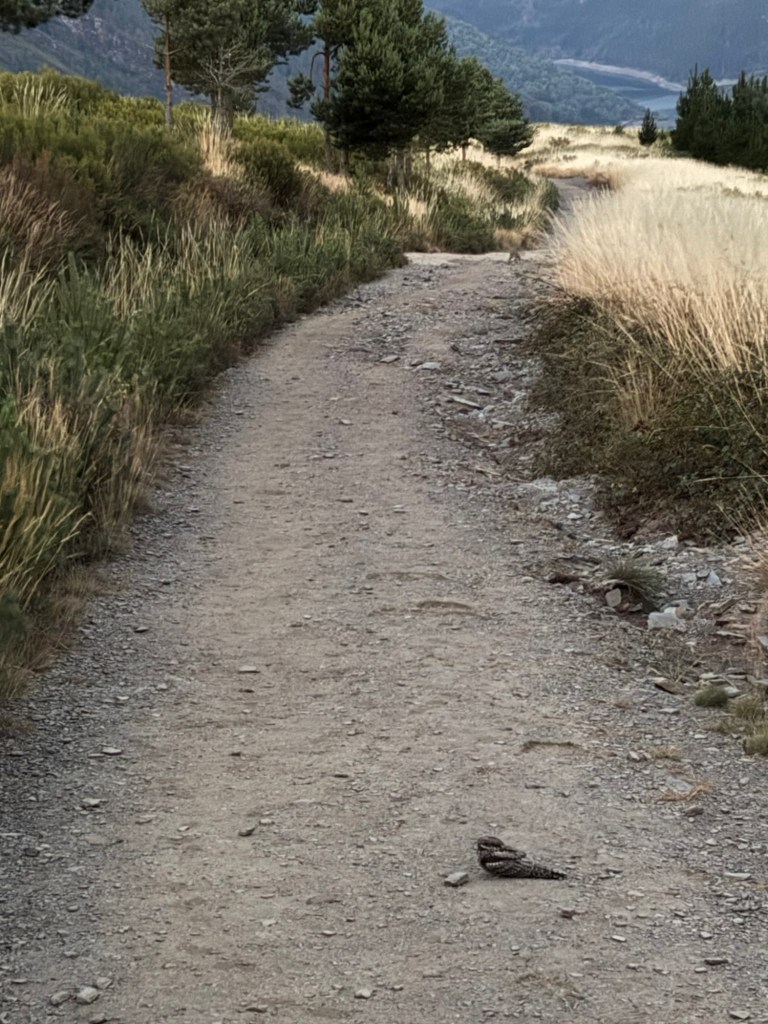
The reward for striking out alone was a nightjar – and not just the sound of one, but the sight of one as well. They’re bizarre creatures, nightjars: shaped like a cuckoo, or maybe a small hawk, with an owl-like face, a whispered beak and enormous black eyes. They’re often heard in the places they frequent, but rarely seen due to their nocturnal habits, so it’s remarkable that they should have left such an impression as to have such an intensely evocative name in each language.

In German they’re nachtschwalben – night swallows. In Spanish, chotacabras – goat-suckers (the Italian succiacapre is much the same). The French use the term engoulevent – literally, wind-eater, on account of their hunting habit of flying through the twilight air with their beaks wide open. In English, I can only assume the name is phonic: because the nightjar’s call can only be described as a long, rasping jar or churr, which it can go on producing for hours with seemingly no need to rest.

I only saw it a few times as it moved beneath the forest canopy, with the jerky motion of a child’s toy glider, its wings held high as it manoeuvred dextrously through the trees. But it was enough. I consider that a very good start to the day.


I came this way during the spring a few years ago and I remember needing gloves, it was so cold. There was even frost on the ground. Not so today: the endless green fields of shimmering wheat have since turned to gold, as though by the hand of Midas. With the merciful cover of the clouds, they were not blinding to the eye, so the loss of my sunglasses in Sansol the other day was no concern, though I did buy a new pair in Santo Domingo; it would be nothing short of madness to attempt the ceaseless flat of the Meseta without them (where it sometimes feels like you’re walking on the sky).


I stopped in Santo Domingo to have the rest of the pâté and bread I bought yesterday as a light lunch. The last time I came here, I was with Mikkel, Lachlan and Sophia and so I never got around to visiting the cathedral, so I made good on that today. Apart from netting me another couple of stamps for the credencial, it also housed a number of treasures that I wanted to investigate – not least of all the famous “resurrected chickens” that feature so prominently in the town’s history.


Santo Domingo de la Calzada, like so many towns along the Camino, was born on the pilgrim road, founded by the same Domingo García who gave the town its name. Its most famous legend tells of the execution of a young German pilgrim who, passing through the town, attracted the attention of the mesonera (innkeeper). After rejecting her amorous advances, the spiteful mesonera concealed a silver cup in the pilgrim’s bag before he left, for which he was accused of theft, sentenced to death and hanged on the spot. When his parents came to identify the body, they found him alive, claiming Santo Domingo had saved him. The sceptical mayor, who was fairly sure that the boy they had hanged the day before had been executed properly, claimed he was as alive as the chicken on his plate – which promptly stood up and crowed, testifying to the truth of the pilgrim’s fate.

Ever since, a pair of the descendants of the resurrected chickens (don’t ask me how they check) have been kept in the cathedral, together with a piece of the scaffold where they hanged – or tried to hang – the innocent pilgrim, all those centuries ago. Go figure.


Santo Domingo’s cathedral, like many in Spain, is full of hidden treasures. I was particularly taken – as always – by the mythical creatures that pop up in the stonemasonry. Harpies, dragons, demons, griffins… for a faith that spent so much time and money driving all traces of paganism from the land, it sure is amusing to see that Spain’s churches are full to the rafters – quite literally – with frozen memories of that dark world.


One really stands out, especially after some recent reading. In one alcove, an icon of the Virgin Mary and child stands above the carved image of a griffin – in fact, there’s quite a few griffins watching over the chapel from the surrounding pillars. There’s a deeper poignancy at work here: griffins have been symbols of maternity since their invention over a thousand years ago.


Unlike the other mythological beasts of the ancient world, like centaurs, unicorns and minotaurs – which have a solid grounding in Greek mythology – the griffin seems to spring into existence out of nowhere, but already fully-formed.

Adrienne Mayor has a very convincing theory that the griffin is an unmistakeable reimagining of the protoceratops, a Cretaceous era dinosaur often found protecting its young in the lands where griffins were believed to reside (Central Asia). As stories of such “griffins” reached Europe, they entered our heraldic system, and are often to be found around the Virgin Mary, the single most important symbol of maternity in the Christian faith. A seemingly bizarre pairing – but a perfectly logical one. Two ancient beliefs meeting in the middle.


Under the cathedral, where Santo Domingo is buried, a relatively recent mosaic stares out at you from a thousand shining tiles. The design is modern, but the style is almost Byzantine: teardrop-shaped faces line the wall with huge, almond eyes the colour of midnight.


This is the kind of religious art that I have always found especially compelling. There’s an otherworldliness to it that borders on the mystical, a connection to the faith of those first believers long ago. That’s what I sometimes think the modern church is missing, why so many lose interest: the more it tries to modernise, to catch up to the new generations “on their level”, the more it loses the mystery that made the early church so compelling. I know that for me, at least, it’s that connection to the ancient ways, to tradition, that speaks to me. And I get a piece of that when I see this kind of art, even in imitation. A mirror to the ancient world, when faith was new and hot like a flame.


It’s nearly half past five. I’d better head back to the albergue – I’m on dinner duty. That’s the price for arriving early! BB x