“…So I Became a Teacher”

Ten years ago, British comedians Ben Miller and Alexander Armstrong ran a cracking comedy show on the BBC. The show has always been one of my standout favourites in British comedy, delivering some truly brilliant sketches including Perfectly Innocent, Kill Them, The Embarrassed Prime Minister and the Polish Plumbers, to name just a few. One running gag that hits close to home but still makes me chuckle is the comedy duo’s Be A Teacher ads, lampooning the common reasons why people “fall into” teaching:

“Failed in the real world? Then why not be a teacher?”
“Quite bright, but lazy? Need a safety net? Be a teacher.”
“Good enough to get a degree but not good enough to get a job? Be a teacher.”
“If your ambitions haven’t quite come off, remember: there’s always teaching.”

It’s a little tragic that one of the most important and time-honoured professions in human history often seems to fall into the category of “one of those jobs you do when you’ve tried all other avenues”. Conversations at school and university often went one of two ways whenever teaching came up: either “I just want to do something more worthwhile with my degree, you know?” or “God, I hate kids. I could never do that”. They’re hardly groundless as arguments go. Who in their right mind would want to get back into the classroom almost as soon as they’d left it? There’s surely something intrinsically sadistic about that kind of decision, and that’s before we even get onto the nitty-gritty of marking, differentiation and pupil management. And as for the hating the kids part… well, they say never work with children or animals – but maybe that’s just because you can’t ever truly predict or control either of them. And it is so very human to want to be able to do just that.

For me, at least, it has never been a question of “lapsing” into the education business. It is, like so many things, a family affair. Both of my parents were teachers. My Spanish great-grandmother was a teacher, and she married a teacher. I’m just continuing with the job. I might have had my wobbles along the way, but I don’t think I’ve ever really doubted that I’d be a teacher someday. Sure, that’s easy to say on a Saturday night, when most of the kids are out and boarding duties have been light, but it really is one of those professions that teaches you all the time, usually in ways you don’t expect.

I’m writing tonight because these last two weeks have been tough. The reality of teaching foreign languages to the English – ever the most stubborn of peoples when it comes to learning foreign languages – is beginning to bite. Not a week goes by when I don’t hear the line “Sir, why do I have to learn a language? Why can’t I just speak English?”, or variations thereof. The Modern Languages and Cultures graduate in me would love to give some solid answers, but these are fourteen-year old kids, for pity’s sake. A university-level argument on the merits of multilingualism pales in comparison to the fact that they have to revise twenty words they may very well never have to use in their lives – besides the end-of-year exam, of course.

So what use is the degree, then? What was the point in spending £9000 a year on the study of French, Spanish and Arabic history and literature if I am to spend the next four years teaching kids how to count up to thirty-one or discuss their plans for the weekend? These are questions I have been asking myself a lot these past two weeks. I came back to England with a mission, to do my part in a desperate campaign to save this country from collapsing into ignorant isolationism, knowing full-well what it would mean. And yes, whilst working in a boarding school does allow me to continue to channel my passion for music – easily the best part of the job by a country mile – the teaching side of it is hardly as scholarly as I’d have liked, sometimes.

At times like these, I do miss university. I miss staying up late with my housemates discussing political or social matters, I miss the excitement of sharing in the knowledge of others, and of sharing your own in turn, and I miss the challenge of stretching my brain. God, I miss that. I’ve been reading like a fiend these last few weeks out of a mad desire to tackle something more intangible than the days of the week. I ordered a book of ancient Spanish poetry off eBay the other day and pored over it during prep one night, something I admittedly would never have done at university. But then, my brain was stimulated in other ways then.

So what’s keeping me here? Why do I go on teaching?

Because I believe it’s nothing more and nothing less than one of the most important jobs in the world. For as long as there have been humans, there has been teaching, and even before then, there was teaching and learning after a kind. In the words of a colleague of mine, “I don’t care how much more you earn in the office, your job could disappear from the face of the earth overnight and nobody would notice. Not so with teaching”. You might see it as giving up on your own hopes and dreams to encourage others to pursue theirs, or that might have been your ambition all along. Teaching is the job that keeps on giving – both in reward and in workload, yes, but the rewards make up for it. I am a far braver, far more tolerant individual thanks to teaching. You don’t go into teaching to share your love with just the kids who love the subject back. That’s neither practical nor necessary. You do it just as much for the kids who don’t listen as for those who do. Teaching the subject you love to children with no love for it whatsoever will sap your zeal, strangle it if it can, but it does encourage you to see things from a different perspective. And, frankly, any job that does that on a regular basis is a job worth pursuing, if the ultimate goal of human existence is to understand each other – which is what I have always supposed it to be.

I still can’t fault Armstrong and Miller, simply because that sketch is bloody hilarious. But if you’re enthusiastic, passionate about your field, patient and have a drive to listen and learn, I cannot encourage you enough: be a teacher. Money might make the world go round, but somebody has to encourage and inspire the next generation (besides, the last thing the world needs is more businessmen). So go on. Be a teacher. BB x

Quote Unquote: ORIGIN by Dan Brown

Image result for origin dan brown

This week’s attempt at escapism was even lazier than usual, since it required no actual reading on my part but rather dipping in and out of the Audible app on my phone during the emptier moments of the day. You might call it “tactical” escapism, though I suspect it’s still just another tired synonym for procrastination. This week I decided to go for a writer I have somehow managed not to read thus far, that being Dan Brown, author of the best-selling Da Vinci Code. What can I say? The film came out before I got around to reading the book, and Dan Brown doesn’t exactly cut to the chase. Origin, one of his more recent works, does not yet have a film adaptation in the works, so it was one that had to be read. The fact that it takes place in Spain had nothing to do with it.

And on that humongous white lie, let’s dive in. Oh, and before you read on, I might add ***SPOILER ALERT***  (because it’s not an easy book to pick apart without giving away some pretty critical spoilers).


If you’ve read/seen The Da Vinci Code or Angels and Demons, you’ll already be familiar with Brown’s clever plots. Expect the same in Origin. In fact, expect a lot of what you’ve seen before: a highly suspicious bishop, a strong, silent-type hit-man with an agenda, a glamorous female sidekick, a mind-blowing secret that you have to wait until the end to discover, and Doctor Who levels of sci-fi explanation. Edmond Kirsch, a billionaire futurist and Elon Musk by another name (Musk even gets a nod at one point), announces to the world that he is going to change what it means to be human (another moment Doctor Who fans might be familiar with), but is shot by a hidden assassin before he can make his ground-breaking reveal. It’s up to Robert Langdon, Kirsch’s one-time mentor, and the director of the Guggenheim Museum and future queen of Spain, Ambra Vidal, to finish the job, racing against the clock to deliver Kirsch’s discovery to the world. Perhaps the most interesting feature of the novel is Kirsch’s supercomputer, a sentient AI known as Winston, who guides the protagonists towards their goal with godlike success.

I’ll admit, I expected a little more from Origin than I got. I wasn’t actually all that bothered by the familiarity of the storyline, but for a book dealing with religion on Spanish soil, I couldn’t help feeling a little disappointed when the Muslim and Jewish characters were killed off early on and nothing was made of this. Fair enough, Spain is a primarily Catholic country, but Angels and Demons made such an exciting use of the spectre of the Illuminati that I went into Origin expecting some dark vestige of Spain’s bloody history to raise its head. Instead we got the Palmarian Church – an innovative introduction to most of us, but given its role in the story, hardly the most threatening or thought-provoking of obstacles. All the same, I enjoyed Brown’s modern, pop-culture-imbued writing style, as it is so far-removed from my usual material, which I am increasingly coming to see as verbose and out of touch (though the travel writings and adventure novels of the late 1800s and early 1900s will always hold a position of glory in my heart for the lexical skill of their writers).

I haven’t mentioned the role played by the Royal Family of Spain, largely because it is so insignificant to the main plot that it might as well have been a soap opera flickering away on a TV in the background. The ghost of Franco was conjured up – but for just a moment. Barcelona loomed into view – but nothing was made of the Catalans. The Spanish Inquisition was mentioned several times, and a terrorist attack on Spanish soil was explicitly detailed – but there was only ever one religion truly under fire all along. Brown has always been good at misdirection in his plots, and he was subverting expectations in Origin like Rian Johnson did with the new Star Wars movies.

The big reveal? Not as mind-blowing as I anticipated, I guess – but then, Kirsch set the stakes very high. When the truth came out at the end, I was surprised it unsettled the Parliament of the World’s Religions so much that they considered prematurely sabotaging his discovery before it could go public. I’m not all that firm a believer myself, but I didn’t find myself questioning my faith once: Kirsch’s expositions on the seventh kingdom and the origins of mankind were insightful, but not exactly earth-shattering. By this point in our history, a future where we share the world with, or perhaps even cede it to the silent sentience of artificial intelligence is more or less inevitable. What started out as a plot device for a 1970s sci-fi nightmare is now almost a matter of fact. My question is, why should that kind of knowledge shake the foundations of the faithful?

My journey with Catholicism is still in its infancy. That comes from growing up in a country which threw off the “shackles of the papacy” a long, long time ago. Though I live and work in a Catholic enclave, it is precisely that, an enclave. It’s easy to forget that, beyond the bubble, most of my countrymen don’t go to Mass on a Sunday, meatless Fridays aren’t the norm, and many of the rules and expectations that seem so normal seem out of date if not alien. Everybody has their own take on their own religion. For me, it’s a family affair. It’s my way of reaching out to my grandfather, a man I never knew, and to my cousins, uncles and aunts in Spain. It’s a way of sharing in that rich and beautiful legacy of ages. Futurists and scientists like Brown’s Edmond Kirsch take great delight in tearing down the temples of the ancients, but what are they doing if not building glass temples of their own in their stead, just as humans have delighted in doing for all time? Religion isn’t about rules and false truths. It’s about love.

My experiences as a student at a Kent grammar school, where daggers-drawn atheism was almost a state religion, actually gave me more of an appetite for a faith of my own. Ironically, my highly opinionated contemporaries pushed me towards God more readily than any beaming, hot-chocolate touting, guitar-strumming Christian Union friends ever did. I suppose what I objected to more than blind faith and the endless four-chord songs about some heavily distorted Western Jesus was the hostile rejection of hope, which has ever been my most treasured of core values (there’s a modern buzzword if ever there were one). And yes, in case it isn’t clear already, modern Christianity and I aren’t exactly a match made in heaven. Somebody once put it to me that Christian music adapted to suit a modern audience. Call me old-fashioned, but I’d take a hymnbook over guitar worship any day. I appreciate the staggering irony in that statement as a devotee of Gospel music, and I’m afraid I’ll have to hold up my hand as an all-too-human hypocrite on that count. For me, Gospel music has never been about a white Jesus who loves everybody, rather about bridging the gap between worlds and reveling in the rage, the sadness and the hope together with the joy of faith. Because that’s what faith is: perseverance in the face of insurmountable adversity. Kirsch, like many characters from my own past, went head to head with the world’s believers with a smug smile, believing he could sweep away the dark religions so that sweet science could reign. In doing so, he betrays his humanity: there are many for whom the most bitter of blows fall like rain upon their faith. Faith is not founded on facts. It comes from a deeper well.

I am one of those for whom the great questions – where do we come from? Where are we going? – have never held all that much interest. For most of our history, mankind has sought to make itself master of all things, seeking the logic and the reason behind everything in an attempt to bend it to his will, to subjugate it, for knowledge is power. And while I love to learn new things, I am no Kirsch. For me, the real beauty of faith is in the great mystery. There are some things that will forever be beyond my understanding. And I’m ok with that. It’s not so much “Jesus, take the wheel”. It’s more of a “I’m mysterious, folks. Deal with it.” Sometimes – as Rowan Atkinson’s character says in the 2005 film Keeping Mum – all we need is a little grace.


Favourite scene:

The chase scene in the Sagrada Familia was pretty spectacular. Brown knows how to pick a good setting, that’s for sure. There’s always something terrifying about the idea of fleeing from a searchlight – some “flight” instinct, buried deep, from a time before flashlights when we ran, ducked and weaved to get out of eyesight of predators who were after our blood, perhaps. Those were always the levels in video-games that scared me the most (Zelda: Wind WakerMetroid Fusion, Harry Potter etc). I digress. Brown’s assassin had a gun and had just killed a man with his bare hands, but that torch in his hands was his most frightening weapon by far. To survive, Langdon and Vidal had to keep in the shadows. Add that to their escape taking place within a cathedral as bizarre and unorthodox as the Sagrada Familia and it makes for a truly terrifying pursuit.


Favourite character:

Winston is far and away the standout success in Origin. Think HAL voiced by Stephen Fry. Educated, intelligent and eerily human, Winston is immediately likable from his first appearance. In fact, I found him such an interesting character that I felt a real sense of loss when Langdon and Vidal lost contact with him at a certain point in the narrative. I had my suspicions about the whole monte@iglesia affair, but the twist that he was the mastermind behind it all hit me like a sucker punch. I didn’t stop liking him for it. In fact, I found him an even more interesting character by far. And that recurring trait of his awkward laugh was a stroke of genius: endearing in its first appearance, terrifying in its last. Origin could be criticised for being a recycling of Brown’s old plots, but his Oxford-educated HAL makes it worth every page.


Favourite Quotes:

“The devout can always benefit from listening to non-believers. It is in hearing the voice of the Devil that we can better appreciate the voice of God.”

Zeus, more than any other god, resisted his own extinction, mounting a violent battle against the dying of his own light, precisely as had the earlier gods Zeus had replaced.

“I’ve been taking confessions for fifty years. I know a lie when I hear one.”

img_4392

Quote Unquote: STREET OF THIEVES

img_4944

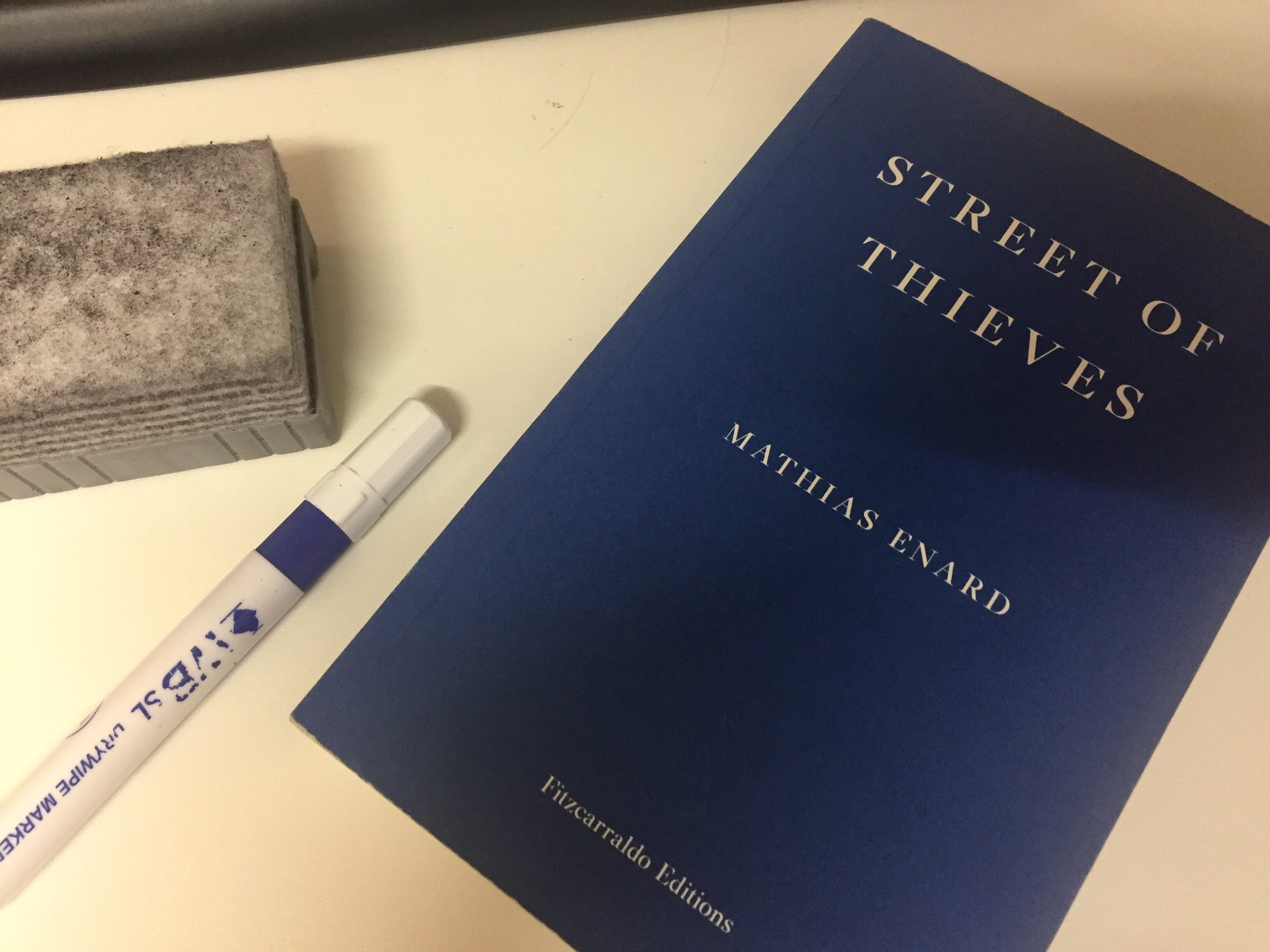
This week’s read is a work in translation: Mathias Enard’s Street of Thieves (Rue des voleurs in the original French). As a former student of languages, I have a somewhat conflicted view on reading works in translation. Part of me has always been a bit of a purist on the subject: if you can read a book in the language in which the author intended it to be read, why not do so? There are so many details and nuances that can be lost in the tricky process of translation – the author’s voice, for one. However, what you read impacts on what you write, and since I write predominantly in English, it always made far more sense to me to read works intended to be read in English, with the effect that I eschewed works in translation altogether. I grew up with English, therefore I must write in English. That at least was the argument I cleaved to for most of my time at university. A colleague once said to me he could destroy that argument in three words: Waiting for Godot. Unfortunately, uncultured pleb as I am, Samuel Beckett has yet to feature on my reading list – nor will he for some time, theatrical scripts not being my preferred reading material of an evening. However, I concede it a point well made, and in the years since I have relaxed my approach a little and tried dipping my toes in the water.

Street of Thieves tells the tale of Lakhdar, a young, idealistic Moroccan whose boyish desire to seek his fortune across the Strait is realised after a series of stark, harrowing underworld adventures that make Enard’s text a bildungsroman of the darker variety. There is enough of the everyman in Lakhdar to make him an instantly sympathetic protagonist, and no matter how you look at it, the sequence of events that set his journey in motion would humble even the strongest of wills.

The greatest strength of Street of Thieves is in its flawless realism. Every single event is wholly and utterly believable; some magic in Enard’s emplotment almost strips the story of its “story”, as though you are watching Lakhdar’s life in real time. Tragic events happen and caricatures come and go, but they are so very real, so human, they might as well be people picked off the street at random and given parts to play. Where there is grief, there is no melodrama; where there is rage, there are no histrionics; just the restless drone of everyday life, weaved seamlessly into the fabric of fiction.

The book’s title refers to a street in Barcelona’s Raval district, one of the seedier quarters of the coastal metropolis. Enard lived in Barcelona for a time and his knowledge of the comings and goings within the depths of the city paint a convincing picture, though even if he had no experience of his own, he could hardly have chosen a more fitting counterweight to the city in which Lakhdar’s story begins: Tangier, by many accounts one of Morocco’s seedier locales. There is a magic to both cities that draws tourists in every year – the ever lucrative vein of “pink gold” Enard so evocatively describes – but we don’t see much of it from Lakhdar’s perspective. Everything is huge, dark and dirty, as though we are seeing both cities through the eyes of a cockroach, scuttling from corner to darker corner. It is certainly an easier book to write about than it was to read.

I may not have read Waiting for Godot, but I have had the good fortune to explore both Barcelona and Tangier. I went to Barcelona earlier this year in the hope of finding material for my own writing. It was a wistful fantasy, to which I am often prone; I found little of any real value in my wanderings around the city, my interests being so far removed from the modern metropolis – say, by about four hundred years. I wandered around the Raval district a lot, carrying with me only my notebook and the card key to my hostel room, and found the place shadowy, dusty and surprisingly Arabic-speaking, but not as menacing as I had heard tell. Then again, I limited my explorations to the daylight hours: I believe Raval puts on a very different mask by night, if the stories are to be believed. All I really remember about Raval was a chance encounter at the end of a street with a flock of monk parakeets drinking from a puddle in the road, illegal immigrants of a different colour, but illegal immigrants all the same.

DSC_0341

Having traveled a good deal in Morocco previously, I found in Tangier a curious melange of the other cities I had seen, as though it were a human imitation of the work of Gods elsewhere. Here were echoes of Fes’ labyrinthine medina, without the medieval charm; echoes too of Marrakesh’s charming cafes, without the charm, Taroudant’s city walls, without the beauty of the desert, and the blinding white of Casablanca, stained brown and grey with age. All the same, Tangier had a far greater effect on me than Casablanca or Marrakesh, knocking both cities down in strength of character, showing that hybrid vigour that sometimes allows a mongrel dog to triumph over a prize-fighter.

I met a Lakhdar, once. Not in name, but almost identical in nature. He was friendly and sincere, with that almost too sincere character common to the folk of many African countries that puts a lot of Europeans on their guard. Had I been traveling alone, I would have undoubtedly abandoned my plans and gone with him to meet his family at his invitation. As it was, I did not, and I have never felt entirely happy with myself for how the ensuing drama played out. Lakhdar, too, is frustrated by visiting Europeans who, one way or another, lead him on only to let him down, concerned or agitated by his desire for friendship. That the story takes place in the turbulent months of the Arab spring gives more than a little credence to their caution, and yet… if you were in Lakhdar’s shoes, would you see things so clearly? The gulf between Africa and Europe is only nine miles wide at its narrowest point, and yet it yawns like Mariana.

DSC_0310


Favourite Scene:

Tough call. Street of Thieves is not a book of standout scenes so much as it is an exploration of the difficulties experienced by a young Moroccan crossing over. Maybe his lengthy descriptions of the sordid Raval district? Enard painted the side of Raval I wanted to see but was too cautious to venture out at night in search of – the Raval one sees through the slits in the blinds. A quarter inhabited by fleshy prostitutes, circling drug addicts and lecherous men who ogle the women one day and turn a blind eye the next on their way to Friday prayers. Like Goya, the Romantics and all the Victorians before me, I am drawn to the dark, if only to better understand the light.


Favourite Character:

Another coin toss, though this time, it’s between two men: Sheikh Nureddin and Marcelo Cruz. The coin analogy is not a bad way to start, for in a way they are two sides of the same coin, just as Tangier and Raval mirror each other. Sheikh Nureddin is the more sinister of the two: calm and comforting, fatherly and always dressed to the nines, he exudes moral strength and commands confidence, and yet all the while he drives honest men to commit brutal acts in his name. Scarier still, even after the illusion flickers and you see the demon beneath the dress-suit, Enard has you seeing his humanity when he walks back into Lakhdar’s life, like Lucifer with his wings restored. Marcelo Cruz, by contrast, is a grotesque caricature of corruption. A twenty-first century undertaker who races to be the first on the scene whenever the bodies of the unfortunate wash up on the shores of the Spanish Mediterranean, Cruz takes an almost inhuman delight in his profession. Death has lost its meaning to him; he has become corrupted by the stink of corruption, and only the endless spiral of ever-darkening videos on the internet keep him entertained as he waits for the bloody tide. Both men are avatars of fear; one wields it, one is possessed by it, and it is hard to say which is the more fearful of the two. The devil you know, and the devil you worship. It is a wonder that Lakhdar is as sane as he is at the end of the narrative – though perhaps you might come to your own conclusions.


Favourite Quotes:

He spread a terrible sadness; the rotten smell of a lonely soul.

Cities can be tamed, or rather they tame us; they teach us how to behave, they make us lose, little by little, our foreign surface; they tear our outer shells from us, melt us into themselves, shape us in their image – very quickly, we abandon our way of walking; we stop looking at buildings, we no longer hesitate when we enter a metro station, we have the right rhythm, we move around at the right pace; and wherever you come from, in the end they train you like dogs.

You try acting funny or charming in literary Arabic, it’s no piece of cake, believe me; people will always think you’re about to announce another catastrophe in Palestine or comment on a verse of the Koran.


img_4392

Quote Unquote: BEARSKIN by James A. McLaughlin

Somebody must have kicked the reading machine in my head real hard, because it’s working overtime at the moment. I suppose it’s the very real threat of having to read up on plotless educational policy and classroom management that is making fiction so damned attractive at this point in time. With lessons well underway and the dreaded Numeracy Skills Test now but a distant memory, the next task looming is the first of the PGCE written assignments – perhaps the first written assignment in my life that I will not be able to wing on the back of a clunky box of quirky and otherwise useless general knowledge. My capacity for absurdity became something of a badge of honour at university as I made it a personal prerogative to shoehorn the most bizarre comparisons into every essay I submitted. Samurai and pashtunwali found their way into an essay on Lope de Vega. The sea witch from The Little Mermaid popped up in an assignment on La Celestina. The Sack of Baltimore somehow drifted into a commentary on Spanish banditry. And then there was that unforgiveable allusion to the nest-building practices of great-crested grebes in a second-year Spanish language exam on cultural divisions (I got scorched for that one, justifiably, and I don’t think it was because my examiners stumbled over the word somormujo).

Nope. This is one essay that I will have to write with my own blood. And my head will not thank me for it.

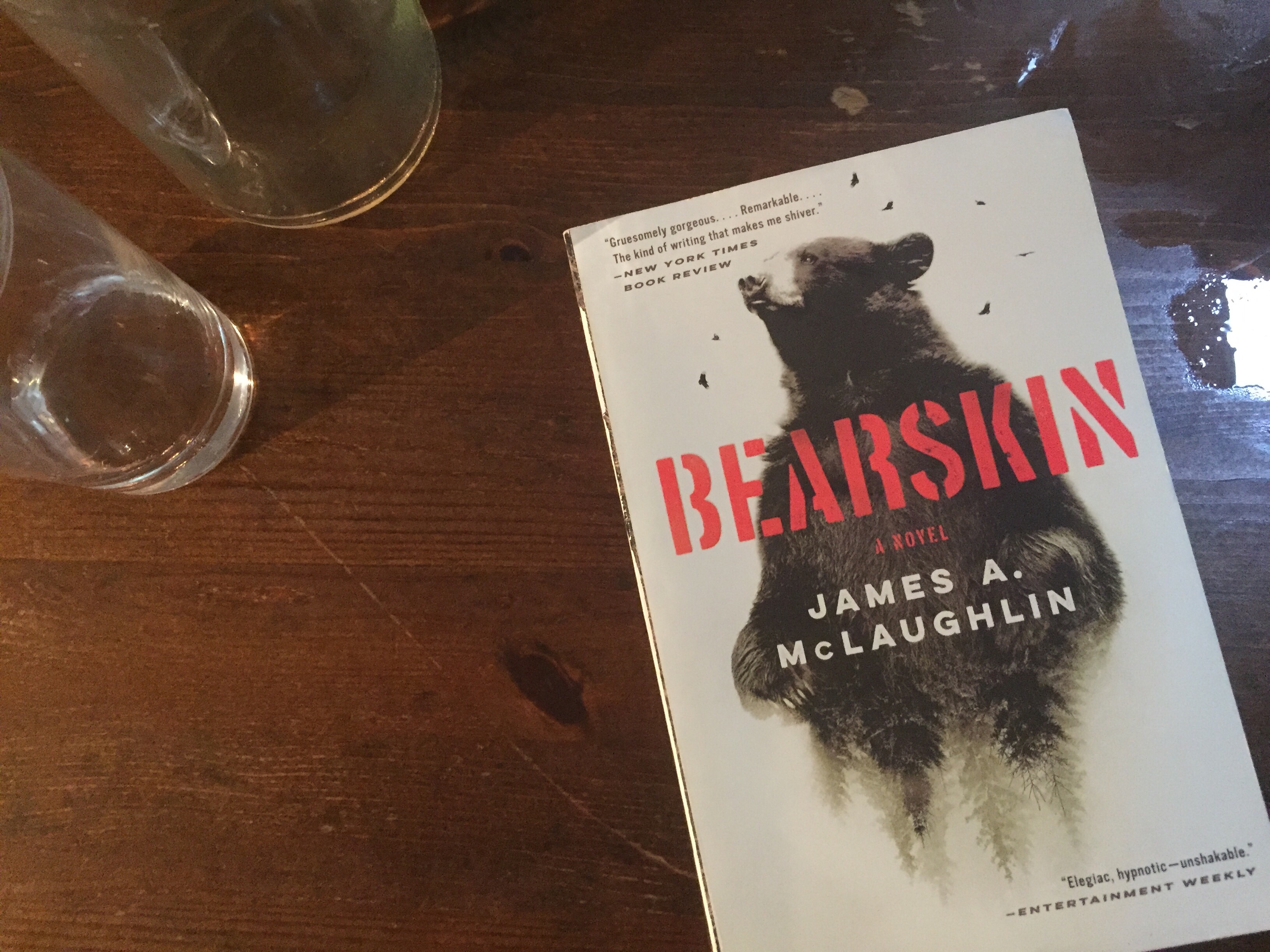
So, conscious that I will scarcely have the time to do my own writing this year, I shall endeavour to persevere with my reading project. After muscling through Thin Air in forty-eight hours (a personal record), I threw myself right into another. This time around, I thumbed around for something different and picked James A. McLaughlin’s Bearskin off the shelf…

……..

“Gruesomely gorgeous” is certainly one way of putting it (New York Times Book Review). Bearskin tells the tale of Rice Moore, an Arizona ex-con working as a caretaker on the Turk Mountain preserve in the forests of Virginia whose decision to get to the bottom of a local bear-hunting operation brings him into conflict with the locals, the law, and ghosts from his past. At times hard-edged thriller of the “Dark South”, at others a quasi-mystical exploration of man in the wilderness, Bearskin is a powerful retelling of the lone-man-standing-up-for-the-forest genre, without the ego or distasteful pessimism of the twenty-first century eco-warrior. Rice makes for an appealing hero, a man with no illusions on whom the forest works its magic. Some of the characters are satisfyingly familiar: a John Wayne, no-bullshit sheriff; a thickset Redneck patriarch and his lawless, swaggering sons; a psychopathic assassin who says nothing and yet instils more fear at the mention of his name than any other man in the book. And then there are the others: Dempsey Boger and his hounds, the ethereal mushroom-picker and, of course, the bears themselves.

There are points in the narrative – fugues – when you cannot be entirely certain which world you are in. When the forest takes on a mysterious character of its own and colours and images swim before your eyes in unfamiliar patterns, and time seems to flow in both directions at once. Moore’s ghillie-clad seclusion on the mountain is ritualistic and deliberately so, serving in a sense as an awakening. It was almost stupefying to read. I’ve never taken magic mushrooms myself, but I felt like I had after one of the scenes. Trips may well be relatively easy to recreate through the medium of film, but McLaughlin certainly knows how to write one.

There was only one thing I was left wanting from the story, and that was something more about the bears. They serve as a springboard for the main events of the narrative, but I caught myself waiting for a gratifying (if cliched) encounter with one of the bears at some point towards the end. One gets the sense they are always there, on the periphery of Rice’s world, more like ghosts than creatures of flesh and blood. And perhaps that much is true of the wild, as man and his endless pursuit for dominance pushes such spirits further and further into oblivion. All the same, I reckon the bears might have appreciated some closure.


Favourite Scene:

The hellish image of the baiting scene deserves a special mention for its sheer monstrosity: the pawless, gutted carcasses of two bears beneath the totemic severed head of a Charolais, suspended from the trees above by a bloody rebar driven through its eyes. The buzz of flies above, the growl of worrying hounds below and the sickly stench of liquorice. I’d like to give a hand to the stalking scene towards the end for its pace and power, but this static freeze-frame is just one of those scenes that will stay lodged in your mind’s eye forever. Some stories produce characters of eternal weight, others moments of utter majesty, and others still paint pictures with flesh, blood and the stuff of nightmares. There’s a lot of human villainy in Bearskin, but the baiting scene takes the biscuit. Somehow the absence of the perpetrators does the trick: the aftermath is far worse in its silence than the act itself.


Favourite Character:

The mushroom picker. McLaughlin strings out a strongly convincing cast of Southern marionettes in Bearskin, but there is one oddity in the bunch who, like the pip of a blackberry, sticks in your jaw long after the cast has come and gone. I was never entirely sure whether he was real or not – and neither am I alone in my doubt, as Rice himself asks this question at least once – but his brief appearances were memorable, to say the least. Who was he? Where did he come from? Was he a mountain man, or something stranger – a vengeful woodland sprite or god, a green man, released from the deepwoods to send the protagonist on a quest? When first he appeared, Rice mistook him for a bear – a mistake he made again on the mushroom picker’s second appearance. To my eyes he is certainly more Beorn than Bombadil, and whatever the author intended him to be, he comes across as by far the most enigmatic and powerful character to emerge from McLaughlin’s narrative.


Favourite Quotes:

Information about the universe leaked from the open eye like poison gas.

“So many people hate snakes. I think it’s because they threaten people’s worldview – they’re alien, limbless, impossible, black magic: a stick come to life. But maybe we’re all sticks come to life. We want to think we’re exceptional, ensouled, angel fairies or God’s special children. The magic of being animate matter isn’t enough.”

They ate a quick breakfast, homicide having no effect on their appetites.


img_4392

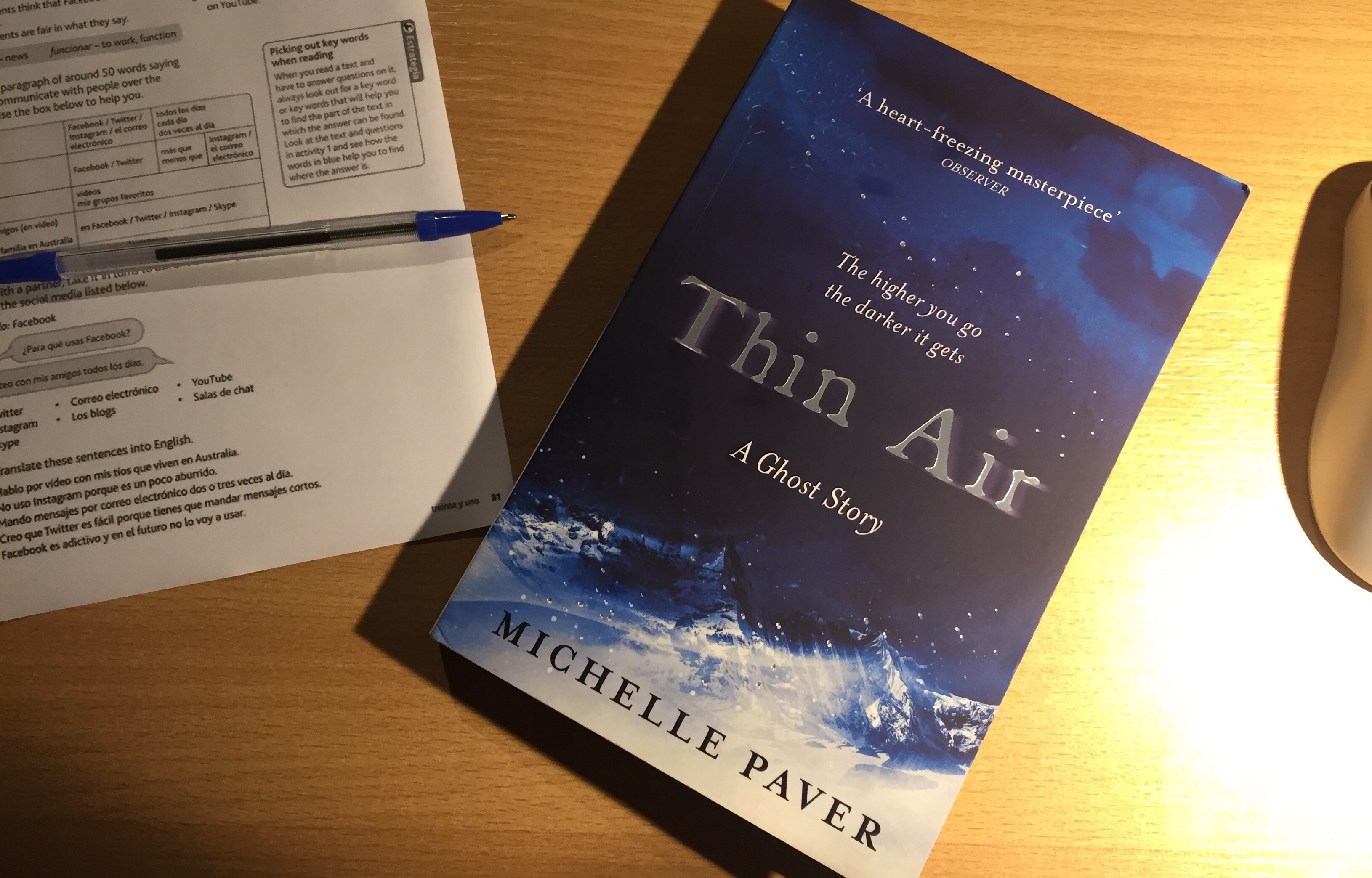
Quote Unquote: THIN AIR by Michelle Paver

img_4837

The funny thing about being busy is that it makes all the things you wanted to do when you were free that much more achievable. It seems counter-intuitive, but it’s true. When time is on your side and you have a stack of books to read, it can be hard to even chip away at one. When you have lessons to plan, essays to write, work to mark and affairs to set in order, reading for pleasure suddenly becomes both more appealing and more feasible. Somehow those twenty minutes you carve out of the day always come around. I suppose routine is the answer, as it so often is. It’s just a pity that routine is harder to maintain when you have nothing but time on your hands.

The days are growing shorter. Prep ends in darkness now, and this Saturday just gone, the martins gathered on the abbey roof, as they always do on a certain day every year. The following morning they were gone. All of them. They say a swallow does not a summer make, but for me, summer is always over on that day when the swallows and martins take their leave. Now is the time of cold, crisp mornings, clear blue autumn skies, mist in the trees and the musty smell of mushrooms.

It is also a wonderful time of year for ghost stories.

……..

Thin Air tells the tale of a British expedition up the southwest face of Kangchenjunga, a mountain of fearsome repute in the unforgiving wastes of the Himalayas, as seen through the eyes of Dr Stephen ‘Bodge’ Pearce. The expedition party, an assortment of British public-school chaps (the swot, the bully, the priest and the major), have set their sights on being the first to climb the evil mountain, which has turned away all previous comers and slain several for good measure for even trying. Struggling with an unenviably rocky relationship with his brother, Kits, Stephen tags along as the expedition’s medic. From the very beginning the expedition is hag-ridden by the previous sortie led by the larger-than-life Lyell and company, whose disastrous defeat casts a long shadow over the group’s attempt – in more ways than one. It quickly becomes apparent that Lyell’s disastrous attempt to climb Kangchenjunga was less of a heroic withdrawal than it seemed at first, and as Pearce’s company scales the mountain, something sinister begins to dog them by degrees. Bullied into silence by his older brother, who alone seems oblivious of the creeping dread, Stephen begins to believe they are being haunted by a vengeful spirit. The mountain may not be the only thing determined to prevent them from carrying out the mission that Lyell started…

The story is full of men walking in the shadows of others. Kits marches in the footsteps of his hero, General Lyell. Stephen plays second-fiddle to Kits for most of the narrative, who seemingly does his level-best to keep him from stealing his place in the spotlight. The sherpas follow meekly in their wake, dismayed at their employers’ ignorance, and both a dog and a raven – stylised with the more ominous name of gorak – shadow the company on their ascent into the darkness. More chillingly still, there is always the nameless presence of something unspeakable. And then, of course, there is Kangchenjunga itself, overshadowing them all.

Kangchenjunga is not just a setting. It is an objective, an idea, an antagonist and a fierce deity. It is also far and away the standout character of the story. There are more sinister incarnations of rage at work in the tale, but one is never allowed to forget the raw ferocity of the mighty mountain. It threatens the company with its avalanches. It sends blizzards to slow them down and it reminds them of their chances with the cairns of those who have tried to master it and fallen in the attempt. One of my favourite parts of the Lord of the Rings growing up was the section of Fellowship when the company of nine attempt the pass of Caradhras and are beaten back by a mountain that is more sentient than it appears. There is something truly awesome about nature at its most raw, and Kangchenjunga is Tolkienesque in its might (interestingly enough, Caradhras’ other name, the Redhorn, is evoked at least once in Paver’s description of the mountain’s “dark-red precipices” – a colour that instantly stands out from the whites, greys and blues of the snowbound Himalayas). Stephen, a Western doctor ruled by his head, flatly denies it all, shooing away the sherpas’ fears as the darkness settles:

“This mountain has no spirit, no sentience and no intent. It’s not trying to kill us. It simply is.”

The question is: are you convinced?

This is genuinely one of those books that merits re-reading. There is so much subtle foreshadowing throughout, and a great deal of it will pass you by until the end. To read it again is to watch Dr Pearce and the company march knowingly into the jaws of doom with an even greater surety than before. You knew the mountain was a killer from the word go – Lyell, Pearce and all the others point to that endlessly – but the way in which Paver weaves the narrative forwards and backwards is spine-chillingly precise. I have deliberately avoided talk of the ghost in this ghost story, if only because the less that is said about it the better – the strength of a ghost story is often in that which is left unsaid. If you know, you know, if you don’t, give it a go. And when you’re done, seriously, skim back through and read it again. It’s almost scarier the second time around. Which is exactly what a good ghost story should be.


Favourite Scene:

The first cairn. It is Dr Pearce’s first encounter with the reality of their situation – and also his first brush with the nameless terror of the mountains. For the superstitious, there is an ancient belief in some parts of the world that walking the wrong way around a sacred object, such as a pillar or monolith (or in the case of Thin Air, an urn) brings on bad luck. I remember the tradition being used to comedic effect in Tintin, but as soon as it showed its head in Paver’s narrative I knew we were in for trouble – I’m glad she made use of that old trick. Because it felt like the necessary snowball that starts an avalanche. Dr Pearce’s musing before the cairn of Dr Yates, the doctor on the Lyell expedition is both stark and satisfying in its foreshadowing – and powerful in the ensuing scene it delivers. This is definitely one of the scenes that is worth a second look.


Favourite Character:

Kangchenjunga. For all of the reasons I laid out above.


Favourite Quotes:

Surely the purpose of a grave is to benefit the living. Aren’t the dead beyond caring where they live?

It’s lack of knowledge which lets in the shadows.

Perhaps that’s what we find frightening. Being on a mountain forces us to confront the vast, unsentient reality that’s always present behind our own busy little human world, which we tuck around ourselves like a counterpane, to keep out the cold. No wonder that when we trespass into the mountains, we create phantoms. They’re easier to bear than all this lifelessness.

There is no justice in this world, so why should we expect it in the next?


img_4392


Quote Unquote: THE LIFE AND ADVENTURES OF JOAQUÍN MURIETA by John Rollin Ridge

This week I’m looking into a rather different kind of novel, albeit one much more in line with my usual taste. Often considered the first novel by a Native American writer, John Rollin Ridge’s The Life and Times of Joaquín Murieta: The Celebrated Californian Bandit is a remarkable account of the life of one of America’s most infamous outlaws. I have no misgivings in making such a claim: Joaquín Murieta may not be a household name like Butch Cassidy or Billy the Kid, but as the primary inspiration for Zorro, and by proxy Batman, the Californian bandit’s legacy is alive and kicking.

As might be expected of a bandit narrative, Joaquín’s tale is a tragic one. Ridge paints a picture of a man who set out with honest intentions but turned to villainy after being wronged once too often on account of his being a Mexican in an increasingly intolerant America (a situation that still resonates painfully across the ages). Finding himself on the wrong side of the law, Joaquín sets out on a career of vengeance against the nation that would not let a man like him earn an honest living. Along the way he gathers about him a colourful cast of characters, including his sweetheart Rosita, his brother-in-law Reyes Feliz, his nemesis Captain Love, and his bloodthirsty second-in-command, the unforgettable Three-Fingered Jack. The end is never in question – millions before and after Murieta have paid the price for defying the might of the United States – but such is the degree of Joaquín’s panache and gallantry that you might be forgiven for willing him to succeed, no matter how many bloody crimes are committed in his name.

To the modern eye, Ridge’s account comes across as half-story, half-history. This is not altogether untrue: the events within the narrative have been, to a greater or lesser extent, subjected to a fair degree of fictionalisation. An overarching narration of events takes precedence over dialogue and character development, and though Joaquín is very much the star of the show, this is as much the tale of his friends and foes as it is his alone. There are elements of the story that make for some hard reading in the twenty-first century – namely, the casual racism employed towards the Chinese, who fall before Joaquín’s men like wheat in the wind. Where Mexicans and Americans stand their ground and fight to the death, all of Ridge’s “Celestials” (an outdated slur used frequently in the narrative) are cowardly weaklings who habitually grovel and flee at the first sign of danger. They feature as a nameless swarm, fodder for Three-Fingered Jack’s bloodlust and a lawless whetting stone for the sorties of Joaquín‘s gang, since their slaughter rarely if ever provokes any reaction from the Americans. Ridge is, of course, speaking with the voice of his time, but given how evergreen the anti-Mexican sentiment of the narrative remains a century and a half later, it is hard not to draw comparisons to the present. Joaquín’s vendetta is in many respects a racial one, but it is rationalised through his personal tragedy. The xenophobia of his enemies cannot be so easily waived, and the indifference of the Americans upon his slaughtering of the Chinese miners speaks volumes.

I have been passionate about bandits since university. I am not entirely sure why. There is something raw about the idea of banditry that appeals to me, as it must have appealed to the Romantics of the nineteenth century. I chose to study Spanish bandit legends for a research project in my third year at university and I have been hooked ever since. I suppose it could be summed up as follows: the further removed one is from violence, the more exciting that violence appears. Some travellers in the 1800s came to Spain with the express purpose of seeking out an encounter with the bandit chiefs they had read about, leaving bitterly disappointed when they returned home unharmed. As I sit down to write of the legend of Joaquín in the comfort of my study, with the faces of surly Andalusian highwaymen staring down at me from the framed Doré prints on the walls, I am no less afflicted than my predecessors. Joaquín Murieta joins their ranks as a fearsome commander, standing tall alongside other such legends: Serrallonga and Roque Guinart; Diego Pernales and El Barquero de Cantillana; Tragabuches, Pasos Largos and El Tempranillo.

It is easy enough to conjure up a fantasy in one’s mind of the lawless world of Gold Rush-era California, but to do so with any degree of accuracy from the niceties of the present day would be no small feat. To write convincingly about the past, one must ignore the attitudes of the present and fully espouse the zeitgeist of the era in question. Therein lies the pitfall, for where is the storyteller who writes for an audience long since dead? And where is the book that is totally free of the truths and prejudices of the day? The very act of putting work into the public domain is to subject it to the scrutiny of the present-day readership, and it is upon this anvil that a story’s success may be made or unmade. To tell Joaquín’s story with more than a kernel of truth today would be to wind the clock back beyond one hundred and fifty years of social change, to a time when it was not essential to take into account the sensibilities of every featured demographic. Ridge’s account sounds so very believable because it was written not long after the events in question occurred, but even then his account is not unbiased: the author’s sympathy for Joaquín bleeds through his writing, for Ridge, a Cherokee, had plenty of reasons of his own to hate the Americans, having lost his father at an early age at the beginning of the events which would lead to the infamous Trail of Tears. History is warped by the age in which it is scrutinised, like a kaleidoscope that twists with each passing year.

August 3rd, 2019. A lone gunman walks into a Walmart in El Paso, Texas, and shoots twenty-two people dead, supposedly in retaliation for the Hispanic invasion of Texas. Within forty-eight hours, a Mexican spokesperson calls the attack “an act of terrorism” against Mexicans living in the US. The men who assaulted the young Joaquín Murieta and raped his wife got the sticky end they richly deserved in Ridge’s account, but in reality they were merely the heads of a greater hydra; the intolerance and hatred they represent is with us to this day. The story of Joaquín Murieta is all the more important now than it ever was. Here is the legend of an ordinary Mexican who was made into a monster by the land of opportunity, but who, like countless bandit heroes before him, rose above the darkness in the hearts of his people to become something eternal: a folk hero.


Favourite Scene:

The parallels between Joaquín Murieta and his illustrious descendants, Zorro and Batman, are mostly subtle ones, drawing largely on the bandit’s sense of nobility and his fight for justice. But there is one scene in particular that is especially poignant in its cultural impact. Having met with an old acquaintance on the road, Joaquín warns him to tell nobody of his presence in the state. The traveller swears he will be true to his word and goes on his way, but upon arrival at the nearest town, he hears talk of the bandit chief and talks of his recent encounter. Unbeknownst to him, Joaquín has friends up and down the country and, hearing of this betrayal from one of his spies, takes the matter personally. He comes to town in disguise, seeks out his old friend and, before dispatching him with a single shot, removes his disguise and declares the immortal line “I am Joaquín!”. It becomes a recurring staple of the legend of Joaquín that he fearlessly reveals himself before making a kill, and it would not surprise me in the slightest if Batman passed over Zorro and got his line directly from the Ridge’s book.


Favourite Character:

Murieta is a man worthy of three legends in one lifetime, but there’s another man in his saga who towers above the rest, and that’s Manuel García, more commonly known as Three-Fingered Jack. Next to Joaquín, Jack is easily the most memorable character, serving as a gruesome foil to Joaquín’s nobility and a grim reminder of the reality of the nature of banditry. Three-Fingered Jack’s unfettered violence is truly galling whenever and wherever it occurs and casts a long shadow over the villainies of his compadres, whose handiwork seems almost gentlemanly in comparison. There seems to be nothing at all redeeming in his character, and yet there is something immensely appealing about the monster – I honestly expected more of the wolverine in his last stand than he actually got.


Favourite Quotes:

They might as well have attempted to catch the red-winged spirit of a storm.

“If you betray me, I will scatter to the winds all that you have and all that you love.”

That terrible, three-fingered hand, which had dyed itself in many a quivering heart, had torn with its ruthless talons the throats of many an agonised victim, and had shadowed itself forth upon the horrified imagination of thousands who only knew that it existed.


Quote Unquote: BLINDNESS by José Saramago

**Quote Unquote is a new series of review-style posts geared towards mining my way through the mountain of books I have managed to accrue over the last few years**


Tonight I’m going to be looking at Blindness by Portuguese writer José Saramago, Nobel Prize winner and author of The Gospel according to Jesus Christ. I’ve had the book for the best part of a year, having borrowed it from my mother’s collection, and I took it with me on the Camino two weeks ago. I thought it would do me good to get some cultural reading under my belt, and Blindness looked like a light read… at the time. But that’s exactly what you get for not reading the blurb thoroughly, though the title alone should have given me an idea of what I was in for!

In his ensaio, Saramago weaves a monstrous tale centred on, above all else, the darkness in the human heart. It is not so much a cautionary tale as a dreadful reminder that we are only one small stage removed from savagery: one small push is all it takes. In this grim tale, that small push is the loss of sight. Starting with a man who goes suddenly and inexplicably blind whilst waiting at the traffic lights, the blindness spreads like a plague, spreading out from the source and driving panic in its wake. As the authorities race to take action, the affected are quarantined within an asylum, where things deteriorate with terrifying speed, culminating in the rule of force of a bunch of blind thugs who seize the food supply and extort their fellow inmates, first demanding their possessions, then the women. When a timely fire drives the blind out of the asylum and into the world, they find things are not all that much better on the outside. Throughout, Saramago conjures up a bleak world of stumbling and tripping, of unimaginable filth and miserable humanity and the depths to which the world can sink. We see it all through the eyes of the doctor’s wife, the one character miraculously spared the “white evil”, whose ability to see all that transpires becomes something of a curse as she alone is forced to bear witness to the breakdown of the world around her. She, and those within her halo of morality, somehow make it through their terrible ordeal until, just as quickly and inexplicably as it began, the blind have their sight restored.

Saramago’s writing style is hard going, to say the least. Even in translation, Saramago opts for chunky, seemingly endless paragraphs with no markers to indicate who is talking to whom. Like the Nadsat employed in A Clockwork Orange, one adapts to this style of narrative after a while, but it does make for difficult reading at times, especially when multiple characters are in conversation.

I’m not entirely sure what it is about blindness that makes for such a powerful plot device. I often come back to Triffids between books, and there are obvious parallels between the two books, though when rested against Saramago’s version of events, Wyndham’s vision of a world populated by the blind seems remarkably clean. Compared to the latter’s apocalyptic London of shattered windows and irregularly parked cars, the streets of the mental asylum and the unnamed city in Saramago’s work are rancid, litter-strewn and splattered with so much human sewage that one wonders whether the triffids operated a waste disposal service as part of their world domination bid. Wyndham’s world is also laced with an unmistakeable air of Middle England decorum: even after the total breakdown of society, the old laws still apply and sex is as invisible in Triffid-infested England as it is in Middle Earth. Not so with Saramago. There is one scene in particular in Blindness that will probably haunt me to the end of my days, not least of all for having seen it acted out with remarkably human depravity by Gael García Bernal in the 2008 film version (not how I imagined the character, but no less menacing a presence).

Blindness as a theme holds a morbid fascination for me, as sight is the one sense of the five I could not live without – and I can speak with a little experience on this count, as an especially fierce migraine temporarily robbed me of mine when I was eleven years old. It was only for few minutes – it might have been three or it might have been five – but I remember the terror as the world faded into darkness in the middle of a Biology lesson one morning. When my sight returned a few minutes later, I cannot even begin to describe my relief. It was an incident I never got any stick for – which is surprising, given how much of a commotion I must have made, flailing about on my stool and crying out that I could not see – but perhaps that stands testament to the shared understanding seated deep within all of us of the terror of a world without sight; an inheritance from our ancestors of a time before fire and the electric light, when the starless night was inky black and full of danger. That primordial sense of fear is never far away in Saramago’s writing. Stripped of any kind of logic or explanation, the plague of blindness reduces humanity to its very worst, reminding us all that, without sight, our mastery of this world is finished and we are cast back to a primal state which, in all likelihood, will kill us all eventually.

In short, I’m glad I read Blindness, but boy, did Saramago have some demons… I am learning to bleed a little more darkness and despair into my own writing, which is and always has been so thoroughly oversaturated with hope, but I sincerely hope I am never driven to conjure up such a hellish place as Saramago’s asylum for the blind.


Favourite Scene:

The blinded icons in the church. You’ll find a lot of the same images in Triffids – the lines of blind people staggering down a street, people clawing hopefully at tins in supermarkets that don’t contain food, the silence of a world where all the cars have suddenly stopped – but there is nothing quite as harrowing in Wyndham’s world as the church of the blinded icons. It’s one of those truly original scenes that one encounters every so often in a good book that stay with you forever. The idea of a vengeful priest scratching out the eyes of the painted saints and blindfolding the statues is monstrously chilling; a vision of lost hope in a figurehead normally associated with being the last bastion of faith in a darkening world. The absence of said priest in the scene, leaving the reasoning to conjecture, only adds to the haunting effect. It is a scene I almost feel moved to paint. Perhaps someday I will give it a try.


Favourite Character: 

The girl with the dark glasses. Cool, independent and frequently insightful, the girl with the dark glasses puts up with a lot in the narrative – in Saramago’s world, a physically attractive woman is no safer in a blind world. She adjusts to her predicament with remarkable speed, adopts an orphaned child and provides an iron support to the women of the asylum through her cool head and determination. The circumstances surrounding her affliction also make for a curious and delightfully awkward plot point – a rare moment of humour in the tale.


Favourite Quotes:

It is necessary to kill when what is still alive is already dead.

I’m not entirely convinced that there are limits to misfortune and evil.

Panic is much faster than the legs that carry it.

Hesperornis

At around eight o’clock in the morning, the sun isn’t quite all the way up yet and the beaches around Arenal d’en Castell are, for the most part, empty of swimmers. A few Speedo-wearing junkies hug the shoreline, and the running girl is back on the boardwalk as she was yesterday, same time, same place. Other than that, the beach is empty – except for one unexpected bather out for a morning swim.

The Mediterranean Shag – perhaps more appropriately dubbed in Spanish as the tufted cormorant – is a diving bird that one normally associates with the rugged cliffs and seabird colonies of the north. The last time I saw these odd-looking snake-necked seabirds I was standing atop the windswept cliffs of Inner Farne, where the birds had built their messy nests mere inches from the footpath. The Farne Islands are magical in their own right with their denizens so fearless and so close at hand, so I suppose I assumed the Farne birds to be a braver sort. In most other parts of the world, birds (and other animals for that matter) know well enough to steer clear of the capricious hand of man. The Great Auk didn’t – and is consequently no longer with us.

Before the tourism industry boomed in the Mediterranean, sea turtles and monk seals swam into the sandy coves to give birth and plovers nested on the shorelines. The human demand for a place in the sun has pushed many of these creatures to local extinction – the Mediterranean monk seal is now one of the rarest mammals on the planet – but some species have decided the only way to cope with the summer surge of noisy humanity is to simply go about their business as though nothing had changed. The shags of Arenal d’en Castell do not appear to mind the presence of their human neighbours in the slightest. The waters of the bay are still teeming with fish, and for this master fisherman, the presence of a few hardy toe-dippers is no obstacle to a morning’s hunting.

There are at least three shags in the bay, not counting those that haunt the rocky cliffs of the headland to the northeast. Like many “urban” animals, they lack the lustre of their wild counterparts. The shining bottle-green feathers of the Farne birds are absent here: Phalacrocorax aristotelis desmarestii dons a more humble suit, with a touch of the sandy-grey “pardel” colour that flecks the coats of all Spain’s beasts, from its mice and rabbits to its bears and wolves.

Or at least, this bunch of townies do.

They really are masterful swimmers. This youngster did an entire length of the bay in a matter of minutes, displaying incredible agility as it darted through the shallows, oftentimes passing within a few feet of the day’s first paddlers, and avoiding what obstacles it encountered with incredible dexterity – with one exception. Perhaps age will bring wisdom.

Every once in a while, nature, that ancient mechanic, finds a form it likes and seems to say to itself ‘yes, that’ll do – no need for further adjustments’. Sharks and sponges and jellyfish have filled an ecological niche since time immemorial, and there is much in the shag that harks back to some of the earliest birds, not least of all the fearsome Hesperornis, a seagoing avian dinosaur with sharp teeth on its beak. There are no teeth on its descendant, but as it floats along the surface of the water, snorkelling often and propelling itself along by its back legs, it seems an ancient creature; and when it finds what it was looking for, it kicks with its powerful legs and dives. And if it looked a capable swimmer on the surface, that is nothing compared to what it can achieve below the waves.

Would that I had an underwater camera and could show you just what I mean! Swimming around the headland this afternoon, I ran into the bird again, paddling only a few metres away without a care in the world. When it dived, I went under and followed it on its underwater hunt. Such speed! The bird moves like a torpedo through the water, powering ahead with powerful kicks of its bright yellow feet. I could only keep up for as long as it allowed; when it had enough of the lumbering tag-along, it kicked harder and took off through the depths. Were the sea calmer I might have watched it go, but the high winds stirred up the sand on the seabed and within seconds it disappeared into the gloom.

It’s moments like this that I wake up for. The flycatchers hawking around the climbing frame in the garden. The hummingbird hawkmoth that visits the hedge every day, the turtle doves that purr from the Aleppo pines, and the blue rock thrushes that warble from the cliffs of every rocky cove – and all of this within five minutes of the flat. Menorca is wild and, for the nature lover for whom a casual swim is simply not enough, it is a truly beautiful place to explore.

The high winds of the last few days are finally on the wane; the waves are not crashing upon the headland as they were this morning. Tomorrow I make for Fornells to explore the reefs on the northernmost cape of the island. I hear there are moray eels to be seen, though I should consider myself more fortunate if I should have the chance to swim with the shags once again. It was a real RSPB moment, up there with the vultures in the mist and the saltpan harrier, and I shall treasure it for years to come. BB x

Stormchasing

It only rained for three minutes this evening – four, at a push – but it was enough. The muggy, sweat-laundering heat that swallowed me body and soul from the moment I stepped out of the plane this morning is over, and with a night breeze blowing and the temperature pleasantly cool, the last three hours of the day are for writing. I’ve not had the time or mental energy to put pen to paper for several months, and I doubt I will at all next year. So tonight, and maybe for the next few nights, the sun is shining and a haymaker am I.

Sweet Caroline is playing on a loudspeaker in the hotel bar down the road. The only other sounds, besides the ever more distant rumblings of thunder, are the chirring of crickets, the metallic ring of a flagpole in the wind and snatches of conversation from the holidaymakers in the surrounding block. I thought tonight might be a night for geckos, but I can’t see or hear any tonight. Not on my balcony, anyway. The rain might have driven them off.

Beach holidays have been late in coming to me. As with so much in my life, I suppose I have been contrary: what appealed to everybody else must therefore be uninspired and dull. I’d love to say I’m still game to throw myself gung-ho into another madcap adventure, but after a year in a boarding school, I’m quite spent, and for once the idea of spending more than a couple of days on the beach isn’t quite as dreary as it once sounded.

Ok, scratch that. The storm that rolled in over the cliffs today lit a fire in my soul and I was up and out the door in a heartbeat.

Standing alone atop the wind-scarred wastes of the Cap des Redoble, I looked out to the west and watched the thunderstorm come rolling in. I have seen displays of grater majesty and covered my ears before more deafening drumrolls, but it felt truly sensational to stand alone, high atop a cliff, as thunderbolts great and small rained down all around me.

Some forked across the sky, skirting beneath the clouds like bubbles under ice, whilst others weaved in and out of the haze as though there were a holes in the clouds. Others still hurtled straight into the sea offshore, some thin and wispy, others monstrous and so bright they lit up the sea in their wake and pulsed in stasis upon the grey canvas of the sky behind before disappearing into the ether – invariably just before I’d pressed down the shutter on my camera.

I love a good thunderstorm. Who doesn’t? It is truly one of nature’s most awesome performances, and who can blame the ancients for believing gods great and wicked were behind such electric devilry. Only weeks ago I wandered out into the grounds at night to watch a silent storm from the hilltop, and stood in equally silent awe for almost half an hour as lightning danced across the sky in flashes of silver and violet, twelve strikes to a minute. And six years before that, in the garden of the bishop’s residence in Boroboro, I watched a similar storm paint the sky shades of purple I had never seen before.

I had planned this first post to be about swimming with tetras and breams and mullets and wrasse, but the thunderstorm that followed somewhat stole its… well. You get the idea.

Nature has always been my elixir. A reliable restorative that works every time, if only I allow myself the time to go out in search of it. That’s part of the draw of working in a rural boarding school, I guess – that at any given moment, if I have an hour or two to spare, I can strap on my walking shoes and be in the heart of an English forest within minutes. My fears are gone, the world is put to rights and my soul is singing. Amman simply couldn’t offer that and I suffered.

In The Power of One, one of Bryce Courtenay’s best and one of my favourite books of all time, the wise and humble Doc tells Peekay that, whatever the question, ‘the answer you shall find in nature‘. Wise words and I swear by ’em. I just wish I were wise enough to act on them more often. Next year is likely to be my greatest hurdle yet, and I will need every trick in my arsenal to pull through.

Four more days in Menorca are just what the doctor ordered. And when Menorca is but a distant memory, a thunderstorm or two like the one I saw today wouldn’t be so bad. BB x

The Strength of Blood

Seat eighty-six, coach two. A sky full of flat-bottomed clouds. The immensity of La Mancha racing by in a haze of olive green, dirty white and wine red, with scarlet carpets of poppies laid out in the tall grass of the wheat-fields. Ruined farmhouses crumbling amongst the endless vineyards, men and women bent double as they work the fields, and a lonely oak tree standing tall. Woodpigeons scattering in the wake of the train; a single kestrel perched high upon a telegraph pole; a pair of harriers wheeling overhead on slender wings, the female a living shadow of the earth below, the male a silver spirit of the sky above. I cannot see the bustards I saw on the way here, nor the rabbits or hares or even the magpies. But far off to the south the land rises, and I can see the blue hills of La Solana and Infantes, the vanguard of the sierras of Andalusia. Andalusia: where all of this began.

It seems strange, now, to imagine this whole Spanish adventure without my family at the heart of it. All those years spent wandering in the shade of the stone pines of Doñana, hiking in the scrubby mountains around Grazalema and anchoring myself in one way or another to an ancient, characterful little corner (literally) of the province of Cádiz… I question why, a cup of café con leche in hand, we did not simply come straight here to La Mancha, where the family is, was and always had been, rather than go chasing the same Andalusian dream that ruined so many British families before us. It would have made a lot more sense, certainly. But such is the way of things, and if we had, would I have half the story to tell? Would I even be where I am today? I think not.

The high sierras of Ronda. The stone pine forests of Huelva. The scent of snow in the Alpujarras, the Arabic lettering on the walls of the Alhambra and the pillared forest of the Great Mosque of Córdoba. And of course, the unspoilt wilds of Extremadura, from the plains of Cáceres to the paradise hills of La Vera. That is the Spain I know. The Spain I have come to love with all of my heart. Just as an athlete needs to warm up before a race, so too did I need to wander before finding my way. My mother chose the destination; I chose the road.

As I continue my wandering in the streets of Alcázar de San Juan, waiting for the connecting train to Madrid, I pass a small and modern church. Families pour out onto the street, shaking hands, exchanging kisses, the children playing chase in the street. I say to myself, aloud, “así habría sido mi vida, quizás…”. I walk in the direction of the windmills, knowing full well I will not make it there and back in the forty minutes at my disposal. I find a small park on the way and stop to eat a semicurado sandwich in a concrete ring decorated with painted tiles telling the story of Don Quijote. I must read that book, I really must. It’s nothing short of a crime to have come this far with my Spanish and not to have read the book.

An hour passes. The train sails through the lush greenery of Aranjuez. My mind races back to an August afternoon, many years ago, when my parents decided to break up the long drive south to our new home with a visit to the royal palace there. Twelve year-old me, with little to no idea what I was getting myself in for, crouched down over a pond staring at pumpkinseed fish. Leaving England behind meant nothing to me, then. I was going to live in a country with pumpkinseed fish, and eagles, and hoopoes, and vultures, and Cola Cao. I knew my priorities. These days I’m not so sure. I know what they are – that much I have learned – but which are the most pressing priorities, the ones I truly cannot live without… that is hard to say.

Without England, I would not have my music. My gospel choir. My a cappella group. My funk band and the chance to pour all my heart and soul into the most powerful necessity on the planet. But without Spain, I would not have my greatest love. I would not have my family, my ever-changing, ever-constant paradise, and the happiness machine that is the Spanish language itself (forgive the overuse of the word “my” – it is so very easy to feel possessive about the things you care the most about). For the last three years I have been forced to choose between the two, and it has done its level best to tear me apart.

Seat forty-eight, coach one. Getafe rises up and out of the fields, heralded by an advance guard of red tower blocks on the horizon. The wilderness is behind us now; the metropolis ahead. Last night I dreamed I was climbing a steep forested hill, when out of nowhere a stag, huge and thunderous with broad antlers, bolted out of the bushes, cleared the fence to my left in a single leap and came to a halt on the other side of the path, looking back at me as though to challenge me. Google says to dream of a stag is an augur of caution against making hasty decisions, and that a running stag foretells a great deal of luck in family life. It sounds like superstitious stuff and nonsense to me, but in truth, I have not had a dream so vivid in a long time. And I have been known to avoid walking under scaffolding.

By eight thirty tonight I will be back at work. With exam season in full swing I could hardly ask for more than I already have. But I return home full of light. Spending the weekend with my family has been everything I wanted it to be and more besides, just like it was this time last year, and the Easter before that. I have never known a happiness quite like it. Seeing the shock, the joy and the tears on my little cousin’s face when he saw me in the church of San Blas… it is a memory I will never forget. Last year it was the novelty of discovery that shook me. Now it is the strength of love and blood, the strongest of all ties. And it will keep me strong until we meet again. That much I know. BB x