Albergue Parroquial de Santa María, Carrión de los Condes. 22.08.
Carrión de los Condes is a wonderful place. Which is odd, as it’s believed to have been named for the villainous counts who did their level best to defile the daughters of Rodrigo Díaz de Vivar in the Lay of El Cid, the (half) true story of Spain’s greatest hero. Even the proper name, Carrión, is an oddity: though it likely sprang from a mangling of the Latin name “Caro”, in its modern form, it carries a double meaning as a pejorative term used to describe somebody vile, useless or otherwise despicable. A carrion-eater, perhaps – one too weak and cowardly to do their own work, and happy or scavenge off the labour of others.
Which, curiously, serves as a good launch-point into today’s blog. Without putting too fine a point on it, I’ll paraphrase Hagrid from the Harry Potter films: not all pilgrims are good.
We left Frómista late (around 7.20ish) after making a valiant assault on the watermelon that Alonso bought last night. It made for a decent breakfast, but we couldn’t finish it all in one sitting, even between the four of us. We put it in the fridge for the benefit of other pilgrims coming after us. We were hardly out of the door when one pilgrim – who had been on the road with us for a while – appeared out of nowhere, made a beeline for the fridge, and took the melon for himself.
Well, that’s kind of what we intended by leaving the melon, right? So what’s the problem? As always, context is everything.
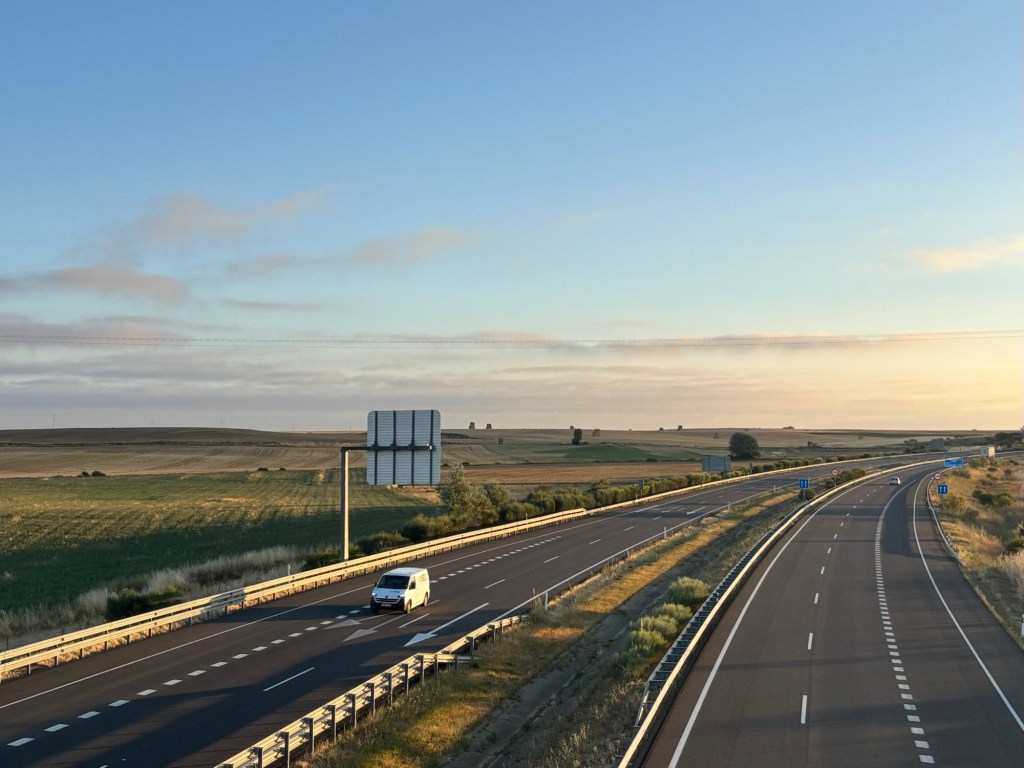
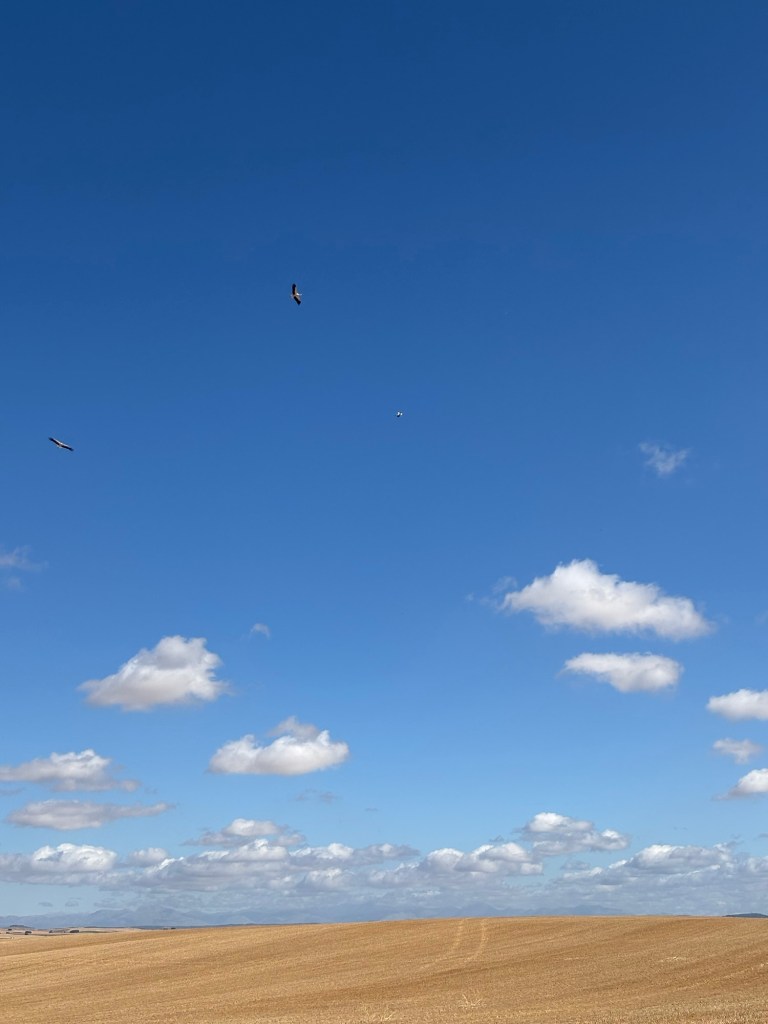
We cleared the 19km distance between Frómista and Carrión in a little over four hours, including a stop in Villalcázar de Sirga for an early lunch. It’s an easy walk, but easily the most tedious of the entire Camino, as it is an arrow-straight line that follows the P-980 highway in its entirety. Opportunities for wildlife observation are slim, and cultural tangents even less. It’s just a long walk in a straight line. At least the storks of Carrión kept us company. We also picked up a new companion in Edoardo, an effortlessly charismatic Italian soldier from Puglia, who was great company on the road.
The Albergue Parroquial de Santa María opened at midday and we were warmly received by the Augustinian nuns and their young assistants, three university students from Galicia, Madrid and Granada. Marta, the granadina, was especially friendly – though that may have been on account of my Andaluz accent which always comes out roaring the moment I meet someone from the south. Edoardo was almost certainly smitten and did his best to charm all three of them, but the granadina especially. I’ve seen a fair amount of bare-faced flirting from older gentlemen on the Camino, but the Italians do it with considerably more panache. It also helps when they’re not over the age of fifty, I suppose.
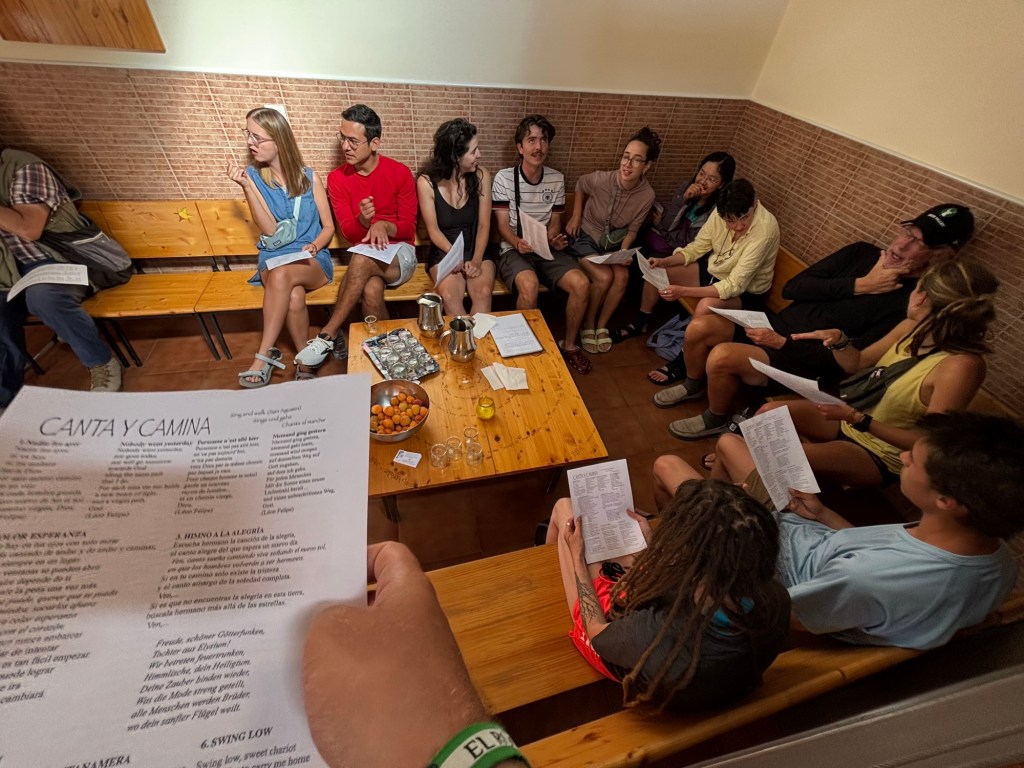
Vespers was beautiful, as Carrión’s nuns are famously musical, led by the vocals and guitar skills of the Peruvian sister (who was here the last time I stayed in Carrión). The encuentro musical was especially magical this time, because unlike Grañón, they asked us outright to share our reasons for walking the Camino. I did, explaining how I’m walking for my grandfather and my great-grandparents who never had the chance – but also as a way of saying thank you to La Virgen del Rocío, who was instrumental in curing me of a tremendously broken heart earlier this year.
And what did they do? They decided on a whim to play us a song for La Blanca Paloma, just for me – the Salve Rociera, known as Olé, Olé. What a beautiful thing to do! I’ve included the lyrics below, because they are so wonderfully poetic:
Dios te salve, María
Del Rocío, señora
Luna, sol, norte y guía
Y pastora celestialDios te salve, María
Todo el pueblo te adora
Y repite a porfía
Como tú no hay otra igualAl Rocío yo quiero volver
A cantarle a la Virgen con fe
Con un olé…
Fizzing with the warm glow of a satisfied acolyte, I went along to Mass. It was… eventful, to say the least. The Bishop of Palencia was in town to conduct the proceedings, which – unbeknownst to all but the townsfolk – had kindled the fire of a small but powerful rebellion.
As was later explained to me by one of the parishioners, their long-serving and beloved parish priest was in the process of being transferred, and the locals – who seemed to adore the man with a fervour rarely seen in the UK – decided to use the arrival of the bishop to make their feelings known. There was a loud buzz toward the end of the service as the doors were flung open, and in marched a large crowd of children and their parents, all of them carrying placards and banners with slogans saying “La voz de la iglesia es la voz del pueblo” and “Queremos que Don Ricardo no se vaya”. The press seemed to have been tipped off, and Don Ricardo made a rather humble exit – I wonder what he made of the spontaneous show of fealty from his flock? It must have been hard to hide any emotion.

After Mass (and the mass protest), I went back to the albergue to help Edoardo make dinner – I cut and cooked the spaghetti and laid the table as the Italian had already prepared an enormous serving of pisto (free from gluten and meat, as it’s hard to cater to everyone with one dish). Together with the nuns and their three volunteers, we put out quite a spread.
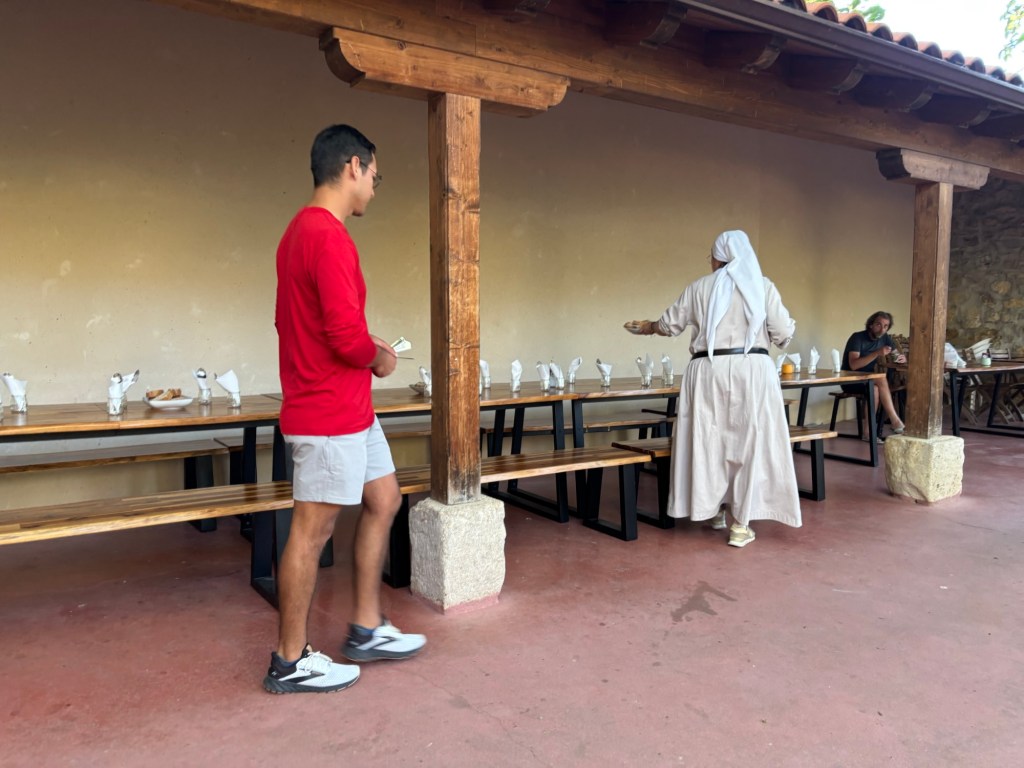
And who should have arrived at our albergue at the last minute but our melon thief! He was conspicuous in his absence from the preparations and did not lift a finger during the clean-up operation, plugging in his earphones and retreating to the other side of the table – present but idle. Not only that, but while the nuns were saying a prayer, he got up and helped himself to seconds and then thirds of the soup the nuns had prepared.
Perhaps I’m being harsh, but this is the fourth time we’ve seen him do this: turn up to an albergue, contribute nothing, extricate himself from the communal preparations and then arrive just in time to devour the spoils, without so much as a please or thank you. Worse, he had the gall to comment that he didn’t think the meal was worth 4€ when the Italian asked for a small contribution to cover the costs of buying the supplies at the end of the supper.
I have spoken to the man previously – who, I am ashamed to admit, is a fellow Englishman – and he admitted that he doesn’t pay in donativos because he believes they’re already dodging taxes, and therefore don’t need our contributions. Which is odd, as he seems quite happy to scavenge off the contributions of others.
Shameful doesn’t cover it. I’m this close to confronting the man, which wouldn’t be in the spirit of the Camino… but if there’s one thing I won’t stand for, as a pilgrim and a teacher, it’s selfishness. I was raised to always put others’ needs before my own, so that kind of behaviour really sets my teeth on edge.
I prayed for him – partly to temper my own frustration and partly out of habit (it’s a good way to deal with people you don’t get on with). I hope he starts to see the light on this Camino and learns to chip in, like so many of us do every day along the pilgrim road, as it would be a dreadful shame if his behaviour cast a dim reflection on the English attitude toward the Camino.
Rant over. I just needed to point out that we pilgrims aren’t exactly model citizens. He’s not. I’m not. I should be the better man and not let it get to me so. But the Camino is the world, and thus have we made it. It’s up to us to call out that kind of behaviour in such a way that everyone feels they can contribute, even in some small way.
I’ll sleep on it. Hopefully I can come up with a way to bring him amicably to the service of his kin. Me, or some higher power.
Our Lady of El Rocío, if you’re listening… give me strength!
BB x
 The Book of Barnabas