Albergue de Ruesta. 16.20.
Picture this, if you can. Call upon all of your senses.
First, sound. Wind, cool and dry, blowing in the branches of the pine trees above, their branches coated in trailing clumps of lichen. A blackcap singing an enchanting solo in the forest, and an endless percussion of cicadas, assailing the ear with their rasping ostinato from every side. You can’t see them. But they’re there. Hundreds of them.
Next, smell. The fresh scent of pine bark, mingling with the dusty trace of crumbling masonry. The occasional coolness of water blowing in off the lake. Mingling with taste, a hint of fried fish from the bar, which closed up shop half an hour ago.
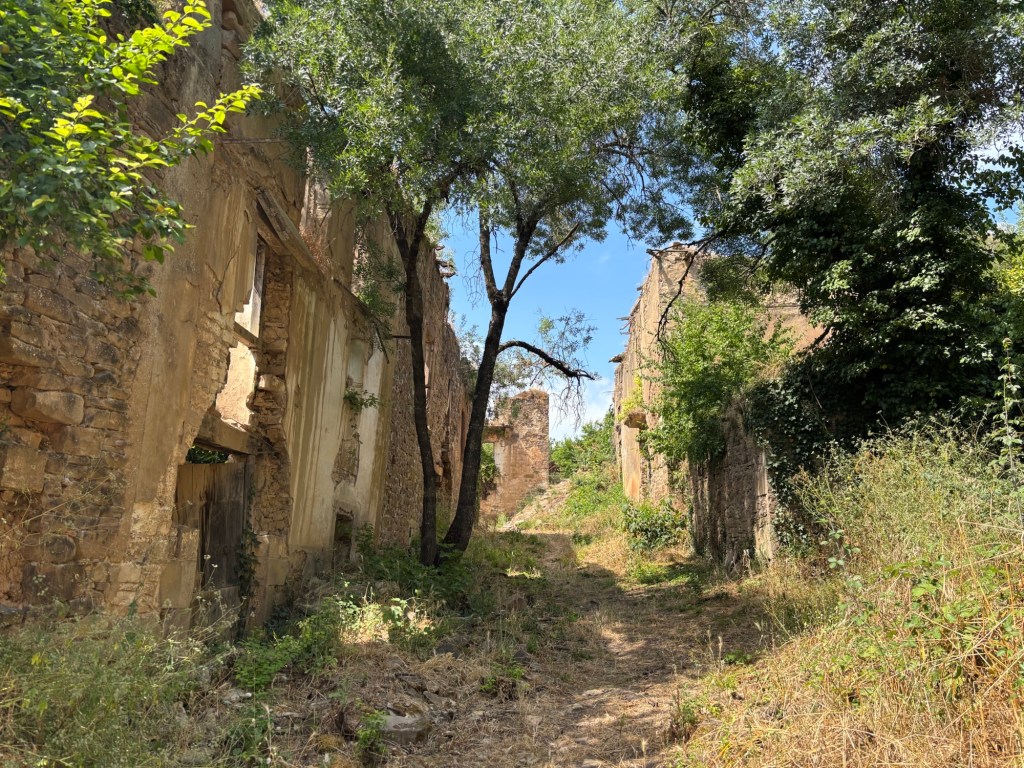
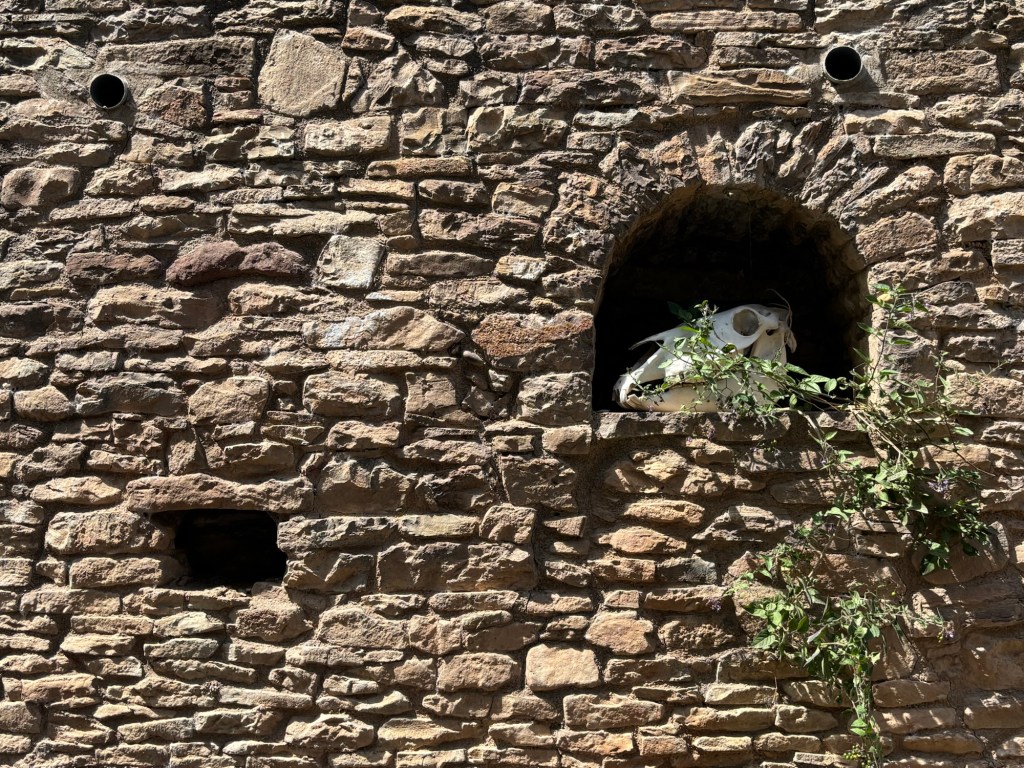
Touch, then. The feel of carved wood, nearly two centuries old. The trace of numbers in stone, chiselled in many hundreds of years before even that. The uneven cobbles of a road long since neglected, and the powdery feel of the houses that line it, within which a thousand plants have weaved a citadel of their own.
Finally, sight. Picture an entire village abandoned a hundred years ago. See the stone balconies, carved with Roman triumph, presiding over an empty world. A church, with fragments of brilliant blue still visible in the decaying fresco above the spot where the slate once stood, stripped bare and opened to the heavens. A lonely watchtower, manned now by thirsty crows, their beaks agape in the heat of the afternoon.
This is my stop for tonight: the abandoned village of Ruesta, one of the last stops before leaving Aragón.

I left on time this morning, shortly before six, sent on my way by Lulu and Nicole with a packed sandwich, an orange and a boiled egg. It felt like being sent off to school. Some hospitaleros really do push the boat out to make you feel at home during your brief stay!
I missed the sign in the darkness and so headed north for a kilometre before joining the road and returning to my westward trajectory. It added about fifteen minutes to my time, but it did give me an unrestricted view of the morning.
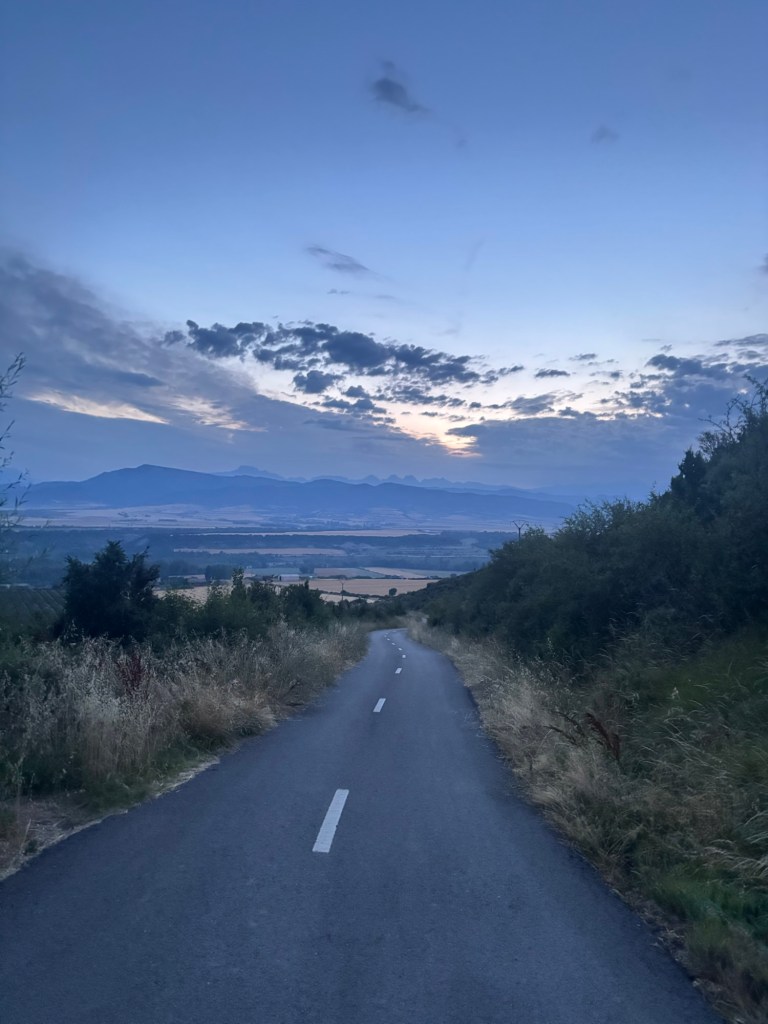
Camino sunrises are something of a tradition on the way to Santiago, but I am going to miss these Aragonese mornings. There’s something about the mountains that makes them that much more mystical. Maybe it’s the way the light turns each row of hills a different shade of blue, always fading toward the base.
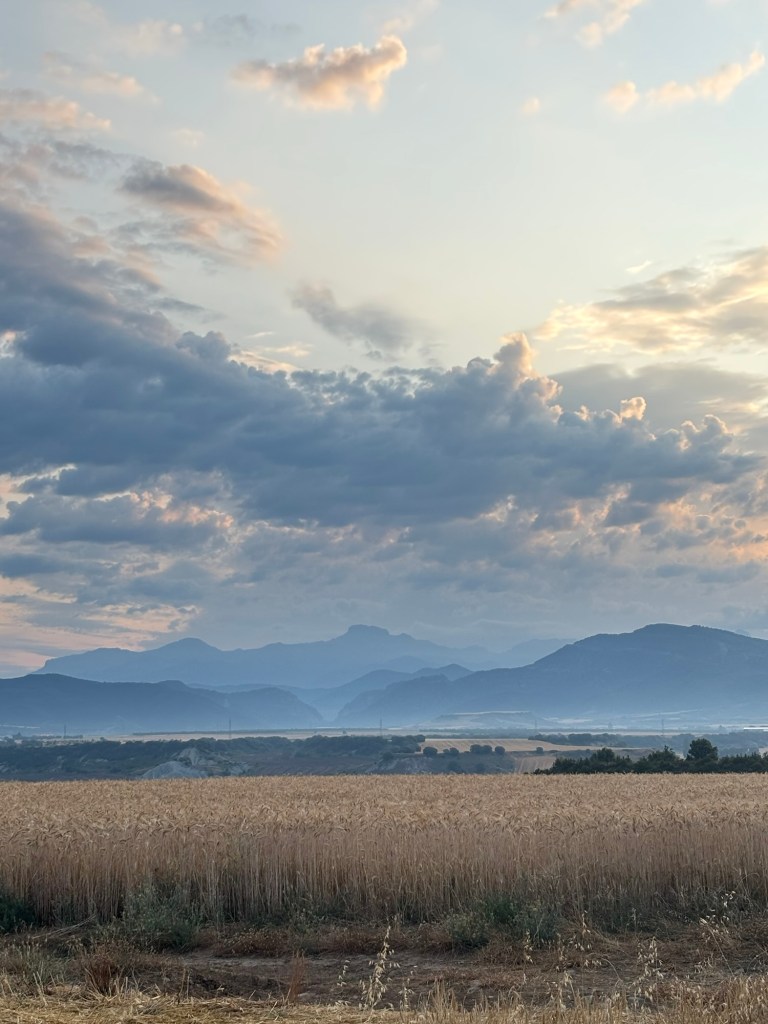
I spent a considerable part of the morning chasing quails. They’re almost impossible to see with the naked eye, standing at around 16cm tall (that’s just over half a ruler) and seldom taking flight when alarmed, preferring to sit tight and rely on their cryptic camouflage to avoid detection. They were all over the place, though – I must have counted at least forty individuals calling from different spots along the Camino in the hour or two after sunrise. They can throw their voices around 150 metres, which can make them very hard to locate, especially when there are four or five in the same field calling at once. I flushed one completely by accident at the side of the road and it took off into one of the vast wheat fields on sharp, whirring wings.
England must have sounded like this, a long time ago. There are places you can go in the UK and hear quails, which do migrate that far (some make it all the way to Scotland), but not on the same scale as you can here in Spain.
Along with the quails, I saw a grey partridge – a rarity in Spain, confined to the north – and goodness knows how many corn buntings, but I think it’s the foxes that stood out the most. There must be plenty in the area, as I saw three within a rather short space of time, including one sprinting across a field near Martés.
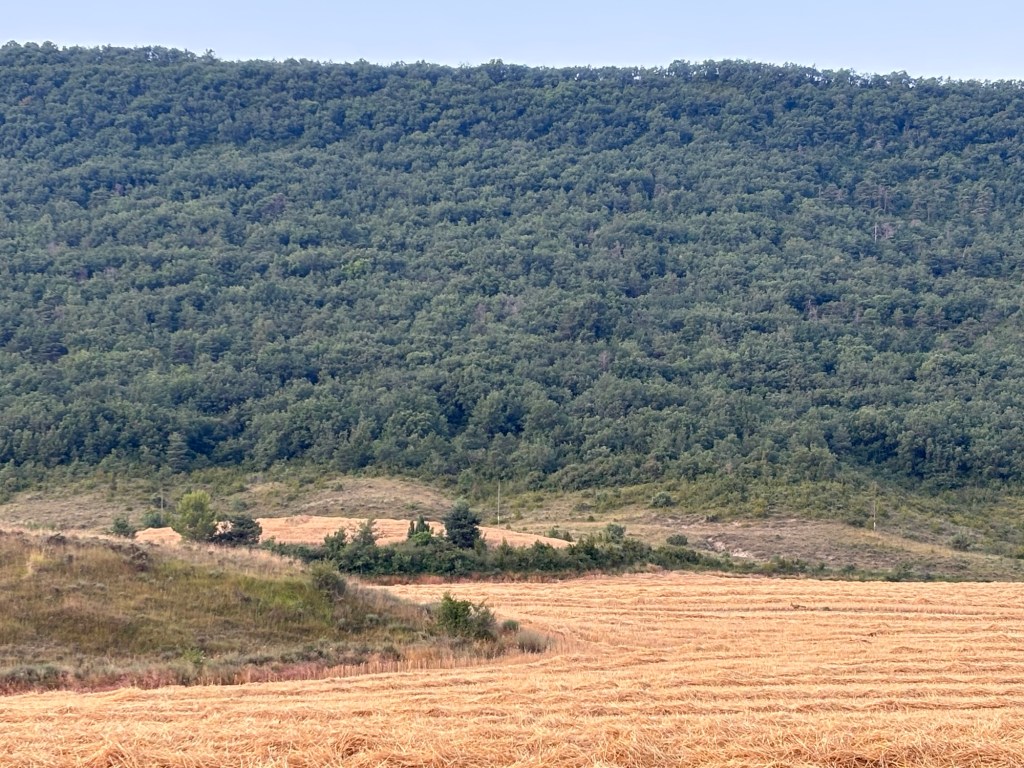
A major feature of today’s walk were the badlands de yeso: strange, wrinkled mounds of gypsum, a distinctive feature of Aragón, Navarra and Almería. This is the kind of terrain that contains fossils like the shell I found yesterday: a prehistoric stockpile of marine life, buried deep beneath the soft grey hills. They’re really quite striking, and since there are no Caminos that pass through the Bardenas Reales to the southwest (one of the strangest lunar landscapes you can find in Europe), the Camino Aragonés does at least provide an introduction.

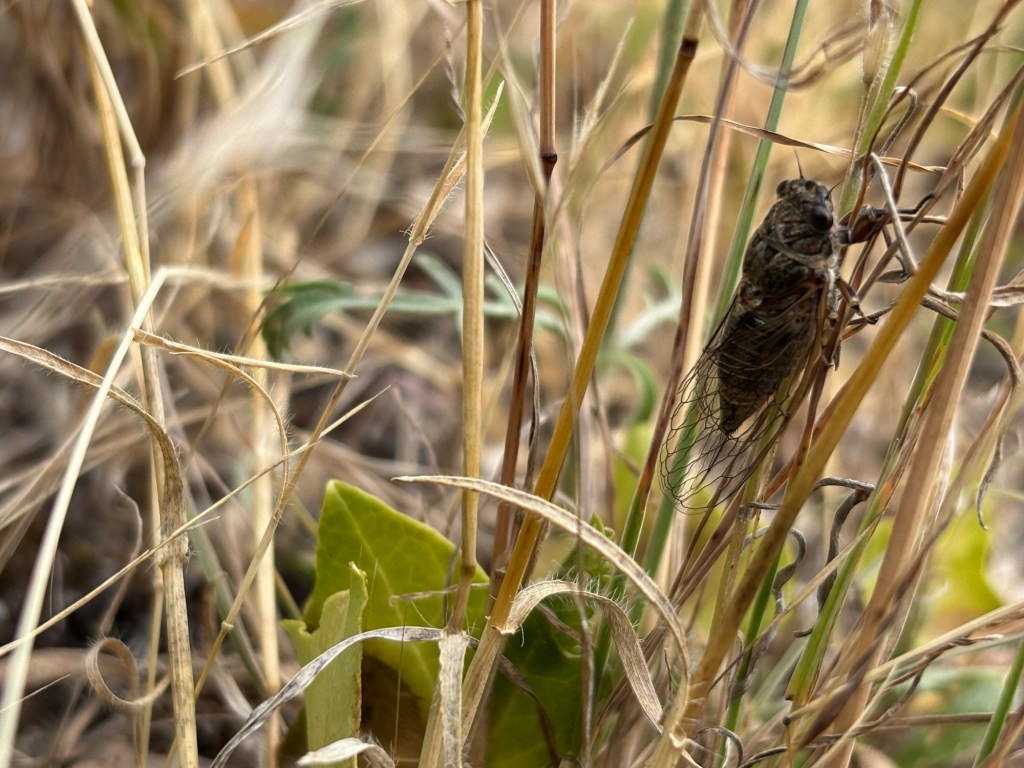
I stopped for water shortly after a brief exploration of Artieda and its gypsum hills (to the great confusion of a local who thought I’d lost the Camino). Here, at my feet of all places, I found one of the ventriloquists: not a quail, but a cicada. They usually conceal themselves high up in the trees, where their voices carry and their mottled bodies blend perfectly into the bark. This one was clearly an amateur, however, as the motion of its churring was trembling the blade of grass in its legs, making it stand out like a sore thumb.
Not to be outdone, my final hour was a butterfly parade, with a scarce swallowtail taking centre stage. I have fond memories of this little creature as it’s one of the ten animals I recorded on my first trip to Spain as an eleven-year-old. Contrary to the famous adage popularised by Muhammad Ali, most butterflies don’t “float”, having a rather manic and jerky flight. Swallowtails, however, are on the larger side, and they do float, or at least seem to, fanning their wings out midflight to glide on the air. They’re skittish, like most butterflies, so it’s hard to get close, but their size, acrobatics and striking colours make them a delight to watch.

Which brings me to Ruesta. There’s really all sorts on the Camino, and Ruesta is very much one of the sorts. Abandoned in 1959 after a lengthy decline – largely because of the construction of the nearby Yesa reservoir, which flooded most of the agricultural land the village depended on – the village has largely fallen into a slow state of disrepair.
Ruesta’s church had some spectacular frescos, which were carefully transferred to Jaca’s Diocesan museum to prevent them from being lost forever. I imagine the place might once have looked not too dissimilar to Artieda, a hilltop town not too far from here. From some angles, you can still just about imagine life as usual: children running down the street to school, the bakery in full swing, old locals gathered at a street corner to gossip…

Ruesta has two functioning buildings: a casa de cultura (of all things) and an albergue, complete with a lively bar/restaurante. The secret to Ruesta’s survival is its acquisition by the CGT, the Confederación General del Trabajo, one of Spain’s larger trade unions. There are plenty of clues for those who don’t recognise the red-and-black flag: the raised fist, the quotes and dates graffitied across the walls and the plethora of signage in Catalan, Galician and Basque (the CGT, being anarcho-syndicalist in its outlook, has strong ties to the local separatist movements).
To their credit, they’ve done a wonderful job. The regional government won’t step in to rebuild Ruesta, as it’s just one of over two hundred abandoned towns in Aragón, so the syndicate has stepped in. They’ve carved out a fully-functioning community in the heart of the old village and are carefully coexisting with the place, without feeling the need to develop or bulldoze what doesn’t serve. The result is a very unique staging post of the Camino de Santiago. There’s not many places along the profitable pilgrim road that have been allowed to fall apart, and yet at the same time been so carefully curated.
I wonder how the future will see us? The creatures of the past left their traces in the rocks by chance. We’ve been deliberately stamping our seal on the earth for thousands of years. Will they marvel at tyre tracks in the mud and put them in museums? Will they weave fantastical stories around the objects they find, like discarded vapes and perfume bottles? What will we make of it all, a thousand years from now?
The Camino gives you a lot of time to think. Six hour walks through the countryside, every day for six weeks… It’s a test of resilience, if not of your sanity. Thank goodness I’m perfectly happy with my own company! BB x
 The Book of Barnabas