Fall

There’s a small oak tree that grows beside the boarding house. It shed its leaves a couple of weeks ago, briefly covering the tarmac in a golden-brown carpet, before the groundskeepers swept them all up into the back of a truck and took them away to the tip. A beautiful gift of death tossed into the trash. Word must have got around, in that silent way that trees have, as so many of the trees around the school have since held jealously onto their leaves well into the usual falling season. My oak, stripped to the skin, looks cold. Winter will soon be here and it has lost its coat.


The world seems a little darker right now. It’s not just the longer nights. The news is full of it. Abuse in the Church of England. Treachery and death in the Middle East. A self-confessed day-one-dictator returning to the White House. Politicians who once laughed at the Man spinelessly throwing in their lot behind the future power base. Shadows creeping over Ukraine. I expected to see more of it on my social media feed, but there’s been surprisingly little said about the US elections. Perhaps the folks I know have listened to the voices in the wind and decided that now is not the time to voice their concerns online. Perhaps they vented their frustration elsewhere. Or perhaps – and I suspect this to be the grim truth – most of them just didn’t care overmuch.


There’s a quote often attributed to the Anglo-Irish philosopher Edmund Burke that runs along the lines of ‘evil triumphs when good men do nothing’. As is the way with so much these days, there’s almost no evidence that he actually said such a thing. We have learned to doubt everything. In that light, how can you blame a nation for putting their confidence in a self-confessed liar?

Burke did, however, say something similar, albeit a lot more profound:

When bad men combine, the good must associate; else they will fall, one by one, an unpitied sacrifice in a contemptible struggle.
Thoughts on the Cause of the Present Discontents (1770)

He might have been writing a little over two hundred and fifty years ago, but he might just as well have been describing the world as it is today. It is always rather chilling when the voices of history stretch their pale and clammy hands into the present.

Until we learn to put our differences aside and work together – even with those with whom we do not, cannot or simply will not see eye to eye – our future will be in somebody else’s hands. Until the educated West accepts this reality, there will be no end to the head-scratching and the bewilderment. I have beat upon this drum since my schooldays, where it was doubtless drummed into me by my teachers, but I still believe this to be true: that you should always be prepared to listen and engage in conversation, no matter what you believe. Cancel culture does not work. It just fans the flames of those who feel their needs are being ignored and their voices silenced. We are marching into an increasingly intolerant age, and it worries me that those who fight for tolerance’s sake are among the vanguard, whether they know it or not. Men like Trump ride into power on the backs of such virtue-signallers.

I’m reading my way through a number of books to try to see the world through somebody else’s eyes. It’s my way of dealing with the situation – particularly when my profession is to help children to make their way in the world. I’ve started with Douglas Murray’s The Strange Death of Europe in an attempt to understand the growing immigration frustration in my country (having been an immigrant myself, however briefly). Ilan Pappé is in the wings. I can’t say I agree with everything I read, but it’s broadening my perspective a little more, and that’s no bad thing.


In the spirit of remembrance, they read the list of names of former students of the school who lost their lives in the two world wars in front of the war memorial yesterday. All of the numbered fallen had one thing in common: not a single one had died on the field of battle. Died in a collision during training. Run over by a lorry near base camp. Killed by an explosive during a training exercise. Shot down by friendly anti-aircraft fire after returning from a successful mission. The senseless waste of war was never more plain. When I was younger I had the morbid suspicion I would see another such great war in my lifetime. It was only ever a whimsy, but these days I am not so sure.

Some of the students were dressed in their military uniform. I had a grim vision of a towering cenotaph. Etched into the cold marble slab were names from every corner of the globe. I hope it does not come to that.


On closer inspection, my little oak has not lost everything. Not yet. A few golden leaves have held onto life, a full fortnight after the rest bowed to the inevitable. It just so happens that they are growing on the branch that reaches closest to the light. I wonder if that is what is keeping them alive.

We can’t give up hope. Hope is one of the things that makes us human. As winter draws near and the world darkens a little more every day, remember to hold on to the light in whatever form that takes for you. It is a warm and precious thing. BB x

Tiny Wings

3rd October, 10.40pm. The Flat

The October half term holiday came to a rather unorthodox end this evening with a last minute trip into town to catch a talk by celebrated English nature-writer, John Lewis-Stempel, on his latest release: England: A Natural History. It isn’t every day you get to meet people who you have grown up reading, and as this is a year for saying yes to things, why not? I came away with a signed copy and a really interesting chat with the author about the importance of names – not just the scientific names of the animals and plants around us, mind, but the old English names that are disappearing even faster than some of the creatures themselves: you might have heard of a peewit or yaffle, or possibly even a dumbledore, but would you know a bumbarrel or cuddy bear* if they were sitting in a tree in your garden? (Answers at the end!)


I’m feeling much recharged after ten days’ leave. These boarding school terms really do knock the stuffing out of you, though as I like to say, I’m happiest when I’m up to my eyeballs – it leaves less time for dwelling on things. I left it a little late for any far-flung adventures this year, but I did make it to Dartmoor a few nights back, taking advantage of the last few days of the public bus service that crosses the moors before they shut down over the winter.


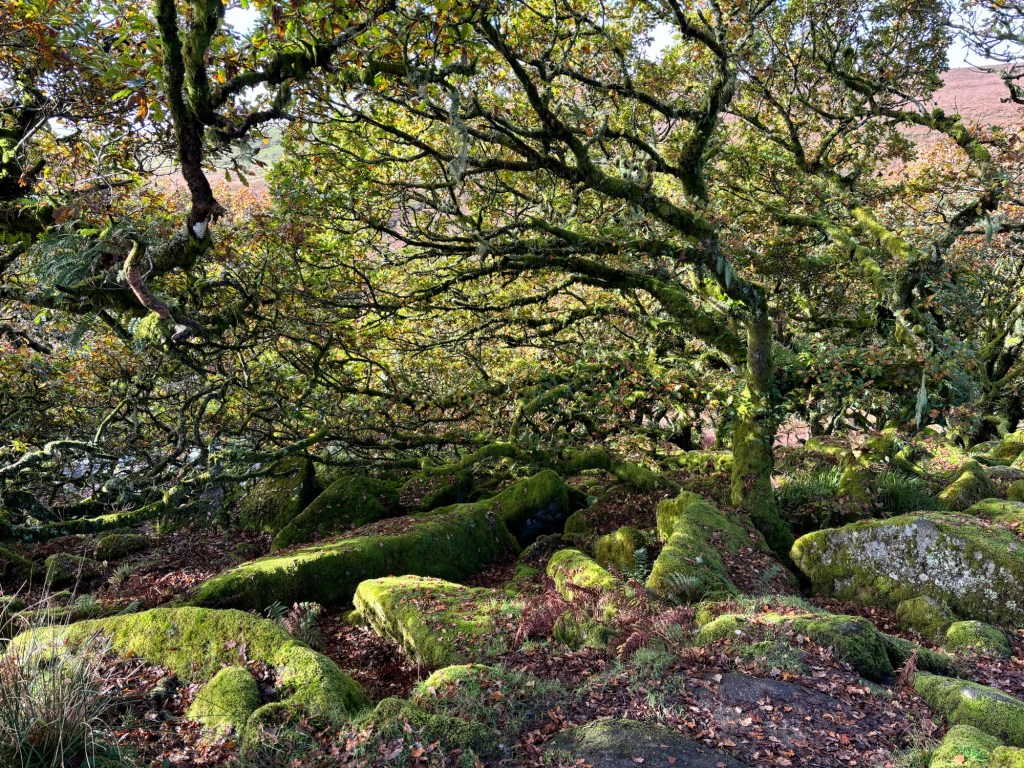
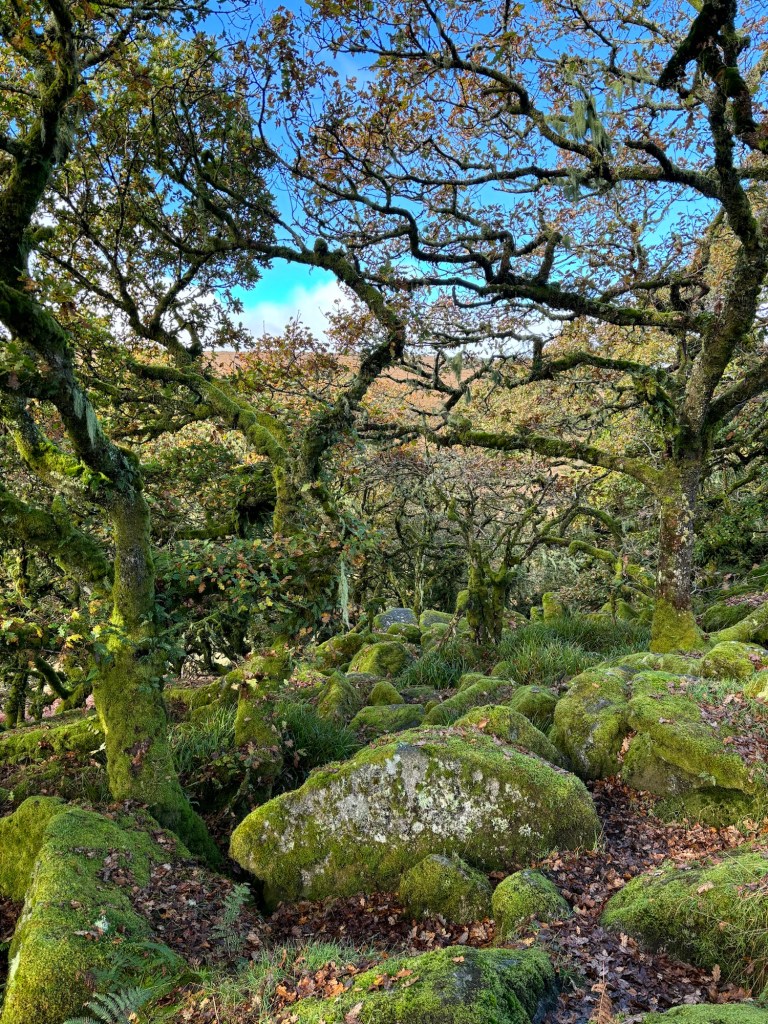
Why Dartmoor? Possibly because it’s arguably easier to get to by public transport than Exmoor, which is a lot closer, but mainly because I had an insatiable itch to see the legendary Wistman’s Wood, a tiny sliver of temperate rainforest nestled deep in the heart of the national park. It popped up in a number of ghost stories I read a while back and again in Guy Shrubsole’s The Lost Rainforests of Britain. The desire to see that last fragment of the Great Wood that once covered this island ended up pressing against the inside of my skull like Wistman’s own stunted trees.

I was holding out for mist and fog, but I had neither. The weather was actually remarkably pleasant for fickle Dartmoor, so instead of mirk and mystery I was treated to soft clouds and sunlight through the ancient branches; the kind of warm glow that Tolkien bestowed for a moment upon Fangorn Forest, an ancient wood of his own design. Did he pass through here, I wonder? His faithful illustrator Alan Lee certainly must have done at some point.


Just as it sits in a valley in the innermost chamber of Dartmoor’s heart, so too is Wistman’s Wood at the heart of much of Dartmoor’s folklore. It is said to be haunted by the spirit of a terrier who can still be heard scampering through the boulders, while by night it is prowled by the far more sinister wisht hounds, a local variant of the hell-hound myth that can be found across the British Isles, from the gytrash and Barghest to the Beast of Bodmin. The wisht hounds were believed to be kennelled in Wistman’s Wood by Old Crockern himself, the ancient pagan spirit of the moor whose foreboding tor rides the crest of the hills a short distance to the west of the woods.

There were no malevolent spirits during my brief stay, of course – at least, none that I could see from my perch atop a boulder on the fringes of the forest (visitors are no longer allowed to enter the wood proper, so as to protect the longevity of this sacred and truly unique ecosystem). But that is not to say the place was lifeless: quite the contrary, in fact. There was no wind, but the trees were alive with rustling leaves that turned out to be the beating of tiny wings. In the space of a single minute I clocked three species of tit (blue, great and coal), blackbirds, redwings, wrens, robins, tiny treecreepers and the truly pint-sized goldcrest, our smallest native bird. I haven’t seen a forest so alive in a long time. Even the air itself felt different, a fact that would have been obvious to all but the senseless by the thick, mossy lichen growing on every surface, a perfect natural yardstick for a healthy forest.


I spent the next five hours or so wandering in a wide arc around the surrounding moorland, following a rather makeshift path swiped from the internet the night before. I haven’t hiked around Dartmoor since I was at primary school, so I’d forgotten that, up on the moors, river crossings are often not bridges but rows of stepping stones. Which are a delightful challenge in balmy summer weather, no doubt, but something of a roadblock after the first heavy rains of autumn. I made the tactical decision to not tempt fate and so I took off boots, rolled my trousers up to my knees and waded across.

I hardly need to point out that Dartmoor’s rivers are devilishly chilly – and surprisingly deep. I was just shy of the other bank when the water came almost up to my waist. Thank goodness I’d brought a spare pair of trousers, or I’d have had a very wet hike back to the inn!


Luckily, as I crested the hills due south of Two Bridges, the sun came out to guide me home. It seemed to turn the grass to gold, in a wave that washed down the hillside until I was stranded in an ocean of golden blades. I straggled up to the Crock of Gold, a small stone-strewn vantage point where, as if on cue, a shining rainbow daubed itself across the grey sky to the north. No leprechauns on this occasion, but I got my gold one way or another.


Well, I’d better put down my proverbial pen and get some sleep. Back to work tomorrow, and another busy term awaits! BB x


*Bravo for holding out for the answers! A peewit is of course a lapwing, a yaffle is a green woodpecker and a dumbledore is a bumblebee, while cuddy bear and bumbarrel are old English names for the wren and long-tailed tit respectively! Go figure!