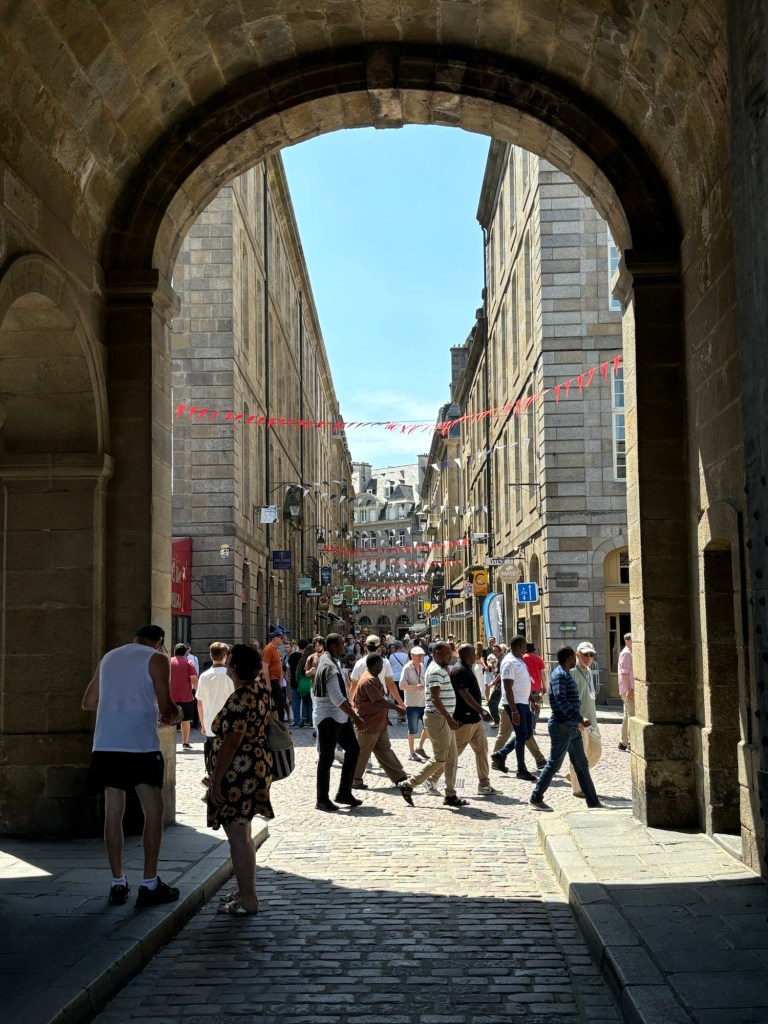
The sun is going down on my second night in Saint-Malo, an enchanting walled port city on the north coast of Brittany. Hector, the herring gull that seems to come with the AirBnB where I am staying, has gone up to the roof to roost. Swifts are still screaming outside and the moon, two days away from its full phase, is already creeping up behind the district of Saint-Servan across the harbour to the southeast.
I’m not entirely sure why I settled on Saint-Malo. My first intention was to make for Saint-Jean-de-Luz on the Basque coast, following a tip-off from a French student at Worth. One way or another, I ended up being drawn to the northwest, and Saint-Malo seemed the natural choice as a base of operations: easily accessible by train, ferry links to Portsmouth, a good combination of sandy and rocky beaches and a former pirate town to boot. It’s also not far from Normandy, and I did so love Normandy the last time I was here. After all, that’s what this whole trip is about, isn’t it? Finding something about France that will spark my interest?
I think I first heard of Saint-Malo in the famous French sea shanty Santiano by Hugues Aufray. My dear friend Andrew slipped that track my way a few years ago, so I owe him for this discovery. It really is a very special place.
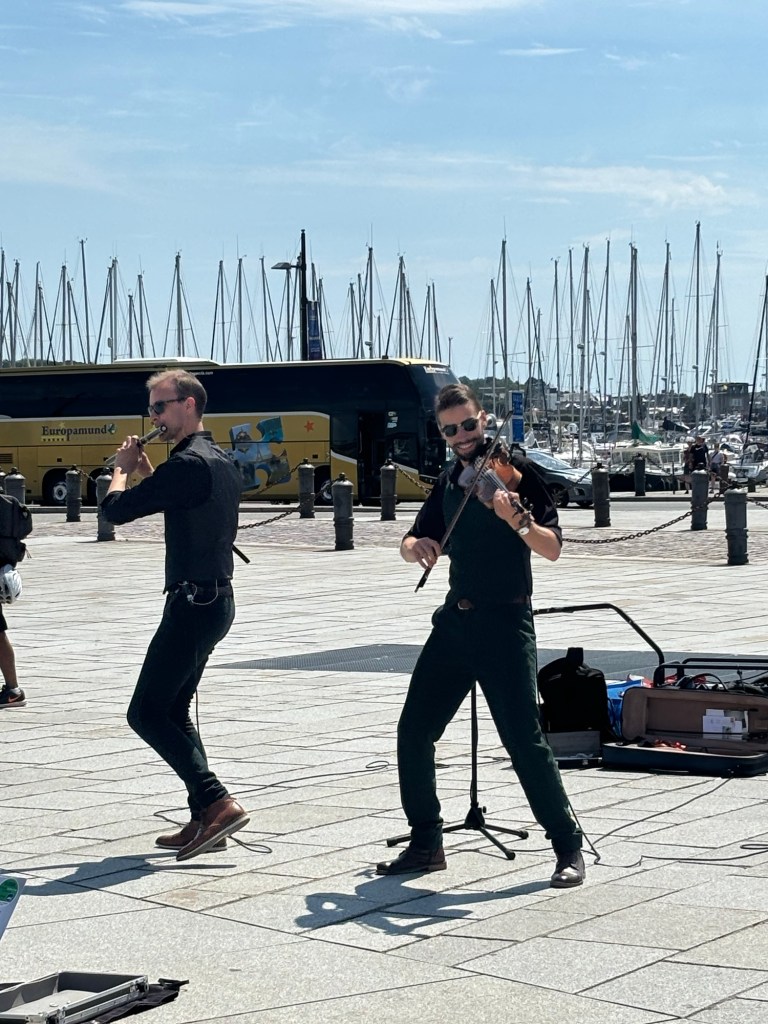
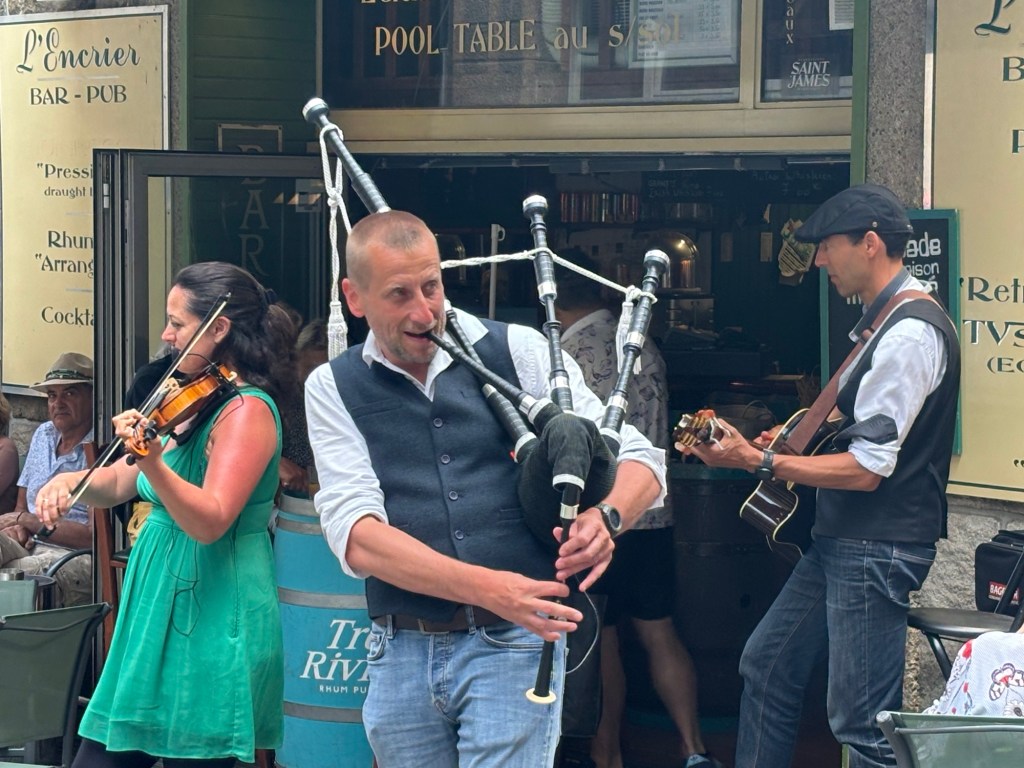
When I arrived yesterday, a local folk band, the Green Lads, were playing a merry medley of familiar folk songs. A few hours later I ran into another trio of buskers, Celtic Whirl, entertaining tourists with a run of similarly Celtic songs, including the theme to Last of the Mohicans. One of the players even whipped out a set of Breton bagpipes, known here as binioù braz (a 19th century Scottish redesign of the local Breton variety). I stuck around for about half an hour in both spots and couldn’t help tipping generously and tapping my feet. It’s strange that neither of the two groups have a French name – they’re both clearly French – but maybe it appeals more readily to the tourist trade (who – he adds with poorly concealed contempt – don’t seem to make much of an effort to speak any French).
Galicia. Brittany. Cornwall. There’s obviously something that draws me to these Celtic corners of the world. Maybe it’s the fact that my instrument is the violin (despite all the noise I make about playing the bass guitar), and that I found a sanctuary in jigs, reels and hornpipes when all the studies, scales and exam pieces got too stultifying for my teenage mind. Perhaps there’s more to it than that, though what it is, I really cannot guess. But I do believe that if I had not taken up the post at Worth seven years ago and instead gone on to a teaching post in Galicia, as was the plan, I might well have stayed there. I think it was the discovery of Galician folk band Luar na Lubre which forced my hand. Galicia is notorious in the British Council auxiliar programme for its charm: few apply for the place, but those who end up there have nothing but gushing praise for the quality of life when they get there.
It just strikes me as odd that, for all my obsessive investigations into the Jewish and Islamic influences on Western Europe, it’s the Celtic corners that I keep coming back to. I wonder why that is? My mother was always very keen to point me in the direction of my Spanish heritage, but I think I’ve been doomed since the moment I heard the first five notes of The Corrs’ Erin Shore.
Yes. That must be it. I blame the Corrs. They’re definitely responsible. I used to listen to Forgiven not Forgotten obsessively on the way to and from school when I was younger, and the fact that they got a shout-out from my favourite childhood author, Michael Morpurgo, probably didn’t help. They have weathered every new wave, every genre, and the aforementioned album remains stubbornly in the top spot of my all-time favourites. I still have the cassette and its case. I think I always will.
I enjoyed a delicious dinner of moules marinières before watching the sunset over Grand-Bé, the larger of the two islets. The French Romantic Chateaubriand is buried there, and when the tide is out tomorrow I will go in search of him, and see why he chose that spot for his forever resting place. As a fellow Romantic, I can’t say I blame him for choosing this town. Saint-Malo is as shining as the shimmering stardust on its shores, when the tide pulls it back out to sea. BB x

 The Book of Barnabas