Storm Clouds over Soho

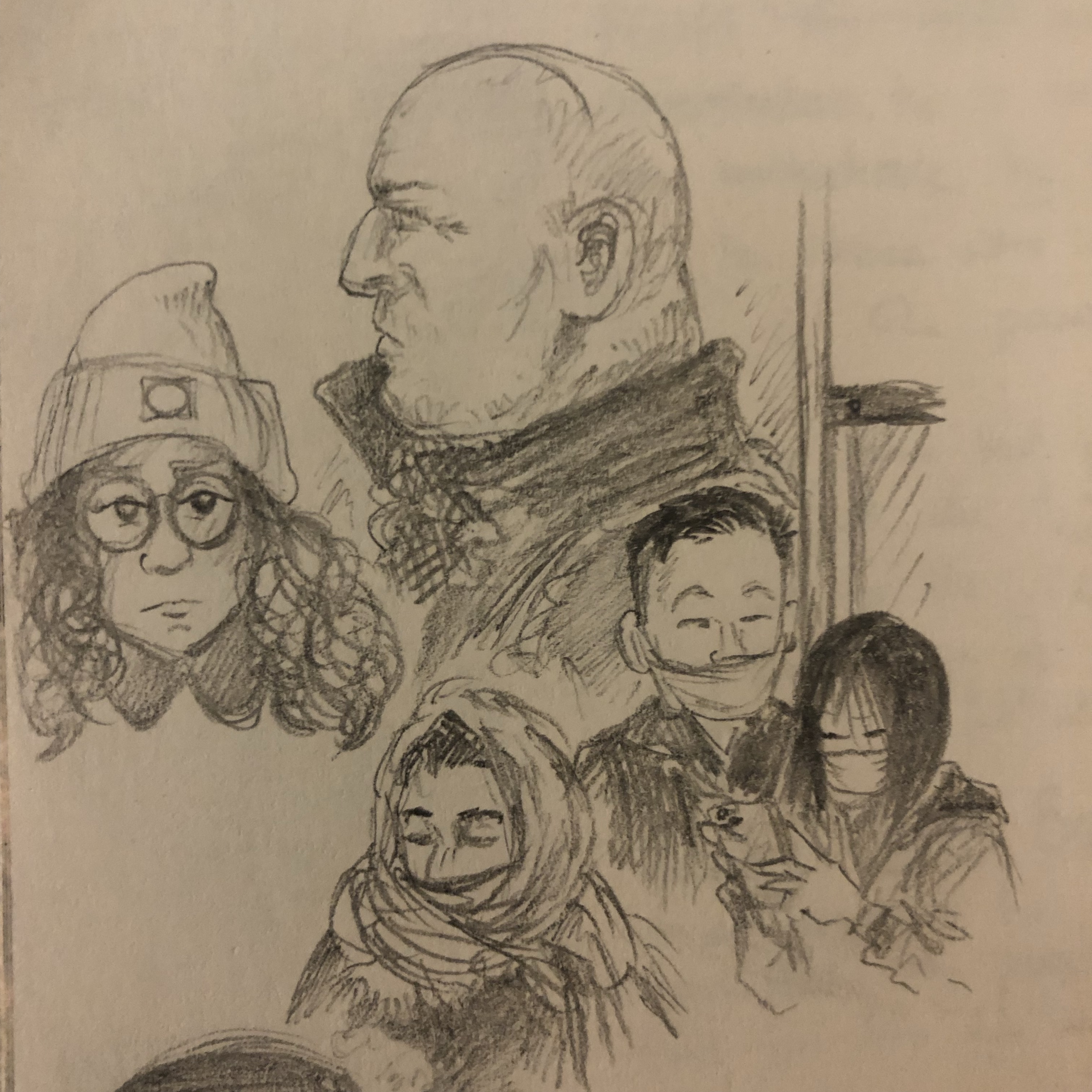
I got the train up to London today with a view to getting my hands on a decent pair of shoes, since I’m told the Italians can be a little snobbish when it comes to standards of dress. With the Northern Line under repairs, it took a little longer to get up to Bloomsbury, so I took a leisurely ride on the Circle Line from Blackfriars and indulged in a favourite pastime: sketching commuters on the Underground. There’s an art to it (no pun intended) – you’ve got to be quick, since most of them only travel a few stops before getting off. And now that face masks are a minority affair, it’s a lot more enjoyable a practice than it was.
Predictably, I got waylaid in Gower Street’s Waterstones en route to the shoe shop. Ever on the hunt for new additions to my Spanish library, I thought I’d do some digging at one of London’s finest bookstores, since it’s been quite a long time since my last visit. I managed to exercise a considerable amount of restraint this time, leaving behind two case studies on the Inquisition from the antiques section in the basement and Minder’s The Struggle for Catalonia… though I’ll be back for that one eventually. Giles Tremlett has brought out a new book on Spain which looks like it will pump out a lot of material I can use with my A Level Spanish students, which is my way of justifying that purchase. The only book I didn’t question was an account of Walter Starkie’s Camino. Starkie wrote so vividly about his journeys as a minstrel across Spain in Spanish Raggle Taggle and peppers his writing with old verses all over the place, so I had to salvage that one.

I wandered down towards Oxford Street in search of a decent pair of shoes, but I couldn’t find anything that jumped off the shelves at me, so I decided to make do what I have (a fine piece of advice at the best of times, which I wantonly ignore whenever I should be near a bookshop) and cut across town back to the river through Soho.

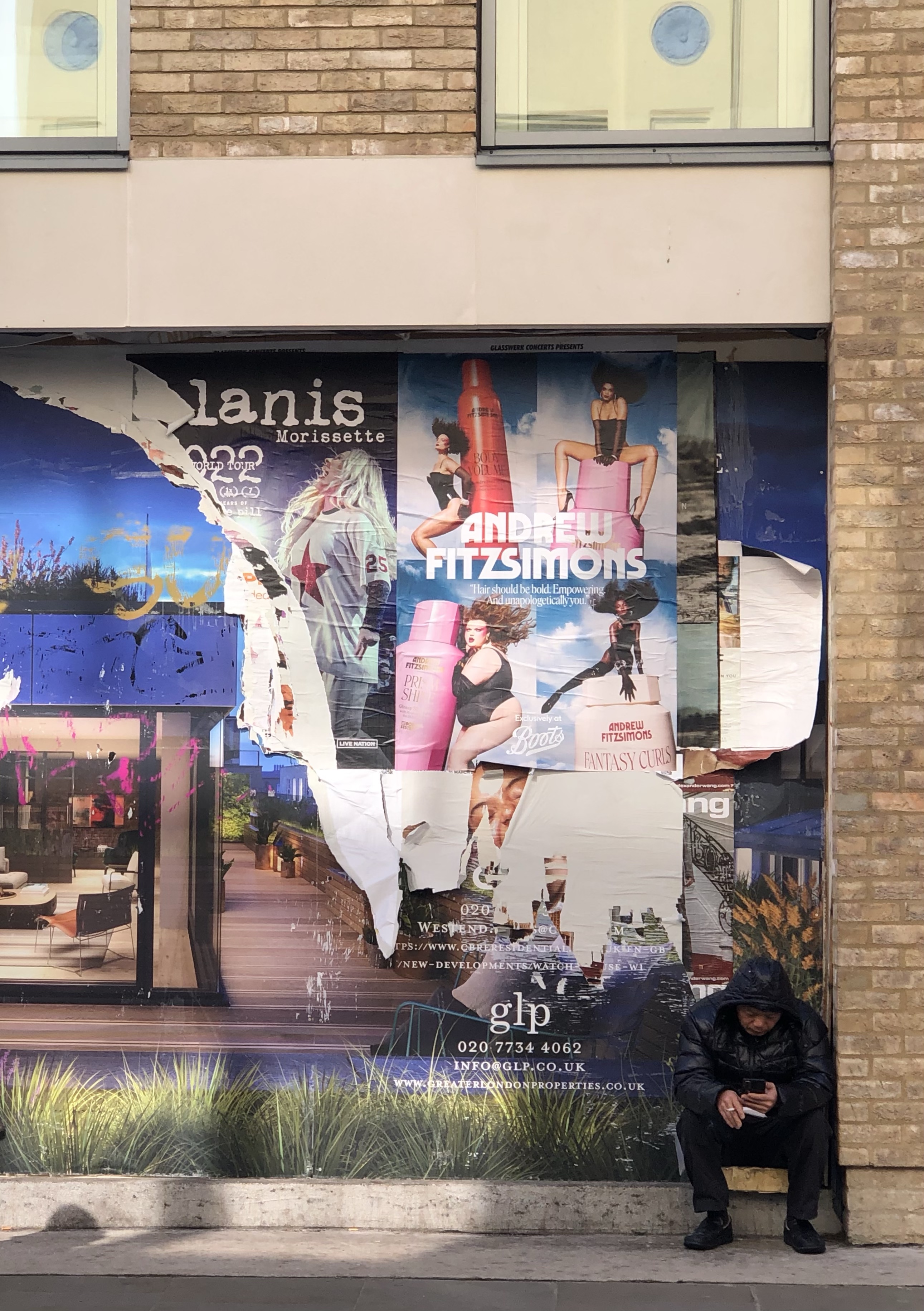
I’ve either forgotten how luridly seedy Soho is, or I haven’t properly explored the place before. What looked like a shortcut led me down a dark alleyway with shady adult stores on either side. The noise of Oxford Street seemed to die in the distance, like the record player in the Waterstones’ basement, stifled into silence by a wall of books… only now by grimy bricks and a mere sliver of sunlight through a gap between the buildings above. I almost collided with a stocky man in a big puffer jacket with a cough came lumbering out of a film store, stuffing something under the sleeve of his coat. Two Arabs stopped talking and gave me a funny look as I passed, clutching my journal in one hand and one strap of my rucksack with the other, humming the tenor line from Ola Gjeilo’s Northern Lights to myself. I guess Soho isn’t on the tourist trail.
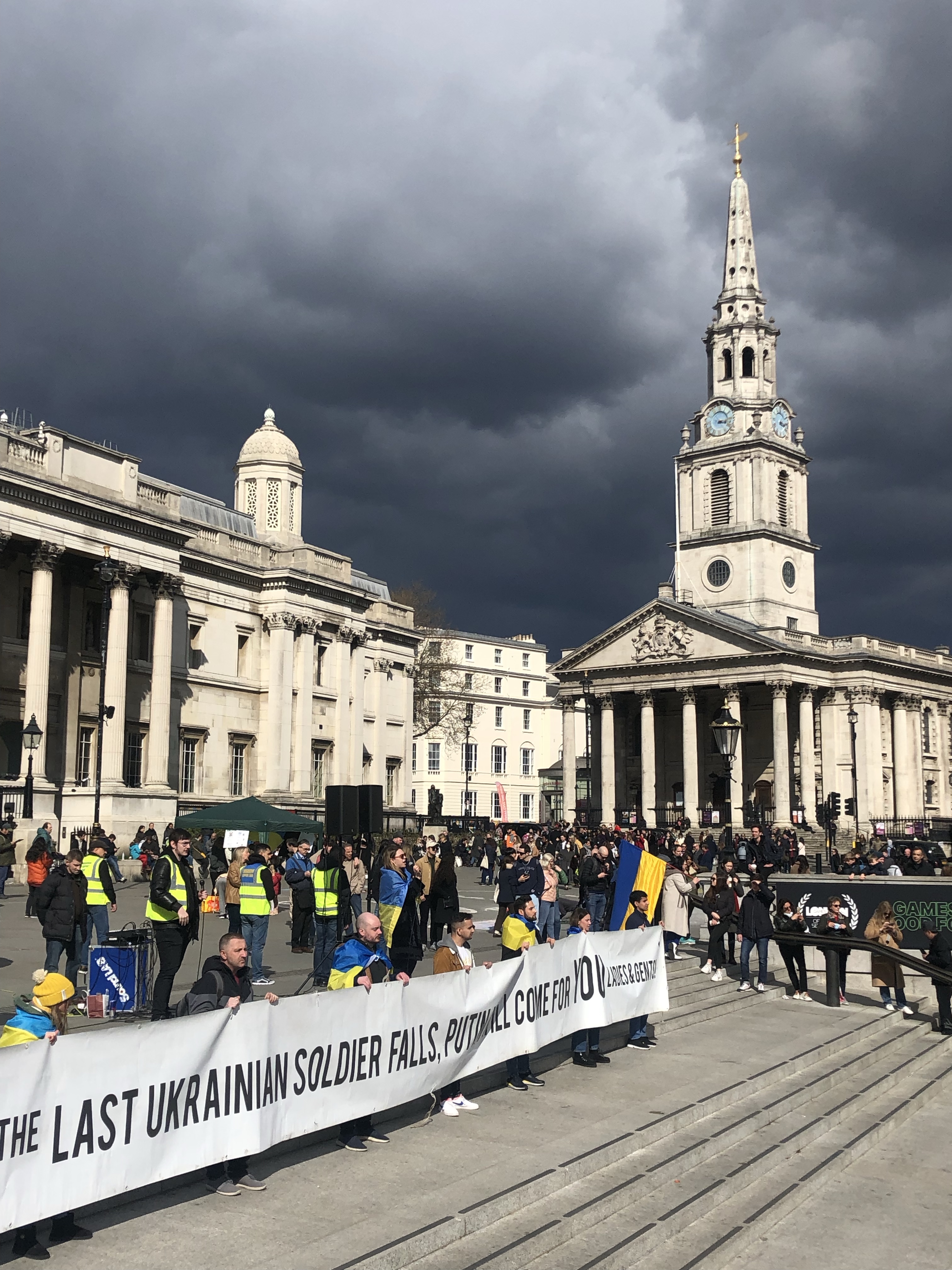
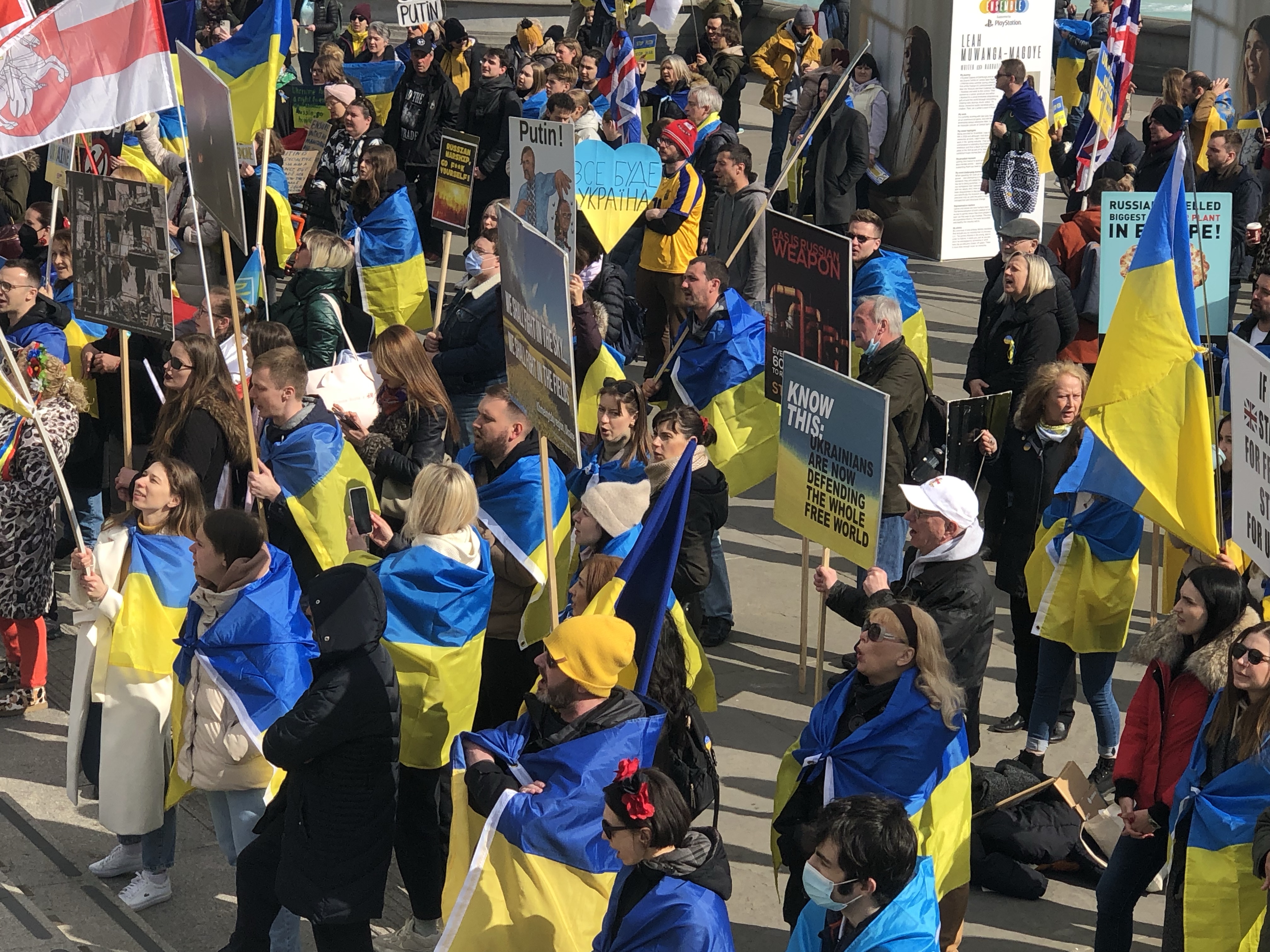
Leaving Soho behind, I wandered through the crowds in Chinatown and came out onto Trafalgar Square, where a large crowd had gathered on the steps. Unsurprisingly, it was a rally against the war in Ukraine. Blue-and-yellow flags fluttered high above the throng, joined here and there by Polish and Hungarian partisans adding their colours to the mast. One woman, the tryzub emblazoned on her cape, stood defiant at the front of the congregation, fist raised in a powerful salute for most of the half-hour I stuck around to watch.
Boycott Russia.
Arm Ukraine.
Stop Putin, stop the war.

Those were the chants, coming around and around before the crowd. The main speaker apologised for the necessity of being so blunt, before decrying the rape of Ukrainian women by Russian forces and the slaughter of its children. An Englishman spoke slightly hesitantly about the need to support Ukraine’s disabled and elderly refugees, and a Ukrainian began to sing a national lament as the sky darkened overhead and the sun faded from sight. I’ll admit I half expected there to be a police van lurked nearby, its officers on standby for any disruption, but I couldn’t find a visible copper for love nor money.
The last time I saw a demonstration like this was back in October in Madrid’s Puerta del Sol, as I walked back to my hostel with one of my cousins. “They’re always here,” he told me, “and so are they,” indicating the loitering policia who hang back just shy of the crowd, silent, hands on their truncheons, watching the Republican flags flying in the night air. The crowd was surprisingly mixed: an old man in a flat cap stood shouting his passionate support in the centre of the throng, while two girls shared an equally passionate and equally political moment on one of the bollards. The policia watched on, silently.
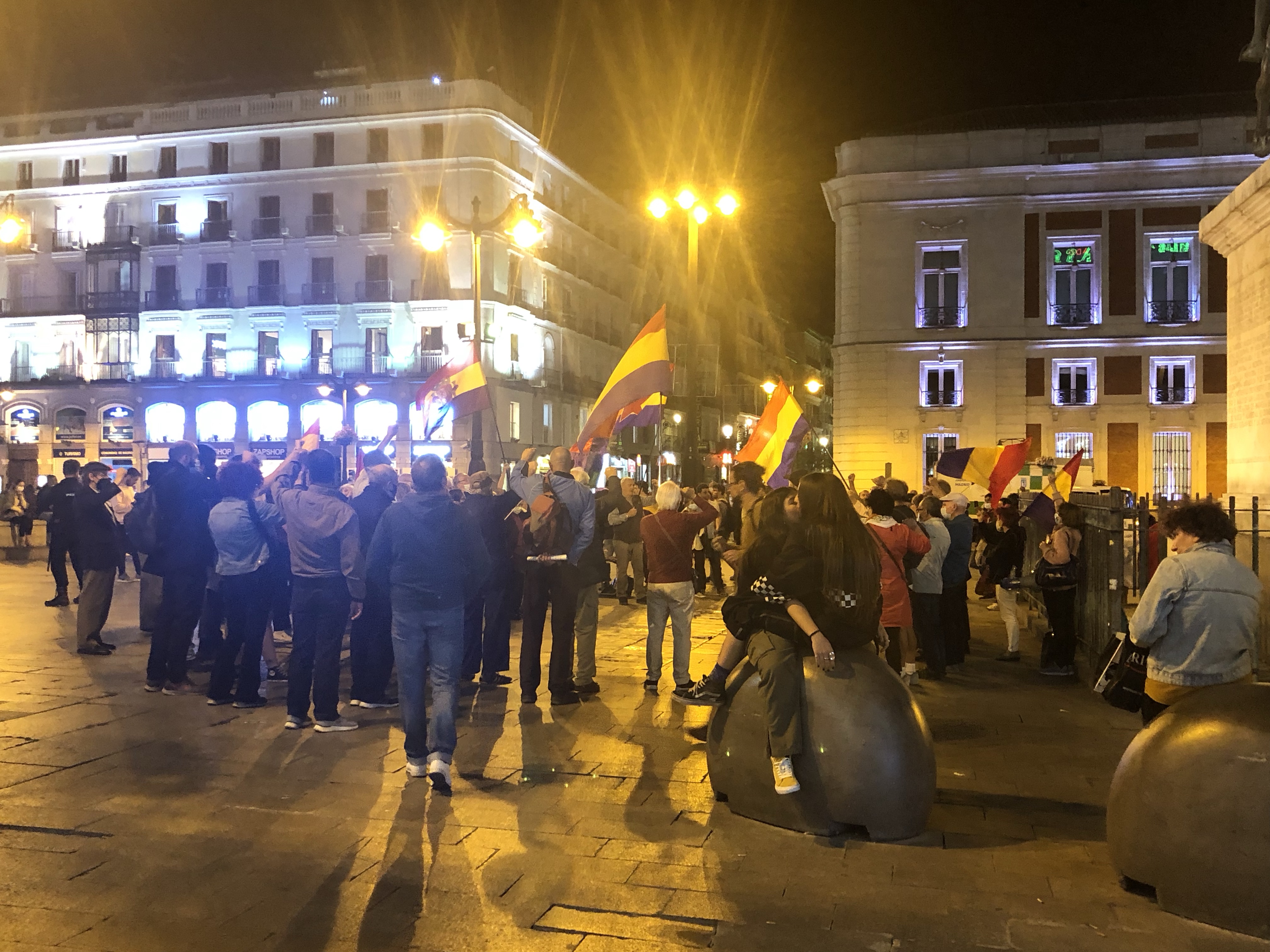
Puerta del Sol, October 2021

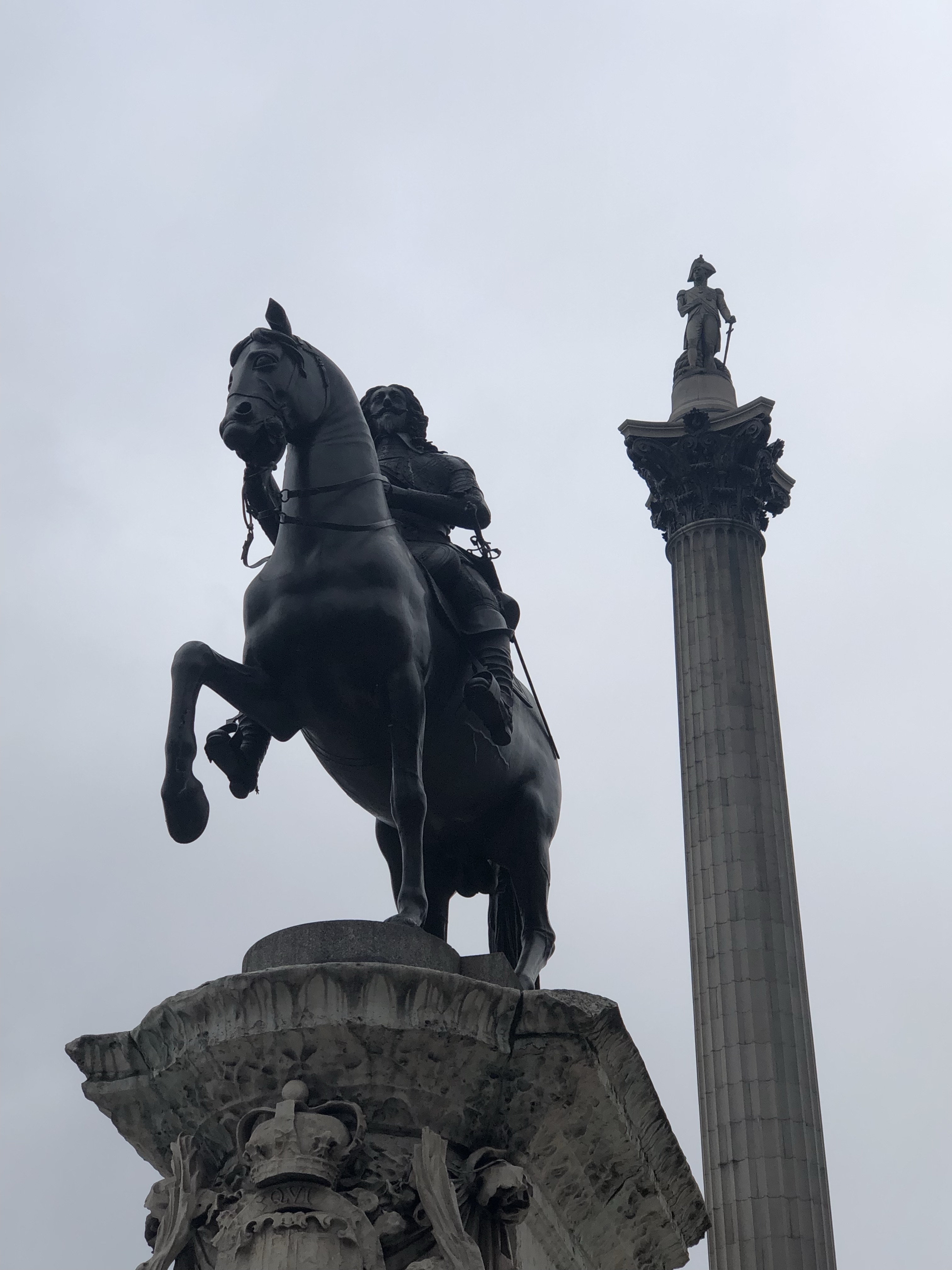
On my way back to the station, I stopped at the traffic lights and looked back to Trafalgar Square. Lord Nelson and a mounted Charles I stared southwards over my head, silhouetted against the clouded sky: two men who got personally involved in European wars and paid a physical price for their efforts. Little wonder, then, that the European powers are so reluctant to send any troops into open battle to defend the Gateway of Europe.
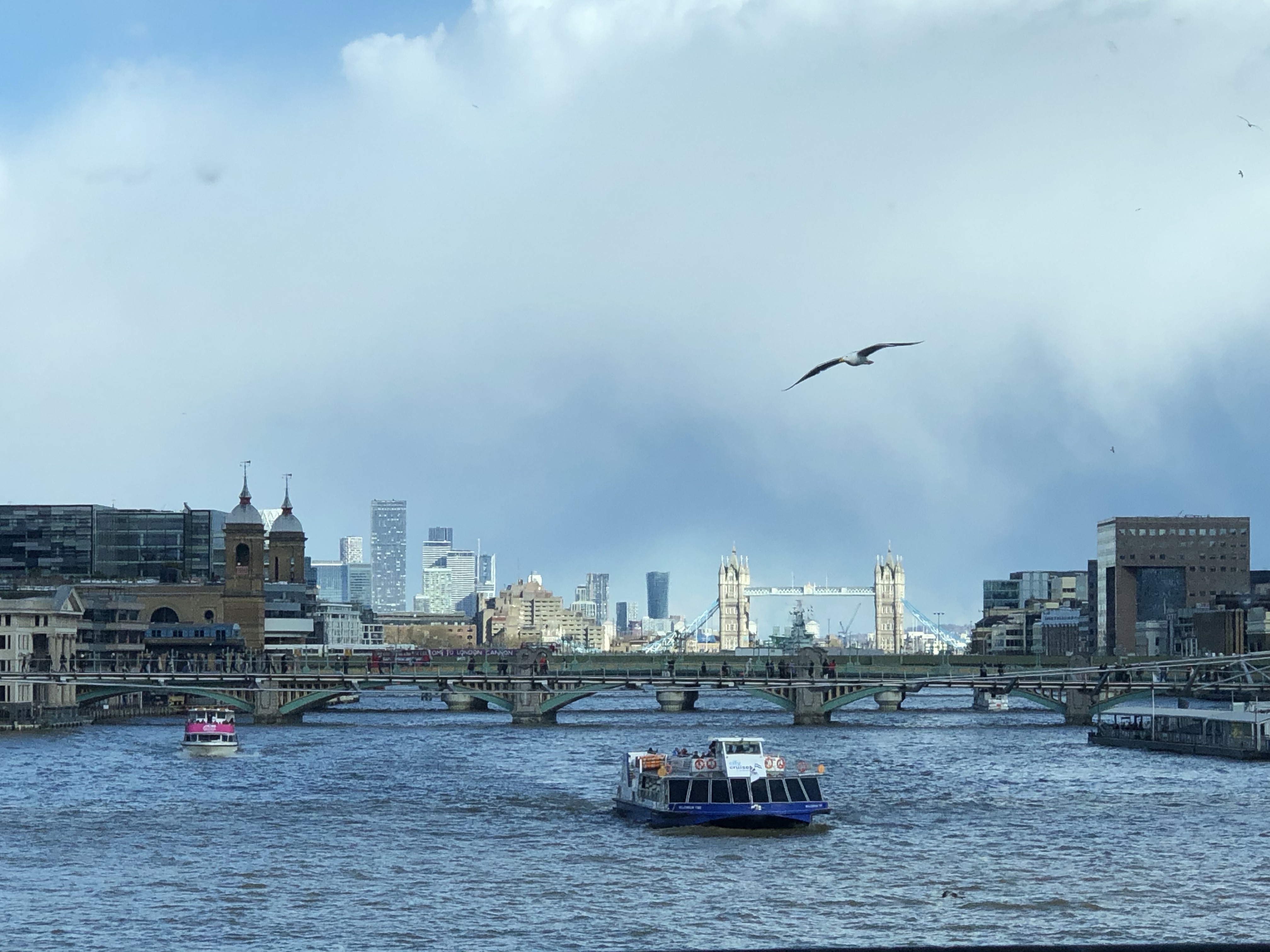
Back at Blackfriars, the rally seemed a world away. I missed the early train by a whisker and had to wait twenty minutes for the next one. A Catalan girl sat on a bench nearby, a red-and-yellow skiing jacket from Cerdanya proudly displaying her winter colours. I instinctively reached for my face, but my usual rojigualda facemask was at home: I’d opted for a less nationalistic face covering today. Away to the east, the sun broke through the clouds over the Thames, lighting up Tower Bridge against the rainclouds rolling in from the south. London seems to go on forever, whatever happens to the rest of the world, and yet it’s Rome that holds the title of the Eternal City. I’m looking forward to seeing it with my own eyes and reading such stories as I can find in its people and its streets. BB x
Keep the Faith

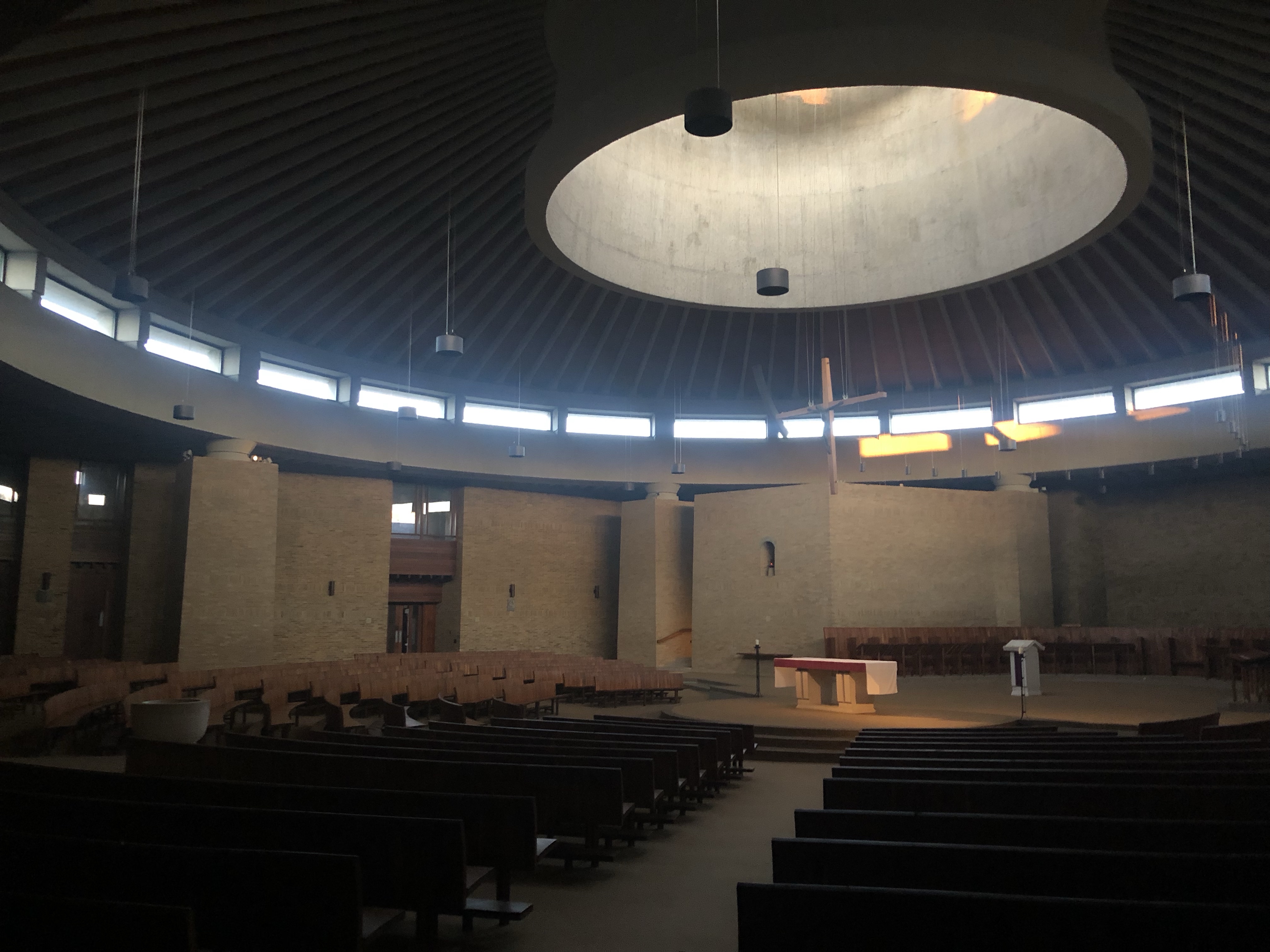
Last night, in a return to pre-COVID tradition, we celebrated Tenebrae in the Abbey Church. With the latest wave of infections sweeping the staff and students, I’ll admit I had my doubts I’d be able to go up and sing as I used to with a house to run, but my housemaster very kindly stepped in, allowing me to bolster the tenor line. It’s hard to overstate the importance of making music in my faith: singing is an act of worship. Perhaps that’s why I didn’t go to Mass when the churches opened last year, while the ban on singing was still in place – how could I practice my faith without lips to speak? I remember saying as much to one of the school’s youth chaplains once, who remarked that I ought to rethink my approach to faith. Was he right? I don’t think so. I think everyone’s path to God is individual. Mine just happens to be through music, which, all things considered, is hardly surprising.

I spent a great deal of my childhood in and out of churches. My mother played the organ for the village church when I was very young, and I remember sitting (probably not so quietly) next to the pedals, listening to the growling hum of the organ long after the last notes faded into the stone walls. Later, during my short spell at a prep school, I spent two nights a week up in the organ loft of Canterbury Cathedral while my father sang for the cathedral choir. What was undoubtedly an incredible privilege became routine – that is, until a Victorian-minded parishioner who happened to look up one week decided that children were better “seen and not heard” and my brother and I were unceremoniously ousted, forced to sit in the quire thereafter.

Perhaps that was God’s will, because twenty years later, I still jump at the chance to stand in just such a stall and tangle with some sacred music. There’s really nothing quite like it.

I have a somewhat unorthodox relationship with God. If it were a Facebook status, I might just go for “It’s complicated”. Somewhere deep within, my spiritual compass spins toward Israel. Maybe it’s the stories my mother brought me up with or the belief we both share that our ancestors were among the many thousands of Spain’s Jews who converted to hide from the Inquisition, many hundreds of years ago. It would go some way towards explaining the ferocious proclivity for the arts borne across the generations by my ancestors, at a time when intellectualism was unwise and even dangerous. Millán-Astray’s battle cry of “muera la inteligencia” in 1936 – around about the time my grandfather was born – hardly seems out of place for a country where, for hundreds of years, it was better to hacer mala letra than open your mouth and betray your wits. Our own Michael Gove gave us an uncomfortable reminder of this dark past when he claimed the British had “had enough of experts” in the lead-up to Brexit.

I can hold my head up high every day as a teacher knowing that I am the next in a long line of teachers, all of whom dabbled in music and poetry and art. Were they really Jews, though? I’d like to think so – I really would – but I have no proof of that. I have barely enough solid proof of my connection to my grandfather, never mind a connection to a Hebrew ancestry that may or may not have ever existed. The silver Star of David I sometimes wear beneath my suit is no heirloom, but rather a keepsake from a Jewish silversmith in Cordoba; a reminder of the terrible fate suffered by the Chosen People in a land far from home that was once their paradise. Will I ever know for sure? I doubt it. But some things you see with your eyes, others with your heart. This is one of those things the heart sees. Something you have always known or believed with little to no provocation. I believe because I cannot be sure. It’s the weakest of arguments, the merest of threads. But about such threads, Faiths are often weaved into being.

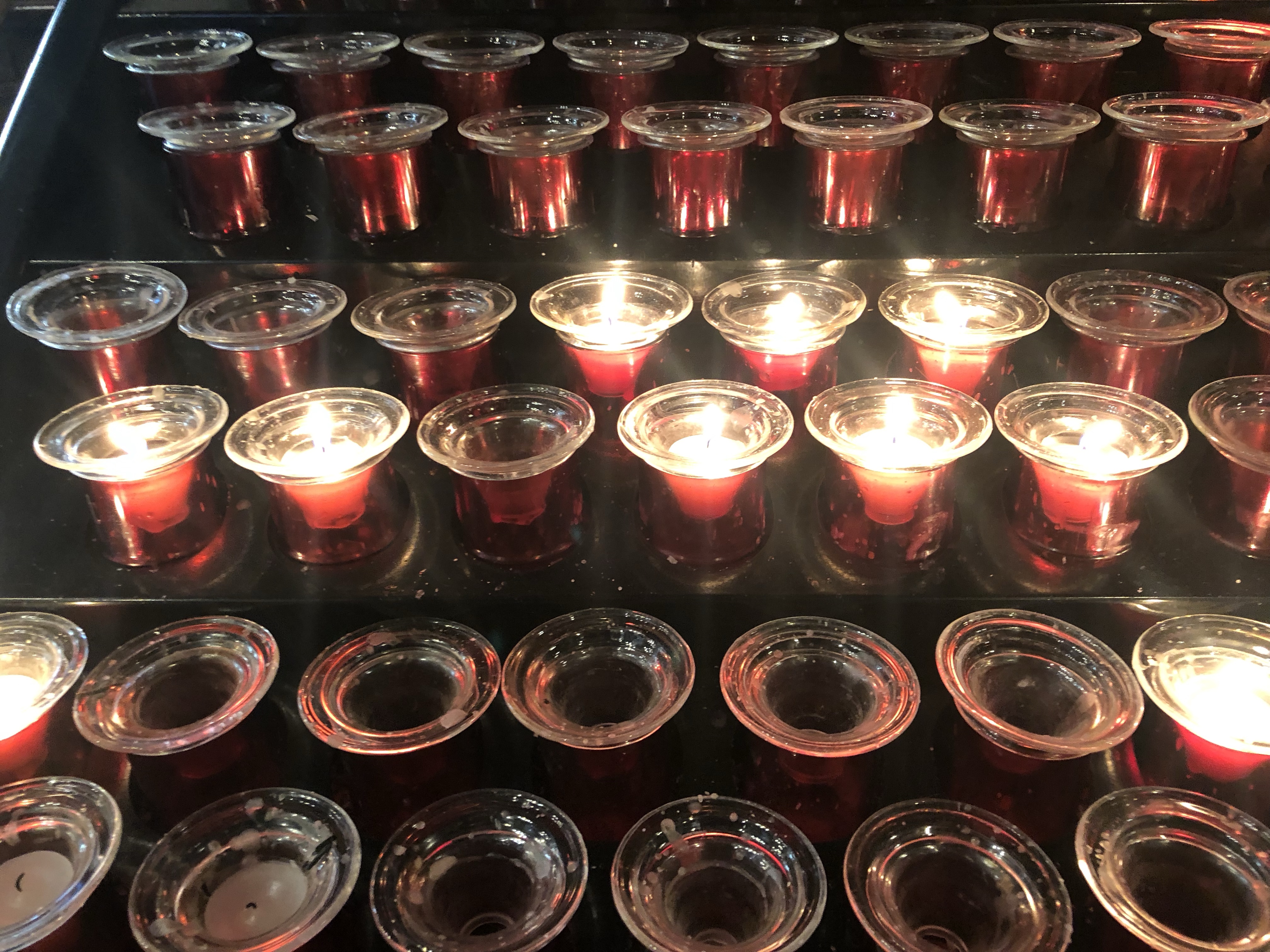
So why am I a Catholic? With such silent conviction, how can I stand there in the darkness, singing Christian verses and watching the candles going out to mark the extinguishing of Jesus’ light and life from the world, a little under two thousand years ago?

I am a Catholic because I would make the same journey as my family. Whether or not my ancestors found their way to the Christian God through awe or terror, I would take that road that they took. And there is something fundamentally grounding about faith. Standing as one with my students and singing songs that have been sung for hundreds of years… you feel a power, there, echoing down the generations. It’s all the more powerful when you see the date at the top of the copy reaching back to the middle ages. One imagines one’s voice reaching up to the heavens and mingling with the voices of those who came before you on its journey across the stars. Perhaps that’s what the choir of Heaven is: the echo of thousands of years of collective prayer through song. I’d like that.

I might also point out that the Catholic church represents an important bastion against the foe, since modern Christian music is, to my ears, quite possibly the wettest, most uninspiring drivel ever produced. It clearly works wonders for some, but it does nothing for me. Give me plainchant any day. A colleague once joked that one of his greatest fears was that he should reach the pearly gates only to find that Mozart and his kin are nowhere to be found, and Hillsong reigns triumphant. It’s a joke (and a nightmare) I share. But that’s a story for another time.

I am also a Catholic because Faith is a journey of forgiveness. Noli mortem peccatoris. Those were the words of power that spoke to me last night, as the last of the candles were snuffed out. I do not want the death of the wicked. I bear no ill will against those shadows who persecuted my people, because there is too much hate in the world already. I wept on the shores of the Dead Sea years ago at the sight of the sun going down over the Holy Land, knowing I was not yet ready to see it with my own eyes. Jerusalem evades me still: the last time I tried to make that journey, a little hiccup called Covid-19 came thundering in.

Finally, I am a Catholic because of what it stands for. Katholikos. Universal. It chimes with me in much the same way that the Arabic expression ahl al-Kitaab – people of the book – called out to me in my Arabic studies, many years ago. The world is immense and no two people are the same, and I think it’s as foolish to expect everyone to share the same faith as it is to expect to find two identical grains of sand on a beach: the closer you look, the more you’ll find yourself doubting. But I have built my faith upon doubt rather than surety, because that, to me, is what faith is all about. Believing in the light when all the world is darkness because your heart tells you to do so. Fate may be the master builder of the temples of our lives, but hope is the cement that holds the stones together. I believe in that light and in that hope. And in my heart I know I would go on hoping, though every light in the world were extinguished as they were last night, one by one.

In three days’ time I set out for Italy on my first solo adventure in a long time. Venice will inspire, no doubt, but it’s Rome I’m especially excited to see. I hope I can catch some music there during my stay. I could use some of that ancient magic after what has been quite a long term. BB x