Quote Unquote: BEARSKIN by James A. McLaughlin

Somebody must have kicked the reading machine in my head real hard, because it’s working overtime at the moment. I suppose it’s the very real threat of having to read up on plotless educational policy and classroom management that is making fiction so damned attractive at this point in time. With lessons well underway and the dreaded Numeracy Skills Test now but a distant memory, the next task looming is the first of the PGCE written assignments – perhaps the first written assignment in my life that I will not be able to wing on the back of a clunky box of quirky and otherwise useless general knowledge. My capacity for absurdity became something of a badge of honour at university as I made it a personal prerogative to shoehorn the most bizarre comparisons into every essay I submitted. Samurai and pashtunwali found their way into an essay on Lope de Vega. The sea witch from The Little Mermaid popped up in an assignment on La Celestina. The Sack of Baltimore somehow drifted into a commentary on Spanish banditry. And then there was that unforgiveable allusion to the nest-building practices of great-crested grebes in a second-year Spanish language exam on cultural divisions (I got scorched for that one, justifiably, and I don’t think it was because my examiners stumbled over the word somormujo).

Nope. This is one essay that I will have to write with my own blood. And my head will not thank me for it.

So, conscious that I will scarcely have the time to do my own writing this year, I shall endeavour to persevere with my reading project. After muscling through Thin Air in forty-eight hours (a personal record), I threw myself right into another. This time around, I thumbed around for something different and picked James A. McLaughlin’s Bearskin off the shelf…

……..

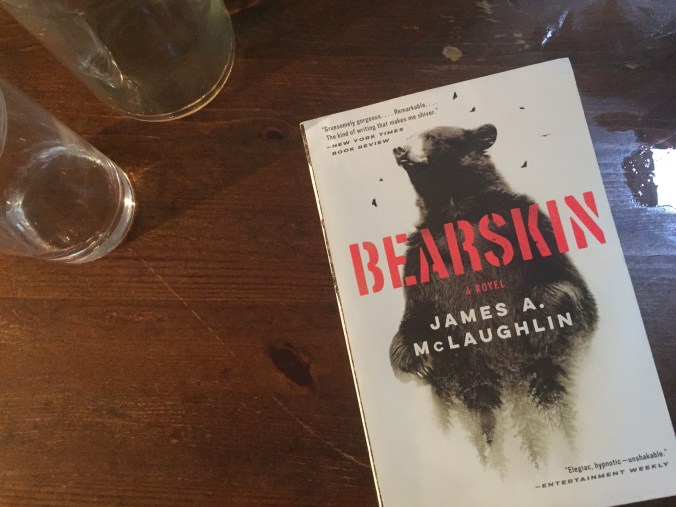
“Gruesomely gorgeous” is certainly one way of putting it (New York Times Book Review). Bearskin tells the tale of Rice Moore, an Arizona ex-con working as a caretaker on the Turk Mountain preserve in the forests of Virginia whose decision to get to the bottom of a local bear-hunting operation brings him into conflict with the locals, the law, and ghosts from his past. At times hard-edged thriller of the “Dark South”, at others a quasi-mystical exploration of man in the wilderness, Bearskin is a powerful retelling of the lone-man-standing-up-for-the-forest genre, without the ego or distasteful pessimism of the twenty-first century eco-warrior. Rice makes for an appealing hero, a man with no illusions on whom the forest works its magic. Some of the characters are satisfyingly familiar: a John Wayne, no-bullshit sheriff; a thickset Redneck patriarch and his lawless, swaggering sons; a psychopathic assassin who says nothing and yet instils more fear at the mention of his name than any other man in the book. And then there are the others: Dempsey Boger and his hounds, the ethereal mushroom-picker and, of course, the bears themselves.

There are points in the narrative – fugues – when you cannot be entirely certain which world you are in. When the forest takes on a mysterious character of its own and colours and images swim before your eyes in unfamiliar patterns, and time seems to flow in both directions at once. Moore’s ghillie-clad seclusion on the mountain is ritualistic and deliberately so, serving in a sense as an awakening. It was almost stupefying to read. I’ve never taken magic mushrooms myself, but I felt like I had after one of the scenes. Trips may well be relatively easy to recreate through the medium of film, but McLaughlin certainly knows how to write one.

There was only one thing I was left wanting from the story, and that was something more about the bears. They serve as a springboard for the main events of the narrative, but I caught myself waiting for a gratifying (if cliched) encounter with one of the bears at some point towards the end. One gets the sense they are always there, on the periphery of Rice’s world, more like ghosts than creatures of flesh and blood. And perhaps that much is true of the wild, as man and his endless pursuit for dominance pushes such spirits further and further into oblivion. All the same, I reckon the bears might have appreciated some closure.


Favourite Scene:

The hellish image of the baiting scene deserves a special mention for its sheer monstrosity: the pawless, gutted carcasses of two bears beneath the totemic severed head of a Charolais, suspended from the trees above by a bloody rebar driven through its eyes. The buzz of flies above, the growl of worrying hounds below and the sickly stench of liquorice. I’d like to give a hand to the stalking scene towards the end for its pace and power, but this static freeze-frame is just one of those scenes that will stay lodged in your mind’s eye forever. Some stories produce characters of eternal weight, others moments of utter majesty, and others still paint pictures with flesh, blood and the stuff of nightmares. There’s a lot of human villainy in Bearskin, but the baiting scene takes the biscuit. Somehow the absence of the perpetrators does the trick: the aftermath is far worse in its silence than the act itself.


Favourite Character:

The mushroom picker. McLaughlin strings out a strongly convincing cast of Southern marionettes in Bearskin, but there is one oddity in the bunch who, like the pip of a blackberry, sticks in your jaw long after the cast has come and gone. I was never entirely sure whether he was real or not – and neither am I alone in my doubt, as Rice himself asks this question at least once – but his brief appearances were memorable, to say the least. Who was he? Where did he come from? Was he a mountain man, or something stranger – a vengeful woodland sprite or god, a green man, released from the deepwoods to send the protagonist on a quest? When first he appeared, Rice mistook him for a bear – a mistake he made again on the mushroom picker’s second appearance. To my eyes he is certainly more Beorn than Bombadil, and whatever the author intended him to be, he comes across as by far the most enigmatic and powerful character to emerge from McLaughlin’s narrative.


Favourite Quotes:

Information about the universe leaked from the open eye like poison gas.

“So many people hate snakes. I think it’s because they threaten people’s worldview – they’re alien, limbless, impossible, black magic: a stick come to life. But maybe we’re all sticks come to life. We want to think we’re exceptional, ensouled, angel fairies or God’s special children. The magic of being animate matter isn’t enough.”

They ate a quick breakfast, homicide having no effect on their appetites.

 

img_4392

Quote Unquote: THIN AIR by Michelle Paver

img_4837

The funny thing about being busy is that it makes all the things you wanted to do when you were free that much more achievable. It seems counter-intuitive, but it’s true. When time is on your side and you have a stack of books to read, it can be hard to even chip away at one. When you have lessons to plan, essays to write, work to mark and affairs to set in order, reading for pleasure suddenly becomes both more appealing and more feasible. Somehow those twenty minutes you carve out of the day always come around. I suppose routine is the answer, as it so often is. It’s just a pity that routine is harder to maintain when you have nothing but time on your hands.

The days are growing shorter. Prep ends in darkness now, and this Saturday just gone, the martins gathered on the abbey roof, as they always do on a certain day every year. The following morning they were gone. All of them. They say a swallow does not a summer make, but for me, summer is always over on that day when the swallows and martins take their leave. Now is the time of cold, crisp mornings, clear blue autumn skies, mist in the trees and the musty smell of mushrooms.

It is also a wonderful time of year for ghost stories.

……..

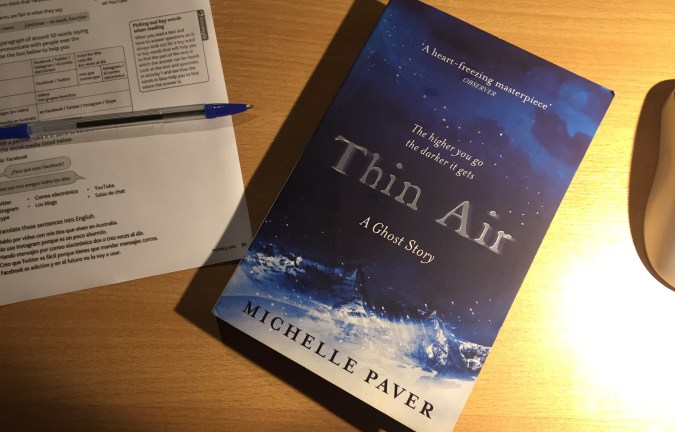
Thin Air tells the tale of a British expedition up the southwest face of Kangchenjunga, a mountain of fearsome repute in the unforgiving wastes of the Himalayas, as seen through the eyes of Dr Stephen ‘Bodge’ Pearce. The expedition party, an assortment of British public-school chaps (the swot, the bully, the priest and the major), have set their sights on being the first to climb the evil mountain, which has turned away all previous comers and slain several for good measure for even trying. Struggling with an unenviably rocky relationship with his brother, Kits, Stephen tags along as the expedition’s medic. From the very beginning the expedition is hag-ridden by the previous sortie led by the larger-than-life Lyell and company, whose disastrous defeat casts a long shadow over the group’s attempt – in more ways than one. It quickly becomes apparent that Lyell’s disastrous attempt to climb Kangchenjunga was less of a heroic withdrawal than it seemed at first, and as Pearce’s company scales the mountain, something sinister begins to dog them by degrees. Bullied into silence by his older brother, who alone seems oblivious of the creeping dread, Stephen begins to believe they are being haunted by a vengeful spirit. The mountain may not be the only thing determined to prevent them from carrying out the mission that Lyell started…

The story is full of men walking in the shadows of others. Kits marches in the footsteps of his hero, General Lyell. Stephen plays second-fiddle to Kits for most of the narrative, who seemingly does his level-best to keep him from stealing his place in the spotlight. The sherpas follow meekly in their wake, dismayed at their employers’ ignorance, and both a dog and a raven – stylised with the more ominous name of gorak – shadow the company on their ascent into the darkness. More chillingly still, there is always the nameless presence of something unspeakable. And then, of course, there is Kangchenjunga itself, overshadowing them all.

Kangchenjunga is not just a setting. It is an objective, an idea, an antagonist and a fierce deity. It is also far and away the standout character of the story. There are more sinister incarnations of rage at work in the tale, but one is never allowed to forget the raw ferocity of the mighty mountain. It threatens the company with its avalanches. It sends blizzards to slow them down and it reminds them of their chances with the cairns of those who have tried to master it and fallen in the attempt. One of my favourite parts of the Lord of the Rings growing up was the section of Fellowship when the company of nine attempt the pass of Caradhras and are beaten back by a mountain that is more sentient than it appears. There is something truly awesome about nature at its most raw, and Kangchenjunga is Tolkienesque in its might (interestingly enough, Caradhras’ other name, the Redhorn, is evoked at least once in Paver’s description of the mountain’s “dark-red precipices” – a colour that instantly stands out from the whites, greys and blues of the snowbound Himalayas). Stephen, a Western doctor ruled by his head, flatly denies it all, shooing away the sherpas’ fears as the darkness settles:

“This mountain has no spirit, no sentience and no intent. It’s not trying to kill us. It simply is.”

The question is: are you convinced?

This is genuinely one of those books that merits re-reading. There is so much subtle foreshadowing throughout, and a great deal of it will pass you by until the end. To read it again is to watch Dr Pearce and the company march knowingly into the jaws of doom with an even greater surety than before. You knew the mountain was a killer from the word go – Lyell, Pearce and all the others point to that endlessly – but the way in which Paver weaves the narrative forwards and backwards is spine-chillingly precise. I have deliberately avoided talk of the ghost in this ghost story, if only because the less that is said about it the better – the strength of a ghost story is often in that which is left unsaid. If you know, you know, if you don’t, give it a go. And when you’re done, seriously, skim back through and read it again. It’s almost scarier the second time around. Which is exactly what a good ghost story should be.


Favourite Scene:

The first cairn. It is Dr Pearce’s first encounter with the reality of their situation – and also his first brush with the nameless terror of the mountains. For the superstitious, there is an ancient belief in some parts of the world that walking the wrong way around a sacred object, such as a pillar or monolith (or in the case of Thin Air, an urn) brings on bad luck. I remember the tradition being used to comedic effect in Tintin, but as soon as it showed its head in Paver’s narrative I knew we were in for trouble – I’m glad she made use of that old trick. Because it felt like the necessary snowball that starts an avalanche. Dr Pearce’s musing before the cairn of Dr Yates, the doctor on the Lyell expedition is both stark and satisfying in its foreshadowing – and powerful in the ensuing scene it delivers. This is definitely one of the scenes that is worth a second look.


Favourite Character:

Kangchenjunga. For all of the reasons I laid out above.


Favourite Quotes:

Surely the purpose of a grave is to benefit the living. Aren’t the dead beyond caring where they live?

It’s lack of knowledge which lets in the shadows.

Perhaps that’s what we find frightening. Being on a mountain forces us to confront the vast, unsentient reality that’s always present behind our own busy little human world, which we tuck around ourselves like a counterpane, to keep out the cold. No wonder that when we trespass into the mountains, we create phantoms. They’re easier to bear than all this lifelessness.

There is no justice in this world, so why should we expect it in the next?


img_4392