Life Lessons from the Mixed-Up Chameleon

‘How small I am, how slow, how weak. I wish I could be big and white, like a polar bear. And the chameleon’s wish came true. But was it happy? No…’

Do you remember reading The Hungry Caterpillar as a child? Eric Carle, the author, wrote another book around the same time called The Mixed-Up Chameleon. It’s about a chameleon that becomes dissatisfied with its own skin and so mimics the animals it sees, until it has transformed into something monstrous. The moral was clear: be true to yourself. For some reason it stuck in my mind far more vividly than the ever-popular Caterpillar, and for good reason: I don’t think there’s a children’s book out there that would have been a better beginning for me.

Adaptability is, in my honest opinion, the greatest asset in the human arsenal. It is, in a way, the most human of traits. We thrive because we can adapt. The trouble with trying to adapt is that at some point you have to put on the brakes and remain true to yourself, or run the risk of being many things and none: a mixed-up chameleon in the flesh. I sometimes wonder whether I am one of those who did not heed the warning signs and simply forgot to brake.

Before I even get into tackling this subject, I know straight off the bat that I am not the most qualified person to write about this. I’m mixed-race, but not enough physically for it to have had a significant impact on my growing-up (we’ll leave the mental impact out for now). In many respects, and despite my best efforts, I am a picture-perfect Englishman. There are people from whom this article would make so much more sense, to whom it would ring more true. And that’s exactly why I’m writing about it: because I’m not the man for the job – and, as a result of that, because I am.

As we grow up, we mould ourselves around the things around us, just like the chameleon: the people we associate with, the expressions we use, the music we listen to. We absorb these aspects of our surroundings along the way in a never-ending process, some voluntarily, some involuntarily, and these little changes can affect our lives in the subtlest ways. In years gone by, when the world was smaller, the number of directions life could take you in were, perhaps, more limited than they are today. YouTube can take you to downtown Los Angeles. Spotify can take you to Mali. Everything is just a click away these days, and so the possibilities for discovery are far more accessible than they once were.

And so we go on absorbing. But herein lies the problem: when does one stop? Is it a subconscious action? Or is there a point when we ought to work on what we are rather than search for the self elsewhere?

Growing up, I always felt that some people were ‘more complete’ than I was. Fellow classmates who had firm opinions of their own, or skills they had mastered. Friends who spoke in complete sentences that made sense, an eloquence I could only hope to achieve with a pen or keyboard. These were people who just seemed to have it all together, to be happy with where they were and confident in what they did. I don’t think I ever was. I wanted to be complete, like them. I even went through the motions if and when I could, but I always felt like a fish out of water. I was a romantic in a cynical age; a funkster in a decade when acoustic was King; an Afrophiliac in a white boy’s body.

So much of what I liked or wanted to be was not what I was on the outside. It made me hate what I was for years, and I fuelled that hate by reading into the worst of my race’s actions. For a long time I was obsessed with the brutalities of the Raj, the inhumanity of the American genocide and the barbarism of the West. It taught me a great deal about the world, but none of it did any wonders for my attitude towards my kin.

In one of life’s beautiful ironies, it was actually a fictional Imperialist – Allan Quatermain – who saved me from my condition, at a point in my life when my will was at an all-time low. He may not be the ideal balanced man by twenty-first century standards, but there was something about his acceptance of his lot that spoke to me, and brought me back from the brink of misanthropy.

Even so, I am still something of a mixed-up chameleon. I can be, but I am not. I suppose that’s natural for a mimic – or, perhaps, a linguist. And of all of the factors that mix me up, the strongest by far is music.

As the child of two music teachers, I admit I find it impossible to imagine a world without music. I was exposed from a very early age – before birth, if you listen to my mother – to all kinds of music. I got the full range of classical music from my father, and the most eclectic mix you could imagine from my mother, up to and including klezmer, jazz, gypsy jazz, disco, punk, broadway classics, film soundtracks, zulu chant and flamenco. As a result, my musical upbringing was incredibly mixed-up. I could have gone down any particular route – except perhaps acoustic-guitar-and-voice, which nobody in my family really went in for – and yet, despite my classical training (or perhaps because of it) I grew tired of that very Western world and threw myself headlong into ‘black music’; the blacker, the better.

It probably wouldn’t be too far-fetched to say that my taste in music and its subsequent effect on my identity has had a massive impact on my attitudes to talking about race, either. How else do I explain my willingness to discuss the one subject guaranteed to make most of my countrymen blanch?

Where am I going with this? We had solo auditions this afternoon for a few new numbers in our repertoire and – after the usual fit of nerves – it dawned on me that I was, once again, fighting for something that wasn’t me. I suppose my problem is that musically, as with so many other aspects of my life, I have made myself something of a Frankenstein. I have tried to be so many different things over the last twenty years and, in complete honesty, a great many of them I am simply not: I could go on and on about how much I dig the tune, but James Brown’s Say It Loud (I’m Black and I’m Proud) was, quite simply, not written for a white middle-class English boy. And it sure ain’t easy singing about the ghetto when you were born and raised in a quiet country village.

My mother’s gift to me in diversity may not have helped my case much. I worship the things that I am not. And whilst I go through the motions, others around me have grown up singing the ‘right’ music for their world. I rebelled, and here I stand, somewhere in the middle, neither here nor there. The fact remains that I am out of place, and it is entirely of my own doing.

‘Just then, a fly flew by. The chameleon was very hungry, but the chameleon was very mixed up. It was a little of this and a little of that. “I wish I could be myself”. The chameleon’s wish came true – and it caught the fly.’

So in choosing to favour diversity over working on what I do best, I have become something of a jack-of-all-trades, master-of-none. A good mimic, but not the best at what I do. Versatility has its drawbacks, it must be said. But, given the chance, I would not trade my position for all the world. I may not be the master of the art, but I love the art to death. Funk music gives me a beat I just can’t shake. Michael Jackson makes me feel alive, African voices lift me to the heavens and flamenco stirs me into a passion I can’t explain. Who gives a damn if I’m white? Music transcends that. It’s how I feel on the inside that really matters.

If catching the fly is the key to getting the job done, I’m still a long way off. But if it symbolises happiness, then I’m better off a mixed-up chameleon. BB x
Double-Edge

The Christmas holidays have come and gone. I’m back in Durham once again for what is beginning to feel increasingly like the last tilt of sand in the hourglass. Last term went by like a bullet as I found myself thrown headlong into a heavy workload once again, but yours truly must have learned his lesson over the last year or two, because I can’t think of a day when I let it get me down. The troubles and traumas of the first two years of academia and extra-curricular pressures wanted and unwanted were very much absent from last term; if they were there, they were buried deep beneath a veneer of simple satisfaction. Satisfaction with my course, satisfaction with my extra-curricular commitments, satisfaction with the direction my life is taking me.

That’s not to say I’ve got it all figured out. I don’t. I’m still waiting on a crucial reference to secure my post next year – without it I could end up in hot water. I’m surrounded by people who are powering ahead with their dissertations at a remarkable rate, whilst I content myself with reading leisurely around the subject before I even think about the process of putting pen to paper. The Lights are also taking me forward at considerable speed, and it is this last which is eating into my timetable more than anything else at the moment. After three entire days of pitch-punching and choreo workshops, it’s easy to forget that university is a place for the pursuit of knowledge.

That’s something I’ve been thinking about recently: what does a university mean?

Over the last few years I’ve met a lot of people from different walks of life who have very different attitudes to university. There are many for whom it is simply the next stage in their studies, a means to an end, an expensive-but-necessary qualification to hack into the job market. I find it a little heartbreaking that this is what university has become for so many, the semi-obligatory next step in the road and one that we are all too often pushed into without even thinking. University should be open to everybody, of course, but does that necessarily mean that everybody needs to go to university? I’m not so sure.

Then there are those who accept that first notion and proceed to enjoy their time at university with their eventual degree very much subsidiary to their overall experience. They’re the ones who couldn’t care less if they land a 2:2 at the end of three years of lectures and under-prepared seminars, just as long as they had an amazing time and met some life-changing people along the way. Granted, it’s a point of view that suits the wingers and the daddy’s-boys more than most, but it’s not too uncommon. And at the end of the day, you can’t criticise the stance too harshly: it’s a very good example of making the best of a bad situation.

What else can a university degree offer? Networking, for one. It’s a fantastic way to meet new people and, by default, make important contacts in the outside world. It’s a good way to hone the skills you learned at secondary school to perfection, or to stay immersed in a subject you enjoyed. Some just don’t like to leave the school environment behind: the routine, the structure and the linear timetabling make for a familiar existence (and I include myself shamelessly in that bracket).

There is, of course, another important reason people decide to go to university: in pursuit of raw knowledge. That, for me, is the very essence of university. It’s what it’s all about: seeking new truths, dispelling old beliefs and walking into new worlds. What saddens me most is that this is so rarely the primary motivation. I wonder whether it’s more than a little big-headed of me to say such a thing, but I guess I expected to find more people with this kind of attitude when I rocked up a fresh-faced, idealistic fresher a few years back. I wasn’t exactly popular, and with an attitude like that, it’s really not hard to see why. Since then I’ve mellowed a bit, but I still feel a little happier than I should when I encounter somebody else who has nothing but unbridled passion for their degree. Perhaps that’s just the nature of an undergraduate degree; the Masters students all seem to be wholly absorbed in their studies. I guess I’ll just have to return to this world a few years down the line.

Perhaps it’s because I want to be a writer that the simple pursuit of knowledge for its own sake is so important to me. How can you profess to write for people if you don’t read? It’s little banal thoughts like that that kicked me back into reading fiction two years back. The effect that reading fiction has had on my overall enjoyment of academic research is surprising, to say the least. I wonder whether the two were supposed to go hand-in-hand from the very beginning.

More and more these days my degree leads me and my stories into worlds and places I could never have found on my own, and likewise the years of research I have carried out for my books gives me insight into my degree that features nowhere in my course. I have been torn from Spain, from the land that bled life into my tales like veins to a beating heart, but with a little hard work, I have found a survival mechanism in the university effect. Whatever one’s motivation for going to university may be, the result is a hot-pad of intellectuals of all walks of life. It is a place for bringing together great minds for the bettering of the nation, in pursuit of new truths and new ideas. Just the vibe alone of such an environment is reason enough to throw oneself into academia. That, I think, is the real purpose of university.

If only the UK could follow the Scandinavian example and make a university degree a realistic option for all, with no respect for money or background. The way things are going, such an aspiration is little more than a pipe-dream at the moment, but if we might try to take a step in the right direction, I’d implore the powers that be to rethink the idea that everybody in this country should be going for a university degree by necessity. University should be encouraged, of course, but no more than an apprenticeship, an equally admirable path by all respects. Higher education should be for everybody, but’s it’s not. An option, not a necessity.

I may be little more than another one of those liberal, meritocratic millennials, but I’m not alone. I think there’s something very wrong with the way we’re monopolising higher education, when it should be nothing more than that: an education.

To make good on my words and dispel a few old beliefs. A university degree is not meant to be the three best years of your life. It’s not meant to be a government-sponsored ride of wild parties and last-minute essays. And it’s not meant to be a long slug of soulless study either. But it can be immensely worthwhile and should not be abused.

But what do I know? Students are, after all, noisy creatures that are happy to live in hovels and live in close-knit cliques of their own. What do I know about the world? x

Letters from my Grandfather

I never knew my grandfather. Neither did my mother. In the twenty-two years I have lived on this earth, my family has never numbered more or less than four: my mother, my father, my brother and I. No uncles, no grandparents, no second-cousins… Four. No more. It certainly made for an easy job learning languages – especially Arabic – but now that I’m older, and especially at this time of year, I find myself wondering just how much I have lost in that absence; an absence I share with my mother.

On account of a bad cold and a very real fear of spending another New Years Eve stranded in a strange place, I shied away from the celebrations last night and spent the following morning in church, questioning my elusive faith as usual. Do I feel like I missed out on a good time? Perhaps. Perhaps not. I try not to think that way these days. Sometimes, however, these things are meant to be. I believe that. I always have. The choices we make lead us in the right direction, wherever that may be.

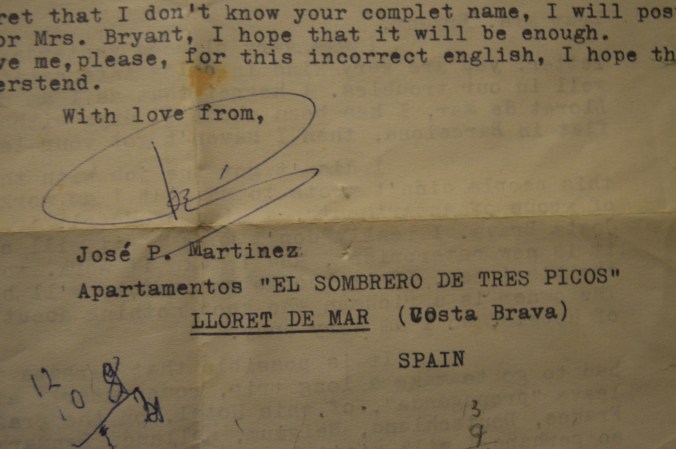
It just so happens that my choice led me to stumbling upon something I’d never seen before: a collection of letters from my grandfather.

dsc_0167

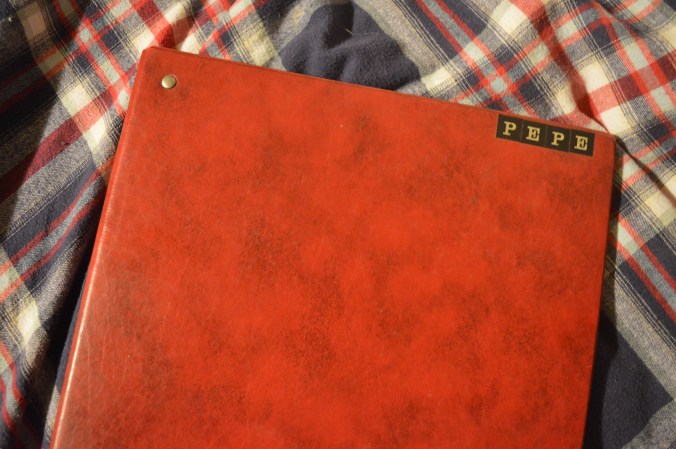
My grandmother’s journal of memories

I don’t need to explain my love for Spain here. I’ve done it before and I expect you don’t want to hear me say it again, nor do I need to tell you if it’s news to you. I used to get sick of people taking the mick out of me for it, as if they hadn’t got it in them to love the places they’d been on their years abroad. I apologise for such childishness on my part. Of course, it’s foolishness to have even reacted in the first place. Because Spain is more than just an obsession. It’s my grandfather’s country. It’s where a part of me is from. It’s a deeply personal adventure, and these things always hurt.

dsc_0169

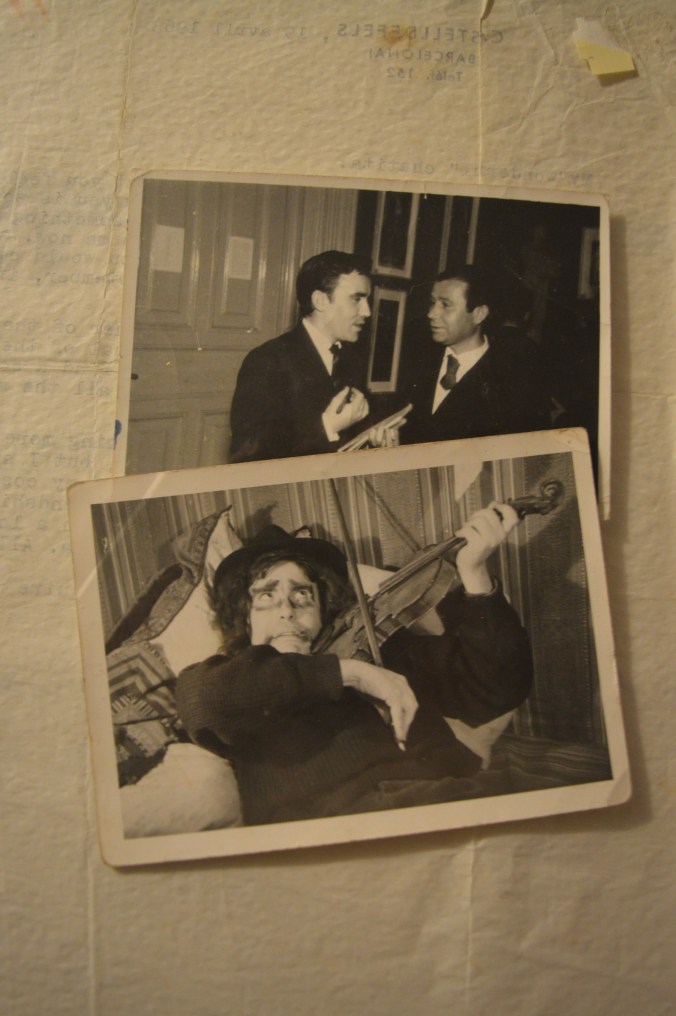
It looks like he could dress up and dress down…

Who were you, abuelo? What did you sound like when you laughed? Did you laugh often? There is sadness in your letters, impatience and frustration, but so much hope. Did you play the violin well, or did you tire of it like me? How can I know, when your mother burned it when you went away? You were a linguist, like me, but you weren’t afraid to chase your dreams. There is so much resolve in your writing, so much conviction. There was a living to be made on the Costa Brava, even if your parents didn’t see it that way. Those dreams of yours, those plans to take my grandmother out to dinner on a boat on the Seine… Spain was about to open up to the world. Did you know, I wonder? How old were you when that car struck you down on that black day in June 1964? I don’t even know that much. All I know for sure is your name, your letters, and your typewriter. I wish I knew you better. I wish I knew you at all.

hotelcatite

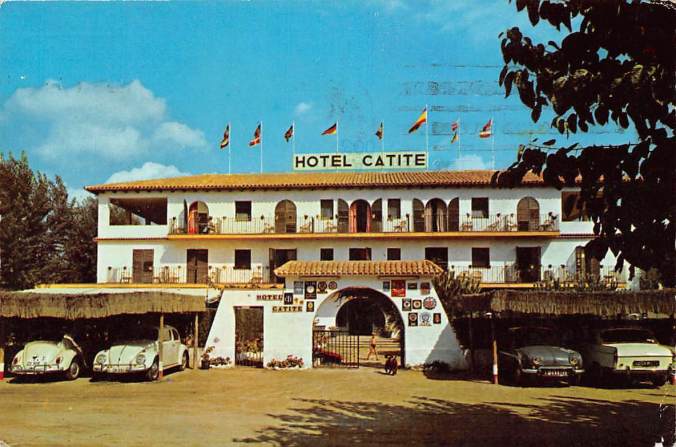
Hotel Catite, Castelldefels, where my grandfather worked as the hotel’s first receptionist

How different life might have been had we met, abuelo. It is impossible to imagine. I see you in my mother and, perhaps, in myself. But you had a family, somewhere out there, and now it’s up to me to find them. Last year I went chasing a dream, but when I found what I was looking for it turned out to be a dream and nothing more and it slipped away through my hands like dust. This is something more. I can feel it.

dsc_0173

Who cares about a language barrier when you’re in love?

2016 has come and gone. It was an odd year. Many things that happened that confused me, and some things conspired to bring me down, and many more lifted me high. It was, for me at least, one of the best of years. The new year is yawning ahead and I have my quest. The road will be long and not wanting in fears old and new, but it leads on and I must follow it now, for my own sake, and for my grandfather José who set this whole affair in motion many years ago. BB x